24
The Edge Interview
called coaching then,” says Goldsmith. “I said, ‘I’ll work with him for year. If he gets better, then pay me. If it’s just me who gets better, then it’s free.’ That was almost 40 years ago and since then all my coaching is done on a pay-for-results basis. I only get paid if my clients get better.” Over the years, Goldsmith has worked with the leaders of some of the world’s biggest and most prestigious organisations, delivering both leadership development and coaching. His clients have included technology giant IBM, consultancy McKinsey & Company, medical centre the Mayo Clinic and the World Bank. During the course of his work, he has visited 102 different countries and notched up 11 million Frequent Flyer miles. So what’s the secret to his success? “I have a clear mission,” says Goldsmith. “My mission is to help successful leaders to achieve positive, long-term changes in behaviours. That might not sound like an unusual mission today, but when I started out, coaching was about fixing losers, not helping winners.”
A 360-degree view Goldsmith’s advice-based approach to coaching contrasts with common practice that is based on “sitting in a room with someone, asking them questions and hoping that the insightful nature of the questions will mean that a person’s life changes”. He gets a 360-degree view of a client, based on confidential feedback from the key stakeholders that the client interacts with. This feedback enables him to identify the areas in which the client is already performing well, along with the areas where he or she needs to improve. “If they’re the chief executive, I involve the board,” Goldsmith explains. “If they’re not the chief executive, then I involve the chief executive.” Most of the clients Goldsmith works with are “smart, dedicated, put in long hours, want to get better, and work hard to achieve high integrity”. Nevertheless, he doesn’t believe that extraordinary intelligence is an attribute that is shared by all great leaders, not least because ‘super-smart’ leaders can be impatient and judgmental, which hinders their ability to get the best out of their teams. “My observation is that to be a leader you need a certain level of intelligence,” says Goldsmith. “And that level is different based on the industry you’re in. If you’re leading people in an extremely high-tech company, with a bunch of geniuses, your IQ needs to be pretty high. If you’re leading people within a pretty stable manufacturing organisation, not so much. But you can start to face challenges in any situation when there is a great difference between your own IQ and the IQ of the people around you.”
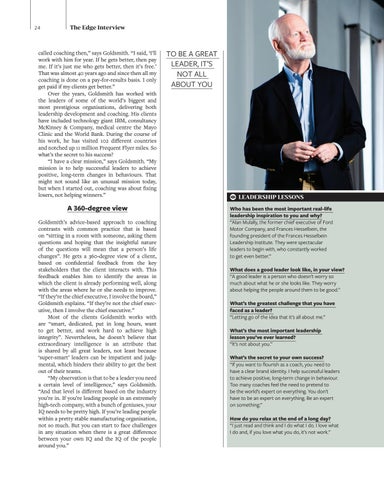
TO BE A GREAT LEADER, IT’S NOT ALL ABOUT YOU
LEADERSHIP LESSONS Who has been the most important real-life leadership inspiration to you and why? “Alan Mulally, the former chief executive of Ford Motor Company, and Frances Hesselbein, the founding president of the Frances Hesselbein Leadership Institute. They were spectacular leaders to begin with, who constantly worked to get even better.” What does a good leader look like, in your view? “A good leader is a person who doesn’t worry so much about what he or she looks like. They worry about helping the people around them to be good.” What’s the greatest challenge that you have faced as a leader? “Letting go of the idea that it’s all about me.” What’s the most important leadership lesson you’ve ever learned? “It’s not about you.” What’s the secret to your own success? “If you want to flourish as a coach, you need to have a clear brand identity. I help successful leaders to achieve positive, long-term change in behaviour. Too many coaches feel the need to pretend to be the world’s expert on everything. You don’t have to be an expert on everything. Be an expert on something.” How do you relax at the end of a long day? “I just read and think and I do what I do. I love what I do and, if you love what you do, it’s not work.”