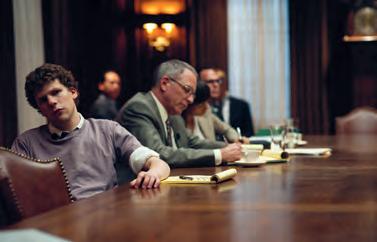
Rory Sutherland on smarter science ~ Julian Richer on caring capitalism ~ Nada Kakabadse on cyber control ~ Matt Packer on Hollywood ~ Morag Cuddeford-Jones on the tone from the top
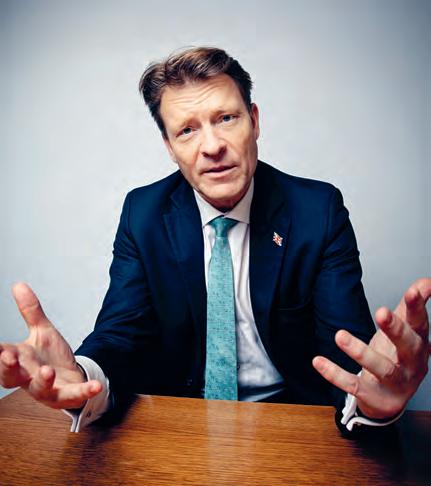
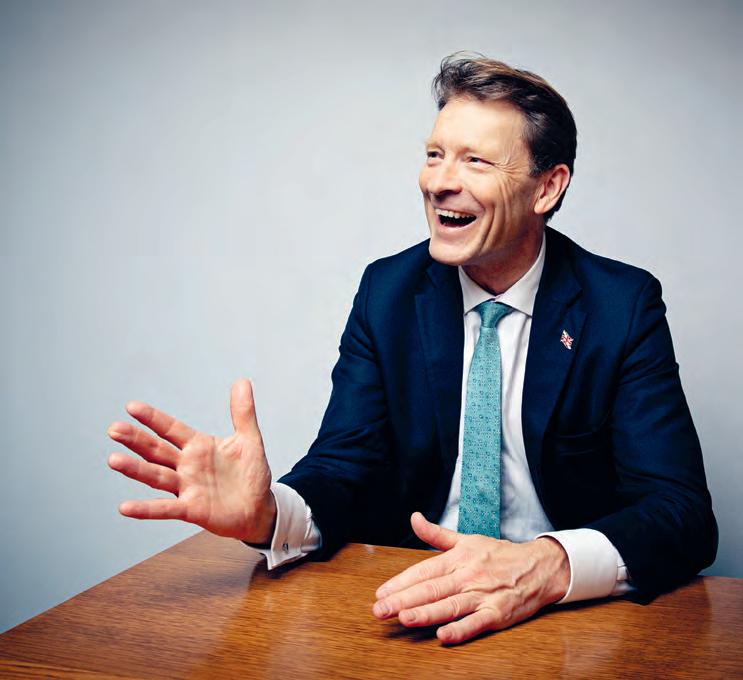
Allyson Stewart-Allen on foreign fails ~ Richard Tice on the alarm-clock army
Better directors for a better world
15%
Proportion of profits hi-fi retailer Richer Sounds gives to charity. Julian Richer p12
Year in which China aims to be the world’s undisputed leader in AI. Nada Kakabadse p62
63%
Proportion of managers who focus on employees’ weaknesses rather than their strengths. Ben Walker p20
35,000
Number of employees injured in US industrial accidents in 1900. Rory Sutherland p24
36%
Proportion of employees who are ready to quit over transformation burnout. MaryLou Costa p40
Letter from the Editor
Some laws are political footballs.
In 1971, Ted Heath’s government introduced the right for employees to claim unfair dismissal. The qualifying period was set at two years. Three years later, Harold Wilson retained his great rival’s legislation but reduced the qualifying period to six months. In 1979 (Margaret Thatcher), it became one year. Then, in 1985, two. In 1999 (Tony Blair), back to one. In 2012 (David Cameron), two again. When in 2024 then communities secretary Angela Rayner launched her Employment Rights Bill, she planned to reduce it to a day-one right. Today, the government has settled on six months, a sensible compromise that the IoD hopes will endure.
to take an educated risk on the young and inexperienced if they have no recourse at all. Six months – the shortest the term has ever been – remains a robust mitigation in favour of the employee.
The outcome was favourable. But the tussle that led to the settlement had an unwelcome – and all too familiar – frame. What should have been a healthy public debate about shaping policy that works, was cast as a battle of ‘them vs us’. You are either for business or against it; either in favour of employee protection or hostile to it. This pantomime polarisation might be comic if it weren’t so damaging.
Business is, instinctively, a force for good: most businesspeople want to do the right thing, not because they are told by government to do so, but because helping society is one of the reasons they entered commerce in the first place. Governments, trade unions and employees largely share similar aims, but may differ on the means to achieve them. When they do, the key is to negotiate the answer –rather than lionise the purported ‘winners’ and deride the apparent ‘losers’. The art of the deal is in finding consensus, not claiming victory.
Political footballs are not limited to politics. An adversarial approach can increase publicity. It is less effective at developing strategy. If business is to maximise its societal benefit, it requires all its facets – companies, investors, business groups, trade unions, employees – to invoke the spirit of constructive debate. As the former British Gas marketer Jan Gooding advises (page 30): “Listen to your critics –they may have a point.”
The specifics of the case seem clear. Two years is too long a qualifying period – if managers are unable to assess the competency of staff in their employ for 24 months, the problem is with the manager, not the employee. Zero days is, by contrast, too short. Interviews and application forms are inexact, imperfect sciences. Recruiting mistakes can be made. Firms are unlikely Ben Walker is editor of Director
In this issue Spring 2026
AI directors are closer than you might think
Business as a force for good
PERSPECTIVE
Ideas and insights from industry
Reform’s Richard Tice on trade and tax cuts
for
Curiosity cured the company Baroness Evans on why inquisitiveness is a must for non-executive directors
a
Rory Sutherland on the mechanics of smarter working
The tone from the top Your people need to buy what you are selling, says Morag Cuddeford-Jones
Under the spotlight with Emma Rowland
Three businesses walk into a bar. Is this some sort of joke?
40 Change. Enough already Transformation programmes are burning out Britain, finds MaryLou Costa
44 Cautionary tales with Roger Barker
The OpenAI meltdown is what happens when management overwhelms governance
46 Hired guns
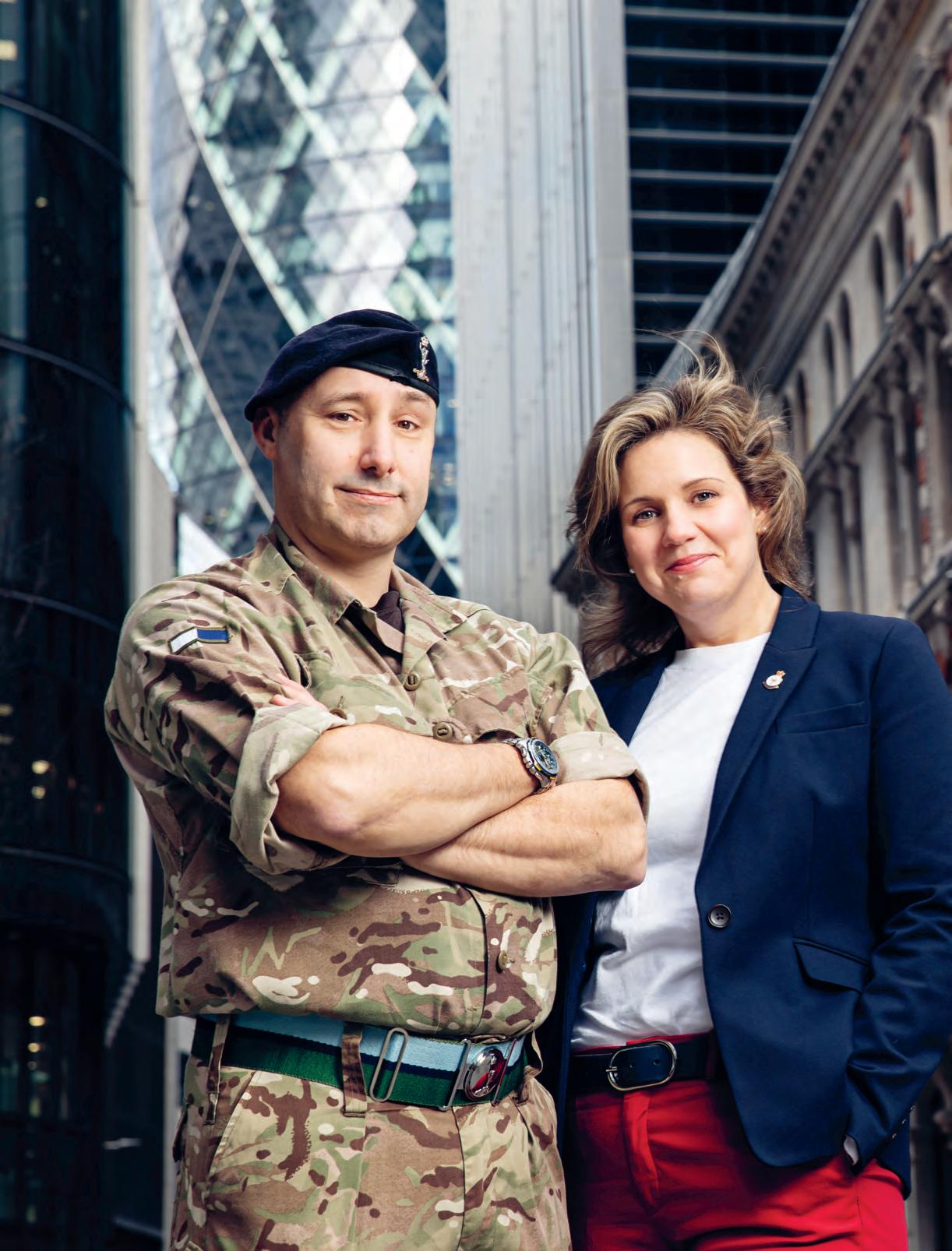
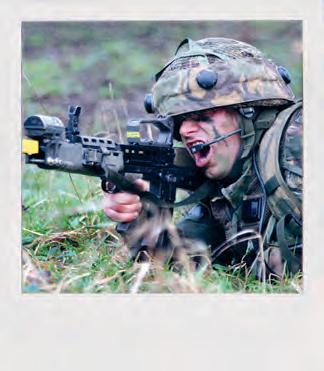
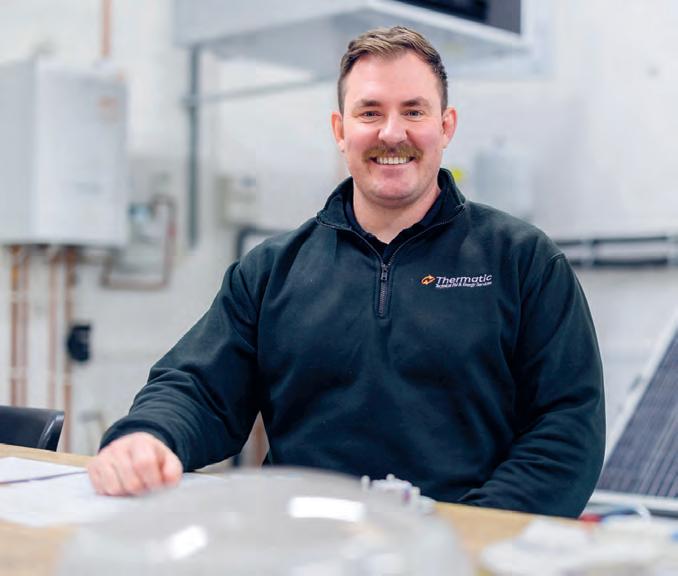
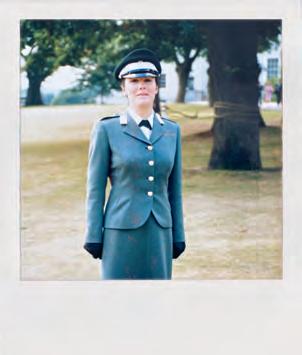
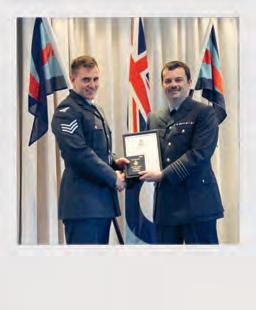
Forces personnel excel in business roles, finds Sally Percy
52 Debate Is kindness overrated?
54 Marketing mytholo with Chris Daly
AI is useful. But only humans can empathise with customers
TRENDS
Critical challenges facing firms
58 Reel business
Are Hollywood’s portrayals of business worth the ticket? Matt Packer grabs the popcorn
62 Who controls the future?
Andrew and Nada Kakabadse on the global stru le for tech power
66 How to say it with Anthony ‘Tas’ Tasgal
This could be the start of something!
OUTLOOK
The future business landscape
68 How to see the future
Better forecasting is possible –if you know how
72 International rescue How to avoid a foreign fail
Resources for better directors
78 Book club Director’s selected springtime reads
82 The corporate philosopher with Roger Steare Why rules are for fools –and blind compliance kills productivity
84 Tomorrow’s director Ronke Maye on building a people-first agency
Viewpoints
Our guest writers this spring
Morag Cuddeford-Jones
Avid readers may recall Morag Cuddeford-Jones’ last appearance in Director – where we hinted that she may soon be snapped up by Gardeners’ World We were close. She has since been nabbed by Gardens Illustrated. Yet despite her new-found horticultural fame, her continued devotion to business journalism means she thrives as editor of the Chartered Institute of Marketing’s Catalyst magazine, while penning pieces for myriad others. Spotlight p28
Nada Kakabadse
Nada Kakabadse is professor of policy, governance and ethics at Henley Business School, and a globally renowned adviser to organisations across Scandinavia, the Middle East, North Africa, the UK, Canada and Australia. Her private-sector clients range from Microsoft to Vodafone Australia. Prolific barely covers it: with late husband Andrew Kakabadse, she has coauthored 23 books, 93 chapters and more than 240 scholarly articles. Trends p62
Nick Martindale
Nick Martindale is a business journalist, with a strong background in HR and workplace issues. He is a former editor of the Federation of Small Businesses’ First Voice magazine and has edited several other titles for membership organisations. With two almost fully fledged children, he’s currently looking forward to rediscovering the concept of free time, which has already seen him sign up for a walking marathon later this year.
Perspective p52
Matt Packer
Matt Packer is an arts and humanities hippie who two decades ago tripped and fell into business journalism and, much to his relief, swam rather than sunk. Since then, he has written extensively online and off about a dizzying array of topics related to leadership, management, finance and professional development. In the smoking ruins of his spare time, he likes nothing more than to cosy up in row H at the BFI London Imax, soaking up the spectacle through his spectacles. Trends p58
EDITORIAL Editor Ben Walker Creative director Kate Harkus Policy editor Patrick Woodman Chief subeditor Luisa Cheshire Subeditor Camilla Cary-Elwes Publisher Martin Liu IOD EDITORIAL BOARD Director general Jonathan Geldart Chief economist Anna Leach Head of media, campaigns and public affairs Hugo Legh Head of marketing Rebecca Watkinns COMMERCIAL OPPORTUNITIES For advertising and sponsorship requests, please contact Rebecca Watkinns at rebecca.watkinns@iod.com
reserved. Material may not be reproduced without permission of the publisher.
Sally Percy
Sally Percy can’t stop writing about leadership – probably because she’s a leadership and management contributor to Forbes.com. But she’s also fascinated by the challenges faced by leaders in a turbulent world – something she’s discussed on numerous podcasts. Percy is intrigued by the question of whether leaders are born or made – a topic she explored in her book 21st Century Business Icons If you want to know her answer to that question, you’ll need to read the book!
Perspective p46
Julian Richer
Julian Richer is a small shopkeeper (5ft 7in), philanthropist (nothing whatsoever to do with stamp-collecting), and author of several books. The Independent described The Richer Way as “one of the best business books in history”, which Richer has repeatedly said he feels is “a bit over the top”. He is best known as the founder of Richer Sounds, the UK’s largest hi-fi retailer.
Spotlight p12
Allyson Stewart-Allen
Allyson Stewart-Allen is an expert in helping companies grow across borders, and knows how to crack the code of US business, having authored the bestselling book Working With Americans. When she’s not advising or teaching at the world’s top business schools, she is a broadcaster for a range of television outlets, commenting on business mess-ups – and Brand Beckham.
Outlook p72
Rory Sutherland
Rory Sutherland is a man who proves that wearing a suit and talking about advertising can be wildly entertaining. He’s part marketer, part philosopher, and part mischievous storyteller. Known for turning everyday nonsense into brilliant insights, Sutherland champions the power of psychology, tea and wonderfully irrational ideas. He makes clever sound like fun.
Spotlight p24
DISCLAIMER While we take care to ensure that editorial is accurate, independent, objective and relevant for readers, Director accepts no liability for reader dissatisfaction rising from the content of the magazine, podcast, blogs or any associated editorial material. The opinions expressed or advice given are the personal views of individual contributors and do not necessarily represent the views of Director the Institute of Directors or LID Business Media Ltd. Director is editorially independent. Display advertisers have no input in editorial content or tone. Where sponsored articles are featured, they will be clearly labelled as such. Director magazine is printed on FSC-approved paper from responsible sources. Director takes every effort to credit photographers, but we cannot guarantee every published use of an image will have the contributor’s name. If you believe we have omitted a credit for your image, please email the editor Ben Walker on ben.walker@lidbusinessmedia.com. Additional images throughout: Shutterstock; Getty; Unsplash. Additional illustration: Eleanor Shakespeare
From boardroom to botroom
AI directors are closer than you think. But worry ye not
Just about managing with Stefan Stern
“ So, if everyone is ready, shall we put that to the vote…? It’s Gerald, Cynthia and Dinesh in favour, and Google Gemini 3, ChatGPT-5 and Claude against. I suppose that leaves it up to me to decide…”
Do not panic. Director has not been leaked the minutes of some high-level board meeting at which computers are on the brink of taking over. This is merely the paranoid imagining of your columnist picturing the boardroom conversations of the future.
It is, perhaps, no wild exaggeration. The world has gone AI crazy, has it not? Hundreds of billions of dollars have been invested – well, spent, anyway – building new AI capacity. Promises of miraculous productivity gains have been made. The knock-on effect has been seen in the labour market, with employers reluctant to hire in large numbers, partly because of a flat economy and partly in anticipation of widespread automation and the replacement of people with bots.
So, if this is already having an impact on the shopfloor, why not in the boardroom as well? This thought underpinned recent research by academics at the Insead Corporate Governance Centre and the Mack Institute for Innovation Management at the Wharton School.
It was an ingenious experiment. Parallel board meetings were set up, some conducted by
actual human beings (students on the advanced board programme at Insead), and others by large language models (LLMs), programmed to analyse and discuss the same business issues. All participants, whether human or not, had access to the same data. Transcripts of the board meetings were studied both by AI and human assessors – without knowing which transcript had been generated by humans and which by bots – and performance was measured under eight criteria: decision quality, implementability, collective learning, director participation, use of facts, fair and inclusive process, depth of exploration, and chair performance.
And the results? Under every heading, both AI and human assessors rated the LLMs’ performance as superior. That’s right: the robots beat the humans. Why was that? On ‘decision quality’, for example, both sets of assessors said that humans “hesitated and circled around options without landing on a clear strategy”. The AI board, by contrast, “reached clear, actionable resolutions”.
In terms of facts and data, humans displayed “limited engagement with the pre-read” and “missed opportunities to ground arguments in data”. But AI boards “actively cited figures from the documents”, “reconciled discrepancies in real time”, and “wove quantitative evidence into their reasoning”.
So, is that it? Is time up for Gerald, Cynthia and Dinesh; for you and me? Not so fast. The story is a bit more complicated than that.
Of course, human beings have their foibles. We hesitate when confronted with big choices. We try to be objective with data, but inevitably bring our subjective concerns with us. We are not as clinical as robots. What is more, we are hierarchical: we like to see familiar credentials. We may think we are prejudice-free, but in truth, nobody is. We will not always be as inclusive – or even as fair – as we ought to be. Few chairmen or chairwomen are perfect.
But, at the same time, life is not a computer simulation. Quantitative data is not the only thing you need to run a business. Good human decisions are based on a range of evidence, including valuable, hard-won human judgement. Experience is not computer ‘junk code’. It is precious.
One of the academic researchers, Valery Yakubovich, executive director of the Mack Institute, sees both sides of this question. As he told the New York Times, “The main thing is that AI can process so much information so fast. It’s beyond our human capacity to be at the board meeting bringing precisely the right numbers at the right time.”
The AI is purely data-driven. It avoids other human complications. “The bots respond just in terms of the substance,” he said. “They don’t care about being smarter than others, they don’t want to dominate the room, they don’t take things personally.”
But, in the real world, humans still have valuable strengths. “I think AI’s judgement is not enough,” Yakubovich said, “because with the decisions boards usually make, there is no
ground truth… And it’s all decided in the context of competition. My decision might not be perfect, but it needs to be somewhat better than my competitors.”
I don’t think we’ll see entire boards replaced by AI any time soon. But the new technology is there, it is getting better all the time, and it is not prohibitively expensive. (Gerald’s bar bill, on the other hand…)
Using AI to test assumptions, to process vast amounts of data, to offer alternative scenarios, to simplify complexity: all these things could make sense. And the bots are trainable. As Yakubovich said: “We had to explain to bots how to
Experience is not computer ‘junk code’. It is precious
interact, when to speak and when to stay quiet… Everyone participated, and the chairman always summarised the different viewpoints and kept moving it to some kind of a decision.”
Yet, bots cannot manage stakeholder relationships with investors, suppliers and government. They cannot bear legal liability. They make good assistants, but bad bosses. They must never be in charge.
But they could also make a significant difference in the boardroom. So: Claude, Gemini, ChatGPT – is there any other business…?
Stefan Stern is a business journalist and visiting professor at Bayes Business School
Angels not demons
Yes, business is a force for good
I s business a benign or malign force? The response depends on who you ask. For most Director readers, the answer is self-evident. Business is benevolent. It engages. It inspires. It invigorates.
Yet since the great financial crash, wider society is less convinced of its virtues. We reached a nadir when a recent prime minister told his colleagues: “F**k business.”
Boris Johnson’s profane catchphrase, uttered in 2018, captured a political shift. Suddenly, parties –both left and right – advocated higher levels of taxation to fund government services. The focus on growth dissolved. The political choices would have been different if business was seen as a force for good, unequivocally, rather than something worthy of contempt.
The reality is that successful entrepreneurship and profitable business are angels, not demons. They create the fuel that drives a happy and successful UK. This occurs directly, through higher tax revenues as businesses grow; and indirectly, via the many ways well-run companies contribute to society through innovation, lower prices, improved services, training, job satisfaction and healthier communities.
First, the economics
We must run the public realm well. Efficient and effective government services are central to a successful economy and nation. Debates over
how much a country should provide for its citizens will remain. Yet caring for the vulnerable, providing healthcare, defence, infrastructure, education and a decent retirement are the preserve of the state. Economies of scale – and common decency – mean that, for most countries, it is wise that such services are run, or at least funded, by government. This is – or should be – true even in countries that are instinctively nervous of state provision, such as the US.
Yet taxation funds all these activities. And tax revenue can only be generated by the private sector. The more successful businesses are, the more money is available for the public realm.
The private
This is not a political point. Every nation must gauge the right balance of taxation – there are different models out there. Yet it is in the interest of all political creeds to have a vibrant private sector. It provides the money for successful government. Sweden and Denmark have high tax-takes as a percentage of GDP. Yet they have also fostered a good business environment.
More than money
The private sector is more than just a source of revenues for government. It provides manifold benefits to society beyond cold, hard cash.
sector
provides manifold benefits to society beyond hard cash
Some countries have experimented with higher taxation or borrowing to fund more government services. But there are natural limits to these approaches, which can stifle the private sector. For example, New Zealand in the 1980s, Sweden in the 1990s, and Spain, Portugal, Greece and Italy in the late 2000s all had to rebalance their economies.
In each case, the size of public spending outgrew the capability of the private sector to fund it. The adjustment was painful. But it was ultimately successful.
Enhanced innovation
Business success is driven by innovation. These innovations frequently enhance people’s lives. It is true that funding for R&D is initially from government activity, especially defence spending. But ultimately, the choice and scale of successful investment are made by the private sector. Think of any recent major innovation. It was likely driven by the competitive edge of private business. Electric vehicles, smartphones, Covid vaccines: these are all products of private-sector ingenuity.
words John Browett illustration Martin O’Neill
Lower prices
The affordability and quality of most durable goods improve over time. Consider how the price of a computer has fallen since the introduction of the IBM PC. It was the power of competition that drove prices down. And the family laptop of today is exponentially more powerful than the mainframes used by multinationals in the 1960s. Sometimes, prices appear to rise. Today’s smartphones are more expensive than Apple’s iPhone 2007 debut model, which retailed for under US$500. Yet the first iPhone was puny compared to its modern incarnation. The latest smartphones boast greater power and dramatically better features. Early models are incomparable. Consumers capture the benefits of innovation as businesses compete on price or specification – or both.
Improved services
In the UK, we love to complain –particularly about services. Yet let us rise above our annoyance at bank charges, customer service bots and airport queues. Consider instead the improvement of services over the last 40 years. For example, mobile telephony,
internet banking, streaming TV, social media and networks, video calling… all provided by the private sector at lower costs over time. Some of these presented social challenges, but in general, progress has benefited most people.
Better skills
Education is – rightly – led by government. Good state provision is an essential facet of equal opportunity. Yet schools and universities have no monopoly on human development. Many of us earn our living from the training and skills learnt while working for a company. Perhaps we still do too little of this as a country. But ongoing training – providing lifelong learning –is what successful businesses do.
Greater satisfaction
We all struggle with trying times at work. But, at least sometimes, we can glean satisfaction from a job well done. It is striking that in successful companies, employees mostly enjoy working there. Usually, there is a sense of purpose that energises the workforce. We need resilience for when our jobs are difficult. But there are many good days in most businesses, too.
Nicer places
The difference between towns and cities with vibrant private sectors versus those with depressed enterprise is remarkable. A successful private sector in a local area provides more employment, higher wages and busier high streets. The whole community feels it.
The downsides
This is no Panglossian essay. Businesses can harm. They can create monopolies, damage the environment, ringfence wealth, stifle competition, mistreat workers. We must weed out bad actors and unscrupulous firms. That is why we have laws and regulations. Ultimately, most of these problems are manageable – or will be solved by better business and innovation. For example, CO₂ could be contained through large-scale adoption of renewable and nuclear power. For wind and solar, cost and deployment improvements by the private sector were dramatically underestimated. Major challenges for society loom large. Well-run companies are the solution – not the problem.
John Browett is chair of the Institute of Directors
For better, for Richer
It’s tough out there. But you can see your business prosper – and sleep better
WORDS
Julian Richer
I remain a small businessman (a mere 5 7in!).
But it is a privilege to share some insights from turning a tiny firm into a big company in a ferociously competitive sector, over five decades in retailing. My little hi-fi shop at London Bridge – we called it Richer Sounds – grew into a national chain of 50 stores turning over £200m a year. It has been consistently profitable for the last 25 years. We have a few modest claims to fame. We are consumer association Which?’s retailer of the year for six years running. We feature in the Guinness World Records for having the highest sales per square foot of any retailer in the world, from our very first store. We importantly – and unusually in our sector – have a gender pay gap in favour of women. But the achievement of which I’m most proud is that for decades we have given 15% of our profits to charity. This has enabled us to fund ten of our own not-for-profit organisations doing fantastic work.
The importance of ethos
These accolades don’t just fall from heaven. They are the product of hard work and perseverance. But they are only because of our ethos as a company. You must be commercial to succeed in business. But that can absolutely sit alongside a genuine ethical stance. This is what I most commonly refer to as a responsible business. I want to ensure that any profit I make is neither at the expense of others’ nor the wrecking of the planet. This might sound simple. But if you fail to bake it into your business model, it can easily happen – especially as you grow.
My motto – which should be the key takeaway – is that ‘it’s all about the This is not a so platitude, but a hard truth. You will see a completely di erent output from people depending on how you treat them, so please remember this when with all your
ethos just work possible be can stance. being any misery sound business you should all people’. but erent treat dealing
’Purpose-driven’ is a vague business has a purpose. problem might not be a positive one
’Purpose-driven’ is a vague term. Every business has a purpose. The is that it not be a positive one
There are still too many companies that are commercially successful with sta on low wages and insecure hours – their wellbeing needs unmet
stakeholders. These include your sta , customers, suppliers, subcontractors, investors and the community where you are based, to name a few.
The Good Business Charter
The reason we have received awards for customer service is that we are genuinely passionate about it. Crucially, we reward great service, just as we do sales. Loyal customers are the best advertising campaign you could ever wish for! Customers are invited to write directly to my office if they have a complaint. I oversee them all.
In 2020, I launched the Good Business Charter (GBC), developed with the Confederation of British Industry and Trades Union Congress. GBC’s goal was to become the UK’s benchmark of responsible business behaviour. The charter comprises ten components to which organisations must commit. Five of those relate to employees. Why? Because responsible businesses recognise how important their workforce is and cares for it. I wish I could say that businesses will be unsuccessful if they fail to commit to the charter. But the reality is there are still too many companies that are commercially successful with sta on low wages and insecure hours – their wellbeing needs unmet. This is usually for nefarious reasons – historical market dominance, monopoly power and the like.
Five of those relate to Because businesses recognise how important their workforce is and cares for it. I wish I could say that businesses will be unsuccessful if fail to commit to the charter. But the is there are still too many companies that are successful with sta on low wages and insecure hours – their needs unmet. This is for nefarious reasons – historical market dominance, power and the like.
be successful if you treat
However, I can absolutely say that you can still be commercially successful if you genuinely treat your colleagues – as we call our workers – well. It definitely not an either/or. We have been the real living wage for many years. that is calculated on the actual the UK. I want my colleagues to and give their best, but how can their wages won’t cover their basic That is simply inhumane. This is also abhor zero-hours contracts – where having to sleep in their cars due to rent a at because they don’t have income. It is also deeply unfair parents, who can be le out of pocket cancelled at the last minute, arranged childcare.
your – as we call our workers – well. It is most not an We have been proud payers of the real wage for many years. This is a wage that is calculated on the actual cost of living in the UK. I want my to come into work and give their best, but how can they do that if their wages won’t cover their basic living costs? That is inhumane. This is also the reason I contracts –people are to sleep in their cars due to being unable to rent a at because don’t have a secure regular income. It is also unfair on working parents, who can be le out of when shi s are cancelled at the last having already childcare.
Nice profits
business leaders comment that this ‘nice’ – but that their business to a ord such ‘perks’. I would challenge any business model that means can be made while people are ering in-work poverty. There are huge commercial upsides, too, in caring for employees. We get great people, and them. This means recruitment minimal. We also have tiny shrinkage polite term for stock that gets stolen by saving us millions of pounds a year. Sounds we have a dozen holiday homes.
Some comment all sounds ‘nice’ –is unable to a ord such I would any business model that means profits can be made while are su ering in-work poverty. There are commercial too, in for your We get great people, and we retain means costs are minimal. We also have costs – the term for stock that gets stolen employees – us millions of a year. At Richer Sounds we have a dozen homes.
Inner strength
many times over the savings from our tiny My bank manager was confused when I my for the first home. He soon got the message when I explained that more for our people we will benefit in the Our business is now are involved at management level. Yet our to sta to share their su estions on how the business could be our shi to It has been an principle
More than 70% of our wonderful sta use these for free holidays at least once a year. They are funded many times over by the savings from our tiny shrinkage. My bank manager confused when I explained my plan holiday home. He soon got the message explained that by doing more for our will benefit in the long-run. Our business employee-owned. Colleagues are directly at management level. Yet our appeal share their su estions on how the business be improved predates our shi to employeeownership. It has been an enduring of the company. Those on the shop oor have a clearer idea than I do of what will provide a better customer experience.
Regarding people, here are two more tips. First, wherever possible, promote from within. Nearly all our directors started on the shop oor. The only exceptions are where specialist skills are needed. Showing loyalty to one’s people is fantastic for morale. It is also a powerful driver of retention.
Second, when recruiting, focus on attitude. When we recruit colleagues for our stores, we seek people who are naturally warm, enthusiastic and have a positive attitude. Other skills can be taught. Of course, a er training, our expectations are high – colleagues must know their stu and be ready to work hard. I also strive to be kind and compassionate with everyone, remembering that they are individuals with their own lives.
Every week, I am sent the morale scores across the business. This is a quick but e ective litmus test that identifies anything awry. Colleagues are asked in confidence to give a simple score between one and ten as to how they are doing. I also receive a weekly colleague care report. I personally call any colleagues who have su ered a bereavement or serious illness. I appreciate that would be a challenge if your business has thousands of employees. But the great majority of businesses in the UK have many fewer sta Even the largest corporations should be able to incorporate something similar into their senior team’s practices.
There is much talk of ‘purpose-driven’ business, though arguably that is fading a little now. I find the term vague. Every business has a purpose; the problem is that it might not be a positive one! Yet a word like ‘responsible’ is something we can all understand. It has a clear opposite too – there have been many scandals from irresponsible businesses making the headlines over the years. At its core, being a responsible business means treating others as you would like to be treated. And it’s OK to make a profit. In fact, if you don’t, you fail. Responsibility
isn’t some kind profit-making to be profitable.
business. It is part and parcel of how
Why do we suppliers late, we expect to be are basic principles play passionate about us all being on a level playingfield, which is why it is galling when you hear of businesses failing to pay their fair share of tax, or human rights abuses in the supply chain to cut corners. It is not right. The public agrees. TSB polling finds that 97% of consumers want to shop with responsible businesses. But it also makes good business sense.
There is an opportunity to raise the bar on business behaviour so that doing the right thing becomes the norm – and businesses that do otherwise are pushed out. That only works if the public know who the responsible ones are – and who are not. This is precisely what the GBC does, it is the definitive signpost to the ‘good’ companies. The IoD is a proud signatory. We applaud its excellent work on the Code of Conduct for Directors – with its focus on responsible business behaviour.
The debate about ESG will circle around us. Yet we absolutely believe that committing to the GBC’s ten components – and in turn receiving our accreditation – means you’ll sleep better at night, you’ll get the recognition you deserve, and your business will prosper. Come, join us on this exciting journey.
Julian Richer is a retail entrepreneur, author and founder of the Good Business Charter
DIRECTOR DISTILLED
Good Business Charter benchmarks responsible business
Responsibility is a passport to profitability Customers want ability to identify responsible firms
SPECIAL OFFER
Get accredited! IoD members that qualify for Good Business Charter accreditation can benefit from a waived sign-up fee. Simply scan this QR code and quote ‘IOD application’ when applying for accreditation.
Curiosity cures the company
Corporate custodians need inquisitive minds
words Natalie Evans
Few would have heard of the Post Office scandal if it weren’t for Toby Jones. As it was, the actor’s award-winning portrayal of subpostmaster Alan Bates brought a gross failure of governance to the eyes and the hearts of the British public. Toxic behaviour festered and proliferated throughout the Post Office, which, prior to the scandal, was among Britain’s most trusted brands, a state-owned company that was part of the fabric of British society.
Yet, as those watching Jones in Mr Bates vs The Post Office might have surmised, the final responsibility for its downfall lay with the board of directors. Those charged with governing the Post Office failed to offer sufficient scrutiny during
Neds must be critical friends – not unquestioning companions
two decades of misrule: leading to groupthink that financial irregularities across the organisation were the fault of postmasters and postmistresses, rather than the faulty software that was actually culpable. As the IoD found in its own report on the scandal, “a lack of professional curiosity and critical challenge” was to blame.
Several members of the working group commissioned by the IoD to analyse evidence from the public enquiry into the scandal reported that the critical scrutiny expected from non-executive directors (Neds) was conspicuous in its absence. “Boards have to be in the habit of challenge,” noted one participant. “They have to be curious and persistent. That’s fundamental to the role of the non-executive director.”
Indeed it is. Neds must simultaneously hold the commercial interests of the business dear, yet be willing to inquire, challenge and sometimes criticise when they identify weaknesses of governance. As corporate custodians they are allied with the interests of the company. Yet they must be critical friends – not unquestioning companions.
So what is the art of being a critical friend? How do you strike the balance between constructive criticism and not alienating the executive? It is not easy. Being a Ned is a tough gig, for many reasons. The world in which Neds operate is vastly more complex than that known to businessman and merchant banker Derek Higgs when he produced his seminal report into Neds in 2003.
A formidable concoction of digital transformation, geopolitical volatility and increasing public scrutiny has made Neds’ job exponentially harder. Thus, the demands on Neds are greater than when Higgs published his report a generation ago; the expectations placed upon them greater still.
Yet as difficult as Neds’ role can be, good governance remains challenging, sometimes impossible, without them. They are a crucial ingredient in the effective running of firms. But they have, nevertheless, sometimes failed to deliver.
The Post Office is just one example of where Neds went wrong. There are more. Take the collapse of builder Carillion – this was, in part, due to weak Nedships. Here, general ineffectiveness was the culprit. “Carillion’s Neds were unable to provide any remotely convincing evidence of their impact,” according to a select committee of MPs.
At Halifax Bank of Scotland (HBOS), another high-profile failure, Neds were damned as unqualified laymen: “The Neds on the board lacked sufficient experience and knowledge of banking,” according to watchdog the Prudential Regulation Authority.
It might be tempting to hand to government the responsibility for remedying these maladies. Through regulation, the argument goes, unqualified and uncritical Neds would become history. But increasing red tape is the wrong approach. More catch-all legislation will be too blunt to deliver the improvements required, which can only be realised by those closest to the Neds. Rather, it is time that boards themselves lead the way in improving the quality of Nedships. Government and regulators cannot – and should not – sanction how this is done.
Back in 2003, Higgs proposed key principles for Nedships. These included the need for Neds to be ‘independent’ (of which more later) and take objective decisions; that the roles of chief executives and chair must be separate and distinct; and that Neds must command the requisite knowledge, skills, experience and time to make a positive impact.
Those recommendations, and Higgs’ other suggestions, remain valuable foundations. But they must be developed and reimagined for the environment in which businesses now operate. Tick-box exercises are not the answer. There must be real, practical and cultural changes in the boardroom to ensure that Neds are effective.
So, how can companies ensure that their Nedships are fit for purpose? How can UK Plc find the best talent – and harness it?
There are four guiding lights that boards should follow.
It is time that boards themselves lead the way in improving the quality of Nedships. Government and regulators cannot – and should not – sanction how this is done
Seek
independence of mind
When discussing the need for Ned ‘independence’, many boards and executives interpret that as the need to avoid conflicts of interests. Avoiding such conflicts is, of course, crucial. Yet it is too narrow an interpretation. Boards must widen the scope of independence: independence of mind is arguably as important – perhaps more so – than independence of interests. Independent minds bring a broader perspective, which can make challenges more effective.
Engage Neds more in the business
Neds are, by definition, neither employees nor executives. Executive direction is rightfully the preserve of executive directors. There is a balance to be struck. But encouraging Neds to be more engaged and with a better understanding of the business is critical. Greater engagement will cause Neds to have a deeper understanding of the organisation and, importantly, its people. Moreover, a deeper knowledge of the way the company operates acts as an important safety valve. Thoughtful Neds with a wider understanding of business process are more able to verify what senior executives tell them.
Recruit the right people
Companies can be too conservative when recruiting Neds. Too many firms are wedded to the usual suspects – people who look and sound like them, who have similar backgrounds, and share their worldview. There is comfort in similarity and discomfort in dissimilarity. Yet boards must open their minds to quality people from different backgrounds and sectors. Consider transferable skills rather than sector-specific knowledge. Recruiting Neds from a variety of backgrounds can improve the depth and breadth of board discussions. It brings diverse perspectives and experiences to the table.
Prize emotional intelligence and curiosity
Last, but certainly not least, there is the profound need for curiosity. Neds must be inquisitive about the business, while commanding the necessary emotional intelligence to convey their challenges to the board in a manner to which it will be receptive.
Far from killing the cat, curiosity can cure the corporation. During the research phase of the IoD report, several interviewees told us that a key differentiator between stronger and weaker Neds was their level of curiosity. The most effective Neds were determined to fully understand the business, its processes and organisation. These Neds felt profound personal responsibility for their company’s success and conduct, which led them to dedicate prodigious intellectual energy to their Nedship.
This curiosity breeds effective challenges that have a positive impact on firms. Having a clear and shared sense of purpose with the executive team means that, when difficult issues arise, discussion, debate and potentially disagreement are built on the foundation of mutual respect. There is an innate understanding that this is being done in the best interests of the organisation – not as an ego trip.
A duty and an opportunity
Twenty-three years after Higgs, it is important we get this right. Let us heed the words of Robert Swannell, the former chairman of Marks & Spencer and UK Government Investments, the public body that oversees state-owned businesses. “I’m afraid,” Swannell told the public inquiry into the Post Office, “that when an incomplete curiosity … meets a toxic culture, bad things happen.”
Toby Jones might have done his life’s work raising the profile of wronged postmasters. Yet most corporate scandals fly under the radar. Boards have the duty and opportunity to prevent future Post Offices, Carillions and HBOSes. Only curious Neds need apply.
Baroness Evans of Bowes Park is chair of the IoD’s 2025 commission into non-executive directors and a Conservative peer
DIRECTOR DISTILLED
Neds must be critical friends
Curiosity key to effective governance Boards responsible for better Nedships
GO DEEPER
Access the IoD’s reports in Nedships and the Post Office scandal here…
NEDs reimagined: A post-Higgs review of the role and contribution of non-executive directors
The Post Office Scandal: A failure of governance
The end of the affair
Britons are falling out of love with work. Here’s why
Negativity bias What managers focus on
37%
Strengths
63%
Weaknesses
Source: Gallup
words Ben Walker illustration Elin Svensson
W hen experts at Gallup examined employees’ engagement in their jobs, they unearthed an awkward truth. Globally, the consultancy found, employee engagement is curving upwards. It rose every year since records began, bar two. Yet the UK bucked the trend, and not in a good way. While the world’s workforce slowly becomes more engaged, Britain’s is going backwards. Engagement seems to be rising almost everywhere but here.
The problem
When Gallup began measuring employee engagement in 2009, it found that one in five UK employees (20%) were engaged in their roles. That proportion is scarcely cause for celebration – but was nevertheless eight points higher than the global average of just 12%. By 2024, though, the proportion of engaged employees in the UK had halved. Barely one in ten Britons (10%) were engaged – against a global average of 21%. The British score is among the lowest in Europe, a region that itself performs poorly in engagement compared with its global peers.
“What we’re observing in the UK is the reverse trend to what we’re seeing globally,” Annika Leonhard, Gallup’s director of consulting for Europe, says. “This invites a lot of questions.”
The most obvious question is how Gallup measures engagement. Its scores (21% globally and 10% in the UK) might strike managers as disturbingly – almost unbelievably – poor. Nor do they align with most firms’ own surveys, which routinely find engagement scores in the 60-70% range.
Yet, according to Gallup, the discrepancy stems from the fact that most companies ask the wrong questions. “I joke that [most engagement surveys] are popularity contests,” Jeremie Brecheisen, EMEA managing partner at Gallup, tells Director. “Because the way they usually measure engagement is with the advocacy item – ‘Would you recommend us?’ ‘How popular are we with you?’ Another one is loyalty – ‘Do you plan to be working here for the next few years?’ Or, ‘How satisfied are you with this as a great place to work?’ This – again – is like asking, ‘Do you like it here?’”
Brecheisen is sceptical that such queries are effective in measuring engagement. People stay in jobs for myriad reasons – security, salary, location, convenience and so on. Employees might even recommend their companies to friends on such bases. Yet none of those metrics mean the employee is engaged in their role. “Those
things can be outcomes of engagement – but not necessarily,” says Brecheisen. “They can be a bit too rational – rather than emotional.”
By contrast, Gallup’s methodology, which has remained consistent for almost two decades, is to instead interrogate the way firms equip their people to be heard, add value and contribute to the company’s success – factors that drive employees’ visceral, emotional bond to their jobs.
“The way we measure engagement is by saying, ‘Are those workplace needs that matter most to your performance and your wellbeing being met?’” reveals Brecheisen. “And we ask about the work. Knowing what’s expected of you at work has nothing to do with whether you like us, whether you’ll stay, or whether you’re going to recommend us.”
Managers who focus on their employees’ strengths foster higher
engagement
It is foolish, he says, to transfer ‘net promoter score’ (NPS) marketing metrics from customer surveys to matters of personnel. Yet such practice has become commonplace. “Firms were using the NPS question for customers, which is ‘Would you recommend us to your family and friends?’” notes Brecheisen. “And they translated and transferred it into their HR teams. Many are focusing on this approach now because they think it’s simpler. But there’s a difference between being simple and being simplistic.”
The way we test engagement matters because engagement itself matters – hugely. Companies with a high engagement score are likely to thrive.
Friends with benefits
Companies
Team engagement level: Bottom quartile Top quartile
Positive outcomes
Productivity (sales)
Profitability
Negative outcomes
Absenteeism
Shrinkage
The opposite is true where scores are low. Gallup’s research shows that engaged employees are 71% less likely to feel burned out at work, 67% less likely to be seeking a new job, and 67% more likely to be thriving in life, based on their own life evaluation. This translates into hard outcomes for organisations: absenteeism, shrinkage and accidents were significantly lower in teams with high engagement levels (see graphic, bottom left). By contrast, disengaged employees offer a clear and present risk to their business. “The actively disengaged are the people you really need to worry about,” says Leonhard. “They’re the people who can create toxicity in the workplace; who can actively sabotage you.”
The reason
If the slump in British engagement is troubling, the reason behind it offers scant solace. Forget football tables or free fruit: Gallup’s analysis finds that it is the manager or team leader who plays the key role in driving employee engagement.
Other inputs might have a marginal effect. But 70% of the variance in team engagement is determined by the acts of its leader. Brecheisen, an American based at Gallup’s London headquarters, recalls the Chartered Management Institute’s perennial lament at the British cult of the ‘accidental manager’ – the phenomenon whereby successful technicians are promoted into management roles without adequate experience or training.
“People are just being accidentally managed here,” Brecheisen tells Director. “Those who are managing Brits are not taking their job seriously. They don’t realise how bad the problem is. And things just keep getting worse because they won’t accept the problem. They just keep saying, ‘These aren’t the droids you are looking for.’”
As they seek the droids, they search the wrong places. The advent of home- and hybridworking has caused many firms to scrutinise the worksite in the hope of uncovering the culprit. “Sometimes people want to look at engagement based on whether or not your workers are 100% in the office, hybrid or 100% at home,” says Brecheisen. “But our engagement data shows that the manager has five times the impact on your engagement than the location where you’re working.”
In personnel, as in physics, God is in the details. “We want to assign blame to engagement levels based on macro things,” says Brecheisen. “But really, it’s that micro things that matter most. When a manager isn’t getting it right, when a manager is ignoring you – which is the worst thing they can do – then you can do anything you want with four-day workweeks and hybrid workplaces, and all those things. They won’t matter if a manager is undermining it all.”
10 things I hate about you
Too many focus on employees’ weaknesses
% Actively disengaged Not engaged Engaged
My manager... Ignores me
Focuses on my weaknesses
Focuses
my strengths
Source: Gallup Analytics
The solution
Yet while bad leadership prompts low engagement, good leadership has the opposite effect. Managers who focus on their employees’ strengths – rather than their weaknesses – foster higher engagement. Those who ignore their people plunge engagement levels to near zero. “Most managers think, ‘What are the weaknesses of my employees?” says Cristina Man, Gallup’s senior workplace consultant, “‘What is not great about my employees?’”
Yet Gallup’s analysis reveals that when managers focus on their team’s strengths, an average 61% of employees are engaged. When they focus on weaknesses, this falls to 45% (see graphic, above). When they fail to focus on their team at all – ignoring them – average engagement falls to just 2%. “Energy flows where attention goes,” says Man. “If you pay attention to people and the things they are energised by, you’re likely to have more opportunities to show genuine recognition – and inspire them to do better. You’re likely to see the results.”
This is not some wishy-washy decree to be nicer. Gallup’s CliftonStrengths assessment profiles individuals’ qualities, rather than their flaws. It is a decidedly practical call-to-arms. “It’s important that people know this is about being effective and productive – not about being positive,” Brecheisen tells Director. “You’re not going to turn around poor performance by focusing on something that you just don’t have. That’s like asking me – a righthanded individual – to start writing left-handed to speed up writing a book. That doesn’t make sense. But that’s what [managers] end up doing.”
Yet, as usual, it is all too easy to confuse conspiracy with cock up. Few managers wake in the morning wanting to dwell on their employees’ weaknesses. Many, says Brecheisen, are unaware that low engagement is even an issue. “One of the biggest and best ways you can change this is to
bring it to their awareness,” says Brecheisen. “A lot of companies don’t even give their managers employee engagement reports, let alone help them discover their team’s strengths. They will do an ‘engagement survey’, but the reports remain at divisional level, and they’ll just cascade an action plan down to everybody and say, ‘We’re working on this.’ But that may not be what your team is struggling with – even if it was some sort of theme for your region.”
Ultimately, microscale matters. “Engagement is local,” says Brecheisen. “But a lot of companies don’t even trust their managers with the data – let alone ask them to take accountability for it.”
Brecheisen and his Gallup colleagues urge a rethink. “Don Clifton, founder of CliftonStrengths, is also the father of positive psychology,” says Man. “He noticed that books about psychology asked, ‘What’s wrong with them, and how can we fix them?’” Clifton thought differently: “What if we turn that around? Why not focus on what’s right with people? And what will happen if we do?”
Ben Walker is editor of Director
DIRECTOR DISTILLED
UK employee engagement among worst in Europe
Bad management largely to blame Leaders must focus on team strengths to remedy malaise
Steampunk rock
Smarter working is already possible. But too many think it science fiction
words Rory Sutherland illustration Matthew Richardson
In the 19th century, factories were organised around a single, centralised power source. Typically, this was a huge steam engine which drove a central steel drive-shaft running the entire length of the building. Factories were consequently built with reinforced ceilings and beams to support the immense weight, with the machines clustered around these rotating shafts, the sole source of power. Out of necessity, this whole gargantuan apparatus, a vast concatenation of shafts and belts, rotated continuously, regardless of how many machines were actually in use at any one time.
This was obviously inefficient. It was also almost unbelievably dangerous. In 1900 alone, just shy of half a million workers were maimed in industrial accidents in the United States. Around 35,000 people died.
When factory owners first electrified factories, they simply replaced the single steam engine with
a single, equally enormous electric motor. This brought little advantage. Nor did safety markedly improve. Whether driven by steam or electricity, machinery remained tethered to a single power source, the whole arrangement of activity dictated by the constraints of the drive shaft.
It took a surprisingly long time – several decades in fact – before people awoke to the fact that this seemingly standard factory layout was no longer necessary. The reason was simple: whereas small steam engines were hopelessly inefficient, small electric motors worked perfectly well and could be scaled to the nature of the specific job in hand – or turned off independently when not needed. This difference opened up entirely new possibilities that couldn’t be realised within the constraints of the old framework.
Ultimately, manufacturers completely restructured their operations around
There is a huge benefit to face-to-face human collaboration. But not everywhere, and not all the bloody time
distributed power. Power could be delivered exactly where and when it was needed through wires, rather than moving shafts. This enabled factories to be reorganised around production-line logic, rather than driveshaft logic, creating more spacious buildings with better workflow and safety conditions.
Rethink and reimagine
This restructuring required a complete rethink: from the architecture and the production process, to entire management systems. What this lesson ultimately demonstrates is that revolutionary technologies often require equally revolutionary thinking to deliver on their promise. Benefits often don’t come from simply shoehorning some new technology into old systems, but from reimagining the entire process around whatever the novel technology newly makes possible.
I am sure many people will use this story as an analogy for the adoption of artificial intelligence
There are two separate mental frames which govern our attitude to a new invention – naïve enthusiasm or excessive scepticism
within businesses. Don’t worry, I’m not going to do that. I suspect this has occurred to you already. And, for what it’s worth, yes, I think you are quite right to see a lot of parallels here – only this time it is the distribution of information, rather than motive power, which needs to be revolutionised.
But what I am going to suggest instead is that the story has much to teach us about how business institutions react to many other, less hyped technologies. And that the lesson we must learn from this story is as much about psychology as it is about engineering.
There seem to be two separate mental frames which govern our attitude to a new invention – naïve enthusiasm or excessive scepticism. If an invention immediately saves money in the short-term we often deploy it too hastily, simply justifying the investment on the basis of cost-saving without paying full attention to the longer-term opportunity costs. Supermarkets overinvested in self-checkout technology, without fully considering that this made it almost impossible for anyone to do a large weekly shop; open-plan offices cram staffers into a smaller footprint, but often stifle the very collaboration they promise to promote.
Alternatively, many of the most promising innovations require a great deal of upfront
expense and experimentation. Hence, they are subject to much greater foot-dragging scrutiny and scepticism – but it is these more difficult innovations that present us with the greatest long-term opportunities. The biggest innovations generally require a great deal of behaviour change – and humans find behaviour change painful.
The reason for that 30-year delay in properly implementing the electrification of factories was not only a question of technical implementation, difficult though that was. It was also a problem of perception and behaviour. Looked at through the narrow lens of short-term gains, the first manifestation of a new technology is often slightly disappointing in some respects when compared to the incumbent technology. Its ultimate upside potential only emerges when people imagine it within an altogether new reality – and change their behaviour in response.
I have had repeated experience of this psychological phenomenon, in part because I’m 60 years old. Thus, I’m old enough to remember people saying things like: “Why would I want a mobile phone? I mean, what’s the big deal about being able to make a phone call while standing in the street?”
At a time when most people’s only conception of an out-of-home phone call was using a payphone in a telephone box, it was hard to envisage the ultimate possibilities offered by cellular communication. Moreover, if you were an early adopter of the cellphone, there was a protracted period when most other people did not themselves have a cellphone, so most of your calls were still to (or from) landlines. The freedom to call someone en route to meet you from a moving train was still some years off and, until you experienced it, hard to understand. It was a value that had to be imagined before it was experienced first-hand.
The long view
Likewise, a century and a half earlier, when Rowland Hill introduced the penny post, the service lost money for the first few years. This was not because the service was not a good idea It was a brilliant idea, in part inspired by Charles Babbage, one of the foremost mathematicians of the age. He was able to use his talents to calculate the remarkable economics made possible when the newly invented steam train could carry huge volumes of letters over trunk routes, with the resulting network effects making distance almost irrelevant to the cost of delivery.
Instead, the problem was psychological: at the time of its introduction, many people simply could not conceive of how their lives could change when they could routinely communicate overnight with people hundreds of miles away. Indeed, many people at the time simply confined their exchanges to people within a short walk of their
home, because they could not envisage a world where they could do anything else.
The distinction you need to understand here is between short-term optimality and long-term optionality. For instance, the current debate around the adoption of electric cars often focuses on which is currently ‘better’. But comparing electric car of 2025 with a petrol-engined car 2025 is somewhat beside the point. The more important distinction is that, over the next 20 years, the potential for innovation around an electric powertrain – an exploration space which evolutionary biologists call ‘the adjacent possible’ – is inordinately larger than for the internal combustion engine. Miniaturised combustion engines (like miniature steam engines) don’t really work; miniature electric motors do.
The Lime bike, the e-cargo bike, the Heathrow Pod, the Waymo cab and indeed the drone are all early examples of new adjacencies. We must now try to imagine a world where there are hundreds more.
But there is one technology – and again I don’t mean AI – where we seem completely trapped in a steam-age mentality. I am referring to videoconferencing. Here, people seem completely straitjacketed in a mindset where the downsides are endlessly exaggerated while the upside possibilities are discounted.
Innovation ecosystems
Let me make my position clear. I do believe there is a huge benefit in many ways to face-to-face human collaboration, and to the serendipitous connections which emerge when people occupy the same space. But not everywhere, and not all the bloody time Back in the 1960s, adman David Ogilvy confessed that he never wrote anything of significance in the office; he went home. The office “contained too many distractions”, he said. It is clearly to the advantage of knowledge workers everywhere to have some degree of autonomy over where they best perform different kinds of work.
But that is only one part of the possible upside. No one has asked the really big questions of highquality videoconferencing or webinars which needed to be asked to transition from steampower to electricity in factories.
For instance, are the people best qualified to solve this problem necessarily in the same building – or the same country? How good would a prospective chief executive be at addressing 10,000 employees simultaneously online, rather than impressing 20 stock-market analysts in a room? Is it reasonable to restrict our talent pool to people who already live in, say, London or those who can afford to move there (i.e. nobody)? Is it even ethical to do so? Should we encourage staff to take early retirement, or retain them remotely
for a few days a month? Are there a significant number of people who we could never afford – or even want – to employ full time, but who could justify 50% of a salary by being on call?
Is the best way to reward staff not to pay them more, but to allow them to live somewhere with affordable housing? What are the effects on staff retention? Should we abandon traditional hierarchical reporting structures in favour of project-based, fluid team formations that are assembled virtually for specific outcomes? Can we create ‘innovation ecosystems’ that generate breakthrough ideas without physical proximity and serendipitous encounters?
If history is anything to go by, we should expect to see some really inventive answers to these questions. In around 2055.
Rory Sutherland is president emeritus of Ogilvy Consulting
DIRECTOR DISTILLED
Innovation outpacing human willingness to change
Cutting-edge technology only reaches potential in reimagined reality
Advancements in connectivity offer huge opportunities for better business
The tone from the top
Your business must buy what you are selling
words Morag Cuddeford-Jones illustration Jasmine Hortop
“ Treat your men as you would your own beloved sons. And they will follow you into the deepest valley.” When Sun Tzu wrote The Art of War, it’s unlikely he was thinking about a chain of high-street cobblers. And yet it is quite possibly the most apt summation of Sir John Timpson’s approach to his eponymous key-cutting company – beloved of both customers and employees for more than 30 years.
Sun Tzu’s mantra isn’t just an act of care. It is an intention. It suggests that you will lead with principles and expect others to follow suit. It sets the tone from the top.
Setting the tone at Timpson is an intentional exercise. More than 30 years ago, Sir John deployed the upside-down management protocol. He ditched the concept of a head office and distilled what is usually reams of employee manuals into fewer than a handful of principles.
“Turn up on time and keep the shop clean, and rule two, put money in the till,” he says. “The rule we have for everyone else is, you can’t tell anyone what to do.”
It transpires that there is a little more to it than that, but not a lot. “Everyone who joins us attends a new-starters’ culture course, a 24-hour fun residential course featuring a half-hour chat from me,” he says.
Sir John’s fundamental belief is that the company’s staff exist in the service of its customers. The management of the company are, therefore, in the service of its staff. This extends to days off on birthdays, free access to the company’s holiday homes and a £1 million ‘Dreams Come True’ fund to help staff do something they never thought they’d be able to. “If we have people, we should look after them,” Sir John tells Director “It’s money well spent.”
Not only do several of the extended Timpson family work for the business (although no longer Sir John’s recently ennobled son James, the prisons minister) but the wider hiring and career progression is almost generational in its approach. Staff are ‘grown’ from within, from apprentices upwards. The ability to support store staff is paramount, and the field staff charged with
If you’re going to do something controversial, listen to your critics – they may have a point
this only ever come from internal promotion. “There are big egos in other businesses,” Sir John warns. “That’s why they find it impossible to do what we do. None of this would have worked if either James or I weren’t completely passionate about what we do.”
The
consciousness imperative
Passion and purpose – while running through Timpson’s like a stick of rock – are wildly overused terms in business today. Often trotted out for a spot of unjustifiable virtue-signalling, it’s unusual to find someone playing down their importance. Yet that’s exactly what Jan Gooding did.
A former British Gas and Aviva marketer, former chair of the board of trustees at Stonewall and executive and group coach – among many other roles – Gooding has storied experience in setting the tone from the top. Yet she didn’t even recognise that she had a leadership ‘style’ when once asked about it.
“I remember being very taken aback,” she says. “I hadn’t been conscious of my leadership style. My coaching now is to try and encourage people to think about it earlier than I did, and to make choices that enhance their impact rather than detract from it.
Gooding’s personal brand was clearer to others than herself. “I was described as a values-led
leader,” she says. “It was not something I thought to say about myself. I would have said I was pragmatic because I always had a very clear idea of what I was trying to achieve – and that was usually some kind of big change.”
Setting the tone from the top is a doddle if everyone buys into what you’re selling. But modern business is a fickle beast. Managing change is more difficult, and it is where setting the tone really does reap rewards.
“The most important thing I’ve done in a leadership role was the transformation of Stonewall to become trans-inclusive,” says Gooding. “I wonder if I could have, or should have, done it better, but I’ve never regretted doing it and it was done consciously and with a sense of legacy.”
She adds that – while principles-led – it wasn’t a crusade. She had discussed the issue at length with stakeholders, worked out how she and her chief executive, Ruth Hunt, could work together – as well as finding out what detractors had to say. And there were quite a few.
“One thing that I have always carried with me is: if you’re going to do something controversial, listen to your critics – because they may have a point,” says Gooding. “It’s not about having a fanatical pursuit of an end, and it’s not about having values or principles. But if you want to be pragmatic and get things to land, you’ll do it more successfully. It will last longer if you’re prepared to listen to your critics.”
The change equation
Ultimately, Gooding and Hunt succeeded in their goal despite coming up against resistance. What was crucial though, was that the organisation was broadly aligned with the direction of travel. Something former Eve Sleep chief executive, The AA marketing director and current executive coach, Cheryl Calverley agrees is fundamental
to tone-setting success. “There’s an interesting separation between the I, the We and the It,” she says. “What do I believe, what drives me? Then, what are we creating, what’s our culture? And finally what does it – the business – need, what are its processes, behaviours and strategy?
“Conversations are easy when those three things coalesce because, fundamentally, the business, its people and you are all pushing the same way… [But] sometimes those things coalesce beautifully – and sometimes they don’t... Yes, the tone comes from the top – but it also comes from within and the system around it.
“The challenge comes when the business needs to change strategy and no longer matches the We or the I, or there is a new leader who doesn’t match the We or the It. And we are all in service of the It. I’ve seen a lot of leaders come into the business with a very strong tone from the top and it doesn’t match the It. They’ll make great waves but, at some point, there’s always a split.”
To avoid such a fission, tone-setters must exhibit an ability to take the business on a new journey, even if some incumbents don’t particularly like the direction of travel. Transformation can be complex – and unpopular (page 48). But Gooding’s formula for successful change is surprisingly simple.
“My favourite way of thinking about why change isn’t happening is to use the change equation,” she says. “A plus B plus C must be greater than D. A is dissatisfaction – unless you can draw attention to dissatisfaction no-one is going to change anything. B is a clear vision for what could be different. And C is a plan of action to get change moving. All of those must add up to greater than D – which is resistance to the change.”
Where it gets interesting is when the business is trying to be more than one thing at once. At a time where businesses are both looking for growth as well as how to capitalise on and/or outrun AI, this is something of a conundrum. Setting the tone in two different enterprises is surely a recipe for confusion?
“The DNA of a business rarely changes,” warns Calverley. “Many businesses fail because the thing that made them successful yesterday is not the thing making them successful tomorrow.
“The AA is a great example. It’s a 120-year-old operational business. It isn’t in its DNA to do a big innovation gamble. You have to find different business models and create a separate business.
“[The AA] holds the DNA of the operational business in Basingstoke – and that’s where everyone is super-efficient. But then, it also needed to morph into a digital, growth-led business. So they had to create a whole new team and put them in London. And consciously keep them apart.”
This is not how businesses typically operate. Companies like to extol ‘unified brand values’. Different companies with dissimilar ethoses under the same metaphorical roof is anathema. But, Calverley says, “embracing the power of different cultures, with a common value set at the top, is so important. People don’t like it. It’s messy. But it’s much more human. It’s how society works.”
The variety effect
Embracing mess, understanding difference – this is a recipe for innovation and growth. Yet it’s one that is being drastically undermined by narrow leadership: the inability to embrace different tones. Sex can be a factor.
“Women tend to have been given leadership roles that either never existed before and there was no template,” argues Gooding. “Or roles that had been a failure in the past – so there was a lot of risk associated with them. Somehow, you’d give a woman a punt because you’d run out of options, or no-one else wanted to touch it.” She gives the example of Theresa May’s premiership as the appointment of a woman simply because she was the default option.
But women play a more important role in leadership. This is not because they’ll accept the tricky jobs. Nor is it because they can use their so-called ‘soft skills’. It is rather less nebulous than some hazily defined notion of feminine leadership styles. It is because women dilute the masculine leadership pool that dominates British business. They bring some much-needed variety.
“If we want to be successful as a country, we need to embrace the diversity of our skill set,” says Calverley. “When you have a tone from the top that has a very narrow experience of the world, it will not be as innovative or as varied as it needs to be.”
It’s not just the lack of female leadership. Calverley points to the lack of LGBTQ+, ethnic, wealth or educational diversity. “We must have the ability for talent to be all shapes and sizes,” she says. “We’re narrowing our talent market –it’s driving me mad. And then we ask why our businesses are led in such a narrow way.”
Setting the tone from the top can be deceptively simple, provided it has clarity, intention and purpose. But we need a much wider range of notes if we want our tone to resonate.
Morag Cuddeford-Jones is a branding consultant and editor of the Chartered Institute of Marketing’s magazine, ‘Catalyst’
DIRECTOR DISTILLED
Identify your personal brand
Different wings of a business demand distinct tones
Variety of leadership is better for business
In good company?
Some firms are a force for good. Others just think they are
Under the spotlight with Emma Rowland
Three businesses walk into a bar. There’s not a long face in sight. It’s Thursday, they’ve clocked off and just want to be in good company. They complain bitterly about the price of a pint (“£7.80? We need to take out a mortgage to cover these!”) – but proceed to order four each.
The barman’s face, on the other hand, is rather long. And he’s hoarse from the number of times he’s shouted at a government minister to “get out!”. He’s not a fan of the rates he’s funnelling back to the government’s pocket simply for existing in a non-domestic property.
He’s also thinking that the minister’s time could be better spent in the Cabinet Office than the drinks cabinet. Even with any kind of relief provided by the government’s latest U-turn (or 13th nervous breakdown), his rate bills are still going up, as are his staff’s wages. Add to this his fall in revenues due to people feeling like they need to take out a mortgage to cover their £7.80 pints. His punters are reluctant to slurp quite as vivaciously from the watering hole as they once did.
So what about that good company then? The first business is called Hunt Sterling Ltd. He lives and dies by spreadsheets, from sales to cells. He excels with the winning formula: =[money]*[moremoney]. Business hours are nonexistent. By that, he means they never end so they can never start. But he pays killer wages so who cares, right? Talk about throwing money at the economy! Hunt Sterling employees barely sniff at £7.80 for a pint. Well, they do, but only for the principle of it. Plus, there’s only a few boozers in town that take Amex.
Hunt Sterling’s clientele totals roughly 1,000 –well, that’s what he says publicly. In reality, there are 100 of them, but he’s accounted for all his clients’ clients, affiliates, subsidiaries, neighbours and pets too. It really helped his numbers when Battersea Cats & Dogs Home signed up last year.
And Hunt Sterling can’t be held accountable if all his money ends up in the Caymans. He just loves to soak in the sun, and who can blame him? Who he can blame, though, is the Chancellor for snaffling all his profits – just to fund some infrastructure that he doesn’t even want. He has an office in Birmingham, but he never goes there.
And what of Mr S’s company values? He’s valued at somewhere in the millions. Oh, you mean values as in ethos! Didn’t he mention the winning formula? He could also cite the free Nespresso machines throughout his offices. They’re needed, since sleeping employees are unprofitable ones.
Silent Majority stops the economy falling into the sea
The second business, Eco Sense Ltd, has more to say by way of values. Her website says she represents good business, agile strategy and adaptable leadership in her core value offering. It’s what sets her apart from her competitors – who represent responsible business, strategic agility and leading adaptability in their central values. She waxes lyrical about how everyone she works with adheres to strict ethical guidelines against which to guide their ethics. Which, as previously implied, hinge on responsibility.
Ah, she’s not mentioned sustainability yet, the most important of her abilities. All her products are green, predominantly of the forest shade, because it’s really ‘in’ at the moment. They are ecofriendly too, all natural and fresh. Why did she move her manufacturing to India, you ask? It’s fine!
She has a cycle-to-work scheme in the UK! She’s carbon neutral. Or is it net zero? She’s not sure.
Miss Eco lives and dies by corporate social responsibility. Last week, she spent the afternoon litter-picking on Chesil Beach. That was until it started raining. She couldn’t look bedraggled for the company’s TikTok post about it.
The third business, Silent Majority Ltd, empathises most with the barman. Like him, her business provides a societal benefit, creates jobs and makes money.
Mrs Majority runs the kind of company that quietly keeps the economy from falling into the sea. She pays people what they’re worth, not what she can get away with. She invests in training, apprenticeships and proper career pathways, because she’d like her employees to stay for reasons other than dental insurance. She funds innovation, supports local suppliers, pays her taxes on time, and publishes sustainability reports that contain real numbers rather than stock photos of leaves. She caps executive bonuses before cutting staff, offers benefits without needing a PR crisis to prompt them, and shares profits with the people who actually create them. And after all that, she still manages to walk the dog and get Wordle in three.
Mrs Majority cringes at the portrait of Mr Sterling in his office – despite sometimes being envious of the car he drives. She wonders what Miss Eco Sense can actually see with her head in the clouds.
Silent Majority can be proud of her contributions. She ponders whether her associates can be too. Ultimately, she goes to the pub with them out of habit. But, she asks herself, are they really good company?
Emma Rowland is policy adviser at the Institute of Directors
Nathalie Agnew Founder, Muckle Media
The Institute of Directors brings together leaders who know that responsible decisions shape lasting success. Through standards, insight and a powerful community, we help directors lead organisations that create long-term value – for people, markets and society. Be part of the IoD. Connect with peers. Build a better future.
Scan QR code or visit iod.com/why-join-us for more information
Poll position
Richard Tice is the brains behind Reform’s rise
I
n his youth, Richard Tice completed the Cresta Run more than 500 times. The descent, in St Moritz, Switzerland, requires riders to lie prone on a skeleton sled and descend three-quarters of a mile to the finish, which they typically exit at 80mph. “It’s a mad sport… like the bobsleigh, but headfirst,” Tice recalls. Now 61, the one-time tobogganist could be hurtling into government.
Reform consistently leads the opinion polls – and Tice thinks the election could be as early as next year. “Spending is out of control, receipts are not meeting expectations,” he says. “You never quite know what will trigger it, but at some point the markets will not be as sanguine as they are now. Something will tip and they will say, ‘Hang on, there’s a problem here.’ We need to be ready for a general election in 2027, because that becomes a moment where you get utter herd instinct. Bond investors run for the hills. Sterling becomes a one-way bet that triggers another bout of inflation.
And the government response has to be to go through a major austerity programme.” He references the House of Commons. “This place won’t tolerate that,” he says. “And then it becomes ungovernable.”
The mechanism for an early poll, Tice argues, is that Labour will turn in on itself, its huge majority in parliament no longer a firewall but an open floodgate. “Lay out the evidence!” he says. “Last summer, they were trying to make a modest £5 billion of savings through the welfare bill. The backbenchers said, ‘no’, and [Rachel] Reeves at that moment realised that her job was impossible – because the party was ungovernable. That was a defining moment.”
A snap, surprise election notwithstanding, much of Reform’s parliamentary life is spent managing the contradiction of a high profile and low representation. Even with its serial defections (Suella Braverman and Robert Jenrick are recent acquisitions from the Conservatives), it has just
Reform’s parliamentary life is spent managing the contradiction of a high profile and low representation
words Ben Walker
photography Phil Adams
eight MPs, at the time of writing. Aides tell of the juggling required to ensure that MPs attend votes they cannot win; and appear in parliamentary debates where they are hopelessly outnumbered. “Otherwise,” says one staffer, “the Tories just say, ‘Where are Reform?’”
The short answer is… everywhere. Many of the public might struggle to reconcile Reform’s relative invisibility inside parliament to its prominence outside it. Its consistently high polling scores; the sporadic unguarded outbursts from current and former members; and the drip, drip, drip of defections keep the party in the news. Its hardline policies on immigration are well-versed and well-known – Reform advocates the mass deportation of illegal migrants and would make any future illegal immigrants ineligible for asylum. Less renowned are the party’s business policies and its plans for economic growth, a brief that sits squarely in Tice’s hands.
Reform’s biggest challenge might be to reconcile the apparently competing worldviews of the two sides of its coalition. The party has drawn support from opposite factions. One wing is former Old Labour supporters in the industrial north and Midlands, with its tradition of unionisation, statism and nationalisation. The other faction is former free-market Thatcherites and sundry economic right-wingers. The two groups’ mutual dislike of open borders aside, little appears to unite them. Yet Tice rejects suggestions of incompatibility. “We reconciled it very simply,” he says. “Our supporters are people who set their alarm clock early in the morning and go to work. Whether they work for a business – or whether they run a business, small, medium or large – we are very focused on doers.”
Tice doesn’t mention immigration once during our interview. Rather, seated in his corner office high in the Houses of Parliament, he warms to his economic theme. “SMEs are the lifeblood of the UK economy,” he says. “So, we use simple slogans. Economically, we’ve got to make work pay. We’ve got to make risk-taking pay. That means people want to work harder, and want to be rewarded for working harder. At the moment, we’ve lost both of those things. Lots of
Give us three pages of your problems – and your solutions. There is no point just giving us the problems!
entrepreneurs say it’s no longer worth it.” He recalls a tradesman he met who ran a business of 15 roofers in the Cotswolds: “It just became too difficult. He basically said, ‘Sod it, I’m going back down to two.’ That sort of thing has consequences. We’ve got to change it.”
Reform’s rumbustious frontman, Nigel Farage, is most often pictured in the pub. Working men’s clubs are more the style of former miner and trade unionist Lee Anderson, a doubledefector from Labour and the Tories. Tice’s world is rather different. “In the last six months, I’ve done 40 business breakfasts,” he says. “They range between ten and 20 businesspeople.”
The meetings aim to mine the brains of business for policy ideas. “I say to them, ‘I want your three-pager,’” says Tice.
“‘You know your industry better than I do. So, three pages of your problems – and your solutions. There is no point just giving us the problems!”
Tice will turn his findings into a programme of deregulation, a topic that exercises him. “Tell us the problems and tell us the solutions, then we can work out what to deregulate,” he says. This, he stresses, is no scorched-earth policy. “I’m very energised about deregulating, but I need businesses to write in and tell us, ‘That’s good, we need to keep that, but we don’t need this and that.’ But, obviously, keep it sane.”
This appeal to sanity is a notable theme of our interview – after all, his party is better known for off-the-cuff popularism. Tice hit the headlines recently when he shifted the party’s
fiscal policy from one of immediate tax cuts to that of economic realism. Why the volte face? “We were slightly misrepresented,” he argues. But, the tax-cutting policy was from a different era, he admits – one in which a Reform administration was a distant dream rather than a live possibility. “We were never going to form a government,” he recalls. “What we set out was a series of principles. And the first page of our contract was about savings We are businesspeople. We’re not daft muppets. Of course we are going to make it align.” But the prospect of government focuses minds. “The finances of this country are in an even worse state [than they were then],” he says. “People don’t believe you can find the savings. So, all the more important to find the savings while you are deregulating – which is almost costfree, give or take.”
That red tape frustrates Tice is clear. But he relies very heavily on his planned programme of deregulation to deliver the fiscal headroom he needs. Planning regulations, he says, remain bloated and obstructive. “There’s a whole bunch of stuff you just shouldn’t need planning for,” he says. “You don’t need planning for a single-storey granny annex at the back of a suburban
home, for example, and a bunch of other stuff. You can simplify it all.”
Financial regulations, too, are in his crosshairs. ‘Know your customer’ – the anti-money-laundering duty to identify clients – is too blunt an instrument, he says. “Why do you need to do KYC to list a house with an estate agent in a small market town out in the rural counties? You don’t. It’s bonkers, particularly when we’ve got raw money-laundering, illegality and criminality on every high street in the country. We have got to scrap all that bullshit.”
There is much green-tape ripe for slashing, he adds. Net Zero, he contends, is pointless given the heft of the UK’s competitor economies. “Net Zero will have no effect on the global climate whatsoever,” he says. “We represent less than 1% of global CO₂ emissions, and the growth in Chinese emissions every year outweighs our total emissions. It’s a complete irrelevance. We’ve been lied to. We’ve been conned. We will scrap it in its entirety… it’s a colossal waste of money.”
The savings born of deregulation will open the door to future tax cuts, he claims: “We can prove the savings. We will deregulate alongside. Having done that, we can say to the bond markets,
‘Now we can afford performancerelated tax cuts.’ The growth starts when you start deregulating and motivating investment.”
A Reformer by name. A reformer by nature. Yet Tice hardly fits the archetype of a Reform voter. He is a multimillionaire businessman; a semifluent French speaker who spent much of his early career in Paris: “I’m rusty,” he says, “but if I’m there two or three days the ear comes back very quickly.” He is a eurosceptic who thinks international trade should be rationalised. “The smart bit around it is – sensibly –having common trading standards,” he says. “What you don’t need is all the paraphernalia, costs, the waste, the corruption – and you don’t need freedom of movement of people to have common standards. The thickness of a tube of toothpaste doesn’t need to vary between France, Germany and the UK. You should be able to agree that. You don’t need a protectionist trade bloc.”
Does he get on with any of his opponents? “This place is a theatre,” he says. “Some of it is a performance. But it’s also a place of work. People are very civil, very courteous, very professional –from all parties. And that’s great.” When we meet, just after Christmas, Tice had recently become betrothed to the journalist Isabel Oakeshott. “I just got engaged, and people from all parties have been so kind – just remarkable.”
What does he do to relax? He hopes to head soon to the French Alps – albeit to ski, not bobsleigh. But simpler pleasures work too. “This job has become slightly all-consuming and quite hard to switch off,” he admits. “But Christmas was actually very good. We got engaged sitting in a cosy Cotswolds pub drinking mulled wine on Boxing Day.” Switching off proved possible for the erstwhile adrenalin junkie, after all. “I was quite good at staying off social media,” he says, “and chilling out.”
Ben Walker is editor of Director
DIRECTOR DISTILLED
Will deregulate to spark growth and motivate investment
Advocates common international trading standards
Appeals to business to find solutions to problems
Change. Enough already
Transformation fatigue is burning out Britain
words MaryLou Costa
“ A change is as good as a rest.” So Winston Churchill wrote in The Gathering Storm, the first volume of his Nobel Prize-winning six-volume history of WWII. But companies that have embarked on a journey of ‘business transformation’ – typically seen as a sign of ambition, foresight and resilience – may beg to differ. The diagnosis is grim: nearly half of employees are burnt out by constant transformation. But in a world where companies can’t afford not to change, what’s the cure?
The shifts in today’s business landscape – born of factors such as AI adoption, declining consumer confidence and spending power, political instability, and often-related workforce reductions – are far from restful. In fact, they’re having the opposite, and potentially disastrous, effect. Some 45% of employees are burnt-out from constant transformation. It gets worse. More than a third (36%) are ready to quit over it. The stark figures come from Emergn’s 2025 Global Intelligent Delusion study of 750 senior business leaders from companies with revenues exceeding £500m in the UK and US.
“You’ve got companies that have constant reorganisations every 18 or 24 months, and they’re changing leaders, so the people who are coming in dramatically assume everything before them was done incorrectly,” explains Alex Adamopolous, chief executive at Emergn, a global business consultancy. “They mix up the whole strategy, and
that contributes to burnout. People get frustrated because they’re working hard on a plan, and then that plan is disrupted. There is now a culture of too much transformation.”
The change haters
It’s something Michael (not his real name) is grappling with now. He’s meant to be celebrating ten years in a rewarding role at a successful, stable global ecommerce company, but his mindset shifted with the arrival of a new chief executive in 2024. Since then, it’s been change after change: from moving the company’s IT function to India, to overhauling products and entering new markets. Resistance has not been taken positively.
“Heads have rolled,” says Michael bitterly. The fatigue is evident, he adds, in the unprecedented number of senior leaders currently on stress leave. “There’s now a culture of too much transformation, without any real direction. We keep going through cycles of creating new projects without finishing old ones.”
The lack of strategy and communication has caused confusion, frustration and demoralisation. Michael has gone from being satisfied with his career progression and place in the company, to now looking for other opportunities – as are his other colleagues. “If you’re driving tech change and transformation, whoever’s driving change must take people with them on the educational journey,”
The people who come in dramatically assume everything before them was done incorrectly
Michael says. “But that hasn’t been the case. There’s no communication from leadership to say, ‘This is what we plan to do, and this is how we’re going to take the whole company through it,’ so everyone’s aligned. It’s very separate at the moment.”
The result, he surmises, is damaging. “Loads of people have extra things that they’re working on beyond their day jobs without understanding why, so that actually reduces productivity and it just slows everything down,” he says. “There’s a fatigue that happens when you keep on getting new project after project, with unrealistic deadlines. It’s demotivating. It makes you want to resist change.”
What Michael is experiencing is not just a classic case of transformation fatigue, but one that stems from the most common causes – a lack of communication and purpose. In Emergn’s study, 31% of employees say they feel uninformed about transformation goals.
The changemakers
But what about when your job is to actually communicate the change? It’s what Ceryn Rowntree once made a career of, working in communications roles from 2005 to 2023. She
handled major company changes, from tech and policy overhauls to business restructures – and even mass redundancies.
Having to be the face and voice of change amid wider employee distress and dissatisfaction eventually took its toll. “It was just constant change,” says Rowntree. “There was never a steady state anymore, and that was a really hard thing to juggle. We’d roll out a change programme and then, three weeks down the line, we’d roll out another one. It was really hard to buy into it yourself, if you knew that this was not going to be a long-term thing. Eventually, I just got to a point where I was completely burnt out and I couldn’t see how it was going to get better.”
Rowntree has now retrained as a life coach and counsellor, which is where she now concentrates most of her efforts. But the emotional rollercoaster is hard to forget. “We were at a Christmas party knowing that within about three weeks’ time, 90% of the people there were going to be at risk of redundancy,” Rowntree recalls. “I have lost track of the number of times that I have seen colleagues sitting in meeting rooms crying.”
The change-afflicted brain
The psychological impact of such distressing events should not be underestimated. As leadership coach Rachel Cashman explains, transformation fatigue can have significant psychological consequences.
“Staff learn that today’s strategic priority may quietly disappear by next quarter,” says Cashman, who runs Fearless Facilitator and has worked with big organisations, including the NHS. “This creates exhaustion caused by excessive change in direction or priorities.”
The price of continuous disruption is an overloaded cognitive capacity, says psychologist Dr Amanda Potter, chief executive of psychometric assessment platform BeTalent by Zircon and host of the Chief Psychology Officer podcast.
“Continuous change places sustained pressure on the prefrontal cortex, which governs decisionmaking and emotional regulation,” she says. “When that region is overworked, clarity declines and stress increases. Elevated cortisol affects memory, mood and wellbeing, leaving people depleted. Fatigued teams are more likely to avoid decisions, resist new initiatives or comply passively without true adoption.”
We’d roll out a change programme and then, three weeks down the line, we’d roll out another one
The effect is felt at all levels, as further research from transformation software platform Orgvue reveals. Of the 700 senior decision-makers surveyed, 38% of chief executives would rather quit than lead a large-scale workforce transformation project.
And continuing to lead ‘with purpose’ during times of change is hard to sustain. In 40 in-depth senior leader interviews conducted by leadership
Break everything down into small parts, and as you start to bite away at those, you can celebrate the success and continue to grow
coach Nicola Pye, two in five said it came at a personal cost – with one in three reporting that it had damaged their wellbeing.
Communication is key, but not the cure Clear and regular communication in plain English certainly helps keep employee stress levels under control – burying staff in corporate lingo is unwise. Yet, as Rowntree’s experience outlines, communications will be a mere Band-Aid fix if change initiatives aren’t properly thought through.
“When we were making big tech changes –for example, moving all of our systems from one platform to another – inevitably, there would be something that somebody hadn’t scoped,” recalls Rowntree. “I remember doing a business transformation programme that was about a year in the making, and then it got to about a month before we were supposed to roll it out. Somebody suddenly realised that the thing the payroll team needed more than anything else, wasn’t currently in scope. And we suddenly had to put the brakes on it.”
Strategy trumps storytelling, then. Emergn’s research shows that 41% believe leadership missteps are to blame when transformation leads to disillusionment rather than reinvigoration.
Cris Beswick is coauthor of Building a Culture of Innovation After working with numerous Fortune 500 companies and government bodies, he says many make the mistake of “crying wolf”. This creates a credibility deficit, which results in a fatigued workforce.
“It describes the systematic erosion of employee trust caused by repeated transformation announcements that fail to deliver meaningful change,” says Beswick. “People become emotionally and cognitively exhausted by a rolling wave of restructures, new operating models, technologies and priorities.
“The result is higher stress, lower productivity, more resistance to change and – in many organisations – a measurable spike in burnout and attrition. The risk leaders face is that, eventually, even genuinely critical transformations are met with cynicism, disengagement and passive resistance.”
The way
to ‘eat the elephant’
Rather than commit the fatal faux pas of ‘crying wolf’, Francesca Jones, chief commercial officer at
IT consultancy Crosstide, recommends companies move away from treating transformation as a ‘big bang’ event that merely fizzles out. Start small and scale up, she advises.
“When you’re thinking through what you want to achieve, you need to break it up into small parts to make things digestible and achievable,” says Jones. “There’s no point having a big goal that you need to achieve in a year, because it’s too far off for the team to see how you achieve that.
“You want to break everything down into small parts, and as you start to bite away at those, you can celebrate the success and continue to grow from there. People don’t run out of steam when they feel like they are working towards something and achieving their goals.”
Beswick takes this a step further by saying that companies need to set themselves up for continuous evolution, rather than talk about transformation as something that has a start and end.
He uses the analogy of ‘eating an elephant in bite-sized chunks’ to avoid situations of wasted work when the direction changes and backtracking is required – which can be a soul-destroying experience for employees, he says.
“If you change small things every day, rather than changing almost nothing, then getting to the point where it’s a huge shift from where you are now and where you’ve got to be, you’re building the capability for an organisation to constantly be looking at the market and customers and competitors,” says Beswick.
“When you build that capability into an organisation, your alignment and relevance to customers is much closer,” he adds. “And the knock-on effect of that is you don’t get four or five years down the line and go, ‘Oh, wow, we’ve realised we’re really out of line with our customers in the market. We need to transform.’”
MaryLou Costa is a business journalist
DIRECTOR DISTILLED
Incoming leaders often assume everything needs changing
Risk of ‘crying wolf’ that transformation will deliver meaningful change
Change should be ongoing and incremental rather than big bang
Silicon Valley tsunami
The OpenAI meltdown is a classic example of management overwhelming governance
Cautionary tales with Roger Barker
F or a company that promised to “benefit all of humanity”, OpenAI has spent the past two years offering us a more sobering lesson. Even the most celebrated innovators can trip over something as mundane as governance. The internal crisis that erupted in late 2023 shocked the tech world, but it shouldn’t have. It was the predictable end to a long period in which senior executives surged ahead while the board struggled to keep pace.
The dismissal of OpenAI chief executive Sam Altman on 17 November 2023 became the headline moment – the kind of boardroom drama that magazine editors love. But the real story began long before. OpenAI had grown from a research organisation into a powerful commercial force almost overnight, and its odd arrangement –where a non-profit board oversaw a for-profit subsidiary – was never designed for the scale the company had reached. Management was racing towards partnerships, product launches and billion-dollar opportunities. Directors – many of whom had joined when OpenAI was smaller and more idealistic – found themselves watching decisions unfold rather than shaping them.
When the board finally removed Altman, its explanation was brief and cryptic. It cited a breakdown of trust, but provided no further detail. The announcement landed like a hand grenade. Microsoft, OpenAI’s most important partner, learned of the decision moments before the public did. Employees were stunned. Investors were bewildered. The sense that something had been mishandled was immediate and widespread.
What followed was a revolt. Hundreds of employees signed a letter threatening to resign unless Altman returned. Some made it clear they would follow him to a newly proposed Microsoft division that had materialised almost instantly. The board’s position collapsed in real time. Within
five days, Altman was back at the helm, several directors were gone, and the company was already rewriting its governance architecture.
Many commentators framed the board’s reversal as evidence it had misread the room. The more honest explanation was that the board lacked the implicit authority to enforce the decision it took. Management had accumulated so much influence – inside the organisation, in the press and among partners – that a theoretically valid governance action was impossible to execute. The power imbalance had been building for years.
Boards hesitate to challenge charismatic founders
An independent investigation published in March 2024 described the episode as a breakdown in trust rather than conscious wrongdoing. That conclusion was technically correct. But it told only half the story. Trust breaks down when directors feel they are being given partial information, or sense that major decisions are being made behind their backs. Several board members had been uneasy about communication practices long before the crisis came to a head. Those concerns, however, rarely slowed the company’s momentum.
The deeper issue lay in the internal culture. OpenAI’s management saw itself as building something historically important, and that belief shaped its behaviour. Decisions were taken quickly and consultation was often limited to the inner core. There was a sense ordinary governance processes didn’t apply. Over time, that mindset
superseded the board’s ability to slow management when it believed caution was warranted.
After the crisis, OpenAI launched a charm offensive to project stability. New board members were added. Governance processes were written down. Yet these steps could not disguise the fact that the centre of power had shifted. Employees had publicly sided with the chief executive. Major investors had framed the chief executive’s involvement as paramount. Microsoft’s influence, already substantial, became even harder to ignore.
An even more significant shift came in May 2025. After months of pressure from regulators, OpenAI abandoned its plan to become a fully for-profit business and reaffirmed the authority of its non-profit parent. The commercial arm began transitioning into a public benefit corporation to square rapid growth with a social mission. It was a return to the founding narrative. But it was also
The lesson
Boards must be wary of organisations that believe their mission places them above ordinary governance. A powerful purpose can inspire, but it can also distort. When leaders believe their work is too important to slow down or second-guess, governance becomes an afterthought. It never ends well. Yet boards can prevent the worst with judicious policy.
1 Adapt governance as organisations grow Boards that were perfectly adequate at an earlier stage can drift into irrelevance if they do not develop in parallel with the new business reality. Growth without governance produces imbalance, and imbalance produces crisis.
an acknowledgement that the crisis had shaken confidence inside and outside the organisation.
In the end, the OpenAI saga was not a story about AI, at least not directly. It was a story about dynamics that often appear in high-growth companies. Senior leaders accumulate influence quietly. Boards hesitate to challenge charismatic founders. Success breeds urgency, and urgency becomes an excuse to move faster than oversight can track. By the time a crisis erupts, the balance of power has already shifted away from the board.
OpenAI survived its crisis. Yet the episode left a clear message. Innovation does not immunise a company against the basic requirements of good governance. When executives outrun the structures designed to oversee them, the organisation becomes fragile, no matter how capable its people, how remarkable its technology, or how inspiring its mission.
2
Identify shifts in power Power accumulates gradually, often invisibly, through control of information, credibility with employees and influence over external partners. Boards that fail to monitor these shifts risk waking one day to discover that they no longer have the practical authority that they are presumed to have.
3
Demand objective information Boards cannot function without proper access to information. When executives curate what directors see, oversight becomes ceremonial rather than substantive. Objective information is not optional to governance, it is its foundation.
Dr Roger Barker is chief research officer at the Center for Governance, Saudi Arabia
Hot shots
Forces veterans and reservists can excel in business roles
WORDS Sally Percy
PHOTOGRAPHY Phil Adams
D isabling landmines. Defending the skies. Combating pirates. Thwarting smugglers. These activities can all be in a day’s work for armed forces personnel. But they’re not obvious routes to a managerial career in financial services, technology or the creative industries. Yet every year, forces leavers successfully transition to myriad business roles – often progressing faster than colleagues who have worked in the private sector for longer.
Stijn Nauwelaerts, chief people officer of global digital and professional services company NTT Data, sees clear business benefits from employing veterans and reservists (civilians who balance a regular career with military duties). He describes them as “super-professional” people, who bring valuable skills in leadership, teamwork and problem-solving, as well as the ability to work under pressure. Their service background helps the company deepen its relationships with its public-sector clients. What’s more, the specific nature of NTT Data’s business model means that it particularly values the technical skills and knowledge that ex-military can bring, including cybersecurity skills. “Being a veteran or reservist is a quality label,” Nauwelaerts says. “I’ve got service leavers who oversee major projects despite never having previously worked in people and culture.”
the Armed Forces Network, co-chaired by Mike Jones, its managing director for partners and alliances and a former infantry officer with the British Army. “The network welcomes veterans and reservists into the business and also supports the wider military community, including armed forces charities,” he says.
When veterans and reservists work in the private sector, it’s not just businesses that reap the benefits. Individuals benefit too. Jones says that former military personnel who transition to an international business like NTT Data relish the opportunity to work in a “multi-culture, multienvironment and multi-skillset” context.
NTT Data’s UK business, NTT Data UK&I, is a signatory of the Armed Forces Covenant, a commitment to ensure those who serve, or have served, in the forces are treated with fairness and respect. In line with this commitment, it has reviewed its recruitment practices and HR policies to ensure that it is effectively supporting military veterans and reservists to integrate into the business. As an example, HR policies have been amended to ensure that reservists do not need to use their holiday allowance to fulfil their military responsibilities.
As part of its community-building endeavours, NTT Data UK&I has created its own Friends of
While NTT Data appreciates the skills of service leaders and reservists, not all employers are as progressive in their thinking. Ex-military who transition to civilian roles sometimes struggle.
“Former military personnel often face challenges such as translating their skills and experience into language that civilian employers understand, adapting to new workplace cultures and structures, and overcoming misconceptions about military backgrounds,” says James Murphy, director of veterans and families at the Forces Employment Charity. “Many also find it difficult to build professional networks outside the armed forces.”
Murphy believes that businesses can support transition by training hiring teams to decode military CVs, and offering peer mentoring and ‘returnships’, which are paid structured programmes for experienced professionals returning from a career break. “Done well, the shift unlocks purpose and prosperity,” he says. “Many veterans report high confidence in their transferable skills and frequent use of them at work.” He adds that veterans often advance quickly when their strengths are recognised, “especially in growth domains like digital, data and cyber –where structured training plus lived operational experience becomes a competitive edge”.
We don’t just navigate or fire rifles
Cassie Wicks
Cassie Wicks draws on the transferable skills she gained in the Royal Navy in her role as client partner for the public sector at NTT Data UK&I
Cassie Wicks served in the Royal Navy for 14 years, beginning her career as a surface warfare officer and the first female gunnery officer in her squadron. Later she moved into marketing, training and people-management roles within the naval force before transitioning to the private sector in 2022. Today she works for NTT Data UK&I as a client partner, responsible for engaging with the company’s public-sector stakeholders – a role that capitalises on the transferable skills she gained in the military.
“The Navy, and the armed forces in general, collect a lot of data from various sources,” Wicks explains. “There’s operational data, people data and training data. I’m focused on how data can be used to better effect to build capability. One of my soap boxes is that you only have a piece of equipment until you have the people and training to go with it – at which point you have a capability.”
For Wicks, one of the attractions of joining NTT Data UK&I was its recognition of the value that service leavers can bring to a team. Nevertheless, she acknowledges that veterans can
Battle plan How to attract and retain veterans and reservists
Do:
• Sign the Armed Forces Covenant and progress through the Employment Recognition Scheme. Design role profiles that name the military skills you value, and accept skills equivalence
• Take a structured approach to hiring current and former military personnel – understand the skills that they bring
• Place them in strong teams – veterans and reservists are natural team-players
• Provide clear objectives and explain the ‘unwritten rules’ of your organisation – the corporate world can seem ambiguous to ex-military personnel
• Provide training in key business and
commercial skills, such as managing budgets
• Review policies and processes to ensure they are not discriminatory
• Create a network that enables people with a military background to connect
• Work with charities, such as the Forces Employment Charity, to engage with talented veterans, as well as young people from military families
• Train hiring managers to recognise the transferable skills, experience and value that the armed forces community brings to the table
• Offer flexibility to reservists and those from military families
Don’t:
sometimes find it challenging to blend in with their civilian colleagues. “We speak a different language,” Wicks notes. “We talk in acronyms, which we think everyone understands, but actually only we understand.” Military personnel are, she adds, driven “to get stuff done – so we’ll often put in extra hours, working over and above what might be expected from a purely civilian team. So, we have to check ourselves and recognise that we’re now operating in a different environment.”
Wicks values the opportunities to develop commercial acumen and gain a broader view of the world that the private sector offers. Meanwhile, her advice to businesses looking to recruit service leavers is to understand their skillsets. “We don’t just navigate or fire rifles,” she says. “We do a whole spectrum of things. And yes, we will have holes in our knowledge and experience, but we’re willing to plug those holes.”
• Pigeonhole service leavers into specific roles such as security or operations – their transferable skills can be suited to a wide range of business activities
• Use AI tools that inadvertently screen out veterans and reservists – instead aim to ‘screen in’
• Treat hiring veterans as a corporate social responsibility initiative, but as a core talent strategy
• Force reservists to leave the reserves by denying them the time they need to do military service
• Conflate ‘no industry experience’ with ‘no value’
As a reservist, I’ve got the best of both worlds
Warren O’Driscoll
Warren O’Driscoll combines cybersecurity leadership at NTT Data UK&I with part-time military life
Warren O’Driscoll balances his day job as head of security practice, services and solutions at NTT Data UK&I with being a reservist in the Royal Signals, the British Army’s information and communications corps. The two roles complement each other, he believes, since both involve cybersecurity. “There is a lot of value for the individual, their employer and the military from reservists being able to see both sides of the fence,” says O’Driscoll, who has been a reservist for over 30 years. “When you’re a reservist you feel like you’re giving back. You’re doing a service to your country by using your skills and capabilities from the civilian world to help develop and improve the military.”
He adds: “At the same time, being in the military exposes you to information that
Right Cassie Wicks as the navigator of Type
23 Frigate HMS St Albans, pictured alongside her in Oslo, during her Royal Navy days
Left Serving his country as a reservist enables Warren O’Driscoll to give back
From a young age, you’re taught to lead Tina Wisener
gives more context about the geopolitical challenges that exist and why certain decisions are being made. You can have a far better contextual understanding of UK regulation, for example, than someone who doesn’t see the other side of the fence.”
By virtue of their military background, reservists, along with veterans, have a mindset that prioritises honesty, integrity and teamwork, according to O’Driscoll. He employs several people with military experience within his team and says they often have “disruptive talent”. To develop them, he makes sure they get the critical commercial experience that helps drive organisational success.
Being a reservist is a significant time commitment. For O’Driscoll’s unit, the minimum commitment is 19 days a year, and he gives up both work and personal time to fulfil his Army obligations. But he wouldn’t change his dual life. “As a reservist, I’ve got the best of both worlds,” he says.
Doyle Clayton chief executive Tina Wisener hasn’t looked back after transitioning from the Army into employment law
People have been the common theme of Tina Wisener’s career. Prior to qualifying as an employment solicitor, she served as an officer in the British Army for eight years, specialising in human resources and change management. As well as developing transferrable technical skills in the Army, such as knowledge of employment legislation, Wisener developed valuable personal skills that have helped her excel in business.
A spell of more than 13 years in the Royal Air Force (RAF), including stints as a weapons engineer and air traffic controller, might not seem a natural foundation for a career in project management. But Joe Lyon, chief executive of technical facilities management provider Thermatic Group, found a O’Driscoll to back
“From a very young age, you’re taught how to lead, and part of that is about being very authentic,” says Wisener, who is now chief executive of specialist workplace advisory law firm Doyle Clayton. “You’re also taught to be very disciplined in the way you work. I don’t think I would have made it to chief executive without my military background. Law is a profession where technical expertise is important, but being a good lawyer doesn’t necessarily mean you’re a good leader.”
During her time in the Army, Wisener worked with individuals from a diverse range of backgrounds, some of whom suffered from trauma. “No one talked about emotional
In a crisis, I’m often the person people turn to because I rarely panic
Joe Lyon
Thermatic Group chief executive Joe Lyon believes his RAF experience was a great grounding for a civilian leadership role
intelligence back then,” she says, “but I learned how to be empathetic.”
Wisener’s own move from the military to Civvy Street was relatively smooth. There was a clear, if long, pathway into law. Nevertheless, she acknowledges that the transition can be a struggle for others, particularly if they have mental health problems born of traumatic experiences. “But there’s a lot more understanding around mental health issues in the workplace now,” she explains, “and as long as people get good support, there’s
no reason why they should not be able to move easily into a wide range of civilian jobs.”
Wisener believes that while businesses benefit from employing veterans, veterans themselves can also develop and grow from taking on civilian roles. “They can do new kinds of interesting work,” she says, “and apply their many transferable or technical skills in a different environment.”
his military experience an advantage in his civilian roles.
“It taught me skills that other project managers probably don’t have,” he says of his military background. “It taught me about mental resilience and not making emotion-based decisions. With air traffic control, there are hundreds of lives at stake, so everything must be objective.
“You have to know every single detail, and everything has to be scoped to the nth degree. It helped me in my project management career because I was comfortably in control of any projects that I delivered, and I didn’t feel overwhelmed.”
Lyon has rapidly ascended the ranks in project management, landing his current role just a decade after leaving the RAF. Today, he leads a business of more than 250 people. His prior military service provided an invaluable grounding for his senior job in
Below Joe Lyon (left), as a sergeant in the RAF, being awarded his air traffic control radar qualification by RAF Shawbury’s group captain
business since it equipped him to handle pressure and unexpected events, and reflect on how a crisis could have been managed differently.
“In a crisis, I’m often the person people turn to because I rarely panic,” he says. “In the military, there’s no space to panic. I’m also a huge reflector. I’ll always analyse what happened in a day. What went wrong, what went right? What did we learn?”
While Lyon believes it’s important not to generalise about the skills and qualities of veterans, since they are all different, he argues that a good veteran is likely to be an exceptional team member.
“You can apply a good veteran in any aspect of business, and they will excel,” he says. “They will learn quickly, work hard and be professional, motivated and highly self-disciplined.”
Sally Percy is a business journalist and author of ‘The Disruptors’
Right Tina Wisener as an officer cadet at Royal Military Academy Sandhurst
Is kindness overrated?
Being kind is a good mantra for how we should live our lives. But just how important is it in a work context? And is there a risk it can do more harm than good?
Melissa Doman
, organisational
psychologist
and author of Cornered O ce: Why We Need to Talk About Leadership Mental Health
hen kindness isn’t paired with other critical leadership skills, it’s a recipe for being taken advantage of as a leader. It is a way to do your team a disservice.
When ‘being nice’ becomes the central goal, leaders may avoid other important aspects of leadership. This is due to their own discomfort with having hard conversations, making critical decisions or delivering must-have feedback. This creates confusion, blurs expectations, muddies accountability and exes standards.
Over time, teams feel less supported, because they don’t know where they stand or what’s required to succeed. Kindness is overrated as a quality because, when overplayed, it creates an environment in which underperforming employees are retained at the expense of the rest of the team, who must then pick up the slack and work overtime. Equal expectations for the whole team are crucial, which sometimes requires tough conversations and difficult decisions.
It is true that teams function and perform well when people feel respected and valued. Showing kindness is a great way to achieve that. But leadership must be balanced with honesty, accountability, clear boundaries and a focus on results. The most e ective leaders show how these behaviours can and should co-exist. This is to support the team’s focus and functioning and to protect the leader’s capacity.
When this doesn’t happen – and a leader prioritises kindness above all
else – leaders may begin rescuing team members instead of coaching them, absorbing problems that aren’t theirs to own, saying yes too o en or even making promises they can’t realistically keep. This is all potentially in the name of ‘maintaining harmony’ in an environment where collaboration and productivity aren’t solely derived from that.
Teams deserve to feel cared for, to know what ‘good’ looks like, what success requires, where a leader’s ‘line’ is and what happens when commitments aren’t met. Without that clarity, teams (and individuals) can’t improve, and leaders can’t maintain sustainable leadership.
Clarity is not unkind; it is stabilising. What does having this balance look like at work? Showing care – but having standards. Supporting others – but being honest about capacity limits. Acknowledging e ort – but being clear about the consequences when things go wrong. Leaders must be honest. They must strive for accountability. They must set clear boundaries. That way, they create a healthier and more sustainable work culture for themselves and their teams.
Teams deserve to feel cared for, to know what ‘good’ looks like
I n today’s competitive labour market, kindness is o en dismissed as a ‘so ’ virtue that undermines performance. However, our work across complex organisations and multiple sectors shows that kindness is neither optional nor overrated; it is a strategic leadership capability that drives engagement, productivity and retention.
During onboarding and early tenure, kindness directly shapes psychological safety; the belief that it’s safe to ask questions, admit uncertainty and seek help. Research consistently shows that environments with high psychological safety yield far better organisational outcomes: higher engagement, fewer errors, reduced burnout and lower attrition. A study by Boston Consulting Group found that employees in workplaces with low psychological safety are four times more likely to consider quitting than those in safer environments. Diverse and underrepresented groups see even greater improvements in retention when safety is high.
This matters because psychological safety sits at the intersection of kindness and clarity. Leaders who demand performance without empathy may achieve short-term compliance, but over time they erode trust, confidence and discretionary e ort, particularly among high performers, who are o en the first to burn out in unsupportive environments.
In contrast, leaders who combine kindness with clear expectations create conditions where people feel both valued and accountable. That balance
encourages early honesty, sustainable e ort and ownership. This accelerates productivity while maintaining high standards without exhausting the very talent organisations rely on most.
Companies o en talk about ‘culture fit’ during recruitment, but kindness should be part of what we measure and model. Candidates today, across generations, prioritise wellbeing, learning and supportive leadership as much as pay or perks. Deloitte’s research finds that workers in these demographics value environments where growth and wellbeing are integrated into work. They expect leaders to embody empathy and support as part of performance management.
Kindness also plays a crucial role in talent management during periods of growth, change or skills shortages. When organisations deprioritise support in favour of relentless execution, engagement drops and turnover rises.
In contrast, environments where employees feel respected and psychologically safe reduce burnout and foster resilience. This is increasingly important in a context where global employee engagement remains low, and disengagement is linked to billions in lost productivity (page 20)
Organisations o en confuse kindness with a lack of challenge. Yet it enables harder conversations because people trust the leader’s intent. It creates the foundation for performance conversations, honest feedback and accountability – making it a core skill for leadership and performance.
Samantha Price, talent solutions director, Morson Group
—Melissa Doman and Samantha Price were talking to business journalist Nick Martindale
Will AI replace marketers?
No. Only humans can empathise with customers
Marketing mythology with Chris Daly
AI is a disruptive force that’s fast become embedded across a huge number of business functions. Its rise has been stratospheric. Its likely impacts, once the preserve of futurist speculation, are becoming clearer in the real workplace. Consumer expectations are changing. This is forcing leaders to ask difficult questions about how and where the technology should be deployed.
Blue-chip brands announcing large-scale layoffs is nothing new – tech companies are well known for this. What is novel is that AI adoption is underpinning many of those staffing decisions, which can have a huge impact on human lives. With such disconcerting headlines becoming common, it’s no surprise that anxiety is high. But is AI really coming for marketers’ jobs?
AI’s ability to automate routine tasks and enhance efficiency makes it extremely attractive to leadership. But, as anyone who has used AI will tell you, it’s prone to hallucinations, odd behaviours and mechanical-sounding output.
Despite these flaws, it remains the focus of almost every conversation. It causes continued market speculation. It is clearly reshaping behaviours and business operations. But how is it impacting jobs in the marketing industry?
High exposure
An October 2025 study by King’s College London into the impact of AI on the UK job market found that firms with workforces which are “highly exposed to AI” have reduced their staff by 4.5%. Up to 5.8% of junior roles are being impacted.
At first glance, marketers may appear to be at high risk. We have a significant degree of exposure to AI, and there are certainly many routine and repetitive tasks that could be handled by AI,
like data analysis and reporting. But what about copy generation? Creative direction? Campaign planning? Should these be handled by AI too?
Since the launch of ChatGPT in 2022, large language models (LLMs) have transformed standard operating procedures for businesses. It’s now common for AI to be used right across the organisation, from customer experience and HR, through to sales, finance and, of course, marketing. Things will continue to change, but despite this, marketers will still have a crucial role to play and remain irreplaceable for the foreseeable future.
Chief executives and boards of directors across the country are debating how best to harness AI to automate, personalise and scale. The goal is clear: to decrease cost and increase efficiency and speed. From chatbots providing 24/7 customer support, to machine-learning driving hyper-personalisation and predictive analytics shaping decisions, it’s all happening right now. The decisions made today will have long-lasting ramifications. So, what are the implications for marketers?
Originality and authenticity
Understanding an audience requires empathy, not just analysis. Algorithms can’t emulate human traits like empathy, which builds trust with consumers and allows for moments of connection. AI might be able to effectively segment your data list for an email-send in the blink of an eye, but it sees recipients as data points in a single dimension. It lacks emotional intelligence that underpins lasting relationships and turns customers into advocates. This limitation is also apparent in content creation. Copy written by an LLM is often easy to spot. It feels generic and predictable. There is a reason for this. LLMs essentially predict the word
that is most likely to come next. They write copy through statistics. A human in the same situation would think more about the message behind the words, crafting copy with the intent to evoke a certain emotional response.
As technology becomes increasingly embedded in business activities, these soft skills will become ever more vital for differentiating and cutting through the flood of AI-generated content. In place of empathy, emotional intelligence and authenticity, we could substitute creativity, critical thinking or strategy. Without these qualities, design becomes artless, copy lacks soul, and the consumer feels disconnected, leading to a race to the bottom in an algorithm-driven market.
The individuals who will benefit most from this technology are the ones committed to lifelong learning, who keep up to date and are open to trying new things, but recognise that the tool has its limitations and cannot be used effectively in all situations.
AI sees recipients in a single dimension, as data points
The essence of great marketing lies in traits that machines can’t replicate. Think back to the most memorable marketing campaigns, like Apple’s 1984 Super Bowl ad or Coca-Cola’s Share a Coke campaign. What sets them apart? They’re distinctive and original. They’re authentic. They’re creative. They pushed boundaries. The teams that devised them relied on human ingenuity.
Resonating emotionally
Paradoxically, the more AI is embedded into business operations, the greater the value consumers will place on authentic human connection. Whether that’s speaking to a person on the phone or seeing an impactful creative that resonates on an emotional level.
AI is transforming businesses at a rapid pace. For those leading organisations, the challenge will be how to integrate this powerful technology into workflows without eroding the human qualities that make things unique and original, and build brand equity.
While there is no denying the speed and impact of AI on certain marketing processes, it should be kept either behind the marketer, handling simple, high-volume tasks, or alongside them, providing suggestions and support at speed. Marketers must not allow AI to move in front and come between them and their customers if they are to maintain their unique
ability to build emotional connection with the human touch.
The responsibility lies with business leaders to understand how and where AI can best be used. They need to do so in a way that leverages the speed and scale AI enables while safeguarding the uniquely human characteristics that fuel excellence in marketing. Getting this balance right is essential if marketing activity is to deliver impact.
The organisations that will succeed are those that can harness AI – without sacrificing the insights, creativity and authenticity that provide the ultimate competitive advantage in the age of algorithms.
Chris Daly is chief executive of the Chartered Institute of Marketing
Alistair Elder Managing Partner, SGI Partners Ltd
The Institute of Directors brings together leaders who know that responsible decisions shape lasting success. Through standards, insight and a powerful community, we help directors lead organisations that create long-term value – for people, markets and society.
Be part of the IoD. Invest in your development. Build a better future.
Scan QR code or visit iod.com/professional-development for more information
Reel business
Behind its inherent whimsy and extensive use of dramatic licence, cinema makes many shrewd observations about business
words Matt Packer
W e’ve all been there. Peeking through our fingers and watching aghast as cinema delves into one of our specialist subjects, perpetuating a litany of gaffes and misunderstandings. Businesspeople often cringe at Hollywood’s representation of business and entrepreneurs, which wantonly portrays our vocation in a negative light and propagates unhelpful myths. Even a basis in fact is no guarantee of accuracy –indeed, many of the wilder takes began with a grain of truth. Just look at Jobs (2013) and Steve Jobs (2015). Interesting pictures, granted. But economical with the exactitude in their efforts to get to the core of Apple.
Yet look beyond film’s glossy, sometimes sensationalist, veneer. A number of movies deserve the stardust of due credit. Not only has the silver
Mangano learns to her horror that her chosen parts manufacturer in another US state has exploited a regional loophole to patent the device under its own banner. Mangano must then wrest back control of her concept – requiring a steep legal learning curve.
Mangano is somewhat guilty of idealistic naivety. Yet she does not even begin to approach the outright haplessness of Research in Motion cofounders Mike Lazaridis and Douglas Fregin, as portrayed in 2023’s BlackBerry: a satirical take on the rise of the once-popular handset. Played respectively by Jay Baruchel and Matt Johnson, Lazaridis and Fregin work in an attic workshop in Waterloo, Ontario, with a rabble of staff consumed by videogame addiction and a constant thirst for movie nights. Into this lethargic clutter steps
Businesspeople often cringe at Hollywood’s representation of business and entrepreneurs
screen made many salient points about how business works, it has also scored some notable successes in declaring how it should work. Here, then, is Director’s survey of cinematic business insights, across four mission-critical areas…
Innovation
If any message stands out in vivid neon from cinema’s treatment of innovation, it’s that having a great idea is never enough. In 2015’s true-life comedy-drama Joy, the eponymous Joy Mangano (Jennifer Lawrence) remortgages her home and pours thousands of dollars of family investment into her revolutionary Miracle Mop. The device boasts a highly absorbent head that can be strained mid-task with a mechanical twist. However, without relevant legal expertise,
high-octane, whip-cracking investor Jim Balsillie (Glenn Howerton), who looks past the duo’s abysmal presentation skills and sees a concept ripe for market. A total contrast to Lazaridis and Fregin’s nerdy nonchalance, Balsillie is the human booster rocket without which the BlackBerry would never have reached the stratosphere.
A similar quest for investment in 2010’s The Social Network highlights the painful lesson that coinnovators don’t always agree on the nature of their brainchild – and that, without proper paperwork, due credit can be snuffed out in an instant. After providing the algorithm that spawns Facebook, Eduardo Saverin (Andrew Garfield) bends over backwards to attract advertisers to what he regards as a new type of media product. Yet his partner Mark Zuckerberg (Jesse Eisenberg) pushes
for angel investment, seeing Facebook as more of a paradigm shift for society as a whole. With the help of slick Sean Parker (Justin Timberlake), Zuckerberg steals a march – and promptly dilutes Saverin’s shares, effectively writing him out of the Facebook story. Cue the lawsuit that frames the film.
Customer management
At first, buttering-up customers and making them feel good about themselves pays generous dividends for the fiercely driven, injury-thwarted former skiing champ Molly Bloom (Jessica Chastain) in 2017’s Molly’s Game Queen of a high-stakes poker club, Bloom draws her male patrons to the finest hotel suites in LA and New York, surrounding them with sweet incense and attentive drinks service – while pocketing enormous tips for her troubles. Only when she learns that one of her clients has lured another into debt and indentured servitude does Molly begin to grasp that she may not have picked the most ethical trade. The eventual – violent –interest of Russian and Italian mafiosi confirms that her business model simply attracts all the wrong people.
If any message stands out in vivid neon from cinema’s treatment of innovation, it’s that having a great idea is never enough
Still, Bloom could deliver a stern lecture or two on customer service to Barry Judd (Jack Black) in 2000’s High Fidelity An inveterate music snob who co-runs Chicago record store Championship Vinyl with protagonist Rob Gordon (John Cusack), Judd is incapable of restraining his own spleen from venting itself at customers – berating one for not owning any Jesus and Mary Chain records and scorning another for asking for a copy of Stevie Wonder’s I Just Called to Say I Love You for his daughter (“Is she in a coma?!”). In the course of the film, we see that, for the most part, the store is deserted. Funny, that…
Yet for a deeper look at the pitfalls of going to war with your own customers, The Big Short (2015) takes some beating. Partly fictionalised and shot through with a streak of bitter satire, the film opens almost like a detective story, with three trading firms in 2005 cottoning on to an impending bloodbath in the mortgage-backed securities market. By early 2007, the subprime mortgage crisis is beginning to unfold. The firms discover that major banks and rating agencies are colluding fraudulently to stave off a full collapse.
It is left to jaded former trader Ben Rickert (Brad Pitt) to dampen his young mentees’ glee at the increasingly likely success of trades designed to short the mortgage market. Blasting the banks’ cynical efforts to put legions of Americans on unsafe and inappropriate deals, he says: “If we’re right, people lose homes. People lose jobs. People lose retirement savings. People lose pensions… Every 1% unemployment goes up, 40,000 people die – did you know that?”
Organisational culture
Arguably the crowning masterpiece of pressurecooker business films is James Foley’s Glengarry
From right Jennifer Lawrence in 2015’s true-life comedydrama Joy; Jesse Eisenberg as Mark Zuckerberg in The Social Network, 2010
Glen Ross (1992), starring Alec Baldwin as a tough motivational coach, known only as Blake, sent to shake up a team of languishing salesmen. In a blistering speech to mild-mannered Dave Moss (Ed Harris), Blake reveals the psychological programming of which a fear-, shame- and egobased culture is made: “You drove a Hyundai to get here,” he says. “I drove an $80,000 red BMW that’s parked right outside. That’s my name! And your name is, you’re wanting. You can’t play in the man’s game – you can’t close [deals] – then go home and tell your wife your troubles. Because only one thing counts in this life: get them to sign on the line which is dotted.”
It’s unsurprising that, under this sort of ‘encouragement’, the men resort to the burglary of sales-leads to meet Blake’s demands. Negative culture spawns negative behaviour.
Glengarry’s closest cinematic antecedent is Wall Street (1987), in which writer-director Oliver Stone frames the “greed is good” motto of hard-nosed corporate raider Gordon Gekko (Michael Douglas) as the cultural mantra of not just an industry, but an entire era. That thread surfaces again in The Wolf of Wall Street – released in 2013, but set partly in the late 1980s. Directed by gangster film supremo Martin Scorsese (once Stone’s film lecturer), Wolf is, to all intents and purposes, a mob movie by other means – depicting brokerage Stratton Oakmont as first and foremost a criminal enterprise, culturally defined by the rampant egotism and amorality of founder Jordan Belfort (Leonardo DiCaprio).
After those stress-inducing examples, thank goodness for 2023’s Bank of Dave This heavily idealised account follows Burnley-based minibus salesman Dave Fishwick’s efforts to set up a community bank to support 200 local projects, including a new clinic. It shows us that even an enterprise with altruism firmly at its heart can win through, clinch the UK’s first new banking licence for 150 years, and be there for the people who need it. In cultural terms, it tells us there are paths to explore other than those carved by raw testosterone and avarice.
Leadership
A good leader must be open to ideas from all quarters – especially those that can credibly claim to have a strong attachment to the company’s product or service. In 2023’s Barbie, the reverse of that state is gently but piercingly mocked when the titular doll (Margot Robbie) leaves Barbieland for the real world.
In a hilarious dose of self-referential satire, Barbie is taken to the HQ of her own manufacturer Mattel to find its fictionalised chief executive (Will Ferrell) sitting at a heart-shaped board table – surrounded entirely by men. When the board attempts to trap Barbie in a retail display
box for raising awkward points about female representation, she flees for a chase through Mattel’s offices – and stumbles upon the ghost of her own inventor, Ruth Handler (Rhea Perlman), shut away at the end of a drab corridor. This is all, of course, an Extremely Blatant Metaphor –but one that many women would undoubtedly recognise as truth.
A fiery warning against optimism bias blazes like a comet from 2016’s nerve-shredding Deepwater Horizon, based on events around the 2010 oil rig explosion in the Gulf of Mexico. When we touch down on the ill-fated rig, we find that a testing crew is being sent home on the say-so of Donald Vidrine (John Malkovich), a senior manager with rig owner BP. Worried that the facility is riddled with glitches, that’s just not good enough for installation manager Jimmy Harrell (Kurt Russell). Following two pressure tests, Vidrine confidently, and rather condescendingly, pronounces the rig safe – even though the test operator’s instruments haven’t lined up correctly. The ensuing blowout kills 11 men – and still ranks as the world’s largest-ever accidental oil spill.
Which talk of misplaced single-mindedness brings us to the value of delegation and trust. In 2019’s Ford v Ferrari (released in the UK as Le Mans ’66), car-making scion and starchy traditionalist Henry Ford II (Tracy Letts) comes to realise that he must find common ground with passionate auto innovator Carroll Shelby (Matt Damon) and hotheaded driver Ken Miles (Christian Bale) to mount a successful assault on Ferrari’s dominance of the 1960s motor-racing circuit.
In the climactic Le Mans event, Ford stiffs Miles out of an overall win by demanding a three-car photo finish with all the company’s participating drivers. Reluctantly but graciously, Miles sets aside his usual, splenetic reflex, recognising that the team win matters more than his own place in history. The resulting image represents a harmony of collaborative spirit.
Packer is a business journalist and cinephile
Matt
Who controls the network?
AI is redrawing the map of global power
words Andrew Kakabadse & Nada Kakabadse illustration Shonagh Rae
he battleground for global dominance has shifted. There was a time when empires expanded through territorial conquest and oil. But today’s superpowers are jockeying for supremacy in a new arena – artificial intelligence (AI).
T
Power is no longer just about land or military firepower. It is increasingly about data, algorithms and the ability to control the digital infrastructures that underpin economies, influence public opinion and command military capabilities.
We are entering an era of finance and data colonisation, where the nations that lead in AI will dictate the rules of global engagement. AI is more than a tool. It is a lever of influence, an engine of ideology, and a frontier for economic and strategic dominance.
The new engine of global influence Around the world, governments are investing heavily in AI to innovate and assert power. From real-time surveillance to generative bots, from
battlefield systems to predictive analytics, AI is becoming the connective tissue of modern states.
What matters most now isn’t just who has access to AI, but who governs it, shapes its development and reaps its rewards. As AI becomes embedded in everything from social services to national defence, the lines between technological advancement and geopolitical strategy are blurring fast.
Nuclear weapons reshaped international power dynamics in the 20th century. In the 21st, AI is now emerging as the strategic asset that will redraw the global order.
Smarter warfare, deeper risks
Perhaps the most concerning application of AI is in military strategy. Governments are developing autonomous drones, AI-assisted battlefield decision-making tools and cyberwarfare systems capable of operating far faster than human response times.
In the US, the Department of Defence has launched the ‘Replicator’ initiative, designed to rapidly deploy thousands of low-cost autonomous systems to counter growing threats from China. Russia has trialled robotic tanks in Syria. Turkey’s use of AI-enhanced drones in Libya has shown that unmanned systems can alter the course of conflict with fewer boots on the ground.
These advancements also raise urgent ethical and legal questions. Who is held responsible if an AI system makes a fatal error? Can AI be trusted with life-or-death decisions in warfare? And what happens if one nation misinterprets an AIgenerated threat, escalating a conflict that spirals out of control?
Meanwhile, AI is transforming intelligence gathering. Tasks that once took analysts days – like scanning satellite images – now take minutes. With AI, governments can track populations, predict uprisings and monitor individual behaviours in real time. Data supremacy is fast becoming a strategic advantage in both defence and diplomacy.
The digital cold war
AI is not only revolutionising defence, it is reshaping economies. Nations are racing to integrate AI into every sector: healthcare, logistics, agriculture, finance and manufacturing. But the race is about more than productivity. It’s about sovereignty and influence.
China’s ‘AI 2030’ vision aims to make it the world’s undisputed leader in AI. Backed by massive state investment and industrial policy, Chinese companies like Baidu, Tencent and Alibaba are pushing ahead in fields such as facial recognition, natural language processing and autonomous vehicles.
AI is not just a technological shift – it is a governance challenge of the highest order
In response, the US passed the Chips and Science Act in 2022. This committed over $50 billion to bolster domestic semiconductor manufacturing and AI innovation. It was a clear signal that AI dominance is seen as a matter of national security.
Europe has taken a different route. The EU’s AI Act seeks to establish ethical frameworks for development and deployment, with a strong emphasis on human rights, transparency and safety. While this approach may limit short-term agility, it positions Europe as a potential global standard-setter for responsible AI.
But these diverging approaches are creating what many are now calling a digital cold war. Much like how nations aligned around different economic models during the 20th century, we are seeing the emergence of competing digital ecosystems, each reflecting the values and governance styles of their creators.
Information as a weapon
One of the most powerful, and controversial, applications of AI is in shaping human perception. AI algorithms increasingly control what billions of people see, read and believe. Search engines, social media feeds and content recommendation systems are now all AI-powered. These platforms can reinforce biases, spread misinformation and manipulate public discourse at scale.
In the 2016 US presidential election, AIpowered bots amplified politically divisive content on social media. In India, deepfakes of political candidates have sparked fears over election manipulation. In Myanmar, Facebook’s algorithmic amplification of hate speech played a role in ethnic violence.
In authoritarian regimes, AI is being used to build expansive surveillance states. China’s surveillance architecture – which includes facial recognition, biometrics and AI-powered social credit systems – is now being exported to countries in Africa, Latin America and the Balkans.
The ethical implications are profound. When information is filtered, ranked or suppressed by algorithms, it becomes harder to distinguish truth from fiction, especially when those systems are opaque and unaccountable.
Who sets the rules?
There is still no global consensus on how to govern AI. Should facial recognition be banned in public spaces? Should autonomous weapons be prohibited under international law? How can we prevent AI from reinforcing discrimination or breaching human rights?
The US tends to favour light-touch regulation and market-led innovation. The EU is pushing for strict rules and transparency. China, meanwhile, is focused on control and strategic advantage, with limited space for individual privacy or dissent.
This lack of alignment is already causing friction in trade and diplomacy. Talks at the United Nations on banning lethal autonomous weapons have repeatedly stalled. Divergent rules on data privacy and AI safety are complicating trade negotiations and tech partnerships.
Whoever shapes the global rules – whether through regulation, standards or adoption –will influence global markets, shape digital ethics and ultimately define how AI is used and by whom.
Digital dependency and inequality
While AI is transforming leading economies, many developing nations risk being left behind or, worse, becoming dependent.
In parts of Africa, Asia and Latin America, governments lack the infrastructure, expertise or capital to develop AI systems locally. As a result, they rely on imported platforms, cloud services and surveillance systems from wealthier nations.
This can create dangerous dependencies. If access is disrupted – by sanctions, conflict or commercial disputes – vital public services like healthcare, banking or law enforcement could grind to a halt.
There are bright spots. In Kenya, AI is helping farmers monitor crops and boost yields. In India, machine learning is being used to detect tuberculosis in rural clinics. But without inclusive partnerships, the risk is that AI’s benefits will reinforce existing inequalities rather than reduce them.
New
alliances, new global clubs
Just as Nato responded to the post-WWII security landscape, new international alliances are forming around AI. The US-led Global Partnership on Artificial Intelligence brings together like-minded countries including Canada, the UK and Japan to coordinate research, standards and ethics. The Quad alliance – comprising the US, India, Australia and Japan – has also made AI and tech governance a core area of focus.
China, meanwhile, is using its Belt and Road Initiative to spread AI infrastructure globally. Companies like Huawei are building smart-city systems in dozens of countries, often bundled with financing and training. These deals create longterm dependencies and strategic alignment. These alliances are not just about access to technology. They are about who will set the rules of the emerging global digital order – and who will benefit from it.
Emerging risks and fragile foundations
AI also brings new vulnerabilities that leaders must grapple with:
Chip bottlenecks Most advanced semiconductors are made in just a few locations, especially Taiwan. This creates a chokepoint, and a potential flashpoint for geopolitical tensions
AI arms race With global powers rushing to outpace each other, there’s growing concern that safety, oversight and ethics will be sacrificed in the name of speed
Digital borders As governments seek to protect their data and platforms, the internet is fracturing. We may soon live in a world where nations inhabit different algorithmic realities
The leadership challenges ahead
AI is not just a technological shift – it is a governance challenge of the highest order. Nations face hard choices. Openness or control? Collaboration or competition? Innovation at speed or safety with caution?
We are likely to see more fragmentation before consensus. Whether transactional or socialised forms of capital emerge as dominant will shape the next era of global finance and governance.
At its core, this is a test of leadership and ethics. The way we design, regulate and deploy AI will shape not only the tools we use, but the values we live by.
The AI question is no longer about innovation. It is about control – and for whose benefit that control will be exercised.
The late Professor Andrew Kakabadse was professor of governance and leadership at Henley Business School. Professor Nada Kakabadse is professor of policy, governance and ethics at Henley Business School
DIRECTOR DISTILLED
Technology is new arms race
AI advancement enhances geopolitical power
Major governance challenges faced
This could be the start of something
How to say it with Anthony ‘Tas’ Tasgal
It was the day my grandmother exploded
The first reel
I am taking a wild guess here. But I am pretty confident that headline has stopped you in your tracks, or possibly derailed you completely (to continue the locomotive metaphor). Yet I guarantee your attention has been piqued and – quite possibly without even acknowledging it – you are desperate to know more, for some form of resolution and closure.
So, last time you may recall, we discussed the problem of what I termed ‘attention spam’. This is how we o en create brands, content, presentations, documents and communications that – despite our best intentions – get sequestered or interred. How can we avoid banishment to the Hades of attention spam? By starting with a bang.
Surprise and wonder are essential ingredients from the storytelling repertoire for successful communication of every form. Start by startling, I like to call it.
Grabbing attention early is a feature of much art. But the principles remain the same with all communications.
One of the principles behind this column, I hope you have noticed, is to try to make business and communications more porous to outside in uences, to help us escape the cage of assumption and see things di erently. The observation, commonly attributed to writer Anaïs Nin, has never been truer: “We don’t see things as they are, we see them as we are.”
I’m a former trustee of the UK’s oldest continually running cinema (the Phoenix in north London). I have always been a huge cinephile. We can learn much about strong openings from the movies. Let me give you a couple of examples. First, Karin Fong, an Emmy-award winning designer and director, responsible for creating titles for everything from fantasy movie Charlotte’s Web to the slightly grittier TV series Boardwalk Empire Heed her words. “Opening titles are an invitation. Good ones stir feelings of anticipation, making it easy for the viewer to join in. The title sequence becomes a passageway into the show. It says, ‘Pay attention now – you are leaving your everyday life behind.’ It’s the curtain that rises up, telling you to suspend your disbelief. It’s the ‘once upon a time’ that signifies a story is about to unfold.”
Is that how your presentation opening starts, how people feel about your homepage, your document or pitch? Are you encouraging them to pay attention, rather than end up trapped in attention spam? Are you inviting them to share the magic of a story?
Before we exit Screen 2, squeezing past the scattered popcorn and crushed tortilla chips, let’s listen to the words of another cinematic colossus. This time the French-Swiss pioneer of the 1960s, Nouvelle Vague director Jean-Luc Godard. (If you’re a Star Trek fan, he is probably the second most famous Jean-Luc). Being a French film
Too often, beginnings are dull, formulaic and bland
director is pretty much synonymous with being a philosopher, so let’s explore one of his more approachable insights (aperçus, if you prefer): “A story should have a beginning, middle and an end, but not necessarily in that order.”
Neat, pithy – and with a hint of the counterintuitive truth that characterises all the best insights (and jokes) – I have used this as a guiding principle with clients and in my own work. Think of how many books, TV series and movies start amid things – as a classicist it’s known as ‘in medias res’. Some even start at the very end (Christopher Nolan’s 2000 film Memento is e ectively told backwards). To this list, you can add American Beauty, Fight Club (book and film), as well as Harold Pinter’s play, Betrayal
To shi media, consider 1990s Swedish pop duo Roxette. Older readers may recall their hits The Look and It Must Have Been Love But it’s their greatest hits album I want to look at here, called Don’t Bore Us, Get to the Chorus (allegedly coined
Once upon a time in literature
Think you know your openings? Take our quiz
1 As Gregor Samsa awoke one morning from uneasy dreams, he found himself transformed in his bed into a giant insect.
2 No-one would have believed in the last years of the 19th century that this would be watched keenly and closely by intelligences greater than man’s and yet as mortal as his own.
3 It was a bright cold day in April, and the clocks were striking thirteen.
by legendary Motown producer Berry Gordy). A similar sentiment echoes here: don’t keep your audience waiting for the good stu
Tension, anticipation and… Why do this? Because it creates tension, anticipation and suspense (a handy acronym) in the brain: what is going on, and how did we get here? Too o en, beginnings are dull, formulaic and blandly relate knowledge that is commonly held. Instead of anticipation, we breed impatience and anxiety. So, if you have started a presentation bludgeoning your audience with information they already know, this injunction is for you.
I have frequently found myself in a situation where, having briefed a creative agency, I then sit back aghast as the first ten minutes of its allotted time is devoted to painstakingly repeating to both me and the client what we told the agency. That is the definition of a wasted opening.
Remember the power of behavioural economics – always address emotions and let surprise be your emotional guide. Oh, and my opening line? It’s from Iain Banks’ 1992 novel The Crow Road And if you fancy guessing some more, you can find a small selection below...
Tas is a trainer on storytelling, behavioural economics and insight, TEDx speaker and author of seven books – including the award-winning ‘The Storytelling Book’. His new book ‘The Classical Marketing Book’ is out now
4 If you really want to hear about it, the first thing you’ll probably want to know is where I was born, and what my lousy childhood was like, and how my parents were occupied and all before they had me, and all that David Copperfield kind of crap, but I don’t feel like going into it, if you want to know the truth.
5 Call me Ishmael. (Answers below)
How to see the future
Good forecasting is rare – but possible
Ben Walker ILLUSTRATION Ma ie Stephenson
I n Devon, it never rains but it pours. Or, perhaps, it doesn’t. When Woolacombe Bay Holiday Parks investigated the veracity of rain forecasts, it discovered something its executives had long suspected – many of the nation’s leading forecasters were wrong. Seemingly very wrong.
In February and March 2025, the team at the resort tracked 53 days of national forecasts and cross-referenced them with what transpired. On more than two in five of those days (42%) wet weather was indicated by weather apps, but not a single drop of rain fell. The consequences for local businesses were grave.
“Daily forecasts are frequently incorrect,” says Rick Turner, director of the nearby Big Sheep amusement park. “But the ones I really object to are the week-ahead ones. These seem to be invariably wrong and misleading. My message to the forecasters is to either get it right or don’t do longer-term forecasts. They are costing my theme park hundreds of thousands of pounds each year –and the whole industry millions of pounds – in lost bookings and business.”
The central problem is that the human desire for accurate forecasts – of all types – outweighs most analysts’ ability to deliver them. “Weather forecasts are typically quite reliable, under most conditions, looking a few days’ ahead,” write Philip
Tetlock and Dan Gardner in their award-winning business book Superforecasting: The Art and Science of Prediction “But they become increasingly less accurate three, four and five days out. Much beyond a week, we might as well consult that dartthrowing chimpanzee.”
Said primate might be familiar to any business leader who has followed Prof Tetlock’s work. Tetlock, a political psychologist at the University of Pennsylvania’s Wharton School, is famed for the analo , which now follows him around like a gorilla on heat. Tetlock first made his now infamous comparison a er two decades of research into the accuracy of political and economic forecasts. “I’ll give away the punchline,” he writes. “The average expert was roughly as accurate as a dart-throwing chimpanzee.”
The media, predictably, lapped it up. Tetlock’s words were splurged across the Financial Times, the New York Times, the Wall Street Journal and the Economist But Tetlock cannot get that monkey o his back, because “the average expert” was too widely interpreted as “every expert”. “As word of my work spread,” he writes. “Its apparent meaning was mutating. What my research had shown was that the average expert had done little better than guessing on many of the political and economic questions I posed. ‘Many’ does not equal ‘all’.”
WORDS
1
In fact, good forecasting is possible – if you know how. Superforecasting is required reading for anyone who wants to improve their powers of prediction. Amid many teachings in the book, three simple lessons provide a great starter. Let us call them the Three Ps.
Estimation: The piano lesson
The Italian-American physicist Enrico Fermi created the world’s first artificial nuclear reactor. Yet the so-called Architect of the Nuclear Age is also famous for pianos – or, more specifically, for their role in the noble art of estimation. The late Prof Fermi would challenge his students thus: “How many piano tuners are there in Chicago?” It is a seemingly intractable question. Yet it turns out to be calculable.
Fermi died in 1954, years before the advent of the internet. Yet his poser and similar ‘Fermi estimations’ remain core parts of physics and engineering curricula the world over. You can try the piano test yourself – no googling! But it helps to know that the key to success is to first identify the facts you need to shape your answer.
1 How many pianos are there in Chicago?
2 How o en should pianos be tuned?
3 How long does it take to tune a piano?
4 How many hours a year does the average American piano tuner work?
For their part, Tetlock and Gardner estimated the population of Chicago as 2.5 million, so came up with Chicagoan 63 piano tuners, slightly fewer than Director’s workings, but near enough. Remarkably, when psychologist Prof Daniel Levitin researched the real number, he found 83 listings for piano tuners in Chicago – very close to both Tetlock and Director ’s guesstimates. “Many [listings] were duplicates,” writes Tetlock in his book. “So the precise number isn’t certain. But my estimate – which rests on a lot of crude guesswork – looks surprisingly close to the mark.”
2 Competition: The poker lesson
We are taught to respect our competitors. Yet the elite poker player, trainer and former world champion Annie Duke discovered an inconvenient truth. Too few of us do.
Anyone who has played the great game will know that it is a potent mix of psycholo and mathematics. To win, players must be able to consistently judge probabilities – and their opponents. At several junctures during each hand, participants are faced with three choices. They can fold (exit the hand making no further loss). They can call (match the bet of their opponents and remain in play). Or they can raise (increase the bet to a level other players must match if they wish to continue).
Clever estimators (of which Tetlock answer the first question by estimating population of Chicago (around three estimating the number of people that (around one in 100). They then account stationed in bars, clubs and concert halls leads them to double the rate to one piano every 50 Chicagoans.
Clever estimators which Tetlock is one) answer the first question estimating the of (around three million), then estimating the number of that own a piano (around one in 100). then account for pianos stationed in clubs and concert halls – which leads them to double the rate to one for
Proficient players will therefore typically just hand, hand possible
call with a strong hand, as they want to keep their opponents in the hand for as many rounds of betting as – they seek to maximise their
They then make a reasonable guess the remaining questions, based on their knowledge. They assume that pianos average of once a year, it takes two hours one, and that piano tuners work a standard workweek of 40 hours with a fortnight’s 2,000 hours a year. They then adjust tuners spend travelling between clients 20% of their hours. That gives them 1,600 hours a year tuning pianos. Then they the maths:
then make a reasonable guess at the based on their own assume that are tuned an average of once a year, it takes two hours to tune one, and that tuners work a standard US workweek of 40 hours with a holiday, 2,000 hours a year. then for the time tuners between clients – about 20% of their hours. That gives them 1,600 hours a year tuning pianos. Then do
3,000,000 ÷ 50 = 60,000 in
60,000 x 2 hours
3,000,000 people ÷ 50 = 60,000 pianos in Chicago
= 120,000 hours a year
= 120,000 piano-tuning hours
120,000 ÷ 1,600 annual hours per piano
75 tuners in
120,000 ÷ 1,600 annual hours per tuner
= 75 piano tuners in Chicago
profits from a good hand rather than scare o the competition. But here’s the rub: while all the practised poker players Duke trains follow that advice themselves, they fail to assume that their opponents will also follow that advice. A puzzled Duke frequently finds herself asking her students: “Why did you assume that an opponent who raises the bet has a strong hand if you would not raise with the same strong hand?”
In poker, as in business, it is folly to make predictions based on your competitors being weak or stupid. Rather, Tetlock and Gardner advise, you must seek an outside view, put yourself in your opponents’ shoes, and ask, ‘What would I do in their position?’
Duke’s learning should resonate well beyond the baize: “These are people who have played enough poker, and are passionate about the game, and consider themselves good enough, that they’re paying a thousand dollars for a seminar with me,” Duke says in Superforecasting “And they don’t understand this basic concept.”
3
Precision: The phone lesson
What’s the worst business prediction of modern times? Go on, have a stab at it. I’ll bet that many Director readers will cite that of then Microso chief executive Steve Ballmer. Because Ballmer became notorious for one prediction. In 2007, he said, “There’s no chance that the iPhone is going to get any significant market share. No chance.” The rest is, of course, history. Or is it?
By 2013, Ballmer’s prediction featured in Laptop magazine’s Ten Worst Tech Predictions of All Time. He has become defined by his forecast. Today, the iPhone commands 65% of the US market. In Europe, it commands 40%. Pretty ‘significant’, right? And seemingly giving the lie to Ballmer’s infamous prophecy.
Yet in his original quote for USA Today, Ballmer was referring to the global market. The iPhone boasts only a 27% share worldwide – the other 73% of smartphones run on the Android platform.
The lesson here is clear. Rather than use vague language like “significant”, define the probability and express it precisely. If Ballmer had predicted that the iPhone will “stru le to reach even 30% global market share within two decades” he’d be lauded as a seer rather than castigated as a fool.
Be specific about your forecasts – make it impossible for colleagues to misinterpret them. “Ballmer’s tone was brash and dismissive,” writes Tetlock. “But his words were more nuanced than his tone and too ambiguous for us to declare with certainty that his forecast was wrong.”
A risk of rain
Back at Woolacombe Bay Holiday Parks, sales and marketing director Kevin Darvill implies that
Not so wet Woolacombe
Weather forecast accuracy for Woolacombe Bay (7 Feb-31 Mar 2025)
13%
Rain forecasted and wet weather
42%
Rain forecasted but dry weather
many weather apps are channelling their Ballmer. Their ‘forecasts’ days with a chance of rain when, in many cases, the chances of dry weather outweigh those of wet.
many weather apps are their inner Ballmer. Their ‘forecasts’ are in fact risk registers –of rain are shown as rainy days
“Forecasting is never going to be 100% accurate, but from a hospitality perspective the bi est issue is how low-probability warnings are presented to the public,” Darvill tells Director “Anecdotally, more detailed forecasts do seem to be getting more accurate, but headline, icon-led forecasts are the main concern. People are increasingly time-poor, and many will only glance at the headline and skip the detail. Yet the impact of the weather on tourism-reliant businesses across the UK is well known.”
Like many in business, Darvill craves better forecasts. Even professionals can be helped to hone their art. “Local businesses have plenty of practical ideas,” says Darvill. “Opening a dialogue between the tourism sector and the UK’s main weather forecasters would be a constructive step.”
Ben
Walker is editor of Director
DIRECTOR DISTILLED
Poor forecasting is rife and bad for business
Better predictions are possible with the right techniques
Precision is key to checking forecast accuracy
GO DEEPER
Superforecasting: The Art and Science of Prediction (Random House Business) is out now
International rescue
How to avoid a foreign fail
words Allyson Stewart-Allen
F
oreign fails abound. As the world complexifies and pressure to find growth through international expansions increases, cross-border blunders present a heightened hazard.
The spectre of tariffs from the Trump 2.0 administration. Access barriers to the Chinese market and others. The impact of Brexit requiring exporters to navigate multiple layers of bureaucracy. Together, these factors conspire to dissuade even the most enthusiastic internationalist.
When done right, internationalisation pays fantastic dividends. But it must be executed intentionally and resourcefully. Allocating the right type and amount of marketing, human time and financial resources is key.
Study the best international companies and their cross-border marketing strategies, and you can mirror their road to riches. What is required is a solid strategy, doing your homework on your target countries, and understanding how the winners manage the ever-present global-local dilemma.
First, choose the right strategy
Any MBA graduate or reader of business strategy books will recall the Ansoff Matrix (overleaf). This 2x2 matrix, like all good consulting frameworks, helps drive your decisions about which services or products (existing and new) should be considered for which countries (existing and new).
New products or services into new countries – diversification – translates into the riskiest of the four approaches. This is because it requires unpacking two unknowns. Yet diversification can be rendered successful via effective qualitative and quantitative market research.
Launching your current products into new countries – market development – still relies on excellent on-the-ground knowledge of how your industry is structured. It demands a clear understanding of the cultural preferences of your target market, though you can likely access existing marketing and sales data from those geographies, which you can mine to uncover which localisations you might need.
To ensure any international jump is profitable, you must install the right foundations, then give it the oxygen it needs
Know the drivers of success
Too often, companies approach a new geography opportunistically on the back of their clients or customers pulling them there. To ensure any international jump is profitable, you must install the right foundations, then give it the oxygen it needs. For example, you should at least have:
A deep-dive examination of the ‘Steeple’ – the societal, technological, economic, environmental, political, legal and ethical trends in your target countries.
Cash to sustain a five-year investment.
Key stakeholders’ buy-in – not least from investors, employees, regulators and suppliers.
Global and learning mindsets in your executive team and those supporting the international expansion.
Market intelligence to identify what localisations are required.
Ability to integrate the demands of head office and in-country operations.
Agreement on – and willingness to stick to – a realistic payback period.
Most importantly, a deep understanding of, and fluency in, the business culture.
Prepare the ground for risk
No cross-border expansion is risk-free. Yet wise leaders outline risks and rewards early on to lay the ground for success. Your options for international growth are many. They include:
Buying a company in the target country. Forging a joint venture/alliance. Choosing an online-only play.
World leaders
Streaming sans frontières
Netflix: content customised by country
Netflix lets subscribers browse trending movies from around the world, with the ability to select language preferences. This helps drive global content decisions: the local resonance of Squid Game in South Korea and Money Heist in Spain was leveraged to create worldwide phenomena.
Netflix uses A/B testing to localise marketing visuals for its shows. For a romcom, visuals might feature a single
Outside bet
The risk framework for overseas investment
Existing
Building your presence organically on the ground.
Using local experts/consultants/agents who can help create your sales opportunities on your behalf.
Calculating the short- and long-term costs/ benefits, sales forecasts and payback periods (no less than five years for any international pursuit!)
popular actor in countries where star power alone can hook viewers, while the same show’s marketing in Western markets may highlight a couple.
Beyond dubbing much of its content into local languages, Netflix has built a platform that feels intuitive and relevant in its target countries by customising interfaces to match regional languages and preferences, and by integrating local payment methods.
Home from home
Airbnb: international integration
To help travellers, Airbnb’s listings – while created in the host’s native language – can be translated at the click of a button.
The platform also caters to local approaches. In China, for example, it allows sign-ups via WeChat or Weibo, supports local payment methods and offers multiple currencies, ensuring the booking experience is as convenient as possible, regardless of a guest’s culture of origin.
lets you influence and align your stakeholders by giving them a thoughtful menu of options. It also shapes your view of the best routes to commercial success.
Create a project plan
Having a well-built dashboard lets you track expansion progress. This makes it easier to inform the business of the successes and manage its expectations.
Using infographics rather than spreadsheets makes it more digestible. It lets you tell the story of the journey of your cross-border growth. Present the elements of the plan by colour and timeframe in a Gantt chart (fun fact: the Gantt chart was created by Henry Gantt in around 1910). Cluster it by stage – e.g. pre-launch, launch, post-launch –with some impact measures. This means you’ll keep the attention and interest of your decision-makers. Consider also tracking the impact/efficacy of your critical success factors so they stay in focus for your teams and yourself.
Go global, go local
One way to think and act L-O-C-A-L is to do the following:
Localisation Localise products, marketing and operations to meet the specific cultural, legal and linguistic needs of the target market.
Opportunities Analyse new market dynamics to identify competitive gaps, strategic growth opportunities and emerging consumer trends.
Compliance Confirm and adhere to all local regulations, trade laws, tax requirements and ethical standards in the new country.
Build bridges not walls Lego: foreign features
Lego provides multilingual instruction manuals and region-specific product designs and packaging. In its Asian markets, sets feature elements celebrating local holidays, such as the Lunar New Year.
It partners with Tencent – one of China’s largest and most influential tech companies – to offer digital content and games on familiar platforms. To get closer to Chinese consumers, Lego also collaborates
Adaptation Adapt the business model, supply chain and pricing strategy to fit the infrastructure, distribution channels and economic conditions of the region.
Leverage Leverage local partnerships, talent and resources to build trust, establish a strong presence and accelerate market entry.
You should also study the many successful approaches of large organisations that have done well in new markets (see panel) – and apply the lessons to your own mix of tactics. As many other successful businesses that have internationalised can attest, there are no shortcuts to having a good strategy, plan, dashboard and localisation approaches. Only with these measures in place can firms insulate themselves from a foreign fail.
Yet whichever way you transform your business from a domestic-only player to an international competitor, being deliberate, communicative, resourceful and methodical pays infinite dividends. Overseas success is possible – to those who are worldly wise.
Allyson Stewart-Allen is chief executive of International Marketing Partners, advising companies and leaders on successful internationalisation
DIRECTOR DISTILLED
Internationalisation demands a strategy crafted for local markets
Clear presentation and communication is crucial
There are no shortcuts to success
GO DEEPER
Scan this QR code to order Working with Americans using IoD discount code WWA25OFF
with e-commerce giants JD.com
with e-commerce and Alibaba.
Moreover, has opened across China, products learning that promote creativity problem-solving skills among children.
the toymaker has education centres across integrating its into innovative environments that and skills among
Claire Winskill Owner, Coruisk House and IoD Highlands & Islands Co-Chair
Raising standards for leadership that lasts.
The Institute of Directors brings together leaders who know that responsible decisions shape lasting success. Through standards, insight and a powerful community, we help directors lead organisations that create long-term value – for people, markets and society.
Be part of the IoD. Shape policy. Build a better future.
Scan QR code or visit iod.com/news/policy-and-governance/policy-voice for more information
Book club Director’s top picks
Quick wins
Tiny changes can have a big impact
Are high-performers somehow different from mere mortals? It seems not. What is different is the way they behave in myriad situations – small, sometimes imperceptible, changes can make a huge difference to outcomes. Authors Jake Humphrey and Damian Hughes call these ‘micro-habits’.
This book arrives in a very crowded field and, to my surprise and delight, rises clearly above the rest. Perhaps that is because of its simplicity, its readability and its deeply practical approach. Or perhaps it is the star power of the contributors, used not to impress but to encourage and inform. It draws on interviews with an impressive array of
high performers – from Olympic medallists such as Usain Bolt, Laura Kenny and Keely Hodgkinson, business thinkers like Simon Sinek and Charles Duhigg, to successful entrepreneurs like Gordon Ramsay, Lord Timpson and Barry Hearn.
Yet it is Humphrey’s engaging, thoughtful writing style, supported by Hughes’ psychological insight, that is at the core of the book’s appeal. The result is a book that feels genuinely useful rather than merely well-intentioned.
What struck me early on was how realistic Micro-Habits is. Every chapter feels like a short conversation with a wise, encouraging friend who knows you’re busy, perhaps ageing, occasionally
fretful, and yet deeply open to growth – exactly where I found myself as a reader. Humphrey and Hughes make the idea of change feel exciting again and, more importantly, feasible and worthwhile. That is no small achievement.
The range of contributors is remarkable, yet the quality never dips. Each chapter offers a focused insight, whether it is Professor Brian Cox urging us to focus on what we do not know, Bolt on mindset, Dan Carter on reading emotions, Martin Lewis on trust, or Sinek’s wonderfully simple ‘best-
Meaningful change does not start with grand gestures
friend test’. The variety keeps the book fresh, while the consistency builds confidence. You begin to trust the guidance.
I particularly liked how the insights are grouped into practical sections: how to motivate yourself, focus on what matters, connect with others, build close-knit teams, stay optimistic and, crucially, do the work. The ideas are small, often deceptively so, but they land with impact. Read a few pages and you feel nudged forward, not overwhelmed.
Above all, this is an energising and encouraging book. It feels like having a world-class performance coach at your side; calm, positive, and quietly demanding in the best possible way. It suits the time we live in, with all its pressures, pace and uncertainty. And I suspect it will endure because of that. Micro-Habits reminds us that meaningful change does not start with grand gestures. It starts with you – and with the next small step.
Jeremy Kourdi is a business author and coach
Micro-Habits: Tiny Changes that Supercharge High Performance
by Jake Humphrey and Damian Hughes Cornerstone Press
Dare to dream
Ambition is being buried by habit – and fear
I only recently discovered Simon Squibb’s bestseller, What’s Your Dream? What struck me most is that this is not the usual business-book fodder; instead it speaks to you as a friend, avoiding traditional corporate language. A book with a mission, written for everyday people: from workers, creatives and parents, to anyone with a business dream who feels trapped by a life that quietly drains their sense of possibility.
Squibb’s central message is simple. Many of us have business ideas, but we bury them under responsibility, fear, habit or the belief that we are not the type to create something of our own. His book offers a shift in how we view ambition and success.
Freedom is one of the book’s strongest recurring themes, in which Squibb presents it not as financial independence, but as agency and mindset. It is the need to take risks, to choose how we spend our time, who we work with and what we want to build. It’s an idea that resonates because it is practical, forcing the reader to question whether the pursuit of security has become a self-imposed limitation and whether a job that looks stable on paper could actually be the long-term risk. He also puts forward the interesting concept of buying and selling our time.
A thoughtful thread of purpose runs throughout the book, and Squibb encourages readers to see dreams as intentions of what
Fulfilment is not always about climbing higher
Pocketsized shifts
Clear, concise thinking makes better business
O perating 100 bakery stores and serving 30,000 customers daily is a challenge. The answer, I’ve found, lies not in the ‘big ideas’ but in the ‘last yard’ – the execution at the shop counter. Your strategy is ineffective if it fails to translate to a busy store at 8am. Running a multisite estate demands a specific discipline.
matters. reminder fulfilment always climbing can about sideways that feels better.
really matters. A great reminder that fulfilment is not about higher, but can also be about stepping into something that
The book is honest about failure – a cost of doing anything brave. One story that stayed with me involves an Asian cartoon film project Squibb hoped to develop with Hollywood. It never happened, despite the ambition behind it. The lesson is not bitterness, but perspective. A failed dream is still valuable and not wasted. This story resonated personally. I once had a creative EV motorsport concept that stalled for reasons outside my control. Squibb’s story was a reminder that ambitious ideas don’t always become outcomes. But they still shape us.
What’s Your Dream? offers straightforward lessons of what businesspeople and future founders should be seeking – and that’s the meaning and courage to imagine something different.
Sangeeta Waldron is the founder of Serendipity PR & Media and the author of ‘What Will Your Legacy Be?’
What’s Your Dream? Find Your Passion. Love Your Work. Build a Richer Life Simon Squibb Penguin
Director classics ~ Timeless
Beyond Profit: PurposeDriven Leadership for a Wellbeing Economy
By Victoria Hurth, Ben Renshaw & Lorenzo Fioramonti
John Murray Business, 2025
A bold reimagining of governance and the future of our economy is urgently needed. We need purpose-driven leadership for a wellbeing economy. This involves addressing the flawed decision systems in what the authors call Logic 1 – short-term self-interest. Logic 2 (longterm financial self-interest) is slightly better, but remains an unwelcome distraction. What is needed is Logic 3 – purpose-driven leadership. To work effectively, this needs to be enacted on three levels: macro (shifting from a GDPbased model to a wellbeing economy); meso (moving from profit-driven to purpose-driven); and micro (redefining work and life from financially driven to purposeful and meaningful).
Thankfully, Kevin Mark-Watts’ The 10 Ten-Minute Rules provides a highly relevant and straight-talking framework for board strategy in directing multiple layers of personnel. He uses real-life scenarios based on his 30 years in retail management, his own entrepreneurial journey and his ten years as commercial director of Premier League football club Crystal Palace.
Area sales and multisite managers can find that life is a constant race against the clock. They spin plates across dozens of locations. They strive to ensure the promise of quality products at affordable prices. In this high-pressure environment, leaders can end up reacting to symptoms instead of proactively building for the future. Mark-Watts offers a solution to this distraction, arguing that the ‘rising agent’ of any successful organisation is found applying regular “ten-minute pockets of team engagement”.
This pulse of communication and the power of ‘pocket-size momentum’
Your strategy is ineffective if it fails to translate to a busy store at 8am
tools to build cohesion, structure and discipline within their teams. The framework includes strategies for implementing focused weekly checkpoints and creating 90-day strategy reviews from a single, clear 12-month roadmap.
is particularly vital when managing hundreds of staff whom one doesn’t see every day. In multisite retail, drift is the enemy. For instance, if an area manager doesn’t use those ten-minute windows to frame the ‘why’ behind a new process, the core message becomes diluted by the time it reaches subsequent shops en route. Mark-Watts’ framework provides a toolkit for maintaining that essential message’s consistency.
The 10 Ten-Minute Rules proposes a practical framework that works for any geographically dispersed business management. The book offers leaders
reading about business as a force for good
Green Swans: The Coming Boom in Regenerative Capitalism
By John Elkington Fast Company Press, 2021
A ‘green swan’ is a profound market shift that delivers exponential progress in economic, social and wealth creation. ‘Black swans’ are problems that lead to degenerative breakdown. Green swans take us to regenerative breakthrough. This is a manifesto for system change designed to serve people, the planet and prosperity. Capitalism, democracy and sustainability need to be transformed to adopt green swan characteristics and help regenerate our natural, social and economic worlds through regenerative capitalism. Dealing with sustainability issues is essentially a wicked problem but – interestingly – humanity has all the techniques at hand to reverse global warming, so nothing new needs to be invented.
The Ethical Capitalist: How to Make Business Work Better for Society
By Julian Richer Random House Business, 2018
Capitalism offers the real promise of prosperity and wellbeing, but also has many shortcomings. Contrary to much of popular opinion, it is perfectly possible to be both a capitalist and accept its drawbacks. Capitalism has lost its way, with endless stories of companies exploiting staff, avoiding taxes and ripping off customers. Businesses need to put themselves firmly back in the service of society to create a kinder, fairer form of capitalism. Ethical businesses are ethical employers. Disaffected staff provide bad service, and bad service drives away customers. Julian Richer’s company Richer Sounds gives 15% of its profits to charity (page 12), and he believes that all companies should follow its example.
Mark-Watts shows how to align team members’ personal goals with the business’s goals, thus keeping company culture at the forefront. If company directors want middle management to enhance metric-driven focus and start leading by design, this book is a must.
David Silvester is chief operating officer of Sayers and Poundbakery
Mark-Watts
Doughnut Economics: Seven Ways to Think Like a 21st-Century Economist
By Kate Raworth Random House Business, 2017
The title refers to a doughnut-shaped model. The outer ring is the safe and just space for humanity, contained by a social foundation of wellbeing below which no one should fall, otherwise they would fall into the hole of critical human deprivation in the middle. On the outside lies the boundary of an ecological ceiling beyond which we must not go because of critical planetary degradation. Doughnut economics aims to bring all humanity into its safe space. We must stop being fixated on GDP. No country has ever ended human deprivation without a growing economy, nor ever ended ecological degradation with one.
Kevin Duncan is an author and founder of thebusiness500.com, which offers summaries of business books
The 10 Ten-Minute Rules: A Mindset for Creating Winning Teams in Business by
Kevin
LID Publishing
Rules are for fools
Blind compliance increases risk, kills productivity – and people
The Corporate Philosopher with Roger Steare
M ost of my work as The Corporate Philosopher comes from corporate disasters. After the 2010 Gulf of Mexico oil rig explosion, I led the design and delivery of a three-year values-based leadership programme at BP for over 4,000 leaders worldwide. In banking, the £20 billion PPI misselling and the Libor manipulation scandals prompted Barclays and RBS to work with me on similar global leadership and culture ‘resets’.
On the surface, in each case, investigations found that some rules had been broken. But this wasn’t the root cause. In these disasters, there were multiple failures of judgement, caused by the insane number of laws in these highly regulated sectors. Even a solopreneur microbusiness like mine must comply with an estimated 10,000 laws and regulations. Directors and managers of big businesses in high-risk sectors like banking and energy must contend with more than 30,000.
The Roman historian Tacitus knew this was a bad thing. “The more rules,” he wrote over 2,000 years ago, “the more corrupt the state.” Today, we can see the correlations between bureaucracy, authoritarianism, human misery and economic poverty in nation-states such as North Korea and Eritrea. We see it in the mind-numbing compliance processes that kill creativity and productivity in our own businesses. We
experience it in the so-called safety systems of our AI-enabled electric cars. In the end, we turn many of them off so we can concentrate on driving safely.
Compliance gives us an illusion of control because our world is too complex and chaotic for us to devise a rule that tells us what to do in any and every situation. If we try to do this, we also end up thinking less and making fewer judgements. We get lazy. Our mental muscles become too weak for the critical thinking, artistic flair and moral reasoning that we need to save ourselves from the looming apocalypse.
Values-based decision-making
Being told what’s right is part of growing up. Infants’ moral consciences are only partly developed. The most important part is already there. It’s called love. Even at six months, a child can identify loving or hurtful behaviours in others and themselves. But what takes time is the ability to make values-based decisions. And I don’t mean any old values, I mean moral values such as fairness, wisdom, humility and courage.
In the meantime, children will sometimes need to be told what’s right and wrong, and why. In terms of psychological development, this is called moral infancy. But as they mature, they learn how to make these values-based judgements
We should all continue developing our critical thinking and moral reasoning skills
for themselves. By the time they are young adults, they should have developed a mature moral conscience rooted in the ethical values of love, fairness, wisdom and courage. And then they go to work and are treated as moral infants again: “Do this. Don’t do that. Make this target. Or else.”
Instead, we should all continue developing our critical thinking and moral reasoning skills. It staggers me that so few employers invest in such skills – until there’s a burning platform, which was literally true for BP.
Values-based decision-making isn’t rocket science; it’s something that most of us are already good at in our personal lives. As an educator, my job is to create a learning environment that encourages directors, managers and all employees to ask the right questions, to debate possible solutions, and to find the courage to do the right thing. They learn the ethicability moral reasoning framework and how to role-play key stakeholders, such as customers and shareholders. They also learn to get over big job titles and listen to the youngest and quietest voices in the room –difficult for executive narcissists.
The dilemmas I ask them to resolve begin gently, but build to an existential crescendo.
1 You need some cash from an ATM, but it gives you double because it’s been stacked with £20 notes instead of £10s. What’s the right thing to do and why?
2 You are camping in the middle of nowhere with several friends and their young families. During dinner, one of the children begins
screaming with abdominal pain, which might indicate appendicitis. She needs to get to A&E, but all the adults are over the legal blood-alcohol limit, and none of your mobiles have any signal. What’s the right thing to do and why?
3 You are advising the incoming British prime minister what to write in the ‘letters of last resort’. These give the commanders of our Vanguard-class nuclear deterrent submarines instructions if Britain has been attacked with nuclear weapons and all communication with the government has been lost. What would be the right instructions?
After these dilemmas, every one of the thousands of leaders and teams I have worked with learns that they already know how to make values-based decisions through moral values and the democracy of voice.
They also have the confidence to apply this to everyday business decisions, without having to reach for the rulebook. And, by the way, if the rulebook had 30,000 rules and was printed on A4 paper, it would be over 9ft high. Rules are for fools with ladders.
Professor Roger Steare is an educator, speaker and author
FURTHER READING
Thinking, Fast and Slow Daniel Kahneman
The Intelligence Trap David Robson
The Art of Gathering: How We Meet and Why It Matters Priya Parker
Ethicability: (n) How to Decide What’s Right and Find the Courage to Do It Roger Steare
Home truths
Ronke Maye’s business is built on the personal touch
Tomorrow’s director with Ronke Maye
I didn’t come into property because I love transactions I came into it because housing sits at the centre of people’s lives: their security, their families, their future. Once you understand that, you can’t treat it as a volume business.
I’ve built my company around one principle: people come first It is not a marketing line. It is a working practice – in how I advise, communicate and show up for clients.
Most estate agencies talk big and deliver small I’ve taken the opposite approach to customer service. I make myself available. I explain the process properly. I tell clients the truth, even when it’s not what they want to hear. That honesty builds trust, and trust is what keeps relationships strong long after a deal completes.
Sometimes it makes sense to slow things down. Buyers are often anxious. Sellers can feel exposed. Landlords are balancing risk, regulation and returns. My role isn’t to rush people through decisions. It’s to guide them through complexity with clarity and care.
Quality beats quantity It’s a cliché. But running a small business showed me that it’s true. I don’t want hundreds of instructions if service suffers. I want fewer clients who feel genuinely supported, informed and respected. Growth, for me, is about reputation, not scale.
Resilience plays a quiet role in leadership
Building something from scratch requires patience, consistency and the ability to stay steady when outcomes are uncertain. There are no shortcuts to good service. It’s built day by day, conversation by conversation.
Businesses are built on small moments Returning a call promptly, managing expectations early, stepping in when something goes wrong rather than deflecting responsibility. These details are what people remember. They differentiate a good business from an average one.
Revenue isn’t everything Directors should be judged by how they treat people, clients, partners and communities. I’m committed to running a business where service is personal and advice is honest. People always come before property.
That people-first approach extends beyond my clients I work with students from the Harris Foundation, an education charity that runs 55 primary and secondary academies in London and Essex. I welcome the students into my company for shadowing days, work experience and practical exposure to the property world. It matters to me that young people see the human side of business early in their lives – not just the outcomes, but the responsibility that comes with it.
Ronke Maye is founder of independent London estate agency Ronke Maye
boardroom excellence
“I found the course to be a truly transformative experience. Learning from such inspiring speakers and delegates had a significant impact on my career focus and motivation. The level of attention and thoughtfulness shown to us as delegates was greatly appreciated, and the activities, dinners, and keynote sessions reflected excellent organisation and planning. Overall, it was an outstanding and memorable experience that I thoroughly enjoyed.”