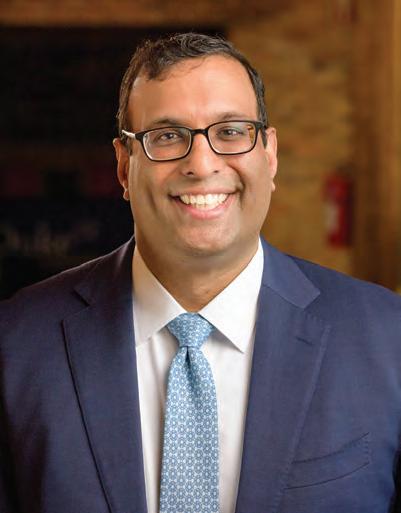
Carolyn Neo CEO at the Institute of Banking and Finance Singapore
Sco D Anthony The upside of the unknown
AI agents A new wave of transformative technology
Iconic companies Fall back in love with work
The trouble with tari s Insights from The CFO Survey
Strategies to thrive in an unpredictable world PLUS The Big Interview
Lead through uncertainty
THRIVING IN THE AGE OF CHAOS
“This book is essential reading for any leader who is serious about breaking free from legacy thinking. If you want your organization to continuously evolve and thrive, you need to stop being afraid of disruption and start seeing it as the opportunity it is. The Antifragile Organization perfectly captures that shift.”
KEVIN NOLAN, President & CEO, GE Appliances, a Haier company
“The Antifragile Organization explains why top-down command-and control businesses cannot survive in today’s world and describes the kinds of dynamic organizations that are able to navigate the unending change that lies ahead. The book’s diverse examples and well explained principles make it a useful resource for anyone interested in the future of business.”
AMY C EDMONDSON, Novartis Professor of Leadership, Harvard Business School, and author of Right Kind of Wrong: The Science of Failing Well
“In The Antifragile Organization Janka Krings-Klebe and Jörg Schreiner take challenging, complex and abstract concepts and make sense of them in a truly compelling way. Their insights are backed by in-depth and highly practical examples from some of the world’s most progressive organizations. If you are simply interested in organizations or wrestling with managing in complex global corporations, this is required reading.”
STUART CRAINER, Co-founder Thinkers50
Print edition: ISBN 978-1-915951-87-8 Published by LID Publishing (
Available through all good book retailers | E-book edition: ISBN 978-1-915951-88-5 www.lidpublishing.com)
Through the fog
Uncertainty aversion – also known as ambiguity aversion – is well established in decision theory. Distinct from risk aversion, it describes the instinctive preference for situations where we can quantify the likelihood of different outcomes, as opposed to those where the probabilities of different outcomes are unknown – or, indeed, unknowable.
Unfortunately, today’s business environment carries plenty of unknowable risks. Rising geopolitical tensions spark into outright conflict overnight. Climate change and environmental degradation continue unabated. Markets shift in the blink of an eye. Digital technology has been a huge driver of change – and now AI is slamming its foot down on the accelerator.
Those trends test leaders like never before. So how can leaders navigate this unpredictability?
Fortunately, this issue of Dialogue has answers. Turn first to Scott D Anthony (p16). He sets out three practices to help leaders hasten the transformation of their businesses: rethinking time, destroying to create, and failing to succeed. They are, as he writes, good things to do in stable times – and indispensable today.
Next, dive into our article by Sharique Hasan (p20), associate professor at the Fuqua School of Business at Duke. Leaders need to create opportunities to test ideas, refine them, and scale up those that work best – because the organizations that win in an uncertain world are those that learn continuously as conditions evolve, he writes.
Meanwhile, Duke CE’s chief executive, Sharmla Chetty, addresses a topic that has moved up the C-suite agenda in recent months: how can organizations cut costs effectively? She argues for a new approach to downsizing: one that is purposeled, growth-focused and deeply humane (p24).
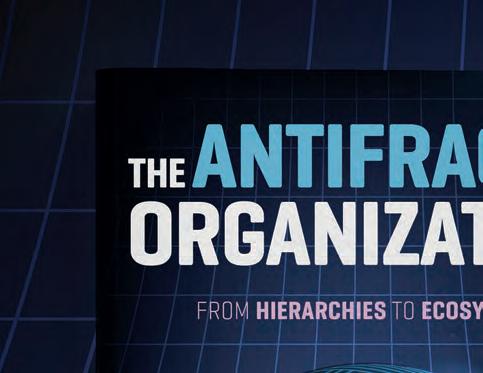
Our Focus section is rounded off by three more great features. Janka Krings-Klebe and Jörg Schreiner warn that traditional approaches to strategy, governance and leadership are reaching their limits, and explore how organizations can
embrace the unexpected (p26). Mau Espinosa focuses on the challenge of guiding teams through uncertain times, urging leaders to consider logic, emotions and tactics together (p28). Finally, Nick Smallman and Dan Parry highlight the toll that ambiguity can take on individuals, and set out ways to embed wellbeing in organizations (p32).
Plus, for an expert view on how uncertainty is playing out in the US economy in 2025, don’t miss our depth interview with Fuqua professor John Graham, who shares insights from The CFO Survey. The trouble with tariffs, he explains, is not just the tariffs themselves: it’s the uncertainty that surrounds them (p58).
Elsewhere, we have two viewpoints on the rise of agentic AI – that is, AI that can independently complete tasks for us, not just run analyses or generate content. Its implications could be even more dramatic than the emergence of the internet itself, writes Terence Tse (p50). The theme is picked up by Tom Sykes, who assesses the strategic quandary for businesses that have developed models based on customer experience. What happens when customers stop showing up? (p78)
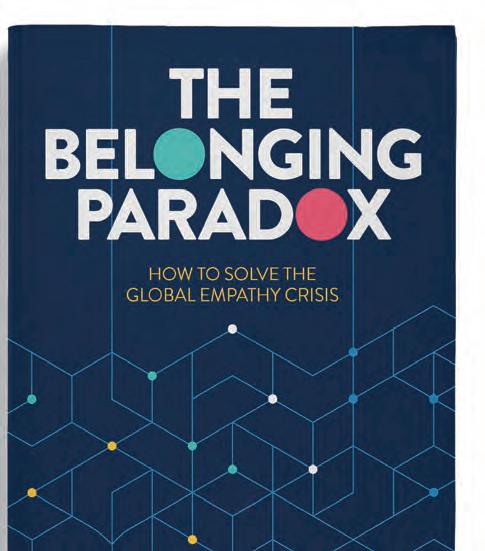
And don’t miss André Martin and Mark Fitzloff on iconic companies that help employees fall back in love with work (p66); Danny Gal’s analysis of the challenge of nurturing a sense of belonging at work at a time of division and polarization (p40); or Camilla Kring’s call for organizations to pay more attention to our natural biorhythms, to ensure employees are performing at their peak (p42). Enjoy the issue.
Today’s business environment carries plenty of unknowable risks
Patrick Woodman is editor of Dialogue
Dialogue is brought to you by:
LID Business Media
Editor Patrick Woodman
patrick.woodman@lidbusinessmedia.com
Creative director Kate Harkus
Chief subeditor Luisa Cheshire
Editor-at-large Ben Walker
Publisher Martin Liu
Associate publisher Alec Egan For advertising sales: alec.egan@lidbusinessmedia.com
Duke Corporate Education
Chief marketing o cer
Christine Robers
Publisher
Published in the United Kingdom by LID Business Media Ltd, LABS House (5.12), 15-19 Bloomsbury Way, London WC1A 2TH
Disclaimer
Copyright 2025 by Duke Corporate Education and LID Business Media Ltd. All rights reserved. Material may not be reproduced without permission of the publisher. While we take care to ensure that editorial is accurate, independent, objective and relevant for the readers, Dialogue accepts no liability for reader dissatisfaction rising from the content of this publication. The opinions expressed or advice given are the views of individual authors and do not necessarily represent the views of Dialogue. This journal is also supported by Knowledge Partners, including Duke Corporate Education as Lead Knowledge Partner. Whenever an author is related to a Knowledge Partner it will be noted as such. Dialogue takes every e ort to credit photographers but we cannot guarantee every published use of an image will have the contributor’s name. If you believe we have omi ed a credit for your image, please email the editor. Cover image Shu erstock
ISSN 2053-4361
Printed by Paragon www.paragon.world
A ma er of time Why chronoleadership can create a
Stepping in Know when to intervene,
Siang on the abundance mindset
DORIE CLARK
Wall Street Journal bestselling author of The Long Game and executive education faculty of Colombia Business School
WHY RECOGNIZING AND ACCOMMODATING CHRONODIVERSITY COULD BE A BOON FOR BOTH EMPLOYEES AND EMPLOYERS FOR BOTH EMPLOYEES
THOMAS WEDELL-WEDELLSBORG author of What’s Your Problem?
“The best companies want to tap into the full potential of their employees – and that means recognizing the unique needs of morning and evening people. Chronoleadership revolutionizes the way we create inclusive work cultures and equips leaders with strategies for embracing a diversity of chronotypes to improve health, productivity and overall wellbeing in the workplace.”
“With this manifesto against our culture’s time tyranny, Camilla Kring points the way to a brighter future: one where employees flourish, students learn more, and society becomes just a little bit more human. Can we get this revolution started now, please?”
“A must-read for anyone interested in unlocking the full potential of their workforce.”
ALEX WUERFEL Executive Coach and former Vice President at AbbVie Inc.
Contributors
Sharique Hasan
Scott D Anthony
A clinical professor at the Tuck School of Business at Dartmouth College, where he focuses on the adaptive challenges of disruptive change. Anthony’s latest book – his ninth – is Epic Disruptions: 11 Innovations That Shaped Our Modern World (Harvard Business Review Press). Thinkers50 named him the world’s ninth most influential thinker in 2023, and the world’s leading innovation thinker in 2017.
Focus p16
An associate professor of strategy at the Fuqua School of Business at Duke University and an associate professor of sociology (by courtesy). Hasan’s primary research uses experiments and big data to study the entrepreneurial process and innovation, and their social and community implications. He is deputy editor for Organization Science, and he writes about innovation and organization at Superadditive.co. Focus p20
Sharmla Chetty
Chief executive of Duke CE and its former president of global markets.
Dr Chetty is a visionary driven by one purpose – transforming organizations and society through leadership. She was previously head of human capital development at Nedbank for over 19 years and has a proven track record of driving transformation through leadership in a wide range of industries. Focus p24
Todd Irwin
Founder and chief strategy officer of Fazer, a global brand strategy firm that helps companies thrive in brutally competitive markets, and the author of De-Positioning: The Secret Brand Strategy for Creating Competitive Advantage (LID Publishing). He has used the de-positioning model to help Fortune 500s and disruptive startups turn customer pain into competitive advantage. Strategy p70
Janka Krings-Klebe
A leading strategy expert in Industry 4.0, and co-author with Jörg Schreiner of The Antifragile Organization: From Hierarchies to Ecosystems (LID Publishing). In 2016, she co-founded Co-shift, supporting organizations in digital transformation. Previously at Bosch, she led digitalization initiatives, crafting corporation-wide strategies and mentoring leaders. Focus p26
Join the Dialogue
Camilla Kring
Founder of Super Navigators, helping organizations create flexible, inclusive work cultures that accommodate different chronotypes and family structures. Kring is the author of six books including Chronoleadership: How to Create Healthier and More Productive Rhythms in Your Work and Life (LID Publishing). Leadership p42
Dialogue Digest
A quick look at the key themes and topics covered in this issue
The human dimension
Cost-cutting is back at the top of the agenda. Duke CE’s Sharmla Chetty outlines a new paradigm for leaders to navigate those di cult decisions (p24). Mau Espinosa explains why logic, emotions and tactics all play a part in leading teams through unsettling changes (p28).
Thrive through uncertainty
Unpredictability is here to stay. Organizations need to adapt by accelerating their dual transformations: reinventing today’s business while creating tomorrow’s growth engine, explains Scott D Anthony (p16). Sharique Hasan of the Fuqua School of Business, meanwhile, explains how embedding a comprehensive approach to experimentation enables organizations to make better strategic decisions – and grow faster (p20).
Brand loyalty
AI levels up
Business and society will be transformed by the rise of AI agents capable not only of analyzing and reasoning, but of doing, writes Terence Tse (p50). It’s a significant strategic problem for business models based on customer experiences, as Tom Sykes explains (p78).
The power of great brands to inspire employees is too often overlooked. André Martin and Mark Fitzlo explore what we can learn from iconic brands about how to help employees fall back in love with work (p66). Todd Irwin challenges the orthodoxy that brands need to stand out as unique in the marketplace. Forget di erentiation: marketing leaders win by de-positioning their rivals, via a singular focus on customer needs (p70).
Make space for a crisis
Strong organizations prepare for things that rarely happen
Thirteen was an unlucky number for NASA. The thirteenth flight of the Apollo moon landings program never reached its destination: an oxygen tank exploded onboard, rendering the craft incapable of sustaining the lives of its three-man crew or returning them safely to Earth.
Yet, somehow, the story had a happy ending. Nasa had long pondered what might happen if the spacecraft failed. Via simulations and planning exercises, its scientists tested whether the lunar module – the unit used to transport two astronauts from the orbiting mothership to the moon’s surface – could be used as an emergency backup. They concluded that it could, dubbing this the “lifeboat scenario.” Nobody ever expected it to be used. It was a remote contingency; a just-in-case strategy should calamity strike.
The rest is history. Calamity did strike. The backup brought all three astronauts safely back to Earth. Ever since, the Apollo 13 ordeal – and the contingency planning that remedied it – has served as a high-octane example of a more mundane truth: strong, resilient, successful organizations spend much time, money, energy and brain power on preparing for things that mostly never occur.
I was struck recently by the comments of Kate Grussing, managing director at Sapphire Partners, at Duke Corporate Education’s Lead with Her conference. Grussing introduced her three Cs: contingency, communication and capacity.
Clear communication is rarer than it should be in business; but at least the case for it is generally accepted. Grussing’s other two Cs – contingency and capacity – are much harder to promote. Contingency, because normalcy bias is the natural human condition – we are hardwired to doubt that the unlikely will happen. Spending vast resources preparing for a pitfall we likely never encounter can be a hard sell to the business. The challenge for capacity is greater still. Equipping for a crisis,
Normalcy bias is the natural human condition – we are hardwired to doubt that the unlikely will happen
the unknown or uncertain, means deploying people and revenue into facilities that may never be needed. Many organizations are under pressure to cut costs (see p24). The ever-present demand for efficiency – doing more for less – makes any latency look like waste. If an organization holds capacity that is rarely or never deployed, why bother with it at all?
That attitude works brilliantly, until it doesn’t. The global financial crisis (GFC) in 2008 was the curtain-raiser for a prolonged era of worldwide volatility that has persisted to this day. Normal no longer means stable; the standard position for organizations is uncertainty. Expecting the unexpected is key to business success.
Many of the banks that failed during those dark days collapsed because they failed to prepare for a crisis. At least two of Grussing’s three Cs were lacking: organizations lacked the capacity to absorb a shock, and shock soon became a contagion. Those with more financial slack – capacity – survived. In the good times, analysts might have deemed that latency wasteful. Yet in the bad times, it was the crucial buffer that helped the organization shrug off a crisis.
Dr Sharmla Chetty is chief executive of Duke Corporate Education
In his book Failure Is Not an Option, Gene Kranz, the man who directed NASA Mission Control to save the Apollo 13 crew, wrote: “Spaceflight will never tolerate carelessness, incapacity and neglect.” The same is true of more earthly pursuits: in volatile times, contingency and capacity are even more crucial to business success.
THE KEY TO TURNING IT
“In The Belonging Paradox, Danny Gal offers powerful methods for bridging divides in our increasingly polarized world. Drawing on his extensive work, he reveals that transformative connection is only possible when we develop the capacity to see the human behind the perceived enemy –a skill that feels more urgent than ever.”
PROFESSOR DANIEL L. SHAPIRO
Author of Negotiating the Nonnegotiable and Founder and Director, Harvard International Negotiation Program
“In this important book, Danny Gal distils decades of work building empathy, showing that building trust with the ‘other’ is not a task limited to saints but a practice that all of us can – and must –take up if our world is to survive.”
DOUGLAS A. JOHNSON
Lecturer in Public Policy at Harvard Kennedy School and former Faculty Director of the Carr Center for Human Rights Policy
“Danny Gal explores the empathy crisis at the heart of global challenges, revealing how disconnection fuels polarization and systemic breakdowns. He presents a compelling call to reclaim democracy and cocreate models of collective belonging rooted in empathy, deep listening and generative leadership. A vital guide for changemakers, this book provides the tools to shape a more inclusive and just future.”
OTTO SCHARMER
Senior Lecturer, MIT School of Management, author of Theory U and Co-founder of the Presencing Institute
Risk and reward
Embracing uncertainty can improve innovation – and leadership
When the neuroscientist Joseph LeDoux studied the amygdala, a part of the brain that processes emotions, he discovered an important truth: it can detect potential risk before the cortex – the rational, ‘thinking’ part of the brain – has time to analyze the situation. That’s why we might leap in fright when we encounter a harmless stick lying on the forest floor: the amygdala triggers a fear response. It is a stick. But it could have been a snake.
Our brains are hardwired to fear. Our propensity for alarm is derived from past experiences: the potential for loss; the proximity of danger. Yet the greatest leaders are those that have been able to overcome the fear of the unknown or the uncertain, and embrace the world as it evolves.
Consider the great explorer Ernest Shackleton. In October 1914, his crew of 27 men (and one cat) set sail from Buenos Aires to what was to be the final port of call for his ship Endurance – Grytviken, a hamlet on the island of South Georgia. From there, she began her doomed voyage to the Antarctic coast. The remarkable thing about the story is not that Endurance was crushed amid the ice – this was the age of exploration and maritime accidents were commonplace – but that Shackleton’s extraordinary leadership led all his men to survive.
Shackleton’s honesty about the risks involved, his willingness to accept them and – crucially –share in them fostered morale and team spirit. It advanced a crucial sense of followership: crewmen dubbed him “The Boss.” Amid the privations and peril, Shackleton and his crew innovated remarkably – camping on sea ice until it drifted close enough to a remote island to deploy lifeboats. Shackleton and five men then completed a daring voyage via open vessel to a whaling station on South Georgia to seek help – and eventual rescue. In business, the conditions may appear less harsh, yet the taking of risk can save many more
The greatest leaders are those that have been able to overcome the fear of the unknown or the uncertain
lives. The billionaire biotech entrepreneur Kiran Mazumdar-Shaw began her career by training as a brewmaster – a gamble given the pervading attitudes to women in brewing at the time. After spells working as a brewer in Australia, Mazumdar in the 1970s launched Biocon India from the garage in her house in Bengaluru, with just 10,000 rupees ($120) in seed capital.
Mazumdar’s youth and sex led to prejudices. Few trusted her ambitions. Recruitment was difficult – her first employee was a garage mechanic. Only a chance meeting with a financier led to her securing investment. India in the 1970s was a tough place to launch a biotech: access to clean water and uninterrupted power were daily challenges. Yet the experience was transformative. By taking on a project in such difficult conditions Mazumdar learned quickly about the need for – and opportunities in – affordable healthcare, accessible to populations in the less developed world. It is unlikely such life-changing innovation would have been achieved had she founded her business in a less hazardous environment. Like many sectors, pharmaceutical firms’ natural inclination is towards safety, not risk – secure, stable and scalable.
In his final book, The View from Ninety, the late, great business philosopher Charles Handy proposes that risk is imperative to invention, and thus business itself: without uncertainty, innovation would be unnecessary.
Handy was right. Fear is the key: a risky world is one ripe for discovery.
Vishal
Patel is president of global markets at Duke Corporate Education
For 25 years, Duke Corporate Education has partnered with organizations across the globe to meet defining moments — and shape what comes next. We don’t deliver off-the-shelf answers. We co-create learning that is custom designed for the challenges organizations face. Whether navigating disruption, building future-ready leadership, or transforming cultures, we walk alongside our clients to fuel purposeful business change — across the globe, at every level.
At the heart of every transformation is a partnership — and every partnership, a story. Let’s shape the next chapter, together.
25 Years of Accelerating Leaders and Sustaining Organizational
ISSUE’S FOCUS
Leading through uncertainty
The business world is more unpredictable than ever. Technological transformation is gathering pace; disruptive threats emerge overnight. From geopolitical shifts to the climate crisis, external factors are reshaping the global economy. Uncertainty can be debilitating – but businesses can’t afford to drift. How can leaders ensure that their organizations forge ahead confidently, making smart decisions as they confront the unknown?
In the Focus section of this issue of Dialogue, we consider how organizations can accelerate their transformations to be ready for whatever the future brings. How can leaders seize the advantages conferred by experimentation? How can cuts be aligned with purpose to drive future growth while respecting their human impact? We reflect on the need to invest in employee wellbeing, and further ask: how can organizations plan effectively in a rapidly changing world?
absorbent, comfortable diapers, P&G struggled to find a price point that worked with consumers.
So in 1962, the development team sought to make sense of the data it had collected. The product seemed to work and consumers seemed to like it – just not enough to justify the 10% per diaper premium pricing.
“We didn’t have any valid scientific research methods for determining consumer price/ volume elasticity,” P&G research scientist Henry Tecklenburg noted in a 1990 retrospective. The team probed consumer pricing attitudes, in what one participant described as an “off-the-wall fishing trip,” and came up with a target price. “With a precision completely unjustified by the scantiness and spread of the data, we established the organizational goal of 6.2 cents per diaper,” recounted Tecklenburg.
Hitting that price point required fundamentally rethinking the manufacturing process. It meant P&G had to shift distribution to more mass-market channels that could live on lower margins. It changed everything.
The upside of uncertainty
The climate has shifted: uncertainty is here to stay. But three critical practices can help your organization adapt
Writing Scott D Anthony
Step back to 1962. A small team at Procter & Gamble faced a critical challenge: how to successfully market a high-quality disposable diaper.
Research and development had started back in 1956 when Vic Mills, leading P&G’s Exploratory Developments Division, had tasked Bob Duncan with creating a disposable diaper. At the time, 80% of American homes had a disposable diaper – but poor quality relegated them to emergency use only.
Duncan’s idea was to create a high-quality solution that could be priced at a substantial premium. The first tests failed due to poor product quality. Yet even when scientists cracked the code of
Todayʼs leaders confront uncertainty that verges on utter chaos
P&G took bold action in an uncertain environment: recall that 1962 saw the war in escalating, and the existential threat of the Cuban Missile Crisis. The company maintained its effort despite geopolitical uncertainty, product development struggles and even failures in test markets – setting it on a path to ultimately take more than 90% of the disposable diaper market by the early 1970s. Its Pampers brand went on to be the first in P&G’s history to register more than $10 billion in annual sales.
The challenge of uncertainty
Today’s leaders confront uncertainty that verges on utter chaos. In early 2025, AlixPartners reported that two-thirds of chief executives reported experiencing substantial disruption.
There’s a seductively simple answer to the challenges of disruptive change, detailed in Dual Transformation, the 2017 book I co-authored with Clark Gilbert and Mark Johnson. In the face of disruptive change, companies should simultaneously reinvent today’s business (transformation A) and create tomorrow’s growth engine (transformation B). Companies ranging from Adobe to Walmart have shown how dual transformation can flip disruption from a threat to an opportunity.
Yet following this seemingly straightforward prescription is harder than it looks, especially when uncertainty spikes. It’s natural – indeed, hardwired in humans – to avoid uncertainty. Psychologists call this the status quo bias (we prefer things to stay the way we are), or the uncertainty effect (we dramatically undervalue risky prospects).
A further challenge is that the smartest, most successful people can struggle with change because they have to unlearn before they can learn. Consider an experiment by Destin Sandlin, host of YouTube channel Smarter Every Day. He asked a welder to change his bike so that when he turned the handlebars right, the bike would go left, and vice versa. How hard could it be, Sandlin wondered, to learn to ride the backwards bike?
Very hard, it turns out. Just try explaining how to ride a bike: you likely learned when you were young and now do it fully unconsciously. To learn how to ride a backwards bike, you have to first unlearn how to ride a normal bike.
Sandlin’s first ride went nowhere. It took him eight months of practicing, five minutes a day, before he could ride the backwards bike. When he got back on a normal bike, he had to re-remember how to ride it – though fortunately this only took 20 minutes. Interestingly, it took his six-yearold son, who had less to unlearn and the higher neuroplasticity that comes with youth, only two weeks to learn how to ride a backwards bike.
In a seminal 1991 Harvard Business Review article, ‘Teaching Smart People to Learn,’ Chris Argyris noted that most leaders lack Sandlin’s ability to persist through such painful unlearning. “Put simply, because many professionals are almost always successful at what they do, they rarely experience failure. And because they have rarely failed, they have never learned how to learn from failure,” Argyris noted. When they do fail, “they become defensive, screen out criticism, and put the ‘blame’ on anyone and everyone but themselves. In short, their ability to learn shuts down precisely at the moment they need it the most.”
Here’s what happens when leaders face uncertainty. Uncertainty leads to conservatism. Conservatism feeds constraints. Constraints lead to a polarizing choice: protect the present or bet on the future? The natural choice is to reduce focus on innovation and growth, and instead cut spending, hunker down and prepare to weather the storm.
Leaders don’t face a one-off storm, however. They face a shift in climate.
Practices for our new reality
Like it or not, we are in the forever normal of predictable unpredictability. Thankfully, three practices can improve the chances of finding the upside of uncertainty.
Practice #1: Rethink time
In the midst of uncertainty, it’s easy to narrow our focus to the here and now. Leaders instead need to dramatically expand their sense of time, simultaneously considering the distant past, the present reality, and the far future.
Leaders need to dramatically expand their sense of time, simultaneously considering the distant past, the present reality, and the far future
That’s exactly what Masahiko Uotani did when in 2014 he became chief executive of Shiseido, a cosmetics firm based in Japan. Uotani was the first outsider brought in as CEO in the company’s then 142-year history. He launched a comprehensive transformation effort that changed the company’s portfolio of products, structure, culture, and even spoken language (from Japanese to English).
Academic research shows that change that threatens an individual’s identity can be particularly challenging. To combat this challenge, Uotani deftly drew on Shiseido’s origins as a company where East meets West, and beauty means science. He could then say that while it felt like everything was changing, in fact the essence of Shiseido would remain intact.
Uotani simultaneously described how the strategy set the foundation for Shiseido’s growth for the next 100 years. Expanding the horizon helped to clarify the key decisions.
Norio Tadakawa was the chief financial officer in the early stages of Shiseido’s transformation. “We spent a lot of money,” he said. “Hundreds of billions of Yen.
“In a sense, it was simple to make these investment decisions because we are here to build the foundation for the next 100 years. The long-term view enabled this simple and quick decision-making.”
Uotani integrated all of this into a set of practical steps to drive growth and performance. Over the next five years Shiseido surged. While the pandemic proved deeply challenging, the foundation set by Uotani positioned the company to continue to perform.
Practice #2: Destroy to create
In 2010, Mark Parker was early into what was to be a hugely successful run as CEO of Nike. At a conference that year, he described receiving a congratulatory call from the legendary Steve Jobs. Parker asked for advice. At first, Jobs resisted, saying he was just calling to offer his congratulations. Parker pushed, and Jobs relented.
“‘Nike makes some of the best products in the world,’” Parker recalled Jobs telling him. “‘Products that you lust after. Absolutely beautiful, stunning products. But you also make a lot of crap. Just get rid of the crappy stuff and focus on the good stuff.’”
“I expected a little pause and a laugh,” Parker told his audience. “There was a pause but no laugh. He was absolutely right.”
The mythology of Steve Jobs centers on ‘Jobs the Creator,’ who took Apple to new heights with the introduction of the iPod, iPhone, iPad and the App Store. We forget that what enabled this was ‘Jobs the Destroyer.’ When Jobs returned as Apple’s CEO in the late 1990s, his first act wasn’t to create new products and services: it was to winnow down Apple’s product portfolio to create capacity to innovate and grow.
Get rid of the crappy stuff and focus on the good stuff. It sounds so easy. But it can be painfully hard for a company to stop a project that has champions and supporters, and even harder for it to shed a part of the business that is part of its heritage.
Take Intuit, which decided in 2015 to sell off its Quicken product. When Scott Cook cofounded the company in 1983, Quicken, which allows individuals to manage their finances, was the company. But things changed. As then-CEO Brad Smith explained in 2015: “It’s one of the most iconic brands out there, but it’s 2% of our revenue and the customer base hasn’t grown for 20 years. It is just an incredibly loyal customer base, and it solves an important problem for a small group of people, and we want to go out and solve big problems that aren’t getting solved well.”
Over the next eight years Intuit’s stock price grew by close to 30% a year. Letting go creates capacity to do new things.
Practice #3: Fail to succeed
In 2024, tennis legend Roger Federer addressed the graduating class of Dartmouth College. He told the class that, while he won 80% of the singles matches he played, he only won 54% of the points he played. Think about that. One of the greatest players of all time was barely better than a coin flip for any given point.
One key to success, Federer said, was learning to cope with near-constant failures. “The best in the world are not the best because they win every
point,” he said. “It’s because they know they’ll lose, again and again, and have learned how to deal with it. You accept it. Cry it out if you need to, then force a smile. You move on. Be relentless. Adapt and grow.”
Get rid of the crappy stuff and focus on the good stuff. It sounds so easy. But it can be painfully hard for a company to shed a part of the business that is part of its heritage
Think back to the Pampers story: the team failed. The story is not an exception. In 1985, Henry Mintzberg and James Waters framed the challenge elegantly with their Strategic Management Journal article, ‘Of Strategies, Deliberate and Emergent.’ A deliberate strategy, they wrote, involves studying, planning, and acting. Do careful analysis. Talk to experts. Build forecasts. Align key stakeholders. And then execute. This works, Mintzberg and Waters noted in an environment that is “perfectly predictable, totally benign, or under the full control of the organization.”
That’s not today’s world. Leaders today need to embrace an emergent strategy, which involves accepting that you can’t know the right strategy from day one. Test, learn and adjust. The approach is not undisciplined; it is just a different discipline. Do your homework, but focus less on the answers and more on the assumptions behind success. Find the most critical ones. Experiment. Learn how you are wrong. Adjust. Once the right strategy emerges, pounce on it, shut down the experimentation and execute.
It’s easy to connect emergent strategy to the mantra of “failing fast” – yet an important distinction applies. As Harvard’s Amy Edmondson notes, some failures are preventable; someone was sloppy, or didn’t do their homework. Such failures should be punished. The contrast is with when someone scientifically experiments to address uncertainties that couldn’t be addressed any other way. If they learn their hypothesis was wrong, we have to call it a failure, but it is an intelligent one that generates useful learning.
The upside of uncertainty
Scott
D Anthony is clinical professor of business administration at Tuck School of Business, Dartmouth, and author of Epic Disruptions (Harvard Business Review Press)
Historical research into innovation during tough times (summarized in my 2009 book The Silver Lining) produced two findings that remain relevant today. First, history shows that disruptive innovations thrive in challenging market conditions like the ones we face today. In the early days of the Covid-19 pandemic, I said that research suggested watching Box, DoorDash, Grab, NuBank, Palantir, and Square. Today, those companies are worth close to $500 billion. Second, the upside to tough times is that scarcity forces leaders to follow practices that they should have been following already. Integrating the past, present and future. Making smart choices to prune the portfolio. Running smart strategic experiments.
Good things to do in stable times; indispensable in uncertain times. As they say, never waste a good crisis.
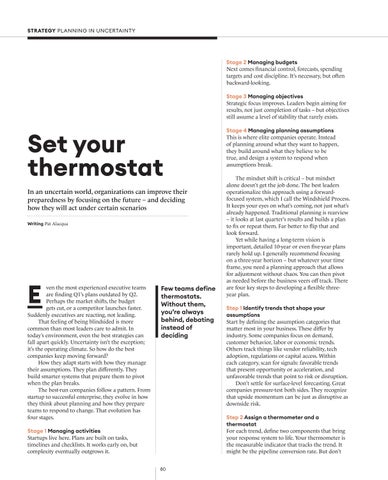
paths. Technological shifts, institutional disruptions and evolving norms frequently move faster than the frameworks used to anticipate them. This often means that standard methods for generating strategic clarity tend to lose their effectiveness, just when clarity is most important.
Today, organizations face a different task. Rather than attempting to forecast the future, they may need to develop strategies for working with ongoing uncertainty. One approach involves shifting the organization’s emphasis toward learning rather than planning. Formal systems built around effective learning can help organizations respond more intentionally to conditions they cannot predict. Organizations can observe changing patterns, generate outcomes and make adjustments without requiring a rigid view of the path ahead.
The experimental organization
To lead effectively through strategic uncertainty, harness the power of experimentation
Writing Sharique Hasan
In today’s uncertain environment, strategy built on forecasts and historical patterns often loses reliability. Economic instability, geopolitical shifts, and accelerating technological transformation cloud the road ahead. The fog of the future obscures what once felt predictable.
Yet strategic planning often begins with the assumption that foresight can help us bring uncertainty under control. This may be true in stable environments, but today’s world is shaped by forms of change that do not follow predictable
The experimental organization harnesses the power of experimentation to learn faster
Within this type of framework, formal experimentation has a critical role to play. It creates a system for navigating ambiguity through structured inquiry and execution: allowing organizations to test their assumptions, gather evidence and refine their actions as their circumstances evolve. The experimental organization harnesses the power of experimentation to learn faster, adapt earlier and respond more strategically to a fast-changing world.
Causal inference in organizations
Learning from experience requires more than collecting data and measuring outcomes. It depends fundamentally on understanding what factors caused those outcomes. Causal inference helps distinguish between patterns shaped by underlying mechanisms and those that reflect noise.
For organizations operating in complex environments, this distinction matters. Without it, decision-makers may act on patterns that appear meaningful but lack any empirical basis. Choices built on spurious patterns often prove unstable, difficult to interpret and costly. However, in the absence of causal evidence, strategy tends to follow narrative and intuition. These may align with prior beliefs and mental models, or offer tidy explanations, but they are often shaped more by inertia than by evidence. When organizations act on anecdotes or beliefs, they can do so with confidence and still fail. These missteps often reduce the chances of learning over time.
In contrast, experiments offer a more disciplined approach. An experiment begins with a hypothesis, imposes contrast between conditions, and relies on measurement to assess outcomes. Each aspect of the experimental process serves a purpose: to quantify effects, support inference, and enable the revision of beliefs based on new evidence. What results from rigorous
experimentation is a clearer account of why some actions work and others do not – and what direction is the most promising.
That’s why experimentation has become routine in many organizations. Many digital platforms have institutionalized large-scale testing to inform design and operations, while in policy and medicine, randomized trials shape decisions that impact the health and wellbeing of millions. These examples suggest that systematic causal inference is possible when it is embedded in practice within organizations.
From running an experiment to experimentation
Individual experiments can yield useful insights. However, their value increases when experimentation becomes part of the organization’s regular practice. One-off tests may clarify short-term questions, but they do little to drive institutional learning. In contrast, a systemic emphasis on experimentation integrates the testing of new ideas into ongoing decision-making. This approach treats experimentation as a core and strategic capability – one that supports continuous
trials on all decisions, large and small. Over time, it fosters learning processes that are distributed, continuous and adaptive.
In experimental organizations, failure is neither avoided nor exceptional. The purpose is to expand the organization’s ability to learn across variation. Value does not come from isolated wins, but in the patterns revealed across multiple trials – potentially thousands of them. As results accumulate, the organization builds a broader understanding of which conditions shape outcomes, and which assumptions need refinement.
Experimentation contributes to two aims: confirming prior expectations and uncovering new opportunities. Through structured testing, existing beliefs can be examined and refined. At the same time, unexpected outcomes reveal overlooked variables or open new directions. These uses of experimentation – validation and discovery – work in parallel. When sustained over time, they increase the range of what the organization can learn and incorporate into its models of action.
The impact of experimentation deepens when findings, both successes and failures, are documented. Records of past tests – what was tried, what happened, and in what setting – create an archive of practical knowledge. This provides a resource for recognizing patterns and generating new questions, and means future decisions can be based on more than immediate judgment.
As experimentation becomes more integrated into an organization’s strategy, the quality of decisions begins to shift. Judgments reflect tested knowledge. Actions align more closely with actual business conditions. Strategic learning becomes less reactive and more deliberate.
Experimentation works
There is increasingly strong evidence that structured experimentation is linked to performance gains. A recent study I conducted with
THE BRIEFING
Through structured testing, existing beliefs can be examined and refined
Rembrand Koning of Harvard University Business School and Ronnie Chatterji at Duke’s Fuqua School of Business (2022) studied the performance trajectories of over 35,000 early-stage ventures. We found that firms using A/B testing grow faster and introduce new products quicker, leading to more rapid scaling (and faster failures, too).
Our findings suggest that experimentation functions as more than a technical tool. It enables a flexible approach to decision-making in settings defined by uncertainty and change. By generating and testing alternatives systematically, organizations can improve both learning speed and decision quality, even when information is incomplete.
Booking.com exemplifies the approach. It runs thousands of experiments at any given time, evaluating every idea, including those from executives, on the basis of measured results. The accumulated insights inform interface design refinements, pricing strategy, and user flow improvements. Yelp has also adopted structured testing, achieving improvements in various parts of its business. Microsoft conducts over 100,000 experiments per year, using a centralized platform to support decentralized innovation across products.
Part of experimentation’s value lies in how it provides a feedback loop. Tests produce early data that inform next steps, reducing exposure and allowing for directional changes before larger commitments are made. This removes the need for precise prediction and replaces it with structured iteration. Over time, it enables organizations to take bigger bets, because risks are mitigated through earlier experiments that give decisionmakers a sense of what to expect.
The four pillars of experimental organizations
How can leaders embed experimentation in their organizations? There are four pillars to consider.
The strategic challenge
Traditional strategic planning often starts with the assumption that organizations can reduce the uncertainty they face – but in today’s environment, that’s increasingly untenable. Experiments that yield data on what works can help leaders navigate this uncertainty, but their power is only fully realized when organizations go further and commit to a strategic approach based on experimentation.
The experimental organization
There are four pillars of a successful approach to experimentation. First, technology and technique: standardized platforms are essential for causal reasoning. Second is human capital: does your organization have the right people? Organizational design is key to support experimentation across teams. And finally, leadership is essential: leaders need to ask for evidence – and listen to it.
Technology and technique Sustained experimentation requires infrastructure that supports both rigor and scale. Centralized platforms can standardize test design, execution and analysis, reducing redundancy and supporting a shared procedural language. The validity of experimental results depends on data that is reliable, relevant and structured in ways that support causal reasoning. Without this foundation, testing becomes either unreliable or inefficient.
Human capital Experimental capacity depends on having the right people. As testing becomes a core input to decision making, it calls for roles that integrate technical competence with conceptual understanding. Some employees generate ideas grounded in user experience or operational constraints. Others design the formal tests and interpret outcomes. These contributions often overlap, but the essential task is to support the full range of skills that an experimental organization requires.
Organizational design Effective organizations enable experimentation across teams. Those closer to customers often hold the contextual knowledge needed to generate and refine hypotheses. Decentralization helps surface these insights. At the same time, shared standards and common evaluation criteria allow results to be compared and decisions to be grounded in fairness and consistency. The organization functions both as a collection of local inquiries and as a network for shared learning.
Leadership Leadership shapes the context in which experimentation operates. When leaders ask for evidence and support tests that fail, they signal that experimentation is part of serious decision making. This support becomes crucial when results challenge existing assumptions. If findings are ignored, the information they provide disappears. Leadership also ensures that testing remains focused on priorities that matter. When experiments shape real choices, they become part of how strategy is made.
Strategic discipline
Experimentation delivers the most value when aligned with the strategic aims of the company. Local tests can generate useful findings, but their broader relevance depends on connection to meaningful strategic goals. A more deliberate strategy brings experimentation into contact with areas that affect future direction – testing new markets, discovering unfamiliar user needs, or trailing different business models. When tests are
selected to explore and learn in these spaces, they help the organization extend its understanding of what is possible.
Strategic use of experimentation also requires clarity about purpose. Some tests confirm prior expectations; others uncover new possibilities. Experiments lose value when designed to reinforce existing assumptions. Well-constructed tests can surface outcomes that challenge current views, redirect attention or reveal overlooked variables. Surprise can be a powerful driver of insight.
For learning to take hold, new knowledge must be shared across the organization, moving beyond the team that produced it. Reviews, documentation, and shared reflection allow patterns to emerge across domains. In some cases, results from one setting may inform another. Equally important is the structure of incentives. When rewards emphasize outcomes alone, risk aversion may take hold.
As experimentation becomes more central to the organization, it begins to shape how strategy is formed. Instead of relying on static forecasts, decisions evolve from evidence gathered across a portfolio of bets. Resources shift based on observed effects, not hierarchical power. Over time, this process supports earlier adjustments and sharper alignment with context. Small tests generate insights that accumulate, producing a deeper and more flexible understanding of how the environment works. The result is not just better choices, but a strategic advantage grounded in the capacity to learn.
The power of experimentation
In uncertain environments, strategy depends on methods that support learning. Experimentation provides a structured way to generate feedback, adjust direction and stay responsive. Well-designed tests in organizations where leaders are committed to continuous experimentation support strategic coherence through changing conditions.
Sharique Hasan is associate professor of strategy at the Fuqua School of Business at Duke University.
A fully referenced version of this article is published on dialoguereview.com
The advantage of experimentation lies in consistent learning. It is the capacity to refine action based on evidence gathered over time: small insights accumulate into more effective decisions.
What sets successful organizations apart is not what they know at the start of the journey – but how they learn as conditions evolve.
Cut to grow
As technology transforms business, leaders need to learn how to cut costs while prioritizing future growth – and embodying care for others
Writing Sharmla Chetty
When I speak with chief executives and C-suite leaders in businesses around the globe, one thing is clear. Amid multidimensional global uncertainty and fast, relentless change, an old staple of running a business is once again to the fore. The capability to
control – and reduce – costs has become a strategic priority as organizations seek to ride the waves of change.
In part, this reflects the economic mood. We may not be in a global recession but the varied challenges facing businesses leave executives in no doubt about the importance of bearing down on costs. Many companies face substantial competitive pressures. As agile, innovative, digital-first disruptors with a low cost base challenge existing models, established organizations are compelled to reduce their overheads. Small wonder that 62% of companies are currently taking cost-cutting action, according to PwC research in May 2025.
Yet if leaders approach today’s cost-control imperative in the way that many corporations tackled previous waves of cuts, they will find themselves losing further ground to the competition. As AI transforms business globally, leaders need a new paradigm for cost control.
The new model is tripartite, comprised of a simultaneous focus on costs, care and growth. It means not just sweating the numbers, but setting aside the spreadsheets and focus on the people involved. Change needs to be human-centered; focused on creating resilience against our fractured, unpredictable world; and part of an enduring mindset shift that prizes the ability to learn, adapt and reorient ourselves, as organizations and as individuals. Here are four ways leaders can rethink the approach.
Beware false narratives
Leaders should beware the false comfort that may flow from cutting costs – because the truth is that cost cutting can only take an organization so far. Delivering a budget freeze, hitting a target for reducing head count, or closing down expensive projects may help move a number from red to black on the P&L statement. It may deliver some short term relief from the pressures an organization faces. Yet it is no substitute for the transformational work of leadership that’s needed to create a compelling vision for the future, or to build a human centered, purpose-led culture that can deliver both commercial and societal value. Indeed, the idea that cuts and growth are inherently in conflict is itself a false dichotomy. In reality, cuts can be essential for freeing an organization to focus on what truly matters. Leaders need to shape a new narrative. How are you using cost-control measures to support your longer-term mission?
Align around purpose
To answer that question, purpose needs to be central to the conversation about costs. What does the organization want to become? What capabilities need to be protected or grown? With a clear view of purpose, it becomes easier to see ‘low value’ work for what it is, whether in unnecessary layers of a process or whole activities – or products and services – that don’t align. Target those first and free up capability to do what matters.
Focusing on purpose also means ensuring that meeting short-term pressures doesn’t fatally undermine the organization’s ability to drive growth over the long term. Shutting down innovation workstreams may save dollars today – but at what cost to the business’s future? How do headcount reductions map against the organization’s talent needs?
Be open and caring
One CEO recently told me: “We used to talk about driving results. Now we talk about creating conditions where people can be their best.”
The shift from control to empowerment is a crucial one – yet it’s too often the case that the moment cost-cutting measures come into view, the shutters come down. The office door closes. Employees are frozen out of the conversation.
Leaders are right to be sensitive when jobs are at stake and must act with empathy. Yet that should not mean shutting out people affected by change. Leaders need to be transparent about the business’s position and how it needs to adapt for the future. Involve people in diagnosing the need for change and shaping solutions: given ownership, they will help shape change rather than resist it.
The idea that cuts and growth are inherently in conflict is itself a false dichotomy
Such an approach also leaves the organization in a better place to move forward in its new shape. It protects, and can even reinforce, that most precious of assets, trust – so easily trashed by badly-handled cuts.
Stepping up to lead
The pressures of a cost-cutting environment put a premium on how leaders act. Being present, visible and accessible, is critical. Be honest about the challenge – even about moments of personal vulnerability.
How cuts are handled will be recalled vividly both by those who leave the organization, whose experiences and stories will affect the company’s employer brand – and by those who remain, who may be saying farewell to valued colleagues and friends. Their continued buy-in and discretionary effort are crucial.
The first step on the road
A bold program of cost-cutting may feel like climbing a mountain in tough conditions: difficult, dangerous, and not something to be repeated. But in truth, cost cutting today cannot – and will not –be a ‘one and done’ process. The market dynamics and transformative technologies that drive a focus on costs this year will still be with us next year, and the year after that.
In response, leaders need to adapt their mindset and lean into the task of continually bearing down on costs, building the organization’s resilience and continually reinventing the business for the future.
Yes, cutting costs can mean difficult decisions and uncomfortable conversations. Yet if leaders embrace the situation and grasp the need to reconcile cost management with care for their people and a focus on purpose-led growth, they can thrive.
Dr Sharmla Chetty is CEO of Duke Corporate Education
It is the only way to ensure an organization stays focused on what matters – and remains fit to navigate the pervasive uncertainty that surrounds it.
only preserves but increases its long-term potential in a dynamic world.
Embracing the unexpected
How Singles’ Day rewrites strategy
Rapid and unpredictable change in the business environment creates plentiful opportunities – but seizing them requires a new approach to strategic planning
Writing Janka Krings-Klebe and Jörg Schreiner
How much of your organization’s strategy and leadership truly emerges from contextual dynamics, and how much is still defined by yesterday’s logic?
In uncertainty, strategy can no longer be an annual ritual tied to forecasts and five-year plans. Static playbooks are obsolete. The organizations that thrive are those that let go of the illusion of tight control.
In this environment, traditional approaches to strategy, governance and leadership are reaching their limits. The familiar tools of risk escalation, centralized orchestration of strategies, and incremental optimization of operations are ineffective when markets, technologies and opportunities are constantly changing. What, then, are the new demands on organizations facing such relentless dynamism? In a rapidly shifting landscape, strategy is defined by the ability to swiftly identify untapped and emerging opportunities and mobilize the appropriate capabilities to act on them.
This is not a one-time event but an ongoing conversation with the environment, using every new signal as input for the next strategic move. It places significant new demands on leadership and governance: both need to keep up with the growing business arena, ensuring that the organization not
Traditional approaches to strategy, governance and leadership are reaching their limits
This shift from long-term planning to dynamic sensing and fast learning is at the heart of antifragility. Where legacy companies cling to stability, antifragile organizations embrace the unexpected, knowing that no plan survives first contact with a changing world. Their flexible structure is no accident: an antifragile organization is intentionally designed as a network of many small, autonomous units, each operating independently yet constantly exchanging information – especially about new business opportunities.
This architecture enables strategic flexibility. It pushes decisions and incentives out to the edges of the organization, where people are closest to customers, markets and emerging trends. Here, strategy is shaped and reshaped continuously by those who see opportunity first; not by annual reviews, but by a steady flow of signals, feedback and initiative.
Strategic flexibility, then, is about speed and maintaining a broad portfolio of experiments –options with limited downside and the potential for outsized upside. These strategic experiments are often small at the start, designed to be easy to stop if they fail, but fast to scale if they succeed. Failure is not stigmatized but actively expected, even welcomed as a source of rapid learning. At any given time some teams are in the early stages of exploration, others are probing new niches, and many more are operating at different levels of profitability or maturity.
Not all of them survive, and that’s good: the health of the ecosystem depends on continuous renewal, as unsuccessful ventures make way for new experiments, while the most profitable scale up quickly and draw others in. Successes that emerge are amplified while failing bets are quickly retired, their lessons captured and shared. This dynamic flow keeps the entire organization moving in sync with the market, always adjusting to new realities. The goal is not perfection or stability but hyper-adaptability – the ability to thrive in uncertainty by seizing new opportunities wherever and whenever they appear, often with several independent efforts running in parallel. This evolutionary approach turns uncertainty from a threat into a source of advantage, as the organization learns, adapts and grows stronger with every experiment.
The Singles’ Day shopping event
Nowhere is this dynamic, modular approach more visible than at Alibaba. The company’s business
ecosystem operates as a living network of small, highly autonomous teams, each with the freedom to pursue new opportunities, but always in close communication with the broader organization. These teams are modular by design, able to combine their strengths or reconfigure instantly to tackle bigger challenges. When a new opportunity or market shift appears, teams don’t wait for direction from above: they join forces, swarm the challenge, and dissolve or regroup as soon as the situation changes. This means Alibaba never loses its strategic momentum.
Every year, this adaptability is put to the ultimate test during Singles’ Day, China’s antidote to Valentine’s Day – an unofficial celebration for people who are not in a relationship. Marked on 11 November, it has become a massive, high-velocity e-commerce event – the largest single shopping day in the world.
In the weeks leading up to the event, Alibaba’s network shifts into high gear. Some teams explore new sales concepts, others invent fresh digital experiences, and still others work with external partners to secure supply or launch joint ventures. As customer data and market signals pour in, teams rapidly re-form, integrating new expertise or dissolving if their experiments stall. During the event itself, new needs or problems can trigger
Janka Krings-Klebe and Jörg Schreiner are the authors of The Antifragile Organization: From Hierarchies to Ecosystems (LID Publishing)
the instant creation of a cross-functional team that solves an issue in real time or jumps on an emerging opportunity – sometimes within hours or even minutes. Throughout, information flows freely: every team acts as a sensor, scout and innovator, constantly exchanging insights and feedback across the network.
This relentless, real time coordination allows Alibaba to deliver record-breaking sales and to turn each Singles’ Day into a vast laboratory. Dozens of business models, marketing ideas and digital products are tested, amplified, or quickly abandoned. No centralized plan could ever predict the volume, pace or diversity of what emerges. What matters is that the entire ecosystem is always aligned with customer needs, able to seize and create opportunities as soon as they surface.
Alibaba’s example brings us back to the opening question: how much of your organization’s leadership truly emerges from context and how much is still defined by yesterday’s logic? In a dynamic environment, strategy must focus on quickly recognizing and developing a multitude of untapped and emergent opportunities. It demands a fundamental shift in both leadership and governance, both of which must continuously adapt to match the expanding space for innovation.
Above Shopping Gala posters in Hangzhou, China, for the Singles’ Day shopping event
The LET model
LET stands for logic, emotion and tactics – three leadership lenses that leaders must learn to balance, especially in moments of change. Most leadership models teach us what to do. LET helps you understand how to show up while doing it.
It’s not a sequence. It’s a triad – a mindset, a rhythm. Some days, the moment demands logic: to organize thoughts, challenge assumptions, clarify direction. Other days, you’ll need to lead from emotion: to listen deeply, acknowledge fear, connect with your people. And every day, you’ll need tactical follow-through: actions, not just words.
The human dimension of change
Navigating uncertainty is not just about plans and projections – it’s about people, too
Writing Mau Espinosa
Change no longer knocks on the door. It kicks it open, moves the furniture, and dares you to adapt before lunch.
From post-pandemic resets to digital acceleration, the rise of AI, and generational mindset shifts around work, purpose and identity – change isn’t coming: it’s already here, constant and complex. And while organizations scramble to reimagine strategy, it’s often leaders who are caught in the middle, translating vision, managing uncertainty, holding up morale, and still hitting the quarterly numbers.
Yet in most leadership playbooks, the human side of change gets buried under plans and projections. Leaders need a better compass – a way to navigate complexity that offers clarity, compassion and execution.
Leaders need a better compass –a way to navigate complexity that offers clarity, compassion and execution
But here’s the truth: LET isn’t just a business model. It’s a life model. I see it every day. At work, we might have systems that keep us aligned. But in our personal lives, we often run on emotion, short on logic, with no real tactics. We react instead of lead. And practicing LET isn’t just for leaders – it’s for anyone who wants to stop surviving change and start shaping it.
Leaders who master LET don’t just lead change. They translate it. They create alignment between what the organization needs and how the team experiences it. And in a world spinning faster than ever, that kind of leadership isn’t just valuable –it’s necessary.
How to apply LET during change
In times of change, people don’t just need new plans – they need new patterns. Leaders who practice LET learn to switch between logic, emotion and tactics like a skilled conductor. Here’s how it works in practice.
L = Logic: make sense of the chaos
Logic is the most used – and often the most overused – tool in leadership. Why? Because it offers a sense of control. It makes us feel secure, structured, confident. Logic is powerful because it feels almost unquestionable, especially when backed by data, KPIs, or historical trends. A goal like “35% growth” can sound completely reasonable – even inevitable – when market forecasts and financial models line up behind it. But that’s also the trap. Logic can justify anything. It doesn’t mean the team is ready for it.
What it looks like:
Asking better questions before offering answers
Distilling noise into patterns and priorities
Using tools like ‘five whys,’ root-cause analysis, or simply separating facts from assumptions
Tip: Start meetings by naming what’s known and unknown. Logic grounds the room. It doesn’t kill emotion – it gives it a place to land.
E = Emotion: lead the human experience
Emotion is the heartbeat of leadership. It’s what keeps the business alive – because people are the business, and people are emotional.
If productivity is low and the target is 35% growth, the question isn’t: “Does the KPI make sense?” It’s: “Why haven’t we done it yet?” Maybe the sales team isn’t engaged. Maybe leadership isn’t aligned. Maybe no one feels connected to the goal. This is where emotion lives: in motivation, in resistance, in alignment.
What it looks like:
Naming the emotion in the room before jumping to strategy
Listening without fixing
Asking: “How do you really feel about this target?” – and letting silence do its work
Tip: Create ‘emotion checkpoints’ in your weekly rhythm – informal spaces to ask how people are, not just what they’ve done. Leadership is not therapy, but it is emotional work.
T = Tactics: turn direction into motion
It’s easy to set actions. It’s much harder to design actions that matter – and that stick. Too often, we create tactical plans with generic to-do lists for the whole team. But action without personal purpose is just a wish. Real tactical planning requires individual clarity: What is my next step? What’s expected of me in the next 48 hours?
As a manager, your role is to understand each individual on your team – their motivators, strengths and challenges – and align their personal goals with the broader business objectives.
I like focusing on three moves: small, specific actions that each individual can take in the next few days to build momentum. They ground strategy in immediate, personal motion. For example, in an automotive dealership, a service adviser’s three moves might be calling five customers from last week’s visit to check in; spending 30 minutes reviewing parts availability with the warehouse; and updating tomorrow’s schedule to reduce bottlenecks. In a manufacturing plant, a production supervisor might commit to reviewing yesterday’s defect log; walking
Leaders who practice LET learn to switch between logic, emotion and tactics like a skilled conductor
the floor to observe one process change; and scheduling a 10-minute stand-up with the second shift to gather feedback. They’re not complicated –but they’re personal, tactical, and tied to purpose.
What it looks like:
Breaking big goals into micro-actions that create traction
Asking each team member to define their own three moves – not just agreeing to a general list –and how they align with their personal goals
Creating follow-up rituals to track movement, not just intent
Tip: The best tactical leaders don’t create action plans for the team – they co-create them with the team.
When leaders integrate all three – logic to frame it, emotion to feel it, and tactics to move it – they stop being just project drivers and become change leaders. They create alignment within, before trying to create alignment around them.
The leader as translator
In times of transformation, leaders and managers throughout an organization are often seen as execution machines – responsible for implementing the latest initiative, rolling out the new strategy, hitting next quarter’s target. But that’s only half the job.
The best don’t just execute change – they translate it. They take the vision and make it meaningful to everyone. They use LET as their language: logic to explain, emotion to connect, tactics to activate.
At the center of that translation? Storytelling. But not storytelling as entertainment – storytelling as alignment. The real power of a story isn’t just in how it’s told, but in how it connects strategy to purpose. When a leader’s story resonates with the story of their people, change stops feeling imposed and starts feeling shared. That’s where commitment begins.
Think of it like jazz. The strategy might be the sheet music, but the real performance depends on how the musician interprets it – moment by moment, audience by audience. Leaders are those musicians. And LET gives them the structure and the freedom to improvise with impact.
LET at times of cost-cutting
Some of the most defining moments in a leader’s career don’t happen during periods of growth, but in moments of reduction.
When businesses face financial pressure, market contraction, or shifting strategic focus, difficult decisions often follow: budget cuts, hiring freezes, restructuring and letting people go. These
moments test not only our business logic, but our emotional capacity and tactical discipline.
Logic plays a vital role in these situations. Leaders must understand and articulate the rationale clearly: Why is this the necessary path? What alternatives were considered? What tradeoffs are being made? A well-grounded explanation – rooted in data, future viability and fairness –doesn’t erase the pain, but it creates transparency. And transparency builds trust.
But logic alone is not enough. This is where emotion must lead. Reductions impact more than roles: they affect relationships, identity and morale. Leaders must be willing to hold space for both the grief of those leaving and the anxiety of those staying. The emotional labor is real. So is the fatigue. The key is to stay present, not perfect. It’s okay to say, “This is hard for me too.” Vulnerability, when genuine, doesn’t weaken leadership – it humanizes it.
And then comes the tactical reality. After the announcement, after the exit interviews, the organization must keep moving. Survivors often feel disoriented, fearful or even guilty. This is when leaders must re-clarify direction: What’s next? What changes? What remains? Tactics in this moment are less about acceleration and more about stability. Focus on manageable priorities. Reinforce roles. Celebrate small wins to re-ground the team. If you’re a leader navigating a downsizing moment, remember this: how you lead during loss will echo far beyond the restructuring. People may forget the press release – but they’ll remember the tone of your voice, the honesty of your words and how you made them feel.
Of course, cost-cutting is not limited to layoffs. Many organizations also enter seasons of expense reductions – freezing budgets, limiting travel, delaying investment in tools or people. On paper, these decisions often make logical sense: preserve runway, protect margin, maintain investor confidence.
But culture doesn’t happen on paper. People see what gets cut. They feel what gets scaled back. And while the logic may be sound, and understood, the emotional impact can still be significant. The moment employees feel that “everything is being reduced,” productivity often dips, morale suffers, and cynicism creeps in.
Good leaders recognize that engagement must rise even as budgets fall. You don’t just manage the present – you cast vision for the future. This is when storytelling becomes a strategic asset. It is not enough to explain where we are. You must paint a picture of where we’re going.
As I often tell leaders: “If your vision doesn’t excite you to the bones – and if it doesn’t scare you a little – then it lacks intensity.”
THE BRIEFING
Uncertainty destabilizes
Organizations are in the midst of vast change, from post-pandemic resets to digital acceleration, the rise of AI, and mindset shifts relating to the role of work. Each affects an organization’s people – yet their needs are too often overlooked. Leaders need to refocus on the logical, emotional and tactical dimensions needed to lead their teams effectively.
The LET model
Logic involves making sense of the chaos, asking better questions and clarifying priorities. The emotion lens means leading the human experience; recognizing the emotional factors that are always at play in an organization. Tactics help turn direction into motion, breaking big goals into micro-actions and ensuring individuals are clear on their immediate next steps.
Good leaders recognize that engagement must rise even as budgets fall. You donʼt just manage the present – you cast vision for the future
That’s where LET comes alive again. Logic gives structure to the plan. Emotion connects people to the purpose. And tactics break the future into movements.
In times like these, even a weekly win becomes long-term progress. When people feel seen, understood and aligned, they don’t just survive cost-cutting – they build from it.
Urgency and patience
Organizational change will never feel easy, but it doesn’t have to feel chaotic. Leadership through change demands both urgency and patience. It calls us to steady the ship while daring to chart a new course, even when the winds aren’t in our favor.
In a world moving faster than ever, leaders are no longer just operational anchors. They are emotional guides, translators of complexity, and builders of belief. When you practice LET, you give yourself permission to slow down long enough to lead with intention – to think clearly, connect honestly and act meaningfully.
Mauricio “Mau” Espinosa is the founder and president of G20 Inc, and author of LET It Happen: How to deal successfully with change through logic, emotion and tactics (LID Publishing)
Great leaders don’t just stabilize teams. They stir them. They create clarity in the fog, connection in the fear, and commitment in the face of fatigue. Whether you’re cutting costs, redesigning strategy or rebuilding morale, remember: your team doesn’t just need a plan. They need a presence. They need to see that you believe in something beyond this quarter.
When your leadership shows up in logic, in emotion, and in tactical motion, you’re not just managing change. You’re modeling it. Your story is yours to shape. Your team is waiting to follow. Let it be bold. Let it be honest. Let it happen.
A culture of social wellbeing
Uncertainty can erode wellbeing among leaders and the wider workforce alike. Here’s how leaders can create cultures that sustain performance through challenging times
Writing Nick Smallman & Dan Parry
In times of uncertainty, businesses need people with an engaged and agile mindset. Company culture, however, can fall short in supporting this objective. The challenges of the 2020s have exposed cultures that are still rooted in 20th-century thinking. Rising levels of uncertainty, sinking consumer sentiment and unpredictable market jitters have brought a new sense of urgency to finding effective ways of working. Ineffective culture does little to support leaders under pressure. They may become stuck, mired in
a wary sense of caution – something approaching paralysis. Or else they might leap into knee-jerk actions that are more panicky than planned. Both can provoke frustration, tension and a toxic atmosphere that leads to inefficiency.
A positive culture that offers meaningful support to everyone across the workforce can help to future-proof your business. However, leaders looking to improve culture to better navigate uncertainty may not know where to start. Begin with this three-step plan.
1. Manage initial reactions to uncertainty
Sidestepping fearful emotion is easier if you have something solid to focus on such as a decisionmaking framework, perhaps based on critical thinking. This is best developed in advance, rather than improvised in the middle of difficulty. The rest of the workforce will similarly benefit from a positive, forward-thinking mindset.
Of course, preparing for uncertainty isn’t easy. While companies are good at solving puzzles, such as sourcing a new supplier, they are less good at solving mysteries – situations where they face many unknowns and find gaps in the data.
Problems with culture are sometimes mistakenly treated as a puzzle. For example, when disengagement is an issue, it can be tempting to go for a quick-fix answer. But the causes of disengagement are complicated; they can’t be solved through a simplistic wellbeing initiative such as a yoga class or a sleep app.
Deep uncertainty likewise demands a deeper understanding of culture. It helps to take a broad, holistic approach, rather than focusing on a single missing piece of the puzzle.
2. Develop a meaningful approach to wellbeing
Individuals want to feel fulfilled, recognized and valued at work. They need these things because their first thought is not about maintaining the company’s KPIs but, rather, because they want to feel good about themselves. A meaningful sense of wellbeing is an objective in its own right.
Here’s another way of looking at it. Typical wellbeing initiatives (voluntary programs, as opposed to required schemes linked to medical insurance) often only attract a handful of participants. Large corporations spend upwards of $11 million a year on wellbeing programs that may only reach a small number of volunteers – people who might not have been struggling with fatigue in the first place.
How successful are typical wellbeing initiatives? Not very, according to Oxford University researcher William Fleming, who in 2024 reviewed approximately 90 wellbeing programs. Virtually all
were ineffective. Mindfulness classes, for example, may be valuable to individuals, but can’t be regarded as a comprehensive business solution to disengagement.
A better alternative is to develop a meaningful and authentic concept of wellbeing that supports everyone across the business. But what does meaningful and authentic wellbeing look like? Researchers have approached this question from many different directions – team interaction, personal fulfillment, fundamental physiological needs, and so on. Yet published papers consistently come back to the same small set of values: trust, respect, psychological safety and belonging. In times of deep uncertainty, those values are more important than ever.
3. Embed wellbeing in culture
The only thing that persistently reaches everyone in the workforce is company culture. A meaningful concept of wellbeing – one that encourages trust, respect, safety and belonging – will only support everyone in the business if it’s embedded in culture. People who feel that they work in an environment that genuinely recognizes and values them are more likely to value the business and step up when the going gets tough.
People who feel that they work in an environment that genuinely values them are more likely to step up when the going gets tough
This concept of culture involves bringing people together in positive collaboration, which is why we call it social wellbeing.
Rather than a quick-fix solution, it’s a longterm strategy. Social wellbeing, and the values that support it, can be developed through training programs for managers and employees; it can then be disseminated via culture champions who encourage, for example, empathy and psychological safety, which in turn helps teams develop higher collective intelligence.
When blame and criticism are replaced with trust and respect, people feel they belong to their team and are more likely to step forward, take risks and offer innovative solutions. In that spirit, it might help to scrap annual appraisals – which tend to look back at past mistakes – and instead adopt regular feedback sessions that focus on future ways of working.
Smallman and Dan Parry are the authors of Engaging Teams: How to Use Social Wellbeing to Boost Performance, Retention and Culture (Kogan Page)
A culture that instills a deeper sense of belonging helps to tackle long-term causes of fatigue. It contributes to a stronger sense of fulfillment, and it leads to better engagement and higher productivity. Success in this strategy will prepare the business for all eventualities, helping to make the difference between surviving and thriving in potentially difficult days ahead.
Nick
with hardly any natural resources. Human capital is the key ingredient for our survival and growth,” explains Neo.
That fundamental economic fact has shaped Singapore’s strategic choices historically, and remains critical today as it adapts to the AI era. It drives a deep commitment to education and continuous learning – at every stage of life. “We’ve not only invested a lot in the education system, but also in people who have entered the workforce,” says Neo. “We focus on growing a skilled and resilient workforce, and look at lifelong learning in terms of upskilling and reskilling in line with the evolving landscape – because Singapore is very much connected to the global economy.”
Co-creator in chief
We speak to Carolyn Neo about the partnerships that are helping leaders adapt to the transformation of Singapore’s financial services sector
Writing Vishal Patel & Patrick Woodman
We live in an era of accelerating transformation. Successful businesses – whole sectors – face the need to reinvent themselves. So too do national economies. And, paradoxically, as technology becomes unprecedentedly powerful, an organization’s ability to deploy its human talent effectively is more important than ever.
The scale of the change before us will demand a collective response – something that few leaders understand like Carolyn Neo. As chief executive of Singapore’s Institute of Banking and Finance (IBF), she is playing a key role in bringing together leading organizations to co-create solutions that will help deliver the talent shift that is so urgently needed.
It starts with the recognition that for Singapore, investment in talent is a national strategic imperative. “Singapore is a small island country
I like to challenge the status quo, break new ground, and explore different ways of doing things
Within that connected economy, IBF operates as an integrated driver of skills development and workforce transformation for the financial sector. Neo serves as chief executive on secondment from the central bank and financial regulator, the Monetary Authority of Singapore (MAS), where she has spent 16 years. Her tenure has included a four-year posting in London, six years in financial center development and three years in prudential policy for the banking sector – providing a rich education in the relationship between the financial sector and society more broadly. “I joined MAS during the global financial crisis,” recalls Neo. “It was a very acute firsthand glimpse of how global financial institutions can impact the economy and the workforce.”
Ever since, Neo’s focus has been on supporting the industry’s evolution. “My journey has very much been looking at the financial sector’s development,” she explains. She has cultivated the capacity to convey a dynamic future-oriented view of the world – and Singapore’s evolving opportunities as an international financial hub.
Yet today’s leader must be Janus-like – facing outward and inward at the same time. Neo’s exposure to a fast-changing external environment happened in tandem with a growing focus on internal capability-building, as she took on the role of organization development and communications leader. “The other aspect I got exposed to is organization-wide transformation – looking at MAS’ own culture and digital transformation, and how we could build a more innovative, agile and data-driven organization,” she reflects. It is a theme that speaks to the ongoing transformations taking place in the financial services businesses she now works with through IBF.
Purpose-driven, people-centered leadership
How does Neo characterize her leadership style? The starting point is the finishing line. “I often begin with the end in mind, to set and align the desired outcomes and impact at the onset. This
helps us pivot and focus on where we can best value-add, differentiate ourselves, and deliver impactful outcomes,” she replies.
Such clarity is key for leaders’ decision-making, but it is also critical for guiding their people. “Having that aligned vision and clarity helps to empower the team,” Neo adds.
“To broaden and deepen our impact, I like to challenge the status quo, break new ground and explore different ways of doing things. This sharpens our effectiveness and efficiency.”
That orientation reflects another of the foundations of her leadership. “My leadership style is people-centered,” says Neo. “Our people are our most important asset. It’s essential to engage staff to build a sense of purpose – and I’m interested in nurturing our people, beyond the tasks at hand,” she says.
Neo has capitalized on a talent for cultivating connections with others since her earlier 12-year stint in International Enterprise Singapore (IE, now known as Enterprise Singapore). “My various roles in IE and MAS have helped me forge strong networks, with not only local, but also regional and global leaders across cultures and sectors,” she explains. A powerful network is critical to Neo’s agenda at IBF, as it is for so many other leaders today. Leadership doesn’t stop at the boundary of the organization – far from it. Leaders are the connective tissue that enable different actors to pull together and solve problems more complex than any one organization could tackle alone.
“Collaboration is key, both at the intercountry and inter-entity levels,” nods Neo. Again, understanding the end point is crucial. “All these partnerships are anchored around a common goal – they share a connection to similar opportunities, and to the broader objective of sustained growth that we’re looking forward to delivering.”
Recognition of common objectives is central to the way IBF works with partners to solve talent challenges in the financial sector. Co-creation is key, emphasizes Neo. “When we’re shaping new initiatives, we have to ask, how do we co-shape its parameters and co-develop solutions?”
It is a critical point. Co-creation means leaders can bring different organizations’ unique capabilities to bear. “That’s the joy of having partnership not only with financial institutions, but also with unions and other government agencies,” she enthuses. The benefits are tangible. “When you have tripartite collaboration, what you come up with is simply more practical,” she explains. “If we, as a government agency, just singly roll out interventions, we may not have buy-in – or the most apt solution.”
IBF’s approach attracts interest from similar bodies around the world yet it is not easily copied,
CV Carolyn Neo
2024-
Chief executive
The Institute of Banking and Finance Singapore (IBF)
2023-2024
CEO-designate (IBF)
2019-2023
Chief representative, London office Monetary Authority of Singapore (MAS)
2018-2019
Executive director and head, organization development and communications department
MAS
2015-17
Executive director and head, financial center development department
MAS
2013-15
Director and head, prudential advisory division
MAS
2008-13
Financial center development department
MAS
having been predicated over the past five decades on Singapore’s unique commitment to tripartite partnership between business, government and unions. “Our framework can be replicated –but what may be hard to execute is the strong tripartism in adopting a concerted, forward-looking and preemptive approach to upskilling and reskilling the workforce at scale,” says Neo. “That kind of understanding and collaboration is quite unique.”
It is a fascinating model, not least because it could contradict the business imperative to keep costs down in pursuit of profitability – or plain survival. Can employers be expected to set aside those considerations?
Neo understands that businesses are driven by their P&L statements – and knows that when times are tough, investment in talent can suffer. “Cost is a key consideration,” she says. “Sometimes the easy way out is to just hire someone who already has the experience or the skills, rather than growing your own timber.” Yet better answers can be found, she argues, when leaders reframe the challenge. “When we have the longer-term outcome in mind – seizing growth opportunities amid uncertainties – it drives strategic commitments in talent development.”
Skills for the future
To help the financial services industry thrive over the coming years, IBF is assessing how skills needs are shifting. Technological change makes this an increasingly urgent challenge. “The shelf-life of one’s skills is getting shorter,” Neo points out.
The key to building a future-ready workforce lies in strategic workforce planning coupled with proactive skills and workforce development –enabling talent to embrace new trends while managing any risks therein. “We need to look at how job roles will be augmented or disrupted, and equip people with new skillsets for redesigned jobs or adjacent career pathways,” Neo explains.
IBF plays a key role in mapping these changes through extensive dialogue with partners via its council, 12 industry workgroups, and engagements with financial sector ecosystem players. “With MAS, we’ve launched Job Transformation Maps (JTMs) to predict the potential impact of emerging trends on jobs and skills in the next three to five years,” explains Neo. IBF maps the new competencies needed for transformed job roles, accredits and co-funds training, recognizes skills mastery via IBF Certifications and Skills Badges, and provides advisory support around career transitions.
Of course, as Neo recognizes, not everything can be predicted. Change is not linear. “Having an open mindset and adaptability are key. Other enduring skills such as critical thinking will be pertinent too,” she continues.
We reflect on the leadership advice that Neo has benefited from herself. “My coach would say, you have to begin with your personal mission,” she reflects. “Once you are anchored on your passion, you will find the inner strength and tenacity to lead your team to pursue your dreams.”
Neo is passionate about supporting women in business, and we reflect on the headwinds that face many women as they confront deep-seated societal biases. Singapore passed a Workplace Fairness Bill in January 2025, aiming to enhance employee protections from discrimination while protecting employers’ flexibility to meet genuine business needs – ultimately, ensuring fair and harmonious workplaces.
Much has changed in recent decades. “Society has moved towards quite a balanced view – we see more and more women taking on leadership roles,” observes Neo. International influences have played their part in changing attitudes. “What is unique about Singapore’s financial sector is that it is very global in nature. Numerous global financial institutions have regional hubs in Singapore, so you see the integration of American, European and Asian values: the sector is very much exposed to female and male leaders from across the globe.”
In the end, opening the door wider for talented women means changing how employers recognize talent – and how they hire. “For me, it’s about advocating a skills-based approach for hiring and promotion. Ultimately, it’s about the skills and competencies you have, regardless of your gender, age, and so on,” says Neo. “Whether you’re female or male is secondary.
“IBF plays a key role in grooming a pipeline of young and senior leaders, including female leaders, for Singapore’s financial sector,” she adds, “through curated leadership programs and support for international postings.”
Shaping the future
With a well-defined understanding of the dynamics transforming financial services – and business more widely – Neo is clear about her vision for IBF’s future. “In the next five years, the financial sector will be transformed at unprecedented scale and speed by the mainstreaming of sustainable finance, the advent of AI and Gen AI innovations, and more. We need to be sharper in sense-making amid fast-evolving trends, and more nimble in what we have been doing,” she says.
Neo is excited by the task ahead. “My vision is for IBF to be a thought leader in shaping skills and workforce transformation blueprint for financial sector workforce, as we navigate new drivers of change. This forward-looking approach will anchor new growth for Singapore, which in turns creates good jobs in the sector.”
We need to look at how job roles will be augmented or disrupted, and equip people with new skillsets
IBF is also charting new pathways for talent development across levels, acting as a catalyst in building a pipeline of young and mid-career talent from diverse backgrounds. Last year, IBF broke new ground by convening 13 financial institutions to provide internship exposures to young talent from Singapore’s Institute of Technical Education. Recently, it inked a partnership with three local universities and a pioneer bank, to create and enhance work and study initiatives for aspiring professionals in the sector.
She is confident about the future. “IBF is in a unique position to uplift the workforce to embrace emerging trends, and at the same time pave meaningful learning and career pathways for talent – be it young or mature – in a fast-changing landscape,” she enthuses. “As the future of finance evolves, IBF itself is also pivoting – to become a more digital, nimble, dynamic and resilient organization.”
Vishal Patel is president of global markets at Duke Corporate Education. Patrick Woodman is editor of Dialogue
It is a vision that will resonate with leaders in all sectors, in all parts of the globe. Change is here to stay. There is no choice but to lean into the complexity and uncertainties it creates. Convenience points us toward merely managing the status quo – but that’s a dead end.
The future belongs to those who step up to lead with courage in the service of business and wider society – together.
SHARING KNOWLEDGE
you’ve understood their reasoning, challenge them further. Encourage exploration of new directions that incorporate both their insights and yours. You might discover surprising insights along the way.”
Intrigued, he smiled and joked, “Can you give me this as an algorithm?”
Introducing the Belonging Paradox
The belonging paradox
In the midst of a global empathy crisis, leaders must balance inclusion and individuality
Writing Danny Gal
Asenior executive at a global company faced growing frustration from his team. While they respected his intelligence, they felt deflated every time they presented new ideas, due to his brutally honest feedback – so harsh it often took them days to recover.
When we discussed this, the executive was self-aware: “I know I come off as harsh. But how else can I empower them if I don’t agree with what they’re saying? Isn’t nodding along dishonest?” He genuinely wanted to help his team improve. Yet his insistence on direct honesty unintentionally discouraged risk-taking and creativity.
I suggested a different approach. “Instead of immediately pointing out flaws, start by asking questions. Be genuinely curious. Try to understand why they reached their conclusions. What was their thought process?”
This required deeper listening – going beyond validating what he already believed. By understanding their thinking, he could acknowledge their efforts’ value, even when solutions seemed incorrect.
“But what about my authenticity?” he asked. “Authenticity isn’t about rejecting others,” I replied. “By asking questions, you remain true to yourself while genuinely understanding others. Once
It
can be profoundly difficult to strike a balance between fitting in and standing out, connecting with others while remaining true to oneself
The executive’s challenge represents a common leadership trap, in which feedback can stifle growth. The example captures a critical yet often overlooked tension in leadership and personal relationships: how can we remain empathetic without losing authenticity? How can we belong without compromising our individuality?
I call this the Belonging Paradox. It can be profoundly difficult to strike a balance between fitting in and standing out, connecting with others while remaining true to oneself. The paradox influences interactions within organizations and our private lives – yet it often goes unaddressed.
In many workplaces, the concept of belonging carries implicit demands for assimilation and conformity. Employees frequently feel pressured to align with established norms, which discourages genuine diversity of thought. Conversely, individuals who rigidly maintain their viewpoints risk isolation and marginalization.
Organizations that don’t navigate this paradox effectively risk falling into groupthink, where dissenting opinions are silenced; disconnection, resulting in fragmented teams; and deteriorating engagement, causing a loss of motivation and increased talent drain.
Connective leadership
Addressing the Belonging Paradox requires more than traditional diversity, equity and inclusion (DEI) approaches. While DEI efforts are essential, they often focus heavily on representation and access, sometimes neglecting the deeper dynamics of empathy and authenticity. Connective leadership expands the DEI conversation by emphasizing not only psychological safety and inclusion but also the healthy belonging of a diverse collage of people to a whole that is greater than each individual.
Connective leadership prioritizes authenticity while actively cultivating empathy and tolerance toward differing opinions, fostering a culture of unity rather than division. Leaders embracing this approach view those with different perspectives not as adversaries but as valuable sources of insight, enriching collective understanding.
These leaders redefine belonging by contribution rather than similarity, asking: “How does this unique individual enhance our collective strength?” They actively foster open dialogue, encourage respectful debate, and integrate diverse
viewpoints – including those of misfits and nonconformists – as critical to organizational innovation and health.
One of my clients, a well-known software company, exemplifies connective leadership by cultivating an environment where candid feedback, diverse ideas, and healthy debate drive creativity and innovation. In this company, employees know their unique perspectives matter and are actively encouraged to contribute authentically, fueling both creativity and innovation.
The empathy crisis and organizational culture
At the core of the Belonging Paradox lies a deeper societal issue: the global empathy crisis. In a polarized era dominated by division, conflict and media-driven echo chambers, empathy is increasingly scarce. This external environment inevitably permeates organizational culture, undermining trust, collaboration and genuine understanding within teams.
Organizations mirror broader societal trends. Many have become spaces where mistrust, superficial interactions and quick judgments replace thoughtful dialogue. The empathy crisis weakens internal cohesion, exacerbating divisions rather than healing them. I frequently hear the same complaint: “We’re working too much in silos and losing sight of the bigger picture.”
Connective leadership addresses this crisis headon. By prioritizing genuine empathy, connective leaders consciously resist external polarization’s
At a time of political polarization and outright conflict, discussions about the Belonging Paradox become even more critical
negative effects, fostering environments built on mutual understanding, patience and genuine curiosity. Such leaders help their organizations thrive – even amid external tensions, becoming havens of productive dialogue and inclusive cooperation.
Enduring values
The Belonging Paradox is not merely a problem to solve – it is a dynamic tension requiring ongoing management. Organizations of the future must embrace leadership that harmonizes unity and individuality without forcing conformity.
The critical question shifts from, “How can we make everyone the same?” to, “How can we create environments that support the authenticity of individuals and en-courages them – literally gives them courage?”
As our world grows increasingly complex and interconnected, leadership must evolve. Organizations that skillfully navigate the Belonging Paradox will attract and retain top talent, drive sustainable innovation, and build resilient cultures prepared to succeed in a challenging future.
At a time of political polarization and outright conflict, discussions about connective leadership and the Belonging Paradox become even more critical. Rather than abandoning conversations about diversity and inclusion, connective leadership reframes these issues in terms of authentic belonging, empathy and unity – values that remain essential regardless of shifting political climates.
Danny Gal is author of The Belonging Paradox: How to Slove the Global Empathy Crisis (LID Publishing)
A matter of time
Based on a scientific understanding of natural human rhythms, chronoleadership can help create healthier, more sustainable and more productive workplaces
Writing Camilla Kring
Chronoleadership is a leadership approach rooted in biological understanding. It emphasizes that aligning work structures and schedules with employees’ circadian rhythms promotes health, engagement and high performance. Leaders who embrace chronoleadership recognize that time isn’t one-size-fits-all. By building flexibility into daily routines, they unlock potential and foster sustainable productivity.
Understanding your circadian rhythm
The Earth has been rotating on its axis for approximately 4.6 billion years. One full rotation takes just under 24 hours – specifically, 23 hours, 56 minutes and four seconds. To adapt to this cycle of light and darkness, all living organisms – including humans, plants and animals – have evolved an internal timekeeping system known as the circadian rhythm.
The word circadian comes from the Latin circa diem, meaning “about a day.” Our internal clock doesn’t run with perfect precision – it follows a rhythm close to, but not exactly, 24 hours. This is why our biological clock needs daily calibration from external cues like sunlight.
Our work and school systems were built for the industrial age – an era defined by fixed schedules, standardized outputs, and clocking in and out. But that world no longer exists. Today, intangible assets such as knowledge, creativity and innovation account for 90% of the S&P 500’s market value. Gartner estimates that there are over one billion knowledge workers globally – yet many still operate under rigid 9-to-5 frameworks that ignore natural human rhythms.
Chronobiology is the study of those biological rhythms – particularly the circadian rhythms that govern our sleep-wake cycles, energy levels and cognitive performance. They play a fundamental role in productivity, health and mental wellbeing. Everyone is genetically predisposed to a unique rhythm: some are morning people, others are evening people. Yet more than 80% of the world’s population – in Europe, the United States and Asia – is forced to disrupt their sleep cycles early to meet work or school obligations. And when work schedules are not aligned with an individual’s natural biological clock, it can lead to long-term health problems. When we need an alarm clock to wake us up in the morning, we are living out of sync with our internal biological clock – making us more vulnerable to infections, cancer, obesity, type 2 diabetes and cardiovascular disease.
Understanding your chronotype is key to optimizing your performance and wellbeing
In 2017, American chronobiologists Jeffrey C Hall, Michael Rosbash and Michael W Young were awarded the Nobel Prize in Medicine for their discovery of the molecular mechanisms controlling the human circadian rhythm. At the center of this system is the suprachiasmatic nucleus (SCN), a group of nerve cells located in the hypothalamus. This master clock governs the timing of our sleepwake cycles, hormone release, body temperature and cognitive function – essentially aligning our internal world with the external day.
These rhythms also define our chronotype – whether we’re early birds, night owls, or somewhere in between. According to the 2017 Munich Chronotype Questionnaire, which analyzed data from over 185,000 participants, 29.3% of people are early chronotypes, 29.8% are intermediates, and 40.9% are late chronotypes.
Understanding your chronotype is key to optimizing your performance and wellbeing. Sleep timing – when you go to bed and wake up – plays a crucial role. Everyone has a personal sleep window: a biologically ideal time frame for rest, when the body is most prepared for sleep. Contrary to common belief, there is no universal best bedtime. The idea that everyone should sleep from 10pm to 6am ignores the biological diversity in human rhythms. You function, feel and sleep best when your schedule aligns with your internal clock – not a socially constructed norm.
It follows that we should think about designing work to better reflect our natural rhythms. Some simple principles apply.
For early chronotypes Morning people naturally wake early, even on weekends. Their peak performance is in the early hours, but social activities late in the day can be challenging. I recommend the following work design principles for early chronotypes.
Tackle complex tasks early in the day
Try early-morning deep work sessions without interruptions
Stick to early bedtimes, even as early as 8:30pm
For late chronotypes Night owls are naturally wired to feel most alert later in the day and typically wake up later in the morning. Traditional 9-to-5 schedules often clash with their biological rhythms, leading to chronic sleep deprivation. Accordingly, the following work design ideas are recommended.
Tackle complex or demanding tasks in the afternoon or evening
Schedule deep work sessions later in the day when you’re most focused
If you can’t start late every day, try to build in a few late starts each week to reduce social jet lag
The case for chronoleadership
In the industrial era, around 80% of a company’s value came from tangible assets – machines, buildings and physical labor. Work was standardized, measured by clock time and organized around uniform schedules. The dominant management model, Taylorism, aimed to optimize productivity through control, repetition and standardization. And it worked. There is no doubt that Taylorism created immense value during this time. For example, after implementing scientific management principles, the time it took to assemble a Ford Model T dropped from 12.5 hours to just 93 minutes.
But the world of work has fundamentally changed. Value lies in, and is created by, those crucial intangible assets – knowledge, creativity, networks and innovation. In this new reality, the rigid time structures of the past are no longer suitable. Knowledge work depends not on physical presence or uniform hours, but on focus, insight and timing – qualities that are deeply tied to our individual circadian rhythms.
Chronoleadership invites us to rethink external time structures so they accommodate the full range of chronotypes, not just early risers. Rather than forcing people into outdated rhythms, we can design flexible systems that support both human biology and organizational performance.
When we align work with our natural energy patterns, we not only foster wellbeing – we unlock
a healthier, more innovative, and more sustainable future of work.
Implementing chronoleadership in the workplace
At the heart of chronoleadership lies one essential condition: trust. When people are given more autonomy to work in alignment with their circadian rhythm, it requires a culture where leaders trust employees to manage their time – and where employees trust that their unique working patterns will be respected.
At the heart of chronoleadership lies one essential condition: trust
As Frances Frei and Anne Morriss have argued, trust is built through a balance of authenticity, empathy and logic – a model known as the trust triangle. In the context of chronoleadership, this means fostering a workplace where people can show up as themselves, where wellbeing is genuinely prioritized, and where decisions about flexibility are based on science and fairness.
There are three key steps to build this kind of culture – which demands that leaders uncover and challenge unconscious assumptions, starting with one of the most pervasive.
1 Recognize early riser bias
In many traditional workplaces, employees who begin their day early are often perceived as more committed, productive or reliable. This early riser bias is deeply ingrained and can lead to unfair advantages for morning chronotypes, simply because they’re visible during standard working hours.
However, this perception ignores the simple truth that people have different biological clocks. Late chronotypes, for example, may perform at
their absolute best in the afternoon or evening, when their energy and focus naturally peak.
To start shifting this mindset, ask yourself: do I automatically associate early starters with higher performance? Do I view those who prefer working later as less motivated or disciplined?
Chronoleadership invites leaders to look beyond appearances and focus on actual outcomes. True inclusivity means recognizing the full spectrum of chronotypes and supporting each person in working when they’re most effective.
2
Strengthen collaboration across rhythms
Supporting individual chronotypes isn’t just good for employees – it’s good for teams. When leaders actively accommodate diverse rhythms, collaboration improves and productivity rises.
Mapping your team’s natural energy patterns allows you to design workflows that work with people’s biology rather than against it. Consider two key strategies.
Maximize individual productivity by aligning meetings and tasks with each person’s peak focus hours
Enhance team collaboration by scheduling shared work during overlapping high-energy periods
By embracing asynchronous work and allowing flexibility, you create an environment where all team members can perform at their best.
3
Build a chronoinclusive culture
A chronoinclusive workplace acknowledges and celebrates the diversity of human rhythms. When employees are allowed to work in alignment with their internal clocks, they experience better health, stronger focus, and more sustained energy.
Circadian alignment affects nearly every aspect of life – from physical and mental health to emotional wellbeing, cognitive function and relationships. As a leader, your awareness of chronobiology can help shape a culture where wellbeing and performance go hand in hand.
Chronoinclusivity isn’t just about flexibility in hours – it’s about building a system that enables individuals and teams to find and follow their optimal circadian rhythms. When people work in sync with their internal clocks, they perform better. And when teams align their rhythms, they gain the momentum needed for long-term success.
The future of work and chronoleadership
For thousands of years, people have tried to measure time in harmony with nature. The rhythms of the sun and the moon are universal constants. But the rhythm of the nine-to-five
THE BRIEFING
Biased towards early risers
The standard 9-to-5 working routine that emerged during the industrial era may be ill-suited to most people’s natural circadian rhythms. A major study found that just 29% are early chronotypes – that is, morning people – yet the social constructs found in most workplaces favor early risers.
Chronoleadership means redesigning work
Chronoleadership involves redesigning working practices to better reflect different people’s varied circadian rhythms. That can reduce their risks of negative health outcomes – and, critically, it allows people to work when they’re naturally at peak levels of productivity and performance.
When employees are allowed to work in alignment with their internal clocks, they experience better health, stronger focus, and more sustained energy
workday is not. It’s a social construct shaped over centuries by church bells, factory bells and school bells; devices designed to synchronize people with the needs of different social and industrial systems.
This external ‘clock architecture’ defined how societies functioned. Over time, we internalized these signals as the natural rhythm of life – an invisible framework that shaped when we should wake, work, eat and rest. But this system was never designed to support human biological diversity. It was designed to control and coordinate work.
Today, we face a new imperative: to redesign our time architecture for the knowledge age. Instead of imposing uniform schedules from the outside, we must begin to listen to the internal clocks each of us is born with – our circadian rhythms – and allow people to find and follow their individual patterns of energy and focus.
While we cannot change our biological rhythms, we can change the social structures around time. Replacing rigid, one-size-fits-all schedules with flexible frameworks that support different chronotypes will reduce social jet lag, increase wellbeing, and unlock higher and more sustainable performance.
Camilla
Kring PhD is founder and CEO
of Super Navigators and author of Chronoleadership: How to Create Healthier and More Productive Rhythms in Your Work and Life (LID Publishing)
People are not equally productive at the same time of day. In a knowledge-based society, respecting our circadian diversity is not a luxury – it is a strategic necessity. When individuals and teams work in harmony with their biological rhythms, they don’t just perform better – they feel better, collaborate more effectively, and contribute with greater clarity and purpose.
As organizations begin to apply the insights of chronobiology, they move closer to building work cultures that are not only more productive, but also more humane, healthy and sustainable.
will be the one held responsible. Knowing when to step in effectively to deal with a problem – and how – is critical. And effective action begins with recognizing where action is most often required: to deal with people and project challenges.
People red flags
Employee issues are often the most difficult problems to fix – but cause huge damage if left unchecked. There are two broad categories: individual performance issues, and personnel conflicts. When performance concerns emerge, it is obviously imperative to act – and most organizations are well-equipped with tools and processes for dealing with performance issues.
Time to step in
Leaders should strive to empower their teams – but need to know when and how to intervene if problems emerge
Writing Mahesh Guruswamy
Delivering bad news is an inevitable challenge for leaders. Whether it’s addressing performance issues, navigating project delays or handling dissatisfied customers, effectively communicating difficult information is a critical skill.
Over the last two decades, the realities of what a manager is and does have dramatically changed. Long gone are the days of loud, Type A, suitwearing and cigar-smoking men barking orders to perpetually overworked and scared employees. They have been replaced with leaders who encourage bottom-up thinking, and use empathy and empowerment to motivate employees.
Being all-empathetic, all-empowering and all-caring may be the ideal for the 21st century leader. Yet, at the end of the day, leaders are also responsible for getting the most out of their teams and delivering a positive return on investment for the business. As managers, we have undoubtedly all had moments when we think, “I’m not sure my team is doing the right thing here. Should I intervene or should I let them figure this out?”
As a manager, the reality is that you’re underwriting the decisions your team is making –and if you constantly overlook bad decisions, you
Leaders have to know how to detect problems and be ready to address them quickly, using the most suitable communication possible
They tend to have less-well developed models for handling personal conflicts, however, even though they are equally important. I have found that trying to convince people to do something they ultimately don’t want to do is a fool’s errand. I have tried cajoling employees, using authority, using their bosses’ authority, hardball tactics, softball tactics, and a million other things. None are a sure-shot way of resolving conflicts.
Instead, I have found that the most effective mechanism for managing conflict lies in what you do before it emerges. Create a set of behavioral tenets or values that clearly describe how employees should resolve conflicts – on their own. This way you are not trying to change people’s behaviors every time there is a conflict, but are preemptively setting the expectations for acceptable behavior and outcomes, even before people are hired.
The sort of blueprint I have created for my teams includes six key steps.
Never shy away from conflicts. Yes, it will be uncomfortable, but as a leader, you are obligated to lean in and find a path forward
Display a high level of emotional intelligence. Never become aggressive or passive-aggressive
Have a cause and conviction
Base your arguments on sound business judgment, not your personal opinion
Validate your assumptions with your peers, your manager, other teams, and against industry standards
Be ready to compromise: there are no absolutes in life or business
With those tenets in place, a leader’s job becomes less about resolving a conflict themselves, but one of holding people to account for how they themselves manage their conflicts.
Project red flags
Project management issues also typically fall into
two buckets – those that crop up during planning and those that show up during execution. Both can involve communication issues, as well.
The biggest planning-related complications occur when the team is planning large projects that span multiple months, or even years. In general, I have found that if your team can’t scope down projects to, at the most, one-month customerfacing milestones, it’s time for the project leader to intervene. It’s time to work with your team to get things on track – and if they are absolutely unable to figure it out, even after a lot of hand-holding, you probably have the wrong people on the team.
Be ready to deliver bad news
If you want to build trust with your team and create an environment of two-way communication, you have to know how to deliver the same message at different temperatures, tailoring the tone of your communication based on the situation.
Most people don’t respond well to disagreements or conflict situations (especially if they end up on the losing side). The stronger and longer a disagreement goes on, the more difficult the outcome may be for some to swallow, even when it is a compromise that benefits all involved.
Knowing when to step in effectively to deal with a problem – and how – is critical
Mahesh Guruswamy is chief product and technology officer at Kickstarter and the author of How to Deliver Bad News and Get Away with It: A Manager's Guide (Greenleaf Book Group)
People tend to remember the emotional toll of the conflict more than the relief of the outcome – so leaders should raise the temperature only slowly. The aim is to avoid putting people on their heels, so they stay open to sharing what they are actually feeling and are more open to compromise – and, hopefully, won’t resent you if they end up losing the argument.
Raising the temperature slowly means first listening, to fully understand the options on the table. Then present an alternative hypothesis, avoiding downright dismissal of the views put forward by the other person or team. Take care not to elicit a strong emotional reaction. It may be possible to reach agreement quickly.
If not, however, then it’s time to raise the temperature. More direct words may be needed. But be aware that even saying the words “I disagree” can elicit a strong emotional reaction; do not cross the line between directness and rudeness.
You may aim to be a bottom-up, empathetic, empowering leader – but that does not mean standing by as problems emerge. Leaders have to know how to detect problems and be ready to address them quickly, using the most suitable communication possible.
WHY TIME MANAGEMENT IS CRUCIAL FOR ANY COMPANY’S SUCCESS
“The book provides a classic methodology that extends from personal time management to leveraging time management as a tool for corporate strategic management…In the opening passage of the book, Guo writes that ‘Resources are limited, while human desires and needs are infinite.’ It is a fact too easily forgotten. The role of business leaders is to find ways to meet demand with a finite supply of this most precious resource. The Power of Time is a great place to start.”
PATRICK WOODMAN Editor of Dialogue leadership magazine
“Time is the scarcest resource for everyone. Guo Wei is an expert in time management, and his book can inspire courage and strength on the battlefield of time, helping you achieve more. It is also an excellent and practical guide for both personal and corporate time management, especially for entrepreneurs… The Power of Time not only helps individuals achieve excellence in the race against time but also provides significant opportunities for business growth.”
MICHAEL YU
Founder and Chairman, New Oriental Education & Technology
Group
Designer babies are ahead of their time
Science
long since left ethics in its wake
We are now in the amoral age. Too often, that adjective is confused with immoral: the intentional violation of accepted societal ethics. But the amoral age is neither evil nor good. Rather, it is unguided: technological progress has outpaced the ethical framework that once underpinned it.
The fields of human reproduction and genetic design have raced so far ahead that it is not only lawmakers that are unable to keep up. Human ethics – the codes that underpin every civilized society – lag far behind. Soon, if not already, a raft of technologies and inventions will become readily available to the public. The problem is that the public have yet to consider whether they should be.
New research has carved a clear path to so-called genetic optimization. One overriding attraction will be that people can choose healthier offspring. But optimization goes further than disease screening. Genetic testing firm Nucleus Genomics recently unveiled Nucleus Embryo, a screening platform that allows aspirational parents to assess – and handpick – up to 20 embryos for more than 900 conditions and traits. Want to ensure your son grows tall? Choose an embryo with the height gene. Excited to bear an intelligent daughter? Pick a girl with cleverness hardwired in.
Some might argue that there is little morally wrong with this. After all, the evolution of the race depends on women choosing partners whom they subconsciously – or perhaps consciously – think will give them healthy, bright, successful children. How is selecting at birth different?
Perhaps it isn’t. Perhaps it is. Yet science and technology continue without any moral debate. All too few are aware that designer babies are even possible; fewer still have pondered whether they are desirable. We still have an opportunity to ensure that science and ethics can progress together: but that window is narrowing every day.
All too few are aware that designer babies are possible; fewer still have pondered whether they are desirable
The US startup Orchid, which pioneered fullgenome sequencing of IVF embryos for disease screening, was once a service available only to a handful of high-net-worth individuals. Not anymore. Its services, like many of those in the genetics space, are being rapidly democratized, becoming more readily available to a burgeoning middle class.
It is possible that the technology could quickly move beyond screening and selection to full-scale embryo editing. Brian Armstrong, chief executive of cryptocurrency trading platform Coinbase, is a longtime fan of cutting edge biotech ventures. He now wants to launch a company that would make DNA design the next generation of family planning. Some will be excited about that prospect. Others will be fearful. Most are simply unaware.
Way back in 2017, I used a Washington Post article to ask: “Human editing has just become possible. Are we ready for the consequences?” I warned that gene-editing technology Clustered Regularly Interspaced Short Palindromic Repeats (CRISPR) had made embryo editing feasible, but that society was wholly unprepared for the moral fallout – and had failed to even launch the necessary ethical debate.
Then, as now, my concern centered on the risk that parents would too easily segue from preventing disease to designing their children. That risk has become reality. Designer babies are born –to the sound of moral silence.
Vivek
Wadhwa is author of The Immigrant Exodus: Why America Is Losing the Global Race to Capture Entrepreneurial Talent
Agentic AI steps up
The next generation of AI has arrived. Here’s how it works – and why it will be revolutionary for business and society
Writing Terence Tse
Artificial intelligence (AI) is no longer a futuristic fantasy; it is a reality, reshaping industries and redefining how businesses operate. And the technology is advancing at break-neck pace. We saw organizations start using prediction-based machine-learning algorithms around 2017, before moving to generative AI (GenAI), exemplified by models like ChatGPT, in 2023. We are now at the cusp of another big step up: agentic AI.
The arrival of agentic AI is likely to represent a paradigm shift. It goes beyond the reactive capabilities of traditional AI to create systems capable of autonomous decision-making and proactive action. Such unprecedented capabilities will undoubtedly alter the future business landscape.
What is agentic AI?
Traditional AI systems operate on fixed rules and require explicit instructions for every task. GenAI excels at producing content, text, images and other media in response to specific user prompts. But agentic AI represents a significant leap forward, as it can execute tasks and make decisions independently toward defined objectives.
Let’s use an analogy. Traditional AI is like a recipe book, providing instructions for dish
Agentic AI functions like a personal chef, managing the entire meal preparation process
preparation. On the other hand, GenAI is akin to a recipe generator, offering a new dish following the inputted requirements. In contrast, agentic AI functions like a personal chef, managing the entire meal preparation process from menu planning to serving the final dish. Three fundamental attributes characterize AI agents.
Autonomy AI agents can execute complex tasks without constant human supervision. When given a high-level objective, such as optimizing a supply chain or managing customer relationships, the AI can independently find, determine and implement the necessary steps to accomplish the stated goals.
Adaptability These systems learn by doing, and adapt their performance through outcome analysis and data integration. In customer service applications, for example, agentic AI can evolve to take on increasingly sophisticated operations over time.
Goal orientation Agentic AI is designed to achieve specific business goals. Hence, unlike previous AI algorithms, AI agents are proactive. For instance, when asked to plan a vacation, AI agents can analyze conditions and requirements, identify local
events and festivals during that time, and develop and propose (or even implement) solutions.
It is precisely due to these attributes that agentic AI is seen as a ‘do it yourself’ approach that will supercharge the next generation of the ‘do-itfor-me’ economy. It could substantially change how users access services and market structures. The internet era reshaped the economy and society. AI – and especially agentic AI – will likely lead to even greater change.
How agentic AI operates
To understand exactly how agentic AI functions, let’s break down the five steps it takes (as illustrated in Figure 1).
1 Perceiving An agent gathers and processes data from various information sources
2 Reasoning It uses GenAI to understand tasks, generate solutions and coordinate specialized AI models for specific functions, such as content creation and recommendation systems
3
Acting The agent executes tasks using various tools, such as spreadsheets or customized user
The internet era reshaped the economy and society. Agentic AI will likely lead to even greater change
interfaces, based on the goal to be reached. What makes agentic AI so powerful is the combination of these two steps, reasoning and acting: they enable an agent to ‘ReAct’
4
Learning The agent improves its performance through feedback and experience, becoming more effective and efficient in making decisions over time
5
Orchestrating An agent shares information and collaborates with other AI agents to solve increasingly complex problems, delivering better user performance.
To put it another way, an AI agent functions like a highly skilled personal assistant who understands objectives and proactively works towards achieving them without constant direction.
A transformative impact
Today’s AI agents can only handle specific undertakings, but they are set to be able to take on multiple tasks simultaneously. As this technology continues to develop, it is not hard to imagine that agents will be able to replace many of today’s jobs. Such an impact will be felt both within and outside
of companies. Businesses using agentic AI are likely to make fewer hires and have fewer organizational layers. Business functions themselves will also change, including IT: “The IT department of every company is going to be the HR department of AI agents in the future,” as Nvidia’s boss Jensen Huang has said.
Extending this logic, we could see many company departments shrink to become a ‘department of one.’ A single human could give directions that are implemented by a workforce of AI agents. Creating a ‘unicorn of one’ – a tremendously successful startup where the founder is the only staff member – is not impossible.
But in the near term, agentic AI is poised to revolutionize various industries, offering unprecedented opportunities for innovation. Healthcare is one. Agentic AI can analyze medical data, assist in diagnostics and provide continuous patient monitoring. Such systems support medical professionals by offering real-time data during procedures and suggesting treatment plans, ultimately improving the quality of care delivery.
Finance is another. Agentic AI techniques are already being used (including by Nexus FrontierTech) to help lending teams at global banks collect and analyze environmental and sustainability data. This enables them to efficiently approve new loans and monitor existing ones in real time. AI agents can also help improve compliance and regulatory analysis, such as evaluating transactions flagged for sanctions.
Supply chain businesses are also likely to see major changes. Agentic AI can optimize inventory, predict disruptions and reconfigure supply chains in real time. By autonomously managing inventory and planning delivery routes, AI-based delivery systems can reduce fuel consumption and increase global logistics efficiency.
Within organizations, AI agents will also raise workflow efficiency. Customer service is likely to be a primary area for deployment. AI agents can automate routine interactions, answer queries and resolve issues with speed and accuracy. They can also offer personalized responses and even predict potential problems before they arise. A recent
THE BRIEFING
If an AI agent makes a mistake, who is responsible?
industry report by UiPath pointed out that 51% of surveyed IT executives believe that increased customer responsiveness will be a benefit of adopting agentic AI.
Document processing will also benefit. Agentic workflows can significantly streamline workflows for extracting and processing information from financial complex documents. This approach enhances accuracy, reduces the need for extensive programming, and allows for adaptation to various document types and information requirements.
All in all, agentic AI has the potential to rewrite many of today’s business rules. Cloud computing and the internet changed the economics of business, shifting the focus from capital expenditure to operating expenditure, and thereby giving rise to the software-as-a-service business model. Similarly, agentic AI is causing fundamental changes that will surely lead to brand new business models and ways of operation. Companies embracing agentic AI will probably be better positioned to adapt to the evolving digital landscape and gain a competitive edge.
The downsides of agentic AI
While agentic AI offers numerous benefits, it also presents significant challenges and considerations that businesses must address to ensure responsible and sustainable adoption.
One of the most significant long-term consequences lies in how agentic AI will transform the nature of work. On the one hand, as AI agents automate routine tasks, human workers can focus on higher-value activities that require critical thinking, creativity and emotional intelligence, leading to more fulfilling work and higher job satisfaction. Indeed, the shift to agentic AI will create new opportunities, roles and jobs. However, in the longer run, agentic AI will move business economics away from employee payroll and toward software subscription. Companies will be spending more on IT but offering fewer jobs.
The future of employment can be expected to be highly unpredictable. The primary challenge will not be an absence of jobs, but rather the need for continuous retraining and adaptation to a
The agentic AI difference
Agentic AI represents a new level in AI’s development and will usher in a new phase of business transformation. Where previous forms of AI can only execute specific instructions, agentic AI is autonomous, adaptable and goal-oriented. Its economic and social effects could be even more far-reaching than those of the internet itself.
Opportunities and challenges
Agentic AI could have huge benefits for sectors such as healthcare and supply chain, and it will also transform functions, such as customer service. Yet there are challenges too, including the potential impact on employment, and issues around accountability and ethical use. It will be critical for leaders to address these.
How agentic AI functions
constantly evolving job market. Financial struggles will likely arise, particularly for individuals who have lost their jobs while they transition and acquire new skills. Psychological difficulties will also emerge in these individuals. These will raise significant challenges for employers and society as a whole.
There is also the question of accountability if human users are delegating decision-making to AI. If an AI agent makes a mistake, who is responsible? The AI? The company itself? Or the technology provider? And how do businesses buy insurance against the financial consequences of such mistakes? Indeed, what measures must be put in place to ensure that AI systems do not perpetuate biases in their decision making?
Like all machines, AI agents can malfunction, leading to operational breakdowns. AI agents may exploit loopholes in their programming to achieve objectives through unintended shortcuts, rather than fulfilling their intended goals. Agents might inappropriately apply learned goals to unforeseen situations, or appear aligned with intended objectives during training while in fact harboring different internal goals.
There is also the potential for agentic AI to be used maliciously. Just as GenAI is now being
used to write sophisticated and personalized fraud emails, AI agents can be abused to facilitate more elaborate scams by creating more convincing and personalized content at unprecedented speeds. Guardrails and guidelines will be essential to ensure agentic AI’s responsible and ethical deployment. New legal and compliance frameworks will be necessary to explicitly address the issue of accountability for AI agents.
Organizations must implement rigorous security audits to protect data and ensure regulatory compliance as these systems become more integrated with enterprise applications and infrastructure. Establishing a secure foundation for AI-driven initiatives is essential to safeguarding operations, reputation and customer trust, and is also necessary to fend off cyberattacks.
The coming agentic AI era
Agentic AI signifies a groundbreaking advancement in technology. It transcends the mere execution of instructed tasks to engage instead in autonomous, proactive problem-solving. As these systems evolve and become more sophisticated, they will be able to address increasingly intricate challenges, fostering unprecedented efficiency and creativity across various industry domains.
Agentic AI could create new economic activities, with startups large or small; highly specialized AI agents will likely be produced and made available on the market. Indeed, there are signs that technology vendors will offer small language models that could be better suited for working with AI agents, as they demand much less computing resources.
For companies, embracing agentic AI will likely confer strategic advantages, enabling them to adapt more swiftly to the rapidly changing digital landscape. In an era where automation is becoming increasingly prevalent, organizations that integrate agentic AI into their operations will gain unprecedented operational efficiency, thereby optimizing processes and workflows.
Terence Tse is professor of finance at Hult International Business School, co-founder of the AI Native Foundation, and co-founder and executive director of Nexus FrontierTech
However, successfully adopting agentic AI requires a thoughtful and balanced approach. It is crucial to maximize the benefits these systems offer, while simultaneously addressing the societal, security and ethical challenges they present. This involves investing in comprehensive training programs to upskill employees, developing robust and secure infrastructure to support AI integration, and implementing stringent governance frameworks to ensure responsible deployment. By navigating these complexities with foresight and responsibility, businesses can harness the full potential of agentic AI, paving the way for a future where human ingenuity and artificial intelligence work in seamless harmony.
crucial for optimizing your response and recovery. At a basic level, leaders should have to hand information addressing several factors ahead of any breach.
A list of all critical parties involved in your response plan, their contact details – and their confirmation of involvement in the response plan
Building cybersecurity muscle memory
The threat of attacks is growing. Leaders need to be ready to respond when the worst happens
Writing René-Sylvain Bédard
What happens when the cybersecurity warning lights for your business, your division or your department start flashing red? Does your executive team know how to react? Have plans been rehearsed? Or are you convinced that someone else is supposed to take the lead?
The chilling truth is that cyberincidents are increasingly common – and increasingly expensive. IBM calculates the global average cost of a data breach in 2024 to be a whopping $4.9 million – a 10% increase on the year before. The risks are too big to leave everything to the tech team or cybersecurity specialists. Executives need to understand the threat – and, more to the point, need to start building muscle memory about how they would respond in the event of an incident. Here’s how.
Your response plan: a recovery checklist
Having a plan starts with doing your homework: it demands that you have surveyed your data, that you have it classified, and that you know which services or systems depend on its availability. This is
IBM calculates the global average cost of a data breach in 2024 to be a whopping $4.9 million
Necessary IT technology, disconnected from your main systems
A step-by-step plan of action
Uncorrupted copies of all company data – such as air-gapped digital copies, or even printed copies if feasible
Funds set aside for activating the response
When a full cyberattack occurs, you will want to notify everyone right away – not in two weeks when your systems start to return to life. You will need a war room, with people physically present, making phone calls and communicating with everyone affected. And no, you won’t necessarily have access to this or that system, and all the associated data those systems hold – which is why paper records should be considered. That may seem awkward in this day and age – but if it is digital, there is a risk of attack.
Consider Aflac, the American insurance company, which was targeted by cybercriminals in June 2025. It reported that the intrusion on its networks was contained within hours; but what if the company had simultaneously been subject to a ransomware attack? Millions of customer records could have been stolen. Without access to core systems, how could the company have notified its customers? How could they protect customers from having their identity stolen?
In today’s connected world, it is easy for disaster to turn into a human catastrophe.
Building muscle memory
The idea of muscle memory is less about learning a movement than about training muscles through repetition so they can respond automatically.
Let’s apply this to incident response. It means practicing the plan and fine-tune it – not just once but a lot, especially when it is new. This could mean monthly rehearsals for the first year of a plan, falling to every second month, then every quarter. Ensure that your management team is committed to providing the necessary support when defining and implementing the plan.
This isn’t to say that organizations should do a complete restore of their data once a month – that would be a massive undertaking. What’s key is repeating the steps involved. Are you able to find your backups? Are they still available if the entire building has gone down, or if all your servers have
been compromised? What do you need to restore them – and most importantly, do you have access?
Consider carefully who is responsible for each step in the recovery plan. You will not want your technical teams to be calling the shots, making critical decisions on their own about how to voice sensitive issues to the public, or about which customers to prioritize. Neither should your technical team choose which law firm, insurance or breach coach to work with. They will not be the ones breaking the news to your board and investors, or thinking about how to ensure that your stock does not plunge after the announcement of an incident. Leadership remains incumbent on organizational leaders – which is why you must be ready.
Strategic investment
These activities will involve multiple employees within your company; the costs will add up. However, these should be viewed as investments. Consider them as levers to support your growth: they are not so much about defending what you have, as about building your capability to reliably respond in the case of a cyberincident. They
Investment in cyber security is a way of purchasing the most important of all assets: trust
show your partners and customers that you are serious about their data and that you care about cybersecurity.
This in turn can enable the business to sign more strategic partnerships and customers. Investment in cybersecurity is a way of purchasing the most important of all assets: trust.
From fear into awareness
René-Sylvain Bédard is author of Secure by Design and founder of Indominus Managed Security
Most fear comes from a lack of knowledge or a lack of control in a given situation. The unknown is a very uncomfortable place for most people – which means a cyberattack is, for many executives, a perfect storm. It strikes in a blind spot, where they have limited knowledge – and where they suddenly discover they have very little control. That is why drills are needed: so that knowledge is built and a plan can be refined. This process brings back some control; you will know how to bring your company back to life. There is a roadmap.
Building awareness means that when an attack happens, you are not a victim. Rather, with a team around you, a plan, and well-developed muscle memory, you can say to the attacker: not today.
THE HUMAN QUALITIES ESSENTIAL TO LEADERSHIP EXCELLENCE
“This concise and thoughtful volume masterfully demonstrates the power of the leader who shows up mindfully, with clarity, calmness, compassion and courage. It condenses a huge body of wisdom into an original and accessible framework, with tools and practical advice to improve both leadership skill and life fulfilment.”
MEGAN REITZ Professor of Leadership and Dialogue at Hult International Business School
“This is an immensely valuable book for anyone who would like to understand what good leadership behaviours look like and would like to improve their own leadership.”
PAUL (PABLO) ETTINGER Chairman of TALENTBANQ and one of the founding team of Caffe Nero
“ Sally-Anne’s book captures an important nuance of leadership through storytelling and blends her experience with a wealth of practical guidance.”
LARISSA HARRISON Global HR Director
Beyond speed
Constant change demands strategic agility and responsiveness
Today’s business environment is characterized by unprecedented uncertainty and a relentless pace. Leaders face disruption not occasionally, but constantly. In such a landscape, agility is critical – not merely speed, but thoughtful, interactive agility that yields high-quality decisions. The ‘Sudd’ framework – scan, understand, discern, decide – is precisely the tool needed for this moment.
Many companies confuse speed with agility. Boeing’s rush to market with the 737 Max has had tragic consequences, while Intel’s delayed response to cloud computing and AI revolution was one of the variables that allowed Nvidia to dominate the GPU market. Both of these stories exemplify rapid, but low-quality decision-making. The Sudd framework counters this by systematically enhancing decision quality, aligning speed with strategic insight.
Step 1: Scan Effective decision-making begins externally, continuously scanning the business environment. Deploying ‘sensors’ helps identify emerging disruptions early. Business leaders should proactively monitor potential disruptive technologies, emerging competitors, customer trend shifts, and weak signals indicating industry inflection points.
Step 2: Understand Scanning alone is insufficient; companies must translate external signals into actionable insights. New GLP-1 weight loss drugs are forcing a realignment of the entire chronic disease management system. From insurance to physicians, hospitals to dialysis centers, models are changing as fewer patients face the complications of obesity.
To operationalize understanding, leaders should broaden their view, rather than focus narrowly on parts of an issue. Consult multiple disciplinary experts to help you grasp the breadth and depth of your problem. Conduct regular scenario analyses, and foster rapid synthesis of market data into strategic intelligence.
Step 3: Discern Effective discernment generates realistic, actionable options swiftly. Adobe and OpenAI discerned the transformative potential of AIdriven creative tools. Their products, including Adobe Firefly and ChatGPT, fundamentally disrupted traditional creative workflows, compressing agency
The Sudd framework transforms agility from mere speed, to strategic responsiveness
margins and redefining creative industries. ChatGPT doesn’t just make things faster –it alters how work gets done, who does it, and what even counts as work.
Leaders enhance discernment by regularly creating multiple strategic options; building scenarios around each option; and embracing directional correctness over complete certainty.
Step 4: Decide Speed in decision-making must align with informed confidence. Chinese automaker BYD exemplifies decisive action in the electric vehicle market, rapidly scaling production and overtaking Tesla through vertical integration, lower costs and aggressive market expansion.
Practical steps for leaders include measuring the rapid conversion of insights into actionable decisions, and cultivating a culture of rapid iteration and adaptive learning.
Sudd in action
We see the benefits of the Sudd framework in several market-leading companies. OpenAI scanned for unmet market needs in conversational AI, understood user frustrations with existing solutions, discerned the opportunity, and swiftly decided to launch ChatGPT. Rapid adoption followed, redefining industry standards.
In retail, industry disruptors Shein and Temu exemplify the framework’s effective use. They scanned the market, identifying younger consumers’ demands for low-cost, rapid-fashion alternatives. Understanding digital behaviors enabled them to discern powerful TikTok-driven marketing and gamified purchasing strategies, quickly deciding to aggressively scale operations.
The Sudd framework transforms agility from mere speed to strategic responsiveness. With it, businesses can confidently navigate today’s turbulent markets – and turn disruption into lasting strategic advantage.
Professor Joe Perfetti is an innovation fellow at Duke Corporate Education and an adjunct faculty at the University of Maryland, College Park
JOE PERFETTI ON FINANCE
The trouble with tariffs
With new trade barriers set to dramatically change the terms of global trade, how do finance leaders regard the outlook for the US economy?
Writing Patrick Woodman
ithout data, you’re just another person with an opinion,” as famed management theorist William Edwards Deming once said. Those looking to understand business sentiment in the US – and specifically the outlook among its leading finance executives – have few sources of data as rich and well-regarded as The CFO Survey.
Started in 1996 by Duke University’s Fuqua School of Business, The CFO Survey is today a partnership with the Federal Reserve Banks of Richmond and Atlanta. At its heart is a survey panel that spans firms ranging from small operators to Fortune 500 companies, across all major industries, with respondents including chief financial officers (CFOs), owner-operators, vice presidents and directors of finance, accountants, controllers, treasurers and others with financial decision-making roles. That makes it a fascinating source of insight on market conditions and the road ahead for US businesses.
Dialogue sat down with John Graham, the D Richard Mead professor of finance at the Fuqua School of Business – who has directed The CFO Survey since 1997 – to quiz him on the latest data and the impact of an uncertain and highly changeable business environment.
Tell us about the findings emerging from the latest installment of The CFO Survey. How do CFOs regard the outlook?
The CFO Survey’s Optimism Index has two components [see Figure 1]. One is, how optimistic are you about your own firm’s financial prospects? And the other measures optimism about the overall state of the US economy. Typically, the ‘own firm’ optimism is above the optimism for the economy, because people are generally that little bit more confident in their own firm’s performance. But this is where things get interesting.
If you go back to President Trump’s first term, the prevailing view was that he was coming in as a pro-business figure. The overall economy optimism score soared: it caught up to, and even briefly surpassed, the own-firm optimism. At that point, CFOs were thinking: “OK, we’re not quite sure what’s going to happen here for our firm. But we think this is going to be good for the overall economy.”
This time around, there was a similar initial reaction after the election. Businesses were thinking, “We know this guy a little bit better than we did the first time around” – and there was an increase in whole-economy optimism, along with a smaller increase in own firm optimism.
CFOs are becoming more concerned about the overall economy. Their confidence about their own prospects has softened, too
John Graham, Fuqua School of Business
But look at what’s happened since then. There weren’t any great moves after President Trump’s inauguration in January 2025. Then ‘Liberation Day’ came, in President Trump’s terminology –the day in April when he announced his tariffs for the first time. It was a shock for the economy. Economy-wide optimism fell quite a lot; own-firm optimism also fell, though not by as much. So we now have a situation where CFOs are becoming more concerned about the overall economy.
Their confidence about their own prospects has softened too, although most have plans to handle what’s happening. They can stock up on inventory, or shift suppliers, and so on. I’d describe the outlook in the last few months as: “We don’t like it, but we think we can limp our way through this.” Note that CFOs never predicted a recession this year. Jamie Dimon [CEO of JPMorgan Chase] did, and some economists did – but what we saw in The CFO Survey was that the mean post-election expectation for GDP growth of 2.3% fell back to 1.4%. That’s a significant drop, but it did not go negative, meaning that CFOs did not anticipate a recession.
So far, CFOs’ assessment has proven pretty accurate – that’s about where we are as an economy. And other indicators, like the employment numbers, are not as bad as people feared. That’s not to put a gloss on things, but CFOs’ attitude has been: “We can get through this.” And that seems to be right.
One of the striking findings in the data over recent years was the divergence between own-firm and whole economy. Was that a temporary change – or does it say something more profound about leaders’ views of the economy and the uncertainty facing business?
That’s a great question. I think it’s probably temporary – we’ve been asking this question for decades, and optimism goes up and down – and you look at what was happening in the economy. During the past five years, we had Covid, then increased inflation and high interest rates, which created a lot of concern. Even when we rounded the corner, there was this lingering concern about how long we could withstand high interest rates. But we were heading in the right direction until the tariffs shocked us back in that negative direction.
Now, has the US economy fundamentally shifted? Are we going to drive all our scientists away, and so on, in the long run? Only time will tell. I do think it’s likely that economy is going to ‘putter along’ in the moderate term, more so than before.
Certainly, in the short run, CFOs are very concerned about the tariffs. There are two components to that. One is the tariffs themselves – and the second is uncertainty about the tariffs. That’s reflected in our data. We ask CFOs an openended question: “What are your top concerns?” We give respondents a blank line, where they can write as much as they want; most put in maybe
Tariffs are the biggest concern we’ve ever had from CFOs over the 15 years we’ve asked this question
John Graham, Fuqua School of Business
two concerns, sometimes three. This “blank line” approach is better than giving people a list where they can just check things off – our approach tells us what CFOs are right now thinking about.
Now, for years, one of the top concerns was labor: its quality and availability, and the challenge of retaining those employees that businesses really value. A couple of years ago, concerns about inflation and interest rates increased, to equal or even surpass concerns about labor.
But what’s happened in 2025? Tariffs are the number one concern, by far. They’re the biggest concern we’ve ever heard from CFOs, over the 15 years we’ve asked this question.
The extent of the uncertainty that confronts leaders around policymaking and the overall health of the economy is striking. What do you see as being the best strategies for business to find their way through this?
Well, one thing you can do is pass the costs along. Overall, 41% of CFOs expect to pass on tariffrelated costs. This could have a big impact: of the CFOs who say they’re directly affected by tariffs, the planned pass-along rate is 80-100%. Of course, there’s always a risk that if you raise prices sharply, demand falls, and you may have to pull price back down somewhat. But at least as an initial step, these tariff-affected firms would like full pass-through on tariff-related price increases. Other firms might pass along costs to a lesser extent – so there’s a substantial portion of the economy saying they’re going to raise prices.
A second option is to cut expenditure, which we’re seeing emerge as a primary response to the tariffs. Capital spending, for example, can be postponed, scaled down, delayed, or outright canceled. Among those businesses that are directly affected, 55% of CFOs say they’re doing one of those things to reduce capital spending. In the manufacturing sector, it’s 59%.
We’ve also seen hiring plans for this calendar year falling. They dropped from the end of 2024 into the first quarter of 2025, and again into the second quarter. CFOs see hiring rebounding somewhat next year, so there’s a sense that this year is going to be pretty challenging, but they expect 2026 to be a little better.
Another play is to stay the course with your core business focus. If you lose track of what you do, you’re in trouble – so leaders might be more cautious. They might decide it’s not the right time to expand – if anything they might pull back, because they’re focused on the short term. And the other thing is to refocus on taking care of your customer. It isn’t necessarily what a finance person naturally thinks about – but it is likely to be super important.
Given how companies are cutting back on capital expenditure and investment, has the short-term become the enemy of the long-term?
Absolutely – and it comes back to uncertainty. Economists often talk about uncertainty and like to debate whether observed effects are the result of the ‘bad thing’ that’s happening or uncertainty around that thing. In this case, I’m comfortable saying that we’re seeing both. The tariffs are generally viewed as not positive – there are some businesses who like them, but generally, they’re not seen as positive.
On top of that, there’s the uncertainty: how big will the tariffs be when the dust settles? Will some be removed, and others increased? Anecdotally, CFOs are saying: “I want the politicians to just make their decisions and tell me what I’m dealing with, so I can start trying to plan around it.”
Companies can change their supply chain if a tariff is in place, for example – but if they think the tariff could suddenly be removed, then maybe they won’t make changes, and maybe they won’t make drastic moves on reshoring.
That leaves CFOs feeling they have to tread water for now. They’re going to see how this plays out, and then be decisive when they have more information.
What’s your sense of how organizations are investing in AI, given its potential impact on corporate productivity – and on costs?
We’re actually asking CFOs about this in the coming quarter, so that will be out in September 2025. We’re seeing a lot of spending on AI in this calendar year and next, but my sense is that while some companies have found AI super-helpful on a few things, a lot of companies are still trying to find the right way to use it. Eventually, you’d think a lot of companies will use AI to cut their cost structure, but I don’t think we’re there yet; there’s still a lot of concern about its imperfections.
So I don’t think AI is affecting employment in a big way at this point – not any more than earlier phases of automation, when we saw things like robots in factories or warehouses. Certainly, that’s what has happened in manufacturing. Even if production comes back to the US, it’s not going to be like the old days, due to fewer human employees and more robots. It could be great for GDP, but not necessarily for employment.
At the same time, even though you might read about layoffs at some companies, we still see other firms really trying to hold on to employees. They know that they could lay people off now – but if the economy rebounds, they may not be able to rehire them. Where companies have got good people, they want to keep them.
2 Planned responses to tariffs
Have additional tariffs or tariff uncertainty led your firm to do any of the following to your planned capital expenditures in the first half of 2025? %
Reported
Did not report tariff concerns
Patrick Woodman is editor of Dialogue
You mentioned the expectation among CFOs that the economy should improve in 2026. If that’s going to happen, what are the key things to look out for?
Outside of the survey data, I’d look at things like consumer spending. It’s a huge portion of the US economy, so if that weakens – because people lose their job, or interest rates stay high and mortgage payments go up, or any reason like that – then that introduces a whole new layer of risk to the overall outlook. People have largely spent any payouts or credit they got during Covid, so going forward, consumer spending is definitely something to keep an eye on.
On the positive side, if the US strikes a number of international trade deals and interest rates were to come down, I think there’d be a little more confidence. There are possibilities that if we get through the tariff turmoil in a reasonable spot, and the Fed starts to feel comfortable reducing interest rates, things could pick up.
That said, there is growing concern about the budget deficit – if the Fed cuts interest rates that could help, but a lot of people think the deficit will start to bite soon.
Nobody knows if that’ll be this year, next year, or the year that – but if the federal budget doesn’t get straightened out, that could be a mediumterm risk.
Source: Duke University, FRB Richmond and FRB Atlanta, The CFO Survey – Q2 2025
That’s no great surprise – but what was clear is that most underestimated the challenge.
One factor is time. While some deals are done in just a few months, the average deal in the survey took eight months to come to a positive conclusion – but in about a fifth of cases, it took over a year. Eighty-six per cent of those polled said their deal took longer than they expected. The result: loss of focus, an inability to execute on business as usual, and frustration all round.
The dangers of data islands
Mergers and acquisitions will fail to deliver value if back-office financial systems aren’t integrated
Writing Bryce Wolf
Delivering value through mergers and acquisitions (M&A) has always been challenging. They are complex affairs, as companies seek to agree valuations, combine cultures, align go-to-market strategies, and right-size staffing levels. Small wonder that studies consistently show a large proportion fail to deliver the anticipated value.
But when it comes to business finance, there is another core challenge, which is often downplayed: the need to combine the financial systems that are a critical part of any business’s operating model.
Recent research conducted by Vanson Bourne for Unit 4, focusing on 600 midmarket and enterprise professional services firms in the US and Europe, confirmed and highlighted this reality. In the study – Built for growth: Turning financial complexity into strategic advantage – respondents said that M&A is expensive, hard to get right, and time-consuming.
Why is M&A so tough and where are the specific sticking points? The answer is a combination of business and tech challenges
Why is M&A so tough and where are the specific sticking points? In short, the answer is a combination of business and technology challenges. In pure business terms, financial data inconsistency, personnel changes and stakeholder misalignment were the three biggest challenges. In technology, IT talent and resource allocation, incompatible systems and back-office process standardization were the anchors slowing down M&A progress.
Making M&A manageable and automated
Of course, ‘soft’ challenges such as culture are never going to be easy to resolve – but there are some practical solutions in play for other elements.
First, scalable and flexible software solutions are needed. Having a mishmash of conflicting and/or sub-optimal systems is going to lead to inconsistent results and a lot of legwork involved in figuring out anomalies. In our survey, 88% said that cash flow management is difficult to manage; just 46% reported that it is automated, with many organizations heavily dependent on Microsoft Excel rather than more specialized financial solutions.
Second, standardize. “Switching between systems is such a headache,” as one research panel member said. Partial automation isn’t working. Instead, leaders need to push for seamless integration between financial tools. Significant time and money is squandered on consolidating and correcting discrepancies. And that pain isn’t just felt at the sharp end: the research found that senior decision-makers are spending an incredible two days per week consolidating financials in the critical run up to year-end.
Third, build for rapid insight. Data islands –key data sets that are held in isolation, lacking integration – are a huge source of inefficiency. Those polled said that having real-time access to financial data, streamlined operations and the scalability needed for combined companies were valuable assets. Forensic, dependable and auditable financial insights let companies understand what’s happening now and what’s coming next. But today, manual work, such as that undertaken for payment reconciliation, workflow approvals, data consolidation, expense tracking, cash flow variance analysis, forecasting and budgeting, slows things down.
Fourth, find partners to help. The survey found that 90% of respondents see value in thirdparty help to augment cash flow management. Integrating systems, choosing the right vendor, and reskilling the workforce can all be accelerated with the right specialist help.
The path to M&A
M&A has matured over the years to become a more trusted path to growth. In the survey, 58% of respondents’ organizations had acquired companies in the last five years, and 48% had been acquired – with a quarter having done both. Even during the Covid period, M&A went on apace, such is the demand for growth and the economies of consolidation. But if the automated systems aren’t in place, then a lot of the benefits of M&A are squandered.
While this study focused on professional services – a sector that is growing fast, merging
The bottom line is that realizing value from M&A requires investment in modern systems
often, and facing more financial complexity than ever – the same barriers to realizing value can be found across verticals. They surface in all sizes of companies, too – albeit that small firms tend to be bigger laggards in adopting new technology to automate and streamline their financial processes. Ultimately, a lack of joined-up systems means that finances are often unwieldy and may not even be trustworthy. That’s a poor combination for companies pursuing often-elusive growth. It also makes companies less attractive propositions to buyers, lowering valuations and extending deal duration.
Bryce
Wolf is director for strategic growth in professional services at Unit 4
The bottom line is that realizing value from M&A requires investment in modern systems –and prioritization by leaders of the work needed to make the move to streamlined operations that provide a single view of what’s happening in the business. Without that, the useful tool that is M&A is blunted forever.
HOW BRANDS CAN SAVE THE WORLD
“ We know that brands change behaviour. We know that if the world is to have any kind of a sustainable future, our behaviour must change. This book shows how sustainable, regenerative brands can be that future. So this might be about the most important book this decade about human behaviour and how to change the world.”
JONATHAN CHENEVIX-TRENCH
Co-founder, Mad About Land
Former Chairman, Morgan Stanley, Co-owner, Madresfield Court and Co-founder, Mad About Land
“Brands and branding are concepts that everyone seems to know about today, but the difference between brands as veneer and brands we can believe in has never been more stark or more important. Bob’s book gives valuable guidance on how to build brands that will succeed and last.”
SIMON MOTTRAM
in has never been more stark or more guidance on how to build brands that
Founder, Rapha Performance Roadwear
“Sheard is a marketing savant who channels his expertise by exploring the mutually beneficial relationship brands must embrace to ensure their legacies. His passion for this union is a call to action for global unity to protect our one shared gift.”
PHYLICIA FANT
His passion for this union is a call to action for global unity to protect our
Global Head of Music, Amazon Court
Global Head of Music, Amazon
Agents of change
Brands are engines for business growth –and social transformation
Brands don’t just affect the markets they compete in. They do so much more.
Start with the personal. People can –and do – form ‘relationships’ with brands. They have brands they love and brands they hate. Sometimes the same brand inspires both reactions among different groups: think of Apple, or Manchester United.
But beyond that, brands have been one of the most important agents of change we’ve ever seen –economically, behaviorally and culturally. Brands have shaped what we eat and drink, what we read and watch. They have shaped how we travel, how we go on holiday, how we bank. They have changed how we meet potential partners, what we give as tokens of betrothal, and even how we think.
Of course, brands have long since evolved from their original role as a mark of ownership. They became the silent salesman. More recently, they became the personification of a set of values. In turn, this has led to their latest role, helping a company define its purpose – highlighting a company’s ability to be a force for good, not just a means to generate profit.
Along the way, brands have been huge generators of income and profit for their owners, often earning billions of additional dollars every year above what a firm might make if it was supplying generic goods and services. However, this isn’t their only economic impact. Many have introduced new ways of doing business that have been adopted across a variety of markets.
Brands like Sunlight – the inspiration of William Hesketh Lever, launched in 1884 – helped shift people away from buying commodities to packaged and advertised brands. Lever saw that a consistently branded pack was a better guarantee of quality than an anonymous block of soap in a general store.
Gillette also introduced a new way of doing business, the razor-and-blades model. It revolves around selling a core product at a low price or even a loss (in Gillette’s case, the razor), which locks the
Brands highlight a company’s ability to be a force for good, not just a means to generate profit
buyer into purchasing a stream of complementary products (the blades). It is from this ongoing stream of purchases that profits are generated. This is still the business model used by brands like Nespresso, Nintendo and Hewlett-Packard.
Brands have driven behavioral changes too. De Beers was founded in 1888, but even as late as 1938, only 10% of engagement rings included a diamond. Only after the famous 1948 ‘Diamonds are forever’ campaign did things begin to really change. By the end of the 20th century, 80% of engagement rings contained diamonds. Small wonder that ‘Diamonds are forever’ was proclaimed the slogan of the century by Advertising Age
Clarence Saunders’ wonderfully-named Piggly Wiggly brand changed the way that people shop. Inspired by seeing a litter of piglets, Saunders replaced general stores and their clerks when he opened his first ‘self-serving store’ in Memphis in 1916, complete with shopping baskets and open shelves stocked with products.
The third type of change inspired by brands is cultural. Coca-Cola could be included on a number of grounds. It helped drive the spread of the idealized American way of life. And while it wasn’t the first brand to use a rotund jolly Santa dressed in red and white, its consistent use of that imagery (and huge advertising budgets) established a powerful link between the two.
When we think about how we’re building a brand, we should dream big – because brands have more power than we realize. Brands are agents of change, and they have shaped all of our lives.
Giles Lury is a freelance brand consultant
The fascination factor
Brilliant brands can help us fall back in love with work
Writing André Martin & Mark Fitzloff
Behind every successful brand is a living, breathing company with all sorts of fascinating idiosyncrasies. From Google to JP Morgan, ExxonMobil to Disney, these companies are more than the sum of their
products, their taglines, or the numbers on a quarterly report. They are ecosystems of ambition, aspiration, competition and innovation, each with its own unwritten rules, defining moments, iconic leaders and beautiful imperfections. It is a combination of all these things that, when seen clearly by employees, makes work feel less like a ‘job’ and more like an ongoing narrative, in which they are the protagonists.
Yet that spark is increasingly rare. Gallup data shows that US employee engagement sank to just 31% in 2024 – the lowest level in a decade. More than two-thirds of American workers are either not engaged or actively disengaged. Globally, engagement is even lower: just 21%. That has a real impact on the bottom line: Gallup calculates that disengagement cost the world economy $9.6 trillion in lost productivity last year.
What if the antidote to this crisis of commitment is not another office ping-pong
table, perks program, or the empty promise of a greater cause – but something more human and evergreen? Enter the fascination factor. In our upcoming book, we explore a simple but profound idea, fascination – a spellbinding, magnetic attraction to the ever-evolving idea of a company –and how it can be cultivated to reignite employee engagement, performance and loyalty. When employees are fascinated by the place they work, amazing things happen. They go from autopilot to fully switched on, turn ordinary moments into meaningful contributions, and commit completely to the work at hand.
The power of fascination
For centuries, “fascination” referred to a literal spell that arrested the senses. Today, neuroscience reveals it as the potent cocktail of novelty, intrigue and attraction that pulls us toward an idea and keeps us there. From infancy, we’re drawn to that
which surprises us, challenges us, and makes us feel connected. That pull never diminishes.
Fascination is fundamental to great advertising. Breakthrough ads make familiar brands and everyday products feel special and attentiongrabbing again. In the workplace, fascination translates to a measurable performance edge. Gallup shows that highly engaged teams outperform their peers by 23% on profitability, and companies with strong employee engagement see significantly lower turnover.
When employees are fascinated by the place they work, amazing things happen. They go from autopilot to fully switched on
But fascination goes beyond engagement. It becomes a magnet for sustained energy, effort and innovation. When we are engaged, we care. When we are fascinated, we are captivated. Work becomes one giant cliffhanger, where we leave each day anticipating what tomorrow will bring.
We believe that fascination is fueled by four deep psychological needs: curiosity – the desire to explore; connection – the need to belong; complexity – the challenge that holds our attention; and continuity – the sense that the story keeps evolving, and we’re part of it.
When all four elements are present, fascination becomes self-sustaining. Remove any one element, and fascination dissipates. No curiosity = a lack of intrigue. No connection = indifference. No complexity = boredom. No continuity = exhaustion from the ups and downs.
So how do we create fascination? We studied some of the world’s most iconic companies –organizations so steeped in narrative and culture that they’re almost mythical. Amazon, Coca-Cola and Nike offer a powerful introduction to what iconic companies can teach us about falling back in love with work.
Amazon: the church of relentless
The Amazon story begins with ambition fueled by a single astounding data point: the 2,300% growth rate in internet usage at the time of Amazon’s founding. A hedge-fund guy named Jeff Bezos developed a plan to sell books – not because he loved them, but because they were a good test case for what he really wanted to build: the ‘everything store’. Bezos named his company after the world’s largest river, but the more telling name was his second choice, which is still an active link: click on Relentless.com and you will be redirected to Amazon.
Relentless is the right word. Amazon didn’t turn a profit for nine years. They’re not obsessed with ads or brand love; they’re obsessed with customer experience and operational excellence. Like saying grace before meals, the six-page narrative – the written component required in any business proposal – is required reading at the start of meetings.
Bezos’s famous ‘Day 1’ idea isn’t a slogan –it’s a belief system. And Amazon’s leadership principles, more akin to brand slogans, are holy writ: “customer obsession,” “have backbone,” and “leaders are right, a lot,” are recited like a catechism. Non-believers are paid to quit. To work at Amazon HQ is to become a congregant in the church of optimization and market opportunism.
Coca-Cola: selling happiness
Here’s a fact: the second most-recognized word on Earth is Coca-Cola. And here’s another: there’s a soda fountain inside Coke’s Atlanta HQ considered to have the most perfectly blended syrup-tosparkling-water ratio in the world. Tasting it may be a small thing – but like all great rituals, it means everything.
The Coca-Cola Company doesn’t just sell beverages. It sells a story. The jewels of the business aren’t just the secret formula or the distribution system, but the brand itself. Coca-Cola’s cultural gravity comes from myth, memory and mastery. The World War II soldier clutching a bottle in the Pacific. The ‘Hilltop’ ad that promised to buy the world a Coke. Santa. The polar bears.
Inside the company, there’s reverence – for the vault holding the formula, or the corporate art collection, from Warhol to Rockwell. But then there are the misses: New Coke, or the cola wars. Here’s the twist: Coke doesn’t hide its stumbles, it celebrates them. Because the brand isn’t perfect, it’s enduring. The mistakes only feed the legend that fuels employees’ fascination.
Above & below Nike appeals to competitors with a creative streak.
The Coca-Cola Company doesn’t just sell drinks – it sells a story
Nike: built by athletes, run by artists
Nike didn’t just invent the sports apparel category – it invented the image of sport itself. What started as a side hustle for a college runner and his coach grew into the world’s biggest athletic brand.
Step onto Nike’s Beaverton campus and you’ll see the archetypal employee in full display: attractive, athletic, creative professionals in head-to-toe Swoosh, hustling between buildings named after Serena, Jordan and LeBron. Yet there’s tension here, between the jock and the art kid. Between ruthless competition and brilliant design. Nike worships athletes, but it also reveres its creatives. Mark Parker went from designer to CEO. Marketing isn’t a department – it’s the heartbeat.
There are rituals: Swoosh tattoos, internal competitions, and lore about Nike’s first sneaker sole, made with a borrowed waffle iron. And the company takes risks: Nike doesn’t test ads, it just launches them. At Nike, brand is feeling, not focus group.
Rethinking career paths
When we start to illuminate what makes these companies so fascinating, we begin to uncover how each can be the right place for a very different type of employee.
Amazon attracts those with thick skin, ambition in their bloodstream, and a bias for action. CocaCola draws global citizens, historians and lovers
of lineage, who join a legend, not just a company. Nike appeals to competitors with a creative streak, and designers who love a game of pick-up basketball over lunch.
When employees find a company that fascinates them, they are likely to find their people – others whose personal values, working style, and passions align with that company’s culture. Find your fascination and you’ll find your tribe.
That supports a powerful counterargument to the recent conventional wisdom that employees need to job-hop to advance. Many employees would stay if given the right environment. It’s not that millennials are inherently disloyal; many leave because they don’t feel a compelling reason to stay. But sustained fascination at work creates a positive feedback loop, like compounding interest.
Indeed, a long, engaging tenure at a company is much like investing: the longer you stay, the more your ‘career capital’ compounds. An employee who spends a decade growing inside a company they love can achieve things that a serial jobhopper never will, as certain innovations, trust, and mastery take time to cultivate.
Five ways to cultivate fascination Fascination isn’t a happy accident – it’s something leaders can intentionally design and nurture. Every organization has unique stories, quirks, ways of working, a brand essence and icons. People don’t fall in love with generic companies; they fall in love with genuine, one-of-a-kind places that spark their curiosity and wonder. And that builds the kind of loyalty that money can’t buy.
1 Put quirks, eccentricities, and oddities on display Every company has weird stories or imperfect histories. Embrace them! In marketing, brands too often try to be exactly what consumers say they want – which turns them into the mirror image of their competitors, who have the same research. It’s the quirks no focus group could come up with that make a brand stand out – that make it human and authentic. So, celebrate the garage where the company was founded, the legendary product failures, or the team’s eccentric traditions. By sharing your organization’s quirks, you show personality and confidence.
2
Be honest about how work gets done (and highlight your brand of crazy) Every workplace has its own brand of crazy – the unwritten rules or cultural peculiarities that outsiders might find strange. Don’t sweep these under the rug; spell them out and own them. If your company thrives on late-night brainstorming, or if the most important leadership meetings only happen on nature walks, be upfront about it.
By giving newcomers a heads-up, you attract the right-fit people and create pride internally. Honesty enables people to opt in wholeheartedly – or opt out.
3 Celebrate long-tenured employees as icons Make longevity aspirational again. Rather than only spotlighting the hotshot new hires, honor those who have dedicated years to the company. Tell their stories: “Meet Jane, who started here as an intern 20 years ago and now leads product development.” Better yet, let those lifers tell their own stories, bridging the gap between current employees and their OG predecessors. By elevating long-tenured team members, you signal that building a career here is valued and rewarded, countering the narrative that you have to leave to advance.
When employees find a company that fascinates them, they are likely to find their people
4 Be clear about who will be a fan and therefore fascinated Fascination flourishes when the right people are in the right environment. Help employees self-identify with your culture by clearly describing what kinds of personalities and values thrive at your company. If your culture rewards creativity amid chaos, say so: “The people who succeed here love fast pivots and aren’t afraid to fail twice before winning.” Cultural clarity attracts devotees.
5 Remind yourself (and your team) what you love about the company A common marketing challenge is to “make the familiar unfamiliar.” How do you make a consumer’s relationship with a brand they’ve known for years feel exciting and new again? As a leader, you should apply this challenge to yourself: your enthusiasm (or lack thereof) is contagious. Take time to reflect on why you fell in love with the organization. Share those stories with your team: “I still remember my first week here, when I saw how our product changed a customer’s life – I knew I was in the right place.” When you express what you adore about the company, it gives others permission to do the same.
Fall in love all over again
Dr André Martin and Mark Fitzloff are co-authors of the forthcoming book, The Fascination Factor:
By implementing these steps, leaders can begin to turn fatigue into intrigue. Building a culture of fascination is not about flashy perks or slogans – it’s about authentic connection. It’s about showing your people what makes your company uniquely worth caring about.
Do this well, and you won’t just have employees – you’ll have fans, advocates, and enthusiasts. That is the fascination factor in action – and it might just make all of us fall back in love with the very idea of work itself.
The death of differentiation
Brands obsessed with standing out as unique risk losing their focus on customer needs. De-positioning offers a better way to shape strategy
Writing Todd Irwin
In a cramped boardroom in Silicon Valley, I watched a startup founder frantically scribble features on a whiteboard, each one designed to make his product “different” from the competition. Sound familiar? For 30 years, I’ve sat in similar rooms with everyone from Fortune 500 company CEOs to scrappy entrepreneurs, all chasing the same elusive goal: standing out in an increasingly crowded marketplace.
But here’s what I’ve learned from working with some of the world’s biggest brands and most ambitious startups: differentiation – the marketing world’s holy grail – is broken. And the brands winning today are doing something far more powerful.
The differentiation delusion Walk into any MBA classroom or marketing conference and you’ll hear the same mantra repeated like gospel: “To win, a brand must define what makes it unique.” This principle has shaped decades of strategy, spawned countless frameworks, and burned through billions in marketing spend. Yet in today’s hyper-competitive markets, uniqueness isn’t just ineffective – it’s become a liability.
The numbers tell a stark story. Every category is insanely saturated. Every perceived white space gets claimed and monetized within months. Every ‘innovative’ feature gets copied by competitors within a quarter. In our current reality, focusing on standing out isn’t a sustainable advantage, it’s an invitation to be replicated.
But the real problem with differentiation runs deeper than market saturation. It has two fatal flaws that most strategists overlook. First, differentiation is fundamentally about you, not the customer. Second, it assumes consumers are paying close attention to what makes you unique. They aren’t.
The psychology of how people really choose
The EBM (Engel-Blackwell-Miniard) model of consumer behavior, a foundational theory in consumer psychology, reveals something profound about how buying decisions actually work. The process begins with problem recognition, not brand recognition. People experience a need, search for solutions, then evaluate alternatives. Nowhere in this scientifically backed model is differentiation the driving force.
The customer isn’t asking, “Which brand is most unique?” They’re asking, “Who can help me right now?”
This insight aligns with Byron Sharp’s groundbreaking research in How Brands Grow
His data demonstrates that buyers don’t gravitate toward brands because they’re different – they choose brands that are mentally available at the moment of choice. Familiarity, not uniqueness, drives sales. Distinctiveness only matters if it helps people remember you when they’re deciding.
These findings point to a seismic shift in how we should think about strategy. Brands built on difference might win short-term sprints through novelty, but long-term loyalty comes from solving recurring problems better than anyone else. Strategy built on relevance will always outpace strategy built on difference.
The birth of de-positioning
This realization didn’t come from textbooks or case studies – it emerged from the trenches. A decade ago, I was deep in a brand strategy project for a
Fortune 500 company, working alongside one of the world’s largest business consultancies. We’d fallen into the typical agency routine: chasing differentiation and purpose-driven messaging. Then the lead consultant shut it down.
“Hold on a sec,” he said. “The strategy isn’t about being different. It’s about solving customer pain points. You brand agencies always derail our work with this soft strategy, differentiation tangent. Whether it’s a hungry person needing food or a business needing a resource partner, the brand message must always focus on the problem you solve for the customer.”
That moment changed everything. I watched how much better the work turned out when we
Strategy built on relevance will always outpace strategy built on difference
focused on pain points instead of uniqueness. The consultancy had handed us the most effective positioning strategy on a silver platter. Our job was to execute it with clarity and coherence – not fluff it up with creative differentiation.
After three decades in boardrooms, war rooms and whiteboard sessions, one truth kept revealing itself: the brands that consistently outperformed didn’t just define what made them different. They defined what made their competitors unnecessary. That insight became the foundation of what is called de-positioning. It’s a strategic approach that doesn’t try to win the comparison game – rather, it removes the comparison entirely. As renowned marketer Scott Galloway puts it: “De-positioning is
without a doubt the ‘gangster move’ in brand strategy.”
This isn’t about direct attacks or negative campaigns. It’s about strategic subtraction – removing competitors from customers’ consideration sets by solving problems so effectively that alternatives become obviously inferior.
The six principles that change everything Through pattern recognition across hundreds of successful brands, six interdependent principles of de-positioning can be identified.
1 Champion the customer The most successful brands shift their center of gravity away from the company and toward the customer’s unmet needs. This isn’t customer-centricity as a buzzword – it’s customer-centricity as a strategic discipline that informs every business decision.
2 Be a hero pain-solver Winning brands identify one massive problem that competitors either overlook or underdeliver against, then solve it better than anyone else. This isn’t about unique selling propositions – it’s about becoming indispensable by addressing what I call the “hero pain point.”
3
Know competitors’ weaknesses Depositioning leverages contrast, using competitors’ perceived strengths against them. The goal isn’t to attack, but to illuminate a better alternative that makes the competition’s approach look antiquated or incomplete.
4 Own one big idea In our noise-saturated world, cognitive science tells us that singularity wins. Brands trying to own multiple ideas fall victim to interference theory: the more concepts you attempt to own, the fewer people will remember. Mental shortcuts require simplicity.
5 Cohere or die Strategy dies in the gaps between promise and delivery. If your message doesn’t match the experience – if your product contradicts your promise – trust evaporates. Coherence across every touchpoint and your complete organization isn’t optional, it’s existential.
6 Integration wins Lack of it kills. Depositioning isn’t a campaign or communication strategy – it’s a brand operating system that must be embedded across product development, sales,
marketing, customer support and leadership. Without total integration, even brilliant ideas collapse under the weight of execution gaps.
Winning brands identify one massive problem that competitors either overlook or underdeliver against, then solve it
These principles work in concert. Miss one, and the others weaken. Apply all six systematically, and you don’t just compete – you remove competitors from the equation. As I often tell clients, “You either de-position or get de-positioned. The choice is yours.”
The mathematical precision of hard strategy
What separates successful de-positioning from wishful thinking is its systematic nature. I’ve distilled the six principles into the De-Positioning Equation.
(Champion the customer + Solve the hero pain point) × (Competitors’ weaknesses ÷ One big idea) × (Coherence + Integration) = Competitive advantage
This isn’t theoretical. It’s a practical framework that ensures every strategic decision reinforces your competitive position. Champion the customer by understanding their needs better than they understand them themselves. Solve their hero pain point – the one massive problem that competitors overlook or underdeliver against. Expose competitors’ weaknesses – not through attack but through superior solutions. Own one big idea so completely that it becomes synonymous with your brand.
The equation’s power lies in its multipliers: coherence and integration. Coherence ensures that every message, interaction and experience expresses unified brand values. Integration demands that this strategy permeates every level of your organization, from product development to customer service.
How Apple de-positions their competition
Apple’s success gets analyzed endlessly, usually through the lens of design aesthetics or marketing creativity. But viewed through a brand strategy lens, Apple’s true genius lies in its mastery of de-positioning.
When Apple entered the smartphone market in 2007, they weren’t the first, cheapest or most powerful. But they solved the most frustrating problem in the market: complexity. The iPhone redefined the smartphone not as a gadget, but as an intuitive lifestyle tool. This wasn’t branding – it was strategic reframing that made competitors like BlackBerry and Nokia suddenly obsolete.
Apple’s approach illustrates a crucial depositioning principle: solve last, not first. They let competitors rush into new categories, identify the friction points, then enter with solutions so customer-centric and well-integrated that
everything else looks antiquated. This wait-andsee strategy has worked across multiple product launches, from the Apple Watch to Apple Pay. Today, Apple’s privacy-first positioning follows the same playbook. It’s not just a marketing campaign – it’s a systematic approach embedded in hardware encryption, the App Tracking Transparency feature, and countless other product decisions that reinforce Apple’s core thesis while making competitors appear careless with user data.
De-positioning across industries
The power of de-positioning extends far beyond technology companies. Consider how Netflix annihilated Blockbuster by laser-focusing on convenience – the hero pain point that Blockbuster’s brick-and-mortar model couldn’t solve. Netflix didn’t need to badmouth Blockbuster. They let their superior solution do the talking. From mail-order DVDs to streaming then original content, each move systematically solved customer problems better than anyone else.
Or take Zoom’s pandemic-era dominance. While competitors like WebEx and Skype offered feature-heavy, enterprise-first products, Zoom focused obsessively on simplicity and reliability. When everyone went online overnight, Zoom’s user-centric design made alternatives feel clunky and overcomplicated. The result: Zoom captured 72% of the global market while its competitors fought for scraps.
These examples share a common thread: success came not from shouting louder, but from building the brand as an operating system that guided how the entire company solved problems.
Cautionary tales: when coherence breaks down
The importance of coherence becomes crystal clear when examining brands that lost their way. Yahoo’s decline offers a stark lesson in what happens when strategic vision becomes scattered. Once commanding 38% of the internet search market, Yahoo pursued conflicting strategies –competing with Google in search, expanding into media, acquiring startups without integration. This fragmentation left customers asking, “What does this brand actually do for me?”
While Yahoo scattered its focus, Google built a cohesive ecosystem around organizing the world’s information. The contrast was devastating. By 2016, Yahoo sold to Verizon for $4.8 billion – a fraction of its peak $125 billion valuation.
Similar cautionary tales abound. Gap’s 2010 logo fiasco demonstrated how change without strategic purpose can alienate loyal customers while creating opportunities for competitors. Pepsi’s tone-deaf ‘Live for Now’ campaign not
THE BRIEFING
Differentiation
no longer works
Marketers have long been obsessed with differentiation, in the belief that brands need to stand out as unique to succeed. But today, market categories are saturated and attempts at differentiation can be quickly replicated by competitors. The differentiation game has become a trap.
The case for de-positioning
De-positioning means refocusing on the customer and solving their pain points so well that the competition fades into irrelevance. Brands should seek to own one big idea, rather than spreading themselves too thinly; focus on coherence across every touchpoint; and ensure an integrated approach across the entire organization.
Success comes not from shouting louder, but from building a brand as an operating system that guides problem-solving
only sparked backlash, but allowed Dr Pepper to position itself as more authentic – ultimately ending Pepsi’s decades-long reign as America’s number two soda.
These failures share a common thread: they prioritized differentiation over coherence, creativity over customer focus. People are skeptical – even one inconsistent touchpoint can shatter brand trust.
De-position or get de-positioned
The writing is on the wall. Performance marketing’s race to the bottom is finally being recognized for what it is – a short-term tactic that erodes long-term brand value. Business leaders who once chased quick wins are asking, “How do we get brand back?” because they’ve learned that people don’t just buy products – they buy into brands.
Every brand leader faces a fundamental choice: continue playing the differentiation game that’s become impossible to win, or embrace the principles of de-positioning that can remove competition from the equation entirely. The companies that choose wisely will survive the coming shake-up and define the new rules of competitive advantage.
Todd Irwin is founder and chief strategy officer of Fazer, and the author of De-Positioning: The Secret Brand Strategy for Creating Competitive Advantage (LID Publishing)
The best brands in the world have already made this choice – some, like Apple, a long time ago. They’re not trying to be different – they’re making their competitors irrelevant by solving customer problems with such clarity, coherence and integration that comparison becomes unnecessary.
The question isn’t whether your industry will be transformed by de-positioning principles. The question is whether you’ll lead that transformation, or become its casualty.
Vespasian – while Ridley Scott’s second Gladiator film launched to great fanfare in 2024.
The popularity of the classics doesn’t stop with TV and film. In the book world, look at the success of Stephen Fry’s Greek myths series, Madeline Miller’s Song of Achilles and Circe, Jennifer Saint’s Ariadne and Hera, or Pat Barker’s trilogy of Greek war stories. In theatre, a musical re-imagining of Orpheus and Eurydice, Hadestown, is playing on Broadway and in London.
Clearly, the classics remain a rich source of stories that capture the popular imagination. They have much to offer marketers, too. Here are three ways in which a grounding in – or re-familiarization with – the classics can create insight and innovation in the marketing and communications environment.
Myth and story
Prove, delight and move
Marketers can draw timeless lessons from classical Greek and Roman culture
Writing Anthony Tasgal
As a microcosm of the broader world, the domains of marketing and communications tend to be in thrall to the latest and shiniest fad: TikTok, Instagram, YouTube influencers, the diet du jour (intermittent ketogenic regime, anyone?).
As a complement – or perhaps an antidote – to this insatiable short-termism, we may need to look toward something that is rather more universal, strategic and timeless. As someone who has been a long-term evangelist for restoring the lost art of storytelling to our business and comms world, the classics can offer us insights and lessons.
Now, you may protest that it’s all dead languages, dated leaders and dark myths. I’d argue you’re wrong. At the time of writing, I can point to the Netflix series Kaos, with Jeff Goldblum perfectly cast as Zeus in a contemporary reimagining of Greek mythology. Netflix also features the French gangster series Furies, German sci-fi thriller Cassandra, and Colombian thriller, Medusa. Then there is Those About to Die, a Roman epic of sports rivalries, with Anthony Hopkins as Emperor
Myths are stories we tell ourselves to explain the world. They are a timeless body of fundamental wisdom
Myths are stories we tell ourselves to explain the world. They are a timeless body of fundamental wisdom, the encapsulation of philosophy in story form, the embodiment of enduring human urges, instincts and fears.
Ancient myths provide a core of human wisdom that can not only help us live better lives but also provide an infinite bounty of ideas, metaphors and analogies for any form of communication, professional or private. They can also educate us in the moral and philosophical realms.
Many successful brands have explored the power of myth by finding – or building – their own brand mythology. Richard Branson’s Virgin is one. Nike, named after the Greek goddess of victory, is another – with its own origin story, based on the use of a waffle iron to create the sole of its first sneakers. Sports teams can excel in creating a myth, too – like Manchester United.
So, find your brand mythology, and use story and myth in your presentation: the hero, the epiphany, and the inciting incident.
Vocabulary
For English speakers, a fresh look at the influence of Latin and Greek on our language can unveil fresh truths and avoid the meaningless depths of jargon. A few examples of words and ideas rooted in the classical languages makes the point.
Authority An etymological reminder that we are designed to give authors (storytellers) credibility
Information We shouldn’t batter our audience senseless with data, but rather give shape (‘form’) to our content
Saliency Originating in the Latin salire, meaning to leap, this is an idea that’s key to effective brands
and communications: they must ‘jump out’ in order to be effective
Decide Meaning to ‘cut down’ – as seen in other ‘-cide’ words, as well as ‘incisive’ and ‘scissors’ – the origins of ‘decide’ remind us that we need to cut out branches from the tree of choice
Persuasion and rhetoric
Anyone remotely interested in improving their presentation and argumentation skills (and that’s pretty much everyone) should learn from the greats – and not just modern orators like Martin Luther King, Mandela or the Obamas.
As well as being a major statesman, the West’s first and most illustrious lawyer, and a central figure in the politics of the late Roman Republic, Marcus Tullius Cicero (106-43 BCE) was a scholar, thinker, writer and teacher. Rhetoric was an obsession for Cicero; his writings on the subject spanned his whole life. As a novus homo (a new man – we would probably say member of the middle class), he lacked the aristocratic connections that
Anthony “Tas” Tasgal is a trainer, TEDx speaker, strategist and author. His seventh book will be The Classical Marketing Book (LID Publishing)
would have enabled him to move up the political ladder, so instead he became a master of legal speeches and public argument.
More than 2,000 years later, we can do worse than summarize Cicero’s goals for persuasive speaking, as captured in his three-word mantra. He describes the aim of the orator as “docere, delectare et movere” – which translates as “to prove, to delight and to move.”
Timeless inspiration
If we want to create genuinely insightful and original services, brands and communication ideas, we should try to be more porous in our sources and influences. Storytelling and persuasion are essential not just to finding new ideas, but to persuading colleagues, clients and stakeholders of their merits.
Bathing in the legends and learnings of the Greeks and Romans is not a Herculean task, but it will take you on an Odyssey; one that might prevent you opening a Pandora’s box, and instead help you find a plethora of eureka moments.
Alamy
Above Jeff Goldblum as Zeus in the Netflix series Kaos
Are people cogs in a machine –or the life blood of a living organization?
“The bible for the life-centred economy.”
STEVEN D’SOUZA
Senior Partner, Korn Ferry, and author of the award-winning Not Knowing
“The future of work requires us to break free from preconceived notions of how organizations are shaped and managed. Paul’s insights spur us to think about organizations as living organisms, providing a fresh perspective and roadmap to create thriving, sustainable organizations.”
MARY CIANNI
Clinical Associate Professor of Organizational Consulting, New York University
“Just as artificial intelligence threatens to further dehumanize organizations, Alive is an urgent reminder that businesses thrive when they are built around motivated and engaged people. I love the analogy to a living organism –in an era of digital transformation, it brings back into focus the need for humanity at the heart of our organizations.”
STEPHEN GRAHAM
Executive Vice President and General Manager, Hexagon
The merger mirage
Mergers and acquisitions persistently fail because of over-optimistic assumptions
Here’s a puzzle that should keep executives awake at night: between 70% and 90% of mergers and acquisitions fail to deliver their promised value, yet in 2024 alone, companies spent over $2.6 trillion chasing the merger mirage. The big weaknesses? Taking untested assumptions as facts. Taking so long to reach a result that the time for risks to emerge expands greatly. And leaders’ personal association with decisions to acquire, which invites in cognitive and social biases – including the famous “escalation of commitment to a failing course of action.”
Consider an example unfolding before our eyes: Dick’s Sporting Goods’ $2.4 billion acquisition of Foot Locker, announced in May 2025. On paper, it’s a strategy consultant’s dream – two complementary retail giants combining forces to dominate the athletic footwear landscape. Yet analyst John Kernan from TD Cowen called the deal a “strategic mistake.” This isn’t just skepticism – it’s pattern recognition from someone who’s seen this movie before. Foot Locker operates about 2,400 stores across 20 countries but has closed hundreds of stores since 2023, struggling with the decline of mall-based retail. Dick’s isn’t just buying a business – it’s inheriting a transformation challenge.
The language around mergers has become a masterclass in strategic wishful thinking. Talk of synergies has become ubiquitous, but synergies aren’t mathematical certainties – they’re bets on behavioral change across complex organizational systems. They assume seamless integration of operations, systems, and cultures – assumptions that history shows are rarely met.
So why do smart leaders keep making the same mistakes? The research points to overconfident CEOs who imagine that a transformational acquisition can reboot a company’s profitability. Acquisitions appear in many cases to be tenure insurance for CEOs, regardless of actual value creation. They may forget that success in one set of circumstances doesn’t guarantee it in another. And incentives matter too – chief executives’ pay is highly correlated with company size.
Sometimes mergers are prompted by a desire to keep a competitor from making a similar move. But in a world of genuine uncertainty, the boldest
The language around mergers has become a masterclass in strategic wishful thinking
strategy might be to resist the siren call of transformational deals altogether.
The uncertainty-informed approach
The persistent failure rate of M&A suggests we need a fundamentally different approach that embraces rather than denies uncertainty.
Start with optionality over integration
Rather than going for immediate full integration, structure deals to preserve the ability to learn and adapt. Maintain separate operations initially, allowing for gradual integration based on actual rather than projected synergies.
Price for probable failure If 70-90% of deals fail, pricing should reflect this reality. Pay prices that make sense even if synergies don’t materialize.
Focus on capability acquisition, not market consolidation The most successful recent tech acquisitions – think Google’s purchase of YouTube – focused on acquiring unique capabilities and allowing them to flourish within a larger ecosystem.
Build integration competence before you need it Learn from companies like Cisco: it has completed over 200 acquisitions, crediting much of its success to the recognition that human capital is crucial. It reports 87% retention of key employees from acquired companies for more than two years.
Mergers don’t fail because of incompetent leaders, but because leaders are operating under the illusion that complex organizational change can be delivered through financial engineering. The real question isn’t whether the Dick’sFoot Locker deal will succeed (the odds say it won’t), but when leaders will stop being seduced by the merger mirage and start building the incremental capabilities that create lasting competitive advantage.
Rita Gunther McGrath is professor of management at Columbia Business School
The end of experience
The rise of AI assistants poses a grave threat to companies that have built their business models around customer experience
Writing Tom Sykes
“How did you go bankrupt?” Bill asked. “Two ways,” Mike said. “Gradually, then suddenly.” Ernest Hemingway, The Sun Also Rises
For nearly three decades, digital businesses have delivered value through a familiar construct: the experience. You know it well.
It’s the elegant scroll of a curated product page, the dopamine hit of a one-click checkout, the almost imperceptible nudge of a recommendation engine encouraging you to “add one more item.”
From marketplaces to media, web and app experiences have been the primary theater of value exchange. And for good reason: it’s where customers show up, where intent becomes action, and where businesses extract insight, revenue, and – on a good day – loyalty. It’s why the likes of Amazon, Airbnb, and Uber invest so much in pixelperfect design.
Indeed, billions of dollars have been poured into designing experiences that convert. Entire business models have been built around the idea that if you control and optimize the experience, you can deliver better outcomes. So, what happens when no one shows up to the experience at all?
Enter the assistants
That is the uncomfortable possibility presented by the rise of AI agents or personal assistants from ChatGPT, Gemini, Claude and others. These systems already act as discovery engines. They summarize, surface and suggest. With generative engine optimization (GEO), they are becoming a viable source of high-intent visits and brand awareness: offering concise, personalized, sometimes more satisfying answers than a page of blue links ever could.
Early evidence already points to a change in customer behaviors. Google’s search share is softening. Users are asking AI assistants instead. They’re skipping the scroll and trusting the synthesis. As trust grows, a flywheel forms – better answers lead to more usage, which leads to better training data, which leads to better answers.
In domains where value is information – news media, comparison tools, FAQ-heavy platforms – the implications are immediate. If the assistant can answer your question, why visit the source? If you’re not behind a paywall (and sometimes even if you are), you’ve been commoditized. The interface is no longer needed.
But this is just the thin end of the wedge. The deeper disruption comes when assistants can act as well as advise. Imagine this: you ask Gemini to recommend a book. You like its suggestion. It offers to order it. You say yes. A few days later, the book is at your door.
You never opened Amazon. Never saw a homepage. Never interacted with a nudge, a recommendation engine, or a loyalty prompt. Amazon may still fulfill the transaction and get the revenue, but the experience has been reduced to a background API, with no context, no control and no brand memory.
The implications of indirect
Without cooperation between personal assistants and experiences, indirect engagement of this kind strikes at three key foundations of many business models, destroying long-term value in the process.
1 Context stops Indirect usage means experiences can’t gather more information: your preferences, intent, where you lingered and what caught your eye. Without this context, businesses lose key insights that drive conversion and lifetime value: no more recommendations or personalized marketing.
2
The relationship breaks Once-loyal customers will see the AI assistant as the principal source of value, rather than the experience. The assistant can ‘own’ the customer, hiding identity, payment details and contact information from the underlying service provider.
Decision architecture collapses Scarcity cues, social proof and default selections all shape outcomes. But assistants don’t scroll or deviate. They just do. Which means that revenue from upsell pathways is likely to become increasingly unreliable. Chocolate might still be positioned next to the checkout, but there’s no one to be tempted.
A strategic dilemma
Not all industries are equally exposed to these risks. Some categories may prove resistant to the advance of AI assistants – like healthcare and luxury, where people often want the friction. Here, trust lives in the journey. Recall that when price comparison sites first emerged, they promised to reduce many complex sectors to just a few metrics – yet the model only took off in a handful of verticals like utilities and insurance. It turns out people care about more than just price and efficiency. That’s unlikely to stop the trend, but it will shape where and how fast it lands.
Accordingly, experience-oriented businesses need to have a theory on how to respond to these scenarios. The situation can be loosely framed as a prisoner’s dilemma-style problem, in which
experiences have two options: cooperate with AI assistants by exposing information, simplifying integration, and maximizing efficiency for indirect consumption – or defect, by building walled gardens, enforcing logins, obfuscating data and withholding structured content.
Before defining your strategy, consider the strategies being pursued by the AI companies. For them, the question is arguably simpler. They know it’s almost impossible for fragmented and competitive industries to shape a coordinated response to their advances, so a dominant strategy usually emerges: defect. That means keeping tight control over fees, data, and the user relationship. For the AI firms, cooperation with experiences may introduce risk and offer little upside; defection is not only easier but safer, more profitable, and strategically aligned with privacy expectations.
In forming a view on how your organization and industry may be impacted, start by reflecting on your strategic context.
1 How distinct is the value we create from the experience layer itself?
Experiences have two options: cooperate with AI assistants by exposing information, or defect, by building walled gardens
2 To what extent are our customers sensitive to efficiency gains?
3 How visible and important are the emotional needs we solve for customers?
4 What are our primary ways of differentiating value today, and do they still hold if accessed through an AI assistant?
5 How important is trust to the value exchange we deliver?
Plausible but not yet proximate
Tom
Sykes is a senior strategy executive, non-executive director and author
Whilst the threat from AI assistants is plausible, we have some way to go before both social norms and AI capabilities evolve to a point where agents are adopted at scale. Yet while you may not need to launch the transformation program today, leaders of experience-centered models shouldn’t delay in defining a ‘clear-enough’ posture towards AI assistants and agents. How far you opt to cooperate or seek to defect, the implications for your value proposition, competitive strategy, technologies and architecture cannot be overstated. It’s worth defining your position sooner rather than later, because the future of experience is set to change in a way that will feel a lot like Hemingway’s bankruptcy. Gradually. Then suddenly.
Stage 2 Managing budgets
Next comes financial control, forecasts, spending targets and cost discipline. It’s necessary, but often backward-looking.
Stage 3 Managing objectives
Strategic focus improves. Leaders begin aiming for results, not just completion of tasks – but objectives still assume a level of stability that rarely exists.
Stage 4 Managing planning assumptions
Set your thermostat
In an uncertain world, organizations can improve their preparedness by focusing on the future – and deciding how they will act under certain scenarios
Writing Pat Alacqua
Even the most experienced executive teams are finding Q1’s plans outdated by Q2. Perhaps the market shifts, the budget gets cut, or a competitor launches faster. Suddenly executives are reacting, not leading.
That feeling of being blindsided is more common than most leaders care to admit. In today’s environment, even the best strategies can fall apart quickly. Uncertainty isn’t the exception; it’s the operating climate. So how do the best companies keep moving forward?
How they adapt starts with how they manage their assumptions. They plan differently. They build smarter systems that prepare them to pivot when the plan breaks.
The best-run companies follow a pattern. From startup to successful enterprise, they evolve in how they think about planning and how they prepare teams to respond to change. That evolution has four stages.
Stage 1 Managing activities
Startups live here. Plans are built on tasks, timelines and checklists. It works early on, but complexity eventually outgrows it.
Few teams define thermostats. Without them, you’re always behind, debating instead of deciding
This is where elite companies operate. Instead of planning around what they want to happen, they build around what they believe to be true, and design a system to respond when assumptions break.
The mindset shift is critical – but mindset alone doesn’t get the job done. The best leaders operationalize this approach using a forwardfocused system, which I call the Windshield Process. It keeps your eyes on what’s coming, not just what’s already happened. Traditional planning is rearview – it looks at last quarter’s results and builds a plan to fix or repeat them. Far better to flip that and look forward.
Yet while having a long-term vision is important, detailed 10-year or even five-year plans rarely hold up. I generally recommend focusing on a three-year horizon – but whatever your time frame, you need a planning approach that allows for adjustment without chaos. You can then pivot as needed before the business veers off track. There are four key steps to developing a flexible threeyear plan.
Step 1 Identify trends that shape your assumptions
Start by defining the assumption categories that matter most in your business. These differ by industry. Some companies focus on demand, customer behavior, labor or economic trends. Others track things like vendor reliability, tech adoption, regulations or capital access. Within each category, scan for signals: favorable trends that present opportunity or acceleration, and unfavorable trends that point to risk or disruption.
Don’t settle for surface-level forecasting. Great companies pressure-test both sides. They recognize that upside momentum can be just as disruptive as downside risk.
Step 2 Assign a thermometer and a thermostat
For each trend, define two components that bring your response system to life. Your thermometer is the measurable indicator that tracks the trend. It might be the pipeline conversion rate. But don’t
stop there. You should also set a thermostat –your trigger for action. For example: “If pipeline conversion stays under 25% for five weeks, pause hiring and focus on retention.”
Most teams have thermometers. Fewer define thermostats. Without both you’re always behind, debating instead of deciding. Having a thermostat can help instill confidence, and get you out of a constant cycle of reacting to events.
One service company I worked with was struggling to adjust its staffing amid unpredictable onboarding swings. When they reacted to market changes, it was already too late to scale up or pull back. So they implemented a simple thermostat: when their pipeline conversion dropped below 25% for two straight weeks, they paused hiring and shifted attention to client expansion.
That single trigger stabilized operations and changed how the company thought. People weren’t reacting to fires. They were working a system. And they put their trust in leadership that had already looked ahead.
Step 3 Determine what happens next
Once you’ve set your thermostat, ask: If this continues, what happens to the plan? What’s the cost? The customer impact? The internal shift?
Think it through now because when the trend accelerates, you won’t have time to figure it out from scratch. Plans don’t fail on paper. They fail when no one knows what to do as conditions shift.
Alacqua is a business growth strategist and author of Obstacles to Opportunity: Transforming Business Challenges into Triumphs
Step
4 Take corrective or opportunistic action
Define the move. If the trend plays out, what will you do? To pursue the upside, consider how to accelerate, invest and act with intent. To counter downside requires a different response: adjust, reroute and protect core priorities.
This is where the Windshield Process earns its value. It creates action-readiness, not just awareness – but it only works if it becomes part of your rhythm. It’s not an annual exercise or something reserved for quarterly reviews. Leadership teams should set aside an hour a month to revisit their assumptions. Each participant brings trend shifts or adjustments that are needed. The meeting doesn’t have to be long, but it does have to happen.
Prepared for all eventualities
Managing by planning assumptions doesn’t mean throwing out strategy. It means staying light on your feet while staying aligned at the top. The benefits are far-reaching. Teams know what to watch for and when to act. Leaders stop being surprised by change. Execution becomes faster, clearer and more confident. And plans evolve in motion, not just in review meetings.
The aim is building a culture of preparedness –because while most companies have a plan, fewer have a preparation system. In today’s world, strategy alone isn’t enough. The ability to anticipate, adjust and stay ready sets real leaders apart.
Pat
Ethiopia
A new mega-dam and policy reforms could usher in a period of rapid economic growth – but ongoing conflicts and aid cuts mean many still live in perilous conditions
Fact file
Land area
1,104,300km²
(426,373 sq mi)
Population
118.5 million (2024 est.)
Capital
Addis Ababa (5.96 million)
GDP
US$117.5 billion
Economic record
+8.1% (2024)
Economic forecast
+8.9%
(government forecast, 2025-2026)
GDP per capita (PPP)
US$3,278
Currency
Ethiopian birr (ETB)
US$1 = 137ETB (July 2025)
Unemployment 3.4%
Life expectancy
Women 70
Men 65.4
Languages Oromo, Amharic, Somali and others
DAM THAT RIVER
1
The Grand Ethopian Renaissance Dam on the Blue Nile will be Africa’s biggest hydro-electric plant
$4.2bn
Budget for the new dam when work started in 2011
60%
Proportion of Ethiopian population without electricity
145m
The height of the Renaissance Dam, which is over a mile in length
85%
Of the Nile’s waters flow from Ethiopian highlands
To our neighbours downstream –Egypt and Sudan – our message is clear: the Renaissance Dam is not a threat, but a shared opportunity
Prime Minister Abiy Ahmed (July 2025)
REOPENING BORDERS
5
Years the border with Eritrea was closed due to war in Tigray region (2020-2022), until June 2025
55,000
Displaced population still living in makeshift shelters after the Tigray conflict 1993
Year that Eritrea seceded from Ethiopia
This… reinforces Ethiopia’s efforts to accelerate the shift toward a more inclusive, sustainable, economy that allows the private sector to contribute more strongly to growth
Maryam Salim, World Bank division director, announces new financial support for Ethiopia (July 2025)
ECONOMIC REFORM
$1bn
Value of the World Bank support package for Ethiopia’s market reforms announced in July 2025
159th
Ethiopia’s international ranking – out of 190 –for ease of doing business
$28bn
Value of Ethiopia’s external debt. Over $13bn is owned by China
10 million
Ethiopians at risk of hunger and malnutrition, according to the World Food Programme
37.5% Share of economic output from agriculture
Principles from software engineering could point to a smarter way to structure work
I Object-oriented business design
n software engineering, objectoriented design (OOD) revolutionized how developers think about building systems: not as linear lines of code, but as a set of interrelated, autonomous and reusable ‘objects’ with clear roles, boundaries and responsibilities. What if business leaders borrowed this logic to rethink how work is structured, teams are organized, and performance is driven?
At its core, OOD is an elegant and practical design philosophy that could help leaders reimagine their organizations – not as machines, but as modular systems of value-creating units. Three principles of OOD stand out for business leaders to translate directly.
1
Encapsulation: contain complexity within clear boundaries In OOD, an object contains both data and the methods to operate on that data. It hides internal complexity from other parts of the system. For business, this means giving teams end-to-end ownership of specific outcomes – customer experience, product quality, innovation – rather than fragmenting accountability across functions. Crossfunctional teams or ‘pods’ that own a full slice of the value chain embody this principle. Encapsulation also reduces the risk of inter-team dependencies becoming bottlenecks. By giving each ‘object,’ or team, the autonomy to manage its own resources and decisions, organizations can move faster and adapt more effectively to a fast-changing environment.
2
Inheritance: build on what already works Software objects can inherit behavior and attributes from ‘parent classes.’ This can be translated into organizations by developing replicable
team structures, playbooks and processes that evolve over time. For instance, if a customer success team creates an effective onboarding framework, that approach can be inherited (and adapted) by a new market-entry team. Inheritance doesn’t mean blind duplication, but intentional learning and refinement – treating organizational components as modular assets that evolve through iteration.
3 Polymorphism: adapt form to context Polymorphism allows objects to behave differently depending on the context. Applied to work, this means enabling teams or roles to flex according to the task at hand. A product lead might act as a strategist in one sprint and a facilitator in another. Roles aren’t rigid –they’re fluid, bounded by purpose, not job titles. This approach supports agility and resilience. It also aligns with how modern workforces expect to operate: with more variety, meaning and autonomy.
Innovation at Schneider Electric
Though rarely labeled as such, Schneider Electric’s operational story exemplifies OOD thinking – in how the company structures both technology and teams.
The company organizes around modular business domains, like smart buildings or industrial automation. Each acts as a self-contained object, reflecting the idea of encapsulation, with dedicated talent and operational systems, and clear accountability for customer outcomes.
Shared digital platforms and sustainability frameworks serve as a common architecture (inheritance), allowing each domain to reuse, adapt, and build upon proven models without starting from scratch. Individuals move fluidly across initiatives – an engineer may act as analyst, facilitator or integrator, depending on the context (polymorphism), while teams form and re-form based on capability and project needs.
By creating manageable units and ensuring clean interaction protocols between domains, Schneider reduces complexity, and maintains agility in a high-stakes, asset-heavy industry. This implicit use of OOD enables faster innovation, scalable growth and resilient collaboration. It’s proof that designing a business like a well-architected system is more than metaphor – it’s a method.
From code to culture
OOD emerged in the late 20th century – yet it is perhaps more relevant than ever. While AI-enabled vibe coding and low-code/no-code tools are becoming more popular, the underlying logic of OOD remains critical. This isn’t about syntax – it’s about structuring complexity, promoting reusability, and enabling modular, scalable systems. By organizing around outcomes, designing for reuse and evolution, and allowing roles to adapt by context, businesses can unlock not just efficiency, but innovation and engagement.
The future of work isn’t built in silos. It’s composed of well-designed, selfcontained and interconnected objects –just like great code.
Perry Timms is founder and chief energy officer of PTHR, a consultancy aiming to create better businesses for a better world. He is a TEDx speaker, top-selling author, and a member of HR Magazine’s Most Influential Hall of Fame
In the house of Huawei
A timely account of the Chinese tech giant’s rise illuminates the impact of geopolitical rivalry on business
Eva Dou’s House of Huawei is a compelling and timely exploration of China’s most controversial tech giant. It offers a rare glimpse inside a secretive company that has come to symbolize both the ambitions of a rising superpower and the anxieties of a fracturing global order. Huawei’s rise – from a modest maker of electronic switches in 1987 to a global force in telecoms, handsets, subsea infrastructure and cloud computing – mirrors China’s economic transformation.
At the heart of this story is Huawei’s founder, Ren Zhengfei. A talented engineer, Ren embodies many qualities
Where Silicon Valley celebrates the cult of personality, Ren Zhengfei cultivates modesty
familiar to followers of American tech: technical brilliance, relentless drive and a near-messianic belief in his mission. Yet where Silicon Valley celebrates the cult of personality, Ren cultivates modesty and obscurity. His ethos, forged in China’s military and shaped by patriotic duty, favors discipline over celebrity, and loyalty over disruption.
Dou effectively contrasts Huawei’s trajectory with that of the Western tech giants, particularly in the US. Both ecosystems rely on ambitious founders, vast internal markets, and close ties to state power – whether via the Pentagon or the Communist Party. But their political contexts differ sharply. US firms may lobby or challenge the government; Chinese companies, however powerful, remain subservient to the state. Huawei exemplifies this dynamic, reshaping its internal structures to align with shifting government priorities, and advancing not just corporate success but national strategy.
One of the book’s most valuable contributions is its portrayal of Huawei as a product of its environment. In its early years, the legal and regulatory vacuum of post-reform China favored boldness over caution; Huawei thrived in this frontier-like setting. Over time, it evolved into a formidable R&D force, no longer dependent on Western tech but increasingly capable of innovation on its own terms.
The book also highlights aspects of Huawei’s internal culture that may surprise Western readers – notably, the prominent role of women in its senior leadership, and a strong emphasis on collective identity. Ren’s belief in “wolf warrior” toughness and personal sacrifice has shaped a
company that prizes endurance, cohesion, and long-term thinking.
There have been controversies, though. Dou addresses accusations of sanctions-busting, complicity in human rights violations (such as racial profiling of Uyghurs), intellectual property theft, and espionage. These charges have led to bans in Western markets and exclusion from 5G infrastructure projects; the loss of access to US technologies was a major blow.
But Dou is also critical of the West. The Snowden leaks revealed that the US had hacked Huawei’s servers years before concerns about Chinese spying reached fever pitch. The detention of Ren’s daughter Meng Wanzhou in Canada – at the request of US authorities – was matched by China’s retaliatory arrest of two Canadians. As Dou notes, both Washington and Beijing play dirty.
Where the book falls short is in its treatment of Huawei’s winning strategy. Dou gives limited attention to the business model innovations, decentralized R&D structure and long-term investment in hard tech that enabled Huawei to outpace competitors like Cisco. Readers looking for insight into how Huawei succeeded – not just how it survived political scrutiny –may find this a missed opportunity.
Nonetheless, House of Huawei is a balanced, accessible and richly reported account of a company that sits at the nexus of technology, geopolitics and ideology. For business leaders, strategists, and policymakers, this is essential reading. As Dou makes clear, the battle over networks and infrastructure is not just about technology – it’s about power. And Huawei, whether threat or triumph, remains central to that story.
Piers Cain is a management consultant
House of Huawei: Inside the Secret World of China’s Most Powerful Company Eva Dou (Abacus)
Building an abundance mindset
An outlook rooted in trust, generosity and a long-term view could improve the quality of leadership decision-making
Recently, I came across a TED Talk by historian and author Rutger Bregman. While his talk was focused on the argument for universal basic income, what stuck with me was something more foundational: how perceived scarcity can change the quality of decisions that we make.
Bregman referenced a study of sugar cane farmers, in which farmers’ IQ scores were found to have dropped during ‘poor’ seasons – only to rise again after the harvest. This was not because they became less capable – but because the mental load of scarcity, whether it be of money, time or resources, impacts decision making.
This made me think about parallels in the corporate world. What if the same principle applies to how we work? What if the way we perceive time, resources or opportunity in our organization actually shapes the quality of our decisions – as individuals, teams and as organizations?
New York Times columnist Frank Bruni has characterized our era as “the age of grievance.” Grievance need not be a negative; it has been a powerful driver of positive social change throughout US history. Yet today, grievance is felt profoundly differently. Online, in politics, and even at work, we see people looking at others’ successes – and interpreting them as losses for themselves. Social media fuels this tendency. Someone else’s highlight reel can feel like your missed opportunity. This is the scarcity mindset at scale.
As Bregman emphasized, this phenomenon does not just impact morale. Scarcity impacts how we think and changes the quality of decisions. So for organizations, the question is: what would it look like to intentionally cultivate an abundance mindset instead? Not the kind of abundance that is about excess or blind optimism, but the kind that is rooted in trust, generosity and a long-term view. And what role can leaders play in creating that shift? Here are three ways to start.
Volunteering signals to your brain and body that you have something to give. It is a psychological cue of abundance
Encourage volunteerism Giving time, skills or attention to others benefits both the recipient and giver. Volunteering signals to your brain and body that you have something to give. It is a psychological cue of abundance. Leaders who create space for employees to volunteer do more than help the community. They are helping build a culture of internal generosity and trust.
Highlight what you do have It is easy to look at what others have and think that you or your team is lacking by comparison. But this is a trap – it draws your focus away from your unique strengths. Leaders who consistently draw attention to what’s working, the resources that are available and the remarkable things that their people can do, are creating a lens of possibility.
Stay grounded during the ups and downs Scarcity tends to creep in during turbulent times. Yet that is often when organizations most need clear, values-based leadership. Leaders who remain steady and avoid being swept away by short-term highs and lows demonstrate that worth does not fluctuate with market cycles. Neither should our capacity for generosity or collaboration.
Leaders have an opportunity to intentionally create environments that counter scarcity culture. Through the language we use, the stories we tell, the structures we build and the values we possess, we can signal abundance. When we do, we unlock smarter, more collaborative and more creative teams.
Sanyin Siang is
a Pratt School of Engineering professor and leads the Fuqua/ Coach K Center on Leadership & Ethics at Duke University
TRANSFORMING BANKS IN A NEW ECONOMIC LANDSCAPE
Traditional banks have a future. But they must accept that they have a different future. If bank leaders fail to make radical changes, they will perish. The time for those changes is now.
In the face of fast-moving, low-cost disruptors, bank leaders must acquire the ability to balance the short- and longterm, to reconcile equally the need to exploit existing markets and experiment with new ones – banks and their leaders must become ambidextrous
IGNACIO GARCIA ALVES is the Global CEO, PHILIPPE DE BACKER is Managing Partner and Global Practice Leader of Financial Services, and JUAN GONZALEZ is a Partner at ARTHUR D. LITTLE , one of the world’s leading management consulting firms.
SMART THINKING AND SELF-DEVELOPMENT FOR A NEW GENERATION
• Dynamic and practical
• Concise and to the point
• Clever, smart and savvy advice
• Relevant to all levels of readers – from students to CEOs
• Appeals to different generations and age groups
Publisher: LID PUBLISHING (info@lidpublishing.com)Distributor: HACHETTE UK DISTRIBUTION www.lidpublishing.com/product-category/concise-advice-series