JAVIER SANCHEZ LAMELAS
BARONESS ASHTON
Q4 2016
AMONG LEADERS AND MANAGERS ACROSS THE WORLD
Lover’s leap for King Cola The democracy formula RICHARD STRAUB DIALOGUEREVIEW.COM
AMONG LEADERS AND MANAGERS ACROSS THE WORLD
Seeking the entrepreneurial state
PIRACY AND PRIVACY
Smash the system Don Tapscott shows how blockchain will destroy hierarchies
Q4 2016
LEADERSHIP
INNOVATION
FINANCE
MARKETING
STRATEGY
Rehumanize this
Hooking Mr Hyde
CFO psychology
Propaganda power
Judgment day
Purpose in a challenging world
The new science of workplace morals
Personalities for bigger profits
Why positive media changes faces
Quit the number crunching diet
001_Dialogue_Q4_2016.indd 1
28/07/2016 10:58
}
The Collaborative
Learning Platform Grow
Empower employees to learn from experts
Share
Increase brand visibility on a global scale
Cloud access to more than 30,000 business books, journals and videos
Easily build engaging content for your clients
Connect and engage with industry experts and your internal leaders
Share bite-sized promotional content on social media
Gain competitive advantage by using modern collaborative tools
Directly reach business leaders through a global platform
Start Your Free Membership at bluebottlebiz.com
contents
3
Digest 14 FOCUS P I R AC Y & P R I VAC Y
16
Smash the system
22
No more Mr and Mrs X
24
Brexit: data’s shock?
REGULARS 7
78
My edit
News nation
Ben Walker on the new digital battleground
The battle for the US presidency
8
Spark New Duke CE chief executive Michael Chavez
80
Reviews
13
Upfront Michael Canning on frame shifting
26
The big interview Coca Cola’s erstwhile marketing guru Javier Sanchez Lamelas
Books, discovery paths, and apps recommended for you
86
Last word Karina Robinson on fairness
Q4 2016 Dialogue
003-005_Dialogue_Q4_2016.indd 3
28/07/2016 11:41
004_Dialogue_Q4_2016.indd 1
28/07/2016 10:20
CONTENTS
5
In depth LEADERSHIP & PEOPLE
I N N O VAT I O N & TECHNOLOGY
31
43
Kate Cooper: The leadership column
32
How to stop good teams failing
Vivek Wadhwa: The innovation column
44
The model that turns ideas into businesses
36
Re-humanizing leadership
40
46
The Mr Hyde antidote
How to build a deep democracy
FINANCE & AC C O U N TA N C Y
MARKETING & SALES
51
61
Phil Young: The finance column
Andy Law: The marketing column
52
62
Speed is the changemaker’s secret weapon
Nike’s next design innovation… unleash human potential
54
64
The truth: straight-laced CEOs could damage your business
The revolution will be televised
58
In search of the entrepreneurial nation state
S T R AT E G Y & O P E R AT I O N S
67
70
68
74
Patrick Woodman: The strategy column Clockwise
Time to quit the number crunching diet Oh baby! The secrets of self confidence
Q4 2016 Dialogue
003-005_Dialogue_Q4_2016.indd 5
28/07/2016 11:41
6
agenda
Contributors
don tapscot t
Don Tapscott is one of the world’s leading authorities on innovation, media, and the economic and social impact of technology. He advises business and government leaders around the world, and has authored or coauthored 15 books. His most recent book, coauthored by Alex Tapscott, is The Blockchain Revolution, which explains why blockchain technology will change the internet, what it does, how we use it – and both the promise and peril for our civilization.
richard straub
Dr Richard Straub is founder and president of the Peter Drucker Society Europe and of the Global Peter Drucker Forum. He is also associate director of the EFMD, a network of business schools and corporations with the mission to improve the quality of management education. In his 32 years with IBM, Straub held key international executive positions. After retiring from IBM in 2005 he stayed connected to the company as senior advisor to its global education industry.
sudhanshu palsule
Sudhanshu Palsule’s work on leadership brings together the latest research from neurology and psychology, and his own exploration of human thinking and behaviour over 30 years. Trained as a physicist, he uses principles of quantum mechanics in his work on building effective organizations and teams that can thrive in complex global ecosystems. His clients include international organizations in the public sector and the United Nations.
chris yates
Chris Yates is chief learning officer and director of people at Caterpillar, and founder of Ethical Organizational Design, a Londonbased consulting firm focused on values-based leadership. Previously, he was the group head of organizational development for HSBC Holdings, where he looked after employee engagement, culture, change, leadership, diversity and inclusion, and a range of other HR aspects globally. Before HSBC, Yates worked at American Express for nearly 15 years.
baroness ashton
Catherine, Baroness Ashton of Upholland, is a British politician who served as the high representative of the Union for Foreign Affairs and Security Policy, and first vice president of the European Commission in the Barroso Commission from 2009 to 2014. Ashton is renowned for her work as a negotiator in difficult international situations, in Serbia and Kosovo, and Iran. She is a life peer in the UK, serving in its House of Lords.
camelia ram
Dr Camelia Ram has helped clients in the energy, utilities, and financial service sectors develop initiatives to adapt to environmental challenges driven by regulation and resource scarcity. Her project management expertise spans a diverse set of projects, including defining organizational capabilities to position a global bank for growth, and the development of a global in-house academy to support skills development. She holds a PhD in operational research from the London School of Economics.
Dialogue Q4 2016
006_Dialogue_Q4_2016_v2.indd 6
17/08/2016 16:55
agenda
7
My edit
Like Eve biting the apple, the human race is forever conflicted between the deliciousness of knowledge, and the tyranny of knowing too much. “The closing of a door can bring blessed privacy and comfort – the opening, terror,” the late US broadcaster Andy Rooney once said. “Conversely, the closing of a door can be a sad and final thing – the opening a wonderfully joyous moment.” Whether openness is a good or bad thing seems to depend on the circumstances. With access to information comes the exposure of ourselves. This issue, our focus is on piracy and privacy – the challenges of the digital age. New European data protection laws, designed to combat the rivers of information heading to unauthorized destinations, face an unclear future from the decision of the UK to leave the EU (p24), while elsewhere (p22) capturing such information has the power to enfranchise two billion ‘lost people’ and, digitally speaking, unite them with the rest of the world’s population. The author Nicklas Bergman (p85) thinks we worry too much about the effects of digitization, arguing in his new book that humans always find a way to tackle the challenges of new technology, albeit without realizing it at the time. Blockchain is a way to take back control. This is a shared ledger – a live, publicly accessible window into transactions of cyberspace. Its potential, says Don Tapscott (p16), is near limitless. This secret-less new world might not look any better, but it certainly operates differently and more democratically. In his column, Andy Law points out that the holiday industry has yet to rise to the challenge of a time where every gem is unhidden by the omnipresent, omnipotent tendrils of the world wide web. What’s the point of buying a guidebook (other than for the photography) when the internet goes further and deeper? Paper maps, too, seem almost obsolete when Google Maps is of a high-
enough resolution to peer into people’s gardens. Yet the secrets that do remain still matter – and are worth a lot. Javier Sanchez Lamelas, Coca-Cola’s erstwhile marketing guru (p26), found the spotlight trained on him during the PepsiCo secrets scandal. His story, one of coolness under extreme pressure, is required reading for any leader. And his ethos – of harnessing the emotions of humans for commercial success – is one that many firms will want to adopt.
Every gem is unhidden by the tendrils of the world wide web One company that has achieved an emotional attachment with its customers, and a great capacity for keeping secrets, is Apple. But, says our new innovation columnist Vivek Wadhwa, the Cupertino giant is struggling for ideas. What to do? Wadhwa reckons the answer comes on wheels (p43). Finally, a word for the expert analysts at MoralDNA, the methodology that may yet unlock one of the biggest secrets of all – why do employees leave their morals at the office door? Our feature (p46) explores the science behind the Jekyll and Hyde tendency. Certainly, when humanity is embraced in business, we do better (p36). Perhaps, then, the challenges of piracy and privacy will be solved by the oldest, and sharpest tools known to us: human intelligence, care, and judgment. When collectively and consistently applied, even a sprawling, pervasive internet is no match for them. Enjoy the issue. Ben Walker is editor of Dialogue
Q4 2016 Dialogue
007_Dialogue_Q4_2016.indd 7
28/07/2016 11:13
8
agenda
Spark
W H AT YO U N E E D TO K N O W
The delivery man: New Duke CE chief executive speaks to Dialogue Michael Chavez says vertical leadership is dead. He tells Ben Walker why business needs integrated, executable plans for a deeply networked world When Michael Chavez was working with industry, he noticed that something didn’t add up. Thousands of strategies carefully devised by management consultants weren’t being realized, chiefly because they lacked accompanying prospectuses for their delivery. “I’ve always been very interested in execution,” he says. “For me, it’s impossible to separate execution from strategy.” Chavez was prepared to break the mould to change the game. When working for one of the largest textile and chemical conglomerate companies in Mexico, he called a highly unorthodox meeting with the client. Chavez challenged the client to try to
I realized that strategy without leadership was just an idea that never comes to fruition articulate how the leadership team was going to embrace and lead the strategy: “I got this look from the client, like, ‘you’re supposed to tell us the answers’, while the lead partner from my firm was kicking me under the table, wondering what the heck I was doing. So I said these exact words: ‘For 20 minutes just do this for me.’ “And, you know what, it ended up being a really interesting session, because it helped the client become
clear what their capabilities were to execute the strategy, and they realized that they didn’t have them. As a result, the project morphed into our helping them launch and run a joint venture. It was much more effective, much more relevant, much more about execution – and much more about the need for their full leadership team’s engagement.” That was in the early 1990s, when Chavez says, “it had already become a cliché that consultants often gave you strategies but didn’t care about execution”. “I was aware of that,” he adds, “and it bugged me. I realized that strategy without leadership was just an idea that never comes to fruition. And leadership without strategy isn’t all that great either, because you have no direction. In that conference room in Mexico it was an ‘aha moment’: you can’t separate the social part of the leadership from the analytical part of the strategy.” Decades later, after a great career in consultancy, which included spells at internationally renowned brands like Coca-Cola and the Los Angeles Times, Chavez brought his passion for aligning strategy and execution to executive education at Duke Corporate Education. After almost ten years with the organization, he was promoted to the very top, taking the reins as its chief executive on 1 July. As chief executive, he aims to continue the impressive work of outgoing premier Mike Canning, who has kept Duke CE as a clear leader in
corporate education: ranked consistently in the top three for 16 years. Central to both Chavez’s and Canning’s strategy is that Duke CE must facilitate for the future – creating leadership excellence for what is yet to come. While no-one knows precisely what’s next, there is one thing of which most analysts are sure. Hierarchies, as we once knew them, are dead. The breakdown in pyramids means what Chavez deems ‘positional leadership’ – leading those who directly report to you – is fit only for an age gone by. “If you look at your leadership energy like an iPhone battery, what proportion of that battery each day is taken up by leading people over whom you have no formal authority?” asks Chavez. “Senior leaders I speak to usually say well over 70%. Positional leadership works brilliantly inside a silo. But the nature of work has changed. Instead of being vertical it’s now incredibly networked, and that’s part and parcel of how leadership and strategy is combined – or ought to be.” With people now asked to lead suppliers, clients, their peers – even their bosses – as well as their reports, Chavez’s one-stop-shop brand of
Dialogue Q4 2016
008-009_Dialogue_Q4_2016.indd 8
28/07/2016 11:16
agenda
9
IN BRIEF
gIRL POWeR
Luminaries from digital industry spent the summer teaching tech to girls as young as seven. Bosses from Google taught the girls at the Glam2016 event in Silicon Valley, California. At the event, of which Dialogue is media partner, girls attended sessions ranging from coding, preparing a business pitch to succeeding as a startup.
TeCH TITanS
The Worshipful Company of Information Technologists (WCIT) announced the winners of the sixth annual WCIT Enterprise Awards at a prestigious dinner in London. The awards were presented at a celebratory dinner in June. Tom Hatton, chief executive and cofounder of RefME won the Young Entrepreneur award. Becky Downing, chief executive and founder of Buzzmove, was crowned Emerging Entrepreneur. Chairman of the awards John O’Connell said: “We are living in turbulent times – and the economic future remains uncertain. Yet the technology sector is in robust health and well suited to support the quality and innovation needed to support ongoing growth in the economy.”
holistic, modern leadership – combined with a deep understanding of networks – is a perfect fit for Duke CE. “The companies that think of strategy and leadership as separate concepts tend also to be the same companies that think of strategy and execution as separate concepts,” says Chavez, “and we know where that leads. It leads nowhere.” Duke CE is – and will be – the place to come for companies that want to
break out of the old strictures and prepare their teams with the tools to lead their companies to success in the 21st century. “The traditional tools – plans and spreadsheets – are now just a given,” says Chavez. “The new tools are purpose, values and vision. Strategy, I think, is somewhere in the middle.” — Michael Chavez and Sudhanshu Palsule explore the need to rehumanize leadership in an exclusive feature on page 34
Mitch Gunn / Shutterstock
RegaT Ta MaT TeRS
Dialogue was treated to a sneak preview into research from Henley Business School as part of the school’s annual regatta day. Leading academics led talks into wide-ranging topics, such as the three ages of the chief executive. Later Dialogue joined business school chiefs for a boat trip down the River Thames to watch the Henley Royal Regatta.
Q4 2016 Dialogue
008-009_Dialogue_Q4_2016.indd 9
28/07/2016 11:16
LEADERS ARE THE GREATEST LEVERS FOR WINNING IN AN UNPREDICTABLE WORLD...
To win in today’s world, filling knowledge gaps is no longer enough. Yesterday’s wisdom won’t help leaders prepare for what lies ahead: more volatility and less predictability. Leaders must do more than simply learn. To be able to grapple with the unknown, they have to reorient and rewire. As our challenges become more global, social and complex, leadership is becoming more and more critical to business success. Duke Corporate Education is the premier global provider of custom solutions that enable leaders at all levels to adapt and move the organization forward. With delivery in over 75 countries, we work together with clients to understand their context and craft the right educational solution for any level of leadership — executives, high potentials, directors or managers. We’re here to help leaders get ready for what’s next.
010-011_Dialogue_Q4_2016.indd 1 DukeCE new ad_2015.indd 1
28/07/2016 19/10/2015 10:34 15:39
DukeCE n
2015 15:39
...WE GET LEADERS READY FOR WHAT’S NEXT
010-011_Dialogue_Q4_2016.indd 2 DukeCE new ad_2015.indd 2
28/07/2016 10:34 15:39 19/10/2015
8th Global Peter Drucker Forum Nov. 17 - 18, 2016 Vienna
The enTrepreneurial SocieTy Speakers and Chairs include
Sara Armbruster
Tim Brown
Clayton Christensen
MaĂŤlle Gavet
Anil Gupta
Gary Hamel
Lisa Hershman
Andrew Hill
Philip Kotler
Roger Martin
Mariana Mazzucato
Sally Osberg
Alex Osterwalder
Jeffrey Pfeffer
Hermann Simon
VP Steelcase
CEO Ideo
London Business School Vice Chair SCRUM Alliance
University of Sussex
CEO Skoll Foundation
Harvard Business School
Financial Times
Business model innovator
COO Priceline Group
Kellog
Smith School of Business
Martin Prosperity Inst.
Stanford Business School
Simon-Kucher&Partners
GPDF
the world`s management forum
www.druckerforum.org
012_Dialogue_Q4_2016.indd 1
28/07/2016 10:21
upfront
13
michael canning
Breaking frames is key to meeting the next set of big challenges
Break frames, think like an insurgent Michael Canning is global head of new businesses at Duke Corporate Education
Our ability to create real change begins with us – bringing fresh eyes to problems, shifting our frames
In our Leading for What’s Next event in New York, Duke Corporate Education partnered with Foreign Affairs. The day challenged distinguished executives to consider how they need to shift their frames to take on the most vexing challenges on the horizon. A live simulation of a company under cyber attack was illustrative. The scenes revealed that while individual companies complete their own due diligence and have plans to manage such events, the real risk often stems from, and affects other parts of, their ecosystem. The level of sophistication, disruptive effects, and increased probability of cyber attacks require us to rethink our planning and execution models. An expert panel later that day confirmed that a shift was required: companies need to strengthen their ability to anticipate such threats and plan with those in their value chain, contacts in security and government, and others across their industry. The more sophisticated the threat, the more valuable such partnerships and collaborations become. Moving beyond the digital realm, The Coca-Cola Company (also see interview, page 26) is rethinking sustainability. Its former chief marketing officer, Bea Perez, applies the discipline she did in that post to her current role as Coke’s firstever sustainability chief. She discussed how water went from an environmental discussion in the boardroom to a business critical one. Communities today are under stress due to lack of clean water and, therefore, so is the business – as a huge consumer of water. Working with business unit presidents, Coke committed to replenishing 100% of the water it uses by reducing, recycling and replenishing across communities with the help of expert partners like the WWF and Bill & Melinda Gates Foundation. With a frame shift that made sustainability a driver of growth, coupled with goal setting, measurement, and innovation, the company is already 94% towards its 2020 goal. The result has been an improved environmental record, boost in business, and a set of powerful new partnerships.
Later in the day, delegates heard how the Goldman Sachs Foundation has focused on capital infusion to female entrepreneurs as a mechanism to drive sustainable economic infrastructure and GDP growth. President Dina Powell explained this shift to empower women is not just about fairness, but smart economics. It comes from understanding that women drive 70-80% of all consumer purchasing, and their economic impact grows yearly. The foundation wagered that empowering women in emerging economies would not only lift those economies, but also GDP globally. Beyond microfinance, Powell said that “the foundation saw a missing middle of small and medium-sized femaleled enterprises that could create hundreds of jobs”. Women from its 10,000 woman-strong programme increased revenues by 80% and jobs by 68% in economies from Brazil to Egypt. The results led to commitment from the World Bank and the US government to work with the foundation and provide 100,000 women with capital. New insights also came from Asa Skogström Feldt, chief executive of The Hunger Project. The Hunger Project’s mission is to end hunger and poverty by pioneering sustainable, grassroots-driven strategies. One example was in Ghana, where the project empowers rural communities so the voices of men and women work together to reduce hunger and achieve self-reliance, equality and dignity. Where it was once taboo for women to touch money, they now run village banks, eat better, and keep their children in school. The people now consider their government a real partner and hold it accountable. It was a great event and it reinforced that, as leaders, our ability to adapt and create real change begins with us – bringing fresh eyes to problems, shifting our frames and rethinking the level and type of collaboration required. Solutions to the next set of big challenges and overcoming the ‘slow growth paradigm’ require the mindset and creativity of an insurgent: a leader who sees opportunity by challenging long-held industry orthodoxies and traditional thinking. Q4 2016 Dialogue
013_Dialogue_Q4_2016.indd 13
28/07/2016 11:17
14
014-015_Dialogue_Q4_2016.indd 14
FOCUS
28/07/2016 11:20
FOCUS
15
Focus
Piracy and privacy The internet has opened the world to much more than some of us ever wanted it to. The ability to communicate and network instantly has transformed business for the better, yet the attendant overload of information presents a major challenge.
ARTICLES 16
Smash the system 22
No more Mr and Mrs X 24
Brexit: data’s shock?
Moreover, the protection of corporate secrets has become fiendishly complex. Business faces a world where the enemy is perennially one step ahead. Each dollar spent by cybercriminals costs $100 for companies to defend. Software piracy costs global businesses more than $100bn a year. Internet companies face serial lawsuits from customers who argue that they unfairly appropriate their personal information. And yet, the internet is a fledgling. The technology is enjoyed by a world that does not yet know how to use it properly. It will not be that way forever. Bitcoin, a transformative currency that itself came from the dark world of computer hackers, brought with it an underpinning infrastructure – blockchain – that will very probably change the world. How will technology itself – and legislation – transform the cyberspace in which humans and businesses spend ever more of their lives?
014-015_Dialogue_Q4_2016.indd 15
28/07/2016 11:20
focus
16
Smash the system You don’t need hierarchies when blockchain allows peers to check the acts of others WRITING
Don Tapscott ILLusTRATIoN
Alexei Vella
It was as if the weather knew what was coming. On 30 July 2015, a massive thunderstorm broke over the East River, triggering loud and random emergency flood warnings on everyone’s smartphones, as a global group of coders, investors, entrepreneurs, and corporate strategists gathered in New York on one of the biggest days of their lives. Ethereum, the blockchain platform 18 months in the making, went live. Those who believe that Ethereum is the next big thing, think it’s transformative not
just for business, but possibly for civilization. Imagine a world where organizations and systems were essentially self-managing: everything from purchase ledgers to online forums are checked and validated by their users. The managers, moderators, middlemen, and hierarchies associated with systems and organizations are superfluous in this new world. That world came closer on 30 July last year. I witnessed the launch first-hand in the Brooklyn office of Consensus Systems
Dialogue Q4 2016
016-021_Dialogue_Q4_2016.indd 16
28/07/2016 11:34
focus
17
Q4 2016 Dialogue
016-021_Dialogue_Q4_2016.indd 17
28/07/2016 11:34
focus
18
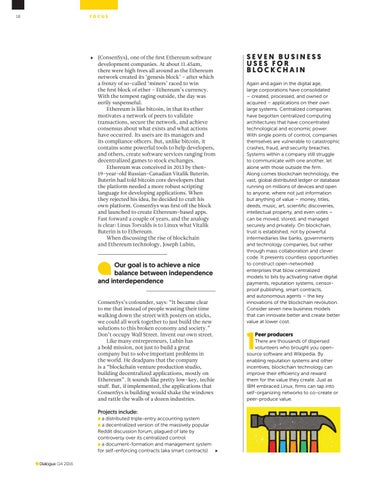
(ConsenSys), one of the first Ethereum software development companies. At about 11.45am, there were high fives all around as the Ethereum network created its ‘genesis block’ – after which a frenzy of so-called ‘miners’ raced to win the first block of ether – Ethereum’s currency. With the tempest raging outside, the day was eerily suspenseful. Ethereum is like bitcoin, in that its ether motivates a network of peers to validate transactions, secure the network, and achieve consensus about what exists and what actions have occurred. Its users are its managers and its compliance officers. But, unlike bitcoin, it contains some powerful tools to help developers, and others, create software services ranging from decentralized games to stock exchanges. Ethereum was conceived in 2013 by then19-year-old Russian-Canadian Vitalik Buterin. Buterin had told bitcoin core developers that the platform needed a more robust scripting language for developing applications. When they rejected his idea, he decided to craft his own platform. ConsenSys was first off the block and launched to create Ethereum-based apps. Fast forward a couple of years, and the analogy is clear: Linus Torvalds is to Linux what Vitalik Buterin is to Ethereum. When discussing the rise of blockchain and Ethereum technology, Joseph Lubin,
Our goal is to achieve a nice balance between independence and interdependence ConsenSys’s cofounder, says: “It became clear to me that instead of people wasting their time walking down the street with posters on sticks, we could all work together to just build the new solutions to this broken economy and society.” Don’t occupy Wall Street. Invent our own street. Like many entrepreneurs, Lubin has a bold mission, not just to build a great company but to solve important problems in the world. He deadpans that the company is a “blockchain venture production studio, building decentralized applications, mostly on Ethereum”. It sounds like pretty low-key, techie stuff. But, if implemented, the applications that ConsenSys is building would shake the windows and rattle the walls of a dozen industries.
SEVEN BUSINESS USES FOR BLOCKCHAIN Again and again in the digital age, large corporations have consolidated – created, processed, and owned or acquired – applications on their own large systems. Centralized companies have begotten centralized computing architectures that have concentrated technological and economic power. With single points of control, companies themselves are vulnerable to catastrophic crashes, fraud, and security breaches. Systems within a company still struggle to communicate with one another, let alone with those outside the firm. Along comes blockchain technology, the vast, global distributed ledger or database running on millions of devices and open to anyone, where not just information but anything of value – money, titles, deeds, music, art, scientific discoveries, intellectual property, and even votes – can be moved, stored, and managed securely and privately. On blockchain, trust is established, not by powerful intermediaries like banks, governments and technology companies, but rather through mass collaboration and clever code. It presents countless opportunities to construct open-networked enterprises that blow centralized models to bits by activating native digital payments, reputation systems, censorproof publishing, smart contracts, and autonomous agents – the key innovations of the blockchain revolution. Consider seven new business models that can innovate better and create better value at lower cost.
1
Peer producers
There are thousands of dispersed volunteers who brought you opensource software and Wikipedia. By enabling reputation systems and other incentives, blockchain technology can improve their efficiency and reward them for the value they create. Just as IBM embraced Linux, firms can tap into self-organizing networks to co-create or peer-produce value.
Projects include: a distributed triple-entry accounting system a decentralized version of the massively popular Reddit discussion forum, plagued of late by controversy over its centralized control a document-formation and management system for self-enforcing contracts (aka smart contracts) Dialogue Q4 2016
016-021_Dialogue_Q4_2016.indd 18
28/07/2016 11:34
focus
19
2
Rights creators
Many musicians, photographers, artists, designers, scientists, architects, engineers, and authors have not received proper compensation for their intellectual property on the internet. Blockchain technology solves the IP world’s equivalent of the double-spend problem (see box) – piracy – better than existing digital rights management systems. Consider the digital registry of artwork, including the certificates of authenticity, condition, and ownership: artists could decide whether, when, and where they wanted to deploy it.
4
Metering economy
With blockchains we can rent our excess capacity for certain commodities – wifi hotspots, computing power or storage, extra mobile minutes, even our expertise – by metering a counterparty’s usage and microbilling on the blockchain. Our subscriptions, physical space, and energy sources can now become sources of income.
6
Blockchain makers
Blockchain technology supports the ‘internet of things’ used in manufacturing. It can automate, not only the coordination of machines, but the tracking of inputs and outputs. We could, for example, monitor our beef from birth to burger, buying animals that were raised humanely, fed quality ingredients, and butchered under sanitary conditions.
3
Blockchain cooperatives
The trust protocol supercharges cooperatives – autonomous associations formed and controlled by people who collaborate to meet common needs. With blockchain technology, they can translate their willingness to cooperate into reliable accounting for rights, assets, and skills that displaces platforms like Uber, Airbnb, and TaskRabbit.
5
Platform builders
Enterprises create platforms when they open up their products and technology infrastructures to outsiders. Blockchain technology makes platform building cheaper and manageable. It provides a standard common database and standard common contracts, which increase data transparency and portability. Users can pursue the best terms and cooperate with the best talent to create their own platforms, rather than using the applications of traditional companies.
7
Enterprise collaborators
Today, commercial collaboration tools like Salesforce Chatter are changing knowledge work, but there are clear limitations. Users often cannot port their ideas from unit to unit, let alone from job to job, yet vendors and corporate IT can eavesdrop on collaborations. To attract talent, firms need to respect employee security and privacy. The blockchain enables individuals to establish and decide how, where, and what to contribute to a commercial project. Q4 2016 Dialogue
016-021_Dialogue_Q4_2016.indd 19
28/07/2016 11:34
focus
20
prediction markets for business, sport, and entertainment an open energy market a distributed music model to compete with Apple and Spotify, though those firms could use it too a suite of business tools for mass collaboration, mass creation, and mass management of a management-less company
The ConsenSys story
The story of ConsenSys is not so much about its ambitious blockchain-based products or services. It’s about its efforts to cultivate a company of its own, pioneering important new ground in management science along the lines of holacracy – a collaborative rather than hierarchical process for defining and aligning the work to be done. “While I don’t want us to implement holacracy as is – it feels way too rigid and structured to me – we are working to incorporate many of its philosophies in our structure and processes,” said Lubin. Among those holacratic tenets are “dynamic roles rather than traditional job descriptions; distributed, not delegated authority; transparent rules rather than office politics; and rapid reiterations rather than big reorganizations” – all of which describe how blockchain technologies work. How ConsenSys is structured, how it creates value, and how it manages itself differs, not only from the industrial corporation, but also from the typical dotcom. Joe Lubin is not an ideologue, and certainly not an anarchist or libertarian like some in the cryptocurrency movement. But he does think that we need to change capitalism if we want it to survive, specifically to move away from the command-and-control hierarchies inappropriate for a networked world. He notes that today, even though vast networks enmesh the world and enable us all to communicate inexpensively, richly, and immediately, hierarchies prevail. Bitcoin is the counterbalance: “Global human society can now agree on the truth and make decisions in ten minutes, or ten seconds,” he said. “This surely creates an opportunity to have a more enfranchised society.” The greater the engagement, the greater the prosperity.
The end of managers. Long live management
ConsenSys operates according to a plan that all employees – known as members – developed, modified, voted on, and adopted. Joe Lubin describes its structure as a ‘hub’ rather than a hierarchy, and each of its projects is a ‘spoke’ in which major contributors hold equity. For the most part, members of ConsenSys choose what they work on. No top-down assignments.“We share as much as possible, including shared software components.” says Lubin. “We build small agile teams, but there is collaboration among them. We have tons
of immediate, open, rich communication.” Members choose to work on two to five projects. When someone sees a piece of work that needs to get done, he or she jumps in and pushes it a little or a lot farther in a valuable direction, as appropriate for her role. “We talk about things quite a bit so people are aware of the many things that could be pushed forward,” he says. But these many things can and do change constantly. “Part of being agile means that priorities are dynamic.” Lubin is not the boss. His main operational role is advisory: “In many cases, individuals ask me or others what would be good to work on,” he says. Through Slack and GitHub, he suggests directions they might pursue “to build all the services and platforms that we want to build, and many that we want to build but don’t know it yet”. Member ownership explicitly incentivizes this behaviour. Everyone owns a piece of every project directly or indirectly: the Ethereum platform issues tokens that members can exchange for ether and then convert into any other currency. “Our goal is to achieve
Dare we coin the neologism blockcom – a company formed and functioning on blockchain technologies? a nice balance between independence and interdependence,” Lubin says. “We view ourselves as a collective of closely collaborating entrepreneur-like agents. At some point, it may prove necessary to suggest that a certain thing really needs to get done and, if nobody steps up, to hire someone initially for that role or incentivize internal people to do it. But, overall, everyone is a self-managed adult. Did I mention that we communicate a lot? Then we all make our own decisions.” The watchwords are agility, openness, and consensus: identify the work to be done, distribute the load among the people eager and able to do it, agree on their roles, responsibilities, and compensation, and then codify these rights in “explicit, detailed, unambiguous, self-enforcing agreements that can serve as the glue to hold all of the business aspects of our relationships together”, Lubin says. Some agreements pay for performance, others mete out annual salary in ether, and still others are more like “requests for participation”, with bounties attached to task completion such as writing a line of code. If the code passes the test, then the bounty is automatically released. “Everything can be surfaced and appropriately transparent. Incentives are explicit and granular,” he says. “This leaves us free to communicate, be creative,
Dialogue Q4 2016
016-021_Dialogue_Q4_2016.indd 20
28/07/2016 11:34
focus
21
W H AT ’ S I N A N A P P L E ? T H E D O U B L E S P E N D P R O B L E M Imagine two friends in a street, Peter and Paul. Peter has an apple, and Paul does not. Peter gives his apple to Paul. The two friends do not need a third party to validate this transaction – Paul can see that he now has the apple and Peter no longer does. Because the apple is a tangible item, those in the transaction are able to self-validate its movement. Since digital currency is not tangible like an apple – or a coin – it is possible to spend the same digital token twice, unless validation systems are put in place. Traditionally these systems have been middlemen – for example banks. But blockchain technology allows users of the network to validate their own network – as the ledger containing all transactions is shared between them and visible to everyone. This shared ledger guards against bitcoins (or other digital currencies) appearing from nowhere.
and adapt based on these expectations.” Dare we coin the neologism blockcom – a company formed and functioning on blockchain technologies? That’s the goal, to run as much of ConsenSys as possible on Ethereum, from governance and day-to-day operations, to project management, software development and testing, hiring and outsourcing, compensation, and funding. The blockchain also enables reputation systems, where members can rate one another’s performance as collaborators, thereby syndicating trust in the community. These capabilities blur the boundaries of a company. There are no default settings for incorporation. Members of the ConsenSys ecosystem can form spokes by reaching consensus on strategy, architecture, capital, performance, and governance. They may decide to launch a company that competes within an existing market or provides an infrastructure for a new market. Once it is launched, they can adjust those settings.
Decentralizing the enterprise
The blockchain will reduce friction for companies everywhere. “Lower friction means lower costs as the price of valuable intermediation is determined via the most efficient price discovery mechanism: decentralized free markets,” Lubin says. “No longer will incumbents be able to leverage legal, regulatory, informational, and power asymmetries to extract far more value from a transaction in their role as an intermediary than they add to it.” Could ConsenSys build some kind of truly decentralized autonomous organization, owned and controlled by its nonhuman value creators, governed through smart contracts rather than human agency? “All the way!” says Lubin.
Going rogue?
Is there a risk that radical decentralization and automation removes human agency in decisionmaking – the risk of rogue algorithms? “I am not concerned about machine intelligence. We
will evolve with it, and for a long time it will be in the service of, or an aspect of, Homo sapiens cybernetica. It may evolve beyond us, but that is fine,” Lubin says. “If so, it will occupy a different ecological niche. It will operate at different speeds and different relevant timescales. In that context, artificial intelligence will not distinguish between humans, a rock, or a geological process. We evolved past lots of species; many of which are doing fine – in their present forms.” ConsenSys is still a tiny company. Its grand experiment may or may not succeed. But its story provides a glimpse into radical changes in
Members of the ConsenSys ecosystem can form spokes by reaching consensus on strategy, architecture, and governance corporate architecture that may help unleash innovation and harness the power of human capital for not just wealth creation, but for prosperity. Blockchain technology is enabling new forms of economic organization and new portfolios of value. There are distributed models of the firm emerging – ownership, structure, operations, rewards, and governance – that go far beyond enhancing innovation, employee motivation, and collective action. They may be the long-awaited precondition for a more prosperous and inclusive economy. Business leaders have another opportunity to rethink how they organize value creation. They could negotiate, contract, and enforce their agreements on the blockchain; deal seamlessly with suppliers, customers, employees, contractors, and autonomous agents; and maintain a fleet of these agents for others to use, and these agents could rent out or license any excess capacity in their value chain. — Don Tapscott is author of Blockchain Revolution (p81) Q4 2016 Dialogue
016-021_Dialogue_Q4_2016.indd 21
28/07/2016 11:34
FOCUS
22
No more Mr and Mrs X More than two billion people worldwide are disenfranchised from much of society because they are effectively faceless. The digital revolution will give them an identity, writes Professor Michael Mainelli
Hernando de Soto, the Peruvian economist renowned for his work on the informal economy and property rights, got it. “Without an integrated formal property system,” he said, “a modern market economy is inconceivable.” Property rights require the rule of law and registries of property owners. More pointedly, without personal identification a modern market economy is inconceivable, not least because without identification there are no holders of property rights. Identity is not just physical: a DNA or retinal match. Nor is it merely about ownership of bank accounts or assets. Our identities are the ‘chains of our lifetime’, binding our pasts and futures with the present. For example, your school grades, driving record, tax payments, and health records are all part of a chain of behaviour entangled with your particular human body. Our identities encompass our relationships with other people and institutions. Our identities vary depending on who is identifying. The tax office probably has little interest in your driving record, but may
care enormously about the days you spent out of the country. About 2.4 billion people worldwide lack official identification, about 1.5 billion of whom are over the age of 14. While they certainly know who they are, they are excluded from market economy property ownership, and, frequently, free movement, social protection, and empowerment. They cannot ‘prove’ their existence to the satisfaction of society’s registries. Lack of official identification increases remittance costs, corruption, and crime. Insightfully, the United Nations has a target to provide legal identity to all, including birth registration, by 2030.
The price of missing identities
Over the past few years, banks have withdrawn from remittance markets in developing countries, citing too much difficulty and fines for not complying with developed world know-your-customer and anti-money-
laundering (KYC/AML) requirements. Perhaps contrarian banks should seek to excel at providing identity and payments in the harshest conditions of war-torn or lawless countries, but so far none have led. At the other end of the spectrum, high-net-worth individuals (HNWI) in the developed world struggle too with the plethora of bureaucracy and paperwork involved in KYC/AML regulation. Onerous KYC/AML is an obstacle to trade, thus reducing the benefits of comparative advantage and specialization. Financial institutions waste time and money on KYC/AML for little avoidance of money laundering or fraud. Some institutions estimate losses post ‘sale’ at up to 40%, with customers refusing to put up with overly bureaucratic procedures and failing to proceed with previously agreed financial services. Two inexorable trends increase the tensions in identity: globalization and population. In a globalized world that is populated by almost 10 billion people, transactional affordability is crucial to success. Sure, a few individuals can afford complex and costly identity schemes, but can developed world financial service providers ponderously insist on using slow and costly systems to exclude large markets full of future customers?
Blockchain to the rescue
Mutual distributed ledgers are open registers that allow groups of people to validate, record, and track transactions across a network of decentralized computer systems. Though such ledgers
Dialogue Q4 2016
022-023_Dialogue_Q4_2016.indd 22
28/07/2016 11:50
FOCUS
23
T H E D I G I TA L R U B B E R S TA M P Our firm, Z/Yen, has built a private system, IDchainZ. Typically there are three parties: the subject, an individual; the certifier, an organization notarizing documents; the inquisitor, an organization conducting KYC/AML checks on the subject. An identity certifier might be a government, an accounting firm, or a credit-referencing agency. IDchainZ uses two distinct mutual distributed ledgers, a content ledger holding the individually encrypted documents, and a transaction ledger holding the encryption keys on a series of ‘key rings’. The subject can give the certifier permission to put digitally-certified documents on their key rings. The subject can give copies of the keys to inquisitors. The system can restrict the number or the timing of inquisitor examinations, and records all inquisitions for the subject. The system meets such data protection standards as the ‘right to be forgotten’
and location of data storage. The subject ‘owns their own data’ and serves as the conduit, when needed, for communication between inquisitors and between certifiers, in full control. Consider the identity certifier as a ‘co-stamper’ of data on to a personal or corporate ‘chain’. The owner of the chain can include what they like – pictures of the cat even. But if they wish to get other people to accept the data’s validity, it needs co-stamping. A simple example might be that your accountancy firm needs to co-stamp the inclusion of your annual report on your corporate identity chain before other parties would normally accept it. Another example might be that you go to an identity certifier to encode your DNA, retinal scan, and photo, thus time-stamping your identity. Certifiers have no further access to the data. However, you can share the key to your identity chain with other people and organizations who will rely upon the fact that the data has been co-stamped by a trusted third party.
are over two decades old, the poster child for mutual distributed ledgers is the blockchain ledger of bitcoin. What if you had a portable, secure, globally available store of personal data in a blockchain? You could have all of your health records or driving history available instantly to hand on to trusted third parties. You might hand over your health record to a new doctor or to obtain a life insurance quote, or your driving history at an airport counter for a car rental insurance discount. Your personal data store might also have your biometric data, thus giving you the ability to prove at any time you are who you say you are, and that the data contained in the blockchain is yours. Governments are setting up innovative digital identity systems and authentication processes. Tellingly, since 2007 Estonia
has been operating a universal national digital identity scheme using blockchains, and has extended it to non-nationals. Though not based on blockchains, since inception in 2009 the Unique Identification Authority of India has issued more than 1 billion identity numbers, which – so far – covers 85% of its population. Britain’s GOV.UK Verify proposes a public services identity assurance programme using a network of trusted and vetted third party providers instead of relying on a centralized database.
What if you had a portable, secure, globally available store of personal data in a blockchain? As de Soto had it, “the way law stays alive is by remaining in touch with social contracts pieced together among real people on the ground”. At a time where access and control over one’s own data is becoming increasingly sensitive, empowering individuals to store, update and manage access to their data seems rather obvious. Transaction costs will drive a ‘many uses’ approach to get the most out of an expensive process. Both high-net-worth customers and low-net-worth customers expect global identity, whether it is payments, credit, government records, health records, or academic qualifications. Their demands will get stronger as they realize what can be achieved, rather than what has historically been foisted upon them. They will bypass service providers with onerous identity rituals. ‘Many uses’ will in turn drive consolidation towards a few, competitive, global systems. Identity sovereignty is coming. — Professor Michael Mainelli is executive chairman of Z/Yen Group and principal adviser to Long Finance. His latest book, The Price of Fish: A New Approach to Wicked Economics and Better Decisions written with Ian Harris, won the 2012 Independent Publisher Book Awards Finance, Investment & Economics Gold Prize Q4 2016 Dialogue
022-023_Dialogue_Q4_2016.indd 23
28/07/2016 11:50
focus
24
Brexit: data’s shock? Britain’s decision to leave the EU poses questions about the future of data protection law, finds Ben Walker
It was a seismic morning. On 24 June, Britain, against all expectations, awoke to find it had voted in a referendum to leave the European Union. The big arguments over whether the decision was right – economically, politically, socially – won’t be settled for several years. Few on that morning were thinking of the details. But the details matter, not
least in the world of data and its place in cyberspace. In April 2016, the European Parliament approved the details of the General Data Protection Regulation (GDPR). The new rules are designed to protect consumer rights as well as clarifying personal data laws for businesses in the EU and those that trade with it.
Brexit, says Robert Cattanach, a partner at international law firm Dorsey & Whitney, places the UK’s integration with the regulation – and the rest of the continent – under threat. “The referendum result creates chaos on at least two fronts regarding privacy issues,” he says. “The UK will not now automatically implement
Dialogue Q4 2016
024-025_Dialogue_Q4_2016.indd 24
28/07/2016 11:52
focus
25
W H AT I S T H E G D P R ? The General Data Protection Regulation was created to regulate the progression of personal data, and is part of the EU privacy and human rights law. It is designed to harmonize the current data protection laws in place across member states and, as it is a regulation rather than a directive, it will be directly applicable to all EU member states without the need for national implementing legislation. A key part of the GDPR’s remit is protecting personal data. This is defined as any information relating to a person who can be identified, directly or indirectly, by reference to an identifier such as a name, an identification number, location data, online identifier, or to one or more factors specific to the physical, physiological, genetic, mental, economic, cultural, or social identity of that person. Interestingly, there is no distinction between an individual’s private, public, or work roles. The legislation will bring in a large number of changes. Organizations will need to consider it carefully and make sure they are compliant. Issues which are attracting particular focus include consent, increased administrative requirements and the need to provide a full audit trail, data exports, and the new obligations on data processors. — Giulio Ricci, chairman, The ITAD Works
the GDPR, which was designed to normalize and harmonize privacy protection requirements, processes, and governance throughout the EU.” Cattanach, who has worked previously as a trial attorney for the United States Department of Justice, fears that the referendum will give the UK the opportunity to wriggle free of a regulation that it was
never very fond of in the first place. “Britain had not been a particularly ardent proponent of the GDPR,” says Cattanach. “And it appears likely that some of the provisions that are considered more onerous may not be embraced in what will now likely be a standalone regulatory scheme in the UK.” So what are the consequences for the continent? Without catchall regulations covering all its major economies, argues Cattanach, data rights management could become more complex. “It raises the spectre of whether the UK’s privacy protection provisions will be deemed sufficiently robust by the EU to merit a finding of ‘adequacy’ that would allow automatic transborder transfers of
personal information, as is currently the case,” Cattanach says. “The UK may well be forced to resort to the same sort of burdensome, binding corporate rules or model clauses now being required of most non-EU countries in order to transfer such information cross-border.” There is a lot left to be determined: the timing, shape, and scope of the UK’s Brexit deal remains unclear. “But bureaucrats in Brussels are likely to take a particularly dim view of Brexit,” says Cattanach. “They may retaliate by finding the UK’s privacy regulations not sufficiently ‘adequate’ to allow it to continue to mesh freely with the rest of the EU from a privacy perspective. “This would create enormous logistical difficulties – and impose significant expense – on virtually all companies in the UK that currently transfer personal information seamlessly between the UK and the rest of the EU.” Yet other experts are more sanguine. “You might think that Brexit could make this new legislation null and void,” says Giulio Ricci (see panel, left), chairman of computer hardware specialist The ITAD Works. “But all indications are that the UK will be looking to toe the line on the rules, to ensure easy and compatible business and trading rules with the EU. In fact, organizations outside the EU are still subject to the jurisdiction of the EU regulators just by collecting data concerning an EU citizen.” Businesses working in or trading with Europe should get ready, says Ricci. Firms that fail to comply face fines which, for those in the financial sector, can reach up to 4% of the organization’s turnover. “In many ways, preparing for the new GDPR involves using common sense,” says Ricci. “We all know that sensitive data has never been easier to obtain or disseminate electronically, while the risks to it have never been greater. A responsible organization will need to recognize the risks and ensure steps are taken to prevent and mitigate any potential problems.” — Further reading To view the GDPR in full, visit bit.ly/gdprlink
Q4 2016 Dialogue
024-025_Dialogue_Q4_2016.indd 25
28/07/2016 11:52
interview
26
Lover’s leap for King Cola Coca-Cola’s erstwhile marketing guru Javier Sanchez Lamelas says emotion – not rationality – conquers all
writing
Ben Walker photography
Julian Dodd
Javier Sanchez Lamelas is more artist than scientist. The venerated former European VP of marketing for Coca-Coca has been globetrotting, and misses our interview slot due to his miscalculating time zones. But when I finally catch up with him, he’s worth waiting for. Lamelas is a strong candidate for being a near genius, spending two decades selling a simple product – Coke – to the world by tugging at consumers’ heart strings, not their rational mind. Emotion, he says, is the key to marketing: plug into people’s instincts, their irrational desires, and you have them in the palm of your hand. “Love consists of overestimating the difference between one woman and another,” he says, quoting the Irish playwright George Bernard Shaw (Lamelas is careful to add that the same is true of men). “All human beings, all mammals, have an emotional brain guiding them through their lives. What good marketers do is attach emotions to products and turn them into brands that deliver higher emotional attachment than the utilitarian essence of a product. That is perfectly fine. If you are driving a car you love, you feel much better than just the simple pleasure of moving your body from one place to another.” Fashion – and its effects on the wearer – is a favourite theme of Lamelas. “When she wears a pair of shoes from Louis Vuitton, a woman instantly feels better,” he says. “And that feeling better is something for which people will happily pay a premium. That is the basic mechanism of marketing.” That is true. Were it not, no one would ever purchase designer clothes or watches, given that decent quality alternatives are widely available for a tenth, even a hundredth, of the price. Yet, beyond the sugar and caffeine rush it gives its consumers, does Coca-Cola really have that sort of effect? I put it to Lamelas that carbonated beverages seem several rungs of luxury below Omega watches or high-heeled shoes from glamorous French designers. The key is the way the drink is marketed to reflect and represent a
lifestyle, he retorts. “Go back into the history of the brand,” he says. “Life tastes better with Coke. Life tastes good. Enjoy. Choose happiness. That’s how we do marketing.” Lamelas’ marketing formula – letting the sunshine in – spreads to his management style. His confirmed view is that companies, as a rule, fail to give their staff enough time and space to have and promote their own ideas, thus strangling the pipeline of ingenuity that leads to commercial success. “There is a tendency of management nowadays to do two things that are incorrect,” he says. “The first mistake is concentrating 100% on the quantitative side – by that I mean taking the view that if someone cannot demonstrate that point quantitatively, that point does not exist, or that point is irrelevant. That is terrible. If we go back in the history of mankind, few of the ideas and inventions that brought us to the world we are living in today were demonstrated by mathematics at the point of conception. You need quantitative support, yes, but I advocate giving leeway for ideas that go beyond quantitative thinking.” The second mistake, he says, is the tendency for people to fill up their team’s diary to the point where considering new ideas becomes a niche hobby of a chosen few, rather than the habit of the entire staff. “Their days, weeks, and months are filled up without their even having the time to think,” says Lamelas. “That’s a huge mistake of corporations, which are filling up the lives of individuals with repetitive tasks, leaving very little time for creativity.” One of the soundest pieces of management advice is that the most important job of a new leader in a team is not to allocate more tasks to their staff, but to take tasks from them. How does Lamelas fight those battles in a large company, with the attendant pressure to fill up people’s diaries? “That’s a fantastic point,” he says. “The answer is that you have to really think through what each individual is good at.” He points at a corporate culture that values
Dialogue Q4 2016
026-029_Dialogue_Q4_2016.indd 26
28/07/2016 12:07
Having great ideas is much easier than selling great ideas
026-029_Dialogue_Q4_2016.indd 27
28/07/2016 12:07
versatility over expertise. “Companies spend too much time making sure people can do everything – then forget that there will be some areas where those people are phenomenal,” says Lamelas. “And many don’t assign work to individuals based on their areas of strength. Yet that is one of the keys to great output – identifying what people are good at, and making sure they do it.” Creating space for ideas, letting them grow, allowing staff time to think, is, he says, all too rare – thus, marketers are being starved of ideas. Sometimes, says Lamelas, it is marketing managers themselves who do the strangling. “We have to realize that managers have filters – and recognize that we tend to start filtering ideas too soon,” he warns. Yet while Lamelas is an artist, he is no dreamer. He is brutally clear about the need for managers to design processes that are easy for teams to work within. The sad reality, he says, is that many processes are ill structured and onerous to maintain. “Processes that are too time-consuming, processes that require five levels of approval – those processes inevitably lead to the wrong outcome,” Lamelas warns. “If you are going to be a leader and deliver great marketing, you need to be a process designer – and you need to make sure your processes are superior to those of the opposition. It’s what I call creating the marketing factory. It’s how great managers bring breakthroughs to the business over and over again.” Nor does Lamelas spare the sensibilities of clients. Many corporate customers, he says, are so bound by their own inflexible systems, inability to make decisions, and subsequent lack of imagination that they miss out on gamechanging concepts. “I think when agencies read my new book (see Further reading, p29), first they are going to be smiling – and then they are going to be crying,” he says. “Agencies present good ideas and they just get discarded. It happens. Some of the time it happens because you get poor decision-management in the [client] company, and other times it’s because people do not understand the power of ideas. It is far more difficult to persuade people of the greatness of a great idea than to have a great idea.” Lamelas reflects on working with the government of a small Mediterranean island (he
026-029_Dialogue_Q4_2016.indd 28
28/07/2016 12:07
interview
29
Go back in the history of mankind – few of the inventions that brought us into the world we are living in today were demonstrated by mathematics at the point of conception
doesn’t want to name it). The island had few cars, so Lamelas proposed making it electricvehicle only, to improve its air quality and give it a USP that would help promote it to tourists. The government of the island vacillated. “They could have done it in five years,” he says. “But the client saw all sorts of complications. That was five years ago. About one month ago, a different island – Formentera – just announced the same proposal. What an opportunity lost [for my client]! But having great ideas is much easier than selling great ideas.” Whatever the difficulties associated with his core business, very little in Lamelas’ career comes close to the days of thunder he faced when the Coca-Cola secrets scandal broke in 2006. Confidential Coca-Cola documents had been leaking out of the company. The company’s arch-rival, PepsiCo, had been contacted by the perpetrators, who offered to sell it the secrets. Pepsi had no choice but to contact Coca-Cola and warn it of the leak, amid fears that Pepsi itself would be implicated. By the time Lamelas was told of the breach, the FBI had pinpointed the leak to his own secretary, Joya Williams. In his book, Lamelas says “my whole world fell to pieces”. What followed was the stuff of thriller novels, not the soft drinks trade. At HartsfieldJackson International Airport in Atlanta, an FBI agent posing as a Pepsi executive met Williams’ associate, exchanging the documents for $30,000. In the aftermath of the trap, ahead of the trial, Williams’ lawyers tried to turn the tables on Lamelas. Their strategy was to make out he was a bad boss, who overworked his secretary to such a degree that she had to take confidential documents home with her. Williams would claim that her associates had stolen the documents. Away from the crucible of the case, the story stretched. Although there was never any suggestion that the Coca-Cola recipe had been lifted, Lamelas came home one day to hear his son, Javier Jr, report that one of his schoolmates had been saying Lamelas had sold the secret formula to Pepsi. I wonder how Lamelas ever slept at night. “The moral duty of managers is to do what is right for the business, which is usually very difficult when there are moments of tension,” he says, coolly. “You develop a sort of self-resilience and a sense of duty which protects
you when there are crises. That helps you to keep going when something like that jumps into the press. You really feel the pressure when you are on the other side of the Atlantic and you start getting phone calls, and journalists start throwing things at you that are untrue.” Despite the undoubted rarity of his experience, he plays it down, implying that it was philosophically little different to the challenges managers face every day. “People go through many of these crises,” he says. “When a company has to restructure a business and you have to resize your department, that’s extremely tough – and many people go through it. “If you have a product-quality crisis or a safety crisis, that’s hard too. There are many. The key is that you hold on to your horses, and you keep your brain cool. Your career is not a oneyear race, it is not a five-year race. It is a 20-, or 30-, or 40-year race – and you are going to find obstacles all the way through.” The Pepsi experience did end up helping him. It burnished his leadership credentials, as colleagues saw how he handled the innumerable challenges it presented him, and how he thrived afterwards. “In my book, you’ll see how a colleague came out the blue and said, ‘Javier, through all this time you have been a great example for all of us, and I want to thank you’. That was a big moment of relief for me.” Lamelas left Coca-Cola this year after a long, illustrious tenure. Now striking out on his own, he is looking for clients who want a more “emotional, meaningful brand message”, but also those – and here is the procedural zeal again – that want to change their systems so ideas can flourish. His new agency is called Topline Martketing Consulting Group. The misspelling is deliberate. He wants to emphasize the art in his ethos – and only an artist could get away with that sort of wordplay. Lamelas speaks warmly of gaining clients from all manner of industries. I suspect he will bubble up to the top.
Further reading Martketing Javier Sanchez Lamelas LID Publishing martketingbook.com Q4 2016 Dialogue
026-029_Dialogue_Q4_2016.indd 29
28/07/2016 12:07
Are you visible to top executive search firms?
%OXH6WHSV 2SWLPL]HV <RXU 9LVLELOLW\ WR 7RS ([HFXWLYH 6HDUFK )LUPV DQG 3RVLWLRQV <RX IRU WKH %HVW ([HFXWLYH -REV
Here’s How:
CREATE
Create your private SUR¿OH DQG LGHQWLI\ FDUHHU targets. Our 9,000+ UHFUXLWHUV FDQ FRQWDFW \RX EDVHG RQ \RXU WDUJHWV
CONNECT
&RQQHFW ZLWK WDUJHWHG H[HFXWLYH UHFUXLWHUV DQG RSSRUWXQLWLHV 6HDUFK ¿UPV E\ LQGXVWU\ IXQFWLRQ JHRJUDSKLF VSHFLDOW\
CONSULT
*HW \RXU IUHH FDUHHU FRQVXOWDWLRQ ZLWK UHVXPH &9 UHYLHZ 2XU FDUHHU DGYLVRUV KDYH KHOSHG WKRXVDQGV RI H[HFXWLYHV
CAREER
0DS RXW \RXU FDUHHU SODQ IRU HYHU\ VWHS RI \RXU FDUHHU 2XU FRQWHQW DQG FRQFLHUJH PHPEHU WHDP ZLOO EH \RXU JXLGH
Visit www.bluesteps.com to get started.
030_Dialogue_Q4_2016.indd 1
28/07/2016 16:15
leadership
31
kate cooper
Successful sports coaching is based on encouraging belief and creating an endless will to improve. Management would benefit from similar
Leaders are game to learn Kate Cooper is head of research, policy, and standards at the Institute of Leadership & Management
sports coach who monitors every aspect We have just enjoyed another great of performance from diet to fitness, sporting summer, and leaders can gain seeking any possible area for improvement, significant insights from the sporting leaders should understand what motivates approach and some of its underlying each and every team member, and theories. The word ‘coach’ has been used appreciate that individual talent needs to in sports for the past 200 years, but it is be nurtured, but never to the detriment only since the 1980s that coaching has of overall team performance. been recognized as a powerful leadership Self-confidence is crucial to elite development intervention. performance. Carol Dweck at Stanford Identifying the elements of performance University linked this to what she terms a you can control – and setting out to control “growth mindset”. Such a mindset values them – is a useful lesson. In 2001 Jim Loehr effort above all, is less constrained by notions and Tony Schwartz offered advice on of talent – and seeks learning opportunities, developing what they termed “corporate even if they reveal shortcomings. The athletes”, which identified how the director of athletics at Ryerson University, physical, emotional, mental, and spiritual Ivan Joseph, rates the ability to believe that wellbeing of a leader all contribute to optimum performance. Terry Orlick’s Wheel you can accomplish any task more highly than athletic prowess. of Excellence, introduced Training and in 2008, emphasized Mental toughness is constant improvement the importance of focus are also fundamental and its constituent considered by many to sports performance. parts. Focus resonates to be key to excellence in Eddie Jones, the coach particularly well today, of the England men’s with increasing demands sport and is also gaining increasing attention from rugby team, who led his being made for leaders’ team to a 3-0 series win attention. Mindfulness the world of work in Australia this year, training has emerged as knows this: “Each player one response. Mental that comes come to training has to have the toughness is considered by many to be key intent to improve,” he says. to excellence in sport and is also gaining Transference from track and field to increasing attention from the world of work. the office has its limitations, however. Notions of fair play are as old as sport Scores provide opportunities for immediate itself – and ‘cheating’ is universally feedback on performance and also give condemned. Authentic leadership not clarity to goal-setting. There are rules and, only requires knowledge and articulation should confusion arise, umpires and referees of one’s own values but also the ethical may be appealed to for instant clarification. principles that guide leadership behaviour. And unlike today’s managers and leaders, If the decisions of leaders were subject to who may have many years of organizational similar transparency tests such as replays life ahead of them, elite athletes have only and video referees, would their decisions a short time to achieve optimum results, stand up to such scrutiny? which concentrates focus. Plus, athletes Leaders in sport work closely with their spend far more time getting ready to athletes to develop the capability of each individual and ensure individuals collectively perform than they do actually performing. But the key lessons that transfer well for form a high-performing team. Leaders the leaders of organizations are the serious need to establish strong relationships with and focused attention they give to all players to support them in realizing their full aspects of performance: the importance of potential, a part of corporate leadership that effort and the imperative to keep learning is sometimes overlooked. Organizational leaders should emulate such practices. Like a and improving. Q4 2016 Dialogue
031_dialogue_q4_2016.indd 31
28/07/2016 16:28
leadership
32
How to stop good The bad news is most teams underperform, write Derek Newberry, Mario Moussa and Madeline Boyer. Here is what you can do about it
It normally wouldn’t have mattered that the Golden State Warriors lost to the Minnesota Timberwolves on 5 April. This was a team that had all but clinched the top seed in the NBA, going against a rock-bottom side that were headed for an early end to the season. But the headlines told a different story: it was a “stunning loss”, according to one. Another screamed that the Wolves had exposed the “myth of the Warriors’ invincibility”. Why the panic? The Warriors were on their way to being crowned as the best team in league history by chasing the single season
Every team experiences a gap between how the team says they want to collaborate and what they actually do
wins-losses record of 72-10, held by Michael Jordan’s Chicago Bulls. They had seemed to be dead cert to break the record until, with the end in sight, they inexplicably dropped two of three games at home. Up until that point, they had been undefeated on their home court. ESPN data analysts lowered their chances of their going 73-9 from about 90% to just over 10% after the 5 April game. How did this apparent unraveling happen? The Warriors players pointed to a lack of focus near the end of the season, leading to turnovers and sloppy play. In other words, a highperforming team with every reason to maintain momentum somehow became misaligned at the worst moment. The same phenomenon is seen in the business world, where Volkswagen is now attempting to recover from a crisis involving engineers designing its “clean” diesel cars to cheat emissions tests. The highperforming leadership team of what had been a
Dialogue Q4 2016
032-035_Dialogue_Q4_2016.indd 32
28/07/2016 12:37
leadership
33
teams failing T H E T H R E E FO U N D AT I O N S O F HIGH-PERFORMING TEAMS
very successful company lost focus and turned a blind eye to an ethical lapse that festered until it became a major public scandal.
No team is perfect
Unfortunately, these are not isolated examples. Our research on teamwork and collaboration at the Wharton School shows that in fact most teams, even elite ones, inevitably underperform compared to their potential. This was one of our main takeaways from observing more than 100 teams engage in a simulated market environment through Wharton’s Executive Development Program (EDP), a flagship executive education course that is run three times a year on our Philadelphia campus. EDP brings together business leaders from all over the world and across industries for two weeks of concentrated, comprehensive learning. A central part of the course is the
Our studies show that highperforming teams excel at establishing and continuously revisiting their team culture: they are constantly fine-tuning the rules. This is why there are two components of the framework: the three foundational types of team rules, and the three-step process they go through to adjust them.
Put together the three foundations and three steps, and you have the 3x3. To understand the framework, let’s start with the first part: The most important rules that every team should pay attention to are:
r u l e 1: c o l l e c t i v e a n d individual goals
US online retailer Zappos, where chief executive Tony Hsieh has been experimenting with the ‘holacracy’ model of management, in which there are no stable teams and roles change on the fly. This may well end up working for the company in the long-run, but it has caused growing pains as employees find they spend more time in meetings figuring out who is doing what, than actually getting things done.
The best goals combine vision with practicality. John F. Kennedy famously declared his lofty ambition for space exploration in 1961: “I believe that this nation should commit itself to achieving the goal, before this decade is out, of landing a man on the moon…” We often remember his big vision, but we forget that the process of achieving it involved a lot of bargaining with political stakeholders to get the necessary commitment of resources. Members of high-performing teams are constantly asking the “what’s in it for me?” question – and they connect collective to individual goals accordingly. r u l e 2: c l e a r , interdependent roles
Groups with clear roles that are not interdependent may look like teams, but they operate in silos, making it difficult to create a truly collective product. On the other hand, teams without any clearly defined role boundaries can play out like the classic “who’s on first?” skit. This has been a drag on morale at the employee-friendly
goals roles norms
r u l e 3: a f e w k e y norms
Every team needs good norms, but where to focus? The research tells us that groups make better collective decisions when they have two characteristics: independent thought and diverse perspectives. In fact, a team’s EQ is a better predictor of performance than IQ because teams with high emotional intelligence create an environment where more members feel comfortable speaking their minds. To set your team up for success, focus on a key few norms around how you share information, how you then make decisions, and how you handle conflict should disagreements arise.
Q4 2016 Dialogue
032-035_Dialogue_Q4_2016.indd 33
28/07/2016 12:37
leadership
34
THE THREE-STEP PROCESS TO SUPERCHARGE PERFORMANCE In EDP simulations, the best teams didn’t stop with the three foundations; they realized that teamwork is an iterative process, not an end goal, and we observed them continually revisiting and revising their rules. While each team is different, every high-
s t e p 1: c o m m i t to t h e rules
To follow the rules, you have to know what they are. Highperforming teams know that if they are not explicit about creating the right culture, one will form regardless, and it may not be the one they want. This is why we recommend teams create a ‘charter’ when they form that explicitly defines their goals, roles and norms. Having this conversation up front saves you the headache of having to uproot and reshape an entrenched culture that perpetuates bad habits later on. Most teams understand the need to have this conversation, but they often stop here. We imagine that once we have set the rules, everyone will follow them, right? Wrong. Remember that the nature of culture makes drift inevitable – misalignments will appear that drag down performance and commitment. This is why the team charter is only the first step, not the end product. s t e p 2: c h e c k alignment
High-performing teams find ways to check in on whether they are still following their original goals, roles and norms, and consider whether they should be adjusted. Leaders should do this even when everything appears to be on track, because what they find may surprise them. We consulted the top team of a financial services firm that had experienced major success, growing from a small team to a public company of more than 500 employees in a few years. Yet when we had the
performing team went through some version of the three-step process we synthesized from our observations: commit check close
team discuss roles, it became clear very quickly that there were major misunderstandings. For instance, several members had completely different ideas of who was in charge of a major initiative to revamp the company’s website. They understood that to keep their rapid growth on track, they would need to have more frequent conversations. s t e p 3: c lo s e t h e saying-doing gap
Once you have identified the changes you need to make in your team, the challenge is to close what we call the sayingdoing gap, because it so often boils down to team members not actually doing what they said they wanted to do. This gap opens up because behavioural change is hard to discuss and harder to implement. The latest research in behavioural economics and psychology shows that successful change is about focusing on the few, specific things that matter and making concrete plans to enhance them. Take Howard Schultz, who turned around Starbucks’ declining customer service ratings by focusing on changing one simple interaction – how baristas dealt with customer complaints. He instituted a process called the LATTE method for approaching these situations: Listen, Acknowledge, Take action, Thank the customer, Encourage them to return. This ended up being effective because instead of trying to tackle the big, vague problem of customer service, Schultz focused on changing one key habit that would have cascading effects.
Dialogue Q4 2016
032-035_Dialogue_Q4_2016.indd 34
28/07/2016 12:37
leadership
fig 1
IT
GOALS
ROLES
ECK
CO
M
CH
M
THE 3X3 FRAMEWORK
NORMS
CLOSE sophisticated simulation in which participants are divided into multiple teams and made to compete against one another as they try to grow their hypothetical companies. It is an intense experience that gives us insight into what makes teams work, and why many fall apart. What we have seen is that every team at some point experiences a gap between how the team says they want to collaborate and what they actually do. Business leaders are increasingly recognizing this problem as well, which is why PriceWaterhouseCooper’s latest global CEO survey noted that ‘execution gaps’ were a common concern raised by respondents. To understand why this happens, we turned to our own social science backgrounds and dusted off an old concept that is gaining new life in the business world: culture.
Culture: the key driver of team performance
A team’s culture is the set of rules it creates to solve problems and get things done. Anthropologists have long recognized that the ability to create culture is what separates us from other species; it allows us to collaborate and accomplish complex tasks quickly and efficiently. Once a group forms a culture, they don’t have to constantly renegotiate how they work together – it becomes the unspoken “way we do things around here”. In this way, you can think of culture as lowering transaction costs. But this efficiency comes with its own price. Because the rules become taken for granted, we often stop paying attention to them, leading to two types of misalignments…
35
1
Misalignments between the team and their external environment
Ways of operating that worked in the past stop making sense when the environment shifts. In the case of VW’s leaders, their famous insularity may have helped them make decisions quickly to grow the company. But at a time of increasing interconnectivity, this culture can create blind spots. In these cases, teams go about business as usual, despite the organizational or market environment around them demanding change.
2
Misalignments between individuals and the team
This second type of challenge happens because we all live in multiple groups with different cultures, such as different organizational teams, or our own home team (i.e. the family). These groups pull us in different directions in ways that are hard to notice. In the case of the Warriors, it may be that certain team members became more concerned about protecting their health for the long term rather than chasing a regular season team goal. In a business setting, team members might disengage due to other commitments at home or on other work teams, or because their career goals change. The result of either type of misalignment is that team performance drops, sometimes without the group understanding why. That’s the bad news. The good news is that, through careful reflection, teams can make their culture work for their objectives. Through our own research and experience, we have developed some broad insights about how to get the most out of any group. We boiled these insights down to the 3x3 Framework (see Figure 1 and panels p33 and p34).
Improve your odds of success
Three foundations, and three steps. It sounds simple in theory, but is tough to follow in practice, which is why so few teams become true high-performers. Those who can commit to the hard work of teaming see the results: recall the Warriors, who almost blew their record-setting season. After their loss to the Wolves, the Warriors’ head coach Steve Kerr had a check-in with the team. He asked them if they still wanted to chase the record, or rest up for the playoffs. The team recommitted to their goals and won the rest of their games, finishing with a win-loss record of 73-9. Similarly, the VW leadership seems to be using this crisis as an opportunity to revisit its own internal culture. The key is to be able to create the space in the hectic day-to-day chaos of work for mindful reflection and good conversations on the team dynamic. Of course, success is never guaranteed. But as the Warriors’ owner, venture capitalist Joe Lacob, has noted, by following a good process, you improve your odds. — Dr Derek Newberry, Dr Mario Moussa and Madeline Boyer are coauthors of Committed Teams
Members of highperforming teams are constantly asking the “what’s in it for me?” question – and they connect collective to individual goals accordingly Q4 2016 Dialogue
032-035_Dialogue_Q4_2016.indd 35
28/07/2016 12:37
leadership
36
Dialogue Q4 2016
036-039_Dialogue_Q4_2016.indd 36
28/07/2016 12:39
leadership
37
Re-humanizing leadership Giving your people a sense of meaning is the key to success
writing
Sudhanshu Palsule & Michael Chavez illustration
Hedof
The re-humanization of leadership has become one of the most pressing issues of our times. Two of our biggest clients, a leading pharmaceutical company and a successful global bank, have both been on a journey of over two years in doing precisely this, with very tangible rewards. Re-humanizing leadership is crucial for the 21st-century enterprise. What are the steps that will take us there?
What went wrong?
Human beings are meaning makers. The higher emotions of purpose, empathy, and shared meaning are critical as they build the foundations for sustainability. But with strategy becoming the proverbial one-eyed king in the country of quantifiable information, we spent much of the 20th century assuming that measurement holds the secret to mastery. We set up countless cottage industries inside our companies, devoted to the sole task of generating information and converting everything into smart decks, spreadsheets, graphs, and statistics. These are useful tools – as long as they don’t commandeer the central position in the complex system of meaning. But, sadly, that is precisely what happened. Management became the science of finding the most efficient ways to maximize production by designing organizations as assemblages of clear, interlocking parts of functions, departments, and processes, managed by lines of command and control. ‘Re-engineering the corporation’ was about precisely this. The complicated financial instruments at the core of the credit crisis of 2008 were computer models to reconstitute bad loans. The models were wrong. But because they were quantified and looked smart, we
assumed they were right. Purpose or intention had no place in the models. But greed and self-interest did. To re-humanize leadership, we will have to overcome an Industrial Age worldview that taught us to define ourselves and our organizations as closed and fragmented black boxes. This approach did seem to work as long as the world was assumed to be linear and a closed system. So strategy became the Holy Grail, and the harbinger of success. And yes, every once in a while we would pay lip service to our values, except those were not values at all but, at best, a list of aspirational statements that were unmoored from reality. At worst they were simply feel-good lines. Purpose had little or no value in a worldview
We spent much of the 20th century wrongly assuming that measurement holds the secret to mastery that was defined by input and output. Our contention is that purpose will have to be the core leadership resource in the 21st century. And as the business environment becomes increasingly complex and ambiguous, there is an even greater need to humanize leadership, imbuing it with deeper meaning and purpose. Yet so many organizations continue to position leadership as an instrument for maximizing efficiency or output, so much so that we have come to accept that as the norm. Yet volatility, uncertainty, complexity, and ambiguity (Vuca) makes this approach even more untenable. Q4 2016 Dialogue
036-039_Dialogue_Q4_2016.indd 37
28/07/2016 12:39
leadership
The Vuca challenge
As the defining acronym for the 21st century, Vuca conjures up an unmanageable world in which disruption is the new normal and leaders had better adapt or perish. The fact is, globalization, convergent technologies, and a new millennial mindset of transparency and collaboration are colluding to obliterate the illusion of a predictable future. All along we had assumed we could navigate the future using the trusted recipe of information, capability, and strategy. In a recent survey by Duke Corporate Education, chief executives declared complexity their number one challenge. But complexity is neither the problem nor a new phenomenon. Our earth’s life-support systems are highly complex – which explains their resilience for millennia. It is suddenly a threat only because we largely ignored it in the 20th century. We conveniently assumed that the world was neat and linear – and what got measured got managed. The 21st century is challenging our belief in linearity. From global warming to global pricing policies, the linear walls that delineated competitors, governments, regulators, and technologies into understandable boxes, are crumbling in front of our eyes. Social media allows customers to talk to each other, access the same information, and influence public opinion with a point of view. The customer is no longer the passive recipient. We have to come up with an entirely new way of leading in the 21st century.
W H AT G E T S I N O U R WAY ? the organization trap
The biggest problem we have is that most of our organizations are simply not equipped to deal with this new reality. We built them on the assumption of a linear world; so we built neat-looking boxes of departments, functions, hierarchies and reporting lines. Now we demand agility, adaptability, and innovation from our employees, but we still reward them for status, obedience, and conformity.
fig 1
T H E T H R E E C O N V E R S AT I O N S Service How do I feel?
Story Why is this relevant?
Strategy What can I do?
Affect internal conversation
Meaning conversation
Power conversation
the cognitive trap
Our brains are simply not adapted for complexity. Nature has prepared us for immediate danger and reacting instantly, but not for deciphering the weak signals of complex problems. Our brains lack the neural wiring to understand them. Ambiguity appears as a threat, triggering an instant reaction, which is inherently biased. That is why we would rather defend an established belief or strategy and ignore evidence to the contrary, than ask if we are doing the right thing. the power trap
Our 20th-century hierarchical organizations replicated social status, which was achieved through the control of information and resources. But what now as the hierarchy itself comes under challenge? Recent research in neurology also demonstrates how those who ‘feel powerful’ through social status have a lower ability to feel empathy. The 20thcentury organization engaged reward mechanisms in our brains to derive power from status; how willing are we to give that up?
WRONG MINDSET Together, the three traps generate a reactive mindset, which propels us to act from worn emotional states and learned scripts without thinking. This mindset is redundant when addressing complex problems, and yet we see managers repeatedly falling into this trap. Even the brain’s logic system is fallible. Much slower than the reactive mindset, the logical mindset is prone to cognitive overload and depletion, and
when that happens, it simply hands back control to the reactive. The rapid and exponential growth of information is a serious threat to our capacity for attention, creating attention-deficit: we notice it in so many senior managers who are emotionally exhausted. Only a mindful mindset that resonates with purpose can overcome the limitations of these two mindsets.
Doing the right thing
In September 1982, several people died in Chicago from taking extrastrength Tylenol, which had been deliberately contaminated with cyanide by a still-unknown perpetrator. The manufacturers, Johnson & Johnson (J&J), withdrew every product from every shelf in the US and stopped production. The contamination did not happen in a company plant but J&J took complete responsibility for it. The company’s chief
Purpose or intention had no place in these models. But greed and self-interest did executive, James Burke, was asked later how he coped with the difficult situation of withdrawing products knowing that the share price would plummet right away. His reply was simple: “It was the right thing to do.” The right action, the defining characteristic of good leadership emerges out of purpose, which asks the question, “Why do we exist uniquely in this world?” Leaders who operate effectively in a Vuca world are merchants of meaning, fluent in navigating complexity.
Gregor Cresnar / Flaticon
38
Dialogue Q4 2016
036-039_Dialogue_Q4_2016.indd 38
28/07/2016 12:39
leadership
The head of technical support in our client bank spoke of the distress that would get channelled to the technical support staff when things did not work. He had a large organization with attrition problems, which was costing him a lot of money. But he knew that his function was doing the organization a huge service. Then, one day at a team meeting, he spoke about his fouryear-old son, who was scared of the dark – and how if he left the door open a little bit, the light from the hallway would give comfort to the boy. The light became a metaphor for the purpose of the technical support function: “They’re scared and they’re nervous. So we’re providing them with that level of comfort. That’s why we’re here. Not to fix their technical problems.” His staff turnover reduced dramatically. He had enabled his team to discover their meaning to the business, through a simple, humanizing process. Leaders like this understand complexity. They know that it plays out in unpredictable and differentiated ways, but it is held together by principles of integration. These principles are usually obscure because it requires a higher cognitive level to see them. Rather than waste energy and resources in trying to control the differentiation, they focus their attention on stepping back and discovering the integrating principle.
Excavating and inquiring into purpose
As the very reason for an organization’s existence, purpose defines the ability to sustain its relationship with the world, allowing the organization to flourish over time. But most of our organizations either
39
lack an innate sense of purpose or have forgotten it, and so it needs excavating. Leaders need to gather narratives, artifacts, perspectives, and ideas that reveal ‘latent purpose’. This is an oblique approach of listening in to what people are thinking and feeling – rather than asking them to define the purpose, which is a mistake that many leaders make. Only then can leaders start building the narrative that will eventually morph into organizational purpose. It begins by paying attention to what people say when they are asked the question, “Why are we here?” and about examining what they connect to,
The re-humanizing of leadership dampens the reactive mindset of bias and biology thereby discovering the artifacts that come out of those conversations. There are two conversations at this stage, the first one being the ‘affect’ conversation (see Figure 1). This one inquires into the feeling that the organization evokes in its people. We refer to this conversation as ‘service’: the notion here is that the call to serve is the highest ‘affect’ that people can feel. The second one is the ‘meaning’ conversation, which elicits the story of the organization and its relevance. This conversation is about the ‘story’. Only after a thorough examination of affect and meaning can leaders turn to the third ‘power’ conversation, which is about finding the answer
to how the sense of purpose can be applied. This is the stage where the conversations get strategic, helping everyone develop a clear line of sight with purpose, and understanding what they need to do.
Institutionalizing purpose
Both our clients are in the process of institutionalizing their respective purpose and it is beginning to percolate into the more tangible level of goals and strategy. Having gone through the stages of excavation and deep inquiry (see Figure 2), they have socialized it in multiple settings, and crafted their purpose. A new humanizing mindset is emerging. In a complex landscape, where the exponential increase of information is making it impossible to know what is around the corner, purpose provides the integrating principle. It allows leaders to have different conversations with their people, using a mindful mindset that is capable of balancing the frenetic pull of short-term business demands with the larger and longer-term perspective of the ecosystem. The re-humanizing of leadership dampens the reactive mindset of bias and biology, and limits the overwhelming of the logical mindset. The 21st century presents a crucial juncture where leaders must actively shape the evolution of their organizations through the re-humanization of leadership. — Sudhanshu Palsule is a leading thinker in the fields of leading in complexity and transformative leadership, and an awardwinning educator and author — Michael Chavez is chief executive of Duke Corporate Education
fig 2
DIG THEN DELIVER
Excavation Values History/story Identity (capability, choices)
Deep inquiry Service… why? Beliefs about the world For what? With what? For when?
Socialization & testing Crafting of purpose
Institutionalization Developing goals and proof points
Q4 2016 Dialogue
036-039_Dialogue_Q4_2016.indd 39
28/07/2016 12:39
leadership
40
How to build a deep democracy Democracy demands much more than giving people the right to vote, writes Baroness Ashton
“We want what you have - democracy as part of everyday life.” The young man who said this to me had recently emerged from eight years in a prison in Libya. We were standing in a Benghazi hotel looking out at buildings – or bits of buildings – shattered by the bombings in a country shortly to disintegrate into chaos. In his perfect English, he made the point that is crucial to the debate on democracy – that it is part of our everyday life. That means it is deeply rooted in our institutions, our media, civil society and in our psyche. That doesn’t happen by accident, it takes time and effort. What I describe as deep democracy is vital if a society is to survive the ups and downs of economic and political change – and, more importantly, deliver what people need. In the UK we have recently celebrated 700 years since Magna Carta. We will shortly celebrate 100 years of women having the vote. It took 600 years to get from one to the other. So it should not be surprising that countries with no history of democracy struggle to escape their past in a few weeks or months. We can offer good advice and supportive actions. But they are no substitute for nations creating their own framework for democracy, and their own institutions, to ensure it functions effectively. Travelling across the world, and especially in countries where dramatic change has transformed the political landscape, I heard “election and democracy” in the same sentence as if one automatically led to the other, or that the two were cause and effect. While elections are a fundamental part of democratic life, they are insufficient on their own. It doesn’t mean that we have to wait centuries for countries to establish democracy, but it does mean we need to keep nurturing and supporting it to ensure it grows deep roots. Deep democracy has many characteristics. Here are six that are fundamental…
1
The campaign test
Free elections need careful preparation. I have seen elections called before people were able to develop their manifestos or platforms, or to work out how they would campaign and who they would work with. The result is confusion at best for the voter, and leads to some surprising and unexpected results – not necessarily in the interests of advancing democracy.
2
The goodbye test
Elections must give voters the practical opportunity – not just the theoretical right – to throw a government out of office and replace it. So ensuring opposition is effective, holding government to account and preparing itself to be in government is important. However much a leader might believe they, and only they, can run the country, democracy must allow that decision to rest with the people. An elderly politician in Egypt, at the time of Mubarak’s overthrow, said to me, “What we need is a retired president. Someone who voluntarily leaves office when their time is up. We have never had that.”
3
The fairness test
The franchise must be full and fair. Women should have the vote – and the right to stand for election – on the same basis as men. There needs to be a wellunderstood age for voting. It means, too, that all eligible adults can easily join the electoral register,
Dialogue Q4 2016
040-041_Dialogue_Q4_2016.indd 40
28/07/2016 12:58
leadership
41
Tunisia, Egypt and Libya saw their leaders toppled by the Arab Spring that swept the Middle East in 2010-12
4
The openness test
I heard election and democracy in the same sentence as if one automatically led to the other
Civil society operating freely is crucial: working in support of communities and causes, holding government to account, pushing ideas and views. Civil society must be able to receive money and operate freely so that people can be informed about issues that affect them – human rights, levels of pollution, conditions in prison, actions of police and so on. When I visited Tunisia in 2011, I went to the offices of the human rights organization in Tunis. I was the first person from outside Tunisia to cross the threshold – the government had forbidden outsiders to visit as part of a crackdown on their activities. There I met many dedicated individuals working in support of their communities and raising concerns. Their work is vital to a thriving democracy.
5
The press test
A free press matters in any democracy. Able to respond to issues and raise questions, the press can inform and educate people to the realities
of what is happening. Of course journalists are sometimes biased. They don’t always tell the truth. But the fact that the press exists in different media, including social media, means information gets to people from more than one source. And good journalism challenges candidates, governments and leaders to answer for what they do.
6
The justice test
The judicial system needs to be impartial and free from corruption. Police and judges must follow the law and the evidence, and not be swayed by populist opinion or government pressure. Again, established democracies sometimes struggle with this, but they also provide examples of the courts standing up to corrupt politicians – such as the state senator from New York last year, and British parliamentarians jailed for dishonest expenses claims a few years ago. People must be able to rely on the judicial system – especially in circumstances where politicians from one group are targeted by another.
These six points are about establishing deep democracy – there are more that I could mention. But the wider point is that democracy is fragile when it is not supported by an interwoven infrastructure. Our striving for democracy shouldn’t forget that. — Baroness Ashton of Upholland was first vice president of the European Commission in the Barroso Commission from 2009 to 2014
Slavko Sereda/James A Dawson/Mohamed Elsayyed/Dmitry Chulov/Shutterstock
and have ready access to polling stations. These are challenges that face even well-established democracies such as the UK and US. Perfection is difficult, but striving for it is essential. On election day, this includes providing remote villages with the tables, ballot papers, ink and collection of documents and so forth that they need.
Q4 2016 Dialogue
040-041_Dialogue_Q4_2016.indd 41
28/07/2016 12:58
The 14 Annual Lunch th
great hospitality high-level networking inspirational speaker Keynote Speaker Julie Bentley, CEO, Girl Guiding
Thursday 10 November 2016 Draper’s Hall Throgmorton Avenue, London EC2N 2DQ Noon – 4pm
Join over 250 women and men Come alone – you’ll be very welcome Take a table – of colleagues, clients, friends
Table of 12
£2340
Half -table of 6
£1170
Individual places £210 Includes pre and post lunch reception, wines and copy of souvenir programme.
Visit citywomen.co.uk to read more about the Lunch programme, sponsorship and advertising opportunities, and to book your places NOW.
042_Dialogue_Q4_2016.indd Dialogue_advert_V2.indd 1 1
28/07/2016 26/07/2016 10:22 20:49
innovation
43
vivek wadhwa
Apple no longer makes revolutionary products. Buying Tesla could restore its once stratospheric reputation
Why Apple needs its man from Mars Vivek Wadhwa is fellow at the Arthur and Toni Rembe Rock Center for Corporate Governance at Stanford University
that have made vertical landings back on It’s not surprising that Apple has stopped Earth. And he’s now looking to render innovating. Innovation no longer happens all the subways and urban transits in the in the way they like to do things in world obsolete with his Hyperloop – a Cupertino. Consequentially, it’s now high-speed public transportation system almost a decade since Apple scored its last in which pressurized capsules ride on a breakthrough. In 2007, when the iPhone cushion of air driven by linear motors and appeared, its launch was shrouded in air compressors. Musk once told me that secrecy. Apple’s strategy is now as it was he wanted to build a space station and live then: hide your products from the world, out a happy retirement on Mars. He wasn’t release them, and have your customers joking. I expect he’ll do this. fawn about how Apple gear “just works”. I’m the proud owner of a Tesla In 2007, this strategy bore fruit. But few of Model S. You can see and feel Musk’s Apple’s competitors work this way today galactic pedigree as soon as you get behind – which is why they are now much better the wheel, because the Model S is like a than Apple at achieving breakthroughs. spaceship that rides on Contrast Apple’s land. It’s better than any conservative, Elon Musk once told Apple product: more clandestine approach to product development me that he wanted to elegant, more beautiful, and better designed. with the suck-it-andbuild a space station and Apple’s Tim Cook see style of Facebook. live out a happy retirement is a truly excellent Facebook launched on Mars. He wasn’t joking. operations executive. its virtual-reality But he is no Steve Jobs. headset Oculus in I expect he’ll do this He is not an innovator. the spring. It wasn’t Apple should buy Tesla, the finished product, use it as the core of an Apple car, and but nor was Facebook expecting it to be. appoint Musk as chief executive. Here’s the modern way: you get a product Would Musk accept? There are no to market, your early adopters buy it, guarantees. He turned down Google in then they criticize it and tell you how to 2013 when the carmaker was on the verge improve it. I’ll bet that version three of the of bankruptcy. With $20 billion of orders Oculus – due 2018 or 2019 – will invoke in the bag for its upcoming Model 3, why the holodecks on Star Trek. It will change would Musk accept now? the way we interact forever, just like the Because he knows the combination iPhone did. of him as chief executive and Cook as So what is poor, shackled Apple operations boss would be formidable, that’s supposed to do? In short, it needs a car. why. Apple’s limitless resources would I’ll be more specific. It needs a Tesla. allow him to scale up Tesla’s operations and Much evolutionary, incremental change deliver the 400,000 orders for the Model 3. is wrongly – and increasingly – billed as And, with Apple’s branding, and perfect fit innovation. But Tesla is the real deal. for in-car media and entertainments, Tesla Elon Musk, the electric car would benefit, too. company’s chief executive, is a straightSometimes true visionaries need a little up revolutionary. This is the guy that push. There are plenty of years and ideas developed a spacecraft with his other left in Musk – still a relative youngster at company, SpaceX, docked it with the just 45. Apple needs a car. And, in its own International Space Station, and returned way, Tesla needs Apple. Mars can wait. with cargo. He’s launched two rockets Q4 2016 Dialogue
043_Dialogue_Q4_2016.indd 43
28/07/2016 13:00
innovation
44
The model that turns ideas into businesses Ideas are common. Successful startups are rare. Test your idea with this easy-to-use framework, writes Scott Bales
How many of us see the opportunities around us in everyday life? How many see the opportunities to improve an industry, a business, a new product or service? Statistics show that more than 75% of people see opportunities almost every day. We all have ideas. The difference between the Mark Zuckerbergs of the world and the average person on the street is just the ability to turn that opportunity into an idea, and that idea into a business. Remember that Facebook’s early years weren’t bountiful, they were just cool. But over time, Facebook was able to work on the human desire to build a
social fabric, the connection with other individuals which created something more powerful, more meaningful in society. It directly worked with the core human need of belongingness. The overwhelming reality that confronts all ideas is that more than 99% of them fail. But failure doesn’t have to be on the negative side. With the right culture and frameworks, failure turns into a series of lessons. And, in time, it helps refine an idea to meet a market need. The challenge when we see an idea is how do we document it? How do we structure it in a way that we can share
it, test it, pursue it? How do we believe in it enough so that we will dive head first into the world of entrepreneurship to pursue that idea, even if it’s only part time? One of the simplest ways of making an idea, and testing an idea’s meaning to society, is a simple process of ideation: 1 Who is your customer? 2 What are they trying to achieve? 3 What are they already doing in an attempt to achieve that goal? 4 What pains, barriers, or obstacles are they facing in achieving that goal?
Dialogue Q4 2016
044-045_Dialogue_Q4_2016.indd 44
28/07/2016 13:01
INNOVATION
45
FIGURE 1
Those pains and barriers could be affordability, accessibility, training or intelligence requirements, or a missing technology. This is where opportunity really starts to manifest as we see what’s needed to help these people pursue that desire. This could be as simple as wanting a pink drink product. It could be as complex as a new medical device. Whatever it is, it needs a deep connection with a human need and a market need before it’s even worked on, before it’s invested in heavily with technology or capital venture. Borrowing from the world of The Lean Startup by Eric Ries and the world of design thinking, I’ve created a simple ‘ideation framework’ that helps convert ideas into business concepts that can be tested. In Steve Blank’s book The Four Steps to the Epiphany, he outlines the need to “discover and validate” before executing an idea. The validation process focuses on the investigation of problems and the demand for solutions to them.
The ideation framework
In Figure 1, we have the ideation framework, a structured way to document an idea and prompt the necessary questions. Use the table to answer a series of structured questions, to logically lay out your idea.
Core hypothesis
Now we use the framework to derive the hypotheses to be used in the validation process. At the core of any business idea is a core hypothesis about the target customer, the specific need it meets, and how the product or service meets that need. So we have three hypotheses: 1 Customer hypothesis: who specifically has the problem? 2 Problem hypothesis: what problem are you trying to solve? 3 Solution hypothesis: how do you intend to solve that problem?
By completing the ideation framework, you’ve already done all the work to create the hypothesis. We just need to extract the right insights for each:
Customer hypothesis = facts + behaviour
To get an idea executed we need to work with a customer base known as
I D E AT I O N F R A M E W O R K Facts Factual information about your target customer.
Pain What barriers, pains, or problems does the customer have in their pursuit of their goal? Is it affordability, accessibility, education, availability, scarce resources?
Behaviour Existing behaviour the customer exhibits currently, in absence of your product/service. What are they doing? Where are they doing it? What triggers the behaviour?
Goals What goal are they trying to achieve through their existing behaviour?
the ‘early adopter’. An early adopter is already consciously aware that they have a problem, and is exhibiting behaviours in an attempt to solve the problem themselves. Take, for example, smokers who are trying to kick the habit. Early adopters in this case are
It’s more effective to work with a customer base that actively wants a problem solved, rather than to convince a mainstream consumer they even have problem those who are already trying apps, programmes, drugs, and so forth in the attempt to quit, but haven’t yet succeeded. The mistake most individuals with ideas make is focusing on mainstream markets too early, where customers aren’t yet aware they have a problem let alone are trying to solve it. It’s more effective to work with a customer base that actively wants a problem solved, rather than to convince a mainstream consumer they even have a problem. By using the known facts of the customer, along with the known existing behaviours, you can quickly
build a profile of which customers to engage first, and where to engage them.
Problem hypothesis = pain + goal
For an early adopter, a problem hypothesis focuses on their inability to achieve a known goal. The barrier to success could be a lack of technology, absence of sufficient information or education, lack of resources like money or time, an inability to access a solution, or many more. So your problem hypothesis is drawn from a known goal, and the obstacles that prevent them from achieving it.
Solution hypothesis = (behaviour + goals) - pain
Solving a problem isn’t about the technology or buzzwords you use. It’s about connecting a solution to a known – i.e. validated – need. Extracting from the ideation framework, and only the framework, we can structure a hypothesis on how we will solve the customer’s problem, thus validating the need for a solution. — Scott Bales is a global leader in the ‘digital shift’ – encompassing innovation, culture, design, and mobility in a world gone digital
Further reading Innovation Wars Scott Bales bit.ly/innovationwarsbook Q4 2016 Dialogue
044-045_Dialogue_Q4_2016.indd 45
28/07/2016 18:19
innovation
46
The Mr Hyde antidote A psychological methodology for measuring individual and company cultures shows that staff are often leaving their morals at the office door. Your business could be damaged if you don’t find a fix
writing
Peter Neville Lewis illustration
David Humphries
Is the culture of your organization a problem? Do you employ people who leave their morals and judgment at the office door? Do you have a Mr Hyde problem? We found that many companies do. Culture in organizations is crucial. Yet it is very difficult to evaluate. Anecdotal cultural indicators are all around you, but how do you compute that evidence? True, you can ask general questions. Do employees feel unable to challenge their managers? Are meetings organized so quiet, thoughtful types are drowned out by bold, outspoken ones? Even softer signifiers can be indicative: are teammates ignorant of the names of colleagues’ partners and children? You might know the answers to some of these questions yet miss other signs elsewhere. Culture is key – but it is notoriously hard to measure. This is a problem. This absence of robust evidence causes difficulties for business because what is hard to measure is hard to change. Take the aftermath of the banking crisis. Regulators wanted to improve risky, short-termist corporate behaviour. But they faced a mammoth challenge: telling senior executives to “fix their culture” sounds reasonable, but leads to serious problems when both parties struggle to understand what is meant by culture, have difficulties in identifying it, and fail to agree what positive changes to it should look like. Regulators’ imperfect understanding of companies’ culture, together with a lack of forensic tools to assess it, often means their interventions can cause more harm than good. There is another way. The MoralDNA (MDNA) diagnostic tool (see panel over page) is a scientific approach to measuring and analyzing company culture. It focuses not on employees’ anecdotal behavioural patterns but instead examines what drives those patterns. Are your people driven by: rules (the ethic of obedience)? principles (the ethic of reason)? And how much concern do they exhibit for the outcomes of their acts (the ethic of care)?
Moral breakdown
Companies we have worked with found MDNA results informative and, in many cases, shocking. Staff in the worst-affected company cultures exhibited a Jekyll and Hyde approach to their lives, changing personality once they arrived at the office. Where many were caring, good parents, and loving friends, they became heartless automatons in the workplace (see Figure 1). Instead of using their own judgment, they slavishly followed the rulebook. Rules are rules, you might say, but we found that the outcomes of such robotic compliance were generally negative. People were simply less caring about outcomes at work than they were at home, a problem that got worse as they climbed the seniority scale. Managers – ostensibly hired
Regulators’ imperfect understanding of companies’ culture, together with a lack of forensic tools to assess it, often means their interventions cause more harm than good for their instinct and judgment as well as their skills – were divesting themselves of the moral responsibility to make good calls. “Too many employers fall into the trap of relying on layers of rules and regulations to say what people can and can’t do,” Ann Francke, Chartered Management Institute chief executive, says. “The result is that people act like robots at work, using the letter of the law as an excuse not to engage their hearts and heads when making decisions. We need to start caring about the impact of our actions.” Why aren’t rules and frameworks enough? Why should care, judgment, and the application of emotional intelligence matter? “To be successful, organizations have to meet the needs
Dialogue Q4 2016
046-049_Dialogue_Q4_2016.indd 46
28/07/2016 13:08
innovation
47
Q4 2016 Dialogue
046-049_Dialogue_Q4_2016.indd 47
28/07/2016 13:08
innovation
48
HOW MORALDNA WORKS Professor Roger Steare’s MoralDNA approach is a psychometric instrument which has now been taken by more than 140,000 people in over 200 countries. In the aftermath of the banking crisis, the UK Financial Conduct Authority considered the research evidence provided by the MDNA as it
The four cardinal virtues
prepared to ‘regulate culture’ from 2013 onwards. MoralDNA measures, at both a personal and corporate level, how people self-assess ten universal moral values. These are then linked to three ethical consciences, thus measuring two aspects of human morality:
The three spiritual values
How we prefer to make moral decisions What moral values we prefer to consider when doing so Taken together, these give a strong indication of how people tend to make and take decisions.
Humility Does the individual exhibit an absence of pride and a feeling for being of service? Honesty Is the individual authentic; do they know what they stand for? Excellence Does the individual strive to do their best and be their best?
MoralDNA also identifies your preferences for three ethical consciences, which philosophers have believed for centuries are key to managing our ego and helping us to make and take decisions. Law Moral decisions are based on obeying or disobeying instructions. The ethic of obedience has been the assumed foundation for the proper regulation of mature adult behaviour. But obedience to authority is at best morally neutral,
and at worst encourages the worst human atrocities by those who claim they were simply “following orders”. The sheer volume of rules and regulations in today’s workplace tends to remove the requirement to think about actions and take moral decisions. Love This conscience is based on our experience and expectation that wellbeing, both for the individual and for the group, will result from making decisions based on empathy. However, the ethic of love is generally suppressed or ignored in the corporate workplace, although it is crucial to the sustainability of any human community, as a safe place of belonging. And, in economic terms, it is key to the fair distribution of scarce resources. Logic The final stage of moral formation focuses on the development of critical reasoning expressed as moral principles, self-determination, and what is the right choice based on these moral principles, irrespective of rules or consequences.
Ideally you want a balance of all three consciences, and if any of them are significantly out of line with the others, you should ask yourself: “What impact might this have on how I frame my
decision-making?” Note that the MDNA profile measures the three consciences on two scales – at work and in life (see Figure 1). It is very common for there to be differences in the scores for these
scales (individually and for groups in an organizational context). — Roger Steare is visiting professor in the practice of organizational ethics, Cass Business School
Wisdom How prudent is the individual? Fairness What is the individual’s capacity for justice and mercy? Discipline How much self-control does the individual exhibit? Courage How brave is the individual, morally, mentally, and physically?
The three core human values
The more people blindly comply with rules, the less they will think about their actions
Trust How much does the individual trust others, and others them? Hope How much belief does the individual have for good in themself and others? Care How much care, empathy, and compassion does the individual exhibit?
The three ethical consciences
of their customers, employees, suppliers, and other stakeholders,” says Francke. “If the values and behaviours of those managing and leading organizations are out of kilter with those groups, they won’t be run in a way that properly serves customers and stakeholders, or gets the best out of employees. In short, they’re destined to fail.”
The risk factor
In AD 50 Tacitus warned that “the more rules, the more corrupt the state”. The ancient Roman historian might have been talking about 21stcentury western companies. The focus of many
managers on compliance with rules, rather than the application of strong values, impacts on companies’ management of risk, a determinant of success in many industrial sectors. Feedback on this aspect of MDNA among senior executives at two major clients we work with has indicated concern at the variations in reported behaviours. They questioned how, if people are not bringing their ‘authentic’ self to work, this may influence their attitude to risk-taking. Are they less likely to challenge instructions as long as they can claim to operate within the rules? Rules mostly tell people what they cannot do – not what they should do.
Dialogue Q4 2016
046-049_Dialogue_Q4_2016.indd 48
28/07/2016 13:08
innovation
Do the RIGHT thing
fig 1
DR JEKYLL AND MR HYDE
The same people exhibit contrasting personalities depending on whether they are at home or at work. Their Love score plunges once they walk through the office door. 65%
Percentiles
Life
60%
Work
It is not practical to ask most corporates to throw away their rulebook. But when we work with clients we demonstrate the ways in which slavish compliance has damaged their peers, and pose a challenge. What, we say, does it take to do the right thing? Most executives we ask walk into a trap. Ask yourself the following questions: Are you, as a business, doing the right thing? (Are
55%
you 100% sure?)
50%
Are you doing it in the right way? (How well risk-
45%
managed and ethical are your operations?)
40%
Are you doing it for the right reasons? (Can you
35%
justify your licence to operate?) Law
Love
Logic
fig 2
T H E VA LU E S P R O P O S I T I O N
rs
Va l
s-
Be h
ou vi
ue
a
Character, judgment, and behaviour are connected stages in a process. Character or integrity is the sum total of all our moral values and informs the behaviour of trusted adults. Good collective judgments and decisions are made when we consider not only legal rules and obligations – the ‘letter’ of the law – but also how our values – the ‘spirit’ of the law – help us to decide fair and reasonable outcomes.
racter
Actions -
C ha
fig 3
T H E FA I R E R S E X ?
Women are not only far more loving, they are more logical than men. Males are less likely to adhere to rules, however – having a lower Law score. Percentiles
Male
Female
55%
50%
45%
40%
Law
Love
The answer to each of the above may be a qualified yes! But is this enough? Not necessarily. Imagine the shock in sessions with clients when we point out that most totalitarian regimes – including Nazi Germany – would answer yes to all three. Many city speculators and traders would give a trio of affirmatives at the end of a successful day, regardless of what damage they may have caused. The point is, you can justify most courses of action under the above formula but that does not mean such acts are right. Why? Because there is a fourth question: Is what you are doing based on the right moral values? This tie-breaker exposes the incompleteness of the three earlier questions. The word RIGHT itself is a useful mnemonic. It stands for: R-ules – do we know and operate within them (letter and spirit)? I-ntegrity – do we act out all the moral values which make up integrity? G-ood – is our decision-making intended to do good – and for whom? H-arm – will our decision-making cause unintentional harm – and to whom? T-ruth – can we honestly stand behind our decision with a clear heart?
s Ju dgm ion ent - Decis
60%
49
Logic
Given the evidence we have gathered, many leaders may decide they want to systematically assess their company’s culture, then create a framework for decision-making using the values-based RIGHT approach. There is a strong inverse correlation between the ethic of obedience and the ethic of reason (see panel) – the more people make mindful, thoughtful, good decisions, the less you need compliance with rules. The converse is also true – the more people blindly comply with rules, the less they will think about their actions. — Peter Neville Lewis is honorary research fellow at Brunel University, London, and founder of Principled Consulting — MoralDNA is a trademark of Roger Steare Consulting Q4 2016 Dialogue
046-049_Dialogue_Q4_2016.indd 49
28/07/2016 13:08
The sharpest writing worldwide on global management and leadership Dialogue is a quarterly business journal for senior managers and leaders across the world, covering global business issues. It is distributed in print and digital formats. We can offer advertising, sponsorship and collaboration opportunities on special projects designed for your brand. Contact us for more information Niki Mullin, Business Development Manager | niki.mullin@lidpublishing.com |
+44 (0) 20 7112 8861
www.dialoguereview.com
050_Dialogue_Q4_2016.indd 1 Drucker_sup_v2.indd 23
28/07/2016 10:23
11/05/2016 11:39
finance
51
phil young
Your investors need to know what profitable growth means
Lessons in winning Phil Young PhD is an MBA professor and corporate education consultant and instructor
to shareholders and presentations to stock Sport provides many a useful metaphor for analysts. Apparently the belief is that the business world. Business leaders are companies exhibiting profitable growth prone to quote the great ice-hockey player are given the most favourable ‘buy’ ratings Wayne Gretsky’s famous words about among stock analysts. “skating to where the puck is”. Have you But unlike other measures such as read Judo Strategy: Turning Your Competitor’s ‘return on equity’ or ‘free cash flow’, Strength to Your Advantage ? There is even ‘profitable growth’ is not based on a a Facebook page called ‘sports to business specific formula. Return on equity is metaphors’. But there is one key area where I think all sports metaphors fall short net profit divided by equity, and free cash flow is cash flow from operations of hitting the mark. I am talking about who minus capital expenditures. But what is actually wins in sports versus business. ‘profitable growth’? I assure you that you If you want to win an ice hockey will not find a single, universally agreed match, then put more pucks in the net than your opponent. But how do you define upon, definition. Based on my experience working with a number of clients who have a ‘win’ in business? Can we actually have focused on this measure, I can list at least an undisputed ‘winner in business’? How five different interpretations. Briefly stated, would you measure this? when a company says its goal is to achieve Suppose we assume that the primary profitable growth it goal of a company in the could mean any one of ‘game of business’ is to the following: create – or maximize I assure you that – shareholder value. you will not find Suppose we measure Growth in revenue a single, universally this using the value of (top-line) and growth in agreed upon, definition a company’s market earnings per share that is capitalization, which is as fast or faster than the of profitable growth its share price times its top line growth shares outstanding. Is Growth in revenue the winning business the one that has the and expansion in operating profit highest market cap? If so, then the primary (i.e. EBIT) margin job of the chief executive of a publicly Growth in revenue and EBITDA traded company is to do whatever it takes margin expansion to drive up the company’s share price and Growth in revenue and return on capital market cap. greater than the company’s cost of capital There are a number of financial targets Growth in revenue and return on capital that are used for this purpose. For example, among the top quartile of companies in the the chief executive could select any industry number of measures of corporate financial performance, such as: return on equity, All interpretations have top-line return on assets, return on capital, EBIT (revenue) growth in common, yet the margin, net profit margin, EBITDA margin, second part showing profitability differs. In cash flow, and free cash flow. my view it is not critical for all businesses But the challenge is that there is no to have the same definition of profitable one agreed measure that will lead directly growth. But it is very important that each to an increase in share price. In past company chief executive ensures that years, the measure called ‘economic value everyone involved in the business, including added’ or EVA has been a favourite among stock analysts, clearly understands its some companies. Over the past decade I particular definition of this financial goal. have noticed that the financial objective How can the players on a team be effective ‘profitable growth’ has appeared among if they do not fully understand what it takes the top priorities in chief executive letters to win the game? Q4 2016 Dialogue
051_Dialogue_Q4_2016.indd 51
28/07/2016 13:08
finance
52
Speed is the changemaker’s secret weapon Want to change a finance company or department? Follow these rules – and whatever you do, do it quickly, says Rick Davis
To twist M. Scott Peck’s opening sentence in The Road Less Traveled, culture change is difficult. Various reports put the failure rate of culture change attempts at somewhere between 50% and 80%. Either number is staggering. Not only is culture change for companies filled with logistical problems – finding the right people, calculating the right rewards, and a host of other issues – it’s also filled with psychological challenges or, better said, more individual, ‘human’ challenges. Most companies are resistant to change. Sales and finance departments can be more conservative than most. Over my many years working in the sector, I’ve found certain psychological principles are common…
Expect discomfort
By nature, change creates not only discomfort in most of us but anxiety, uncertainty, and fear. I’m uncomfortable at some point every single day simply because life and work involve the unexpected, and the unexpected is beyond our control. All we can do is wisely choose our responses to those unexpected occurrences.
Make tough decisions
Change always presents difficult decisions – and leaders must make them. If you are not willing to ask for, accept, and execute hard decisions, then you are
merely working on the fringes of the change that your organization needs. I often look to history for inspiration regarding the challenges of leadership and change. As commander of the United States’ first army during the War of Independence, one of my heroes, George Washington, served in a very stressful position, where he controlled little. He couldn’t control Congress; he couldn’t control the British, who were constantly flanking and outmanoeuvring his troops; he certainly couldn’t control the weather. Washington was attempting to accomplish something that very few have done –
overthrow a military force that was vastly superior in arms, numbers, and tactics. It was up to him to launch out into an ocean of possibilities. Choosing the wrong option would bring dire consequences – surrender, defeat, or death. Despite the discomfort, challenge, and uncertainty, Washington did not shirk the difficult decisions. He knew he was responsible to lead, and he acted accordingly.
Surround yourself with a trusted team
If you choose to embark on the rewarding struggle that is corporate culture change, make certain you have a core group within the company that accepts and buys into the need for change. Remain connected with that trusted team of advisers throughout the process. One of our clients, Shealy Electrical Wholesalers, a $225 million supplier of electrical products and services, has experienced rapid growth over the past dozen years. It has democratized its client relationships by shifting to a matrixed sales structure. The shift, which establishes multiple reporting lines between client and supplier, has eliminated the risk of one person ‘owning’ the customer relationship, which can be jeopardized if and when the lynchpin individual leaves the business. The deeper, broader relationships developed with the customer lead to better customer retention, more share, and increased margins.
Dialogue Q4 2016
052-053_Dialogue_Q4_2016.indd 52
28/07/2016 13:14
finance
53
Too often, corporations announce ‘big changes’ and get people excited, only to move at a snail’s pace – allowing the resistance movement to gather strength
Anticipate the roadblocks
Inevitably, there will be those within the organization who are resistant to change. Clear communication and a thorough understanding of the process are necessary for both those who resist the change and those who embrace it. Another client, Doug Daniel, chief executive of East Coast Entertainment, has been facilitating a significant shift in its eight-person management team, in large part because, in the old days of the company, people were promoted into the management team based solely on their sales success. “Resistance has been significant, as others have not been used to anyone making hard decisions,” says Daniel. “It has required a great amount of confidence and fortitude. And it’s been a struggle to find an ally. If I were to advise a chief executive on navigating these changes, I’d say to decide on your course, then surround yourself as fast as you can with other people that also believe what you believe.”
Shift gears decisively
Analyse, assess, and decide on your course methodically and slowly. But once the important decisions have been made, move swiftly and decisively. This is absolutely crucial. The concept of swift movement in the midst of change may seem counter to other advice, but the reasons for swift movement are compelling. Swift movement prevents the opposition from developing resistance; they simply won’t have enough time to formulate a plan and take action. For those who are
eager for change, swift movement is encouraging. Too often, corporations announce ‘big changes’ and get people excited, only to move at a snail’s pace, allowing the resistance movement to gather strength and put up roadblocks. The end result is that neither side is happy. If you want to quickly see the rewards that are the result of improved company and employee performance, make it happen. Many will relish the rewards of change.
challenges amid all the technical, logistical, and operational decisions, the results will be both rewarding and motivating for your company. — Rick Davis is managing shareholder of Elliott Davis Decosimo, a top 30 US accountancy and finance consultancy. He blogs at rickedavis.wordpress.com
Practise patience
Conversely to the principle of swift movement, remember that big accomplishments take time. Be prepared for the long haul. If your vision is significant enough to inspire you, to inspire your peers, and to inspire your employees, know that such a vision will take time to bring to fruition. In the midst of change, you may wonder if the pain and challenges are worthwhile. But if you prepare yourself for the psychological
Q4 2016 Dialogue
052-053_Dialogue_Q4_2016.indd 53
28/07/2016 13:14
FINANCE
54
The truth: straight-laced CFOs could damage your business
WRITING
Malcolm Fox ILLUSTRATION
Research shows that companies with traditionalist financial bosses are the least profitable
Adam Quest What kind of chief financial officer do you have at your company? Do they like to think objectively, ignoring politics and personalities? Do they prefer existing systems and processes to spearheading change? Are they efficient administrators rather than reforming strategists? If the answers to all of the above are ‘yes’ you might have a traditionalist in your midst. And the bad news is they are often bad for business. Redshift Research surveyed more than 1,500 CFOs in businesses with more than 100 employees in the US, Australia, China, France, Germany, Hong Kong, Mexico, Singapore, Sweden, UK, and Canada. A clear finding
emerged. Straight-laced financial bosses tend to work in companies that are less profitable than those staffed by their modern, swashbuckling counterparts (see personality profiles). So why is this? First, it is difficult to build strong interpersonal relationships with a traditionalist CFO, which often leads to their being bureaucratic and resistant to change. Second, traditionalists were far less likely to use management accounting techniques than their peers of other personality profiles (28% vs an average of 39%). Management accounting is the discipline of giving advice to leaders based on the data rather than just the numbers themselves. Naturally, a lack of applied financial analysis can hamper profitability. Finally, traditionalists are shunning the great help that is on offer from modern technology. There is a wealth of products out there that can
Dialogue Q4 2016
054-057_Dialogue_Q4_2016.indd 54
28/07/2016 14:54
FINANCE
55
THE SIX SHADES OF CFO
1 THE TRADITIONALIST Prefer to work within existing systems Rarely influenced by reputation and personalities when making decisions Find it difficult to build strong interpersonal relations Likely to think objectively and ignore politics and personalities Can be bureaucratic and resistant to change Often efficient administrators Rarely reforming strategists Arithmetic skills
5/5
Technological ambition
1/5 2/5
Profitability rating
Most likely to say: “That’s just the way we do things here.” Least likely to say: “Rules schmules. Let’s go for it!”
2 THE REVOLUTIONARY Charismatic by nature Can be demanding and resistant to seeking consensus Often unsatisfied with company IT services Used to working outside formal systems and processes Take risks where necessary Most likely CFO type to experience profit increase Get things done and drive the agenda forward Arithmetic skills
3/5 5/5 5/5
Technological ambition
Profitability rating
Most likely to say: “Rules are there to be broken.” Least likely to say: “Rules are rules.”
help CFOs do more in their role for less time and effort. Yet not only are traditionalists more unlikely than any of their peers to believe that their IT systems allow them to do more than in years gone by (9% vs 23% of their peers), they are also the least likely to acknowledge any need to change them (14% vs an average of 32%, see graphic). Luddism, it seems, is alive and well in the world of the traditionalist CFO. “The preference for traditional CFOs to work within existing systems and disregard the need for change stems from a lack of flexibility,” says Dr Dimitrios Tsivrikos, a business psychologist at University College London. “One study has shown that flexibility plays a major role in the innovation process. Taking on new perspectives and being open to novel ways of doing things allows a person to find optimal and creative solutions to problems, which fosters innovation.”
So if traditionalist CFOs are the personalities to avoid, which are the profiles companies should look to hire? If it’s pure profitability you crave, you should seek out a revolutionary. These charismatic figures are rarely bound by corporate rules and processes, and are happy to break free
Luddism is alive and well in the world of the traditionalist CFO of such strictures if the business demands it. As a result, 72% of them saw profits in their business increase last year, compared to just 56% of their antitheses, the traditionalists (see Figure 2). Delve deeper into the psychology of these ultra-modern revolutionary CFOs, and something interesting emerges. They are rarely Q4 2016 Dialogue
054-057_Dialogue_Q4_2016.indd 55
28/07/2016 14:54
FINANCE
56
3 THE CONDUCTOR
4 THE POLITICIAN
Sets tough, challenging goals for theirself and their team Often think creatively Happy to bend rules and work outside of formal systems Provide encouragement to their staff and an ethos of teamwork Prone to taking decisions based on gut instinct Strong defenders of corporate culture Prefer topline numbers to delving into data
Cautious leaders with methodical, teambased approach Consult widely with staff on important decisions More inclined to delay decisions than risk mistakes Skilled at consensus building Plans are usually well thought through Many use bespoke software for financial management and accounting Most common CFO profile
Arithmetic skills
Arithmetic skills
Technological ambition
Technological ambition
2/5 3/5 4/5
3/5 5/5 4/5
Profitability rating
Profitability rating
Most likely to say: “It feels right to me.” Least likely to say: “Can I see the spreadsheet?”
Most likely to say: “What do you think?” Least likely to say: “It’s my way or the highway.”
happy with their lot. Rather than accepting a company’s processes and systems as the way things are, revolutionary CFOs rail against anything that gets in their way. For example, they were the most likely of any personality type (48%) to report that the IT support they got from their company was inadequate. The data is clear: if you want a revolutionary, profitmaking CFO, make sure they have the best tools for the job. “As a result of their tendency to set high targets, revolutionary CFOs are likely to be critical of any current systems or processes that
FIG 1
FIG 2
Common people? CFO personality type breakdown based on survey of 1,500 financial decision 9% makers globally 9% Politicians Revolutionaries Carers Conductors Traditionalists Visionaries
hinder their path to success,” says Dr Tsivrikos. “This accounts for the finding that almost half of the revolutionary leaders believe the current IT support they receive is inadequate – they are forward-thinking and keen to explore new systems that will help them achieve their goals. And their less rigid approach leads to business success, as can be seen by the fact that revolutionary leaders are more likely to experience profit growth than their peers.” That’s fine for those companies that are blessed with such game-changers at the heads
Rich revolutionaries Proportion of businesses experiencing a profit increase in the last year by CFO personality type 27%
17% 20% 18%
Revolutionary Conductor Carer Politician Visionary Traditionalist Average
72% 70% 63% 60% 60% 56% 64%
Dialogue Q4 2016
054-057_Dialogue_Q4_2016.indd 56
28/07/2016 14:54
FINANCE
5 THE CARER
57
6 THE VISIONARY
Open to changes when they are carefully planned Cautious and methodical in their approach Would rather delay a decision than risk mistakes Worry about dearth of accurate data Can suffer from lack of self-confidence Close attention to detail Often miss the big picture
Take decisions based on experience and intuition Strong leaders who articulate goals clearly Orientated towards action rather than caution Tendency to gloss over details can lead to mistakes Often underestimate personal and political agendas of colleagues Emotionally expressive and self-aware Believe strongly in changing businesses for the better
Arithmetic skills
4/5 3/5 3/5
Arithmetic skills
1/5 2/5 2/5
Technological ambition
Technological ambition
Profitability rating
Profitability rating
Most likely to say: “Let’s not rush into anything.” Least likely to say: “I’ll trust my instincts on this one.”
of their finance department. But if your CFO is more of a stout traditionalist, what do you do? The good news is that people can change, with the right support. Even in an age where technology is there to do the heavy lifting, many CFOs remain bogged down in the day-to-day morass of cost management and fine financial detail. Automate much of this nitty-gritty, and some CFOs will escape the shackles of the traditionalist and become unbounded revolutionaries.
FIG 3
Average
“Researchers have identified ways for individuals to become more flexible and adaptive, such as being open to new ideas, by accepting feedback and engaging in nonhabitual behaviour,” says Dr Tsivrikos. By adapting and innovating, CFOs can avoid damaging business growth, and help improve it instead. — Malcolm Fox is vice president of product marketing at business software specialist Epicor — Some figures may be subject to rounding error. Profiles include Dialogue’s own analysis
FIG 4
Democratic politicians Proportion of CFOs that prioritize working across departments within the business by personality type Politician Carer Visionary Conductor Traditionalist Revolutionary
Most likely to say: “Build it and they will come.” Least likely to say: “Let me interrogate the numbers.”
27% 24% 23% 21% 19% 15% 22%
Luddite traditionalists Proportion of CFOs that believe their IT systems need updating by personality type Traditionalist Conductor Politician Revolutionary Carer Visionary Average
14% 32% 32% 32% 37% 41% 32% Q4 2016 Dialogue
054-057_Dialogue_Q4_2016.indd 57
28/07/2016 14:54
finance
58
In search of the entrepreneurial nation state National governments have been largely impotent as trivial technological comforts have replaced meaningful innovation. That must change, writes Richard Straub
Charles Handy had it right. “The past,” the great business philosopher said, “is not the present”. Handy was in good company. When Albert Einstein warned that “the significant problems we face cannot be solved at the level at which we created them”, he precisely forecast the problems global business faces today. Life-changing innovation risks becoming a thing of the past. Economists such as Larry Summers and Robert Gordon predict a period of stagnation as the last great phase of invention tails off. The electric light, motor transport, air travel and antibiotics, they point out, all came about in a single lifetime. Now, by comparison, innovation is about comfort, convenience, and choice. Social media and even smartphones are, to some degree, luxuries. When investors today pour billions into so-called tech unicorns, they are backing for the most part trivial, incremental innovations, not the revolutionary or more broadly ambitious developments of the recent
past. “We wanted flying cars,” says entrepreneur Peter Thiel. “We got 140 characters.” It is not for the want of ready money that this underwhelming approach to innovation has taken hold. American corporations alone are sitting on a cash pile of $1.9 trillion or more, much of it held abroad. Yet a preference for profit maximization over innovation, and consolidation over entrepreneurship, means that too few of these dollars find their way to backing transformative ideas. In 2015, close to $1 trillion was instead lavished on stock repurchases and dividends. Buy-backs over the past five years have been running at more than 100% of corporations’ capital expenditure. Many of today’s most innovative companies have few staff, relying instead on matching tasks to freelance labour. Some of these disruptive enterprises have just a notional physical presence – the companies are themselves platforms manifest largely in cyberspace. In a digitally
Dialogue Q4 2016
058-059_Dialogue_Q4_2016.indd 58
28/07/2016 14:59
finance
transformed world, innovation as well as employment has been ‘uberized’, transferring the power of ideas from large, centrally managed multinationals to small, dispersed business cells. The seemingly inexorable decline of the corporation as the central force in innovation poses a massive challenge for public administration. No longer is it sufficient for governments to simply manage a landscape where big-ticket employers are able to thrive. Now they must instead seek to make space for ideas away from the corporate ecosystem. Up to now, governments have been largely impotent in the rise and demise of the corporation, beyond creating a series of intrusive, inefficient regulations aimed at solving a financial crisis after it had already occurred. But, as Handy also said, “the past is not the future”, and their recent ineffectiveness need not persist.
PHB.cz (Richard Semik) / Shutterstock
Public spending must be channelled away from traditional welfare and towards wealth creation Nation-states must become ‘entrepreneurial states’ – a place where innovations can grow into viable businesses, and be backed. This means the focus of public spending must be channelled away from traditional welfare and towards wealth creation. Professor Mariana Mazzucato points out that states do have some pedigree in fostering entrepreneurialism. Much publicly funded research has, many years later, paid off, as the discoveries from that research are turned into wealth-creating ventures by enterprising companies. The internet itself emerged from defence research. Apple and other companies have incorporated the results of taxpayer-funded R&D in their products. But the notion of the entrepreneurial state encompasses more than seed-funding and research. Equally important is the need to switch the emphasis of social security from employment protection to support for
59
self-help and independent, entrepreneurial forms of work. The net aim must be to build a supportive environment for entrepreneurs, along with better-developed capabilities for fostering market-based solutions when and where they make sense, and new public-private or community-based hybrids where they do not. This is particularly true in the social sector – we have barely scratched the surface of the innovation potential of social entrepreneurship. As Roger Martin, academic leader of the Martin Prosperity Institute, and Sally Osberg, chief executive of the Skoll Foundation, describe it, social entrepreneurs aim to permanently and systematically transform a miserable or unfair societal condition. Equally, Peter Drucker long ago observed that every social problem is a business opportunity in disguise. It is not hard to conceive of ways in which the same technology could enable ‘community platforms’ for acts of citizenship of reciprocal support and exchange – a ‘caring’ as well as a ‘sharing’ economy. The time for national governments to embrace the entrepreneurial state is now. With digital technology having reduced the barriers to entry by providing ready-made infrastructures and support services globally on demand, there may not be a better moment in history to democratize entrepreneurship and make it the driving force for democratic capitalism, fostered by an entrepreneurial state. Entrepreneurs, entrepreneurial managers and a new ethos of entrepreneurship may represent our best opportunity to make the difference between enduring stagnation and enduring prosperity – a defining moment for the 21st century. — Dr Richard Straub is president of the Global Peter Drucker Forum
The 8th Global Peter Drucker Forum – The Entrepreneurial Society takes place on 17-18 November in Vienna, Austria. To book your place, please visit www.druckerforum.org
Q4 2016 Dialogue
058-059_Dialogue_Q4_2016.indd 59
28/07/2016 14:59
BEYOND THE WRITTEN WORD AUTHORS WHO ARE EXPERTS
LID Speakers are proven leaders in current business thinking. Our experienced authors will help you create an engaging and thought-provoking event.
A speakers bureau that is backed up by the expertise of an established business book publisher.
060_Dialogue_Q4_2016.indd 1 LIDspeaker_AD_dialogue.indd 1
28/07/2016 10:24 27/07/2015 13:04
marketing
61
andy law
The internet has educated holidaymakers. Now travel firms must learn to market to a more cosmopolitan customer
How we became tourists in cyberspace Andy Law is executive chairman of Inition and an independent consultant to businesses on how to modernize and keep ahead
We can hear local languages, retrieve The UK is not turning its back on Europe, its recipes for exotic dishes, look at places in citizens have been advised. Brexit means real time or from a historical perspective, opening our minds to the rest of the world. and talk to people anywhere on the planet That might make holiday companies over messaging systems, voice, or video. want to think a little. We can research the history of where We English don’t like to go too far we are going. We can discover the lineage away for our holidays. Europe is the of people we are meeting. We can look at obvious place. It’s near, familiar, hot, and local legislation and uncover local news. invariably cheap. Spain and France remain Obviously we can check the weather, our top holiday destinations. The other but we can also check the minutiae of European stalwarts, Italy and Greece, are the conditions, down to the forecast not far behind. If we tiptoe outside the temperature on the hour of our arrival. Mediterranean we might go to the US, We can verify the weather data through or Thailand. live webcams, adding So opening up the unquestionable visual rest of the world for this assurance to the raw particular multibillionIn cyber travelling, data of information. pound commercial we travel more. We We can even see what enterprise will prove can take ourselves to people are wearing in interesting. To rise to various locales – and if the challenge of any wherever we want to go, contemporary tourism, look around, and converse their umbrellas are up. Our keyboards you need to understand with locals without ever are not just for typing what travel actually leaving home words – they are now is today. our maps. Our fingers We travel in ways are curious cursors, we have never travelled combining together to help quench our before. At one time, travel was a journey almost insatiable thirst for information. between two points. Yet cyber travel is This information appears after we have an experiential trip to multiple places made our digital input requests – and our at multiple times and in many different cyber agents are happy to be hard at work time zones. And because of the exciting in both our waking and sleeping hours. intermediate points that we discover The travel agents and travel guides of during the travel process – we chance the pre-internet era merely skimmed the upon an interesting artist, for instance, surface, while fingers on keyboards can lift while searching for a holiday – the entire the lid on the remotest of places and, with experience can be ramified at each practised ease, explore and sample as much such point, providing a multiplexed, or as little as we like. multivariate experience. The new digital ‘travel agents’ charge In cyber travelling, we travel more. no commission and offer a bespoke service. We can take ourselves to wherever we The world has opened up in ways we want to go, look around, and converse never would have believed. Those selling with locals without ever leaving home, holidays need to market customers that and at no extra cost than our can know almost everything. normal living expenses. Q4 2016 Dialogue
061_Dialogue_Q4_2016.indd 61
28/07/2016 15:00
marketing
62
Nike’s next design innovation...
Nike
... unleash human potential Great design thinking should be applied to developing your people, as well as your products, write Andre Martin and Drew Fifield
Our team is the spark behind innovation that shapes the future of sport
At Nike, product design and innovation are at the core of the creative process, and our business is centred around putting ourselves in the shoes of our consumers. At its best, design is the perfect balance of form and function that “captivates at first glance”, as John Hoke, Nike’s vice president – global design, puts it. In an effort to extend Nike’s design aesthetic, we’ve applied a designer’s mindset to the execution of our talent development strategy. We’ve asked ourselves, what could it mean to put the employee at the centre as we design talent solutions in service of unleashing their full potential? As we approached this challenge, we focused on three big shifts in traditional learning
and development thinking that are critical in developing leaders of growth…
Shift 1 From employees as workers, to employees as consumers
Nike’s mission – to bring inspiration and innovation to every athlete (if you have a body, you are an athlete) in the world – begins with employees. Our team is the spark behind innovation that shapes the future of sport, and our talent strategy centres around building global, capable diverse talent to fuel growth. That’s why we put employees and their needs at the centre of our
Dialogue Q4 2016
062-063_Dialogue_Q4_2016.indd 62
28/07/2016 17:28
marketing
At Nike, we use a co-design evaluation process that is built to encourage deeper learning talent strategy. This consumer mindset demands that we develop a deeper understanding of the employees we serve, to truly know what motivates and engages them. It is our north star – it reminds us that every effort we take to invest in our talent is to unleash their full potential.
Shift 2 From instructional designers to product and experience designers
As talent product and experience designers, we build empathy with our consumers – employees – to better understand their unmet needs; whether they are a financial analyst on their first day in a field office, a tenured retail manager eager to advance, or an executive transitioning into a complex and challenging role. We use this understanding as the fuel for a design brief that maps consumer insights with ideas. From there, prototyping and iterating solutions alongside the consumer begins by enrolling employees
63
as co-designers. Inviting them into the process early not only builds a better product, it ensures we have champions who can demonstrate the value of the programme, from day one.
Shift 3 From programme evaluation to rapid prototyping
Gone are the days of smile sheets, post-programme surveys, and a narrow view of participant satisfaction as the sole evaluator of success. At Nike, we use a co-design evaluation process that is built to encourage deeper learning from the employees we serve. We mine the insights we receive and work with employees to create better experiences for those who will come next. We do this by collecting rich stories from our employees and comparing that narrative with what we learned from them earlier in the process. In practice, does their experience match our intent for them? These stories are used as a frame of reference as we meet with stakeholders and leaders to assess the impact of our design. From that, new outcomes or consumer needs emerge, and we begin the design process once again. — Andre Martin is chief learning officer and vice president of talent development at Nike — Drew Fifield is leadership development manager at Nike
W H E R E D O E S T H E D E S I G N I N N OVAT I O N B E G I N ? As a chief learning officer or learning leader, it is important to consider the difference between running a traditional learning and development organization, and a consumer-centred design firm. Focus on unmet employee needs and create a story about those needs through the eyes of real employees. the role of the learning practitioner
As a learning practitioner and designer, the move to a consumer-centered approach asks that you bring the voice of the employee into every design conversation. To start, build your skill in developing empathy with employees by capturing what they say, who they are, and where they struggle to perform. It will serve you well in balancing the form and function of the solution you design.
the role of the business leader
As a business leader, or other key stakeholder, you should play an active role in the design process from beginning to end. Be prepared to be hands-on co-designers, iterating and prototyping solutions for your employees. Talent solutions can no longer be “thrown over the fence at the business”. Demonstrate this commitment by clearly articulating your willingness to participate in the design process and build it alongside your talent development designers. unleashing human potential
Grounding talent solutions in employeecentric design thinking has the power to unleash the full potential of employees –
and it will naturally challenge long-held beliefs about learning and development. Conversely, a lack of focus on consumers leads to solutions that do not stick and do not advance sustained talent development. As we design talent solutions at Nike, we keep this in mind: Invite the consumer (employee) in early and understand their needs Build a strong design brief that highlights the key design constraints and criteria Keep the voice of the employee at the centre of every discussion Iterate, prototype, and build solutions with the employee (and others) Use stories to articulate impact and refine design
Q4 2016 Dialogue
062-063_Dialogue_Q4_2016.indd 63
28/07/2016 17:28
marketing
64
The revolution will be televised ‘Posaganda’ can help kick out racism, sexism and homophobia – and make the world embrace diverse leadership, writes Chris Yates
Before we had a black president, we had black presidents in the television series 24 and movies The Fifth Element and Deep Impact. Before we had a reality TV star US presidential nominee, we had The Apprentice setting a new standard of business acumen. When the media helps us imagine things a different way, it enables a new reality. Any change at the individual, organizational or societal levels begins
with imagination – the ability to see things differently and envision new possibilities. Television and film planted cognitive seeds of possibility for President Obama with strong, recurring, positive images of black presidents. Those with little contact with members of the LGBT community are provided with positive images direct to their living rooms, which normalizes acceptance, away from traditional biases. Media
Andrea Raffin / Joseph Sohm / Shutterstock.com; ZUMA Press, Inc. / Alamy Stock Photo
Television and film planted cognitive seeds of possibility for President Obama with strong, recurring, positive images of black presidents
Dialogue Q4 2016
064-065_Dialogue_Q4_2016.indd 64
28/07/2016 15:36
marketing
representation of different genders, races, sexuality, religion, and other aspects of diversity can change the way people think and the associations people make. More people watch primetime television than watch political shows and news. The entertainment media is dramatic, taps into emotions, and places a strong impression upon the mind. It shapes our unconscious attitudes, which then guide our behaviour. At the organizational level we have the opportunity – and responsibility – to influence both individuals and society through deliberately spreading ideas about equality, tolerance and inclusion. I call this ‘posaganda’ – storytelling in a systematic, ethical and positive way to spread new cultural narratives about inclusion. I have been talking about the positive and intentional use of propaganda to shape culture for some time, but the word has a negative connotation of being misleading. Yet, propaganda is one of the earliest and most successful forms of influential
Andrea Raffin / Joseph Sohm / Shutterstock.com; ZUMA Press, Inc. / Alamy Stock Photo
Propaganda is linked with the psychological concept of priming – a memory effect in which exposure to a certain stimulus impacts how we respond to another stimulus communication. Propaganda is linked with the psychological concept of priming – a memory effect in which exposure to a certain stimulus impacts how we respond to another stimulus. Organizations already know what it takes to influence humans in the pursuit of profit and power. Considerable funds and time are spent on designing advertisements aimed at convincing consumers to buy products or make positive associations with brands. A sophisticated range of multimedia channels are used to impact public opinion and emotion. Politicians use propaganda to help project a particular image about themselves or bring their agendas to the table. Governments use propaganda to create ideologies and influence the way people think about current affairs, as well as to create cultural discourses and new ways of thinking.
In organizations, there is the very real opportunity to shape human opinion and culture through ‘posaganda’. Positive organizational stories can articulate values and propagate ideas around inclusion. Stories form part of propaganda as much as advertising, posters, imagery and logos do. In some ways, stories – because they are so ‘real’ – are more powerful at impacting the subconscious level of human understanding. They stay with us. It seems obvious that if we want to change a culture, we have to work on behaviour as well as beliefs. It is ineffective to try to force people to do things differently through rules and procedures if they subconsciously hold on to the same old ways of thinking. We have to tackle the belief level of diversity and inclusion. We have to take on the challenge of shifting unconscious biases and open up new ways of thinking about each other. We have to move mindsets. And in order to do this, we have to begin with imagination. Neuroscientist Jeffery Schwartz talks about how learned behaviours like obsessive-compulsive disorder (OCD) can be ‘cured’ through the treatment of imagination. In 2012, Schwartz spoke at a United Nations conference about his work with actor Leonardo DiCaprio, who played Howard Hughes, a man suffering from OCD, in the film The Aviator. Schwartz explained that sometimes actors get so involved in roles that it can actually change their personality and brain chemistry. After learning about OCD for the role in the film, DiCaprio actually developed OCD himself and had to be treated for three months to remove the symptoms. Seeing is believing. And believing is behaving. What we see around us creates our beliefs of what is normal, possible, and even desirable. Our beliefs then impact on how we behave, how we see ourselves and others, and what expectations we have, ultimately creating reality. This is why it is so crucial to look at the beliefs we hold, before we can start to change anything else. We are limited by our beliefs and by the stereotypes that we possess. Until we can imagine something new as a real possibility, it can never happen. Imagination sits at the heart of changing mindset. It is the key that unlocks the deeply held unconscious biases that have seemed impossible to
65
After learning about OCD for an acting role Leonardo DiCaprio actually developed OCD himself shift despite a decade of investment in diversity and inclusion initiatives. Imagination, or ‘posaganda’, is the silver bullet when it comes to shifting the needle on diversity and inclusion. Using ‘posaganda’ techniques internally can convey the new and positive associations we want to create within our employees. It means tactically designing positive communication campaigns across the organization that leverage images and language that have impact. Media campaigns cannot create ideas, they always build on ideas that exist already. Modern organizations are possibly more powerful than many nation states. I believe that the positive impact organizations can make, as good citizens, in shaping society is significant. I am not proposing that we manipulate people. The intent of ‘posaganda’ is to use media and communication to counter prevailing stereotypes and prejudice, instil beliefs that are positive, fair and rational, and create an equal and inclusive environment. We can deliberately shape a culture in a transparent way with integrity. If we want to see a more diverse and representative workforce characterized by inclusive behaviours, we must leverage our media channels and plant the seeds. — Chris Yates is director of development and chief learning officer at Caterpillar Inc. Further reading Rewire. A Radical Approach to Tackling Diversity and Difference Chris Yates and Pooja Sachdev Bloomsbury bit.ly/rewirebook Q4 2016 Dialogue
064-065_Dialogue_Q4_2016.indd 65
28/07/2016 15:36
Immediate impact, growing advantage. At A.T. Kearney, we pride ourselves on our uniquely collegial culture and care passionately about our work and our people. We offer our clients a range of global capabilities anchored in our heritage of essential rightness. The same promise we make to our clients—immediate impact, growing advantage—we offer to our people. Working together, we drive immediate results and help build lasting, transformational advantage. Consulting Magazine has recently named A.T. Kearney as one of the Best Firms to Work For 2014 and honored the firm with an Achievement Award for Excellence in Diversity. For more information about A.T. Kearney and to read some of our latest thinking, please visit www.atkearney.com.
A.T. Kearney is a leading global management consulting firm with offices in more than 40 countries. Since 1926, we have been trusted advisors to the world's foremost organizations. A.T. Kearney is a partner-owned firm, committed to helping clients achieve immediate impact and growing advantage on their most mission-critical issues. For more information, visit www.atkearney.com.
066_Dialogue_Q4_2016.indd 1
28/07/2016 10:25
strategy
67
patrick woodman
Never let a good crisis go to waste
Strategy is about failure too Patrick Woodman is head of external affairs at the Chartered Management Institute
and leadership. That hardwires fear into It’s a great unspoken truth: crisis and failure how teams work and, by ratcheting up the are part and parcel of being a manager pressure, could induce paralysis and poor and leader. decision making. That truth can be deeply uncomfortable We spoke to a number of leaders in to confront. Or it can be a relief. We’re depth about their experiences. Sir Gareth taught – explicitly in management models, Rhys Williams, the British government’s and implicitly in the expectations of senior chief commercial officer, reflected that leaders – that errors, mistakes and crises he’d started his career in a business where should be foreseen, mitigated, eliminated. the message from leadership was: “‘I don’t But the reality is different. In a mind if you make mistakes, I just don’t complex, competitive and unpredictable want surprises’; ‘If you aren’t making world, things do go wrong. That fact has mistakes you aren’t working hard enough’; implications for us personally and for our and ‘Only 51% of your decisions have to organizations. Learning how to handle be right, as long as one of the other 49% adversity is a vital part of personal success doesn’t kill us.’” As he said, “That tone as a leader. It should be part of how leaders from the guy at the top creates a totally shape their organizations too. different mindset. To Unfortunately, the have that background evidence says most has been really helpful.” organizations could do If you aren’t making Crises are an much better on this mistakes you aren’t inevitable part of a front. CMI’s latest white working hard enough manager’s professional paper, Bouncing Back, life. They can break shows that while 94% or make a career. of managers admit to They can be devastating, life changing, having faced crises, only just over half feel transformative. They can ruin relationships they managed the problems posed by the and working cultures – or solidify them crisis well – and only 36% feel they were and make them stronger. able to effectively manage how it hit them Whether the nature of the crisis is emotionally. The results include dents personal or related to business challenges, in managers’ confidence (81%), stress whether the causes were external that affected their personal life (79%) economic factors or internal matters, crises and, for many, a direct drop-off in their can deeply affect those involved and their performance at work (63%). performance in the workplace. Asked what would have made the The challenge is to learn from the crises biggest difference to how they handled that erupt around us so that we become their crises, managers look for more better leaders, and to help others learn support from their line manager or from to fail well. We learn as much – or more their senior leaders. That could mean – from defeat as from victory. Make sure practical help in solving a problem, but it those in your teams and businesses have can also be about reassurance, backing the support they need to fail, to learn, and and encouragement. to bounce back strongly. To be effective, that can’t start just as the moment of crisis arrives. Leaders need — Find CMI’s white paper, Bouncing Back: to set a tone that makes it okay to fail, Leadership Lessons in Resilience – plus video and destigmatizes failure. All too often interviews with the likes of former BP chief in business – as in society more widely – executive Lord Browne, the original ‘rogue we’re quick to point the finger of blame. trader’ Nick Leeson, and the lawyer who stood Just think of television show The Apprentice up to online sexism, Charlotte Proudman – at and the signals it sends about management www.managers.org.uk/bouncingback Q4 2016 Dialogue
067_Dialogue_Q4_2016.indd 67
28/07/2016 15:32
STRATEGY
68
Clockwise Get your timing right, writes Camelia Ram
You’ve followed all the rules of the game. You’ve set clear objectives and measures of success. You’ve examined multiple future scenarios and the risks they represent. You’ve engaged and aligned stakeholders on the way forward. You have implemented agreed actions over a defined period of time. Yet they have not had the desired impact. You conduct a postmortem on the choices, and it appears that your timing was off: there were unforeseeable circumstances that impacted success. This situation is all too common in business. The reality is that the best attempts to plan for change can falter in uncertain and volatile environments. This is because we cannot always predict the precise nature and timing of change in such environments. Therefore timing decisions right requires a flexible approach…
Understand perception
In a study involving the relationship between decisions and time, it was found that what improves a decision is not the length of time devoted to making it, but the quantity and quality of the evidence accumulated during the run-up. Decisions made in short order with lots of supporting evidence are more likely to win support and succeed than decisions made over longer periods with less evidence. Commitment to action takes place as soon as there is a satisfactory level of evidence for a choice. Indeed, increasing the time given over to making a decision can be counterproductive. In the UK, the government has repeatedly delayed the key decision over where to build a new runway. The general perception is not that this is a responsible government
taking due time to decide on a key plank of its economic development strategy, but instead one that is vacillating – and failing to face up to its responsibilities. When we allocate more time to making a decision, the brain interprets the outcome as being a less confident choice. As a result, it is better to frame our choices using a compelling rationale. That way our brain focuses less on timing, and more on perception of the evidence at hand. Elite athletes undergo psychological training as a core part of their preparation. They learn how to
If we allocate more time to making a decision, the brain interprets the outcome as being a less confident choice interpret what is happening to them and why, so they can make decisions based on relevant cues. As a result, their high performance is a combination of physical and mental preparation, which ensures that they have a well-rehearsed story of what their body can cope with as circumstances change, allowing them to adjust performance in a timely manner during competition.
Think small
Want to time your strategy right under uncertain circumstances? Progress and preparation are your watchwords. In terms of progress, one should ask: what is the smallest amount of progress that will be useful and viable to the essential task we are trying to get done? In terms
Dialogue Q4 2016
068-069_Dialogue_Q4_2016.indd 68
28/07/2016 15:39
STRATEGY
of preparation, the critical questions are: what is the smallest amount we could do right now to drive successful outcomes? What is standing in the way of getting things done? What obstacles, if removed, would make the majority of others disappear? The soft launch trend in the food industry embodies this concept well. Restaurants typically offer discounts on food for a defined period to showcase what they are good at; understand market reaction; and give themselves time to get things right. Similarly, comedy previews help comedians test audience reaction to jokes, then refine the order and nature of their delivery in advance of important shows.
Build contingency
The well-known planning fallacy refers to people’s tendency to underestimate how long it will take to complete a task, even when they have done the task before. This can have a severe impact on preparation for and execution of
After-action team reviews are a meaningful way to reflect on performance and recalibrate responses a task, as the race to the South Pole highlighted. Roald Amundsen and Robert Falcon Scott were tasked with the same goal, but their approach to preparation differed vastly. Robert Falcon Scott did the bare minimum, whereas Amundsen diligently prepared for a variety of setbacks. This meant that
69
he stored more food with appropriate levels of B and C vitamins, planted multiple markers along the path, and had a transportation plan that was less dependent on manpower. When returning from the Pole, Scott lost five men from his 65-strong team – including himself. Amundsen’s entire team of 19 returned to Norway safely.
Find failsafes
These choices can be difficult in time and cost-constrained business environments that are focused on shortterm performance. For organizations that struggle to implement these practices, a diligent approach to focusing on elements that are within one’s control is critical. This means working with others to challenge assumptions about the timeframe within which outcomes can be expected, and the possible barriers and risks to meeting those outcomes. The second consideration for organizations struggling to implement these practices is adopting a mindset that embraces continuous learning and experimentation. After-action team reviews are a meaningful way to reflect on performance and recalibrate responses. Finally, the cost versus benefit of maintaining the status quo versus some reallocation of resources to build in flexibility must be put on the table when decisions are being made. This will ensure that the debate on timing and nature of options is deliberately considered. — Camelia Ram holds a PhD in operational research from the London School of Economics
Q4 2016 Dialogue
068-069_Dialogue_Q4_2016.indd 69
28/07/2016 15:39
strategy
70
Time to quit the number crunching diet In the rush to embrace big data, the role of qualitative judgment in innovation is increasingly overlooked
writing
Alessandro Di Fiore illustration
Miguel Montaner
Numbers can only take you so far. Big data has become such a creed, that many managers and leaders ignore the facts – that the human touch and incisive analysis still trump raw statistics in the race for business success. Sound qualitative judgment is behind most market-beating innovations. So what you can do to support that? Drawing on my research, I have developed six rules to improve the qualitative judgment of innovation in your organization.
Dialogue Q4 2016
070-073_Dialogue_Q4_2016.indd 70
28/07/2016 15:41
strategy
71
Q4 2016 Dialogue
070-073_Dialogue_Q4_2016.indd 71
28/07/2016 15:41
strategy
72
rule 1
D E M O C R AT I Z E I D E A S
Companies believe that innovation-insight generation is the responsibility of a few, highly qualified professional people. There is a widespread autocratic view that considers that only the chosen ones are entitled to come up with ideas. Often, I’ve seen companies creating corporate units of 20 to 50 people (equally often called Future Business or Idea Lab) to look for insights to shape the company’s future. Yet such an approach runs counter to the evidence. Companies embracing the more democratic credo of Lean Six Sigma are the successful ones. In reality, two worlds – manufacturing effectiveness and innovation-insight generation – which apparently seem so remote, share the same philosophy for success. In the Lean Six Sigma world everybody is responsible for the search and implementation of ideas to improve operational performance; responsibility is pushed down to the widest and lowest possible level in the organization. Best practice demonstrates how powerful it is to unleash the innovation-insight generation power of your workforce. Facebook organizes Hackathons – all-night work events – every six to eight weeks. The goal is to dream up new, potentially innovative ideas. Even Facebook interns can present their ideas directly to Mark Zuckerberg and top managers, who decide in a few minutes which ideas should go forward and which should be binned. Timeline, Facebook’s completely redesigned homepage, and the iconic Like button started as Hackathon ideas. rule 2
TRAIN THE MASSES
Cooks are clearly better positioned than waiters to passionately describe and explain the menu
Do you want insightful employees? All people have innate creative-thinking abilities, but it is up to managers to reignite or nurture them. The best companies deliver insight skills-training programmes to their staff – no one excluded – to develop a fully democratic and popular skill throughout their organizations. But in which tools and methods should we train our employees? Innovative entrepreneurs develop their winning value propositions or products through observation and probing a few customers. It is not a data-crunching game. Their sparks are generated by ‘explorations in depth’ of a small number of customers or non-customers. Of course there are exceptions. Procter & Gamble (P&G) is a case in point. Under the leadership of Alan Lafley in the early 2000s,
P&G started an innovation journey that led the company to become a ‘community of explorers’. Driven by a democratic approach, P&G widened the responsibility for the generation of strategic insights from a few professionals to the whole body of the organization, thanks to a significant investment in training. P&G created an internal ‘innovation college’, with ten to 12 different courses. Over the years, thousands of people went through training. This had a positive impact on innovation and insight-generation skills within the company. The corporation as a whole benefited from an improved attitude towards innovation and a greater propensity to generate ideas. rule 3
BE YOUR OWN EXPLORER
Most companies rely on market-research professionals – internal or external – to assess customers’ expectations for new products. The results of this process are poor – 80-90% of new products fail every year. A potentially better approach – one used by many successful innovative entrepreneurs – is to explore the needs and aspirations of the marketplace for yourself. Neuroscience studies demonstrate how insight generation at an individual level is the result of four factors: motivation, creative-thinking ability, skills, and knowledge. The latter is essential for the creative process. To be effective, a deep understanding of the subject matter is essential, a key criteria that most market researchers lack. If you are looking for innovation insights, who else should run customers’ explorations other than you and your staff? You are the person able to walk away with relevant insights and act on them.
rule 4
MAKE INSIGHT A HABIT
Often, failure is rooted in a common mistake: companies generate insights through sporadic projects. Successful business stories have
Dialogue Q4 2016
070-073_Dialogue_Q4_2016.indd 72
28/07/2016 15:41
strategy
demonstrated that insight-generation practices need to become a habit in order to develop a long-lasting capability. By making it a mandatory routine, the system cannot reverse after the ‘strategic innovation’ or ‘insight generation’ project of the year. This is useful not only for large companies, but also for small businesses. At Davide Oldani’s Michelin-starred restaurant D’O in Milan, there are no professional waiters. Although it may sound strange for a high-end gourmet restaurant, the practice of waiting tables has been embedded in the job description of the cooks. Taking weekly turns, the cooks take orders directly from customers, establish direct communication with them and comprehend their needs. The cooks are clearly better positioned than waiters to passionately describe and explain the menu. The insights of the cooks are then injected into the menu innovation session that is held every season. The rotation system has contributed to building a committed workforce that actively seeks insights and, therefore, creates better dishes. rule 5
S E C U R E Q UA L I TAT I V E REASONING
Promising insights don’t turn into successful businesses on their own. You can develop the best insight generators, but then the organization must still be able to leverage the insights they produce. Innovation should be a process in which analysis serves insights. Without a systematic approach to integrating qualitative judgment in procedures, the organization will smoothly and inevitably revert to a comfortable number-driven approach. In some cases, companies rely on a set of simple rules to make decisions, rather than on complicated quantitative models supporting resourceallocation processes. Research by Donald Sullivan and Kathleen M. Eisenhardt has demonstrated that complex models carry a high risk of paralyzing the decision-making process. Moreover, they sharply reduce the scope of people to exercise their qualitative judgment,
which, in turn, leads to less effective outcomes. Developing a simple yet specific set of rules to facilitate informed decisions is key. rule 6
HOTHOUSE HOMELESS INSIGHTS
Frequently, it is an individual who takes the lead in developing an insight. This is typically the owner of the idea, who usually commands little or no direction from their organization. Unfortunately, in the majority of cases, the strong identification of the idea with its owner makes it politically vulnerable: few people have a stake in it and there are no clear processes on how to fund and advance it – unless the individual involved happens to be the chief executive. In some firms, the environment can be so hostile that people simply squash their valuecreating insights out of fear. Individual-born qualitative insights have no natural organizational protection and direction. Consequently they tend to die on the vine. How can your organization effectively protect and nourish such homeless insights? Best practice indicates that companies should create an organizational hothouse for insights, in particular for those entering the risky front-end phase. Organizations that have adopted the model of an ‘insight nursery’ have successfully protected high-risk/reward ideas, and sped up the innovation process.
73
The strong identification of an idea with its owner makes it politically vulnerable: few people have a stake in it and there are no clear processes on how to fund and advance it
The Pathway
Building a qualitative judgment capability requires a significant shift for most companies that are deeply ingrained in number-driven innovation. The pathway should reflect the starting point. The first step should be an assessment of the company’s current capability. Then, companies should agree on its critical axes of change, which might reflect some of, or all, six presented rules. Finally, they should agree on an appropriate ambition level and develop a shared road map to attain it. For many companies, to develop such a capability will remain a source of frustration. For the best ones, however, it will represent an exciting journey. Figuring out how to harness the power of qualitative judgment as a driver of innovation and growth could represent the ultimate competitive advantage in today’s knowledge society. — Alessandro Di Fiore is founder and chief executive of the European Centre for Strategic Innovation and ECSI Consulting Q4 2016 Dialogue
070-073_Dialogue_Q4_2016.indd 73
28/07/2016 15:41
strategy
74
Oh baby! The secrets We learn self-confidence as infants then lose the technique as we get older. Drucker knew how to get it back, writes William A. Cohen
Dialogue Q4 2016
074-077_Dialogue_Q4_2016 (David’s MacBook Pro's conflicted copy 2016-07-28).indd 74
28/07/2016 16:07
s
strategy
75
of self-confidence “Living in fear of loss of job and income is incompatible with taking responsibility for job and work group, for output and performance.” Those were the words of the late, great Peter Drucker. They are as true today as they ever were. As we examined in the last issue (Dialogue, Q3 2016, p58), Drucker believed that no manager could operate effectively without taking risks. But risk-taking demands self-confidence. “That’s all well and good,” wrote Drucker, “but how can you not fear job loss, especially in times when loss of job is a real possibility, regardless of tenure or successful performance?” The answer is usually self-confidence. I challenge you to find any upwardly mobile manager who doesn’t possess a healthy dose of selfconfidence. Self-confidence is always a necessity for significant success. Unfortunately, the fact that selfconfidence is a prerequisite for success doesn’t tell us how to acquire it.
Getting self-confidence Drucker’s way You must acquire self-confidence yourself before can you instil it in others. Yet my research into Drucker found only three ways to have self-confidence: type 1
The million-dollar baby You are born with self-confidence and use it to your advantage throughout your life. type 2
The tenacious toddler You gain confidence slowly and laboriously over many years as you acquire
experience, make mistakes and learn from them. type 3
The golden child You start building your self-confidence yourself deliberately, improving it whenever you decide.
So let’s examine how we might achieve one of these. We could arrange to be born with it – now there’s a stunt if you could pull it off. Nobody starts out in life accomplishing what we think of as big things. We start as an infant and accomplish what we as adults think of as small things, like learning to walk and talk. But are these really small things? At the time you first learned to do any of these routine human accomplishments, if you had been able to think about it, you would not have considered them so small. Even with these ‘small things’, we started out by doing still smaller things first and slowly increasing the difficulty of the subtasks until we could accomplish what is really the major task of learning to walk for the first time. Today, there is no longer any doubt that, unless you have a major injury, when you stand, put forth one leg and then another, you are going to move forward and walk. As you read these sentences, unless you are just learning English, there is no doubt but that you will understand what you have read. In fact, once you can read, it is impossible for you not to read words once you cast eyes on them. Once you have acquired a skill, you automatically expect positive results, and you get them. So what happens when we grow up and step out in business? With the more
Q4 2016 Dialogue
074-077_Dialogue_Q4_2016 (David’s MacBook Pro's conflicted copy 2016-07-28).indd 75
28/07/2016 16:07
strategy
76
complex and challenging tasks and projects faced by adults and managers, you may expect to not succeed, but to fail. This expectation of failure is for only one of two reasons. Either you have been unsuccessful at similar tasks or projects in the past, or you have never tried to accomplish them in the first place. The context is very different. But the secrets of self-confidence vary little between childhood and professional life… you fall down, and you get up again… or maybe you don’t
How many infants have you heard of that simply took their bottles out of their mouths, placed them on a nearby table, hopped out of their cribs and begin to walk or run? I don’t know about you, but I haven’t heard of any. The correct sequence is that the baby learns to roll over, begins to crawl, gains self-confidence enough to stand up, gains a little more self-confidence and takes a step. Usually the first step ends in a minor disaster and the infant falls. But, the baby knows that at least
You will be a top producer if you put yourself where your strengths are, and if you work on developing your strengths it made a start. Usually the parents are so elated about his attempt that they are full of praise and cheer enthusiastically, even though the baby has not managed to take even a single step successfully. Soon the failed attempt is forgotten. Often, it is not even considered a failure, but as a brave, successful first attempt. Because of this, the child eagerly tries again not long afterwards. Eventually, the child will be able to walk, then run. This development process illustrates an interesting fact about why people in general – and many consultants and executives – still lack self-confidence later on in life. An infant learning a more mature task usually has someone cheering him on. But if he didn’t, he would have been blissfully unaware whether that first step, when he fell, was a terrible attempt or a good one. The problem is, as we become older, there
are others that observe us either with or without malice. Many of these observers are judgmental and let us know when we do a poor job. They are less likely to say when we do an acceptable one, or a good one. We soon get the idea that no attempt is a good attempt. The truth is it is always a good attempt, as every venture helps us learn. It took my youngest son, now a successful management consultant, almost two years to learn to talk. I wasn’t worried. It took Einstein almost four years! you hope that cream rises to the top of the bottle
It’s possible to gain self-confidence through experience alone as you ‘pay your dues’. Some of us eventually become successful this way, and there is nothing wrong with doing so, except that it is usually a long, and sometimes painful, process. You enter your work or a profession, do what everyone else is doing, work hard and do your best. With a bit of luck you will stand out and your efforts will be – eventually – noted and rewarded. If all goes well and as you progress upward, at every stage you gain more self-confidence. But with these methods you get blown by the winds of fate. Sometimes a promotion you think you earned and deserved goes to someone else. Through no fault of your own, you could suffer a layoff. Bad things seem to occur at inopportune times, such as when you have only recently bought an expensive house, are supporting a child in college, or when you are older and it is more difficult to find another job. But if you survive and are a little lucky, you will probably eventually reach your goals – if they are not too high. However, the process is uncertain, takes time, and there are no guarantees that you will get to where you want to go. There is a better way…
over time. In this way it is related to the slow, ‘pay your dues’ method I discussed previously. Except that it is much faster, less risky and you are guaranteed results since you are not dependent on someone else and you don’t stumble and learn from ‘hard knocks’. You proceed purposefully. Drucker noted that: “Every artist throughout history has practised kaizen, or organized, continuous self-improvement. And you will be a top producer if you put yourself where your strengths are, and if you work on developing your strengths.” For example, exercise a muscle every day, and every day it is going to grow bigger and stronger. Arnold Schwarzenegger didn’t start out with all those muscles that led him to win international bodybuilding championships even before he became
you train up from babyweight to heav yweight
Could you take charge of your own confidence building? I like this method best. It is faster and with less risk than the previous method. Moreover, you have more control. The method of taking charge that I recommend is based on a simple principle. You can develop anything about yourself, physical, mental, or spiritual by beginning with a small challenge and increasing it
Dialogue Q4 2016
074-077_Dialogue_Q4_2016 (David’s MacBook Pro's conflicted copy 2016-07-28).indd 76
28/07/2016 16:07
strategy
Make the decision that you are going to take a specific action to develop your self-confidence in a specific area, and then do it. Select a relatively easy goal to accomplish and proceed until you reach it
an actor and, later, the governor of California. However, by exercising with increasingly heavy weights every day, his muscles got bigger until after some years he was at world-champion level. Schwarzenegger mastered the technique but he did not pioneer it. Milo, an ancient Greek athlete trained by lifting a calf every day and carrying it a short distance. Four years later he was still lifting the calf, but he gained immortal fame throughout the ancient world because the ‘calf’ was now a fully matured bull. Now I’m not suggesting that you start by lifting a calf every day to develop your self-confidence, although it might help! But the principle works for developing your self-confidence in much simpler and easier ways. All you need to do is to make the decision that you are going to take a specific action
77
to develop your self-confidence in a specific area, and then do so. Select a relatively easy goal to accomplish and proceed until you reach it. Every time you complete a task or goal successfully, celebrate and congratulate yourself. Then set a higher goal or a more difficult task. It’s just like training with weights: you build up the amount of weight slowly or run more swiftly as you develop your strength. Before long, you’ll be doing things that you never thought you could. You will have acquired that self-confidence you need to succeed in whatever you desire. And, more often than not, you will succeed. — This article is adapted from Peter Drucker on Consulting: How to Apply Drucker’s Principles for Business Success, published by LID Publishing
Q4 2016 Dialogue
074-077_Dialogue_Q4_2016 (David’s MacBook Pro's conflicted copy 2016-07-28).indd 77
28/07/2016 16:07
78
news nation
The presidential battleground Hillary Clinton and Donald Trump face off to become leader of the free world
WA S H I N G TO N D C
When I was growing up, my parents always told me that I had to do what I thought was right and not listen to other people. That was hard for me Hillary Clinton
FAC T F I L E U N I T E D S TAT E S Land area
Official languages
3,796,742 sq mi
English, Hawaiian, Spanish, French, native languages
(9,833,517 sq km)
‘Official’ languages de facto and de jure, depending on state
Population
GNI per capita
323,969,599
$53,750
Capital
Life expectancy
Washington DC
82 Women
split decision
The political ideologies of the two candidates are in stark contrast. (Negative figures more liberal, positive figures more conservative)
Hillary Clinton 0 Donald Trump -5
Major religion
Christianity
79 Men
-10
Individual rights Domestic issues
Economic issues Defence issues
Gino Santa Maria / Joseph Sohm / Shutterstock
5
Dialogue Q4 2016
078-079_Dialogue_Q4_2016.indd 78
28/07/2016 16:00
news nation
79
Your Dialogue
CLINTON CASH FLOW The Democratic candidate has access to far more campaign spending than her billionaire Republican rival Campaign committee cash June 2015 to May 2016 $40m
social scene
Cash on hand
Follow us on twitter @dialoguetweets Follow the editor @brjwalker
$30m $20m
Paul Thoresen @surveyguy2 1 Jun Interesting read on #leadershipdevelopment by @VlatkaHlupic via @dialoguetweets
$10m $0m
iTalent Corporation @italentcorp 14 Jun @kinchingwu inspired #GLAM16 girls to be #leaders! Check out her @DialogueTweets interview
Campaign committee fundraising June 2015 to May 2016 $250m
Cumulative raised
$200m
Meet The Media @meetthemedia 26 Jun Here’s the truth. Successful people read #books. Do you agree? @DialogueTweets #learn #read
$150m $100m $50m $0m Jun
Jul
Aug
Sep
Oct
Nov
Hillary Clinton
Dec
Jan
Feb
Mar
Apr
May
Wayne Bergman @OHBIZCoachWayne 27 Jun Do you need to work on any of the... Four bad habits of super-smart leaders, via @dialoguetweets
Donald Trump David Slocum @davidslocum 7 Jul From diagnosis to prescription to rewiring for change: Guide to Company Brain Surgery @DialogueTweets
D I V I D E D N AT I O N
Trump must turn several of Obama’s blue states red to win
332
206
Obama
Romney 270 electoral votes needed to win
DIALOGUE IS BROUGHT TO YO U B Y… editorial board
Dr Liz Mellon, chairman Tom Albanese, chief executive, Vendanta Resources Michael Canning, chief executive, Duke Corporate Education Professor Pedro Nueno, president, China Europe International Business School Karina Robinson, chief executive, Robinson Hambro Ben Walker, editor, Dialogue editorial
Ben Walker, editor Kate Harkus, art director Luisa Cheshire, chief subeditor Miro Iliev, social media executive Jazz Berry, editorial
assistant management
One of they key problems today is that politics is such a disgrace. Good people don’t go into government Donald Trump
Martin Liu, publisher Niki Mullin, business development manager niki.mullin@lidpublishing.com Charlotte Hutchinson, communications executive
Disclaimer Copyright 2016 by Duke Corporate Education and LID Publishing Ltd. All rights reserved. Material may not be reproduced without permission of the publisher. While we take care to ensure that editorial is accurate, independent, objective and relevant for the readers, Dialogue accepts no liability for reader dissatisfaction rising from the content of this publication. The opinions expressed or advice given are the views of individual authors and do not necessarily represent the views of Dialogue. This journal is also supported by Knowledge Partners, including Duke Corporate Education as Lead Knowledge Partner. Whenever an author is related to a Knowledge Partner it will be noted as such. Dialogue takes every effort to credit photographers but we cannot guarantee every published use of an image will have the contributor’s name. If you believe we have omitted a credit for your image, please email the editor. ISSN 2053-4361 Printed by Pensord www.pensord.co.uk
publishing
Published in the United Kingdom by LID Publishing, 1 Adam Street, London WC2
Q4 2016 Dialogue
078-079_Dialogue_Q4_2016.indd 79
28/07/2016 16:00
80
REVIEWS
IN ASSOCIATION WITH
The capitalism of give and take Reciprocity – not self-interest – is the key to business success, finds Kate Cooper
Nine Visions of Capitalism Charles HampdenTurner & Fons Trompenaars Infinite Ideas bit.ly/ninevisions
the equation and, thus, finds only half When Charles Hampden-Turner and Fons of the answer. Trompenaars critique different forms of free Another example is how we may learn enterprise, they demonstrate a genuine respect from successful immigrants: those adept at for difference and an intent to find positives. The reconciling two opposing value systems – the nine models of wealth creation they examine begin with the Anglo-American system, and end one they left behind and the one they are seeking to survive in. with crowdfunding. Hampden-Turner and Trompenaars remind Wealth, the authors point out, is created by us about the importance of intrinsic motivation transforming money into products and services and how the pursuit of money – rather than for customers, who then transform them back wealth – propels us to make poor decisions and into revenue by purchasing them. So far, so exploit one stakeholder to reward another. They obvious. But here’s the rub: because all parties in note how small businesses are this process have contributed very often liked and admired, to the creation of wealth, the but big companies are despised authors say, all parties should The pursuit of and distrusted. This, they say, therefore share in the gains. money – rather demonstrates the appeal of This necessity of mutual benefit than wealth – propels us keeping wealth-generation is the crux of the book. to make poor decisions entities small. Pure self-interest results Nine Visions of Capitalism only in short-term gains. is an extremely persuasive For wealth creation to be argument for the conduct of ethical business. sustainable, the relationships between the While Hampden-Turner and Trompenaars stakeholders need to be mutually beneficial – aim their book at customers, suppliers and even though their interests are often opposite. financiers, HR departments within companies For the deal to work long-term, all stakeholders might be buoyed by its findings. As HR’s key must commit to reciprocity. function is to find mutual benefit throughout The book is much more than an interesting organizations – transcending the short-term commentary. It offers thought-provoking self interest of individual departments – this is a advice. A key piece of guidance emanates from text that might as well have been written for it. Hampden-Turner’s Dilemma Theory, which Hampden-Turner and Trompenaars emphasize runs that opposing values need to be reconciled, how collaborative working and the resolution of because exposure to opposing views informs and difference is vital to organizational success. assists both sides. Mostly, the book powerfully illustrates that The authors use left- and right-wing treating people well – whether they be suppliers, ideologies as a useful example of this, observing customers, employees or investors – makes that capitalist and socialist politics in the UK, US sound economic sense. It is not only the business and France represent the seemingly conflicting community that could benefit from adopting interests of managers and workers. such a code. In fact the two groups need each other and would be useless without each other; so each — Kate Cooper is head of research, policy and side of politics addresses just one side of standards at the Institute of Leadership & Management
Dialogue Q4 2016
080_Dialogue_Q4_2016.indd 80
28/07/2016 16:09
REVIEWS
IN ASSOCIATION WITH
81
Blockchain: the protector of the world wide web The internet just got bigger, safer – and more powerful, writes Liz Mellon
Blockchain Revolution: How the Technology Behind Bitcoin is Changing Money, Business, and the World Don and Alex Tapscott Penguin Books bit.ly/blockchain revolutionbook
While bitcoin, the virtual currency, is a word most people recognize, the blockchain that supports it is less well known. Yet to those in the know, it is blockchain that is the exciting, revolutionary development. With this book the Tapscotts explain blockchain, making it more accessible as a concept, and then explore widely what it means for our future. That people trade, individual directly with individual, using a digital currency seems an exotic enough idea. But how do you ensure the security of the transactions? Hidden by the internet, people can deal honestly or can cheat, lie and steal. As the Tapscotts quote the New Yorker, “on the internet, nobody knows you’re a dog”. Blockchain is the algorithm that settles transactions with complete security and without going through a trusted intermediary. Every industry is afraid of disintermediation, and blockchain threatens a pandemic across many – not just the banking industry. Blockchain – the worldwide ledger – is a distributed trust network based on seven principles: networked integrity (integrity is encoded and distributed, not vested in any single member); distributed power (a peer-topeer network with no single point of control); value as incentive (the software rewards those who contribute to it – miners – with bitcoin or some token of value); security (safety measures are embedded with no single point of failure, and the reckless harm only themselves); privacy (individuals must use cryptography to participate and thus can be trusted without the need to reveal any information about themselves); rights preserved (ownership rights are transparent and enforceable); and inclusion (lowers the barriers to participation and allows for distributed capitalism, not just a redistribution). This is an amazing list of almost fairy-tale proportions. Blockchain eliminates all
the bad stuff we have come to expect from the internet – misrepresentation, fraud, identity theft and data misappropriation. How does it do it? And what are the consequences? The Tapscotts explain that blockchain creates a trust protocol through a distributed peer-topeer network using clever cryptography. The network timestamps every financial transaction and rejects subsequent spends of the same coin, eliminating double spending. All recent transactions are settled every ten minutes in blocks of data and each must refer to the
Blockchain is the algorithm that settles transactions with complete security preceding block to be valid. And the blockchain is public, so no-one can hide a transaction. Having explained the process, the authors then go on to explore the potential impacts on financial services, company architecture, new business models, government, economic inclusion and much more. They resist the temptation to predict, reminding us how many false predictions were made about the internet. Reading this book will bring you bang up to date with one of the most exciting inventions of this century. It is endorsed by everyone from Steve Wozniak, the cofounder of Apple, to Paul Polman, the chief executive of Unilever. They leaven the technical content with lively anecdotes, stories and quotes from songs (my coauthors and I intended to do this for our book The New CFOs, but we never did), topped by a quote from my favourite character, Yoda. It is a seriously cool book. You should read it. Q4 2016 Dialogue
081_Dialogue_Q4_2016.indd 81
28/07/2016 16:18
82
REVIEWS
IN ASSOCIATION WITH
Discovery Path: Piracy and privacy Do you know your customers all too well? The internet age has brought with it a moral trade off: connectivity for privacy. Meanwhile, instant access increases potential sales but brings with it the threat of piracy. This reading selection will help leaders improve their knowledge and understanding of how the digital revolution has affected longstanding principles of privacy.
BLUE BOTTLE BIZ TOP FIVE
Defying Doom This book is a call to action. If you need to know what it takes to break through to a new layer of oxygen in an organization that has been flying high in the past, the framework explained in this book carves a clear path. The book’s three simple steps – What’s the story? Who’s on board? Getting things done – will head you towards transforming an organization, as opposed to letting it sink into decline. bit.ly/bbbdefyingdoom
A Guide to the Project Management Body of Knowledge – Fifth Edition What Stays in Vegas: The World of Personal Data Lifeblood of Big Business – and the End of Privacy as We Know It Chapter 18 bit.ly/bbbstayvegas Internet giants, leading retailers, and other firms are voraciously gathering data with little oversight from anyone. In Las Vegas, no company knows the value of data better than Caesars Entertainment. Many thousands of enthusiastic clients pour through the ever-open doors of their casinos. The secret to the company’s success lies in its one unrivalled asset: it knows its clients intimately by tracking the activities of the overwhelming majority of gamblers. Yes, there are many benefits to the free flow of all this data, but there is a dark, unregulated, and destructive netherworld as well.
Learning Bitcoin Chapter 4 bit.ly/bbbbitcoins The financial crisis of 2008 raised attention to the need for transparency and accountability in the financial world. As banks and governments were scrambling to stay solvent while seeking a sustainable plan, a powerfully new and resilient technology emerged. Bitcoin, built on a fundamentally
new technology called ‘the Blockchain’, offered the promise of a new financial system where transactions are sent directly between two parties without the need for central control. Simply put, Bitcoin is “programmable money” that has the potential to change the world on the same scale as the internet itself.
This book reflects the collaboration and knowledge of working project managers and provides the fundamentals of project management as they apply to a wide range of projects. This internationally recognized standard gives project managers the essential tools to practise project management and deliver organizational results. bit.ly/bbbproject
Dialogue – Issue 9 Article: Unblock the shared economy
Dialogue. Issue 9
bit.ly/bbbdialogueblockchain Growing trust in mutual distributed ledgers – such as the Blockchain technology underlying bitcoin will change financial services for the better. Michael Mainelli is your expert writer.
The Digital Economy Anniversary Edition: Rethinking Promise and Peril in the Age of Networked Intelligence Chapter 2 bit.ly/bbbthedigitaleconomy Two decades ago, Don Tapscott’s The Digital Economy changed the way the world thought about the internet. Now, in this new edition, the New York Times bestselling author provides topical updates with a sweeping new analysis of how the internet has changed business and society in the last 20 years.
Banks are the hubs of the global financial network. But, with traditional financial services under pressure from disruptive technologies and market entrants, deep and lasting reform is required fast if their business model is to survive. bit.ly/bbbdialogue9
Multipliers A thought-provoking, accessible, and essential exploration of why some leaders – ‘Diminishers’ – drain capability and intelligence from their teams, while others – ‘Multipliers’ – amplify it to produce better results. Featuring the five key disciplines that turn smart leaders into genius makers, Multipliers is a mustread for everyone from first-time managers to world leaders. bit.ly/bbbmultipliers
100 Ways to Boost Your SelfConfidence When you don’t believe in yourself, everything is more difficult. 100 Ways to Boost Your SelfConfidence will help change your life by changing the way you feel about yourself. Not only will you have faith in who you really are, but the people you love and work with will believe in you as well. bit.ly/bbbselfconfidence
Dialogue Q4 2016
082_Dialogue_Q4_2016.indd 82
28/07/2016 16:32
REVIEWS
IN ASSOCIATION WITH
83
PIERS CAIN ON BOOKS
There is more to eloquence than soaring rhetoric and polished spin
Kiss the business blarney stone Piers Cain is a management consultant
A good speech is a bit like poetry – the pauses and the rhythm do not necessarily follow the grammatical structure and the punctuation
We have a slightly ambivalent attitude to those who excel at public speaking. One can be too slick: who wants to be thought of as ‘all spin’ or ‘too clever by half’? In The Gift of the Gab, David Crystal – an independent scholar, public speaker and broadcaster – explores how eloquence works at a technical level. Great communication isn’t just about the formal, classical techniques of public speaking, he claims. Eloquence can emerge from within anyone, and isn’t restricted to the high styles of lecturers, politicians and religious leaders. The book is aimed at those who want to give better public presentations. In this respect, Crystal only partially succeeds in his aim. In truth, this book is as much a slightly discursive discussion as a ‘how-todo-it’ manual, but perhaps none the worse for that. The examples Crystal uses come mainly from politics. This is no accident – the ability to use words is pretty much the main weapon of the politician. They have to do it well. Professor Crystal has the interesting conceit of using Barack Obama’s inauguration speech throughout the book to show how different techniques can be used. The great benefit of analysing Obama’s speech as an example is that it is readily accessible on YouTube and elsewhere. So, not only can we analyse the text, but we can also hear how Obama delivered it – the tone of voice, the use of pauses, when he raises his voice, when he lowers it, when he slows down or speeds up. Crystal shows how all these techniques affect, or create, the impact and meaning of what Obama is saying. In this respect a good speech is a bit like poetry – the pauses and the rhythm do not necessarily follow the grammatical structure and the punctuation. Interestingly, analysis shows that politicians really do speed up to skirt over a weak point and slow down to emphasize the point they want you to focus on. (It also turns out that people in towns speak faster than those from rural areas…) Crystal is
fascinating on Winston Churchill, who paid close attention to how he wanted to sound. Churchill laid out his speeches on the page using stepped indentation to show how the prosodic structure should be distributed. They look more like poems than regular text. As with so many things, Churchill was an innovator. Crystal is good on all the practical things that go on around the delivery of the text itself. You need to speak more slowly if the room or the audience is large. Cultural differences matter – don’t be disconcerted if a Japanese audience listens to you with their eyes closed. He provides advice on what to do if the previous speaker has hogged much of the time allocated to you. He is also pretty realistic: three days after a purely aural presentation an audience will recall only about 10% of what was said. If a visual element is added, the recall rate goes up to 60% or more. Crystal shows that to be effective as a public speaker you have to appear to be authentic, but in fact there is a lot of art and preparation behind it. Sometimes this can backfire. Obama’s reputation for eloquence is used against him by his political enemies, who like to contrast the promise of his inaugural speech with what they would regard as his disappointing performance in office. Crystal doesn’t appear to see this as a problem, otherwise he wouldn’t have used Obama’s inauguration speech so prominently. But if you are responsible for delivering outcomes, being eloquent is in itself not enough. Still, a final thought – it is also possible to be widely regarded as a buffoon and yet be an effective communicator. Donald Trump is perhaps the master of the short, attentiongrabbing comment that uses simple words effectively. In a few years’ time will we be reviewing The Eloquence of Donald Trump? Perhaps not – what you say is as important as how you say it. — The Gift of the Gab: How Eloquence Works David Crystal, Yale University Press bit.ly/giftofgabbook Q4 2016 Dialogue
083_Dialogue_Q4_2016.indd 83
28/07/2016 16:33
Meet with Anyone, Anywhere
With Citrix GoToMeeting you can hold meetings online regardless of where your customers, colleagues or partners are located. With HD video conferencing, screen sharing and integrated audio you can still communicate professionally as if you were in the same room without the need to travel.
For reliable, simple and professional online meetings, try Citrix GoToMeeting for free – gotomeeting.co.uk
© 2015 Citrix Systems, Inc. All rights reserved. Citrix and GoToMeeting are trademarks of Citrix Systems, Inc. and/or one or more of its subsidiaries, and may be registered in the U.S. Patent and 7UDGHPDUN 2IĨFH ZLWK WKH 2IĨFH RI +DUPRQL]DWLRQ IRU WKH ,QWHUQDO 0DUNHW DQG LQ RWKHU MXULVGLFWLRQV $OO RWKHU PDUNV DSSHDULQJ LQ WKLV SLHFH DUH WKH SURSHUW\ RI WKHLU UHVSHFWLYH RZQHU V
084_Dialogue_Q4_2016.indd 1
28/07/2016 10:26
REVIEWS
IN ASSOCIATION WITH
Humans will weather the technology storm History teaches that the human race learns to cope with technological disruption. They just forget that when it’s happening, finds Scott M. Bourke
Enter Nicklas Bergman. His book Surviving the Tech Storm provides some perspective on our present malaise. Bergman’s ambition is to help the reader gain a broader perspective on, and make more effective sense of, the ‘tech storm’ that is engulfing society. Bergman references a number of case studies to support the points he makes about the intersection of leadership, technology, business strategy and innovation in exploring how we can not only survive, but evolve and move forwards in these times of uncertainty. The book will obviously be of interest to organizations and those in leadership roles in the areas of business and innovation strategy. But its insights, guidance, and practical recommendations go far beyond these industries. Bergman addresses issues that are part of the ongoing dialogue at the community, political, and business levels of technology – and its future. During periods of rapid change, emerging technologies tend to become almost overwhelming. While these technologies may transform society for the better in the long-term, they can be very disruptive in the short-term. Bergman’s thoughts on this, and the overall part technologies play in shaping a sustainable future, is a significant contribution to discussions about the future.
Bergman goes into detail on how society has responded to progress, both technologically and more generally. These changes have been well documented over the years and, when analysed, show that we have responded with a fair degree of consistency throughout history. Yet Bergman also notes that society tends to lose that historical perspective during the disruptive period that often accompanies new technology. With the confusion and challenges to current methodology that emerging technology causes, it’s easy for society to only look forwards – instead of backwards – when trying to effectively resolve these ‘progressive tensions’. Surviving the Tech Storm is more than just another ‘technology is eating the world’ tome. For individuals, groups and organizations struggling to come to terms with and successfully navigate the tech storm, Bergman’s insights and methodological framework provide the basis of a practical chart that shows the whirlpools, shallows, and protective ports in which to harbour safely. — Dr Scott M. Bourke is an international innovation adviser and World Smart Cities Forum ambassador — Surviving the Tech Storm Nicklas Bergman LID Publishing
85
APPS FOR LEADERS: SKRUMBLE
Email faces an existential threat from another great app, writes Perry Timms Inbox bulging? Calendar stacked? Messages that need responding to from your remote team? Constant series of video calls looking for people’s addresses? Projects in progress that all need checking? Meeting after meeting after meeting getting in the way of doing work and catching up with the team? Skrumble might be for you. It takes the same email-relief approach to Slack with messages through channels and threads, private and group messages coupled with integrated calling, meetings setups, and video calls. Skrumble is effectively trying to negate the need to have a series of machine-slowing tabs open for Skype, Slack, Basecamp, Outlook, Word, Lync, Excel, SharePoint Intranet, Yammer, Google Docs, Hangouts – you get the idea. With Skrumble you can: Set up channels – projects, ongoing work, new ideas, new leads, team keep-in-touch, just like Slack In the channels, post updates, progress checks, drag-and-drop files and clips, links and images Private or group messaging – just like Yammer DMs or Lync messages Set up virtual meetings and launch them from within the channel: no need to dive into the Skype address book or scan Hangouts for the last time you made that call a voice or video call This is an app to watch – it brings knowledge and creative workers together and brings dialogue to their work. Is it another nail in email’s coffin? If nothing else this proves how busy the alternative to email marketplace is becoming. Slack and Ryver had better watch out. — Skrumble is available from iOS and Google Play stores, alongside a desktop interface — Perry Timms is an independent HR/ OD practitioner, speaker, writer and CIPD advisor on social media and engagement. Tweet him @PerryTimms Q4 2016 Dialogue
085_Dialogue_Q4_2016.indd 85
28/07/2016 16:35
86
last word
karina robinson
Fairness is a complex goal but that ought not stop us aiming for it
Fifty shades of fairness Karina Robinson is chief executive of Robinson Hambro
on the gender front: 18% of the board is My life plan is to become an old lady whose made up of women. There are no quotas smiley enthusiasm will be tempered by in the UK, but there are targets under a series of oft-expressed bugbears. Every the Davies Review. A quarter of FTSE 100 other sentence will begin with a croaky shout of, “It’s a scandal that…!” I shall then boards, including banks, are now made up of female directors. The next target is proffer solutions that are fairer and more for all FTSE 350 companies to have 33% sensible, with a wave of an imperious, female board representation by 2020. wrinkled hand. What would be fair? The ECB should bring Of course, the tried and tested its governance up to date with that of the counterpoint to anyone who preaches banks it governs. So should the Bank of fairness is that fairness means different England. At least 33% of the ECB Governing things to different people. There is truth in Council should be women, and at least 25% that. Both of these statements sound fair of the BoE’s Court of Directors. and sensible: the pay gap between skilled Number three: Saudi Arabia could well professionals and semi-skilled workers face its own Arab Spring within the next should be reduced. Those who add most 12 months. Four factors are playing a big value to the economy deserve to earn and role. The fall in revenues due to the collapse retain a premium. In real world economics, in the price of oil; US those two statements disengagement – both work against each other. real and perceived Fairness, thus, isn’t The counterpoint – from its erstwhile straightforward. But to anyone who allies; archenemy there are areas where preaches fairness is that Iran’s rejoining of we can do much better. fairness means different the international Here are a few. community; the Number one: rewards things to different people Saudi demographic for failure. Greedy challenge, with 70% of fund managers whose the population under 30 years of age, and missives begin with endless paragraphs on around a third of them unemployed. the world economy, the markets and their There is no question that Saudi Arabia’s strategy, finally ending with a throwaway alliance with the West is defective. Women line which almost makes it clear that they still cannot leave the house without a male lost money. Your money. Your capital. Yet guardian nor open a bank account without they talk about “underperforming” their their husband’s permission. The country’s benchmark. You as the investor still pay their fees. What would be fair? There should strategic decision to push down the price of oil so as to safeguard its market share be a commensurate loss of fee income for has been done by bankrupting Western fund managers when their funds lose shale producers. investors’ money. What would be sensible (fair not being Number two: the persistent lack of the right word here)? Realpolitik demands women in powerful finance positions. The that the West continues to support a Governing Council of the European Central flawed, authoritarian regime. The West Bank (ECB) consists of 25 members. Two cannot afford for the House of Saud to be of them, or 8%, are women. Germany, France, Italy and Spain, the major Eurozone overthrown, resulting in another failed state like Syria or Libya – let alone one with countries governed by the ECB, all have a massive population of 32 million that gender quotas for their larger company happens to be a geopolitical anchor, and boards, including banks. These range within whose borders is Mecca. from 33% to 40%. Outside the Eurozone, Sometimes, what is fair and what is the Bank of England’s (BoE) Court of sensible conflict. Directors does slightly better than the ECB
Dialogue Q4 2016
086_Dialogue_Q4_2016.indd 86
28/07/2016 16:41
087_Dialogue_Q4_2016.indd 1
28/07/2016 10:36
LL SMAOKS:
BIDIEGAS
BO
ConciseAdvice2016_AD_dialogue_OL.indd 1 088_Dialogue_Q4_2016.indd 88
11/05/2016 10:38 10:25 28/07/2016