Reduce your lighting costs by up to 80% with a Lighting Solutions Upgrade FEBRUARY 2023






Toradh caithimh tobac – bás. Smoking kills. PLAY BENSON & HEDGES’ 150 YEAR ANNIVERSARY GAME FOR THE CHANCE TO WIN PRIZES!* ALSO JOIN BENSON & HEDGES’ EXCLUSIVE MAILING LIST FOR YOUR CHANCE TO WIN MORE PRIZES! *BENSON & HEDGES’ 150 YEAR ANNIVERSARY GAME IS ACTIVE FROM 6TH FEBRUARY 2023 UNTIL 10TH MARCH 2023. TERMS AND CONDITIONS APPLY. OUTER SHOULD BE REMOVED BEFORE RETAIL SALE. PACKS IN THIS OUTER ARE PLAIN PACKAGING COMPLAINT. THIS ADVERTISMENT IS FOR TOBACCO RETAILERS ONLY AND SHOULD NOT BE MADE AVAILABLE TO THE PUBLIC NOR SHOULD IT BE DISPLAYED IN ANY AREA WHERE IT IS VISIBLE TO THE PUBLIC. QUALITY ASSURED
Shocking Statistics
A NEW survey commissioned by Circle K has revealed some appalling statistics about retail staff being harassed by customers. The research, which canvassed 380 Circle K staff and 500 other retail employees, found that a massive 83% have experienced some form of abuse from customers, while half have witnessed customers physically assault a colleague. These disquieting figures come under the microscope, as our Chief News Reporter, Pavel Barter, drills down into the statistics and asks what can be done to protect retail staff (Page 2).
Elsewhere in this issue, we report on the latest figures from Kantar, which reveal that grocery price inflation has hit a record high of 16.3% (Page 7). The statistics further reveal that in January, average price per pack rose 14.6%, while volume per trip was down 13%, as the cost-of-living crisis impacts on Irish shoppers. Indeed, a survey carried out on behalf of Aldi Ireland, found that 77% of consumers are feeling the pinch (Page 3).
We also talk to incoming IGBF President of Appeals, Tesco Ireland’s Joe Manning, about his plans for the year ahead (Page 14), while the winner of the NOffLA Off-Licence of the Year Award 2023 explains why the independent offlicence retains a special place in the hearts of consumers (Page 24). Jean Smullen reveals the top wines to stock for Easter (Page 27), and Linda Hynes and Sinead Likely of Lewis Silkin advise on how new Regulations on Transparent and Predictable Working Conditions will affect retail employers (Page 42).
Kathleen Belton Editorial & Marketing Director
News
2 Counting the cost of retail worker abuse.
3 Cost-of-Living crisis affecting 77% of the population.
4 New CEO at BIM; Nominations open for 2023 EY Entrepreneur Of The Year programme.
5 New Co-Chair of ECR Ireland; Joy for Irish stores in Fed Awards.

6 Musgrave accelerates efforts to increase senior female representation; Tesco launch enhanced pay and benefits for employees.

7 Grocery price inflation hits a new record high.
Retail Ireland: Monthly Update
12 Changes to legislation on price indication; Rollout of Deposit Return Scheme progresses.
Retail News Interview
14 Tesco Ireland’s Commercial Director, Joe Manning, is the incoming Irish Grocers Benevolent Fund’s President of Appeals for 2023. He explains how happy he was to take on the role and his plans to increase the profile of the Fund in the year ahead.


Centra
18 Centra have announced a €23 million investment in their store expansion programme for 2023, including the opening of 18 new stores.

Easter Treats
20 The top confectionery treats to stock this Easter.
NOffLA Off-Licence of the Year
Awards
24 Cathal McHugh from McHugh’s Off-Licence, Malahide Road, Dublin, explains what it means to be named National Off-Licence of the Year and why independent off-licences are so valued by customers.
On The Vine
27 Jean Smullen picks out some perfect wines to stock for Easter.
Grow with Aldi
35 Grow with Aldi, the supplier development programme, is back for its sixth year.
Cash Management
36 Top tips for effective cash management.
Food & Drink Exports
38 Irish food and drink exports reached a record high of €16.7 billion in 2022, despite what was in many respects a challenging year.
Employment Law
42 The European Union (Transparent and Predictable Working Conditions) Regulations 2022 became law on December 16, 2022, and they include some significant obligations for all employers which require immediate attention.
Sponsorship
46 The Irish sponsorship industry is expected to grow to exceed €200 million in 2023, according to a new survey.
Regulars & Reports 8 Industry News 30 Healthy Options: Good 4 U 40 Drinks News 49 What's New 50 Forecourt Focus: News 52 Shelf Life Retail News|February 2023|www.retailnews.ie|1
Contents
24 4 38 46 14 Published by: Tara Publishing Ltd, 14 Upper Fitzwilliam Street, Dublin 2. Tel: 00353 1 6785165 Fax: 00353 1 6477127 Web: www.retailnews.ie Email: info@retailnews.ie Subscription to Retail News: e95 plus VAT Email: milly@tarapublications.ie Reproduction without written permission is strictly prohibited. Managing Director: Patrick Aylward Editorial & Marketing Director: Kathleen Belton kathleenbelton@retailnews.ie Editor: John Walshe johnwalshe@tarapublications.ie Sales: Brian Clark brian@retailnews.ie Sales: Aaron Stewart aaron.stewart@retailnews.ie Chief News Reporter: Pavel Barter Production: Ciara Conway ciara@tarapublications.ie Wine Correspondent: Jean Smullen Graphics: Niall Mc Hugh Printed by: W&G Baird @RetailNews1 facebook.com/RetailNews1 Retail News Ireland’s Longest Established Grocery Magazine
Counting the cost of retail
MANDATE Trade Union has called on the state to introduce legislation that makes it a specific offense for customers to intimidate assault or harass a retail worker. Gerry Light, General Secretary of Mandate, told Retail News he was reasserting calls to Neale Richmond TD, Minister of State at the Department of Enterprise, Trade and Employment with special responsibility for Employment Affairs and Retail Business, to introduce a “custodial penalty of up to seven years” for abuse directed at retail workers. “We’ve had members who’ve been spat at,” said Light. “There is precedent to say we need to afford retail workers protection because they are exposed.”
The call comes on foot of a survey by Circle K, the forecourt and convenience retailer, which found that 83% of retail staff in Ireland have experienced harassment from customers. Retail representatives told Retail News that reports of verbal and physical harassment of staff began rising during pandemic restrictions and have not abated since.
Recent years have seen many high profile incidents. In October 2020, a video of a gang of youths harassing employees at a Gala store on Sheriff Street, in north inner city Dublin, went viral. In April 2021, a shopkeeper in Drumcondra died from heart failure after chasing an alleged shoplifter. Last November, Galway news outlets reported an incident in which gangs of youths ran through Eyre Square Shopping Centre throwing eggs and ketchup.
Arnold Dillon, Director, Retail Ireland, added: “Since we emerged from Covid, we’re hearing more from retailers about their staff’s negative experiences, ranging from low level rudeness to verbal abuse and assault. It’s a massive concern for the business. It’s not isolated to one particular area or type of store but clearly some of these problems are prevalent late at night and in city centre, urban locations.”

According to Circle K’s survey - conducted amongst 380 of its own colleagues and 500 people across a “broad range” of retail settings - half of Irish retail workers have witnessed customers physically assault a colleague. 28% have experienced gender-based abuse; 34% have experienced racial abuse.
“Frequently, this has racist undertones,” concurred Vincent Jennings, CEO of CSNA (Convenience Stores and Newsagents Association). “We’ve asked fellow workers in the stores who are Irish or white if they have noticed or experienced harassment to the same level, and there is no doubt they have not. It is not acceptable that somebody has racist invectives flung at them. These are people we are sworn to protect.”

The forecourt survey follows other studies in recent years which suggest the problem is worsening. In 2021, CSNA’s National Security Report found that 80% of 490 retailers surveyed had experienced “aggressive, violent and threatening behaviour” within the previous three months. 58% were subjected to verbal abuse on a weekly basis.
“That’s an extraordinary high majority,” said Jennings. “This is not going away and it doesn’t seem to be attracting the attention that it should from those charged with protecting and providing security –
the police force, courts and the Department of Justice.”
In 2021, Scotland passed the Protection of Workers Bill, which created a new offense for retail workers who are assaulted, threatened or abused. Last year, the UK introduced new policies to allow for large penalties handed to customers who harass shop workers, under the Police, Crime, Sentencing and Courts Act 2022. Some retailers, alongside Mandate, want to see similar legislation introduced in Ireland. “It’s an additional crime to go after a first responder, a Garda, or a fire brigade person. But I also feel that retail workers, and others serving the public, deserve protection,” said Jennings.
Mandate believes employers should take more responsibility in tackling anti-social behaviour in their stores. The trade union welcomed Circle K’s survey and encouraged other retailers to do the same – send out a clear message that they do not tolerate abuse of their staff.
Gerry Light said “the responsibility is primarily and initially with the employer to have security measures in place – CCTV, panic buttons, properly trained staff - whether in management or security - to intervene immediately in the event a retail worker is mistreated. They should also have a clear company policy of zero tolerance in regard to abuse of staff and make it obvious that any abuse of any form against staff will not be tolerated.”
A spokesperson for Circle K told Retail News the company launched a series of anti-harassment campaigns in 2022, which included “mitigation procedures, implemented to protect Circle K team members”. These included: store team and leadership training; simplified

News 2|Retail News|February 2023|www.retailnews.ie
Arnold Dillon, Director, Retail Ireland.
Vincent Jennings, CEO, Convenience Stores and Newsagents Association.
worker abuse
reporting processes; counselling for staff members affected by harassment; and a confidential helpline for simplified reporting of incidents.
“This comes in addition to other safety mechanisms such as enhanced CCTV coverage across stores, security staff at identified locations and a series of robbery prevention measures,” said the spokesperson.
One shopping centre in Dublin has introduced anti-social behaviour orders in alliance with the Gardaí, according to Jennings. Arnold Dillon noted that some shops are investing in new security approaches, such as engaging third party security providers, and working on wellness programmes to provide training and support staff that experience harassment.
“Central to addressing some of the serious issues around harassment is a closer and collaborative relationship between the Gardaí and the retail sector,” said the Retail Ireland Director. “We keep an ongoing contact with the Gardaí at a sector level, but in addition it also means good relationships on the ground with local Gardaí.”

Ultimately, retailers believe, the onus falls on customers to treat retail workers with decency and respect. Circle K, as part of their anti-harassment measures, introduced “customer facing awareness campaigns and signage in stations”. Mandate called on other retailers to introduce signage that encourages good behaviour. “When you enter a shop, this is a workplace and everybody here is entitled to have a healthy and safe working environment,” said Light
“At a basic level, customers have a role to play: to be kind and understand the pressures retail workers are under,” said Dillon. “Also, to make sure that if people are having a bad day or are in a bad mood, they don’t take that out on customer service workers.”
Retailers believe that something must be done, and done fast. The retail sector employs over 300,000 people. According to Circle K’s report, 249,000 people within this workforce are experiencing harassment. “It’s a significant challenge for the industry,” noted Dillon. “These issues make it a less attractive job to work in at a time when the industry faces labour shortages. It’s another added challenge when it comes to attracting and retaining staff.”
Cost-of-Living crisis affecting 77% of the population
MORE than three-quarters (77%) of the population have financial worries due to the ongoing cost-of-living crisis, according to a new year survey of Irish consumers commissioned by Aldi Ireland and conducted among 1,000 consumers by Bounce Insights.
The survey sought to gauge the severity of the impact of the cost-of-living crisis on Irish consumers, the trends and behaviour emerging with regard to personal finances and the actions people are taking to best manage challenges presented by the rising cost of living.
The survey found the cost-of-living crisis is making almost one in every three people (30%) ‘fearful or anxious’ about the future, while more than seven in 10 people (72%) are conscious of the price of goods, and that almost half (47%) are seeking value for every cent they spend.
The switch to own label products is also something the survey has found an increasing number of consumers focusing on, with 77% having already swapped brands for own label products and a similar number (73%) having switched to discount retailers to help cut their grocery costs.
“The research findings are stark, with more than threequarters of people in Ireland having financial worries as a result of the cost-of-living crisis,” noted Niall O’Connor, Group Managing Director, Aldi Ireland. “It shows the extent of the impact this crisis is having on Irish consumers and the extreme measures they are taking to combat it. We continue to be very aware of this impact
and are even more committed to our customers in helping them weather this storm. We will continue to shield and protect them with low prices, starting with even bigger discounts over the coming year.”
The survey showed that more than three-quarters of all customers have already switched to private label goods as they look to manage their household budgets. Worryingly, it also revealed that half of people surveyed are cutting back on fruit and vegetables, and 86% on organic or environmentally friendly produce. “We don’t believe customers should ever have to choose between price, health and quality,” Niall O’Connor maintained. “With that in mind, for example, in January, we delivered discounts of over 40% on produce in our Aldi Savers programme, with fruit, vegetables, bread, cereals and lean meats making up a significant portion of goods on offer. We will continue that in February with over 40% discount.”
Aldi’s ambitious plans for the year also include the creation of more than 360 new jobs across the country, the retailer having launched a recruitment campaign to hire new staff to fill these new roles across Ireland. The new jobs arise due to the ongoing expansion of the Aldi store network – 155 stores currently, with plans for an additional six this year - and the demand the retailer is currently seeing in the market, with increasing customer numbers and strong projections for 2023.
Retail News|February 2023|www.retailnews.ie|3 News
Gerry Light, General Secretary of Mandate.
Niall O’Connor, Group Managing Director, Aldi Ireland.
BIM unveils new Chief Executive Officer
BORD Iascaigh Mhara (BIM), Ireland’s Seafood Development Agency, has announced the appointment of Caroline Bocquel as its new Chief Executive Officer. Caroline Bocquel has held the role of Interim CEO at BIM since November 2022 and has a proven track record of leadership. Prior to joining BIM in 2021 as Director of Corporate Services, she held senior executive roles at GOAL and the Marine Institute.

“Following a rigorous search process, I am pleased to announce Caroline’s appointment as CEO at BIM,” noted BIM Chair, Aidan Cotter. “Caroline brings significant drive, experience and insight to her new role that will help take the organisation and Ireland’s seafood industry to the next level of sustainable development and secure its future in the face of major change. She is a strong leader with extensive experience and sectoral knowledge, and I look forward to working with her in the coming years.”
Caroline takes on this role at a time when BIM is implementing
a range of schemes for industry, with a total value of €265 million under the Brexit Adjustment Reserve, delivering on the recommendations of the Seafood Taskforce. The aim of these schemes is to develop and restructure the sector, ensuring it is profitable, innovative and sustainable - and to identify opportunities for jobs and enterprises in coastal communities, dependent on the sector.
This year will see the launch of new European Maritime Fisheries and Aquaculture Fund schemes, with a value of €258 million, further enhancing the sector’s ability to develop. These funds will be allocated for the management of fisheries, aquaculture and fishing fleets, and also cover measures such as scientific advice, controls and checks, market intelligence, maritime surveillance and security.
Commenting on her new role, Caroline Bocquel said, “I am delighted to take on the role of CEO at BIM at this critical time, where the need for innovation and strong leadership has never been more necessary. The Irish seafood industry has shown enormous resilience and ingenuity in the face of challenges, turning them into opportunities in many cases. I am confident we can leverage the industry’s skillsets to deliver BIM’s vision to significantly boost value creation of an Irish sustainable seafood sector, across the supply chain, from catch to consumer. I look forward to working collaboratively with all stakeholders to deliver on this mission, particularly my colleagues on the senior leadership team, the wider BIM team, and the industry we serve.”
Nominations open for 2023 EY Entrepreneur Of The Year programme
THE EY Entrepreneur Of The Year (EOY) programme 2023 is officially open for nominations. Entrepreneurs from emerging, established, and international businesses operating across all industry sectors across the island of Ireland are invited to submit their nominations before March 2, 2023.
The theme for this year’s programme is The Art of Entrepreneurship. This year EY will recognise and celebrate entrepreneurs who apply their unique vision and skill to create and build businesses that leave a valuable and lasting impact on the local communities and the economies in which they operate.
“We are very excited to invite entrepreneurs from the Republic of Ireland and Northern Ireland to submit their nominations for the EY Entrepreneur Of The Year 2023 programme,” said Roger Wallace, Partner Lead for EY Entrepreneur Of The Year Ireland. “Over the past 26 years, this programme has gone from strength to strength and has become an important part of our entrepreneurial ecosystem. The impact of our indigenous business sector, both locally and globally, is hugely significant. The EY Entrepreneur Of The Year programme exists to celebrate and inspire talented and brave entrepreneurs who seize the opportunity to do things differently and achieve great success in the process.
“At EY we are proud to support entrepreneurs who are actively seeking to take their businesses to the next level. Over the years, we’ve had applications from a diverse range of sectors including tech, life sciences, food, construction, retail, manufacturing and more. We are keen to receive nominations,
across industries, age groups, gender, location, and background. In addition, to being part of our exciting awards programme, the selected finalists will join our illustrious alumni – a truly unique group of leading entrepreneurs who continuously support and drive each other to ever greater heights.”
For more information, visit www.eoy.ie
Pictured at the launch of the EY Entrepreneur Of The Year programme 2023 are: Roger Wallace, Partner Lead, EY Entrepreneur Of The Year; Anne Heraty, Chairperson, EY Entrepreneur Of The Year judging panel; Martin McKay, Founder & CEO, Texthelp, & EY Entrepreneur Of The Year Ireland 2022; and Eimear McCrann, EY Entrepreneur of The Year Lead, Ireland.

News 4|Retail News|February 2023|www.retailnews.ie
Caroline Bocquel, Chief Executive Officer, BIM.
New Co-Chair of ECR Ireland revealed

ECR Ireland has announced that Edel Russell, Insight & Innovation Director, Musgrave, has been appointed as its new retailer CoChair. Joining Helen Kenny, Green Isle Foods, as Co-Chair, Edel takes on the role following the conclusion of the tenure of John Brennan, Tesco Ireland.

“On behalf of Musgrave, I am delighted to have this opportunity of working with ECR Ireland in an industry leadership role to advance how we can work better together,” said Edel. “Encouraging better collaboration between trading partners is at the core of ECR and this is especially relevant right now as there are so many ways we can deal with the effects of the pandemic, the war in Ukraine and inflation by collectively working better as an industry. With Musgrave being an Irish business, present in every community in Ireland and committed to growing sustainably, I would like to ensure that ECR Ireland delivers value to all members during my tenure and is a driving force to support companies to develop sustainably.”
Declan Carolan, General Manager, ECR Ireland and Co-Chair, ECR Community, said: “I am delighted that Edel will play a leading role in ECR Ireland for the next three years. Musgraves are an instrumental member of ECR Ireland and an essential contributor in the development of the Irish grocery sector. They are passionate
about collaboration, sustainability and supporting Irish companies … all of which are vital components of the ECR offering.”
Declan thanked John Brennan for his leadership role as CoChair of ECR Ireland for the last three years: “John strongly believes in industry collaboration and in developing the skillset of the Irish grocery sector. During an extremely challenging three-year period for every Irish company, John’s leadership was a critical factor in ECR Ireland’s success.”
ECR Ireland is a not-for-profit industry group which promotes better working together between trading partners to fulfil consumer wishes better, faster, at less cost and in a more sustainable way. For more information, visit www.ecrireland.ie.
Joy for Irish stores in Fed Awards
TWO Irish stores won big at the 2023 Fed Awards. Casey’s Londis store in Roscommon saw off competition from stores throughout Ireland and the UK to win the Store of the Year Award at a glittering ceremony, hosted by BBC presenter Naga Munchetty, at London’s Royal Lancaster Hotel on January 24.

Meanwhile Peter Steemers, who own’s Steemers O’Leary in Bunclody, Co. Wexford, took home the Customer Service Retailer of the Year Award.
The Fed (Federation of Independent Retailers) was formerly known as the NFRN and is a not-for-profit organisation with more than 10,000 members throughout the UK and Republic of Ireland.
“Last spring, I was part of a group that flew over to Ireland for a whistlestop tour of some of our members’ stores, and the positivity and ingenuity that I saw has made a lasting
impression,” noted The Fed’s National President Jason Birks. “One store in particular blew me away, as the owner truly knows and understands the demographic of his customer base and he tailors his offering accordingly.
In short, Casey’s thoroughly embraces the ethos of being an independent retailer. I decided that he deserved recognition for displaying excellence and ingenuity across all retail disciplines.”
Jason went on to describe Steemers O’Leary as an “Aladdin’s Cave, offering shoppers everything they need”. He said that “There is a friendly smile and warm welcome for everyone entering Steemers O'Leary - even if they are shopping there for the first time.”
Store owner Peter Steemers said: “Service is what me and the team pride ourselves on. We are the heart of the community and know everyone. Even passing trade, we make them feel special, so hopefully they will shop again on their travels. Customer service distinguishes me from the local competitors and supermarkets. I do not believe in the statement ‘the customer is always right’ but I do believe in ‘they pay our wages’. There is no loyalty today, so you have to fight for your customers. Look after them and they will look after you.”
Retail News|February 2023|www.retailnews.ie|5 News
Edel Russell, Musgrave Group, has been appointed Co-Chair of ECR Ireland.
Pictured at the Store of the Year Award presentation are (l-r): Booker Group’s customer director Martin Swadling, with Jim McCausland, Maria McCausland, Andrea Casey, Jim Casey, with Jason Birks, National President, The Fed, and event MC Naga Munchetty.
Peter Steemers, owner Steemers O’Leary, Bunclody, Co. Wexford.
Musgrave accelerate efforts to increase senior female representation
MUSGRAVE have become the first Irish business to partner with the LEAD Network (Leading Executives Advancing Diversity), which aims to attract, retain and advance women in the retail and consumer goods industry in Europe through education, leadership and business development.
Musgrave CEO, Noel Keeley, signed the LEAD Network CEO Pledge at the annual Musgrave management conference. The Pledge lays out specific actions for Musgrave to drive greater advancement of women across the business, including coaching

and mentoring, ensuring there are intentional strategies to drive inclusive recruitment, leveraging employee resource groups and educating colleagues on the impact of bias.
Separately, Musgrave have set a target to increase female representation in leadership and senior management roles to over 40% by 2025, from 32% currently. In addition, Musgrave have committed to achieving over 30% female participation in their executive team by 2025 from 25% presently.
“The LEAD Network CEO Pledge further strengthens our commitment to creating a more inclusive Musgrave, which will play a vital role in helping us to develop a world-class food and beverage business,” revealed Noel Keeley, CEO, Musgrave. “We have made progress in advancing female participation at senior levels, but our work is not done yet. We continue to review and renew our policies on an ongoing basis to ensure we are doing everything possible to encourage women to consider, commit to, and thrive in a career in our industry. This will be a constant process to ensure that the business we pass on to the next generation is more equitable, more diverse, and more inclusive.”
The company recently introduced a variety of policies and fundamental changes to business operations aimed at encouraging more women to join the business, and to encourage women in the business to keep advancing their career. A core aspect of Musgrave’s overall People Strategy is a comprehensive inclusion and diversity plan, which is made up of three pillars: ‘Engaging & Educating’, ‘Attracting Diverse Talent’ and ‘Modernising the Way We Work’. A recent employee engagement survey found that 86% believe Musgrave is an inclusive organisation.
Tesco launch enhanced pay and benefits for employees

FROM March 1, Tesco are introducing an enhancement of their Colleague Clubcard, providing a monthly 15% discount event on top of the existing 10% discount available on purchases and a twice-yearly 20% discount on seasonal events - after three months of service, Tesco staff receive a discount card for themselves and a second card for a family member. To further support households and families, Tesco are increasing the annual discount allowance by €200, bringing the annual total allowance to €1,500.
To support colleague benefits, Tesco are providing free hot breakfast and lunch options and complimentary period care products for colleagues.
From April 1, staff will receive a 4% increase in their hourly pay, bringing the total pay increases awarded in past 12 months to 10%.
“Our colleagues have told us how much the colleague discount we provide helps them and their families,” revealed Maurice Kelly, People Director, Tesco Ireland. “As part of our financial wellbeing programme, we’re pleased to be making this permanent investment in our total reward and benefits to further help colleagues and their families.”
Tesco are one of the largest private sector employers in
Ireland, offering staff highly competitive reward and benefits. In the last 12 months alone, Tesco have invested significantly in benefits, including paid maternity, paternity, and adoptive leave, along with the introduction of a more accessible industry leading retirement savings plan last year. Tesco also provide save as you earn share purchase schemes, facilitate the Government tax-incentive train tickets and Bike to Work schemes for colleagues, as well as other financial wellbeing tools.
News 6|Retail News|February 2023|www.retailnews.ie
Noel Keeley, CEO, Musgrave, and Eileen Biggs, Head of Resourcing and I&D Lead, Musgrave.
Grocery price inflation hits a new record high
TAKE-HOME grocery sales in Ireland increased by 5% in the four weeks to January 23, 2023, according to the latest data from Kantar, with grocery price inflation of 16.3% driving value sales growth rather than volume driving market growth. In January, average price per pack rose 14.6%, while volume per trip was down 13%, showing the challenges Irish shoppers are facing.
In the 12-week period to January 23, 2023, take-home grocery sales increased by 6.8%, with shoppers contributing an additional €211.8 million to the overall market performance. As a result, shoppers spent an additional €90.50 per household year-on-year.
“The sector growth comes as grocery price inflation hit 16.3% - the highest level seen since Kantar started tracking grocery inflation,” explains Emer Healy, Senior Retail Analyst. “However, this does trail just behind Great Britain, where inflation hit 16.7% after two months of slight decline. Irish households will now face an extra €1,159 on their annual shopping bills if they don’t change their behaviour to cut costs.”
Consumers are keeping a close eye on their purse strings after indulging during the festive period, when the first Christmas since 2019 with no Covid-19
restrictions saw shoppers spend an additional €119 million at the tills, making it a record-breaking month, with sales of €1.3 billion in the four weeks to December 25, 2022.
“It’s no surprise that shoppers continued to trade down to supermarkets’ own label products this period, with sales rising 10.4%, well ahead of a 4.7% increase in branded lines,” noted Emer.
Sales of premium own label lines have reached €152.6 million, up €5.7 million from last year, with €26.7 million of that coming from premium own label chilled convenience products in the 12-week period, a strong growth of 11.6%. Value own label lines saw the strongest growth, up 34% year-on-year, with shoppers spending €17.9 million more on these ranges.
The Irish grocery market is more competitive than ever before, with shoppers looking for the best deals and retailers looking to retain customers. This is reflected by many supermarkets using their loyalty schemes to help shoppers save. According to Kantar’s LinkQ data, nearly 38% of shoppers claim to always use a money-saving voucher. As a result, the amount bought on promotion has fallen to 27.7%, the lowest level for five years, exaggerating the usual post-Christmas
drop-off in deals. However, government action to help consumers manage cost of living pressures may have bolstered shopper confidence, as the number of households who classified their financial situation as struggling fell from 32% in October to 23% in December 2022, with just over half of Irish shoppers (52%) feeling they were managing financially.
Many Irish shoppers kicked off 2023 with good intentions, making health a priority. Shoppers spent an additional €848,000 on vitamins and mineral supplements. ‘Veganuary’ saw sales of meat-free alternatives grow 4%, with shoppers spending an additional €102,000 on tofu. ‘Dry January’ also saw sales of non-alcoholic beverages grow 4.6%, with 5% of Irish households purchasing a nonalcoholic beverage during January.
Online sales remained strong during January, up 5.6% year-on-year, with shoppers spending an additional €8.5 million in online channels. An influx of new shoppers boosted online sales, with nearly one in five Irish households now purchasing online.
Dunnes Stores hold the highest share amongst all retailers at 23.7%, with growth of 10.3% year-on-year. This growth stems from an influx of new shoppers in-store, up 1.34 percentage points, and shoppers returning more often contributed an additional €24.9 million to their overall performance.
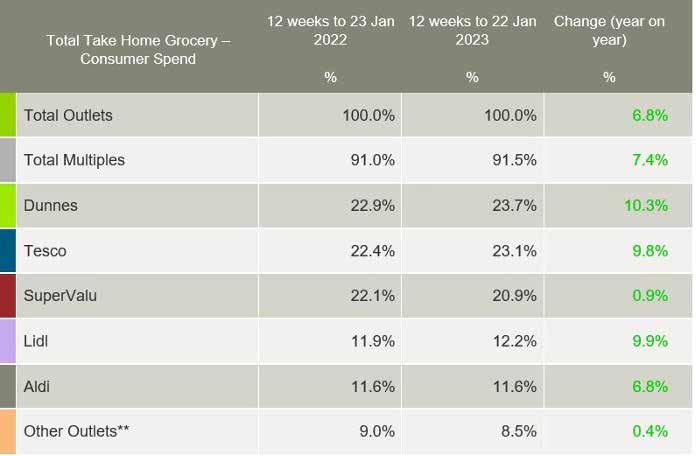
Tesco are close behind with 23.1% market share and growth of 9.8% yearon-year. Tesco also have the strongest frequency growth amongst all retailers, up 10% year-on-year.
SuperValu hold 20.9% of the market and 0.9%. growth. Among the Irish grocery retailers, SuperValu shoppers make the most trips in-store, with 20.8 trips on average, up 9.2% year-on-year.
Lidl hold 12.2% share and 9.9% growth year-on-year. New shoppers and more frequent trips contributed an additional €25.5 million to their overall performance. Aldi hold 11.6% and 6.8% growth yearon-year, with new shoppers and more frequent trips contributing an additional €10.8 million to their overall performance.
Retail News|February 2023|www.retailnews.ie|7 News
Lidl Ireland sign €17 million deal with Honeyvale Foods

LIDL Ireland announced a new contract worth more than €17 million with Honeyvale Foods. The new deal will see the Tipperary supplier deliver a range of premium Irish pork and bacon products to more than 217 Lidl stores across the island of Ireland. Founded in 1940, Honeyvale is part of the family-owned Brett Group that started as a small agricultural merchant selling to farmers in Kilkenny and Tipperary. It has grown over the years to become an international supplier of premium pork and bacon. Claire Mulrennan, Senior Buyer, Lidl Ireland, is pictured here with John Brett, Commercial Director, Honeyvale (left), and David Brett, Managing Director, Honeyvale.

Mace store sells €3.5 million Lotto ticket

Felix purrfect pairing with Robbie Williams
A LOCAL shop in Kilbarrack has been revealed as the selling location for the January 21 Lotto jackpot winning ticket worth an incredible €3,519,138. Mace in Kilbarrack Shopping Centre, Dublin 5, sold the winning ticket on Friday, January 20. “I’m absolutely ecstatic! I couldn't believe it when I got the call,” noted store owner Rhonda Brophy. “I thought ‘oh my goodness, after all this time in business, we’ve actually got a winner’. It's just unreal. We have to be one of the busiest lottery shops on the northside, so it's about time one of our customers won! We're a locally owned and run business in the shopping centre.” Rhonda Brophy is pictured with Conor Donohue, National Lottery.
PURINA have announced that Robbie Williams has recorded a brand-new song, as the new voice of the most mischievous cat around, Felix. Felix the cat is the face of one of the best loved foods for Irish cats, with Felix being one of the recognisable brands in Purina’s wide-ranging pet food portfolio. The internationally acclaimed recording artist stars in a film premiere in which he unveils a new exclusive track written and recorded specifically for this new Europe-wide Felix advertising campaign, ‘It’s Great To Be a Cat’. Taking inspiration from Robbie’s own adored cats, as well as the mischievous antics of Felix, the global superstar wrote and created an iconic track especially for Felix, celebrating the glorious life of cats.
“The cat is out of the bag,” said Robbie. “I’m the new voice of Felix. I’ve been a long-time fan of cats, I’ve had many feline friends over the years and after studying their fascinating behaviour, I can confidently say, It’s Great To Be a Cat.” See FelixandRobbie. com for more information.

Fyffes search for Ireland’s Fittest School
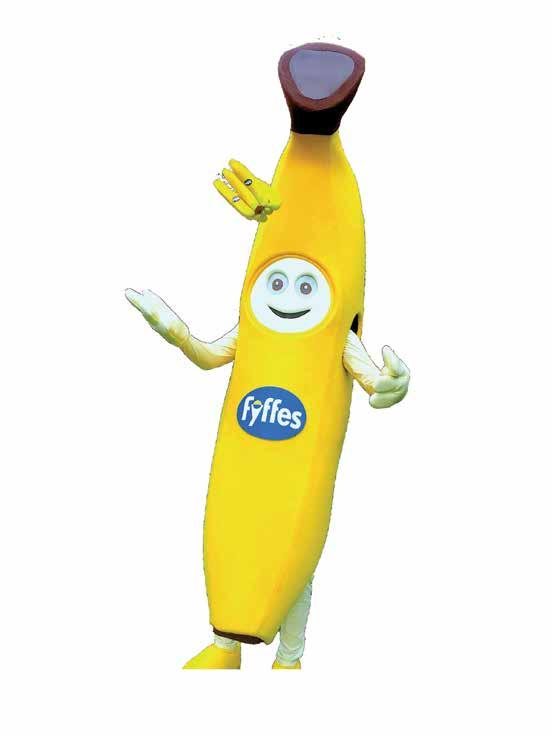
FOR the second year in a row, a call has gone out to schools across the country, from Irish Olympians Phil Healy and David Gillick (pictured), who have joined forces with Fyffes in a quest to find ‘Ireland’s Fittest School 2023’. Registration for the competition can be made online at www.fyffesfitsquad.ie, with the overall winning school to be announced in April. Coupled with spot prize rewards, one successful school will have the distinction of being chosen as ‘Ireland’s Fittest School 2023’, the prize for which will be a special visit from Healy and Gillick and €5,000 worth of sports equipment. The competition coincides with the ongoing roll-out of the Fyffes Fit Squad, a children’s fitness programme of live school visits across the country.

Coca-Cola launch enhanced maternity and paternity policy
COCA-COLA HBC Ireland and Northern Ireland have announced a new and improved maternity and paternity policy for all staff, which went live at the start of this year. On reviewing previous policies and in recognition of the need to support new parents and improve work life balance, Coca-Cola HBC have developed a Diversity Action Plan which includes a reformed maternity and paternity policy in addition to other changes. The new policy will give expectant mothers 26 weeks of 100% pay and then a further three months on 50% pay. The organisation is also taking steps to improve paternity leave cover, offering expectant fathers six weeks of leave on 100% pay. The announcement comes as the beverage business, which has over 750 employees on the island of Ireland, announced 35 new roles as part of a €20 / £17 million expansion to its production facility in Knockmore Hill, Lisburn, Northern Ireland.
Industry News 8|Retail News|February 2023|www.retailnews.ie
Consumers can ‘Win on the Double with Denny’

ICONIC food brand Denny has been at the heart of Irish family homes for more than 200 years. Their new campaign, Win on the Double with Denny, reminds us that, sometimes, the most comfort is derived from comforting others. The campaign gives shoppers the opportunity to enjoy Denny’s delicious, quality ham, while also being in with a chance to win one €100 grocery gift voucher for themselves and one for a loved one. Consumers simply pick up a pack, freetext the unique
Spar’s Better Choices campaign launched by Irish Olympians
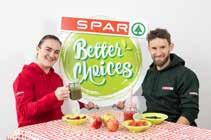
TWO Irish Olympians and Spar Ambassadors, boxer Kellie Harrington and rower Gary O’Donovan, have joined forces to launch the Spar Better Choices campaign for 2023, which aims to encourage customers to make Better Choices when shopping across the convenience retail network. The campaign features the two champions taking each other on in a fun set of challenges to see who will be crowned the Spar Better Choices Champion, over events like the Smoothie Slalom, the Popcorn Relay and the Apple Bobsleigh. To launch this initiative, Spar have partnered with Dietician, Dr Yvonne Finnegan, and there is an educational element to the campaign, with text appearing on screen to educate viewers on the nutritional values of the foods used by the Olympians in the challenges.
code inside and are in with a chance of winning every day over the competition’s life.
Ornua recognised as Company of the Year for 2022
ORNUA were the winners of the prestigious Company of the Year award for 2022 at this year’s Business & Finance Awards in association with KPMG. Ornua CEO John Jordan accepted the award on behalf of the business at the gala award ceremony, held in Dublin’s Convention Centre and attended by leading political, international business, and social leaders, including President of the European Commission, Ursula von der Leyen, and then Taoiseach Micheál Martin TD. John Jordan thanked his colleagues at Ornua, their members, and the 14,000 Irish farming families they represent: “Our success is down to their continuous commitment and dedication. An
incredible achievement in a poignant year for us, having celebrated 60 years in the business just last year.” Seamus Hand, Managing Partner, KPMG Ireland, presents Ornua CEO John Jordan with the 2022 Company of the Year Award, alongside Business & Finance President Ian Hyland.

New food waste app to help tackle

rising costs
A NEW food waste app, Gander, has experienced a surge in downloads and usage in-store, helping families across Ireland and the UK to save money by providing real-time information on reduced food items in local stores. Over the last four years, Gander has been urging retailers to tackle food waste and transform both the food chain and their bottom line by adopting its technology. However, as the cost-of-living crisis deepens and disposable incomes decrease, Gander recognises its potential to look beyond food waste prevention to support struggling families to maximise their shopping budget. Stacey Williams, Head of Customer Engagement and Business Development at Gander, says, “Last year, we saw an increase in Gander users as food prices soared. Our service allows customers to purchase reduced food locally and save an average of 56% on their weekly food bill.” For more information, visit www.gander.co.
Pepco offer payday pick-up
TO mark over 100 days since quietly launching pilot stores in Ireland, Pepco in Ireland recently revealed a January payday offer that was hard to resist. Ireland’s newest discount retailer thanked their growing community of customers by offering a €10 discount when customers spent €30 in one of their five locations in Ireland, in time for the end-of-month payday weekend. The vouchers, distributed through neighbourhood door drops, were redeemable at the brand new Pepco stores located in Omni Shopping Centre (pictured), Finglas Main Centre, The Park at Carrickmines, The Courtyard at Newbridge and Galway Shopping Centre. The pilot stores were launched in September 2022 after Dealz completely revamped five of their Irish stores, giving them top-to-bottom makeovers that converted them to the Pepco brand, creating an additional 60 jobs.

Industry News Retail News|February 2023|www.retailnews.ie|9
Daybreak raises €36,328 for Irish Heart Foundation

DAYBREAK’S 2022 Get a Move On! campaign has raised an incredible €36,328 for longterm charity partner, the Irish Heart Foundation. During the month of September, 169 Daybreak stores across Ireland took part in the active challenge, where participants committed to increasing their daily activity to 10,000 steps per day. The active challenge saw Daybreak customers, family and friends sponsor participants to achieve the fundraising target. “We are absolutely delighted to have raised €36,328 in aid of the Irish Heart Foundation. We want to say a huge thank you to our Daybreak colleagues for their participation and of course, to all those who sponsored the fundraiser. We are blown away by the generosity and support the Get a Move On! campaign has received”, said Molly Byrne, Assistant Brand Manager Daybreak, pictured (left) with Cliodhna Burke, Senior Business Development Manager, Irish Heart Foundation.
Danone Ireland partner with FoodCloud
DANONE Ireland have announced a three-year partnership with FoodCloud to help educate and empower community groups nationwide to prepare nutritious meals using surplus food. The partnership aligns with Danone’s mission to ‘bring health through food to as many people as possible’ and will see the company provide a nutrition education programme as part of FoodCloud’s Community Support Programme, which assists approximately 600 charities and community groups around Ireland with educational resources and training. Danone is the first company in Ireland to support FoodCloud’s network with access to recipes tailored by nutritionists and dietitians. The partnership will allow FoodCloud to distribute the equivalent of over 600,000 meals in three years, and help FoodCloud to increase the volume of food redistributed by 10% and grow its network by 50 new charities and community groups per year. Pictured are Killian Barry, Managing Director of Danone Ireland, with Aoibheann O’Brien, Partnerships Director at FoodCloud, and Brendan Dowling of Whitefriar Community Centre at FoodCloud’s hub in Tallaght.


€
Aldi Play Rugby returns
IRISH rugby internationals Rob Herring, Iain Henderson and Dan Sheehan are pictured at the launch of Aldi Play Rugby, a national programme aimed at primary school children across Ireland, which is now in its seventh year. To date, more than 30 primary schools have shared €500,000 in Aldi funding through the Aldi Play Rugby sticker competition, with a further €100,000 set to be distributed this year. Primary schools across Ireland are invited to enter for a chance to win a sports facility makeover worth €50,000. For more information, visit aldi.ie/playrugby

100k up for grabs via Tesco 25 Years Community Fund
TESCO Ireland have launched their latest community initiative that will see four community projects share €100,000 in funding from the special 25 Years Community Fund. ‘The 25 Years Community Fund’ is designed to help groups to realise a once-off special project from start to finish. Applications will be grouped according to locations and one cause from Munster, Leinster, Connacht and Ulster, and Dublin will receive a €25,000 donation each to help support their communities. Local organisations can apply online at www.tescoireland.ie or scan the QR code on the Tesco community board located at the front of all 164 stores nationwide. “For 25 years we’ve been supporting the communities we live and work in, and this year more than ever, we wanted to do something special for our communities,” revealed Rosemary Garth, Communications Director, Tesco Ireland, pictured (second from left) with Tomás Sercovich, Business in the Community CEO; Denise Charlton, Community Foundation CEO; and Minister of State for Business, Employment and Retail, Neale Richmond TD.
Local retailers celebrate €1 million EuroMillions wins!

THE National Lottery have confirmed the winning selling locations of the two winning tickets in the February 3 special EuroMillions Raffle draw, which are worth €1 million each.
Rodney Dean’s Centra store in Nobber, Co. Meath (left) sold a winning ticket, while the Donegal winner purchased their winning Quick Pick ticket on the day of the draw at Mary Tourish’s Burnfoot Service Station in Grianan Vale, Burnfoot, Co. Donegal. Pictured celebrating on the right are (back row): Paul Hegarty, Margaret Tourish, Mary Tourish and Emmett Tourish, with (front row) Tamara Gill and Kate Tourish.

Industry News 10|Retail News|February 2023|www.retailnews.ie
Maxol announce €340 million deal with BWG Foods
MAXOL have announced a four-year, €340 million contract with one of Ireland’s largest retail and wholesale companies, BWG Foods. The deal, which followed a competitive tender, will see BWG Foods retain the wholesale contract for Maxol’s extensive foods range, private label goods and alcohol range. Maxol and BWG Foods have had a trading partnership for more than 25 years and the new contract is the biggest ever agreed between the two Irish businesses in terms of value and product range. As part of the deal, BWG Foods have also won the contract for Maxol’s range of baked and deli goods.
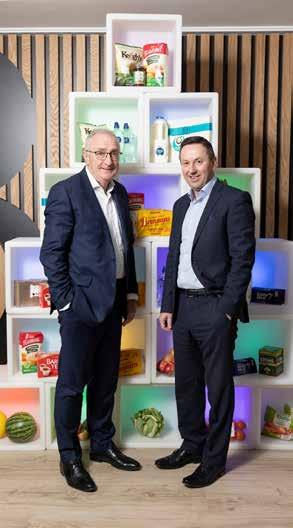
The announcement means that BWG Foods will continue to provide Maxol and their independent retailers in the Republic of Ireland with access to BWG's extensive supply chain and distribution infrastructure. “We are operating in a hugely dynamic sector and it’s both reassuring and exciting to have agreed a strategic supply and support agreement with BWG Foods, a partner who bring extensive experience and knowledge as a leader in the evolving Irish convenience market,” noted Maxol CEO, Brian Donaldson, pictured (right), with Leo Crawford, Group Chief Executive, BWG Group.
A Delicious and Unique Apple Cider Vinegar
NATURAL Umber is a delicious and organic apple cider vinegar, completely different to any other on the market. Fermented differently to the rest, Natural Umber has all of the same health benefits, but retains the natural sweetness of apples and tastes delicious!
Since launching in late January 2018, Natural Umber apple cider vinegar has taken the health food world by storm and has sold nearly 250,000 bottles. Demand is soaring as more customers discover this delicious vinegar and the word spreads online.

Apple cider vinegar has traditionally been seen as an unpleasant but vitally beneficial drink. Many people believe it can lower cholesterol, aid weight loss, relieve acid reflux, ease symptoms of arthritis, gout and much more.
Natural Umber is a genuinely delicious alternative, which doesn’t require additional sweeteners or flavours to hide the taste.
Unpasteurised, organic vinegars like Natural Umber also contain ‘Mother’, a naturally occurring by-product from the fermentation process. ‘Mother’ is a complex structure of bacteria and enzymes, believed to bring enormous health benefits.
Produced in Northern Ireland, Natural Umber was developed by Michael Mackle, whose family have over 70 years’ experience producing apple products. “After seeing the benefits of apple cider vinegar myself, I knew there had to be a better way of creating it,” he explained. “Apple cider vinegar always tasted so bitter, but apples are sweet! Which is why we spent years developing Natural Umber. We’re delighted with the unique flavour and look forward to bringing Natural Umber to even more kitchen tables!”
Natural Umber is available to buy from www.naturalumber.com, Amazon.co.uk or Yumbles.com. Also available from a selected number of retailers.
If you are interested in becoming a stockist, contact Luke Mackle on 04887784345 or Luke.mackle@naturalumber.com
Retail News|February 2023|www.retailnews.ie|11 Industry News
Retail Ireland: Monthly Update Changes to legislation on price indication
JUST before Christmas, the Government introduced very significant new legislation governing how retailers must conduct price promotions. For many retailers, it will involve big changes to their current sales practices.

The Price Indication Directive was unexpectedly introduced alongside the Consumer Rights Act 2022 on Tuesday, November 29. Among a range of measures, it aims to ban raising product prices immediately prior to a sale in order to provide the impression of misleadingly large discounts. Any business advertising a discount is now required by law to display the previous price, which must be the lowest price applied in the previous 30 days.
This piece of legislation has been agreed at EU level and was due to be applied in Ireland. However, the new rules, which have immediate effect, have created a major problem for many businesses, which are simply unable to makes the necessary adjustments to their systems and business plans over a short period of time. For many companies, these changes will take months to implement.
Retail Ireland has raised these serious concerns with both the Department of Enterprise, as well as the Competition and Consumer Protection Commission (CCPC), which is tasked with enforcing the new rules.
The Department has acknowledged that the new law may create short-term challenges for certain retailers to adapt their systems. The CCPC has indicated it will apply a practical approach when it comes to carrying out its statutory functions and is working to raise awareness of the regulations in the retail sector.
ROLLOUT OF DEPOSIT RETURN SCHEME PROGRESSES
WORK is ongoing to deliver Ireland’s planned Deposit Return Scheme for plastic bottles and cans. As mandated by the EU’s Single-Use Plastic Directive, Ireland is aiming to collect over 90% of these containers for recycling by the end of the decade and the Deposit Return Scheme will be central to meeting this target. The scheme includes PET plastic bottles, aluminium and steel cans from 150ml to 3 litres and will not include milk cartons. The deposit amount will be 15 cents for cans or bottles of 500ml or lower, while for containers above 500ml, the deposit will be 25 cents. Consumers will pay a deposit, additional to the retail price, when buying a can or a bottle and will be able to return containers to retail stores nationwide.
A new registration portal for system participants, including beverage companies, retailers and other impacted operators, was recently introduced. Ensuring that all parties are registered and compliant with their obligations is an important element in the overall planning for a successful launch.
As such, impacted companies who have not yet done so are encouraged to complete the registration process via Re-turn’s website at www.re-turn.ie
In January, the entity created for the purposes of operating the Deposit Return Scheme, Re-Turn, announced more details and guidance around the scheme, particularly in relation to retailer handling fees and the producer fees, including exemptions that businesses can apply for. It is currently envisaged that the scheme will become fully operational from February 2024. However, there is still a lack of clarity on a range of important issues on how the scheme will operate. Many retailers believe that the current launch timeline is not realistic and will need to be pushed back to allow for the necessary preparation to take place.

Retail Ireland continues to engage with members, government and the operating company on the roll-out of the scheme, with major concerns and challenges remaining.
Tel: 01-6051558 | www.retailireland.ie
Need more?
For more information about Retail Ireland and details of how your retail business can benefit from our unique services and supports, please visit us at www.retailireland.ie
12|Retail News|February 2023|www.retailnews.ie

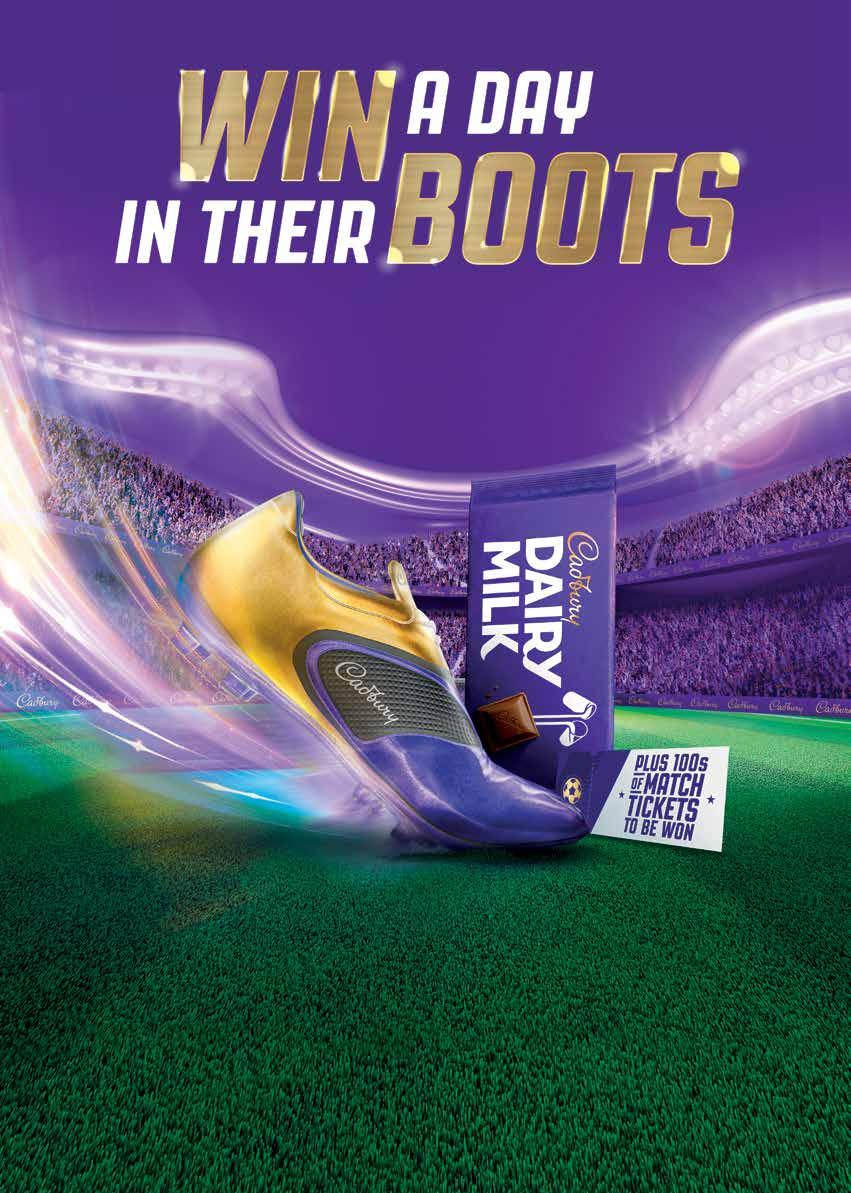

VIP MATCH BEHIND THE SCENES GROUP TRAINING WHICH EPIC EXPERIENCE WILL YOU CHOOSE? DAY DAY DAY UK/ROI 18+. 03/01/23 10:00 - 26/03/23 16:59. Visit winaday.cadburyfc.com for full T&Cs. Purchase necessary (NPN for NI & ROI). Prizes subject to clubs and/or COVID-19 guidance
No ordinary Joe
Joe Manning, Commercial Director at Tesco Ireland, is the Irish Grocers Benevolent Fund’s President of Appeals for 2023. He talks us through his pride in being asked to take on the role, his plans for the year ahead and his hopes to raise not just the funds raised but the entire profile of the Fund.
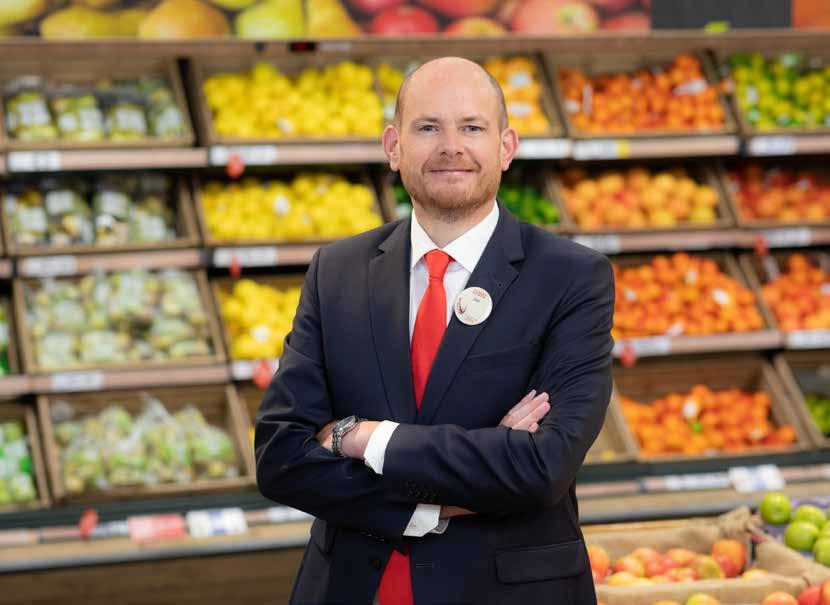
TESCO Ireland Commercial Director Joe Manning will this year take the helm as President of Appeals for the Irish Grocers Benevolent Fund (IGBF). A proud Cork man, and a well-known figure in the Irish retail sector, Joe replaces outgoing president Kevin Keating of Tennant & Ruttle, who has been in the role for the past 12 months.
“It’s my honour to serve as President of Appeals of the IGBF for 2023,” Joe explained. “Throughout my career in the industry, the IGBF has been an integral part of the retail landscape, providing essential help to those in need. Now more than ever, the role of the hardship
fund is as important as it was when it began 59 years ago. It’s a testament to the long-standing members of the industry who have ensured that we look after our industry’s members, spouses, and bereaved families right across the country.”
In his role as Commercial Director with Tesco, Joe is responsible for ensuring the integrated commercial success of the business in Ireland. Having worked across a variety of commercial roles in Ireland and the UK for Cadbury/ Mondelez International, Joe joined Tesco in 2014 as Ambient Category Director, before assuming the role of Fresh
Director in April 2017. Joe was then appointed Commercial Director in 2018. In addition to the commercial strategy, Joe oversees Sourcing and Food Waste elements of Tesco’s ESG strategy, supplier relationships and its support of Irish agribusiness. Joe is also a board member of Repak. Joe is well used to the pressures of a demanding role and expects taking on the President position at IGBF will be “both challenging and very rewarding”.
“I’m looking forward to the year ahead and doing my part to support the Fund,” he revealed. “Not many professions support their own in the way retail is doing and has done over the years through this network.
14|Retail News|February 2023|www.retailnews.ie Retail News Interview
It is greatly admired by other professions and trades and is a hallmark of the integrity of our industry. I am committed to the role and to building on the fantastic success of the IGBF to date. I work in a great business with so many brilliant colleagues, and I really believe they can play an important role to help me during my tenure as President of Appeals.
“It’s not the first time a Tesco nominee has been in the job, so that helps, in terms of people across the business being familiar with how the IGBF operates and the kind of fundraising activities which have taken place in previous years,” continued the incoming President of Appeals. “Clearly, I have a role to play but what’s really encouraging has been the enthusiasm of the team to get involved to lead some of the activities. I’m absolutely committed to giving ample time to support the IGBF’s goals and striving to deliver the best outcomes to the beneficiaries of the Fund.”
Putting his stamp on the role Joe believes there’s plenty of scope as President of Appeals to raise even more
awareness about the vital role that the IGBF can play in helping those who need it most. “When it comes down to it, the most important part of the brief is about fund-raising,” he acknowledged. “However, I want to use my year in the position to try to raise as much awareness as I can for the organisation. We have hundreds of wonderfully generous suppliers who I know will continue to contribute in a meaningful way during 2023, and I’m hoping also to bring some new contributors on board to help increase the resources of the fund.”
As always, there will be a series of regular fund-raising events which will be spread across the year. Joe says these events are always well attended, but believes that “there is always the potential to grow the numbers, and get more people involved. It is well known that there are many companies who year after year actively help to fundraise and contribute financially; however, there are many more who have not traditionally engaged with the IGBF who could be persuaded to get involved.
“From a Tesco Ireland point of view,
it has been really important to us as a business to be able to give back in a meaningful way,” he added. “The IGBF, as an extension of the retail industry, also has its unique social responsibility role to play by continuing to provide assistance to relieve hardship amongst unemployed and retired members of the retail sector.”
Challenges for the year ahead
Competing with other worthy causes is always a challenge for the IGBF. However, in the current inflationary environment it can be argued that the need for the organisation is more important than ever. The numbers of people that the IGBF is helping continues to grow and doesn’t appear to be dissipating anytime soon.
The IGBF is unique in terms of an Irish charity organisation funded entirely by a business sector to support people in that industry who need help: “It continues to support those colleagues across the grocery industry who have fallen on hard times, regardless of whether their companies were supporters of the IGBF or not: it doesn’t discriminate,” Joe stressed. “This is about helping our colleagues.”
Retail News Interview Retail News|February 2023|www.retailnews.ie|15
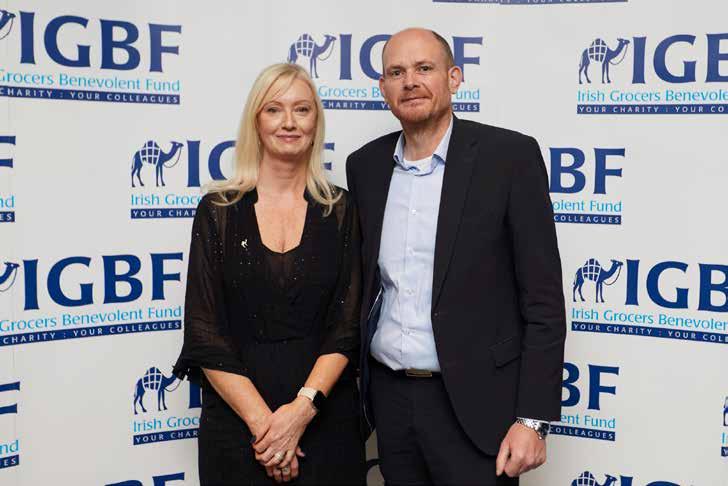
IGBF Chairperson Frances Higgins, BWG Foods, with Joe Manning, President of Appeals, Tesco Ireland, pictured at the recent IGBF Christmas Lunch.
Joe believes there’s plenty of scope as President of Appeals to raise even more awareness about the vital role that the IGBF can play in helping those who need it most.
Strong commitment
One of the issues in recent years has been that a relatively small amount of people do an awful lot of work when it comes to the IGBF committees, with previous Presidents of Appeals highlighting the need for new blood within the organisation, both to ease the time burden on those who have already given so much and to bring new ideas into the Fund.
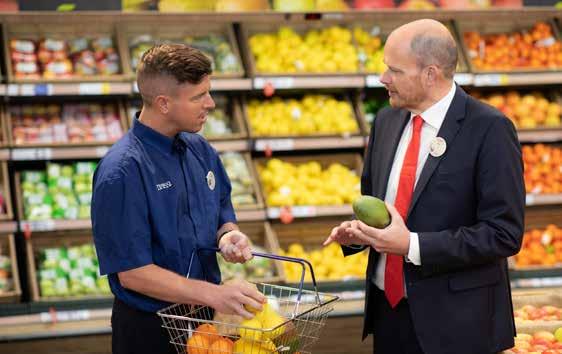
“I see my tenure as President of Appeals as an opportunity to get more people involved, both from within my own organisation and through the strong relationships we have with hundreds of suppliers across the country,” Joe explained.

At the end of his tenure, what would Joe like to have achieved as President of Appeals?
“Overall, I would like to grow the engagement from organisations with the IGBF. If we can achieve this, then increasing our fundraising targets will follow,” he concluded. “It is a big challenge, but I am confident that we will continue to be supported by the many great organisations who
have stepped up so often for us in the past. I hope I will get more engagement from organisations and get more Tesco colleagues taking part in the different events, and overall, I’d like to see growth in the numbers of people attending the many great social events like the golf outing, the Grocers Fun Run and the TWIG lunch.”
16|Retail News|February 2023|www.retailnews.ie Retail News Interview
I see my tenure as President of Appeals as an opportunity to get more people involved, both from within my own organisation and through the strong relationships we have with hundreds of suppliers across the country.
“ “
Joe Manning: “I work in a great business with so many brilliant colleagues, and I really believe they can play an important role to help me during my tenure as President of Appeals.”
NEW



DISCOVER X-STRONG




100% TOBACCO FREE NICOTINE POUCHES



For more information go to: WWW.NORDICSPIRIT.IE
EXTRA SOMETHING READY FOR Nordic Spirit contains nicotine. Nicotine is an addictive substance.
Centra’s €23 million store expansion programme
CENTRA have announced a €23 million investment in their store expansion programme for 2023, which will see the opening of 18 new stores, creating at least 468 new jobs across local communities, bringing the total employment figure at Centra to over 12,000. As part of the programme, Centra will also revamp and refresh 35 existing stores in 2023, with their bespoke award-winning store design. Centra’s store expansion and investment programme is in addition to the €25 million deployed last year, which included the refresh of 33 outlets across their retail estate.
Sales of €1.98 billion in 2022
2022 saw sales of over €1.98 billion achieved for the first time across 167 million consumer transactions. The brand has demonstrated strong resilience in the face of the ever-increasing economic challenges, which has resulted in a 17% increase in sales compared to 2019, the last non-Covid-19 impacted retail year.
As 2022 saw the final lifting of Covid-19 restrictions, employees returned to offices in urban locations around the country, with a corresponding uplift in demand for Centra’s convenience offering, with on-the-go breakfast and lunch options increasing sales by 13% on 2021. Lunchtime deli sales alone increased by almost 11% (10.9%) compared to 2021 as the need for convenience lunch topped the agenda for consumers. Frank and Honest coffee sales were up 7%. In addition, Centra’s bakery also continued to grow in popularity, with sales increasing by 8% yearon-year.
However, 2022 was not without its challenges as the cost-of-living crisis began to take hold. Shopping trends showed that consumers made a shift in the latter part of 2022 and were focused more heavily on dining in, with the Centra Freshly Prepared range enjoying a 10% growth year-on-year. As consumers continued to pursue value and shop ‘smarter’, Centra also saw demand for their own-brand range increase significantly, with sales growing by 10.3%.
“At Centra, we strive to deliver the best value and exceptional quality Irish products to customers,” noted Centra Managing Director Ian Allen. “Our in-depth understanding of the role of convenience
in shopping decisions saw us adapt to the schedules of our time-poor shopper, meeting their needs at each hour of the day. Today’s customers are shopping little and often and Centra is the perfect solution to meet this trend.”
The MD revealed that Centra are “cognisant that these are challenging times, with increased living costs and rising inflation”, and noted how Centra are “continuously adapting to meet our customers’ needs and I would like to thank them for their loyalty, as well as our retail partners in every community across Ireland for the role they have played in delivering this relentless value and service.”
Plans for 2023
Centra have a number of innovations planned for this year and beyond.
In Q1 2023, Centra expect to expand their trial same-day delivery partnership with Just Eat & Deliveroo to six further locations. Customers have shown significant interest in the delivery service, which was rolled out across 34 locations in 2022.
Moo’d ice cream, Centra’s exclusive ice cream brand, enjoyed a 13% increase in sales in 2022, with growth fuelled by the installation of a further 34 new Moo’d ice cream counters across the retail estate in 2022, and new flavours set to launch in 2023. In addition, Centra’s partnership with The Happy Pear continues to go from strength
to strength, with a 21% growth in sales recorded in 2022.
Sustainability will continue to be a leading priority for Centra, with 96% of ownbrand product packaging now recyclable, reusable or compostable, which positions the business ahead of targets to achieve 100% green packaging by 2025. Having launched the Musgrave Sustainability Fund in 2022 to the tune of €25 million, Centra stores across Ireland are undergoing sustainable upgrades. So far, 200 Centra stores in the Republic of Ireland have availed of the fund, which has achieved a reduction of 1,714 tonnes of carbon to date. Through the fund, Centra stores can avail of funding for LED lighting, refrigeration and freezer upgrades, electronic shelf edge labels (eSELs), solar panels, and electric delivery vans. This fund is part of the company’s commitment to achieve net zero carbon by 2040.
Centra stores continue to play an active role in their communities, making significant financial contributions through employment, sponsorships and supports to a number of charities. Last year, Centra stores raised over €105,000 for the Irish Cancer Society, while Centra also launched their in-store fundraiser in March 2022 to support those impacted by the war in Ukraine. This funding, combined with the Musgrave Group fundraising appeal, contributed over €1 million to these efforts.
18|Retail News|February 2023|www.retailnews.ie Centra
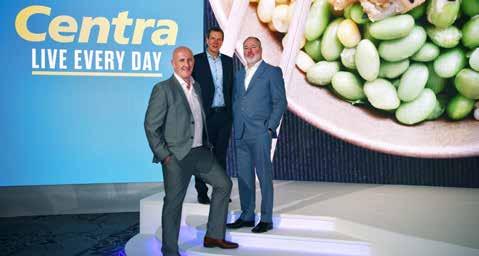
Pictured are Ian Allen, MD, Centra; Ian Cuddihy, Centra Council Chair; and Cormac Dawson, Sales Director, Centra; at the annual Centra Conference at The Great Southern, Killarney, Co. Kerry.


STOCK UP NOW on Ireland's No.1 Novelty at Easter Source: Nielsen, Total Scantrack excluding discounters @17 Weeks to 17.04.22 ROI Data
Easter Treats
Egg-cellent sales opportunity
With consumers treating themselves to their favourite Easter confectionery well ahead of Easter Sunday, the advice for retailers is to stock up early on your seasonal selection.

EASTER Sunday lands on April 9 in 2023, meaning that Easter Egg season is already upon us, with many consumers already seeking out their favourite brands in chocolate egg format.
Last year was one of the most successful Easter seasons ever for Irish retailers, as consumers celebrated their first Easter without social restrictions for two years, due to the impact of Covid-19. According to figures for Kantar for the four weeks leading up to Easter Sunday, 2022, Irish consumers spent €10.8 million more on Easter eggs and seasonal chocolate compared to the same time the previous year.
Irish shoppers are buying more eggs than ever before, with plenty of Irish consumers already indulging in some seasonal chocolate treats long before Easter Sunday itself. So the advice is to stock up early this year, as consumers will be keen to purchase.
Lir Chocolates
Leading Irish chocolatiers and Origin Green Gold Member, Lir Chocolates have a wide variety of delicious Easter treats for 2023, all proudly made in Co. Meath since 1987. This Easter is especially exciting for Lir Chocolates as they expand their Baileys Chocolate range with the new Baileys Chocolate Original Easter Egg 260g (RRP €10).
The Lir Easter range has something for every chocolate lover with their wide selection of chocolate flavours: White


Chocolate Egg (155g, RRP €8.50), Crispy Caramel Egg (155g, RRP €8.50) Milk Chocolate Egg (230g, RRP €10.50), Dark Chocolate Egg (230g, RRP €10.50). Each egg is beautifully packaged in 100% fully sustainable packaging, wrapped with pink Kraft paper which unfolds to reveal the beautiful hand-crafted egg. Each egg also includes Lir truffles – an added treat for consumers.
The Lir Chocolates Easter range will be available in all major
20|Retail News|February 2023|www.retailnews.ie
Lir’s Milk Chocolate and Dark Chocolate Easter eggs are 230g each, with an RRP of € 10.50.











































An Post Retailer Ser vices Supporting Small Irish Business Card Payment solutions • Accept all major Debit & Credit cards in your store • Desktop, WiFi, Mobile, and Virtual terminals available • Short Term contracts available • Next working day settlement in your bank • Local customer support from the GPO Next working day swap out Business Deposits • Conveniently lodge your business cash at your Local • Longer Opening hours/Saturday lodgements • Next Working Day Settlement • Fast Track Lodgements • Fees are typically 30% cheaper than pillar banks aprs.sales@ anpost.ie 1800 300 150 Gift Box & Bag Sell Christmas Sta mps in your store One4all and Gift Boxes & Bags also available from PostPoint. Stamp Booklets available International Stamps x5 • National Stamps x5 National Stamps x20* * (includes four FREE stamps) Gift Boxes & Bags Gift Box 9 • Gift Bag 6 Christmas Stamps & One4all are huge sellers in PostPoint stores every year. If you would like to stock these and apply to become a PostPoint agent please call or email. x One4all Gift cards aprs.sales@ anpost.ie 1800 300 150 Postage includedCustomers can buy and post in store Christmas Stamps2022 5Stampaí d náisiúnt Int rnationa st mps SChristmas tamps 2022SChristmas tamps 2022 5 S mpa náisiúnt Nationa s ps 20Sta paínáisiú ta Nation stamps Christmas Stamps2022 Christmas Stamp Booklets
Easter Treats
The
includes
multiples and independents. The entire portfolio can be purchased online at www.lirchocolates.com
Lir Chocolates are delighted to be expanding their Baileys Chocolate range for Easter 2023. Baileys Chocolate combines creamy chocolate with the iconic Irish Cream Liqueur for a luxurious, indulgent treat. This Easter will welcome the new Baileys Chocolate Original Egg to Irish shelves (260g, RRP €10). This milk chocolate egg is flavoured with a hint of Baileys and includes eight original twist wrap truffles. Completely enclosed in board packaging, Lir Chocolates and Baileys Chocolate are continuing their efforts to bring new products to the market in more sustainable packaging by reducing the amount of plastic used.
Their mouth-watering range is sure to please every sweet tooth this Easter. The Baileys Chocolate Easter range offers consumers a wide array of gifting and self-treat options this Easter season. The Baileys Chocolate Easter portfolio includes; Baileys
Strawberry & Cream Egg (205g, RRP €13), Baileys Salted Caramel Egg (215g, RRP €13), Baileys Sundae Egg (220g, RRP €13) and Baileys

Chocolate
Luxe Mini Eggs (138g, RRP €6) and Baileys

Strawberry & Cream Hearts (90g, RRP €5).
The Baileys Chocolate Easter portfolio is available to purchase in-store at all major retailers
Lir Chocolates are expanding their Baileys Chocolate range for Easter 2023, with indulgent treats guaranteed to tempt consumers.

No Yolking: Cadbury launch Creme Egg White

CADBURY have unveiled their first Cadbury Creme Egg innovation in half a century in the shape of Cadbury Creme Egg White. That’s right, Cadbury Creme Egg fans are in for an egg-cellent Easter this year, as the new tasty eggs will be available far and wide across Ireland...and better yet, they’re here to stay.
The delicious white chocolate twist on the fan favourite launched as part of the permanent Cadbury Easter range, the first Cadbury Creme Egg innovation in 50 years.
The new recipe features the unique Creme Egg goo, coated in white chocolate sourced from 100% sustainable cocoa. The unique combination of a melt-in-the-mouth Cadbury Creme Egg centre combined with a smooth and silky white chocolate texture, makes it an irresistible Easter treat.
The much-anticipated launch includes Cadbury Creme Egg White singles (RRP €1.02) and Creme Egg White five packs (RRP €5.50). Fans will also be able to purchase mixed multipacks containing two classic Creme Eggs, two caramelfilled eggs and one white chocolate egg (RRP €5.50) which are available from major retailers now.
“It’s a New Year which means it’s time for a new Cadbury Creme Egg Season,” noted Maighréad Lynch, Cadbury Creme Egg Brand Manager. “We are delighted to introduce the White Creme Egg in time for Easter celebrations this year. White chocolate fans across Ireland will be delighted that they can now look forward to enjoying this new addition to the Creme Egg family.”
Chocolate connoisseurs will need to mark their calendars as Cadbury Creme Egg White will only be around between January and April and whilst stocks last.
22|Retail News|February 2023|www.retailnews.ie
Lir Easter range
a White Chocolate Egg and a Crispy Caramel Egg, both 155g with an RRP of € 8.50.
New Cadbury Creme Egg White is a delicious white chocolate twist on the fan favourite.
and independents. The full Baileys Chocolate range can be purchased online at www.lirchocolates.com
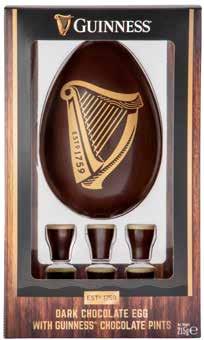
The iconic Guinness Dark Chocolate Harp egg with six mini pints (215g, RRP €13) is sure to be a hit with all Guinness fans. The Guinness Egg will be available to purchase from all major multiples and independents. Shop the entire Guinness range online at www.lirchocolates.com
Mars
Mars are introducing new innovations alongside the return of key seasonal favourites for Easter 2023.
The Easter range is expanding with the launch of M&M’s Easter Shapes, delicious, individually foil-wrapped chocolate shapes filled with M&M’s. The unique shapes and fun designs make for the perfect seasonal gift and are sure to be a firm favourite with shoppers. The hollow centre filled with M&M’s will surprise and delight.
Easter 2023 will also see the return of M&M’s Speckled Eggs, this time in new and improved packaging and a display that is even more eye-catching in-store.

This is in addition to the wide range of traditional Easter egg formats in large, extra large, luxury and giant sizes from consumers’ favourite brands, including Celebrations, Mars, Bounty and Galaxy. This range will see the introduction of three new large formats: a Bounty Large Egg for coconut chocolate lovers, a Twix XL Egg and a delicious Galaxy Enchanted Giant Egg, featuring two packets of the popular Galaxy Enchanted Eggs and one Enchanted Egg Treat Bag.
Across the whole seasonal range, attention has been given to reducing the impact of its packaging – Mars have been on a significant packaging reduction journey since 2020 and are proud to
say that 97% of their Easter egg portfolio is now plastic-free. Mars will continue to look at sustainable packaging solutions as they work towards a global goal to have packaging that is 100% reusable, recyclable or compostable by 2025.
New M&M’s Easter Shapes are delicious, individually foilwrapped chocolate shapes filled with M&M’s.


Lily
O’Brien’s Salted Caramel Truffles named Product of the Year
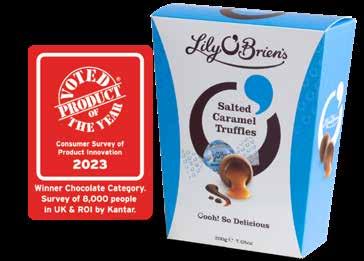
LILY O’Brien’s were delighted to announce that the latest addition to the brand’s chocolate collections, the Lily O’Brien’s Salted Caramel Truffles, were recently voted Product of the Year 2023 in the Chocolate Category at the Product of the Year awards in London.
The new Lily O Brien’s Truffles range was launched in Q4 2022 and has already proven extremely popular with consumers. The Product of the Year logo will now be displayed on Salted Caramel Truffles boxes and incorporated into Lily O’Brien’s marketing plans throughout 2023 to inform shoppers of this very positive consumer endorsement of the new Salted Caramel Truffles.
“We are very proud to be voted Product of the Year in the Chocolate Category,” noted Michelle Vance, Chief Executive Officer. “Thank you to all the consumers who voted for Lily O’Brien’s Salted Caramel Truffles. Knowing that our product was voted by consumers as the winner in the chocolate category is fantastic support of our new Salted Caramel Truffles.”
The award-winning Salted Caramel Truffles can be found in retailers nationwide and online www.lilyobriens.ie
Retail News|February 2023|www.retailnews.ie|23
Easter Treats
M&M’s Easter Shapes make for the perfect seasonal gift and are sure to be a firm favourite with shoppers.
Lily O’Brien’s Salted Caramel Truffles were voted Product of the Year 2023 in the Chocolate Category at the Product of the Year awards in London.
The Guinness Dark Chocolate Harp egg with six mini pints (215g, RRP €13) is sure to be a hit this Easter.
NOffLA Off-Licence of the Year Awards
NOffLA Off -Licence of the Year winners announced
McHugh’s Off-Licence, Malahide Road, Dublin, was named National Off-Licence of the Year at the annual NOffLA Off-Licence of the Year Awards. A delighted Cathal McHugh explains what the win means to the innovative store and why independent off-licences are so valued by customers.
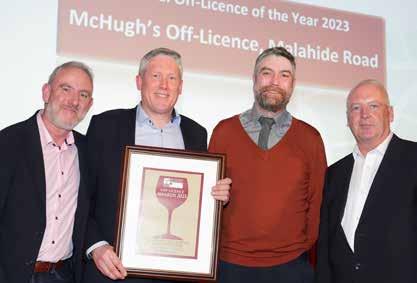
THE National Off-Licence Association (NOffLA) has announced the winners of its annual Off-Licence of the Year Awards 2023, which are now in their 27th year. The Awards were held at the Honourable Society of King’s Inns in Dublin.
The Awards, which included 46 finalists, saw McHugh’s Off-Licence, Malahide Road, Dublin 5, awarded ‘National Off-Licence of the Year 2023’, O’Donovan’s Off-Licence Group awarded ‘Responsible Retailer of the Year 2023’ and 64 Wine, Glasthule, awarded ‘Food Retailer OffLicence of the Year 2023’.
NOffLA, which was established in 1991, represents independent specialist off-licences across Ireland, with the sector representing 5,900 jobs in 26 counties. The Awards recognise and showcase the excellence of independent off-licences and highlight those retailers that offer exceptional service to customers and demonstrate excellence in retail standards.
The best of community retailing
“We are thrilled to finally be back in-person celebrating the NOffLA Off-Licence of the Year Awards, which champion the very best of community retailing and all that is great about the independent off-licence sector,” said Gary O’Donovan, NOffLA Chairman. “NOffLA members provide exceptional standards of service to their customers and exemplify the true ethos of ‘shopping local’.”
Gary went on to note that the last 12 months has been an unprecedented year for small businesses, with inflation and rising costs impacting NOffLA members and the wider hospitality sector. “Government can implement an immediate lifeline to these businesses through a reduction in alcohol excise rates, which remain the highest in Europe,” the NOffLA Chairman insisted.
“We have had Minimum Unit Pricing in place for a year, a pricing floor that now prevents alcohol from being retailed at dangerously low prices, meaning Ireland’s excise regime is no longer justified on the grounds of public health,” Gary continued. “And with the State now taking in record levels of tax receipts, it is time for Government to ease the unrelenting cost pressures on all hospitality businesses by bringing excise rates in line with European levels.”
On the night, all 46 finalists were awarded Certificates of Excellence and a Customer Service Award based on their performance. Other awards on the night included:
1. The 19 Crimes Best First Time Entrant 2023 – Carry Out Muckross Road, Killarney, Co. Kerry
2. The Peroni Nastro Food Retailer Off-Licence of the Year 2023 – 64 Wine, Glasthule, Co. Dublin
3. The El Coto Customer Service Award of the Year 2022 – Molloy’s, Liberties
4. The Redbreast Spirit Specialist of the Year 2023 – The Vintry, Rathgar, Dublin 6
5. The Guinness Beer Specialist of the Year 2023 – Carry Out Tramore, Co. Waterford
6. The Dona Paula Wine Specialist of the Year 2023 – Jus De Vine, Portmarnock, Co. Dublin
7. The Hennessy Munster Off-Licence of the Year 2023 – Galvin’s Carry Out, Carrigaline, Co. Cork
8. The Drumshanbo Gunpowder Irish Gin Connacht/Ulster OffLicence of the Year 2023 – Daly’s Drinks, Boyle, Co. Roscommon
9. The Alpha Zeta Leinster Off-Licence of the Year 2023 – The Wine Centre, Kilkenny
10. The Bombay Sapphire Dublin Off-Licence of the Year 2023 –Martin’s Off-Licence, Fairview, Dublin 3
11. The NOffLA RTC Online Trainee of the Year 2023 – Emily McEntee, McEntee’s, Kells, Co. Meath
12. The NOffLA Responsible Retailer of the Year 2023 – O’Donovan’s Off-Licence Group
13. The NOffLA National Off-Licence of the Year 2023 – McHugh’s OffLicence, Malahide Road, Dublin 5
24|Retail News|February 2023|www.retailnews.ie
Pictured at the presentation of the NOffLA National Off-Licence of the Year 2023 to McHugh’s were Frank Haughton, Cathal McHugh, and James Carroll of McHugh’s Malahide Road and Gary O’Donovan, Chairman, NOffLA.
Judging for the Awards involves an examination of over 100 aspects of each entrant’s business. Final awards were allocated following this process.
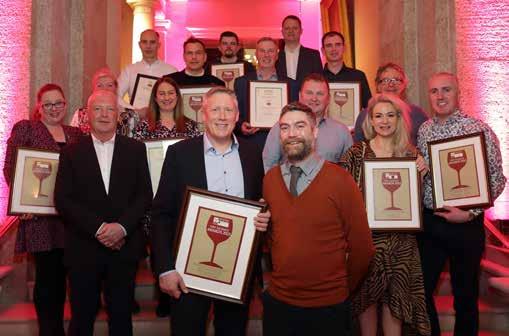
National Off-Licence of the Year winners, McHugh’s have been NOffLA members since their first off-licence opened in 1995 on Kilbarrack Road, Dublin 5. “We set that up from scratch and the following year, in 1996, we purchased an existing off-licence, which was then called Kelly’s on the Malahide Road," explained store owner Cathal McHugh. "We operated as Kelly’s for a few years as it had strong recognition and the McHugh’s name didn’t at that time, but in 1999 we switched it to McHugh’s.”
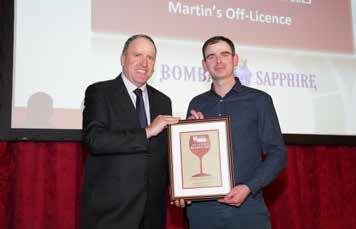
Being a part of NOffLA is hugely important, not just for McHugh’s but for every independent off-licence across the country, according to Cathal: “Each one of us on our own has just a small voice, whereas NOffLA seem to be able to open doors into the decision-making forums and get things done.”
Both McHugh’s off-licences have become extremely wellknown in the intervening years, building up a loyal customer base. “We’re always trying to find different ways to engage with our audience,” explained Cathal, who reveals that they have always tried to be “at the cutting edge” of new trends across
wines, beers and spirits.
McHugh’s developed their own beer brand, Roadtrip, which was created by partnering with craft breweries across the country for a series of limited edition beers, which have sold extremely well, as well as the more specialist, small-batch Roadtrip Explorer series.
“We released our first beer in 2016, partnering with Kinnegar Brewing in Donegal, which was a fantastic American IPA,” Cathal explained. “Since then we have partnered with other craft breweries, including Independent Brewing in Carraroe, Co. Galway, Larkins’ Brewing Company in Wicklow and Hope Beer in Dublin.”
Craft beers are no longer niche and have gone mainstream, the store owner explained, but while supermarkets have dipped their toe into the craft beer sector, it continues to be driven by independent off-licences.
“It really requires a quality independent with commitment to the craft beers category to stock the full range,” Cathal noted. “Supermarkets cherry-pick some beers, but on an ongoing basis we stock 600 different beers. Some consumers want our knowledge, our expertise and the wider range of beers.”
The off-trade witnessed something of a surge in spirits sales during lockdown, as consumers sought to recreate their pub experience at home and wanted to indulge in premium spirit brands.
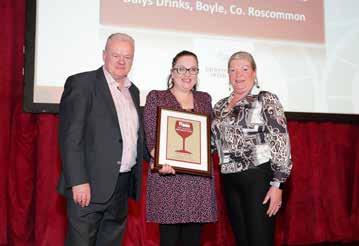
“People were experimenting at home with different spirits during lockdown,” Cathal revealed. “Gin was the craze up to about four years ago, but over the last year and a half, whiskey has really been on an upward trajectory. We see huge growth in Irish whiskey. Where before, people may have had three or four different gins on their sideboard, now they might have four or five whiskeys and they are very curious about picking up new and different whiskeys.”
Cocktail culture too has really taken hold on our shores, which
NOffLA Off-Licence of the Year
Retail News|February 2023|www.retailnews.ie|25
Awards
All the category winners at the NOffLA Off-Licence of the Year Awards 2023.
John Cassidy from Edward Dillon & Co. presents the Bombay Sapphire Dublin Off-Licence of the Year 2023 Award to Damian Martin, Martin’s Off-Licence, Fairview.
Nigel Moran, The Shed Distillery & Dalcassian Wines & Spirits, presents the Drumshanbo Gunpowder Irish Gin Connacht/Ulster Off-Licence of the Year 2023 Award to Carol and Geraldine Daly, Daly’s Drinks, Boyle, Co. Roscommon.
NOffLA Off-Licence of the Year Awards
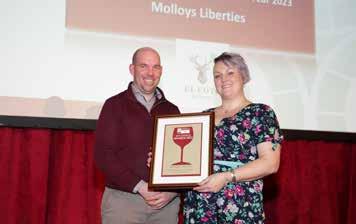
has also seen a spike in spirits sales, but McHugh’s have gone a step further than many other off-licences in a bid to capture the hearts of cocktail consumers.
“We’ve seen a huge increase in demand for cocktails,” Cathal stressed. “We like to think of ourselves as being innovative and bringing new things to market, so we created our own brand of cocktails, called Shake Me.”
McHugh’s restaurant in Portmarnock employs two mixologists, who batch-make cocktails and bottle them. “They are made with top quality ingredients and great expertise,” Cathal explained. “We have a core range of four cocktails – Margaritas, Cosmopolitans, Old Fashioneds and Porn Star Martinis – which were launched during lockdown and they’re still going very strong.”
Cathal McHugh is adamant that the independent off-licence sector in Ireland continues to thrive because is offers a level of service, expertise and a range that multiple supermarkets cannot compete with.
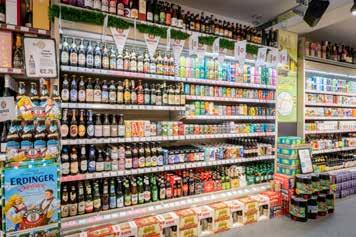
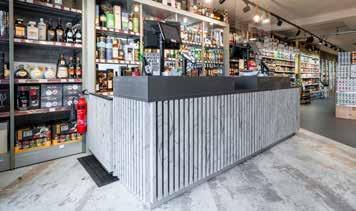
“It’s the team that we have, the knowledge that we have and our willingness to impart that knowledge to customers,” he insisted. “Our specialist range across wines, beers and spirits is considerable; we feel we are strong across all three categories. If someone is coming in for that special bottle of wine, or they’re looking for a particularly wide range of beers, or a premium whiskey or gin, they know that we will have it, that we will be able to answer any questions they may have about it and point them in the right direction. Supermarkets by their nature dumb down the off-licence offering; it tends to be a ‘one size fits all’ approach. Whereas, we can be a bit more adventurous.”
The store owner was thrilled when McHugh’s was named as the NOffLA Off-Licence of the Year for 2023. “You always go into the competition with hope and expectation and sometimes you’re disappointed, but we were cautiously optimistic this year and we were delighted to win,” he revealed. “Part of the winning of this award was that we invested heavily in 2021 in our Artane shop. We were delighted with the results of that refurbishment.”
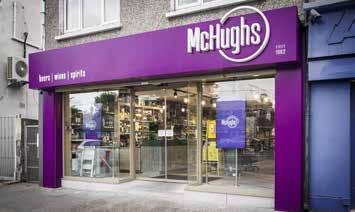
Indeed, McHugh’s are currently in the process of revamping their other off-licence in Kilbarrack.
The team at McHugh’s will be making the most of their win in the coming weeks, ensuring their customers are aware of the award: “We’ll be making up signs, hanging bunting and doing everything we can to publicise our win. It gives us something to shout about and hopefully our customers agree that we are worthy winners.”
We have had Minimum Unit Pricing in place for a year, a pricing floor that now prevents alcohol from being retailed at dangerously low prices, meaning Ireland’s excise regime is no longer justified on the grounds of public health.
McHugh’s underwent a comprehensive refurbishment programme in 2021.
McHugh’s off-licence on Dublin’s Malahide Road: National Off-Licence of the Year.
Hazel Fitzgibbon from Molloys in The Liberties, receives the El Coto Customer Service Award of the Year 2023 from Bren Smith, Mackenway Distributors.
“ “
McHugh’s have an extensive craft beer selection, with up to 600 different beers available.
26|Retail News|February 2023|www.retailnews.ie
Wines for Easter
Jean Smullen picks out some perfect wines to stock for Easter.


SPRING is almost here and this year, Easter will fall on the second week of April, and before that we have a long weekend for St Patrick’s Day, so customers will definitely be entertaining at home during these important holiday periods. Let’s take a look at what wines to stock.
Ampersand
This Easter, Ampersand Wines will promote their award-winning wine portfolio. Ampersand were top performers at this Irish Wine Show, winning the titles of Irish Wine of the Year with Rioja Vega Crianza and White Wine of the Year with Lolo Albariño, among many others.
Rioja Vega Crianza (RRP €14.95) was noted as having “a wonderful nose, sweet red berry fruit, cigar box spice, wood and tons of fruit” and was awarded the Gold Star for the Best OldWorld Red Under €15 as well as the Overall Wine of the Year title 2022-23.

White Wine of the Year at the NOffLA Irish Wine show, LoLo Albariño (RRP €14.95) is a stunning and elegant white wine. Noted by the Irish wine show judges as “a really elegant white with a complex palate of apricot, nectarine and apple with beautiful balance harmony and length”, Lolo Albariño also won the gold star for Best Old World White Wine Under €20.
Barry & Fitzwilliam
Sarah Jessica Parker won Gold Medals and a Trophy for her wines at the New York International Wine Competition, sharing the news with her 6.9 million Instagram followers. The Sarah Jessica Parker premium Rosé is the second release in the Invivo
On the Vine Retail News|February 2023|www.retailnews.ie|27
Ampersand Wines were the big winners at the Irish Wine Show Star Awards for White Wine of the Year (LoLo Albariño DO) and Overall Wine of the Year (Rioja Vega Crianza DOC 2018).
On the Vine
X Sarah Jessica Parker Wine Collaboration. It comes from the South of France, from a family estate in Provence. Look out for the SJP Sauvignon Blanc and the SJP Rosé on offer this April for €15, reduced from €18.
Graham Norton’s He Devil is the latest addition to Graham Norton’s very successful range of wines. This is an intense, big, juicy red wine made from Malbec grown in Mendoza in Northern Argentina. This Easter, it will be on offer at €12, reduced from €15.
The Kylie Minogue range, launched two years ago, has also achieved enormous success. The range includes a Prosecco, a Provence Rosé, a Chardonnay, Sauvignon Blanc and a Merlot; all have strong sales recognition with millennial consumers. This Easter, the Kylie Minogue Sauvignon Blanc, Rosé and Merlot are on offer at €10, reduced from €12.
Bibendum Ireland [yellow tail] was first launched on the Irish market in 2007, the top [yellow tail] sku is the [yellow tail] Sauvignon Blanc.

years and both the Reserva and Grand Reserva are an ideal recommendation with lamb and so ideal for Easter.
Look out too for the Santa Rita 0% alcohol range this year, which is bound to be in great demand this Easter.
With consumers more conscious of the negative effects of alcohol and regular wine drinkers reducing their alcohol intake over the last couple of years, the introduction of non-alcoholic wines to the Santa Rita 120 range could not have come at a better time.
Two non-alcoholic wines, a Santa Rita 120 De-alcoholised 0% Sauvignon Blanc and a 0% De-alcoholised Cabernet Sauvignon, were launched into the Irish market in March 2022 and have proven extremely
PepperBox was created to target the more adventurous shopper who has a keen interest in cooking at home, and who is prepared to pay a little more for their wine to match this food.
Graham Norton’s He Devil an intense, big, juicy red wine made from Malbec grown in Mendoza in Northern Argentina.
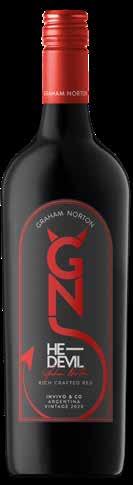
Annita Forte of Bibendum Ireland told Retail News that this April, there will be a focus on promotions in the multiples for the [yellow tail] Malbec to coincide with Malbec Day, which is April 17. Last year, [yellow tail] launched PepperBox Shiraz, a premium wine aimed at millennial home chefs who like to entertain and are adventurous in terms of the food they cook and the wine they choose. The 2019 PepperBox Shiraz, a spicy fruit-forward style of Shiraz from South East Australia has received great reviews from the wine press. The ideal wine to pair with traditional lamb with all the trimmings at Easter.
The Ramón Bilbao Reserva & Gran Reserva are award winning wines from Rioja Alta. Concours Mondial de Bruxelles awarded the 2016 Reserva a Grand Gold Medal, which is a significant achievement. Originally founded in 1924, in 1999 the winery was purchased by Diego Zamora, who has extensively modernised it. The popularity of the Ramón Bilbao wines has increased enormously in recent
Casillero del Diablo Casillero del Diablo is hitting TV screens with the sponsorship of the highly anticipated final season of Smother on RTÉ.
Casillero del Diablo is currently on TV screens as sponsor of top drama Smother on RTÉ.
Casillero del Diablo sponsored previous seasons of the hit show, so it is the perfect fit for their brand as they continue to build on their strategy of 'owning

Santa Rita 120 De-alcoholised Cabernet Sauvignon has proven very popular and should be a big hit this Easter. the night in’.


Last year, Casillero del Diablo sponsored Conversations with Friends on TV and the advertisements featured their brand ambassador Pedro Pascal, star of the TV series, The Last of Us. The new Casillero ad campaign featuring Pedro Pascal has been on air since Sunday, February 5.
Cassidy Wines
Marqués de Cáceres was founded in 1970 by Enrique Forner at Cenicero in the heart of La Rioja and today it is one of the world’s best known Rioja brands. This April, Cassidy Wines will have the 2016 Marqués de Cáceres Reserva (RRP €23.99) on offer at €21.99. The 2016 vintage
28|Retail News|February 2023|www.retailnews.ie
was awarded a Gold Medal at the Rioja Masters in 2021 and this wine also received 92 points in the Guia Penin and Wine Spectator. A dry summer meant that the grapes were nearperfect by harvest time. Cassidy’s also have the 2012 Marqués de Cáceres Gran Reserva (RRP €37.99) on promotion at €30.99, which will definitely appeal to the consumer trading up for Easter. The Gran Reserva comes from old vines (65-85 years old) grown in the Rioja Alta region. Made from a blend of 85% Tempranillo, 8% Garnacha Tinta and 7% Graciano, this wine also received high scores (over 90 points) from Guia Penin, Wine Enthusiast and Tim Atkin MW. This is drinking beautifully now, though will last for some years to come.
Comans Beverages
Comans Beverages, distributors for a range of wines from California, are targeting some of their premium wines for promotion this spring. Ravenswood is an iconic, cult range of Zinfandel wines from America’s renowned ‘King of Zin’ Joel Peterson, who founded the estate in 1976. The wines are expressive and lively and produced using old world inspiration. Joel has shepherded Ravenswood from a small unknown winery, producing 427 cases of Zinfandel, to a respected, high-quality producer of premium wines. Ravenswood has a massive cult following in the United States and Comans are delighted to introduce it as a new addition to their wine portfolio. The Ravenswood Winery Old Vine Zinfandel 2019 (RRP €22) is a full-bodied Zinfandel, aged for 18 months in French Oak Barrels, another ideal wine to recommend with roast meats.
The wines from Louis M. Martini, known as the ‘King of Cabernet’, use grapes harvested in some of Napa and Sonoma’s most coveted sites, including the world-famous Monte Rosso vineyards. Don’t miss the 2019 Louis M. Martini Napa Valley Cabernet Sauvignon (RRP €50) made from the best blocks of leading Napa Valley vineyards. It is matured for 19 months in French oak barrels, using 80% new wood. It's a good recommendation for spring lamb or a range of vegetarian options, such as beetroot and goats cheese quiche.
Look out too for Comans’ newest Portuguese red, the 2019 Pocas Vale de Cavalos (RRP €13) a stunning wine from the Douro region, now widely available in independent off-licences. With lovely black fruit and hints of spice, this is the ideal wine to serve with roast meat and all the trimmings for a fine St Patrick’s Day family celebration.
Edward Dillon & Co
The grape with the greatest ‘rock star’ credentials must surely be Sauvignon Blanc, the most popular grape on the Irish market, out-performing all other varieties by over 50%. Consumers can celebrate this Easter with the iconic Cloudy Bay, New Zealand’s most recognised wine. The 2022 Cloudy Bay Sauvignon Blanc (RRP €37.60) is everything a top-quality Sauvignon should be: concentrated and vibrant, with beautiful citrus and stone fruit character.
Terrazas de los Andes was established in the 19th century and today is owned by LVMH. In 1992, Chandon Argentina began the Terrazas de los Andes project to discover the best sites for Malbec, Cabernet Sauvignon and Chardonnay. The Terrazas de los Andes wine portfolio is a selection of wines sourced from the best high-altitude plots of the estate’s vineyards in Lujan de Cuyo and Uco Valley. The 2021 Terrazas Chardonnay (RRP €26.40) is surprisingly fresh with ripe melon fruit and hints of spice on the palate. The 2020 Terrazas Malbec
(RRP €26.40) received a 90-point rating from Tim Atkin MW and has perfumed aromas with dark berry fruit flavours and a spicy chocolate finish. This full-bodied red with firm tannin is another good Easter recommendation to serve with roast rack of lamb.
Findlater & Co
One of the world’s top wine brands, 19 Crimes has a unique selling point. Download the app and point it at the label and you will hear the stories of the convicts who were transported to Australia in the 19th century
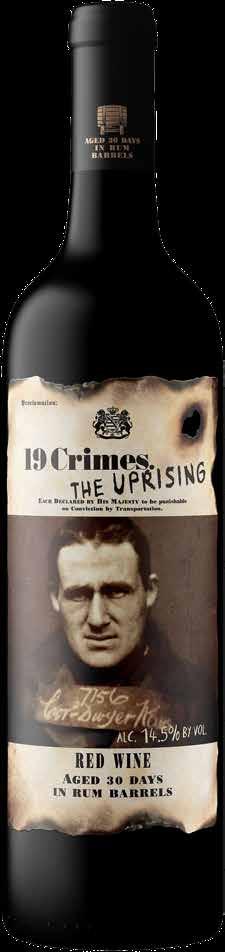
In the run-up to Easter 2023, Findlater & Co will highlight one of Australia’s top wine brands by running an on-pack competition entitled ‘19th Cork’, which will offer consumers an opportunity to win a share of a €2,500 cash prize. The competition will feature on three of the top 19 Crimes varietals wines, The Red Blend, The Uprising and Sauv Block.
To complement this activity, Findlater & Co will run an in-store sampling campaign. Tastings will be offered in a number of outlets, including Dunnes Stores, SuperValu, Centra, Carry Out and independent off-licences. At the samplings, customers will be offered an on-site gift with their purchase. A social media campaign will highlight details of the venues and the promotional prizes on offer. With this Findlater & Co aim raise greater brand awareness and engage directly with the brand’s core customers.

On the Vine Retail News|February 2023|www.retailnews.ie|29
19 Crimes will be supported with an on-pack competition, 19 th Cork, in the run-up to Easter.
Healthy Options: Good 4 U
When health means wealth…
Healthy eating is big business, as more and more consumers embrace the health and wellness trend, with huge opportunities for food and drinks brands and retailers.
THE trend towards health and wellness in Ireland was already prevalent prior to Covid-19, but the pandemic accelerated this trend and made consumers even more mindful of their consumption, according to the latest report into the sector by Euromonitor International.
Since we have emerged from lockdowns, the move towards healthier products has continued. Indeed, the amount of consumers actively seeking out a healthier diet, cutting down on foods that are high in salt and sugar, and eating more plant-based and ‘free from’ products, has grown exponentially. 2022 YouGov data tells us that the three most important factors that consumers look for, besides taste, are: good for my health, source of protein, and clean ingredients.
Recent years have seen many manufacturers, particularly in the soft drinks and confectionery sectors, engage in reformulation of their products, cutting down on sugar, salt and fat [See separate panel on the recent FSAI and Healthy Ireland Host Food Reformulation Event].
A recent report from the Organisation for Economic Cooperation and Development (OECD) provided some good news about our nation’s health, revealing that people in Ireland eat more daily portions of fruit and vegetables than in any other EU country.

Across all EU member states, just 12% of adults consume the recommended five or more portions of fruit and vegetables per day. However, 33% of adults in Ireland reach this target, with a further 48% consuming between one and four portions daily, according to the latest OECD Health at a Glance 2022 Report
The future for health and wellness products is bright, according to Euromonitor, who predict positive growth in the coming years, as the legacy of the pandemic continues to make consumers much more mindful about health and wellness. Many consumers will
continue to avoid high levels of consumption of sugar, fat, salt and caffeine going forward, with manufacturers responding by offering products with either zero or reduced contents of these ingredients.
Clonakilty Veggie Sausages
Clonakilty Food Co are delighted to announce the launch of Clonakilty Veggie Sausages (RRP €3.50). The new Clonakilty Veggie Sausages are made with the same passion for quality and exacting standards as the much-loved Clonakilty Ispíní Sausages, Clonakilty Rashers, Clonakilty Blackpudding, Whitepudding and Veggie Pudding.
New Clonakilty
Veggie Sausages are packed full of fresh vegetables and grains, are soya free, high in protein, low in fat and come in recyclable packaging.
30|Retail News|February 2023|www.retailnews.ie




A taste you’ll love, made with fresh vegetables. SOYA FREE LOW FAT SOURCE OF FIBRE HIGH PROTEIN Clonakilty Veggie Sausages are made with the same passion for quality and taste as our famous Clonakilty Ispíní Sausages. CONTACT SALES@CLONAKILTYBLACKPUDDING.IE 023 8834835 | WWW.CLONAKILTYFOODCO.IE NEW
Healthy Options: Good 4 U
FSAI and Healthy Ireland host food reformulation event

The addition of the new Veggie Sausages adds to Clonakilty’s Family of Great Taste.
A welcomed addition to their product range alongside Clonakilty’s Ispíní, Ireland’s favourite pork sausage, Clonakilty Veggie Sausages are the second vegetarian product launched by Clonakilty, joining the Clonakilty Veggie Pudding.
As members of Bord Bia’s Origin Green, sustainability is a key pillar for Clonakilty Food Company’s business. Clonakilty Veggie Sausages are packed full of fresh vegetables and grains, are soya free, high in protein, low in fat and come in recyclable packaging.
“At Clonakilty we feel passionately that everyone should enjoy the delicious taste of a Clonakilty sausage,” notes Colette Twomey, owner of Clonakilty. “We wanted to ensure our new Veggie Sausage offered the same great taste and quality that people expect from Clonakilty. We really hope you enjoy our Clonakilty Veggie Sausages as much as we do.”
For more information, email sales@clonakiltyblackpudding.ie or call their sales team on (023) 8834835.
KitKat Vegan
THE Food Reformulation Task Force, a partnership between the Food Safety Authority of Ireland (FSAI) and Healthy Ireland, hosted a workshop recently on food reformulation for food manufacturers, retailers and the out-of-home food sector. Attendees at ‘Food Reformulation in Ireland: A Workshop for Food Businesses’ heard opening remarks from Dr Pamela Byrne, Chief Executive, FSAI, before presentations focusing on policy from the Department of Health, an insight into the National Prepared Consumer Food Centre by Teagasc and an explanation of supports available for food businesses as they work on reformulation by Enterprise Ireland. The workshop also featured case studies from Britvic Ireland, O’Brien Fine Foods, Sodexo and Nestlé.
Food reformulation means improving the nutritional content of commonly consumed processed foods and drinks by reducing calories and target nutrients (such as saturated fat, salt and sugar). The goal of reformulation is to reduce target nutrients, without increasing the energy content or nutrients of concern, to ensure healthier food choices are available to Irish consumers. The Food Reformulation Task Force is responsible for implementing a Reformulation Roadmap with specific targets which will continue to be tracked from initial baseline figures in 2015.
Dr Pamela Byrne, CEO, FSAI, described the event as “a great opportunity for food businesses to come together and to hear what other businesses are doing to achieve food reformulation targets. In Ireland, two thirds of the adult population are estimated to be obese or overweight. Obesity reduces life expectancy and people are more likely to get heart disease, stroke, type 2 diabetes, certain cancers, and other diseases. Food reformulation is one of the measures to help tackle obesity and to improve the health and wellbeing of consumers. We look forward to continuing to work with food businesses to ensure key targets are met, which result in healthier food options for consumers and improved health.”
Then Minister of State for Public Health, Wellbeing and National Drugs Strategy, Frank Feighan TD said: “The Department of Health is delighted to be working with the FSAI to ensure that food companies, such as those who attended the workshop, make progress towards reducing key markers in food and drinks. This could make a real difference in offering healthier choices to consumers.”
For more information, visit www.fsai.ie
A sell out when it launched as a limited edition in 2021, KitKat Vegan is back for good! Available as a single 41.5g 4-Finger bar, this plant-based break is made with a rice-based milk alternative to create an indulgent-tasting vegan chocolate and crispy wafer combo. KitKat Vegan is available now in all major retailers.

All KitKat products produced in the UK and Ireland are made with 100% certified sustainable cocoa.
Aldi’s healthy eating range
Aldi are proud of their healthy eating range, which includes everything from wholesome salads and hearty soups to nutritious ready meals and traditional homestyle dinners. Thanks to Aldi’s range of ready-to-eat meals, shoppers can take the hassle out of mealtimes and still make healthy choices.
KitKat Vegan is is made with a ricebased milk alternative to create an indulgent-tasting vegan chocolate and crispy wafer combo.
Aldi stock a soup-er selection of hearty, warming soups from their award-winning Specially Selected range. Perfect for lunch or dinner, these ready-to-heat soups come in a variety of flavours like classic Specially Selected Tomato & Basil Soup, wonderfully wintry Specially Selected Butternut Squash Soup or exotic Specially Selected Mexican Style Bean Soup, which picked up a Silver Award
Pictured are: Jim Murphy, Senior Technologist, Enterprise Ireland; Dr Pamela Byrne, Chief Executive, Food Safety Authority of Ireland; Nuala Collins, Food Reformulation Task Force Lead, Food Safety Authority of Ireland; Catherine Curran, Assistant Principal Officer, Department of Health; and Shay Hannon, Manager, Teagasc, at the workshop at the Teagasc Ashtown Conference Centre, Meath.
32|Retail News|February 2023|www.retailnews.ie
at the 2022 Free From Food Awards.
For lunch, the range includes Aldi’s tasty, plant-based lunch like the Eat & Go Falafel & Houmous Wrap. Consumers can feast on a Willow Brook Farm Pasta Salad, available in Chicken & Bacon, Mixed Cheese or Tuna & Sweetcorn, or tuck into a simple Tasty To Go Sushi Selection, which picked up a Silver Award at the Irish Quality Food and Drink Awards 2022.
For those who fancy a healthy, nutritious dinner that you can pop Aldi’s tasty, plant-based Eat & Go Falafel & Houmous Wrap.
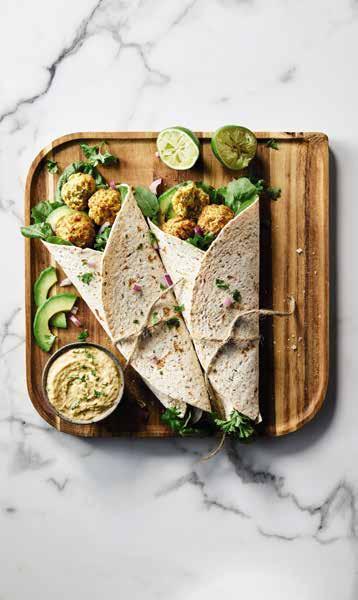
in the microwave without a second thought, Aldi stock NutriQuick’s range of ready meals in stores nationwide. Founded by Dean Siney, the Blessington-based company strives to make healthy eating easy, accessible, and affordable and was started with young, busy professionals in mind.

Available in Aldi stores nationwide, the range includes breakfast options like the NutriQuick Protein Power Pots and NutriQuick Burrito Bowls, which can be enjoyed as a quick and easy lunch. Meanwhile, consumers can make dinner time delicious without sacrificing nutritional value thanks to NutriQuick Ready Meals, with varieties like Chicken Curry, Spaghetti Bolognese, Chilli Con Carne, Taco Fries, Turkey Sliders and more.
“Between work, family and social commitments, I know many young professionals struggle to find the time to cook meals for
Healthy Options: Good 4 U
themselves. That’s why I started NutriQuick,” noted Dean Siney, founder of NutriQuick. “Our meals are for people who want something quick, convenient, and healthy.”
Other tasty, healthy dinners available in Aldi include the One Pot Brazilian Black Bean Stew With Tomato, Cashew & Quinoa and One Pot West African Peanut & Chickpea With Red Rice. Vegan, glutenfree and low in calories, each of these stews contain two of your recommended five a day.
Thanks Plants
Irish brand Thanks Plants have a full meatless meat range, from sausages to burgers and their famous Everyday Roast, served with the usual roast trimmings of vegetables and potatoes.
Started by Aisling Cullen in response to the lack of meat substitutes available in supermarkets in Ireland, the Thanks Plants range are vegan products that are both meaty in taste and made from wholefood ingredients. “I turned vegan a few years ago and was underwhelmed by the choice and quality of products available,” Aisling explains. “I also found it hard to understand the list of ingredients on the packets. I started experimenting at home and made my own seitan sausages which were really tasty and had the all-important meaty flavour and texture. I also knew exactly what was going into them and ensured it was only wholesome nutritious ingredients.”
The Thanks Plants range started with three types of sausages -
Retail News|February 2023|www.retailnews.ie|33
Aisling Cullen, founder of Thanks Plants.
Healthy Options: Good 4 U
Apple & Sage, Sundried Tomato & Herb and The Frankfurter - made from a simple mix of seitan flour (a high protein flour), cannellini beans, vegetables and spices. The range has now expanded to include Chipotle Salsa Sausages, NoMoooo Burger, Everyday Roast and the seasonal Festive Roast. All products are handmade in a professional kitchen in Dublin by Aisling and her team.
Rudd’s
The Rudd’s brand has long stood for breaking ground within the artisan food world in Ireland. In 1973, Rudd’s embarked on a culinary adventure and the creativity continues to this day. Rudd’s have recently revealed a new look, giving the brand a more modern refreshed feel, as well as an updated range of products to meet all customer needs.
The new look makes it easier to navigate the customer’s needs, and includes a lean and functional option in Eat Well, as well as some plant-based alternatives in Plantiful.
Simon Rudd, Rudd’s Commercial Manager, explained that Eat Well offers a range of more functional products for a more health and fitness conscious customer, while the Plantiful range gives a plant based alternative option for the changing consumer landscape.
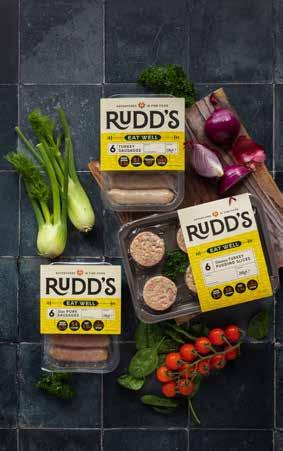
Alcohol consumption falling
IRELAND is seeing a reduction in alcohol consumption, as consumers embrace healthier lifestyles. Indeed, Irish alcohol consumption has fallen by a third since 2001, with Ireland’s consumption now within European consumption norms, according to Pat Rigney, the new Chairperson of Drinks Ireland, who noted that clear evidence is emerging that consumers, particularly young Irish adults, are consuming alcohol products in a more balanced and moderate way and are ahead of the often times outdated stereotypes put about in Ireland.
Drinkaware recently asked the public in its national survey which tools and techniques they found to be the most effective to help reduce alcohol consumption.

Clear information on what is meant by a standard drink, and what the maximum number of drinks a person should drink (HSE low-risk weekly guidelines) was reported by 32% of respondents and remains the top tool ranked for the third year in a row, while a quarter of respondents (25%) ranked no/low alcohol drink options as a tool they would use. The increased variety of no/low alcohol products available has seen sales of these products more than triple between 2017 and 2021.
“As the national charity working to help support the public to either cut out or down on their alcohol consumption, it’s crucial that we understand what works and what doesn’t work for people when they want to cut down, cut out or drink alcohol in a more mindful way,” noted Sheena Horgan, CEO for Drinkaware.
Research commissioned by Musgrave MarketPlace recently shows that the younger generation is leading the way when it comes to growth of the Zero Alcohol category, choosing alcohol substitutes to get into the party spirit rather than an all or nothing approach to festivities, even at Christmas. Zero alcohol beer and mocktails are the most popular beverages across the nation, with 18–34-year-olds opting for the fruity, easy to drink mocktails, which still let them feel a sense of celebration and get their party on. 18-24-year-olds are actively trying to drink less when reaching for a Zero Alcohol drink, with 30% doing so for health reasons or to avoid ending up hungover.
Ken Allan, Head of Beverage at Musgrave MarketPlace, revealed that the Irish market has seen significant growth of 11.2% in the Low & No Lager category in 2022, generating €22.4 million in sales to September 2022 according to CGA figures: “Our research shows Gen Z are really leading the way in terms of the Zero Alcohol category with an appetite for tasty premium alcohol-free options that still allow them to feel like they’re celebrating and enjoying a special moment, or just letting their hair down albeit in a non-traditional way.
“We know this generation to be un-afraid of treating themselves with premium purchases but who also look after their bodies and minds with healthier options, be that food, drink and mental and physical wellbeing, so it’s no surprise they’re making waves and driving innovation and creation within this burgeoning category.”
34|Retail News|February 2023|www.retailnews.ie
Rudd’s Eat Well was designed to help people eat the foods they love without the compromise or the guilt.
Grow with Aldi back for 2023
Grow with Aldi is calling on Irish producers to back their business in 2023.
GROW with Aldi, the supplier development programme, is back for its sixth year, with Aldi seeking to back bright, bold businesses powered by passion and innovation and help take them to the next level.
Undertaken in conjunction with Bord Bia, this mentor scheme sees Aldi champion emerging Irish artisan producers and offer their products a valuable national platform, thus serving as a springboard for success, while also allowing Aldi customers to sample the finest of Irish artisan food and drink.
Applicants from food and non-food categories submitted their products for consideration during January. All products are currently being assessed by a judging panel, with successful applicants having their products launched in all 155 Aldi stores nationwide in May as part of the popular Grow with Aldi Specialbuy promotion. From there, lucky winners will be offered further development opportunities with Aldi. These chosen few will receive valuable mentoring and participate in a number of workshops in topics like buying process, supply chain management and social media marketing, as well as a number of oneon-one sessions with the Aldi buying and marketing teams and experts from Bord Bia.
Homegrown success stories
Since its inception, over 230 producers have taken part in Grow with Aldi and helped grow their business, with the programme producing countless success stories. Matthew Collins of The Sibly Food Co. in Co. Cork started making energy balls for his friends and classmates in college. After selling them at a Christmas market, he began to receive hundreds of orders per week and developed a loyal customer base around Cork and Kerry. Matthew was selected to take part in Grow with Aldi last year and saw his products stocked on shelves nationwide before ultimately being selected as one of five winners for Grow with Aldi 2022 and awarded a core contract.
Fiona Twomey, Bord Bia Retail Specialist, noted the value of the programme for Irish food and drink producers: “Bord Bia is delighted to support the Grow with Aldi programme

again this year. Since its inception, the programme has supported a large and diverse group of high calibre Irish food and drink companies. Through their involvement in the programme, suppliers have the opportunity to develop their business, while also learning a range of critical business skills. Collaboration between Irish suppliers and retailers such as Aldi is important, especially in the current challenging economic environment, to ensure businesses are supported, and indeed, ensure consumers continue to get the choice of new, innovative and high-quality Irish products. Bord Bia looks forward to welcoming a host of new food businesses to Grow with Aldi this year.”
Speaking about the launch, Irish entrepreneur, best-selling author and founder of the Hike Life, Roz Purcell said: “I am absolutely thrilled to be working with Aldi for this year’s Grow with Aldi campaign. The Grow with Aldi programme represents values that are dear to my heart; quality Irish produce, supporting local and entrepreneurship! I am so looking forward to meeting the finalists later this year and seeing their products hit shelves in Aldi stores nationwide!”
Steadfast support for Irish producers
Laura Harper, Aldi Buying Director said: “At Aldi, we are steadfast in our support of dynamic Irish food and drink producers. We are passionate about offering Irish consumers great value, great tasting food and drink from local suppliers. That's why we are delighted to partner with Bord Bia on Grow with Aldi for the sixth year running. Over the last six years, we have supported over 230 producers and invested more than €8 million into working with these suppliers and forging meaningful long-term partnerships. Best of luck to everyone and I look forward to seeing what amazing products we discover this year!”
Last year, 43 products from 24 suppliers went on sale as part of the Grow with Aldi Specialbuys events. Five producers were selected to have their products stocked in Aldi stores nationwide and secured a core or seasonal contract: Cully’s Bakery from Co. Cavan; The Sibly Food Co. from Co. Cork; Hanley’s Puddings from Co. Cork; Vale & Acre from Co. Tipperary; and Builín Blasta from Co. Galway.
For more information on the Grow with Aldi programme, visit www.Aldi.ie/grow
Grow with Aldi Retail News|February 2023|www.retailnews.ie|35
Pictured at the launch of Grow with Aldi for 2023 are (l-r): Laura Harper, Buying Director, Aldi Ireland; Roz Purcell; Deborah Crowley, Grow with Aldi Winner 2019; Matthew Collins, Grow with Aldi Winner 2022; and Fiona Twomey, Global Retail Specialist, Bord Bia.
Money talks!
WHILE the pandemic certainly accelerated the amount of non-cash purchases across all retailers, including grocery, there is still a place for cash in the hearts and wallets of consumers.
Proper cash management allows for improved security, recordkeeping and cash-flow in your business, but there are plenty of challenges involved, as there are a myriad of moving pieces to manage at any given time. However, we all know that margins are exceptionally tight in the grocery sector and increased costs mean that they are only getting squeezed ever tighter, so effective cash management can help to alleviate the pressure.
Improving understanding
Store owners and managers need to examine how their cash management is currently working and ask themselves: can you tell where all your cash is at any moment? How fast can you locate written information about the movement of cash in your store?
Understanding and keeping a close eye on cash improves visibility and helps to minimise losses. This can be as simple as ensuring your books are up to date, in terms of recording daily records of cash in and out of your business. It’s easier to spot anomalies if you’re on top of record-keeping, and it also makes it simpler to evaluate your cash management process regularly.
Organisation is a huge part of cash management, so an effective schedule will help to keep your business running smoothly. This could be as simple as organising bank deposits at certain times, ensuring you always have the right amount of cash in-store, or knowing when to reconcile your books.
Letting technology do the work
Advances in technology have made cash handling and cash management much easier and less cumbersome a task. Automated cash management can be more accurate, more efficient and more secure, cutting down on human mistakes and also helping to minimise shrinkage.
When you update your cash management technology, you should also update your policies and procedures around cash handling and communicate these to staff. Clear procedures ensure that your staff are working as a team when it comes to cash management.
Staff training
It is important that your staff are trained in secure, accurate cash handling. You may need to train staff on both your cash handling technology and your procedures. Properly trained staff are more likely to uphold policies and procedures right across the store, not just when it comes to handling cash. When your staff members understand what is expected of them and why certain policies and procedures are in place, they are more likely to follow them.
It’s also important to ensure you have enough staff in-store, particularly at busy periods, as overly stressed or rushed staff can make mistakes. It’s a fine balance, as you don’t want too many staff with little to do for long periods, but get it right and you can go a long way to cutting our errors, while also ensuring your customers are looked after in-store.
If you’re having trouble with your cash management, calling in the experts sooner rather than later could save you huge headaches and profits. Consulting with a cash management solutions supplier could make life a lot easier and help that allimportant bottom line.
Managing cash securely
How do you reduce the risk of cash-related crime? Consider the following:
• Keep cash in a secure till or cash box
• Avoid keeping excess cash (particularly high value notes) in the till – it should be moved to a locked tamper-proof unit or safe;

• Check regularly for counterfeit notes;
• Avoid counting cash in front of customers;
• Remove cash from tills overnight;
• Make regular bank deposits and ensure the cash is secure in transit.
36|Retail News|February 2023|www.retailnews.ie Cash Management
Top tips for effective cash management. Image from rawpixel.com





































































Makes your worries DISAPPEAR!! GONE Cash Floats and Counting GONE Cash Reconciliation GONE Cash Discrepencies GONE Cash Overs/Unders GONE Cash wasted Time Let CashGuard take care of your cash management. Starting @ 365 per month. Please email: pturner@cashguard.ie, telephone 087-9840412 for more details… www.cashguard.ie IT’S A KIND OF MAGIC IT’S A KIND OF MAGIC
Food & Drink Exports
Food and Drink exports hit record high
Irish food and drink exports reached a record high of €16.7 billion in 2022, despite what was in many respects a challenging year.
THE value of Ireland’s food, drink and horticulture exports increased by 22% last year to reach a new record high of €16.7 billion.
The significant increase in food and drink exports, up €3 billion since last year and almost 30% on pre-pandemic levels (€13 billion in 2019), can be attributed to both increasing unit prices, due to inflation and rising input and operational costs, and an increase in the volume of goods exported. The volume of exports for sectors such as Irish beef and dairy increased in 2022; while prepared consumer foods (PCF) and drinks achieved new milestones in the value of their respective exports. Value-added meat and seafood exports, captured under PCF, reached over €1 billion in 2022. This represented an increase of 30% compared with the previous year, with exports surpassing pre Covid-19 levels by 23%. Within meat, this subcategory represents a vitally important outlet for traditionally lower value cuts.
A profoundly challenging year
Speaking at the launch of Bord Bia’s Export Performance and Prospects report 2022/23, the Minister for Agriculture, Food and the Marine, Charlie McConalogue TD, welcomed the sector’s impressive results in the face of significant global challenges. “I’m proud to announce today’s excellent results, which were delivered amid a profoundly challenging year for the sector, most notably the impact of the war in Ukraine, inflationary pressures on producers and ongoing Covid-19 disruptions to the global supply chain,” he said. “Against the backdrop of this difficult global trading environment, Ireland has continued to maintain its reputation as a world-class sustainable food producer and supplier, while also successfully securing new business in new markets around the world. I would like to congratulate the companies, farmers, fishers and producers who have contributed to this performance, which would not have been possible without the strategic support that Bord Bia provides to the sector.”
The Department of Agriculture, Food and the Marine, estimates that total Irish agrifood exports, including non-edible products not included within Bord Bia’s report, to have been worth €18.7 billion in 2022, representing a 21% year-on-year increase.
Bord Bia Chief Executive Jim O’Toole echoed the Minister’s sentiments and said the industry’s performance in the face of such challenging market conditions has been highly commendable: “Following two years of profound disruption, 2022 brought a new range of cost and sourcing challenges, making this year’s export performance even more impressive. Today’s results are testament to the resilience of one of Ireland’s most important export industries.”
Looking ahead, the Bord Bia Chief Executive said that the industry needs to be responsive to a range of oncoming challenges in 2023, as the challenging trading conditions of this year will endure and evolve: “As 2023 is predicted to be another disruptive year of economic difficulty and challenging supply chains, Bord Bia will continue to be agile and responsive to client and sector needs in what is likely to be a period of ongoing volatility. For Irish food and drink exporters, it will be increasingly important to be aware of how consumers respond to the current cost of living crisis and to position their products accordingly.”
Sectoral highlights
Irish dairy exports were valued at €6.8 billion last year, a year-on-year value increase of 33% or €1.7 billion, driven mainly by Irish butter (up 26% in value) and cheese (up 25% in value). This was followed by the meat and livestock sector, with exports valued at over €4 billion, representing a 15% value increase (+€520 million) compared to 2021. Prepared consumer food (PCF) export values exceeded €3 billion, in a performance that was largely driven by the reopening of foodservice as Covid-19 restrictions lifted in early 2022 across key markets.
Irish drink exports reached almost €2
billion (+22% year-on-year) for the first time, a 25% value increase on pre-pandemic (2019) levels, which reflects the extraordinary recovery and now growth of the sector following difficult years in 2020 and 2021. Improved prices helped drive the performance in Irish seafood with export values increasing by 3% (or €17 million) year-on-year to reach €530 million. This was despite a 19% decrease in volumes exported, reflecting the challenging situation faced by Irish seafood exporters in securing supply.
Finally, exports of Irish horticulture and cereals exceeded €300 million, with mushrooms, largely destined for the UK, accounting for 50% or €152 million (-6% on 2021), while cereals exports were valued at €73 million (+10% on 2021).
 Minister for Agriculture, Food and the Marine, Charlie McConalogue TD, and Bord Bia CEO, Jim O’Toole, pictured at the launch of Bord Bia’s Export Performance and Prospects Report 2022-2023.
38|Retail News|February 2023|www.retailnews.ie
Complete cleansing care with Nivea – no compromise

CREATED to offer easy make-up removal, skin cleansing and care, the Nivea cleansing range delivers the most complete cleansing experience. The innovative collection of products from Ireland’s number one face brand helps to thoroughly cleanse the skin, while gently caring and protecting its delicate moisture balance. The Nivea cleansing line comprises various formats to suit all cleansing preferences, with dermatologically and ophthalmologically approved products.
Daily Essentials Sensitive 3 in 1 Micellar Cleansing Water

This award winning product has an innovative formula which cleanses and removes makeup while moisturising the skin, in one simple step. It respects the skin’s natural balance, requires no rinsing and is free of perfumes, colourants and parabens, making it ideal for sensitive skin.
Biodegradable Cleansing Wipes


Gently and effectively cleansing the skin while maintaining its natural balance, these



wipes thoroughly remove face and eye make-up, while providing the skin with refreshing moisture. These soft and gentle wipes are made with 100% renewable plant fibres, are biodegradable, and are enriched with specially selected organic Argan Oil and organic Aloe Vera, ensuring they are suitable for even sensitive skin.
enriched with cornflower extract, which is known for its anti-inflammatory and soothing properties.

Refreshing Facial Wash Gel
This wash gel deeply cleanses and hydrates for a perfectly clean, refreshed skin look and feel. The formula combines effective cleansing with the mild and moisturising benefits of Vitamin E to help strengthen the skin’s protective barrier, while effectively moisturising to support skin in maintaining its natural moisture balance every time you cleanse.
MORE WIPES. LESS PLASTIC.
Retail News|February 2023|www.retailnews.ie|39 Nivea
THE WORLD’S SKINCARE BRAND* *©2021 N e senIQ data value & unit sales, Skin Care, 52 w/e 02.01.2022 ROI Total Scantrack.
Drinks News
Jameson
launch responsible drinking advert
JAMESON have unveiled a new responsible drinking advert as part of their commitment to tackling overconsumption and alcohol misuse. ‘Take It Handy’ promotes responsible drinking by encouraging people toward more mindful, moderate consumption and reinforces the message that whether you measure, sip or skip, no one should feel awkward for doing so. Co-written by and starring comedian Aisling Bea, who brings her Irish wit and humour to the screen, the advert showcases a number of typical social drinking scenarios consumers can find themselves in when they choose to moderate or skip a drink. Bringing to light the perceived societal pressures that lead to overconsumption, it inspires drinkers to forget the feeling of FOMO and embrace moderation, measurement or abstinence.

Loughran Brewing Stores acquire UK ingredients supplier
Pat Rigney elected Chairperson of Drinks Ireland

A DUNDALK-based family business, Loughran Brewing Stores, led by James Loughran, has acquired Brewers Select, based in Peterborough, in the UK. A market leader in the UK, Brewers Select was established to supply brewing ingredients and equipment to meet the needs of the burgeoning craft beer industry in the UK. The acquisition brings together the finest quality beer ingredients from the world’s best suppliers, all under one roof, that of Loughran Brewers Select, which will supply over 1,000 breweries across Ireland, the UK and Europe. Managing Director of Loughran Brewing Stores, James Loughran, is pictured with Will Avery, Commercial & Marketing Director.
Teeling release new single pot still whiskey


TEELING Whiskey have released the second edition in their Wonders of Wood series of Single Pot Still, limited edition bottlings. The Wonders of Wood series is part of Teeling’s mission to push the boundaries of flavour, by utilising unique styles of wood for the maturation of their award-winning range of whiskeys. The second edition in the Wonders of Wood bottlings consists of Single Pot Still crafted from a recipe of 50% malted barley and 50% un-malted barley, which has been triple distilled in the Teeling Whiskey Distillery in Dublin and then matured in virgin Portuguese oak barrels. In collaboration with the Tree Council of Ireland, every release in the Wonders of Wood series will work towards the reforestation of a designated area of woodland in Ireland with exclusively native Irish trees.
DRINKS Ireland, the Ibec group that represents the Irish drinks sector, have announced the election of Pat Rigney as their Chairperson for the next two years. Pat is the founder and managing director of The Shed Distillery of PJ Rigney, best known for Drumshanbo Gunpowder Irish Gin, which it distils in Drumshanbo, Co Leitrim. Prior to founding the distillery in 2014, Pat had 25 years’ experience in the industry. “Too often the drinks industry is misrepresented and maligned at home,” Pat noted. “Our mission in 2023 and beyond will be to rebalance the debate and to highlight the reality that alcohol consumption in Ireland is more balanced and moderate, having fallen by a third since 2001, with Ireland’s consumption now within European consumption norms. Indeed, clear evidence is emerging that consumers, particularly young Irish adults, are consuming our products in a more balanced and moderate way and are ahead of the often times outdated stereotypes put about in Ireland. I look forward to working with Director Cormac Healy, his team and the Drinks Ireland members as we continue to highlight the importance of the drinks industry to our economy, our heritage and communities throughout Ireland.”
Coca-Cola Ballina recognised as advanced manufacturers by WEF
COCA-COLA Ballina, formerly known as Ballina Beverages, was recently recognised by the World Economic Forum as one of the world’s most advanced manufacturers and has been added to the WEF Global Lighthouse Network. The Global Lighthouse Network is a World Economic Forum platform that recognises leading manufacturers that use Fourth Industrial Revolution (4IR) technologies including Artificial Intelligence (AI) and robotics, as well as Cloud Computing and Big Data, to increase productivity, advance sustainability and build supply chain resilience. “We’re delighted to be named the first Coca-Cola facility worldwide to be accredited as a ‘Lighthouse Site’ by the World Economic Forum,” noted Eraldo Sales, General Manager, Coca-Cola Ballina. “With the investments that we have made, combined with the pioneering efforts of the team in adopting new technologies, our manufacturing facility in Ballina is at the forefront of transformation, innovation and sustainability.”

40|Retail News|February 2023|www.retailnews.ie
Rugby star shines in new NDC campaign

RUGBY star and National Dairy Council ambassador Eimear Considine is starring in a new ad campaign for the EU-funded ‘It’s Good to Know its Good’ campaign, alongside NDC farmer ambassador Nicholas Cooney on his farm in Louth. The campaign highlights the hard work and commitment required by top athletes and dairy farmers to be on top of their game. It is designed to (re)build pride in Ireland’s dairy industry, which arguably has been under attack in recent years.
This campaign sets out to bring balance to the argument, showcasing the hard work undertaken by our dairy farmers each day. Not only is the industry comprised of 17,500 family farms, but thanks to our grass-based production system, Ireland is one of the most sustainable dairy producers in the world. Irish dairy is enjoyed and celebrated the world over, just like our athletes.
The importance of milk




“I am delighted to be involved in this campaign and to support and promote the great work undertaken by hard working dairy



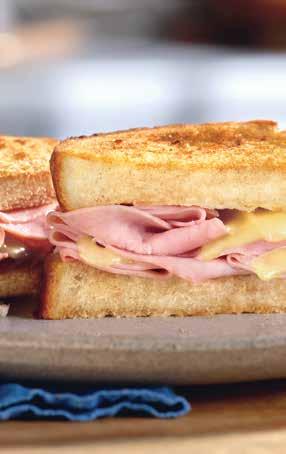
farmers all over the country,” said Eimear Considine. “Dairy plays a really important role for me as part of a healthy balanced diet of protein, calcium and vitamin-based foods. I choose milk as my supplement of choice to keep my body in good condition and to stay hydrated after I train. As well as being an affordable, natural, versatile, and widely available choice, milk also provides a range of vitamins and minerals.”
Jeanne Spillane, Marketing Manager, NDC, said, “This campaign celebrates Irish dairy farmers as producers of nutritious products which are enjoyed on and off the field of play. The commitment and dedication of our sports stars and dairy farmers have many parallels, ultimately leading to world class outcomes. In this execution, the focus is on one of Ireland’s most celebrated assets which has been the home of sporting fields and dairy farms for hundreds of years - our lush green grass. It is a fresh reminder that the grass beneath our feet connects us, nourishes us, and enables Ireland to be one of the most sustainable dairy producers in the world.”
ONLY WILL DO WIN ON THE DOUBLE! with DENNY PICK UP A PACK TO ENTER Terms and conditions apply, see www.denny.ie. Competition open from 23.02.23 to 27.03.23 WIN A €100 GROCERY VOUCHER FOR YOU AND A FRIEND EVERY DAY. Denny_Trade Press Half-Page Ad_180x132mm.indd 1 26/01/2023 17:32
New Regulations on Transparent and Predictable Working Conditions
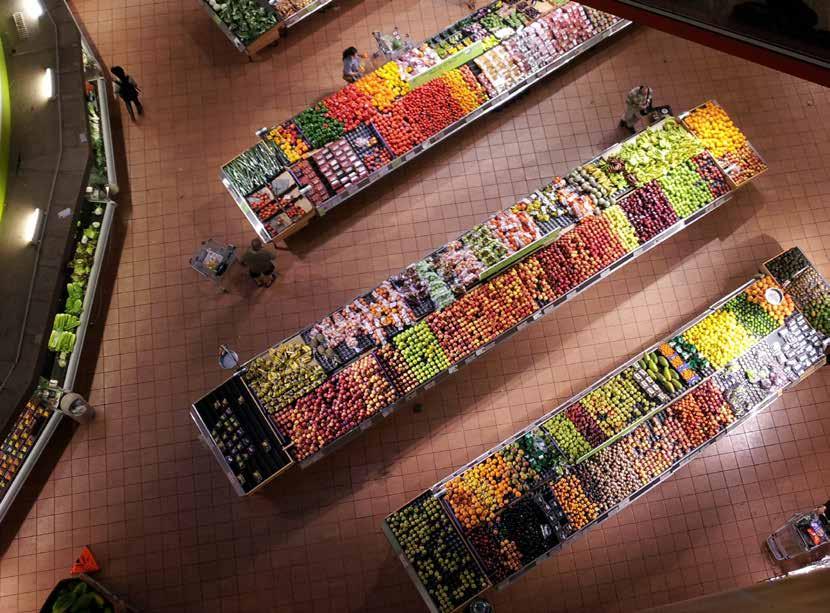
Linda Hynes and Sinead Likely of Lewis Silkin report on the key implications of new Regulations on Transparent and Predictable Working Conditions that employers in the retail sector need to know.
THE European Union (Transparent and Predictable Working Conditions) Regulations 2022 became law on December 16, 2022, without much attention, notwithstanding that they include some significant obligations for all employers which require their immediate attention.
The Regulations transpose EU Directive 2019/1152 on Transparent and Predictable Working Conditions in the European Union. While many of the Directive’s provisions were already part of the Irish employment law framework, they create new employee rights and have a number of important implications for retail employers and employees around terms and conditions of employment. We have set out the key provisions/ changes in light of the Regulations of which employers in the retail sector should be aware.
Statement of terms and conditions/ information requirements
Some important changes have been made regarding the notification dates for information to be provided to employees and the nature of the information that is provided on those dates. While it was previously the case that employees received a written statement of five core terms of employment within five days of starting a job, and a statement of the remaining terms of employment within two months, the Regulations now provide for additional information to be furnished within five days and the remainder to be furnished within one month.
The ‘Day Five’ statement introduced by the Employment (Miscellaneous Provisions) Act 2018 previously required employers to set out:
1. The full names of the employer and employee;
2. The address of the employer;
3. The expected duration of the contract (if the contract is temporary or fixedterm);
4. The rate or method of calculating pay, and the ‘pay reference period’ (i.e. weekly, fortnightly or monthly);
5. What the employer reasonably expected the normal length of an employee’s working day; and week to be (for example, eight hours a day, five days a week).
This ‘Day Five’ statement must now also include the following:
6. Where a probationary period applies, its duration and conditions;
Employment Law 42|Retail News|February 2023|www.retailnews.ie
7. The place of work or, where there is no fixed or main place of work, confirm that the employee is employed at various places or is free to determine his or her place of work;
8. The title, grade, nature or category of work that the employee is employed for, or a brief description of the work;
9. The date of commencement of the contract of employment;
10. Any terms and conditions relating to hours of work (including overtime).
Retailers should note that the last four items on this list were previously required to be provided to employees within two months of commencement of employment. They must now be set out in the ‘Day 5’ statement.
Separately, all other terms of employment required to be given to the employee under the Terms of Employment (Information) Act 1994 are now required to be provided to them within one month of commencement of employment.

This ‘One Month’ written statement must set out the following:
1. Pay intervals (for example, weekly or monthly);
2. Details of any paid leave, including annual leave and public holiday entitlements;
3. Details of any sick pay entitlements (bear in mind that three days’ SSP is now payable to employees in Ireland even if there is no scheme operated by the employer);
4. Details of any pension and pension schemes;
5. The periods of notice to be given by employer or employee;
6. Details of any collective agreements that may affect terms of employment.
Additional terms must now also be included as follows:
7. The training entitlement, if any, provided by the employer;
8. In the case of a temporary agency worker, the identity of the end-user;
9. If the working pattern of the employee is completely (or mostly) unpredictable, an acknowledgement that the work schedule is variable, the number of guaranteed paid hours and
the remuneration for work performed in addition to those guaranteed hours. It should also state the hours and days where the employee may be required to work, and the minimum notice to be given to the employee before the start of a work assignment;
10. The identity of the social security institutions receiving the social insurance contributions attached to the contract of employment and any protection relating to social security provided by the employer.
Retailers should also note that any change in terms of conditions must be notified to an employee in writing no later than the day on which the change takes effect, rather than the previous one-month time limit that applied.
Probationary periods
Some significant changes have been made with respect to probationary periods. The Regulations provide that probationary periods cannot exceed six months. They
can be longer on an exceptional basis, where it would be in the interest of the employee, but no longer than 12 months. While probationary periods longer than six months probably tend to be less common in the retail sector, retailers should nonetheless look at their existing contracts to ensure compliance with this change. With the new maximum statutory probation period of six months, retailers may also want to consider whether to apply a six-month probation period or a shorter period with the right to extend up to the six-month maximum. Retailers should also examine their current performance management processes to ensure they fit within the new probationary periods.
Another important implication of the Regulations for retailers to be aware of is that any employee who commenced employment prior to December 16, 2022, who is subject to probation of longer than six months, and the employee has completed at least six months of the probationary period, that probationary
Retail News|February 2023|www.retailnews.ie|43 Employment Law
The European Union (Transparent and Predictable Working Conditions) Regulations 2022 became law on December 16, 2022, and have some significant implications for retail employers and their staff.
period expired on February 1, 2023, or the date on which the probationary period was due to expire (if earlier).
Retailers should therefore try to identify any employees who might be caught by this provision so that any necessary actions, such as appraisals or reviews that might be anticipated to form part of the probationary process, are completed before the probation period automatically expires.
Where retailers use fixed term contracts, the length of any probationary period for fixed term employees must be proportionate to the expected duration of the contract and the nature of the work and cannot be included in any renewal of a fixed term contract (for the same function).
Exclusivity of service
Another significant implication of the Regulations that retailers should be aware of relates to exclusivity of service. An employer can no longer prevent an employee from working for another employer, outside their work schedule, or treat an employee adversely for working for another employer. A restriction on the right to work for another employer is only permitted where it’s proportionate and based on objective grounds. This is referred to as an ‘incompatibility restriction’ and where it is imposed, details of the restriction, along with the objective grounds on which it’s based, must be included in the contract of employment or the written statement provided to the employee.
The Regulations contain a nonexhaustive list of what is meant by ‘objective grounds’ which includes the following:

a. Health and safety;
b. The protection of business confidentiality;
c. The integrity of the public service;
d. The avoidance of conflicts of interests;
e. Safeguarding productive and safe working conditions;
f. The protection of national security;
g. The protection of critical national infrastructure;
h. The protection of energy security;
i. The administration of vital public service functions;
j. Compliance by the employer and the employee with any applicable statutory or regulatory obligations;
k. Compliance by the employee with any professional standards for the time being in force.
While exclusivity of service provisions have been commonplace in contracts of employment, retailers will now need to consider their contracts of employment where such clauses are included. If exclusivity is required for specific roles, retailers should update those contracts to include the objective justification by reference to the Regulations.
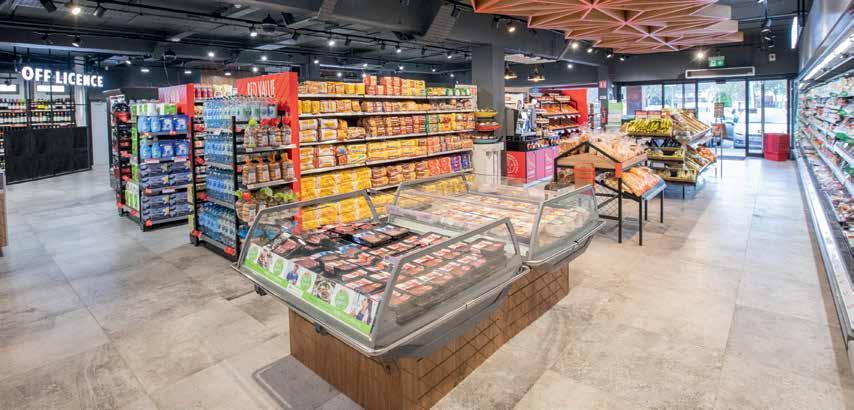
Mandatory training
Where retailers are required by law or by a collective agreement to provide training to an employee so that they can carry out their role, such training must:
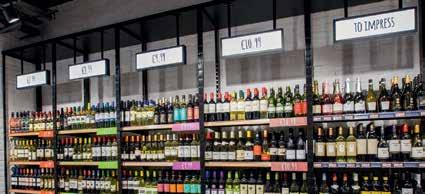

• Be provided to the employee free of cost;
• Count as working time;
• Where possible, take place during working hours.
Collective agreements
There is a carve-out in employments where there is a collective agreement already dealing with any of the matters covered by the Regulations (but only for the employees covered by that agreement).
Changes to the Organisation of Working Time Act 1997
Another important development for
Employment Law 44|Retail News|February 2023|www.retailnews.ie
“
We recommend that employers in the retail sector carefully review their contracts of employment in light of the new provisions to ensure that they are amended to comply with the provisions of the Regulations.
“
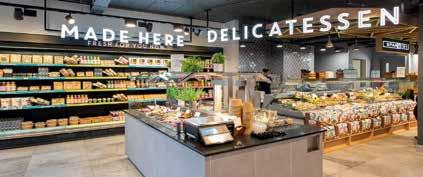
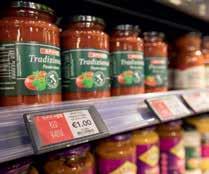

CONTACT: COLINDONNELLY,SPARSALESDIRECTOR: 0863803924 EMAIL: CDONNELLY@BWG.IE OR SARAHCONROY: 0867760815 EMAIL:SCONROY@BWG.IE TO SEE HOW WE CAN HELP YOU AND YOUR BUSINESS GROW... join us AT SPAR, WE NEVER STAND STILL
Irish sponsorship market to break €200 million
The Irish sponsorship industry is expected to grow to exceed €200 million in 2023, according to a new survey.
THE Irish sponsorship industry grew by 9% to reach €196 million in 2022 and the 17th annual Onside Irish Sponsorship Industry Survey estimates there will be further growth of 8% in 2023 to €212 million, surpassing the €200 million threshold first reached in 2018.
53% of sponsors intend to increase their sponsorship investment levels in 2023, broadly in line with 2022 expectations, and seven in 10 expect sponsorship spending across the wider industry to increase, compared to only one in five back in 2021.
“Despite strong concerns amongst three in 10 sponsorship industry practitioners that feel that the cost-of-living crisis will have a significant negative impact on the sports industry in Ireland, we know brands that maintain their investment in sponsorship during tough times reap the rewards in the long-run,” noted John Trainor, Founder and CEO of Onside. “While the instinct may be to cut back on sponsorship and activation, astute CMO’s and marketers will dive into the right data, adapt their approach, and ensure their CEO and CFO colleagues are well-informed of the real return-on-investment they are delivering.”
Competition for sponsorship assets
Trainor believes that there will still be “significant competition” for available sponsorship assets in 2023, predicting that “demand for premium properties will continue to outstrip supply”, although this has softened slightly compared to last year. “Six in 10 sponsors will be looking for new properties in 2023, a drop of 7% on last year, and 47% are looking to drop out of existing partnerships, up 12% year-onyear,” he revealed.
The Onside Irish Sponsorship Industry Survey 2023 is a survey of key industry stakeholders in the Irish sponsorship market. The respected barometer, conducted annually since 2005, gathers insights on the state of the sponsorship industry in Ireland, tracking sponsor and rights holder spend, investment, strategy and opinion.
Strongest sponsorship growth opportunities in 2023 are expected to be in the broad areas of sustainability / environment, cause, community, and diversity & inclusion, while banking and airline brands are tipped by the survey respondents as sectors to watch for growth this year.
Müller Corner Waltzes back onto TV screens
MÜLLER Corner has returned as the sponsor of RTÉ’s Dancing with the Stars, the country’s most popular dance-off show, and is supporting it with a significant promotional campaign to help drive consumer demand in store of Müller Corner Irish Favourites. Special promotional packs are on shelves now and include a ‘Text to Win’ Competition to be in with a chance of winning a pair of tickets to attend a live Dancing with the Stars show and overnight hotel stay.
The multipack includes Müller’s best-ever Müller Corner recipe, which contains more protein and has a thicker and creamier texture and consumers can enjoy Ireland’s favourite flavours: Strawberry, Vanilla Chocolate Balls, and Milk Chocolate Digestives.

“Dancing With The Stars is always such a joyful show to watch, and we are very excited to be proud partners again this year,” noted Sean Cleary, Head of Müller Ireland. “With such a great cast, audience and dances each week that keep us on our toes, the show perfectly aligns with our brand purpose, which is to inspire happy and healthy lifestyles.”
The show, which runs until March 2023, features a new hosting duo of Jennifer Zamparelli and Doireann Garrihy, along with famous faces such as Suzanne Jackson, Carl Mullen, Panti Bliss and Shane Byrne taking to the dancefloor this year.
Sports sponsorships vital
With Rugby World Cup 2023 on the horizon, the survey perhaps unsurprisingly found rugby as the top sport offering opportunities for sponsors to invest in this year, while soccer made a notable return to the Top 10 areas of opportunity. Seven in 10 sponsors say their businesses see the Rugby World Cup in France as an opportunity to engage with consumers, while 43% see opportunity for their businesses around the Republic of Ireland team’s presence at the FIFA Women’s World Cup 2023 in Australia and New Zealand.
Female stars in sports and entertainment continue to dominate the list of most marketable personalities for 2023, with the top four being females. 68% of industry professionals mentioned a female star, with Katie Taylor sharing the top spot with Ireland soccer team captain Katie McCabe, as the soccer star jumped up the rankings from 13th place last year. The success of the Women’s National Football Team in qualifying for the FIFA Women’s World Cup also saw coach Vera Pauw and players Amber Barrett and Niamh Fahey all making the most marketable list.
John Trainor, Founder and CEO of Onside.
Reflecting on the improving standard of activity produced by the collective Irish sponsorship industry last year, one in three industry professionals believe sponsorship campaigns in Ireland were

46|Retail News|February 2023|www.retailnews.ie Sponsorship
more effective in 2022 than 2021, which is up 5% year-on-year. According to the industry professionals surveyed, Sky Ireland’s partnership with the FAI’s Women’s Team was most worthy of recognition, while Lidl and AIG’s ties with Gaelic games stood alongside Vodafone and Bank of Ireland’s rugby partnerships as perceived best-in-class of ‘22. KPMG’s new partnership with the Women’s Irish Open Golf was also a notable new entry to this year’s list.
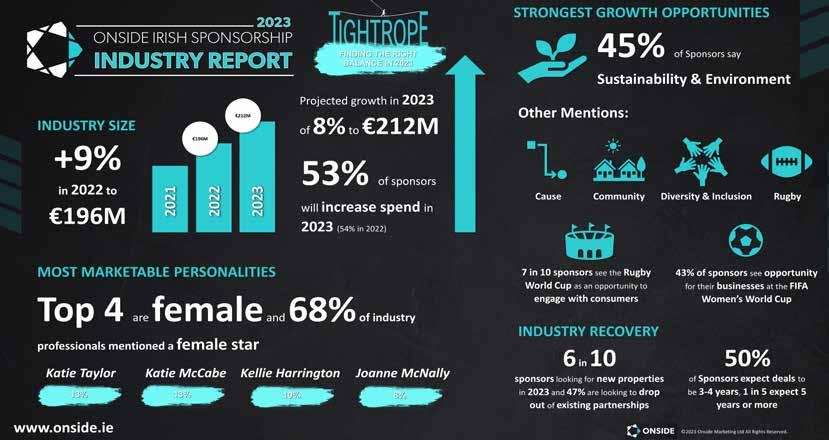
Sport also dominates the survey list of the most effective rights holder partners in the eyes of sponsors, with the IRFU leading the line, alongside the GAA, the FAI, and Aviva Stadium. They are joined on that list this year by Live Nation, who managed the full re-opening of a wide portfolio of venue and outdoor festival partnership properties in 2022.
Video sharing platforms are expected to be the big risers among activation channels in 2023, comfortably sitting in top spot, with 76% of sponsors expecting to use more of these platforms to leverage sponsorship programmes in the coming year, an increase of 22% from last year.
Public approval an important factor
Meanwhile, recent public research produced by Onside in parallel to the industry survey found that two thirds of the Irish public believed that sponsors of the 2022 FIFA World Cup would be right to turn down or off their sponsorship of the tournament due to concerns over Qatar’s human rights record and stance on the LGBTQ+ community.
“As controversy and resultant public opinion and backlash around sponsorships linked to Russian and Qatar-based events remained a consistent theme throughout 2022, it is no surprise that eight in 10 rights holders in Ireland agreed that public opinion impacts the brands they will consider partnering with in 2023,” concluded John Trainor. “The importance of public approval for sponsorships has increased significantly in the last 12 months, highlighting the tightrope that sponsors and rights holders will walk when developing partnerships in the year ahead.”
Kepak renews
sponsorship with Meath Ladies GFA

KEPAK Group recently announced a significant three-year renewal of their hugely successful sponsorship of the history-making Meath Ladies Gaelic Football Association.
Kepak Group began their partnership with the Meath Ladies Gaelic Football Association in 2020 and the last three years have coincided with unrivalled success for Meath LGFA on the field. In 2020, Meath Ladies rose to prominence as All-Ireland Intermediate champions, followed by back-to-back glory in 2021 and 2022 when they claimed their first and second Senior All-Ireland titles. Since the partnership with Meath and Kepak began in 2020 there has been an increase in clubs now registered within the county, while the number of players in Ladies Football has doubled.
Kepak’s partnership with Meath LGFA underscores the Cloneeheadquartered food company’s continued commitment to supporting local communities and diversity and inclusion. Kepak have a strong history of supporting Gaelic games in Meath; the company and county previously enjoyed one of the longest and most successful relationships in Gaelic football, featuring a 15-year sponsorship of the men’s team.
“Kepak are delighted to continue our partnership with Meath LGFA for the next three years,” said Mick O’Dowd, Head of Agri-Business, Kepak. “Being able to play a supporting role at such a groundbreaking time in Meath Ladies Gaelic Football is a huge honour for Kepak.”
All-Ireland winning Meath Senior LGFA players with Kepak AgriBusiness Development Manager, Mick O’Dowd, Meath Senior LGFA Manager, Davy Nelson, and Meath LGFA Chairperson, Colm McManus, at the launch of Kepak’s renewed three-year sponsorship of the team.
Sponsorship Retail News|February 2023|www.retailnews.ie|47
Reduce your lighting costs by up to 80% with a
Lighting Solutions Upgrade from Energia
Save time and money by upgrading your old lighting now
Our Lighting Solution is an upgrade to your current lighting system using high quality, energy efficient LEDs. This will guarantee savings on your monthly bill, reduce your energy consumption and improve the lighting in your business. The savings you make finance the project so there is no upfront cost.
Find out more at energia.ie/business/lighting-solutions
BENSON & HEDGES’ 150-YEAR ANNIVERSARY

THIS year marks a momentous milestone for Benson & Hedges, who are celebrating 150 years of distinctive, uncompromising quality. To celebrate this, the brand is offering valued trade members the chance to win amazing prizes throughout the year as a thank you for their continued support that has helped to make Benson & Hedges Ireland’s No.1 SKU (Source: NielsenIQ ROI Extended Scan Track, RMC, SOM, YTD, January 1, 2023). Celebrations are kicking off with the opportunity to win prizes by playing Benson & Hedges’ 150 year anniversary game between February 6 and March 10. To enter, simply scan the QR code on the Trade Ad. Finish within the Top 10 on the leaderboard at the end of the competition and be crowned a winner to receive a prize. There’s more to come from Benson & Hedges throughout 2023. So, keep your eyes peeled and stock up today!
UNLOCK PLAYFULNESS WITH OREO AND XBOX
OREO and Xbox are colliding in a much-anticipated collaboration. To celebrate the partnership, the iconic black and white Oreo cookie has been transformed to pay homage to the Xbox controller, with six embossed Oreo Xbox Special Edition cookies available since January 2023. By scanning the Oreo Xbox Special Edition cookies, fans can revel in exclusive Oreo-themed in-game content, including an Oreo ‘Parade Ground’ armour coating in Halo Infinite, an Oreo ‘Valiant Corsair’ sail set in Sea of Thieves and an Oreo Edition ‘2009 Pagani Zonda Cinque Roadster’ in Forza Horizon 5. In addition, there will be thousands of prizes available over the promotional period, such as Xbox Series S consoles, Xbox Stereo Headsets and Xbox Game Pass Ultimate subscriptions. All entries will go into a grand prize draw for the chance to win a family holiday to California.
NORDIC SPIRIT OFFERING SOMETHING EXTRA

NORDIC Spirit are extending their nicotine pouch range with the addition of a new strength variety, Nordic Spirit Smooth Mint X-Strong, a more intense strength for those who want to experience more. Nordic Spirit’s X-Strong pouches contain 11mg of 100% tobacco free nicotine, and can be used anytime, anywhere. Smooth Mint is also available in Regular (6mg) and Strong (9mg) strengths, along with flavours Spearmint and Berry Citrus also available in Regular and Strong. Stock up now to Discover the Unseen!

BREAK IN THE NEW WITH KITKAT IN 2023


KITKAT fans are set to enjoy a breaks bonanza this year, as the brand announces a raft of exciting new products. Among the highlights soon to hit supermarket shelves are tantalising 2 and 4-Finger flavours and the nationwide rollout of the hugely popular KitKat Vegan. Available in a multipack of nine 20.7g bars, KitKat 2-Finger Caramel is now available in all major retailers this month. Meanwhile, a KitKat 4-Finger Caramel single bar (41.5g) is available nationwide since February 1, followed by a multipack of 4 x 41.5g bars from April 1. KitKat Dark (single 41.5g bar) relaunches with a new recipe and refreshed packaging, making it an even tastier option for dark chocolate fans. The new-look KitKat Dark is available in a wide range of retailers since February 1.
ROWNTREE’S NEW RANGE TICKS ALL THE BOXES
NEW for 2023, Nestlé Ireland’s confectionery team are introducing a Rowntree’s range of sharing gummy sweets. The range is made with real fruit juice and 30% less sugar, plus has no artificial flavourings, colourings, or sweeteners. The irresistibly fruity range comes in four formats: Berry Hearts - these squidgy hearts come in flavour favourites strawberry, raspberry and blackcurrant; Safari Mix - giraffes, elephants, hippos and paw prints make up this fun mix with strawberry, orange, lemon and apple flavours; Gummy Bears - nostalgic gummy bears in strawberry, orange, lemon and apple flavours; Jelly Snakes - these two-toned gummy delights come in apple & blackcurrant, and raspberry & orange. Nestlé has utilised soluble corn fibre which allows a reduction in the amount of sugar and increases the product’s fibre content compared to traditional sugar confectionery. The range also contains 5.5% fruit juice.
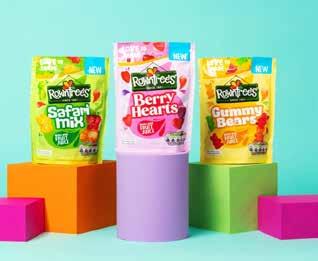
What’s New
Retail News|February 2023|www.retailnews.ie|49
Parcel Connect join forces with Applegreen
PARCEL Connect, Ireland’s largest Pick-Up & Drop-Off (PUDO) and Returns network, with over 1,300 collect, return, and send points around Ireland, are delighted to announce a new partnership with Applegreen.
In addition to the extensive Parcel Connect network, consumers across Ireland can now drop into their local Applegreen store when returning items purchased online from many of the largest domestic and international retailers, including: Asos, Boohoo, Life Style Sports, Oxendales, Very and Zalando, that have chosen Parcel Connect as a returns partner. Irish consumers can also collect their parcels from their local Applegreen store, from retailers offering click-and-collect and signed up to Parcel Connect's collection service.
“We’re delighted to welcome Applegreen to our Parcel Connect network, which complements Applegreen’s marketleading offering,” noted Danny Hughes, Fastway CEO and Parcel Connect Co-Founder. “Both Parcel Connect and Applegreen are strong Irish brands, where local communities and sustainability inform all aspects of the business. Our partnership with Applegreen is a perfect match. Both organisations are on a transformational journey, constantly evolving and looking to offer consumers more choice, convenience, simplicity, and that all important seamless customer experience, whether that’s filling up the tank, picking up the paper, grabbing a snack on-the-go, or now, returning or collecting an item purchased online.”
Deborah Howell, Head of Trading, Applegreen Ireland, said, “We are very excited about the collaboration between Applegreen
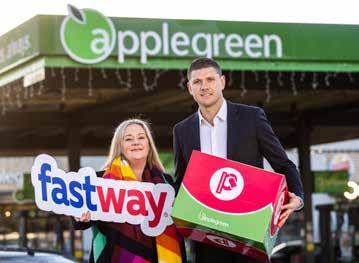
and Parcel Connect. Many of our customers use our stores as a regular stop in their day-to-day busy lives. Having the option to return a package on their daily trip to their local Applegreen store makes the returns process that much easier. Similarly, the clickand-collect option allows our customers to receive their packages at their local Applegreen, meaning they can be more flexible around delivery times”
Circle K Christmas charity initiative raises €40,000 for Jack and Jill

CIRCLE K announced that their Christmas charity initiative raised €40,000 in much-needed funds for the Jack and Jill Children’s Foundation. The initiative, which took place at Circle K sites nationwide, excluding Circle K Express, saw €1 from every car-
wash purchased between from December 19-24 donated to the children’s charity. Through the support of Circle K customers and colleagues, the funds raised will provide 2,222 hours of vital home nursing care to over 400 children currently under the care of the Jack and Jill Children’s Foundation right across the country.
“We are delighted to have built on the success of last year’s initiative by exceeding our fundraising target and raising €40,000 in much-needed funds for the Jack and Jill Children’s Foundation,” said Judy Glover, Senior Market Director at Circle K Ireland. “The Jack and Jill Children’s Foundation carry out such important work to help families under their care across the country, and this donation wouldn’t be possible without the support of our colleagues, customers, and campaign ambassador, Stephanie Roche. From all at Circle K, we would like to thank everyone who supported the fundraising initiative this Christmas.”
Soccer star and broadcaster Stephanie Roche, who officially launched the fundraising initiative, concluded: “I was delighted to support Circle K and the Jack and Jill Children’s Foundation on this initiative, and I am thrilled to hear how much money was raised in just a week. The Jack and Jill Children’s Foundation provide such an important service to families and this donation ensures that they can continue to support those who need it most. Well done to all who donated to this cause.”
Forecourt Focus: News
50|Retail News|February 2023|www.retailnews.ie
Pictured are Deborah Howell, Head of Trading, Applegreen Ireland, and Danny Hughes, Fastway CEO and Parcel Connect Co-Founder.
Irish footballer Stephanie Roche is pictured at Circle K, Martello, alongside Judy Glover, Senior Market Development Director at Circle K Ireland, and Carmel Doyle, CEO, The Jack and Jill Children’s Foundation, at the December launch of the charity fundraising initiative.
Maxol Christmas coffee cup campaign raises €60K for Aware
MAXOL’S annual Christmas coffee fundraiser has raised €60,000 for the mental health charity Aware. Launched in the lead-up to Christmas 2022, Maxol’s pay it forward initiative aimed to promote the spirit of kindness across Ireland by encouraging customers to purchase a coffee or hot drink for someone else. In line with previous Christmas fundraisers, for every cup of Rosa Coffee or hot drink bought at one of Maxol’s service stations in November and December, 10c was donated directly to the charity.
“We’re proud to support Aware and the selfless work its team of volunteers do every day across the country,” noted Brian Donaldson, CEO of The Maxol Group. “We’ve been working with Aware for seven years, and we’ve seen first-hand how important fundraising initiatives such as our Christmas coffee campaign are for the charity. Thank you to all our valued customers, retailers and staff, who have supported this wonderful cause in 2022 and have helped many people who have been going through tough times.”
Drew Flood, Business Development Manager of Aware, said: “We rely heavily on the generosity of the public and corporate organisations like Maxol to ensure we can continue to provide our free and essential services. €60,000 is a fantastic fundraising result and we are very grateful to Maxol, their retailers and all the customers throughout the
country who purchased a Rosa coffee over the Christmas period. Every single euro raised makes a difference, contributing towards the support of another person or delivery of another positive mental health programme. Importantly, it has also raised awareness of mental health in communities all over Ireland. Thank you.”
Applegreen announce significant partnership with Barretstown
THE Applegreen Charitable Fund has announced a three-year partnership with Barretstown, becoming one of the largest annual contributors to the children’s charity. This significant partnership, launched at the charity’s headquarters at Barretstown Castle, Ballymore Eustace in Co. Kildare, will see Applegreen commit to raising €1 million for the charity from 2023-2025.
As part of the fundraising pledge, The Applegreen Charitable Fund will support Barretstown’s world famous onsite residential camp programmes for children and their families affected by serious illnesses, and will result in supporting 3,000 priceless days of therapeutic programmes for a seriously ill child and their families from across Ireland, over the next three years. Placing families at the heart of the partnership, Applegreen will become title sponsor for a week-long Applegreen Summer Camp this July, as well as supporting the magical Barretstown Winter Wonderland experience in November.
Founded in 1994 by Hollywood actor Paul Newman, Barretstown offers free, specially designed camps and programmes for children and their families living with a serious illness – supported behind the scenes by 24-hour on-site medical and nursing care.
“We are delighted to announce this partnership with Barretstown and equally thrilled to be able to pledge €1 million over the course of the next three years,” said Aaron Duggan,


Applegreen Ireland Retail Operations Director. “Our customers and communities are at the heart of everything we do and supporting families will be a key element of the partnership. We are very proud to be able provide 3,000 days of therapeutic programmes for a seriously ill child and their family members.”
Barretstown CEO Dee Ahearn, Applegreen Retail Operations Director, Aaron Duggan, Applegreen Commercial Director, Seamus Stapleton and Applegreen CSR Manager Rosie Begley were joined by Barretstown families, including the Cogley Family from Wexford, 11 year old Ciara and her sister Grace 15, and the Curran family from Dublin, 13 year old Danny and his sister Anna, 10.
Circle K fuel promotion proves massively popular

ON Thursday, December 15, Circle K announced details of a special Christmas fuel discount. From 1-4pm on that date, the price of their premium miles and milesPlus fuel was reduced by 20c a litre at 350 participating service stations across
the Republic of Ireland, including Circle K Express. The promotion proved extremely popular as news spread, with queues outside many of the company’s forecourts as motorists rushed to take advantage of the promotional prices.
Forecourt Focus: News
Retail News|February 2023|www.retailnews.ie|51
Drew Flood (left), Aware, and Brian Donaldson, CEO, Maxol Group, pictured with Rue the miniature cockapoo.
GRENADE have launched an Oreo Protein Bar, combining the high protein, low sugar bar with the unmistakable great taste of Oreo cookies. With 21g protein, just 1g of sugar and a whole lot of that iconic Oreo flavour, the bar features a creme layer flavoured with genuine Oreo vanilla flavour and a nougat centre loaded with authentic Oreo cocoa flavour. With this instantly recognisable black & white centre and a taste to match, this is a bar that the most die-hard Oreo fans will love.

FOLLÁIN, the West Cork based producers of wholesome and delicious jams and preserves, have raised €15,000 for the Simon Communities as a result of the success of their recent Christmas charity donation campaign. Folláin committed to donating half of all of their online sales throughout the month of December, and this commitment was supported with a targeted digital, social media, PR and influencer marketing strategy, along with a suite of new products to offer customers. The January donation to Simon Communities kicks off a busy year for Folláin, which also marks the company’s 40-year anniversary, and as part of their birthday celebrations, Folláin hope to continue their working relationship with Simon Communities.
ALDI Ireland are rolling out a nationwide partnership with Too Good To Go, making Aldi the first Irish supermarket to partner with the food surplus app. Following a successful trial last year, the retailer is making surplus food bags available nationwide in a bid to tackle food waste and offer even lower prices to customers. The surplus food bags, known as ‘Surprise Bags’, will contain a range of products that are approaching their sell-by or use-by dates at a third of the price, costing just €3.99 each to purchase. To avail of a Surprise Bag, shoppers can download the free Too Good To Go app and search for their nearby Aldi store before reserving a bag to collect from the store at an allotted time.
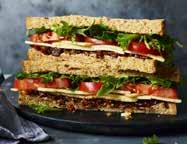
MARS Pet Nutrition continue to reduce packaging waste in Europe with leading brands Sheba, Whiskas, Perfect Fit and Catsan saving 480 tons of plastic per year. New measures in the Irish market include new Pedigree Schmackos 20 stick packs and megaboxes, which are set to be introduced in 2023, with over 230kg of plastic and 600kg of cardboard waste expected to be saved as a result. This follows the successful introduction of new Dreamies packaging last year, which saved the equivalent of 8,000 plastic bottles in Ireland in 2022. These Irish measures are part of wider European initiatives to remove excess packaging - Mars Pet Nutrition Europe also transformed their Sheba and Perfect Fit Mini Pouches last year, replacing plastic flow-wraps with high performing and widely recyclable paper sleeves. Whiskas dry food plastic bags have also been replaced with carton boxes in select European markets, and Catsan cat litter brand has removed unnecessary layers of plastic in its secondary packaging on a trial basis in France.
MARKS and Spencer Ireland have launched Sparks Stamps. For February only, M&S extended rewards across their Irish stores so that every customer is able to track their sandwich (including a delicious range of Irish sandwiches) or wrap purchases within the M&S Sparks App and enjoy a complimentary sandwich after every six purchased. M&S are now the first major retailer in Ireland to offer a reward scheme using digital stamps.
DASH, the zero-sugar, zero-calorie seltzer company based in the UK and known for infusing wonky fruit in its drinks, has announced the completion of an €9.8 million Series A funding round. New investors who took part included Johnny Sexton, Ireland’s rugby captain, and David Milner, Dash’s chairman and former CEO of F&B titans Tyrells, Lily’s Kitchen, and St Pierre Bakery. Listed in more than 10,000 stores globally, B-Corp certified Dash currently leads the UK seltzer category with a 39% share of value sales and is aiming to take the Irish market by storm. Pictured are Dash founders Jack Scott and Alex Wright.

TESCO’S Grand Effie Award-winning ‘Food Love Stories’ campaign is back with its latest instalment made especially for audiences in Ireland, created by BBH Dublin. ‘Food Love Stories’ heroes quality Irish produce that elevates meals to something special, while inspiring audiences to get cooking by ditching the unrealistic food porn tropes that dominate the category. BBH Dublin brings this to life in ‘Sam’s ‘Saviour’ Steak Salad’, a 30-second film that tells the all-too-relatable tale of Sam, who is doing her best to pick up the pieces after Jess, her friend and housemate suffers a mishap, lovingly making a salad with a 32-daymatured Tesco Finest Irish Angus ribeye steak as the star of the show.
CONGRATULATIONS to Mr Price, who have won the Advancing Disability Equality Award at the National Diversity & Inclusion Awards 2023, thanks to the retailer’s partnership with Rehab Group and National Learning Network to increase employment rates of people with disabilities in every county. “Mr Price are innovative change-makers in the recruitment sector. Our partnership with Rehab Group and National Learning Network is pragmatic and impact orientated. Our team all across our 63 stores, Head Office and Distribution Centre are leading this change for the better, ensuring inclusion diversity and equality are at the heart of their teams,” noted Edel McSorley, Operations Director for Mr Price, pictured with the Mr Price team.

THE Shop & Display Equipment Association (SDEA) have announced the addition of a new SDEA Networking Lounge at the upcoming VM & Display Show, to be held in April at London’s Business Design Centre. This new feature will provide members with an opportunity to connect with other industry professionals and an extremely cost-effective route to take part in the VM & Display Show. “The SDEA is committed to providing its members with the resources and opportunities they need to succeed in the retail display industry,” noted Antony Behiels, Director of the Shop & Display Equipment Association.

Shelf Life 52|Retail News|February 2023|www.retailnews.ie
How will the cycle work ?

when and where

cost to participate