W
ithin track & field, various models exist regarding the macro-management of speed enhancement. For instance, coaches may subscribe to a short-to-long, long-to-short, or concurrent system to inform global progressions within the allocated preparation time. Though these themes speak to how a plan conceptually attempts to advance the skill of sprinting along with specific fitness, these overarching modes of training are superficial and limited in their scope as it relates to the micro-level management of planning. Specifically, these broad models fail to provide insightful perspective that allows the coach to carefully deliver nuanced programming, and more importantly, instruct a speed development session with precision. In other words, having greater clarity on both the intended goals and actual outcomes of a given sprint tactic or drill may improve a coach’s ability to deliver targeted cues or verbal instruction. As a result, the motor-learning effects of properly designed sprintskill development sessions are augmented through informed and artful coaching. While the development and practice of coaching should be grounded in evidence, they are often separated — causing a detrimental dissociation between the aspects of curriculum delivery, skill analysis and movement modification. Therefore, the purpose of this article is to arm coaches with a logical progression of tactics that develops sprint skill while considering the temporal aspects of highvelocity running.
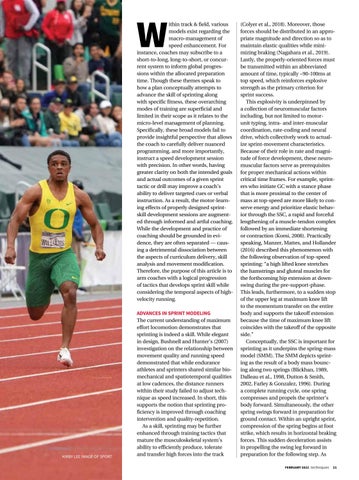
KIRBY LEE IMAGE OF SPORT
ADVANCES IN SPRINT MODELING The current understanding of maximum effort locomotion demonstrates that sprinting is indeed a skill. While elegant in design, Bushnell and Hunter’s (2007) investigation on the relationship between movement quality and running speed demonstrated that while endurance athletes and sprinters shared similar biomechanical and spatiotemporal qualities at low cadences, the distance runners within their study failed to adjust technique as speed increased. In short, this supports the notion that sprinting proficiency is improved through coaching intervention and quality-repetition. As a skill, sprinting may be further enhanced through training tactics that mature the musculoskeletal system’s ability to efficiently produce, tolerate and transfer high forces into the track
(Colyer et al., 2018). Moreover, those forces should be distributed in an appropriate magnitude and direction so as to maintain elastic qualities while minimizing braking (Nagahara et al., 2019). Lastly, the properly-oriented forces must be transmitted within an abbreviated amount of time, typically ~90-100ms at top speed, which reinforces explosive strength as the primary criterion for sprint success. This explosivity is underpinned by a collection of neuromuscular factors including, but not limited to motorunit typing, intra- and inter-muscular coordination, rate-coding and neural drive, which collectively work to actualize sprint-movement characteristics. Because of their role in rate and magnitude of force development, these neuromuscular factors serve as prerequisites for proper mechanical actions within critical time frames. For example, sprinters who initiate GC with a stance phase that is more proximal to the center of mass at top-speed are more likely to conserve energy and prioritize elastic behavior through the SSC, a rapid and forceful lengthening of a muscle-tendon complex followed by an immediate shortening or contraction (Komi, 2008). Practically speaking, Manzer, Mattes, and Hollander (2016) described this phenomenon with the following observation of top-speed sprinting: “a high lifted knee stretches the hamstrings and gluteal muscles for the forthcoming hip extension at downswing during the pre-support-phase. This leads, furthermore, to a sudden stop of the upper leg at maximum knee lift to the momentum transfer on the entire body and supports the takeoff extension because the time of maximum knee lift coincides with the takeoff of the opposite side.” Conceptually, the SSC is important for sprinting as it underpins the spring-mass model (SMM). The SMM depicts sprinting as the result of a body mass bouncing along two springs (Blickhan, 1989, Dalleau et al., 1998, Dutton & Smith, 2002, Farley & Gonzalez, 1996). During a complete running cycle, one spring compresses and propels the sprinter’s body forward. Simultaneously, the other spring swings forward in preparation for ground contact. Within an upright sprint, compression of the spring begins at foot strike, which results in horizontal braking forces. This sudden deceleration assists in propelling the swing leg forward in preparation for the following step. As FEBRUARY 2022 techniques
11