1
is a proud sponsor of the
2020 Region 7
Teacher of the Year! 2
brookshires.com
3
K-BAD
6
Q&A WITH TODD SCHNEIDER
8
OMNITRACK
10
LEXI’S LEGACY
12
REGION 7 HEAD START
14
TOMATO BOWL TOTEM POLE
16
NEW FACES
20
KILGORE ISD’S FIGHT AGAINST UNDERAGE SUBSTANCE ABUSE
REGION 7’S NEW EXECUTIVE DIRECTOR
REGION 7’S NEW WORKSHOP REGISTRATION SYSTEM
A YOUNG GIRL’S GIFT TO GLADEWATER ISD’S GIFTED AND TALENTED STUDENTS
ADAPTING TO THE NEW NORMAL
A JACKSONVILLE ISD TRADITION
AT REGION 7 ESC
HARMONY ISD & ELYSIAN FIELDS ISD STUDENTS AND TEACHER SELECTED AS
STATE HEALTH AMBASSADORS
WE'RE LOOKING FOWARD TO A YEAR FILLED WITH
HEART
We are accepting nominations through January 17, 2021 Awards Ceremony April 15, 2021
Submissons will be accepted February 1 through March 1, 2021 Awards Ceremony April 28, 2021
For more information on these events and to learn about our arts rograms for students and teachers visit us at arts4allkids.com 2
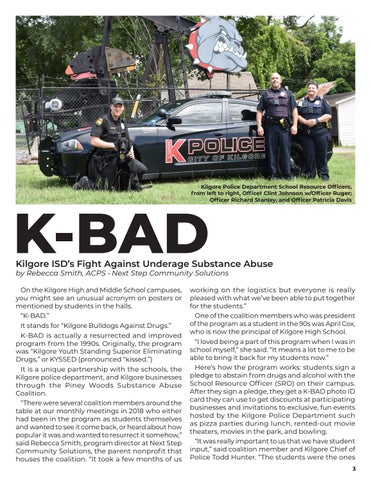
Kilgore Police Department School Resource Officers, from left to right, Officer Clint Johnson w/Officer Ruger; Officer Richard Stanley, and Officer Patricia Davis
K-BAD
Kilgore ISD’s Fight Against Underage Substance Abuse by Rebecca Smith, ACPS • Next Step Community Solutions On the Kilgore High and Middle School campuses, you might see an unusual acronym on posters or mentioned by students in the halls. “K-BAD.” It stands for “Kilgore Bulldogs Against Drugs.” K-BAD is actually a resurrected and improved program from the 1990s. Originally, the program was “Kilgore Youth Standing Superior Eliminating Drugs,” or KYSSED (pronounced “kissed.”) It is a unique partnership with the schools, the Kilgore police department, and Kilgore businesses through the Piney Woods Substance Abuse Coalition. “There were several coalition members around the table at our monthly meetings in 2018 who either had been in the program as students themselves and wanted to see it come back, or heard about how popular it was and wanted to resurrect it somehow,” said Rebecca Smith, program director at Next Step Community Solutions, the parent nonprofit that houses the coalition. “It took a few months of us
working on the logistics but everyone is really pleased with what we’ve been able to put together for the students.” One of the coalition members who was president of the program as a student in the 90s was April Cox, who is now the principal of Kilgore High School. “I loved being a part of this program when I was in school myself,” she said. “It means a lot to me to be able to bring it back for my students now.” Here’s how the program works: students sign a pledge to abstain from drugs and alcohol with the School Resource Officer (SRO) on their campus. After they sign a pledge, they get a K-BAD photo ID card they can use to get discounts at participating businesses and invitations to exclusive, fun events hosted by the Kilgore Police Department such as pizza parties during lunch, rented-out movie theaters, movies in the park, and bowling. “It was really important to us that we have student input,” said coalition member and Kilgore Chief of Police Todd Hunter. “The students were the ones 3
who came up with the name change, and we had students at the meetings and asked them what kind of discounts or events they would like, and we continue to get their input. We want them to see this as a cool program to be a part of.” Chief Hunter was one of the program’s biggest advocates. He used the department’s drug seizure funds to purchase the ID card machine, rent out movie theaters for K-BAD students, and other fun events that students recommend. Drug seizure funds are earmarked for prevention education, Hunter said, so it was ‘a perfect fit.’ School Resource Officer Clint Johnson said the program draws on ideas from the previous program, but also prevention research. “ We k n o w f r o m research that one of the best ways to keep youth f rom using drugs and alcohol is to beef up their ‘refusal skills,’ meaning help them come up with ways to turn down drugs and alcohol,” Johnson said. “ What’s great about this program is it gives them an excuse to say ‘No.’ They can say ‘No thanks, I can’t take that drink or smoke because I’m in K-BAD.’ It also incentivizes them to say ‘No’ as well with the discounts and events.” Businesses in Kilgore t h a t o f f e r K- B A D discounts are identified with a door sticker. Businesses include Sonic , Whataburger, Panda Express, Johnny Ozark’s, The Back Porch, Kilgore Skateland, Mazzios, Charlie’s Sno-Balls, Four Star Cinema, and Little Ceasar’s in Kilgore. One of the businesses that offers one of the biggest discounts to K-BAD students is Johnny Ozarks. “I love it because it supports our kids early on,” said Linda Thompson, front manager. “It is a great way for us to support our local school district. One of the improvements on the former program is students now go over an info packet when they join the program with the SRO. The packet was created by the prevention experts at Next Step and covers not only the dangers of substances, but also 4
healthy coping skills students can use instead of substances, and research from Texas A&M on the actual rates of substance use in East Texas among 7-12th graders. “When we talk to students, they almost always believe 80 to 90% of their peers are using substances regularly,” Smith said. “A lot of times it is human nature to believe we are the only ones doing the right things, but this belief that ‘Everyone is doing it’ can really add to a student’s sense of peer pressure.” Texas A&M administers the Texas School Survey with 7-12th grade students across the state every two years. The survey is totally anonymous to get the most reliable data, and researchers even have questions to weed out students who aren’t being honest. The data is then broken down into the 11 health regions in Texas. The latest sur vey results f rom 2018 (2020 was postponed due to the pandemic) show that, on average, only 30% of East Texas students said they had alcohol in the last 30 days; 19% used tobacco in the last 30 days (14% used an e-cigarette); only 12% had used marijuana and 8% had taken a drug prescribed to someone else in the last 30 days. “Do we want these percentages to come d ow n eve n m o re? Absolutely,” Smith said. “But it’s important for students to know that, even though they feel like ‘Everyone is doing it,’ the majority of their peers aren’t using substances.” When students sign up for the program, they also agree to random drug tests, funded by the police department. In the event that a student fails a drug test, they have to either meet with a licensed counselor or go through a prevention curriculum before they can be reinstated to receive the benefits of the program. The course of action is decided on by the student, school administration, and the student’s parents. “It was really important to the coalition members that the discipline after a failed drug test not be too punitive, and that we give the student a chance to
be in the program again,” Smith said. “Studies show that students are much less likely to reoffend after a failed drug test if they talk about it with someone who cares about them.” The program now has hundreds of students participating. As the program has grown, the SROs have added several components to make it stronger, such as a grant through Texas Youth and Adult Program with Texas A&M, and participate in the Tobacco Enforcement Program with Texas State University. K-BAD students work with the officers to conduct undercover stings in which students, under an officer’s watch, try to buy tobacco as a minor to catch retailers who aren’t following the law. The SROs also partner with the Texas School Safety Center, and students attended their first SayWhat! tobacco prevention conference virtually this summer. “We joined and the students love it,” said Officer Patricia Davis, SRO at Kilgore Middle School. “We were proud to be able to communicate with our youth and help them to continue to advocate. We have really grown as a coalition.” The SROs have also incorporated other activities that are fun as well as educational, such as an “The Great Vape Escape” escape room game for Red Ribbon Week. “We are dedicated to keeping our program thriving,” said Davis, SRO at Kilgore Middle School. “Just because they are learning about substances doesn’t mean it has to be a boring presentation.” The Kilgore Police Department also provided
a K9 officer, Ruger, who specializes in detecting substances. A black Labrador, Ruger’s nose is so powerful he can detect vaping devices that are sealed inside a vehicle on campus. Ruger travels to both campuses and works with Officer Johnson. “Ruger is the face of our program,” Davis said. “The youth love him.” Ruger makes regular appearances on the K-BAD social media pages where youth and families can see upcoming events. Smith said K-BAD is a great example of how substance abuse prevention should work. “Everyone has a role to play in prevention,” she said. “When different parts of the community come together to help like they did with K-BAD, we can accomplish so much more.” ■
Bowling night for members of K-Bad. 5
QA &
WITH TODD SCHNEIDER
Region 7 ESC’s New Executive Director
In this issue, we talk with Todd Schneider, who became the new Executive Director of Region 7 Education Service Center on September 1, 2020. He has served for 25 years in public education, with 18 of those years in Region 7 school districts. Schneider chatted with us about his role at the ESC, goals for the future, what inspired him to go into education, and, of course, sports. Q : WH AT D O YO U D O AT REGION 7 ESC?
A: My off icial title is Executive Director, which can be summarized as the one who is charged to lead the organization in planning, vision creation, and implementation of programs and services that support schools in educating the students of all of Region 7. Q: WHAT DID YOU DO BEFORE COMING TO REGION 7 ESC? A: I spent 31 years in Texas Public Education, starting in Spring Branch ISD as a JH Math teacher and Coach. I spent 15 years in
the classroom before entering administration. I have served as an Assistant Principal, Principal, Assistant Superintendent, and Superintendent. A majority of my administrative experience was in Region 7 at Martin’s Mill ISD and Bullard ISD. I retired in 2019 and spent a year working for Raise Your Hand Texas, a non-prof it organization that advocates on behalf of the 5.4 million students in Texas Public Education. Q: WHAT INSPIRED YOU TO GO INTO EDUCATION? A: My uncle was a math teacher/ coach who f inished his career as an administrator. I have great respect for him and we are very close. My love for math and sports directed my career path to follow the same path he did. Q: WHAT IS YOUR FAVORITE PART OF THE JOB? A: I am very passionate about how the service center can support the Region. ESC 7 is an awesome place to work with an outstanding reputation across East Texas. Some of the things I am most excited about is building on what we have, adding new programs/services, and increasing the impact we have on our schools, staff, and students. Q: WHAT BIG GOALS ARE ON
6
THE HORIZON FOR THE ESC? A: Hard to say being here less than four months. I am still learning all that goes on within the building and how TEA influences what we do. For now, I am absorbing information and gathering data. Q: WHO HAS INFLUENCED YOU MOST WHEN IT COMES TO HOW YOU APPROACH YOUR WORK? A : There are many people that have influenced me and continue to as well. My wife, Jan, has been and will always be the one who encourages me and drives me to have the courage to take risks and confidence to see them through. As I mentioned, my uncle, Don Schneider, was a major influence on me as well. I also have a strong network of school leaders that help guide me on a regular basis. Q: WHAT’S A WORK-RELATED ACCO M PL I S H M E N T T H AT YOU’RE MOST PROUD OF? A: As Superintendent of Bullard ISD, we moved from a being on
the PEG list and a low B grade (near the middle of the region) to an A rating (in the top four rated districts in the region) in just three years. A lot of challenges were faced and met head on, but the plans worked and students were benefiting from the systems and programs that were implemented. Q: WHAT WAS YOUR FIRST JOB? A: At 12 years old, I delivered newspapers every morning, 365 days a year. I got up, folded over 100 newspapers a day, loaded them on my bike, and delivered throughout the neighborhood. I did this for three consecutive years before working in construction during summers. Q: WHAT’S THE BEST ADVICE YOU’VE EVER BEEN GIVEN? WHO WAS IT FROM? A: Retire f rom the Superintendency…from my wife and kids!! Stress level was taking it’s toll and I had to hear it from them!
Q: WHAT IS ONE THING THAT M I G H T S U R PR I S E PE O PL E ABOUT YOU? A: I was born and raised in Denver, Colorado. After I graduated from college, I landed a job in Houston (1988). I knew Texas was home within the first week. Q: WHEN YOU WERE A KID, WHAT DID YOU WANT TO BE WHEN YOU GREW UP? A: A person who worked doing something with math!!! I wasn’t even aware of careers other than teaching that involved math. Q: WHAT WOULD WE MOST LIKELY FIND YOU DOING ON THE WEEKEND? A: Playing golf with all three of my boys, going to church, or working in my barn building some kind of furniture Q: WHAT’S YOUR FAVORITE SPORT TO WATCH AND WHICH TEAM DO YOU ROOT FOR? A: Being a Denver, Colorado native….I am a huge Denver Bronco fan. GO BRONCOS! ■
7
OmniTrack
Region 7 ESC’s New Workshop Registration System by Toni Erickson, Region 7 ESC Workshop Specialist
On September 1, Region 7 converted from MIS to OmniTrack, propelling our workshop system into the 21st century. From a technical perspective, OmniTrack is written in a current computer language, allowing the software to easily be updated and customized to meet Region 7’s needs. MIS had been written in a language that is now obsolete. Internally, OmniTrack provides a more efficient workflow for those who are involved the workshop process including: • It is an online system – nothing must be installed on your computer to create a workshop. • Workshop creation is a one-stop shop – versus MIS where a workshop had to be created, and sessions tied to that workshop had to be created. • Evaluations and sign-in sheets are all online – saves hours of time deciphering handwritten evaluations into MIS and ensuring participants have registered and signed into the workshop. • Closing workshops are no longer necessary – because of electronic sign-in and evaluation, participant data and scorecard information is in the system. Time Accounting is still in MIS, which does not talk to OmniTrack. • Time Accounting will be converted to MIS in the Fall of 2021. Currently, there is no connection between OmniTrack and MIS for Time Accounting 8
data. OmniTrack has a report available named “Workshop Time” report for staff to keep an accurate record of their time accounting as it relates to live workshops. Externally, OmniTrack has several features for our participants including: • Remote check-in – participants can sign into a workshop from their own device at the beginning of the workshop. • Online evaluations • A “My Content” tab that provides their personal workshop calendar, upcoming workshops, and workshop history all in one area. • Access to their certificates at any time just by going to their workshop history. • Several online courses that are on demand (iSpring) – when they finish the course, they no longer must wait for their certificate till the course ends like they did in MIS (Canvas courses). On the workshop system home page OmniTrack, we have provided tutorials for our participants, as well as a workshop support ticket system that has a less than a 24-hour turnaround time. We have finished our first two months in the new workshop system, and there are many more features and reports that we are currently working on to meet both internal and external requests. ■
10
Lexi’s Legacy A Young Girl’s Gift to Gladewater ISD’s Gifted & Talented Students by Cori Arevalo, Region 7 ESC Communications Technician Lexi Commander was a loving, active child who had many friends, a huge smile, and an even bigger heart. She had a tremendous love for animals, her friends, and her teachers at Gladewater ISD. Remembered as the family “daredevil” and very courageous from an early age, Lexi lived life to the fullest. Pat Commander, Lexi’s grandmother, recalls a time when Lexi received a gash on her knee at daycare. While at the emergency room, Lexi carefully watched as the doctor closed her wound with stitches. Lexi informed him that she wanted to put the stitches in. While the physician wasn’t able to let her help, he did promise to let her take them out when the time came. “She held him to his word and took them out herself with his supervision and never flinched or winced,” said Mrs. Commander. Being at school in Gladewater ISD was very special to Lexi. She would play school at home and when she was at school, she loved to help her teachers and to help take care of her friends. Mrs. Commander recalls, “She always made sure that a classmate with learning disabilities always had his favorite treat.” These kind and courageous acts will never be forgotten by Lexi’s friends and family. Tragically, Lexi Commander passed away on December 17, 2011 as a result of an ATV accident on the family farm during their annual family Christmas celebration. Lexi left behind her parents, Kyle Commander and Jaclyn Harvey, and numerous friends and family members. Since Lexi’s passing, the Commander family has ensured that Lexi’s legacy continues. For the first few years, the family held fundraisers in her name and eventually established a scholarship at Kilgore College to be awarded to Gladewater seniors in 2022, the year Lexi would have graduated. This year, Lexi’s legacy was also extended to some of the youngest students in Gladewater ISD. Students in 2nd and 3rd grades compete yearly in the Region 7 ESC Robotics Competitions. They were limited in the tasks they were able to perform at this competition due to their outdated WeDo robots. Angie Townsend, Gladewater ISD Gifted and Talented teacher, reached out to the city’s education
foundation, which was due to hold their inaugural fundraiser on October 10, 2020, hoping to receive funds to help with the purchase of new robots. It was at this fundraiser that the Commander family heard about this need and graciously donated the full amount needed, in Lexi’s memory. Gladewater G/T students will soon have the newest WeDo2.0 robots, which will officially be named LEXIbots. Townsend, who also taught Lexi, shared, “Lexi was an amazing kid with a contagious smile and one of a kind laugh! I’m absolutely overjoyed in playing a tiny part in keeping her memory alive. I have a picture of Lexi in my classroom and now I will get to tell every one of my students that she’s the reason for our brand new robots! I am so proud to honor Lexi every single day for many years to come!” Townsend and her students are looking forward to the moment that they will be able to invite the Commander family to watch students show off their Lego construction and coding skills on the LEXIbots. Mrs. Commander shared, “I think she [Lexi] would be elated to be able to help her school mates and will be smiling and cheering them on from Heaven when they participate in contests with their robots.” ■
Gladewater G/T students working with WeDo Robots. 11
Region 7 Head Start Adapting to the New Normal
by Summer Stone, Region 7 ESC Communications Coordinator 2020 has been a challenging year for every realm of public education, and Head Start is no exception to the struggles and adaptations needed to move forward in serving students, their families, and the surrounding community. However, Region 7 Family Service Workers and Family Service Advocates have risen to the test and found ways to be both safe and supportive to keep families involved in activities while respecting local and state-mandated COVID-19 protocols. According to Felicia Woodard-Shaw, Region 7 ESC Head Start Assistant Director, Family Service Workers/Advocates (FSWA) are hired by Region 7 ESC and placed on ISD campuses to be a part of the campus community. FSWAs also act as a liaison between the school/daycare, campus personnel, parents, and Head Start staff. One of the primary responsibilities of the FSWAs is to build positive relationships with parents. FSWAs are trained on how to make connections, making the process less intimidating for them as possible. The progress of relationship building continues as they assist parents with developing individualized goals that are specific to each family’s needs. FSWAs continuously conduct follow-up with parents while assisting them with achieving set goals. They provide training for parents that is individualized, as well as provide various training to help support their child’s learning experiences and development. 12
They also connect parents to community resources based on each family’s needs. “Parent training has been the most different change for me since we are all learning new ways to do things,” says Monica Strickland, FSWA at Brownsboro ISD. “We have always enjoyed the opportunity to meet parents in person, shake their hands, give them hugs, and get to know them face-to-face. With COVID, we missed all of these opportunities and had to shift to virtual meetings. We also can’t have parent volunteers in the classroom, which limits our ability to create personal relationships.” FSWAs also got creative with the 2020-21 enrollment process, with several schools conducting a ‘drive through registration’ for their students. “Each family would drive up to the campus and we would take the forms out to them. They would fill them out and return them from their vehicle,” says Faz. “This eliminated large groups and made our families and staff feel a little bit safer.” Overall, the comprehensive, multi-generational, and community-based nature of Head Start is why it is such an effective partner for families within our 14 county service area in helping them overcome new obstacles and find pathways to success. As we continue to navigate through the ‘new normals’ of public education, Region 7 Head Start Family Service Workers/Advocates will remain key and
essential to the implemntation of safety protocols and empowerment of East Texas children and their families in early education. As a way to f ill the gap, Region 7 Head Start districts have implemented ClassTag, a free parentteacher communication tool that connects them with parents and guardians to relay information about the curriculum and upcoming involvement projects. Head Start also utilizes ReadyRosie, a researched-based parenting curriculum that builds on parents’ knowledge, and harnesses the power of video and mobile technology to empower schools to work together to promote school readiness, while focusing on parenting outcomes such as nurturing, discipline, teaching, language, and supervision. “We
actually saw an increase in our male involvement activity by using ClassTag and allowing families to work together at home instead of at school during working hours,” says Alice Faz, FSWA in Eustace ISD. Eustace ISD, in addition to several other Region 7 districts, created a male involvement activity focusing on Halloween safety and fun. “We asked them to send pictures through the ClassTag app, and I compiled a PowerPoint collage to share with all of our families.” Faz believes families were more inclined to participate because they were in the safety of their own homes and able to help after traditional working hours, which resulted in higher involvement. ■
13
Tomato Bowl Totem Pole by Grace Taylor, Jacksonville ISD Public Relations Director One of the longest standing traditions associated with Jacksonville Athletics and the Tomato Bowl is the Totem Pole on the hill. The Pole stands in front of the stadium facing downtown. Like the Tomato Bowl, it has been present in the community for decades. Many Jacksonville natives have early memories of gathering with big crowds after a game and celebrating at the pole while a Fightin’ Indian added to the blue lights. After the recent completion of the Tomato Bowl restoration project, the Totem Pole was also updated with a new, well-designed and similar version. The Jacksonville Athletic Booster Club oversees the 14
Totem Pole, and thanks to the JABC and several generous donors, it is the perfect complement to the new stadium, almost a brilliant finishing touch to top it off. In May of 2017, Jacksonville residents approved a Bond proposal with an 80% approval rate to restore the beloved Tomato Bowl Stadium. When the passing of the Bond was declared, all of the blue lights on the Totem Pole were lighted to signify the big win for the community. The origin of the Totem Pole is already well known to most Jacksonvillians. The Frank Brown family designed it, built it, and placed it where it still stands today. Mrs. Patti Kobitz Brown, who at age 91 still
resides in Jacksonville, herself drew the designs for the original Totem Pole. Mrs. Brown recently shared memories about the origin of an idea that would become a treasured tradition in our community. “My husband, Frank H. Brown, had the idea for a “totem pole” after he had served as the president of the Jacksonville Quarterback Club in 1961. The Quarterback Club was an early “Booster Club”, before this practice was common in Texas schools. The totem pole was to have the emblems of each team that JHS played, and include a way to display when the Indians won a game. The pole was to be placed in front of the Tomato Bowl to help promote team spirit. The original idea was to make it a vertical pole, with the team emblems “stacked” like an American Indian totem pole. But, if the team emblems were displayed in this manner, the totem pole would be exceedingly tall. I had the idea to offset each emblem to either side, and up and down the pole, and place a horizontal bar with flood lights at the bottom. Blue flood lights would be illuminated after the Indians won a game. There were also hooks under each light, to hang a “scalp” of a defeated team. The “Scalp Stick” was an existing tradition at JHS football games, and it was determined to move this tradition to the Totem Pole for more exposure. The frame of the Totem pole was made of welded steel pipe, and was built by Richard Lewis on the parking lot of National Forest Products Company on the Frankston Highway. The team emblems were fabricated and painted by a commercial sign company in Longview, Texas”, states Mrs. Brown. The Brown family is still involved and invested in Jacksonville and the honored traditions associated with Jacksonville Athletics. Timeworn pictures exist of the original Totem Pole placement, with the Brown’s employee at the time, Mr. Richard Lewis at the top of the pole. Another photograph portrays Senator Robert Nichols placing a blue light on the pole after an Indian win in 1962. Senator Nichols recalls the Totem Pole tradition, “I was President of the Student body and Co-captain of the team. So, when the booster club wanted to dedicate it, I gave a short speech at the dedication on behalf of the team and student body at the top of the stadium stairs. I remember it well. In my comments I recall thanking them for the pole as well as for the idea of the different color lights for wins (not my idea) and how important it was for us to display our pride of our school and team. At the time, it had ten lights in a row, left and right at the bottom for all the preseason and District games. At the conclusion, after thanking them again, I mentioned that there was only one thing
wrong with it. I asked where are the other four lights? Because WE PLAN TO GO TO STATE. We did play three more games after District and got to Semi-finals, but never made it to State. But try, we did. They put up the extra four lights”. The modern version of the Totem Pole is precisely detailed and follows the premise of the original design with competing team emblems. The pole is also beautifully illuminated at night and can be seen from far away. The new project took multiple volunteers to bring to fruition. These individuals and businesses generously donated their time and talents to fulfill the vision of a new version of an old idea. Many thanks go to Cherokee County Electric Coop, Horton Concrete, Gibson Signs, Craig Garner, and Harris & Son Electric for their specific time and talents. The base of the pole also proudly showcases 8” X 8” engraved bricks with the names of 10 extremely big-hearted donors who contributed to the Jacksonville Athletic Booster Club to enable this transformation to happen. Those include Austin Bank, Texas National Bank, Dick Sheffield Family (Betty Sheffield), Gene Brumbelow, Mary Alice Adamson, the Eddie Arrington Family, Coach Danny Long, Tamishea Contreras, the Frank and Patti Brown Family, and the Brad Jacobson Family. Although the wooden structure was too time and weather-worn to salvage, many pictures exist of it throughout its 60 years. Photographs are showcased in the Tomato Bowl Hall of Fame entry with other historical documents. The Tomato Bowl Totem Pole is yet another example of how the Jacksonville community is drawn together through generations and memories involving our one-of-a-kind landmark on the hill, the award-winning Downtown Historic Tomato Bowl. For more information about the Jacksonville Athletic Booster Club, please contact the current JABC president, Chad Devillier at chaddevillier81@ gmail.com. ■
15
NEW FACES at Region 7 ESC
16
17
Students across Region 7 submitted original photography artwork throughout the Fall 2020 semester that captured various moments around the district. Below are the top winners who each received prizes for their work.
FIRST PLACE
Courtlyn Brown - Kilgore ISD
SECOND PLACE
THIRD PLACE
Liz Meyers - Van ISD
Taylor Hewett - Chapel Hill ISD
HONORABLE MENTIONS: Cerenity Exline, Kilgore ISD | Susie Torres, Chapel Hill ISD | Grace Dixon, Central ISD | Connor Mason, Van ISD | Lizzi Wilkerson, Diboll ISD | Sarah Clowers, Union Grove ISD | Brice Caskey, Chireno ISD
For more information regarding Fine Arts in Region 7, please contact Brooke Kinsman, Region 7 ESC Curriculum Coordinator, at bkinsman@esc7.net.
Harmony and Elysian Fields Students & Teacher to Become
State Health Ambassadors by Summer Stone, Region 7 ESC Communications Coordinator Individuals from around Region 7 are stepping up in their schools to promote a healthy lifestyle, increase awareness of healthy eating, and explain the benefits of Texas agriculture among their peers. The Texas Department of Agriculture (TDA) recently released a Health Ambassadors for a Ready Texas (or HART) Program for students that allows them to be actively involved with decisions regarding food selection and resources that impact their menu. Region 7 is proud to recognize Grant Sims, sophomore at Elysian Fields High School, his mom Jana Sims, Physical Education teacher and Family Consumer Sciences teacher at Elysian Fields ISD, and twins Breanna and Bailee Chavez, juniors at Harmony High School, for being chosen by the state for this program. These students and teacher will represent their student body, school district, and Region 7 for the 2020-2021 school year as state Health Ambassadors. Grant Sims, sophomore at Elysian Fields High School, is a competitive swimmer, cross country, track, and basketball student-athlete who values the importance of good nutrition and the effect it has on his performance on and off the field. Grant is always willing to try new foods and encourages others to try them as well. Jana Sims, Physical Education teacher and mother of Grant, says that often times Grant’s teammates will visit their home and try new foods she has prepared, most containing high vegetable content. “I am passionate about healthy lifestyles and childhood nutrition,” says Sims. “I have an MS in Clinical Exercise Physiology and worked in the hospital setting for f ive years before becoming a
Pictured from left to right: Breanna and Bailee Chavez, Grant Sims, and Jana Sims 20
mother. While in the hospital, I was trained in Shape Down Childhood Obesity Education Training, and I was helping cardiac patients rehabilitate after an event or procedure. I found myself thinking that I wish I could help young people, and possibly prevent these major health issues f rom ever happening. After becoming a mother, I decided to go into teaching to have the same schedule as our children.” Jana shares that she is also an athlete, having raced in multiple marathons around the country (including the Boston Marathon), as well as being a black belt in ATA Taekwondo. Twins Breanna and Bailee Chavez are currently juniors at Harmony High School. They are both actively involved with FFA, cheerleading, student council, and the National Honor Society. “My life goal is to inspire others,” says Breanna. “During my time in high school, I have been able to motivate others through my healthy eating practices. I have also held leadership positions, including being cochair and founder of the Harmony FFA Healthy Lifestyles Committee, which have helped me promote nutrition in a balanced, positive, and fun way!” Breanna states that after high school, she will attend Texas A&M University and major in Nutrition to begin her journey in becoming a Registered Dietician. For more information on the HART Program, please visit https://squaremeals.org/PublicResources/ HealthAmbassadorsforaReadyTexas.aspx. ■
3111 McCann Road (903) 753-1212 hher24.com Follow us:
Fast & thorough care Works with ALL commercial insurance treating covid-19 safe treatment locations for non-covid emergencies
Amy Palmer
Summer Stone
Cori Arevalo
CALL the print center team FOR YOUR FREE QUOTE!!
www.esc7.net