INTRODUCTION
australian centre for field robotics, university of sydney
australian centre for field robotics, university of sydney
Field Robotics and Agriculture: Teacher Introduction
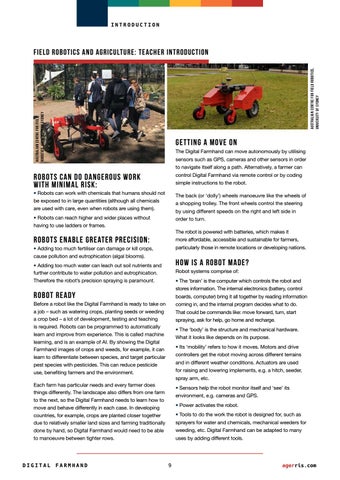
Getting a move on The Digital Farmhand can move autonomously by utilising sensors such as GPS, cameras and other sensors in order to navigate itself along a path. Alternatively, a farmer can
Robots can do dangerous work with minimal risk:
control Digital Farmhand via remote control or by coding
• Robots can work with chemicals that humans should not be exposed to in large quantities (although all chemicals are used with care, even when robots are using them).
The back (or ‘dolly’) wheels manoeuvre like the wheels of
• Robots can reach higher and wider places without having to use ladders or frames.
order to turn.
simple instructions to the robot.
a shopping trolley. The front wheels control the steering by using different speeds on the right and left side in
The robot is powered with batteries, which makes it
Robots enable greater precision:
more affordable, accessible and sustainable for farmers,
• Adding too much fertiliser can damage or kill crops, cause pollution and eutrophication (algal blooms).
particularly those in remote locations or developing nations.
How is a robot made?
• Adding too much water can leach out soil nutrients and further contribute to water pollution and eutrophication. Therefore the robot’s precision spraying is paramount.
Robot systems comprise of: • The ‘brain’ is the computer which controls the robot and stores information. The internal electronics (battery, control
Robot ready
boards, computer) bring it all together by reading information
Before a robot like the Digital Farmhand is ready to take on a job – such as watering crops, planting seeds or weeding a crop bed – a lot of development, testing and teaching is required. Robots can be programmed to automatically learn and improve from experience. This is called machine learning, and is an example of AI. By showing the Digital Farmhand images of crops and weeds, for example, it can learn to differentiate between species, and target particular pest species with pesticides. This can reduce pesticide use, benefiting farmers and the environment.
coming in, and the internal program decides what to do. That could be commands like: move forward, turn, start spraying, ask for help, go home and recharge. • The ‘body’ is the structure and mechanical hardware. What it looks like depends on its purpose. • Its ‘mobility’ refers to how it moves. Motors and drive controllers get the robot moving across different terrains and in different weather conditions. Actuators are used for raising and lowering implements, e.g. a hitch, seeder, spray arm, etc.
Each farm has particular needs and every farmer does things differently. The landscape also differs from one farm to the next, so the Digital Farmhand needs to learn how to move and behave differently in each case. In developing countries, for example, crops are planted closer together due to relatively smaller land sizes and farming traditionally done by hand, so Digital Farmhand would need to be able to manoeuvre between tighter rows.
DIGITAL
FARMHAND
• Sensors help the robot monitor itself and ‘see’ its environment, e.g. cameras and GPS. • Power activates the robot. • Tools to do the work the robot is designed for, such as sprayers for water and chemicals, mechanical weeders for weeding, etc. Digital Farmhand can be adapted to many uses by adding different tools.
9
agerris.com