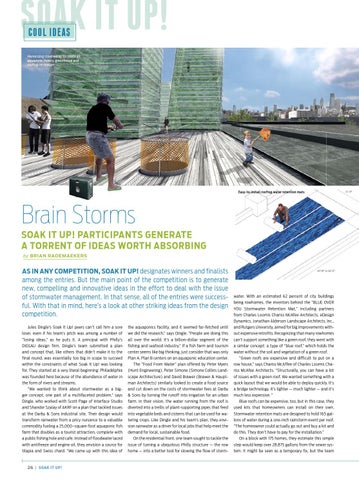
COOL IDEAS Harnessing stormwater to create an aquaponic fishery, greenhouse and rooftop recreation
Easy-to-install rooftop water retention mats
Brain Storms
Soak It Up! participants generate a torrent of ideas worth absorbing by Brian Rademaekers
As in any competition, Soak It Up! designates winners and finalists among the entries. But the main point of the competition is to generate new, compelling and innovative ideas in the effort to deal with the issue of stormwater management. In that sense, all of the entries were successful. With that in mind, here’s a look at other striking ideas from the design competition. Jules Dingle’s Soak It Up! peers can’t call him a sore loser, even if his team’s pitch was among a number of “losing ideas,” as he puts it. A principal with Philly’s DIGSAU design firm, Dingle’s team submitted a plan and concept that, like others that didn’t make it to the final round, was essentially too big in scope to succeed within the constraints of what Soak It Up! was looking for. They started at a very literal beginning: Philadelphia was founded here because of the abundance of water in the form of rivers and streams. “We wanted to think about stormwater as a bigger concept, one part of a multifaceted problem,” says Dingle, who worked with Scott Page of Interface Studio and Shandor Szalay of AKRF on a plan that tackled issues at the Darby & Sons industrial site. Their design would transform rainwater from a pricy nuisance to a valuable commodity fueling a 25,000–square-foot aquaponic fish farm that doubles as a tourist attraction, complete with a public fishing hole and cafe. Instead of floodwater laced with antifreeze and engine oil, they envision a source for tilapia and Swiss chard. “We came up with this idea of
26 | SOAK IT UP!
the aquaponics facility, and it seemed far-fetched until we did the research,” says Dingle. “People are doing this all over the world. It’s a billion-dollar segment of the fishing and seafood industry.” If a fish farm and tourism center seems like big thinking, just consider that was only Plan A. Plan B centers on an aquaponic education center. The “Food From Water” plan offered by Peter Myers (Hunt Engineering), Peter Simone (Simone Collins Landscape Architecture) and David Brawer (Brawer & Hauptman Architects) similarly looked to create a food source and cut down on the costs of stormwater fees at Darby & Sons by turning the runoff into irrigation for an urban farm. In their vision, the water running from the roof is diverted into a trellis of plant-supporting pipes that feed into vegetable beds and cisterns that can be used for watering crops. Like Dingle and his team’s plan, they envision rainwater as a driver for local jobs that help meet the demand for local, sustainable food. On the residential front, one team sought to tackle the issue of turning a ubiquitous Philly structure — the row home — into a better tool for slowing the flow of storm-
water. With an estimated 62 percent of city buildings being rowhomes, the inventors behind the “BLUE OVER YOU Stormwater Retention Mat,” including partners from Charles Loomis Chariss McAfee Architects, eDesign Dynamics, Jonathan Alderson Landscape Architects, Inc., and Rutgers University, aimed for big improvements without expensive retrofits. Recognizing that many rowhomes can’t support something like a green roof, they went with a similar concept: a type of “blue roof,” which holds the water without the soil and vegetation of a green roof. “Green roofs are expensive and difficult to put on a row house,” says Chariss McAffee of Charles Loomis Chariss McAfee Architects. “Structurally, you can have a lot of issues with a green roof. We wanted something with a quick layout that we would be able to deploy quickly. It’s a bridge technology. It’s lighter — much lighter — and it’s much less expensive. “ Blue roofs can be expensive, too, but in this case, they used kits that homeowners can install on their own. Stormwater retention mats are designed to hold 165 gallons of water during a one-inch rainstorm event per roof. “The homeowner could actually go out and buy a kit and do this. They don’t have to pay for the installation.” On a block with 175 homes, they estimate this simple step would keep over 28,875 gallons from the sewer system. It might be seen as a temporary fix, but the team