JANUARY 2020 / ISSUE 128 / GRIDPHILLY.COM
T O W A R D A S U S TA I N A B L E P H I L A D E L P H I A
■
Deer Hunter: wildlife refuge takes on overpopulation p. 14
■
Is your 401K fueling climate change? p. 6
SECOND LIFE
Kimberly McGlonn explores the intersection of climate change and social justice at Grant Blvd, her radical fashion company
shop locally
& Sustainably
Zero Waste shopping throughout the store, from bulk to beauty products. Ambler • Chestnut Hill • Mt. Airy Community-owned markets, open to everyone.
www.weaversway.coop
Monthly Maker Kathleen Capuras Philadelphia, PA kcapurasdesign.com @kcapurasdesign Tell us about yourself I am a Philly based pyrography artist, and have been woodburning for 17 years. I have been operating a small business called kcapurasdesign for the last 5 years. In addition to doing custom work and selling my products in person and online, I also teach a monthly Intro to Woodburning class at NextFab. What do you make? I utilize a mix of exotic, rescued, and domestic wood to offer handmade, unique pieces including kitchenware / barware, jewelry, home decor, and statement art pieces. What are you currently working on? I am currently developing a new line of decorative wall art pieces that incorporate hand-cut recycled mirrors. What's the hardest part? The hardest part is playing all the roles needed in my business and being just one person. It's a whirlwind but it's definitely worth it. What are your goals? My goals are to keep learning and trying new things to incorporate with my pyrography, to do some collaborations with other amazing artists, and to continue to find exciting ways of integrating into the local maker scene.
Discover more stories nextfab.com/grid #nextfabmade
NextFab is a network of collaborative makerspaces. North Philly
South Philly
JAN UARY 20 20
Wilmington
G R I DP HILLY.COM
1
EDI TOR ’S NOTES
by
alex mulcahy
The Great Turning
managing editor Alexandra W. Jones associate editor Timothy Mulcahy copy editor David Jack Daniels art director Michael Wohlberg writers Bernard Brown Constance Garcia-Barrio Claire Marie Porter Randy LoBasso Jimmy McGinley Meenal Raval Lois Volta photographers Milton Lindsay Rachael Warriner Albert Yee illustrators Sean Rynkewicz Lois Volta published by Red Flag Media 1032 Arch Street, 3rd Floor Philadelphia, PA 19107 215.625.9850 G R I D P H I L LY. C O M
2
GR ID P H I L LY.CO M
JA NUA RY 2020
What I find so powerful about this book is that, instead of glossing over the sadness and loss we feel, it acknowledges and legitimizes it. Our emotions are not something we need to hide or bury, but confront. But we must not succumb to despair. After becoming aware of our grief, the authors ask us to imagine a world where we want to live. For example, if we didn’t burn fossil fuels, how would society work? What are the steps we need to take to get there? One way of understanding what we are witnessing, according to this book, is the Great Unraveling, and that encompasses economic decline, resource depletion, climate change, social division and war, and mass extinction of species. But another way to see things is that we are on the cusp—and actually have already begun—the Great Turning, where we will make the commitment to act for the sake of life on Earth. Each of these entrepreneurs featured in our pages has imagined a beautiful and different world than the one we live in right now. They are playing their part to stem the tide and reverse the trends. I’ll leave you with a brief passage from Active Hope. Active hope is not wishful thinking. Active hope is not waiting to be rescued by The Lone Ranger or some savior. Active hope is waking up to the beauty of Life on whose behalf we can act. Happy New Year, everyone! Let’s make 2020 the year the Great Turning became inevitable.
ALEX MULCAHY Editor-in-Chief alex@gridphilly.com COV E R P HOTO BY M ILTO N LI NDSAY
P O R T R A I T BY J A M E S B O Y L E
publisher Alex Mulcahy
I
t’s hard to overstate how inspiring I find the business owners featured in this month’s issue of Grid. They all fall under the rubric of social entrepreneurship, which often includes the triple bottom line of “people, planet and profit.” Most businesses operate with a single bottom line, and that, of course, is profit. Grant Blvd, Triple Bottom Brewery and Quaker City Coffee, on the other hand, take aim at the biggest problems we have: poverty, racism and climate change. Yet in the face of these daunting challenges, these business owners aren’t discouraged. In fact, they are energized. As a rule, capitalism does not reward altruism. Running a business with concerns beyond the bottom line is akin to entering a boxing match and volunteering to tie an arm behind your back. Holding your business accountable to your values is hard, and usually costs more money. I regularly talk to small business owners in the sustainability world, and many of them struggle to do what they think is right and remain financially viable. But yet, they persist. They dream big. Instead of taking advantage of cheap materials and factories overseas, they slow down the waste stream of fast fashion by using second hand garments. They hire people who were formerly incarcerated. They attempt to integrate neighborhoods in a meaningful way. They fight climate change. Close readers of my monthly notes (Hi, Mom!) know that I teeter between unbridled optimism and eco-despair, a term used to describe the sadness one feels when recognizing the destruction of our planet, the extinction of species and the overall decline of the life-giving systems of our planet—all by our own hands. If you have felt this feeling, or even if you’ve come to the doorstep of it and looked away instead, there is a book I just encountered that I highly recommend: “Active Hope: How to Face the Mess We’re in without Going Crazy” by Joanna Macy and Chris Johnstone.
Grow your leadership from the grassroots up. Online & part-time
drexel.edu/goodwin/graduatestudies
Meet 50 great day & overnight camps for kids & teens ages 3-17
BUCKS CAMP EXPO SUMMER CAMP FAIR FREE ADMISSION FREE PARKING
January 18
12-3 pm
Delaware Valley University BucksCampExpo.com JAN UARY 20 20
G R I DP HI LLY.COM
3
by
lois volta
DEAR LOIS,
Do you ever clean up after your friends, and do your friends ever clean up after you?
M
arie is spicy, clever and tells you how it is. This combination of traits pairs especially well with a dark, self-deprecating sense of humor and a healthy amount of gumption. She knows how to pick me up and dust me off, and reminds me to not take myself too seriously. Our friendship is not a competition. We encourage one another and celebrate our successes. We cook together, fold laundry, hike, thrift, day drink and, for the most part, hold each other accountable for bad habits. We teach each other the fundamental boundaries of self-respect. I met Marie around the time I obtained the title of Cleaning Lady. I hadn’t chosen to be a housekeeper, but I found myself becoming increasingly methodical in my approach, rethinking the path and starting my own business. We started working together. I would come to her home and we would discuss the functionality and state of her house. We made plans to organize and clean, strategizing methods for developing a symbiotic relationship with laundry. I was her cleaning lady and I loved it! We talked dirty and we still do. We talked about bathroom dirt, dishes dirt, personal dirt. She was supporting my new business; I was helping her get her home in order. It was mutually respectful, valuable and honest in very personal ways. What started out as money for muscle was replaced with wine for folding. We listened, cared and quickly became good friends. 4
GR ID P H I L LY.CO M
JA NUA RY 2020
It’s hard to find good friends, and I didn’t know the meaning of friendship until I went through a divorce. With no friends in sight, I was an uncomfortably heavy load to be around, little children and all. She was the first person to ask me how I was holding up. With Marie, I could be myself and it was fine; she accepted me as I was. For the first time, I felt seen by a woman as a woman. At that time, my values changed and I didn’t know how to protect myself, but I held tight to an unbreakable thread of spirituality. The winds were strong and transformative, and I, the kite flyer, was convinced
this thread would hold my kite as it sailed to a higher place. At times I got carried away, finding silver linings in every storm cloud, but Marie sanctioned my unreasonable optimism, and I liked that. She flies a different kite from mine, but we soar alongside each other, navigating confusing emotions, and sharing similar winds and dreams of a better life. She’s taught me that it is okay to be real and to be myself, ragged flag and all. When life brings difficulty, it’s often within this that we find our real friends. I know this sounds overly dramatic, but life is hard all of the time. There’s a war right outside our windows, and the fighting inside of our homes is more than we bargained for. Existence itself is catastrophically messy at times, and your true friends will make sure you rise above the garbage. Marie and I recently met a group of breast cancer survivors who shared their stories with us. They reiterated that when they felt sick, the deepest kind of support was when someone cooked a meal, hired a cleaning service or played with their kids. In any heavy situation, be it sickness, divorce, death or trauma, simple acts of
P O R T R A I T BY J A M E S B O Y L E
TH E VO LTA WAY
IL LUSTRATIO N BY LO I S VOLTA
domestic service are transformative. It may be easier to avoid others’ misfortune, to forget that hard breaks and tough times tear apart marriages and wreak havoc on social lives. We hope that someone else is taking care of business and convince ourselves that we don’t have time. Kindness is strange, and we should give showing up more credit. There is a giant island of trash floating in the ocean right now. I didn’t make it, didn’t cause it, so it must not be my problem. There is a massive pile of laundry sitting in your friend’s basement right now. You didn’t make it, so why would you help wash and fold? There are many ways to be a good friend and dive ever deeper into the human experience of the gift of friendship. One of the best ways to be present for each other is in sharing everyday human experiences, the ups and downs, the celebration and also the mess when we drop the balls we are juggling. When we clean, cook and take care of each other in basic ways, we communicate that we are here and present. Help out. Scrubbing the fridge and moving boxes of books is going to mean something to someone. We are all dirty, messy humans looking for a happy place to call home. When we humbly approach one another in our low points, we understand more about ourselves and our friends. It is just a perk that it feels good to do beautiful things for others; not a motivating factor. Cleaning a friend’s toilet may not feel glamorous or significant, but the act goes a long way. Much good is born from muck and crud. There is no longer the excuse of “not knowing what to do.” If you want to make the world a better place, do something nice for someone without expectations. You don’t need money; you just need time. We can rise above the garbage when we stand together. My friendship with Marie was built in a dark place, and we’ve been holding the lamp for each other ever since.
You don't have to be FROM a faraway planet to save the world. when you take septa, you protect the environment, improve air quality, and reduce your carbon footprint.
lois volta is a home consultant, musician and the founder of Volta Naturals. loisvolta.com. Have a question? Send it to thevoltaway@gmail.com JAN UARY 20 20
G R I DP HI LLY.COM
5
EN ERGY
by
meenal raval
Put Your Money Where Your Mouth Is
H
er retirement funds were doing well, but my friend Lynn was feeling guilty. A retired schoolteacher, she had a 401K fund. Every pay cycle, a percentage of her income had gone into this fund. Over the years, she also put money in individual retirement accounts (IRAs). Both funds are tax-exempt, meaning she didn’t pay taxes on this income the year she earned it. Both accounts were also invested in mutual funds, an aggregation of stocks, bonds and commodities that diversify investments, and therefore spread risk. While she was able to choose which mutual funds she wanted, it was actually a portfolio manager who decided which companies should be included in the fund. Looking at the statements, she was appalled to learn that some of the high-performing funds invested in fossil fuel companies—the same companies that are killing the planet. The main priority of publicly traded companies is to make money for their shareholders, like Lynn, and many others with retirement funds big and small. If any of those companies in a mutual fund are involved in fossil fuel extraction (such as drilling or fracking), transportation (such as oil trains and pipelines) or combustion (such as power plants), then the investors make money by betting against climate solutions. We began a conversation about moving her money. But where? While she’d already put the money in socially responsible funds, those didn’t exclude investments in fossil fuels. She wanted to put her money where her mouth is: on climate solutions. Christiana Figueres of the United Nations Framework Convention on Climate Change was quoted in the New Yorker: “Where
capital goes over the next 15 years is going to decide whether we’re actually able to address climate change and what kind of a century we are going to have.” Of course, change begins at home. Amending the “reduce, reuse, recycle” mantra to include energy—“conservation, efficiency and clean renewables”—in our lives. Each of us needs to look at our fossil fuel usage (in our homes, travel, and shopping habits) and invest in reducing and electrifying each fossil fuel habit. This is a journey we need to support each other on, avoiding shame or blame. If you have money invested in the stock market, see how your funds are rated. The best site we’ve found is called fossilfreefunds. org, offering a quick report card for each mutual fund you may own. The socially responsible investments (SRI) of the past are now called environmental, social and governance (ESG) criteria to measure the sustainability and societal impact of an investment. For those who like to maintain some liquidity and keep money in savings accounts and certificates of deposits, there’s the Clean Energy Credit Union set up by the American Solar Energy Society. Deposits to the Clean Energy Credit Union fund loans for residential solar projects, energy efficiency and electric bicycles. This new year, make a resolution to look at your statements and see where your money is. Take the effort to understand what this is doing to the planet and consider changing your investments. Lynn reports that she is “now motivated to start some kind of green investors group.” It’s time we all put our money where our mouths are. Together, we can turn the climate crisis around by starving the monster ravaging our planet.
meenal raval is a catalyst for the Sierra Club’s Ready for 100 campaign and Solarize Southeast PA, to assist people transitioning away from fossil fuels like coal, oil, gas and gasoline. 6
GRID P H I L LY.CO M
JA NUA RY 2020
P O R T R A I T BY J A M E S B O Y L E
Are your investments supporting fossil fuel companies? Start 2020 by moving your money
FRIENDS CENTER
The Quaker Hub for Peace and Justice in Philadelphia
Choose Friends Center for Your Eco-Friendly Event! Since 1856, Friends Center has been a gathering place for business, community and private events. With our LEED Platinum green renovation, modern video and teleconferencing facilities, we are both historic, up to date and ready for your use. • • • •
Rooms to accommodate events from 10 to 700 people. 10 unique spaces to fit your specific needs. Centrally located and easily accessible. Bike, transit and pedestrian friendly. For more information: Shakirah Holloway 215-241-7098 • sholloway@friendscentercorp.org 1501 Cherry Street, Philadelphia, PA 19102
friendscentercorp.org
Creating strong foundations for a lifetime of learning Our integrated approach to education allows students to become autonomous, creative thinkers able to put their ideas into action.
SCHEDULE A TOUR
Kimberton.org
4 1 0 W S E V E N S TA R S R D | P H O E N I X V I L L E , PA | 6 1 0 . 9 3 3 . 3 6 3 5
JAN UARY 20 20
G R I DP HI LLY.COM
7
bike talk
Let’s Stop Congestion Philly should take notes from NYC and prioritize by randy lobasso public transit over private cars
N
ew York City was in a unique position in 2019. The city’s legendary subway system was failing and people were upset. At the same time, the city had massive problems with traffic congestion, vehicular violence and carbon emissions. While New York’s politicians could have continued putting Band-Aids on the problems, as politicians often do, they dusted off a decade-old, revolutionary plan designed to tackle all four problems head-on. In the spring of 2019, New York became the first U.S. city to pass a congestion-pricing program that tolls drivers who opt to enter the Big Apple’s most congested areas. The plan is multi-pronged, but the money raised via the tolling system will reportedly go
8 GR ID P H I L LY.CO M JA NUA RY 20 20
straight to the Metropolitan Transportation Authority for subway system upgrades and is projected to raise $15 billion by 2024. The fee has not yet been determined, but it will be imposed on all vehicles traveling on local streets below 60th Street, where the average speed is 4.7 miles per hour; it is expected to be implemented in 2021. Upon the passage of the legislation in New York, Philadelphia Mayor Jim Kenney showed interest in congestion pricing. “We always pay attention to policies in other cities to see if they can be adapted to fit Philadelphia’s unique circumstances, and we’ll be watching NYC’s experience with congestion pricing closely to see how this can help improve equity, safety, sustainability and mobility,” Kenney spokesperson
Kelly Cofrancisco told The New York Times. The city of Philadelphia should pay attention to what New York is doing when the fee kicks in in 2021. Whether it’s congestion pricing, or something else like it, Philadelphia will soon have no choice but to enact a policy that reduces private vehicles for the sake of our public transit system, the lives of our citizens and the good of the planet. Bus ridership has lagged in Philadelphia as additional options—namely, ride-sharing services Lyft and Uber—have allowed anyone to become a taxi driver. Those additional vehicles on our streets every rush hour has led to gridlock traffic in neighborhoods throughout the city. Gridlock leads to unhappy bus riders. Unhappy bus riders lead to more people choosing ride-sharing services, which leads to more gridlock! This is America. If people want to sit in traffic, they should be able to do that. But we shouldn’t all suffer for it. With all these new vehicles on the road, those of us who use SEPTA to get around are but a cog in a congestion machine. Buses packed with dozens of people are sitting behind single-occupancy cars and empty cabs. That’s a problem. Philadelphia has a good public transportation system, and in many neighborhoods, a car is unnecessary. But because we subsidize vehicles, fuel and storage for car owners, it’s not uncommon for Philadelphia residents to own multiple vehicles, store them for free on sidewalks, in no parking zones, in bus zones and in bike lanes—and for those vehicles to remain unticketed. Congestion exists because people are reliant on their cars. If there were fewer cars on the road, your bus would be on time. Such policies would also uplift the city’s Vision Zero goals. Kenney’s administration has set a goal to bring all traffic deaths and serious injuries to zero by 2030. Such a goal is possible, but not with the city’s current incremental infrastructure implementation. IL LUSTRATIO N BY S EAN RY NKEWI CZ
The most obvious change is to get people out of their cars and into a sustainable form of transportation that doesn’t kill 40,000 people throughout the country every year. A year from now, about 100 people who are currently living in Philadelphia will have had their lives needlessly cut short because of traffic collisions. One hundred families’ lives will change forever. We shouldn’t put up with this. Congestion pricing, combined with better infrastructure and banning private and commercial vehicles from certain streets dedicated to people (which New York has also done on 14th Street in Manhattan) would help reduce vehicular deaths simply because there would be fewer people driving. This is not a point that’s often publicly stated by Philadelphia’s mayor, but we’re kidding ourselves if we think we can continue increasing the number of motor vehicles on our streets while making travel safer for pedestrians, bicyclists and motorists. (Household vehicle ownership increased 6 percent between 2012 and 2017 in Philadel-
Congestion exists because people are reliant on their cars. If there were fewer cars on the road, your bus would be on time. phia, while the population increased less than 2 percent.) To top it off, the City of Philadelphia has vowed to reduce its carbon footprint. Transportation emissions in the region increased by 22 percent between 1990 and 2017, according to a report conducted by Boston University, and transportation now accounts for 17 percent of the carbon emitted in Philadelphia (the vast majority comes from buildings). If people in the Philadelphia region know they have to pay every time they bring a car into Center City, it goes without question that some people just won’t bring their cars into the city. They’ll use public transit—and
an increasingly improving one at that, with the congestion pricing cash going back to SEPTA—or, as our bike infrastructure improves, they may even choose a bicycle or electric scooter to get around. There are numerous possibilities once you eliminate the incentive to drive a car. Right now, we are on the wrong trajectory. As private vehicle usage increases, so do emissions, traffic violence and accidents and congestion. The right policies could redefine our city’s relationship with transportation, but in order for that to happen, strong leadership must pave the way.
JAN UARY 20 20 G R I DP HILLY.COM 9
rubric tk
A Stitch in Time A tapestry merges science and art to raise the alarm for climate change
D
by
jimmy mcginley smith
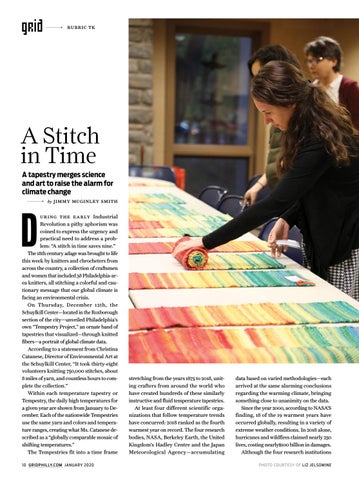
uring the early Industrial Revolution a pithy aphorism was coined to express the urgency and practical need to address a problem: “A stitch in time saves nine.” The 18th century adage was brought to life this week by knitters and chrocheters from across the country, a collection of craftsmen and women that included 38 Philadelphia-area knitters, all stitching a colorful and cautionary message that our global climate is facing an environmental crisis. On Thursday, December 12th, the Schuylkill Center—located in the Roxborough section of the city—unveiled Philadelphia’s own “Tempestry Project,” an ornate band of tapestries that visualized—through knitted fibers—a portrait of global climate data. According to a statement from Christina Catanese, Director of Environmental Art at the Schuylkill Center, “It took thirty-eight volunteers knitting 750,000 stitches, about 8 miles of yarn, and countless hours to complete the collection.” Within each temperature tapestry or Tempestry, the daily high temperatures for a given year are shown from January to December. Each of the nationwide Tempestries use the same yarn and colors and temperature ranges, creating what Ms. Catanese described as a “globally comparable mosaic of shifting temperatures.” The Tempestries fit into a time frame 10 GR ID P H IL LY.CO M JA NUA RY 2020
stretching from the years 1875 to 2018, uniting crafters from around the world who have created hundreds of these similarly instructive and fluid temperature tapestries. At least four different scientific organizations that follow temperature trends have concurred: 2018 ranked as the fourth warmest year on record. The four research bodies, NASA, Berkeley Earth, the United Kingdom’s Hadley Centre and the Japan Meteorological Agency—accumulating
data based on varied methodologies—each arrived at the same alarming conclusions regarding the warming climate, bringing something close to unanimity on the data. Since the year 2000, according to NASA’S finding, 18 of the 19 warmest years have occurred globally, resulting in a variety of extreme weather conditions. In 2018 alone, hurricanes and wildfires claimed nearly 250 lives, costing nearly$100 billion in damages. Although the four research institutions P HOTO COURTESY O F L IZ J E LSOMI NE
Crafters from around the world created these “Tempestries,” which depict global temperature data stretching from 1875 to 2018.
used different technological tools in measuring land and ocean temperatures, their findings were that there exists an irrefutable global warming trend. The Tempestry Project’s global data visualization reiterates a similarly disturbing message through textile or fiber arts. All Tempesties or temperature tapestries, using a varied color scheme of yarns, depict the temperature ranges for a given year. Looking at climate change in Philadelphia—as elsewhere, largely the result of greenhouse gas emissions—a pattern of hotter and wetter weather is emerging, with more flooding from increasingly intense storms. Moreover, the shift in climate is producing a variety of negative implications for human health and ecology, as well as the safety of the region’s infrastructure. Since 2010 Philadelphia has experienced a number of record-breaking weather
events: among them, the two warmest summers on record, including 2010, when Philadelphia had 55 days of above 90 degrees and 17 days above 95 degrees. By contrast, the Schuylkill Center’s Tempestry for the year 1875, crocheted by Lauren Bessler, reveals that Philadelphia’s highest daily maximum temperature was one day of 95 degrees, occurring on June 25th. Leaping to our current era, the Tempestry created by Jessica Griffith for the year 2018 reveals -with a fiery cranberry color- that Philadelphia’s highest daily maximum temperature occurred on July 3rd, when it climbed to a staggering 101 degrees Fahrenheit. Between 1970 and 2018, Philadelphia averaged 28 days above 90 degrees per year. But according to climatologists, by the year 2080, Philadelphia could have up to 100 such days of 90 degree-plus days. Besides the troubling trend to warming temperatures, the Philadelphia region and
the globe is also experiencing fewer cold days. In 1875, for instance, there were 30 days with high temperatures that never rose above freezing. Yet by 2018, there were only 9 such frigid days. The evidence of this is mirrored in the changing colors of Tempestries for those respective years. The Tempestry Project was spearheaded by Justin Connelly, Marissa Connelly and Emily McNeil of Anacortes, WA. Along with Philadelphia, hundreds of other Tempestries have been made by crafters around the world. Located on what was originally farmland in the northwest section of the city , the 340 acre Schuylkill Center was founded in 1965, and is one of the first urban environmental education centers in the county. With the goal of allowing city residents to experience the wonders of nature, the center, located near Ridge Avenue and Hagy’s Mill Road, includes a rich expanse of fields, forests, streams, ponds, along with being fronted by a collection of solar panels. In addition to the Tempestries Environmental Art exhibit, the Schuylkill Center is open Monday to Saturday, 9:00am to 5:00 pm and welcomes visitors ranging in ages from kindergarten to college students and seniors. The center has specific environmental programs targeting preschool and kindergarten children, enabling them to interact with native birds, butterflies and frogs and explore nearby forests and ponds. JAN UARY 20 20 G R I DP HILLY.COM 1 1
street stories & curbside characters
Sunny Side Up After landing in Philly from war-torn Cambodia, this food truck owner delights customers with good grub by constance garcia-barrio and his gift of gab
W
ho would have guessed that you could cook up peace with a hot griddle and a splash of oil? Utdam Thach and his wife, Maggie, both 53, from Cambodia, serve up toothsome sandwiches with a side of joy at the Happy Sunshine Food Truck on Drexel University’s campus. “They always have a smile for you,” says Brian Delose, a Drexel freshman, majoring in finance. “After a while, they know what you like and start cooking it when they see you coming.” He particularly enjoys their sandwiches and bucket iced tea. Thach has traveled light-years in outlook and miles to land on this busy corner. “I was a soldier in Cambodia in the ’80s, fighting the Khmer Rouge,” he says, speaking of the regime said to have killed more than a million Cambodians. “My father, mother, sisters, brother and I fled to Thailand. An American organization brought us to the United States in 1995.” Thach’s family settled in Philly, but Thach, a restless young man then, bounced around. “I stayed in New York for six months, then Connecticut for 13 months, then, Lowell [Massachusetts],” says Thach, who’d learned some English in Thailand. “I don’t have studies or a trade, so I work[ed] with my hands. I was a dishwasher in Japanese and Chinese restaurants. I made money under the table.” When friends told Thach about a good job in this area, he moved back to Philly. “I worked in a diaper factory in King of Prussia,” he says. “I started out at $13 an hour, but things slowed down. They said they would pay me $10 an hour, or they would give me papers to collect unemployment [compensation].” Thach took the compensation but felt unmoored. “I was depressed,” he says. “I had just a little money, and I was gambling. I was like 12 GR ID P H I L LY.CO M JA NUA RY 20 20
a homeless person.” But he knew where to turn for help among Philly’s approximately 12,500 Cambodians in the early 2000s. “I went to the [Cambodian] Buddhist temple. They feed you, and you help the monks and sleep on benches in the temple,” he says, explaining how he got by. “The temple used to be on Second Street, but neighbors didn’t like the festivals. Too much noise. Now there’s a big temple [in West Philadelphia].” The temple’s help exceeded Thach’s wildest dreams. “I met Maggie there,” he says, smiling at the attractive woman working alongside him in the truck. “She straightened out my life. I’m lucky to find her.” Thach and Maggie married in 2008. “With honesty, truth and respect, you have a good marriage,” he says. Two years into their marriage, Thach and Maggie heard about a food truck for sale. “It cost $48,000, a good price, but the truck needed work,” he says. “We had to fix the refrigerator, broken pipes, the fan on top and other things.” The truck made the most of their abilities. They both have stamina, and Thach had acquired handyman know-how over the years. Something else worked in his favor. On a scale of 1 to 10, his people skills rate a 12. He brims with so much goodwill that it raises the ambient temperature by a good 5 degrees. “I talk, talk, talk, bring in customers,” he says. It’s usually Maggie at the griddle. She gained cooking skills at a gourmet restaurant, Thach says, and later helped a friend who had a food truck, so she had experience preparing American breakfast and lunch sandwiches. They balanced diplomacy and profits in setting their prices. “Before we opened for business, we went around to see how much other trucks were charging,” Thach says. “If you under-
cut other trucks, it can make bad feelings. Maybe you come back one morning and find your truck damaged.” Thanks, in part, due to its low prices, Happy Sunshine has a loyal following. “Look at the size of this steak sandwich,” Schnik Beej, a marketing major, says. “It’s $4.50 and enough for two people.” A pepper, egg and cheese sandwich goes for $2.25, and hash browns, and bacon, egg and cheese costs $3.50. Maggie and Thach have a grueling schedule. “We get up at 3:40 a.m.—okay, sometimes we oversleep until 4 a.m.—then we load the car and drive here from the Northeast,” he says. “We’re here by 5 a.m., and we open at 6 a.m.,” which helps Happy Sunshine draw early risers, Thach says. “We close at 3 p.m., but we don’t go right home. You have to clean the griddle and do other things to be ready for the next day. It takes an hour.” “Vacation” seems to be a foreign word to Thach. “What vacation?” he says. He and Maggie may have enough downtime to see family members living 10 minutes from their home, and occasionally Maggie does traditional sewing she learned from her mother and aunt. Thach and Maggie have stiff competition with a slew of other trucks like Dos Hermanos Tacos, Le Dominique Creperie and a halal food truck, yet Happy Sunshine stands out for more than its canary color. (“That’s the color of peace,” Thach says.) “You have to give respect,” and now and then something more concrete. For regular customers, Thach sometimes throws in a free soda or bag of chips. But Happy Sunshine’s success stands on more than demeanor. For one thing, Maggie has her secret sauces and recipes. “She’ll go to restaurants and try something, then come back and make her own [version of it],” Thach says. However, Maggie’s cooking includes an even more elusive ingredient. “Buddhism teaches you to be peaceful,” Thach says. “If you have a peaceful heart, you have a peaceful family, then a peaceful community. We put peace in our food.” P HOTO G RAP HY BY AL BERT YEE
Maggie and Utdam Thach own and operate the Happy Sunshine food truck. They conduct their business on Drexel University’s campus.
JAN UARY 20 20 G R I DP HILLY.COM 13
Good Will Hunting A new program aims to control urban deer populations, get more Philly residents hunting–and feed the hungry by
bernard brown
Y
ou had to leave the city to hunt deer when Brad Gates, a wildlife biologist, conservationist and Philadelphia hunter, was growing up in Upper Roxborough in the 1970s. “You got in your car, drove three or four hours to the Poconos, to Tioga County,” he recalls. Closer to home, Gates roamed the woods of the Schuylkill Center for Environmental Education and the Upper Roxborough Reservoir, catching frogs, toads and snakes. Today a kid like Gates roaming Philadelphia’s forests will run into white-tailed deer or signs of them (scat, trails or antler-rubbed trees) regularly, but 40 years ago deer were more scarce. 14 GRID P H IL LY.CO M JA NUA RY 2020
“If someone saw a deer, everyone would call everybody, and everyone would try to get a look,” Gates recounts. By the 1980s, teenage Gates was seeing more deer. He and some like-minded friends researched the rules about hunting in Philadelphia and realized that although firearms were prohibited, hunting was otherwise generally allowed on private property. “We started bowhunting along the Schuylkill River on Port Royal Avenue. Then, as the deer population grew, and our knowledge of hunting grew, we got more organized.” The increasingly abundant deer were becoming a nuisance. By the mid-1990s, 129 deer per acre lived in Pennypack Park, although the land could only sustainably
support 8-10 deer per acre. Large numbers of deer over-browsed the forest understory in parks, preventing seedlings from growing into trees and, as a side effect, clearing out the competition for invasive plant species that they don’t eat, such as garlic mustard and Japanese stilt grass. Philadelphia Parks and Recreation, which has not allowed recreational hunting, has dealt with the deer overpopulation by bringing in professional sharp-shooters to cull the deer and donating the venision to local anti-hunger programs. The John Heinz National Wildlife Refuge has similarly culled deer while prohibiting recreational hunting, according to refuge manager Lamar Gore. “When I first got to the refuge about five years ago, I started getting phone calls right away, people asking if we allowed hunting,” says Gore, who soon saw an opportunity to involve the public. “I can’t justify bringing sharpshooters in if we’re not giving an opportunity to hunters who want to hunt their own meat.” Planning and community
P H OTO G R A P H Y C O U R T E S Y O F T H E U . S . F I S H A N D W I L D L I F E S E R V I C E
urban naturalist
outreach followed, culminating in what was the refuge’s first public deer hunt in the fall of 2019. Hunting demographics do not mirror Philadelphia’s population. A 2016 survey by the U.S. Fish and Wildlife Survey (USFWS) found that 97 percent of hunters are white. “I think in the conservation and management world, we’ve done ourselves a disservice, whether intentionally or unintentionally, leaving out a whole generation of people,” says Gore. Offering a hunting program in a diverse city is one step in the right direction. The same USFWS survey found that hunting is declining in popularity, with 11.5 million American hunters over 16 years of age, down from 12.5 million in 2006. Since hunting license fees fund land conservation directly and taxes on hunting fund conservation indirectly, Gore also points to the need to promote hunting among urbanites for conservation purposes. Jamie Coyle had been thinking about hunting when he discovered the new program on the refuge’s website. Coyle works for the Coyote Tracks Youth Program of Four Elements Earth Education, a program that connects kids to nature. Hunting appealed to Coyle as a way to control the “outrageous deer population,” he says, as well as, “getting food that’s sustainable and local. And venison is delicious.” He signed up, taking part in the refuge’s training that combined education in deer biology and hunting rules with crossbrow practice. Overall the group bagged 12 deer. In three outings Coyle did not manage to shoot any himself, but counts the experience as a win. “It was super pleasant to be out in the woods watching birds and squirrels running around,” he says. Gore and Gates both also emphasized the joys of spending quiet time outdoors while hunting. Over the years Gates’ hunting has evolved into a serious hobby. When we spoke in November he had just returned from a hunting trip to Kansas. Back in Philadelphia Gates tries to do his part to keep the deer population in check by targeting does. He estimates he kills about 10 per year (keeping some of the venison and sharing the rest with food-insecure families). “It’s my way to decompress,” he says. “My way of watching the wildlife, the hawks and the deer.”
Farm-to-Table Fresh Organic and Local 1 Boathouse Row • 215-978-0900
Winter hours
Open Wednesday through Sunday 8 AM to 4 PM Closed Monday and Tuesday
cosmicfoods.com
JAN UARY 20 20 G R I DP HI LLY.COM 1 5
story by claire marie porter photography by milton lindsay
Sustainable apparel brand Grant Blvd
makes climate activism and social justice fashionable
FASHION FORWARD
Kimberly McGlonn is the founder of Grant Blvd. The slow-fashion company is based in Grays Ferry.
Grant Blvd is the name of the street where Kimberly McGlonn grew up in Milwaukee, on the North side, “where the blacks lived,” she says. She has no background in fashion, aside from her mother dragging her through thrift stores as a child. “I hated them,” she remembers, “the dust, the chaos.” These were defining moments for her, however, as she describes this time in her past as the beginning of her “lifelong training” to
return life to something others have thrown away, both literally and metaphorically. On Grant Blvd, she was exposed early to a variety of themes about beauty, health, clothing and poverty that would later inform her business, and manifest in a company that combats climate change and fast fashion while giving hope to previously incarcerated individuals. McGlonn, a petite 40-year-old woman whose zest for life is visible, is a Doctor of
Philosophy and teacher of social justice in the Lower Moreland school district, a councilwoman for her community in Jenkintown, and the CEO and founder of Grant Blvd, a radical fashion design company that is deconstructing stereotypes while attempting to disrupt systems and protect the Earth. Now, in a modest, naturally lit studio on the second floor of the Queen Memorial Building in Grays Ferry, McGlonn has JAN UARY 20 20
G R I DP HI LLY.COM
17
created a new vision of Grant Blvd. It’s a place of refuge, free from waste and free from judgement, a sanctuary where people from all walks of life make beautiful things together. The styles are fashioned from salvaged clothing handpicked in local thrift stores. From sweatshirts and tees to runway styles, the company uses no new water and barely any new materials, and zero outsourcing. The small Grant Blvd team designs, cuts and sews every piece of clothing in its collection. Grant Blvd’s mission is to directly battle systemic problems like climate change and mass incarceration but also to whittle away at capitalism and subvert the patriar-
18
GRIDPH IL LY.CO M
JA NUA RY 2020
chy. Because as McGlonn points out, a truly sustainable business isn’t just about being “eco-friendly,” it’s about rebuilding community, fostering a safe space, having a holistic approach to employment and, if it’s Grant Blvd, creating edgy, bold and idiosyncratic garments. “Some people don’t want their fashion to be political,” she says. “That’s not my tribe.”
Fast fashion is a modern invention. While
the traditional fashion cycle was twice a year, spring and summer and fall and winter, the trends are on a super speed cycle and have as many as 50 to 100 microseasons.
Some people don’t want their fashion to be political. That’s not my tribe.” — kimberly mcgl onn
What that means is consumers are purchasing more clothing, more quickly, and keeping older items for shorter periods of time. According to the World Resources Institute, the average consumer bought 60 percent more clothing in 2014 than in 2000 and kept each garment for half as long. The turnover is only part of the problem. Cotton is an incredible thirsty plant, and the main one used in clothing production, making up about 33 percent of all fibers. Clothing already has an enormous carbon footprint; the fashion cycles’ planned obsolescence only exacerbates the problem. Grant Blvd is combating its carbon footprint both subversively and noisily. Screen
As several employees work on implementation, McGlonn styles a new garment. All of Grant Blvd’s clothing is crafted from second hand wares.
printing is one way that it uses fashion to start conversations, says McGlonn. “Sustainable AF,” and “Earth Bae” are some of the messages on Grant Blvd’s screen-printed styles that suggest the sentiment “that we are people who have a really affectionate relationship with the planet,” says McGlonn. “Books, not bars” promotes public education over prisons, and “End mass incarceration,” the most popular print, addresses the overcrowding and poor treatment of people who are incarcerated. “What we wear should communicate our values,” she says. And everything we choose to put on our bodies makes a statement, even if it does so silently, she points out. But for those that want to be a little more vocal, it can also be a conversation piece, she adds. On display in McGlonn’s studio is a vintage men’s military coat, reminiscent of the original structure, but reshaped and with added color and ruching, a bunching technique used in dressmaking that gives fabric a three-dimensional quality. Another piece is a long, architectural skirt made from denim scraps, with a matching denim jacket that sports a denim-scrap mosaic of the Earth on the back. “We don’t throw away,” she says. “We don’t waste anything.” A vintage trench coat with pillow cases lining the back is both practical and fresh, like a walking quilt. Another piece is a dusty rose vintage coat that McGlonn paired with curtain sheers, giving it puffy, voluminous sleeves. The Harriet, a classic men’s button-up shirt reworked with a feminine crop and ruffled sleeve, is another favorite, and a mainstay in the collection. At a recent fashion show, the showstopper was an evening gown fashioned from men’s business shirts. “It still has life,” says McGlonn. “We just have to find it and make it and give it.”
McGlonn’s vision to fight mass incarceration and inhabit the intersection between sustainability and social justice is manifested in both the items of clothing and her approach to “green collar” job creation. In order to focus on employing previously incarcerated and returning citizens, she’s created partnerships throughout the city and a fellowship program to help identify women who are interested in sew-
ing, who have had some life experience with the criminal justice system. The employment is holistic: along with being taught to sew, healthy habits and diet are also a part of the training. Her current team consists of two interns, a director of talent and development, a director of production and design, and she is working on bringing on a director of operations. Grant Blvd currently employs one formerly incarcerated woman as a seamstress, a product of the fellowship program. The company recently partnered with the Pennsylvania Department of Corrections to identify new talent, which will include re-entered citizens as well as those preparing to re-enter in Philadelphia County. The idea, says McGlonn, is to build a bridge from their current situation to a steady vocation when they’re out of the prison system, so they can have a community waiting for them. “We’ll make visits into correctional facilities, and build networks in that direction, and then create a nice, warm, soft landing spot,” says McGlonn. Because 95 percent of incarcerated people do come home, says McGlonn. Six hundred and fifty thousand people in the United States return home from prison every year, according to the American Civil Liberties Union. Women are also the fastest growing incarcerated population in the country. Mass incarceration refers to the singular way the United States has dealt with crime, leading to a staggering number of prisoners. Currently, the U.S. holds 25 percent of the world’s prison population, having increased 700 percent since 1970, largely as a result of the War on Drugs. These numbers include local, federal and state prisons. A significant part of Grant Blvd’s training program is recognizing that prison is a traumatic experience, and coming home has many obstacles to reintegration, says McGlonn. It requires “business planning that is mindful of avoiding exploitation and adding nutrition to the lives of people who have experienced cyclical trauma and generational poverty,” says McGlonn.
Nevada Gray, Grant Blvd’s director of production and design, says that before working with McGlonn, she was so accustomed to working with fast fashion and new materials that she had never once thought about the waste. JAN UARY 20 20
G R I DP HI L LY.COM
19
McGlonn puts about 35 hours a week into Grant Blvd, handling all the marketing, publicity and sales, going straight from her teaching job to her studio. She works long days, but it’s so much soul work, she says, she doesn’t mind.
A Grant Blvd seamstress stitches a label into a denim jacket. The company currently has four employees.
“I’m super new to sustainable fashion,” she says. “And it’s really changing my life. How I shop, how I think—I can’t stop talking about it.” “If I have become passionate about this,” says Gray, “anyone can.” Gray studied fashion design at the Art Institute of Philadelphia, specializing in formal wear. The creativity that goes with restricted fabric supply has challenged her ideas of what can be done with less. She also says the environment at Grant Blvd is very open and honest. It’s a breeding ground for creativity. Together she and McGlonn handpick garments and scraps that are in good condition. Along one wall in the studio are piles of thrifted menswear, mostly flannel shirts. Some of that creativity includes taking used garments and reimagining them. “We play with taking back things that once belonged to men,” says McGlonn, and about 75 percent of the salvaged materials were previously menswear, she says. Because the sizes are often larger, there’s more room for cutting and restructuring, and ability to cater to all body shapes and sizes. “I completely love the play of the pulling out the effeminate in the masculine,” says Gray. “We’re not these fragile little flowers. I love that in our story.” As the director of design, every garment goes through Gray’s hands before it leaves the studio, she says. She oversees all the sewing and works one on one with all of the employees. She says the production is slow, because many women who go through the training program have little to no prior experience. 20
GR IDPH I L LY.CO M
JA NUA RY 20 20
In perfecting small things, like doing labels or working on a specific stitch, Grant Blvd revels in the small triumphs, she explains. “It’s amazing to go to work and feel like you’re making some impact in the world,” she says.
It was McGlonn’s upbringing that led her to work that addresses the needs of the marginalized. Her father was a food activist who opened up a healthy deli across the street from a Kentucky Fried Chicken. Her mother volunteered at a correctional institute on the weekends. “That was the backdrop in my parents’ lives,” she says. “That informed my activism.” She went on to become a teacher for the next 18 years. But as she struggled to teach her high school students about the complexities of the U.S. criminal justice system, as well as the state of the planet, she found herself feeling disconnected. She spent a year learning about the fashion industry and working in the prison industrial system. She started volunteering for Books through Bars (where the screen-print inspiration came from), a volunteer-run program in Philadelphia that distributes free books and other educational materials to people who are incarcerated. For every Grant Blvd garment purchased, the company sends a book through the program. Two years ago she resigned from teaching full-time, though she still teaches high school classes in Montgomery County. She also works with twelfth graders who need extra support.
Too often, the modern sustainability movement excludes marginalized communities. The first four United Nations’ sustainable development goals—eradicating poverty and food insecurity, while promoting good health and quality education—address inequality. Yet sustainability can be a buzzword for eco-friendly trends that do not exact change for those who are most impacted by the changing climate and inequality. “As America becomes less white, we’ve gotta get that majority to the table,” says McGlonn. The conversation must include the marginalized, and it needs to be in a way that recognizes not just equality, but ownership, she continues. And it’s more than just Fair Chance hiring, she adds, it’s about getting them to a place of self-sufficiency. “People who come home from prison, they need opportunities, and if we don’t create them, they don’t exist,” she explains. She wants to urge sustainable businesses to think about how to create communities where people who have been purposefully marginalized are brought to the spotlight. “Until we can shift the sustainability conversation to include people of color, it will be an effort in vain,” says McGlonn. The brand aims to launch into a retail space by next year, and then to encourage a conversation about sustainability that is accessible for people at a variety of price points, and highly inclusive, she says. “The hope is to use retail ... to challenge systems of hierarchy,” she says, “while wearing our values.” Being intentional about not only what we buy, but from whom we buy, holds a lot of weight, says McGlonn. By doing so, “we have the power to challenge not only the social issues exacerbated by mass incarceration, but to more meaningfully address climate change,” she says. “Because if it’s not for the good of the whole,” she says, “then it really ain’t good.”
JAN UARY 20 20
G R I DP HI L LY.COM
21
From left: Taproom Manager Sola Onitiri; Bill Popwell, Tess Hart and Kyle Carney co-founded Triple Bottom Brewery in 2019 and made a committment to hiring a diverse staff.
Brewing With a Purpose Triple Bottom Brewery has planned carefully to bring inclusivity to the craft beer scene story by claire marie porter • photography by rachael warriner
22
GRIDPH IL LY.CO M
JA NUA RY 20 20
T
he hop flower in the center of Triple Bottom Brewery’s Philly skyline logo has three leaves—one for people, one for planet and one for beer. The image is an homage to the brewery’s take on the original triple bottom line (people, planet and profit) and symbolizes the company’s commitment to social good over dividends. The brewery opened this past September on Spring Garden Street, after many years of planning. Tess Hart; her husband, Bill Popwell; and brewer Kyle Carney took the time to make sure their business was a little different from a typical craft brewery. Seeking to add more diversity to the craft beer movement, Triple Bottom Brewery intended to hire women, people of color and those with criminal records who traditionally have been excluded from the economy. Hart and Popwell were both community developers living in Washington, D.C., when the idea of a more inclusive brewery came to them. They were always struck by the way bars brought people together and saw them as the centers
Our team is 50 percent women, 50 percent people of color and looks different than any other brewery around.” — te ss hart, co-founder
of communities, says Hart. Bars were places “where people went looking for a story, not just a drink,” she says. Bars and breweries create a perfect environment for people to connect, to show natural curiosity in one another’s lives and to practice open-mindedness, she continues. Hart wanted the brewery to feel like coming home. “We also noticed that the vast majority of breweries we were going to were not inclusive,” she says, referring to how the craft brewing industry is dominated by white men. According to data collected by the Brewer’s Association, the majority of U.S. breweries have male owners, and 88 percent of
all brewery owners are white. “[The] traditional customer base for craft beer isn’t very diverse,” she adds. She and Popwell started thinking about how they could create a different kind of brewery about five years ago. They knew that inclusivity would be something that required intention and planning. Soon after, they found Kyle Carney, an experienced brewer. “As much as we were driven by a social mission,” says Hart, “our beer had to be great.” The team of three began workshopping their vision for the brewery. They knew they wanted it to be a Fair Chance business and an example of what an employer can be for returning citizens. Specifically, the business doesn’t see criminal records as a barrier. In fact, they seek out people who have them. “I don’t care how many chances you’ve had, at this point, when you’re ready to work, this is what’s fair,” she says. The brewery opened with 13 new employees, a third of which the company employed through their neighborhood foundation and nonprofit partners. Some of the partners include Project Home, a nonprofit that empowers individuals to break the cycle of poverty and homelessness, Mural Arts Philadelphia and the Youth Sentencing & Reentry Project, which works to keep children and youth out of adult prisons and bring home adults who were sentenced to life in prison as children. “Our vision is that everyone in every community should have the opportunity to create something great,” says Hart. And the first few months of the fledgling business have exceeded expectations, she says.
“Our team is 50 percent women, 50 percent people of color and looks different than any other brewery around,” she says. The brewery is also committed to sustainability. All of their electricity is from wind power that comes primarily from Pennsylvania. They have a large trash room for sorting waste, in an effort to divert as much as possible from the landfill. Their spent grain from brewing is sent to a local farm, where it’s then used as cow feed. The brewery tries to maintain a range of flavors and styles of brews, with an emphasis on accessibility from a taste perspective. They want the customer to feel at home and comfortable, says Hart. So the beers span from light lagers to stouts, all with Philly namesakes. One of the 10 they currently have on tap is an IPA called The Training Montage, an homage to the Rocky films. Another is a light lager called Sunny, “because It’s Always Sunny in Philadelphia,” says Hart. The Terminal foreign extra stout is named after the Reading Terminal Market, and is their richest, darkest beer. The brewery has a small kitchen and a simple menu that features food from Philly artisans, like Di Bruno Brothers cheese and charcuterie, and Stargazy, a British pie shop in South Philly, whose steak-and-stout pie is made using the Terminal. Hart is originally from Philadelphia, and she saw a space to be filled in her hometown. With one of the fastest-growing millennial populations, and simultaneously one of the highest poverty rates in the country, Philly is a city that could benefit from a bridge. “Our business was really speaking to both of those populations,” she says, hoping that when people walk through the doors at Triple Bottom Brewery, “the chasm between those two communities could disappear—at least for a little while.” JAN UARY 20 20
G R I DP HI L LY.COM
23
Returning the Favor How two men built a coffee business to address recidivism story by claire marie porter
D
espite what you might have heard, the coffee scene isn’t just for hipsters, says Bob Logue. Quaker City Coffee, which Logue launched with Christian Dennis in 2017, sells wholesale coffee and provides office catering. It was founded around the idea that everyone—returning citizens included—should be able to work in the fair trade coffee industry. Dennis had just gotten out of prison when he and Logue first met. Logue, who is also the co-owner of Bodhi Coffee and Federal Donuts, met Dennis in 2015 at the ReEntry Support Project, a program designed for returning citizens, at its commencement ceremony at the Community College of Philadelphia. Dennis, who had served time in prison, shared his story at the event. Logue was struck by his speech. “I thought, ‘This man has so much poise, this man has so much grace,’” recalls Logue. “He has a tremendous amount of gratitude.” 24
GRIDPH IL LY.CO M
JA NUA RY 20 20
Logue, moved by Dennis’ story, approached him after the commencement. They exchanged numbers and have been like family ever since, Logue says. After several meetups, the two decided to go into business together, with a mission to intentionally seek out and employ people like Dennis. Logue says it was a lightbulb moment, the idea of creating a company that uses the skillsets of people who have been involved in illegal businesses, namely selling drugs, and utilize those skills in a legal business. “We live in a huge city, but it’s really two separate cities that are constantly pushing at each other,” he says. “The resentment, fear and anxiety of gentrification—the folks who feel simply left out.” Logue and Dennis both grew up in Frankford, but Logue says it’s like they lived in two totally different neighborhoods because of a mix of factors, including systemic racism, a lack of equal employment opportunities and poverty.
“My heart has always been where I’m from,” says Logue. “I appreciate the fact that so many people have moved to Philadelphia, and our tax base has increased. But a lot of the folks from where I grew up aren’t getting a piece of that.” This is how the pair came up with the idea of Quaker City Coffee Company, a business that would place formerly incarcerated people in a steady job, in an effort to reduce recidivism in a city that has one of the highest incarceration rates in the United States. They partnered with many Philadelphia organizations, including the Center for Carceral Communities, the Adult Probation and Parole Department and the Mayor’s Office of Reintegration Services. Through their nonprofit partnerships they’ve managed to place returning citizens in jobs, selling and distributing coffee from Philly Fair Trade Roasters. Since its beginning, the coffee company has employed six formerly incarcerated employees. Dennis and Logue manage sales and product distribution. The name comes from the idea of Philadelphia once being a thriving Quaker city, an “industrial superstar” in the 1800s and early 1900s, says Logue, when the city was built around small businesses. “Maybe we can bring back some of that energy again,” says Logue, “for the citizens here and now.” Logue says navigating the obstacles embedded in re-entry from the criminal justice system hasn’t been easy, and the company has been through many iterations, from being a simple brick-and-mortar retail company to a wholesale one. For a company like theirs, flexibility is essential, Logue says. They describe it as a “profit-sharing” company, which means the strategy is not so much to make profits for the ownership, but to help its employees reintegrate and become part of a prospering community. The company emphasizes financial literacy. “It might mean sacrificing most of our bottom line,” says Logue, “but we’re willing to take that risk.”
P H OTO G R A P H Y C O U R T E S Y O F Q UA K E R C I T Y C O F F E E
From left: Quaker City co-founders Christian Dennis and Bob Logue committed to running a coffee business that would employ returning citizens.
kitchen textiles sold to support urban agriculture
beautiful sustainable practical
thekitchengardenseries.com JAN UARY 20 20
G R I DP HI L LY.COM
25
Clean Laundry Clean Planet Clean Slates
TOP OF MIND local businesses ready to serve
26
crafts
fitness
food
Sweet Mabel Store and Studio
954 Dance Movement Collective
Kimberton Whole Foods
The store offers art & craft from local and national artists, First Friday art openings and free gift wrap. The studio hosts parties, workshops, camp and open studio using repurposed goods.
Our mission is to get you dancing! The 954 Dance Movement Collective studio is also available for rehearsals, readings, classes, events, recitals, workshops, photography, video and performances.
A family-owned and operated natural grocery store with six locations in Southeastern PA, selling local, organic and sustainably-grown food for over thirty years.
sweetmabel.com
954dmc.weebly.com
GR IDPH I L LY.CO M
JA NUA RY 2020
kimbertonwholefoods.com
Sustainable Laundry and Linen Solutions for Philly’s Laundry and Linen Residents and Solutions for Businesses
Small Businesses
Save 10% off your first order. Code: GRID10 WashCycleLaundry.com
Recognizes Our Subscribers and Patrons. Thank you for your support! A N D R E W A B B OT T
J E S S I C A M C AVA L I E R E
E D WA R D G O L D E N
N A N C Y K L AVA N S
ANNE ODONNELL
L A U R A S I LV E R M A N
A LO N A B R A M S O N
C H LO E C E R W I N K A
N AT H A N G R A C E
E VA N K L I N E F E LT E R
ST E V E O L I V E R
HARRY SIMONS
C H A R L ES A DZ E M A
HEDY CERWINKA
R O S I E G R AY B U R N
J E RO M E K N AST
P E N N Y O R D WAY
KAREN SINGER
CARINA AHREN
MARY CHEN
C H R I ST I N A G R I F F I N
E M I LY KO VA C H
K AT E O S H E A
C SKEMA
G R E G O R Y A LO I A
BLUE CHEVIGNY
BRENT GROCE
JENNY KRAFT
W I L L I A M O S WA L D
BETH SMITH
V I C TO R I A A Q U I LO N E
ROSE CHIANGO
ABBY C GROSSLEIN
MONICA C KRAMER
A L E X PA L M A
CHRIS ARGERAKIS
S U S A N C H I N N I C I M OY E R
ROBERT GROVES
CYNTHIA KREILICK
C H R I S TO P H E R PA P P O
C H R I S T I N A A R LT
HE CHUNG
D AV I D H A A S
VICKY KRESGE
C A R O L I N E PA R K
CHARA ARMON
J E R O M E C LO U D
K I M B E R LY H A A S
REBECCA KRISS
S A R A PA S C H
M A RY A R M ST RO N G
ANN COHEN
LENNY HABERMAN
K R I ST I E L A N D RY
O G N I A N PAV LO V
ALLAN ASH
SARAH COLINS
SUSAN HADDEN
VA L E R I E L A N G
JANE PEPPER
AMANDA ASHMORE
S U S A N M C O LO W I C K
SUZANNE HAGNER
L E VA N A L AY E N D E C K E R
E L I SA B E T H P E R E Z L U N A
DENIS & JUDY ASSELIN
JANE COMBRINCK-
BARBARA HAGUE
JAMIE LEARY
JULIA PERGOLINI
A N N E LY S S A S N Y D E R
KENNETH HAHN
LAURA LECHTENBERG
M A R Y A N N P E T R I L LO
G A R Y S O B O LO W
AW B U R Y A R B O R E T U M
GRAHAM
ERICA SMITH LAUREN SMITH MEGHAN SMITH JUDE SMITHEY ANNA SMUKLER D AV I D S N E L B A K E R
K Y L E B A G E N S TO S E
KASSANDRA COMBS
HEIDI HAMMEL
MARSHALL LEDGER
ALLISON PIERSON
LO R Y S O D A
G R E TC H Y N B A I L E Y
A N N L CO N ROY
CHARLENE HANBURY
DON LEEDY
BOB PIERSON
PETER SODY
DYLAN BAIRD
ANNE COOK
K E L LY H A N N I G A N
MINDY LEMOINE
SARA PILLING
C H R I S T I N A S PA N G L E R
AMANDA BAKER
CHERYL COOK
BARBARA HANSEN
ST UA RT L EO N
JESS PLUMMER
JACOB SPEIDEL
BRIANNA BAKER
MARY COOLEY
MARCIA HARP
LIZ LEWIS
S TA N P O K R A S
R YA N S P I E S
SUZANNE BAKEWELL
K E I L A C O R D O VA
J O H N H A RTZO G
SUZANNE LEWIS
K R I ST I PO L I N G
LAURA SPINA
JEFFREY BALIFF
CAROL FERN CULHANE
DEBRA L HARRIS
E DA N L I C H T E N ST E I N
MARGIE POLITZER
HENRY BARNES
ELIZABETH CUNICELLI
V I C TO R I A H A R R I S
CONNOR LIDDIC
DEBBIE POSMONTIER
N A N C Y B A R TO N
JOANNE DAHME
LEANNE HARVEY
J O H N L I N D S AY
LISA POWLEY
E L I S A B AT T L E
C H E S N E Y D AV I S
ROBERT HASSON
A M Y K AT E LO B E L
LISA PRICE
D OT T I E B A U M G A R T E N
S A R A D AV I S
K AT I E H AW K E S
K AT H L E E N LO P E Z
CONNOR PRITZ
ANNA BEALE
MARY DEVILBISS
CJ HAZELL
R O B I N LO W R Y
SARAH PULEO
BRENT BEERLEY
PA U L D I F R A N C E S C O
S U S A N L H E C K R OT T E
FA C U N D O L U C C I
CARLA M PUPPIN
P. B E H R E N S
R I C H A R D D I L U L LO
W I L L I A M H E N GST
CECILIA LUSARDI
MAUREEN PURCELL
M A R I O N S TO R E Y
J OY A B E RG E Y
AURORA DIZEL
ANNA HERMAN
AISHA MACKINS
SUSAN QUINN
E R I C S TO W E R S
J OS E P H B E R N ST E I N
LISA DIGIACOMO
H E AT H E R H E R S H
M E G A N M A L LO Y
H O L LY Q U I N O N E S
C H R I S T I N E E S U L L I VA N
BRUCE BERRYMAN
GILDA DOGANIERO
DEBORAH M
JOHN MARGERUM
ROSEMARY RANCK
S H AW N S U M M E R S
NINA BERRYMAN
A M E L I A D U F F Y-T U M A S Z
DEBORAH MARGULIES
A M E E T R AV I TA L
C H R I S SW I T KY
C H A R LOT T E
K R I ST I N A DUGA N
H E AT H E R H I L L
LELAH MARIE
G E N I E R AV I TA L
D O R OTA S Z A R L E J
CAROL DUNCAN
JODY HILL
FRED MARSHALL
KIM RAZNOV
D AV I D TA N I E R
K AT H R Y N B I R S T E R
SUSAN EDENS
JUDY HOFFMAN
W M J M A R S TO N L E E D A P
TED REED
A N N E TAY LO R
M I C H E L L E B LO O D W E L L
A M A N D A E D WA R D S
RICHARD HOFFMANN
J E N N I F E R M A S TA L E R Z
JENNY REEVERTS
B A R B A R A B LO O M
MICHELLE EISENBERG
M A R YA N N H O O K E R
J O S E P H M ATJ E
M.B. REGAN
D AV I D B LO O V M A N
ROBIN EISMAN
D A N I E L H O WA R D
L I S A M AT H E W S O N
G I G I R E I TA N O
L I N D A B LY T H E
HELEN ELKINS
ANDI HUBBARD
N I C O L E M AT T H E S E N
J A N E T R E I TA N O
JAMIE BOGERT
S T E P H E N E LW E L L
HARRIETTE HUBBARD
NEIL MCBRIDE
JENNIFER REZELI
NICOLE BOICE
MEHDI ENTEZARI
LY N D A H U B B E L L
R YA N M C C O R M I C K
NICKY RHODES
H E C TO R B O N E S
N I C E S P O S I TO
M A R YA N N E H U N T E R
K AT H L E E N M C C O U R T
JOAN RILEY
ALEXA BOSSE
M O R G A N E VA N S
A M E Y H U TC H I N S
JEN MCCREERY
JOHANNA RIORDAN
JOEL TRINIDAD
A N N E B OY D
E D WA R D FA G A N
K AT H R Y N I D E L L
M A R Y LY L E M C C U E
MARK RIVINUS
C H R I ST I T U M I N E L L I
CO L L E E N B OY D
K AT E FA R Q U H A R
E L L E N I WA M OTO
PAT R I C K M C D E V I T T
JULIA RIX
T R A C Y T U M O LO
JA N E B OY D
L I SA F E I N ST E I N
KAREN IZZI
ALLISON MCDONAGH
C H R I STO P H E R R O B E R T S
SUSAN UNVER
BRACKEN LEADERSHIP
ANDREW FELDMAN
MICHAEL JACOB
MICHAEL MCGETTIGAN
TERRY ROBERTS
I L A VA S S A L LO
HELENE BRENNAN
J A M I E F E R E L LO
TYKEE JAMES
TO M M C G E T T I G A N
LIZ ROBINSON
LAUREN VIDAS
CLIFFORD BRETT
JULIA FERNANDEZ
J O N AT H A N J E N S E N
THADDEUS MCGINESS
JON ROESSER
LO I S V O LTA
ANDREA BRETTING
JO ANN FISHBURN
LO R R A I N E J E W E T T
K I M B E R LY M C G LO N N
G LO R I A R O H L F S
PAT R I C I A WA G N E R
SUSAN BRETZ
ANNA FISCHMAN
BRETT JOHN
J A M E S M C G O WA N
JOHN ROMANO
LINDSEY BRITT
JANET FISHMAN
CRAIG JOHNSON
ROBERT MCKENZIE
ANDY ROSEN
SO P H I E B RO N ST E I N
H E AT H E R F I T Z G E R A L D
A D A M W. J O N E S
DENNIS MCOWEN
HAROLD ROSNER
BERNARD BROWN
D O R E E N A F I T Z PAT R I C K
BRAD JONES
K I M B E R LY M C G LO N N
MARC ROWELL
ROBERT BROWN
ALLISON FLANDERS
CAROLE JONES
ST E P H E N M E A D
WILLIAM RUSSELL
RUTH BROWN
ROB FLEMING
FREDERICK JONES
A N D Y M E H R OTA
M I C H A E L RUZ ZO
WILLIAM BROWN
SUSAN FLESHMAN
MADELEINE JONES
PA I G E M E N TO N
LO R R A I N E R YA N
BENJAMIN BRUCKMAN
E R I K A F LO R Y
MARTIN JONES
DANIELLE MERCURIO
N I C O L E S A LT Z E R
M A R I LY N WA X M A N
COLE BRUNSON
BOB FORMICA
YVONNE M JONES
GAIL MERSHON
JENNY SANDLER
LAURA WEBB
ANTHONY A BUCK
P H I L FO RSY T H
IRA JOSEPHS
B E TSY M I C H E L
B R YA N S ATA L I N O
H A N N A H W E I N ST E I N
DANIELLE BUEHLER
DEANA FRANK
MONICA KANE-HUGHES
ELIZABETH MILLER
TO N I S AV C H U C K
CAROL WEISL
REGAN BUKER
HENRY FRANK
GRANT D KALSON
EVE MILLER
MARY SCHOBERT
LEE WENTZ
MARLA BURKHOLDER
SUSAN FRANK
CHARLES KARL
JENNINE MILLER
REGINA SCHOFIELD
K I RST E N W E R N E R
MCHELLE BURNS-
LAUREN FRISCO
LY N N K A R O LY
K AT H Y M I L L E R
KEVIN SCOLES
H O L L I S W E S TO N
JEFFREY FULLER
NANCY KASSAM-ADAMS
KIM MILLER
H I D E KO S E C R E S T
PA U L W H I T TA K E R
PA U L B U T T N E R
MICHAEL GALE
K AT H L E E N K AT Z
NIESHA MILLER
SHOSHANNAH SEEFIELDT
ELAINE CAHILL
SHEILA GALLAGHER
D O N A L D K AVA N A G H
S U S A N M O N TA G U E
H SEITZ
RACHEL WISE
ANTHONY CAMP
TO M G A L L A G H E R
J O S E P H K AVA N A G H
JOHN MOORE
RACHEL SEMIGRAN
F R A N K LY N C A N TO R
C O N S TA N C E G A R C I A -
MARINA KEC
D O R OT H Y M O R A
DANIELLE SERVEDIO
SABRINA KEELER
B E T H M U R R AY
R I C H A R D S E X TO N
B E TA N C O U R T
MCHUGH
M A D E L I N E C A N TO R
BARRIO
H E U C K E R OT H
ALLISON SPONIC L AU R E N ST E E L E D I A N A ST E I F PA U L S T E I N K E M A RGA R E T ST E P H E N S SA R I ST E U B E R
N Y S S A TAY LO R ANNE THOMFORDE THOMAS JACQ U ES -J E A N T I Z I O U F R A N K TO R R I S I EST E L L E T RAC Y
L I N D S E Y WA L A S K I J O H N WA L B E R A L E X A N D R I A WA L K E R P H O E N I C I A WA L L A C E D E B B I E WA R D E N M A R S H A L L WA R F I E L D
ERICA WOLF DANIEL WOLK ZACHARY WOLK J U D I T H W O LO F F
CECI CARDESA
G LO R I A G E L L A I
SOHEE KEMPF
R O G E R M U S TA L I S H
J I L L S H A S H AT Y
KYLE CARMONA
LO L A G E O R G
KALLIE KENDLE
B NAGENDRA
PA M E L A S H AW
K AT E C A S A N O
NANCY GERYK
LAURA KENNEDY
CAROL NASHLEANAS
C A R R O L L S H E P PA R D
ALBERT YEE
SUSAN CASKEY
JACEK GHOSH
CLAUDIA KENT
JEFFREY NEWBURGER
WILLIAM B SHICK
JEN YUAN
M A R Y LO U I S E C A S TA L D I
LAURA GIBSON
KEN KESSLIN
M I C H E L L E N I C O L E T TO
V I C TO R S H U G A R T
HILLEL ZAREMBA
M A R I SSA CAST RO
MARY GILMAN
BILL KING
MASON NOBLE
L I S A S H U LO C K
BARBARA ZARSKY
J O C ATA N Z A R O
SIOBHAN GLEASON
G LO R I A K L A I M A N
K AT H L E E N O ’ M A L L E Y
K L A U D I A S I KO R A
CURTIS ZIMMERMANN
CHARLES D WRIGHT
Subscribe online for as little as $2.99 a month, or make a contribution in any amount at gridphilly.com JAN UARY 20 20
G R I DP HI L LY.COM
27
EV EN TS
january 2020
January 11
January 18 – 20
January 25 – 27
Wildseed: A Seat At The Table
Reading and Discussion on Dr. Martin Luther King, Jr.
American Handcrafted
This spoken-word event offers you the chance to take a poet-curated tour of the Center for Art in Wood in Old City. Designed to be an immersive artistic experience, the night will include interviews with the performers and featured sets by three Philly poets. It celebrates women and women-identifying poets and wood makers. centerforartinwood.org WHEN: 6 to 9 p.m. COST: $15 WHERE: 141 N. 3rd Street
Examine the holiday within the scope of incarceration. Head to the Eastern State Penitentiary to talk about the relevance of his 1963 “Letter from Birmingham Jail” today and why civil rights leaders of the 1960s used jail time as part of their demonstrations. easternstate.org WHEN: Readings at 11:30 a.m, 1:30 p.m. and 3:30 p.m. COST: Free WHERE: 2027 Fairmount Avenue
January 23
January 11 Winter Bird Census
Plant Care 101 with Plant Kween
It’s easy to spot birds in leafless trees against the white snow—that’s why winter is the best time to birdwatch. Take part in Philadelphia’s annual bird census by counting the number of bird species you can spot in the city’s forests and fields. schuylkillcenter.org
This workshop is led by a Brooklyn-based Black queer femme named Christopher Griffin, who is known online as Plant Kween. Griffin has nearly 50,000 Instagram followers with whom they share their botanical adventures to plant shops and botanical gardens. muttermuseum.org
WHEN: 8 to 11:30 a.m. COST: Free WHERE: Various locations
WHEN: 5:30 to 7:30 p.m. COST: $8 WHERE: The Mütter Museum
January 12
January 25
Puppy Yoga
Lunar New Year
For those who want to downward dog in a room full of puppies, this event promotes the adoption of dogs at the Morris Animal Refuge, and all proceeds go to the shelter. It is hosted by Amrita Yoga South.
Come Celebrate the Chinese Lunar New Year at Dilworth Park with a dancing dragon performance, ice skating and tasty food. The first 50 guests will receive lucky red envelopes that hold secret prizes.
morrisanimalrefuge.org
centercityphila.org
WHEN: 1:30 to 2:30 p.m. and 3 to 4 p.m. COST: $25 WHERE: 2306 South Street
28
GRIDPH I L LY.CO M
JA NUA RY 2020
WHEN: 5 to 9 p.m. COST: Free WHERE: Dilworth Park
This event is a haven for business owners looking to connect with makers. American Handcrafted is the largest handmade wholesale trade show in the country. This is a great place to build up stock for your shop, gallery or museum gift shop. americanhandcraftedshow.com WHEN: 9:30 a.m. to 5:30 p.m. COST: Free to qualified buyers WHERE: Pennsylvania Convention Center
January 26 Kennett Square Chocolate Lovers Festival Who doesn’t want to celebrate chocolate? This annual festival celebrates all its forms and benefits the United Way. Here, you can taste hundreds of chocolate delicacies such as cakes, brownies, candies, cookies and cupcakes. kennettchocolate.org WHEN: 12 to 3 p.m. COST: $18 WHERE: 750 Unionville Rd., Kennett Square
January 31 Fundamentals of Vegan Cooking Find out how the chef behind the LUHV Food Vegan Deli at Reading Terminal Market makes his food. Attend this cooking demonstration lead by Chef Daniel Lucci. He will be teaching the fundamentals of vegan cooking. WHEN: 6:30 p.m. COST: $50 WHERE: 51 North 12th Street
During the winter, baby greens are a delicious source of vitamins and minerals. All year long, we have been crop planning with our farmers to ensure the largest selection of local greens available in the tri-state area. And when it comes to produce, no one is more local than Philly Foodworks. Now available at a new price:
Get 4 oz for $2.99 or 1 lb for $9.99! USE THE CODE
GRIDPFW AT CHECKOUT AND GET
$15 OFF YOUR FIRST PURCHASE
Philly Foodworks
phillyfoodworks.com | 215-221-6245 | info@phillyfoodworks.com
Making the connection A Penn alumnus found his calling at the intersection of multiple fields VIRTUAL CAFÉ Join the MES program director from 12-1 p.m. on the first Tuesday of every month for an online chat about your
When Gee Paegar (MES ‘18) began the Master of Environmental Studies program at Penn, he did not have a specific career path in mind. “I just knew I wanted to work in environmental governance and policy and make a difference in people’s lives,” he recalls. The multidisciplinary nature of the program engaged his broad interests and helped him discover his passions—energy efficiency, environmental health, and environmental justice—as well as professional fields of practice that unite all three.
interests and goals. Log in with us.
www.facebook.com/UPennEES @Penn_MES_MSAG
In the summer after his first semester, Gee joined a student- and faculty-led project to reduce lead exposure across southeastern Pennsylvania. “I loved every aspect of that project,” he says. “And it provided a window into the opportunities that exist in the utility sector for MES graduates.” Now, Gee works as an Energy Efficiency Program Analyst at Philadelphia Gas Works, where he manages rebates and grants that incentivize customers to install highefficiency equipment. “People might not understand the impact these measures have, but they really do lower emissions significantly and save customers money.” To learn more about how Gee is contributing to a greener Philadelphia, visit:
WWW.UPENN.EDU/GRID