The
first generation of Redemptorists in Britain and Ireland were a remarkable group of men. Although two young Irish emigrants had entered the congregation in the New World in 1848, the first Irishman to join with a view to serving the missions in his own country belonged to the very small number of aristocratic Catholic families. His name was William Plunkett (1824-1900), son of the Earl of Fingall, of the same family as the martyred St Oliver Plunkett. He was professed in 1850, and ordained four years later. Among his fellow novices in St Trond in Belgium was a young Englishman convert, five years his junior, Thomas Edward Bridgett (1829-1899). Two of the first Redemptorists to preach in Ireland were also converts - Robert Coffin (18191885), a former Anglican rector of St Mary Magdalene in Oxford, and Edward Douglas (1819– 1898), a Scottish aristocrat who had become a Catholic priest. It is not surprising that three of these early Redemptorists were converts. This was the famous 'Second Spring' of English Catholicism, heralded by yet another convert whom they all knew, Blessed John Henry Newman (1801-1890). Newman’s 'Oxford Movement' also had followers among convert members of the landed gentry of County Limerick. Some of them, like Lord Dunraven of Adare, William Monsell, the local MP (later Lord Emly) and Aubrey de Vere of Curraghchase became friends and supporters of the Redemptorists when they settled in Limerick.
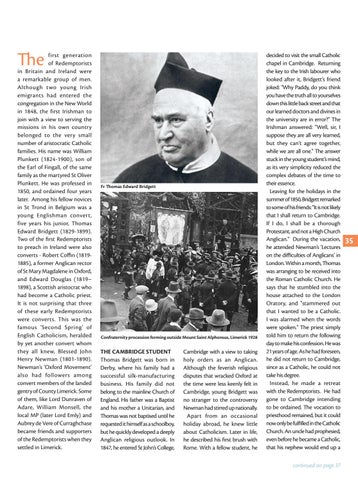
Fr Thomas Edward Bridgett
Confraternity procession forming outside Mount Saint Alphonsus, Limerick 1928
THE CAMBRIDGE STUDENT Thomas Bridgett was born in Derby, where his family had a successful silk-manufacturing business. His family did not belong to the mainline Church of England. His father was a Baptist and his mother a Unitarian, and Thomas was not baptised until he requested it himself as a schoolboy, but he quickly developed a deeply Anglican religious outlook. In 1847, he entered St John’s College,
Cambridge with a view to taking holy orders as an Anglican. Although the feverish religious disputes that wracked Oxford at the time were less keenly felt in Cambridge, young Bridgett was no stranger to the controversy Newman had stirred up nationally. Apart from an occasional holiday abroad, he knew little about Catholicism. Later in life, he described his first brush with Rome. With a fellow student, he
decided to visit the small Catholic chapel in Cambridge. Returning the key to the Irish labourer who looked after it, Bridgett’s friend joked: "Why Paddy, do you think you have the truth all to yourselves down this little back street and that our learned doctors and divines in the university are in error?" The Irishman answered: "Well, sir, I suppose they are all very learned, but they can’t agree together, while we are all one." The answer stuck in the young student’s mind, as its very simplicity reduced the complex debates of the time to their essence. Leaving for the holidays in the summer of 1850, Bridgett remarked to some of his friends: "It is not likely that I shall return to Cambridge. If I do, I shall be a thorough Protestant, and not a High Church Anglican." During the vacation, he attended Newman’s ‘Lectures on the difficulties of Anglicans’ in London. Within a month, Thomas was arranging to be received into the Roman Catholic Church. He says that he stumbled into the house attached to the London Oratory, and "stammered out that I wanted to be a Catholic. I was alarmed when the words were spoken." The priest simply told him to return the following day to make his confession. He was 21 years of age. As he had foreseen, he did not return to Cambridge, since as a Catholic, he could not take his degree. Instead, he made a retreat with the Redemptorists. He had gone to Cambridge intending to be ordained. The vocation to priesthood remained, but it could now only be fulfilled in the Catholic Church. An uncle had prophesied, even before he became a Catholic, that his nephew would end up a continued on page 37
35