UK EDITION
BEYOND THE ORDINARY
DRAGONS & CYBORGS Emilia Clarke: from Game Of Thrones to Terminator Genisys
PEP GUARDIOLA “It’s irrelevant if my way is best. But it is mine“
IBIZA Is it still the world party capital?
0515Cover-UK_Pep [P];14_View.indd 1
REDBULLETIN.COM
VIDEOS, PICTURES, STORIES
RULES OF SUCCESS
£2.50 MAY 2015
GET MORE
FOOTBALL GENIUS REVEALED PEP GUARDIOLA’S
23.03.15 14:18
jeep.co.uk
jeep.ie
Model shown Jeep Renegade 1.4 MultiAir II 140 hp Limited 4x2 Manual with optional two-tone alloy wheels and Trailhawk versions and the 7" TFT is standard on all Limited, Opening Edition & Trailhawk versions. OFFICIAL FUEL 32.1 (8.8) – 51.4 (5.5), COMBINED 40.9 (6.9) – 61.4 (4.6), CO2 EMISSIONS: 160 – 120 G/KM. Fuel consumption and representative of real-life driving conditions. Factors such as driving style, weather and road conditions may also
RBM0515_002_UK 2 Jeep_RedBulletin_May.indd PgAll Pages Prodigious UK
25.03.15 17:31
optio CONS CO2 fi have
s and FUEL n and also
BE RENEGADE
THE ALL-NEW JEEP RENEGADE.
Life’s a journey. So why follow anyone else’s path? The All-New Jeep Renegade with its unmistakable styling and road presence is an SUV unlike any other. In addition to its wide choice of fuel-efficient engines, you also get the kind of safety features that come from over 70 years of adventures. Not forgetting a host of cutting-edge technologies such as the 7" TFT driver display and class-leading 9-speed automatic transmission available on selected versions.^ And with prices starting at only £16,995 OTR. So wherever you’re going, go your own way.
optional bi-colour paint at £23,545 OTR. ^The 9-Speed automatic transmission is standard on selected Limited & CONSUMPTION FIGURES FOR JEEP RENEGADE RANGE MPG (L/100KM): EXTRA URBAN 48.7 (5.8) – 70.6 (4.0), URBAN CO2 figures are obtained for comparative purposes in accordance with EC directives/regulations and may not be have a significant effect on fuel consumption. Jeep is a registered trademark of FCA US LLC. ®
RBM0515_003_UK 3
25.03.15 17:32 20/03/2015 12:39
AMAGE R BEACH, DENMAR K
HELLY HANSEN CATWALK
Scandinavian Design is the cornerstone in all Helly Hansen gear. The optimal combination of purposeful design, protection and style. This is why professional sailors, mountain guides and discerning enthusiasts choose Helly Hansen. HE L LY H AN SEN . CO M
RBM0515_004_UK 4
25.03.15 17:32
RBM0515_005_UK 5
25.03.15 17:32
RBM0515_006_UK 6 DCUP_Delevingne_Disruptive_THF1_CAH1210BA0862_mag_404x276mm_FR.indd 1
25.03.15 17:34
RBM0515_007_UK 7
25.03.15 17:34 17.03.15 10:33
Daniel Ricciardo for Pepe Jeans London
RBM0515_008_UK 8
25.03.15 17:33
THE RED BULLETIN
32
THE HIGH LIFE
GETTY IMAGES (COVER), MUSTANGWANTED.COM, DAVID ROBINSON/RED BULL CONTENT POOL
ILOVEDUST (COVER)
Mustang Wanted: urbanclimbing cult hero and scourge of the police
WELCOME This issue is about excellence: people who have mastered their art, whether in a packed stadium or on an off-limits rooftop. We get inside the mind of our cover star, Pep Guardiola, to see what makes the Bayern Munich manager one of the most successful men in football. UK graffiti artist Pure Evil takes to the streets with spray can in hand and The Red Bulletin in tow. Ukrainian urban climber Mustang Wanted – no real names in his quasi-legal world – risks his life to scale skyscrapers across Europe without safety equipment. And there’s “Everything is loads more, including Formula One driver more fine-tuned Daniil Kvyat showing off his skills in a very and precise different type of car, and Game Of Thrones in Formula One” star Emilia Clarke on swapping dragons DANIIL KVYAT, PAGE 50 for robots. We hope you enjoy the issue. THE RED BULLETIN
RBM0515_009_UK 9
09
25.03.15 17:33
MAY 2015
AT A GLANCE GALLERY 16 This month’s most amazing images
BULLEVARD
56
23 RUN HARD Fast-track inspiration in the lead-up to the Wings For Life World Run on May 3
FEATURES 32 Mustang Wanted
CAPTURING IBIZA
No fear, no climbing gear: tall tales from the man who scales buildings
Divas, DJs, dancefloor ecstasy: Balearic nightlife through the lens of snapper Faris Villena
44 Pep Guardiola
44
Inside the mind of the world’s top football manager
50 Daniil Kvyat
The Formula One young gun revs up for a new driving experience
56 Ibiza in pictures
The hedonism of La Isla Blanca, captured on camera
LEARN THE ROPES
Abseiling not challenging enough? Tackle the dizzying drops of a Utah canyon for the ultimate adrenalin thrill
FOOTBALL’S MOST WANTED
Still just 44, Bayern boss Pep Guardiola is arguably the greatest manager in the modern game. We find out why
66 70 FIFTY SHADES OF SPRAY
He wears a Barbour jacket and his work fetches five-figure sums. Meet Pure Evil, not your typical graffiti artist 10
RBM0515_010_UK 10
DIVING AMBITION
Four-times world champion cliff diver Gary Hunt is an innovator in his sport, and now he’s set on total domination
Actress Emilia Clarke, grime star Ghetts, cliff diver Gary Hunt, trial biker Martyn Ashton and blues veteran Seasick Steve
70 Pure Evil
Spray it loud: the gallery-owning graffiti artist taking it to the streets
ACTION! 77 TRAVEL Rappelling in Utah 79 GEAR Next-level photography 80 WATCHES Classic looks, modern tech 81 WHEELS The Indian Scout is reborn 82 MUSIC Giorgio Moroder and PC Music 84 MOVIES Liam Neeson: action hero 86 HOW TO Wrestle an alligator 88 SAVE THE DATE Unmissable events 90 ACTIVE STYLE Essential kit 98 MAGIC MOMENT Cedric Dumont
FARIS VILLENA, GETTY IMAGES, ALEX DE MORA, ROMINA AMATO/RED BULL CONTENT POOL
62 Heroes
77
THE RED BULLETIN
25.03.15 17:33
r aIN suPreme
Bergh aus,
, LIVe FOr aDVeNTure a ND h YDrOsheLL are regIsTereD Tr aDem arks OF Bergh aus LImITeD.© Bergh aus 2015.
i n t r o D U Ci n g t h e h y D r o s h el l C o l l eC t io n. P o W e r e D B y o U r a W a r D-W i n n i n g W at e r P r o o F t eC h n o lo g y, i n s P i r e D B y 5 0 y e a r s o F r el e n t l es s i n n o vat io n.
B e r g h a u s.c O m / h Y D r O s h e L L * M e n’s
s i z e l a r g e, o t h e r s i z e s va r y.
RBM0515_011_UK 11
25.03.15 17:34
honda.ie Finance Example: On the Road Price €22,495 including delivery/related charges. Deposit €7,290. Finance Advance €15,205. 36 monthly payments of €218.91. Total cost of credit €1,796.25. Optional Final Payment €9,057††. APR 4.9%. Model shown for illustrative purposes. ††Guaranteed Minimum Future Value (GMFV) payable if you renew/retain vehicle at end of agreement. Further charges may be applied subject to km limits/vehicle condition.
11085_Civic_Red Bulletin.indd 1 RBM0515_012_UK 12
25.03.15 17:35
Award winning reliability. Award winning customer satisfaction. Arresting good looks.
And now from €219 per month* at 4.9% APR*.
PROUD SPONSORS OF
*Lending criteria, terms and conditions apply. Finance provided by hire purchase. Finance based on 4.9% fixed rate APR inclusive of once off documentation fee of €63.49. To qualify for this Finance Offer; a min deposit of 10% of the ‘On the Road Price’ and a max term of 37 months applies. Rate quoted correct as at 20th October 2014 and is subject to change. Offer available on all new Honda Civic models registered before 31st March 2015. Credit provider is Bank of Ireland Finance.
RBM0515_013_UK 13
13/02/2015 16:11 25.03.15 17:35
CONTRIBUTORS INSIDE THIS ISSUE
WHO’S ON BOARD
RÜDIGER STURM
Coach trip: Perarnau, left, spent a year with Guardiola
Pep talk for a whole season Barcelona-born writer Marti Perarnau knows the manager of Bayern Munich better than any other journalist. He spent the best part of a year following Pep Guardiola and the resulting book, Pep Confidential, is a deep and fascinating insight into the man and the manager. “The most important lesson I learned,” says Perarnau, of his time with the Catalonian, “is the importance of always giving 100 per cent, regardless of the importance of the task. To give yourself completely to your passion.” For more, see page 44.
IN FOCUS BEHIND THE LENS
The German writer spent time with Emilia Clarke, aka Daenerys Targaryen in Game Of Thrones and Sarah Connor in the new Terminator movie. How to tame dragons and Arnie: page 62.
THE RED BULLETIN
AROUND THE WORLD
DAUMANTAS LIEKIS
The Lithuanian wordsmith travelled to Kiev to track down urban climber Mustang Wanted. Unsurprisingly, he found him on a rooftop. Read his superb story on page 32.
The Red Bulletin is published in 11 countries. On the cover of the latest American edition is the annual summer travel guide on how to make your holidays work harder for you.
Watch for the lights: Daniil Kvyat’s new pit lane strategy
“ After the test drive, Daniil grinned for the first time” BERNHARD SPÖTTEL A fixture at German Touring Cars and Le Mans, the Bavarian photographer, above, is a motorsport fiend. For The Red Bulletin, he shot Infiniti Red Bull Racing’s Daniil Kvyat in the Renault Sport RS01 in Rome. Strap in and head for page 50.
14
RBM0515_014_UK 14
THE RED BULLETIN
25.03.15 17:35
#MAKES YOU PIONEEr
28 & 29 May, 2015
Hofburg ImperIal palace, VIenna
Join 2,500 inventors, hackers and troublemakers at Hofburg Imperial Palace, Vienna. Be among the first to take a look at the future. #Pioneers15
PF15_redbulletin-ad_EN.indd 1 RBM0515_015_UK 15
TICKETS
LIVESTREAM
pioneers.io/festival
redbulletin.com/pioneers
13.02.15 11:09 25.03.15 17:35
SAM GREENFIELD/DONGFENG RACE TEAM/VOLVO OCEAN RACE
PAC I FI C O C E AN
GOING OVERBOARD China’s Dongfeng Race Team battled the elements on the fourth leg – from Sanya to Auckland – of the Volvo Ocean Race. Seven crews will steer hightech yachts 71,000km around the globe, finishing up in Gothenberg in late June. Even a relatively simple task like checking the leech line, as Kevin Escoffier has just done here, is fraught with risk. Teammate Thomas Rouxel, the man pulling him back in, says, “With this challenge, a team that will stick together is a must.” volvooceanrace.com Photography: Sam Greenfield
16
RBM0515_016_UK 16
25.03.15 17:36
RBM0515_017_UK 17
25.03.15 17:36
SAM GREENFIELD/DONGFENG RACE TEAM/VOLVO OCEAN RACE
RBM0515_018_UK 18
25.03.15 17:36
LEO G AN G , AU STR IA
TUNNEL VISION What’s daunting for most is pretty straightforward for downhill racer Gee Atherton. “Racing is so simple,” says the Brit. “The fastest man always wins.” That’s not to say it’s easy; at the UCI Mountain Bike World Cup, riders are tested with huge jumps, root-riddled tracks and the occasional uphill tunnel – all tackled at blistering speeds. The series kicked off in Lourdes, France, on April 11 and will visit nine countries in total – including Fort William, Scotland, on June 7 – en route to the finish in Val di Sole, Italy, on August 23. Catch all the World Cup action live at redbull.com/bike Photography: Sven Martin
RBM0515_019_UK 19
19
25.03.15 17:36
RBM0515_020_UK 20
25.03.15 17:36
PREDRAG VUCKOVIC/RED BULL CONTENT POOL
B J E L A S N I C A , B O S N IA PREDRAG VUCKOVIC/RED BULL CONTENT POOL
ICE BREAKER American Brian Grubb took his wakeskate (think wakeboard without the bindings), an electric winch and a wetsuit to an icy creek and created a whole new kind of winter sport: snow-wakeskating. His journey along the winding gap, known locally as the Dragon’s Tail, was worthwhile, despite the biting cold. “It’s easier to connect a fluid line in the winter than summer,” says Grubb. “You can transition from water to snow and back again.” Watch the video at redbull.com Photography: Predrag Vuckovic
RBM0515_021_UK 21
21
25.03.15 17:36
Rise above your limits LIVETRACK
Connected AC C U M U L AT E D E L E VAT I O N
889m
VERTICAL SPEED
750m/h E L E VAT I O N
1873m
No matter what your ambitions or your limits, confidently rise above them with the new fe-nix® 3 GPS sports watch. Tough athletic style with its steel EXO™ antenna , innovative outdoor, trail-running and multi-sport training features, makes for a unique watch where cutting-edge performance meets premium design. Complete with smart watch capabilities that give the freedom to customize as your needs develop., fe-nix 3 is the ultimate watch for the demanding athlete and outdoor adventurer allowing you to train harder, and go further, with confidence. For more information visit garmin.com
fe-nix 3 ®
©2015 Garmin Ltd. or its subsidiaries.
RBM0515_022_UK 22
25.03.15 17:37
RUN HARD
Gearing up for the Wings For Life World Run on May 3
KILIAN JORNET
UPHILL GENIUS
MATT GEORGES
This astonishing athlete runs up and down mountains as if they were indoor athletics tracks Kilian Jornet’s motto is “onwards and upwards, as quickly as possible”. By the age of five, he had scaled Aneto, the highest peak in the Pyrenees and the third highest in Spain. At 27, the Catalonian has run up and down the Matterhorn in the Alps in less than three hours. Jornet has broken record after record with his Summits Of My Life project, tackling seven of the world’s most important mountains. He’s completed five, and this year’s target is the ascent-anddescent record for Russia’s Mount Elbrus. Which only leaves the big one: Everest. THE RED BULLETIN
RBM0515_023_UK 23
ROUTE CAUSE When Claire Wyckoff goes jogging, penises appear. True fact. Page 25
AROUND THE WORLD All you need to know about the global running event of 2015: Wings For Life World Run. Page 26
WE ARE MAN MACHINES Why you, homo sapiens, are king of the running beasts. Page 28
23
25.03.15 17:37
BULLEVARD
RUN HARD
Pump up your playlist It is claimed that by tailoring your music to your run, you can increase your speed by 10%. Here’s a playlist to match your running rhythm
Leading behind: Izabel Goulart and her athletic gluteus maximus
WA L K I N G
SPEED OF SOUND Coldplay
SHAPING UP NICELY
B PM
120
IZABEL GOULART
ONE MORE TIME Daft Punk
GETTING GOING
B PM
BEAT IT Michael Jackson
Squats, sit-ups, dumb bells, running, Pilates. According to her social media presence, Izabel Goulart’s life is 100 per cent workout. Her Instagram feed tells us that on flights, while we’re eating peanuts and watching movies, she’s exercising. Yet there’s one thing in the model’s life that needn’t be honed to perfection: she finds a slight paunch attractive on a man. That sound? It’s Goulart’s 1.7 million followers breathing out in relief.
WALK Foo Fighters
A C C E L E R AT I N G
BP M
160
SHAKE IT OFF Taylor Swift
G E T T I N G FAST E R
BP M
180
ROCK AND ROLL Led Zeppelin
“ I speak to anyone who approaches me with good intentions. But I don’t go out with just anyone”
SPEED Billy Idol
KISS OF LIFE
BP M
104
STAYIN’ ALIVE Bee Gees
A sprint through history WHY NATURE GOT MANKIND ON THE MOVE, AND HOW THE URGE TO RUN HAS EVOLVED DOWN THE YEARS
24
RBM0515_024_UK 24
3.5 BILLION YEARS AGO SINGLE-CELLED MICROORGANISMS – or Protozoa – learn that by moving towards their food source, their appetite is sated more quickly
3-4 MILLION YEARS AGO 1829 BC* EARLY HOMINIDS move from all fours to two feet. This helps them see further and improves their sense of balance
THE TAILTEANN GAMES give residents of preChristian Ireland a chance to test their speed, skills and strength
GETTY IMAGES(4), FOTOLIA, CLAIRE WYCKOFF(2), PARAMOUNT PICTURES, DISNEY, STUDIOCANAL, THE KOBAL COLLECTIONS
14 0
The Victoria’s Secret model is a fitness fanatic who posts the results of her exercise routines online
776 BC THE GREEKS run for the King of the Gods in the first ancient Olympics. Winners receive laurel wreaths
* Earliest date (one of many) suggested by historians.
25.03.15 17:38
SE 2
You’ve got to hand it to her: what happens when Claire Wyckoff goes for a run
SE 29th Ave
SE 26th Ave
SE 26th Ave
SE Stark St
Running commentary From Forrest Gump to Lord Of The Rings: important lessons from the most famous running scenes in cinema history
SE Morrison St SE Belmont St
SE Yamhill St
SE 30th Ave
SE Taylor St SE Salmon St
R U D E H E A LT HSE Madison St
COCK OF THE SIDEWALK
FORREST GUMP If you’re tired, sleep. If you’re hungry, eat. Otherwise, run.
SE Madison
GETTY IMAGES(4), FOTOLIA, CLAIRE WYCKOFF(2), PARAMOUNT PICTURES, DISNEY, STUDIOCANAL, THE KOBAL COLLECTIONS
SE Hawthorne Blvd
Using an app and a map, Claire Wyckoff turns the streets of San Francisco into a giant canvas. With added penis Do you draw because you run, or run because you draw? I like making people laugh. And I like not being fat. So I run. It was an anti-fat, pro-laughter impulse. What was the first shape you ran? The first drawing I made was of a corgi, the best dog in the world. My husband and I had been out running and I noticed that the satellite view of the route we took looked a bit like a dog, so I went back Claire Wyckoff: and improved it. also draws And what’s with Space Invaders all the penises? They are just so incredibly funny! And the people at Nike no doubt had other intentions when they developed the app [Nike+], so that makes the penises even funnier.
How long does it take you to produce a drawing? Appearances can be deceptive. I often have to go back on myself, meaning that a line that only looks around three miles long was actually a six-mile run. What kind of pre-run preparation do you do? I will normally sketch the shapes on a map first to see if they’ll turn out how I imagine. Then I’ll take the sketch out with me on my run and spend the whole time looking between the running app and the pattern I want to create. Do you always create art when you go out for run? No, not at all. The drawings take a lot more work than it might look. Have you ever had to take a ridiculous shortcut to get the shape you wanted? Well, one time, my run took me through a graveyard. It felt quite strange drawing a huge penis around all those graves.
THE LION KING You can’t always run away from problems. At some point you have to grow up.
THE GRADUATE The ability to sprint at will is useful when helping a bride jilt her groom.
THE LORD OF THE RINGS Always have a goal ahead of you. For example, saving the entire world.
runningdrawing.tumblr.com
490 BC
2,000 YEARS AGO
1600 S
1897
1936
PHEIDIPPIDES, a messenger, runs 42km to Athens from the battle in Marathon, announces victory, then dies
THE TARAHUMARA, a people indigenous to Mexico, become known for their long-distance running ability. Some are said to run up to 150km a day
NOBLEMEN in England keep fit for duels by going on endurance runs. How that helps their aim is unclear
FIFTEEN RUNNERS take part in the first-ever Boston Marathon, now the world’s longest-running annual marathon
JESSE OWENS, the US athlete, wins four golds at the Berlin Olympics and makes Hitler and the Nazis look pretty stupid
THE RED BULLETIN
RBM0515_025_UK 25
Turn over to keep on running…
25
25.03.15 17:38
BULLEVARD
RUN HARD
WINGS FOR LIFE WORLD RUN 2015
RUN AS FAR AS YOU CAN On May 3, thousands of runners across the world will all set off at the same time. They won’t only be competing against each other: they’ll be running for those who can’t run themselves. The Wings For Life World Run is the largest global charity event dedicated to spinal research. To take part, visit wingsforlifeworldrun.com. Enter ‘RBUK Bulletin’ in the club box to run with us Wings For Life World Run 2015 locations Other running events, from impressive to crazy THE LO N G EST
Kalmar
SELF-TRANSCENDENCE RACE, New York City. A punishing 5,000km in less than 51 days, round and round the same block.
Stavanger Aarhus Darmstadt
THE HA R D EST BARKLEY MARATHONS, Tennessee. Only 14 runners have ever finished this steep 160km race in the allotted 60-hour limit.
Niagara Falls Santa Clarita Sunrise
FOR T HE LAZ Y BEER FLOATING, Finland. Sit in a dinghy, surrounded by cans of your favourite brew, and float to victory on the river at Vantaa.
Breda
Poznan
Silverstone
Kolomna
Dublin
Bucharest
Ypres
Alanya
Rouen
Kakheti
Olten
Dubai
Porto
Gurgaon
Aranjuez
Bratislava
Munich
Ljubljana
St Polten
Zadar
Verona
T HE CLASSIC
DIETMAR KAINRATH
ATHENS MARATHON. Follow in the footsteps of the inventor of the marathon – but hopefully avoid his fate (see previous page).
Brasilia Cape Town Lima
ANTARCTIC ICE MARATHON. You’ll need: a degree of insanity, resistance to cold, extreme fitness and the €11,400 entry fee.
Santiago
FOR E VE RYONE
GETTY IMAGES(2), REUTERS
THE M O ST E X P E NS I VE
GREAT ETHIOPIAN RUN, Addis Ababa. In 2014, 36,000 runners finished Africa’s biggest road race – 10km at 2,400m above sea level.
1960
1962
1967
1972
2003
ABEBE BIKILA wins Olympic marathon in Rome, running barefoot. Defends his title four years later, in shoes.
BILL BOWERMAN lays the foundation for outdoor running with his book, Jogging.
KATHRINE SWITZER becomes the first woman to run the Boston Marathon, ignoring doctors’ warnings that her uterus could fall out.
THE TRIMM-DICHBEWEGUNG, a health initiative in Germany, sets out over 1,500 running paths (most long since disused).
ROBERT GARSIDE is the first man to officially run around the world, taking almost six years to cover nearly 60,000km.
26
RBM0515_026_UK 26
THE RED BULLETIN
25.03.15 17:39
On the wrong track
WFL WORLD RUN 2014
RECORDS Hard to beat: last year’s bests
HERE’S HOW IT WORKS: Participants set off at the same time at 35 locations around the world. The Catcher Car, which reels in runners from the rear, starts 30 minutes later. The last runner to be caught by the Catcher Car wins.
35 Top speed in kph of the Catcher Car breathing down the runners’ necks.
T HE M O ST B E AU TI F UL GREAT WALL MARATHON, China. One disadvantage to running on the snaking landmark: there’s not much room to overtake.
PYONGYANG MARATHON, North Korea. Open to locals only this year. Leader Kim Jong-un must be a strong bet for a winner’s medal.
Distance run in km by last year’s champion, Lemawork Ketema.
164
Takashima
92
DIETMAR KAINRATH
T HE B I G GEST RUN FOR THE PASIG RIVER, Manila, the Philippines. Officially the world’s largest race, with over 100,000 crossing the start line.
Age in years of last year’s oldest runner, Michael Selinger.
35,397
GETTY IMAGES(2), REUTERS
TAKE THE TRAIN Rosie Ruiz wins the 1980 Boston Marathon. Problem was, she completed part of it by subway.
FIND A SHORTCUT Jason ScotlandWilliams allegedly leaped the barriers at the 2014 London Marathon.
Nations represented in 32 countries on six continents.
Yilan
Number of runners in Wings For Life World Run 2014, all raising money for spinal cord research.
Melbourne
RBM0515_027_UK 27
START
78.57
FO R THE O B E D I ENT
THE RED BULLETIN
Not fair or sporting, of course, but some people will try any trick to steal a march in running races
2009
2014
USAIN BOLT breaks the 100m record at the World Athletics Championships in Berlin, with a time of 9.58 seconds.
THE WINGS FOR LIFE WORLD RUN is launched on May 4, with simultaneous races in 34 locations.
SPLIT IT WITH AN IDENTICAL TWIN No one’s tried it yet – or, at least, been caught. Could be foolproof.
1 FINISH
CAN TALK
The less I think, the quicker I can run
27
25.03.15 17:39
BULLEVARD
RUN HARD
KEEPING UP WITH THE HOMO SAPIENS
POWER TO THE PEOPLE Five remarkable features that make human beings mean running machines. We’d even give the king of the dinosaurs a good contest
DOWN BELOW
AT THE REAR
ON THE INSIDE
UP TOP
Two feet
Gluteal muscles
A kilo of TNT
Runner’s high
Nothing would work were it not for our behinds. The three muscles in this group – gluteus maximus, medius and minimus – are an evolutionary stroke of genius. They stabilise the centre of the body and allow us to stand up straight – and to run and run.
During a marathon, a runner produces and uses 75kg of adenosine triphosphate, a kind of internal biodiesel. The energy expended is the equivalent to that contained in a kilo of TNT.
Humans get natural benefits from running. If the body has to produce a peak performance beyond the pain barrier, it releases endogenous opioids, which are addictive.
Kangaroos jump, ostriches stride, and apes support themselves on their hands. But a Homo sapien is the only mammal that can walk elegantly on two feet the whole time. This function goes handin-hand with the development of a larger brain.
ON THE OUTSIDE
Sweat Any number of animals would beat us in a sprint. But in terms of stamina, we’re out there on our own. We have no fur, but three million sweat glands keep us cool over long distances. And which body part has the most sweat glands? The soles of the feet.
* Quick, as in ‘quick as Usain Bolt’ (top speed: 44.7kph). Or, at least, quicker than the people running behind you.
28
RBM0515_028_UK 28
HORSE The Man versus Horse Marathon in Wales pits jockeys against jocks. Beast has triumphed 33 times in 35 races since 1980.
MAN
OSTRICH
In 2006, Dean Karnazes ran 50 marathons in 50 US states on 50 consecutive days, finishing in New York (three hours, 30 minutes).
Its protein-rich flesh makes good fuel for our muscles, but, at 50kph, the world’s largest bird is more likely to make us eat its dust.
FOTOLIA(2), CORBIS
T.REX The toothy beggar had a top speed of about 40kph. Those quick legs of ours* would have kept us out of his jaws for a while.
THE RED BULLETIN
25.03.15 17:39
53Degrees_Columbia_Spring2015_Layout 1 3/20/15 2:00 PM Page 1
DISCOVER
SPRING 2015 STAY DRY
JUMPING IN THE RAIN ENJOY THE OUTDOORS COME RAIN OR SHINE, WHATEVER MOTHER NATURE THROWS AT YOU. Columbia has the right head-to-toe equipment to make sure you stay dry and protected at all times. MEN’S
LIGHTRAIL ZIPPER
WOMEN’S
MEN’S
CONSPIRACY OUTDRY III
CONSPIRACY III RRP: €80
RRP: €100
WOMEN’S
SLEEKER JACKET
RAINSTORMER JACKET
RRP: €100
RRP: €110
CONSPIRACY III RRP: €80
PEAKFREAK RRP: €100
See the full Columbia Spring/Summer range at 53 Degrees North Visit us in our Carrickmines, Blanchardstown and Cork stores or online at www.53degreesnorth.ie or www.53degreesnorth.co.uk
RBM0515_029_UK 29
25.03.15 17:40
BULLEVARD
No slip-ups
RUN HARD
Clip-on ice grips from Yaktrax keep your run free from mishaps.
Heart beats These Jabra Sport Pulse earbuds track your run, take your pulse and set the tempo.
Smart apps
Sweat shirt Perspiration spurs you on. When this ViewSPORT top gets wet, a logo appears.
PERFORMANCE-BOOSTING KIT
RUN WITH IT Second skin
Tech tools to get you going
Soft cell Designer Shamees Aden says her Ameoba trainers – sleek ‘shoes’ made from renewable protocells – will be on the market by 2050.
From heart-monitoring headphones to the running shoes of the future, these training accessories will keep you moving for years to come
The Hexoskin smart shirt keeps your body snug and records significant physiological data.
RUNTASTIC A fitness/GPS app that can turn a run into a narrative adventure.
Time check These silicon Pacebands remind you what your split times should be, helping you break your personal best.
ROCK MY RUN Playlists tailored specifically to your training programme.
Band for life The Runtastic Orbit records your run, calories burned, and monitors your sleep.
WALKJOGRUN You’re away from home, looking for a good route to run. Here’s the solution.
KAINRATH
FAKE MY RUN Tells the world about the killer 10k you didn’t run. Sadly, it’s only a spoof.
30
RBM0515_030_UK 30
DIETMAR KAINRATH
?
SAM BOND
The Wings For Life World Run winning formula
ZOMBIES, RUN! The undead are coming… but to win this game you must run for real.
THE RED BULLETIN
25.03.15 17:40
RBM0515_031_UK 31
25.03.15 17:41
2012 / MOSCOW
THE HIGH LIFE
RBM0515_032_UK 32
LOCATION
HEIGHT
ADDITIONAL NOTES
E U R A S I A T OW E R
24 0 M E T R ES
S N OW FA L L , C O L D A N D I CY W I N D
25.03.15 17:41
U k r a i n i a n c l i m b e r M u s t a n g Wa n t e d l i v e s l i f e o n t h e e d g e , scaling skyscrapers, bridges and churches without the aid of safety equipment. His stunts around the world have made him both a star and a target for the authorities Words: Daumantas Liekis 
RBM0515_033_UK 33
Photography: mustangwanted.com
33
25.03.15 17:41
LOCATION
HEIGHT
ADDITIONAL NOTES
M O S C OW S TAT E UNIVERSITY
240 M E T R ES
L E D T O T H E T H R E AT O F S E V E N Y E A R S I N JA I L
RBM0515_034_UK 34
25.03.15 17:41
2014 / MOSCOW
RBM0515_035_UK 35
35
25.03.15 17:41
2012 / MOSCOW
LOCATION
K U D R I N S K AYA S Q UA R E BUILDING
RBM0515_036_UK 36
HEIGHT
ADDITIONAL NOTES
156 M E T R ES
BALANCED ON THE F I V E- M E T R E GO L D S TA R ON TOP OF THE SPIRE
25.03.15 17:42
RBM0515_037_UK 37
37
25.03.15 17:42
2010 / KIEV 2011 / KIEV 38
LOCATION
HEIGHT
ADDITIONAL NOTES
PA R K O V Y B R I D G E AT TRUKHANIV ISLAND
50 METRES
OFTEN CAME CLIMBING HERE AS A CHILD
LOCATION
HEIGHT
ADDITIONAL NOTES
CENTRAL KIEV
110 M E T R E S
THE WOODEN BOARD WA S R O T T E N
RBM0515_038_UK 38
25.03.15 17:42
RBM0515_039_UK 39
39
25.03.15 17:42
S P E N T A F E W DAYS H I D I N G O N T H E R OO F BEFORE THIS STUNT
105 M E T R ES
D OW N T OW N K I E V
2013 / KIEV
ADDITIONAL NOTES
HEIGHT
LOCATION
40
ADDITIONAL NOTES
F I N A L LY, A R A R E , U N D I S T U R B E D S PAC E F O R A P H O T OG R A P H
HEIGHT
40 M E T R ES DOW N T OW N K I E V
The Red Bulle tin: Aren’t you scared of the police? mustang Wanted: The greater the chance of being caught, the better, because it’s more of a challenge. My favourite thing to do is to clamber up scaffolding on the front of a building, in full view of everyone. And just for the record, I never break in anywhere. I am very careful not to harm anyone. There’s a word for the latest sports craze of climbing over the roofs of houses: roofing. You must be the most famous roofer in the world. Hang on a minute, I’m not a roofer. What I do out there is more than roofing. Take what I did in St Petersburg a couple of years back at that building site with the huge crane. I went up there with a BASEjumper friend, wandered over the metal
LOCATION
ight has fallen in Kiev, hometown of the man who calls himself Mustang Wanted. The 28-year-old (real name Hryhoriy) stands with his hands stuffed deep into the pockets of his old jogging bottoms and a hood covering his face. Although his appearance doesn’t give it away, Mustang is a star. He has hundreds of thousands of followers on Facebook, Twitter and Instagram, and his YouTube videos get millions of views. There aren’t many cities in the world he can walk around as undisturbed as he is now: Mustang has been arrested by the police in every country he’s visited, for climbing skyscrapers, bridges, towers or churches without any safety precautions. It tries authorities’ patience, and he’s had run-ins with the police everywhere from Berlin to Bratislava. If he ever sets foot on Russian soil again, he’ll face seven years in prison.
2014 / KIEV
N
construction, did my tricks. Imagine a roofer doing any of that. Roofers don’t walk along metal rods just a couple of centimetres wide. It’s like slacklining, only harder. It’s very easy to counterbalance and control the movements a slackline makes. You can’t do that when you’re 200 metres in the air on the metal struts of a crane. The wind rattles the bar you’re standing on and it’s almost impossible to control the situation. When it got boring, we turned the crane on and started rotating it. What’s the tallest building you’ve climbed to date? The Princess Tower in Dubai. I was just hanging over the edge there, 414 metres up. But I didn’t do it for the sake of breaking a height record. It was about the experience. Experiences are worth more than records. It’s one of the most breathtaking images anywhere on the internet: you hanging there by your fingertips at that dizzying height. Professional climbers would have a safety harness, a rope and, at the very least, a helmet. I trust my hands more than I trust any kind of climbing equipment. And seeing as you’ve mentioned the internet, I don’t care how much attention I attract. People can do what they want. If they want to subscribe to my channel or like my stuff on social networks, they’re absolutely welcome to. I don’t care. The opinion of the public doesn’t make me any stronger or weaker. I’m just doing what I enjoy, which is climbing buildings and making cool videos. But it’s not always just about climbing, is it? You do chin-ups on the icy metal struts of a bridge a hundred metres up in the air in sub-zero temperatures. You skateboard just above sheer drops. Can you understand why that annoys the police? I’ve had trouble with the police everywhere: Kiev, Moscow, Bratislava, Berlin, Dubai, Budapest… but I honestly can’t understand why. What I do harms
RBM0515_040_UK 40
25.03.15 17:42
DAUMANTAS LIEKIS
RBM0515_041_UK 41
41
25.03.15 17:42
LOCATION
OUTSKIRTS O F M O S C OW
42
RBM0515_042_UK 42
HEIGHT
ADDITIONAL NOTES
140 M E T R ES
FREEZING. HANDS SO C O L D T H AT T H E Y F R OZ E T O T H E M E TA L
THE RED BULLETIN
25.03.15 17:42
2011 / MOSCOW
“I don’t have to do anything to combat f e a r, b e c a u s e I ’ m n o t a f r a i d . I ’ m r e l a x e d a n d f o c u s e d . T h a t ’s a l l t h a t m a t t e r s ” no one. And I mean no one. So why should I be locked up? You actually end up in jail remarkably rarely. How do you manage to avoid the police? I run away. It sounds obvious, but it works. Policemen don’t run as fast as me. The trickiest thing is if I’m climbing a bridge and the police are waiting up at the top in their car. If that happens, there’s no way for me to escape. So I have to outwit them. I have to run in the opposite direction from the one they’re facing. Then it’s them trapped, because they have to get to the other end of the bridge before they can turn around. And that gives me more than enough time. Do the police in every country react to your stunts in the same way? Europeans are polite, and so are the police there. Like on that really tall bridge in Budapest. It was a hot, sunny day and an exhausting, difficult climb, then suddenly a wasp stung me on the arm. I have no idea what it was doing all the way up there. I reached the top of the bridge, but my arm was giving me problems because of that bloody wasp. Someone had seen me from below and called the police, but when they arrested me, they offered me medical assistance first. I thought that was nice. Is it true that in Russia you have a prison sentence hanging over you? Yes, seven years. And the Russian police are the harshest. Last year, I climbed this building in Moscow and painted a Soviet star, 176 metres up, in the colours of Ukraine. I didn’t get caught, but four of my BASE-jumper friends who just happened to be there were arrested and have been languishing in prison ever since. What I do mocks the sense of existing laws. If I shot at people at random on the street, I’d get three years. But now I’m meant to go to prison for seven years because I climbed 176 metres up a building and painted a star? What a sick world.
How do the Ukrainian police react to your stunts? They like taking pictures of me. Have you had any unusual run-ins with the law? When I was coming down the Princess Tower in Dubai: I ran straight into the arms of two watchmen who were incredibly big and ugly. They said something or other in Arabic, and I didn’t understand a word. Then one of them grabbed me and, of course, I struggled to free myself. It could so easily have come to blows. But then I showed them videos and pictures of me clambering over other buildings, and they liked that. So by the time the police arrived, the whole situation had long since calmed down. They asked me how I’d got onto the roof. They thought I must have broken open locks or something like that. But it was just that someone had left a window on the top floor open. I showed them, then they let me go. Is there any kind of philosophy behind what you do? I’m interested in philosophy. I even studied it for a few years. But then I quit university because I wasn’t interested in titles and qualifications. You don’t need all that to be happy. I have my own philosophy of life. Don’t try to understand it. I’m convinced that if you enjoy doing something and don’t harm anyone doing it, it’s the right thing to do. No one will persuade you it’s a crime. But be clear about one thing: I don’t do this to be rich or famous, or to set new sporting records. I just do it because I enjoy it. What do you do to combat fear when you’re hanging by your fingertips hundreds of metres in the air? Nothing. I don’t have to do anything to combat fear, because I’m not afraid. I’m relaxed and focused. That’s all that matters. You need relaxation and focus for control. What do you do on a quiet evening in? I drink tea. Only tea. I never drink alcohol or take other drugs. And I watch videos. [Points to a laptop displaying a YouTube video of skateboarder James Kelly.] Look at the speeds he’s riding. What he does is amazing. Watch him closely. You’ll see that when he’s on his board, he’s completely relaxed, too. mustang-wanted.com
THE RED BULLETIN
RBM0515_043_UK 43
43
25.03.15 17:42
PEP GUARDI O IS THE BEST
FOOTBALL M A 44
RBM0515_044_UK 44
THE RED BULLETIN
25.03.15 17:43
GETTY IMAGES
SO SAYS MARTI PERARNAU, THE AUTHOR OF A BOOK CHARTING GUARDIOLA’S FIRST SEASON IN CHARGE OF BAYERN MUNICH. IT’S A BOLD CLAIM TO MAKE ABOUT A 44-YEAR-OLD WHO HAS BEEN IN MANAGEMENT FOR LESS THAN A DECADE, BUT DURING THAT TIME
ILOVEDUST
IN THE WORLD
I OLA T GETTY IMAGES
ILOVEDUST
M ANAGER HE HAS GUIDED HIS TEAMS TO ALMOST EVERY MAJOR TROPHY IN THE GAME. HAVING BECOME GOOD FRIENDS WITH THE CATALONIAN DURING HIS REIGN AT FC BARCELONA, PERARNAU IS WELL PLACED TO REVEAL THE FOUNDING PRINCIPLES OF GUARDIOLA’S SUCCESS THE RED BULLETIN
RBM0515_045_UK 45
45
25.03.15 17:43
KNOW GOOD IDEAS
WHEN YOU SEE THEM.
46
RBM0515_046_UK 46
GETTY IMAGES
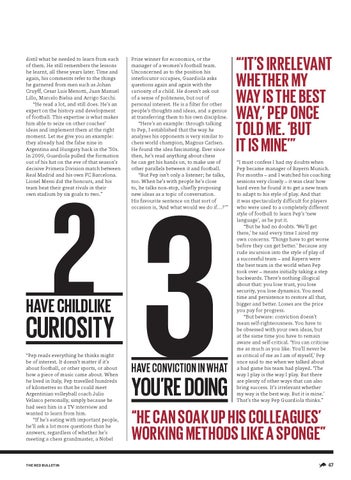
“First and foremost, let’s demystify Pep,” says Perarnau. “Everyone says that he has reinvented football. He hasn’t. His greatest talent might actually be something else: observing and listening closely. He can soak up his colleagues’ working methods like a sponge. He knows a good idea when he sees one, and he’ll steal it and make it part of a new whole. “I’ve often spoken about this with Pep and his friend, Ferran Adria, who is considered the best chef in the world and was the brains behind Spanish restaurant, elBulli. Adria makes a precise distinction: ‘Pep isn’t a creator, he’s an innovator.’ “In the early days of his managerial career, Pep chiefly devoted himself to two things: travelling and reading. He proceeded to what he called ‘initiation trips.’ On those trips, he would become engrossed in the work of other, very different managers. He would listen to them attentively for hours on end and
ILOVEDUST
THEN STEAL THEM
THE RED BULLETIN
25.03.15 17:43
distil what he needed to learn from each of them. He still remembers the lessons he learnt, all these years later. Time and again, his comments refer to the things he garnered from men such as Johan Cruyff, Cesar Luis Menotti, Juan Manuel Lillo, Marcelo Bielsa and Arrigo Sacchi. “He read a lot, and still does. He’s an expert on the history and development of football. This expertise is what makes him able to seize on other coaches’ ideas and implement them at the right moment. Let me give you an example: they already had the false nine in Argentina and Hungary back in the ’50s. In 2009, Guardiola pulled the formation out of his hat on the eve of that season’s decisive Primera Division match between Real Madrid and his own FC Barcelona. Lionel Messi did the honours, and his team beat their great rivals in their own stadium by six goals to two.”
Prize winner for economics, or the manager of a women’s football team. Unconcerned as to the position his interlocutor occupies, Guardiola asks questions again and again with the curiosity of a child. He doesn’t ask out of a sense of politeness, but out of personal interest. He is a filter for other people’s thoughts and ideas, and a genius at transferring them to his own discipline. “Here’s an example: through talking to Pep, I established that the way he analyses his opponents is very similar to chess world champion, Magnus Carlsen. He found the idea fascinating. Ever since then, he’s read anything about chess he can get his hands on, to make use of other parallels between it and football. “But Pep isn’t only a listener; he talks, too. When he’s with people he’s close to, he talks non-stop, chiefly proposing new ideas as a topic of conversation. His favourite sentence on that sort of occasion is, ‘And what would we do if…?’”
HAVE CHILDLIKE
GETTY IMAGES
ILOVEDUST
CURIOSITY “Pep reads everything he thinks might be of interest. It doesn’t matter if it’s about football, or other sports, or about how a piece of music came about. When he lived in Italy, Pep travelled hundreds of kilometres so that he could meet Argentinian volleyball coach Julio Velasco personally, simply because he had seen him in a TV interview and wanted to learn from him. “If he’s eating with important people, he’ll ask a lot more questions than he answers, regardless of whether he’s meeting a chess grandmaster, a Nobel
THE RED BULLETIN
RBM0515_047_UK 47
HAVE CONVICTION IN WHAT
YOU’RE DOING
“‘IT’S IRRELEVANT WHETHER MY WAY IS THE BEST WAY,’ PEP ONCE TOLD ME. ‘BUT IT IS MINE’” “I must confess I had my doubts when Pep became manager of Bayern Munich. For months – and I watched his coaching sessions very closely – it was clear how hard even he found it to get a new team to adapt to his style of play. And that it was spectacularly difficult for players who were used to a completely different style of football to learn Pep’s ‘new language’, as he put it. “But he had no doubts. ‘We’ll get there,’ he said every time I aired my own concerns. ‘Things have to get worse before they can get better.’ Because any rude incursion into the style of play of a successful team – and Bayern were the best team in the world when Pep took over – means initially taking a step backwards. There’s nothing illogical about that: you lose trust, you lose security, you lose dynamics. You need time and persistence to restore all that, bigger and better. Losses are the price you pay for progress. “But beware: conviction doesn’t mean self-righteousness. You have to be obsessed with your own ideas, but at the same time you have to remain aware and self-critical. ‘You can criticise me as much as you like. You’ll never be as critical of me as I am of myself,’ Pep once said to me when we talked about a bad game his team had played. ‘The way I play is the way I play. But there are plenty of other ways that can also bring success. It’s irrelevant whether my way is the best way. But it is mine.’ That’s the way Pep Guardiola thinks.”
“HE CAN SOAK UP HIS COLLEAGUES’ WORKING METHODS LIKE A SPONGE” 47
25.03.15 17:43
with Pep to understand that good communication takes passion. “Guardiola suffers during a game. He goes through hell. He visibly ages. He swears at referees. And all that energy comes across to his players. They know that he is ready to fight with them and for them, to support them and to bring out performances in them that they didn’t know they were capable of. “Guardiola’s management technique is like oil being poured onto a flame, the result being an ever-greater fire.”
BE PASSIONATE
IN THE WAY YOU COMMUNICATE
48
RBM0515_048_UK 48
TO LOVE “When Bayern Munich secured the Bundesliga title in March 2014, Ribery went up to his manager during the celebrations and said to him, ‘I love you! You’re in my heart.’ “In the first match of the 2014/15 season, Bayern had plenty of problems: important players were out through injury, and the players from the German national team, who had only just got back to Munich after their successful World Cup campaign, had hardly trained. It was a tough game, but Pep demanded the highest level of commitment from his players. Bayern won, and after the game Pep and Philipp Lahm hugged in a show of boundless joy. “Philipp, I love you!
QUESTION
EVERYTHING “Pep never stops asking questions – directed not only at others but at himself. His questions can get on people’s nerves. And sometimes he changes his mind overnight. Not because he doesn’t know what to do, but because he likes to get an overview of every aspect and eventuality that might occur during a game. “We learn from Pep that success comes about much more from doubts than it does from certainties.”
ILOVEDUST
Barcelona-born journalist Marti Perarnau’s book, Pep Confidential: The Inside Story Of Pep Guardiola’s First Season At Bayern Munich (Arenasport), is available now. birlinn.co.uk/PepConfidential.html
BE WILLING
GETTY IMAGES
“The core aim with any team is to turn the individual into the communal. And to that end, communication is the most important tool. It’s a hard tool to master, because if it’s misused, it can bring bad results from even the best of ideas. “It gets all the more difficult if you have to convey your ideas and convictions in a language that isn’t your mother tongue. There are six languages being spoken at Bayern training sessions: the stock language is German, which Pep has learnt, then there’s English; he also talks to players in either Catalan, Spanish, French or Italian. The conversations are visibly full of passion, and when oral communication isn’t enough, Pep resorts to gestures. He hugs his players, pats them on the back, kisses them, urges them on – and they respond in a similar fashion. You only need to see how Franck Ribery or Jerome Boateng celebrate scoring goals
Thank you for your great performance,” he said to his captain. “For Pep, this level of emotion is nothing to do with management culture or quality of leadership. It really is about love for his players, and he is by their sides through thick and thin. “When the young Danish midfielder Pierre-Emile Hojbjerg confided that his father had cancer, he and Pep cried together. The coach did everything he could to support the player and his father, who died a few months later. Hojbjerg once told me, ‘Pep is like a second father to me.’ “Later, Hojbjerg revolted. He wanted to be played more often and demanded a regular place in the team, but Pep didn’t grant him one. Hojbjerg was behaving like a rebellious 19-year-old son. He asked to be loaned to FC Augsburg. Pep behaved like a father who only wanted the best for his child; he let him go, but made him promise to come back.”
THE RED BULLETIN
25.03.15 17:43
“HE’S JUST A NORMAL GUY WHO DOESN’T MIND CRYING IN FRONT OF HIS PLAYERS”
NEVER FEEL
SATISFIED
GETTY IMAGES
ILOVEDUST
“At three o’clock one morning, Pep was sitting in a corner with his little daughter lying half asleep in his arms. Bayern had just recorded a big win over Borussia Dortmund in the German Cup Final. But Guardiola wasn’t satisfied. ‘We didn’t play as well as we could have,’ he said. “Pep normally allows himself five minutes to celebrate a victory. That’s five minutes, no more. After that, it’s all about a cool analysis of the game with the colleagues he’s closest to, and then he’ll prepare for the next match. “Guardiola is never satisfied. Doesn’t he like winning? Of course he does; he loves winning. But one demand he makes of himself is to find the perfect play. He knows it’ll never happen, but he’ll keep trying. The result is important, of course, but he’s more interested in how it came about. After all, sometimes a result can be deceptive. For Pep, it’s more important to analyse the dynamics of the game, because only then will it be possible to ensure future success.”
“HE HUGS HIS PLAYERS, KISSES THEM, URGES THEM ON – AND THEY RESPOND IN A SIMILAR FASHION” THE RED BULLETIN
RBM0515_049_UK 49
DRESS
APPROPRIATELY “Before training, Pep slips into a tracksuit that his assistants have laid out for him; if it’s cold weather, he pulls something over his head. Day-to-day, he’s not all that bothered about his get-up. But that changes when it comes to the magic of game day. Then he pays attention to his appearance and dresses appropriately. It isn’t about vanity; it’s about respect. “In Pep’s view, the game itself is the high point of the profession and one should dress for it as one would dress for a celebration. The way he dresses makes clear to his players just how highly he values the game. Today is game day, the day of ceremony. Today, we have to show off everything that we’ve worked hard for.”
BE
VULNERABLE “Pep hates losing, even though he knows that he has to be able to live with defeats. He’s not a hard man, and he doesn’t mind admitting it or showing it. If he’s worried about something, he scratches his head. If he’s satisfied with a training session, he shouts out loud, applauds, and kisses people. If he’s dissatisfied, he goes off and sits in a corner. He gives his emotions free rein. He’s convinced that you have to react in a sanguine manner when you lose, and remain level-headed when you win. “But he’s not some superhero, just a normal guy who doesn’t mind crying in front of his players when he is overcome with emotion, or guffawing like a big kid when Thomas Muller cracks one of his jokes.”
49
25.03.15 17:43
WHEN YOUR OFFICE IS A RACETRACK, OVERTIME IS WELCOME: RISING STAR OF FORMULA ONE DANIIL KVYAT TESTS A RACE CAR WITH A ROOF WORDS: WERNER JESSNER PHOTOGRAPHY: BERNHARD SPテ傍TEL
NEED FOR
50
RBM0515_050_UK 50
25.03.15 17:43
SPEED RBM0515_051_UK 51
25.03.15 17:43
W
You can get a sense of how tight it is inside. But what isn’t so apparent is just how hot a sports car like this can get, even if it’s cool outside
e’re at the Piero Taruffi racing circuit in Vallelunga, Italy, about 30km north of Rome. Formula One is on its offseason break, so for a few months the race-weekend rhythm has been interrupted. For the drivers, this provides a precious opportunity to recharge their batteries and work on important stuff that got overlooked during the season. And to have some fun. On his desk at home in Rome, Daniil Kvyat still has the invitation from Renault Sport. It was sent during his Toro Rosso days, suggesting he comes in during the final stage of adjustments to their new sports car and puts it through its paces. It’s hard to believe that for whizz-kid Kvyat, covered racing cars are virgin territory. The Russian driver, now 20, went straight from karting to various formula-racing series and made his Formula One debut last year at the age of 19. What’s more, he got on the scoreboard in his first race – ninth in the Australian Grand Prix – the youngest driver in history to do so. The spectacular and as-yet-not-fullytested 500hp piece of kit awaiting him in the pit lane at Vallelunga is the Renaultsport RS 01, a car designed solely for the track. The first race of Renault’s World Series takes place in late May, with a starting line-up that promises to be full to capacity. Appropriately enough, the RS 01 was unveiled in Kvyat’s homeland at the Moscow International Automobile Salon, though he assures us that this was just a coincidence. 52
RBM0515_052_UK 52
Getting into the cockpit of any racing car – let alone one with a roof – is a challenge for the new Red Bull driver, who has to bend his body and duck his head. “And yet I was extremely small as a child,” says Kvyat, who now stands at 5ft 11in (1.8m) – taller than your average Formula One star. “I was always one of the smallest when I was karting. It was only later on that I grew.” The engineers, delighted to have contact with a living, breathing Formula One driver, kneel at the gull-wing door. Kvyat looks around and tries to make
THE RED BULLETIN
25.03.15 17:44
GETTING INTO A COCKPIT – LET ALONE ONE WITH A ROOF – IS A CHALLENGE FOR 5FT 11IN KVYAT himself comfortable. “I guess I can leave the visor open in here, can’t I?” Nods all round. Fresh air is in short supply and drivers have to wear a cooling vest for races that take place in hot weather, so they don’t pass out in the cockpit. Kvyat is finally settled behind the wheel. “The visibility is actually better than I expected,” he says of the car with two pedals in the footwell, which allows him THE RED BULLETIN
RBM0515_053_UK 53
It’s squat, loud and, most noticeably, incredibly wide. The Renaultsport RS 01 has all the sports-car ingredients that true petrolheads love
to brake with his left or right foot. But for an F1 driver like Kvyat, braking with the left foot is a point of honour. When it comes to changing gear during a grand prix, he uses hand paddles behind the steering wheel – the right paddle to shift up, and the left to go down. The Renaultsport RS 01 has a similar set-up and an automatic clutch, which prevents the engine from stalling in case the car spins. Things like ABS or traction control sensitivity can be adjusted from the steering wheel. The Renaultsport RS 01 has been designed in such a way that ambitious drivers should to be able to cope just as well as the most seasoned professionals. But how will Kvyat acclimatise to driving
a different kind of race car? After all, his only ‘normal’ cars to date have been a small VW and a Renault Clio. You can tell by the fact the car is packed full of sensors recording Kvyat’s every movement that technicians are hoping for more than a few polite words and a crash-free lap. In addition to telling him to have some fun and rev the engine, they’ve asked him to solve a problem in his first run-out: the carbon brakes at the front have become slightly too hot during previous test drives. The temperature they’re aiming for is 900°C, yet the sensors have detected peaks of 1,000°C on the development driver’s runs. This may not affect the brakes’ performance, but it does shorten their shelf life, and 53
25.03.15 17:44
reduced wear and tear has been a specific development goal to keep costs down. Therefore, the tech team are experimenting with a variety of air ducts at the front of the car to better aerate the brakes and expel any hot air more quickly. It could work, but it might not. “Five laps, Daniil, and please don’t go too easy,” he’s told. “We want to see if the new air ducts make a difference.” Kvyat nods his head and flicks a switch to turn on the engine. Its exhaust consists of twin pipes as fat as a pair of legs, and sounds as refined as you’d expect. Then he’s off. It’s a good thing he knows the circuit. Kvyat’s in-lap is impressive enough, but then he reels off three laps with times comparable to the experienced test driver, who could drive this track with his eyes shut, before easing off slightly on the last lap to let the car cool down. From novice to old hand in five laps – it gives you a sense of the unearthly talent for motion that Formula One drivers possess.
THE HARD FACTS POWER: 550hp WEIGHT: under 1,100kg TRANSMISSION: seven gears BRAKES: carbon SUSPENSION: Öhlins, adjustable
The main giveaway that Kvyat is driving a prototype is the tape on the front of the car
HE REELS OFF THREE LAPS WITH TIMES CLOSE TO THE TEST DRIVER 54
RBM0515_054_UK 54
25.03.15 17:44
feedback, and I set traction control to the minimum after the in-lap. I had to be wary of snap oversteer on the fourth lap. The rear tyres had probably overheated a little. The roof didn’t bother me for a second. What does the data say?” That’s pretty good feedback from someone who’s just driven his first-ever laps in a covered sports car. Others might have left it at “Wow” or “Awesome”, but Kvyat, adrenalin rush notwithstanding, provides a painstaking breakdown of what went on in the car, plus analysis and confirmation of the data in equal measure. No period of acclimatisation,
“THIS CAR HAS MASSIVE POWER AND CONTACT PRESSURE”
When the doors open, revealing a glistening pair of eyes peeping out of the young driver’s helmet, his first words are unprintable. Suffice it to say, they include the F-word twice and “brilliant”. “The car is really powerful and has massive contact pressure thanks to the aerodynamic underbody and the rear wing,” reports Kvyat. “On slow corners I felt slight understeer, and on medium corners there was a bit of a tendency for the back of the car to get away from me. There never used to be that bump on the quick right-hand turn, so I had to adjust my trajectory slightly. The brakes are good – you can really plough into them. I lowered the ABS from four to three on the second lap to get more THE RED BULLETIN
RBM0515_055_UK 55
THE TECHNICAL SIDE The Renaultsport RS 01 runs on the brilliant 3.8-litre, twinturbo engine from the Skyline GT-R, made by affiliate Nissan. The power unit is good for hundreds of thousands of kilometres, and the solid base structure works well to keep maintenance costs down. The sevenspeed sequential gearbox is tried and
tested. The outer shell may look like carbon, but it is actually made of fibre-reinforced plastic, which is cheaper – deflectors and bonnets are seen as expendable due to the often rudimentary driving in one-make racing. No expense has been spared when it comes to safety: the driver sits in a carbon survival cell, and the additional steel cage even meets the requirements of the top-class Le Mans Prototypes, which can do more than 215mph.
no finding his way around the controls, just straightforward professionalism from the first instant. It must be the mould that Formula One drivers are cast from. The technicians are pleased as they tell him what to do for his next set of laps, which he signs off on with equal mastery. “Basically, the car isn’t hard to drive,” Kvyat sums up at the end of a long but enjoyable day. “I’d probably need another half day of testing to squeeze out those very last tenths. But even less experienced drivers will have a lot of fun in it.” Isn’t a car with a roof and only 500hp frightfully dull for someone used to Formula One, though? Kvyat disagrees vehemently. “Everything is, of course, more fine-tuned and precise in Formula One. We have more power, the gear changes are quicker and the centrifugal forces are greater. Having said that, today’s data showed a maximum of 2.3G. That’s a perfectly respectable figure.” And to prove just how seriously he meant what he said, Kvyat returned a few days after our test – incognito, with a couple of friends – to have some more fun with the Renaultsport RS 01, without all that test equipment around. “You’ve still got to practise a bit in the off-season, after all,” he says with a smile. infiniti-redbullracing.com. The RS 01 makes its race debut at Spa Francorchamps, Belgium, on May 30-31. worldseriesbyrenault.com
55
25.03.15 17:44
On deck “This is a DJ’s view of his adoring crowd. These revellers were at David Guetta’s F*** Me I’m Famous! party at Pacha.”
Capturing Al fresco ecstasy “The Destino Pacha Ibiza Resort is known for its lavish live shows. Here, 500 people party by the outdoor stage, beneath the night sky.”
56
RBM0515_056_UK 56
25.03.15 17:45
Ibiza Erratic, ecstatic, sexy and spontaneous: the nightlife of Ibiza is preserved for posterity by photographer Faris Villena. Here, he chooses his favourite shots WORDS: ANDREAS ROTTENSCHLAGER PHOTOGRAPHY: FARIS VILLENA
Heart attack “It’s 3am at Pacha’s Flower Power night. Ibiza celebrates its hippy roots here every Tuesday.”
RBM0515_057_UK 57
25.03.15 17:45
All that glitters… “These dancers [right and below right] were at DJ Guy Gerber’s Wisdom Of The Glove party at Pacha.”
Precious rocks “ Ivan Rodriguez [left] and Graham Thunder are resident DJs at Ibiza Rocks House at Pikes Hotel. The venue, close to San Antonio, is a 15th-century finca [farm estate]. The Rolling Stones have held private parties here.”
Touch bass “Paul ‘El Hornet’ Harding from British/Australian drum ’n’ bass collective, Pendulum, is an island regular. This photo was taken at the Dirty Dutch party at Pacha.”
58
RBM0515_058_UK 58
25.03.15 17:45
Floral tribute “As well as the DJs, entertainers [right], dancers and artists form an important part of the island’s nightlife. The dancer in the picture [above] is Laetitia Laeet at Flower Power. I’ve been taking photos of her for a year now.”
RBM0515_059_UK 59
25.03.15 17:45
Hell’s angel “Bikers in a club? That’s nothing new at Pacha. Kotrina [left], a dancer, is being chauffeured in on a Harley.”
Picture perfect “Three partygoers strike a pose in the photo booth at Rock Nights at Ibiza Rocks House. This is one of the best after-show parties on the island. Contact the venue via social media and you might get your name on the guest list.”
Party piece “This dancer was modelling a dress by Nu’Art, an Italian design and entertainment company, at an open-air event at Destino. Fashion plays a very important part in Ibiza’s nightlife, and Destino gives young designers a platform.”
RBM0515_060_UK 60
25.03.15 17:45
“Things only really get going at 7am” Say cheese “This was Steve Aoki’s DJ set at Pacha. He’s a full-blooded showman. He came up to me and said, ‘I’m gonna make the room go crazy now. You get a photo.’ I think it turned out pretty well.”
Dancing queens “A typical night at Underground, which is a mecca for electronic music. You always meet beautiful women here.”
t he r ed bulle t in: You’ve made your career documenting Ibiza’s biggest clubs and most exclusive parties. What’s so different about the nightlife on the island? f ar is v ille na: The incredible line-up of DJs. After Berlin, Ibiza is the most important place in the world when it comes to new dance music trends. But, unlike in Berlin, here you can go to the beach for a swim after the club. How long do Ibiza nights last, then? Until the following afternoon, usually. The best parties get going at 7am. Seriously? Seriously. Most package tourists are tucked up in bed at their hotels by then. So what’s left are the locals and people who are really interested in music. What’s your tip for connoisseurs? Go to Underground in San Rafael. There’s free entry, the drinks are cheap, and you get acts like The Martinez Brothers and DJ Sneak dropping in to perform spontaneous sets. Many of your pictures show people dancing with a complete lack of inhibition. How do you capture that? My aim is to capture the energy of the night. For that, you have to be part of the party yourself. So I just dance along until people forget my camera.
Bunker beats “Locals party through the winter at the Veto Social Club. On the decks are Erre de Ruido [left] and Joshel.”
Madrid-born Faris Villena, 33, has been photographing Ibiza nightlife for four years farisvillena.com
RBM0515_061_UK 61
61
25.03.15 17:45
HEROES
“I’M GOING TO BE VICTORIOUS” EMILIA CLARKE She tames dragons as Game
Of Thrones’ eye-catching queen, and now the lusty Londoner is taking on the Terminator
Words: Rüdiger Sturm
t he r ed bulle t in: You’re now in the fifth season of Game Of Thrones. Do you think you’ll win in the end? emili a c l ar ke: Of course! I’m always saying to my co-stars, “Relax. I’m the one who’ll end up on the throne.” As well as taming dragons as Daenerys, you’re playing Sarah Connor in Terminator Genisys. Do you consider yourself a badass? I’m a very long way from the characters I play. In day-to62
RBM0515_062_UK 62
day life I don’t get the chance to tame dragons or fight robots. I think that the hardest and most badass thing you can do as a woman is just accept who you are and be happy with it. So, you’ve never tamed dragons. Have you tamed any other animals? Cockroaches. Many moons ago, I lived in a house that had cockroaches, and funnily enough I befriended one of them. I named him Bob. What became of him? He’s no longer with us.
matter. I get really scared in those kind of situations. When you’ve got so much equipment around the set that could easily get destroyed by an idiot actor on a horse, it’s worrying. And, of course, in my first scene I was riding a horse, which made it even more intimidating. There was a huge amount of fear leading up to it, but it was the same as having nerves in the wings of a theatre before you go on stage. As soon as you set foot on set and then you’re on camera, it’s all about the character and everything else dissolves into the background. You do what you’re there to do.
“I ONCE LIVED IN A HOUSE THAT HAD COCKROACHES, AND FUNNILY ENOUGH I BEFRIENDED ONE OF THEM. I NAMED HIM BOB” Daenerys went from naive girl to accomplished ruler in the same way you’ve gone from roach-tamer to star. I like the parallel. Before Game Of Thrones, I was working in catering. That’s when I was living with Bob. Have you retained your catering skills? Could you whip up some lunch now? I could serve up some really good champagne and canapés.
for the part. I didn’t have much experience, but I had plenty of enthusiasm. And they took me. It was a bit of a whirlwind, really, like an amazing fairy tale. Was your first time on set a daunting experience? Learning the language of the Dothraki was difficult, for starters. And while I’m a huge fan of horse riding, doing it on camera is a totally different
Have you learnt what it takes to be a heroine? You have to be determined and unselfish in the pursuit of your goals. You can’t get wrapped up in your vanity. If you ruled for real, what would be your first decision for the common good? Hmmm. I’d probably halve the price of beer.
SOFIA SANCHEZ AND MAURO MONGI/TRUNK ARCHIVE
D
aenerys Targaryen, Emilia Clarke’s much-loved character in Game Of Thrones, was sold into marriage but then rose through the ranks to command a colossal army and become empress-to-be. Even in the turbulent universe of one of the world’s biggest, most talked-about TV drama series, this is a striking career trajectory. Now, the 28-yearold is on her own fast track to the top as she prepares to take on the role of Sarah Connor in Terminator Genisys.
What was the driving force behind your choice of career? I’m convinced that if you want something long enough and you focus on it and don’t give up, it’ll happen. Ever since the age of tiny, I’ve wanted to be an actress. I appeared in the musical Showboat when I was three, and it was like I’d been hypnotised. Not long after that, I saw Audrey Hepburn in My Fair Lady and became completely obsessed with her. I watched that film every day for two years. How did an unknown like yourself land a part in Game Of Thrones? I’d finished drama school the year before and I auditioned
hbo.com/game-of-thrones THE RED BULLETIN
25.03.15 17:46
When the HBO series Game Of Thrones began in April 2011, Emilia Clarke became a star overnight
RBM0515_063_UK 63
25.03.15 17:46
HEROES
“I PAINT PICTURES WITH WORDS” GHETTS The grime MC with a difference weaves emotional stories, loves electric guitars and doesn’t say no to make-up
Words : Ruth Morgan in grime, and I envied them. I started comparatively late, around 18. Then I started reading all sorts of books and it changed me. I learnt to paint pictures with words, and tell stories in rhymes. Did you expect success? I have [award-winning grime MC and actor] Kano to thank for it. He was on the radio every week, embarrassing other MCs with his talent. When I joined his crew, I knew I had to be up to par. I was unpolished, my breathing was all over the place and I had a lot to learn. But he heard
The Red Bulle tin: Your album’s titled Rebel With A Cause. Are you rebellious? ghetts: As a kid, yes, but I had no cause. My daughter’s birth, three years ago, gave me direction. I split the album in half: my rebellious youth, then finding my purpose. How did you get involved with the grime scene? I’m from Newham. There and Tower Hamlets is where grime was born. People I went to school with played a big part
something in me and took me on tour with him and Mike Skinner from The Streets when I was 19. It opened my eyes to new possibilities. Are your family musical? I was raised a Seventh-day Adventist, so there was a lot of gospel. Dad listened to jazz and Jamiroquai. I’m the black sheep of the family. At 14, I discovered garage, and then I got into US rap. Tupac was commercial, but he was saying stuff that Will Smith wasn’t.
64
RBM0515_064_UK 64
truest to come out of Britain. So let’s move it forward. If hip-hop had stopped aged five, it wouldn’t be what it is today. There’d be no Drake. Is innovation behind your spoken word track, too? That’s different. Definition Of A Rebel is me with subtitles. Sometimes I spit so fast, you can’t digest it. So I slowed it down. Spitting fast came from wanting to be the best technically. It made me the MC’s MC. But the average listener missed a lot. To be great, you have to know the power of simplicity, too. I want to be known as a great songwriter as well as a rapper. How did it feel to get three 2014 MOBO nominations?
“SOMETIMES I SPIT SO FAST, YOU CAN’T DIGEST IT. BUT, TO BE GREAT, YOU HAVE TO KNOW THE POWER OF SIMPLICITY TOO” can play several instruments; he’s a genius. Kadeem formed the band, the Rebels, which gave my music an extra edge. There’s an emotional contact with live instruments. You feel something when you hear a piano, whoever you are. Is it still grime? On Rebel, I brought in a rock sound that a lot of people wouldn’t class as grime. But my tone and delivery stems from grime. It’s the youngest genre in the world, one of the
Great, but performing live at the awards on prime-time TV meant the most. I’ve watched them for years, and my mum always calls, saying, “How comes you’re not nominated, son?” So she was overjoyed. It was amazing. I enjoyed getting styled – even the make-up.
COURTNEY FRANCIS
W
hen The Red Bulletin meets up with Ghetts, aka 30-yearold Justin Clarke, he hasn’t slept. He’s been in an Ealing studio all night, putting the finishing touches to recordings of his live shows. He’s now in a near-empty pub in London’s Docklands, an area he visits to skateboard uninterrupted and clear his head. But even in this remote venue at 11am on a Wednesday, he gets recognised. A student-type comes over to thank him for a “sick gig”, and Ghetts smiles his first smile of the day.
Why are you known as Ghetto, Ghetts and J Clarke? They’re all parts of me. Ghetto has an attitude, arrogance. He was me when I was young, a reflection of my surroundings then. I was insecure and acted up. My friends began to call me Ghetts, so soon I took on that name, not realising how much I was changing musically. I toured, saw the world, met new people and it relaxed me. I was laughing more, I let my guard down. Finally, J Clarke is the person I am in front of my nan and my daughter. He’s my calmer, emotional side. What made you decide to put a live band together? The guy on keys at my shows is my brother, Kadeem. He
Out now: the soundtrack to Ghetts’ documentary, Cause Of The Rebel, War Of The Minds. disruptltd.com THE RED BULLETIN
25.03.15 17:46
Ghetts was named Hardest Working Artist at the AIM Independent Music Awards last year
RBM0515_065_UK 65
25.03.15 17:46
Away from diving, Hunt’s hobbies include cooking, juggling, playing the piano, “and most recently I’ve taken up carving. I make fruit bowls out of wood”
RBM0515_066_UK 66
25.03.15 17:46
HEROES
“I’M MORE CONFIDENT WHEN I’M IN SPEEDOS” GARY HUNT Defending his title isn’t enough
for the four-times world champion cliff-diver: he wants to win every event this season
Words: Ruth Morgan
G BALASZ GARDI/RED BULL CONTENT POOL
ary Hunt grew up in Southampton, but these days the champion diver travels the globe from the Paris suburb he calls home. Having taken first prize in the Red Bull Cliff Diving World Series for an incredible fourth time last year, 30-year-old Hunt heads into the new season more determined than ever. t he r ed bulle t in: You’ve had huge success in this competition over previous years. Does this add to the pressure this time around? gar y hunt : The success is only just sinking in, to be honest. I’d been in the sport for four years when I became champion for the first time [in 2010], and at that stage it still felt strange being among all these divers I used to watch on TV, let alone going on to win the thing. It’s taken years for that to feel normal. The competition gets tougher each time as everyone ups their game, but I’ve stepped up my training and I’m in a good place right now. The bigger the challenge, the more pride I feel in winning. THE RED BULLETIN
RBM0515_067_UK 67
What makes you better than your fellow competitors? I think it’s down to the way I train and the kind of person I am. I’m one of those people who, at the end of a practice session, will use any spare moment to play around and try out interesting dives. Some divers might have a problem with a certain dive and choose to avoid it, sticking instead to the elements they’re strongest at. But I’ll work hard on those weaker elements to make them my strengths. I push myself to perform every type of dive there is.
back off the platform and shake them out. After that first dive, I was fine. You’ve got a reputation as an innovator, having not just performed the only dive with a running start, but also the most complex, with the highest difficulty level of 6.2. What’s next? There’s always room to improve. You only need to look at what the 10m divers are doing; theirs is an older sport than ours in competitive terms, but they’re still innovating. We have almost three times the amount of space to play with, so there’s always more to fit in. As for this year, I’m focusing on
disappears because you know you can’t stop it. That’s a great feeling. Your body is totally in control; it’s like switching on cruise control and letting muscle memory take over for those three seconds. Then, once you’re in the water, there’s the huge relief and happiness that you did it. The real rush comes when it’s over. You spend most of your professional life in Speedos. Do you get self-conscious? When I’m diving off a cliff, I feel completely normal in Speedos. But there are a couple of competitions where we dive, go to the beach and walk through a town centre to get back up to the
“THE SECOND MY FEET LEAVE THE PLATFORM, ALL FEAR DISAPPEARS… IT’S LIKE SWITCHING ON CRUISE CONTROL” Do you still get scared when you return to cliff diving after the off-season break? A cliff dive is anything between 26-28m high, and our sport is unique in that we have nowhere to train at that height when we’re not competing. Which makes the first event of the season more scary. I remember being really nervous during my first dive of the season two years ago. I couldn’t stop my legs from visibly shaking. I had to step
bringing more consistency to my diving. My goal is to win every event this season. That’s never been done before, so why not go for it? What is it about cliff diving that makes the risk worthwhile for you? It’s the feeling of having conquered it. You feel stress and pressure when you’re on the platform as it’s a dangerous thing to get wrong. But the second my feet leave the platform, all fear
platform, and that can feel a bit strange. Then again, I once walked along a diving platform fully clothed to have a look down and I was terrified. You feel the wind more with your clothes on, and you know you’re not ready to dive, so it’s scarier. I’m always more confident when I’m in my Speedos. Follow the 2015 Red Bull Cliff Diving World Series at redbullcliffdiving.com
67
25.03.15 17:46
Ashton rides a specially adapted 650cc bike equipped with rods that keep it upright when starting and braking
RBM0515_068_UK 68
25.03.15 17:46
HEROES
“I KNEW I HAD TO RIDE AGAIN”
“NO ONE UNDER 50 SHOULD BE A STAR”
MARTYN ASHTON When life dealt the British
SEASICK STEVE The American bluesman got
trial biker the harshest of blows, he faced up to his toughest challenge yet: bouncing back
M
ROBIN KITCHIN, GETTY IMAGES
artyn Ashton has ridden bikes where most people have never taken them before: down water-park flumes, along aeroplane wings and over the beams of bridges. A pioneer in the world of trials riding, Ashton, 40, made a name for himself from tackling the most unlikely of structures. Then, in 2013, while performing at a bike show at Silverstone, he suffered a life-changing fall that left him paralysed from the waist down. t he r ed bulle t in: How did you deal with your change in circumstances? mar t yn a sht on : You have to just get on with it and not waste time dwelling on the negatives. Some days are tough, but isn’t that the same for everyone? I began to reclaim my life and challenge myself, and that grew into #TrybeforeJuly, where I’d go out and do something new. What’s been the most memorable challenge? Canoeing. It was a disaster. I couldn’t do it; they’d push me off from the side and I’d tumble over and nearly drown. My family were there, and every time I came up for air, they’d just belly laugh at how ridiculous it was. I gave it about six goes, then the guy wouldn’t let me try any more. Do you have anything lined up for this year? I’ve had a look at sit-ski waterskiing. I don’t expect to be any good, but that’s part THE RED BULLETIN
RBM0515_069_UK 69
of the fun. I’m looking for things that will be more of a disaster than a success! It’s about creating moments, and the most valuable are the ones that make you laugh. Which one activity should everyone try? Riding a motorcycle. It’s the greatest invention on Earth. I knew that when I got out of hospital I had to work out how to ride one again. And you succeeded? Getting back on the Triumph was one of the best days of my life. I hadn’t expected another life highlight after my injury, but it was great. You have to tell yourself your best days are ahead. And you're doing the Wings For Life World Run again. Yeah, I can’t wait. It’s a wicked event. The car chasing people down feels like such a celebration – whenever people are caught, they’re like, “Oh, finally! Where have you been? I’ve been running for ages.” Do you have a goal? Only to go as fast as I can, although the course is quite hilly. My nan and her walking aid travel faster uphill than I do, so I reckon I’m going to be caught a lot sooner than I’d like!
his big career break 11 years ago, aged 62. Before that, he was a bona-fide hobo
t he r ed bulle t in: You’ve sold a million records since the release of your debut album in 2004, but your new, seventh album, Sonic Soul Surfer, was recorded at home and not in a high-tech studio. Aren’t you overdoing the modesty a bit? seasic k st eve: That’s not why I did it at all. Nothing sounds better than my old reel-to-reel tape decks. You can forget your studio. Things were produced much better in the past. Take automobiles: ’50s cars still work today. Do you think we’ll be seeing cars from 1995 in 30 years’ time? They’ll already be rust. When you look back at what you’ve achieved in such a short space of time, do you wish you’d started earlier? Do you know something? No one under 50 should be a rock star. Music managers will tell you what you’ve got to do and promise you the Earth. When I was 20, I would have believed them and turned into a jerk. No, you’re better off waiting until you’ve got greater perspective and more life experience. seasicksteve.com
Jack White and Dave Grohl are both fans of Seasick Steve
The starting pistol for the 2015 Wings For Life World Run will be fired simultaneously in 35 locations in 33 countries around the world on May 3, 2015. Who will hold the Catcher Car at bay the longest? Type ‘RBUK Bulletin’ in the club box when you enter at wingsforlifeworldrun.com
69
25.03.15 17:46
Charley UzzellEdwards takes a walk through his living canvas. Opposite: the tools of Pure Evil
RBM0515_070_UK 70
25.03.15 17:47
FIFTY SHADES OF SPRAY Pure Evil is a blue-blooded, opera-loving, Barbour jacket-wearing gallery owner. He’s also one of the UK’s most prolific and sought-after street artists. The Red Bulletin follows him down a dark alleyway near his east London HQ... Words: Josh Jones Photography: Alex de Mora
THE RED BULLETIN
RBM0515_071_UK 71
71
25.03.15 17:47
From top: When the Keith Haring jacket he’d bought online proved to be fake, Pure Evil turned it into art; Keith Haring’s Nightmare; the man and his gallery
ure Evil is not your archetypal graffiti artist. He listens to opera, he can trace his lineage back to Sir Thomas More and he even does interviews. In the shadowy world of street art, whose figurehead is the famously anonymous Banksy, such openness is unusual. But, as becomes clear, the man behind the Pure Evil moniker – Charley Uzzell-Edwards – has no interest in following the pack. He’s at his gallery in London’s Shoreditch to talk about 365streetart, a challenge he set himself to paint or leave a new piece of art on the street each day for a year. It’s day number, er, 382. Unwittingly, he’s overrun. “I think I’ll just keep on going into the second year: 365streetart2,” he says with a grin. “Street art is fun because it’s more vague than graffiti. Knitting, seed bombs, Sellotape shapes, impromptu sculpture… they all count. Being creative with dead animals can also be street art.” He’s only kidding about that last one. Possibly. The past year has seen him take 365streetart around the world, though this hasn’t been without its problems. 72
RBM0515_072_UK 72
25.03.15 17:47
Eddie Fisher’s Nightmare, part of Pure Evil’s Andy Warhol-inspired Nightmare series showing weeping celebrity icons
“When I was in Hong Kong, I spent half my trip trying to find spray cans that didn’t seem like they were half-filled with wee,” he says. “I finally got in touch with a man who knew someone who knew someone, and they met me on a rooftop and gave me some delicious, thick paint. On my first day in Chile, I had to improvise with boot polish.” Uzzell-Edwards’ art may appear in unexpected places worldwide, but east London is home. Ten years ago, the art appearing on the walls of pre-gentrified Hackney began being documented on the internet, pre-Tumblr and Instagram, then leaked into mainstream media. Spearheaded by painters such as UzzellEdwards, Banksy, Ben Eine (whose profile was raised when David Cameron THE RED BULLETIN
RBM0515_073_UK 73
“I like street art because it’s a dictatorship. There’s no focus group, just a wall, some paint and maybe a vague idea swimming around” gave Barack Obama one of his works as a gift) and pioneering print house Pictures On Walls, the community was tight and suspicious of outsiders. Shoreditch was a no-go area, its HQ the Dragon Bar, a Wild West saloon-of-a-place dripping in original artwork, where street artists would scheme in dark corners. Pictures On Walls’ anarchic pop-up gallery/shop Santa’s Ghetto brought this subversive world to mainstream attention. Squatting in disused shops in Soho each December, it opened a window 73
25.03.15 17:47
Other work on show at the Pure Evil Gallery includes Spray Hand by Abalon Living Art from Barcelona
Pure Evil at work. Above: 100% of sales of I Can’t Breathe 2 will go to the family of Eric Garner, who died under NYPD restraint
into this guarded community: people could view and buy original and affordable pieces. It gave artists a new kind of exposure, just as street art was becoming ultra-desirable. It was at Santa’s Ghetto in 2005 that Uzzell-Edwards, back in London after 10 years in San Francisco, first broke into the burgeoning UK scene. As well as selling one of his canvases at the show, 74
he was commissioned to stencil graffiti on the set of an MTV video. “That night, I just went out on the streets, started creating and didn’t stop,” he says, his eyes lighting up. “It was such a buzz. Seeing pieces by the likes of Pablo Fiasco, Faile, Bast and Banksy around this area, it felt like you were in a time and place that was really significant, like Haight-Ashbury in the ’60s.”
RBM0515_074_UK 74
25.03.15 17:48
zzell-Edwards is getting into Pure Evil mode, preparing to create his latest piece of 365streetart: a stencil of Marlene Dietrich with a Dali moustache. The reality of making street art doesn’t conform to stereotype any more than the man. For one thing, he wears a Barbour jacket. And he’s not sneaking about in the early hours: it’s 1pm on a grey Wednesday. He walks to an alley covered in stickers, stencils, freestyles and, bizarrely, a life-sized cardboard snowboard complete with bindings. He’s had his eye on this spot for some time.
“When I was in Hong Kong, I spent half my trip trying to find spray cans that didn’t seem like they were half-filled with wee” He calmly takes the waist-high stencil out of its cardboard cover, leans it on a metal door and fills it in with black spray paint. In a couple of minutes he’s done. He touches up his signature and moves away; the people murmuring on the other side of the door didn’t notice a thing. Chances are they won’t complain about Dietrich: they’re more likely to get her valued. Ever the pro, Pure Evil doesn’t hang about to find out. “When I started, street art wasn’t the national pastime it is now,” shouts UzzellEdwards, 46, over the din of black-cab traffic and the lunching design types that fill present-day Shoreditch. “You’d have to go home, change your jacket, wash your hands, then come out and take a photo. Now, you just leave it there for 10 minutes and someone’s already photographed and uploaded it. “I like street art because it’s a dictatorship. There’s no focus group meeting, just a wall, some paint and maybe a vague idea swimming around in adrenalin. Every act of graffiti is political art, whether it’s an anti-war slogan painted under a bridge at night or a cartoon of a fuzzy character. It’s not meant to be there. That’s political.” Uzzell-Edwards’ life took a dramatic turn in 2008, when he was refused reentry to the USA. With no way back to San Francisco, he found himself living in his parents’ garden shed in Wales. (His father John, who died in March last year, was an award-winning painter.) His work became darker; Sgt Pepper’s
RBM0515_075_UK 75
Lonely Hearts Bastards, an homage to the famous Beatles album cover artwork, was populated by some of the worst despots in history, including Pol Pot, Stalin and Hitler. He set the price at £666 and sold enough to kick-start his career in London. “When you return from San Francisco with £200 in your pocket, £666 for a print is serious money,” he says. “It just kind of snowballed from there.” This is a modest description of his achievements. The Saatchi Gallery has exhibited his work, which sells to the rich and famous for five-figure sums, and his own gallery is buzzing. But even with this commercial success, Uzzell-Edwards remains a street artist; cut him and he’d bleed spray paint. He recalls the story of being chased down an alley one night by an undercover policewoman in heels and a miniskirt on a drugs bust. She told him to go home, but not before causing him to snap the pole he’d attached to his spray can so that he could paint up high. “I didn’t go out again that night,” he laughs, “but those kind of situations illustrate why you get hooked.” Stepping above ground hasn’t made him any less a part of the street-art world, either. For starters, he’s one of the few people who would recognise Banksy. “I was out with my friend Nylon years ago and there was a guy sitting on a bench,” he says. “I just wanted to get on with spraying, but Nylon went to chat with this guy. When we left, he was like, ‘That was Banksy.’ I ran back, took off the Pure Evil T-shirt I was wearing, gave it to him and said, ‘You’re f--king awesome.’ It was nice to be able to give some respect.” The street-art revolution that gave Pure Evil a leg up from the alley to the gallery has changed the wider world, too. “There’s the phenomenon of Banksy’s children now,” he says. “He has spawned all these people who want to be as famous as him. Being a street artist has become a viable career path. Most people in the past didn’t give a toss about how many people liked what they were doing; they were just doing it because the voices in their head told them to.” On the surface, Pure Evil seems like a mass of contradictions, blending spray paint and Barbour jackets, graffiti and galleries. But beneath all that, for him, it’s simple. The value of street art has always been in scratching the itch of nonconformity. “It’s about the urge to go out to paint and be a vandal,” he says. “If you’re just doing it for the fame, you’re missing the whole point. Which is to create and paint because you need to.” pureevilgallery.virb.com
75
25.03.15 17:48
/redbulletin
Visual Storytelling Beyond the ordinary
JULY 2014 R30
BEYOND THE ORDINARY
7
ADRENALIN PLAYGROUNDS
MAKING CH ANGE PAY
THE CAPTAIN OF ADVENTURE
TO BLOW YOUR MIND
So u th Afri ca’s b ri g htest so c ial e ntre p re n e u rs
ALL-ROUND ACTION HERO WILL GADD IS A LIVING LEGEND IN THE TRUEST SENSE.
LINKIN PARK On th e i r n ew album and Tw itte r ma d n ess NEYMAR JUNIOR, Brazilian Football Star
NEYMAR!
UK EDITION
BEYOND THE ORDINARY
19 WORLD
AWESOME
SHOT!
Action photo special
CA N TH E B OY GE NIUS WIN TH E WO R L D CUP FO R B R A Z IL?
CLASS WATCHES
UNDEAD FUNNY
QUEEN OF THE BEACH
2014’s most hilarious movie
Dave Grohl
PEAK FREEFALL
Adventure’s toughest task
EXCLUSIVE: the legend reaches into your mind and music’s future
|
WEB
|
APP
|
SOCIAL
redbulletin.com RBM0515_076_UK 76
25.03.15 17:49
See it. Get it. Do it.
AC T I O N ! 78
TRAVEL 79
GEAR 81
WHEELS 82
CULTURE 86
HOW TO 88
EVENTS
TRAVEL
LEARN THE ROPES
Adrenalin thrills in the desert
Seen one desert, seen them all? Not even close. In Utah, USA, thrill seekers explore adrenalinheavy opportunities in otherworldly landscapes for months without their pulses slowing. But, if your heart can handle it, the best way to experience the highs of the desert is to walk off one of its many vertiginous cliffs backwards, into the void below.
RBM0515_077_UK 77
77
25.03.15 17:49
ACTION Rappelling – sliding down a fixed rope using a braking device to control your descent – could have been invented for Utah’s colossal sandstone fins, improbably balanced boulders and soaring spires. The 73,000-acre Arches National Park contains endless challenges and dizzying drops, plus thousands of stone arches that give the park its name. “Take a course of instruction before you dangle your body off of any high feature on the planet’s surface,” says Todd Goss, who is the brains behind Paragon Adventures, a company that organises guided outdoor activities in Utah. And anyone wanting to tackle them armed only with a rope requires a clear head and nerves of steel. “Walking backwards off a cliff goes against most people’s concept of self-preservation,” says Goss. “So, unsurprisingly, there’s a big adrenalin response. The biggest issue for people starting out is trying to manage that.” Instructors can help prepare firsttimers for the feeling of taking their lives into their own hands. “My heart was racing as I went over the edge,” says Katie Sanders, 24, a legal secretary from Santa Monica, USA. “You can’t shake the knowledge that the only thing stopping you plummeting more that 100 metres to the canyon floor is the piece of rope. But then the adrenalin surge subsided into this amazing feeling of freedom and control over my actions. I could then really be part of the descent and appreciate the incredible surroundings.” Anyone that musters the will to hang off natural structures often hundreds
TRAVEL UTAH
More to explore Dive After a five-day course, you’ll be BASE-jumping off the Perrine Bridge in Twin Falls, Idaho. Receive training from one of the pioneers of the sport and launch yourself from a jump point 150 metres above the Snake River. utahextremesports.com
Drift After a tough day of rappelling in Utah, take to the skies over Arizona in a hot air balloon for another view. Experience the area’s magical monoliths, mesas, and awe-inspiring spires from 1,500m as you fly over the sprawl of sandstone. monumentvalley ballooncompany.com
Advice from the inside
“Before you go rappelling, make sure you learn how the system operates and how to stay alive if something goes awry,” says Todd Goss.
Salt Lake City Do you dare to make the drop? Visit: paragon adventure.com
78
RBM0515_078_UK 78
of metres tall is repaid with unbeatable views. Hanging from a rock face with nothing more than fresh air between your feet and the sun-scorched ground below offers a completely new way to appreciate landscapes that in photos often defy belief. “When you’ve got the amazing beauty of the red desert, slot canyons, sweeping vistas, and massive cliffs,” says Goss, “the technique of rappelling gives you a whole new perspective. And a great thrill, too.”
Explore secluded canyons, hidden arches, prehistoric dinosaur tracks and breathtaking views of the Colorado River from the inside of a Hummer. The rugged Arizona landscape tests the all-terrain vehicle to the limit. highpointhummer.com
KLEIN/RED BULL CONTENT POOL, CORBIS, KEITH JEFFERS
Drive Utah, USA
THE RED BULLETIN
25.03.15 17:50
GEAR
ACTION
SNAP HAPPY
Four-propeller drones can be hard to control, but inbuilt GPS helps stabilise the Phantom. The attached camera’s three-axis gimbal mechanism fends off the elements to get a straight shot.
Shoot and share your photos anywhere with the latest camera technology in the coolest designs
Hasselblad Stellar II
CARTER DOW, JONATHAN BEER
Luxury styling meets modern tech as historic camera company Hasselblad gives the Sony RX100 a makeover. hasselblad-stellar.com
GoPro HERO4 Silver
A new edition of the pro-quality video camera with tonnes of rugged features, plus a touchscreen and greater control over settings. gopro.com
THE RED BULLETIN
RBM0515_079_UK 79
Phantom 2 Vision+
This drone-cam records HD video and 14MP stills from the air and can be preprogrammed or manually controlled and viewed from a mobile or tablet. dji.com
Polaroid Socialmatic
Social media combines with old-school instant printing. Connect to your favourite apps and share via Wi-Fi, or print a 2in x 3in photo. polaroid.com
Nikon Coolpix AW120
Waterproof, shockproof, shoots 16MP stills and can keep going in temperatures of -10ºC. Plus it’s equipped with GPS and a compass. europe-nikon.com
VSCO Film
If you use a digital camera but want the look of film, this software is full of realistic effects that save hours of fiddling with less finessed filters. vsco.co
79
25.03.15 17:50
ACTION
GEAR
THE NEW CLASSIC Mechanical meets modern
Montblanc TimeWalker Urban Speed e-Strap Adopting new technology no longer means giving up on style. Montblanc has become one of the first watch makers to embrace wearable technology while maintaining the classic look of their timepieces. The e-Strap, which can be attached to any wristwatch wide enough, communicates with most Android and iOS smartphones via Bluetooth Low Energy. Its touchscreen allows you to monitor emails, texts, calls and social media updates, and can help locate your phone within a 30-metre range. Sports enthusiasts can log activities, measure steps taken and calories burned, and receive vibrating alerts. The e-Strap also works as a remote control to help you take the perfect selfie, or play tunes from your phone’s music library. Available to buy from June as a complete chronograph including timepiece, or as a standalone e-Strap to attach to your existing watch. montblanc.com
The electronic module is tucked away discreetly on the underside of the e-Strap, with a touchscreen that is slightly indented to prevent damage. Just turn it gently to access its functions and read off information
SIGN OF THE TIMES
Current chronographs that combine cutting-edge technology and style Panerai Luminor Submersible 1950 Carbotech Carbon-fibre layers bound with PEEK high-end polymer make the case, attachments and bezel of this diver’s watch strong yet ultra-light. It’s also self-winding and water-resistant up to 30 bars. panerai.com
Alpina Alpiner 4 Chrono Flyback Manufacture This brand-new timepiece is at the cutting edge of
80
RBM0515_080_UK 80
innovation: an automatic chronograph that you can wear like a sports wristwatch. Particularly smart is the single-touch flyback function to restart the stopwatch. alpina-watches.com
Hublot Big Bang Jeans Vintage
Its denim exterior may look casual, but inside this steel chronograph is all business. The case houses a durable Swiss ETA 7753 movement, accurate to an eighth of a second for 12 hours. hublot.com
THE RED BULLETIN
25.03.15 17:51
ACTION
WHEELS
MOTOR MERCH Because it’s not just a ride, it’s an experience
BMW i Remote This award-winning app for the Samsung Gear S and other mobile devices delivers status updates remotely, warning of open doors or windows and even letting you pre-heat the car on cold mornings. bmw.com
THE ROVER’S RETURN
Welcome back the Scout
BARRY HATHAWAY, GRAEME FORDHAM
You could say the Indian Scout has effortless beauty, but that would be unfair to its design team: something this attractive doesn’t happen without a lot of hard work. The Indian brand has been through the ringer since the original Indian Motorcycle Co went bankrupt in 1953. Numerous nostalgia-fuelled false restarts have kept the name alive, but only recently, with serious money behind it, has it been properly dusted off. In the last two years we’ve seen the return of the Chief, the Chieftain touring model, and now the Indian Scout gets the resurrection treatment. This light cruiser comes in at the bottom end of the range in terms of price and weight. At 253kg with a full tank, it has some heft, but it’s about 130kg lighter than its biggest brother to appeal to a more diverse demographic. Though built for the open road, the Scout is more than capable of manoeuvring around town. Which, of course, is where it will turn heads. The advertising may feature empty desert highways, but something this pretty needs to be seen. indianmotorcycle.com
The Indian Motorcycle Company was founded in Springfield, Massachusetts, in 1901, by former bicycle riders George M Hendee and Carl Oscar Hedstrom
THE RED BULLETIN
RBM0515_081_UK 81
PRIME MOVER
New 911, new thrills Indian jacket Indian’s range of biker jackets hide their modernity well, with CE protectors and zippered liners concealed under the brass tags and embroidered logos. You don’t even need the bike to look good in one. indianmotorcycle.com If you like the wind in your hair but your thrills behind the wheel, the newly unveiled Porsche 911 Targa 4 GTS might be more your style. Porsche cover all the 911 bases, with 21 variations available on the market. However, this is the first time that the company has combined the folding-roofed, glass-wrapped Targa with the GTS badge. The Targa 4 GTS carries the distinctive GTS flared bodywork, features a bit more power than the Targa 4S (430hp vs 400hp) and, in common with the other GTS models, bridges the gap between the ‘comfortable’ and ‘performance’ niches of the 911 range, adding more of the latter without sacrificing the former. porsche.com
Jaguar Heritage ’57 range This range celebrating the glorious D-Type includes a holdall crafted by renowned leather makers Pittards, featuring an embossed Heritage lozenge and the winning No 3 motif. jaguarheritage.com
81
25.03.15 17:51
ACTION
CULTURE BARBIE BEATS
THE PLAYLIST GIORGIO MORODER
PC Music is the new genre being dropped into hipster chat. Here’s all you need to know
In 1977, Giorgio Moroder revolutionised club music with the global hit, I Feel Love. He went on to work with the likes of David Bowie and Blondie, and wrote Academy Award-winning music for the movies Flashdance and Midnight Express before retiring in the early ’90s. A collaboration on Daft Punk’s 2013 album Random Access Memory returned him the limelight, and now Moroder is back with new material. 74 Is The New 24 features Kylie Minogue and Charli XCX, and proves he’s still the disco king. Here are five songs that got him hooked and inspire him today. giorgiomoroder.com
Paul Anka
Wendy Carlos
Diana
Switched-On Bach
“I heard this song on the radio when I was 15 and I couldn’t get it out of my head. The problem was that I missed the artist’s name, so it took me ages to find the single at the local record shop – these things were much harder back then, without the internet. Diana was the song that got me into making music professionally. I did a cover version of it and that became my first moderate hit.”
“This record was the reason I started playing the synthesizer in the early ’70s. It was the concept and the sounds that appealed to me. Carlos played Johann Sebastian Bach’s Baroque sonatas with only her Moog synthesizer. Despite its experimental approach, it became the first classical album in history to sell half a million copies. It’s still a great album, even today.”
Iggy Azalea feat Charli XCX
Rihanna feat Calvin Harris
Fancy
We Found Love
“I’m not a big hip-hop fan usually. I like Kanye West’s productions, but a lot of the time I simply don’t understand the lyrics, especially gangster rap. Having said that, Iggy Azalea’s approach to it is something I really appreciate: this is a great song with great lyrics. The same goes for Charli XCX, who sings the chorus. I liked her voice so much, I collaborated with her on my new album.”
“I find current EDM music very interesting. The sounds these young producers create are amazing and beautiful, though sometimes I miss melodies and structures. That’s why I love Calvin Harris; he’s able to perfect both, which this tune proves. Excellent arrangement, great sound. Unfortunately I haven’t met him in person yet, but I’d love to work with him in the future.”
Clarity “This is a great song that deserved the Grammy it won last year for Best Dance Recording. Zedd’s gift for arrangement and melodies is magnificent, and Foxes also has a great career ahead of her. She’s one of the most talented and charismatic young singers around at the moment, a true disco queen of tomorrow. Maybe she will be the new Donna Summer.”
82
RBM0515_082_UK 82
Like Aqua’s Eurodance hit Barbie Girl, but faster. Sounds weird? Yep. But don’t turn it off just yet: it takes a few listens to find the sophistication behind those catchy plastic pop beats.
Who’s behind it? A small group of young, male British producers who prefer to stay anonymous, hiding behind fake personas and names such as Hannah Diamond, SOPHIE and QT (pictured top).
AMP IT UP iRig 2
With this pocket-sized interface, musicians can play and record guitar riffs on their smartphone, no additional amplifier needed. Use it with the AmpliTube app and you can rock out with dozens of virtual effects pedals and classic amp tones. ikmultimedia.com
Why it works After years of serious underground club music trends like deep house, producers fancy something more colourful. The mainstream follows: SOPHIE worked on Madonna’s new album, Rebel Heart.
SONY MUSIC
Zedd feat Foxes
What does it sound like?
THE RED BULLETIN
25.03.15 17:52
RBM0515_083_UK 83
25.03.15 17:52
ACTION
CULTURE GENERATION X
Mortal Kombat X: new fight, same fun
Of course it has new characters and a new story (although the story in a beat-em-up never strays too far from providing many, many opportunities for fighting). Of course it’ll look better than the last one. But the point of Mortal Kombat X (you say ‘ex’, not ‘10’) is not to break gaming’s boundaries but to nudge them, while also reminding everyone who has played any of the 20-odd games in the Mortal Kombat series (which debuted in 1992) how much fun it is to play. One neat idea: venerable favourite characters like Raiden, Kano and Sub-Zero are now aged grandmasters. Out for Windows, PS4 and Xbox One in mid-April. mortalkombat.com
EMPIRE’S BACK
Classic Star Wars stories revisited
Why Liam Neeson is big at the box office right now To still cut it as action heroes on the movie screen, Sylvester Stallone and Arnold Schwarzenegger, both 68, have had to plant their tongue in their cheek with the Expendables series. But age isn’t the issue; the biggest action star in the world today is 62, yet shows no signs of wear. Since the 2009 US release of Taken, Liam Neeson has starred in Unknown, The Grey, Taken 2, Non-Stop, A Walk Among The Tombstones and Taken 3 – all commercially and critically successful films in which flexes his muscles and acting chops. (He’s also strong in ensemble action flicks like The A-Team, Clash Of The Titans and Wrath Of The Titans.) One reason for his success could be that he doesn’t
84
RBM0515_084_UK 84
seem that old or come with the baggage of Sly and Arnie, whose fresher-faced back catalogue is still much-loved. It might also be a result of Neeson throwing himself into his work after his wife’s death in 2009. Or it could be a fluke: he said he thought Taken would go straight to DVD. Whatever the reason, Neeson is the winner. His salary for Taken is said to have been around $1m, and he reportedly earned 20 times that for Taken 3, which is out on home entertainment platforms this month. His latest kick-ass-capade, Run All Night, is in cinemas now. Enjoy Neeson in a gun-toting role while you can: he’s given himself two more years before retiring from the ‘geriaction’ subgenre.
GETTY IMAGES
SWING INTO ACTION
April sees the release of Star Wars Legends Epic Collection: The Empire Vol. 1, a 440-page reprint of stories from the Marvel comic series. The book picks up the saga post-Episode III, and its highpoint is the emergence of a certain black-clad Sith Lord with father-son issues. marvel.com
THE RED BULLETIN
25.03.15 17:53
RUNNING FOR A REASON The Marathon de Sables is a gruelling multi-stage race through one of the world’s most inhospitable climates - the Sahara desert. It’s enough to challenge even the most seasoned runner, but Simon, who raised £12,000 for learning disability charity, Mencap, says it’s all about changing lives.
“FOR ME THE MDS BROUGHT INTO SHARP FOCUS THE STRUGGLE THAT SOME PEOPLE HAVE ON A DAILY BASIS.” “Sign up and get out there. You never know what obstacles are around the corner.”
Mencap are recruiting an intrepid team for the 2016 event. Be warned, places are limited and popular, so register your interest today.
www.mencap.com/MDS #TeamMencap @mencap_charity
RBM0515_085_UK 85
25.03.15 17:53
ACTION
HOW TO
WRESTLE AN ALLIGATOR
1
Respect and fear
Gus Batista has been wrestling alligators for more than 17 years. “It’s been thousands of encounters,” says the 44-yearold, who is also known by the nickname ‘Onebear’, given to him after he was mauled and almost killed by a black bear. He works for the Seminole Tribe of Florida as a wildlife officer on the tribe’s lands, dealing with bears, gators and snakes, and also as an alligator wrestler in shows, in which, he says, “the alligator is the star. We performers are just there to make people understand the animals, to give a voice to them.” If those gators could speak, they’d probably say, “Do we have to wrestle Gus again? That guy is too good.”
“I wrestle nuisance alligators taken out of the wild and put in a controlled environment because of laws and the threat they pose,” says Batista. “They’ve paid the ultimate sacrifice, of being enclosed, and I never forget that.”
2
Clear your mind
“It’s necessary to declutter. Some people use breathing techniques; I just sit there and observe the animals, like watching fish in a fish tank. It kind of relaxes me.”
3
Think one step ahead
“You have to secondguess the animal and know its response before it responds. They are a lot faster than you are, and if you lack that intuition, you’re going to get caught.”
“The reality of this occupation is not if you get bitten, but when. I’ve been bitten 12 times; I only have half my right thumb. If you are bitten, stay one with the animal. If he shakes, stay in contact with him. That way, the bite won’t intensify.”
86
RBM0515_086_UK 86
5
Get a grip
“If it’s a smaller gator, I’ll use my right hand. But with the really big ones, I can’t get a full grip because my halfthumb won’t go around the snout, so I have to lead with my left arm instead. Then, once I’ve got a good grip, I follow through with the right.”
MARK THOMAS
4
Don’t get bitten
THE RED BULLETIN
25.03.15 17:53
It’s March Mayhem
at Lee Valley White Water Centre
Experience the thrill of white water rafting for just £35pp *
BOOK FOR MARCH
AND SAVE
£15
Lee Valley White Water Centre Book at RECOMMENDED
RBM0515_087_UK 87
gowhitewater.co.uk or call 08456 770 606
Licensed bar, BBQ and only 40 minutes from central London *Enjoy a white water rafting adventure during March for just £35pp a saving of £15 (off peak price £50). Terms & conditions apply.
25.03.15 17:54
EVENTS
Last year’s Superbike World Championship was won by France’s Sylvain Guintoli
May 24 Great British bike-off Donington Park Racing Circuit, Leicestershire The Superbike World Championship returns for the British round of the 2015 season, with 25 of the planet’s top riders revving up to race at Donington Park. This year’s line-up features six competitors from these shores, including Northern Irishman Jonathan Rea. The 28-yearold, who took third place overall in last year’s
88
RBM0515_088_UK 88
championship, will be hoping for a victory on UK asphalt to push him to greater success this time round. But, as all fans of the sport know, anything can happen in bike racing. Whatever the outcome, you can guarantee a big turnout for this knee-grinding, high-octane spectacle. redbull.com/motorsports
May 1-3 Tykes and bikes
May 24-25 Feel the love
May 3 Step it up
Across Yorkshire
Eastville Park, Bristol
Rathnure, Co Wexford
After hosting the Grand Depart of last year’s Tour de France, Yorkshire welcomes back some of the best cyclists on the international scene for its own three-day event. The route of the inaugural Tour de Yorkshire, from Whitby to Leeds’ Roundhay Park, offers stunning views – shame the racers will have their eyes fixed on the road ahead. letour.yorkshire.com
Back for its fourth year, the Love Saves the Day festival is bursting with good vibes. Jessie Ware (right) is primed to set hearts alight on Saturday, alongside long-time collaborator Julio Bashmore. Acts including Azealia Banks, Grandmaster Flash and Floating Points will keep the passion burning on Sunday. lovesavestheday.org
The Blackstairs Adventure Race caters for competitors of various abilities with its three course options: Three, Five or Seven Black Steps. Mountain runs and cycling feature in all three, plus tougher bike routes and kayak sprints in the two longer challenges; the number of Steps (or stages) you tackle is up to you. blackstairs adventurerace.com
TIM KEETON/IMPACT IMAGES, TOUR DE YORKSHIRE, MARIA ZIEGELBÖCK, DERKEVIN.COM, NATHAN GALLAGHER/WINGS FOR LIFE WORLD RUN, SCOTT SERFAS
ACTION
THE RED BULLETIN
25.03.15 17:54
SAVE THE DATE
May 14-16 Escape to the sea Various venues, Brighton
Get wet and wild with these openwater swim challenges
TIM KEETON/IMPACT IMAGES, TOUR DE YORKSHIRE, MARIA ZIEGELBÖCK, DERKEVIN.COM, NATHAN GALLAGHER/WINGS FOR LIFE WORLD RUN, SCOTT SERFAS
Combine a curated selection of the best new artists with a trip to the seaside and you’ve got one of the year’s top urban festivals. The Great Escape takes part over three beatheavy days, during which any venue in the city worth its salt will be packed with talented up-and-comers. Grab a wristband, a beer and possibly a doughnut from the pier, and watch artists such as rap ingenue Little Simz and AK/DK (right) with their improvised synth-anddouble-drum creations. greatescapefestival.com
29
May Swim a lake at night Test your nerve once daylight has departed in the Glow Night Swim in County Armagh’s Camlough Lake. It’s part of the Camlough Lake Water Festival, so expect plenty of fellow swimmers to stop things getting too eerie. clwf.eu
May 3 Take on the world Silverstone, Northamptonshire The Wings For Life World Run is a race like no other. Not only are you competing against runners in 34 other countries in real time, you have no idea how far you’ll end up running: the finish line comes to you in the form of a Catcher Car. wingsforlifeworldrun.com
CLUB OF THE MONTH
LWE
Tobacco Dock, London
31
May Take on a loch Swim a kilometre or two across a Scottish loch overlooked by the picturesque Bardowie Castle. It won’t be warm, but try to resist jumping into one of the many boats owned by the local sailing club. vigourevents.com
May 10 Peak performance Lomond Auditorium, Glasgow From bike feats on impossible-looking ridges with trials rider Danny MacAskill, to slacklining at faint-inducing heights with record-breaker Faith Dickey, the Banff Mountain Film Festival – currently touring the UK and Ireland – presents adrenalin-fuelled films that defy belief. Don’t miss Sun Dog, the story of Conga, a two-year-old dog who skis as well as his pro owner. banff-uk.com
THE RED BULLETIN
RBM0515_089_UK 89
London Warehouse Events, or LWE, has been one of the city’s most exciting party series over the past five years. What sets LWE apart is not only its consistently top-notch choice of unique warehouse venues and DJs – from minimal-house honcho Richie Hawtin to local newcomers such as Krystal Klear – but its refreshing approach to party hours. LWE events start at midday and finish before midnight at the Tobacco Dock industrial site in Wapping. It’s convenient in terms of public transport and, the promoters explain, “daytime raving seems to bring an altogether friendlier atmosphere”. londonwarehouseevents.co.uk
7
June Tame the Thames The Thames Open Water Swim Series, includes some of the highlights of the summer calendar. Take on the talent in multi-distance races in Windsor, Marlow, Henley and Bray. f3events.co.uk
89
25.03.15 17:55
ACTIVESTYLE
Whatever your cycling persuasion, choosing the right gear is an uphill struggle. With more brands than ever jostling for position in the peloton, remove your style stabilizers and upgrade your ride with our guide to this season’s bike kit WORDS AND STYLING: Olie Arnold PHOTOGRAPHY: David Abrahams PRODUCTION: Otter Jezamin Hatchett
INCASE RANGE MESSENGER LARGE (goincase.co.uk); X-BIONIC THE TRICK® BIKING SHIRT MAN (x-bionic.com); KASK MOJITO HELMET (velobrands.co.uk); G-SHOCK GD-X6900HT-8ER WATCH (g-shock.co.uk); OAKLEY GLASSES (oakley.com); SHIMANO SHOES (cyclesurgery.com)
RBM0515_090_UK 90
25.03.15 17:55
C IT Y STEA LTH You rely heavily on your trusty steed and wouldn’t travel any other way. Channel your inner courier and pick the products that will give you the edge and help you last the distance when attacking the tarmac.
Urban cycling demands a ride that’s quick and hardy, and the Tricross Elite Disc bike has both qualities in spades. Armadillo tyres allow the rider to transition from street to dirt seamlessly, and the world-class Shimano gearing will help you lead the pack from the off.
ASICS GEL LYTE V TRAINERS (kickz.co.uk); SPECIALIZED TRICROSS BIKE (cyclesurgery.com); SHIMANO PEDALS (cyclesurgery.com); THULE PACK N PEDAL COMMUTER BACKPACK (thule.com); RAPHA PRO TEAM DATA PRINT JERSEY (rapha.cc); QUICKSILVER JEANS (quiksilver.co.uk); KRYPTONITE NY LOCK (cyclesurgery.com)
RBM0515_091_UK 91
91
25.03.15 17:55
M OUNTAIN MAV E R I C K As the dawn chorus breaks, you’re already two-hoursdeep into a trail and looking for the next steep bank to hurl yourself down. You need gear that will keep you protected and beat the elements, but still turn heads in the bar when you get to the bottom of the mountain.
ROCKY MOUNTAIN BLIZZARD BIKE (bikes.com); SALEWA APEX 22 BP RUCKSACK (salewa.co.uk); HELLY HANSEN JOTON JACKET (hellyhansen.com); THE NORTH FACE THERMOBALL HOODED JACKET (thenorthface.co.uk); BERGHAUS SOL NECK GAITER (berghaus.com); SALEWA WILDFIRE PRO SHOES (salewa. co.uk); NORTHLAND AIRFORCE BIKE POLO SHIRT (northlandpro.com); CONTOUR ROAM 3 CAMERA (contourshop.com); SCOTT STEGO HELMET (scott-sports.com); POLAR V800 WATCH (polar.com); ALPINESTARS A-8 PROTECTION VEST (alpinestars.com)
There’s not much the Canadians don’t know about mountains and how to conquer them. With top-end suspension and tyres that wouldn‘t look out of place on a monster truck, the Blizzard will take you places bikes are not supposed to go – and give you the ride of your life.
92
RBM0515_092_UK 92
25.03.15 17:55
DOWNTOW N DA P P E R Getting from A to B for your 9-to-5 and not arriving sweaty for that important meeting are what matters most here. Ensure your gear is cut from a different cloth and your hardware shows you mean business.
Strida are kings of innovation, proving that folding bikes can be functional and stylish at the same time. This bike weighs only 13kg and is ready to ride in less than 10 seconds. The grease-free chain means you’ll always look sharp when you arrive at the office.
STRIDA FOLDING BIKE (velorution.com); STRIDA FRAME BAG (velorution.com); PAUL SMITH 531 WINDPROOF PANELLED CYCLING GILET (paulsmith. co.uk); INCOTEX CYCLING REFLECTIVETRIM WOOL-BLEND SUIT (mrporter.com); ABUS KRANIUM CARDBOARD HELMET (velorution.com); VULPINE SOCKS (velorution.com) BROOKS ENGLAND PICCADILLY LEATHER KNAPSACK (mr. porter.com); BROOKS ENGLAND JOHN BOULTBEE PACKAWAY CYCLING CAPE (mrporter.com); VELORUTION VINTAGE LEATHER CYCLING SHOES (velorution.com)
RBM0515_093_UK 93
93
25.03.15 17:56
ST REET TO UGH Your ride is the ultimate accessory. The chances of you ever breaking a sweat are extremely remote and your custom-built bicycle is unlikely to see a rainy day. So picking the best brands and wearing them well together is paramount. Dress to be seen.
Detroit may be famous for its car industry, but local brand Shinola proves you don‘t need an engine to pack vehicular muscle. Thanks to the Runwell‘s high-end, 11-speed internal hub, you can climb hills without a second thought and cover more miles with a lot less maintenance.
SHINOLA RUNWELL BIKE (SHINOLA.COM); HARRIS TWEED BAIRN MINI MESSENGER (trakke.co.uk); VANS SK8-HI REISSUE TRAINERS (vans.com); NAPAPIJRI ORANGE RAINFOREST JACKET (napapijri.com); DAKINE OAKRIDGE FLANNEL SHIRT (dakine.com); S.OLIVER PRINTED T-SHIRT (soliver.eu); EIGHTYNINE BY BOX FRESH HYVOT SWEATER (boxfresh.com); NEW BALANCE C-SERIES COLLECTION YELLOW TRAINERS (tokyobike.co.uk); FOSSIL WATCH (houseoffraser.co.uk); LEVI’S INDIGO DENIM ECO 511 COMMUTER JEANS (levi.co.uk); O’NEILL ADVENTURE BOMBER JACKET (oneill.com)
94
RBM0515_094_UK 94
25.03.15 17:56
SIGN UP NOW!
THE ONLY RACE WHERE THE FINISH LINE CATCHES YOU. WHERE WILL YOU RUN? 3 MAY, 2015 SILVERSTONE, 12:00 P.M. RD
3 MAY, 2015 DÚN LAOGHAIRE, 12:00 P.M. RD
WINGSFORLIFEWORLDRUN.COM RBM0515_095_UK 95
Wings For Life Spinal Cord Research Foundation, UK registered charity no.1138804, invests an amount equal to the value of entry frees, net of vat, to spinal cord research projects.
25.03.15 17:56
Editorial Director Robert Sperl Editor-in-Chief Alexander Macheck Editor-at-Large Boro Petric Creative Director Erik Turek Art Directors Kasimir Reimann, Miles English Photo Director Fritz Schuster Production Editor Marion Wildmann Managing Editor Daniel Kudernatsch Editors Stefan Wagner (Chief Copy Editor), Ulrich Corazza, Arek Piatek, Andreas Rottenschlager Contributors: Muhamed Beganovic, Georg Eckelsberger, Sophie Haslinger, Werner Jessner, Holger Potye, Clemens Stachel, Manon Steiner, Raffael Fritz, Martina Powell, Mara Simperler, Lukas Wagner, Florian Wörgötter Web Kurt Vierthaler (Senior Web Editor), Vanda Gyuris, Judith Mutici, Inmaculada Sánchez Trejo, Andrew Swann, Christine Vitel Design Marion Bernert-Thomann, Martina de Carvalho-Hutter, Silvia Druml, Kevin Goll Photo Editors Susie Forman (Creative Photo Director), Rudi Übelhör (Deputy Photo Director), Marion Batty, Eva Kerschbaum Illustrator Dietmar Kainrath Publisher Franz Renkin Advertising Placement Sabrina Schneider Marketing and Country Management Stefan Ebner (manager), M anuel Otto, Elisabeth Salcher, Lukas Scharmbacher, Sara Varming Marketing Design Peter Knehtl (manager), Simone Fischer, Julia Schweikhardt, Karoline Anna Eisl Head of Production Michael Bergmeister Production Wolfgang Stecher (manager), Walter O Sádaba, Matthias Zimmermann (app) Repro Clemens Ragotzky (manager), Claudia Heis, Maximilian Kment, Karsten Lehmann Subscriptions and Distribution Klaus Pleninger (distribution), Peter Schiffer (subscriptions) General Manager and Publisher Wolfgang Winter Global Editorial Office Heinrich-Collin-Strasse 1, A-1140 Vienna Phone +43 1 90221-28800 Fax +43 1 90221-28809 Web redbulletin.com Red Bull Media House GmbH Oberst-Lepperdinger-Straße 11–15, A-5071 Wals bei Salzburg, FN 297115i, Landesgericht Salzburg, ATU63611700 Directors Christopher Reindl, Andreas Gall
96
RBM0515_096_UK 96
THE RED BULLETIN United Kingdom, ISSN 2308-5894 Editor Ruth Morgan Music Editor Florian Obkircher Chief Sub-Editor Nancy James Deputy Chief Sub-Editor Joe Curran
THE RED BULLETIN Mexico, ISSN 2308-5924 Editor Luis Alejandro Serrano Deputy Editor Pablo Nicolás Caldarola Contributor José Armando Aguilar Proof Readers Alma Rosa Guerrero
Country Project and Sales Management Sam Warriner Advertisement Sales Georgia Howie +44 (0) 203 117 2000, georgia.howie@uk.redbulletin.com Printed by Prinovis Ltd & Co KG, 90471 Nuremberg UK Office 155-171 Tooley Street, London SE1 2JP Tel: +44 (0) 20 3117 2100
Country Project and Sales Management Giovana Mollona Advertisement Sales +5255 5357 7024, redbulletin@mx.redbull.com Printed by RR Donnelley de Mexico, S de RL de CV (RR DONNELLEY) at its plant in Av Central no 235, Zona Industrial Valle de Oro en San Juan del Río, Querétaro, CP 76802 Subscription price $270, for 12 issues/year
THE RED BULLETIN Austria, ISSN 1995-8838 Editor Ulrich Corazza Sub-Editor Hans Fleißner Country Project Management Lukas Scharmbacher Advertisement Sales Alfred Vrej Minassian (manager), Thomas Hutterer, Corinna Laure anzeigen@at.redbulletin.com Subscriptions Subscription price €25.90 for 12 issues/year, getredbulletin.com, abo@redbulletin.at Printed by Prinovis Ltd & Co KG, D-90471 Nuremberg Disclosure according to paragraph 25 Media Act Information about the media owner is available at: redbulletin.at /imprint Austria Office Heinrich-Collin-Strasse 1, A-1140 Vienna Tel: +43 1 90221-28800 Contact redaktion@at.redbulletin.com THE RED BULLETIN Brazil, ISSN 2308-5940 Editor Fernando Gueiros Sub-Editors Judith Mutici, Manrico Patta Neto Advertisement Sales Marcio Sales, (11) 3894-0207 contato@hands.com.br THE RED BULLETIN France, ISSN 2225-4722 Editor Pierre-Henri Camy Assistant Editor Christine Vitel Translation and Proof Reading Susanne & Frédéric Fortas, Ioris Queyroi, Christine Vitel, Gwendolyn de Vries Country Channel Management Charlotte Le Henanff Advertisement Sales Cathy Martin 07 61 87 31 15 cathy.martin@fr.redbulletin.com Printed by Prinovis Ltd & Co KG, 90471 Nuremberg France Office 12 rue du Mail, 75002 Paris Tel: 01 40 13 57 00 THE RED BULLETIN Germany, ISSN 2079-4258 Editor Arek Piatek Sub-Editor Hans Fleißner Country Channel Management Christian Baur, Nina Kraus Advertisement Sales Evelyn Kroiss, evelyn.kroiss@de.redbulletin.com Martin Olesch, martin.olesch@de.redbulletin.com Subscriptions Subscription price €25.90, for 12 issues/year, www.getredbulletin.com, abo@de.redbulletin.com THE RED BULLETIN Ireland, ISSN 2308-5851 Editor Ruth Morgan Music Editor Florian Obkircher Chief Sub-Editor Nancy James Deputy Chief Sub-Editor Joe Curran Advertisement Sales Deirdre Hughes 00 353 862488504 redbulletin@richmondmarketing.com Printed by Prinovis Ltd & Co KG, 90471 Nuremberg Ireland Office Richmond Marketing, 1st Floor Harmony Court, Harmony Row, Dublin 2, Ireland Tel: +353 (1) 631 6100
THE RED BULLETIN New Zealand, ISSN 2079-4274 Editor Robert Tighe Chief Sub-Editor Nancy James Deputy Chief Sub-Editor Joe Curran Country Project and Sales Management Brad Morgan Advertisement Sales Brad Morgan, brad.morgan@nz.redbull.com Conrad Traill, conrad.traill@nz.redbull.com Printed by PMP Print, 30 Birmingham Drive, Riccarton, 8024 Christchurch Subscriptions Subscription price $45, for 12 issues/year, getredbulletin.com, subs@nz.redbulletin.com New Zealand Office 27 Mackelvie Street, Grey Lynn, Auckland 1021 Tel: +64 (0) 9 551 6180 THE RED BULLETIN South Africa, ISSN 2079-4282 Editor Angus Powers Chief Sub-Editor Nancy James Deputy Chief Sub-Editor Joe Curran Advertisement Sales Ryan Otto, ryan.otto@za.redbull.com Printed by CTP Printers, Duminy Street, Parow-East, Cape Town 8000 Subscriptions Subscription price R228, for 12 issues/year, www.getredbulletin.com, subs@za.redbull.com Mailing Address PO Box 50303, Waterfront, 8002 South Africa Office South Wing, Granger Bay Court, Beach Road, V&A Waterfront, Cape Town 8001 Tel: +27 (0) 21 431 2100 THE RED BULLETIN Switzerland, ISSN 2308-5886 Editor Arek Piatek Sub-Editor Hans Fleißner Country Channel Management Antonio Gasser Product Management Melissa Burkart Advertisement Sales Marcel Bannwart, +41 (0)41 7663616 or +41 (0)78 6611727, marcel.bannwart@ch.redbull.com Subscriptions The Red Bulletin Reading Service, Lucern Hotline: 041 329 22 00, Subscription price 19 CHF, for 12 issues/year, www.getredbulletin.com, abo@ch.redbulletin.com THE RED BULLETIN USA, Vol 4 issue 10, ISSN 2308-586X is published monthly by Red Bull Media House, North America, 1740 Stewart St, Santa Monica, CA 90404. Periodicals postage paid at Santa Monica, CA, and additional mailing offices. Editor Andreas Tzortzis Deputy Editor (acting) Steve Root Copy Chief David Caplan Director of Publishing and Advertising Sales Nicholas Pavach Country Project Management Melissa Thompson Advertisement Sales Dave Szych, dave.szych@us.redbull.com (LA) Jay Fitzgerald, jay.fitzgerald@us.redbull.com (New York) Rick Bald, rick.bald@us.redbull.com (Chicago) Printed by Brown Printing Company, 668 Gravel Pike, East Greenville, PA 18041, bpc.com Mailing Address PO Box 1962, Williamsport, PA 17703 US Office 1740 Stewart St, Santa Monica, CA 90404 Subscribe www.getredbulletin.com, subscriptions@redbulletin.com. Basic subscription rate is $29.95 per year. Offer available in the US and US possessions only. The Red Bulletin is published 12 times a year. Please allow four to six weeks for delivery of the first issue. For Customer Service 888-714-7317; customerservice@redbulletinservice.com
THE RED BULLETIN
25.03.15 17:57
Get the Gear April.qxd:Layout 1
20/3/15
10:13
Page 1
GETtheGEAR Ellis Brigham Mountain Sports reviews six of the best pieces of outdoor gear for mountaineers, hikers, trail runners and mountain bikers this spring. Mountain Hardwear Scrambler 30 OutDry £84.99 (Euro 117) A long standing favourite among hikers, climbers and skiers, Mountain Hardwear’s popular Scrambler pack has been upgraded to an OutDry construction making, the pack completely waterproof.
Suunto Ambit3 Peak (HR) £409.99 (Euro 520) This fully featured GPS sports watch has a feature set worthy of the most demanding mountain adventures. The Ambit3 Peak is the first Suunto sports watch to feature Bluetooth Smart compatibility, allowing you to stay up to date by viewing call, text message and push notifications directly on the watch.
The North Face Oroshi GTX Active Jacket £229.99 (Euro 317) An ultra-light alpine shell designed for mountaineers pursuing fast and light ascents. The minimal design keeps weight and bulk down, while providing the essential features for success. GORE-TEX Active fabric gives top waterproof protection along with excellent breathability. The hood is helmet compatible and the pockets double as vents.
Black Diamond Ember £39.99 (Euro 51) Hand-held lighting and portable power come together in this sleek Black Diamond creation. Featuring one TriplePower LED the Ember will illuminate the way with its powerful 150 lumen beam. Easy to handle, it is swipe activated, rechargeable and can charge hand-held devices via its USB port, rejuvenating your phone when it has run out of juice.
Arc’teryx Acrux FL GTX £179.99 (Euro 248) The new footwear launch from Arc’teryx challenges the norm and raises the bar in terms of technology and comfort. The Adaptive Fit GORE-TEX liner sits within the outer chassis, providing waterproof and breathable protection in a design that conforms to your foot for lasting comfort. The Vibram Arc’teryx Approach sole gives maximum grip on rocky terrain. For technical approaches over rough terrain, these shoes are unbeatable.
GoPro Hero4 Black £409.99 (Euro 520) The Hero4 Black takes award-winning GoPro performance to a whole new level. Incredible high-resolution 4K30 and 2.7K50 video and high frame rate 1080p120 video enables stunning, immersive footage of you and your world. It’s waterproof to 40 metres, takes 12MP photos at a blistering 30 frames per second and it’s equipped with improved audio. The Hero4 Black is the ultimate device for capturing the action.
www.ellis-brigham.com follow us on
RBM0515_097_UK 97
25.03.15 17:57
MAGIC MOMENT
This is a restricted area, a strict no-fly zone. But Cedric Dumont set his heart on becoming the first person to perform a wingsuit-aided flight over the pyramids of Giza. Achieving his dream involved sweet-talking Egypt’s Defence Minister and battling sandstorms. But it was worth the effort. “It was the most incredible view you can imagine.” cedricdumont.com
Neither bureaucratic nor meteorological obstacles could get in the way of Belgium’s 42-year-old wingsuit superhero, Cedric Dumont. NOAH BAHNSON/RED BULL CONTENT POOL
GIZA, EGYPT January 11, 2015
“I worked three years for this moment”
THE NEXT ISSUE OF THE RED BULLETIN COMES OUT ON MAY 12 ALSO WITH THE IRISH TIMES ON MAY 11, AND THE EVENING STANDARD ON MAY 14 98
RBM0515_098_UK 98
THE RED BULLETIN
25.03.15 17:58
Ride it
at Lee Valley VeloPark Track | BMX | Road | Mountain From
ÂŁ6 Book now
visitleevalley.org.uk
RBM0515_099_UK 99
25.03.15 17:58
RBM0515_100_UK 100
25.03.15 17:58