All-Natural Success: Hicks – Didlot Cattle Company by Amy Wampler, Communications Intern
Tammi Didlot was a suit-wearing businesswoman flying across the country every week for work when she inherited her family’s cattle operation in southwest Oklahoma.
When the Didlots started growing their herd 15 years ago, they faced the area’s challenging terrain and climate – significant drought, with limited water resources and no shade.
“I was one of those kids that was never going to be on the farm,” said Didlot. By her personal choice, she left the farm, pursued a business degree at Oklahoma State University and entered the corporate world.
As with all cattle producers, the Didlots needed their cows to produce offspring each year for the operation to continue to be successful, but they were facing reproductive challenges during the drought.
After she married her husband, Dale, he was sent to Desert Storm, prompting Didlot to go back to the family farm in Altus, Oklahoma, where the Hicks – Didlot family raises cattle, cotton and wheat on 700 acres. When she returned to the farm, she could not help but get attached to the lifestyle.
“We ran mostly black cattle at that time,” Didlot said. “We had a significant issue with cattle breeding in this heat and without the shade.
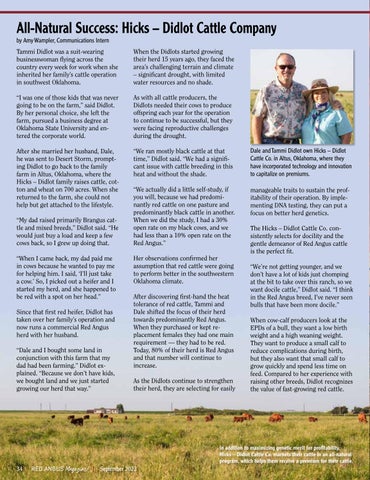
Dale and Tammi Didlot own Hicks – Didlot Cattle Co. in Altus, Oklahoma, where they have incorporated technology and innovation to capitalize on premiums.
“We actually did a little self-study, if you will, because we had predominantly red cattle on one pasture and predominantly black cattle in another. When we did the study, I had a 30% open rate on my black cows, and we had less than a 10% open rate on the Red Angus.”
manageable traits to sustain the profitability of their operation. By implementing DNA testing, they can put a focus on better herd genetics.
“My dad raised primarily Brangus cattle and mixed breeds,” Didlot said. “He would just buy a load and keep a few cows back, so I grew up doing that. “When I came back, my dad paid me in cows because he wanted to pay me for helping him. I said, ‘I’ll just take a cow.’ So, I picked out a heifer and I started my herd, and she happened to be red with a spot on her head.” Since that first red heifer, Didlot has taken over her family’s operation and now runs a commercial Red Angus herd with her husband. “Dale and I bought some land in conjunction with this farm that my dad had been farming.” Didlot explained. “Because we don’t have kids, we bought land and we just started growing our herd that way.”
Her observations confirmed her assumption that red cattle were going to perform better in the southwestern Oklahoma climate. After discovering first-hand the heat tolerance of red cattle, Tammi and Dale shifted the focus of their herd towards predominantly Red Angus. When they purchased or kept replacement females they had one main requirement — they had to be red. Today, 80% of their herd is Red Angus and that number will continue to increase. As the Didlots continue to strengthen their herd, they are selecting for easily
The Hicks – Didlot Cattle Co. consistently selects for docility and the gentle demeanor of Red Angus cattle is the perfect fit. “We’re not getting younger, and we don’t have a lot of kids just chomping at the bit to take over this ranch, so we want docile cattle,” Didlot said. “I think in the Red Angus breed, I’ve never seen bulls that have been more docile.” When cow-calf producers look at the EPDs of a bull, they want a low birth weight and a high weaning weight. They want to produce a small calf to reduce complications during birth, but they also want that small calf to grow quickly and spend less time on feed. Compared to her experience with raising other breeds, Didlot recognizes the value of fast-growing red cattle.
In addition to maximizing genetic merit for profitability, Hicks – Didlot Cattle Co. markets their cattle in an all-natural program, which helps them receive a premium for their cattle.
34
RED ANGUS Magazine | September 2023