Breed Improvement
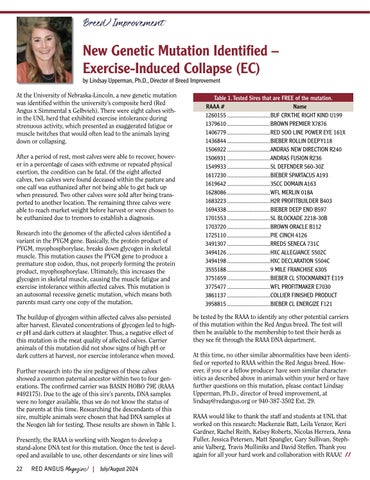
New Genetic Mutation Identified – Exercise-Induced Collapse (EC) by Lindsay Upperman, Ph.D., Director of Breed Improvement At the University of Nebraska-Lincoln, a new genetic mutation was identified within the university’s composite herd (Red Angus x Simmental x Gelbvieh). There were eight calves within the UNL herd that exhibited exercise intolerance during strenuous activity, which presented as exaggerated fatigue or muscle twitches that would often lead to the animals laying down or collapsing. After a period of rest, most calves were able to recover, however in a percentage of cases with extreme or repeated physical exertion, the condition can be fatal. Of the eight affected calves, two calves were found deceased within the pasture and one calf was euthanized after not being able to get back up when pressured. Two other calves were sold after being transported to another location. The remaining three calves were able to reach market weight before harvest or were chosen to be euthanized due to tremors to establish a diagnosis. Research into the genomes of the affected calves identified a variant in the PYGM gene. Basically, the protein product of PYGM, myophosphorylase, breaks down glycogen in skeletal muscle. This mutation causes the PYGM gene to produce a premature stop codon, thus, not properly forming the protein product, myophosphorylase. Ultimately, this increases the glycogen in skeletal muscle, causing the muscle fatigue and exercise intolerance within affected calves. This mutation is an autosomal recessive genetic mutation, which means both parents must carry one copy of the mutation. The buildup of glycogen within affected calves also persisted after harvest. Elevated concentrations of glycogen led to higher pH and dark cutters at slaughter. Thus, a negative effect of this mutation is the meat quality of affected calves. Carrier animals of this mutation did not show signs of high pH or dark cutters at harvest, nor exercise intolerance when moved. Further research into the sire pedigrees of these calves showed a common paternal ancestor within two to four generations. The confirmed carrier was BASIN HOBO 79E (RAAA #492175). Due to the age of this sire’s parents, DNA samples were no longer available, thus we do not know the status of the parents at this time. Researching the descendants of this sire, multiple animals were chosen that had DNA samples at the Neogen lab for testing. These results are shown in Table 1. Presently, the RAAA is working with Neogen to develop a stand-alone DNA test for this mutation. Once the test is developed and available to use, other descendants or sire lines will 22
RED ANGUS Magazine |
July/August 2024
Table 1. Tested Sires that are FREE of the mutation. RAAA # Name 1260155..............................BUF CRK THE RIGHT KIND U199 1379610..............................BROWN PREMIER X7876 1406779..............................RED SOO LINE POWER EYE 161X 1436844..............................BIEBER ROLLIN DEEP Y118 1506922..............................ANDRAS NEW DIRECTION R240 1506931..............................ANDRAS FUSION R236 1549933..............................5L DEFENDER 560-30Z 1617230..............................BIEBER SPARTACUS A193 1619642..............................3SCC DOMAIN A163 1628086..............................WFL MERLIN 018A 1683223..............................H2R PROFITBUILDER B403 1694338..............................BIEBER DEEP END B597 1701553..............................5L BLOCKADE 2218-30B 1703720..............................BROWN ORACLE B112 1725110..............................PIE CINCH 4126 3491307..............................RREDS SENECA 731C 3494126..............................HXC ALLEGIANCE 5502C 3494198..............................HXC DECLARATION 5504C 3555188..............................9 MILE FRANCHISE 6305 3751659..............................BIEBER CL STOCKMARKET E119 3775477..............................WFL PROFITMAKER E7030 3861137..............................COLLIER FINISHED PRODUCT 3958815..............................BIEBER CL ENERGIZE F121
be tested by the RAAA to identify any other potential carriers of this mutation within the Red Angus breed. The test will then be available to the membership to test their herds as they see fit through the RAAA DNA department. At this time, no other similar abnormalities have been identified or reported to RAAA within the Red Angus breed. However, if you or a fellow producer have seen similar characteristics as described above in animals within your herd or have further questions on this mutation, please contact Lindsay Upperman, Ph.D., director of breed improvement, at lindsay@redangus.org or 940-387-3502 Ext. 29. RAAA would like to thank the staff and students at UNL that worked on this research: Mackenzie Batt, Leila Venzor, Keri Gardner, Rachel Reith, Kelsey Roberts, Nicolas Herrera, Anna Fuller, Jessica Petersen, Matt Spangler, Gary Sullivan, Stephanie Valberg, Travis Mulliniks and David Steffen. Thank you again for all your hard work and collaboration with RAAA! //