20 | telegraph | nautilusint.org | December 2016
MARITIME WELFARE
The mixed blessings of the internet The shipping industry is facing increasing pressure to improve crew connectivity. But will better onboard online access help or hinder the mental wellbeing of seafarers? Dr OLIVIA SWIFT and Dr RIKKE JENSEN of Royal Holloway, University of London, assess the evidence…
F
Seafarers live and work for months at a time in small, multi-cultural crews with little contact with their home lives on land. The maritime industry has been alert for a long time to the detrimental effects this can have on individuals’ wellbeing and on the recruitment and retention of quality crew. However, there seems to have been confusion about what precisely is meant by ‘social isolation’ and how it does (or doesn’t) relate to loneliness and mental ill-health. Nevertheless, concern about the mental health of seafarers seems to have been gaining prominence recently. In June this year, the Seafarers’ Hospital Society started funding the development of the Big White Wall: an online, mental health and wellbeing service for all UK-based serving merchant seafarers. And in October, the ITF Seafarers’ Trust ran a two-day workshop with an ‘all-angled’ approach to mental health at sea, designed to culminate in a clearer set of priorities for action and research. Such activities are welcome. While comprehensive data is lacking about the extent to which mental health problems and suicide are a problem at sea and whether rates are rising or falling, there is agreement that on pragmatic, compassionate and moral grounds combined, more can and should be done to alleviate suffering and suicide; even one death is one too many. What precisely can be done across the sector, beyond the valuable but fragmented initiatives above, is more difficult to navigate, and some interventions and improvements are more feasible than others.
We need to establish what level of contact with home is good for us
“
”
In this article, the focus is on mental health in ‘the digital age’ and more specifically, on how connectivity and social media help and/or hinder seafarers’ mental health and social cohesion onboard, based on existing research. This is partly to explore the evidence in relation to a familiar binary: does onboard connectivity support or threaten seafarers’ mental health and crew cohesion? The effect of connectivity on crew cohesion has not been the topic of extensive research, because in few land-based settings is there a comparable issue. There is an oft-heard concern in the industry that seafarers able to access the internet on their own devices in their cabins will no longer socialise together, to the detriment of the ship’s overall operations. The counter-argument’s logic is that in today’s world, connectivity can’t and/or shouldn’t be avoided, and that the issue is how to manage the challenges it brings. Some would add that connectivity actually aids cohesion. Internet-based gaming between crew members, for example, is an example of how social bonds are reinforced in a digital context onboard. And there is an entire field within gaming that’s ‘cooperative’ and appears to increase cooperation in analogue reality, which has the potential to be used onboard as a planned intervention.
20-21_spread_SR edit.indd 20
Research into the effects of digital technology on mental health is more plentiful, although very little takes seafarers as its focus. Among the most widely cited is Futurenautics’ Crew Connectivity survey, which in 2015 reported that 40% (down 6% from 2014) of seafarers (typically the older and less technically literate) felt connectivity reduced social interaction onboard. The survey found 16% (down from 22% in 2014) felt crew communications do impact on safety. Of these, 23% (down from 54% in the previous year) felt this influence to be a positive one — based on beliefs that digital communications made for happier, less stressed (and hence less accident-prone) seafarers, and that this also enabled better access to information affecting work processes and events (such as medical information or piracy reports). In contrast, 77% of that 16% of seafarers believed improved communications have reduced ship safety because of increased levels of fatigue and distraction, personal devices being unsafe and because of concerns about cybersecurity. Similar data has been collected from the British armed forces. Among service personnel, communication (digital and other forms) has been found to reduce boredom and isolation and help maintain marriages and relationships with children. Personnel communicating with home also supports mental health, morale and occupational effectiveness, while a lack of contact increases the risk of developing mental health conditions. Echoing Futurenautics’ findings, contact with home was found to also have negative effects on some occasions, especially when problems arise at either end, or if levels of communication are less than expected. The research also found that too much contact with home could be problematic for operational effectiveness. In both the military and merchant marine contexts, further research is needed to ascertain optimal levels of communication between deployed personnel and loved ones back home. Nonetheless, the research shows that overall, being able to communicate with home is advantageous. A study of UK peacekeepers found that when it came to seeking support during stressful experiences at work, only 23% made use of
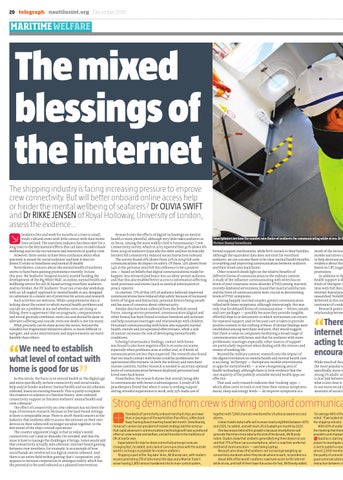
Smartphones are now the number one choice of seafarers for communicating while at sea. Dr Oliv Picture: Danny Cornelissen
formal support mechanisms, while 80% turned to their families. Although the equivalent data does not exist for merchant seafarers, we can assume there to be clear mental health benefits to enabling and improving communication between seafarers and their loved ones back home. Other research sheds light on the relative benefits of different forms of communication in the military context. A study of the influence communicating with wives has on levels of post-traumatic stress disorder (PTSD) among married, recently deployed servicemen, found that marital satisfaction and the form of communication were crucial in determining levels of PTSD symptoms. Among happily married couples, greater communication tallied with fewer symptoms, although interestingly, this was only true for delayed forms of communication — letters, emails and care-packages — possibly because they provide tangible, effortful objects or documents to which servicemen can return for repeated support, and/or because care is taken to provide positive content in the crafting of these. If similar findings were established among merchant seafarers, they would suggest that there is value in companies facilitating a broad range of communication with home and that for seafarers with more problematic marriages especially, other sources of support are particularly important when dealing with the stresses and strains of working life. Beyond the military context, research into the impact of the digital revolution on mental health and mental health care is accruing. ‘mTherapy’ — therapeutic mobile interventions or apps for mental health — is now a burgeoning area of health technology, although there is little evidence that the vast majority of the publicly-available mental health apps are effective. That said, early research indicates that ‘tracking’ apps — which allow users to track in real time their various symptoms, mood, sleep and energy levels — do improve symptoms as a
result of the increased mobile narratives use to help decrease anxie evidence about the be based on CBT (cognitiv promotion. In addition to these health support is deliv levels of therapist invo time with full therapi internet-based psycho researched. Notably, b delivered in this mann treatment of a wide ra Research paints a m relationship between
There a internet is acting to encourag
“
While much of this res the most popular soci specifically, more rece young US adults’ use o a clear link between th what is less clear is wh to use more social me amounts of social med
Strong demand from crew is driving onboard communicat
I
Standards of connectivity onboard merchant ships are lower than in any region of the world other than Africa, a Merchant Navy Training Board meeting heard last month. Drew Brandy, Inmarsat’s senior vice-president of market strategy, told the seminar that rapid advances in communications technology will have a profound effect on crew morale and welfare, and will transform the traditions of life at sea for ever. Expectations for ship-to-shore connectivity amongst crew are changing fast, he added, and a lack of communication with the outside world is no longer acceptable for modern seafarers. Shipping is part of the ‘big data’ drive, Mr Brandy said, with modern vessels generating 2TB of data every 100 days and a Maersk Triple E vessel having 2,800 sensors hardwired into its main control system,
together with 7,000 channels monitored for situational awareness and alarms. Global mobile data traffic will increase nearly eightfold between 2015 and 2020, he added, and will reach 30.6 Exabyte per month by 2020. One key reason behind this growth is because smartphones will generate five times more data by the end of the decade, Mr Brandy noted. Studies show that seafarers generally bring three devices to sea and that 77% of them carry a smartphone, which is now their preferred method of communication — overtaking laptops. Research also shows that seafarers are increasingly weighing up connectivity standards when they decide where to work, he pointed out. About 40% of the world’s seafarers now have access to the internet while at sea, and half of them have the access for free, Mr Brandy added.
‘On average 46% of the w noted. ‘If we looked at this the shipping industry.’ With 60% of seafarers the meeting that there is a providers and shipowners g Nautilus is starting to c project to investigate seaf is due to publish a report i almost 2,000 members w the quality of connections good communications wi interaction between crew,
16/11/2016 17:37