Profile
PHOTOGRAPHY: MANUEL VASQUEZ
pivotal role in it. But the picture she paints of Regus’s recruitment going back just a couple of years is a very different one. “It was slow, it was impractical, and disjointed between HR and the field. The field was saying ‘I can’t grow my business because HR aren’t recruiting people fast enough’,” she says. The company’s separate recruitment teams in each of Regus’s geographies — the Americas, the UK, EMEA [Europe, Middle East & Africa] and Asia Pacific — “were quite heavy in terms of manpower, admin and spend”, she continues. “We were asking a junior recruiter in Hong Kong to recruit local people in Brisbane. It was just ridiculous, so quite clearly we needed to do something drastic. “It wasn’t HR or recruitment’s fault. It was just they were under-resourced, and didn’t really have the skills or the accountability to do what they needed to do. So we tore it up.” If that sounds overdramatic, Regus’s rapid
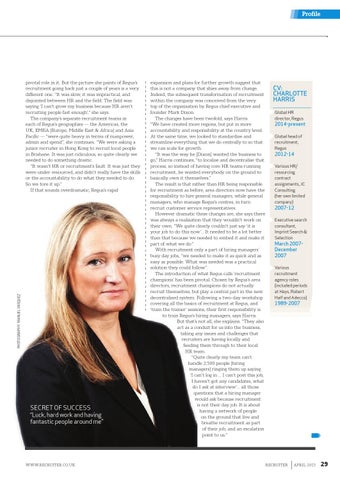
SECRET OF SUCCESS “Luck, hard work and having fantastic people around me”
WWW.RECRUITER.CO.UK
34-39_Recruit_APR15_Profile.indd 37
expansion and plans for further growth suggest that this is not a company that shies away from change. Indeed, the subsequent transformation of recruitment within the company was conceived from the very top of the organisation by Regus chief executive and founder Mark Dixon. The changes have been twofold, says Harris. “We have created more regions, but put in more accountability and responsibility at the country level. At the same time, we looked to standardise and streamline everything that we do centrally to so that we can scale for growth. “It was the way he [Dixon] wanted the business to go,” Harris continues, “to localise and decentralise that process, so instead of having core HR teams running recruitment, he wanted everybody on the ground to basically own it themselves.” The result is that rather than HR being responsible for recruitment as before, area directors now have the responsibility to hire general managers, while general managers, who manage Regus’s centres, in turn recruit customer service representatives. However dramatic these changes are, she says there was always a realisation that they wouldn’t work on their own. “We quite clearly couldn’t just say ‘it is your job to do this now’… It needed to be a lot better than that because we needed to embed it and make it part of what we do.” With recruitment only a part of hiring managers’ busy day jobs, “we needed to make it as quick and as easy as possible. What was needed was a practical solution they could follow”. The introduction of what Regus calls ‘recruitment champions’ has been pivotal. Chosen by Regus’s area directors, recruitment champions do not actually recruit themselves, but play a central part in the new decentralised system. Following a two-day workshop covering all the basics of recruitment at Regus, and ‘train the trainer’ sessions, their first responsibility is to train Regus’s hiring managers, says Harris. But that’s not all, she explains. “They also act as a conduit for us into the business, taking any issues and challenges that recruiters are having locally and feeding them through to their local HR team. “Quite clearly my team can’t handle 2,500 people [hiring managers] ringing them up saying ‘I can’t log in … I can’t post this job, I haven’t got any candidates, what do I ask at interview’… all those questions that a hiring manager would ask because recruitment is not their day job. It is about having a network of people on the ground that live and breathe recruitment as part of their job, and an escalation point to us.”
CV: CHARLOTTE HARRIS Global HR director, Regus
2014-present Global head of recruitment, Regus
2012-14 Various HR/ resourcing contract assignments, JC Consulting (her own limited company)
2007-12 Executive search consultant, Imprint Search & Selection
March 2007December 2007 Various recruitment agency roles (included periods at Hays, Robert Half and Adecco)
1989-2007
RECRUITER
APRIL 2015
29
12/03/2015 11:32