DIVERSITY
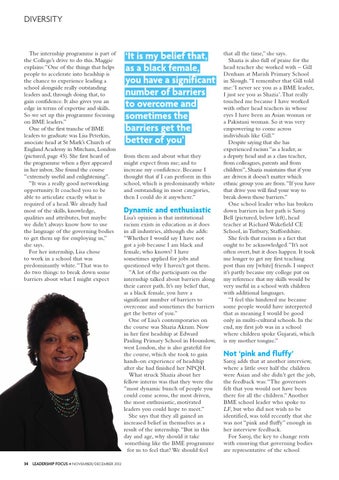
The internship programme is part of the College’s drive to do this. Maggie explains: “One of the things that helps people to accelerate into headship is the chance to experience leading a school alongside really outstanding leaders and, through doing that, to gain confidence. It also gives you an edge in terms of expertise and skills. So we set up this programme focusing on BME leaders.” One of the first tranche of BME leaders to graduate was Lisa Peterkin, associate head at St Mark’s Church of England Academy in Mitcham, London (pictured, page 45). She first heard of the programme when a flyer appeared in her inbox. She found the course “extremely useful and enlightening”. “It was a really good networking opportunity. It coached you to be able to articulate exactly what is required of a head. We already had most of the skills, knowledge, qualities and attributes, but maybe we didn’t always know how to use the language of the governing bodies to get them up for employing us,” she says. For her internship, Lisa chose to work in a school that was predominantly white. “That was to do two things: to break down some barriers about what I might expect
34
‘It is my belief that, as a black female, you have a significant number of barriers to overcome and sometimes the barriers get the better of you’ from them and about what they might expect from me; and to increase my confidence. Because I thought that if I can perform in this school, which is predominantly white and outstanding in most categories, then I could do it anywhere.”
Dynamic and enthusiastic Lisa’s opinion is that institutional racism exists in education as it does in all industries, although she adds: “Whether I would say I have not got a job because I am black and female, who knows? I have sometimes applied for jobs and questioned why I haven’t got them. “A lot of the participants on the internship talked about barriers along their career path. It’s my belief that, as a black female, you have a si significant number of barriers to ov overcome and sometimes the barriers ge get the better of you.” One of Lisa’s contemporaries on th the course was Shazia Akram. Now in her first headship at Edward Pa Pauling Primary School in Hounslow, w west London, she is also grateful for th the course, which she took to gain ha hands-on experience of headship af after she had finished her NPQH. What struck Shazia about her fe fellow interns was that they were the “m “most dynamic bunch of people you co could come across, the most driven, th the most enthusiastic, motivated le leaders you could hope to meet.” She says that they all gained an in increased belief in themselves as a re result of the internship. “But in this da day and age, why should it take so something like the BME programme ffor us to feel that? We should feel
that all the time,” she says. Shazia is also full of praise for the head teacher she worked with – Gill Denham at Marish Primary School in Slough. “I remember that Gill told me: ‘I never see you as a BME leader, I just see you as Shazia’. That really touched me because I have worked with other head teachers in whose eyes I have been an Asian woman or a Pakistani woman. So it was very empowering to come across individuals like Gill.” Despite saying that she has experienced racism “as a leader, as a deputy head and as a class teacher, from colleagues, parents and from children”, Shazia maintains that if you are driven it doesn’t matter which ethnic group you are from. “If you have that drive you will find your way to break down those barriers.” One school leader who has broken down barriers in her path is Saroj Bell (pictured, below left), head teacher at Richard Wakefield CE School, in Tutbury, Staffordshire. She feels that racism is a fact that ought to be acknowledged. “It’s not often overt, but it does happen. It took me longer to get my first teaching post than my [white] friends. I suspect it’s partly because my college put on my reference that my skills would be very useful in a school with children with additional languages. “I feel this hindered me because some people would have interpreted that as meaning I would be good only in multi-cultural schools. In the end, my first job was in a school where children spoke Gujarati, which is my mother tongue.”
Not ‘pink and fluffy’ Saroj adds that at another interview, where a little over half the children were Asian and she didn’t get the job, the feedback was: “The governors felt that you would not have been there for all the children.” Another BME school leader who spoke to LF, but who did not wish to be identified, was told recently that she was not “pink and fluffy” enough in her interview feedback. For Saroj, the key to change rests with ensuring that governing bodies are representative of the school
LEADERSHIP FOCUS ● NOVEMBER/DECEMBER 2012
32-35 BME heads NEW.indd 34
25/10/2012 15:33