YOUR CLA
HAMPSTEAD HEATH IMAGES: JAMIE SMITH
LONDON BRANCH
MICHAEL SIMS CLA SOUTH EAST COMMUNICATIONS MANAGER mike.sims@cla.org.uk 01264 313434
R
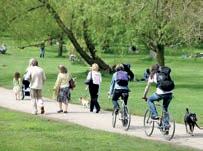
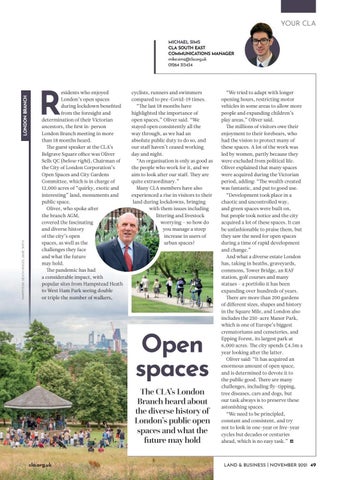
esidents who enjoyed London’s open spaces during lockdown benefited from the foresight and determination of their Victorian ancestors, the first in-person London Branch meeting in more than 18 months heard. The guest speaker at the CLA’s Belgrave Square office was Oliver Sells QC (below right), Chairman of the City of London Corporation’s Open Spaces and City Gardens Committee, which is in charge of 12,000 acres of “quirky, exotic and interesting” land, monuments and public space. Oliver, who spoke after the branch AGM, covered the fascinating and diverse history of the city’s open spaces, as well as the challenges they face and what the future may hold. The pandemic has had a considerable impact, with popular sites from Hampstead Heath to West Ham Park seeing double or triple the number of walkers,
cyclists, runners and swimmers compared to pre-Covid-19 times. “The last 18 months have highlighted the importance of open spaces,” Oliver said. “We stayed open consistently all the way through, as we had an absolute public duty to do so, and our staff haven’t ceased working day and night. “An organisation is only as good as the people who work for it, and we aim to look after our staff. They are quite extraordinary.” Many CLA members have also experienced a rise in visitors to their land during lockdowns, bringing with them issues including littering and livestock worrying – so how do you manage a steep increase in users of urban spaces?
Open spaces The CLA’s London Branch heard about the diverse history of London’s public open spaces and what the future may hold cla.org.uk
49 LondonBranch_November 2021_Land & Business.indd 49
“We tried to adapt with longer opening hours, restricting motor vehicles in some areas to allow more people and expanding children’s play areas,” Oliver said. The millions of visitors owe their enjoyment to their forebears, who had the vision to protect many of these spaces. A lot of the work was led by women, partly because they were excluded from political life. Oliver explained that many spaces were acquired during the Victorian period, adding: “The wealth created was fantastic, and put to good use. “Development took place in a chaotic and uncontrolled way, and green spaces were built on, but people took notice and the city acquired a lot of these spaces. It can be unfashionable to praise them, but they saw the need for open spaces during a time of rapid development and change.” And what a diverse estate London has, taking in heaths, graveyards, commons, Tower Bridge, an RAF station, golf courses and many statues – a portfolio it has been expanding over hundreds of years. There are more than 200 gardens of different sizes, shapes and history in the Square Mile, and London also includes the 250-acre Manor Park, which is one of Europe’s biggest crematoriums and cemeteries, and Epping Forest, its largest park at 6,000 acres. The city spends £4.5m a year looking after the latter. Oliver said: “It has acquired an enormous amount of open space, and is determined to devote it to the public good. There are many challenges, including fly-tipping, tree diseases, cars and dogs, but our task always is to preserve these astonishing spaces. “We need to be principled, constant and consistent, and try not to look in one-year or five-year cycles but decades or centuries ahead, which is no easy task.”
LAND & BUSINESS | NOVEMBER 2021 49
19/10/2021 16:54