

















12 Higher-order thinking skills for teachers and learners 18 How mentoring can tackle staff isolation and stress 22 Inside independent training providers set.et-foundation.co.uk Issue 53 Autumn 2023 TIME FOR A CHAT? The journal for professional teachers, trainers and leaders in the further education and skills sector : Exploring the impact of artificial intelligence on the FE and skills sector
Early bird tickets from £119
Tuesday 16 January 2024 at The Vox Conference Centre, Birmingham
Aimed at teachers and trainers in the Further Education and Training sector, our annual conference is a fantastic opportunity to hear from inspiring speakers, gain practical insight and connect and learn from your peers. And back by popular demand, we’re excited that the incredible Sarah Simons, MSET, will be returning as host! Book

Host: Sarah Simmons
Keynote speaker: Anthony Bennett

today: set.etfoundation.co.uk/conference
early bird tickets available for SET24! *Early bird tickets available until 30 September 2023. Discounts available for bulk booking.
your ticket
Discounted
UPFRONT
05 NEWS
Registration open for governance professionals’ qualifications; maths, English and ESOL courses now open; and deadline looms for technical fellowships
08 OPINION
The latest views on FE from Dr Katerina Kolyva, Martine Ellis FSET ATS, Stacey Vipas FSET ATS and Dr Rebecca Clare
12 ADVICE
How developing higher-order thinking skills raises the expectations of all
12
THE KNOWLEDGE
26 TIME FOR A STORY
Wendy Horrex FSET QTLS looks at how storytelling can be a useful tool to help bring learned experiences to life
30 LESSONS FROM AFAR
After a visit to Freire Charter School in Philadelphia, Dan Williams MSET QTLS explores what lessons our FE institutions could take away from its methods
33 INSIDE JOB
Heidi McWade MSET ATS’s Doctor of Education research project involved interviewing people from her own workplace – she describes the challenges that arose
MEMBERS’ CORNER
36 THE FORUM
Conference planning and become a SET ambassador
38 MY LIFE IN TEACHING
Rachael Betty MSET QTLS’s journey: from mental health nursing to an academic advisor
LEAD DESIGNER: David Twardawa
14
FEATURES
14 TIME FOR A CHAT?
AI tools such as ChatGPT are making the headlines –often for all the wrong reasons – but how can teachers use this tech to cultivate learner understanding?
18 IT’S GOOD TO TALK
How a culture of mentoring and support can help under-pressure teachers to stay in the profession and solve the ever-present retention crisis
22 FIGHTING ON
Independent training providers are determined to fight on, despite funding challenges impacting the sector
25 ROLL OF HONOUR
Celebrate the latest to have achieved QTLS status
DIRECTOR: Martin Reid
COMMUNICATIONS OFFICER: John Hilsdon
InTuition
SUB-EDITORS: James Hundleby, Amy Beveridge
PICTURE RESEARCHER: Claire Echavarry
ETF DEPUTY DIRECTOR: Paul Kessell-Holland
Publishing Ltd
(0)20 7880

6200 redactive.co.uk
PRODUCTION: Jane Easterman jane.easterman@redactive.co.uk
+44 (0)20 7880 6248
While every care has been taken in the compilation of this magazine, errors or omissions are not the responsibility of the publishers. Opinions expressed are not necessarily those of the publishers or editorial staff, the Society for Education and Training or the Education and Training Foundation. All rights reserved. Unless specifically stated, goods or services mentioned are not formally endorsed by the Society for Education and Training or the Education and Training Foundation, which do not guarantee or endorse or accept any liability for any goods and/ or services featured in this publication.
ISSN: 2050-8980
AUTUMN 2023 INTUITION 3
157-197 Buckingham Palace Road London, SW1W 9SP membership.enquiries@ etfoundation.co.uk set.et-foundation.co.uk is published on behalf of the Society for Education and Training
Redactive
+44
EDITOR: Nick Martindale
PRINTED BY Precision Colour Printing, Telford
CONTENTS AUTUMN 2023
MARTIN REID
A profitable partnership
Welcome to the latest edition of inTuition, which I’m pleased to announce has been shortlisted for best magazine in an upcoming membership awards ceremony. It’s recognition of the hard work our team of contributors – including many Society for Education and Training (SET) members – put into shaping the journal. The recent reader research has helped to contribute to this, and the ongoing development of inTuition, so many thanks to all those who took part.
There can be few people who have not by now heard of ChatGPT, and its potential to significantly change many aspects of our lives. The education space is likely to be at the forefront of adopting this. Our cover feature this issue looks at how this – and other artificial intelligence technologies – will impact the sector, whether positively or negatively.
This is just one element of what is a constantly changing environment, and it’s not surprising that teachers and other further education and skills (FES) professionals can sometimes feel lost, or even overwhelmed, with the demands of the job.
One way to counter this is through mentoring, which aims to connect people with those who have more experience or particular skills. Our feature on page 18 takes a look at the benefits that can stem from this for both mentee and mentor. You can also find out more about SET’s own MentorMe scheme, which has been well received since its launch earlier this year.
It’s a busy time of year for those working in the sector, and the independent training provider space has had plenty to think about. Our sector focus on page 22 looks at some of the challenges it faces, including funding for apprenticeships and the delivery of training to adults.
Our Knowledge section this issue features three must-read pieces, including Wendy Horrex FSET QTLS’s incisive article on the role of storytelling in the field of teacher education, and the lessons Dan Williams MSET QTLS picked up around engaging learners from lowincome backgrounds from the Freire Charter School in Philadelphia.
Finally, a reminder that you can now book your tickets for SET24, to be held on Tuesday 16 January 2024 at the Vox Conference Centre in Birmingham. The event will again be hosted by Sarah Simons MSET, and will feature Anthony Bennett as a keynote speaker, who will talk about how a near-death experience changed his approach to life. Tickets are limited, so make sure you don’t miss out. Find out more at set.et-foundation.co.uk/community-and-events/ annual-set-conference
MARTIN REID, director of professionalism and customer experience, Education and Training Foundation

TEACHERS CAN FEEL LOST, OR EVEN OVERWHELMED, WITH THE DEMANDS OF THE JOB. ONE WAY TO COUNTER THIS IS THROUGH MENTORING
WELCOME FIRST WORDS 4 INTUITION AUTUMN 2023
Mentoring connects those in the FE and skills sector who have experience and knowledge with those just starting their journey, and both sides can learn from each other
LATEST UPDATES FROM SET AND THE ETF
X (TWITTER) @SocietyET HAVE YOUR SAY #SETinTuition
CFO AND FINANCE MANAGERS’ PROGRAMMES
QUALIFICATIONS
REGISTRATION OPEN FOR GOVERNANCE PROFESSIONALS’ QUALIFICATIONS
The three ETF qualifications for governance professionals in further education (FE) and sixth-form colleges are now open for registration.
The Award for Further Education Governance Professionals (Award FEGP) assesses essential knowledge and skills, with its content derived from the Further Education Governance Professionals’ Competency Framework.
The Certificate for Further Education Governance Professionals (Cert FEGP) is for those who have completed or been awarded an exemption from the Award FEGP. Candidates will be assessed via
a portfolio of evidence, covering criteria including products of work, witness testimonies and personal reflective statements, as well as questioning between candidate and assessor.
The Diploma for Further Education Governance Professionals (PG Dip FEGP)
requires candidates to be employed as a governance professional with a UK FE or sixth-form college corporation, to have been employed as a governance professional for at least five years with a minimum of three years in FE, and to have completed or been awarded an exemption from the Cert FEGP.
The qualifications were designed in partnership with the Institute of Directors, the Department for Education and other key FE sector stakeholders.
For details and to register visit bit.ly/ETF-GPP
Booking is now open for the February 2024 cohorts of the ETF’s development programmes for chief financial officers and finance leaders and managers in the FE sector. The programmes are designed in collaboration with – and delivered on behalf of the ETF by – the Institute of Chartered Accountants in England and Wales (ICAEW).
The Chief Financial Officers’ Programme develops the skills and knowledge needed to lead change and be strategically confident. The programme includes a two-day, one-night residential programme in Birmingham on 28 and 29 February.
The Finance Leaders and Managers’ Programme, aimed at deputy finance directors and finance managers, focuses on driving team performance, influencing the broader business and effectively supporting the CFO and other stakeholders. The programme is delivered as a two-day residential in Birmingham on 20 and 21 February.
For details and to book a place visit bit.ly/ETF-financeprogrammes

AUTUMN 2023 INTUITION 5
WEBSITE set.et-foundation.co.uk
NEWS
FACEBOOK SocEducationTraining
BOOK NOW FOR LEADERSHIP DEVELOPMENT PROGRAMMES
SUBSCRIBE
TO ETF NEWSLETTERS
Receive regular updates from the ETF on new and updated CPD courses and resources as well as selected topic areas.
Sign up at et-foundation.co.uk/ newsletters
We are delighted to invite you to book for the ETF leadership development programmes taking place in the 2023–24 academic year.
The Preparing for CEO programme is for experienced leaders looking to take the step up to CEO. The Senior Leaders programme is aimed at current senior leaders who would like the opportunity to take part in leadership development for their strategic role. It aligns with the ETF’s Professional Standards for Senior Leaders.
Aimed specifically at senior leaders with strategic responsibility for change, the Strategic Innovation for Skills programme develops the skills and capacity necessary to ensure technical skills provision is responsive to labour market, employer and learner needs.
For middle leaders, the Aspiring to Senior Leadership programme is for those looking to progress into more senior roles. The Leading from the Middle programme, which focuses on the effectiveness of those in middle leadership roles, is also being offered.
For those who are relatively new to leadership, the Stepping into Leadership programme concentrates on developing participants’ thinking and practice.
For details of all ETF leadership development opportunities visit bit.ly/ETF-leadership
BRITISH SIGN LANGUAGE TEACHER WINS TUTOR AWARD
Emma Iliffe, a teacher of British Sign Language (BSL) at City Lit, was named the winner of the ETF-sponsored tutor award
TECHNICAL COURSES
MATHS, ENGLISH AND ESOL COURSES NOW OPEN
Booking is open for the next intakes of some of the ETF’s popular maths, English and ESOL courses, which will begin in October.
The in-depth technical courses are designed to enhance knowledge and improve practice, and are delivered via 10 weekly, two-hour online sessions.
Start dates for the courses are: Teaching ESOL in the post-16 sector: develop your practice (Level 5 module) – 3 October Teaching maths functional skills – 4 October
at this year’s Festival of Learning in July.
Emma, who is deaf, joined City Lit in 2018 and now spends half her time teaching and the other half preparing, supervising BSL teachers and creating resources. Having been denied access to signed education as a child, she is motivated by her desire
to support hearing students in learning and developing their own language skills.
Teaching English functional skills – 5 October
Teaching maths GCSE: Develop your practice – 2 October
Teaching English GCSE: Develop your practice – 5 October
Develop your learners’ maths skills in vocational and technical settings – 3 October
Develop your learners’ English skills in vocational and technical settings – 2 October

Her passion for teaching adults was ignited by her experiences studying to become, and then working as, a BSL teacher in local adult education colleges.
Previously, she’d worked as an illustrator of books and in a school for deaf children.
The award was presented by ETF chief executive Dr Katerina Kolyva, who said: “Emma, and other tutors like her, are transforming lives and communities with their inspirational work.”

6 INTUITION AUTUMN 2023 NEWS SECTOR UPDATE
Find
your
on the ETF website at bit.ly/ETF-startdates
out more about the courses and how to book
place
DEADLINE LOOMS FOR TECHNICAL FELLOWSHIPS
Applications for the 2024/25 Technical Teaching Fellowships close at 5pm on 24 November 2023. Awarded by the ETF and Royal Commission for the Exhibition of 1851 following a rigorous selection process, the fellowships are open to exceptional technical teachers in the further education and skills (FES) sector.
Following a review of the impact of the Technical Teaching Fellowships programme since its inception in 2018, the fellowships are now included in the Royal Commission’s portfolio of permanent awards, alongside other prestigious awards.
The decision means that an increased number of ETF-Royal Commission Fellowships – up to six – will be awarded for 2024/25.
It also means an extension of the geographical reach of the fellowships, with applications welcome from practitioners demonstrating excellence working in England, Northern Ireland, Scotland and Wales. With the support of the Welsh government, the programme is also being made accessible to Welsh speakers.
For
CONGRATULATIONS TO SECOND COHORT OF T LEVEL STUDENTS
We are delighted to congratulate the second cohort of T Level students on their results. We would also like to recognise all staff from T Level providers who have guided their students during their studies.
At the ETF, we are very proud to have supported over 18,000 teachers and leaders delivering T Levels through the TLPD offer – and it’s fantastic to see the positive impact this has had on the experience of students. It’s exciting to see increasing numbers of providers offering T Levels as more subjects are rolled out, and we look forward to continuing to offer support to new and existing providers.
54%
The proportion of training providers in line for some form of intervention, with three in 10 deemed “at risk”
£111
The additional money awarded to providers per student for 16-18-year-olds for 2023-24, creating a new base rate of £4,753 per learner
3,448
ETF CHAIR TO STEP DOWN
Peter Latchford OBE, chair of the Education and Training Foundation (ETF), has announced his intention to leave the role at the end of 2023. This provides an opportunity for a new chair with extensive experience of working in the sector to take the charity forward. Latchford was appointed to the role in October 2019.

The ETF has recently undertaken a strategic review with input from across the sector and will be announcing a new strategy in the autumn, when it will mark its 10-year anniversary. The board of trustees have expressed their intention to seek out a new chair who has significant experience of working in the FES sector to best support the organisation’s new strategic direction.
The number of T Level students who received their results this summer. More than one in five achieved the top grades
£29m
The donation made by philanthropist Hamish Ogston to help fund training and wage costs for 2,700 people, including apprentices, in at-risk heritage crafts
£500m
The extra money allocated to colleges over the next two years to help fund staff pay rises
AUTUMN 2023 INTUITION 7 SECTOR UPDATE NEWS NEWSINNUMBERS
FELLOWSHIPS
further details and to apply, visit bit.ly/ETF-TTF
INSPIRATIONAL JOURNEYS
Power of collaboration
It is this dedication that underpins the delivery of transformational opportunities for learners.
Since joining the ETF six months ago, I have been privileged to witness firsthand the essential role our sector plays in transforming opportunities for learners and their communities. Earlier this year, we launched our Together We Transform initiative, highlighting the significant impact of the FES sector and all those who work and learn within it. Celebrating that transformative impact remains particularly important in the face of ongoing challenges confronting the sector, from funding to staff retention. Throughout my cross-sector visits to providers across the country, I have seen how collaboration and external partnerships with industry can create transformative opportunities, not only for learners but also for wider communities and staff. I have witnessed how a focus on staff development and
supporting career progression through Advanced Teacher Status and SET membership, alongside embedding the ETF’s professional standards to support professional practice, is supporting staff recruitment and retention.
At this year’s Festival of Learning event, I had the pleasure of presenting the Tutor of the Year award. This award celebrates the difference that the commitment, talent and dedication of teachers makes. The winner, Emma Iliffe, is a teacher of British Sign Language (BSL) at City Lit. Emma, who is deaf, was denied access to signed education as a child and she now dedicates her time to teaching and supporting other BSL teachers, as well as supporting hearing students in developing their own language skills. Exceptional educators like her are a beacon of inspiration, driving positive change and inclusive leadership growth in our sector.
All these encounters have highlighted the vibrant tapestry of innovation, dedication and collaboration that defines the sector – and has also helped identify the key areas that ETF needs to focus on in the future.
This autumn marks the ETF’s 10-year anniversary. It has been a remarkable journey both for our charity and for the sector in times of rapid policy, political and economic change. The ETF’s progress – from its inception as a fledgling sector body supported by a startup grant, to its current position as the central pillar of professional standards and workforce development in FES – is testament to what the sector has achieved over the past decade.
Together with the sector, we have developed Professional Standards for Teachers and Leaders, built the sector’s professional capacity and capability through Advanced Teacher Status, and launched the new and enriched Qualified Teacher Learning and Skills programme. We have focused on key global issues, including sustainability and EDIB (equality, diversity, inclusion and belonging). In collaboration with the sector, the ETF has led programmes supporting the delivery of apprenticeships, T Levels and basic skills, and supported them with leadership and governance, educational technology, safeguarding and SEND.
Looking forward, this Autumn brings the launch of a new strategy for the ETF –the culmination of an extensive strategic listening exercise. The strategy will focus on how the ETF and SET together can provide ongoing support to practitioners throughout their careers and enhance the pathway to improving professional practice. Our work with partners will take a stronger focus on delivering our purpose, concentrating on being ‘sector-first’ and being able to respond to the needs of the sector in an effective and agile way.
Over our next decade we aspire to support all professionals in the FES sector so they can reflect on their professional practice against standards, own their professional development as a means to progress their careers and have access to invaluable networks of support through communities of practice, events and professional development opportunities. We will ensure that the ETF remains truly with, and for, the sector. Through collaboration, innovation and a shared commitment to excellence, we will continue to shape the future of the sector for the better.
DR KATERINA KOLYVA is the chief executive of the Education and Training Foundation




Seeing first-hand the innovation and dedication of those working in the further education and skills (FES) sector underlines the importance of development, says Dr Katerina Kolyva
ALL THESE ENCOUNTERS HAVE HIGHLIGHTED THE VIBRANT TAPESTRY OF INNOVATION, DEDICATION AND COLLABORATION THAT DEFINES THE SECTOR
8 INTUITION AUTUMN 2023 OPINION DR KATERINA KOLYVA
MANAGING WORKLOAD
Take back control
Many teachers will relate to feeling overwhelmed by work tasks and pressures. Using the PAR method can help you manage this and ensure you don’t become overloaded, says Martine Ellis FSET ATS
Around 15 years ago, I worked in the finance sector in a senior leadership role. It’s fair to say I was busy. Or, at least, I thought I was.
Only when I left finance to become an unqualified lecturer in further education (FE) did I truly understand the meaning of the word ‘busy’. That first year of teaching was brutal, resulting in severe burnout. I quickly learned that the only way I could cope with the conflicting demands of the teaching role was to use productivity strategies to manage my workload.
If you’ve ever felt overwhelmed by your workload, my personal approach to productivity – the PAR method –might be what you need. To start using this, you need a: calendar (such as Outlook, Google Calendar or a paper planner)
to-do list (such as a notepad, Todoist or TickTick)
note-taking tool (such as a notepad, Google Docs or Notion).
Schedule a 10-minute daily planning session, ideally at the end of each day, to plan the coming day. You’ll also need a 30-minute weekly review session to review your week and plan the coming week. Add these events to your calendar. You can now use the PAR method in your next 10-minute daily planning session.
PAR stands for:
Pull everything out of your head, process your thoughts and tasks, prioritise your tasks, and plan your day
Action and adjust as needed
Review.
Step 1: Pull everything out of your head
You need to pull everything out of your head and get it down on paper or in an app. Do this 10-minute mind dump in your daily planning session and any time your mind is feeling too full.
approach prioritisation – some examples include ABCDE, the Eisenhower Matrix, Eat That Frog, an Energy-Based Approach and the MoSCoW method (Must, Should, Could, Won’t).
Read more about these specific prioritisation approaches at bit.ly/MartineEllisblog-prioritise
Step 4: Plan your day
Now you have prioritised your tasks, you can plan your day using timeblocking. This is scheduling every part of your day – everything goes on the calendar (this includes teaching, meetings and breaks).
Step 5: Take action
Now that you’ve prioritised and planned, it’s time to take action: deliver your sessions, attend meetings and work through that task list.
Step 6: Adjust as needed
As you go through your day, remain flexible and adjust your plans as needed. Adapting to change is crucial for success. Keep a note in your note-taking tool of anything you need to adjust in your next daily planning session.
Step 7: Review the week
Step
2: Process your thoughts and tasks
During your daily planning session, review the items you’ve pulled out of your head and decide whether to add them to your to-do list, calendar or notepad. This is processing. Top tip: if you are in a teaching role, ensure the sessions you deliver are on your calendar, as this will give you a true picture of the time you have left for everything else.
Step 3: Prioritise your tasks
You should now have tasks on your todo list, events and key dates on your calendar, and notes in your note-taking tool.
The next step is to prioritise your tasks. There are various ways to
The weekly review is the cornerstone of the PAR method. It’s an opportunity to look back (review the week) and look forward (plan the coming week). It must be a recurring event in your calendar and will take approximately 30 minutes. In your weekly review, you’ll review your calendar and start preparing for the coming week.
Read more about how to carry out a weekly review at bit.ly/MartineEllisblog-review
MARTINE ELLIS FSET ATS is a teacher, writer and lifelong learner @heymartineellis

AUTUMN 2023 INTUITION 9 MARTINE ELLIS OPINION
SCHEDULE A 10-MINUTE DAILY PLANNING SESSION, IDEALLY AT THE END OF EACH DAY
NOTE-TAKING
Balanced education
We know that learning is defined as an alteration in long-term memory, and that therefore if nothing has altered in long-term memory, nothing has been learned.
The practice of note-taking in lessons has been with us for decades, but does it really help to change long-term memory and explain why some students and teachers still insist on it?
Having done possibly thousands of lesson visits over my career, I have often questioned why students need to take notes, and why teachers say: “Make sure you get this down.” What, I ask, is the benefit to learning of insisting that it is all written down? Could there be better ways?
Perhaps it is an enduring faith that writing it down helps; and having spoken to students about why they take notes, they often say it’s to help them remember. However, I suspect that in a lot of instances they simply take the notes home and then hope to ‘learn’ the topic when revising. I’m sure there will be occasions where the notes never surface again!
Some students don’t even write anything down. In a digital age we also witness students using their phone to record the teachers’ white boards, positing that it is their method of note-taking.
Consider the theory of ‘the split attention effect’, which questions whether we can write down and understand at the same time. Science says we cannot, that multi-tasking is a myth and flicking quickly between two tasks isn’t effective. It overwhelms the limited attention spans our young people
have, and the harder the task becomes, the more attention is required. To me, this isn’t going to work. No wonder students whip out their phones to snap the tutor’s jottings: after all, a quick click is much less taxing on the brain!
Consider also an alternative perspective: if a lesson provides a means of writing things down with the aim of learning everything later, what exactly is the benefit of attending classes? Do students really need to attend group sessions to ‘write stuff down’ when knowledge acquisition is often nothing more than a few clicks away on Google or through generative AI?
Educationalists stress how important class attendance is, and we talk about unmissable lessons. So let’s make lessons unmissable: lessons where deep learning actually happens and are not just gatherings for note-taking.
In Comparison of self-questioning, summarizing and notetaking-review as strategies for learning from lectures (1992) by Alison King, which discusses improving memory and fact retention, the results show that those trained in self-questioning techniques performed
somewhat better than those trained as summarisers, and significantly better than those trained as note-taking reviewers. This suggests that notetaking is certainly the weaker method of ensuring learning occurs on the basis of alterations in long-term memory.
However, Note taking hacks for study success (2020) by Karen Tui Boyes highlights that notes are an important memory tool to help trigger content and learning during selfstudy and revision sessions. So, with contradictory studies, where do we go from here? Are note-taking revision methods out, and summarising and questioning strategies in?
Cognitive science theories and evidence-informed learning techniques such as retrieval practice, spaced practice, elaboration, dual coding and ‘assessment as learning’ are the answers in my opinion. We can use any or all of those perceptive processes to instil the knowledge students need into their long-term memories so they are ready to pull the facts into their working memory when required.
This doesn’t mean that note-taking is dead. Established note-taking aids can be considered and deployed to support the aforementioned processes of embedding that knowledge. Suitable examples include the Microsoft One Note app, or the traditional pen-and-paper Cornell method, which focuses on key points and summarising recall sections that are added when notes are re-read.
Nevertheless, if the goal is to embed knowledge, skills and behaviours into long-term memory, then primarily let’s focus on the strategies that get it there. My message to students and teachers alike is either shape up your existing note-taking practices or ship them out in favour of cognitive science techniques.
STACY VIPAS FSET
ATS is head of digital learning at Askham Bryan College

The practice of note-taking is well established in education, but there are better ways of learning and of making lessons unmissable. It’s time to rethink, says Stacy Vipas FSET ATS
10 INTUITION AUTUMN 2023 OPINION STACY VIPAS
DO STUDENTS REALLY NEED TO ATTEND GROUP SESSIONS TO ‘WRITE STUFF DOWN’?
CURRICULUM AND TEACHING IN FE
Standing out
Careful curriculum planning and effective teaching methods are key to ensuring learners can gain the skills they need to progress. Ofsted’s Dr Rebecca Clare outlines some examples

Earlier this year, we published a blog outlining some examples of high-quality curriculum planning and teaching. This reflected on factors that contribute to the positive picture of education we usually see in the further education and skills (FES) sector. We’re delighted to be able to share more of our findings in this article.
I was recently talking to a curriculum lead for ESOL, for instance. He told me how he plans a balanced curriculum that covers the immediate vocabulary that new speakers of English might need, connected with schools, jobs, doctors and shopping. Alongside that, the curriculum deals with fundamental grammatical structures.
His teachers use teaching methods that help learners to focus on the curriculum, with minimal distractions, and provide opportunities to practise in different contexts. The result is that learners learn the English they need to begin to settle in the UK. They can use and understand more complex and appropriate language in more situations over time.
We see this kind of careful curriculum planning, drawing on the building blocks of the subject and ensuring application in a variety of situations, in lots of successful providers. We also see many teachers who skilfully identify and build on learners’ starting points and use teaching methods that focus on and embed the knowledge and skills learned.
Consider the carpentry and joinery teacher, who makes sure that learners understand the fundamentals of
timber science and how to work with different kinds of wood, before supporting them to select the right wood and use the best techniques for particular tasks. The first kind of content is what Professor Chris Winch describes as propositional knowledge, or ‘knowledge that’.
We often see this kind of curriculum content taught very effectively through clear exposition. This can help learners to grasp the key fundamental knowledge accurately, reducing any opportunity for gaps in understanding. Then there is know-how, or skills: in this case, knowing how to work with different kinds of wood.
We might describe the third kind of knowledge/skill (knowing when to use particular wood and particular techniques for a particular job) as a kind of conditional knowledge, or ‘knowledge-when’. Often, in vocational
subjects, it’s the development of really effective conditional knowledge, informed by secure and accurate propositional knowledge and knowhow, that tells a teacher or employer that a learner or apprentice is developing expertise.
Particular subjects might also have their own subject-specific means of supporting the development of conditional knowledge. In some subjects, such as software development, conditional knowledge arguably forms the bulk of the curriculum. Effective teaching of that subject is therefore likely to include plentiful opportunities to practise coding and testing in a wide range of increasingly complex situations.
Effective teaching methods, then, often follow the selection of curriculum content. We don’t expect teachers to be familiar with epistemology. But we do know that teachers should think deeply about i) the fundamental building blocks and wider application of their subject, ii) how to sequence content to help learners make sense of the subject and develop expertise over time, and iii) how to teach so that learners focus on and remember what they are learning.
It’s not as easy as it sounds, we know! That’s why inspectors are also interested in supportive management practices, such as provision of highquality professional development. We will ask about the ways in which teachers are supported to do the best job they can. We want to know whether professional development supports teachers’ understanding of their subject, how to make it accessible to learners and how to teach and assess it.
We’re very interested in hearing from teachers who are engaged in these debates. Join the conversation at CurriculumUnit@ofsted.gov.uk
DR REBECCA CLARE is senior HMI curriculum, further education and skills policy at Ofsted
DR REBECCA CLARE OPINION AUTUMN 2023 INTUITION 11
IN SOME SUBJECTS, SUCH AS SOFTWARE DEVELOPMENT, CONDITIONAL KNOWLEDGE ARGUABLY FORMS THE BULK OF THE CURRICULUM
Aiming higher
If you were asked to produce a list of higher-order thinking skills (HOTS), what would you include? In fact, pause reading and have a go now. If you can, find someone to compare lists with.
Did you mention any of these?
Critical or convergent thinking skills through evaluation or analysis
Novel or divergent ways of thinking using creativity or innovation
Collaborative skills to explore connections between concepts, change perspectives or solve problems
Improving thinking using metacognition or reflection
Maybe even curiosity as a means of motivating and stimulating thinking
All of these would have been correct. Undoubtedly, each list will be slightly different, but most would reflect the fact that HOTS require learners to go beyond the simple recall and restating of facts. HOTS could include any way of thinking that is more complex or which demands more active processing to improve learning.
With an economy reliant on new technology and rapid change, innovation is crucial to success. This requires agile employees, ready to adapt to the opportunities of the future. Employers want skills, not knowledge. Having HOTS encourages learners to take risks and experiment with the novel solutions demanded.
An added benefit of developing HOTS is seeing things from different perspectives and the resulting emotional intelligence. As well as supporting future relationships with others, it helps learners to better understand themselves, helping them to better express, and control, their thoughts, feelings and actions.
While it might take some time to develop HOTS, the impact of taking time early on pays dividends later. Learners with well-developed HOTS are more independent, better able to assimilate content and can more successfully navigate assessment. Here’s how you can go about developing HOTS for your learners.
INCLUDE HOTS IN YOUR LEARNING OBJECTIVES
Learning objectives (LOs) don’t have to just be about the content. You can include LOs relating to HOTS development, or frame your LOs as a ‘big question’ for learners to inspire their curiosity at the start of each session.
ILLUSTRATIONS: ISTOCK
12 12 INTUITION AUTUMN 2023
HIGHER-ORDER THINKING SKILLS
Developing higher-order thinking skills requires teachers to have high expectations of their learners, and encourage them to offer more than straightforward answers. Joanne Sutton MSET outlines ideas for a culture in which everyone tries their best
ADVICE
ENCOURAGE CREATIVITY AND COLLABORATION
Provide opportunities to be creative and collaborate, but group work is not enough. Enthuse learners with debates, problem-solving activities or ‘what if?’ scenarios that encourage them to synthesise information, evaluate alternatives or create solutions.
Promoting counterfactual thinking allows learners to explore what might happen within different parameters or from different viewpoints. Don’t forget that online tools such as Jamboard are an effective way to encourage collaboration, both in and out of the classroom.
USE METACOGNITION AND REFLECTION
Give learners the chance to explain how they arrived at an answer. Discuss the ways they tackle tasks and encourage them to share their understanding of concepts using analogies and metaphors. Low-floor/high-ceiling problems, odd-one-out tasks and Fermi questions are all excellent ways of posing problems that might have multiple solutions and allow learners to construct their own meaning from the content. Finally, build good habits by giving time at the end of tasks for learners to reflect on how they were completed, and the effectiveness of the strategies used.
ASSESS HOTS AS WELL AS THE CONTENT
SCAFFOLD THINKING AND MODEL INSTRUCTION
Don’t assume learners know how to think in these higher-order ways. They will need strategies and guidance as they would for any other skills development. Use an ‘I do, we do, you do’ approach to model thinking behaviours in the session.
Diamond Nine activities are a fantastic way to encourage learners to discuss options and make decisions based on evidence and formulating strong arguments. For learners who need more support with how to begin a task, a question matrix can provide useful starting points.
is a CPD trainer at the Education and Training Foundation




Just as you can include them in your LOs, add HOTS into your assessment. Give feedback on how well your learners are improving their skills and task them with developing further.
Be brave and use the power of a ‘pause’ before taking answers. More complex processing needs longer thinking time. If you want your learners to work harder, give them all time to think before choosing who will respond. Explore incorrect or partial answers fully, and let learners discuss how correct an answer is. This will give you clues to their misconceptions and allow them an opportunity to reflect on their understanding.
AUTUMN 2023 INTUITION 13
JOANNE SUTTON MSET
HIGHER-ORDER THINKING SKILLS ADVICE
TIME FOR







Deborah Millar runs a series of workshops exploring how her colleagues at Hull College can get the most out of artificial intelligence (AI). Each one begins with the same introduction: “What if I told you that you could have the best personal assistant on any topic, any time of the day?” Her audience is cautious: disaster stories about the impact of AI range from it stealing our jobs at best to leading to human extinction at worst.
“When we use the term AI, people tend to lock down,” says Millar, executive director of digital transformation at
the college. “I explain the ‘art of the possible’; that it can save time in lessons, and in your personal and professional life. Your students are already doing this, and we need to be on the same bus.”
In late 2022, OpenAI released a demo of its ChatGPT tool and, as users shared examples of what it could do, it soon went viral. In the months since, if your teaching staff haven’t been getting to grips with the possibilities of generative AI, then your learners certainly have; research by analytics firm Similarweb has found that 100 million people were using it just two months after its launch.


The rise of ChatGPT and other tools has rightly sparked concern about plagiarism among educators: they can compose essays, research sources and create impressive artwork in a fraction of the time it would take a human. But a growing number of further education (FE) professionals appreciate that, while there are risks associated with increased use of AI, there are also unmissable opportunities.
Much of the work around the use of AI in the further education and skills (FES) sector to date has centred on colleges, but the potential benefits could equally be applied across other parts; in prisons,
14 INTUITION AUTUMN 2023 FEATURE ARTIFICIAL INTELLIGENCE
In recent months, it’s been impossible to avoid the seemingly inevitable rise of ChatGPT and other forms of AI. In FE and skills settings, concerns around the risks can be counterbalanced by potential benefits for both learners and teachers. Jo Faragher reports
100m


The number of ChatGPT users in February 2023, just two months after it launched, according to analytics firm Similarweb

ARTIFICIAL INTELLIGENCE FEATURE
INTUITION
FEATURE ARTIFICIAL INTELLIGENCE


68%
The proportion of staff that have considered leaving education due to their workload, the 2022 Teacher Wellbeing Index finds
adult education settings or independent training providers. Hull College runs its ‘AI Academy’ regularly and staff are encouraged to “show and tell” what they have discovered with the technology. Millar explains: “We aim to have a handson exercise. We start with simple prompts for the tool, then move them on, such as: ‘write a policy in the style of Shakespeare’ or ‘write a module on logo design’.”
Staff learn to write better prompts for the tools through practice, and sharing any challenges or mistakes is useful for others. “We look at the good, bad and ugly outcomes. We had one construction teacher write a report on curriculum intent, and others writing handouts or managing their budgets,” she adds.
Learner benefits
Vikki Liogier, national head of EdTech and digital skills at the ETF, points out that AI will have a significant and varied impact in different vocational areas, so it’s essential for students to experience how it might help or hinder them in their chosen workplace. “Tools such as Midjourney, Stable Diffusion and Dall.e enable anyone to produce high-quality artwork from simple text prompts,” she says.
“It is understandable that highly-skilled visual artists feel challenged, so our role as educators is to support students to make the most of the tech available, by building specialist literacy for effective prompt engineering, for instance. We also need to instil in them an evaluation mindset to critically analyse what is coming out of these tools and make the work their own.”
Andreas Åberg, an educational developer at Dalarna University in
TOOLS
GENERATIVE AI
Most people will be used to using some form of AI in their daily lives, from asking Alexa to add something to a shopping list to using Google Maps to find the best route to their next meeting. Traditional AI tools such as these recognise patterns and make predictions, but generative AI takes this a step further, creating new content in the form of: text to image; text to video; text to audio; text to text; text to motion; text to code; text to NFT; text to 3D; audio to text; audio to audio; brain to text; and image to text. There is a growing armoury of AI tools that could be useful to FE professionals:
1ChatGPT by OpenAI

The most popular tool is based on a natural language processing model known as large language model (LLM). From users’ prompts, ChatGPT can write reports, compose social media posts, produce recipes and much more. Access an interview between Hi Robot and ChatGPT at bit.ly/YT-HiRobotChatGPT
2 Colossyan
This allows users to create AI videos from text and auto-translate to dozens of languages with the click of a button. See colossyan.com

3 TeacherMatic
An AI generator that can produce
high-quality classroom resources in a fraction of the time. It can produce lesson plans, activities, worksheets and more. See teachermatic.com
4 Midjourney
For graphic designers or teachers simply wanting to use design in their work, Midjourney is an AI programme where users can prompt it to create images or artistic concepts based on their requirements. See midjourney.org
5 Gamma
This allows users to convert text to slides using an AI slide creator. See gamma.app/generate
6 Otter.ai
A transcription service that could save teachers time by ‘taking’ notes from meetings and recording learner assessments. Microsoft Teams has also recently released transcription functionality. See otter.ai
7 SocialBee
If learners want to post social media updates, they can prompt this AI tool with everything from the desired content to tone of voice. See socialbee.com
8 Music creators
There are many AI tools that can be used to create music, including Aiva, Boomy, Soundful and Riffusion.
16 INTUITION AUTUMN 2023
PHOTOGRAPHY:
SHUTTERSTOCK
Sweden, has one fundamental piece of advice – that the pedagogical idea comes first, not the technology. “Students need to be active to learn; we need their participation,” he says.
Since learners can use AI to produce ‘traditional’ lesson outputs such as essays or reports, teachers could find ways to incorporate it into tasks, but in a way where the learner has to add value to what the tool has produced. “Create a learning situation that assesses their knowledge,” suggests Åberg.
“So if they’ve asked ChatGPT a question about a piece of literature, what did it get wrong? How can they illustrate a concept generated by AI through the text itself?” Discussing use cases for AI can also help learners to understand the ethical implications of deploying it when a task is more appropriate for human intervention.
Lightening the load
For teaching and support staff in FE, there is immense potential to reduce the time they spend on tasks such as lesson planning, creating schedules of work, writing policies and even developing courses. Fraz Arshad, who works in the computing department at New City College in London, has been involved in a research project looking at how FE teachers can unlock the potential of ChatGPT and similar tools.
“For staff, this is exciting,” he says. “I’ve written a whole year’s unit using the technology, and it has generated lots of new case studies. I advise staff to ‘use it and abuse it’ until they work out which prompts produce the best answers for them. They can use it as part of their teaching, create tasks and show differentiation between students. It saves so much time.”
Arshad is describing the art of ‘prompt engineering’, which is working out which prompts produce the most accurate or informative results; something that gets better through trial and error (ChatGPT keeps a record, but creating a spreadsheet of the best ones is a useful tip).
“I delegate the doing rather than the thinking,” says Martine Ellis FSET ATS, a trainer, writer, lifelong learner and inTuition columnist. “It’s about getting the AI to do the graft, but you still do
GUIDANCE
ETHICAL FRAMEWORK

Following the FE Technology Reference Group meeting in June, Jisc, the Association of Colleges and the ETF have joined forces to develop an ethical framework for the use of AI in further education.
The framework aims to assist the sector in considering how this rapidlyemerging technology is used. It will place an emphasis on the use of generative AI by learners and staff in FES institutions, addressing how to support AI literacy, ethical use and effective integration of generative AI tools into the learning experience.
The government has also produced a white paper on AI, which can be accessed at bit.ly/GOV-AIwhitepaper

The Department for Education’s policy paper on generative artificial intelligence in education can be accessed at bit.ly/GOV-AIpolicy
the thinking.” For Ellis, this means support with creating session plans, designing resources and plotting out schemes of work.
This has been hugely beneficial for her wellbeing, she believes. “Workload is a huge issue for teachers and AI is likely to have the biggest positive impact on this we’ve had for a long time. It means we can focus on the good stuff rather than admin, and I’ve seen a shift in how I prioritise my work.”
She cites research from the 2022 Teacher Wellbeing Index that shows 68 per cent of staff have considered leaving education due to their workload, so AI could make a hugely positive impact.
Such seismic shifts in how teachers operate cannot happen without having policies and “guardrails” in place, however. “I think, by now, every college or training provider should have an AI policy,” says Ruth Sparkes, an education communications professional. “And that policy shouldn’t just be a rulebook for ChatGPT, but more like a ‘satnav’ that guides everyone – from the principalship to the academic departments and support services – through the exciting (and a bit scary) territory of AI.”
Data concerns
FES settings will also need to look at their data protection policies as AI processes a lot of data, and learner interaction with this will need to be stored securely.
“When people share sensitive personal information with AI, it becomes part of the data that the AI processes; it’s using the data you input and your interactions to learn,” adds Sparkes.
“Although efforts are made to anonymise and protect data, sharing sensitive information presents a risk because the information could potentially be accessed, intentionally or unintentionally, by others.” Another suggestion is to set up an AI ethics committee that meets regularly to discuss the impact of AI and its use in that particular organisation, or perhaps an AI co-ordinator.
Many providers are facilitating training in this area, but it’s not just about the ‘techy’ bits, according to Sparkes. “By creating a culture of curiosity, we’re encouraging learners and staff to explore, innovate and learn,” she says. “It’s about embracing the exciting opportunities that AI offers – such as personalised learning, instant feedback, and smoother admin processes – while also tackling its challenges with a thoughtful and critical mindset.
“By swapping fear for curiosity, we create an environment where everyone is geared up to engage with AI and shape the future of FE in a positive and responsible way.”
AUTUMN 2023 INTUITION 17
ARTIFICIAL INTELLIGENCE FEATURE
JO FARAGHER is a freelance journalist with a strong background in education

18 INTUITION AUTUMN 2023
FEATURE MENTORING
nature of
teachers can feel
job means
Mentoring is one way to help them cope, through learning from the experiences of others. At a time when recruitment is on the agenda, it makes sense for all FE and skills organisations, says Elizabeth Holmes


IT’S GOOD TO TALK
At a time when many teachers feel overwhelmed, and recruitment and retention issues are dominating the further education and skills (FES) landscape, finding support systems that will benefit teachers and their organisations is a sensible course of action. Mentoring is one such intervention.
The Education and Training Foundation’s (ETF’s) Mentoring Framework for Practitioners in FE (further education) defines mentoring as a process that involves “teachers and trainers supporting colleagues on a one-to-one basis, over a sustained period, to bring about professional learning and development”. The ETF advocates mentoring that is nurturing, rooted in collaboration and support, and adaptable to the individual needs of the mentee. There are several
ways of accessing mentoring as an FE professional, from peer mentoring both within and beyond your setting to support from line managers and senior colleagues, and online communities dedicated to supporting FE colleagues such as those found on LinkedIn.
Peer mentoring
One mentoring path that is gaining popularity is SET’s MentorMe programme. “This is peer mentoring, which gives people control over their matching,” explains Jacqui Howard FSET, leadership and management facilitator at the ETF. “Both mentor and mentee can learn about each other before agreeing to engage in mentoring, and there are resources to help carefully manage the process.”
This approach to mentoring means that mentees can seek support on their terms, rather than being allocated to
AUTUMN 2023 INTUITION 19 MENTORING FEATURE
The
the
many
stressed and isolated.
ILLUSTRATION: IKON
someone because they happen to teach the same subject. Mentees can benefit from wider support around whatever they are hoping to develop, from pedagogy and behaviour management to confidence or organisation.
Kenneth Wilcox MSET QTLS is education facilitator at South Central Ambulance Service NHS Foundation Trust, and has benefited from the concept as both a mentor and mentee. “After having a difficult time recently, I had mentoring through the NHS Leadership Academy,” he says. “It had a huge impact on my personal and professional life, and after that experience I would like to be able to help others make similar changes in their lives.”
He’s now signed up to become a mentee through the MentorMe programme. “I’ve been teaching in adult education for a number of years now, and have made a few mistakes and learned from them,” he says. “Combining those with a sense of humour and a desire to help others, I am looking forward to developing my relationship with my new SET mentee.”
Jane Galbraith, head of membership at the Society for Education and Training (SET), points to the possibilities with MentorMe for linking up outside your organisation. “The system does the mentor-matching,” she says. “The mentor/mentee relationship has to click. External mentors bring in other perspectives. Different points of view can be helpful. Mentors won’t give answers but they will help the mentee to develop skills of self-reflection.”
The mentor/mentee relationship is key to the success of mentoring. Gavin Lumsden MSET QTLS, director of education and student experience for Essential Teaching UK, feels that we should not only mentor at the point of stress or crisis but as a general matter of course. “Mentoring isn’t a management tool,” he says. “It is about progression and wellbeing. Mentoring is for all, and it should happen from induction into a role until leaving a job. It should happen continuously across all staff. That way you develop a culture of mentoring.”
Safe space

The creation of a safe space in which to talk without fear of judgment is central
CLAIRE WOOD is a lecturer in business studies at Chelmsford College. She explains the benefits she has gleaned from being mentored as part of the ETF’s T Level Leadership Mentoring Programme:

“Mentoring has been hugely beneficial to me in my professional development,” she says. “It has given me the space and time to reflect,
action-plan and develop as a lecturer. I have grown in self-confidence and have pushed myself further than I thought was possible.
“As I have had such a positive experience with mentoring, in terms of my own wellbeing, I am more confident, happier and better organised. I have a positive work-life balance because I have been provided with strategies that allow me to reflect and take action.”
JAMES REYNOLDS
FSET ATS has 23 years’ experience in education, mainly as an FE lecturer, and he’s now helping others as a mentor for SET’s MentorMe scheme.
“My career has provided me with a range of valuable experiences and opportunities,” he says. “This has included mentoring of new teachers and also some more experienced staff through various professional
development opportunities, such as ATS, for example.
“The exchange of knowledge is really valuable; that discovery of new ideas, theories and practices means that I too can learn from being a mentor. I have had fantastic experiences both as a mentee and mentor and maintained some of those relationships throughout my career so I appreciate how impactful and valuable it can be. When it works well it can be a really important careerlong professional association.”
‘I WAS STRUGGLING WITH IMPOSTOR SYNDROME AND FEELING VERY CHAOTIC’

JESSICA WEBSTER is an early-years lecturer at Solihull College and University Centre. She pinpoints changes in her practice after being mentored through the ETF’s T Level Leadership Mentoring Programme:
“My experience of mentoring was brilliant. My mentor was great. At my first meeting I was struggling with impostor syndrome and feeling very chaotic. I worried constantly about not getting things right and quite frankly considered giving up my role in FE.
“She quickly saw through my chaos and began offering tips and strategies to support me within my co-ordination role. She would often allow me to talk and show me an alternative way of thinking.
“I started to recognise what was in my control and how I could manage things. This also impacted on my worklife balance as I wasn’t taking home negative emotions from work.
“I am now feeling more confident in my role and have a toolbox of strategies. I can’t recommend mentoring enough for anyone who is doubting their abilities.”

20 INTUITION AUTUMN 2023
FEATURE MENTORING
‘I AM MORE CONFIDENT, HAPPIER AND BETTER ORGANISED’
‘IT CAN BE A REALLY IMPORTANT CAREERLONG PROFESSIONAL ASSOCIATION’
to an effective mentoring programme. “Quite a lot of what happens in mentoring is around change management,” says Howard. “There have to be boundaries in mentoring and people need to have that safe space to chat. The role of a mentor is to help the mentee to be solution-focused. People often need a neutral perspective to help them to find solutions.”
Howard feels that the two main features of a successful mentoring programme can be distilled into first taking the time needed for it, and protecting that time. “People sometimes say they don’t have time for mentoring, but when they commit to it they realise that they are actually saving themselves time,” she explains.
The second feature is the creation of a psychologically safe space in which to talk about the challenges mentees are facing. “One mentee said to me, ‘You helped me untangle my head spaghetti’, which is a great phrase,” says Howard. “People can say what they need to without fear of being judged.
“Mentoring can be about giving people permission to use the power they have. People feel braver after talking things through. It can give them courage to make changes. It’s about taking control of your role. If you can solve the core issue, then peripheral issues will follow. Knowing and understanding what you have control over is part of that.”
While numerous mentoring models exist, Howard feels that the power of the questions asked is more important than the model used. “The point of a good question is to move the mentee forward,” she explains. “Open questions that can apply to many situations can be good here. ‘Why?’ can make people feel defensive, but there are many ways you can reframe that question. It’s about having a mentoring mindset: asking the question, ‘What do you want to get from this?’ And if they say they don’t know, I often ask, ‘If you did know, what would you say?’ Good mentoring helps people dig below the surface.”
These views are shared by Galbraith. “Good mentoring has happened when the mentee increases their confidence and feels more self-empowered,” she says. “The mentor can also offer reassurance that the mentee is on the right track.”
Retention tool
Using mentoring to support retention as well as teacher development is key for Lumsden. “There is a five- to six-year exit window where a lot of people leave their jobs, so we need to focus mentoring at the three- to four-year point,” he says.
“A good way of doing that is to bring them into the mentoring programme and empower them to be mentors. This can help them to refresh, reframe and refocus. The refocus part tends to happen through helping others.”
It’s important, though, that organisations provide the right culture for mentoring to thrive. “Mentoring can give teachers autonomy and ownership, and empower them to take risks without fear of failure,” he says. “This can encourage teachers to be creative. But without the four elements –accepting change is inevitable, accepting difference, empowering failure and encouraging creativity – you cannot have a culture for mentoring.”
Berta Miguez-Lorenzo MSET QTLS, participant experience manager for the professional formation programmes (QTLS/ATS) at SET, sees a strong role for mentoring in the support of mental as well as professional health. But there are also some words of caution. “Some organisations are very well set up to support mentoring, but others do not have well established resources,” she says.
“This can be difficult when effective mentoring needs a team of advanced teachers or teaching and learning coaches. For example, in some FE settings there may be a
few teachers, perhaps in a remote area, who do not have resources to access support.” Online coaching and mentoring communities, such as those on LinkedIn, Facebook and X (formerly Twitter), can help here, she adds.
Dr Lou Mycroft, curator of the JoyFE Collective, feels that mentoring needn’t be just a formal relationship. “FE grassroots communities fold you into a network of educators who provide formal and informal opportunities for peer mentoring through, for example, the twice-weekly ‘Ideas Rooms’ on Zoom,” she says.
Feedback from mentees on the ETF’s T Level Leadership Mentoring Programme is encouraging. They speak of how important their mentors are in helping to encourage a renewed focus. One spoke of changing their outlook “from one of dread to quiet confidence”, while another spoke of it being “probably the best thing I have done in my years in teaching in FE”.
Those who have had access to mentoring value it greatly. Considering the challenges of recruitment and retention facing the sector, investing time in high-quality mentoring just might bring dividends all round.
ELIZABETH HOLMES is a freelance journalist specialising in the education sector
Further information
ETF Mentoring Training Hub: et-foundation.co.uk/professionaldevelopment/mentoring/training-hub
Mentoring Framework for Practitioners in Further Education: et-foundation.co.uk/wp-content/ uploads/2021/09/ETF-MentoringFramework-for-Practitioners-inFurther-Education.pdf
SET MentorMe: set.et-foundation. co.uk/membership/set-mentorme
T Level Leadership Mentoring Programme: booking.etfoundation. co.uk/placementapplication/ intro?pp=2
JoyFE: linktr.ee/JoyFE
MENTORING FEATURE
IT SHOULD HAPPEN CONTINUOUSLY ACROSS ALL STAFF. THAT WAY YOU DEVELOP A CULTURE OF MENTORING
AUTUMN 2023 INTUITION 21
FIGHTING
ON

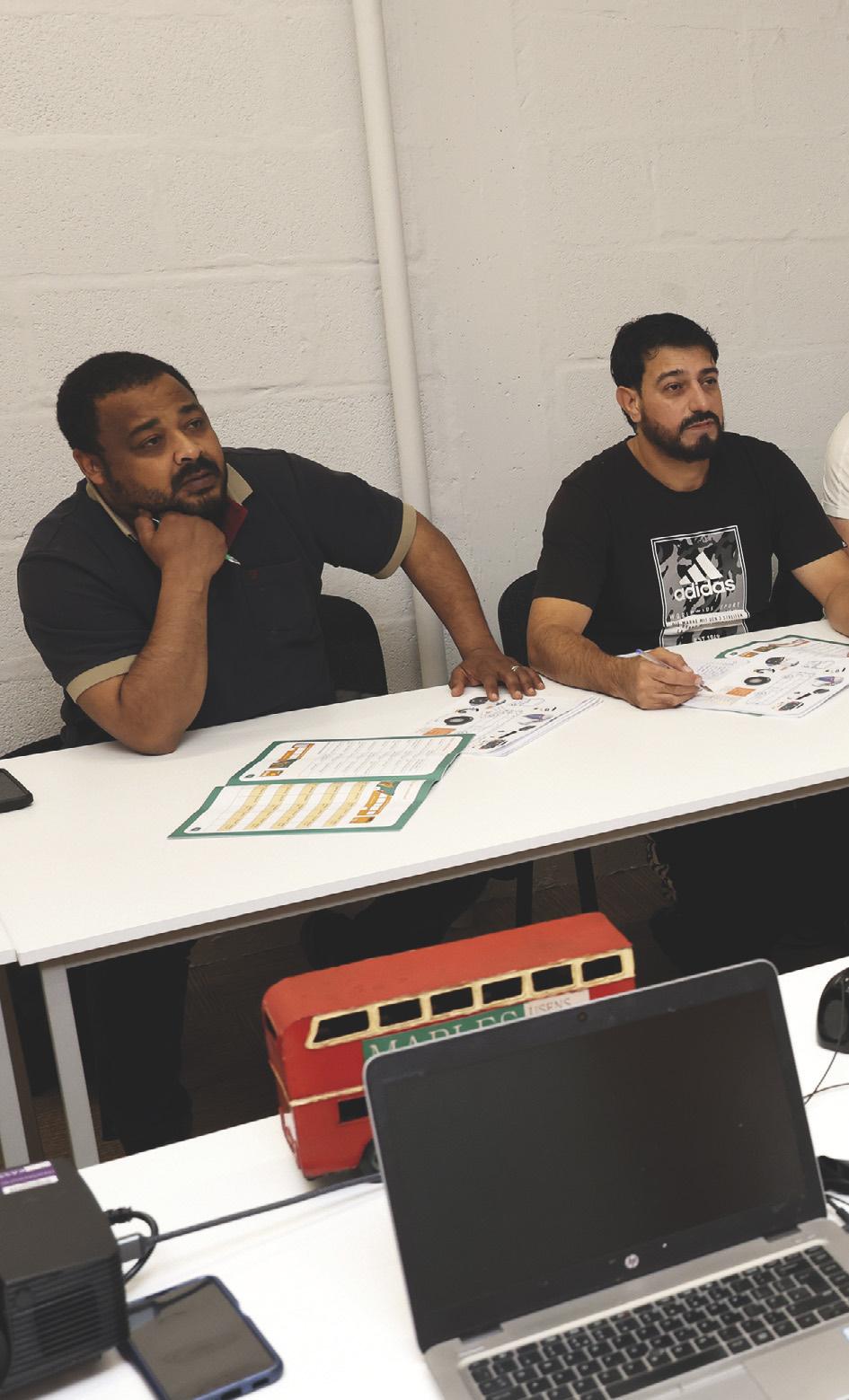
Independent training providers (ITPs) are a crucial pillar of the further education and skills (FES) world, providing a wide variety of learning and training opportunities to young people and adult learners across the UK.
apprenti collapse ITPs are a hu l
weren’t there, the apprenticeships system would collapse.”
There were 1,385 ITPs in August 2022, according to Ofsted, employing about 28,000 people and serving roughly 650,000 learners. ITPs often deliver training direct to employers, alongside adult education courses and about two-thirds of all apprenticeships in England and Wales. Indeed, as Paul Warner, director of strategy and business development at the Association of Employment and Learning Providers (AELP), puts it: “If the independent training providers
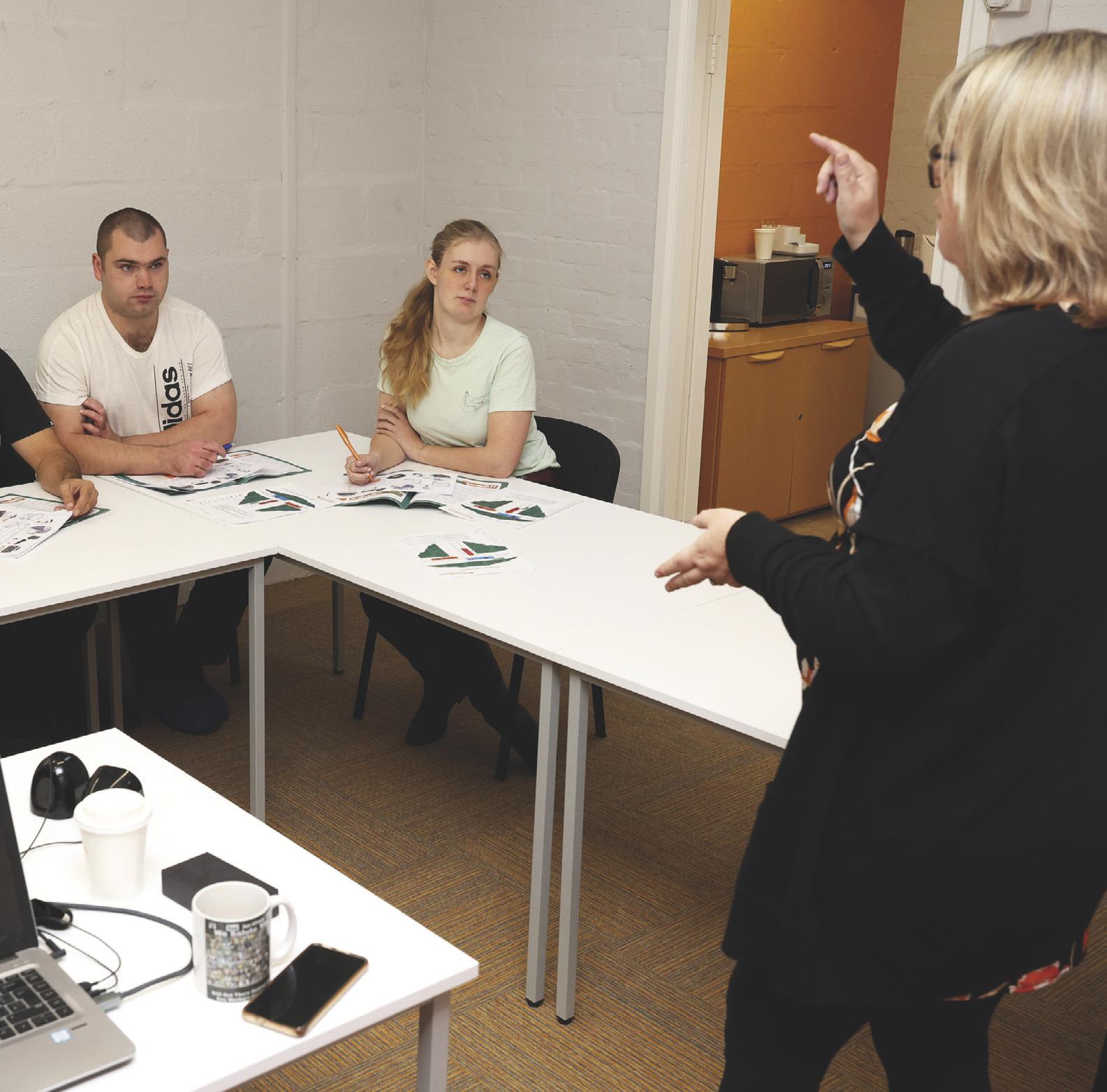
ITPs are a hugely diverse, and essential, part of the FES sector. Sometimes referred to as ‘independent learning providers’ or ‘private training providers’, they come in many different forms, including large and small businesses, charities and other notfor-profit organisations. They often specialise in particular industries or learner groups, linking the needs of learners and of employers.
The quality of provision offered by ITPs has increased over the past few years, with 80 per cent of ITPs judged good or outstanding at their latest inspection by Ofsted as of February 2021, compared with 74 per cent in its 2019/20 report. Their unique role was recognised in the Department for
Education (DfE) Skills for Jobs white paper, which stated: “We will continue to recognise the unique knowledge and capacity that independent training providers bring.
“They are the largest provider type delivering apprenticeships and they contribute substantially to adult education and training.”
Paragon Skills is a Bournemouthbased ITP that works predominantly with employers in the care and earlyyears education sectors, delivering apprenticeships and other qualifications for learners working in domiciliary care,
22 INTUITION AUTUMN 2023 SECTOR FOCUS ITPs
IF THE INDEPENDENT TRAINING PROVIDERS WEREN’T THERE, THE APPRENTICESHIPS SYSTEM WOULD COLLAPSE
Independent training providers have endured a tough few years, with challenges in funding affecting the whole sector. But, as David Adams discovers, it’s a resilient and valuable part of the FES sector, and one that’s determined to thrive
nurseries and residential childcare and as teaching assistants. Alongside thousands of other providers across the sector, they have had a challenging few years since the pandemic as they switched to delivering learning via remote digital technologies.
But this has brought some unexpected benefits. Ian Bamford, chief operating officer, reflects that many employers found this model of delivery worked well for their apprentices, saving them time yet increasing engagement: in some cases a single face-to-face meeting every eight weeks was replaced by online engagement every two to three weeks. Many of Paragon’s programmes now operate on a 70/30 remote/faceto-face basis. Learners have stated they prefer the remote nature of engagement with their personal tutor on a more regular basis as beneficial to their development and progression.
Apprenticeship funding
Financial issues in recent years have affected delivery of apprenticeships of all kinds. A closer working
relationship between AELP and the DfE has led to welcome changes to the DfE’s apprenticeship funding rules, increasing flexibility in some areas. Off-the-job training can now take place in every calendar month of a practical period, rather than every 28 days; and there is more flexibility around the deployment of progress reviews.
However, in many cases, funding has struggled to keep pace with inflation. Providers welcomed an exceptional funding band review in June by the Institute for Apprenticeships and

Technical Education, aiming to support providers as their costs have risen. But the review targeted 20 apprenticeships in skills shortage and priority sectors, so provided only a partial fix.
“Some of the funding bands have not changed for years,” says Gregg Scott, CEO of another ITP, Realise Training, which offers apprenticeships and adult education throughout England, often for key worker jobs in education, health and social care and public transport, among others.
The AELP would like to see providers helped by a more nuanced approach to the way the success of apprenticeships is measured, taking into account external factors that might lead some learners to leave before completion. “Things are precarious enough without using performance measurements that include non-completions for reasons outside of the provider’s control and quite possibly unrelated to their learning activities. That just pushes providers right to the edge,” Warner explains.
Many providers would also like more flexibility (and funding) around maths and English functional skills requirements. Bamford points out that some learners in this position are in their mid- to late-20s, so it is some years since they tried to pass maths GCSE while at school or college. “For me, it’s about making sure that those English and maths skills are
AUTUMN 2023 INTUITION 23
PHOTOGRAPHY: REALISE/SAM STEPHENSON, ISTOCK
ITPs specialise in particular industries or learner groups, linking the needs of learners
ITPs SECTOR FOCUS
WE NEED GOVERNMENT TO SHOW IT MATCHES THE DETERMINATION OF THE SECTOR TO KEEP PROVIDING CRUCIAL SKILLS FOR EMPLOYERS AND LEARNERS
contextualised, rather than just set up like GCSEs,” he says. “I get learners who complain that they don’t understand the question, but if it was put into context with the sector they’re working in, they would understand it and be able to do it.”
Another continuing concern is that the introduction of the Apprenticeship Levy in 2017 has led to a decline in Level 2 and 3 apprenticeships, which were previously often associated with small- and medium-sized enterprises (SMEs). These businesses do not pay the levy but instead pay 5 per cent of training and assessment costs – which may be prohibitive in the current environment. Warner says the AELP view is that SMEs – and by extension many learners and providers – could benefit if apprenticeships at a lower level and for younger people were funded through a dedicated general taxation fund.
Adult education
There is also a need to alter some policies affecting ITP delivery of adult education, with funding shortfalls again presenting challenges, as AELP highlighted in July when it launched its campaign to save the skills system.

Delivery of adult education services has been helped but also complicated by regional devolution deals. “It can create problems for larger employers with employees based in different places,” Scott explains. “They might have an employee in Manchester and another in Warrington whose programmes might be paid for out of different funding streams, so they may not be able to go to the same training provider for both.”
Cost pressures also make recruitment and retention of staff more difficult. Similar to other further education (FE) providers, many ITP staff have been recruited directly from the industries they serve. This brings great advantages in terms of experience and expertise, but also means they may be tempted by offers to go back into this industry with better pay and conditions.
BPP is a professional education and apprenticeships provider that is tackling
650,000
and career progression. BPP invests in workforce development through CPD days, in-house tutoring and coaching, supporting professional body subscriptions and non-executive experience as external examiners, trustees or Ofsted inspectors.”
Critical point
ITPs are working hard to explore ways of working within the constraints of current funding to offer enhanced learning opportunities for the future, such as using their flexibility to adopt new technologies to enhance teaching and course content. The DfE-funded Apprenticeship Workforce Development Programme, delivered by the ETF in partnership with a consortium of sector partners, has been a welcome source of support to ITPs. The programme is freely available to all those involved in the delivery of apprenticeships, with more than 3,628 courses being accessed so far.
1,385
the challenge of staff recruitment and retention head on. On a recent visit, Dr Katerina Kolyva, CEO of the Education and Training Foundation (ETF), was impressed by the organisation’s agility and innovation, as well as its commitment to professional development.
“BPP has a wow factor,” she says. “Through acquisitions, BPP has strengthened its offer in the UK and further afield. It hosts both further and higher education and brings together many professional education disciplines ranging from business, accountancy and digital to legal and healthcare.
“It was so impressive to see how all staff have opportunities for development
Warner detects a determination among providers to weather the storm, but says that urgent government action is now needed to deliver the skills the country needs. “Despite how hard it is at the moment, there is a feeling of ‘We’re keeping going’,” he says, “but we’re at a critical point.
“We need government to show it matches the determination of the sector to keep providing crucial skills for employers and learners by urgently reviewing funding rates, particularly on apprenticeships. It must also put in place a long-term plan to stabilise the skills sector through a sustainable and integrated national skills strategy. Without this, the skills system, despite the best efforts of everyone working in it, could effectively collapse.”
There are some insights for policymakers here, as it is clear that we need these unique members of the education ecosystem to thrive. If we can just give our ITPs a little bit more TLC, huge numbers of learners and employers –and our entire economy and society –will all benefit.
DAVID ADAMS is a freelance journalist
SECTOR FOCUS ITPs 24 INTUITION AUTUMN 2023
The number of learners served by ITPs in 2022, according to Ofsted
The number of independent training providers in the UK, Ofsted figures show
QTLS
OCTOBER 2021
Cara Batchelor MSET
Charlotte Hanson MSET
JANUARY 2022
Ana Paula Nascimento da Silva
Cardoso MSET
Gemma Squirrell MSET
OCTOBER 2022
Cassandra Adebolu MSET
Samara Aden MSET
Alyson Agrawal MSET
Aasim Ahmed MSET
Suleman Ameen MSET
Kathy Anderson MSET
Sarah Anthony MSET
Michael Apichella MSET
Helen Appleby MSET
Kate Archer MSET
Emma Ashby MSET
Jade Ashcroft MSET
Henna Ashraf MSET
Rebecca Atwell MSET
Majad Aurangzab MSET
Anya Bailey MSET
Sara Baistrocchi MSET
Emma Barraclough MSET
Karyn Barry MSET
Samia Bashir MSET
Karen Bates MSET
Curtis Bateson MSET
Suzy Batty MSET
Marc Baugh MSET
Lisa Beales MSET
Farzana Begum MSET
Andrei Belikau MSET
Simon Bengio MSET
Cheryl Bertschi MSET
Rachael Betty MSET
Katie-Louise Bilsby MSET
Sarah Blackledge MSET
Kevin Blake MSET
Kezia Blakeley MSET
Deborah Bosso MSET
Angela Bower MSET
Claire Bowley MSET
Sophie Bradford MSET
Helen Bradley MSET
Danny Brain MSET
Carl Bramham MSET
Elliot Broughton MSET
Rasline Brown-Ewen MSET
Fiona Bullock MSET
Sarah Burton MSET
Chloe Butcher MSET
Lewis Campbell MSET
Rebecca Carlin MSET
Richard Cartwright MSET
Hannah Catt MSET
Noochinsadat Chamsozoha MSET
ROLL OF HONOUR
The following have successfully achieved QTLS status. Congratulations to all!
Melissa Charlton MSET
Bridie Chatfield MSET
Chloe Cheyne MSET
Laura Clarke MSET
Sandra Clough MSET
Jessica Cocker MSET
Andy Colclough MSET
Rebecca Cole MSET
Debbie Collins MSET
Matt Cook MSET
Leah Cooper MSET
Ruth Cooper MSET
Loren Cotterell MSET
Will Cowell MSET
J Cristina Fuster MSET
Joanne Crockett MSET
Sian Crompton MSET
Joscelyne Daniel MSET
Freya Darbyshire MSET
Paul Davies MSET
Maxine Davis MSET
Rachel De’ath MSET
Simon Dewhurst MSET
Severine Dizel-Cubuca MSET
Matthew Dominey MSET
Clare Dorotiak MSET
Carla Doughty MSET
Steven Driver MSET
Bradley Edwards MSET
Sarah Edwards MSET
Karin Eklund MSET
Bassel El Deiry MSET
Zahra Elkiraa MSET
Bernadette Ellis MSET
Abdinasir Elmi MSET
Jodie Evans MSET
Katie Evans MSET
Lloyd Evans MSET
Yiu Fai Chan MSET
Asma Farooqui Qammar MSET
Nathan Fawley MSET
Natasha Feinstein MSET
Anna Felsen Dit Kronfeld MSET
Anthony Field MSET
Annabella Finn MSET
Kelsie Ford MSET
Serena Francois MSET
Matty Friedmann MSET
Sabrina Fry MSET
Louise Gabrys MSET
Teresa George MSET
Valentina Georgiou MSET
Emily Geraghty MSET
Abdorhaman Ghanem MSET
Luke Gibson MSET
Adil Gite MSET
Lucy Gladdy MSET
Sean Gleistein MSET
Hadassah Goldman MSET
Thomas Goodson MSET
Tracey Goodwin MSET
Ross Gouldie MSET
Kasavan Govender MSET
Melanie Green MSET
Callum Grey MSET
Andrew Griffin MSET
Katie Gunn MSET
Sue Gunn MSET
Katie Haig MSET
Rivky Halberstadt MSET
Hanane Hammani MSET
Rebecca Hammond MSET
Gemma Hamond MSET
Yasmeena Hanief MSET
Rebecca Hansom MSET
Matthew Harrington-Keeton MSET
Mark Harris MSET
Hannah Hassall MSET
Grace Hawkins MSET
Edward Hawkins MSET
Sean Healey MSET
Hindy Heiman MSET
Michelle Hill MSET
Isabel Horwood MSET
Natasha Hudson MSET
Chris Hudson MSET
Natasza Hughes MSET
Stacy Hughes MSET
Dean Hughes MSET
Liam Hulme MSET
Lee Hurrell MSET
Abbas Hussain MSET
Hodo Hussein MSET
Aimee Hyde MSET
Louise Ince MSET
Elena Iorga MSET
Hawah Isaac Amatcha MSET
Alice Jackson MSET
Jesse Jackson MSET
Jayne Jackson MSET
Nicole Jazmin Harper MSET
Michelle Jeavons MSET
Sophie Jenkins MSET
Sarah Jenkinson MSET
Marcia Jennifer Wellington MSET
Helena Jetha MSET
Ana Jolly MSET
Donna Jones MSET
Natalie Jones MSET
Simone Jones MSET
Barbara Joubert MSET
Bradley Joynes MSET
Yudit Kahan MSET
Jopaul Kariyathi Kallarakkal MSET
Prabhpreet Kaur MSET
Faizal Kayat MSET
Sian Kelly MSET
Abbey Kemp MSET
Seema Khan MSET
Vicky Kielthy MSET
Shanna King MSET
Amelia King MSET
Caroline Kirton MSET
Elisheva Klyne MSET
Rhianna Knapp MSET
Vicky Knight MSET
Srilatha Kuchipudi MSET
Rachna Kumar MSET
Angela Lacatus MSET
Josh Lack MSET
Carol Lake MSET
Leanne Lane MSET
Joanna Leather MSET
Sarah Lederman MSET
Irsaad Lia MSET
Sima Lieberman MSET
Lucien Likandja MSET
Sandra Ling MSET
Fay Llewellyn MSET
Leah Lockwood MSET
Charlotte Logan MSET
Paula Luz-Ferreira MSET
Tim Lynskey MSET
Yusuf Mallick MSET
Laura Marie Smith MSET
Mark Mark MSET
Rebecca Marsh MSET
Stephanie Marshall-Whitley MSET
Scott Martin MSET
Phil Matthews MSET
Syed Mazhar Uddin Taj MSET
Lisa Mazzoni MSET
Victoria McCallister MSET
Andrew McCran MSET
Rebecca Mcdonald MSET
Conall McDonald MSET
Ben McGeiver-Carney MSET
Aurelia Mckelvey MSET
Jack McMillan MSET
Safia McNabb MSET
Lisa McNally MSET
Gillian McSkimming MSET
Amy Millington MSET
Andrew Mitchell MSET
Safiyyah Mohammed MSET
Raheel Mohammed MSET
Iman Moinuddin MSET
Sarah Moise MSET
Olenna Mokliak MSET
Tania Monteiro MSET
Robert Moore MSET
Paris Moran MSET
Simon Morley MSET
Simon Morley MSET
Lisa Mortlock MSET
Julie Mosley MSET
Abdul Moududh Choudhury MSET
Yasmin Murad MSET
Daphne Muskett MSET
Selvin Naidoo MSET
Rebecca Nash MSET
Shireen Nawaz MSET
Lee Newton MSET
Shaun Nicholson MSET
Lily Nugent MSET
Michelle O’Rourke MSET
Regina Oparaugo MSET
Ebru Osar MSET
Alex Otakho MSET
Shannon Owen-Youens MSET
Stephanie Owusu MSET
Darren Oxton MSET
Antonia Palmer MSET
Amy Parker MSET
Daniel Parker MSET
Eileen Parris MSET
Ashley Partridge MSET
Dhruvika Patel MSET
Melissa Pauley MSET
Charlotte Pedersen MSET
Lauren Penney MSET
Helen Pickles MSET
Charles Pilgrim MSET
Dabrusha Pink MSET
Adelina Piris MSET
Chloe Poole MSET
Ryan Potter MSET
Laura Pouabe MSET
Genesee Powell MSET
David Powell MSET
Leah Powell MSET
Lucy Privett MSET
Lynne Quinn MSET
Georgie Radmore MSET
Fouzia Rahim MSET
Perry Ralls MSET
Jose Ramon Olea Diez MSET
Samantha Ramsay MSET
Glenys Reid MSET
Alan Richards MSET
Mark Richardson MSET
Marie-Ann Roberts MSET
Connor Rollinson MSET
Matthew Rowe MSET
Arabella Rucco MSET
Batsheva Saberski MSET
Thomas Saich MSET
Subeer Said MSET
Gemma Saintierney MSET
Yechiel Salomon MSET
Carla Salt MSET
Jayde Sarrington MSET
Rachel Saunders MSET
Jemma Savo MSET
Josie Schifano MSET
John Sellars MSET
Asim Shah MSET
Gigi Shapiro MSET
Rehana Sharif MSET
Emilie Shepherd MSET
Natasha-Lea Sheppard MSET
Rebecca Shields MSET
Elizabeth Simpson MSET
Laura Smith MSET
Rebecca Stapley MSET
Zoe Steele MSET
Rebecca Steele MSET
Chaya Steinhaus MSET
Sarah Stevens MSET
Lee Stevens MSET
John Stirling MSET
Lauren Straub MSET
Wendy Straw MSET
Kirsty Street MSET
Emma Streets MSET
Shallah Subhan MSET
Seena Sudhakaran MSET
Jennifer Suleiman MSET
Emma Sweetman MSET
Marta Szklarz MSET
Safia Tabassam MSET
Shaheena Tarafdar MSET
Jenny Tarleton MSET
Maria Taylor MSET
Alexandra Taylor-Brown MSET
Julie Teasdale MSET
Danielle Texeira MSET
David Thomas MSET
Daniel Thompson MSET
Olivia Tuffs MSET
Trudi Twigg MSET
Chaya Vogel MSET
Gladis Voila Asif MSET
Charlotte Wade MSET
Charlotte Waite MSET
Morgan Walker MSET
David Wall MSET
David Waters MSET
Jess Waters MSET
Bethany Watson MSET
Kimberley Whitbread MSET
Chantelle White MSET
Ellie Wilkin-Smith MSET
Molly Williams MSET
Alex Wines MSET
Steve Withers MSET
Gemma Wollaston MSET
Keenan Wright MSET
Victoria Wright MSET
Jack Wynter MSET
Kerrie Yates MSET
Joe Yates MSET
Lareese Yearwood MSET
Rika Zobin MSET
Nadia Zubairi MSET
JANUARY 2023
Jessica Addison MSET
Roua Alhalawani MSET
Tatiana Aminul MSET
Amber Armitage MSET
Lucy Armstrong-Clarke MSET
William Baker MSET
Gourab Banerjee MSET
Natalya Barton MSET
Karen Beecroft MSET
Kane Beere MSET
Naina Begum MSET
Nadine Benjamin MSET
Leora Bennett MSET
Jan Benz MSET
Zobia Bi MSET
Rachel Biggs MSET
Jamie Blanshard MSET
Joy Bott MSET
Rebecca Calder MSET
Sharon Carter MSET
Emily Cassidy MSET
Dena Chaya Rose MSET
Rebecca Clinton MSET
Ann-Marie Costello MSET
Claire Croud MSET
Ashley Culler MSET
Asha Dahir MSET
Kelly Daley MSET
Lewis Dallas MSET
Jahnvi Dave MSET
Olivia Davies MSET
Roxana Deacon MSET
Naomi Drapkin MSET
Jo Eaton MSET
Tara Edwards MSET
Jessica Evans MSET
Eve Feiner MSET
Julie Fox MSET
Maresha Futhela MSET
Chelsea Garner MSET
Melissa Gee MSET
Nicola Giles MSET
Kirby Hall MSET
Atifa Hansrot MSET
Aliaa Hassaneen MSET
Nathan Hawke MSET
Harry Hazlem MSET
Elliott Herbert MSET
Nathan Hole MSET
Ashleigh Howe MSET
Christine Hull MSET
Sarah Jackson MSET
Tim James MSET
Annabel Lermer MSET
Jema Li MSET
Katie Lovell MSET
Toni Martin MSET
Helen McCreadie MSET
Yaseen Miah MSET
Joel Murray MSET
Sana Nasar MSET
Kacey-May Nash MSET
Talat Nasim MSET
Aisha O’Flaherty MSET
Israel Okunwaye MSET
Martin Oppong MSET
Alisha Overend MSET
Natalie Owen-Mounsey MSET
Georgina Pattison MSET
Josh Pillinger MSET
Lindsay Putland MSET
Kirsty Rennie MSET
Leanne Reynolds MSET
Alice Roberts MSET
Elyse Russell MSET
Sophie Savage MSET
Huda Sheikh Shahid MSET
Simcha Shira Tamman MSET
Aaron Slight MSET
Kate Smith MSET
Karan Soni MSET
Anna Southerd MSET
Christa Stephenson MSET
Simon Takel MSET
Natalie Taylor MSET
Rachael Thompson MSET
Tanya Tipping MSET
Jessie Vaughan MSET
Lauren Walker MSET
Rebecca Waller-Brown MSET
Sally Whittington MSET
Kirsty Williams MSET
James Wise MSET
Ben Wright MSET
Sacha Yabsley MSET
Erum Yousaf MSET
Natalie Zolty MSET
AWARDS QTLS AUTUMN 2023 INTUITION 25
RESEARCH AND INSIGHT FROM THE FURTHER EDUCATION AND SKILLS SECTOR
Time for a story
Storytelling can be a useful tool in helping to engage students and bring experiences to life.
Wendy Horrex FSET QTLS set out to look at this in the field of teacher education, and found it could have a powerful effect on the development of skills that would later be needed in the classroom
26 INTUITION AUTUMN 2023
Dialogue is widely recognised as a central tenet of teaching (for example, Alexander, 2008), but my research set out to investigate key features of dialogue in teacher education, specifically teacher education in the further education (FE) sector.
One of the findings was that storytelling was a frequently employed and much appreciated tool in teacher education. In many teaching situations, storytelling would be classed as monologic, with the teacher expertly weaving a narrative, often drawing on their own vocational expertise to engage students and to illustrate an abstract concept or principle.
In the development of teaching skills, including in teacher education, student teachers were able to develop the skill of storytelling. Stories were more than simply a learned skill, as they also offered strategies for entering the teaching community and for managing the demands of the role.
Savvidou (2010) studied a professional development project in which teachers’ stories were videoed and uploaded to a digital platform, where other colleagues could respond with a story of their own. She conceptualised storytelling as interactional –a reflective dialogue in which participants connected a story to another, echoing phrases and words. They used questioning and development of meaning to draw conclusions, which allowed for construction, or reconstruction, of professional knowledge.
This was the nature of the storytelling that was observed in the classroom in my research, and which participants (teacher educators, student teachers and mentors) considered to be of real value
to student teacher learning. Its value was in terms of content, such as to illustrate theory and practice, but also of process, as student teachers found their teacher voice and became legitimate participants in the teacher community.
The telling of stories was observed to be a dialogic process. In this context, narrative or storytelling was conceptualised as the relating of an experience – what Segal refers to as “small stories” (2019, p. 1) by nature of their brevity and being embedded in everyday interaction.
Personal experience
While storytelling is valued in many different phases of education, in the teacher education programme it had several distinct features that related directly to the characteristics of the student group and the learning context. In my research in a FE setting, student teachers brought a rich life history including vocational experience and expertise.
Even at the start, student teachers related tales of their experiences in education, often from a learner, parent or support staff perspective. But as the programme progressed, they increasingly shared stories of teaching in their placement, matching the stories told by their lecturers and mentors.
The fractured nature of the sector they were entering meant that generalisations and textbook answers could
sometimes seem unhelpful, whereas stories allowed them to capture “the complexity, specificity and interconnectedness of the phenomenon with which we deal” (Carter, 1993, p. 6). In teacher education, storytelling emerged as a form of dialogue in that it was reciprocal.
In the research, data was collected with a cohort of teacher education students, following them through an academic year. These included observations of taught classroom sessions and mentor meetings; interviews with students, educators (lecturers and tutors) and mentors at the beginning and end of the programme; and documentary evidence in the form of classroom resources, learning journals and recorded reviews. Analysis of the data identified four areas in which storytelling contributed to the learning process for student teachers.
Storytelling for learning: linking principles and theory to practice


Students and lecturers alike told stories to illustrate application of theory to practice, a form of dialogue evident in the structured classroom sessions and in the students’ conversations before and after taught sessions.

Example 1: When discussing the Black and Wiliam report Inside the Black Box (1998) in the early weeks of the learning programme, one student told
 WENDY HORREX FSET QTLS is a trainer in professional development at Eastern CollegesGroup
FOR LEARNING PURPOSES, STORYTELLING NEEDS TO BE ACCOMPANIED BY QUESTIONS AND PROBES TO PROMOTE ENGAGEMENT AND RECIPROCITY
AUTUMN 2023 INTUITION 27 STORYTELLING IN EDUCATION THE KNOWLEDGE
a story of a lesson she had observed and ways in which she had noticed the teacher using feedback of the type described in the report. The lecturer commended the student’s layering of the theory on to an episode that she had witnessed. In a later session, one of the students told a story illustrating how she had very naturally used this approach in her own teaching, effectively integrating theory with her practice.
Example 2: Where a student had not yet had a particular classroom experience, the stories told by peers and by tutors and mentors allowed a vicarious experience, which helped them to prepare for those situations. Where a whole cohort had not yet had specific experiences, such as being part of an Ofsted inspection, tutor stories were coupled with student stories from a different stakeholder perspective (such as a parent or governor) to gain valuable insights.
Storytelling for debate and argumentation
Exchanging stories allowed student teachers to offer different, sometimes contradictory perspectives, as they were sharing experiences rather than directly challenging an opinion.
Example 3: In one session, a student described how she had carried out a classroom assessment and the lecturer suggested a way that it could have been done differently. The
student went on to describe more details of the story, giving more information about the particular circumstances and justifying the approach she had taken. The lecturer agreed that, in this context, it was an appropriate action. The storied nature of the debate meant each could discuss from their own experiences and perspectives, without a direct challenge to the beliefs or values of the other.
ONE LECTURER REFLECTED ON THE WAY THAT STORYTELLING OFFERED STUDENT TEACHERS A SENSE OF VALIDATION OF THEIR OWN SIMILAR EXPERIENCES
Storytelling for participation in the community of practice
As student teachers matched stories from lecturers, there was evidence of becoming part of the teacher community. When interviewed, students and mentors reflected on the way students had become part of the staff room community as they shared stories with colleagues in their placement teaching teams. Notably, storytelling was a valuable part of students’ informal conversations, not only in the taught sessions but with tutors and in their placement staff rooms, and as they participated in extracurricular activities within their placements.
Example 4: One student reflected on the value of what she referred to as “chit chat” with her tutor as she could see parallels between her own career path and that of her tutor, revealed through the exchange of stories that each told.
Storytelling for reassurance and wellbeing
Relating stories could be a way to manage the stresses of the classroom, and to experience peer support as student teachers shared tales of their early teaching experiences. This was particularly important when formal support structures of the learning programme were stretched.
Example 5: One lecturer reflected on the way that storytelling offered student teachers a sense of validation of their own similar experiences and
28 INTUITION AUTUMN 2023 THE KNOWLEDGE STORYTELLING IN EDUCATION
reassurance, which is essential to wellbeing in a challenging role.
These findings reflected the work by Segal (2019), who suggested that storytelling can be a tool in terms of identity (social positioning), of representing practice, and for argumentation.
Use of Activity Theory1 to analyse the data led to a further finding that storytelling was not only a tool in the activity of the teacher education programme, but an object of it. Storytelling on the teacher education programme was beneficial in the here and now, but also allowed practising of this skill for situations that students would encounter throughout their teaching career.
Mentor and tutor feedback to student teachers commended them on their use of storytelling in observed practice teaching. In this sense, stories were mediators of learning, but students’ use of storytelling was also an object of learning.
Wider implications
How can these insights into the value of storytelling be of use to teacher educators? For the teacher educator, the study revealed that students valued the dialogic nature of storytelling for learning, being given the opportunity in the classroom and in tutorials to share narratives about what they had observed or what they had done. Tutors, lecturers and mentors who made time for this, and asked questions to prompt appropriate use of student storytelling, indicated that this was very worthwhile in achieving multiple objectives.
When teaching complex theory and principles in teacher education settings, telling stories can make those ideas more accessible and relevant. Offering opportunities for reciprocal stories for students to respond to can demonstrate the processing of these ideas in their own context.
Segal’s (2019) ethnographic study of storytelling between teachers suggested that substantive engagement was more prevalent when the story related to a problem rather than success; stories of success were not subjected to reflective analysis by colleagues in the same way. For learning purposes, storytelling needs to be accompanied by questions and probes to promote engagement and reciprocity, not just related for positioning purposes. Caution needs to be expressed about the risk of developing a kind of folk pedagogy from a single story: teacher educators and mentors need to relate student stories to wider principles to ensure that singleoccasion anecdotes are not given disproportionate warrant in developing teachers’ knowledge. For a student or new teacher, the telling of stories to peers, tutors and mentors can help to master this skill so they can use it in their own classroom to build relationships with learners and bring meaning and application of the wider principles that they are teaching. Opportunities to practise this skill in the teacher education classroom can prepare student teachers for using it effectively in their own teaching.
Across the wider teaching community, storytelling helps new teachers feel a part of their profession. Community is based on shared practices, shared identity, shared language and shared goals. Being able to participate in reciprocal storytelling gives student teachers an entry to this community.
Rex (2011, p. 6) summed this up: “For pre- and inservice teachers, narrative is a way of becoming and being professional. They talk and think in story.”
References and further reading
NOTES
¹Activity Theory represents activity as a mediational triangle: the subject acts on tools and artefacts in order to realise an object
REFERENCES
Alexander R. (2008) Towards dialogic teaching: Rethinking classroom talk. 4th edition. York: Dialogos UK.
Black P and Wiliam D. (1998) Inside the Black Box. London: King’s College London, School of Education.
Carter K. (1993) The place of story in the study of teaching and teacher education. Educational Researcher 22(1): 5-1, 18. Available at: doi. org/10.2307/1177300
Rex L. (2011) ‘Introduction. Narrative discourse analysis for teacher educators: Considering participation, difference and ethics’. In L Rex and M Juzwik (Eds.) Narrative discourse analysis for teacher educators: Managing cultural differences in classrooms. New York: Hampton Press, pp. 1-29.
Savvidou C. (2010) Storytelling as dialogue: How teachers construct professional knowledge. Teachers and Teaching 16(6): 649-664. Available at: dx.doi.org/10.1080/135 40602.2010.517682
Segal A. (2019) Story exchange in teacher professional discourse. Teaching and Teacher Education 86(102913). Available at: doi. org/10.1016/j.tate.2019.102913
STUDENT TEACHERS SHARED STORIES OF TEACHING IN THEIR PLACEMENT, MATCHING THE STORIES TOLD BY THEIR LECTURERS AND MENTORS
AUTUMN 2023 INTUITION 29 STORYTELLING IN EDUCATION THE KNOWLEDGE
Lessons from afar
Freire
As our plane came into land at the Philadelphia International Airport, the breathtaking views of the city’s iconic skyline glistened in the sun; a symbolic show of the city’s power and prestige and, arguably, a reflection of the great American dream.
However, in spite of its beauty, Philadelphia is a city rich in colonial history. In fact, one might argue that this colonial past still resonates in contemporary society, with 26 per cent of the city’s population living below the poverty line, 50 per cent of whom are of Black African-American heritage. I couldn’t help but wonder if these individuals are really afforded the opportunity to achieve the socalled American dream…
When an inner-city educational establishment promises a rigorous college preparatory programme and a commitment to peace and nonviolence in the community, then perhaps the American dream isn’t so far away. This is exactly what Freire Charter School does, helping mainly African-American pupils from low-income backgrounds to make great progress with their learning and life ambitions by embracing a Freirean ethos.
For those of you who are unfamiliar with the work of
Paulo Freire, he was a Brazilian philosopher whose influential work, notably Pedagogy of the Oppressed, contributed to the notion of critical pedagogy and the idea that education is not neutral and cannot be separated from politics. This means teachers and students must be made aware of the politics that surround their learning to enable them to think critically and expose social and political contradictions (critical consciousness).
Such an ethos resonates with our commitment to socially-just practices at the University of Derby, notably those of the Further Education (FE) and Skills Initial Teacher Education programmes. Those of you in FE will be all too familiar with the disadvantages and barriers to learning that learners are faced with, with many coming from workingclass backgrounds, often with intersecting minority identities.
As a lecturer in FE teacher education, I am acutely aware of the need to support trainees with the development of inclusive practices. This formed the basis for our recent visit to the school to learn more about how the Freirean ethos is operationalised in a school setting, with the aim of bringing back a toolkit of ideas to share
Charter School in Philadelphia is an inner-city educational setting with a commitment to peace at its heart. Dan Williams
MSET QTLS went to see what our FE institutions could learn, particularly when it comes to engaging with learners from lowincome backgrounds
THE KNOWLEDGE FREIRE CHARTER SCHOOL 30 INTUITION AUTUMN 2023
with trainees to reflect on and trial in their own practices.
Lessons learned
Perhaps naively, I arrived at the school expecting to see distinct approaches that I could bring back in a neat package to share with colleagues and trainee teachers.
Alas, after two days of lesson observations and discussions with teachers, support staff and school leaders, I found the following common themes:
Routine is at the heart of classroom practices. Learners know exactly what is expected of them and, consequently, their behaviour and participation in learning is often very good.
Relationships are built on trust and excellent knowledge of the learners and their needs. Teachers know their learners’ starting points and are warm, friendly and kind in all that they do. As a result, the learners are respectful of the teacher and one another, and all get the support they require to make progress.
High expectations and challenges are provided for all learners through the content in the curriculum. I’d go as far to say that an eighth-grade maths lesson (13-14-year-olds)
contained higher-level content than most of the GCSE maths lessons I’ve observed.
Dialogic learning is promoted through frequent probing questions and paired and small group discussions, with multiple responses encouraged to foster diversity of thought.
One teacher described it as “lighting a match and creating the fire”, whereby the teacher initiates the spark and encourages learners to contribute their own ideas to increase the complexity of the learning.
A culture of error and the fostering of individual responsibility means that learners are willing to share their ideas freely and accept that learning is a messy process where mistakes will be made.
None of this seems to be particularly radical or distinct, or have what you would call a ‘Freire stamp’, and it’s certainly the type of teaching we try to empower our trainees to do, which is entirely appropriate in FE. If you’re reading this as a teacher yourself, you probably nodded your head to each of the above. So, what was different, I hear you ask?
The school purposefully selects anti-racist curricula that are purchased from external organisations. These are researchinformed and provide learning materials for teaching staff to adapt to suit their learners.
For those who aren’t aware, an anti-racist curriculum is one concerned with dismantling systems of oppression, healing and truth-telling. In practice, this means that staff engage in developing their critical consciousness to understand how racism is built into systems and structures, to understand their privileges and unconscious biases and to engage in the scholarly work of those who are often sidelined in favour of white counterparts.
In using an ‘off-the-shelf’ curriculum that has a critical ethos at its heart, it removed the requirement for teachers to plan and develop learning resources,
 DAN WILLIAMS MSET QTLS is programme leader for post-14 FE and Skills (FES) Initial Teacher Education at the Universityof Derby
AUTUMN 2023 INTUITION 31 FREIRE CHARTER SCHOOL THE KNOWLEDGE
THIS WAS A SAFE SPACE FOR LEARNERS TO EXPLORE WHO THEY ARE, WHERE THEY’VE COME FROM AND WHO THEY WANT TO BE
freeing them to examine their beliefs and ideas, and to develop relationships to engage with and listen to their learners.
All teachers spoke with confidence about their role in acknowledging their beliefs and unconscious biases. They were comfortable being uncomfortable and open to engaging with the learners about their culture and ideas, understanding the powerful role they have in helping the learners to heal through restorative practices.
Middle ground
While there was always a power imbalance (in that the teacher had ultimate control of the environment), there was an obvious attempt to bring the power to a middle ground where the classroom was viewed as ‘ours’, not ‘mine’. This was evidenced through the teaching practices outlined above.
This levelling of power was not just noticeable in the classroom but also in the staff body, where there is no obvious hierarchy. All play an equal role in supporting
the learners, whether that be the teachers, the school psychologist, the school counsellor, the leadership team or the receptionist. When issues arise, everyone takes responsibility and supports one another – teamwork pervades the school culture.
Of course, in their own words, the school isn’t perfect. They’re on a journey, which was significantly impacted by Covid-19, and consequently there are some inconsistencies in priorities. Some might also argue that using more traditional teaching techniques such as
those above is not consistent with a Freirean ethos but, to my mind, good teaching is good teaching. The Freirean ethos permeates beyond the classroom in the way the educators act and embody it.
There is a sense of community and of love, and a commitment to healing without overstepping boundaries and compromising learning. In the words of one teacher, “the school is a metaphorical cuddle”. I can testify that this was a safe space for learners to explore who they are, where they’ve come from and who they want to be in the world.
I feel very privileged to have been able to visit the school and learn from colleagues who are battling with alarming inequities. It was a period of introspection for me and, despite very different circumstances, I feel that no matter where we are in FE, we can create the same opportunities that the Freire Charter School does for its learners. It starts with a few simple commitments, which I’d urge my fellow FE and FE ITE colleagues to also adopt:
a commitment to examining our own ideas, beliefs and truths
a commitment to studying racism and other forms of oppression
a commitment to promoting anti-racist and anti-oppressive practices to our learners.
In doing so, we may contribute to a more socially just world and, in turn, create opportunities for learners to achieve their dreams.
THE KNOWLEDGE FREIRE CHARTER SCHOOL 32 INTUITION AUTUMN 2023
FREIRE WAS A BRAZILIAN PHILOSOPHER WHO CONTRIBUTED TO THE IDEA THAT EDUCATION CANNOT BE SEPARATED FROM POLITICS
Inside job
When Dr Heidi McWade MSET
ATS CTeach undertook a Doctor of Education research project, she decided to conduct the research within her own place of work. This resulted in a number of ethical dilemmas. She outlines how she approached these
At the methodology and research design stage of my Doctor of Education research project, I made the decision to be an insider-researcher. This means that I carried out my research at the further education (FE) college I work within rather than collecting data from participants from other organisations.
I therefore interviewed participants who worked in the
same college as I did. This article explains my reasons for this decision and the resulting ethical considerations during recruitment and data collection. I hope this will be helpful to anyone who is contemplating research design.
Why be an insiderresearcher?
I work in a general FE college as a teacher educator and quality practitioner; my own students, mentees and people I support with professional development are teachers themselves. My research set out to explore the relationship between vocational lecturers’ professionalism and technology-enhanced learning (McWade, 2022). My justification for investigating within the organisation I am employed in was to develop my own professionalism through better understanding the professional knowledge and circumstances of the vocational lecturers where I work. Data collection from other organisations would not have accomplished this goal.
Conducting insider research comes with advantages. These include easily obtaining permission to conduct the research (Mercer, 2007; Unluer, 2012), knowing the formal power structures of the organisation (such as the management and organisational hierarchy), and understanding the local values, language and conventions referred to by the participants (Drake and Heath, 2008).
Being aware of documented potential disadvantages of insider research was important to enable the consideration of ways to overcome them when interviewing participants – for example, being mindful not to take organisational concepts for granted, and being aware of seemingly ‘obvious’ questions and asking them anyway to ensure the answers are represented in the data.
Similarly, it was important to be mindful that participants may think that they don’t need to explain shared organisational experiences or concepts because they believe I already know about them. This meant it was crucial to encourage them to include that discourse (Mercer, 2007). Also, I had to be aware of how my own knowledge about the organisation, or the biases I hold, might influence the interview.
Ethical issues
Contemplation of ethics was central to the research and appreciated in numerous ways throughout the research process. Ethical considerations such as voluntary participation and consent, anonymity and confidentiality, disclosure, and ethical analysis and reporting (BERA, 2018) were considered generally, and in relation to issues accompanying my insiderresearcher status.
I sought permission from my employer to recruit for, and carry out, the project on college premises. There was potential for my employer to expect me to share data with them, which can be understandable in cases where employers fund or partfund the research (Dowling, 2016). However, sharing data with the employer could prevent confidentiality and diminish trust from participants. Therefore, I requested that the employer representative signed to agree that participants’ data would be confidential and unavailable for sharing with college personnel and other stakeholders.
I aimed to recruit a minimum of six participants. However, I was sceptical about recruiting enough participants for two reasons. Firstly, the college I work for was restructuring at the time and colleagues’ morale was noticeably low. Secondly, as an insider-researcher, I feared
AUTUMN 2023 INTUITION 33 ETHICAL CONSIDERATIONS THE KNOWLEDGE
THE KNOWLEDGE ETHICAL CONSIDERATIONS
my own professional image as a quality practitioner would hinder recruitment because after observing colleagues’ lessons I would share feedback with their line management.
Having this role within the organisation immediately incurred unintentional power differentials, which could have deterred participation. If I had previously taught somebody for their teacher training, or mentored them for support, they might still view me in a particular way because of that role, even if the role had come to its natural end. These power-related factors, along with anticipation that some participants may sign up but later withdraw, led me to send recruitment emails to more people than needed, with the intention to end up with at least the target number.
There were instances where my colleagues had recommended potential participants to me. To maintain confidentiality and protect identity, if a colleague’s recommendation resulted in successful recruitment, this was not shared with the commending colleague, or any college personnel. My email sample was selected purposefully. Participants had to be qualified to teach to assume pedagogical knowledge, thus limiting potential for harm (BERA, 2018) such as embarrassment from an inability to express their teaching rationales. Another step taken in an attempt to diminish power relationships was to ensure I was not assigned to observe any participants through the college observation process in the lead up to interviewing.
Reflexive journal
I acknowledged the issues that arose through my insider-researcher status by keeping a reflexive learning journal to help make my thought processes, reflections and reflexivity explicit and transparent (Creswell, 2013). I reflected upon
happenings, recording what I had learnt from them and what they meant to me. Reflection occurred during recruitment, when preparing for interviews, during interviews or retrospectively when considering what occurred and what could have been.
One of my first key journal entries occurred when more people agreed to participate than anticipated. I found that pre-existing relationships with potential participants made objectivity difficult, even before I started interviewing. I was aware that having more participants than needed would result in an incredible amount of data to transcribe and analyse. Ideally at this stage I would have politely turned down some potential participants.
However, I found I could not turn anyone down. I didn’t know who to choose over anyone else and on what basis. I was concerned I might turn someone down who was genuinely committed, only to keep another in who might later withdraw. My reflexive journal led to thoughts of whether being an outsider-researcher would have alleviated this dilemma, and raised awareness of the need to anticipate, and better prepare for, this scenario.
A research project briefing sheet was attached to the email invite, explaining the purpose of my study. The document enabled invitees to make an informed decision about volunteering to
DR HEIDI M C WADE MSET ATS CTEACH is a lecturer in teacher education and quality practitioner at the College of West Anglia. Her research project featured in the Winter 2022 issue of inTuition

participate. The brief dissociated the study with the college and reassured participants that their data would not be shared with management or others within the organisation. This was substantiated by using official university-headed documents and my student email address rather than my work one. All research documentation for participants went through the university’s ethical committee.
Interview process
Interviews took place preCovid-19, during the college summer break but when participants were not on annual leave. This was advantageous as participants were only giving up preparation and planning time rather than contact time with their own learners. Voluntary informed consent was obtained before the first interview began, as was consent for their interviews to be audiorecorded to enable focus on the participants’ responses and prevent reliance on notetaking. Participants were also reminded of their right to withdraw at any time (BERA, 2018).
Interviews commenced in a location of the participant’s choice within the college (a risk assessment was carried out for issues associated with lone working). Also, they were invited to suggest convenient times for interview so I could avoid being intrusive in terms of time and space. I had estimated how long interviews might take within the briefing sheet sent out during recruitment so participants could plan accordingly.
During the interviews, I was mindful of the language
34 INTUITION AUTUMN 2023
I used. I give feedback as part of my professional role using dialogue appropriate to lesson observations or coursework. I did not want participants to associate my research process with staff development or with assessment of their practice in any way.
When discussing the participant’s professional work, I was mindful to maintain focus on the research purpose without deviating to discuss other professional issues.
I was aware that power differentials can lead to participants withholding information through fear of consequence for sharing their views (Mercer, 2007). However, I do not believe that this issue affected my study. In fact, participants seemed keen to talk about their practice openly and honestly. Participants could reveal information that leaves the researcher in a moral dilemma of confidentiality (Drake and Heath, 2008) – but this did not occur during my study.
During my research there were situations where I did not feel like an insider, particularly when interviewing a participant I had never met or worked with before, despite both of us working for the same institution. Mercer (2007) proposes an insider/ outsider continuum along which researchers move back and
forth as situations of status and boundaries between researcher and participant shift.
The times when I felt more like an insider were when participants could relate to me as a trusted colleague with similar responsibilities as them. However, regardless of how I viewed my positioning or how a participant perceived me, it was important to be mindful of my impact on the research process. Entries in my reflexive journal helped with this.
To protect participant anonymity and ensure confidentiality, interviews were transcribed using pseudonyms (Creswell, 2013). Once transcribed, interviews were encrypted and stored electronically with a passwordprotected computer. Data was not given to anyone else. After the interviews, participants were given a debrief form, reminding them of the right to withdraw at any time. To prevent deductive disclosure, data went through a ‘cleaning’ process, removing information that would allow readers to deduct identity (Kaiser, 2009).
Concluding thoughts
This article has given an account of how my decision to research within the organisation I work in makes
ETHICAL CONSIDERATIONS THE KNOWLEDGE
me an insider-researcher, and the ethical effects that this positioning has had on my research design. My purpose – wishing to become more familiar with the professional knowledge that my colleagues have when using technology to enhance their vocational teaching – was a key influencing factor in deciding to interview research participants who work at the same place as me.
However, readers may have other reasons for wishing to carry out research in their own organisations. I hope this article will be of help to anyone who is thinking through (potential) research design and the ethical considerations associated with their choices.
References and further information
BERA. (2018) Ethical guidelines for educational research. (4th Ed.) London: British Educational Research Association. Available at: bera.ac.uk/wp-content/uploads/2018/06/BERA-EthicalGuidelines-for-Educational-Research_4thEdn_2018.pdf
Creswell JW. (2013) Qualitative Inquiry and Research Design: Choosing Among Five Approaches. 3rd Edn. London: Sage.
Dowling S. (2016) ‘Three agendas for researching professionals – developing your thinking about your doctoral journey’, in Burnard P., Dragovig T., Flutter J. and Alderton J. (Eds.) Transformative Doctoral Research Practices for Professionals. Rotterdam: Sense Publishers
Drake P and Heath L. (2008) ‘Insider research in schools and universities: the case of the professional doctorate’, in Sikes P. and Potts A. (Eds.) Researching Education from the Inside. Oxon: Routledge.
Kaiser K. (2009) Protecting respondent confidentiality in qualitative research. Qualitative Health Research 19(11): 1632-1641. Available at: www.ncbi.nlm.nih.gov/pmc/articles/PMC2805454
Mercer J. (2007) The challenges of insider research in educational institutions: wielding a double-edged sword and resolving delicate dilemmas. Oxford Review of Education 33(1): 1-17.
McWade H. (2022) Technical tensions. InTuition 50 (Winter, 2022): 28-31.
Unluer S. (2012) Being an insider researcher while conducting case study research. The Qualitative Report 17(Art. 58): 1-14. Available at nsuworks.nova.edu/tqr/vol17/iss29/2
AUTUMN 2023 INTUITION 35
MEMBERS’ CORNER




FORUM Conference planning
Depending on which part of the sector you work in, September can be a very different time of the year in further education and skills (FES). For our members in general further education (FE) and sixth-form colleges, it’s the start of a new term, with all the opportunities and challenges that it brings.
For members working in independent training providers and adult and community learning settings – the armed forces and offender learning, among others – it may mark the end of the summer, during which time it’s very much been business as usual.
Here at SET, we are always mindful of the breadth of the sector we represent, so when we are planning things like the prestigious SET annual conference, we meticulously take into account the entire personality of the SET membership – not an easy task! The programme for SET24, to be held on 16 January 2024 at the Vox in Birmingham, is shaping up nicely.
We have confirmed our keynote speaker, Anthony Bennett. If you’ve not read Anthony’s inspiring story, please take some time to check it out at anthonyinspires.com. Sarah Simons MSET, a member of the SET management board, is hosting the event
again in 2024, bringing her vivacious personality and sense of humour to what will undoubtedly be a great day. Visit the SET website for more details, including ticket prices and key updates as speakers are announced.

September is also traditionally the time of year when initial teacher
webinars, so please do look out for emails and newsletters as they drop into your inbox. If you’re a teacher educator with a new cohort, we would be happy to talk to your students about the benefits of joining SET, so please do get in touch via the normal channels.
It’s vitally important that we maintain the correct contact details for all our members. Please take the time to log into the members’ online dashboard, MySET, and under the My Profile tab, check that your email and mailing addresses are up to date. While you’re there, please do check what areas of special interest you have recorded with us – it’s important that we know what interests you so we can ensure you don’t miss out on relevant content and events.
education (ITE) programmes get under way. If you’re reading this as a SET student member, on an ITE, then welcome, or welcome back if it’s your second year. SET is doing more and more to support trainee teachers, including clearer signposting to the resources we feel are most valuable, such as live and on-demand CPD
Finally, on behalf of the entire SET team, we would like to offer our warmest congratulations to all members who have recently been awarded QTLS status. If you’re interested in finding out how QTLS can support your career ambitions, head over to the SET website. The application window for the next cohort, which gets underway in late January, is now open.

36 INTUITION AUTUMN 2023
TIPS AND RESOURCES TO HELP YOU MAKE THE MOST OF YOUR MEMBERSHIP
THE
GET SOCIAL
followPleaseuseand ourhashtag #SETinTuition toseethelatest featuresfrom inTuition
‘SET IS DOING MORE AND MORE TO SUPPORT TRAINEE TEACHERS, INCLUDING CLEARER SIGNPOSTING TO THE RESOURCES WE FEEL ARE MOST VALUABLE, SUCH AS LIVE AND ON-DEMAND CPD WEBINARS’
JANE GALBRAITH is head of membership at SET
DISCIPLINARY INVESTIGATIONS
MAINTAINING PROFESSIONALISM









We regularly publish details of the disciplinary cases we consider when a member has allegedly breached the Code of Ethics and Conduct. The investigation panel consists of the ETF’s director of professionalism and customer experience, the head of membership, the head of professional status and standards, and a senior ETF colleague.


The latest cases heard can now be found on the SET website. The Code of Ethics and Conduct is a key pillar of professionalism; SET members are required to abide by it, and failure to do so may result in a subsequent investigation and potential sanctions. Familiarise yourself with the code and contact the membership team with any questions.
TOOLKITS

Become a SET ambassador
We know just how powerful a personal recommendation can be. Over a third of new members joining SET hear about us from a colleague or friend.
Building on this and our ambition to further grow membership, we are asking for your support. Over the summer we developed a SET ambassador toolkit, which contains digital collateral, key messages and guidance on sharing the best reasons to engage with SET.
If you’re interested in promoting SET membership though your own professional networks and conversations with colleagues and peers, please contact the team on 0800 093 9111 or at membership@etfoundation.co.uk, quoting ‘ambassador campaign’, and we will be in touch.

MEMBER BENEFITS
Meet your mentor
The article on page 18 talks about the benefits derived from mentoring and explores, among other things, the benefit of peer-to-peer mentoring with like-minded individuals outside your own educational setting.

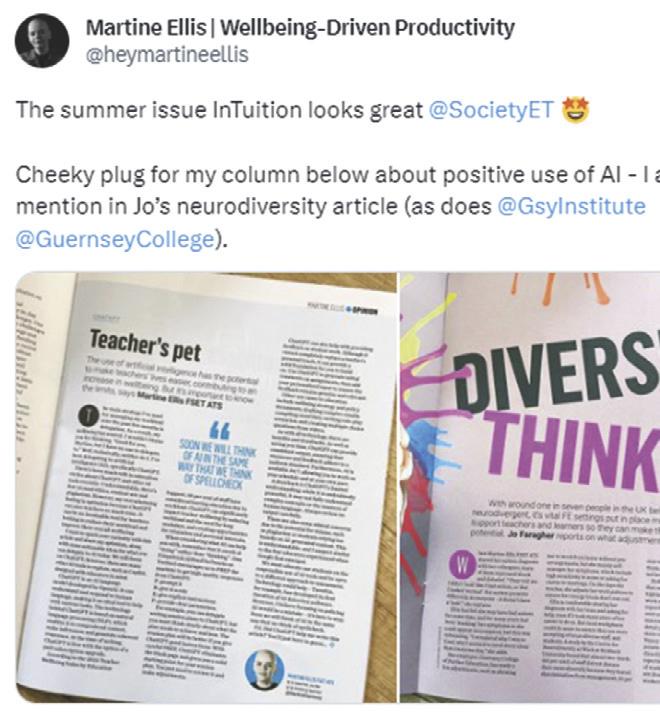
If this is something which interests you, then check out the SET MentorMe platform. Designed specifically with peer-to-peer mentoring in mind, SET MentorMe matches mentors with mentees, within the SET professional community of members, based on mutual areas of interest and professional development.
“We are delighted with the interest in SET MentorMe since it was launched at the end of May,” says Ellie Locke, membership engagement manager. “We already have a number of active mentoring partnerships, and feedback so far is that the platform is very intuitive and easy to navigate.”
Head over to the SET website to find out how you can access this benefit of membership, either as a mentor or mentee.


ONLINE RESOURCES MEMBERS’ CORNER TWITTER.COM/SOCIETYET AUTUMN 2023 INTUITION 37
How did you first get into teaching?
I’ve always been passionate about teaching – I volunteered to support younger students with pottery when at sixth form, and my second job was as a teaching assistant for adolescents with autism and learning disabilities. My passion was reignited after working as a mental health nurse for 10 years, and enjoying the clinical teaching and student support aspects of nursing.

Why did you feel this was the career for you?
As well as my passion and enjoyment of supporting students, I was keen to overcome my fear of public speaking, having passed on several exciting opportunities to present at conferences. I signed up for my PGCE in 2018 and never looked back.
Where has your career taken you so far? Since completing my PGCE, I have delivered training courses and was successful in getting a pastoral support role for apprentice nurses within my NHS trust. I have spent the last year working within our Accredited Learning Centre, working with newly qualified nurses and international recruits across the trust to achieve our accredited preceptorship programme. I also deliver a Level 3 bridging module to prepare students who aspire to degree-level study.
What is your current position?
SPEAKING OUT
preceptorship course for newly qualified nurses is the largest. As it is compulsory, one of our challenges is promoting motivation and engagement among those who may not have chosen to do the course if it was optional.
How has the QTLS programme helped you?
I found the QTLS process very valuable and incredibly thorough. It was a great opportunity to reflect on, and continue to develop, my practice while working alongside my supporter. I would recommend it to anyone.
How would you like your career to develop?
I am excited at the prospect of developing new courses for our workforce, particularly around therapeutic approaches such as solution-focused therapy and traumainformed practice, and quality improvement projects. I am really committed to carer awareness in addition to supporting patients and would like to develop opportunities.




career in t. I spent last within our earning ing ses onal ss ve d p I also el dule to prepare to study tion?
Can you run me through a typical day?


A typical day involves teaching in the mornings, exploring aspects such as delegation, clinical skills, team dynamics and quality improvement. This is followed by tutorials, team meetings, marking and career planning conversations in the afternoon. Working from home is great but I like getting out to clinical areas and meeting preceptees to maintain variety.
What one piece of advice would you have for your former self?




Take any kind of action in pursuing your interests without delay, no matter how small. You never know which doors it may open.
What do you get up to outside work?
Having recently bought my first house, I do lots of DIY and gardening – watching sunflowers grow is incredibly satisfying. I love cycling and sea swimming, and I’m trying to get back into running.


I am officially an ‘academic advisor’, having recently progressed from a trainee academic advisor on completing my QTLS with SET.

















y an visor’, tly from demic on my with SET.


What are the biggest challenges you face?
While we deliver many different courses and CPD options, our




If you would like to be featured in My Life in Teaching, email intuition@redactive.co.uk

A desire to overcome a fear of public speaking, as well as to help student nurses, led Rachael Betty MSET QTLS to a career in teaching
RACHAEL BETTY MSET QTLS is an academic advisor at the Accredited Learning Centre at Cumbria, Northumberland, Tyne & Wear NHS Foundation Trust
MEMBERS’ CORNER MY LIFE IN TEACHING 38 INTUITION AUTUMN 2023
BOOK REVIEWS
IF I COULD TELL YOU ANOTHER THING

EditedbyDavidMiles
The Mathematical Association 2023
This book follows If I Could Tell You One Thing, which was published last year and was so popular that a follow-up was commissioned straight away. Like its predecessor, it is a collection of advice for the successful teaching of maths, from a group of authors with impressive profiles who are well respected in the profession.
The format is the same, but the authors are different. It is aimed at maths teachers, school leaders and teacher educators at all stages of their careers.
For me, the best things about this book are the excellent, relevant examples of how to teach or approach something. The approach is down to earth, and it is good to have a book with practical examples that I feel I can take and use straight away, rather than waiting for or contriving an opportunity. I will very likely purchase the previous book for this reason.
The advice contained in this book covers mainly GCSE and A Level maths, which makes it very useful for maths teachers in the FE sector. I definitely recommend it.

INDEPENDENT THINKING ON BEING A SENDCO

ByGinnyBootman
Independent Thinking Press 2023
Our reviewer is DR ANNE DAVIS MSET QTLS , who has worked as a sixth-form maths teacher and head of maths in south-east England. She is also a private tutor, teaching maths, chemistry and physics, specialising in the 16+ age group. She is a cycling and kayaking coach, with experience of coaching disabled athletes

COACHING YOUNG PEOPLE FOR LEADERSHIP
ByMarkJamieson
Critical Publishing 2023





Although the author works in a school environment and clearly writes primarily about what she knows and her area of expertise, the vast proportion of this book is applicable to all who work in the field, and also educators and school management. It covers most day-to-day issues facing the SENDCO role with good humour and a positive approach, while acknowledging that this is a challenging but very fulfilling role.
I was pleased that this book has a big emphasis on empathy, stopping and breathing, and thinking before acting and speaking. The author acknowledges that this isn’t easy to do and gives advice to help overcome the knee-jerk reactions that can damage the precious relationships that we need to develop and preserve.
Most of the advice given here is common sense, but I liked its inclusion of tips for changing perspectives from our normal reactions to a more productive, relationship-building approach.
As in any book of this nature, it is littered with well-known phrases of modern education such as ‘walk alongside the parents’. But it is more than just a collection of well intended words – it also offers examples and explanations about how to achieve these goals.
This is a new book from this publisher by an awardwinning coach who excels in the area of leadership roles. The aim is to challenge coaches to lead the way in new thinking behind the development of new leaders – in particular young people. These ideas are combined with wellestablished, and also some overlooked, concepts.
The author recognises that leadership coaching is an evolving field, which requires coaches to be ready to embrace changes and to be able to choose which changes are needed and relevant. The emphasis on the coach and young person collaborating on a chosen pathway together is refreshing, and reflects modern thinking across all fields where teaching and coaching have a presence.
This book is unafraid of being critical of current practice, and the pitfalls on chosen pathways to leadership are identified and discussed.
Although this book is full of modern phrases that get a lot of use in books of this nature, it is a good resource and very relevant.
AUTUMN 2023 INTUITION 39 BOOK REVIEWS MEMBERS’ CORNER
InTuition readers receive a 20% discount on this book with the code Another20 at members.m-a.org.uk/ Shop/product/1178
InTuition readers receive a 20% discount on this book with the code intuition20 at crownhouse.co.uk
InTuition readers receive a 20% discount on this book with the code COACHING23 at criticalpublishing.com (valid until 31 December 2023)
“I feel happy knowing that I have provided an individual with knowledge, skills, and information so they can develop and ‘grow’ personally and professionally.”
Debra Barnett, MSET, QTLS


SET MentorMe
Our exclusive mentoring platform
SET MentorMe is a peer-to-peer mentoring platform, exclusive to connect with other members looking to support, or be supported, with professional development based on interest, skills and expertise - and vice versa - and is a











Return to The Society for Education and Training
QTLS status is developed by the Education and Training Foundation and conferred through SET
SET MentorMe: set.etfoundation.co.uk/membership/set-mentorme
157-197 Buckingham Palace Road London SW1W 9SP
Explore