FM BUSINESS IN FOCUS
THE ISSUE: Energy management as a strategic support service from an FM service provider THE INTERVIEWEE: Mike Sewell, head of energy, Kier Group
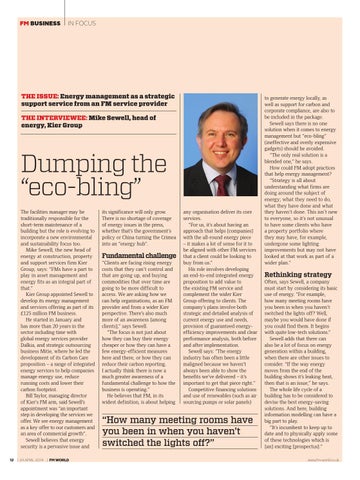
Dumping the “eco-bling” The facilities manager may be traditionally responsible for the short-term maintenance of a building but the role is evolving to incorporate a new environmental and sustainability focus too. Mike Sewell, the new head of energy at construction, property and support services firm Kier Group, says: “FMs have a part to play in asset management and energy fits as an integral part of that.” Kier Group appointed Sewell to develop its energy management and services offering as part of its £125 million FM business. He started in January and has more than 20 years in the sector including time with global energy services provider Dalkia, and strategic outsourcing business Mitie, where he led the development of its Carbon Care proposition – a range of integrated energy services to help companies manage energy use, reduce running costs and lower their carbon footprint. Bill Taylor, managing director of Kier‘s FM arm, said Sewell’s appointment was “an important step in developing the services we offer. We see energy management as a key offer to our customers and an area of commercial growth”. Sewell believes that energy security is a pervasive issue and 12 | 24 APRIL 2014 | FM WORLD
12_BusinessFocus.indd 12
its significance will only grow. There is no shortage of coverage of energy issues in the press, whether that’s the government’s policy or China turning the Crimea into an “energy hub”.
Fundamental challenge “Clients are facing rising energy costs that they can’t control and that are going up, and buying commodities that over time are going to be more difficult to access. We are asking how we can help organisations, as an FM provider and from a wider Kier perspective. There’s also much more of an awareness [among clients],” says Sewell. “The focus is not just about how they can buy their energy cheaper or how they can have a few energy-efficient measures here and there, or how they can reduce their carbon reporting. I actually think there is now a much greater awareness of a fundamental challenge to how the business is operating.” He believes that FM, in its widest definition, is about helping
any organisation deliver its core services. “For us, it’s about having an approach that helps [companies] with the all-round energy piece – it makes a lot of sense for it to be aligned with other FM services that a client could be looking to buy from us.” His role involves developing an end-to-end integrated energy proposition to add value to the existing FM service and complement the wider Kier Group offering to clients. The company’s plans involve both strategic and detailed analysis of current energy use and needs, provision of guaranteed energyefficiency improvements and clear performance analysis, both before and after implementation. Sewell says: “The energy industry has often been a little maligned because we haven’t always been able to show the benefits we’ve delivered – it’s important to get that piece right.” Competitive financing solutions and use of renewables (such as air sourcing pumps or solar panels)
“How many meeting rooms have you been in when you haven’t switched the lights off?”
to generate energy locally, as well as support for carbon and corporate compliance, are also to be included in the package. Sewell says there is no one solution when it comes to energy management but “eco-bling” (ineffective and overly expensive gadgets) should be avoided. “The only real solution is a blended one,” he says. How could FM adopt practices that help energy management? “Strategy is all about understanding what firms are doing around the subject of energy; what they need to do, what they have done and what they haven’t done. This isn’t new to everyone, so it’s not unusual to have some clients who have a property portfolio where they may have, for example, undergone some lighting improvements but may not have looked at that work as part of a wider plan.”
Rethinking strategy Often, says Sewell, a company must start by considering its basic use of energy. “For example, how many meeting rooms have you been in when you haven’t switched the lights off? Well, maybe you would have done if you could find them. It begins with quite low-tech solutions.” Sewell adds that there can also be a lot of focus on energy generation within a building, when there are other issues to consider. “If the way energy moves from the end of the building shows it’s leaking heat, then that is an issue,” he says. The whole life cycle of a building has to be considered to devise the best energy-saving solutions. And here, building information modelling can have a big part to play. “It’s incumbent to keep up to date and to physically apply some of these technologies which is [an] exciting [prospectus].” www.fm-world.co.uk
16/04/2014 15:42