Broken
THE SKY’S THE LIMIT
Fight
Rising demand Parametric policies transforming flood cover

thejournal.cii.co.uk June – July 2023 Florence Dennis on being the CII’s youngest ever local institute president
bonds What next for the Net Zero Insurance Alliance?
or flight Travel insurers battle to get holidaymakers moving
Recognising the rising stars of the insurance profession

Forty promising professionals from claims, underwriting, broking and the London Market will work alongside other rising stars from the insurance profession, collaborate with key regulatory bodies, meet with members of parliament, learn how to handle the media and work together to improve the profession as a whole. Don’t miss the opportunity to be part of this great programme.
Closing date for applications:
To find out more, visit: www.cii.co.uk/new-generation-programme
The CII is seeking the best new talent in insurance to join its flagship talent programme –
The New Generation Group.
CLOSING THE PROTECTION GAP
Russell Higginbotham looks at how the insurance profession can connect with more people and businesses

around digitalisation ourselves to reinvent our propositions and how we interact with our customers.
MIND THE GAP
The one thing that we have not yet cracked is the fundamental challenge for all of us in the insurance profession: to get more people and businesses to buy our products. The ‘protection gap’ (across almost all lines of business) grows bigger each year as people are either unaware of the risks they face and/or choose to take no mitigating action around them.
Iam writing this article from Singapore, where I have just attended and spoken at the 2023 Insurtech Connect (ITC) Asia event, where about 1,400 people from around the region and indeed the globe gather to discuss latest technology trends in the insurance world.
Working for more than three decades in an industry that is some centuries old, I have to say that I found it inspiring and energising to see the potential that we have in the nottoo-distant future, as well as the young and talented people working in our sector, driving the next stage of evolution.
While the data and technology in the insurance world has changed immeasurably through the years and seems set to do so even more rapidly in the future, the fundamentals of insurance remain the same: in exchange for a premium, we transfer risk from a customer balance sheet to our own. We have become much better at understanding, segmenting and mitigating risk, as well as developing appropriate product and service solutions around it.
Broadly, our customers can access risk solutions more easily, buy them more quickly and enjoy benefits of product ownership significantly beyond a simple claims payout. In this sense, and while in no way resting on our laurels, we should be proud of how our great profession has transformed over the years. We have moved away from fears of ‘being disrupted’ to tackling the challenges and opportunities
This is a failure of the insurance industry and one that we need to address head-on. Risk awareness and then attitude towards risk are the areas we need to influence. The pandemic is an example of how external events can influence these factors. Take health insurance for example – research during the pandemic showed that consumers were much more aware of the need for health cover. It also showed that people became much more focused on what different policies covered and what they did not (as opposed to generally buying the cheapest cover). This level of awareness and interest is a very positive thing.
We also saw that customers started to change their views on what benefits they wanted from their policy too. A cash payment or indemnity around the cost of a medical intervention of course has value, but at a time when your needs are more around access to services and rather more basic items such as hand sanitiser and face masks, customers now have a clearer view on what they want from their products. For most of us, thankfully, the pandemic fades into the past but unfortunately, for many people, this heightened awareness and willingness to buy health insurance does too.
As an industry, we need to move quickly and make use of these external events and their impact on people’s views on risk. Climate change and, for example, increased flooding will likely have a similar impact on property risk awareness and demand. This will in turn call for much better publicprivate partnerships to understand and mitigate risk before reasonably priced insurance can transfer the residual away from individuals and businesses. ●
Russell Higginbotham is president of the CII5 thejournal.cii.co.uk / The Journal / June - July 2023 PRESIDENT’S OPINION RUSSELL HIGGINBOTHAM
ILLUSTRATION: MATTHEW BRAZIER
WE SHOULD BE PROUD OF HOW OUR GREAT PROFESSION HAS TRANSFORMED OVER THE YEARS
FROM THE CII TWITTERATI »
@GrahamSpriggs
Local Institutes are the lifeblood of the @CIIGroup. They provide grassroots support. Those working in these institutes give up their valuable time to support their members
@BritishInsurers
An insightful presentation from @griffitha at the @CIIGroup President’s Breakfast Seminar hosted at @SwissRe. The Minister set out the long-term vision for the UK’s #FinancialServices sector & emphasised the critical importance of risk & the #InsuranceIndustry
@InsuranceWomen
We are thrilled to be partnering with the Chartered Insurance Institute once again for our 2023 Women in Insurance Awards ceremony
CII CEO SAYS MORE APPRENTICESHIPS WILL BOOST INSURANCE SECTOR
Alan Vallance, CEO of the CII, spoke at the BIBA Conference 2023 about the value of workplace apprenticeships for attracting new talent into the insurance profession.
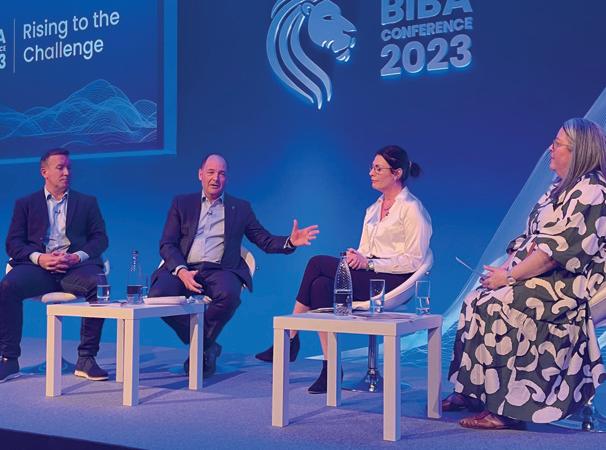
On a panel discussing recruitment challenges faced by the UK market and the need to identify future talent, Vallance said: “Apprenticeships are a great example of structured and alternative pathways to accessing talent. People think of apprenticeships as something for 16- to 18-year-olds but it is actually a very flexible scheme that offers different kinds of qualifications.
“They can help older people returning to work and get people ready for working
MEMBERSHIP
in a different way than they have done before. Apprenticeships also allow access to different pools of talent. If we keep looking in the same places and doing the same things, we won’t be able to get that
NEW COMMUNITIES REPLACE
GI SOCIETIES
As part of its new Strategic Plan, the CII has committed to refreshing and renewing its governance and identity to ensure both the CII and Personal Finance Society can flourish as professional membership bodies.
As a first step, the CII has announced it is moving away from using the three ‘Society’ brands for insurance brokers, claims and underwriting professionals.
Members have told the professional body they found it confusing to become a member of not just the CII, but also a local insurance institute and a Society. In future, we will refer to professional communities of members led by boards of expert practitioners.
In due course, the CII will seek to identify other ways in which the organisation – unique in having two membership bodies – can speak for, and across, the insurance, financial planning and mortgage advice professions.
Tim Groves, programme development and partnerships manager, said: “We have made it simpler to understand the CII’s offer by launching new CII professional community pages on our website and LinkedIn. The web pages will be the home of new content, including dedicated programmes of CPD, and provide further information about each community and their boards. The LinkedIn pages will provide forums for discussion
diversity of talent into our organisations, so I would encourage people to think differently about those sorts of things.”
The CII Aspire Apprenticeship programme can help those seeking apprenticeships, as well as helping firms and employers from all regions and of any size, to find the right training provider and apprenticeship standard for their business. The CII Apprenticeship Awards programme was also introduced in February of this year, with a cash prize available for eight different apprenticeship awards.
Read our article on this year’s BIBA Conference on page 14 of The Journal
across each of the three communities.
“During the last six months we have focused on recruiting additional community board members and we now have a wealth of highly experienced senior practitioners, from a diverse range of backgrounds, who are all passionate about serving their communities and working with the CII.”
→ To find out more, visit: www.cii.co.uk/ professional-communities
Read our special Broking Community section on page 35 of The Journal
6 NEWS thejournal.cii.co.uk / The Journal / June - July 2023
TALENT
@BrokerDirectPlc

Our @CIIGroup status has been renewed! This means that our #insurance advice is certified as of the highest quality and based solely on the needs of our customers
@InsCharities
Wonderful to hear local poet @mikegarry at the 150-year celebration for @CIIGroup Manchester Institute. He spoke of community and being there for those who ask. Huge resonance with @InsCharities and why we exist
TALENT
CII SEEKS FUTURE LEADERS FOR NEW GENERATION PROGRAMME
The CII is seeking rising stars to join its talent scheme, the New Generation Programme. The 2023/2024 class will be made up of 40 promising professionals from claims, underwriting, broking and the London market. Each group will produce a project or initiative that could make a significant difference to the insurance profession and present it to the CII board. Typically taking about six months to complete and involving collaboration with members across the country, these projects are both challenging and rewarding. Previous reports produced include Reputation Risk in a Social Media Culture, Insurance Implications of Fracking, and, most recently, the Hybrid Working London Market report.

This year’s programme will include:
● An interactive session with key
@ToddCue
We pride ourselves on our service which we believe is the key to our success and we are delighted to be one of the few firms which has gained Chartered Status from the CII
20,267
Followers and counting...
CII company 88.9k followers
CII Group 50.2k members
personnel from the Financial Conduct Authority.
● Talks from Members of Parliament and lobbying organisations in the insurance sector, as well as a tour of the Houses of Parliament.
● Training on subjects such as leadership and handling the media.
Alan Vallance, CII CEO, said: “The CII’s flagship New Generation Programme has been helping to advance talent in our profession since 2011. This year’s intake will take us beyond 500 participants, which is a phenomenal achievement. The New Gen Programme continues to provide a fantastic opportunity for those early in their careers to take on a challenge that tests their ability and gives them the confidence to become a leader of the future.”
Applicants are likely to hold a minimum qualification of Dip CII level and five to 10 years’ experience within the general insurance profession. They must be CII members, working within insurance claims, broking, underwriting or the London market.
Applications from groups that are currently underrepresented in the profession are particularly encouraged, such as women, ethnic minorities, members of the LGBTQ+ community, and those identifying with both seen and unseen disabilities. The closing date for applications is 7 August 2023.
→ More information and how to apply, visit: www.cii.co.uk/new-generation-programme
CII NEW GEN REPORT EXPLORES THREAT OF HYBRID WORKING TO LONDON INSURANCE MARKET
Participants in the CII’s New Generation Programme have published a report exploring the potential threat of the hybrid working model to London’s insurance market.
Data gathered from a diverse group of respondents has been used to provide insights and recommendations on how the London market can adapt to maintain its position as global leader in the insurance profession.
‘The new normal’ sees a drastic shift in the amount of time spent working in
traditional office spaces. Pre-pandemic, 90% of survey respondents attended the office four times a week or more. In stark

contrast, 86% are now attending the office three times a week or less.
Recommendations for improving development in the hybrid working model saw three concurrent themes: structured learning such as formalised training or development days; coordinated office attendance for increased productivity and interaction between junior and senior colleagues; and mentoring schemes.
→ To read the full report, visit: www.cii.co.uk/107063
7 thejournal.cii.co.uk / The Journal / June - July 2023
Twitter
@CIIGroup
LONDON MARKET
NEWS
CII ANNOUNCES BRIAN CARUTH AS INTERIM VICE-PRESIDENT FOR LOCAL INSTITUTES
The CII has announced the appointment of Brian Caruth as interim vice-president for local institutes.
In the role, Caruth will chair the Local Institute National Forum, which provides a voice to local institutes across the UK, ensuring that projects, initiatives, successes and concerns are proactively discussed and fed back to the CII Group board.
Caruth is well versed in local institute matters, having served as a council member for the Insurance Institute of Northern Ireland (IINI) for more than 30 years. During 2018 and 2019, he served as president of the IINI, during which time he received the Belfast Ambassador Award for working with the CII’s regional membership team to help highlight and

promote the Belfast region.
Caruth said: “I am delighted to have been asked to serve as the vice-president for local institutes. I am looking forward to working with CII members across the UK to help drive forward the important work that is already underway across our 55 local institutes.”
CITY MINISTER APPEARS AT CII PRESIDENT’S BREAKFAST
“The UK can be the world’s market,” said the economic secretary to the Treasury and City Minster, the Honourable Andrew Griffith MP, as he spoke at the CII’s inaugural President’s Breakfast in May about the “enormous opportunity” that the financial services sector gives the UK. The event was hosted by CII president, Russell Higginbotham, at Swiss Re headquarters in London.
The session was the first of three events being held by Higginbotham during his year as CII president, designed to bring senior leaders together from across the insurance and financial services professions to cultivate discussion and thought leadership.
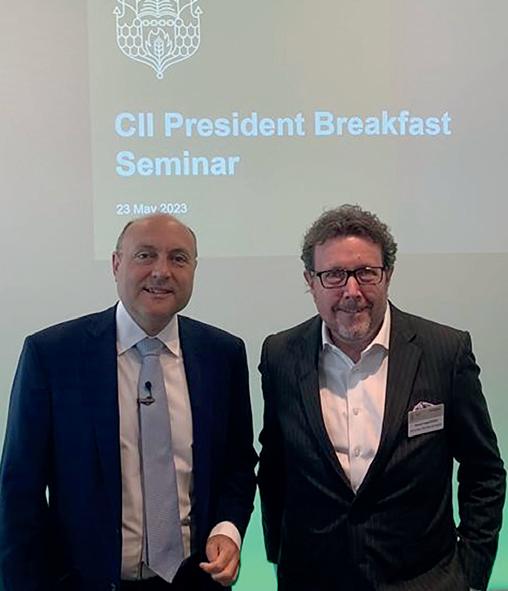
Griffith spoke about how the insurance sector had shaped the City of London over time and discussed the work the government is undertaking to “compete in this new world with speed and agility”, including through the Financial Services and Markets Bill that is currently moving through parliament.
Helen Phillips, CII Group board chair, said: “We are very pleased to announce Brian Caruth as interim vice-president for local institutes, bringing a wealth of knowledge and experience to the position. He is a council member of the Insurance Institute of Northern Ireland, a partner in Andrews Insurances, a representative for Northern Ireland & Isle of Man on the Local Institute National Forum, and serves on the local Personal Finance Society committee. In 2018/2019, he also served as president of the Insurance Institute of Northern Ireland. We offer Brian a warm welcome.”
→ To find out more about your local institute, visit: www.cii.co.uk/ local-institutes
MEMBERSHIP
CII LISTED IN TOP 10 OF UK’S LARGEST PROFESSIONAL BODIES LIST
The CII features at number 10 on the UK’s Largest Professional Bodies list from MemberWise Network, with CII membership at 122,000.
The MemberWise Network recently shared its updated list for 2023, with the Royal College of Nursing at first place; an organisation that represents one of the largest workforces in the UK. Other bodies included are those supporting and representing longstanding professions such as accountancy, law and medicine.
Alan Vallance, CII CEO, said: “We are very pleased to have delivered a member experience that finds the Institute in the top 10 of the UK’s Largest Professional Bodies list. This comes as a result of the hard work demonstrated by our staff and volunteers, which will continue as we strive to build our membership in line with our five-year Strategic Plan.”
→ To read the CII’s Strategic Plan, visit: www.cii.co.uk/strategic-plan
8 NEWS thejournal.cii.co.uk / The Journal / June - July 2023 LOCAL INSTITUTES
REGULATION
ACCREDITATION

WHAT’S NEW
Did you know the CII has a service that accredits learning programmes and events for their quality as an effective CPD learning activity?

In 2023, a variety of such programmes have been accredited, where these learning activities have either achieved CII CPD accreditation status for the first time or have successfully completed an annual maintenance review and been awarded re-accreditation. Take a look at the table below which includes a taster of some of these programmes.
→ For a more comprehensive list of accredited programmes, visit: www.ciigroup.org/cpd-accredited-companies
OrganisationProgrammeOrganisationProgramme
Allianz SEP&C Academy training programmes
Allianz SELife and Health training programmes

Atlanta GroupContact Centre Induction programme
BankhallProfessional Development days
Virtual Learning webinars
Skills workshops
Fire Protection Association RISC Authority webinars
LUCIDLUCID 2023
MarshMarine insurance course
Online partnership Strategic Level relationship programme
RSABroker leadership programme
ALAN VALLANCE, CEO
TRUST AND CONFIDENCE
“I promise to pay the bearer on demand the sum of…” These words are written on every Bank of England banknote. This ‘promise’ dates from long ago when its notes represented deposits of gold. As the link with gold has faded the meaning has evolved such that holders today can be confident that they can exchange any Bank of England banknote ‘on demand’ for other Bank of England banknotes of the same face value. It is this trust – underpinned through the Bank’s actions for hundreds of years – that gives what are otherwise thin sheets of printed polymer their value today.
Insurance contracts should elicit similar feelings of trust among their holders, with a promise to replace new with old in the same way as with banknotes, or some other agreed outcome in the event of risk crystallisation.






Simply BizLearning events
InfoPro DigitalPost learningSt James’s Place Wealth Management
Practice Support Specialists (PSS) development framework
Invesco Perpetual Investment seminars threesixty Services CPD events


Lloyd’s Market Association Contract Wordings Foundation programme
Multi organisation investment events
UCL (University College London)
Multi organisation investment events
Natural Hazards for InsurersPost Graduate Certificate course
Power of 3 virtual event
→ For more information on CII Accreditation Services visit the CII Accreditation Collaboration Portal or email the team at CIIaccreditation@CII.co.uk
However, as my colleague Dr Matthew Connell writes in this issue, while the general public have been surprisingly relaxed about increases in insurance premiums in the past year, they remain concerned about the speed of claims and want more choice about how they are paid. These are feelings that have persisted for some time. We have been conducting our Public Trust Index survey since 2018 and the latest findings indicate that there remain a great many opportunities to improve trust between the public and insurance providers.
Abraham Lincoln once wrote “If you trust, you will be disappointed occasionally, but if you mistrust, you will be miserable all the time.” I suspect as a profession we would hope the general public and firms would support this notion, but our research indicates that there is more we can collectively do to meet the reality of customer expectations and that is a challenge we face collectively. As part of our new Strategic Plan, we have committed to play our part by publishing more of the detail behind our Public Trust Index and raising awareness of its findings, so firms have greater intelligence from which to inform approaches. But I’d also appreciate hearing from members about what more you think we can do through our surveys and other work to inform and assist the cultivation of a virtuous cycle of collective interest between the public and profession into the future, which is in all our interest.
9 NEWS thejournal.cii.co.uk / The Journal / June - July 2023
ILLUSTRATION:
MATTHEW BRAZIER
INTERNATIONAL PROFESSIONAL PARTNER FIRM STATUS AWARDED TO BRAXTONE GROUP

CII regional director Gaenor Jones has presented the CEO of Braxtone Group with the institute’s International Professional Partner firm plaque. International Professional Partner Firms
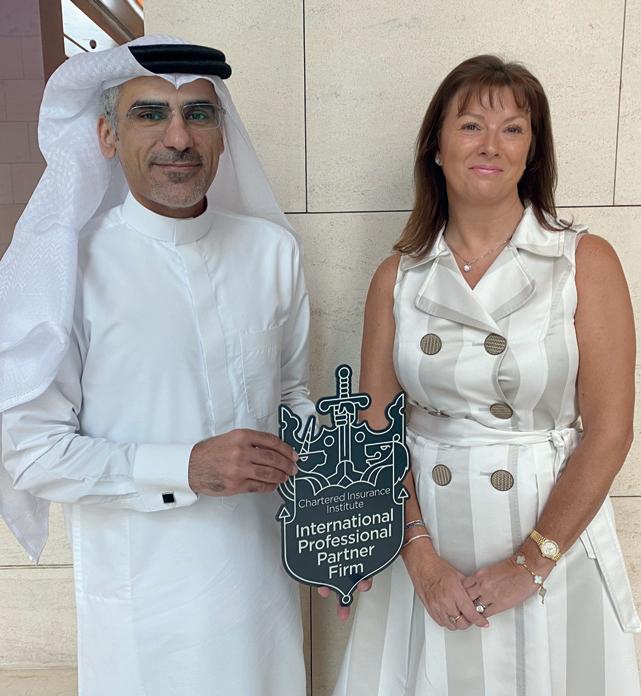
are those that have aligned themselves with the CII’s code of ethics and whose employees are committed to attaining CII qualifications to uphold the highest professional standards.
CII ATTENDS HEALTH &
PROTECTION ROUNDTABLE
A roundtable event held in Dubai, facilitated by Health & Protection magazine, saw CIII regional director of the Middle East, Gaenor Jones, contribute on a range of topics pertinent to the health insurance sector.

These included the issue of recruitment in the Middle East in the context of global mobility, where Jones spoke about the increasing trend of companies employing professionals from the local and regional areas. She also conveyed the importance of their attaining internationally recognised qualifications and explained how the CII is assisting in this endeavour, which is supported by the majority of GCC governments and regulators.
MIDDLE EAST NOMINATIONS FOR MIDDLE EAST INSURANCE INDUSTRY AWARDS
The CII’s Middle East office has been nominated by third parties for two categories in the prestigious Middle East Insurance Industry Awards, which take place at the end of the year.
Firstly, the Educational & Training Initiative category nomination recognises the entity that “has provided product innovation and customer service, while encouraging the growth of insurance as a core component of good financial planning through educational initiatives”.
Secondly, CII regional director Gaenor Jones has been nominated in the Woman Leader category, which recognises “a leading female executive whose actions best demonstrate the crucial contribution that women make to the insurance industry in MENA”.
MIDDLE EAST
UAE
NATIONALISATION PROGRAMME AIDED BY CII QUALIFICATIONS ATTAINMENT
Emirati students enrolled on a qualifications programme facilitated by Emirates Institute of Finance, supported by the CII, are enjoying great success.

They started the programme with the FIT unit and then moved on to W01, with 97% of the cohort achieving a pass rate on the W01 units.
In the coming weeks, the cohort will study for WUE and WCE units to attain the certificate. The student cohort is comprised of graduates who are not from an insurance sector background, so the achievement is especially commendable.
10 INTERNATIONAL NEWS thejournal.cii.co.uk / The Journal / June - July 2023
DUBAI
MIDDLE EAST
CII VISITS BUSINESS PARTNERS ACROSS ASIA-PACIFIC




The CII team including Kenny Siu, regional director of Hong Kong & Asia-Pacific; Alpha Ho regional corporate development manager of Hong Kong and Asia-Pacific; and executive director of membership and engagement, Azlina Bulmer, visited business partners across the Asia-Pacific region.

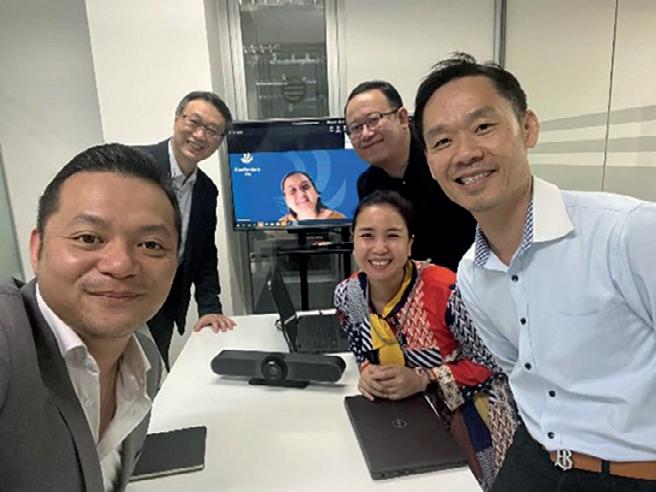

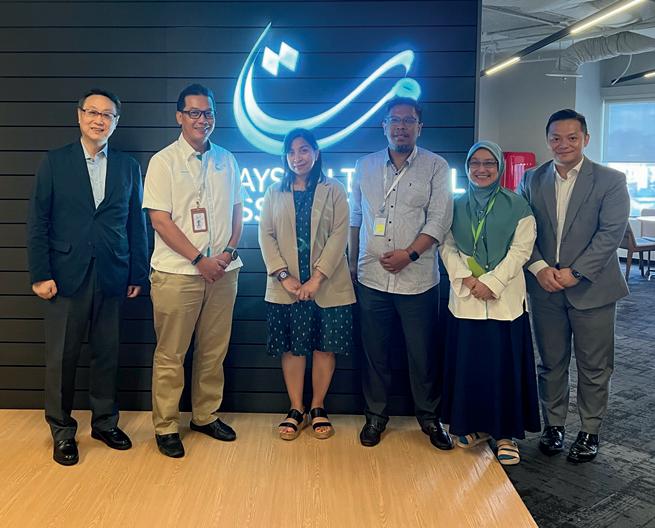
Visits included Singapore where the CII met with Singapore Insurance Institute, Singapore College of Insurance and Grandiose Pte Ltd, one of our international professional partner firms in Singapore; and Malaysia, where the team visited the Malaysia Insurance Institute and the Malaysia Takaful Association in Kuala Lumpur for discussions following the lifting of travel restrictions in the area.
The CII also held meetings with BlueVenture TPA, a business administration service along with different stakeholders and goodwill ambassadors based in Bangkok, Thailand. g
JOINTNETWORKING EVENT AT LLOYD’S ASIA OFFICE
In collaboration with Lloyd’s China, the CII hosted the first CII professional networking event in Singapore, in June 2023.
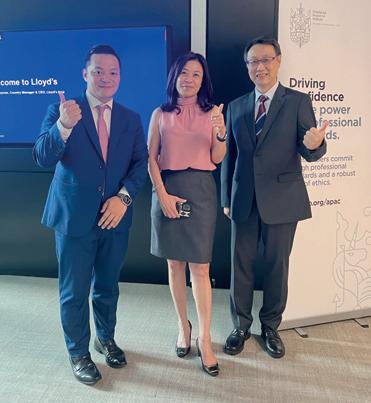
Azlina Bulmer, CII executive director of membership and engagement, shared the recently launched CII Strategic Plan to more than 30 insurance and financial services professionals at the event, which was hosted at the Lloyd’s office, and was then followed by a CII certificate presentation to Chartered and Fellowship awardees in Singapore.
ASIA-PACIFIC







SUPPORTING PROFESSIONALISM IN THE ASIAPACIFIC REGION



Alan Vallance, CEO of the CII, and Azlina Bulmer, membership and engagement director at the CII, visited Hong Kong in March, where they met with the Legislative Council and the local insurance regulator.
After discussions with The Hon Chan Kin-por, GBS, JP, Legislative Council member and Executive Council member of Hong Kong, the CII representatives met with the Insurance Authority to discuss how to support talent development in Hong Kong, in line with government policy to nurture domestic talent while adopting an open and proactive talentattraction policy internationally.
11 INTERNATIONAL NEWS thejournal.cii.co.uk / The Journal / June - July 2023
SINGAPORE
ASIA-PACIFIC
A S P of re th pr at a Fe
Singapore College of Insurance, Singapore
Malaysia Insurance Institute, Malaysia
BlueVenture TPA, Thailand
Takaful Association, Malaysia
MANCHESTER
MANCHESTER CELEBRATES MAGNIFICENT MILESTONE
Throughout 2023, the Insurance Institute of Manchester will be celebrating its 150th anniversary.
Manchester is the oldest insurance institute in the world and the formation of the Institute preceded, and directly led to, the establishment of the CII.
To mark this milestone, the Institute held a special conference and exhibition at the Midland Hotel in Manchester. The theme of the day was ‘Insurance Manchester –the past, the present and the future’ with keynote speakers including CII CEO Alan Vallance, as well as an industry panel discussion, an exhibition and member networking opportunities.
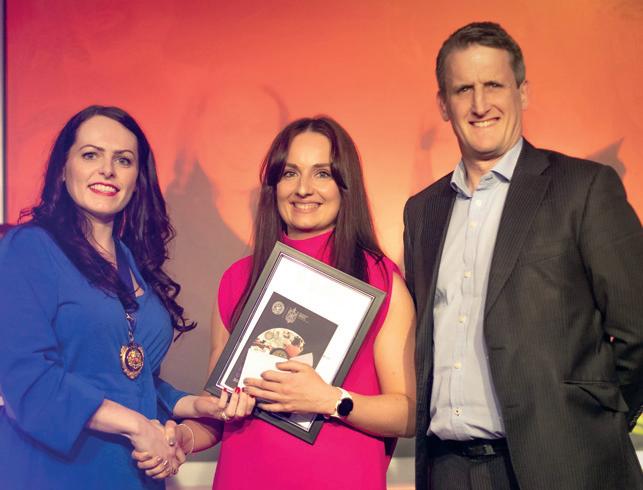
The conference was followed by a networking dinner welcoming members to celebrate with Manchester council members past and present. The dinner was also an opportunity to celebrate the success of members
LEEDS
locally, with the Jubilee Prize giving highlighting and rewarding members for successful completion of CII qualifications.
→ For more information, visit: www.cii.co.uk/manchester
LAUNCH OF FUTURE LEADERS SUPPORT PROGRAMME
The Insurance Institute of Leeds has launched its Evolving Leadership programme, designed to support members with developing and enhancing their leadership skills.
The 10 half-day sessions running throughout the second half of the year will help a cohort of members who are at the start or in the middle of their own leadership development and who have a strong desire to develop personally.
Leeds Institute president Kate Edmondson said: “This opportunity for members will be challenging,
CHARITY INSTITUTES SUPPORT INSURANCE CHARITIES AWARENESS WEEK
interactive and inspiring. Delegates will learn techniques in good practice in leadership and management, client care and solving problems. There will be continuity, with application between sessions to maintain momentum and to enable attendees to build on their experience throughout the programme. There are practical guidelines to apply in day-to-day work and time devoted to allow the group to discuss the real-life situations experienced.”
→ For more information, visit: www.cii.co.uk/leeds
Several of our local institutes have been out in force across June, supporting the Insurance Charities Awareness Week.
The Insurance Charities is the only charity for the UK and Irish insurance profession, providing support for current and former insurance employees and their dependants. The charity wants to ensure no insurance employee who is struggling misses out on the financial and practical support it can offer.
As we all experience a sharp rise in the cost of living, the charity’s support may be needed now more than ever. Last year, more than £1.3m was awarded to support insurance people in need.
→ For more information and to find out how you or your colleagues can apply for support, visit: www.theinsurancecharities.org.uk
12 REGIONAL NEWS thejournal.cii.co.uk / The Journal / June - July 2023 EVENTS THE IMPORTANCE OF EFFECTIVE RISK PRESENTATIONS → 12:30pm – 2:00pm Insurance of Northampton cii.co.uk/northampton 04 JULY TEAM EMPOWERMENT – WHAT RESEARCH TELLS US → 12:30pm – 1:30pm Institute of Newcastle upon Tyne cii.co.uk/newcastle 11 JULY HE IMPORTANCE OF EMOTIONAL INTELLIGENCE AT WORK → 12:00pm – 1:00pm Institute of Bedford and Milton Keynes cii.co.uk/bedford 12 JULY
President of the Insurance Institute of Manchester, Sandra McDonald, left, with Rebecca Taylor and Andrew Hope, of Sedgwick
CHRIS LOWE CELEBRATES HIS CII HALF-CENTURY
The Insurance Institute of Luton and Hertfordshire has been helping life vicepresident Chris Lowe celebrate a recent milestone, after reaching 50 years as a CII member.
In 1972, Lowe joined Norwich Union in Nottingham and was required to pass his ACII within five years. To help him achieve this, he joined Nottingham Insurance Institute (NII) and by 1974 he had joined Provincial Insurance as a trainee inspector.

In 1976, Lowe married the second person he had been introduced to when he joined the NII on 1 April 1974. Two children and four grandchildren later proved he made a wise choice, and he also gained his ACII.
Fully qualified, Lowe joined Cornhill Insurance in 1978 but retained CII
NORTHEAST ANNUAL CONFERENCE BACK AT THE RACES
The Insurance Institutes of the Northeast are returning to Wetherby Racecourse in October for the 2023 edition of their popular inperson conference.
This year’s focus is ‘Insuring the future: Modern methods of construction, the underwriting of modular buildings, and impacts on claims’ and the event takes place on Thursday 12 October,
promising interactive sessions from industry experts and delivering up to six hours of continuing professional development for attendees.
More information and booking options will be provided in the coming weeks on the websites of the insurance institutes of Halifax & Bradford, Hull, Leeds, Middlesbrough, Newcastle upon Tyne, Sheffield and York.
membership at Derby, as he was in the local institute cricket team. He spent the next few years organising corporate hospitality at Cornhill Test matches and meeting some famous sports personalities, before joining Brown Shipley Insurance Brokers in 1987.
Dealing with many independent schools in Hertfordshire, plus several famous public schools, Lowe was responsible for many innovations in education insurance and literally ‘wrote the book’ on insurance for schools opting out from Local Authority Control.
Lowe joined the council of the Insurance Institute of Luton and St Albans – now Luton and Hertfordshire – in 1984 and was elected for his first term as president in 1988, followed by three more terms – in 2007, 2008 and 2015.
Lowe retired in September 2017, determined to make full use of his Middlesex County Cricket Club membership and his Northampton Saints season ticket, as well as working for local church groups and organising quiz nights.
KENT CONFERENCE TO RETURN IN 2024
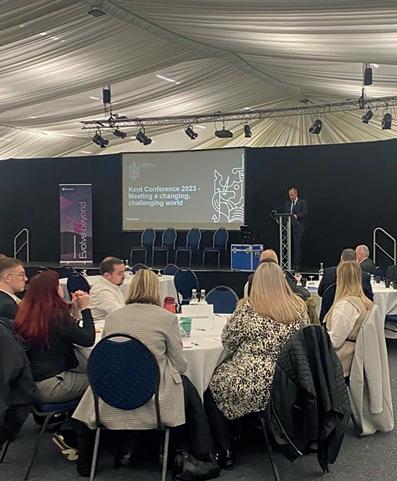
The annual Kent Conference will return for its 11th edition on 16 April 2024. The Insurance Institutes of Mid-Kent and Royal Tunbridge Wells lead a group of southeast-based institutes to provide a fantastic day of education, debate and networking.
Further information will be provided in the coming months about the event, which will take place at Kent Showground, Maidstone.
→ For more information, visit: www.cii.co.uk/mid-kent
13 REGIONAL NEWS thejournal.cii.co.uk / The Journal / June - July 2023 MARINE CARGO INSURANCE → 12:30pm – 1:30pm Institute of Cheltenham & Gloucester cii.co.uk/cheltenham-gloucester 12 JULY FCA GI CONSUMER DUTY AND UPDATE → 12:00pm – 1:00pm Institute of York cii.co.uk/york MOTOR FLEET INSURANCE –IN A NUTSHELL → 12:00pm – 1:00pm Institute of Luton and Hertfordshire cii.co.uk/luton-hertfordshire 18 JULY 20 JULY
AND HERTFORDSHIRE
LUTON
KENT
NORTHEAST
Luke Holloway reports on the key takeaways from this year’s BIBA Conference in Manchester
The 45th British Insurance Brokers’ Association (BIBA) Conference took place in May this year, with the event welcoming more than 9,000 professionals to Manchester.
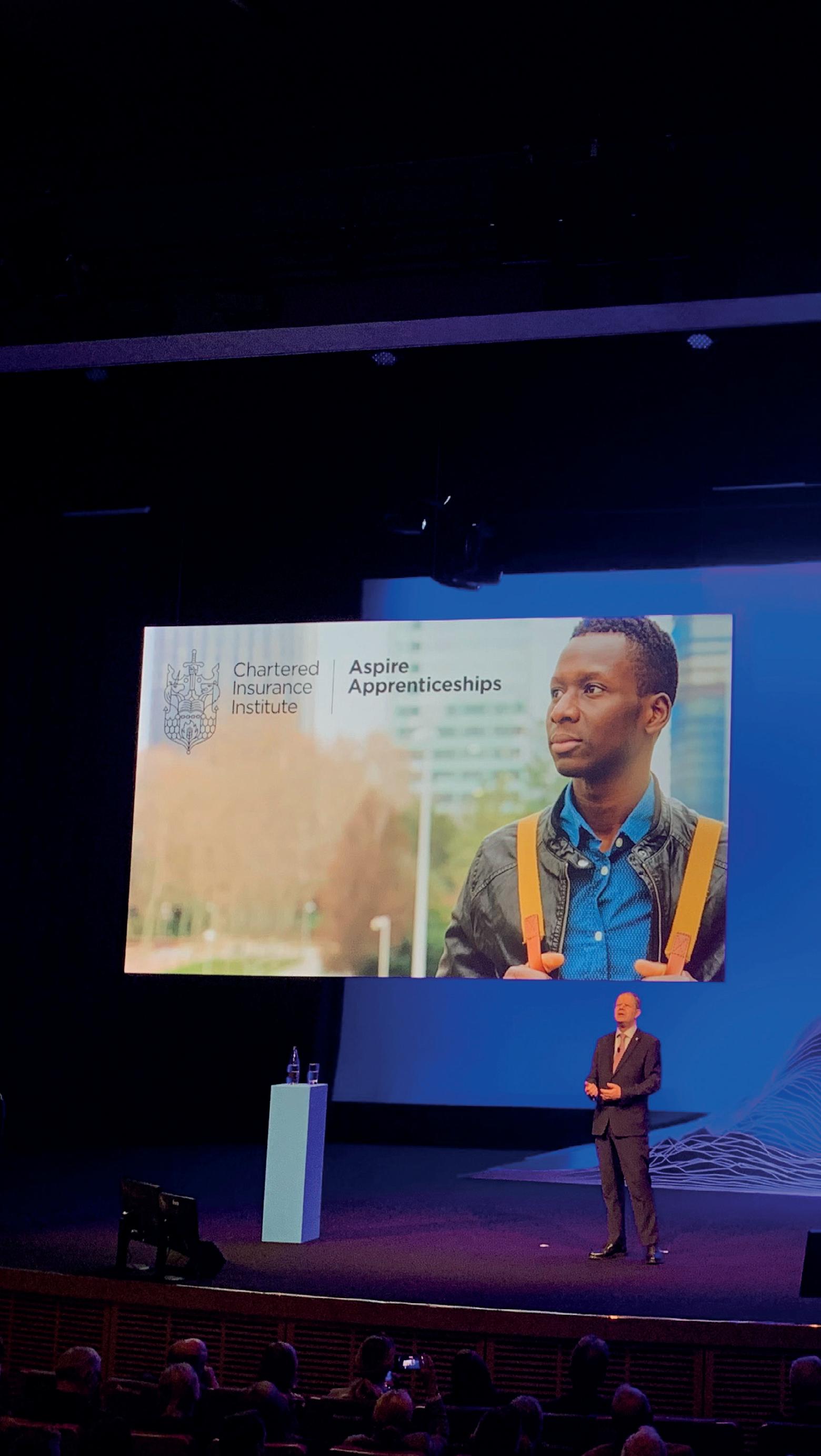
Introducing this year’s theme of ‘Rising to the challenge’, BIBA CEO Steve White praised the broking community for its resilience and adaptability in recent times, before urging the profession to step up in its mission to engage with the next generation of talent. At this point, he also made special mention of BIBA’s continuing partnership with the CII’s Aspire Apprenticeships programme and its importance in attracting and developing the next wave of brokers.
The two-day conference boasted a host of keynote speakers, including representatives from the Financial Conduct Authority, the Association of British Insurers, political powerhouses and Olympic champions, as well as hundreds of brokerages promoting their focus for the future to thousands of delegates from across the world. Here are some of our key takeaways from the flagship event…
1 FIRMS NEED A TALENT USP
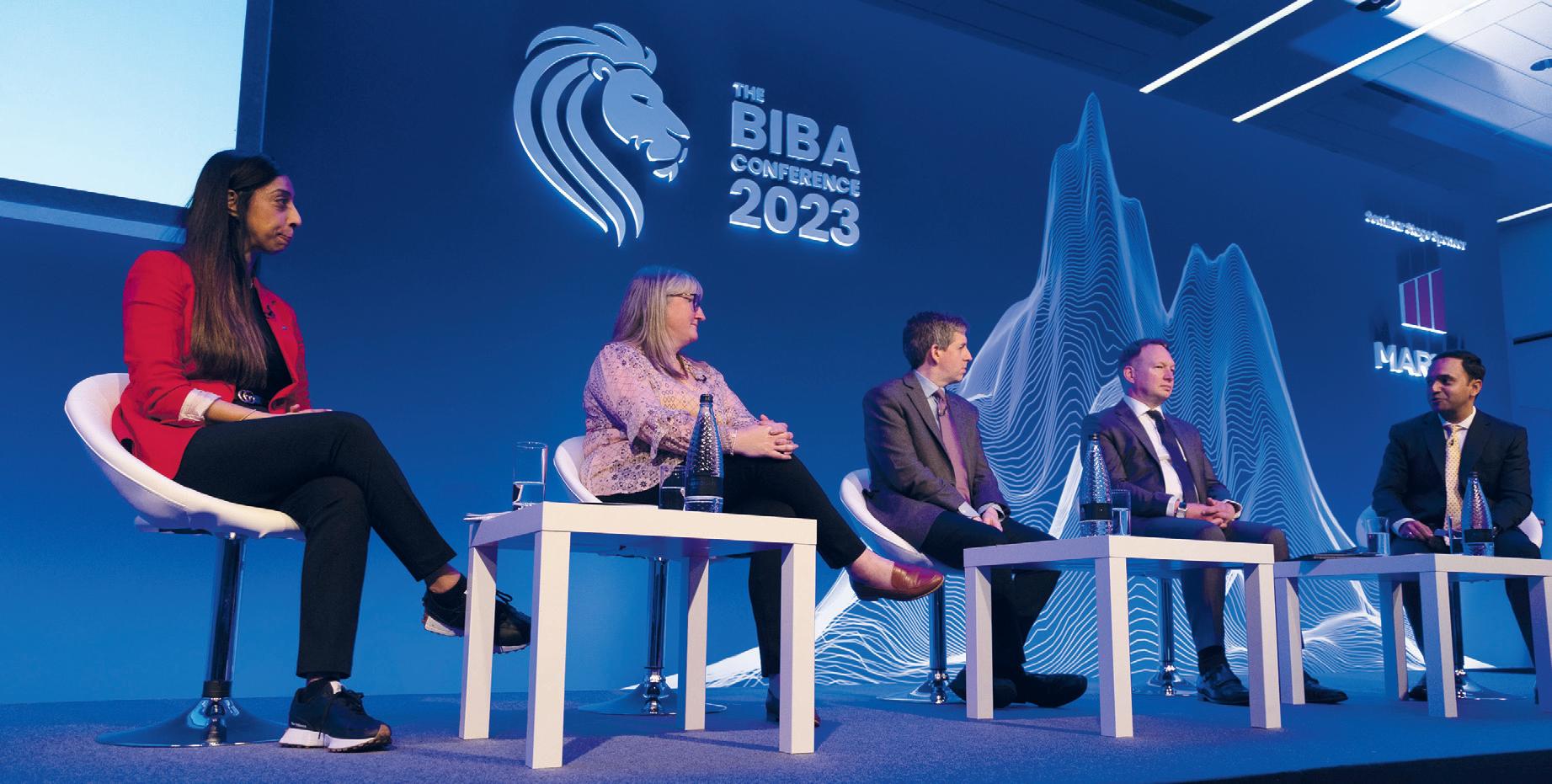
The hot topic of recruitment was the focus of a panel debate featuring CII CEO Alan Vallance, who banged the drum for apprenticeships as a way of attracting new talent into the profession, while urging insurers to look at their organisations and decide what is
RISING TO THE CHALLENGE
thejournal.cii.co.uk / The Journal / June - July 2023 BROKING 14
unique about them that they can offer prospective new employees.
“Apprenticeships are a great example of structured and alternative pathways to accessing talent,” Vallance said during the discussion, which featured experts Ella Wardleworth-Phillips, senior manager at The Careers & Enterprise; and Matt Green, chief executive at IDEX Consulting. “People think of apprenticeships as something for 16- to 18-year-olds but it is actually a very flexible scheme that offers different kinds of qualifications.
“They can help older people returning to work and get people ready for working in a different way than they have done before. Apprenticeships also allow access to different pools of talent. If we keep looking in the same places and doing the same things, we won’t be able to get that diversity of talent into our organisations,” said Vallance.
Green agreed: “Almost every broker I have spoken to during this year’s conference has said that the biggest challenge to their business is attracting new talent. Then you dig a little further and ask, ‘Where does recruitment sit in your list of priorities?’ and it is always behind clients. To get the best people in the market, you have got to have a long-term strategy,” he stressed. “I would encourage
people to think differently,” said Vallance in conclusion. “Organisations should take a look at themselves and work out what their USP is for talent.”
2 CYBER COVER: A FORCE FOR GOOD

Insurance can be a force for good in making the UK the safest place in the world to do business, Lindy Cameron, CEO of the National Cyber Security Centre (NCSC), told the audience during the keynote speech on cyber risk.
In 2022, nearly a third (32%) of all businesses and nearly a quarter of all charities in the UK reported a cyber incident, “and those are just the ones that reported it”, emphasised Cameron. She went on to highlight the massive implications these incidents have, not only for businesses but also for the insurance profession.

“As I see it, the NCSC and the insurance industry have a shared interest in developing much more sophisticated and better priced products in the market to help manage the risk of cyberattacks by reducing the impact and harm they cause in the UK,” said Cameron.
“For the cyber insurance industry, we think there is a real added incentive to ensure that your customers make better informed decisions about their own cyber risk requirements and their own resilience. We want them to deepen their understanding of the coverage on offer and of the value of insurance. We would like you to help them choose the cyber insurance policy that is right for their businesses, while also making sure that insurers are not paying out for avoidable claims – that would mean a positive correlation between customers implementing good cybersecurity and your bottom line.”
Cameron said the NCSC wants to see an “aspirational cyber culture” where clients focus on ensuring their resilience and therefore reducing the high premiums that can deter new customers.
thejournal.cii.co.uk / The Journal / June - July 2023 BROKING 15
Steve White, BIBA Inset: Host, Huw Edwards →
“On a macro level, we believe the insurance industry can be a force for good in making the UK the safest place in the world to do business. Prosperity and economic security go hand in hand and cyber insurance is one of the few market-based levers that can incentivise organisations to implement security-controlled resilience measures,” she said.
“We don’t believe this should all be done by regulation; the market has a key role.”
ESG FROM THE TOP DOWN
Brokers are experiencing increased scrutiny from clients, investors and regulators to show that they have a grip on environmental, social and governance (ESG) issues. This year, the CII and BIBA have both published new guidance to support insurance professionals in this area.
At a seminar session debating ways for firms to approach ESG, Laura Hancock, managing director of Yutree and chair of the CII Broking Community, said everything firms do from the top down feeds into their culture and shows clients, employees and society that the firms have integrity and values that align with their own.
“For our firm, ESG is a consolidation of everything we have built,” said Hancock. “We have a clear business strategy for the future and ESG has a very important place in that.
“It can be quick wins like LED lighting in the office and better
recycling, but we have also introduced wellbeing workshops and mental health first aiders, while improving our staff packages and policies. We also look out into the community; we support local theatre groups and rugby foundations for women and children, as well as charities that raised money during the pandemic and, in terms of governance, we have measures in place to report on all of this.
“All of these things build up and create a culture that shows you care about the world around you. Ultimately, your positive actions and behaviours will speak for themselves,” she said.
“ESG isn’t something you need to start,” added Baljinder Mahil, head of distribution operations at Axa XL, “the likelihood is you are already doing it. It may already be happening in pockets of the organisation, but the key is to bring that together.
economy and cost-ofliving crisis.
The cause of the current economic situation in the UK and the sometimes volatile relationship between politics and the economy was fiercely debated at this year’s conference by a panel including former Chancellors of the Exchequer George Osborne and the Right Honourable Philip Hammond; former MP and shadow Chancellor Ed Balls; and former communications strategist in Tony Blair’s government, Alastair Campbell.
Osborne pointed to other countries across Europe also struggling with high inflation, with key drivers being the war in Ukraine, political instability and the after-effects of the Covid-19 pandemic.
He added: “The evidence is pretty straightforward now: Brexit has definitely hit the UK in a way that has meant the UK has had a bigger economic setback than our peers in France, Germany and other western democracies. Whether that is a one-off shock as we leave our single biggest market, or whether that is a
HAS INSURANCE PREMIUM TAX PEAKED?
“It has to be top down and engagement across the firm is crucial,” she said. “The leadership team need to be accountable for the strategy; they need to set clear goals and metrics to be able to track those strategic goals across the business.” 4
Unsurprisingly, a theme that resonated across many speeches and seminars was the UK
3
ESG ISN’T SOMETHING YOU NEED TO START. IT MAY ALREADY BE HAPPENING IN POCKETS OF THE ORGANISATION, BUT THE KEY IS TO BRING THAT TOGETHER
thejournal.cii.co.uk / The Journal / June - July 2023 16 BROKING
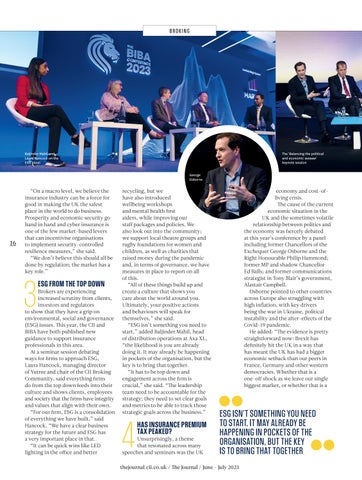
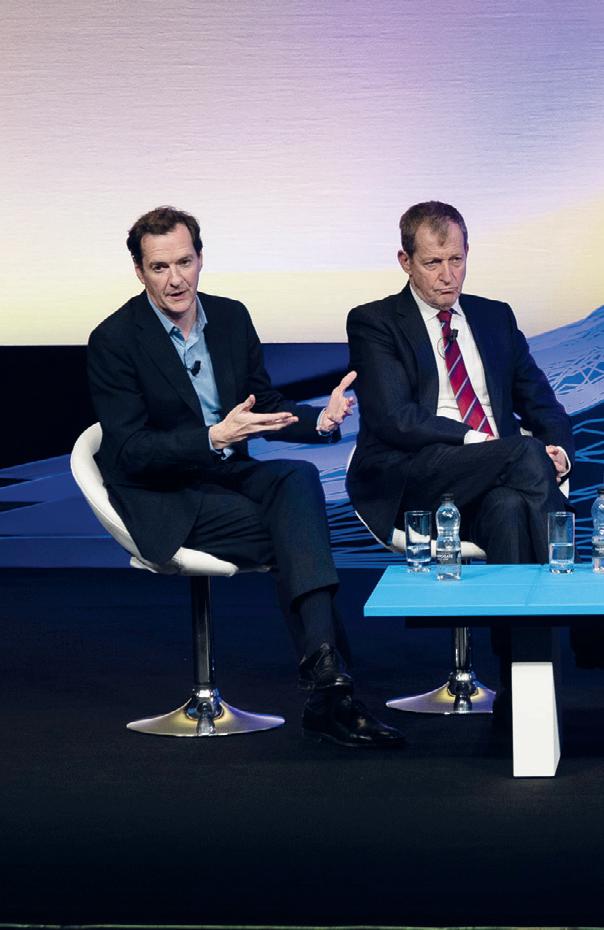
Baljinder Mahil and Laura Hancock on the ESG panel
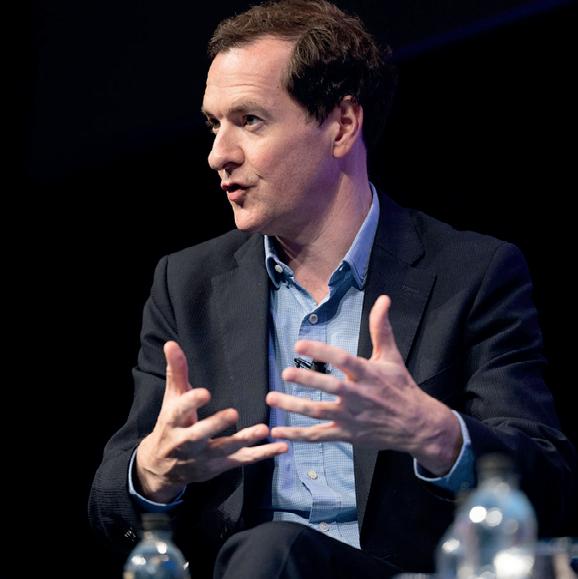
George Osborne
The 'Balancing the political and economic seesaw' keynote session
permanent blow to the UK, is not yet clear. I fear it is the latter.”
However, Osborne pointed to the city of Manchester as a shining example in a torrid economic time. “This city is booming,” he said, “so for all the problems that Britain has, it is still one of the most competitive places in the world to do business and, for financial services such as insurance, one of the best places in the world.”
On the subject of insurance, Hammond spoke about BIBA’s campaign for the government to freeze Insurance Premium Tax (IPT) – which he himself increased to its current 12% when he was Chancellor.
“[As Chancellor], the right thing to do is to increase the taxes that will minimise damage to economic growth and the Treasury’s analysis at that time was that IPT was a tax that could be increased without causing significant economic damage. But I think now, we have probably reached an equilibrium.”
5 INSURANCE HEROES
This year’s CII fringe session saw an expert panel throw light on what it means to be a good insurance broker.

“Good broking to us is about being trusted advisers to our clients, which means you do sell insurance but, more importantly, you offer advice,” said CII Broking Community chair Hancock. “We have now got to a point where our clients come to us with
contract reviews, advice on acquisitions, even strategic decisions that they are making. We really are embedded in our clients’ businesses.”
Jon Miller, group sales director of Partners&, agreed that being a good broker is about adding value to a client relationship wherever possible: “You need to dig a little deeper with clients and really understand what it is they are aiming to achieve.
“As sales director, I do want people who can deliver and win business, but it has to be done in the right way. You need understanding, empathy and technical knowledge, but it is also about challenging the client on their understanding because they are not experts in what we do, so we have to assure we are protecting them as much as possible. That is how you build longstanding relationships and trust.”
Succession is an increasingly vital part of the profession, with the war for talent affecting many sectors – and insurance and broking are no exception.
“Education is key,” said Florence Dennis, lead client adviser at Partners&, and vice-president of CII Leicester. “I co-hosted Young Broker Day here at this year’s conference, speaking to around 50 students who aren’t in insurance. We asked them to write down one word that they
would relate to the industry. Many wrote down words like ‘old’ and ‘boring’. That is how they view our profession at the moment. Once the hosts got up and told them about our careers and the opportunities there are, that all changed – they saw insurance as something interesting and exciting.”
Miller added: “Insurance doesn’t have the social cache of other professions. When I was young, we would watch shows like Ally McBeal and Suits, and think: ‘Wow that’s what it must be like to be a lawyer!’ Unfortunately, we don’t have a TV hero who is an insurance broker.
“But this is something that I and many others are passionate about. We are not alone in this. I have done a lot of work, for instance, in the food sector and they are always saying: ‘No one wants to join our industry even though we have so many fantastic jobs and career paths.’ It is exactly the same for insurance.
“At school, there has been no one advocating for careers in business as a whole, let alone our small part of it, so that is what many of us are now trying to do. We need to go out there and share with young people the breadth and opportunity there is in our incredible industry.” ●
Luke Holloway is editor of The Journalthejournal.cii.co.uk / The Journal / June - July 2023 17 BROKING
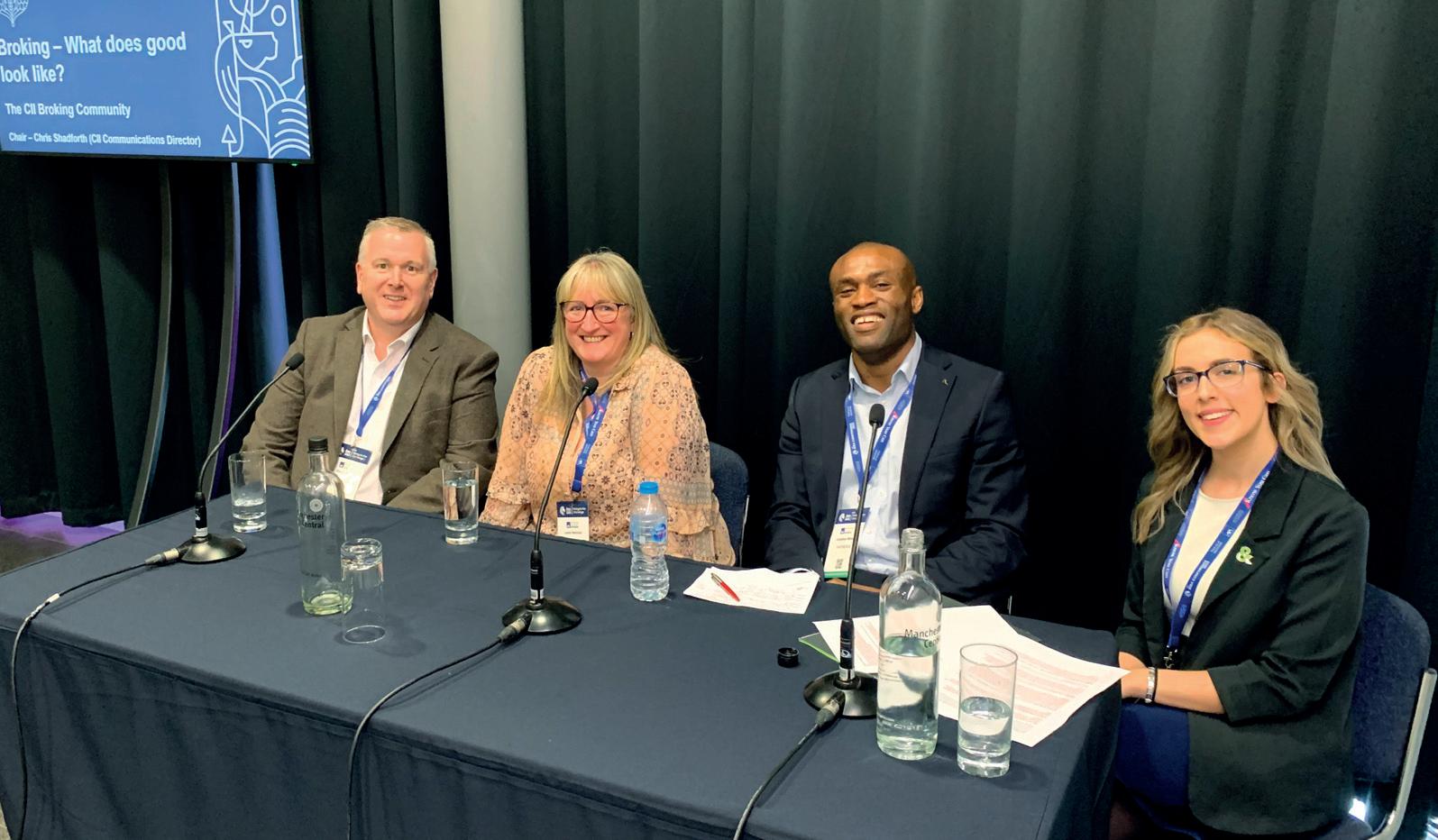
GOOD BROKING IS ABOUT BEING TRUSTED ADVISERS TO OUR CLIENTS, WHICH MEANS YOU DO SELL INSURANCE, BUT MORE IMPORTAN TLY YOU OFFER ADVICEThe CII Fringe session panel of Simon Mabb, Laura Hancock, Jon Miller and Florence Dennis
DELIVERING FOR THE FUTURE
When we published our new, five-year Strategic Plan in April, we did so with a great deal of pride. That reflected the depth of engagement, breadth of consultation and extensive, careful thought that has gone into the development of its 48 pages. It also demonstrates the great weight we are placing on transparency as an organisation, as we set out 70 detailed actions, associated expected outcomes and key performance indicators on which we will report annually.
That said, we appreciate that some of our members may prefer the ‘edited highlights’, which I provide here, along with some of the actions that are already underway.
So, big picture, what’s new in the plan? Well, it’s perhaps better to start with what’s not. The CII received its Royal Charter in 1912, which was updated in 1987 when Queen Elizabeth II granted the organisation a new version. The seven ‘objects and purposes’ set out in that Charter remain the CII’s DNA and flow through and drive everything we do.
That said, the world is very different now and we’ve evolved our mission statement and vision in this plan to reflect the current market environment and our expectations for the future. The insurance profession arguably thinks more about risk than any other, so we felt it was essential to use the insights
generated within the sector to inform our own thinking, in particular the World Economic Forum’s Global Risks Report, which was written in partnership with Marsh McLennan and Zurich Insurance Group. As a result, we are confident the plan is grounded in the reality of the world today, while being flexible enough to evolve if we consider appropriate.
KEY THEMES
The six themes contained in the plan draw heavily on the outputs from our Shaping the Future Together consultation conducted in the latter
part of 2021, along with input from the many meetings, visits and other engagements we have held with members and other stakeholders more recently. In sum, it places a renewed emphasis on professional standards and the value of CII and Personal

CII VISION
‘Working together, as one insurance profession, we will drive confidence in the power of professional standards’

18 thejournal.cii.co.uk / The Journal / June - July 2023
With the CII’s new five-year Strategic Plan now underway, Christopher Shadforth highlights the key themes
STRATEGIC PLAN
Finance Society (PFS) membership, supported by the world-class learning and qualifications for which we are already so highly regarded.
The order of the themes is very deliberate, placing ‘excellent member experience’ at the top of our list. To that end, a key element of our work this year will be to agree a new arrangement with the 55 local insurance institutes, so they can expand their ability to engage and grow participation in the countries and regions of the UK. But we also recognise that we can do more to support our international members
too, reflecting the fact that insurance professionals belong to communities that span the globe. So, we’ll be reflecting on how we can increase international engagement, including through the communication channels we use and operational structures we have in place.
Our other five themes focus on achieving high professional standards; delivering sector thought leadership and world-class learning; embracing technology, so that our offer is digital first; as well as ensuring that the Institute is sustainable in the long term.

TWO PHASES
It is worth noting that the plan is organised into two distinct phases. During this first year– 2023 – our focus is on addressing legacy systems issues, returning the CII to a surplus position after the pandemic and building strong foundations for the future. The subsequent four years focus on delivering new capabilities and rebuilding the Institute’s reserves for the long term. Each theme encapsulates a series
of actions for 2023 and 2024-2027, with identified outcomes and key performance indicators. That said, we’re not waiting until 2024 before delivering tangible member benefits related to the plan. For example, we have already published our Green Finance Companion Guide to our Code of Ethics and published new data on public perceptions of Chartered status to help drive engagement within the profession and better serve wider society. We are also undertaking a major review of the role professional standards play in the context of Chartered status for individuals and corporate members. If this has whetted your appetite to find out more, you can find the Strategic Plan on our website or you can also listen to our six-part podcast series on CII Radio, where I explore the themes contained in the plan with members of the CII board and executive team. Find our CII Radio podcasts at:
www.thejournal.cii.co.uk/podcasts and read the full Strategic Plan at: www.cii.co.uk/strategic-plan ●
Christopher Shadforth is communications director of the CII
OBJECTS AND PURPOSES OF THE CII
● To promote efficiency and improvement in insurance practice among professionals.
● To secure and justify the confidence of the public and employers.
● To promote the study of subjects related to insurance.
● To inform regulations and law associated with the profession.







● To exercise supervision and control over professional standards of our members.



● To assist members in developing their careers.




● To assist members who have fallen on hardship.

thejournal.cii.co.uk / The Journal / June - July 2023 19
ISTOCK / GETTY
STRATEGIC PLAN Chartered Insurance Institute Strategic Plan 2023-2027
Strategic Plan 2023-2027
BREAKING THE CLIMATE ALLIANCE


In recent years, a whole set of acronyms have sprung up around climate change and the insurance industry, as groups form to tackle the climate emergency.





The Intergovernmental Panel on Climate Change has no less than three A4 pages listing the many acronyms related to climate change – many of

which are now used regularly across insurance. Perhaps the best known of the insurance acronyms is the UN’s Principles of Sustainable Insurance (PSI) and, more recently, the Net Zero Insurance Alliance (NZIA), which was created in the wake of COP26 in Glasgow.



However, this year the NZIA has fallen foul of the anti-climate agenda










lobby in the US and members with large US interests have been rethinking their approach. A number of lawyers and commentators report that the anti-climate lobby in the US has been growing more vociferous, with Republican-controlled US states pushing ahead with anti-ESG stipulations that have seen it wrapped up in the so-called culture wars in the country.

20 thejournal.cii.co.uk / The Journal / June - July 2023
CLIMATE
Many believe that working together is the only way to tackle climate change but, as Liz Booth reports, it is not that easy to bring global players to sit at the same table
In fact, House Republicans ended 2022 by launching an investigation into whether climate alliances are violating antitrust laws.
The first founding member to quit the NZIA was Munich Re, which discontinued its membership in April, citing those antitrust concerns. Joachim Wenning, CEO of Munich Re, said at the time: “In our view, the opportunities to pursue decarbonisation goals in a collective approach among insurers worldwide without exposing ourselves to material antitrust risks are so limited that it is more effective to pursue our climate ambition to reduce global warming individually.”
Munich Re was quickly followed by Zurich and Hannover Re in quitting the alliance, although neither of those groups cited antitrust risks for their departure.
In recent weeks, questions have been asked about the survival of the NZIA after seven more departures, including the group’s chair Axa, as insurance companies take flight in the face of opposition from US Republican politicians. At the time of writing, 10 of the original members have removed themselves from the alliance.
Axa, Allianz and Scor left days after Swiss Re became the fourth member to pull out. They have been followed by Lloyd's, QBE and Sompo Holdings.
Axa said in a statement it was leaving to “continue its individual sustainability journey.”
The original Munich Re announcement had raised eyebrows worldwide, as even climate activists
were quoted as backing the sector and saying it must be allowed to make changes collectively.
ANTITRUST RISKS
But what are the real risks of antitrust action? As has been reported: “The core principle that binds NZIA members is an overarching target to transition all operational and attributable greenhouse gas (GHG) emissions from their (re)insurance underwriting portfolios to net-zero emissions by 2050.”
Back in January, the NZIA established a framework for the transition and established a target-setting protocol, but how carriers reach their own goals remained up to them.
Supporters of the NZIA argue that this structure is a core feature protecting the organisation from antitrust challenges.
The NZIA said that “from the outset”, it has been clear that it and its members “will comply with applicable laws, rules, and regulations, including antitrust”.
Nevertheless, an Insurance Insider legal source said it’s feasible that litigation risks could arise, for example, if carriers introduce exclusion policies to reach targets under the protocol, particularly if these were done simultaneously by NZIA members in US states where anti-ESG sentiment is being stoked.
KEY MEANINGS
















● UN PSI: United Nations Principles for Sustainable Insurance
● NZIA: Net Zero Insurance Alliance
● COP26: UN Climate Change Conference of the Parties (COP27 took place last November and COP28 is scheduled for November 2023)
● UNEP: United National Environment Programme
● CCII: Climate Change and the Insurance Industry – an EU project
● TCFD: Task Force on Climate-related Financial Disclosures






“One source theorised that energy companies in certain US states could use a carrier’s NZIA membership as one piece of a wider legal argument to claim an insurer is operating under a framework for collusion, to exclude certain industries or companies. The same argument could be applied to simultaneous price increases that restrict certain companies’ access to insurance,” it said.

Elsewhere, Maurits Dolmans, a partner at Cleary Gottlieb Steen & Hamilton who advises Race to Zero, a group that’s affiliated with NZIA and other climate alliances, was quoted as saying insurers’ extra sensitivity about antitrust issues may be tied to the sector’s “occupational habit” of trying to anticipate risks.
And Alec Burnside, a partner at Dechert in Brussels who specialises in competition law, was quoted as saying the firms most susceptible to the threat of litigation are those with large US operations.
“Competition authorities in the EU and UK have generally encouraged collaboration on sustainability, while the US authorities are behind the game,” he said. “Companies with substantial US operations will likely be most sensitive to the issue because of the backlash against ESG.
“Companies that are exiting climate alliances have a practical interest in not getting into an ESGwokeism slanging match, with antitrust as one of the weapons that’s used against them. One way to keep your head down amid all the backlash against ESG is to say ‘we remain wedded to sustainability goals, but we are pursuing them unilaterally’.”
NEED FOR COLLABORATION
It has not been all bad news for the NZIA. A few weeks ago, Beneva became the first insurer domiciled and fully based in North America to
thejournal.cii.co.uk / The Journal / June - July 2023 21
CLIMATE
GETTY IMAGES
IT IS MORE EFFECTIVE TO PURSUE OUR CLIMATE AMBITION TO REDUCE GLOBAL WARMING INDIVIDUALLY
join the NZIA and also said it was adopting the PSI. Beneva is the largest insurance mutual in Canada, with more than 3.5 million members and customers.


And in the past couple of weeks, the NZIA has put out a statement saying: “In light of the recent discussions within the US, members of the United Nations-convened Net-Zero Insurance Alliance, particularly those with significant US business and exposure, have made the individual and unilateral decision to either remain or withdraw from the NZIA.
“As a voluntary initiative convened by the United Nations Environment Programme (UNEP), every company has the freedom to join or withdraw from the NZIA at any point in time and for any reason.”
It went on to say: “Regardless of the situation, UNEP reaffirms its conviction ever since it initiated, convened and launched the NZIA – that to successfully tackle the climate emergency,
there is a fundamental and urgent need for collaboration, not just individual action.”


The NZIA, it said, has provided a framework that enables insurers, reinsurers and other insurance market participants across the globe to individually start or propel their respective net-zero insurance journeys and take urgent and ambitious individual, unilateral climate action. “This is why UNEP will continue to strengthen and deepen its collaborative work with the insurance industry and key stakeholders to advance net-zero insurance thinking and practices globally,” it added.
NZIA also pointed to the Intergovernmental Panel on Climate Change’s recent AR6 Synthesis Report, which reiterates that the climate emergency is “an unprecedented global crisis that requires urgent and ambitious action by all actors in society to protect lives, livelihoods and assets; and to protect communities, cities and countries”.





The NZIA added that global warming has resulted in more frequent and more intense extreme weather events that have caused increasingly dangerous impacts in every region of the world and every increment of warming results in rapidly escalating hazards.
However, with 10 of its members quitting, it remains to be seen whether this can remain a viable vehicle for the insurance industry on its net-zero journey. ●
Liz Booth is contributing editor of The Journal







ANTITRUST RISKS
The US Federal Trade Commission describes antitrust risks as: “When competitors interact to such a degree that they are no longer acting independently, or when collaborating gives competitors the ability to wield market power together.”

22 thejournal.cii.co.uk / The Journal / June - July 2023
THERE IS A FUNDAMENTAL AND URGENT NEED FOR COLLABORATION, NOT JUST INDIVIDUAL ACTION
CLIMATE
REGULATORY UPDATE
In this issue, Dr Matthew Connell considers the FCA rules on multipleoccupancy buildings and the upcoming Consumer Duty deadline
FCA RULES ON MULTIPLE OCCUPANCY

The UK Financial Conduct Authority (FCA) has published the latest instalment of its approach to multipleoccupancy buildings insurance.

The key requirements are:
● Improved disclosure for tenants, designed to:

o Support leaseholders, so they receive clear information about the insurance in place.




o Help leaseholders to better understand the costs associated with the insurance and what the premium is made up of.




o Enable leaseholders to challenge unfair remunerations, insurance placements and conflicts of interests.
o Increase scrutiny and pressure on firms in the distribution chain to manage conflicts of interests more appropriately.
● Improved governance requirements, that will:
o Expressly require firms to focus on the interests of all customers that receive a benefit from the insurance and have an obligation to pay towards the insurance costs, including leaseholders.
o Ensure products provide better value to all relevant customers, including leaseholders.






o Reduce prices by tackling poor remuneration practices; in particular, situations where remuneration is excessive relative to the costs firms incur and the benefits they provide.
o Give the FCA greater scope to challenge poor firm practices around remuneration.
The FCA’s consultation period ran to 9 June. The regulator has proposed that firms will have three months from the publication of the final rules to implement them.

CONSUMER DUTY DEADLINE APPROACHES

The deadline for implementation of the Consumer Duty for everything except legacy products is 31 July. In a speech in May, FCA executive director Sheldon Mills said: “I would like to personally thank every firm, every member of staff and yes, every consultant, who has worked tirelessly to meet this deadline.”
He went on to pose the following questions:
● Does your purpose and culture align with your obligations under the duty and support the delivery of good outcomes for customers?
● Is the duty being considered in all relevant discussions such as strategy, remuneration and risk?
● Have you made sure your remuneration and incentive structures drive good outcomes for customers?
● Are you prioritising delivering good outcomes for customers in a changing external environment?
An aspect of the regulatory system that has made the Consumer Duty particularly challenging to deliver has been the need to evidence good governance on a product-by-product level – a legacy of product governance rules at EU and UK level, alongside market studies that have focused on value at a product level. In some ways, this has provided a distraction from the more fundamental questions that Mills has posed, and instead created a mini-industry of producing and recording evidence.
This means that the more meaningful challenges posed by the Consumer Duty, reflected in the FCA’s work on multiple-occupancy buildings, will continue to provide work for firms well beyond July. ●
REGULATION 23 1
2
thejournal.cii.co.uk / The Journal / June - July 2023
Dr Matthew Connell is director of policy and public affairs of the CII
TAKING TO THE
SKIES
Travel is back on the agenda, with 72% of people planning an overseas holiday this year, according to research by AllClear Travel Insurance. But with travel insurers dealing with challenges such as Brexit and the cost-of-living crisis, it is too early to say whether the market is completely back to normal. Demand for cover has certainly recovered. For instance, in the first four months of 2023, Staysure saw a 25% increase in the number of policies it sold. “People are catching up on the holidays they missed during the pandemic,” says Steve Parker, chief insurance officer at Staysure. “ABTA predicts that demand for holidays will go through the roof this year.”

BREXIT EFFECT
As well as the removal of pandemic restrictions, holidaymakers will see other changes when they head overseas. Following Brexit, travellers are getting used to new rules on passports; different – and often longer – queues at border control; and the replacement of the European Health Insurance Card with the Global Health Insurance Card.
The travel insurance market is also feeling the effects of Brexit. Anthony Kaye, managing director of Campbell Irvine and chair of the Association of Travel Insurance Intermediaries, explains: “With passporting no longer an option, a disproportionately high number of European travel insurers have decided not to return to the market. It is causing a capacity issue.”
New providers have entered the market to fill the gap. Anna-Marie
Duthie, insight consultant of general insurance at Defaqto, says that while the number of products on the market dropped to around 700 during the pandemic, it is back to its original level of more than 1,000 again. “We are seeing a lot of new providers, especially airlines and travel providers,” she explains. “They want to help people feel confident to travel again.”
FINANCIAL SQUEEZE
Rising costs are putting insurers under pressure. As well as an initial surge in claims at the beginning of the pandemic, insurers are also seeing claims costs increase as a result of inflation. Practices are also changing
24 thejournal.cii.co.uk / The Journal / June - July 2023 TRAVEL
With pent-up demand for holidays during the pandemic now being released, Sam Barrett examines the outlook for the travel insurance sector
post-pandemic, with Parker pointing to repatriation as an example: “Before the pandemic, most airline providers would have allowed us to bring someone back on a standard flight. This doesn’t happen any more so we might have to arrange a private air ambulance. This pushes up claims costs.”
Amid these pressures, premiums have increased. Kaye says the pandemic has put an additional 15%25% onto premiums. “Insurers need to pay staff more to retain them,” he says. “It’s not easy out there. Some are dealing with 50% more claims with 25% less staff.”
Another pricing challenge concerns health risk. Many consumers were forced to press pause on their regular medical checkups and screenings during the pandemic. This, explains Garry Nelson, director of corporate affairs at AllClear Travel Insurance, has implications for firms providing cover.
“Insurers are carrying a greater risk,” he explains. “Immune systems are weaker and some health conditions will have gone undiagnosed as people stayed away from their GPs. Insurers have seen an increase in claims.”
CONSUMER APPETITE
It is not all bad news for the sector. The rapid response of the insurance market to cover pandemic-related losses, coupled with an eagerness to travel again, means that consumer confidence in travel insurance is high. “Travel insurance is seen as a must-have now,” says Nelson. “The cost-of-living crisis has made everyone more sensitive to price but people do understand the value of travel insurance.”
Insurers are also tweaking their products to help consumers manage pricing. Kaye says that one retailer might have as many as 20 different product propositions and brands on the market, with each appealing to a slightly different demographic.
Another cost-control mechanism – the excess – is also being used to ensure products meet consumer appetite. Analysis by Defaqto shows that, although average excesses have ticked up year on year since 2011, they fell across all key areas in 2022. As an example, the average excess for medical expenses on an annual policy fell from £133 in 2021 to £125 in 2022, although this is still much higher than the £96 average in 2016.
“This can be attributed to the new entrants, with the majority of those (68%) having excess amounts of £100 or less,” says Duthie. “Many providers will offer multiple excess levels. This can help balance out premiums during the cost-ofliving crisis.”
FUTURE DEVELOPMENTS
As consumer appetite for holidays returns, the travel insurance sector is optimistic about the future. “Insurers are investing in AI technology to automate claims,” says Kaye. “It is a leap of faith but technology could transform the sector.”

Other developments are expected too. Staysure’s Parker is excited about telemedicine: “Offering this to customers will mean that, wherever they are in the world, they will be able to get quick access to a medical professional who speaks their language. This is convenient but also helps to control costs.”
The next technological steps could be even more beneficial to insurers and their customers, according to Duthie. She expects to see products that use smartphone technology to determine when someone is abroad and tailor their cover to their needs. “It could tell when baggage or flights are delayed and settle claims instantly,” she says. “This type of product helps to build the relationship between a customer and their insurer. It’s a positive time for the travel insurance sector.” ●
thejournal.cii.co.uk / The Journal / June - July 2023 25 TRAVEL
Sam Barrett is a freelance journalist
GETTY
INSURERS ARE CARRYING A GREATER RISK. IMMUNE SYSTEMS ARE WEAKER AND SOME HEALTH CONDITIONS WILL HAVE GONE UNDIAGNOSED AS PEOPLE STAYED AWAY FROM THEIR GPS. INSURERS HAVE SEEN AN INCREASE IN CLAIMS
ost people are familiar with how traditional insurance works: you buy a policy from an insurer, who agrees to reimburse you for the cost of any damages if something bad happens. But a different type of insurance –parametric insurance – is gaining traction as a way to cover even the most at-risk from perils.
Parametric insurance policies pay a pre-agreed amount if a predefined parameter is met. As a payout is made after an event occurs, it is also known as event-based insurance.
While this may be new term to some, this type of insurance has existed for centuries. One of the earliest examples is bottomry contracts, used as early as 4,000BC-3,000BC to protect traders if goods were lost at sea. A simpler and more modern example is life insurance. When someone dies, their loved ones receive a pre-agreed payout.
“Any time you can meaningfully connect risk to a given dataset, there’s an opportunity to employ parametric insurance, ” writes Michael Elliott, senior director of knowledge resources, The Institutes.
MIf there is a measurable event, you can apply parametric insurance. If that event happens, then you get paid. Parametric insurance is becoming more and more common, particularly for natural catastrophe risks such as earthquakes, hurricanes and flooding. Until recently, parametric policies have been limited to large governments and corporations through catastrophe bonds. That’s because the policies have previously been too complicated to write without extensive resources. However, improvements in technology and data have allowed parametric insurance to reach the mass market.
In our company, we combine cloudbased underwriting and IoT technology to provide flood insurance to at-risk businesses of any size. Using water depth as the parameter, we pay out a pre-agreed amount as soon as water reaches a predefined depth.
WHAT IS DIFFERENT ABOUT PARAMETRIC?
Traditional insurance is based on the principle of indemnification. You pay a premium to ensure that in the event of a loss, you are reimbursed for anything you have lost. The aim is to return the insured to the state they were in before the event and protect your balance sheet in the long term.
MEASURED, GETS PAID
Once an event has occurred and a claim has been submitted, a loss adjuster will most likely pay a visit. They assess whether the insurance policy covers the loss and whether the claim is the right amount. To help them establish the claim amount, the claimant may need to keep damaged items and give them receipts for any lost or damaged items and for any repair work. This can take time to establish and it means claimants won’t know for sure how much money they will receive until they are paid.
With a parametric insurance policy, the customer chooses the claim amount before the event occurs. That means there is no need to establish the claim amount after a loss. Customers simply get paid the pre-agreed amount once the parameter has been met and verified. The payout can typically be used to cover any costs incurred due to the event. Due to this simplicity, parametric policies pay out far quicker than traditional ones. While traditional insurance can take months to settle claims, parametric claims are often paid in full within days.
26 thejournal.cii.co.uk / The Journal / June - July 2023 FLOOD
Ian Bartholomew provides an introduction to parametric insurance and the key benefits it has over traditional cover
WHAT GETS
WHAT ARE THE BENEFITS? 1
Covers risks that traditional insurance cannot
Parametric insurance allows ‘uninsurable’ risks to be insured. Often, traditional insurance is not an option for those at high risk, or for those who have been previously hit by catastrophe. If it is, cover often comes with high premiums or excesses to account for the level of risk. Parametric insurance comes with fewer additional costs and greater certainty, resulting in simpler policies and lower premiums.
$29.3bn
The parametric insurance market is estimated to reach $29.3bn in value by 2031, up from $11.7bn in 2021
Source: Research and Markets, 2022
2
Transparent claims process
With traditional insurance policies, customers won’t receive a payout until a loss adjuster assesses the damage to the property and its contents. This can be a lengthy and uncertain process. As many as 90% of small companies fail within a year of a disaster, unless they are paid within five days, so speed is essential. A parametric insurance policy pays a pre-agreed amount, meaning no haggling at claim. Provided the insurer and insured agree that the trigger has been met, the payout is made. This makes the claims process quicker and far more transparent.
3
The customer is in control
Parametric policies are all about choice. The policyholder will typically choose their triggers and payout values. For example, with a FloodFlash policy, the policyholder can tailor the quote to meet their needs and budget, choosing the trigger depths and payout values they need. What’s more, if a policyholder is hit by a flood, they choose how they spend the payout.
THE FUTURE OF PARAMETRIC INSURANCE
Parametric is rapidly becoming a major part of the insurance industry, complementing and providing an alternative to traditional forms of insurance. From startups to insurance heavyweights, many are seeing the potential of parametric insurance –from earthquakes to crop loss, from software downtime to drought. As the global protection gap increases, data and technology capabilities advance and investors recognise the potential of parametric, the possibilities for this type of cover will only increase. ●
Ian Bartholomew is co-founder and chief underwriting officer of FloodFlash

thejournal.cii.co.uk / The Journal / June - July 2023 27
FLOOD
SHAKING THINGS UP
Luke Holloway talks to BIBA Young Broker of the Year winner Florence Dennis about her passion for the profession

thejournal.cii.co.uk / The Journal / June - July 2023 28
THE INTERVIEW: FLORENCE DENNIS
Florence Dennis has become one of the most dedicated and dynamic members of the CII, displaying a drive and enthusiasm that saw her named the Insurance Institute of Leicester’s youngest ever president in 2021 at the age of just 25.
As she marks an exhilarating first 10 years in the broking profession, Florence – lead client adviser at Partners& – can already reflect on many achievements, which include her various roles across the CII local institutes as well as playing an active part at the British Insurance Brokers’ Association (BIBA), most recently as chairwoman of the East Midlands Committee and being crowned BIBA Young Broker of the Year in 2022.
She even found time to write a regular column for The Journal during 2018, sharing her studying experience with other CII members as she earned her Cert CII and Dip CII qualifications.
STARTING OUT
Meeting with Florence at this year’s BIBA conference in Manchester – where she is co-hosting Young Broker Day as well as appearing as part of an expert panel at the CII’s fringe session – her passion for the profession is palpable. “When I started out, I had no idea how massive the insurance profession was,” she tells us. “The year I attended my first BIBA Conference as a young broker, that just did it for me. It was then – as it is now – an incredible and valuable experience, both personally and professionally. I decided right then I would be coming back every year.”
Starting out her career in insurance as an apprentice in 2013, Florence began studying for Cert CII and, within two years, had joined the Insurance Institute of Leicester committee as Next Generation chair, helping to arrange CPD and revision courses, along with social events with a focus on younger members.
“I loved every minute of it,” she says. “I had fantastic support from everyone at the Institute and, as I grew into the role, more experienced members around me said that my energy and ideas could have an impact more widely.
“When I became president, so many things were done really well, but also it was a chance to shake things up and bring a fresh perspective. The key focus of my presidential year was running ACII fast-track qualifications. I completed
one myself when I was at Gallaghers and I am not sure I ever would have earned that qualification if it wasn’t for that support.
To offer that to members, free of charge, had a real impact.
“Being part of our local institutes also makes you appreciate how incredibly important volunteers are to the work we do at the CII. In recent years, I have realised just how many amazing people are involved behind the scenes – it really is what makes us thrive as a community.”
PROMOTING INSURANCE
Back in the Midlands, Florence has also been part of a group of professionals going into schools and colleges to help promote insurance as a viable career.
“The career paths in our industry are endless and more needs to be done to let the younger generation know what an awesome career you can have in insurance.
“We have appeared at careers fairs, presented in assemblies and visited classrooms where we introduced the Discover Risk video and game from the CII. The gamification of insurance is a really impactful way to show them how it works and how big insurance is as a whole.
“It is about leading with the benefits of insurance and how it can help you. As well as the incredibly varied career paths that young people can have –especially with technology becoming more prominent, with data analysis and innovation – there is so much that bright new talents can engage with and find a career they can succeed in.”
This year, Florence is part of the CII New Generation group – a talent programme that takes a cohort of 40 insurance professionals annually to develop their skills and offer them a range of learning opportunities, including meetings with key regulatory
body personnel and sessions with members of parliament, as well as leadership and media training.
“The programme so far has been amazing and has given me a whole new view of a different side of insurance. I have met a group of professionals who are just as passionate as me, while the CII Broking Community board members act as mentors, so in terms of making connections and growing your network, it is invaluable.”
The group also completes a project that it believes could make a difference to the insurance sector, with Florence’s broking team focusing on changing the perception of the industry for the younger generation.
“We will be creating educational multimedia material for brokers, insurance companies and CII members to show anyone, from GCSE to university students, just how much insurance influences the world. I believe promoting the scope and power of insurance is key to attracting the next wave of talent.”
EVOLUTION
Florence is certainly optimistic about the progression of the sector. “I feel like the profession is growing and evolving in an incredibly positive way. We need to continue our focus on equality, diversity and inclusion, which will hopefully be a huge step to changing the perception of us and opening doors to help attract new and diverse talent,” she says.
“There will be challenges ahead in terms of technology and artificial intelligence, but we should consider these as opportunities. I am excited to see what the future holds and how insurance plays a key role in how the modern world adapts.”
With insurance professionals like Florence Dennis at the forefront, the future is certainly looking bright. ●
LukeHolloway is editor of The Journal
thejournal.cii.co.uk / The Journal / June - July 2023 29
THE INTERVIEW:
DENNIS
FLORENCE
I BELIEVE PROMOTING THE SCOPE AND POWER OF INSURANCE IS KEY TO ATTRACTING THE NEXT WAVE OF TALENT
Fraud is a serious and growing problem in the UK and the statistics are alarming. According to the City of London Police (CoLP), one in 13 adults have been victims of fraud, and the annual cost of fraud to the UK economy is more than £4.3bn. Between 2021 and 2025, it is estimated that fraud will increase by between 25% and 60%. Fraud is now the single largest crime, making up more than 40% of all crime in England and Wales.
Insurance fraud forms a not insignificant part of the overall fraud picture. According to Mark Allen, head of fraud and financial crime at the Association of British Insurers (ABI): “Insurance fraud is an ongoing, socially corrosive threat that causes financial loss, grave mental anguish and sometimes physical harm.” ABI members detected 1.1 million cases of general insurance fraud in 2020. So what is the insurance sector doing about it?
TAKING ACTION
Last year marked the 10th anniversary of the establishment of the Insurance Fraud Enforcement Department (IFED), a partnership between the CoLP and the ABI, which funds it. As the national lead force for fraud, the CoLP has partnered with a number of different industries, including insurance, to take action to bring fraudsters to justice.
According to Allen, in the last three years alone, the IFED has achieved 210 judicial outcomes and issued 60 cautions, 19 conditional cautions and nearly 100 ceaseand-desist notices. As Allen emphasises: “The IFED remains a cornerstone of the industry’s counterfraud strategy.”



Working in partnership with the insurance industry, Detective Chief Inspector (DCI) Tom Hill, who leads the IFED, outlines its objectives:
● To tackle serious, organised and opportunistic crime through detection, disruption and prevention.

● To target criminal finances.
● To tackle the perception that insurance fraud is low risk and acceptable.
● To be a centre of excellence to improve the overall response to insurance fraud. Typically, the types of fraud threats the IFED sees relate to data theft, fabricated loss, induced motor accident, staged motor accident and ghost broking, which now makes up a third of all cases.
1 in 13
According to DCI Hill, intensive investigative effort sits behind the figures. In one operation to disrupt online fraud, action was taken against more than 300 entities. In one incident, a TikTok ‘ghost broker’ profile was suspended within 16 minutes of identification.


UK adults have been a victim of fraud



In another operation, 15 fraudulent claims for injury and disruption with six different insurers for missed or cancelled travel were detected, and the perpetrator was apprehended and convicted.
In another case, a man was jailed for £24,000 of bogus medical insurance claims. Although the sums at stake
30 thejournal.cii.co.uk / The Journal / June - July 2023 FRAUD
FRAU D
FIGHTING INSURANCE FRAUDSTERS
PURSUING FRAUDSTERS
were not enormous, it sends a message that fraud will not be tolerated at any level.

A case of life insurance fraud involved significantly higher sums and a complex web of investment, insurance and pension fraud over a number of years, including accidents involving the perpetrator’s cousin and a taxi driver, which led to a conviction and sentencing for 30 counts of fraud.
The IFED also recently obtained its first ever Serious Crime Prevention Order against a fraudster who cheated insurers and lawyers out of nearly £250,000 in an elaborate scam involving stolen identities and a cloned claims management company.
These are just some examples of how the IFED has real teeth when it comes to tackling insurance fraud.
Recently, the UK Government launched its ‘Fraud strategy: stopping scams and protecting the public’, which aims to address the growing prevalence of fraud, which is one of the fastest-growing crimes in the UK. This strategy sets out a plan to reduce fraud by 10% from 2019 levels, by 2025. The strategy has three core pillars: to pursue fraudsters, empower the public, and stop and block. Within the CoLP’s remit as national lead force for fraud, it intends to go after fraudsters by creating a number of new proactive investigative teams, as well as replacing Action Fraud with the new Fraud and Cybercrime Reporting and Analysis Service (FCCRAS), which is designed to improve the victim experience and send enhanced investigation packages out to policing. To empower the public, it will

establish a national protect network with protect officers in each region, and bolster victim support by expanding and extending coverage of the National Economic Crime Victim Care Unit.

Finally, it will stop and block frauds as they are carried out, support partners in industry to deliver by using information collected by the FCCRAS, and work alongside industry partners to identify suspects and remove their access to UK systems and platforms.


Protecting the public and bringing offenders to justice is what the IFED aims to do. It has recently been working more closely with social media companies such as Meta to remove scammers online. Even where it cannot prosecute, it can take steps to disrupt fraudsters to prevent harm being done, especially online. Working in partnership with the police, the insurance sector is now better equipped to tackle this growing menace. ●

thejournal.cii.co.uk / The Journal / June - July 2023 31 FRAUD
Mellissa Collett is executive director of professional standards at the CII
FRAUD IS NOW THE SINGLE LARGEST CRIME, MAKING UP MORE THAN 40% OF ALL CRIME IN ENGLAND AND WALESMellissa Collett takes a look at the work of the Insurance Fraud Enforcement Department
JEDI NOORDEGRAAF / IKON IMAGES
TRUST:

Dr Matthew Connell looks at the key takeaways from the latest edition of the CII Trust Index



How has the cost-ofliving crisis affected consumers’ attitude to insurance? What impact does Financial Conduct Authority (FCA) regulation have on public trust? What are the effects of the pandemic on small and mediumsized enterprises’ (SMEs) attitudes to insurance?
Since 2018, the CII has tracked consumers’ and SMEs’ attitudes to insurance to answer this kind of question, based on the importance they give to different aspects of the service and how they tell us their own insurer is performing.

32 thejournal.cii.co.uk / The Journal / June - July 2023 TRUST
ly 2023
Aspects of the service that we examine for all consumers and SMEs are:
● Price.
● Suitability of protection.
● Confidence that the insurer will pay out.
● Rewards for loyalty.
● Ease of doing business.
● The relationship that the insurer builds with its customers.
For consumers and SMEs that that recently made a claim, we look at:
● The speed of paying claims.
● The control consumers and SMEs have over their lives as the claim is being processed.
● The respect that insurers pay to claimants – do they leave them feeling as if they have been treated as customers or as potential fraudsters?
We determine the size of the expectation gap by asking around 50 questions about consumers’ experiences, including whether they felt they had the level of cover explained to them properly, whether they felt their insurer was trying to get out of paying a claim, or whether existing customers felt they were being treated in the same way as new customers.

We also look at consumers’ expectations and experiences across a range of products:
● For retail consumers, we look at motor, buildings and contents, as well as travel insurance
● For SMEs, we look at property, liability, motor and business interruption insurance. Looking at the experiences of consumers and SMEs in this way allows us to see how insurers are performing in the middle of key economic and social changes, as well as producing concrete statements about what insurers can do to build trust with customers in future.
INSURERS’ PERFORMANCE AGAINST KEY SOCIAL AND ECONOMIC CHANGES
Consumers are not up in arms over price…
One thing that we might expect, given the extent of the cost-of-living crisis, is more consumers becoming dissatisfied with the price they are paying for insurance. However, in spite of higher inflation, the expectation gap on price for home, motor and travel insurance has remained low compared to most other factors. Consumers feel that price has become slightly more important, but that insurers’ performance has also improved.
PROCESS THE
Why would consumers be so relaxed about price when household budgets are so much tighter than a year ago? The answer may be that insurers' prices are far more stable than, for example, rocketing utility prices. According to Consumer Intelligence, insurance prices rose 2.8% between December 2021 and October 2022, and according to the Association of British Insurers, the average premium paid for car insurance went up only 2% between Q3 2021 and Q3 2022. This framing effect has worked well for insurers.
thejournal.cii.co.uk / The Journal / June - July 2023 33
ISTOCK TRUST Rankings for price, out of the nine key factors for building trust: Date to:Oct 19 Feb 20 May 20 Sept 20 Dec 20 Apr 21 Jul 21 Dec 21 Jul 22 Dec 22 Expectation gap ranking 5th6th7th7th5th5th5th5th4th8th Size of the expectation gap: Performance (scale of -10 to +10)3.723.643.725.195.06 Importance (scale of -10 to +10)4.534.534.945.505.30 Overall expectation gap (scale of -30 to +30) 5.355.426.166.326.26 →
...but loyalty is still a big issue
While consumers may be relaxed about insurance premiums in general, they still hate the idea that they are paying more than other people for the same cover. The FCA introduced rules to ensure that new and existing customers are treated in the same way in 2022, but it is clear that consumers are still ‘once bitten, twice shy’ about renewal premiums. The gap between expectation and reality for consumers remains stubbornly high and has actually gone up a little since January 2022:
provoke the strongest reactions from consumers, the index notes that insurers should:

1Turn a necessity into a virtue, by making it clear to existing customers that they are not paying more than new customers. This could be done by offering an explicit guarantee that premiums will not increase because a customer is not a new customer. Customers want to be sure they are not going to be offered a lower rate if they go to a comparison website rather than if they rely on the premium offered at renewal.
2Focus on excellent complaints handling. The ability to handle complaints fairly is a competitive advantage and any signal that an insurer gives about being ready to listen to complaints is a sign of confidence and strength.






3 Ensure policies are explained clearly. In the wake of the pandemic, SMEs are more concerned than retail consumers about what their policy does and doesn’t cover.
Consumers want more control over how claims are paid
The research also brings out consumers’ concerns about claims, especially for home insurance. Consumers who have made a recent claim are telling us that they want more choice about how the claim is paid – as a financial settlement, repairs or replacement. This may reflect the fact that households have less disposable income. These concerns are not as high for SMEs, for whom issues around the adequacy of cover and confidence that insurers will pay out are still very significant. In particular, in an environment of rising inflation, SMEs are more concerned than ever that their ‘cover is the right level for my business to continue to trade’ and that claims are paid quickly.
HOW INSURERS CAN BUILD TRUST
So, the message from the latest edition of the CII Trust Index is that insurers are providing a solid service at a decent price, but consumers want more reassurance around how they are being treated, especially around loyalty and speed of claims.






Based on the statements that
2Give customers a choice on how they settle a claim. For example, in a cost-of-living crisis, some customers may want a financial settlement rather than repair or replacement. The index shows us that consumers are more interested than ever in the form that their settlement takes and want to be part of the conversation.
3 Be transparent about how risks are judged, so that people can see that the price reflects their risks – again, consumers are more concerned with whether they are paying a fair price for the risks they bring to the table than with the overall amount that they are paying.
4Make complaint handling more effective than ever. Even before consumers make a claim, they want to know that they will be listened to if they make a complaint. Firms should not be frightened to show what happens when their customers complain – consumers know we do not live in a perfect world.



To build trust with SMEs, insurers can:

1 Offer reassurance about fairness for existing customers on renewal. SME concerns about renewal are not as strong as consumer concerns, but there is still an opportunity for insurers and brokers to spell out how they treat customers fairly.



4 Ensure that cover is adequate. Again, the pandemic has taught SMEs that adequacy of cover is as important as breadth, so this is an opportunity to talk about the impact of inflation on their insurance and what they can do about it. Sometimes, it may feel as though the insurance profession has a mountain to climb in building trust, but overall the public appreciates the importance of insurance. The CII Trust Index shows that improvements in some aspects of insurers’ work, such as giving reassurance about renewal premiums and complaints, can make a real change to consumers’ attitudes. ●
Dr Matthew Connell is director of policy and public affairs of the CII
34 thejournal.cii.co.uk / The Journal / June - July 2023
Loyalty expectation gap Dec 20 Apr 21 Jul 21 Dec 21 Jul 22 Dec 22 9.048.898.859.169.259.45 TRUST
BROKING THE BALANCE
Chair of the CII Broking Community board
Laura Hancock reflects on the crucial role brokers can play in volatile times
Iam very proud to be writing my first piece as chair of the CII’s Broking Community board. When I took up this position, the board was called the Society of Insurance Broking, which has recently changed to the Broking Community. I am encouraged by this change. The purpose of these boards is to increase member engagement and to facilitate two-way communications between members and the wider CII.
If you are a CII member and an insurance broker, it feels natural that a part of your membership includes access to the Broking Community. Our aim is to become a go-to place for individuals within insurance broking firms on issues impacting them in their roles. Our overarching aim is to support individuals to be better brokers through the work of our board and of the wider CII.
STANDING PROUD
Broking is a dynamic, fast-moving, innovative and robust profession, which I am extremely proud to have built a career within. In recent years, it feels as though we have been navigating a constant obstacle course in continuing to give the best advice and solutions to our customers, while facing some monumental changes and challenges. We have experienced unique circumstances such as the UK’s exit from the EU. Financial services were carved out of the original deal, therefore
there are still many questions about the future of trading in Europe. We faced a global pandemic; something that we all thought was consigned to theoretical textbooks about how the world might look in 50 years. It became our reality very quickly and whipped up a storm for the insurance sector. We found ourselves having to justify why some business interruption (BI) claims relating to the lockdown were not covered, while other claims were valid.
On top of all of this, a revolving door at Number 10, war in Europe, runaway inflation, climate issues and a raft of regulatory challenges mean that the obstacles for brokers and their clients are still coming thick and fast.
Against this backdrop, brokers continue to stand proud. The role of the insurance broker has never been more important. We are the profession who will advise individual consumers and their businesses through these unusual and challenging times. We hold the reputation of the insurance sector in our hands. The truth behind the insurer position on Covid-19 BI claims was that they had never been intended to provide cover for a lockdown following a pandemic.
With a small number of exceptions, the BI claims being paid are down to weaknesses in insurer wordings, rather than an intent to insure in the first place. Brokers articulated this to clients.
Another factor influencing public trust in insurance is pricing. There is a lot of complex information behind a hard market that clients will not appreciate – and why would they? Brokers hold the key here. One pillar of the FCA’s Consumer Duty is ‘customer understanding’. As brokers, we must not only sell a policy, but advise our clients on the external influences driving price, appetite and approach to risk by insurers.
Our Broking Community board is made up of volunteers committed to delivering content, events and education that enable individuals within broking firms to be the best that they can be. As brokers, by truly educating the public and advising them on insurance and risk, while helping them to keep abreast of all of the changes outlined above, it is clear that insurance brokers are critical in delivering stability and opportunity for the UK economy – something we can all agree is much needed right now. ●
thejournal.cii.co.uk / The Journal / June - July 2023 35 UNDERWRITING BROKING
Laura Hancock is chair of the CII Broking Community board
OUR OVERARCHING AIM IS TO SUPPORT INDIVIDUALS TO BE BETTER BROKERS THROUGH THE WORK OF OUR BOARD AND OF THE WIDER CII
BROKING BAROMETER
Liz Booth talks to the CII Broking Community board about how brokers must evolve to stand out in challenging economic times
The number of insurance brokers in the UK has fallen 0.4% in 2023, down to 1,626 from 2022 levels in a sector that is worth approximately £9bn. However, figures from Plimsoll suggest any growth in market value recorded in the past year is not shared equally. In fact, almost half the revenue is generated by the top 10 companies alone.
Add to that the cost-of-living crisis along with increasing use of technology and it could look a pretty bleak picture for insurance brokers. But, as so often is the case, dig a little deeper and it appears that the sector is thriving as brokers continue to deliver good outcomes to their clients.
A critical part of their success comes from customer service. As Liz Foster, non-executive director of the CII Broking Community board, explains: “It is important to be an adviser who can ensure that all elements of each client’s risks are both understood and clearly communicated to client and carrier. A broker should be able to offer risk mitigation strategies and have a
thorough knowledge of the insurance market and what differentiates one insurer from another.
“It is very important to identify both current and emerging risks, as well as contextualise these for each client while also understanding how the insurance market is providing for these.”
Her words are echoed by Graeme Trudgill, executive director of the British Insurance Brokers’ Association, who says the role of a broker is “to act as agent of both the client and the insurer, helping a client to identify, mitigate and transfer their risks”.
He also believes that a strong knowledge of the economy and world events help with identifying
relevant risks, such as the very real underinsurance risk due to inflations or the supply chain issues, meaning a client may want a longer business interruption indemnity period.
WIDER IMPACT
Emily Kenna, director of Senserisk and a CII Broking Community board member, notes: “We need a new title – risk and insurance advisers. We challenge our clients to consider their risks and we advise on what risks can and cannot be insured, to help our business clients better manage risk and become more resilient and profitable.
“It is important that we understand the wider impact of risks on our business clients – we need to address these to ensure clarity on what is and isn’t covered by their insurance programme. This helps them understand and manage risk better for the benefit of their businesses.”
Jordan Maskell, head of franchise development at Coversure and member of the CII Broking Community board, adds: “In my view, the role of the broker should and has grown significantly for those brokers who are trying to stand out
36 thejournal.cii.co.uk / The Journal / June - July 2023
WE NEED A NEW TITLE – RISK AND INSURANCE ADVISERS. WE CHALLENGE OUR CLIENTS TO CONSIDER THEIR RISKS AND WE ADVISE ON WHAT RISKS CAN AND CANNOT BE INSURED
BROKING
from their competitors.
“Brokers in general all deliver pretty much the same proposition and service levels to the customer as the next. So, when it comes to renewal, guess what? Most customers stick with their existing broker; hence, retention levels are more than 75% in general.
“The brokers that are able to understand data, financial performance, different sectors and innovation, as well as provide more advice and guidance about managing risk (not just the insurable parts) can stand out.
“For me, credibility is an essential quality that customers look for in a broker. Demonstrating beyond just conveying what the insurer’s proposition is, how much it costs and what clause to look out for can be difficult. For those brokers who share a good wider knowledge, great levels of business and financial acumen build huge amounts of credibility and trust with customers.”
Tim Nash, head of product recall of Bowring Marsh, adds: “To facilitate the placement of a risk transfer solution which meets the client’s needs involves having a solid understanding of the different coverages available and being able to analyse which best fits the client. The client should be guided through the various options to enable them to make an informed decision on which option is right for them.
“We tend to place risks on an annual basis and therefore we need
to have a level of foresight of how a client’s risk exposure might change during that period. The risk at the point of inception is unlikely to be same risk when the placement expires. The broker needs to factor this in where possible. For example, it could be an assessment of limit adequacy given the increased cost to replace or repair insured products.”
CHALLENGES AHEAD
Most brokers are realistic about the challenges, whether they come from external factors such as supply chain or internal challenges such as retaining the right staff and handling the cost pressures. They also present a long list of trends to keep an eye on – from ESG and government policies to legal decisions and online fraud. Kenna is among those who believe that both global and local issues must be monitored carefully, whether it is “supply chain issues, for a number of political reasons, along with the resulting business interruption, indemnity periods and supplier extensions; underinsurance with inflation and the weak pound affecting the costs of materials and services; or flood which continues to be a problem for small businesses including property owners who don’t benefit from Flood Re”.
She also highlights the growing issue of cyber risks: “In my opinion, cyberattacks have the potential to be as widespread as Covid-19 was. If you take down key infrastructure and services, this could have huge impacts
on the economy and we need to be mindful of this and how we protect ourselves and our customers.”
Maskall looks slightly longer term when he suggests: “Technology and AI will impact which insurance programmes are pulled together. I have seen this in the farming sector where different types of cover are becoming more prevalent in policies covering livestock, for example.
“There is a rise of short-term insurance or a pay-as-you-go arrangement for people like tradesmen who might need cover for a specific contract and then not have any work for a few months. And of course, we can’t ignore the increased interest in our sector from the likes of Amazon, Google and Sky, who have the scale, infrastructure, data and potential to rock our industry significantly.”
So, while it is good news that the overall broking market is growing, it seems there are plenty of challenges that brokers must face. ●
Liz Booth is contributing editor of The Journalthejournal.cii.co.uk / The Journal / June - July 2023 37
BROKING
YELLOW MAN / ISTOCK
HOW TO WIN OVER THE GEN ZS AND ALPHAS
Can ESG really help when it comes to attracting the right talent to insurance broking?
The challenge of attracting the next generation into the insurance broking sector and convincing them that insurance is a worthwhile career is well documented. But it seems that appealing to their causes is one way to show relevance – and environmental, social and governance (ESG) is one such cause.
Most Gen Zs (born 1995-2009) and Gen Alphas (born 2010-2024) have strong convictions around ESG issues, whether that be about tackling climate change, encouraging diversity in the workplace, encouraging a positive and open culture, or running a forwardthinking, well-governed ship.
So, a recent roundtable looking at ESG issues, with the CII Broking Community board and Sarah Crowther from DAC Beachcroft, was a timely reminder of the value of ESG matters to brokers and how that can be used to attract younger talent.
Liz Boothreports
38 thejournal.cii.co.uk / The Journal / June - July 2023 BROKING
The roundtable delegates heard from reports by McKinsey, which suggested strong ESG alignment makes good commercial sense for a number of reasons, including attracting young talent. McKinsey explained that new recruits are very discerning and actively seek employers with values aligned with their own, including around ESG. In all, it found that a strong ESG policy translates to lower turnover and better talent retention.
Having a strong ESG philosophy will help brokers as they seek to retain their clients in a fast-changing world, agreed the group. That, in turn, makes the business more attractive to young recruits, eager to see evidence that brokers are putting their money where their mouth is and delivering on their promises.
SOCIAL FACTORS
But it is important that brokers remember that ESG is more than just environmental issues. The S for social came to the fore during the Covid-19 pandemic, when working practices were turned upside down by lockdowns and remote working became the norm.
Anecdotal for sure, but plenty in the insurance market are reporting that it is extremely hard to persuade younger talent to come to the office for five days a week – even if they are still training and need to learn from their peers.
Ajay Mistry, co-founder and co-chair of the Insurance Cultural Awareness Network and head of digital sales and marketing at Clear Insurance, sees the good and the bad in hybrid working.
He says: “Hybrid working can help brokers to better serve their clients by allowing employees to work remotely, ensuring that client needs are met even if they are unable to travel to the office. It can also increase efficiency and reduce costs for insurance brokers by allowing employees to work from home,
reducing the need for office space and travel expenses.
“Hybrid working can attract and retain talent in broking offices by offering flexibility and a better worklife balance. It also allows brokers to hire outside of their geographical location, without the expensive footprint.”
However, Mistry also highlights the downsides: “Hybrid working can create a lack of personal touch in client relationships, making it more difficult to build trust and rapport with clients. And there is decreased collaboration among team members, leading to a potential lack of sharing best practices and expertise – especially for newer or younger brokers.”
some roles in insurance broking may be suitable for remote work, it may not be ideal for all roles or all companies.”
Finally, he says if someone is determined to work remotely, the employer should “focus on providing advice on how to network and build relationships in the industry while working remotely, such as attending virtual events or using social media to connect with other professionals”. His words are echoed by Emily Kenna, director of Senserisk and a CII Broking Community board member, who says: “Hybrid working is a positive step for our sector. People need different working patterns and the flexibility we show around this as employers is important to the talent pool and retaining key staff, especially those with caring responsibilities.”
He believes both employers and employees need to be realistic about hybrid working: “You could explain that while remote work is possible in insurance broking, it is not always feasible or practical, especially for entry-level roles. You could suggest that the young person consider gaining some office-based experience first before transitioning to remote work or explore other opportunities in the industry that are more conducive to remote work, such as underwriting or claims.
“I would also say you need to be candid – be honest about the challenges of remote work in broking, such as potential isolation and the need for strong communication and collaboration skills. You could explain that while
However, while she is a big fan of remote working – saying she personally gets more done at home – she believes it is important to maintain an office environment for those less experienced that need to learn and ask questions to service the client base well. She says we all need to be sensible in our requests and consider others and their circumstances.
“An office allows experienced and less experienced professionals to come together and help each other grow and learn for the benefit of the business. In our business, as an example, we have two apprentices that are in the office three days a week with an experienced professional and two days where they prefer to conduct their studies from home,” adds Kenna.
Jordan Maskell, head of franchise development, Coversure and member of the CII Broking Community board, adds: “I think we need to consider the wider society’s view of this in that it is now almost ‘expected’ in most modern professional working environments, so to operate in a different way could be considered
thejournal.cii.co.uk / The Journal / June - July 2023 39 BROKING
SHUTTERSTOCK
→
BE HONEST ABOUT THE CHALLENGES OF REMOTE WORK IN BROKING, SUCH AS POTENTIAL ISOLATION AND THE NEED FOR STRONG COMMUNICATION AND COLLABORATION SKILLS
negatively or show firms as not a great place to work, particularly with the increased use of social media and websites such as Glassdoor.
“To attract talent, maintain engaged workforces and allow our staff to operate to their full potential, I think it’s important to operate on this basis. However, there are specific times or projects where this may not be possible, such as client meets, etc.
“While you can work remotely, I also think team meetings, regular social events and insurer meets should be face-to-face, ultimately leading to better quality relationships that have a wider positive impact.”
CULTURE CLUB
Mistry believes company culture plays a big role in all of this: “Culture is crucial in insurance broking firms as it sets the tone for how employees interact with each other and clients, as well as how they approach their work.”
Bear in mind, he suggests, that remote working can lead to a potential lack of connection and communication among employees, making it more difficult to establish and maintain a positive culture. On the other hand, hybrid work arrangements that allow for both remote and office-based work can create a more flexible culture that accommodates different working preferences and lifestyles.
Overall, he concludes: “Culture will influence employee engagement, retention and productivity. A positive culture that values employee development, recognition and worklife balance can attract and retain top talent, while creating a motivated and high-performing team.
Kenna agrees, but has one word of caution: “Culture is a huge thing – it can impact people in different ways. Some cultures will draw certain staff to the office while potentially driving others away. I think we need to remember as employers that we can’t please everyone all of the time.
What is important is that we create cultures where people can be open and discuss their needs and we, as employers, listen and ensure we have processes and procedures in place to address those needs equitably.”
The final word goes to Maskell, who says: “It is important to be upfront and honest to manage expectations of what life might be like within the
brokerage. For example, if the team is a large, online, high volume-type environment, then working remotely and embracing Teams, Whatsapp groups and One Drives is clearly important.
“However, if the business’s culture is more focused on faceto-face experience of clients, working collaboratively across other departments (claims, underwriting, risk management, etc), then actually regular face-to-face time is key.”
It may seem a stretch to suggest that embracing ESG will help your firm attract the right talent, but used in a positive way, it is certainly likely to be a massive tick in the right box for the next generations. ●
Liz Booth is contributing editor of The Journal40 thejournal.cii.co.uk / The Journal / June - July 2023 BROKING
CULTURE IS CRUCIAL IN INSURANCE BROKING FIRMS AS IT SETS THE TONE FOR HOW EMPLOYEES INTERACT WITH EACH OTHER AND CLIENTS, AS WELL AS HOW THEY APPROACH THEIR WORK
THE VALUE OF VOLUNTEERING
The CII’s local membership proposition is delivered ‘by members, for members’ via its network of local institutes. Each local institute constitutes a group of volunteers who donate their time to give something back and we rely on upwards of 800 dedicated individuals to provide a local programme of support.

Here, Simon Carr, council member at the Insurance Institute of Preston & Blackpool, gives us an insight on how he got involved and what it means to him.

“I first joined the insurance profession after leaving college back in 2005, after initially planning to go to university and study law. In the local paper, I found a large print advert I can still remember now – ‘Career in Insurance’. It was for a local firm, J A Redman & Co, which later became TIC Redman. My first role was in account handling, dealing with personal lines policies for the local community.
“I have been a member of the Insurance Institute of Preston & Blackpool council for more than 10 years, having been introduced by Philip Wall at Walmsley’s Commercial Insurance Brokers. Phil had suggested joining the Institute Council to help develop my career and I subsequently became its secretary and, more recently, treasurer.
“Preston & Blackpool offers a varied and plentiful education syllabus, and it is rewarding to be able to support fellow members. Historically, these

sessions were face to face, but now the norm is to provide continuing professional development (CPD) sessions via webinar, which has helped the institute reach even more of its members.
“There is a considerable choice of excellent webinar topics and hosts that the institute uses for CPD programmes, such as the team at Nick Thomas and Associates, and we are confident that we can deliver quality content aimed at both the general insurance and Personal Finance Society communities. The convenience of the webinar format enables us to develop more content year on year, based on feedback from members.”
GET INVOLVED
“I would encourage any member to talk to their local institute – they are a fantastic opportunity for networking and career progression. Although I’ve been on my local council for more than 10 years now, I still enjoy meeting new people and participating in the educational support, as well as attending both the annual dinner and Christmas lunch. Being involved with your local institute council is really rewarding. You are part of a fantastic team that arranges a valuable
educational and support programme for members, while getting involved in charitable activities for both The Insurance Charities and our president’s nominated charities during each term.
“The Insurance Institute of Preston & Blackpool has recently celebrated its centenary year, which is an incredible achievement and underlines the continuing importance the institute plays in the local professional community. At Preston & Blackpool, we are looking to build on previous years’ success by ensuring our education syllabus continues to meet members’ development needs, engaging in more charitable activities and hopefully growing our council numbers so that we are still serving and supporting members in another 100 years’ time.”
LOCAL INSTITUTES 41
●
thejournal.cii.co.uk / The Journal / June - July 2023
Simon Carr is council member at the Insurance Institute of Preston & Blackpool
I WOULD ENCOURAGE ANY MEMBER TO TALK TO THEIR LOCAL INSTITUTE – THEY ARE A FANTASTIC OPPORTUNITY FOR NETWORKING AND CAREER PROGRESSION
JENS MAGNUSSON / IKON IMAGES
Simon Carr writes about the fantastic experiences he’s enjoyed, being part of his local institute for more than 10 years
TAKING PRIDE IN THE WORKPLACE
There are many conversations and initiatives in respect of environmental, social and governance (ESG) currently discussed and being delivered in the marketplace. The CII five-year Strategic Plan’s proposed activity for 2023 includes the release of good practice and companion guides to the CII Code of Ethics with new topics this year including ESG, sometimes known as ‘green finance’.
The S of ESG covers social – how organisations treat their people and, considering the Consumer Duty,



their customers. On that note, in the month of June, the LGBTQ+ Insurance Network (Link) celebrated Pride. The social element of ESG provides a platform to deep dive on the subject. Here, we invite Maurice Rose and Maxim Cook, co-chairs of Link, to provide insights into how the profession may best serve the LGBTQ+ community.



The insurance profession’s focus to date has been, quite rightly, on the E of ESG and, more specifically, greenhouse gas emissions, especially in the context of what many are coining the climate emergency. The insurance profession is uniquely

42 EDI
With Pride Month underway, Vivine Cameron hears from Maurice Rose and Maxim Cook, co-chairs of the LGBTQ+ Insurance Network
thejournal.cii.co.uk / The Journal / June - July 2023
positioned to support the transition to net zero though engagement with clients, influencing behaviours through underwriting and pricing mechanisms, as well as supporting technological innovation through the provision of effective risk transfer.

Many firms, however, are now shifting focus beyond the E and looking at sustainability in its broadest terms, which also encompasses the social element of ESG, while as the same time, integrating diversity and inclusion (D&I) to sit within wider ESG strategies. Given that June was Pride Month, now is an opportunity to explore how LGBTQ+ inclusion can support the ESG agenda.
For those who missed the rainbow flags, Pride Month is a vibrant and significant celebration observed globally each June and holds immense importance in recognising and honouring the LGBTQ+ community. It serves as a vital reminder of the ongoing struggle for equality, acceptance and human rights. It is a
time to reflect on the progress made, acknowledge the challenges that persist and reaffirm our commitment to creating a more inclusive and equitable world.

LGBTQ+ inclusion is often seen as a litmus test for wider inclusion and should remain a key focus for supporting the ESG agenda. Here's how LGBTQ+ inclusion supports the S in ESG:
Equal rights: LGBTQ+ inclusion supports the principle of equal rights, advocating for equal treatment and non-discrimination based on sexual orientation, gender identity, or gender expression. This helps create a more just and equitable society where individuals can participate fully and enjoy the same opportunities and benefits as their heterosexual and cisgender counterparts.
D&I: Embracing LGBTQ+ inclusion fosters diversity and inclusion in workplaces, communities and society as a whole. Research has shown that diverse teams and organisations tend to be more innovative, productive and resilient. By valuing and respecting the LGBTQ+ community, businesses and

institutions can tap into a broader talent pool, perspectives and ideas, leading to better decision making and performance.
Employee wellbeing and engagement: LGBTQ+ inclusive policies and practices positively impact the wellbeing and engagement of LGBTQ+ employees. When employees feel supported, accepted and safe in their work environment, they can be more productive, motivated and loyal. Companies that prioritise LGBTQ+ inclusion often see improved job satisfaction, reduced turnover and increased employee morale.


Reputation and brand image: Demonstrating a commitment to LGBTQ+ inclusion can enhance a company's reputation and brand image. Consumers, investors and other stakeholders increasingly expect businesses to embrace diversity and support social causes. By actively promoting LGBTQ+ inclusion, organisations can attract a broader customer base, build trust and strengthen their brand reputation.





Legal and regulatory compliance: In many jurisdictions, laws and regulations are in place to protect LGBTQ+ individuals from discrimination and promote equal rights. Embracing LGBTQ+ inclusion ensures compliance with these legal frameworks and helps companies avoid legal risks and liabilities associated with discrimination claims.

Overall, LGBTQ+ inclusion aligns with the social aspect of ESG by promoting equality, diversity and inclusion. By fostering an inclusive environment for LGBTQ+ individuals, organisations can contribute to a more socially sustainable and equitable society, which is a key component of ESG practices.
To support LGBTQ+ inclusion, and the wider ESG agenda, we encourage you all to sign up to Link, the cross-industry LGBTQ+ network

– www.lgbtinsurancenetwork.com
– and attend one of its many UK or international events. ●

ISTOCK 43
Vivine Cameron is EDI manager of the CII
EDI
BY VALUING AND RESPECTING THE LGBTQ+ COMMUNITY, BUSINESSES AND INSTITUTIONS CAN TAP INTO A BROADER TALENT POOL, PERSPECTIVES AND IDEAS, LEADING TO BETTER DECISION MAKING AND PERFORMANCE
thejournal.cii.co.uk / The Journal / June - July 2023
Maxim CookMaurice Rose
Connections that matter



Learn from others or give back. With Connect the choice is yours.
In 2023 we’re growing the number of mentees AND mentors on Connect. Find your perfect match.




Start your journey at c

ii.co.uk
WORK IN PROGRESS
It is hard to believe that it has been more than a year since I was appointed equality, diversity and inclusion (EDI) manager at the CII, aiming to improve diversity and inclusion within the CII and the insurance profession. I have experience of being excluded based on being black and female both personally and professionally. But despite the challenges, there is much to celebrate. Playing a small part of in the growth of all – and particularly underrepresented – talent in the profession has been truly rewarding. The biggest learning for us all is that when everyone is genuinely given equitable access, opportunity and included, diversity follows.
April/May 2023 saw the 30th anniversary of the murder of promising student Stephen Lawrence. Black Inclusion Week aimed to celebrate and highlight the importance of Black inclusion and Black voices. And on 25 May 2023, we marked the anniversary of the murder of George Floyd. Media coverage of Floyd’s murder in 2020 saw global protest.
Elsewhere, insurance employers and employees increased engagement and action to improve EDI. A profession gamechanger occurred with the Six Steps to Racial Inclusivity paper published by the African-Caribbean Insurance Network (ACIN) in 2020. Here, I invite Godwin Sosi and Junior Garba, co-founders of the ACIN, to share what has changed in the profession since they started the network and what further work needs to be done:


SIX STEPS TO RACIAL INCLUSIVITY
“As a profession, we are all aware that change does not happen overnight and, to bring about sustained change, we need to unlearn certain unconscious biases as well as measure success tangibly. The murder of George Floyd was the final nail in the coffin for the lack of representation that Black people have felt throughout their lives, which has not just been limited to the corporate environment. When we founded the ACIN in 2019 as London market underwriters, we had the lived experience of what it was like to be an ethnic minority. We made it our duty to represent
and be the voice for the London market and the profession’s Black and minority ethnic community.
“The research paper Six Steps to Racial Inclusivity was set out as a guide to aid the London market and profession on how to start their EDI journey. Although we we still have a long way to go, the ACIN has made notable strides so far. In 2020, we launched its recruitment arm ACINRecruit, which acts as a traditional recruitment agency and bridges the gap between diverse talent and the insurance market. We are here to help the insurance sector build the workforce of the future by creating access for insurance companies to recruit from diverse pools of talent. To date, the ACIN has recruited over 150 candidates –many of whom were not previously aware of the profession.
“However, attraction is not enough. We also recognise that we need to do our best to also retain and develop talent as well. This is why the ACIN community is imperative for the profession. The community allows people to find a representation of themselves through our frequent events. Our networking events have turned the workplace isolation that our members often felt on its head, by creating a thriving community that bolsters employee retention.
“The ACIN works closely with Lloyd’s of London, which is a gold sponsor of the network. Its ambition is to have one in three hires coming from an ethnic minority background. Its latest Market, Policies and Practices report highlights some key improvements the market has made during the last year. The report states that ethnic minority representation in leadership roles increased by four percentage points to 9%, with improvements seen at all leadership levels. In addition, ethnic minority representation across the market increased by two percentage points to 11%.
“The report demonstrates that progress has been made against Lloyd’s of London’s one-in-three ethnic minority hiring ambition, with 17% of all new hires coming from an ethnic minority background – an increase of two percentage points from last year. While progress has been made, however, there is more work to be done.” ●
EDI 45
thejournal.cii.co.uk / The Journal / June - July 2023
Vivine Cameron is EDI manager at the CII
Vivine Cameron reflects on her first year as EDI manager of the CII and meets co-founders of the African-Caribbean Insurance Network
BECAUSE GIVING BACK MATTERS T








George Tsounias highlights the CII’s participation in the Lord Mayor’s We Can Be event in partnership with the Worshipful Company of Insurers and The Insurance Women’s Inclusivity Network


he CII and the Insurance Women’s Inclusivity Network (iWIN) recently joined forces with the Lord Mayor’s Appeal, with the support of host HDI, for the annual We Can Be event that took place in central London. The Lord Mayor’s Appeal is seeking to change the perception of women believing they do not have the same chances as men, by empowering young women to make informed decisions about their future career opportunities.
46 thejournal.cii.co.uk / The Journal / June - July 2023 EDUCATION
We Can Be provided a unique opportunity for young women to be inspired by a career in risk as a viable and exciting career option.

CII AND IWIN
HDI group hosted the full-day event, where young students (years 10-13) from across London came into the
City to learn more about the risk profession.
The day included introductions to the CII, the risk profession, career pathways and early careers advice, as well as the key role that insurance plays in our lives.
To enable students to engage with the risk profession, in small teams and with the support of other professionals from the market, participants worked together on the interactive Discover Risk game.
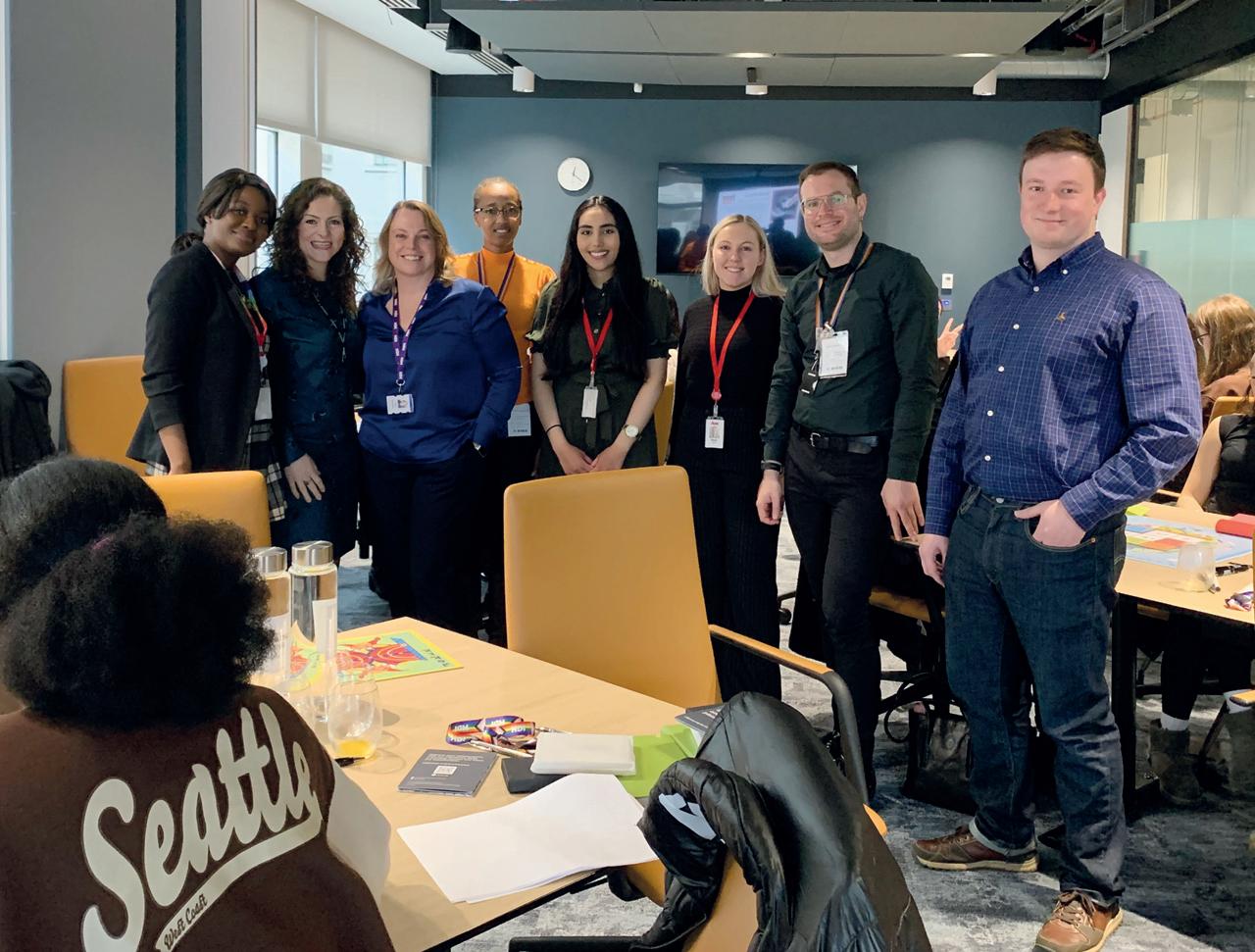
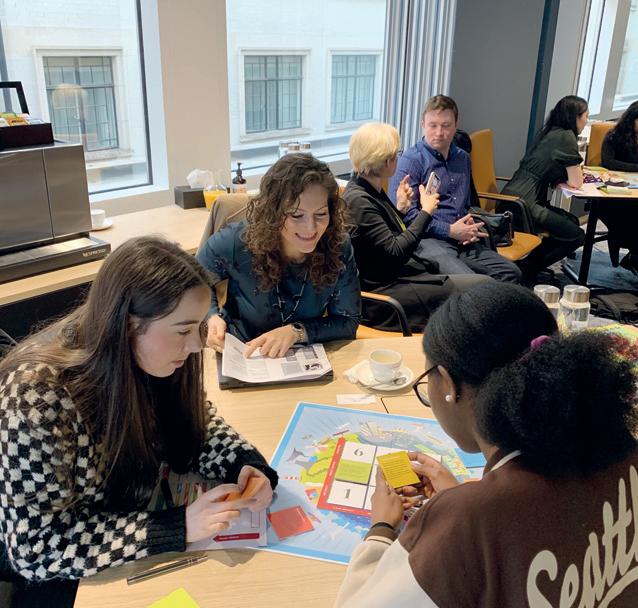
Discover Risk allow students to gain a greater understanding of the sector and the range of careers opportunities available to them. The sessions are also designed to develop students’ soft skills, which are of great importance in the world of work.
WOMEN INSPIRING CHANGE
No event would be complete without hearing from the professionals themselves. Seeing and hearing from a range of women in this thriving profession will only inspire more young people to change their perception and increase their understanding about the world of risk and its opportunities.
Thanks go to Vilma Marques, of the CII; Claire McDonald and Emily Exley,
both of iWin and HDI; Irem Yerdelen, of iWIN and ERM; along with Frankie Boateng, Skye O’Neill and Tania Bal of Aon, without whom the event would not have been the success it was.
iWIN has a regular programme of in-person and virtual events to support the learning and development of aspiring young female professionals. To find out more scan the QR code.

To learn more about the Discover Risk programme and how it can be used in schools, email: george.tsounias@cii.co.uk ●


thejournal.cii.co.uk / The Journal / June - July 2023 47
George Tsounias is education programme manager at the CII
I THOROUGHLY ENJOYED THE WE CAN BE EVENT, AS IT WAS A FANTASTIC OPPORTUNITY TO MEET AND ENGAGE WITH YOUNG, THOUGHTFUL AND INTELLIGENT GIRLS, LEARNING ABOUT THEIR ASPIRATIONS AND (HOPEFULLY) ENCOURAGING THEM TO CONSIDER THE VARIETY OF CAREER OPTIONS AVAILABLE IN THE INSURANCE PROFESSIONFrankie Boateng, early careers recruitment business partner at Aon
IT IS IMPORTANT THAT WE SHOWCASE THE INSURANCE CAREER POTENTIAL TO STUDENTS BEFORE THEY MAKE UNIVERSITY AND JOB CHOICES. I BELIEVE THE INSURANCE INDUSTRY HAS A LOT TO OFFER AND OFTEN DOES NOT HAVE THE SAME PROFILE WITH YOUNGER PEOPLE, COMPARED TO BANKS FOR EXAMPLEClaire McDonald, member of the executive board at HDI Global SE
CREDIBILITY
Membership conveys professional recognition and helps build reputations
MEMBERSHIP
Membership expands networks and creates new opportunities
Membership develops technical expertise faster and accelerates personal growth
COMMUNITY CAREER
Membership helps you go further, faster
Membership is a life-long journey which is relevant at every stage of your career.
Find out more at cii.co.uk/membership
This set of questions, courtesy of online CII training package Insurance
are at the bottom
QUESTION 1
In respect of caravans, what is a flood saver device designed to do?
Create a flood barrier around the perimeter of the caravan
Raise the caravan by means of hydraulics
Raise the caravan by means of flotation
Protect the caravan against water ingress by creating an airtight seal around all openings
QUESTION 2
Which of these reasons describes why a holiday home is considered a non-standard risk for home buildings insurance?
Select two options:
It is likely to be unoccupied for longer periods of time
It is likely to be located in coastal areas and more susceptible to storm damage
It is likely to be in areas regularly frequented by tourists
It is likely to be located in coastal areas and more susceptible to flood claims
QUESTION 3
Following Brexit, are Green Cards now required if a UK registered vehicle is being driven in an EU country?
No - agreement has been reached to allow travel without Green Cards
UK-registered vehicles are no longer permitted in EU countries
Yes, but only if comprehensive cover is required
Yes, they are mandatory when driving in the EU
YOUR SCORE »
1–3 POOR 7–8 VERY GOOD
4–6 GOOD 9-10 EXCELLENT
10C. The fraud screening should take place throughout the life of the claim.
9D. Insuring environmental liabilities through a captive allows organisations with greater exposure to obtain wider cover.
QUESTION 4
In the context of travel insurance, in which of these groups of countries is the global health insurance card (GHIC) valid?
EU countries only
EU countries plus Switzerland
EU countries plus New Zealand and Australia
EU countries plus Iceland and Norway
QUESTION 5
Above what age is it unlikely that you will be able to place a personal accident risk for your client?
QUESTION 6
Which of these organisations manage the listing buildings process?
QUESTION 7
Which of these is the general monetary limit below which travel insurers would not seek a contribution from another insurer?
QUESTION 8
Which of these is the main benefit of an annual travel policy?
It is a more economic option than a single policy per holiday
Cover is provided for several trips per year
The sums insured are higher on each section
There is no excess applicable
QUESTION 9
Q&A
Why do companies often choose to insure environmental liabilities through captive structures?
Cover is always less expensive
Environmental liability cover isn't provided in standard policies
No insurers offer standalone environmental policies
The cover under public/general liability policies is very limited
QUESTION 10
At which point should the screening of commercial property insurance claims for fraud take place?
When the claim is initially notified
When a claim settlement offer is made
At all stages throughout the life of the claim
When the claim is settled
ANSWERS
8B. For familieis taking several holidays a year, annual policies will usually eroff a more competitive premium.
7C. Any claims settled for £100 or less are not deemed economical when considering administr ative costs.
6A. The listing process is managed by Historic England.
5C. Insurers will start to withdraw or restrict cover for your clients from the age of 65 onwards.
4B. The GHIC is valid in the EU and Switzerland.
3A. The UK and the EU have now agreed to re-admit the UK to the Green Card Free Circulation Area.
2A&D. Holiday homes combine increased risk factors such as unoccupancy, being let, and susceptibility to oodfl damage.
the caravan above the surface of the water.
1C. A ood'fl saver' is designed to
49 thejournal.cii.co.uk / The Journal / June - July 2023
STUDY ROOM
Assess, will test your knowledge of relevant learning topics. Answers
55 60 65 75
Historic England Local councils National tourist boards National Trust
£50 £75 £100 £150
oatfl
MENTORING – A TWO-WAY STREET
When I think about mentoring, I recall fondly one of my first mentor meetings back in 2019. We’d arranged to meet at Vergnano 1882 down Mark Lane in the City of London, I was fresh out of university and felt privileged to have found someone outside my organisation who was willing to devote time to discussing my nascent career.
As it turned out, my mentor was a true pillar of support, shedding light on blindspots in my career map that I had not yet experienced. The ensuing meetings yielded many pearls of wisdom. Indeed, her guidance was one of the reasons why I decided to join the insurance profession and, to this day, we regularly keep in touch.
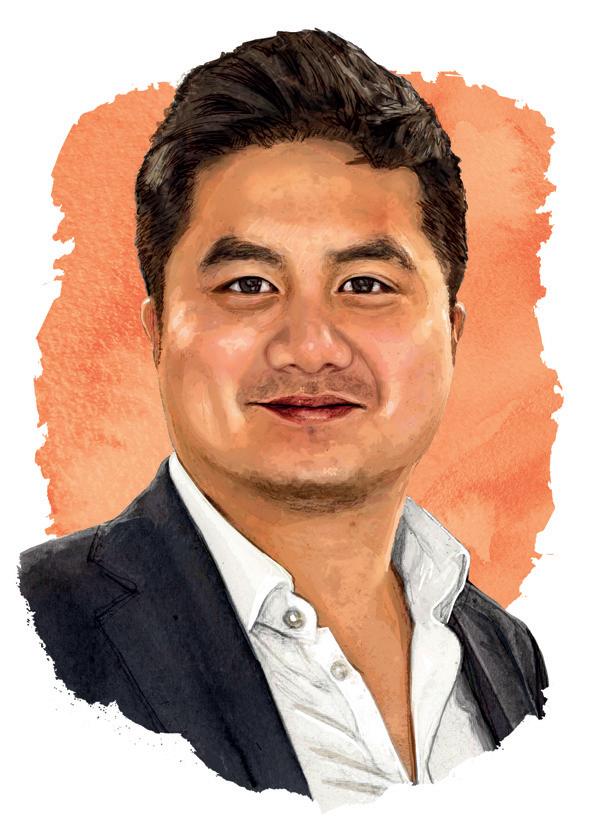
Beyond the personal rewards, many corporations now acknowledge the benefits of mentoring. With firms looking to improve job satisfaction and talent development, especially against the backdrop of a competitive talent market, implementing a formal in-house mentoring programme is becoming increasingly compelling. Indeed, in LinkedIn’s latest annual Top Places to Work to Grow Your Career report, mentoring programmes were a recurring attribute across the 50 firms recognised.
At Aon, too, within the Strategy and Technology Group, we recently launched our own mentoring initiative dedicated to diversity and inclusion (D&I). The purpose was simple: to foster an inclusive culture where colleagues can network, learn and grow together by sharing experiences and knowledge.
Like most consulting businesses, we already had a degree of mentoring rooted in our modus operandi. For instance, as our work is project-based, each engagement is led by a manager, who is responsible for the team’s career development. At project end, there is a formal upward and downward feedback process, which constitutes part of the annual evaluations.
Nonetheless, there were still key considerations we had to factor into the designing of a fresh mentoring programme: How could the programme best cater to our organisational structure? How frequent should we encourage participants to meet, given time commitments? How can we ensure
remote-working staff feel included?
Speaking to colleagues across the market, many have shared similar thought processes within their respective organisations, with some having to sadly put proposals on hold.
Through the years, I have come across some effective approaches for how development programmes can run sustainably:
1Executive sponsorship is key. Set realistic objectives and present the corporate business case to senior executives to garner their buy-in. Considering resource constraints, having a sponsor to drive a clear message from top down not only gives you the initial acceleration, but can also maintain the programme’s momentum.
2Mentoring is not a one-way street. Create a mechanism that enables different directions of mentoring. Mentoring is often misperceived as a one-way street, but mentors benefit tremendously from reverse mentoring. Mentees should be given the opportunity to ask probing questions to challenge the status quo on topics from digital technology through to leadership styles.
For our D&I programme, we wanted to connect employees in three ways to respect the intersectionality of our experiences: vertically (mentor and mentee), horizontally (peer to peer), as well as diagonally (connecting colleagues across global offices).
3Mindfully pairing mentors and mentees. Bespoke pairing can encourage a more meaningful mentorship connection. Gathering key information on professional background and ambitions can help to create more mindful matches. Providing participants with a choice of candidates based on initial matches can also offer them a sense of ownership of the process.
Mentoring is one of the most powerful career development tools to have in a corporate environment. While individuals can seek out mentors independently, having a structured in-house programme as part of your people strategy makes it easy for ambitious employees to connect with supportive advisers to help them achieve their professional goals. In more ways than one, mentoring is not a one-way street. ●
50 OPINION thejournal.cii.co.uk / The Journal / June - July 2023 ILLUSTRATION: MATTHEW BRAZIER
Marcus Li is senior strategy associate at Aon’s Strategy & Technology Group
MARCUS LI
Marcus Li explains the benefits of corporate mentoring programmes, for mentor, mentee and firms


















































































































Providing financial and practical support to current and former insurance employees The Insurance Charities Limited is a registered charity in England & Wales (206860), Ireland (20200129), Scotland (SC047527) and Isle of Man (1230). A company limited by guarantee. Registered in England and Wales (74461). Registered office: Third Floor, 2 St Andrews Hill, London EC4V 5BY and in the Isle of Man (006098F): 34 North Quay, Douglas, Isle of Man, IM1 4LB.
To keep up with compliance you need

Take your organisation’s training and development to the next level.
InsuranceAssess is the online training and competency solution designed for the insurance sector.


Stay up to date and compliant with over 600 courses covering the basic principles of insurance and regulation up to the more specialist areas from personal and commercial lines to the complexities of London Market products, available 24/7 on desktop, tablet and mobile.
Start your free 14-day trial or request a demo to find out how Insurance Assess can support you and your business at cii.co.uk/insuranceassess or scan the QR code.