THE MAGAZINE FOR THE BRITISH INSTITUTE OF FACILITIES MANAGEMENT | 5 MAY 2016
FMW www.fm-world.co.uk
THE BEAUTIFUL GAME From ‘hostmanship’ to activity-based working, why facilities management in the Netherlands is an attractive proposition
01_Front_Cover_5may2016.indd 1
26/04/2016 16:13
ALTIVAR HVAC Drives
Web Exclusive
on a massive range of Altivar 212 drives - in stock now! The Altivar 212 variable speed drive is dedicated for (HVAC) heating, ventilation, air conditioning and pumping applications in a buildings environment. • 3-phase asynchronous motors from 0.75 kW to 75 kW • Energy savings of up to 50% compared to a traditional control system • Easy integration into (BMS) building management systems • Low harmonics THDi<35% • In built EMC filter • Integrated HVAC functions such as fire mode, damper control, pump jam management, sleep/week, mode, etc. • Available in IP21 chassis-mount and IP55 enclosed drive • In the box configuration for quick and easy pre-programming • Universal graphical keypad
Quote Promo Code: DRIVE1 to claim this special online offer... Huge range in stock now - visit cef.co.uk/altivar to place your order and choose one of the following special offers* for a limited period only... Free ‘Service in a Box’ 24/7 telephone support and one on-site engineering day.
Free iPad cable commission the drive directly from an App on your iPad.
Free remote keypad kit commission and change parameters remotely.
Worth c.
Worth c.
Worth c.
£1,100
£100.00
£90.00
Plus direct telephone contact - with a Drives Technical Specialist to assist with commissioning. Whilst stocks last *
cef.co.uk
All products are subject to availability and are correct at the time of print. Errors and omissions excepted. All prices shown are exclusive of VAT where applicable.
The Power To Supply...
FMW.050516.002.indd 2
22/04/2016 10:24
VOL 13 ISSUE 9 5 MAY 2016
CONTENTS
08| Palaces get an upgrade
18| Cruyff turn out for the best
28| CDM 2015 – one year on
NEWS
OPINION
FEATURES
06 Employers are ‘spooked’ by labour costs 07 Bosses’ guide to apprenticeships published 08 Project of the fortnight: Palaces to see £37m upgrade 09 Think Tank: Is there an appetite for having social enterprises supply your catering, cleaning, grounds maintenance and other facilities services? 10 News analysis: FM industry barometer shows fair weather ahead 11 News analysis: The evolving breed of local authority joint ventures 12 Business news: Graeme Davies: The NLW and its unintended consequences 13 Interserve wins a £230m FM deal to service USAF bases in the UK 14 In focus: Peter Hawes, managing director of Norse Commercial Services on joint ventures between councils and private providers
16 Edward Finch discusses how technology has created a new type of disabled workplace user 17 Five minutes with Paul Goldin, vicepresident of Avmor
MONITOR 33 Insight: Market intelligence 34 Legal update: Dyslexia and reasonable adjustments 35 Technical: Over-insulation and legionella 36 Comment: The skills gap – it’s not just FM
REGULARS 38 41 42 43 44 46
BIFM news Diary of events Case in point Behind the job Appointments Calls to action
43| Uni FM Jayne Townsend
18
Brilliant orange – how the Dutch do FM: Activity-based working and a service-led focus are boosting FM’s profile in the Netherlands
24
Public sector FM – a shared vision: Speakers from the public sector and the service provider market share their views on what lies ahead
28
Trust the process: It is a year since CDM 2015 changed the regulations for the construction process on all projects. So how has it been going?
18TH MAY
2016
LACE AT P R U O Y BOOK KFM.COM THIN
HAVE YOU BOOKED FOR THINKFM? 18 MAY 2016 BOOK YOUR PLACE AT WWW.THINKFM.COM
For exclusive online content including blogs, videos and daily news updates
visit fm-world.co.uk FM World Jobs – the best place to find FM career opportunities online
visit fm-world.co.uk/jobs For daily notice of the latest FM news and fresh FM World content, follow us on Twitter Cover image: SHUTTERSTOCK
visit twitter.com/fm_world FM WORLD | 5 MAY 2016 | 03
03_Contents.indd 03
27/04/2016 16:54
The electrical inspection and testing specialists • • • • •
Electrical Installation Condition Reports Portable Appliance Testing Load Monitoring Recording Thermographic Surveys Electrical RectiÀcation Works
As a leading key service provider we operate throughout the UK and Channel Islands providing a very competitive “best value� service which has become very well recognised throughout the Facilities Management market Please contact us for immediate attention Email: qcltd@quantectest.co.uk Phone: (01634) 865750 Fax: (01634) 861195
www.quantectest.co.uk Dec15.indd 1 Quantec Nov13.indd
17/11/2015 09:55 12:26 31/10/2013
0$< 0,/721 &2857 /21'21 )LQG RXW KRZ IDFLOLWLHV PDQDJHPHQW FDQ XQOHDVK \RXU RUJDQLVDWLRQpV SURGXFWLYLW\ SRWHQWLDO
2016
(YROYLQJ IURP ODVW \HDUpV WKHPH RQ FRPSHWLWLYH DGYDQWDJH WKH FRQIHUHQFH WKHPH LV 7KLQN)0 7KLQN 3URGXFWLYLW\p H[SORULQJ IDFLOLWLHV PDQDJHPHQW DQG WKH ZRUNSODFHpV UROH LQ HQDEOLQJ RUJDQLVDWLRQDO SURGXFWLYLW\
THINK FM: THINK PRODUCTIVITY Book now at www.thinkfm.com/book +44 (0)1279 712 640
www.thinkfm.com Brought to you by
HEADLINE SPONSOR
thinkfm@bifm.org.uk #ThinkFM +44 (0)1279 712 640
BIFM Think FMWORLD 186x123.indd 1 04 | 5 MAY 2016 | FM
FMW.050516.004.indd 04
SPONSORS
29/02/2016 16:38
22/04/2016 10:42
Redactive Publishing Ltd 17 Britton Street, London EC1M 5TP 020 7880 6200 www.fm-world.co.uk
MARTIN READ
EDITOR COMMENT
EDITORIAL Tel: 020 7880 6229 email: editorial@fm-world.co.uk editor: Martin Read ⁄ assistant editor: James Harris ⁄ news editor: Herpreet Kaur Grewal ⁄ sub editor: Deborah Shrewsbury ⁄ content development executive: Martha Harris ⁄ consultant art director: Mark Parry ⁄ art editor: Nicola Skowronek
LEADER
ADVERTISING AND MARKETING email: sales@fm-world.co.uk sales manager: Darren Hale (020 7880 6206) ⁄ senior sales executive: Jemma Denn (020 7880 7632) ⁄ sales executive: Jack Shuard (020 7880 8543) / case in point sales: Greg Lee (020 7880 7633) recruitment sales: Sabmitar Bal 020 7880 7665 PRODUCTION production manager: Jane Easterman senior production executive: Aysha Miah PUBLISHING publishing director: Joanna Marsh Forward features lists and media pack available at www.fm-world.co.uk/about-us
his should go without saying, but in case you’re a BIFM member yet to avail yourselves of the many opportunities on offer, let me say this clearly and unequivocally: you really must get around to attending a BIFM regional group event. The mix of networking and knowledge sharing should be potent enough reason in itself, but there’s even more to it than that; these are events compiled, organised and promoted almost exclusively by volunteers – people who take time to craft events that are relevant, timely and useful. What you get when you attend is a real sense of a local FM practitioner community coming together for the collective benefit of all. I recently spent the day with the South West regional group at its quarterly training day, themed around effective security planning and awareness. Of the many elements discussed, two related issues stuck out for me: the need to ensure that a culture of security is introduced, and the need to ensure said culture of security is subsequently maintained. A security culture? Here’s the definition: “The style, approach and values that any organisation needs to nurture and develop, amongst all it’s people, including customers and visitors, in order to create a security culture as part of an effective security regime.” Chris Dickson is a former south-west regional manager for the National Counter Terrorism Security Office, and now a consultant for security consultancy Covenant. He was once part of UN peacekeeping operations and kept as a hostage, so I think you can safely say he’s walked the walk. Dickson explained how maintaining a security culture is “the hardest thing to control as an organisation”, but that such control is affects “your styles, approaches and values”. A security culture is one in which all parties are invested and engaged. Security is everyone’s responsibility, so a security culture cannot be said to be in place if there are any people who take the attitude that security is not part of their job. So the value of a good security regime comes down to the enthusiasm of the people within an organisation to adhere to, and promote, their organisation’s security strategy and associated security plan. These are the kind of traits required of FM personnel more broadly, of course, and those frequently cited as valuable across all facilities service lines: An eye for detail, an awareness of compliance and an aptitude for getting stuck in to solve a potential problem. As the South West Group security awareness training day progressed, speakers drilled down into the component parts of a well-balanced security plan, the ways in which threat levels can be identified and the specific threats to retail and local authority environments. I’ll be more than happy to write elsewhere about the issues they raised about identifying vulnerabilities or the concept of ‘credibility multipliers’, but the point of this particular column is for me to say this: in order to get the real value of all this material, you really have to be there, asking questions. You’ll see a list of upcoming regional events on our diary page. If you’ve not been before, try one that suits - you’ll find they really are worth your time.
T
SUBSCRIPTIONS BIFM members with FM World subscription or delivery queries should call the BIFM’s membership department on 0845 0581358. FM World is sent to all members of the British Institute of Facilities Management and is available on subscription to nonmembers. Annual subscription rates are UK £110, Europe £120 and rest of world £130. To subscribe call 020 8950 9117 or email redactive@abacusemedia.com – alternatively, you can subscribe online at www.fm-world.co.uk/about-us/subscribe/ To order the BIFM good practice guides or the FM World Buyers’ Guide to FM Services visit www.bifm.org.uk/bifm/knowledge/ resources/goodpracticeguides. EDITORIAL ADVISORY BOARD Simon Ball, business development director, Mitie ⁄ Martin G Bell, global FM development manager, Unilever / Lucy Jeynes, Larch Consulting / Nick Cook, managing director, Avison Young ⁄ Rob Greenfield, director, Assured Safety & Risk Management ⁄ Ian Jones, director of facilities, ITV ⁄ Liz Kentish, managing director, Kentish and Co. ⁄ Chris Morris, business development manager, Xenon Group ⁄ Anne Lennox Martin, FM consultant ⁄ Peter McLennan, joint course director, MSc Facility Environment & Management, University College London ⁄ Geoff Prudence, chair, CIBSE FM Group ⁄ Jeremy Waud, chairman, Incentive FM group⁄ Jane Wiggins, FM tutor and author Average net circulation 13,326 (Jul 14 – Jun 15) FM World magazine is produced using paper derived from sustainable sources; the ink used is vegetable based; 85 per cent of other solvents used in the production process are recycled. © FM World is published on behalf of the British Institute of Facilities Management (BIFM) by Redactive Publishing Ltd (RPL), 17 Britton St, London EC1M 5TP. This magazine aims to include a broad range of opinion about FM business and professional issues and articles do not necessarily reflect the views of the BIFM nor should such opinions be relied upon as statements of fact. All rights reserved. This publication may not be reproduced, transmitted or stored in any print or electronic format, including but not limited to any online service, any database or any part of the internet, or in any other format in whole or in part in any media whatsoever, without the prior written permission of the publisher. While all due care is taken in writing and producing this magazine, neither BIFM nor RPL accept any liability for the accuracy of the contents or any opinions expressed herein. Printed by Pensord Press ISSN 1743 8845
BIFM ENQUIRIES
British Institute of Facilities Management Number One Building, The Causeway, Bishop’s Stortford, Hertfordshire CM23 2ER Tel: +44 (0)1279 712 620 Email: admin@bifm.org.uk Web: www.bifm.org.uk
www.fm-world.co.uk
05_Leader.indd 05
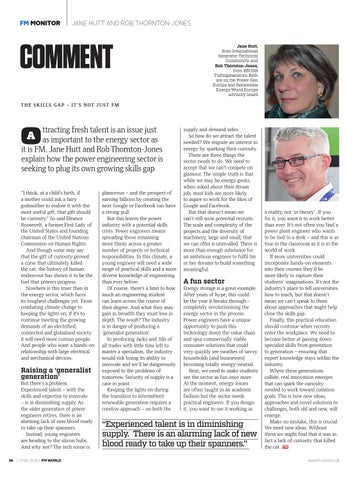
“A security culture cannot be said to be in place if there are any people who take the attitude that security is not part of their job”
FM WORLD | 5 MAY 2016 | 05
27/04/2016 15:29
FM NEWS
SIGN UP FOR FM WORLD DAILY AT FM-WORLD.CO.UK
EMPLOYMENT
GETTY/ALAMY
Employers ‘spooked’ by rising labour costs The latest UK employment figures suggest that employers are “spooked by increasing labour costs”, according to a spokesperson from the Chartered Institute of Personnel and Development (CIPD). The Office for National Statistics (ONS) labour market report states that the number of unemployed people has increased in the three months to February 2016 to 1.7 million representing a 5.1 per cent unemployment rate. The ONS reports this as a rise of 21,000 compared with the previous three months. However, the latest unemployed figure was 142,000 fewer than the same three-month period in 2015, where the unemployement rate was 5.6 per cent. The number of people not working and not seeking or available to work (economically inactive) fell in this period. Comparing the three months to February 2015 and three months to February 2016, total pay increased by 1.8 per cent in nominal terms – lower than the growth rate between the three months to January 2015 and the three months to January 2016 (2.1 per cent). Gerwyn Davies, labour market adviser at the CIPD, said that employers’ concerns over the cost implications of the national living wage [NLW], pension autoenrolment and the impending apprenticeship levy were starting to affect confidence. “Against a backdrop of worries over a slowing economy, it’s perhaps not surprising that we’re starting to see employment growth ease off,” said Davies. “Where employment growth has happened, this is mainly due to the growth in the number
06 | 5 MAY 2016 | FM WORLD
06_News.indd 06
of self-employed, suggesting that employers are in ‘wait and see’ mode over increases in employment costs and the EU Referendum.” The NLW came into effect on 1 April. Employers are now legally required to pay employees over the age of 25 a minimum of £7.20 an hour. The apprenticeship levy, which sees large employers pay a proportion of their wage bills into a central fund used to boost the number and quality of apprenticeships in the industry, comes into effect in 2017. Davies suggested that the UK’s relatively low productivity growth remains a pressing concern. “If businesses are putting
employment decisions on hold, they should use this time to take stock of the skills, technology and working practices needed to move their businesses forward in the long term, regardless of the EU decision,” he commented.
“Poor productivity growth and the introduction of various labour costs such as the national living wage and the rolling out of the government’s auto-enrolment pension scheme may account for the fall in total pay.”
HEALTH AND SAFETY
All 17 Edinburgh PPP schools ‘faulty’ Edinburgh City Council has announced that early findings of building surveys shows “evidence of faults across all 17 affected schools” to varying degrees after safety issues forced their closure last month. In a statement on 15 April, council leader Andrew Burns said: “The council received early indications that suggest evidence of faults across all 17 affected schools to a varying extent. “At the moment it is too early to say what the impact will be, as full survey results from Edinburgh Schools Partnership (ESP) have not been yet been received. Some faults may be easy to fix and may not present a major problem while others could be longer term.” Burns added that “we won’t take risks with the safety of our schools’ children, and schools won’t reopen until Edinburgh
Schools Partnership can assure us of their safety.” As part of the contract, ESP own, maintain and assure the safety of the affected buildings. Amey, which is the FM provider across the ESP schools portfolio, announced that it would be working with the body to identify and help with additional repairs to allow 17 schools in the city to be reopened after safety issues.
The chief executive of the City of Edinburgh Council and senior education officials met directors of ESP after the collapse of a wall at a local primary led to the closure of 17 schools in the area closed on Monday 11 April affecting more than 8000 pupils. House builder Galliford Try has said it takes contractual responsibility for just four of the 17 Edinburgh schools affected by closure. Galliford acquired Miller Construction, which primarily designed and built the schools in question, in 2014. The schools, built under a £360 million deal by the ESP consortium, were completed in 2005. The ESP also included the Bank of Scotland. As FM World went to press, Edinburgh City Council had not received any more details about when the schools would reopen. www.fm-world.co.uk
27/04/2016 17:02
NEWS
BRIEFS Humphreys takes chair at AUDE
Bosses’ guide to apprenticeships published The government has published employer guidance for the apprenticeship levy that comes into force in 2017. The document, published by the Department for Business Innovation and Skills this week, applies to employers from any sector with a pay bill of more than £3 million each year. The levy will be charged at a rate of 0.5 per cent of a company’s annual pay bill. The guidance explains what counts as a pay bill and how to calculate what needs to be paid among other details. The apprenticeship levy is set to be introduced in 2017 and is
designed to increase investment in training and apprenticeships. The government has committed to an additional three million apprenticeship starts in England by 2020. The levy will help to deliver new apprenticeships and it will support quality training by putting employers at the centre of the system, said the government. The Chartered Management Institute’s director of strategy and external affairs, Petra Wilton, said: “Employers have less than 12 months to put their plans in place, and so a concise guide to announcements to date
on the levy is to be welcomed.” She added: “The guide sets out a clear timetable, and employers need to act now to take full advantage of available skills funding. Apprenticeships are a highly cost-effective route for workforce training, but will require new relationships and a fresh approach.” The apprenticeship levy was announced in the Summer Budget 2015, and in the 2015 Autumn Statement it was announced that it would come into effect in April 2017. Read the guidance at: tinyurl. com/FMW-05-05-AppLevy
The Association for Directors of Estates has appointed Trevor Humphreys as its chairman. He is director of estates and FM at the University of Surrey. Humphreys took up the chair of AUDE at the 2016 AGM in April and his term of office is one year. The role of AUDE is to “to promote excellence in the strategic planning and management, administration, operation and development of the university estate and facilities”.
Amey to study Edinburgh walls Edinburgh City Council has awarded a contract to inspect the city’s walls to Amey – despite the provider being a part of the consortium responsible for safety issues at 17 of the city’s schools. Gordon Allan, Amey’s business director for consulting in Scotland said: “As an approved supplier to the Scottish Excel Framework [a procurement organisation dedicated to serve all local authorities and related organisations across Scotland], Amey was invited to tender… and named preferred bidder after a competitive bidding process.” Under the contract Amey will be “drawing on our consultancy expertise to catalogue the location and condition of retaining walls throughout Edinburgh so that the council’s maintenance team can develop a formal inspection and proactive maintenance schedule”.
Half of hospitality workers ‘work unpaid overtime’ Office rents on upward course
per cent nationwide – making the sector among the most likely to work beyond contracted hours. Just under half – 42 per cent
admit to working 5-10+ extra hours each week. Yet only 49.1 per cent of sector workers receive overtime pay. Of those surveyed, 27.5 per cent of workers say they do not receive a lunch break. Lee Biggins, founder of CV Library, said: “With the introduction of the new national living wage it will be interesting to see if these workers continue to clock extra hours, and whether employers further restrict who is entitled to overtime pay.”
SHUTTERSTOCK/ALAMY
Most workers in the hospitality sector work overtime – but only half are paid for doing so. A survey of more than 16,000 workers who use job site CV Library, reveals that the average day for a hospitality worker is eight hours and 12 minutes, which the survey reports is “marginally shorter that the UK average of eight hours and 16 minutes”. It says 84.4 per cent of hospitality professionals work overtime, compared with just 60
The first quarter of 2016 has witnessed the highest level of office take-up across the UK’s ‘Big Nine’ cities since 2008, according to Bilfinger GVA’s regional review of office occupier markets. This has amounted to 2.3 million square feet – 13 per cent above the fiveyear quarterly average. It continues the strong occupational story of the past two years. Q1 figures are characterised by a significant number of big deals – six over 50,000 sq ft, with Morgan Stanley’s 155,000 sq ft pre-let in Glasgow standing out. The construction market is responding; the latest wave of activity was initiated by Paradise and 3 Snowhill in Birmingham, says the report.
www.fm-world.co.uk
07_News.indd 07
FM WORLD | 5 MAY 2016 | 07
27/04/2016 17:34
FM NEWS
SIGN UP FOR FM WORLD DAILY AT FM-WORLD.CO.UK
PROJECT OF THE
FORTNIGHT NEWS BULLETIN
Survey lifts lid on UK workers’ views about NLW Londoners are most likely to be more loyal to an employer paying the national living wage (NLW), with 58 per cent saying they would be more committed, whereas respondents in the North-West and Yorkshire are least likely to agree. A sample of 2,020 men and women over the age of 16 based in locations across the UK was surveyed by consultant Censuswide, on behalf of workforce management software developer Kronos Incorporated. Respondents highlight the impact they expect this will have on wider pay scales, loyalty, and productivity as employees and businesses in the UK adjust to the legislation. The research also shows that in return for paying the NLW, a third of survey respondents believe that organisations will expect greater loyalty from them, and more than half predict that management will demand increased productivity. And two-thirds of respondents say they would have been more loyal to their current employer if they had voluntarily introduced the NLW before the law came in. Understanding the different motivations of multi-generational workforces will be “central to organisations positively impacting this loyalty”, says the survey, with 62 per cent of 16-24 year-old respondents confirming they would be more loyal to employers if they had the chance to be paid the new living wage.
MAJOR UPGRADE WORKS AT TWO ROYAL SITES COMMISSIONED BY: Royal Collection Trust WORKS DONE: Interiors and structural renovation and restoration SITES: Windsor Castle and the Palace of Holyroodhouse (pictured) LEAD DESIGNERS: Purcell architects (Windsor Castle) and Bur Haward Architects (Palace of Holyroodhouse) EXPECTED COMPLETION: 2018
ISTOCK
Palaces to see £37m upgrade The Royal Collection Trust is to invest £37 million on major improvement works at Windsor Castle and the Palace of Holyroodhouse in Edinburgh. The works will fall under the trust’s ‘Future Programme’. The trust says the works will “transform the way visitors are welcomed, interpret the buildings in new ways, create dedicated new learning centres, and open up new spaces to the public”. At Windsor Castle, works include increasing public access to the ground floor of the state apartments, and a 14th century undercroft will be developed as the castle’s first café. The trust is also planning to reinstate the Georgian entrance hall, linking the visitor entrance to the north with the state entrance on the south side of the castle. At the Palace of Holyroodhouse, works include a “new interpretation” in the state apartments, which the trust explains will explore the history of the palace, including the lives of Mary, Queen of Scots and the ‘Young Pretender’ Bonnie Prince Charlie (Charles Edward Stuart). The programme includes a new family room inside the palace, as well as the restoration of the Abbey Strand buildings. The trust is also working with Historic Environment Scotland on plans to maximise the palace’s outside spaces, which includes Holyrood Park and its forecourt, re-connecting the palace with the city of Edinburgh. The works are to be funded by the trust through admissions to official residences of the Queen and its associated retail income. The programme is expected to start on site in 2017, with scheduled completion at the end of 2018. Both sites will remain open to visitors throughout the development.
08 | 5 MAY 2016 | FM WORLD
08_News.indd 8
Stakeholders ‘must exchange ideas’ on building Construction currently does “not allow for the necessary exchange of ideas between stakeholders in the building process”, delegates at the Chartered Institution of Building Services Engineers’ (CIBSE) symposium heard recently. Richard Rooley, former president of ASHRAE, a global society advancing human wellbeing through sustainable technology for the built environment, told attendees construction was not a linear process. He said that to avoid current issues with underperforming buildings “we must create models which allow proper collaboration and information sharing between stakeholders and outside influences, rather than rely on a linear model which discourages dialogue. “We must focus less on strict processes and more on the product – making sure to analyse the consequences of decisions made during the project and how these affect the finished building, with the input of all stakeholders, rather than allowing these changes to derail the project from its original targets.” The building services industry needed, he said, to give “more attention to what it is trying to achieve, and how to manage people, projects and processes to deliver buildings that perform as the clients require”. The annual CIBSE symposium took place at Edinburgh’s Heriot-Watt University in April.
CBRE says Brexit fears fail to dent office take-up Demand for office space in London has remained “robust” through the traditionally quiet first quarter, says global real estate adviser CBRE. The firm said 3.1 million square feet of the capital’s offices were snapped up by companies despite fears that economic headwinds and the possibility of Brexit could dampen demand. The 3.1 million sq ft is only marginally below the 10-year average of 3.2 million – a major move by Thomson Reuters to take 315,400 sq ft at 5 Canada Square in the Docklands lifted overall take-up for the quarter. The amount of office space now under offer remains unchanged from the previous quarter at 3 million sq ft, having been above the 10-year average of 2.8 million sq ft since the beginning of 2014. The development response has so far tracked demand, with supply increasing by 2 per cent over the course of the quarter to stand at 12.2 million sq ft – some 17 per cent below the 10-year average. Emma Crawford, head of central London leasing at CBRE, said: “Between a weak outlook for global economic growth and an upcoming vote on EU membership, businesses have had to contend with a heightened level of uncertainty. That demand for office space has remained so resilient speaks volumes for London’s attractiveness as a global hub.” www.fm-world.co.uk
27/04/2016 10:47
FM NEWS SIGN UP FOR FM WORLD DAILY AT FM-WORLD.CO.UK
THINK TANK
OUR READERS SAID… We asked our LinkedIn and mailing list members: Is there an appetite for having social enterprises supply your catering, cleaning, grounds maintenance and other services? Last month a £1 billion ‘Buy Social’ Corporate Challenge to encourage big businesses to procure the services of social enterprises was launched by the Social Enterprise UK and the Cabinet Office. It encourages big businesses to join forces to spend £1 billion with social enterprises. Support services company Interserve is involved, while Johnson & Johnson, PwC, RBS Group, Santander, Wates and Zurich are also among the first businesses to sign up to the campaign. There has long been the perception that organisations with a social motive often do not have the capacity or business acumen to deliver services to bigger organisations. But could this perception be changing?
We asked whether you thought initiatives such as ‘Buy Social’ have potential within your organisation. Is there an appetite for having social enterprises supply your catering, cleaning, grounds maintenance and other facilities services? Perhaps unsurprisingly, most of you – 53 per cent – did not feel social enterprises were as capable as required, even though some of you wished it could be different, with statements such as: “I would like to say yes, but it is no.” One respondent said: “Relying upon social enterprises, dependent on partisan funding and which are required to produce politically useful outcomes, contributes to chronic economic failure typically explained away as being ‘not for profit’.
Yes, perceptions are changing 47%
No, social enterprises are still not as capable as we require 53%
Collectivist social organisations, such as those encouraged by UN Agenda 21 goals (the blueprint for global order), habitually have politically driven objectives of their own often based on liberal Marxist economics; they are inclined to demand peer political conformity rather than free thinking and prosperity.” But 47 per cent of you thought perceptions were changing. “There are now numerous examples of very successful social enterprises, delivering against strict KPIs and commercial frameworks that meet the demands of clients and
customers,” said one respondent. Another remarked: “Capitalism is not predicated just by the freedom to do whatever you can to maximise profits as long as it’s within the rules; it’s also predicated on customers freedom to know and make an informed choice based on this knowledge.” They added: “Social enterprises are pioneering open and transparent approaches and are succeeding in winning market share based on their ability to achieve a sometimes complex balance of multi-stakeholder need.”
Impact of wage rise is hard to predict, says report The economic impact of paying for the increase in wages resulting from the introduction of the national living wage (NLW) is “difficult to predict”, according to research by commercial property consultant Bilfinger GVA. Its research briefing paper looks at the likely effects of the introduction of the £7.20-an-hour rate, which was applied to about a million workers above the age of 25 from 1st April. GVA’s briefing says the economic impact of the wage is difficult to predict and that similar warnings given before the introduction of the minimum wage in April in 1999 “ultimately failed to materialise”. It added: “But since then there has been a fundamental change www.fm-world.co.uk
09_News.indd 09
in the retail, leisure and hotel sectors, with a much larger range of choice and greater competition, particularly from low-cost or online models.” The briefing note states: “An obvious outlet for business
would be to increase prices and daily rates to compensate for the increase prices and daily rates to compensate for the increase in wages, but with concerns over the global economic outlook and some retail markets still struggling
following the recession, this is not so straightforward.” It points out the heavy reliance upon EBITDAR (earnings before interest, taxes, depreciation, amortisation, and restructuring or rent costs) to determine rent in many of the sectors where the national living wage will have the greatest impact means that businesses who struggle with this increase will also face greater pressure on their ability to pay rent. The research adds: “The strength of existing lease covenants may need to be reassessed in the short term, although it may well be that the biggest impact of the national living wage is more social than economic.” FM WORLD | 5 MAY 2016 | 09
27/04/2016 16:11
SIGN UP FOR FM WORLD DAILY AT FM-WORLD.CO.UK
FM MARKET
FM industry barometer shows fair weather ahead
Could the outcome of the EU Referendum cast a cloud over the industry? HERPREET KAUR GREWAL newsdesk@fm-world.co.uk
The FM sector has been described as a barometer of the economy. Well, if that’s the case, the outlook seems rosy – even if optimism is not perhaps quite as high as it was last year. In the BIFM’s business confidence monitor released last month, 64 per cent of UK professionals from the sector describe the business environment as “positive” or “very positive”. When comparing these findings with 2015 figures, it’s a 6 per cent fall. BIFM says this is “caused by external influences such as the upcoming EU Referendum and the economy, as well as changes to government funding”. The FM Business Confidence Monitor 2016 research was created from a survey of professionals from senior decision-makers to teams on the ground delivering services. 10 | 5 MAY 2016 | FM WORLD
10-11_News Analysis.indd 10
The sector employs about 10 per cent of the UK’s working population and is estimated to be worth £111 billion a year to the economy, which is why it is a barometer of business performance as a whole. But when considering their own business, 38 per cent of respondents say they are confident, while 30 per cent indicate that they are slightly more confident in economic growth and performance of their business over the next 12 months compared with 2015. When respondents were asked if the apprenticeship levy would
facilitate more apprentices within their organisation 48 per cent say they remain unsure. When asked if they plan to hire apprentices in 2016 only 35 per cent say, ‘yes’ compared with 47 per cent in 2015. The report says: “While the government and FM service providers speak passionately about the importance of funding these programmes, the research suggests there is a disconnect between rhetoric and ambition and the practicalities of delivery.” A number of large FM service providers have pledged to recruit more apprentices, but this arguably contradicts the survey results. In reality, 56 per cent of respondents do not hire apprentices, while 37 per cent say they do and 7 per cent are not sure. These figures are slightly down on last year, when 47 per cent of respondents said they were recruiting apprentices. The pattern continues when they are asked: “Do you plan to hire apprentices in 2016?” Only 35 per cent say ’yes’ compared with 47 per cent last year.
The known unknowns Martyn Freeman, managing director of Mitie FM, said: “There is so much more we need to understand about how the apprentice levy is going to work, how it is to be funded and how it is to be delivered. We are at the early stages of any legislative change. There is a lot of work to do to understand how that will affect employers.” James Sutton, CEO, BIFM, said: “The outlook of the FM industry remains relatively buoyant, although it is appears to be proceeding with caution until the
“There is so much more we need to understand about how the apprentice levy is going to work, how it is to be funded”
outcome of the EU Referendum and the effects of new legislation such as the apprenticeship levy are fully realised. Although the future funding of apprenticeships has been protected by the government, the findings of this year’s FM Business Confidence Monitor also echo the institute’s discussions with employers. This is that there does seem to be a limited understanding of apprenticeships and the full extent of the opportunities and implications they present.”
Growth opportunities Terry Myatt, relationship director for business services at Barclays, said: “The cautious optimism displayed by the FM sector is understandable given the range of uncertainties facing the industry in the short term. But there are still growth opportunities for businesses with a clear strategy who are able to adapt at speed to the changing economic and regulatory environment.” Market research agency MTW’s director Mark Waddy says the results tally with its 2016 report. It said the FM market faced some “near-term challenges such as the current ‘economic blip’ stimulated by short-term factors – not least the EU referendum stimulating growth in ‘wait and see’ policies”. “FM companies heavily engaged in the public sector are also seeing a continued squeeze on contract prices, while there are growing signs of an erosion of business confidence in private sector FM markets as well.” But, added Waddy: “Its important to keep these short-term negatives in context and not talk ourselves into stagnation. There are strong, underlying fundamentals for medium to longer-term growth for FM from both public and private end-use sectors”. i The FM Business Confidence Monitor 2016 research was conducted by BIFM in partnership with i-FM.net and Barclays
SHUTTERSTOCK
FM NEWS ANALYSIS
www.fm-world.co.uk
27/04/2016 17:03
Cofely has a joint venture with Cheshire West and Chester Council
PUBLIC-PUBLIC PARTNERSHIPS
The evolving breed of local authority joint ventures
ALAMY
HERPREET KAUR GREWAL newsdesk@fm-world.co.uk
Between 2009/10 and 2014/15, spending by England’s local authorities was cut by a fifth because of austerity measures. This has required councils to find alternative funding models to sustain themselves and protect frontline services. One of these has been joint ventures (JVs), which have been in use for years by local government. But now, according to a report by business and financial adviser Grant Thornton, their use is expected to increase. JVs have traditionally seen local government partner with commercial organisations, but the report says a new breed of publicpublic joint ventures could be particularly effective. FM firms have been prominent in forming JVs. In 2013, Cheshire and Wirral Partnership NHS Foundation Trust (CWP) selected Ryhurst as preferred bidder for a comprehensive range of FM services to set up a 15-year, 50:50 joint venture partnership to deliver FM. www.fm-world.co.uk
10-11_News Analysis.indd 11
Last year Cofely signed a joint venture with Cheshire West and Chester Council (CWAC) to provide customer and integrated workplace management services.
Partnership objectives Norse has also been building its joint ventures portfolio for a number of years – the latest being formed with Havant Borough Council (see page 14). The firm is actually wholly owned by Norfolk County Council, so its JVs are public-public ones. The report states that “this type of JV provides the opportunity for councils to partner with companies that bring both the scale economies and expertise,
combined with the public sector ethos”. There have also been the notable “tri-borough” deals with numerous London councils and providers such as Amey. The report says that while local authorities are increasingly looking to joint ventures it warns that as more local authorities adopt JVs in the future, they would need to consider carefully the objectives and partnership arrangements of these models to ensure that they can “survive and thrive”. Report authors identified a number of JVs, set up to deliver services in a particular way, that had not been responsive to the council’s changing agenda, objectives or circumstances. This had resulted in both sides reaching for the contract and the JV ultimately failing. Grant Thornton’s analysis covers JVs delivering a range of council services, both back-office and front line, at different stages in their lifecycle and found that the most common services provided through a JV are: IT; finance; human resources; payroll; road repairs and maintenance; revenues and benefits; schools catering; and property management. Although there have been some high-profile JV failures, the report found that with the right set of shared objectives, a culture of trust, and the right governance, they can be successful. In part, this is as a result of combining common cultures, but in many instances, councils
“Overall, joint ventures can be a viable alternative delivery model for local authorities. Our research indicates that the numbers of joint ventures will continue to rise”
already have good collaborative relationships. There is also less tension for councils as a partner in a profit-making public-public JV, as ultimately all profits are returned to the public purse.
Success in the field It reports successes such as CATERed in Plymouth – a co-operative trading company which is jointly owned by 67 local schools and Plymouth City Council and which has reduced costs for the local authority. For instance, by owning a 51 per cent stake in CATERed, the council has been able to ensure that staff have retained their Local Government Pension Scheme pensions. The council does believe that aspects of the JV’s management will need further development – this includes performance management. The report also warns that councils must be aware of EU procurement requirements and the different requirements that may apply when the other party is in the private rather than the public sector. Among its recommendations on how to make a JV successful, the report says it has to be allowed to operate independently outside of the council. Vivien Holland, local government advisory at Grant Thornton and report author, said: “Overall, joint ventures can be a viable alternative delivery model for local authorities. Our research indicates that the numbers of joint ventures will continue to rise, and in particular we expect to see others follow examples of successful public-public partnerships.” i Better Together: Building A Successful Joint Venture Company is the latest in a series of reports looking at alternative service delivery models in local government and can be found here: www.tinyurl.com/fmw0505grantthornton-jvs
FM WORLD | 5 MAY 2016 | 11
27/04/2016 17:04
FM BUSINESS SIGN UP FOR FM WORLD DAILY AT FM-WORLD.CO.UK
ANALYSIS
The NLW and its unintended consequences GRAEME DAVIES newsdesk@fm-world.co.uk
The national living wage (NLW) may only be a few weeks old, but already thoughts are turning to the possible longer-term consequences of the uptick in pay for the lowest earners. Over the coming months we will discover whether the prophets of doom who predicted that companies’ profitability will be hit by the millions in extra costs were right and if the warnings
from companies as diverse as FM provider Interserve to retailer Next and hospitality specialist Whitbread were correct. But there are wider potential consequences of the NLW for the UK economy that will also become clear over the coming months. And such potentially unintended consequences could bring about some vital changes in the economy. First, the introduction of the National Living Wage could
finally stoke some inflation in the economy after years of stubbornly low inflation. Indeed, the last time we saw the Consumer Prices Index measure of inflation at the Bank of England’s target of 2 per cent was over two years ago, and inflation has dipped into negative territory in the intervening period. The weakness in inflation has meant the Bank of England has been able to resist the urge to hike up interest rates, leaving monetary policy as loose as possible. This has aided the economic recovery but has also stalled the process of normalising interest rates by returning them to anything near their historical averages. Second, the hike in the wages of the lowest paid will contribute to wage inflation but is also thought likely to be passed on to end customers and consumers through price rises. This could begin to encourage wider inflation in the
Contract wins
NEW BUSINESS NG Bailey has secured a three-year, £20 million maintenance deal, covering eight retail centres owned by Land Securities. The service provider has maintained five of the centres for five years. The new deal expands the responsibilities to three additional centres. Centres in the portfolio are St David’s in Cardiff, Lewisham Shopping Centre, the O2 Centre and West 12 Shopping Centre in London, Trinity and White Rose Centre, both in Leeds, Gunwharf Quays in Portsmouth, and The Galleria in Hatfield. Bouygues Energies & Services has secured a five-year contract to deliver hard FM services to 45 sites and 102 buildings at Surrey and Borders Partnership NHS Foundation Trust. The 12 | 5 MAY 2016 | FM WORLD
12-13_BusinessNews.indd 12
trust is a provider of specialist mental health, drug and alcohol and learning disability services. The contract began on 1 April. Churchill has renewed its cleaning contract with the London Oratory School for another three years, taking the length of the partnership to nine years. The original contract began in 2009, and as part of the renewal process a review of the entire service delivery was carried out, including remapping of the areas to be cleaned and the scope of services. Service provider Mitie has won a waste management contract with Lucozade Ribena Suntory. The deal sees Mitie take on waste services at
the company’s manufacturing site in Coleford, Gloucestershire, and its UK headquarters in Uxbridge, west London. OCS has won a three-year total facilities contract with the Northview Group. Under the deal, OCS will provide a number of services at the firm’s head office in Maidenhead, including catering, cleaning, reception services, manned guarding, CCTV and access controls, remote monitoring, planned and preventative maintenance, waste management and pest control. Private bank C Hoare & Co, the UK’s oldest family-owned private bank, has chosen cleaning firm Julius Rutherfoord to service its sites at Fleet Street and Lowndes Street in London. The contract includes a stipulation to pay the London Living Wage. CIS Security has been awarded the contract for security services at Spitalfields E1 estate in London by managing agent CBRE. CIS has been securing Spitalfields E1 estate for 14 years and has recently retained the contract for three more years.
economy. Last year, Lord Wolfson, boss of Next, said that the NLW threatened to create “a harmful inflationary loop” in the economy and Whitbread also talked of selective price rises to meet the extra costs of rising wages. But some companies will find price increases hard to push through – including many in FM. In such cases, businesses will look to improve the productivity of their workforces to offset extra wage costs. In a recent survey three in 10 firms said improved productivity was the best way to combat rising costs and pushing through such an agenda could also help to resolve one of the biggest head-scratchers of the recent economic recovery – the woeful lack of improvement in productivity of UK workers. In previous rebounds productivity improvements have been to the fore; this recovery has seen employment grow strongly but productivity growth remain weak. This could be about to change. Alongside those companies who are looking to meet extra costs through improved productivity, one in five public sector businesses says it expects to meet extra wage costs through job reductions. Indeed, the most recent threemonth figures showed UK jobless numbers rose for the first time since the middle of 2015. Whether the government intended its NLW to help boost productivity and encourage some inflation back into the economy or not, it is likely these will be among the big long-term economic consequences of the policy. How successful firms are at passing on wage costs or mitigating them through better productivity will have a significant bearing on this, and also on the overall effect of the policy on corporate profitability in coming years. Graeme Davies writes for Investors Chronicle
www.fm-world.co.uk
27/04/2016 15:30
BUSINESS Interserve wins a £230m FM deal BRIEFS to service USAF bases in the UK Interserve has been awarded a five-year contract worth about £230 million with the Ministry of Defence’s (MoD) Defence Infrastructure Organisation (DIO). The company will provide facilities services to the US Air Force’s estate in the UK. The prime contract – called United States Forces Prime (USFP) – combines four existing facilities support contracts covering the six US Air Force (USAF) main bases in the UK and their associated satellite sites. Interserve will carry out a combination of total facilities management and engineering services maintenance for three operational wings of the USAF – the 48th Fighter Wing, 100th Air Refuelling Wing, and the 501st Combat Support Wing Works start in November.
Sodexo hits 2016 ‘targets’’
Interserve will carry out total facilities management at six US Air Force bases
Many of the sites Interserve will take on have previously outsourced support services; this is the first time the estate will be managed by one provider. This amalgamation of contracts is designed to drive greater efficiencies, allow flexibility to accommodate changes in estate requirements and funding, while
providing vital support to USAF military operations and training. Adrian Ringrose, CEO of Interserve, said: “Bringing the United States Air Force’s facilities management under a single arrangement is a significant undertaking, but one which will deliver real synergies and greater flexibility for our client.”
ALAMY/HAILEY HAUX
CBRE chosen to manage Commerz Real’s UK estate Global real estate adviser CBRE has been appointed by asset management firm Commerz Real to manage property assets in its investment portfolio of its openended real estate fund hausInvest. The portfolio, covering 1,100,438 square feet across the UK, comprises seven mixed-used properties predominantly in London, with one in Liverpool at Mann Island. The six properties in the capital include 180 Great Portland Street, Paternoster House, 1 Paternoster Square, Athene Place, two hotels – the Novotel and IBIS – in Blackfriars, and an industrial unit in Harlow, Essex. CBRE will deliver day-to-day property management to each of the assets. www.fm-world.co.uk
12-13_BusinessNews.indd 13
Sodexo has reported operating an profit of ¤621 million (£493 million) for the first half of its financial year, marginally up from 2015 (¤620 million). Its revenues were reported at ¤10.59 billion (£8.42bn), a 6.7 per cent rise from the same sixmonth period in 2015. Broken down into regions, Sodexo’s UK performance for the first half of its fiscal 2016 was ¤1.1bn (£0.87bn), a significant 27 per cent rise. Operating profit in the region was ¤66 million (£52.4 million), a 74 per cent increase.
Churchill wins Croydon deal Churchill has forged a partnership with the London Borough of Croydon. The company will provide cleaning and support services on behalf of Croydon Council for three years. The deal takes effect from 4th July 2016. Services will include cleaning, washroom, window cleaning, and confidential and medical waste services to a portfolio of about 70 properties, including council offices, housing sites and community centres.
Amadeus caters in Belfast
The IBIS hotel on Blackfriars Road, part of the portfolio to be managed by CBRE
Martina Kraus, for property management controlling at Commerz Real, said: “We welcome CBRE to our supplier family and look forward to
working with its experienced team to ensure that our UK office and logistics portfolio is managed in line with our overarching aims.”
Amadeus has secured a £16 million contract over five years with Belfast Waterfront and Ulster Hall (BWUH) in Northern Ireland for the exclusive supply of catering conferences and events. Amadeus has 40 years of experience, including 25 years as caterer for the International Convention Centre (ICC) in Birmingham. Elllvena Graham, chair of the board of BWUH, which operates both Belfast Waterfront and Ulster Hall, said: “We value Amadeus’s innovative approach to catering.” FM WORLD | 5 MAY 2016 | 13
27/04/2016 15:42
FM BUSINESS
IN FOCUS
The interviewee: Peter Hawes, managing director of Norse Commercial Services The issue: Joint ventures between councils and private providers
New partners, new directions Last month, national FM and contract services group Norse Commercial Services launched a 10-year, £6.5 million-a-year joint venture with Havant Borough Council called Norse South East. The Havant venture is the latest in a long line of local authority partnerships that Norse has formed, including those with Newport City Council and Great Yarmouth Borough Council, which it says have contributed “significantly to the company’s growth”. What has been unique about Norse’s approach to Havant? Peter Hawes, MD of Norse Commercial Services, explains: “Havant has a high dependency on the leisure industry… which meant we had to be mindful of different income streams and different skill sets that some of the staff may have had. This is a beautiful part of the country and there is very high regard for environmental issues so it’s absolutely essential we understand the specific requirements of that location.” Street cleaning, refuse collection and grounds, maintenance tasks will be handled in much the same way from council to council, says Hawes. “The only thing is, generally there will be different 14 | 5 MAY 2016 | FM WORLD
14_BusinessFocus.indd 16
requirements for different uses and that’s what we have to be careful with. For instance, we need to understand what the exact frequency of grass cutting may be and what standards are required to ensure that this is giving the authority the image that they want to portray… the service for each authority varies depending upon whether it is in a highly industrialised or a leisure area… the frequency of certain services and standards required helps us understand what exactly the partner wants us to achieve.” A strong business base Hawes told FM World that Norse is focusing on expanding in the country with a similar model to the one in Havant. “We have a strong base now on the South Coast and we will be looking at how we can grow the business from that base. We’ll be looking to secure new contracts and introduce new skills in order to win new work which perhaps the borough has not yet undertaken.”
A joint venture essentially means a local authority becomes a company. “It’s a partnership of Norse and Havant Borough Council and we will be bidding for work and expanding the company as best we can. The authority is a shareholder in the new company… we are able to move the staffing to a company and with that comes more commercial freedom to develop the business in that area.” But, he says: “We don’t want this to be seen as a standalone private company, we want it to be seen as a company owned – in this case – by Havant which is delivering services in a more commercial way.” And the ambition of the Havant and Norse JV is broad. “Some of our partnerships still retain the name of the authority we work with, like Medway Norse, Barnsley Norse and Newport Norse. Havant have decided they want to have broader ambitions in the SouthEast, so therefore they have been very clear to not directly
“We have a good process for doing this and we are pretty well experienced”
have ‘Havant’ in the name [of the company] even though they are proud to be a part of [it].” Big ambitions And Norse is an ambitious company. Hawes says it is exploring the possibility of new work “throughout all of our activities whether it is care homes, asset management, professional services or facilities and environmental work that we do. There are huge opportunities in the public sector at the moment”. The company is exploring two Midlands joint ventures. Hawes said: “We have two potential JVs in the offing in the Midlands, but they will take place over the course of the year. These things have a long gestation period and we have to work through what the issues are with our potential customers, and they have to feel comfortable with us. So there is a degree of due diligence to be carried out.” Norse seems to have the expertise to make it work, given its work with other local authorities. Says Hawes: “We have a good process for doing this and we are pretty well experienced.” HERPREET KAUR GREWAL newsdesk@fm-world.co.uk
www.fm-world.co.uk
27/04/2016 10:15
Lower maintenance costs with Lifetime Blinds from Westgate Solar Control The fit and forget blind designed to withstand demanding environments Save maintenance time: Blinds engineered to last the life cycle of the facilities contract Lower costs: reduce ongoing maintenance or replacement costs, typically associated with cheaper blinds Reduced Risk: Incorporate crank handles to remove ligature risk Rest-Assured: Our blinds come with up to 10 years guarantee giving you peace of mind Build Your Solution: side wire, blackout, heat reduction, manual or electric options available
Why Westgate: • All our surveyors and installers are DBS checked • Full planning process managed by an in house contracts team • Products manufactured and quality controlled in the UK • Approved vendors to many large facilities companies, including Mitie, Kier, and Interserve… • FREE surveys and quotations available
“Great product for a school environment with little to no maintenance” Blinds installed at Co-operative Academy of Leeds “I have purchased many college blinds over the last few years and the staff I deal with at Westgate are always friendly and helpful, nothing is ever too much trouble for them.” Mitie Facilities Manager
Also available from Westgate Solar Control, low maintenance window films. • Over 150 types of window film available to manage; heat, glare, UV, privacy, safety, security and more • Anti-pick edge seal can be installed on request to ensure films remain in excellent condition during life cycle management.
T: 01785 242 181 | salesteam@westgateuk.co.uk | www.westgatesolarcontrol.co.uk
WGSolar
DBS
ACCREDITED
FMW.050516.015.indd 2
22/04/2016 10:30
FM OPINION
THE DIARISTS
WHO’S THE DISABLED ONE?
‘
EDWARD FINCH
is a former professor in FM at Salford University and previously editor of the academic journal Facilities
I’m wheeling my way along the corridor against a crowd of conference attendees keen to get to the coffee. Many are immersed in a phone
or tablet. There’s one coming my way and he’s not looking where he’s going. Surely he’s going to see my wheelchair? But I’ve seen this many times before. Invariably they cause me to do an emergency stop, then stand over me looking confused and embarrassed before careening around me. I thought it was me that was disabled? Not only am I immobile, I have optic neuritis, which can make it hard to make visual sense of my surroundings in times of stress. So what’s this guy’s disability? Well, his headphones make him insensible to my calls of alarm and his smartphone consumes any remaining sensory awareness. So why’s it me that’s left feeling like the clunk in this encounter? On this occasion no one was going to get hurt. No doubt other mishaps involving building occupiers can have greater consequences. That’s why we look to FMs to provide a safe environment. But there are two
things that don’t appear in the rulebook. The first is the growth of what I call ‘technologically disabled’ – building users who choose to make the real world subservient to a virtual world when walking about. Checking our text messages as we descend the stairs; talking on the phone as we carry hot drinks in the café. Disabled people spend much of their time carrying out their own informal risk appraisals. They have to be to avoid the calamitous fall in the washroom or the uncontrolled descent down the stairs. So we have an apparent paradox. Some building occupants are using every precaution to avoid injury at work. At the same time,
“HIS HEADPHONES MAKE HIM INSENSIBLE TO MY CALLS OF ALARM AND HIS SMARTPHONE CONSUMES ANY REMAINING SENSORY AWARENESS”
many healthy workers choose to take risks to save time. Second, there’s the concept of risk compensation. This states that people typically adjust their behaviour in response to the perceived level of risk, becoming more careful where they sense greater risk and less careful if they feel more protected. That’s our situation in a nutshell. Some of us necessarily have a heightened perception of risk (the ageing and disabled workforce); others have a reduced perception of risk (protected by their youthful exuberance). For the FM this presents a problem: the safer their constructed environment, the more inclined people are to take risks. I don’t have an answer; I simply ask, can we adopt a health and safety culture for the distracted workforce? Increased risks are not solely attributable to disabled and ageing people. The phenomenon of distracted walking has created a new type of disabled user.
BEST OF THE WEB Views and comments from across the web The office isn’t dying, it’s crosspollinating (BIFM Group) Ian Thomas: Some people just won’t want to believe it... Most probably those wanting to push workers into their own homes in order to save office rents. Short term-ism? Charles Marks: Definitely, though seeing much more of an appetite for business wanting to explore the provision of alternative environments. Michael Bartlett: I disagree with the comment “short termism”. 16 | 5 MAY 2016 | FM WORLD
16_Opinion.indd 16
Pushing workers into the home environment is the way forward for both the worker and the employer. What are the significant considerations when proposing a maintenance strategy? (BIFM Group) Kate Gould: It has become apparent from some of the work that I have been doing, relating to catering equipment, that many FMs do not have a robust asset register linked to their maintenance strategy. If FMs own the asset register, rather than the
maintenance company, then a streamlined approach can be adopted without additional costs or potential disruption to services with the change of a supplier. Stephen Moore: The right strategy depends on the type of industry your strategy relates to. Is it manufacturing? In which case condition monitoring, planned maintenance, building in redundancy into your process are the way to go. David Manners: Alignment to the business strategy
is key, length of leases, stakeholders requirements and occupancy trends are all factors to consider. Do we still need to provide so many fire extinguishers in modern offices? (Paul Huber, BIFM Group) Brendan Murray: Extinguishers are quickly becoming obsolete; particularly as so many businesses are either not training staff in their use or specifically stating that staff should never to attempt to put out a fire
using a fire extinguisher. Rees Howel: In my case it’s one fire in 10 years. The ballast in a low bay fitting in our production area started smouldering. The risk may be low but I was glad to have an extinguisher to hand. Amanda Harris: Safety equipment is always useless right up to the point where we need it… Adding training would be a good idea. Most people don’t know how to use a fire extinguisher and would be surprised to know they only operate for seconds. www.fm-world.co.uk
26/04/2016 15:52
You can follow us at twitter.com/FM_World www.tinyurl.com/fmthinktank
BEST OF THE
FMWORLD BLOGS Codify this Simon Heath, Murmuration I’ve been a knowledge worker myself and worked alongside knowledge workers for nearly all of my working life. Leaving aside the fact that left brain vs right brain has been shown to be a myth, a great many creatives find themselves in knowledge work. Some of them will be lucky enough to work in roles where they are able to use their creative talents. Many will not be so lucky. Our workplaces are full of makers, artists and writers. Many will have had the will to express themselves creatively crushed. By teachers, by managers, by circumstance. Millions of thoughts going unheard. Thoughts that might lead to new products, new treatments, new politics, new novels. We need that creativity. But the design of workplaces won’t get us anywhere and not if it’s based on a photocopy of what works at Google. Not without people. And a deep understanding of the latent creativity at our disposal. Creativity does not spring forth at our command or in the places we expect it to. It can’t be neatly codified and labelled. It defies structures and attempts to contain it. But it needs people to flourish. To see it in ourselves and others. To let it soar. We need creativity. Shortsighted notions of who it might come from might give us another Google. But we don’t need another Google. Creativity will bring us the next big thing. Creativity is not the preserve of an elite. It belongs to us all. Keep doodling. Read this full article at www.tinyurl.com/zlbre8q
Architecture without FM = aeronautics without pilots Steve Maslin It wouldn’t make sense if aeronautical engineers designed aircraft without pilots. Surely then, early involvement of FMs would make sense in the design of buildings? Post-occupancy energy performances frequently fall short of their intended targets. How much better might outcomes be if there was prior discussion? It will be the FM to whom HR and customer services go to resolve things. The challenge is that built environments often become “set in stone,” unable to facilitate the activities that go on within them – despite the best efforts of FM. How could we avoid this? FMs will be familiar with putting the case for investments in changes that bring about cost savings. But there is always the risk that one could be making short-term cost savings that will have a detrimental impact on less easily quantified matters and erode value over the longer term. Building a case that captures value is a wise move. So what value-based insights could you bringing these projects? Whilst FMs are strategically placed, narrow thinking can still creep in from your comfort zone – unless you are prepared to up your game. The antidote is joined-up thinking, bringing people around the table to gather perspectives. We cannot always predict change but we can start to anticipate possibilities via exploring scenarios. Many of the challenges that you are likely to encounter involve interactions between people and your facilities. So one of the biggest reasons for FM getting in at the pre-design stage is to pay proper attention to how well facilities work for intended occupants. You may be sold design concepts such as “smart” or “agile” working, but do you know what the impacts are on employee performance and productivity? This is where a clued-up FM can make sure that the right advice is sought. We need to make sure that in seeking an input, project value is not sacrificed by confusing it with cost savings. Engaging in these issues could get you a promotion. But let’s take stock and review what it could mean to you in your current role. Read this full article at www.tinyurl.com/zf95464
www.fm-world.co.uk
17_Opinion.indd 17
FIVE MINUTES WITH NAME: Paul Goldin JOB TITLE: Vice-president, Avmor
Many cleaning professionals now select “cleaner-disinfectants” when performing cleaning tasks tackling facility germ centres such as restrooms, desk-tops, high-touch areas, food service areas, and more. But the way they use these products may actually make them ineffective. This is because many cleaning professionals believe these products clean and disinfect all in one step. This is not correct and can have serious health repercussions. Using a cleaner-disinfectant is always a two-step process. The surface must be cleaned first – often referred to as a ‘pre-cleaning’ – and then cleaned a second time. It’s the second step that actually disinfects the area being cleaned, and it’s necessary for the product to be used properly. The key issue is that the actual soils on the surface must be removed first. If cleaning professionals read the spec sheets or technical data sheets that accompany these products, this ‘pre-cleaning’ step invariably will be mentioned. Unfortunately, many workers do not read spec sheets. Because of this, distributors should always point this two-step process out to their clients. When using and selecting cleanerdisinfectants, select a product designed to kill a spectrum of bacteria and viruses on hard and non-porous surfaces. If there are any particular bacteria or virus of concern, be sure the product label mentions these, that the product is proved effective against them. Read the label and be aware of the cleanerdisinfectant’s dwell time, as this can vary with different products. The cleaner-disinfectant must remain wet on the surface. If it dries, the cleanerdisinfectant should be reapplied. FM WORLD | 5 MAY 2016 | 17
27/04/2016 15:32
FM FEATURE
18 | 5 MAY 2016 | FM WORLD
18-23 Going Dutch..indd 18
FM IN THE NETHERLANDS
SARA BEAN
www.fm-world.co.uk
27/04/2016 17:45
FM IN THE NETHERLANDS
ORANGE REVOLUTION HOW THE DUTCH DO FM
The Netherlands is having no trouble luring an influx of young people into facilities management with innovations such as activity-based working and a service-led focus boosting its profile. Sara Bean finds out what it is that sets the Dutch art of FM apart
T
he built environment appears to be going Dutch at the moment, with the British Council of Offices (BCO) 2016 Annual Conference taking place in Holland in May, following Amsterdam’s hosting of the Smart Workspace Design earlier this month where The Edge, the world’s greenest and smartest building, is based. The reasons for this interest is because the Dutch are widely acknowledged as leading the way in the adoption of more productive and innovative ways of working, in particular activitybased working (ABW) and they also take a refreshing approach to facilities management. FM is taken seriously in Holland, where it is perceived as an important and popular discipline – whether you’re working within the private and public sector, as an in-house FM or as part of a services supplier. Ron van der Weerd is the chairman of EuroFM and programme manager of ZP7 Real Estate reconstruction at Hanze University of Applied Sciences in Groningen, and was until www.fm-world.co.uk
18-23 Going Dutch..indd 19
recently the dean of the School of Facility Management at Hanze University. He says: “FM is in a very advantageous position here in Holland because the profession is really mature and pretty well recognised, and that has to do with two key aspects. One is our educational system, which plays an important role, and secondly, we depend more here on a service economy than a production economy.” “We also have a lack of space in Holland, which is trying to accommodate a pretty large population of 17 million people; so you always have to be very efficient and organised and use space as best you can with the least waste, so all of our culture
is about being efficient and effective.” Figures from the Dutch FM association, Facilities Management Netherlands (FMN), show 260,000 people are involved in the facilities business in the Netherlands with the total market including real estate worth ¤77.2 billion. This contains both real estate – at ¤39.9 billion – as well as FM services at ¤37.2 billion. From that, about ¤22 billion is outsourced, with a 40/60 split between in-house and outsourced FM.
Learning and training Recent changes in Dutch labour laws limit employers from imposing temporary contracts to encourage the use of fixed
“When we employ people from the Netherlands we find we’re getting high-quality, engaged young professionals”
contracts, and that regulation, along with the government’s expectation that employers are responsible for the competence of their staff, means there is a strong emphasis on education and training. In fact, over the past few years the Dutch have developed quite a reputation for producing a highly qualified new generation of FM practitioners. “A bachelor degree-level education has already been here for 40 years”, says Wil Gooskens, programme manager at NHTV Breda University of Applied Sciences. “Every year we have 1,700 people who started their education in FM and there are at least 20,000 to 30,000 practitioners, on a comparative level 6 to the UK system.” All this education doesn’t necessarily mean that the average Dutch FM is very young. Like those working in FM in the UK, the median age is around 40 and at the top end of the spectrum the more senior FMs are around 60. Holland has an ageing population and recently increased its retirement age to 67. But the Dutch don’t have any problem attracting younger FM WORLD | 5 MAY 2016 | 19
27/04/2016 17:45
FM FEATURE
FM IN THE NETHERLANDS
people into FM, many of whom enter the sector from the age of 18 or 19 when they’re choosing their professional education. Says Ron van der Weerd: “Something that I have noticed in my international experiences is that a lot of countries trail behind in attracting young people into FM. This requires some leadership [from the profession] to go into schools to present yourself as a very attractive profession, with the emphasis on the management aspects of facilities management.”
SARA BEAN
Right, below and overleaf: The Edge in Amsterdam is described as ‘the world’s greenest and smartest building”
PHOTOGRAPHS: HORIZON PHOTOWORKS, INTERIOR ARCHITECT – FOKKEMA & PARTNERS
Work placements The Dutch are also active in getting work placements and organising fact-finding trips for students, including trips to the UK, which is viewed as “one of the frontrunners in FM,” says George Maas, a partner at leading consultancy and project management firm Hospitality Group. He has taken parties of student FMs to the capital as “we think of the UK as the country where FM is most well organised.” “Where the UK is well ahead of us is with innovative models, in particular PFI, which we have in our country as well – but in the UK you’re onto the next generation,” he says. “However, we have chosen a different way of evolving FM in Holland with the belief that in the future we’ll have to deal more with hospitality and almost all the corporates now organise FM into more of a hospitality function than facilities management.” “This service-led focus means that while the average age of a facilities manager in the Netherlands is still between 45 and 55, and 70 per cent of this generation at a senior level are male – when we look at the students coming into the discipline, 60 per cent are female.” In the most recent FM World
20 | 5 MAY 2016 | FM WORLD
18-23 Going Dutch..indd 20
“Hostmanship is designed to induce end users to come to your building and it plays a key role for Dutch FM” www.fm-world.co.uk
27/04/2016 17:45
FM IN THE NETHERLANDS
STAR PERFORMERS
AN OVATION FOR INNOVATION Below are some more examples of best practice by people and firms working in the Dutch FM sector. 1. Lisa Hut won the FMN Bachelor of the Year award in 2012 for her study of the physical environment of a 3rd workplace, and has gone on to join Measuremen, based in Amsterdam, which collects data on the use of the workplace, the work activities and employee experience. This data helps organisations to create the ideal working environment for every employee.
Salary Survey for the UK the ratio of male/female respondents was 66/34.
Dutch FM trends Rather like their UK counterparts, the Dutch are also engaged in debate on the relationship between service providers and clients and how they can work better together. Innovation is a key trend in Dutch FM, with a lot of effort going into how the market and service providers need to become more mature and offer ‘added value’, but the Dutch have resisted being pushed too far down the commodity route. “When I speak to counterparts in the Netherlands they are surprised by how FM is approached here,” says Phil www.fm-world.co.uk
18-23 Going Dutch..indd 21
2. Ronald Vos, who won the EuroFM bachelor award for his graduation internship has been working to improve the Cleaning Cost Calculator used by Eurest Services. This calculates the required cleaning hours of the various office locations in the Netherlands. Owing to multiple office design changes and the lack of a clear data management plan, the data had become outdated, resulting in inaccurate budget and cost monitoring of the cleaning process. Vos worked on identifying flaws, restoring cleaning calculation data and guaranteeing a well-operating cost calculation system. 3. Martin Vos, a PhD student with a BA in FM, is currently working at the consultancy department of Netherlands Railways (NS) and has been involved in experiments with scents and ambient lighting to find out what settings enhance customer satisfaction.
Ratcliffe, managing director of Procore. “In the UK over the last few years there’s been a rise in the whole concept of the workplace – with a lot of formally FM companies rebadging as ‘workplace companies’, but when you ask ‘how do you buy those services’, procurement again drives it down to the commodity experience. “In practice, this means that when you buy in FM here you go into a detailed analysis on costs right down to how much the engineers’ mobile phones will cost.” Procore has formed a close collaboration with Delft University in the Netherlands, where the real estate and FM course is run by Tanja Zuijderwijk. Says Ratcliffe: “Our impressions are that FM does seem to be more of a discipline of choice for students in the Netherlands – of course there are students here, but when we employ people from the Netherlands we find we’re getting high-quality, engaged young professionals.” Zuijderwijk says the Dutch have even come up with a word that describes a way of making people welcome. “Hostmanship is designed to induce end users to come to your building and it plays a key role for Dutch FM. “In Holland, we not only have service level agreements but experience level agreements – meaning we’re not just fulfilling our client’s needs but surprising them, and if you do that you’ve exceeded their expectations and their return is guaranteed.” As in the UK, in Holland the integration of support services is another trend that larger corporates are talking about, with IT, HR and FM working together within the business. As part of their course work Zuijderwijk’s students focus on ways to
increase cooperation with HR managers, and how they can work together to facilitate people.
Cultural differences Marcel Broumels, an alumnus of Breda University and innovation acceleration manager at Essent – the Netherlands’ largest energy company – has been involved in setting up an innovation platform for the firm’s FM team. Like most large firms, Essent has a number of service level agreements with a range of suppliers. Broumels explains: “The traditional approach is to set up a contract which assumes that if you put it all down on paper you’ve going to give the end users what they need and the suppliers will know what to do and that will fix it all. “In practice, that’s never the case because what we are actually looking to do is to deliver the best experience that the people in the company can have; but [at this stage] they don’t really know what it is they want so it’s a very fake relationship and you need to instead look to innovate and surprise your customers.” Although Essent’s suppliers use a standard contract that states, for example, the length of the contract and the key performance indicators (KPI), alongside this the FM team meet a few times a year with suppliers, managing agents and FM students from universities to look at ways to enhance the user experience. Broumels says: “This has helped us as a company to come up with new and innovative services, but when I’ve presented on this approach abroad it’s often viewed with suspicion. “This I believe is because the culture is different here. In the Netherlands, we’re far more open to being creative and using trial and error than other countries. “In the Netherlands if you FM WORLD | 5 MAY 2016 | 21
27/04/2016 17:46
PHOTOGRAPHS: HORIZON PHOTOWORKS, INTERIOR ARCHITECT – FOKKEMA & PARTNERS
FM FEATURE
FM IN THE NETHERLANDS
don’t challenge your boss, you’re not doing your job. My supervisor says ‘you have specific capabilities I want you to use and not just do as I say’, whereas in Germany, for example, which follows a more traditional hierarchical model, you might get into trouble if you’re not respecting the bosses. “I’ve also noticed that people here are very direct and very honest with their opinions, whereas when working in the UK people will say something is fine even if it’s not, because they’re trying not to be impolite. In the Netherlands we will only say something is fine if it is fine. “The same goes for end users, who will be more likely to express their opinion when things aren’t the way they’d expect than worry about
22 | 5 MAY 2016 | FM WORLD
18-23 Going Dutch..indd 22
SARA BEAN
offending the hierarchy.”
Going ABW The Netherlands leads the world in its adoption of activity-based working (ABW), as pioneered by Dutch firm Veldhoen, which supports workers by supplying a variety of office environments that support different activities. David Sheehan, managing partner for Veldhoen in the UK, says ABW is a forward-thinking idea that the UK has been slow to pick up on. He first came across the idea when looking to find a partner who’d create the modern way of working he was seeking for Sainsbury’s new head offices. The UK, he says, often looks too much towards the US rather than the continent for ways of working, and concentrates too much on property costs, rather
“If you don’t challenge your boss, you’re not doing your job” than focusing on productivity and efficiency. ABW as an aid to productivity is borne out by Leesman Index research, which shows that its functionality and effectiveness score is consistently higher for workplaces that have implemented ABW. But why are the Dutch so advanced in their thinking? Sheehan says it’s down to a cultural difference. “The Dutch are very practical, level-headed, pragmatic people who analyse very objectively
and come up with ways of solving problems and maximising opportunities without some of the hang-ups of the past.” “The other thing the Dutch consider is ‘discretionary motivation’ – what makes somebody want to do something above and beyond their normal 9 to 5? It’s about connection, being treated like an adult and having power about what you want to achieve and objectives of output and input; those are all things that thrive in ABW.” www.fm-world.co.uk
27/04/2016 17:46
FM IN THE NETHERLANDS
ILLUSTRATION: NIEL WEBB
OPINION
THE DUTCH AND THE ART OF SPACE MANAGEMENT
ABW is making great inroads into the Dutch market; the top four financial institutions, ING, Rabobank, ABN Amro, and SNS Bank have all embraced it. And a Future of Work project at Essent has resulted in a change management programme that introduced new ways of working – approached from a people aspect, rather than estates or IT. As Dutch architect Ron Bakker of PLP, behind the design of the Edge, explains it: “The Edge is an early example of how things can develop across the built environment. It’s not one big invention, but the coming together of lots of little things and it reflects the unique working culture that we have here.” FM i For more information see: www.fmn.nl/ www.eurofm.org/
www.fm-world.co.uk
18-23 Going Dutch..indd 23
FM correspondent Andrew Brown argues that Dutch attitudes to space management can also be seen in the way its national football team plays The Dutch (and to an extent, their north European neighbours in Scandinavia) are regarded as leaders in ideas on how to improve employee engagement, productivity, wellbeing and basically putting people ahead of the capital asset. What you might not know is that this is rooted in Dutch culture. There is a distinct Dutch way of doing things. Organisations like Veldhoen adhere to the concept of activity based working (ABW) with a philosophy about workplace and how to improve an organisation’s performance. It all hinges on ABW. They won’t bother working with you unless you buy into their way of doing things. This is a very Dutch attitude and a principled approach that flows through many aspects of Dutch life including, as a prime example, football. Total Football, to be precise. The biggest and most successful exponent of the total football philosophy (tactics don’t even cover the concept) was Johan Cruyff. He died just before Easter and in every obituary were the words legend, genius and influence. He changed football forever. His approach was one based upon questioning received wisdom (again a Dutch attitude). He was an original disruptive thinker (something FM in the UK is crying out for right now). You can read almost anywhere on the internet
about total football and Cruyff’s influence, but his determination to be creative and his challenge of authority inspired, astonished and delighted contemporaries. Together with Rinus Michels, he re-imagined football as a swirling spatial contest: whoever managed and controlled limited space on the field would win. David Winner, author of the book Brilliant Orange, argues that in this Cruyff and Michels drew on wider Dutch culture: for centuries the people of the Netherlands had been finding ways to think about, exploit and control space in their crowded sea-threatened land. It is present in Dutch design, architecture and land management. It’s present in workplace and FM. Can you see the connection? I’d argue there are lessons here for ‘professionals’ in workplace and FM. We need to rethink what is happening in the UK support services sector just as Cruyff and his colleagues did in the 70s and 80s with regard to Dutch and world football. FM can learn from workplace. Workplace can learn from football. But whatever happens, with or without ABW, it needs leadership. It also needs rules and a rigid system to allow the freedom of such a swirling spatial contest to succeed. Because even as players swap positions and roles (think about that in a workplace scenario for a minute) the system fails without the genius and leadership of someone like a Cruyff in its midst. Let’s go Dutch.
FM WORLD | 5 MAY 2016 | 23
27/04/2016 17:46
FM EVENT FM IN THE PUBLIC SECTOR
JAMIE HARRIS
PUBLIC SECTOR FM: A SHARED VISION A recent university of Salford event, The Future of Facilities Management in the Public Sector, explored the problem of ineffective public facilities and had speakers proposing ideas to ‘rationalise and transform’ the sustainability of public sector FM operations. Jamie Harris picks out some of the day’s key contributions
SHARED SERVICES, LINKING AGENDAS - AND THE PRESSURE TO INNOVATE Public sector services are constantly under threat from economic, social and political factors, and that hinders FM’s ability to innovate, claimed Glenn Woodhead, part of the estates team at the Royal Borough of Kensington & Chelsea. “There are constantly elections going on,” he said, “and constant changes, what with local elections and the EU referendum.” Despite changing politics and demographics, the desire to link facilities agendas with other units has stayed the same. 24 | 5 MAY 2016 | FM WORLD
24-26_FM_Public sector.indd 24
“We’re looking at trying to join up the FM agenda with the carbon and air agenda. This is not easy to do – it might sound sensible to look at where the adjacencies are, but in reality, linking those agendas together is not straightforward. There’s a lot of people looking after their own agendas so it is often very hard to join programmes together.” Woodhead referenced the project that saw three London boroughs join together to share back office functions and operate a shared delivery model, known as the tri-borough agreement. Several local authorities have since looked into sharing FM costs and services. He said: “What we did in FM is drive together three very different estates with different cultures and delivery models – one of those councils had an
outsourced model, another was very insourced. We had to join together and come up with a model that worked.”
Future FM consideration: The age of FM being driven by value, rather than cost, is still some way away, said Woodhead. “We’re still in the age of austerity – the funding gaps are still there, we are still being pressured in terms of more for less - that challenge, the idea of adding extra value, not accepting the lowest cost – I’m intrigued about how that’s going to work. The reality is that our procurement issues don’t really allow us to do those matters.”
www.fm-world.co.uk
27/04/2016 17:48
EMPLOYERS SHOULD SET OUT TO DEFINE FM SKILLS BIFM director of education Linda Hausmanis called for employers to become more involved in directing the sector in which skills they are looking for from the next generation of facilities managers. While apprenticeships in Germany are held in such high esteem, and there is parity between them and a university degree in the UK, question marks remain over the quality of apprenticeships and their connection to the workforce. Hausmanis said: “One thing that concerns me about trailblazer apprenticeships is that they are driven by the number of three million by 2020 [the government has set a target for three million people to be in apprenticeships by the end of the decade]. I’d rather see 10 per cent of that figure, but see quality apprenticeships.” The skills problem is more deep-rooted within the school system, suggested Hausmanis. “Money is going in, and then employers are claiming that [the skills gained by school leavers] are not what they want. They should be shaping those skills. There must be a breakdown of boundaries between education and employers.” More is required from government to make apprenticeships an attractive option, said Hausmanis. “It’s scandalous that apprentices are on £3.70 an hour [the national minimum wage] – no 15 year old will be excited by that.”
REGIONAL DEVOLUTION COULD IMPROVE PUBLIC SERVICES Regional devolution could help public sector FM services become more efficient, said Nick Caton, commercial director at the Crown Commercial Service (CCS). A number of public sector sites would benefit from integrated and shared service arrangements, said Caton. But sharing such services between different public bodies would, he said, always be a “complex and difficult” process. “It’s only when [devolution happens] that you can get this collaboration, these ways of working and these integrated services,” he said. The existing supplier base is already efficient, said Caton; suppliers are benefiting from maximising the resources they commit on contracts close to each other, continually looking at ways to make the most of the mobile workforce working on them. He cited devolution in the city of Manchester and its surrounding boroughs as an example
www.fm-world.co.uk
24-26_FM_Public sector.indd 25
of how services for a council building could be procured in tandem, for example, with a healthcare trust or school. He compared this with arrangements whereby a hospital trust and council building can be close to each other but “have two very different contracts with different specifications and different suppliers”. Sharing services within the public sector ecosystem meant providers working together. “This is not just about contractual terms or money, but about collaborative behaviours. How do I get [one service provider] to share intellectual property with another? The integration of customers, suppliers and procurers will drive FM forward.”
Future FM consideration: Public facilities could benefit from using space for community groups or other organisations. “Libraries are already doing what Amazon does [allowing third parties to use their platform to sell goods], in using space for other services.”
“THE CHALLENGES FACED FOR LOCAL GOVERNMENT AND SERVICE PROVIDERS ARE POLITICAL, ECONOMIC, SOCIAL… THERE ARE CONSTANT CHANGES THROUGH ELECTIONS, AND CHANGING SOCIAL DEMOGRAPHICS. THE CUSTOMER BASE CHANGES AND THE REQUIRED DELIVERY OF SERVICES CHANGE… ” GLENN WOODHEAD, INNOVATIONS AND SOLUTIONS MANAGER, ROYAL BOROUGH OF KENSINGTON AND CHELSEA, WHO IS INVOLVED IN THE BOROUGH’S SHARED SERVICES AGREEMENT WITH THE BOROUGH OF WESTMINSTER & HAMMERSMITH/FULHAM
FM WORLD | 5 MAY 2016 | 25
27/04/2016 17:48
FM EVENT FM IN THE PUBLIC SECTOR JAMIE HARRIS
FM PROCUREMENT ‘HINDERS’ OUTSOURCING The procurement process in FM has become a hindrance to public sector outsourcing, according to Bellrock FM’s CEO Martin Holt. Holt said there is often a lack of transparency in the FM industry, which hinders the flexibility of facilities and estates teams. He said: “The whole procurement process gets in the way. From a public sector practitioner’s perspective, OJEU (Official Journal of the European Union) can be helpful and it can be very unhelpful. “If you’re facing a challenge where you need to be more flexible over who you can contract with, OJEU gets in the way, and if I’m being perfectly candid, I don’t think the CCS [Crown Commercial Service] framework has really helped. It’s channelling down into set boxes
PUBLIC SECTOR FM TEAMS CAN LEARN FROM EACH OTHER Public sector FM teams in different working environments can learn from each other to improve services provided, claimed Peter Bright, head of strategy at the University of Salford. Bright has experience working in local authorities, and he noted that the professional services side of a university is not dissimilar from the way local governments operate. “Looking at residential space, education, libraries, in both sectors there is a range in the age, quality and use of buildings,” said Bright. “Both [local authorities and education institutions] have backlog maintenance programmes, and both require looking after the resources that support people, enabling them to work safely and comfortably.” Bright cited shared front-ofhouse services at Lincolnshire and other district councils in the area, catering services for
26 | 5 MAY 2016 | FM WORLD
24-26_FM_Public sector.indd 26
that don’t really help [the FM provider].” A government spokesperson responded to Holt’s comments, telling FM World that the CCS believes this isn’t the case, and that the framework “offers flexibility in procuring facilities management contracts across the public sector”. The spokesperson said: “This ensures access to government contracts to a wide range of suppliers, including SMEs, while supporting delivery of high-quality services and value for money.” The FM models in public sector organisations also need to address ownership of asset management tools, according to Holt. He said that by pushing asset management on to the service provider, the FM team loses the opportunity to benchmark. “Data needs to sit with the public sector
schools at a local authority being spread across a district, and urged FMs to be open to changes in operations that may seem bold. “For example, we are looking at extended working hours at [the University of] Salford, including 24-hour access to libraries. When working at a local authority, we allowed community volunteers to run longer operating hours in the local library. “But while there is an enthusiasm to share and work together, the enthusiasm needs to be sustained,” said Bright. “It is not just about sharing benefits, but costs and challenges as well.”
Future FM consideration: Both sectors have a certain requirement for flexibility within service provision, said Bright. “Offering agile working conditions will change the dynamic of FM.”
body, the client, or you lose transparency.”
Future FM consideration Holt referred to a quote from Steve Jobs. “It’s impossible to join the dots looking forward.” Holt urged FM teams to consider what they should have been doing five years ago to make services as efficient as they can be today. He said that the future of public sector facilities management would be centred on placemaking, and ensuring that estates are using information to effectively create a flexible space for its users. “I predict that we’ll be talking about the workplace and assets, rather than facilities management itself. FM has a certain understanding in the marketplace – not about the physical act of the service you’ve provided, it’s what you are trying to create.”
Bellrock FM CEO Martin Holt
“OJEU GETS IN THE WAY, AND IF I’M BEING PERFECTLY CANDID, I DON’T THINK THE CCS FRAMEWORK HAS HELPED” BELLROCK FM’S MARTIN HOLT’S BLUNT VIEW ON THE FRAMEWORKS IN PLACE FOR FM PROCUREMENT ON PUBLIC SECTOR CONTRACTS. THE CCS RESPONDED BY SAYING THAT THIS WAS NOT THE CASE, CITING THE FRAMEWORK’S FLEXIBILITY AS A KEY FACTOR
www.fm-world.co.uk
27/04/2016 17:48
FMWorld www.fm-world.co.uk
REINVENTED
FM World Ad STG3 AW.indd 27
27/04/2016 17:50
FM FEATURE
CDM REGULATIONS 2015
LOUISE HOSKING
TRUST THE PROCESS It is a year since the CDM 2015 replaced CDM 2007 – changing the law for the whole construction process on all projects. So how has it been going? Health and safety consultant Louise Hosking reports
ISTOCK
T
he Construction (Design & Management) Regulations 2015 (CDM) have meant significant change for anyone using contractors from 6 April 2015; not only because of changes in responsibilities for dutyholders, but also because – for the first time – smaller-scale works and domestic projects had to follow the process. Anyone commissioning works, using contractors, designing, pricing, scoping or delivering projects has had to review their arrangements and act accordingly. I became involved in building projects during the mid-1990s when CDM was new. I have always believed CDM principles are sound, and have made good use of all the associated guidance to support clients, designers and
28 | 5 MAY 2016 | FM WORLD
28-31 CDM.indd 28
contractors alike to implement systems of work that comply with Section 3 of the Health & Safety at Work Act 1974. This says an employer has a duty to protect those not in his direct employment from the risks created by his undertaking. In the run-up to 6th April last year, safety and health professionals waited eagerly for the guidance, attending seminars and reading the draft guidance, and listening to our peers’ views. The actual guidance, L153, was not released until the day of the regulations – even the Health & Safety Executive (HSE) website had to play catch-up. This meant a significant amount of work for our customers – who represent all five dutyholders categories (clients, principal designers, www.fm-world.co.uk
27/04/2016 13:45
CDM 2015
designers, principal contractors, contractors, and workers) – to assess how they were going to adjust their arrangements. And they have adapted – all are now managing building work just that little bit smarter. But CDM15 has not been without its challenges. Initially, there was a transitional period for works where a CDM coordinator had already been appointed which gave these projects up to 6th October 2015 to transition over to the new regulations. This actually caused some confusion because some organisations believed they did not have to comply until 6th October 2015.
Scope of the regulations I work mainly in the facilities and commercial management sectors, so by far the largest number of queries I have had to deal with regarded the scope of the regulations owing to the definition within them on what is considered to be construction – in particular, the inclusion of ‘maintenance and repair‘ within the definition.
“The regulations have removed the role of CDM coordinator, but I am shocked by how many client organisations are still trying to shoehorn this role into their projects” www.fm-world.co.uk
28-31 CDM.indd 29
Initially, I guided organisations to focus on their larger projects or those with significant risk, but pure interpretation led to much confusion. The definition of construction work has not changed. Planned, routine maintenance or work where individual components are removed and replaced, or lubrication and inspection undertaken, is not CDM work. The definition refers to work on the structure and CDM15 is all about construction projects that have a start and finish, and involve the use of construction tools and construction equipment. The HSE issued excellent guidance in the form of a Q&A to assist, but I agree it is not definitive and no one wants to be the legal test case. I have been watching discussions on the topics closely because this remains an area I am often asked about. The guidance I offer is to risk-assess each project against the definition and consider the following: 1. Does the work involve construction techniques, tools and knowledge? 2. Does the work involve breaking into the structure? 3. Does the work fall within the scope of a project with a start and finish? If the answer to all of the above questions is ‘yes’, the work is likely to be CDM work. The regulations were never designed to complicate routine, low-risk, short-duration works, so a decision should still be made on risk as well. For buildings that contain asbestos, fragile surfaces and unknown risks, a risk assessment would be likely to conclude that the CDM15 process should be followed. I was asked recently if jet washing a waste storage area FM WORLD | 5 MAY 2016 | 29
27/04/2016 13:46
FM FEATURE
CDM REGULATIONS 2015
would fall within the scope of CDM15. This is routine cleaning work with known managed risks and would be considered planned preventative maintenance (PPM) works, although jet washing the external fascia of a building would be a different scenario. HSE guidance suggests individual routine maintenance tasks completed as part of a regular PPM programme would not be considered a ‘project’, and therefore would not have to follow the CDM15 process. But if work is undertaken by the same contractor (which is unusual) outside of the normal scope of services, it may well be. Construction work by employed staff could also fall under the scope of the rules.
Application for term maintenance and PPM works
SHUTTERSTOCK
Even where the CDM15 process does not apply, section 3 of the Health & Safety at Work Act certainly does. I advise our customers to review all their contractor management arrangements and apply the process for PPM works by contractor as follows: 1. Ensure those engaged have the correct skills, knowledge, experience and organisational capabilities to undertake the work 2. Prepare pre-construction information and provide access to previous Health & Safety files, so contractors are aware of hazards that are inherent to their place of work. 3. Ensure that responsibilities for management and supervision are clear, especially where subcontractors are engaged. 4. Prepare site rules and expectations for safe working – create a client pack that clearly outlines expected standards. 5. Ensure that resourcing and
30 | 5 MAY 2016 | FM WORLD
28-31 CDM.indd 30
LOUISE HOSKING
time is adequate for the work in hand. 6. Induct workers coming to site. 7. Review Risk Assessment and Method Statement (RAMs) together for routine works to be undertaken at an appropriate frequency based on risk. 8. Meet with term contractors on a regular basis, and ensure that health and safety is on the agenda of every meeting. 9. Make sure contractors have access to welfare facilities if this is reasonably practicable. 10. Keep existing health and safety files current.
Competency of contractors Competency has always been a CDM cornerstone. The new rules replaced this with a requirement to consider skills, knowledge, experience (SKE) and organisational capability when engaging the services of others. Client responsibilities for engaging those with the correct SKE are now more critical than ever, and the penalties for not complying are greater than ever before. At the heart of the regulations is ensuring that those who create the risk are responsible for managing it. Some designers and principal designers have become used to referring to a CDM coordinator to ‘think safety’ on behalf of the project. Now, there is an expectation they will make the right choices and decisions themselves as they design. This could mean some designers will have to learn more about health and safety and CDM15 to meet client expected standards. I have worked with more designers in the last year than ever before. They really can eliminate risks at the design stage, not only for those who construct, but also for anyone using or maintaining the completed project. Once they
are shown how their decisions can have an impact on others a host of clever design solutions to manage safety problems and consider the health of others come tumbling out. I have witnessed some real light bulb moments. If contractors and designers cannot show they are working to meet the new standards, clients will choose those who can.
Goodbye, CDM coordinator, hello, CDM consultant The regulations have removed the role of CDM coordinator, but I am shocked by how many client organisations are still trying to shoehorn this role into their projects. The requirements are very clear – the CDM coordinator no longer exists. Individual dutyholders must step up and develop
the necessary SKE to fulfil their defined responsibilities. They should all be able to make riskbased choices as part of what they do, and with each decision made. CDM coordinators have a wealth of knowledge, but must now adapt their approach to train, guide and support dutyholders, not do the work for them. Under the Management of Health & Safety at Work Regulations 1999, organisations should have access to a competent person to guide them in the application of health and safety legal requirements. Dutyholders cannot subcontract their responsibilities. The HSE has been clear on this topic. Support may only be required for a short time while the necessary skills are acquired by the design team, client or contractor. Cooperation, www.fm-world.co.uk
27/04/2016 14:18
CDM 2015
“Every design alters along the way, so this may mean tweaking drawings at the end of the project to align with what has actually been built” good project management, and effective coordination is key to ensuring that there is a clear overview of all the safety issues resulting from the work and how risks are being controlled. Organisations requiring support are responsible for verifying that advisers or consultants have the SKE and organisational capability for the work. The Association of Project Safety (APS) has been working this past year to make sure its members are meeting expected standards in knowledge to give sound advice to others. Anyone www.fm-world.co.uk
28-31 CDM.indd 31
looking for advice can request evidence that the person they are working with has passed the APS examination of CDM15 competency. General safety consultants should be listed on the Occupational Safety & Health Consultants Register (OSCHR). All dutyholders can benefit from learning more about applying the principles of health and safety prevention and application of the hierarchy of risk control. This will achieve greater control for any project. On larger projects, there are
likely to be members of the design team with particular specialisms who can contribute to managing the risk as a whole. Application of the requirements in this case is all about good coordination of knowledge to determine how individual risks or disciplines combine or interact. If there is more than one contractor involved in the project, the client must appoint a principal contractor (PC) and principal designer (PD) in writing and will retain these duties until they do so. There is scope for the roles to change during the project, but this must be organised in a managed manner. The PC role has changed less than the others, but PD is new. Some project managers and architects have been reluctant to take on the PD role, and some added costs have definitely been disproportionate to what is actually expected. For smaller projects, much less is required. Responsible clients are working with their regular contractors and designers to achieve the standards expected and this is exactly what the changes anticipated. For clients to know they have to appoint a PC or PD, they must be aware of how many contractors are working on the project. This means clients have to ask the question, and contractors who do not directly engage their workers must inform them.
Do the filing Some project teams remain unsure as to what should be included, and clients can help by clearly communicating how they would like the information provided. There has been a reluctance to provide ‘as built’ drawings, and files are still not being created during the work, which is definitely the best way to collate it.
Clients should ask for regular updates to determine whether the file is progressing as expected. Everyone should expect ‘as built’ drawings. Every design alters along the way, so this may mean tweaking drawings at the end of the project to align with what has actually been built. Generic electrical layout or drainage drawings will equally not be enough to satisfy the requirements, and drawings must show where new utilities have been installed. Photographs taken during the project are a great way to show where services run and the location of aspects of the project that will be hidden in future. Once developed, health and safety files should be updated rather than created from scratch, if possible, and looked after. This is future pre-construction data, so it’s important, and clients should be demanding high standards of information.
Conclusion Commercial clients who have accepted the new processes and acted upon the regulations feel more in control. Roles and responsibilities have greater clarity, and the regulations are more prescriptive, meaning everyone has direct duties to fulfil – which they usually like. Informed project teams are definitely stepping up and I believe standards have improved. The CITB has some great guidance on its website, and industry sectors are supporting their trades in a productive manner. Health issues are being pushed to the fore with brooms being replaced by vacuum cleaners, and designers challenged to eliminate risks as early as they can. FM i Louise Hosking is a chartered safety and health practitioner and director at Hosking Associates
FM WORLD | 5 MAY 2016 | 31
27/04/2016 14:18
EFMC2016 European Facility Management Conference
MICO MILAN I T A LY
7–9 JUNE 2 0 16
FM – ENHANCING PEOPLE AND BUSINESS
RE-DESIGNED CONCEPT: TOPIC-ORIENTED: 2 focused conference tracks joining business and research perspectives LOCAL: Integration of the IFMA Italia FM Day INTERACTIVE: Study Tours & Networking Evening Event PROGRESSIVE: Digital concept featuring live connectivity, social media engagement and a brand new EFMC app COMMUNITY-DRIVEN: New price structure
Platinum Sponsor:
www.efmc-conference.com
FMW.050516.032.indd EFMC 280x210.indd 2 2
Partners:
Local Host:
organised by
22/04/2016 11/04/2016 10:31 09:50
FM MONITOR
MARKET INTELLIGENCE
INSIGHT ECONOMY
The figures on this page have been compiled from several sources and are intended as a guide to trends. FM World declines any responsibility for the use of this information.
ELECTRONIC SECURITY & ACCESS CONTROL 2016-20
VAT rates: Standard rate – 20% Reduced rate – 5% Source: HM Treasury (hmrc.gov.uk)
Bank of England base rate: 0.5% as of 14 April 2016. Source: Bank of England (bankofengland.co.uk)
Consumer Price Index (CPI): The CPI rose by 0.5 per cent in the year to March 2016, compared with a 0.3 per cent rise in the year to February. Rises in air fares and clothing prices were the main contributors to the rate increase between February and March 2016. These upward pressures were partly offset by a fall in food prices and a smaller rise in petrol prices than a year ago.
THE ELECTRONIC SECURITY AND ACCESS CONTROL PRODUCTS AND SERVICES MARKET HAS IMPROVED AFTER YEARS OF POOR PERFORMANCE, DRIVEN BY PRICE DEFLATION AND A SLUGGISH CONSTRUCTION SECTOR. PUBLIC SECTOR INSTALLATIONS IN AREAS SUCH AS CITY CENTRES HAVE BEEN THE MAIN AREA OF DEMAND FOR CCTV IN RECENT YEARS.
APPLE, ANDROID SMARTPHONE AND TABLET INTERFACING FOR REMOTE ACCESS TO SECURITY SYSTEMS CONTINUES TO BE A GROWTH SECTOR. HIGH-QUALITY 4K AND HD MEGAPIXEL SYSTEMS ARE MORE AFFORDABLE, FACILITATING A SHIFT AWAY FROM ANALOGUE TO DIGITAL PRODUCTS. IN THE SHORT TO MEDIUM-TERM, PROSPECTS FOR THE OVERALL ELECTRONIC SECURITY MARKET ARE POSITIVE.
CCTV ACCOUNTS FOR MOST OF THE MARKET WITH A 50% SHARE, FOLLOWED BY INTRUDER ALARMS WITH 30% AND ACCESS CONTROL WITH 20%. INDUSTRY SOURCES SUGGEST THAT IP-BASED PRODUCTS NOW ACCOUNT FOR MOST CCTV SALES. NEW TECHNOLOGY – PARTICULARLY DEVELOPMENTS IN THE SOFTWARE SECTOR, ALONG WITH A SHIFT FROM MECHANICAL TO ELECTRICAL LOCKS – IS FORECAST TO CONTINUE.
50%
30%
THE 2015 AUTUMN STATEMENT OUTLINED INCREASES IN CAPITAL SPENDING ON INFRASTRUCTURE AND EDUCATION, WITH A CONSISTENT LEVEL OF SPEND COMMITTED ON HEALTH. STUDENT ACCOMMODATION MAY ALSO CONSTITUTE A GROWTH AREA.
20%
SOURCE: AMA RESEARCH
Source: (www.ons.gov.uk)
EMPLOYMENT
National Minimum Wage The following rates came into effect on 1 October 2015: Category of worker
Hourly rate from 1 Oct 2015
Aged 25 and above (from 1 April 2016)
£7.20
Aged 21 and above
£6.70 (up from £6.50)
Aged 18 to 20 inclusive
£5.30 (up from £5.13)
Aged under 18 (but above compulsory school age)
£3.87 (up from £3.79)
Apprentice rate, for apprentices under 19 or 19 or over and in the first year of their apprenticeship
£3.30 (up from £2.73)
SHUT TERSTOCK
UK Living Wage: The following rates are set by the Living Wage Foundation: Category of worker
Hourly rate from Nov 2015
UK Living Wage
£8.25 per hour
London Living Wage
£9.40 per hour
www.fm-world.co.uk
33_Insight.indd 33
PREFABRICATED VOLUMETRIC BUILDINGS
REGIONAL ACTUAL HOURS WORKED
The UK market for volumetric modular buildings and portable buildings has improved over the past couple of years, with recoveries in the economy and in non-domestic construction, and grew 5 per cent during 2015. Estimates for this market exclude bathroom and kitchen ‘pods’. Between 2008 and 2013, market values declined, but since 2013 there has been some improvement, underpinned by demand for site accommodation on big infrastructure projects and in the events sector, and recovery in applications for offsite construction, e.g. student accommodation and schools. Other important areas of demand for volumetric buildings are healthcare, social housing apartments, sports facilities and commercial offices. Between 2005 and 2013, the main application for volumetric construction was MoD single-living accommodation. Over the medium term, a recovery in sector key drivers is expected to sustain demand. And the housing sector offers scope because of shortages in new housing and of skilled tradesmen. Another factor expected to drive demand for offsite construction is BIM, now mandatory for public SOURCE: AMA RESEARCH sector building projects.
From January 2015 to December 2015, the region with the highest average actual weekly hours worked for all workers was Northern Ireland, at 33.3 hours, followed by London (33h) and the East Midlands (32.6h). The lowest were in the North-East and the South-West (both 31h), followed by Scotland (31.2h). Women
Men
North East North West Yorkshire E Midlands W Midlands East London South-West South-East Wales Scotland N Ireland
05
10
15
20
25
30
35
40
Actual hours worked measures the number of hours worked in the economy. Changes in actual hours worked reflect changes in the number of people in employment and the average hours worked by those people SOURCE: OFFICE FOR NATIONAL STATISTICS
FM WORLD | 5 MAY 2016 | 33
26/04/2016 15:52
FM MONITOR
DANIEL WILDE
LEGAL UPDATE
Daniel Wilde is partner and head of employment at HardingEvans LLP
DYSLEXIA AN D R EA S O NA BL E A DJ UST M EN T S
rganisations could be liable for O discrimination claims if they fail to make reasonable adjustments for employees with dyslexia, says Daniel Wilde
what is reasonable is ultimately an objective test and not simply a matter of what the employee or employer thinks is reasonable. When deciding if an adjustment is reasonable, an employer can consider:
Organisations will be aware that since 1995 employees are protected from discrimination on grounds of disability in the workplace. The definition of disability encompasses dyslexia, a learning difficulty that typically involves difficulties for affected individuals in information processing, and often involves difficulties in reading and writing. Dyslexia can be a disability under the Equality Act 2010. A disability under this act is a physical or mental impairment that affects a person’s ability to carry out normal day-to-day activities. The adverse effect must be substantial and long term. In most cases, dyslexia will count as a long-term physical or mental impairment, so the issue is whether the impact of dyslexia on each person is severe enough to have a substantial adverse effect on that person’s normal day-to-day activities.
● How effective the change will be in avoiding the disadvantage that the client would otherwise experience; ● Its practicalities; ● The cost; ● The organisation’s resources and size; and ● The availability of financial support.
Making adjustments Losing a discrimination case can result in adverse publicity to an organisation, as Starbucks found when one of its employees won a disability discrimination case based on dyslexia. Starbucks disciplined its employee, who was dyslexic, for falsifying documents after data was entered wrongly on a form. An employment tribunal found that the employee had been discriminated against after making mistakes because of her difficulties with reading, 34 | 5 MAY 2016 | FM WORLD
34_Legal update.indd 34
writing and telling the time. Although a financial award will be made against Starbucks, the coverage of the case in the media will be of equal concern. The case does not set a legal precedent, but employers need to be aware of how to address dyslexia. The British Dyslexia Association estimates that one in 10 people have dyslexia to some degree, even though some may not be formally diagnosed. The duty to make reasonable adjustments aims to make sure that as a disabled person, an employee, as far as is reasonable, has the same access to everything that is involved in doing the job as a non-disabled person. An employer is under a positive and proactive duty to take steps to remove, reduce or prevent obstacles that an employee faces as a result of his/her disability. This duty can include changing the way things are done, making changes to overcome barriers created by the physical features of a workplace, or providing extra equipment or help to assist the disabled person.
What is reasonable? Various factors influence whether a particular adjustment is considered reasonable. The test of
Types of adjustments Most employees suffering from dyslexia are likely to have some difficulties, including writing and/or interpreting information. Specific adjustments could include: ● Publishing company-wide information in alternative formats, such as audio files or large print; ● Enabling the staff to have a choice of coloured backgrounds, overlays and fonts, ● Creating the right workforce environment; ● Possibly providing specialist one-to-one training for dyslexic employees, such as time management, organisational skills and concentration for memory improvement techniques; ● Considering assistive technology and software, such as voice recognition and work
“In some circumstances, financial support can be provided by the Access to Work Teams at the DWP”
prediction software; and ● Considering proofreading options. These examples are a guideline only, and each case must be looked at in the context of an individual’s particular difficulties.
When does the duty arise? The duty arises at all stages during the employment relationship, from pre-recruitment through to circumstances in which employers are considering disciplinary action. In the Starbucks case, the employee was disciplined for falsifying information when the discrepancies in data arose in consequence of the employee’s difficulties with words and numbers. In this case, the employee complained that she wanted more time to be able to get familiar with the task, and someone to check her work. These adjustments were not made. Adaptive software might cost money – do you need to make the adjustments? Potentially, yes. The duty to make reasonable adjustments takes into account the size and resources of the employer, but generally it would be expected that the cost of low-cost adjustments would be met by the employer. In some circumstances, financial support can be provided by the Access to Work Teams at the DWP. Employers should ensure that disabled employees are provided with reasonable support in the workplace. Working practices, policies and procedures should be reviewed so that employees know how to seek support and managers know how to respond to such requests. This will help avoid costly tribunal claims. FM www.fm-world.co.uk
27/04/2016 11:22
FM MONITOR
CHRIS NORTHEY
TECHNICAL
Chris Northey is an associate director at building services & environmental design consultancy ChapmanBDSP
LEG ION ELL A: T H E T I CK I N G T I M E BO M B
hris Northey explains the emerging C threat posed by rising temperatures in cold water systems – particularly in modern buildings – and looks at possible solutions We are facing a battle to keep temperatures in cold water systems low enough to stop dangerous bacteria such as legionella from growing and multiplying. The past decade has thankfully seen few outbreaks of Legionnaire’s disease, the potentially fatal form of bacterial pneumonia caused by the ingestion of legionella bacteria. This is largely because the hot water systems in the UK’s buildings – once a common breeding ground for legionella – are now able to consistently maintain high enough temperatures to kill off the bacteria. Legionella occurs naturally in water environments and flourishes under certain conditions. Temperature is the biggest factor in determining risk. Between 25-50°C is considered high risk, however, the bacteria can still multiply between 20-25°C. Anything below 20°C and the bacteria can survive but will not multiply, while any temperature above 60°C kills it. Keeping our hot water hot enough was historically the biggest issue when it came to combating legionella. Now, it is making sure our cold water stays cold that poses the real challenge.
Thermal mass Our buildings are now so well insulated that it is becoming difficult to maintain cold water systems below the 20°C www.fm-world.co.uk
35_Technical.indd 35
temperature as recommended by the Health & Safety Executive (HSE). Water leaving the tank at, say, 20°C could rise to 25°C by the time it reaches an outlet – warmed rapidly by its passage through the thermal mass of the building and energy-efficient materials such as cavity wall insulation and thermal plasterboard. The problem appears to be even more acute in London, where water is already around 20°C when it enters buildings. This poses a real danger to human health. It is for everyone involved in the lifecycle of a building – from engineers, architects and contractors to building managers, FMs and occupiers – to work together to find a solution.
The letter of the law Guidance on legionella control is provided in the HSE’s Approved Code of Practice (ACoP) L8, published in 2013. Aimed at all dutyholders, including building and estates managers, ACoP L8 sets out all legal requirements in relation to legionella control, from the identification and assessment of risk to the implementation, management and monitoring of precautionary systems. Although there is no specific
law relating to the control of legionella as there is with asbestos and lead, ACoP L8 is still a legally binding document. If legionella is discovered in your building and you are found to be negligent in meeting the requirements set out in the HSE’s code of practice, you could face a significant fine. Estate managers must understand the guidelines set out by ACoP L8 to ensure that their buildings meet the necessary standards. They should also advise occupiers on the steps that can be taken to minimise risk – it is often the building users themselves who have little awareness of these issues and can unwittingly exacerbate the problem.
In buildings that are unused over the weekend (schools, commercial offices, GP practices), there needs to be an adequate means of ‘draw off’ to stop bacteria growing. One such option is to design the cold water system to keep water flowing at all times. Traditionally, one pump is used to boost water to the outlets as and when it is needed. What we are often doing now is including a return leg, with an additional pump to keep water circulating around the system at all times. This removes the risk of stagnation which, coupled with the correct water treatment, can significantly reduce the threat.
Planned prevention Practical steps Rigorous monitoring of the temperature in the water systems (hot and cold) and taking samples from all outlets are the two essential activities to minimise the risk of legionella and ensure compliance with ACoP L8. Building managers should be aware that it is not just older buildings that need constant monitoring. In fact, because of the extreme efficiency of modern insulation products, it is newer buildings that are often more prone to temperature issues. Alongside temperature and effective water treatment, water movement can have a big impact on legionella risk, as stagnant water provides an excellent breeding ground for the bacteria.
“The problem appears to be even more acute in London, where water is already around 20°C when it enters buildings”
We can try to design out the problem, but too many times we see instances where the actual performance of a water system doesn’t meet its ‘as-designed’ specification. This can be because the equipment is incorrectly installed or because the system isn’t maintained to a high enough standard. For those who are responsible for building management, it is vital that the correct steps are taken to make sure systems are performing as designed. This means regular planned preventive maintenance (PPM) and robust monitoring procedures – including continual sampling and testing of water from all outlets in the building. Ultimately, if estates managers and others responsible for a building’s lifecycle understand and follow the guidance set out in the HSE’s code of practice, they can’t go far wrong. Those who are not familiar with it should become so immediately – or they may face real problems. FM FM WORLD | 5 MAY 2016 | 35
27/04/2016 11:23
FM MONITOR
JANE HUTT AND ROB THORNTON-JONES
COMMENT
Jane Hutt, from International Generator Technical Community, and Rob Thornton-Jones, from BRUSH Turbogenerators. Both are on the Power-Gen Europe and Renewable Energy World Europe advisory board
THE SKILLS GAP – I T ’S N OT J UST FM
ttracting fresh talent is an issue just A as important to the energy sector as it is FM. Jane Hutt and Rob Thornton-Jones explain how the power engineering sector is seeking to plug its own growing skills gap “I think, at a child’s birth, if a mother could ask a fairy godmother to endow it with the most useful gift, that gift should be curiosity.” So said Eleanor Roosevelt, a former First Lady of the United States and founding chairman of the United Nations Commission on Human Rights. And though some may say that the gift of curiosity proved a curse that ultimately killed the cat, the history of human endeavour has shown it to be the fuel that powers progress. Nowhere is this truer than in the energy sector, which faces its toughest challenges yet. From combating climate change to keeping the lights on, if it’s to continue meeting the growing demands of an electrified, connected and globalised society it will need more curious people. And people who want a hands-on relationship with large electrical and mechanical devices.
Raising a ‘generalist generation’ But there’s a problem. Experienced talent – with the skills and expertise to innovate – is in diminishing supply. As the older generation of power engineers retires, there is an alarming lack of new blood ready to take up their spanners. Instead, young engineers are heading to the silicon hubs. And why not? The tech scene is 36 | 5 MAY 2016 | FM WORLD
36_Comment.indd 36
glamorous – and the prospect of earning billions by creating the next Google or Facebook can have a strong pull. But this leaves the power industry with a potential skills crisis. Fewer engineers means spreading those remaining more thinly across a greater number of projects or technical responsibilities. In this climate, a young engineer will need a wide range of practical skills and a more diverse knowledge of engineering than ever before. Of course, there’s a limit to how much an engineering student can learn across the course of their degree. And what they may gain in breadth they must lose in depth. The result? The industry is in danger of producing a ‘generalist generation’. In producing Jacks and Jills of all trades with little time left to master a specialism, the industry would risk losing its ability to innovate and we’ll be dangerously exposed to the problems of tomorrow. Security of supply is a case in point. Keeping the lights on during the transition to intermittent renewable generation requires a creative approach – on both the
supply and demand sides. So how do we attract the talent needed? We reignite an interest in energy by sparking their curiosity. There are three things the sector needs to do. We need to accept that we can’t compete on glamour. The simple truth is that while we may be energy geeks, when asked about their dream job, most kids are more likely to aspire to work for the likes of Google and Facebook. But that doesn’t mean we can’t still wow potential recruits. The scale and complexity of the projects and the diversity of machinery, large and small, that we can offer is unrivalled. There is more than enough substance for an ambitious engineer to fulfil his or her dreams to build something meaningful.
A fun sector Energy storage is a great example. After years of hype, this could be the year it breaks through – completely revolutionising the energy sector in the process. Power engineers have a unique opportunity to push this technology down the value chain and spur commercially viable consumer solutions that could very quickly see swathes of savvy households [and businesses] becoming totally energy-neutral. Next, we need to make students see the sector as fun once more. At the moment, energy issues are often taught in an academic fashion but the sector needs practical engineers. If you design it, you want to see it working as
“Experienced talent is in diminishing supply. There is an alarming lack of new blood ready to take up their spanners.”
a reality, not ‘in theory’. If you fix it, you want it to work better than ever. It’s not often you find a power plant engineer who wants to be tied to a desk – and this is as true in the classroom as it is in the world of work. If more universities could incorporate hands-on elements into their courses they’d be more likely to capture their students’ imaginations. It’s not the industry’s place to tell universities how to teach, but that doesn’t mean we can’t speak to them about approaches that might help close the skills gap. Finally, this practical education should continue when recruits enter the workplace. We need to become better at passing down specialist skills from generation to generation – ensuring that expert knowledge stays within the industry. Where these generations collide, real innovation emerges that can spark the curiosity needed to work toward common goals. This is how new ideas, approaches and novel solutions to challenges, both old and new, will emerge. Make no mistake, this is crucial. We need new ideas. Without them we might find that it was in fact a lack of curiosity that killed the cat. FM www.fm-world.co.uk
27/04/2016 15:58
LOADBANKS for GENERATORS
AC Resistive Only and Resistive/Reactive Loadbanks DC Loadbanks Containerised Loadbanks Crestchic Limited, Second Avenue, Centrum 100, Burton upon Trent, Staffordshire DE14 2WF, UK T: +44 (0)1283 531645 F: +44 (0)1283 510103 E: sales@crestchic.co.uk :HSLZ HUK 9LU[HS 6MÄJLZ PU ! <2 5VY[O (TLYPJH :PUNHWVYL .LYTHU` )YHaPS 5L[OLYSHUKZ -YHUJL HUK +\IHP
www.crestchic.co.uk
FM CALENDAR MAY 17-19 Understanding FM - Edinburgh 19 Strategic Financial Management in FM (Executive)
YOUR CAREER OUR COURSES TRAINING FMs FOR OVER 20 YEARS
Telephone
+44 (0)20 7248 5942
facebook.com/bifmtraining
JUNE 7-9 8 8 8 9 14-16 15 16 16 21 21 22-23 22-23 23 28-30 28-29 29
Professional FM 2 (Intermediate) Overview of FM Compliance & Standards Introducing Building Information Modelling (BIM) Cutting Costs but Maintaining Services Waste Legislation & Resource Management Understanding FM (Foundation) Customer Focused FM Managing FM Performance Advanced Sustainability Financial Management 1 – The Essentials Building Surveying & Maintenance Understanding & Managing Building Services The Essentials of Property Management Making the Transition to ISO14001:2015 Professional FM 1 [Intermediate] Disaster Recovery & Business Continuity Legionella awareness, Responsibilities & Compliance
info@bifm-training.co.uk | www.bifm-training.com
twitter.com/bifmtraining
linkedin.com/company/bifm-training
FM WORLD | 5 MAY 2016 | 37
FMW.050516.037.indd 037
26/04/2016 16:31
BIFM NEWS
BIFM.ORG.UK
FACILITIES SHOW
BIFM Careers Zone Once again BIFM is hosting the popular dedicated ‘Careers Zone’ as part of Facilities Show, at ExCeL, from 21-23 June. The BIFM Careers Zone will support FM professionals with all aspects of career advice through a series of tailored sessions spanning across the three days, including: ● Keeping ahead of the curve in FM training and skills – Jane Bell, director of learning and development services, BIFM Training ● Investing in yourself through Continuing Professional Development (CPD) – Julian Burton, FM consultant and freelance lecturer, jb-fm and training ● How to lead and inspire – Alan Russell, head of facilities management, Terminal 5, Heathrow ● Recognition in FM – Tanya Horscroft, Rising Talent in Facilities Management winner, 2015 BIFM Awards ● FM and H&S – Not just abbreviations – Ricky Plumb, MD, PIP Services Ltd ● Women in FM: Mentoring: Learn, grow and progress your career – Lucy Jeynes, chair, Women in FM ● Negotiating skills for a pay rise –Anne Lennox-Martin, managing director, FMP360 Ltd ● Who exactly is a typical facilities manager in 2016? Martin Read, editor, FM World ● Facilities Management Qualifications – Fraser Talbot, professional standards and education manager, BIFM ● BIFM qualifications – why feel the fear? Tools and techniques for success – Jill Fortune, consultant partner, 3edges ● Rising FMs Back to Basics: 38 | 5 MAY 2016 | FM WORLD
38_40_BIFMNews.indd 38
For three days, the UK’s top FM practitioners will be on hand to help you in all aspects of your professional development
Networking – BIFM Rising FMs committee ● BIFM Training: How to implement environmental and social initiatives – Sunil Shah, trainer, BIFM Training ● Creating a learning and career development strategy – MacFarlane Telfer, Learning and Career Development Award Winners 2015 ● Taking your FM career international – Neil Everitt, strategic development, BIFM ● How to get THAT job – Victoria O’Farrell, managing director at MV Consultants Ltd The zone will also host The FM Network, COREcruitment, BIFM Training, Sodexo and PIP Professional Training & Services, which will be there over the full three days to offer tailored careers advice and available to discuss next career and professional development steps with FM
professionals. Access to the BIFM Careers Zone and programme content is free, and pre-booking of sessions is not necessary. To be part of the zone you just need to register (for free) to attend Facilities Show at www.facilitiesshow.com THINKFM CONFERENCE
18 May 2016 Taking place on 18 May in London, and online, the 2016 conference theme is ‘ThinkFM: Think Productivity’; exploring facilities management and the workplace’s role in enabling organisational productivity. Starting at 08.00 with a networking breakfast, sessions and key learnings include:
How the National Grid boosted performance through smart workspace – Simon Carter, National Grid ● Get insight around how a well-functioning workspace can contribute to improve staff productivity, collaboration, wellbeing, recruitment and retention. Why doing the basics brilliantly adds real strategic value – Jacqueline Cupper, GlaxoSmithKline ● Find out why delivering what people need rather than want adds value to your people and organisation. Setting an aspirational agenda for wellbeing that’s good for
KEEP IN TOUCH » Twitter @BIFM_UK » LinkedIn » Facebook » YouTube » Flickr www.fm-world.co.uk
27/04/2016 13:48
Please send your news items to communications@bifm.org.uk or call +44 (0)1279 712 620
employees and good for business – Dr Jill Miller, CIPD ● Why developing a culture of wellbeing is good for employees and good for business. Think productively and brilliantly every day – Katie Ledger, Complete Coherence ● Find out how you can be more productive yourself – and how the employees in your organisation can be more productive by working on coherence from the inside out. Productivity: Our problem, their problem or your problem? Polly Plunket-Checkemian ● How to tackle barriers, challenges and opportunities available to your organisation from workplace management and trends. Happiness and productivity – scientific good sense? Eugenio Proto, University of Warwick ● See how lower happiness is systematically associated with lower productivity and how you can influence happiness levels. The conference then hosts the early evening drinks reception from 17:00-19:00. BIFM members can attend in London (Milton Court, EC2Y 8DT) for £359+VAT. A single online delegate is £99+VAT, whilst company online tickets are available at £900+VAT for between 1-25 online delegates; and £1,200+VAT for between 26-50 online delegates. i For full details, and to book, go to www.thinkfm.com, or contact the ThinkFM team on thinkfm@bifm. org.uk or +44 (0)1279 712 640
BIFM AWARDS
Countdown
BIFM COMMENT
M World has been a cornerstone of the Institute’s offering for many years, having recently celebrated its 12th birthday and this is its 279th issue. It provides a range of news, analysis, case studies and insights to support the facilities management profession and the Institute’s membership. The Institute has been through significant change over these 12 years and so has the FM World offering. The magazine itself has evolved to reflect the changing nature of the profession as well as embracing new technologies and reader demand. The FM World website, FM World jobs and the FM World Daily have all been introduced and developed; but essentially the core of the magazine has remained broadly the same. A fortnightly publication providing industry news and showcasing the range and breadth of issues affecting FM. FM as a profession has grown in stature and awareness during this time, with greater understanding of the role it plays in business and society. Yet there are still considerable challenges to face and address to continue this progress and positioning of FM as career of choice and building understanding amongst the business community and fellow built environment professions. The magazine is central to communicating its changing nature to members and wider audiences. It is readily accepted within publishing circles that the nature of media is changing. The way we consume content and information has evolved. Access to information through digital channels on the web and social media means that it is now so fast paced that at times news is read and digested several times over by the time it appears in print – sentiments echoed by our Editorial Advisory Board. Our challenge is on reflecting on how to deliver content products and services that are fit for purpose, timely, relevant and of high quality. We have been undertaking a research process to ensure that we continue to deliver the right content that will support you in your daily roles as well as equipping FM professionals with the knowledge they need for the future. This began in February with our annual FM World Readership Survey to gather quantitative information. Alongside this at a recent Editorial Advisory Board we reviewed and discussed the structure and content of the magazine. To gain further insights, Martin Read, our Editor, has met with members to build on these conversations and gain the views from other FM professionals. A series of further focus groups and questionnaires with key stakeholders is underway to shape the future of the offering. We are aiming to review, address, and act on these discussions quickly with the purpose of delivering a refined member offering this summer that will deliver increased benefit to our members and the profession. The Institute’s magazine FM World, is recognised as the leading publication in FM. Its information and insight have been a core benefit to our membership offering and we hope that by completing this review it will grow in the value it delivers in the years ahead. If you have thoughts on what you’d like to see from the FM World offering, share your views by emailing editorial@fm-world.co.uk
F
“THE NATURE OF MEDIA IS CHANGING. THE WAY WE CONSUME CONTENT AND INFORMATION HAS EVOLVED”
i
Entries and nominations for the 2016 BIFM Awards close on www.fm-world.co.uk
38_40_BIFMNews.indd 39
James Sutton, CEO, BIFM
www.bifm.org.uk
FM WORLD | 5 MAY 2016 | 39
27/04/2016 13:48
BIFM NEWS
BIFM.ORG.UK
Friday 27 May, and there are lots of resources to help you with your entry. Past winners Why not look to past winners for inspiration on your 2016 entry? Resources available include case studies, articles and interviews. See more at www.bifmawards. org/hall-of-fame Advice Read advice from our 2015 entrants on putting your submission together at www.bifmawards.org/advice How to enter 1 Review the categories at www.bifmawards.org/about-thecategories; 2 Register online for the categories you want to enter at https://bifm.awardsplatform.com; 3 Prepare your entries; and 4 Upload and submit your entries online at https://bifm. awardsplatform.com. If you need any support, or would benefit from speaking to a lead judge about your entry or nomination, email awards@bifm. org.uk, or call the team on +44 (0)1279 712 640. The full list of FM ‘People’, ‘Innovation’ and ‘Impact’ categories comprises: People ● Newcomer of the Year* ● Leader of the Year* ● Manager of the Year* ● Lifetime Achievement** ● Team of the Year ● Learning and Career Development *Nominations close on 29 July. Innovation ● Innovation in Technology and Systems ● New Product or Service of the Year Impact 40 | 5 MAY 2016 | FM WORLD
38_40_BIFMNews.indd 40
● Brand Impact ● Impact on Customer Experience ● Impact on Organisational
Performance ● Impact on Sustainability ● Societal Impact ● Workplace Impact Winners will be announced at the BIFM Awards ceremony, taking place at the Grosvenor House on 10 October 2016. Book now and secure a great location at www.bifmawards.org/theceremony. i www.bifmawards.org has full details on the awards.
BIFM NORTH
Summer ball Tickets and tables are now available for the popular BIFM North Region Summer Ball, which returns to the Hilton Hotel, Deansgate, Manchester, on 7 July. Tables of 10 are available for £1,003+VAT, and individual ones cost £110+VAT. The black tie event starts at 18:45 with a champagne reception, followed by a three-course dinner, live entertainment and dancing until 02.00. More than 300 FM professionals will be at the event, which is regarded as the North Region’s FM social event of the year. i For further details and to purchase tickets and tables go to www.bifm.org.uk/northball. You can also email the committee on north@bifm.org.uk and follow them on Twitter for the latest updates, @BIFM_North
BIFM TRAINING THE FM PROFESSIONAL AND STRATEGIC IMPACT
snapshot of the Professional FM1 – 3-day intermediate course: 28-30 June 2016 Central London This course will help delegates understand the strategic impact of FM on organisations, and the business drivers that determine operational priorities. You will learn how to apply management techniques to add value to the FM operation and improve its performance in line with organisational objectives. It will encourage you to recognise and act on opportunities to improve overall business performance through more effective facilities planning and management. It is intended for public and private sector staff with a minimum of two or three years’ management experience in the field, who are looking to develop an already sound understanding of day-to-day operations into a strategic view of FM. Suitable delegates would include: facilities/premises/estates or site services managers; project planners and managers; and consultants/advisers assisting clients with policymaking. It includes: Establishing the FM service • Scope & extent of FM & its range & diversity • Contexts for FM • Relationship between FM & business functions • FM & outsourcing • The FM team The importance of health and safety • Services & options for delivery provided in FM • How support services are identified & managed An introduction to financial management • Financial statements • Cash flow & profit & loss (P&L), accruals, prepayments & depreciation • Budgeting (exercise) • Business case (exercise) • Financial cases Relocation project management exercise • Risk management • Applicable legislation • Risk & hazard management & assessment • Managing security • Fire safety • Business continuity • What is sustainable development? • Living within environmental limits; • Promoting good governance • Using sound science responsibly
A
i To register please call 020 7248 5942 or email us on info@quadrilect.co.uk
www.fm-world.co.uk
27/04/2016 13:49
FM DIARY
Send details of your event to editorial@fm–world.co.uk or call 020 7880 6229
INDUSTRY EVENTS
HOME COUNTIES REGION
18 May | ThinkFM 2016: Think Productivity ThinkFM 2016 will explore how facilities and workplace management is fundamental to productivity, with insights on how to enable the full potential of your people, as individuals and as teams through FM. Hosted by Kirsty Lang, and sponsored by Sodexo. Venue: Guildhall School of Music & Drama, Silk Street, Barbican, London EC2Y 8DT Web: For more information and to book tickets, visit thinkfm.com
26 May | Vodafone’s FM strategy More information to follow. Venue: Vodafone House, The Connection, Newbury, Berkshire RG14 2FN Email: Sophie.buck@xenongroup. co.uk for more information.
8 June | Quora Smart Working Summit In partnership with BIFM. The summit is to explore the issues of dwindling productivity, and how to reverse the trend. Venue: St Paul’s 200 Aldersgate, London EC1A 4HD Web: tinyurl.com/quorasmw0616 8-9 June | European Facility Management Conference 2016 The annual EuroFM event. The conference features multitrack presentations which focus on disruption and change management, service excellence and value co-creation through facilities management. Academic research will also be presented. Venue: Milano Congressi, Piazzale Carlo Magno, 1 – 20149 Milan, Italy Web: www.efmc-conference.com 21-23 June | Facilities Show, in association with BIFM An annual facilities management conference and exhibition, co-located with a number of other exhibitions relevant to the profession, including the Safety and Health Expo and Firex. Venue: Excel, London Web: www.facilitiesshow.com 29 June | Corporate Members Event – productivity in FM Programme to be confirmed. Venue: TBC, London Email: Jenny.Phillips@bifm.org.uk for more information. 13 July | World FM Day Various events planned, to be confirmed. Venue: TBC Contact: Email communications@ bifm.org.uk for more information, or visit globalfm.org/events/worldfm-day-2016. www.fm-world.co.uk 41 | 8 MAY 2014 | FM WORLD
41_Diary.indd 41
LONDON REGION 14 June | Regional golf day £80 per person or £320 per team of four. Lunch buffet included. Sponsorship available. Venue: Highgate Golf Club Email: Don Searle at donsearle@ c22.co.uk for more information. 14 July | Region summer party Summer networking event. Registration to open shortly. Sponsored by Office Concierge and COMXO. Venue: Riba, 66 Portland Place, London W1B 1AD Email: cathy.hayward@ magentaassociates.co.uk for more information. NORTH REGION 18 May | Lancashire group – Counter terrorism seminar Speakers include Andrew Black, head of security at the NEC (OCS), Steven Gardner, head of security standards, OCS, and David Skirvin, counter terrorism security advisor for Lancashire Constabulary. Venue: Recycling Lives Building, Essex Street, Preston PR1 1QE Web: Visit tinyurl.com/gu3bjht to book tickets. 15 June | Sheffield and South Yorkshire Group – a hot topic Simon Stokes, Assured Fire and Security, to present information on fire safety compliance. Venue: Carillion, 2 Broad Street West, Sheffield S1 2BQ Contact: Visit tinyurl.com/ zehm6gx to book tickets or email Bob Rabagliati at bailiff@trinityestates.org.uk. 16 June | North West group – FM in the 21st century More details to follow. Venue: Airbus, Chester Road, Chester, Cheshire CH4 0DR Email: mark.a.whittaker@integral. co.uk for more details. 22 June | Regional golf day The day will cost £50 per person, including breakfast, tea or coffee.
A number of prizes will be on offer, and the day is in support of the Baby Beat Appeal for “Little Ted’s Room” at Preston Hospital. Venue: Rudding Park Hotel, Rudding Lane, Follifoot, Harrogate HG3 1JH Contact: Email Sue Gott at north@bifm.org.uk or visit www.regonline.com/ northregiongolf2016
will focus on Legionnaires disease both from a medical and a legal compliance perspective. Current and future guidance on water hygiene control will be covered. Venue: Sandford Springs Golf Club, Kingsclere RG26 5RT Contact: Email Ian Fielder at ian.r.fielder@gmail.com for more details or visit tinyurl.com/ zosyhtw to book tickets.
7 July | North Region Summer Ball 2016 Black tie event, including dinner and live entertainment. Early-bird tickets on sale (£99 per ticket) until 29 March. Venue: Hilton Hotel, Deansgate, Manchester M3 4LQ Contact: Email Sue Gott at north@bifm.org.uk or visit tinyurl. com/bifmnorthball2016 to book tickets.
SOUTH WEST REGION
SCOTLAND REGION 20 May | Quarterly training day – technology More information to follow. Venue: Hilton Strathclyde, Phoenix Crescent, ML4 3JQ Email: isabel.brown@glasgowlife. org.uk 16 June | Quiz night A general knowledge and music quiz night, raising funds on behalf of chairman’s charity Kids with Cancer. Teams (a maximum of five people) will cost £20, including a meal. Sponsorship opportunities available. Venue: The Piper, George Square, Glasgow Email: bill.2.anderson@bt.com for more details.
17 June | Energy, environment and sustainability The programme is set to include information on going carbon neutral – what you need to know; the BIFM 2016 Sustainability Survey feedback, waste management legislation overview; and introducting sustainable changes to the workplace. Venue: Bristol Hilton Hotel, Woodlands Lane, Bradley Stoke, Bristol BS32 4JF Contact: Email beth.goodyear@ fmhsconsulting.co.uk or visit bifmjuneqtd.eventbrite.co.uk to book tickets. SPECIAL INTEREST GROUPS 17 May | International – Ambassadors for international FM – FCO case study The Foreign and Commonwealth Office estate covers 250 sites around the world. John Burke of the FCO will share the progress of its outsourcing programme. Venue: Arcadis House, 34 York Way, London N1 9AB Contact: Email Claire Sellick at sellickc@aol.com for more details or visit tinyurl.com/jxk5278 to book tickets.
SOUTH REGION 1 June | Martin Pickard An evening of discussion on facilities management from Martin Pickard, winner of the 2015 BIFM Lifetime Achievement Award. Venue: To be confirmed. Email: Ian Fielder at ian.r.fielder@ gmail.com. 30 June | Regional golf day Full details to follow. Venue: Sandford Springs Golf Club, Kingsclere RG26 5RT Email: Dave Barratt at dave@barrettassociates.co.uk for more information. 27 July | Death by water A CPD training programme, which
25 May | Workplace – Design Treasure Hunt A guided tour of Clerkenwell Design Week, coupled with a treasure hunt in the area. From 5:45pm. Venue: Garden of St James, St James Walk, Clerkenwell, London EC1R 0EA Contact: Email dan.pilling@maber. co.uk for more details or visit tinyurl.com/jscfmja to book tickets. 8 June | International – Impact of behavioural differences across Europe More information to follow. Venue: TBC London Email: Claire Sellick at sellickc@ aol.com for more details FM WORLD | 5 MAY 2016 | 41 www.fm-world.co.uk
26/04/2016 15:52
FM MONITOR PRODUCTS PUT TO USE
Call Greg Lee on 020 7880 7633 or email greg.lee@redactive.co.uk For full media information take a look at www.fm-world.co.uk/mediapack
CASE
IN POINT FEATURE CASE STUDY
Non-intrusive flow measurement of chilled water for UK synchrotron PROBLEM Diamond Light Source, the UK’s synchrotron, considers the effective management of its environmental policy – including energy usage – to be an important corporate responsibility. As such, Diamond is committed to the ongoing improvement of its environmental performance and the minimisation of the synchrotron’s environmental impact. Since its initial construction, Diamond has both enhanced the efficiency of existing equipment and limited the amount of equipment needed to run without affecting machine operations. SOLUTION As part of a modernisation of the system, six chilled water pipes had to be fitted with flow
meters to ensure that the cooling systems are operated as efficiently as possible. Diamond Light Source’s plant engineers hired a FLUXUS portable flow meter and performed control measurements with it in order to explore the potential for optimisation. For the buildings structural engineers, FLEXIM’s portable ultrasonic systems are now an indispensable working tool.
OUTCOME At Diamond Light Source, the practical experience with the FLUXUS F601 proved so impressive that engineers even decided to fit permanent flow measuring points with FLEXIM’s non-invasive ultrasonic technology. In addition to the simple handling and unconditional reliability of
FLEXIM’s clamp-on ultrasonic technology, users particularly appreciate its exceptional measuring dynamics. This is why even low flow velocities can be detected reliably and accurately. Stationary FLUXUS ultrasonic systems that are specially designed for water applications are now used on the six chilled water pipes. www.flexim.com
EU Ecolabel products used at Top marks for PAT tester at all Principle cleaning sites famous Oxford college
Pigeon prevention in Enfield
PROBLEM
PROBLEM
PROBLEM
Sustainability is a key driver in the cleaning industry, so it is vital to let clients know that a company is increasing its environmental sustainability by manufacturing products or providing services of good quality.
The in-house FM team at Pembroke College carries out about 3,000 tests each year on appliances used by students and visitors to meet its health and safety responsibilities.
SOLUTION
SOLUTION
Cleankill Environmental Services was called to an Enfield office block after the property manager was alerted to a pigeon problem at the six air conditioning units and plant room on the roof. The birds had been nesting in the plant room for several years.
Principle Cleaning Services has a rollout programme introducing EU Ecolabel products across all its contract cleaning sites. EU Ecolabel is recognised across Europe as reliable and scientifically verifiable, which involves certification, as well as compliance checks by independent, qualified scientists, and is trusted by consumers.
The college is using a Seaward Apollo 600 multifunction portable appliance tester to carry out testing, and all results and equipment details are stored in the complementary PATGuard 3 test management software to enable formal records, test certificates and reports to be maintained.
OUTCOME
Specialist product training has allowed non-electrical maintenance team members to carry out testing as part of a preventative programme that comes with the ability to track and identify equipment to ensure that everything is regularly tested.
Clients have seen the EU Ecolabel’s worth and know that cleaning staff are using environmentally friendly products in their offices. This indicates corporate social responsibility and increases sales. W: www.principlecleaning.com E: liz.taylor@principlecleaning.com T: 020 8341 4718 42 | 5 MAY 2016 | FM WORLD
42_Case in point.indd 42
OUTCOME
W: www.seaward.co.uk
SOLUTION The nesting material and faeces were removed from the plant room. The air conditioning units were then cleaned and a missing panel replaced. Netting with access zips was installed using special posts across the air conditioning units.
OUTCOME Pigeons can no longer nest in the area so it will remain clean and tidy. The risk of air conditioning engineers coming into contact with pigeon fouling has been greatly reduced, as has the risk of disease being contracted by other staff. W: www.cleankill.co.uk
www.fm-world.co.uk
27/04/2016 10:13
FM PEOPLE
MOVERS & SHAKERS
BEHIND
DATA
THE JOB
JAYNE TOWNSEND
TOPIC TRENDS
NAME: Jayne Townsend JOB TITLE: Estates & maintenance services manager (hard FM) ORGANISATION: University of Sussex (and current chair of the BIFM Education SIG)
decontamination of the ground… I learned a great deal working with the Environment Agency and our insurer. If you could give away one of your responsibilities to an unsuspecting colleague, what would it be?
Audits – whilst it’s an important aspect of the job, checking the quality of cleaning and maintenance within 100 buildings over a 250-acre site does take up a great deal of time.
Brief description of the job and key responsibilities:
If you could change one thing about the industry, what would it be?
Part of the client function overseeing the outsourced TFM contract. In 2014, the University of Sussex partnered with Interserve to deliver 23 areas of FM services on the campus on the outskirts of Brighton.
Encourage more young women into the industry.
What attracted you to the job?
Any interesting tales to tell?
While working at the BBC I met many celebrities; Judi Dench was one and another was David Suchet (Poirot). I had to go to the studio he was recording in to apologise for the noise next door as we were pumping three lorry-loads of concrete.
Sussex was the first university in the country to outsource a full TFM contract. Having been FM in a school for seven years, managing an in-house team was a natural progression for me. WHAT SINGLE PIECE My top perk at work is… OF ADVICE WOULD The campus is bordered by a YOU GIVE TO A YOUNG national park. I love being able to FACILITIES MANAGER walk around a lovely campus, but STARTING OUT? also walk just a few yards up the “Get to know and understand hill for some stunning views of the building users – what are the South Downs.
their needs and expectations?”
How did you get into facilities management and what attracted you to the industry?
I came into FM through the construction route. What attracted me to construction was being able to map my influence on buildings and people around the country. The first FM I met was at the BBC. I’d never heard of FM before that. What I really enjoy about FM is that we can have a positive impact on people’s lives, or experience of a place. In the university sector we speak about the student experience – the facilities have a huge impact on which university students choose.
If I wasn’t in facilities management, I’d probably be…
An agony aunt. I am one of life’s facilitators and this is why the industry suits me. I have always mentored those working for me and tried to inspire in them a can-do attitude. Which “FM myth” would you most like to put an end to?
FMs are the unsung heros of businesses. I’d like to change this, improving the profile of the estate function which plays a vital role in organisations.
OUR INTERVIEWEE RATES THE IMPORTANCE OF CURRENT FM TOPICS OUT OF 10. THE ‘AVERAGE’ SCORE (IN GREEN) IS TAKEN FROM OTHER RECENT INTERVIEWEES.
Buying in / speccing up FM services
7
4
AVERAGE (SINCE JAN 2015)
JAYNE TOWNSEND
Working on initiatives to ensure compliance
9 3
Working on energy efficient initiatives
8 10
Adapting to flexible working
7
2
How do you think facilities management has changed in the last five years?
FM is becoming more of a respected career, particularly when considering soft landings and how we hand over the continued management of running a building. FM has also gained much from the hotel industry on space use and booking offices.
Maintaining service levels while cutting costs
9
9
And how will it change in the next five years? What’s been your career high point to date?
The university winning the Green Apple Award for the tripartite arrangement between the university, Historic England and Brighton & Hove City Council. What has been your biggest career challenge to date?
While working at a school, dealing with a leak of heating oil from an underground oil tank and the www.fm-world.co.uk
43_Behind the Job.indd 43
I’d like to think there would be an increased reliance on computer modelling and the data passed to the FM at handover – enabling better budgeting for repairs and maintenance. Have you got a story to tell? We are looking for facilities managers to feature in Behind the Job. Contact the team at editorial@fm-world.co.uk for more information
Organising training for the FM team
9
6
FM WORLD | 5 MAY 2016 | 43
27/04/2016 10:13
Appointments
JOBS
PLAN YOUR NEXT MOVE
on the move New features available through your smartphone See the latest job listings View all the jobs from the website Search or browse to find the right opportunities Create and update your live email job alerts View jobs directly from your email alerts Save and apply for jobs Save jobs to your profile Email jobs to yourself or friends Apply for the right jobs first using your saved CV Keep track of all your jobseeking activity
Go to www.fm-world.co.uk/jobs 44 | 5 MAY 2016 | FM WORLD
RECR_FMW050516.indd 044
jobs.fm-world.co.uk
26/04/2016 16:08
Call the sales team on 020 7880 7665 or email jobs@fm-world.co.uk For full media information take a look at www.fm-world.co.uk/mediapack
JOBS
To check out all the latest FM jobs go to:
www.fm-world.co.uk/jobs
Director of Building Services Shipley, West Yorkshire Salary: circa £69,000 pa
Facilities Supervisor London Salary: £28,944 plus benefits
Head of Facilities Building Facilities Manager London Salary: £43,980 pa
Witham, Essex Salary: £38,405 pa starting salary with potential earnings to £48,313
Head of Facilitie Building Service Nottingham Salary: £58,434 - £68,09
Senior Facilities Manager London Salary: £180 - £220 per day
FMW Laundry List FP.indd 1 jobs.fm-world.co.uk
RECR_FMW050516.indd 045
Redevelopment Project Manager London Salary: £40,000 pa (spot salary)
26/04/2016 16:30 FM WORLD | 5 MAY 2016 | 45
26/04/2016 16:32
REQUESTS
Unless otherwise stated, all surveys mentioned on this page will keep your contact details confidential at all times and not use them for commercial purposes
SURVEYS / POLLS / EVENTS / RESEARCH
CALLS TO
ACTION HERE’S WHERE WE BRING TOGETHER ALL THE LATEST REQUESTS FOR YOUR INPUT – AND THE REASONS WHY IT’S WORTH YOUR WHILE TO GET INVOLVED ( = DEADLINE FOR ENTRIES)
BIFM SUSTAINABILITY IN FM SURVEY What The BIFM's Sustainability in FM survey, now in its 10th year. Developed in conjunction with the BIFM Sustainability Special Interest Group, the survey explores what sustainability means to organisations, which teams take the lead, the role that FM plays and how initiatives are measured and reported. Details The 2016 survey is sponsored by Waste Cost Reduction Services (WCRS)
and is now open and all from the FM profession are encouraged to take part. The research is to cover energy and waste management, as well as focusing on the supply chain’s role in how services are delivered, and how sustainable practices are perceived within organisations. For more on the survey, see page 11. Background Last year's survey found that 40 per cent of
respondents believed their organisation was “very good” or ”excellent” at implementing sustainability, compared with a figure of 60 per cent in 2014. Commitment The survey can be completed online, and should take no longer than 10 minutes to complete. The survey can be completed at www.bifm.org.uk/ FMSustainability
This survey closes on 13 May. The results will be published in due course.
THINKFM: THINK PRODUCTIVITY What The annual BIFM conference, held this year at Milton Court in London. ThinkFM 2016’s theme sees speakers focused firmly on how FM can impact organisational productivity. Speakers include Jacqueline Cupper, GlaxoSmithKline; Simon Carter, National Grid; Jill Miller, CIPD; and Eugenio Proto, the University of Warwick. Commitment This year, those who are unable to attend the one-day conference in person can stream the event online. Online tickets cost £99+VAT per person, and full company streaming tickets can also be purchased. Delegates can purchase tickets and online passes at www.thinkfm.com The conference takes place on 19 May in London.
2016 FM SALARY SURVEY
SALARY
SURVEY 2016
What The BIFM and FM World d annual FM salary survey, now in its 11th year. Commitment BIFM members and the wider FM profession are asked to spare 10 minutes completing an online survey, helping with this annual research programme. Why y By helping to paint a picture of the profession’s employment status, you’ll be taking part in an important exercise that will inform future BIFM research activity and you will gain insight into how your situation compares against the rest of the profession. Notes Salary survey results will be analysed and reported in a special Pay & Prospects edition of FM World, which will also include analysis and comment from experts across the facilities management sector. The survey can be completed at tinyurl.com/FMSalarySurvey2016 The survey will close later this month.
BIFM WEBINARS What The BIFM has released an Operational Readiness Guide, tying in with the RIBA Plan of Works 2013. Following its release, there will be two webinars drilling down into the finer details of the guide. Commitment The guide aims to equip FM professionals with the skills, knowledge and guidance to engage at each of the eight stages in the design and construction process. It is designed to fit with the Royal Institute of British Architects’ Plan of Works. The webinars will last for an hour, and will be available to view on demand after the broadcast. 5 May 2016 - Part 1: Stages 0-4: tinyurl.com/BIFM-OP-EF-Web1 12 May 2016 - Part 2: Stages 5-7: tinyurl.com/BIFM-OP-EF-Web2 The webinars will take place on 5 and 12 May respectively at 4pm.
IN THE NEXT ISSUE OUT 19 MAY
FEATURE: CO-WORKING WORKPLACES /// FEATURE: ENERGY REDUCTION AT THE NATIONAL TRUST /// FEATURE: ENERGY MANAGEMENT IN 2016 /// GLASS BOARDS – COMMUNICATING TOOLS /// SLACKNESS IN FIT-OUT PROJECTS /// WORKING IN CONFINED SPACES /// ALL THE LATEST NEWS AND BUSINESS ANALYSIS 46 | 5 MAY 2016 | FM WORLD
46_Call to action.indd 46
www.fm-world.co.uk
27/04/2016 16:53
HEADLI NE S P O NSO R
BOOKINGS OPEN BIFM Awards Ceremony 10 October 2016
2016
THE CATEGORIES: PEOPLE SEARCHING FOR THE BEST FM TALENT N NEWCOMER OF THE YEAR* M MANAGER OF THE YEAR (NEW)* LEADER OF THE YEAR (NEW)* LIFETIME ACHIEVEMENT TEAM OF THE YEAR LEARNING AND CAREER DEVELOPMENT }
INNOVATION UNCOVERING CUTTING EDGE INNOVATION INNOVATION IN TECHNOLOGY AND SYSTEMS NEW PRODUCT OR SERVICE OF THE YEAR
IMPACT HIGHLIGHTING THE IMPACT OF FM BRAND IMPACT IMPACT ON CUSTOMER EXPERIENCE IMPACT ON ORGANISATIONAL PERFORMANCE (NEW) IMPACT ON SUSTAINABILITY
Entries are now open for the 2016 BIFM Awards – your opportunity to celebrate and showcase your best FM people, innovation and impact. DON’T MISS THIS OPPORTUNITY TO BE PART OF THE 2016 BIFM AWARDS
62&,(7$/ ,03$&7} WORKPLACE IMPACT
www.bifmawards.org
awards@bifm.org.uk
@bifmawards
SPONSORS
ENTRIES CLOSE 27 MAY 2016 *OPEN TO ENTRIES/NOMINATIONS **NOMINATIONS CLOSE 29 JULY
FMW.050516.047.indd 2
22/04/2016 10:26
Game Changer
Lightning Protection
High Level Window Cleaning
Electrical Testing
Gutter Cleaning
Fire Services
Building Cleaning
Steeplejack Services
Pressure Cleaning
Safety Testing Training
Safety Installation
Consultancy
Cradle Maintenance Cradle Installation
Insurance Inspections
Contact us to find out more about our multi-discipline, niche services for the FM sector and understand how we can help you deliver a winning strategy.
Training Solutions Ltd
PTSGGroup @PTSGPLC www.ptsg.co.uk • 01977 668 771 • info@ptsg.co.uk Multi-discipline service centres throughout the United Kingdom FMW.050516.048.indd 2
22/04/2016 14:06