September 2019
thesofiamagazine.com
for Today’s Woman
Celebrating Autumn
FIT for
BUSINESS!
WOMEN
Making Music
Women of Coldwell Banker King
Photos by Jon Shaner
As the 2019 recipient of the “Women’s Choice Award” Coldwell Banker is committed to women in real estate. Women account for 91% of the buying power when purchasing a home and no one understands that better than Coldwell Banker King.
Bridget Adams, Sr VP and Terri King President, Coldwell Banker King
As the largest female owned and operated Real Estate Company in Western North Carolina, we understand the business of real estate and the important role women play in it. You can find us at any of our locations: Downtown Asheville, Biltmore Park, Hendersonville, Burnsville, and Columbus/Tryon/Lake Lure. Contact us when you’re buying or selling. www.cbasheville.com
Biltmore Park Office
Asheville Office
Burnsville Office
8 Town Square Blvd. • Suite 100 Asheville, NC 28803
1 North Pack Square • Suite 100 Asheville, NC 28801
105 W. Main Street Burnsville, NC 28714
828.398.5700
828.398.5955
828.398.5777
Columbus/Tryon/Lake Lure Office 191 E. Mills Street Columbus, NC 28722
828.210.1155
Hendersonville Office 130 South Main Street • Suite C Hendersonville, NC 28792
828.233.3100
Deep, Practice and... “ADig must-read for all leaders. Practical wisdom and relatable stories!” - Robert Easton, Senior Managing Director, Accenture
Sept 27, 28, 29 Fri & Sat, 9-5 and Sun, 10-4:30 Admission $7 Free Parking Handicap Accessible Over 300 Quilts from across the USA $10,000+ in Prize Money 25 Unique Vendors Plus: Demonstrations, Silent Auction, Gift Shop, Opportunity quilt, Kids Sewing, Quilts for Sale, Group Discounts
Sponsored by
Cheri Torres WNC AG CENTER, DAVIS EVENT CENTER
I-26 Exit 40, Airport Rd., Gate 5 Across from Asheville Airport For more information: Carolyn.quiltshow2019@gmail.com Asheville Quilt Show
modafabrics.com
Ashevillequiltguild.org
- Lead Catalyst - Speaker - Author - Trainer
Download your free conversation toolkit at www.conversationsworthhaving.today
Dig
Improve balance, reduce pain, realize your dreams laviniaplonka.com
Lavinia Plonka, GCFP 828.258.7220
2
thesofiamagazine.com | September 2019
YES!
Sofia Style
You Can Wear White After Labor Day! By JeanAnn Taylor
I
f you are like me, you
cashmere, and flannel will feel much
grew up with the strict
better on chilly days.
fashion rule of, “No white
after Labor Day.” White clothing was appropriate from Memorial Day until Labor Day. Period. Fortunately, that silly fashion rule is outdated. White is too pretty to limit to only spring and summer. Wearing white is now considered to be appropriate for all seasons.
Summer whites are often clear, bright whites; the whites of fall are softer creams, ivories, and vanillas. For a pretty accent on a monochromatic outfit, try including one element of color such as a bright ruby or soft blush scarf. This will add just a pop of color. Mixing whites is also a flattering way to wear white.
White fashion during the heat of
Eggshell can be mixed with ivory;
summer makes perfect sense. White
cream can be worn with vanilla.
fabrics don’t absorb heat the way darker
The key to mixing prints, colors, and
colors do. The light color also lends
textures is to make the ensemble
itself to the easy-breezy silhouettes
appear intentional—not haphazard.
found in full skirts, loose-fitting tops, and butterfly sleeves. These flowing styles help to keep us cool when the temperatures soar. To transition white into autumn and
Labor day is considered to be the end of summer fashion; however, with cozy hoodies in vanilla, cashmere sweaters in ivory, skirts in eggshell, and pea-coats
winter, consider your choice of fabric. Obviously,
in marshmallow—all in our foreseeable fashion
eyelets, linen, and seersucker are too lightweight
future—who can feel sad about that?
for cooler weather. Denser-weave cotton, wool,
Style expert JeanAnn Taylor can be reached at jeananntaylor@rewnc.com
September 2019 | thesofiamagazine.com
3
CONTENTS
26 Forget About It Lavina Plonka
18
Woman Making Music
Peggy Ratusz
3
Yes, You can Wear White after Labor Day
JeanAnn Taylor
10
How to Beat the Sniffles
Natasha Kubis
12
DIY Decadence
14
Back to School...
Cheri Torres
22 Relocating to WNC
Trish Luzzi
24 It’s Apple Picking Time 25 Celebrating Autumn
4
thesofiamagazine.com | September 2019
JeanAnn Taylor
Dig Deep, Practice and...
Cover Story Terri King
Find Your V o i c e
�� Jazz �� Soul �� Rock �� Country
Blues Pop
Page 7
Pre-Teens to Baby Boomers Novice to professional
Peggy Ratusz
Vocal Coach 828.301.6768
peggymarie43@gmail.com
reverbnation.com/peggyratusz Photographer: Bren Photography
Acupuncture & Wellness Please enjoy
$20 off your first session with this ad
Natasha Kubis, L.Ac. 917.576.9198 • Natasha@essential–well.com
essential-well.com
16
The Role of Thoughts in our Happiness Jill Long
September 2019 | thesofiamagazine.com
5
Letter from the Publisher Publisher
Hello Friends! Welcome to the premier issue of SOFIA, an editorial based magazine
Tammy Sheppard publisherofsofia@gmail.com
Contributing Editor
for today’s woman.
JeanAnn Taylor jeananntaylor@rewnc.com
And so, the adventure begins. As publisher,
Director of Business Operations
I plan to use SOFIA as a platform to celebrate,
Al Sheppard asheppard@rewnc.com
educate, and communicate with women through conversation and the written word.
Art Director / Web Design Tina Gaafary
If you have any suggestions or ideas,
For Advertising Inquiries
please let us know what is on your mind.
Mike Demos 828.273.0098 mikedemos@aol.com
I want to thank the staff, contributing writers, and photographers who helped to make this happen. And thank you, the reader. “Today a reader, tomorrow a leader.” -- Margaret Fuller. Tammy Sheppard
Trish Luzzi 828.423.0248 wnccreations@gmail.com
Contributing Writers: Natasha Kubis Jill Long Trish Luzzi Lavinia Plonka Peggy Ratusz Sandi Tomlin-Sutker Cheri Torres
All advertising published in SOFIA is believed to be truthful and accurate. However High Five Enterprises, Inc. assumes no responsibility and shall have no liability whatsoever for errors, including and without limitation, typographical errors or omissions in SOFIA. Any reference made to High Five Enterprises, Inc. is not to be construed as making any representation, warranty or guarantee concerning the information advertised in SOFIA. The content of all ads contained herein are solely the responsibility of the advertiser. The opinions and statements contained in advertising or elsewhere in this publication are those of the authors of such opinions and are not necessarily those of High Five Enterprises, Inc. High Five Enterprises, Inc. reserves the right to edit or refuse any advertising submitted to this publication.
6
thesofiamagazine.com | September 2019
High Five Enterprises, Inc. PO Box 8683 Asheville, NC 28814 828.279.5962
“Great captains aren’t made from calm seas.”
T
erri King had the words of this proverb sitting on her desk; after the 2008 recession hit and the real estate market crashed, she realized it was true. “I knew the experience was bound to make me better, and it did.” The road to her current life as owner of Coldwell Banker King in Western North Carolina was a winding one; very much like the roads of her native Leicester, NC, community. Terri comes from many generations of tough mountain people and a long line of entrepreneurs. Her first year of college was spent at UNC Chapel Hill’s dental school; realizing she didn’t want to “be in people’s mouths” all her life, she heard that she could get a college degree riding horses (her first love) so she pursued that route. After gaining her degree in Animal Science at NC State, she worked first as an agricultural extension agent in Clay County, NC. Her next job gave her a pioneering opportunity: she became the first female tobacco extension agent in the largest Burley tobacco producing county in the state… Madison.
I’ve ever had in terms of professional and personal growth. I like to be right in the middle of things that matter. The land is where it all starts, it’s how we exist and live. Wars are fought over land. It is the most powerful asset class in the world, and I enjoy having that as my area of expertise.”
By the early 2000’s Burley production was dwindling and Terri realized two things: “I thought it was time for me to figure out what I wanted to do in my life, and I realized it was time for me to get a master’s degree.” Following the entrepreneurial call, she was in the first cohort graduating with a degree in Entrepreneurship from Western Carolina University. Given that her family are all in some kind of housing, mortgage, or construction business, real estate was an easy decision. She was the first in her family to break into the brokerage area of the business, getting her license in 2003.
Like most of us at that time I thought it was never going to end. I did a lot of risky things, bought a lot of “toys” … I’d never really had anything growing up so to be able to buy a motorcycle, a fast car, and a house with a million-dollar view, I was eating that up!”
“It’s been one of the best experiences 8
thesofiamagazine.com | September 2019
Because Coldwell Banker had a stellar reputation for their real estate training, she started her career there. “In those days you didn’t have the rule where you had to work for two years under another broker, so within a year I was operating a little boutique real estate company. Terri King of Coldwell Banker King
But things did end, with a crash. So, she fell back on the master’s project she had created: a business plan for New Leaf Historical Woodworking. “Tobacco barns were just sitting or being torn or burned down. They had so much history and I thought of taking them down to salvage the wood. Because I’m a writer, I gathered oral history around each barn with the idea of creating ‘mint coin’ fur-
Proverb
niture pieces that would come with a certificate of authenticity, a photo of the barn and its story. That idea landed me in articles in Sophie magazine and Southern Living.” Since she didn’t have the skills or equipment to build the furniture, she brought in a Madison County craftsman who did. Doing that work kept her spirits up to some extent but still, she had lost everything she’d worked so hard for in the worst recession since the Great Depression. “I’ll never forget every time I’d lay down at night, I’d get this pain… it’s called anxiety. I sort of got aggravated about it! One of the things I
learned is that you have to act, you can’t just wallow in it. One night in January, at 1:00 a.m., aggravated with that pain in my chest, I got up and made ‘hot laps’ in the neighborhood in nothing but my robe. By the time I got that worked out I knew what I was going to do. I went back to the house, laid down, and never had that pain again.” What she did was something called “strategic default” where she made a decision: this investment is going to be underwater for as long as I’m alive. As difficult as it was it proved to be a good thing in the end. “With what reserves I had I was able to move forward in a different direction. I got rid of my toys, let the house go, moved with my kid into a 700 square foot apartment and just tried to beat the pavement from there. I never gave up.” And then she got “lucky”! She invested $170 in a sign to sell a farm near Marshall on the 25-70 Bypass. A woman from New Orleans wanted to buy land where she could have a business. The agent on the first place she looked into couldn’t get it rezoned commercial. Partly because of her determination, and the
fact that she was a well-known local, she was able to get three acres rezoned and the result was the location for a new rafting company. “She paid cash and I had both sides of the deal which gave me the ability to negotiate my debt on my two mortgages since I now had cash, and with what was left I went after a Coldwell Banker franchise.” If she had given up and gone bankrupt that would have killed any chance of getting the franchise. “I gambled every penny I had and still needed to have a partner, so I got the experience of going after capital.” Coldwell Banker corporate turned her down twice; she just didn’t ‘fit the bill’ for them. But back 16 years ago, when she decided to go into real estate, she knew she wanted to be a major player in the industry. “I love the business and the game of business; it’s fun. I kinda forgot about that earlier vision, but the subconscious doesn’t forget.” “I told Coldwell Banker corporate ‘you have a problem with your brand in my market and I think I can help you.’ I built an unconventional business plan with very little money put into brick and mortar fixed costs. I coined the phrase ‘facilitating the mobility of the agent’: keeping a small footprint, outsourcing and automating anything we could, meant we could ebb and flow with the market.” For the past 18 years Terri has studied Science of Mind ideas, learning from writers like Napoleon Hill who said, if the answer is “No,” it just means your plans aren’t sound. “Finally, after another franchise sales person from corporate met with me he went back to the office and told them: ‘If you
don’t give this girl a franchise, someone else will and you don’t want her on the other side.’” Her financial partner helped her meet those money requirements and she
was able to pick up the franchise. “I had decided I was comfortable with failure as long as I tried my best. We bootstrapped what corporate said would take about half a million dollars with about $140,000.” Terri asked Bridget Adams, who was with the former franchisee, to come on with her to help manage the business. About five or six agents who were committed to the brand came over as well. It has grown from that level in 2011 to its current 100 agents. As much as business has been Terri’s passion and focus, she actually credits
being a single mother as the thing that made her, as she says, “a far better person that I ever wanted to be.” She came about having a daughter, Jewelian, now just turning 15, in a very unconventional way. “She was actually my niece. My older brother and his girlfriend had her and when she was eight months old, she came to me. During that time, I was supposed to show this 100-acre farm (priced at $10,000 per acre) in Big Pine to a man on a Saturday. I’d just suddenly become a single mom and didn’t have resources yet, like a babysitter. So, I bought a Kelty backpack, put her in it and when I got out of my truck to greet the buyer, I introduced him to her and said she was my helper today. By the time we got back down the mountain he was giving her the sippy cup and wiping her nose. I’d had this kid for barely two weeks and still managed to put a deal together and sold the property. By the way, that was almost my first million-dollar land sale, except the survey came in just under 100 acres!”
What the Future Holds “There’s a lot of room in this industry as a whole to innovate, create and disrupt. We hope that our little nucleus at Coldwell Banker King can be positive
disrupters. Our industry has been plagued with competency issues with agents coming from certain business models that have evolved over time. Our goal is to affect the reputation and quality of service by being a part of the transaction every time. We can illustrate how it can be by growing good agents who do the right things every time. We’re dealing with what is usually a person’s largest asset and they are counting on us. We take that seriously.” Finally, it’s important to look at the full person, not just the business person. Two years ago, Terri
introduced her team to her #FitForBusiness initiative. It is open to all agents although they are not required to participate. Recently she and some team members participated in the Spartan Races, one in Charlotte, NC, (three mile race with 20 obstacles) and she and one other agent did the Black Mountain Super Race of nine miles with 31 obstacles… think Mud Runs, lifting and rolling huge truck tires over, and keep in mind, Black Mountain is IN the mountains, so what goes down must come up again. On the white board in Terri King’s home garage gym are written the words of her life philosophy: LIVE
WELL – DIE STRONG. “My hope is that all women can live in those words,” she says, and that “women helping women will play a huge roll in future success for all.” Sandi Tomlin-Sutker is a freelance writer and editor. Contact her at sts@ madison.main.nc.us
September 2019 | thesofiamagazine.com
9
How to BEAT the Seasonal Sniffles By Natasha Kubis
are moments when all anxiety and stated toil are “ There becalmed in the infinite leisure and repose of nature. ” - Henry David Thoreau
M
r . Thoreau was a master of words when describing the profound beauty of our natural world, but I do wonder if his perspective would differ had he suffered from allergies. Nature is our temple, our sacred place to find solace, but for more than half the population who suffer from allergies, being in nature can feel as though the immune system is at war. Finding solace in between all of the sneezing and tissues can present quite the challenge. Seasonal allergies (also called hay fever) are common. They occur during certain times of the year– particularly the spring, summer, or fall and can be triggered by pollen, grasses, weeds, and molds. Hay fever can make the nose, throat, and eyes itchy and irritated. Sneezing is common and the nose may become runny and stuffed up, potentially leading to headaches and sinus infections. Symptoms can feel relentless and intrusive when trying to enjoy a splendid hike in Appalachia
10
thesofiamagazine.com | September 2019
or tending to the garden. So why is our immune system reacting to nature with such pesky side effects? The immune system is our body’s defense against elements from the outside that are potentially harmful. However, with allergies, the immune system mistakes harmless bits of proteins as harmful invaders and misidentifies the proteins found in the pollens of trees and grasses as noxious invaders. The hyperactive immune system then creates Immunoglobulin E (IgE), a type of antibody produced by the immune system, to help fight the perceived threat. On every subsequent exposure to the proteins, the antigen IgE stimulates the immune system to create histamine and other chemicals in response, leading to hay fever. Histamine is a compound which is released by cells in response to allergic and inflammatory reactions, causing contraction of smooth muscle and dilation of capillaries.
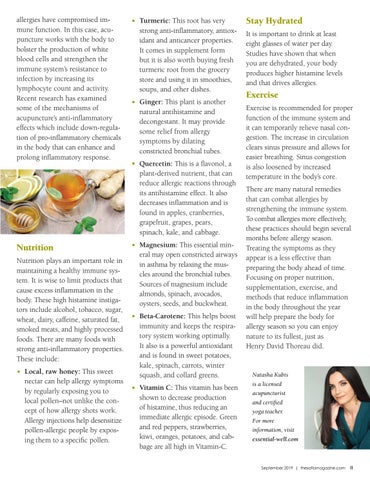
Pollen is not inherently bad for our health, but a weakened immune system is. Common treatments for seasonal allergies target inflammation in the sinuses and include steroid nasal sprays, antihistamines, decongestants and immunotherapy in the form of allergy shots. There are natural ways to combat allergies in addition to traditional methods which include the following suggestions.
Irrigation Regularly flushing out the sinuses with a warm water and salt (saline) solution may help loosen and wash out mucus and hydrate the nasal lining. This technique is called sinus irrigation. Also, bathing the eyes with plain eyewashes (such as Artificial Tears) can help reduce irritation.
Acupuncture This ancient technique can help boost a weakened immune system or re-balance an over-active immune system by stimulating anti-inflammatory mechanisms in the body. Typically, patients fighting
allergies have compromised immune function. In this case, acupuncture works with the body to bolster the production of white blood cells and strengthen the immune system’s resistance to infection by increasing its lymphocyte count and activity. Recent research has examined some of the mechanisms of acupuncture’s anti-inflammatory effects which include down-regulation of pro-inflammatory chemicals in the body that can enhance and prolong inflammatory response.
urmeric: This root has very • T strong anti-inflammatory, antioxidant and anticancer properties. It comes in supplement form but it is also worth buying fresh turmeric root from the grocery store and using it in smoothies, soups, and other dishes. inger: This plant is another • G natural antihistamine and decongestant. It may provide some relief from allergy symptoms by dilating constricted bronchial tubes. uercetin: This is a flavonol, a • Q plant-derived nutrient, that can reduce allergic reactions through its antihistamine effect. It also decreases inflammation and is found in apples, cranberries, grapefruit, grapes, pears, spinach, kale, and cabbage.
Nutrition Nutrition plays an important role in maintaining a healthy immune system. It is wise to limit products that cause excess inflammation in the body. These high histamine instigators include alcohol, tobacco, sugar, wheat, dairy, caffeine, saturated fat, smoked meats, and highly processed foods. There are many foods with strong anti-inflammatory properties. These include:
• L ocal, raw honey: This sweet nectar can help allergy symptoms by regularly exposing you to local pollen–not unlike the concept of how allergy shots work. Allergy injections help desensitize pollen-allergic people by exposing them to a specific pollen.
agnesium: This essential min• M eral may open constricted airways in asthma by relaxing the muscles around the bronchial tubes. Sources of magnesium include almonds, spinach, avocados, oysters, seeds, and buckwheat. eta-Carotene: This helps boost • B immunity and keeps the respiratory system working optimally. It also is a powerful antioxidant and is found in sweet potatoes, kale, spinach, carrots, winter squash, and collard greens. itamin C: This vitamin has been • V shown to decrease production of histamine, thus reducing an immediate allergic episode. Green and red peppers, strawberries, kiwi, oranges, potatoes, and cabbage are all high in Vitamin-C.
Stay Hydrated It is important to drink at least eight glasses of water per day. Studies have shown that when you are dehydrated, your body produces higher histamine levels and that drives allergies.
Exercise Exercise is recommended for proper function of the immune system and it can temporarily relieve nasal congestion. The increase in circulation clears sinus pressure and allows for easier breathing. Sinus congestion is also loosened by increased temperature in the body’s core. There are many natural remedies that can combat allergies by strengthening the immune system. To combat allergies more effectively, these practices should begin several months before allergy season. Treating the symptoms as they appear is a less effective than preparing the body ahead of time. Focusing on proper nutrition, supplementation, exercise, and methods that reduce inflammation in the body throughout the year will help prepare the body for allergy season so you can enjoy nature to its fullest, just as Henry David Thoreau did.
Natasha Kubis is a licensed acupuncturist and certified yoga teacher. For more information, visit essential-well.com
September 2019 | thesofiamagazine.com
11
Avocado Banana Papaya The smell of this luscious mask will transport you to the beaches of a tropical destination. This formulation packs a punch, containing key components to nourish skin, such as vitamins A, B1, B2, B3, C, and K, plus antioxidants. It helps to manage acne and contains anti-aging and anti-inflammatory properties.
DIY DECADENCE
W
ho can resist the lure of a creamy, decadent face mask? Just the thought of spreading that cool concoction on our abused skin brings a feeling of peace and relaxation. Too often, however, we find ourselves sliding the jar back onto the shelf in disappointment as our dreams of pampering are dashed to pieces.
The thought of ripe, juicy peaches brings to mind the joys of warm summer days. This fruit is perfect for a do-it-yourself face mask, as the vast amount of vitamin C it contains not only helps the skin maintain a healthy glow, but also guards against infections and harmful UV rays. Olive oil is a veritable powerhouse of skin nourishment all on its own. It provides excellent anti-aging benefits, with the potential to remove age spots and wrinkles, and is an effective moisturizer. Antibacterial in nature, the use of olive oil in a face mask is able to boost the immune system.
Strawberry Almond Yogurt
For this recipe, simply peel and mash one peach and add one teaspoon of olive oil into the puree. Mix well and apply to the face. After ten minutes have passed, rinse off with warm water.
Mix three tablespoons of ground almonds, two tablespoons of yogurt, and some mashed strawberries together into a paste. After applying, rinse with cool water.
thesofiamagazine.com | September 2019
Peach Olive Oil
It does not have to be this way! DIY face masks are super easy to make in the comfort of your own home for a fraction of the cost of ready-made creams. As a bonus, the natural ingredients leave skin feeling refreshed and have many of the same benefits as chemical-based compounds.
This facial treatment will have you sighing in pleasure at the delicious scent and feel of exfoliation and creaminess combined into one. According to Organic Facts, this formulation contains salicylic acid, ellagic acid, alpha hydroxy acid, antioxidants, vitamins C, E, and K, and can help to protect the skin from UV rays, which is very important for sensitive facial skin.
12
Mash one banana, one avocado, and one-half papaya together into a paste. Spread on the skin, leaving for fifteen minutes before gently rinsing.
As an added note, essential oils can be added to any DIY face mask recipe containing olive oil, or another type of carrier oil, for additional benefits. Lemon, lavender, frankincense, rose, tea tree, ylang ylang, and lemongrass are popular choices.
Lime, Mint & Watermelon Punch This refreshing non alcoholic punch is a delicious mix of lime, mint, and watermelon. Perfect for hot summer days by the pool.
Ingredients: 1 – medium seedless watermelon 4 – limes 1/3 cup – mint leaves 1/2 cup – water 1/2 cup – sugar In a saucepan on medium heat, combine water and sugar. Stir over heat until all sugar crystals have completely dissolved. Set aside to cool. Cut up your watermelon into pieces appropriate for a blender jug. Place watermelon pieces into blender jug and pulse until a smooth puree is formed. Add in extra pieces and repeat if all your watermelon did not fit at once. Measure out five cups worth of watermelon puree from blender and pour into a bowl. Place bowl in refrigerator for two hours. Cut mint leaves finely and grind in a mortar and pestle (alternatively in a bowl with a wooden spoon) Juice limes using a hand held juicer. Combine mint and lime in bowl. In a punch jug add watermelon puree and lime mixture using a spoon. Add desired amount of sugar syrup so that your punch is sweet, but not overly sweet. This will depend on the natural sugar content of the watermelon used. Add alcohol and ice cubes at this point if you wish.
The perfect gift for your little ballerina!
Read the story of Lily, an endearing little girl who’s passion for spinning gets her into trouble until she learns to spin like a ballerina. Available at A Walk in the Woods 423 Main Street, Hendersonville and online at gratefulsteps.org
Written by local author, JeanAnn Taylor
For more information on book signing events,
please call 828-989-2651
Come in and smell the spices! Spices • Herbs • Blends Salts • Teas • Gourmet Gifts THE SPICE & TEA EXCHANGE® OF ASHEVILLE 46 Haywood St., #101 | Asheville, NC 28801 | 828-505-7348
September 2019 | thesofiamagazine.com
13
By Cheri Torres
Summer’s over, kids are back in school. What if this year we make it a remarkably different year for our kids—all our kids? What if we contribute to their happiness and learning every time we talk to them? How?
R
e search in the areas of positive education, positive psychology, and neuroscience tells us why our conversations are so important. Our brains are wired for two dominant activities. The first and primary activity of the brain is to keep us safe. Our nervous system is always scanning incoming stimuli for safety: Have I experienced this before? Will this harm me? If the answer is yes or maybe, our protect system is triggered. Stress hormones are released: cortisol, norepinephrine, testosterone, adrenalin. The more threatening the stimulus, the greater the chemical dump as our body and brain prepare to fight, flee, 14
thesofiamagazine.com | September 2019
freeze, or appease. Neuroscience has shown that this biochemical reaction literally inhibits development of, and access to, the pre-frontal lobe and neocortex. When we need it most, our creativity and critical thinking are unavailable. The other dominant activity our brain is wired for is learning and creativity. Barbara Fredrickson, a UNC Chapel Hill Professor, has shown that learning (and thriving) takes place in the context of positive emotions such as love, interest, happiness, contentment, curiosity, empathy, compassion, and care. Her research shows that these emotions broaden and build our
capacity for learning, creativity, and connection with others. These functions take place in the pre-frontal lobe and neocortex. Neuroscience tells us that an entirely different set of hormones are necessary for us to develop and access higher order thinking centers. They are known as the love/happiness hormones: oxytocin, serotonin, dopamine, and endorphins. These hormones help us connect to our higher order thinking capacities, long term memory, and creativity. They also give us greater access to empathy and connection with others. If we want all children to grow, learn, and thrive, then we need to
create environments that fuel the production of the happiness/love hormones. This is required for pre-frontal and neocortex neurological development and access. One of the primary ways we do this–or not–is through every day communication. For teachers and parents this is critical information; your words are more than words. They carry the power to ignite learning and growth, or suppress it. This may sound like a lot of responsibility. It is. The conversations we have trigger protect or nurture connect (for everyone, including ourselves). We can choose to nurture connect, even in the most challenging of situations.
positive emotion; you yourself begin to have greater access to your pre-frontal cortex. From that place, you are more likely to respond with compassion, curiosity, and care, which in turn will have a different impact on the child. You might simply ask, with genuine curiosity, “What’s going on for you today?”
Two simple practices will support you in doing this: generative questions and positive framing. Generative questions change the way people think, and they create compelling images that move us to action. For example, if a child is acting out, instead of making quick judgments and admonishing the child, you might pause first and ask yourself: What might be going on for the child that’s resulting in this behavior? This might encourage you to look at their actions in the larger context causing you to further wonder: Are they stressed about the test? Did something happen at lunch? What might have happened at home before they arrived? These questions shift your thinking about the child. Such curiosity is a
then we need to
The second practice is positive framing. Talk about what you want instead of what you don’t want. Instead of telling kids what not to do, have a conversation about the outcomes you want and invite them
“If we want all children to grow, learn, and thrive, create environments that fuel the production of the happiness/love hormones.” to identify what they need to do to achieve that outcome. They just might surprise you with their creativity and awareness. For example, a mother was frustrated by continuous arguments with her son about driving around with friends and not letting her know where he was going. She kept demanding he let her know and he kept deflecting that he didn’t always know, and she should just
trust him! Then, she learned about positive framing and generative questions. First, she asked herself: Why do I want to know where he is all the time? What is it I really want? Do I trust him? She realized what she wanted was the assurance he was safe. So that’s how she framed the next conversation. She opened with, “I realize I just want to know you are safe when you’re out with your friends. I totally trust you, but I don’t fully trust a couple of your friends. What can we do so you can have your freedom and I know you’re safe?” The whole conversation shifted. He shared that he didn’t want her to worry and he knew exactly which friends she was talking about. They arrived at a solution that allowed both of them to get their needs met and they did it together. This year, make it a year where you help every child you interact with grow, learn, and thrive. Commit to having conversations worth having with them. For a free Conversation Toolkit, including a parent page on questions to ask your kids and questions to ask your children’s teachers visit ConversationsWorthHaving.today.
Cheri Torres is a Lead Catalyst for positive change and organization consultant with Collaborative by Design.
September 2019 | thesofiamagazine.com
15
“Why do I feel this way?”
The Role of
Thoughts in our Happiness By Jill Long, M.A. Ed.
16
thesofiamagazine.com | September 2019
I
t is out of the times when we are feeling the most uncomfortable that we are at our strongest point for personal growth. We tend to view our difficult times as weak points, but if we see these times as opportunities, we can develop our potential and be more authentic. Instead of getting caught up in the “bad” feelings of sadness, fear, or even anger, and trying to rid ourselves of them, we could be-friend them and allow them to tell us what may need to change in our lives. Through evaluating these thoughts and feelings, we can move to make changes in our behavior and make our lives happier, be more present, and more authentic in the world. We tend to identify closely with our problems and feelings even allowing ourselves to be labeled by them. We may say: “I’m just an angry person,” or “I have a quick temper.” Feelings occur as a result of thoughts based on an event that has happened. We are not born with a certain predisposition of feelings. They may come from an unconscious thought or one that extends so far back in our lives we no longer recognize it. The feelings that come from these thoughts can become our “go to” feelings when certain things happen that may trigger us. We may even become comfortable with these feelings and not know how to be without them. However, it is helpful to identify and evaluate them, allowing them to
become friends to help us. Through this process, we can understand our feelings and make changes in our behavior.
actions, or spending time dwelling on something that happened which you had no control over.
Some thoughts are “automatic thoughts.” They occur without much effort because we have become programed by these thoughts. These automatic thoughts will lead us to certain feelings. For example, someone cuts you off in traffic. You may not realize at the time, but this action on someone else’s part can trigger certain automatic thoughts such as: What an idiot, Did they not see me? What a bad driver. These thoughts may not even register at the time, but they are there in the background of your mind. These thoughts then may lead you to become angry. This process happens within a few seconds, behind the scenes of your awareness. Within a few seconds you have caused yourself to become angry–possibly increasing you blood pressure, heart rate, and even temper. You didn’t start your day to get upset, but here you are.
Back to the example of someone cutting you off in traffic. Take time to think about what your automatic thoughts are: What an idiot, Did they not see me? What if for a moment you questioned what might be going on in their life? Could they have just got bad news? Are they sick? Would these questions help change your automatic thoughts and possibly create less anger or stress for yourself?
To take time to identify your automatic thoughts can be very helpful in creating a happier and more authentic life. These thoughts can cause more angst than help, can lead to uncomfortable feelings, even inappropriate or illegal
We have all had life events that caused varying degrees of troubled thoughts and uncomfortable feelings. Others may not understand the extent of our discomfort because what is troubling for one person may not be as troubling for another. Instead of dismissing our feelings and thoughts, or labeling ourselves, maybe we could examine our thoughts and feelings, allowing them to teach us about ourselves. This doesn’t mean we need to dwell on them, but allow whatever experience you have to be present with no judgement. Explore your automatic thoughts and how you present in the world based on your thoughts, and see which ones still serve you.
Think about all the people and events that have shaped your life and your automatic thoughts, and therefore who you have become as a result. You have developed automatic thoughts about the world and have become a reflection of that. You have a world view based on your thoughts that is mirrored to the world in your actions. If you do not like who you see in this mirror, take time to evaluate your thoughts about the world and how it reflects on your actions. Personal growth comes from viewing your thoughts and life experiences in a different light, not seeing them as good or bad, but as potential. Our thoughts about our life and how they have shaped our world view, are the key to happiness and living an authentic life. The next time you are feeling upset or down, take a moment to reflect on why you feel the way you feel, and which thoughts lead to those feelings. Ask yourself as many times as needed: Why do I feel this way? How do my thoughts affect the way I feel? Is this a true reflection of who I am or want to be in the world? Use the insight you gain from this exploration to lead to more happiness and fulfillment in the world.
“Our thoughts about our life and how they have shaped our world view, are the key to happiness and living an authentic life.”
Jill Long, M.A. Ed. Licensed Professional Counselor
September 2019 | thesofiamagazine.com
17
Women Making
Music By Peggy Ratusz Above: Musician and song writer Gwyn Fowler
W
hen Tammy and Al Sheppard contacted me to ask if I’d be interested in resuming my feature “Women Making Music,” for their new women-focused magazine, I was more than thrilled and I accepted readily. Humbled by the positive feedback I received for twelve years writing this monthly column for WNC Woman Magazine, I aim to continue the tradition of spotlighting in these pages now, area female musicians who by and large, have manifested their desires, making a living via their respective creative musical talents. As a woman of age, I have been performing for nearly forty-four years– the last seventeen of them in this area. I have come to know Asheville and surrounding regions, to be a loving, net-working family whose motivation is to welcome and lift up natives to newcomers, within the music community. I am continuously heartened by the number of musicians and venue owners who pay attention, who strive to do their best to support female artists, bridging the gender disparity 18
thesofiamagazine.com | September 2019
gap. Women supporting women co-creating and co-producing collaborative shows and showcases, has become a regular occurrence. While I feel I have done and will continue to do my part to advocate for girls, young women, women of age and those who identify as women, where I and as I can, there are women who came before me and an increasing number of females who spearhead events who also continue the advocacy. As our scenic, inspiration-evoking and beautiful WNC continues to grow, there comes with that growth, the conundrum of when will we, or have we already reached our tipping point? It’s especially challenging for us musicians to reconcile the dilemma that opportunities coming from a thriving cultural and creative music scene (supported in part by tourists) brings, versus the gentrification of certain neighborhoods and areas (because of the influx of residents and hotels), that leaves some having to get creative on a whole different level, in order to afford to stay. As I ponder this trade-off as it relates to the women making music around these
parts, I am compelled to concentrate on the positive aspects the aforementioned conundrum stirs. For instance, there has never been more female instrumentalists, whose presence on stages further chips away at the disproportion between men and women that still exists. Just last night, I attended Russ Wilson’s weekly, “Wine, Dine & Dance with his Foundry Hotel Orchestra” series at the new Foundry Hotel. On saxophone was Jackie Tatsch and on banjo was new mom, Annie Erbsen. You can find Linda Shew Wolf or Ruby Mayfield wailing their superb phrases on saxophone at the Wednesday night Blues Jam at the Block off Biltmore at 8pm, or The Guitar Bar’s weekly Saturday jam from 5pm-7pm. Ruby’s got her own band and Linda is now a member of the Rewind House Band. Another notable female saxophonist and one of the founding members of Empire Strikes Brass, is saxophonist, Debrissa McKinney. All of these fine women horn players are becoming more and more sought after.
More and more we find women fronting bands playing killer guitar riffs too! April Bennett, Nicole Nicolopoulos, Lyric and Maddie Shuler come to mind. Female bass players like Kayla Lynn, Aileen Pearlman and Mira Spiritvoice are being recognized. There are drummer/percussionists like Eliza Hill, Nancy Asch and Amanda Hollifield who play regularly. Keyboard players who also write and sing include Rachel Waterhouse, Carrie Morrison and Marika Straw. Fiddle/violinist Lyndsey Pruitt, cellists Melissa Hyman, Brooke German and Jamie Leigh Bennett who have all been classically trained add their feminine juju to a plethora of musical configurations, shows, and acts. The list is long when it comes to the number of female piano, string, and woodwind players who also teach or play in various area symphonies and orchestras. There’s Rosalind Buda (bassoon, small pipes, and bagpipes), Gabrielle T, Linda Gaines and Rebecca Modrzynski (piano), Holley Ross, Linda Kendall Fields, Anastasia Yarbroough, Mandy Guilfoyle (Suzuki violin, viola, cello, ukulele), Karen Bell (claw hammer banjo) are just a few of the women, that a little digging on the internet will find you.
As for vocalists, you cannot find a better flock of sister songbirds than here in the mountains. Rhoda Weaver, Wendy Jones, Linda Mitchell, Mare Carmody, Ellen Trnka, Paula Hanke, Rebecca O’Quinn, Christina Chandler, Laura Blackley, Melodee Edington-Leyshon, and Whitney Moore are just a few of the premiere singers who reside here. Scratching the surface of vocal instructors and/or voice coaches include Nancy Simmons, Pam Jones and myself. Nationally and internationally acclaimed female musicians coming out of Asheville proper include Amanda Anne Platt of the Honeycutters (Americana band) and Caitlin Krisko of The Broadcast (Soul, R&B and Rock band.) Next month, I’ll be profiling another fine feminine, nationally and internationally known player, singer and songwriter, Anya Hinkle from Tellico (Bluegrass/Americana/Roots). She will have just returned from several weeks, touring Europe and she’s going to tell us all about it! You’ll find no shortage of women musicians, vocalists, and singer songwriters appearing on our local stages in the month of September in the meantime. Below is a list of just some of the show
and gig dates of just some of these daughters of the trade. There are so many others that my word-count will not allow me to mention. And to you fantastic females especially whom I did not have room to mention, I invite you to contact me via email, for mentions of your performance dates. Be sure to do so the first of the month prior to the month your performance date. I will do my best each month, to profile individually, women from all genres and ages, who are working their tails off. Those who co-create, co-produce shows and write original music, those who record, sell and market themselves, sometimes on a shoestring. All of them continuously hone their crafts in order to attract you, the local music supporter, to their performances.
Peggy Ratusz is a vocal coach, song interpreter, and songwriter. For vocal coaching email her at peggymarie43 @gmail.com
WOMEN musicians, vocalists, and singer songwriters appearing on our local stages in the month of September Sept 4th
Ruth Cooney, featured artist Southern Appalachian Brewery Jazz Jam, 6:30pm
Sept 6th
Lyric (Leeda Jones), The Spillway, Marion, NC, 8pm
Sept 7th
Hope Griffin, Sanctuary Brewery, 8pm
Sept 7th
Jesse Barry, Mountain Brook Vineyards, 5pm
Sept 8th
Paula Hanke with the “World Beat Band” at Jubilee! Community Church, 7pm
Sept 14th
The British are Coming Show featuring among others, Peggy Ratusz,Isis Music Hall, 8pm
Sept 20th
Linda Mitchell, (The Live Wires) Southern Appalachian Brewery, 8pm
Sept 21st
Westsound, Soul R&B band fronted by Gina Duke--Echo Depot for the Arts Council, 7pm September 2019 | thesofiamagazine.com
19
When a passion for running her own business and a desire for a slice of blueberry pie collided together, Kirsten Fuchs (pronounced Fox), began the search for a place to start the next chapter in her life. Actually, no. She was writing a whole new book! stranger she met at a wedding once told her, and leading up to her 50th birthday, she began the search. She one day, in the summer of her 50th, Kirsten and her oldest daughter, Haley, were driving around in South Asheville in Baked Pie Company. When you walk into either shop (one is located in Arden
Two locations: 4 Long Shoals Road, Arden | 828-333-4366 Hours:
wanted her customers to experience. “Remember those summers that you would visit your of bed, down the hallway, and into the kitchen where you found yourself sitting at the table waiting to see what was about to come out of those that walk into Baked,� explains Fuchs. smiling faces behind the counter lets one know that this is indeed a special place. If you have had the opportunity to taste a piece of their famous Honey Pecan pie or any of their many varieties of baked or cream pies, then you know! You know just how amazing this locally owned business is. Baked is more than a place to get a great piece of homemade pie; it is a destination worth visiting.
50 N. Merrimon Ave (in Reynolds Village)
Become a Contributing Writer SOFIA Magazine is now accepting submissions from Contributing Writers! Articles will be published in our printed magazine and on our website.
We are looking for contributors to the following categories: – Business / Career
– Health / Fitness
– Beauty Products / Make-Up / Skin Care
– Home Décor
– Entrepreneurship
– Real Estate
– Dining
– Relationships / Dating
– Family / Parenting
– Shopping
– Fashion / Apparel & Accessories
– Social Media
– Financial Services / Investments
– Technology / Electronics
– Food / Recipes / Cooking
– Travel
– Pets
Qualified contributing writers may submit articles by emailing them to publisherofsofia@gmail.com and using Contributing Writer Submission in the Subject Line. SOFIA Magazine will review each submission and reply.
Relocating to WNC By Trish Luzzi
W
elcome to the first edition of SOFIA! I am very excited to be a part of this publication to share tips in Real Estate every month with you. This month’s topic is “Relocating to WNC.” Here are a few pointers to do prior to your trip here, and then what to do when you arrive to look at homes.
on the same page with house needs before they arrive.
WNC has so much to offer for all ages and is a fantastic place to call home. When thinking about moving here you should reach out to a local Realtor prior to your arrival to have a consultation about why you are thinking about moving and what your “must have list” is. Each county in WNC has its own uniqueness and the towns within each county are also unique. Realtors ask for this time upfront as it is
Many customers ask, “Why do we have to meet you at your office?”. We do this for many reasons, one being safety for our agents. Many offices have a policy that agents must meet at the office and get a copy of the customers drivers license to keep on file. We also review with each customer the, Working with Realtors in NC brochure, to help explain how to work with an agent, so you can protect your confidential information. You are not a “client” until you are under contract with an agent, so ensure that you keep personal and confidential information to yourself until you are under contract. When I meet with folks from out of town, I spend either a morning or afternoon with them on
very important for us to understand your needs prior to showing you homes so we can best serve you. When I have folks coming in from out of town, I like to chat with them prior to their visit and send them some homes to look online so we can ensure that we are
the road, after our meeting, to review paperwork, then I give them some homework to do on their own. I ask them to tour downtown Asheville, Hendersonville, and Black Mountain (if that is their general area) and spend some time in each one. That way they can experience each town and
22
thesofiamagazine.com | September 2019
provide really good feedback for our next venture out to see homes. Agents will encourage you to do a “drive by” on your own time as well, and that isn’t because we don’t wish to show you the home, it is because some areas may not be what you like or you may find by driving up to some of our homes in higher elevations, you may not wish to go inside after all. While the attraction of living on a mountain is appealing to most from out of state, the roads to get to your home may be challenging for some once they experience the drive up. This also assists us to focus in on what will really work for you and not disrupt sellers in leaving their homes for something that isn’t going to work anyways due to location. Also plan
three-four days minimum in town if you can to see if you like the area and really invest the time to see all aspects of the town you wish to call your next home.
“Some who relocate choose to do a 6-12-month rental first and then spend the time to really look as they have a chance to live here at the same time as looking.” We do find many times that visitors to the area will arrive and then call into Realtor to try to get into homes that day. While we are excited that you are wanting to see homes, many of us have our day planned out with clients and so we don’t wish to disappoint you, so preplanning works best for all. Also, in fairness to our sellers we do try to give them 24 hours notice for each showing. There are many excellent Real Estate agents in our area and so when you speak to one that you feel you will have a great connection with, stay with them and provide feedback to develop a fantastic working relationship. One final note, homes are still selling very well in our market so if you are serious about purchasing a home, ensure that you are pre-approved for a loan and any agent can help you with locating a great local lender here. You don’t want to miss out getting a home because you were not pre-qualified for a loan. I hope you enjoy the first issue of SOFIA and if you are just visiting us and picked up a copy, we hope to see you back here real soon
Trish Luzzi lives in Asheville, NC and is a professional real estate broker wnccreations @gmail.com
September 2019 | thesofiamagazine.com
23
I t’s
picking time!
Here are some of our favorites FUJI APPLES are typically striped with pink over a yellow-green background. It is crisp and juicy, with a sweet flavor that has contributed to its rise in popularity.
GALA APPLES are usually small to medium in size with a distinctive red and yellow striped heart-shaped appearance. They have a sweet flavor and keep well in storage.
GINGERGOLD APPLES are greenish-gold and is generally considered one of the best early-season apples. It is a good keeper and will last several weeks in the fridge. It has a sweet-tart flavor, great for salads, and cooks well too.
GRANNY SMITH APPLES have a bright green skin that is often speckled with faint white lenticels (spots). Their flesh is bright white and crisp in texture with a tart, acidic, yet subtly sweet flavor. It’s one of the best to bake and cook with, and it won’t brown quickly, making it ideal for salads, fruit platters, freezing and more.
HONEYCRISP APPLES are crispy, juicy and sweet. They are a medium-to-large sized apple, with a distinctive mottled red color over a light green/yellow background.
JONAGOLD APPLES are juicy, crisp, and sweet with just a hint of tartness. The coloring is a creamy yellow with large flushes of red. Excellent for eating fresh, in salads and baking.
PINK LADY APPLES are one of the newest apples on the market. The skin is a vivid green covered in a pinkish blush. Pink Lady apples have a crunchy texture and a tart taste with a sweet finish. The flesh of the Pink Lady apples is slow to oxidize when cut, making it good for cheese boards, sandwiches and salads.
15th annual
5 t 1 h e a h t n n r iversary! o f s u n i o J
Come share inspiration, celebration, and practical learning about earth-based healing and women’s health
October 11-13, 2019 Kanuga Conference & Retreat Center, near Asheville NC
www.sewisewomen.com
24
thesofiamagazine.com | September 2019
J eanAnn’sJ ourney
Celebrating Autumn
W
hen publisher Tammy Sheppard called to tell me her idea of creating a high-quality magazine designed for women by women, I was thrilled! We know women are powerful consumers, making 83% of all buying decisions. This includes 91% of new homes, 92% of vacations, and 65% of new cars. Add food, clothing, and healthcare for themselves and their families, and they have a substantial percentage of influence. With this in mind, women deserve a magazine specifically created for them. Along with a new magazine, we embark on a new season; the first day of autumn is September 23, and we begin by celebrating Labor Day. This holiday was created by the labor movement in the late nineteenth century to pay tribute to American workers. It is dedicated to the social and economic achievement of those who work to make our country strong and prosperous. It became a federal holiday in 1894. Today, America is enjoying the lowest unemployment rate since 1969. The unemployment rate for women dropped to 3.1% this past spring – the lowest since 1953. Now that is something to celebrate! As a passionate dressmaker, quilter, and lover of any-and-every thing to do with fabric, needles, and thread, I enjoy celebrating National Sewing Month each September. Sewing is not only fun
and functional, it is an important life skill mistakenly (in my opinion) taken out of our public school system. If you want to sew, but are not sure where to start, visit a fabric store, take a sewing class, or join a sewing circle. If you are looking for a way to express yourself, sewing can take you wherever you want to go. As you read this editorial in the safety of your home, my son is serving our country in Afghanistan. This war, which began after America was attacked on September 11, 2001, is now the longest in our country’s history. In Afghanistan alone we’ve had nearly 2,300 casualties, and over 20,000 of our military have come home physically wounded–I imagine all of them come home with emotional scars. The only way I can, as a Military Mom, get through this time is to be the person worthy of my son fighting for. I know the best way to honor him is to honor myself. So, while I may feel like crawling into a hole, instead I’m going to take care of myself. The last thing I want to do is to give him something else to worry about while he is on the other side of our planet eating cafeteria food, sleeping in a bunk, and carrying heavy equipment while wearing a bullet-proof vest under his combat uniform–in 99+ degree heat. So, I’ll be strong, and smart, and when he comes home, I’ll breathe again.
When I hear the chirping of the cicadas, I know summer is nearing its end. Their enchanting call lures me outside to sit quietly and listen. You can squeeze a little more fun into these last days of summer by going for a hike to search for early-fall wildflowers like asters, witch hazel, joe-pye weed, and goldenrod; wading in cold, creek water before the temperature drops; picking apples at an apple farm, then baking a pie; watching a sunset from a hilltop. The month of September is the perfect time to start a new venture. The shift in the air creates an anticipation of something new. I’m honored to be part of a magazine that will truly inspire, inform, and entertain. We’ll have information on health, relationships, gardening, fashion, beauty, and lots more. We’ll tell the story of successful, local women; give you ideas for decorating; and share recipes. You may not love everything you read in SOFIA, but you’ll find something you love each issue. I hope you enjoy the premier issue of SOFIA for Today’s Woman! Please send your thoughts and ideas to me at jeananntaylor @rewnc.com
September 2019 | thesofiamagazine.com
25
FORGET ABOUT IT By Lavinia Plonka
Scarecrow “They took my arm and they threw it over there! And then they took my legs and threw them over there!”
Tin Man “That’s you all over.”
M
y first vivid memory of forgetting was from age eight. My mother and I were at a discount outlet diving into bins of underwear like pirates into a treasure chest. “Mine, all mine.” I clutched all the new panties my chubby fingers could grab. Never again would I worry about being in a car accident and having the hospital staff cluck over my ragged briefs. I could move on to more weighty subjects like ending the Cold War or how I could con my father into more spare change so I could win the “Mission Money” collection contest and get a glimmer of approval from Sister Giovanni.
26
thesofiamagazine.com | August 2019
As we stood at the check out, my mother gave me a rare smile, clutching her lace trimmed slip with the adjustable straps. Then suddenly, she hissed, “Where is your pocketbook?” In the orgy of new lingerie, I had misplaced my first, my best, my only pocketbook, a red patent leather fantasy with a cool clasp that you turned. The blood drained from my face. I had $3.00 in that purse. My mother tore out of the line, dragging me back through disgruntled women who were busy burying themselves in discounted blouses. We tore the underwear bin apart. Looked through all the socks. Tears streaked my desperate face. This was it. I’d never have a pocketbook again. Let alone cash. A woman approached us, holding my purse. “Did you lose this, little girl?” she asked kindly. My mother thanked her profusely
and turned to me. “What are we going to do with you? I swear you’d forget your head if it wasn’t attached!” Since then, I have left my purse at parties, in shopping carts, in cabs and in restaurants. I rack my brain to try to retrace my steps, to remember where it may have gone astray. When finally I remember, it is a vivid experience, as if suddenly everything has come together. Like the Scarecrow, my parts were scattered, and now I’ve reconnected the neurons that keep my thoughts together, my head on my shoulders, my purse beside me. A woman’s purse is like a limb, sometimes even forming a hollow in the shoulder from the years of hauling apparently unnecessary things. Then comes that moment when someone says, “Does anyone have a nail file, band-aid, lozenge,
mint, hairbrush, tampon, aspirin, pen, the Yellow Pages, a map of the NYC Subway system, the original eight track of Helen Reddy’s, I Am Woman, the solution to the world energy crisis?” And you casually root around in your purse, muttering something like, “I think I have one in here somewhere,” producing the requested item to the delight and surprise of onlookers. Unfortunately, this magic does not work when you are looking through the same collection of items for your keys as the rain is pouring down, a strange man has followed you into the parking lot, and one of the bags is starting to tear. When I have the opportunity to travel somewhere without my purse, there is inevitably a moment where I stop dead, trying to figure out what’s missing. What have I forgotten? And sometimes, I have my purse, but I’m so used to carrying it, that I forget it’s there. “Oh my god, I forgot my… oh, heh heh, here it is.” Men are no exception to this phenomenon. I’ve watched my husband Ron ransack the house looking for the glasses perched on his head. Neuroscientists are always poking around in our heads trying to find our memories. Some speak about the functioning of the amygdala, a tiny little part of the brain that seems to store the unforgettable memories. I’ve hoped that I could delete some of my old memories so that there might be room on that little hard drive for remembering names of people I meet and recent conversations. Surely there is no reason to keep remembering the time I forgot about a concert engage-
ment and got a call from the stage manager asking me where I was. Muscle memory is bandied about as the reason certain habits don’t quit, like the limp that remains years after a sprained ankle. I once had a client whose ribs were held as tightly as armor. All attempts to introduce movement came to a dead end. “It’s muscle memory,” she announced. “Oh, were you injured there?” I asked. “No, it’s from the corset.” “Corset?” “In my last life, I had to wear a corset. It was during the nineteenth century you see.” I can’t remember where I put my keys, and she can remember her last life. Where is the fairness in this? Then again, I’d hate to imagine the state of her amygdala. When I was a girl, I had no idea that my Mother, who had survived capture by the Nazis, had PTSD. Neither did she, since we’d never heard of it. I did not understand that certain triggers catapulted her brain’s hard drive into replaying scenes from the war. Whenever my father was even a minute late from work, no matter what the weather, she’d grab her purse and start walking the streets looking in the gutters for his dead body. When my Father came home minutes later, he would launch into violent cursing as he tore out of the house looking for her. One day, we hid her purse. She tore the house apart, then collapsed on the couch. Instantly, my sevenyear-old sister, my two-year-old brother–who thought it was a marvelous game, and I jumped
on her, pinning her to the couch. “Where is my pocketbook?” she wailed. “What have you done with my pocketbook?” By the time my father got home, five minutes later, we were all sobbing on the couch. To her dying day, she never went anywhere without her purse. The worst is when I forget myself. It can happen at any moment. I’ll be driving and suddenly I’m at my office, when I was just going to the supermarket. Or I’m walking along a beach, so deeply in conversation with an imagined adversary that suddenly I say out loud, “I really don’t think so,” just as I pass an elderly man who looks at me pityingly. In those brief moments of awakening, I experience clarity, like the moment I remembered where I left my purse. Except in this case, it wasn’t my purse that got forgotten somewhere, it was me. My thoughts are scattered all over, and then whoosh! Everything comes back together, I am re-membered. I grope in my purse for my notebook to jot down this trope of enlightenment. My wallet is not in my purse. I forgot it on the kitchen counter. Thank goodness that at the bottom of my pocketbook is at least $4.00 in change from the time I forgot to properly close my change purse. . .
Body language expert, Lavinioa Plonka has taught The Feldenkrais Method for over 25 years. For more information, visit her at laviniaplonka.com
Biltmore Family Medicine PLLC Let Our Family Care for Your Family
Family members that are healthy are more likely to be happy and spend their time together. To help with this, you should have a medical practice that can see all of you in one location. From your children to your grandparents, make sure that everyone is taken care of. You will receive these services and more at Biltmore Family Medicine PLLC. Biltmore Family Medicine PLLC was established in March of 2004; since then, we have focused on giving our quality care to you and your loved ones. We pride ourselves on being friendly, courteous and professional – more than that, we are proud to give your family a new sense of well-being. Let our family care for your family. We are licensed and insured for your protection and ours. Call Biltmore Family Medicine PLLC to set up your next appointment.
CALL US TODAY AT (828) 252-4020
Our Newest Product
SculpSure
Non-invasive laser body contouring that helps you achieve a natural-looking, slimmer appearance. No Surgery. No Downtime. Just Results. SculpSure’s body contouring technology is able to target and destroy fat cells safely in 25 minute treatments.
• Customizable treatment plans • Over 90% patient satisfaction rate • FDA cleared Visit: www.sculpsure.com today and call our office to schedule your Free Consultation
(828) 252-4020 | www.biltmorefamilymedicine.net 1 Saint Dunstans Road, Asheville, NC 28803 Mon - Fri 8:30am - 5:00 pm | Closed for lunch 12:30 -1:30pm Extended Hours: Sat 9:00 am - 1:00 pm
ADVERTISE with SOFIA! Our readers are your potential customers.
WOMEN HAVE CONTROL OF THE MONEY AND THE PURCHASES. Women represent the largest market opportunity in the world, according to Forbes magazine. Globally, they control $20 trillion in annual consumer spending. In the next five years, it is expected that this number will rise to nearly $30 trillion. In the United States, women have enormous control, and it’s increasing. Reports range from $5-15 trillion, with Marketing Zeus citing sources that $7 trillion is contributed by women in the U.S. in consumer and business spending. Fleishman Hillard Inc. estimates that women will control two-thirds of the consumer wealth in the U.S. over the next 10 years. Women handle the bulk of purchasing decisions for everyday items like groceries and clothing — even for those items targeted at men. In fact, 50% of products marketed to men are actually purchased by women. That’s why items for men are often marketed with women in mind, as well. In addition to being responsible for most of the day-to-day purchases, women are also heading up or influential in large ticket purchases like cars, homes and appliances.
85% of ALL CONSUMER PURCHASES in the U.S. are made by women. 93% of FOOD PURCHASES are made by women. 75% of women identify themselves as the PRIMARY household shopper. 50% of PRODUCTS typically marketed to men are PURCHASED by women. 80% of HEALTHCARE DECISIONS are made by women. 68% of NEW CAR purchase decisions are made by women. 66% of PCs are purchased by women. 92% of VACATION DECISIONS are made by women. For additional advertising information contact one of our representatives below: Mike Demos Trish Luzzi
828.273.0098 828.423.0248
mikedemos@aol.com wnccreations@gmail.com
4th HotWorks.org
Asheville Fine Art Show October 26 & 27, 2019 Pack Square Park, Asheville, NC
www.hotworks.org Facebook.com/HotWorksArtShows Instagram @HotWorksArtShows John Wayne Jackson, Sculpture
Juried Fine Art & Fine Craft Show ~ $1,500 Professional Awards All Art is Original, Personally Handmade & for Sale by the Artist Present at the Show Saturday & Sunday 10am-5pm daily ~ Free Admission Plus! Youth Art Competition for K-8 or Ages 5-13 with $250 Youth Art Awards MENTORED BY
â„¢