January 2020
thesofiamagazine.com
for Today’s Woman
Courtney Maybin Owner Beauty Bin
Cool Beanies | Embracing Change | Victim or Warrior
“We have everything you need to be successful!”
December Floriani Event December 12-14 Sign up early and save $50
Come Visit Our Shop ~ We are fully stocked! We also offer Services ~ Visit our website for so much more!
Relax with Friends & Family Enjoy Nature Lock & Leave with Ease
32 N Main St. | Weaverville, NC 28787 | 828-484-7200
TheViewsAtRoseHill.com 828.398.5948
fivemonkeyquilts.com Hours: Monday-Friday 10-6; Saturday 10-5 | Sunday - CLOSED
Voted Best of WNC for the last six years
Keeping Families Warm since 1993
Heat Pumps • Air Handlers • Air Conditioners • Coils • Package Units • Waterfurnance Heat Pumps Thermostats • Gas Furnances • Air Cleaners • Duckless Systems • Steam Humidifiers • Geothermal Bypass Humidifiers • Dehumidifiers • Wine Cellar Cooling Units • iWave
bullmanheating.com 2
thesofiamagazine.com | January 2020
828.658.2468
Publisher Tammy Sheppard publisherofsofia@gmail.com
Contributing Editor
JeanAnn Taylor jeananntaylor@rewnc.com
Director of Business Operations Al Sheppard asheppard@rewnc.com
Art Director / Web Design Tina Gaafary
For Advertising Inquiries Mike Demos 828.273.0098 mikedemos@aol.com
Happy New Year!
Trish Luzzi 828.423.0248 wnccreations@gmail.com
from the staff of SOFIA!
Contributing Writers: Natasha Kubis Jill Long Lavinia Plonka Peggy Ratusz Cheri Torres
Dig Deep, Practice and...
Find Your V o i c e
�� Jazz �� Soul �� Rock �� Country
Blues Pop
High Five Enterprises, Inc. PO Box 8683 Asheville, NC 28814 828.279.5962 Acupuncture & Wellness
Pre-Teens to Baby Boomers Novice to professional
Please enjoy
$20 off your first session with this ad
Natasha Kubis, L.Ac. 917.576.9198 • Natasha@essential–well.com
Peggy Ratusz
Vocal Coach 828.301.6768
peggymarie43@gmail.com
reverbnation.com/peggyratusz
essential-well.com
All advertising published in SOFIA is believed to be truthful and accurate. However High Five Enterprises, Inc. assumes no responsibility and shall have no liability whatsoever for errors, including and without limitation, typographical errors or omissions in SOFIA. Any reference made to High Five Enterprises, Inc. is not to be construed as making any representation, warranty or guarantee concerning the information advertised in SOFIA. The content of all ads contained herein are solely the responsibility of the advertiser. The opinions and statements contained in advertising or elsewhere in this publication are those of the authors of such opinions and are not necessarily those of High Five Enterprises, Inc. High Five Enterprises, Inc. reserves the right to edit or refuse any advertising submitted to this publication.
CONTENTS How to Beat the Blues during the Long Cold Dreary Months Page 15
On the Cover
Courtney Maybin
Beauty Bin
Asheville's One-Stop Beauty Shop Page 6
5 Sofia Style Cool Beanies JeanAnn Taylor
8
Spotlight on Christine Breininger Peggy Ratusz
12 Yoga for Every BODY Natasha Kubis 14 My New Year's Resolution Jill Long 16 Embracing Change Lavinia Plonka 18 JeanAnn’s Journey New Year New You JeanAnn Taylor
20 Priming the Family for Great Dinner Conversations Cheri Torres
22 Life Victim or Life Warrior Jill Long
4
thesofiamagazine.com | January 2020
Sofia Style
Cool
Beanies By JeanAnn Taylor
f you are looking for a stylish way to stay warm this winter, there is no better option than to wear a fuzzy, cozy beanie on your head. This quintessential winter-weather bonnet has been a staple for many years, but it has come into its own recently with more styles, colors, and options for wearing.
I
Beanies were once considered a casual-wear-only accessory. Now however, they may be fashioned so prettily, they can be worn to outdoor weddings and other fancy soirées. Sparkly threads, cashmere yarns, and interesting shapes make them fashionable and chic. Beanies can also be embellished with ribbons, appliqués, flowers, bows, and brooches.
The most popular style is the “cuffed” version. This beanie may have an actual turned-up cuff, or a band woven with a tighter weave creating a cuff. It’s worn pulled snugly over the head, ends just above the eyebrows, and completely covers the forehead and ears. The “fisherman” beanie is a smaller, shorter version. It sits at the crown of the head, ending above the ears. The “slouch” beanie is worn over the forehead and ears, but is fuller and longer than a classic cuffed beanie causing it to hang loosely in the back. If you don’t want the slouchy beanie to look slouchy, simply fold the bottom band up to create a cuffed, snug fit. My favorite beanie style is the “cloche.” This flattering and feminine hat is popular now, just as it was in the 1920s.
Your choice of color will of course depend on your outfit. Beanies come in every color and pattern imaginable. You may want to wear a complementary color to let your beanie blend in, or let your beanie stand out by wearing a bright neon snowflake print. You may also consider your hair color. If you have dark, black hair, a black beanie will not be as striking as if you wore a ballerina-pink color.
A “bobble” or pom-pom is often placed at the top of a beanie. This fluffy ball of yarn adds a pop of personality to an ordinary beanie. Fun fact: the bobble was originally created for the Scottish Highlands military to help distinguish clans.
You can find beanies in nearly every store you visit, but making one yourself will give you something to do when it’s freezing outside–as well as the fulfillment of creating something yourself. Give me a ball of yarn and a crochet hook, and I’m a happy lady. You can also easily make your own pom-poms using a pom-pom maker. You may enjoy this fun craft so much, you’ll begin adding pom-poms to everything! To spark your creativity, you can look online for patterns and ideas. Style expert JeanAnn Taylor can be reached at jeananntaylor@rewnc.com January 2020 | thesofiamagazine.com
5
Beauty Bin Asheville's New One-Stop Beauty Shop
N
ative to WNC, Courtney Maybin has lived here all her life, except during a few years when she moved around the country with her husband, Cameron Maybin who is a professional baseball player. In 2015, they returned to Asheville and bought a home. It was then that Courtney found the opportunity to consider what she wanted to do for her own career. “I always loved the beauty industry, so I chose to take the esthetics course at Blue Ridge Community College. I became a licensed esthetician in 2018. From there, I decided to start a studio out of my home to continue to practice and to begin to gain clientele, but I always knew I wanted to open a store front,” she says. “I began the planning for Beauty Bin in early 2019 and 6
thesofiamagazine.com | January 2020
worked throughout the year to prepare for an end-of-year opening.” Courtney’s vision for a salon and spa includes her mission to give affordable services to everyone regardless of race, gender, or age. “It’s important to me that no matter who walks through the door, they (my staff) know how to work on any kind of hair or any kind of skin type.” Insisting on this diverse skill set means that her employees require more training, but Courtney believes it is worth the effort. “Selfcare is important and something all people should invest in.” Tammy Barnwell, Courtney’s mother, has been instrumental in her new business venture. “She’s my lifesaver,” Courtney says. “As far as business things, whether it’s scheduling or bookkeeping, she can do
it all. I know the field of esthetics, which she doesn’t know at all, and she knows all these things about internal business. We’re learning a lot from each other. Beauty Bin couldn’t run without her!” With Tammy by her side, these two ladies also look for ways to give back to the community. Beauty Bin was a drop-off location for MANNA Food Bank’s annual holiday food drive; and they are planning to continue to work with the food bank throughout the year to help those in need. Courtney is also continuing to work on a charity she started with her husband, Maybin Mission, with a spa-inspired twist. The original program allowed the community to nominate families to receive holiday gifts: a Christmas dinner party, and a visit with Santa. One lucky winner was
gifted with a 60-minute massage, custom facial, brow wax, and skincare set. “Looking forward, I want to find more ways to give back to the community as much as possible.”
At Beauty Bin, you’ll find everything you are looking for in a spa or salon. This “one-stop” shop offers facials, massages, lash extensions, color, cut, and more. You can get it all under one roof at the Beauty Bin.
Visit the Beauty Bin at 117 Sweeten Creek Road in Asheville and you’ll leave feeling beautiful!
January 2020 | thesofiamagazine.com
7
Elliot Schwartz Photography
Spotlight on
Christine Breininger By Peggy Ratusz
W
here would we be without our local, live music lovers? Live music fans are cultural catalysts, for sure. Research says that those who attend concerts are generally happier and healthier people. In Asheville, there are a plethora of rosy-cheeked devotees who spread the word and plan their weekends around who is playing where. But, there is a queen among these enthusiasts, and I feel it’s time to shine a spotlight on the one and only, crazy and fabulous, mega advocate, Christine OntheScene! You’re probably familiar, acquainted, or friends with the red-headed firecracker whose given name is Christine Breininger. If you haven’t met her, then be delightfully forewarned: sparks from her vivacious and exuberant personality will surely fly when you do. That’s what happened to me 15 years ago when I first met Chris at a local pub in Hendersonville. A friend brought her in for 8
thesofiamagazine.com | January 2020
dinner on a night that my blues band, The Daddy Longlegs was playing in the lounge. On our first break she approached me with urgency, calling out to me, “Hey! You are fabulous! Where did you come from? I’m so glad I came here tonight! I think we could be great friends!” With her infectious laugh and unabashed overture, I knew I’d just met a friend for life. Christine deserves this recognition because she’s the type of super-fan that helps make livelihoods thrive. She epitomizes community cultural and arts patronage; namely, the live, local, music scene. Hendersonville singer-songwriter, Eric Congdon christened her “Christine Onthe Scene” a few years back, inspired by her tireless and thoughtful, colorful posts on Facebook and Instagram that to this day consist of high praise for, and video snippets of bands and solo artist’s shows and gigs she attends as well as creative, grassroots marketing strategies she im-
plements to promote upcoming events. Today she’s revered as the champion for musicians, bands and vocalists. Practically anyone who plays regularly in town knows they can count on Christine to cultivate a crowd. We shared a lovely conversation, and the gist of it consisted of the following questions: Your championing of musicians, bands and singers from every genre and generation started how and why? “Eight years ago, my path began to shift. With the end of my marriage and an abrupt change in my fifteen year career as a math and science teacher, I simultaneously realized I needed a new start. After I moved here from Florida, I went into semi-retirement but knew I had to try new things to figure out what was next for me. When I was a kid, all I liked to listen to was rock music. The night I met you at Cypress Cellar was the catalyst, reigniting a passion for music that lay dormant and
lost in me since my teen years. I heard your style of music and it touched my soul. You introduced me to dozens of other musicians and it moved that something inside me that had long been put away. What with being in academia, a teacher, wife, and stepmother, I thought that was the path I’d always be on. And yes, now I promote, support, and share my joy for many genres. My motivation to continue comes from a yearning to inspire more people to get up and get out so they can experience what I experience. If I can get one person to go to one show to hear one band, then I’ve done the community and my heart a good turn.”
Your reputation has garnered requests for collaborating. In particular, a new business called Asheville Explore Tours employs you as a part time music blogger. How did that happened? “Former 98.1 radio Disc Jockey, Heather Hogsed mentioned me to the owner and operator of Asheville Explore Tours, Kristin Shelly. Heather graciously described me as ‘The Music Guru of Asheville’ and felt our alignment would enhance AET’s structure. The model for Kristin’s business is guided van tours where clients customize their trips to popular locations and events that interest them. When Kristin and I met, it was a passion for entertainment promotion
Women Making Music Calendar for January: Every Monday in January: Caro Mia Tiller and Friends, 5 Walnut Wine Bar, 5 Walnut, Asheville, NC, 8pm Every Tuesday in January: Soul Tuesdays with Lyric, Ben’s Tune Up, 195 Hilliard Ave., Asheville, NC, 7pm Every Wednesday in January: Ruby’s Jam, The Block off Biltmore, 39 S Market St. Asheville, NC, 9pm Every Sunday in January: Sunday Jam featuring Nicole Nicholopoulous, Pisgah Brewing, 150 Eastside Dr., Black Mountain, NC, 6:30pm 01/02: Hope Griffin, WXYZ Lounge Aloft Hotel, 51 Biltmore Ave., Asheville, NC, 8pm 01/03: Queen Bee & the Honey Cutters, The Foundry Hotel, 51 S Market St., 5pm 01/03: Ashli Rose Acoustic Showcase, Luellea’s BBQ, 501 Merrimon Ave., 8pm 01/03: Jesse Barry and the Jam, 5 Walnut Wine Bar, 5 Walnut St., 9pm 01/04: The Lost Chord Moody Blues Tribute Band featuring Kate Barber on flute, Ambrose West, 7pm 01/04: The House Hoppers featuring Stacey Ann Glasgow (drums, vocals), Libby Pascoe (piano), Annie Gaye Erbsen (guitar/banjo), Cary Fridley (bass), The Crow & Quill, 106 N Lexington Ave., 9pm
that inspired the inclusion of my music blog on her website. The blog informs potential customers who together with Kristin, plan an evening’s music-related tour. Chauffeuring riders to concerts and music events within the city is an element to her business called, Music After Dark.” Seems to me, it all began when you started taking tip jars around to collect gratuity for whatever act at whatever venue you were there to hear. You’re still doing it. What’s your secret when soliciting tips? “For one thing, if a venue doesn’t allow a tip jar or someone to take a tip jar around, I respect it though I totally disagree with the practice of not allowing a band to have a tip jar. People can be shy or apprehensive about getting up and putting money in a tip jar. Those instances where it’s appropriate, I approach patrons with authentic spirit and my intention is not to intrude, but to share with them how a particular act is helping me feel right then, that night. “What a band, right? Gosh I admire their expertise, don’t you? Can you believe this show is free (or can you believe you only paid $5) to hear this incredible music?” When the person drops money in the jar, I offer a hug or a kiss on the cheek and these days, if I forget a hug or a kiss on the cheek, they let me know it!” Like I always say, it’s all about love.” facebook.com/christine. breininger.96?ref=br_rs ashevilleexploretours.com/asheville musicblog
01/07: Molly Rose Reed, Cedric’s Tavern, Biltmore Estate, Asheville, NC, 6pm 01/07: The John Henry’s, featuring Lyndsey Pruitt on fiddle, 5 Walnut Wine Bar, 5 Walnut, Asheville, NC, 8pm 01/10: The Gypsy & Me, featuring Kyzandrha Zarate, Triskelion Brewing Company, 340 7th Ave., Hendersonville, NC, 7pm 01/11-01/12: 3rd Annual Women In Music Series, featuring Amanda Anne Platt, Aubrey Eisenman, Jane Kramer, Laura Blackley, Tina Collins and Quetzal Jordan, 8:30pm 01/18: Saturday, Jan 18th, Alien Music Club presents Disco Dance Party featuring Paula Hanke & Peggy Ratusz, Isis Music Hall, 743 Haywood Rd., Asheville, NC 01/24: Deep River, featuring Sandy Howard, Sharon Lewis & Nita Smith, An Homage to The Eagles, Ambrose West, 7pm 01/25: 11th Annual Django Reinhardt Birthday Celebration featuring Maggie O’Connor and Cynthia McDermott’s Pimps of Pompe, The Grey Eagle, 185 Clingman Ave., Asheville, NC, 7pm 01/25: Alien Music Club presents The British Invasion featuring Peggy Ratusz, Upstairs Lounge, Isis Music Hall, 743 Haywood Rd., Asheville, NC, 6pm
Peggy Ratusz is a vocal coach, song interpreter, and songwriter. For vocal coaching email her at peggymarie43 @gmail.com
January 2020 | thesofiamagazine.com
9
Deep, Practice and... “ADig must-read for all leaders. Practical wisdom and relatable stories!” - Robert Easton, Senior Managing Director, Accenture
Cheri Torres - Lead Catalyst - Speaker - Author - Trainer
Read the story of Lily, an endearing little girl who’s passion for spinning gets her into trouble until she learns to spin like a ballerina. Available at
Download your free conversation toolkit at www.conversationsworthhaving.today
A Walk in the Woods 423 Main Street, Hendersonville The Sock Basket 99 Edgewood Road, Suite A Asheville
Dig Deep, Practice and...
and online at gratefulsteps.org Written by local author, JeanAnn Taylor
For more information on book signing events,
please call 828-989-2651
made it myself! More than 10,000 bolts of quality quilting cotton!
Improve balance, reduce pain, realize your dreams
sheville EST.
1997
ON CO.
laviniaplonka.com
Lavinia Plonka, GCFP 828.258.7220
10
thesofiamagazine.com | January 2020
1378 Hendersonville Road in Asheville ~ 828-277-4100 Check out our classes at www.ashevillecottonco.com
January 2020 | thesofiamagazine.com
11
By Natasha Kubis
Yoga for
Y
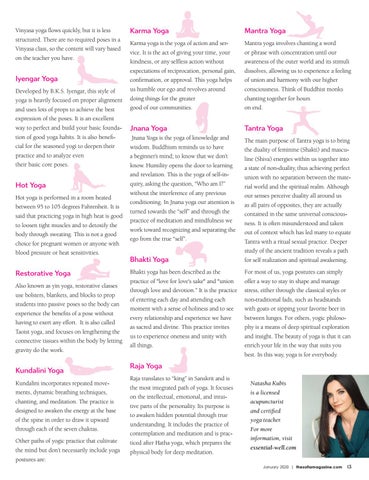
oga with goats, naked yoga, beer and cannabis yoga, laughing yoga, rage yoga . . . the rapid boom of the industry has brought the concept of yoga (however loose the interpretation) to the masses and has fused yoga with everything imaginable (and unimaginable). There is truly a style of yoga for everybody. While some of these fads may seem far removed from yoga’s Hindu roots and its Buddhist origins of meditation and mindfulness, I don't think seasoned yogis, in principle, would meet trendy yoga fads with spiritual snobbery. The physical practice of yoga, which is most relatable to the masses, is just an access point that can lead to deeper levels of engagement of the mind. If stretching naked with goats, while sipping beer acts as an entry way for deeper self awareness, go for it! Since 2012, the yoga industry in America has skyrocketed. We spend $16 billion a year on classes, fancy clothing, teacher trainings, and accessories. Trends show that between 2012 and 2016 the number of Americans doing yoga grew by 50%. Approximately one in three people have tried yoga at least once. I think the massive mindfulness movement among westerners is a very positive thing for our society as a whole, whether it is through our monthly 12
thesofiamagazine.com | January 2020
Every BODY subscription to Yoga Booty Boot Camp class, or at an ashram in India. The word “yoga” is derived from the Sanskrit word “Yuj” which means to join or unite. It is a practice that connects the body and mind through different body postures, meditation, and controlled breathing. Yoga is not a religious practice, but it can be a spiritual practice, and it is all-inclusive whether you are Jewish, Hindu, Christian, Muslim, or atheist. It is an exercise in becoming the best version of ourselves both physically and mentally, while encouraging self reflection and positive intention. This ancient tradition can be an exercise of forward folds and headstands as well as a daily practice of insightful and conscientious living. There are many yoga paths and knowing where to begin can feel overwhelming, especially if you don’t have any background in yogic philosophy. Here is a basic guide to the various styles of yoga to help you navigate your own personal practice.
ful” or focused movement. It is an umbrella term that encompasses the various styles of the physical exercises and movements of yoga. The body is a temple and maintenance of the body is an important stage of our physical and spiritual growth. Through the practice of asanas, we develop discipline and the ability to focus, both of which are necessary for meditation. Here are some of the most popular subgenres of Hatha yoga you may encounter:
Ashtanga Ashtanga yoga is physically demanding and fast paced. It involves a predefined collection of poses that are executed in a specific order of six series (primary, intermediate, and four advanced series). Students are expected to begin with the first (primary) series and progress to the next level only when they have fully mastered each preceding series. Typically classes involve a teacher leading the class, but as students advance, they may explore Mysore classes, which are in a self-directed setting.
Hatha Yoga Hatha yoga is the yoga we are most familiar with in the west. It involves the practice of the classical postures known as the “asanas”. The Sanskit word “hatha” translates to “will-
Vinyasa In the yoga world the most common understanding of “vinyasa” is the coordination of movement with breath. Like Ashtanga,
Vinyasa yoga flows quickly, but it is less structured. There are no required poses in a Vinyasa class, so the content will vary based on the teacher you have.
Iyengar Yoga Developed by B.K.S. Iyengar, this style of yoga is heavily focused on proper alignment and uses lots of props to achieve the best expression of the poses. It is an excellent way to perfect and build your basic foundation of good yoga habits. It is also beneficial for the seasoned yogi to deepen their practice and to analyze even their basic core poses.
Hot Yoga Hot yoga is performed in a room heated between 95 to 105 degrees Fahrenheit. It is said that practicing yoga in high heat is good to loosen tight muscles and to detoxify the body through sweating. This is not a good choice for pregnant women or anyone with blood pressure or heat sensitivities.
Restorative Yoga Also known as yin yoga, restorative classes use bolsters, blankets, and blocks to prop students into passive poses so the body can experience the benefits of a pose without having to exert any effort. It is also called Taoist yoga, and focuses on lengthening the connective tissues within the body by letting gravity do the work.
Kundalini Yoga Kundalini incorporates repeated movements, dynamic breathing techniques, chanting, and meditation. The practice is designed to awaken the energy at the base of the spine in order to draw it upward through each of the seven chakras. Other paths of yogic practice that cultivate the mind but don’t necessarily include yoga postures are:
Karma Yoga
Mantra Yoga
Karma yoga is the yoga of action and service. It is the act of giving your time, your kindness, or any selfless action without expectations of reciprocation, personal gain, confirmation, or approval. This yoga helps us humble our ego and revolves around doing things for the greater good of our communities.
Mantra yoga involves chanting a word or phrase with concentration until our awareness of the outer world and its stimuli dissolves, allowing us to experience a feeling of union and harmony with our higher consciousness. Think of Buddhist monks chanting together for hours on end.
Jnana Yoga
Tantra Yoga
Jnana Yoga is the yoga of knowledge and wisdom. Buddhism reminds us to have a beginner’s mind; to know that we don’t know. Humility opens the door to learning and revelation. This is the yoga of self-inquiry, asking the question, “Who am I?” without the interference of any previous conditioning. In Jnana yoga our attention is turned towards the “self” and through the practice of meditation and mindfulness we work toward recognizing and separating the ego from the true “self”.
The main purpose of Tantra yoga is to bring the duality of feminine (Shakti) and masculine (Shiva) energies within us together into a state of non-duality, thus achieving perfect union with no separation between the material world and the spiritual realm. Although our senses perceive duality all around us as all pairs of opposites, they are actually contained in the same universal consciousness. It is often misunderstood and taken out of context which has led many to equate Tantra with a ritual sexual practice. Deeper study of the ancient tradition reveals a path for self realization and spiritual awakening.
Bhakti Yoga Bhakti yoga has been described as the practice of "love for love's sake" and "union through love and devotion.” It is the practice of entering each day and attending each moment with a sense of holiness and to see every relationship and experience we have as sacred and divine. This practice invites us to experience oneness and unity with all things.
For most of us, yoga postures can simply offer a way to stay in shape and manage stress, either through the classical styles or non-traditional fads, such as headstands with goats or sipping your favorite beer in between lunges. For others, yogic philosophy is a means of deep spiritual exploration and insight. The beauty of yoga is that it can enrich your life in the way that suits you best. In this way, yoga is for everybody.
Raja Yoga Raja translates to “king” in Sanskrit and is the most integrated path of yoga. It focuses on the intellectual, emotional, and intuitive parts of the personality. Its purpose is to awaken hidden potential through true understanding. It includes the practice of contemplation and meditation and is practiced after Hatha yoga, which prepares the physical body for deep meditation.
Natasha Kubis is a licensed acupuncturist and certified yoga teacher. For more information, visit essential-well.com January 2020 | thesofiamagazine.com
13
My New Year's Resolution By Jill Long
M
y new year’s resolution turns out to be more of an intention than a resolution. The thought that turned into an intention came to me in the middle of the night right after Thanksgiving. Maybe because I sense other’s mood/energy and can absorb it at times if I’m not careful. As it turns out, there are people in Asheville who are in a foul mood and not sending out the good vibes that we are known for, and I pick up on them even with complete strangers. It sometimes takes a concerted effort to not take on the energy of others. So, here’s my intention: to send out positive, healing energy and to be received by others with gratitude and acceptance who can either benefit from the healing, be grateful for the positivity, or become friends. The older I get, the less I want to deal with, especially when it comes to people who are in a bad mood. Of course, we all have bad moods, but there seem to be some people who are in a constant state of irritability and negativity. They are not people 14
thesofiamagazine.com | January 2020
I know in my business life but people I see out in public. You can pick them out in the crowd, either by something they do to you or others or just by the type of energy they emit. And these people aren’t always accepting of those of us who try to be more upbeat and loving. I am the person who calls people “sweetie” or “love” or who reaches out to give someone a hug if they need it. And I run across people who are uncomfortable with this. Now let me say that I grew up in the south so this is perfectly comfortable to me. And since we don’t come with signs stating our comfortability with such, I assume most everyone else is (since we are still in the south). But I have found that some people are not, so I set my intention this year to attract the people in my life who accept how I am in the world and don’t get offended by it. I am going to build an invisible shield around myself to protect myself from the energies that do not serve me or honor who I am.
When I make this statement and set my intention on attracting like-energy to myself, I have to keep in mind that an intention is a two-sided coin. It involves both the energy we intend to put out as well as the energy we intend to receive. As Newton says, “for every action, there is an equal and opposite reaction.” Now I’m not sure how this will play out with my new year’s intention, but I’m hoping for good results. Maybe I should add to my intention that I want to receive only positive, healing energy and to have gratitude for such. Okay that feels more complete.
Jill Long, M.A. Ed. Licensed Professional Counselor
Coolto How
Beat the Blues During the Long, Cold, Dreary Winter Months
S
ometimes people begin to feel a little down after
leaves us feeling depressed, lonely, and isolated unless we
the holidays and before the warm spring and
continue to maintain these connections throughout the rest
summer months. There are, however, things
of the year. Take this chance to reconnect again now that
everyone can do to stay positive, focused, and happy during
the holiday rush is over. Go to lunch with a friend or take
this time of year.
an exercise class together. Call or email or even visit your
Take a vitamin D supplement. Vitamin D is the natural mood
relatives. A few hours spent with a chosen companion or
elevator that is one of the secret reasons we humans crave
two can do wonders for your mental health.
warm weather and sunshiny days. Your body
Write a list of gratitude. This is a simple and
naturally produces it when exposed to the
profound tool for mood elevation. Simply list
sun, but it may be lacking during the cold
out things, people, or events you are grateful
days of winter. Supplements can be bought
for, then place the list where you will see it
over-the-counter, but ask your prescribing
regularly. Change the list every few days so
doctor if it will interact negatively with any
you realize just how much you have to be
current prescriptions you have. Vitamin D
thankful for.
usually has no drug interactions and no side
Pick up an old hobby or learn a new one.
effects, so most doctors will give you the
Humans crave meaningful and pleasurable ac-
green light.
tivities. It can be very satisfying to learn how
Stay connected with loved ones. This in-
to paint with watercolors, crochet an afghan,
cludes family and friends. Most of us reconnect with those
or to build a birdhouse. Find a craft that interests you, take
we love during the holidays, and this can create a natural
a class, or go online to improve your skill.
feeling of well-being and good cheer. This then fades and
With these tips you can have a happy, fulfilled New Year! January 2020 | thesofiamagazine.com
15
Embracing Change Bracing for Change By Lavinia Plonka
O
ne of my oddest, odd jobs was a mini-career in reading Tarot cards at parties as Madame Lavinia. It had begun by accident: a theatrical agent who knew that I dabbled, called me in hysterics: their psychic was sick (couldn’t she have predicted that?). Could I, would I throw together a gypsy costume and read cards? “I can’t do that! I’m not psychic!” But no excuse would deter her from her conviction that a phony seeress was better than none. I sat at this party feeling like a cross between a con artist and a blithering idiot. “You’re going through some big changes at the moment,” “Things have been tough, but it’s all going to change,” “You need a change.” Whenever I was at a loss as to how to 16
thesofiamagazine.com | January 2020
interpret the cards, I just had to couch my oracular pronouncements from the perspective of change and I was on a par with the Delphic Pythoness. Somehow, word got around and next thing I knew, (although I should have seen it in the cards), Madame Lavinia was booked for events ranging from corporate picnics to graduation parties. In the past, during particularly dreary days, I’d pull out the cards and say to myself, “Yes, things are pretty bleak right now, but they are about to change.” Then I’d lay out the cards. When the spread dared to intimate more of the same misery, I would quickly gather them up, saying, “Clearly I haven’t shuffled enough. Give me something better than that . . . now!” I’ve been told more than once that “all is good.” That it’s all about attitude.
Looked at from another perspective, we could reframe things: bad is the new good! For example, there’s a Tarot card called the Tower. It shows screaming people leaping out of a burning castle or skyscraper. Instead of saying, “Uh oh, there’s a catastrophic change ahead,” look at the good: “You are about to experience a magnificent opportunity to liberate yourself from old attachments.” One of my favorite doom and gloom cards is the Ten of Swords. A person lies face down, stabbed in the back by ten swords. The Tarot historically defines this as ruin, betrayal, utter despair. What a wonderful time to treat yourself to a massage! Better yet, let’s look at the therapeutic quality of being punctured. Maybe a few sessions of acupuncture are in your future. All the great philosophies tell us that change is inevitable. The I Ching is
actually called The Book of Changes. Just when you think things couldn’t get worse, they do. When you’ve been knocked up side the head by the Ten of Swords, be comforted that even this can be interpreted positively: there’s no place to go but up! If I don’t drink my opened bottle of wine, it will turn into vinegar. On the other hand, if I forget about the apple cider in the fridge, it becomes hard cider. See? Change is good. When do you let change happen and when do you initiate change? Is my decision – whether it’s a fashion fit before a party or quitting my job – really mine?
“Who would have expected Ilsa to fall apart like that. She was such a rock!” “It’s always the quiet ones.” “And now she’s in pieces. I don’t think she’s going to be able to get herself back together.” “Well, she was no spring chicken.” “Yeah. We got time.”
there, paralyzed. A week before the move, I asked him how it was going and Ron assured me he was almost done. When the movers arrived at his studio, they not only had to finish packing his stuff, but they had to order another truck because Ron’s “few boxes” amounted to another whole move. After everything was gone; the house was empty, the studio was empty, the new family was waiting outside, Ron stood rooted in the house. I asked him if he was scared. “No, why?” “Because you’re standing stock still in the middle of our former house.”
Everything is always changing, even when we don’t notice it. I imagine a conversation between two rocks sitting on the bank of a river.
“Huh?” “It’s time to go now. We’re moving to Asheville.”
“Hey.” “Hey what.”
“Right, right.”
“I’m eroding.”
To this day we, or rather I, joke that Ron’s heels left skid marks on the floor in our old home as I dragged him to his new life. He doesn’t think it’s funny
“I’ve noticed you’re looking thinner. You look great!” “I dunno. I could probably still lose a bit on the bottom.” “Well, you better be careful. Try to change too much and you’ll do something radical. Did you see what Al did? “How could you miss it? He went right over the edge of the bank.” “Well, he’s been on the edge for a long time. I warned him.” “Yeah, but to just go like that.” “Crazy, huh.” “Hey, he’ll survive, he likes to take chances. Anyways, let’s face it, you never know when change is going to hit you. Look at Ilsa, man.” “I know, she totally cracked!”
When we decided to leave NJ for Asheville, I felt reborn. I ran up and down stairs, packing boxes, organizing yard sales, giving things away. I couldn’t wait to start over. No one in Asheville would know I’d ever been a fortune teller. I would have no past, except what I was willing to divulge. While I packed, my husband Ron would slip out of the house in the morning and return in the evening without so much as touching a box. I assumed he was busy packing up his studio. But he wasn’t. He was sitting
Life is good. I decide, why not read my Tarot cards? They come up – two of disks: change, five of cups: disappointment, The Moon: fear of the unknown. I quickly gather them up and say, “Clearly I haven’t shuffled enough!”
Body language expert, Lavinia Plonka has taught The Feldenkrais Method for over 25 years. For more information, visit her at laviniaplonka.com
January 2020 | thesofiamagazine.com
17
J eanAnn’sJ ourney
New Year NE YOU! his catchy little phrase gets
ourselves. The primary purpose of
and when I got out. I reinvented
a lot of publicity in January.
reinvention is to give ourselves the gift
myself after surviving cancer and as
Many of us take a look at
of living authentically.
an empty-nester. I reinvented my-
our lives each new year and reassess
I’ve “reinvented” myself several times
self from a “reserved-introvert” to a
where we are and where we want to
over. I reinvented myself when I
“social-introvert” so I could compete
be. Some of us then make the decision
became a mom, when I worked in
in dance competitions and speak to
to create a “new you,” or to “reinvent”
a professional career environment,
large groups of people. Reinvention
T
Life is ever-changing, and reinvention helps us honor our personal values as we go through our journey.
18
thesofiamagazine.com | January 2020
isn’t something I do each New Year; it’s something I do regularly to keep up with the person I become as I go through my life. I’ve found that reinventing myself is essential for my happiness and personal fulfillment. I think it’s unrealistic to expect that the dreams and goals you have at 20-something will always be the same at 60-something. Those first objectives served a purpose and may have given you joy—and money—but that doesn’t mean the career you choose
cific project and then realize that you
“New Year, New You” can be more
at 25 can’t change when you are 45.
have discovered a new passion. This
than just a January expression when
Life is ever-changing, and reinvention
can lead to the desire to make changes
you adopt it as the motivation you
helps us honor our personal values as
in your life so you can explore these
need to take a conscious look at your
we go through our journey.
possibilities further.
life. You can then create changes that
The motivation to reinvent ourselves
Happy, fulfilled lives don’t just hap-
will make you healthier, happier, and
often comes from feeling dissatisfied
pen; they require work, focus, and a
more fulfilled. Reinvention can give
or unhappy with our current situation.
desire to live authentically. When you
your life meaning because living
I’ve learned that this initially feels aw-
are feeling stuck, the first thing to ask
authentically is really the only way to
ful, but if you take a good look, you’ll
yourself is, ‘What do I want?” Sounds
live your life with purpose, and to
realize that the uncomfortable emo-
simple, right? It’s not. I love the line
have your wishes and dreams realized.
tions are actually sending the message
in Alice in Wonderland when Alice
that it’s time to make a change. This
asks the Cheshire Cat which path she
yearning or dissatisfaction keeps us
should take. His simple answer says
from staying in paralyzing circum-
everything, “That depends on where
stances. Without the anxious or rest-
you want to go.” Ask yourself: How
less feelings, we may never reach the
do I want to live my life? What gives
point where we say, “This is enough.”
me joy? What do I have to do to make
Only when we acknowledge our truth
my dream a reality? To answer these
can we begin the search for new ex-
questions, you must know who you
periences or changes that will lead to
are at every stage of your life. It’s good
living a fulfilled and authentic life.
to know that it’s never too late to rein-
There are also times when serendipitous occurrences lead to the desire for reinvention. You may decide to learn a new skill for a spe-
Happy New Year!
vent yourself. I know an 80-year-old lady who recently began taking dance lessons, and she just entered her first dance competition! Changing who you are and being willing to take risks requires courage, drive, energy, focus, and planning; but the results are fulfillment, contentment, happiness, and inner peace.
Please send your thoughts and ideas to me at jeananntaylor @rewnc.com January 2020 | thesofiamagazine.com
19
Priming the Family for Great Dinner Conversations
I
’ve heard parents lament their efforts at hosting family dinners. They too often end up eating in silence after several attempts at starting a conversation. At the end of a long day, trying to talk over dinner just feels like more work. The result, we return to dining by screen light. Don’t give up! With practice, we can regain the lost art of conversation. In fact, consider adding this to your 2020 New Year’s resolutions. Here’s how you can make it easy. First, choose a topic that has interest and inspires creative thinking. Be sure everyone can participate even if you have children at the table. Then create a positive frame for it. For example, a national discussion topic around public schooling is the achievement gap. Many of these conversations are focused on “fixing kids” or “fixing teachers.” This is a subject every child in school can 20
thesofiamagazine.com | January 2020
weigh in on. They will have ideas and insights that adults won’t have. Here’s how you might frame such a conversation for the family: When some of the flowers in our garden aren’t blooming, we don’t try to change the flowers, we change their environment: giving them extra nutrients, water, sunlight. Not all children bloom in our school environments. Instead of trying to change them, we can change their environment. Then, ask questions. Let the youngest be the first to answer, make sure everyone has a chance, and no one dominates the dialogue. Be sure to join in yourself and be the last to answer. Follow up on great ideas with questions to deepen and broaden the thinking; see how they might unfold. Link similar ideas together, building and expanding the realm of possibilities. Ask questions that inspire curiosity and creative thinking; invite
By Cheri Torres everyone to be part of the conversation. For example: What are your teachers doing to help every student bloom? When are you most alive and excited about learning? Tell me about a specific time when you felt like you bloomed in school. What did you value about yourself, other students, and your teacher in that experience? What do you think would help your peers who are struggling? How can students help each other bloom? What strengths do you have that would help others? What three wishes do you have to make schools a place where everyone blooms? Here are some additional topics and reframes to get you started:
Anyone can come up with answers, but the sign of genius is asking great questions. What questions did you ask today? What are you most curious about? What disruptive questions might change the way we think about _______. You can also focus crafting questions on a specific topic. What genius questions might we ask about ______? Innovative solutions to some of our climate challenges are being discovered or developed daily, like fungi that decompose plastic, 3-D on-site building printing, and the Clean Ocean Interceptor (which cleans plastic from rivers). What do we do in our daily living that contributes negatively to climate change?
What are some ways we could decrease our negative impact right now? What technological innovation might allow us to keep doing what
we’re doing and not have a negative impact? There are no problems in the world we cannot solve! If you could solve one problem in the world, what would you solve? What would be the outcome? How would you know you were successful? What are we already doing and what else might we do to achieve that? Find an inspiring short video to kick off a conversation. To find one, google ‘inspirational videos,” “positive news,” “innovation that is changing everything,” or another uplifting topic. Then start off a conversation based upon the video. Some examples might be: People doing good deeds for others might foster conversations guided
by questions such as: How does this video inspire you? How did you help someone or do a good deed for someone else today?
How can we help each other each day? New inventions that resolve an important human need (clean water, food, housing). Questions might include: What do you think made it possible for this invention to come about? What needs do we have in our community that could use an invention? What kind of impact do you want to have in our family? Community? The world? Remember, the art of conversation is not about right and wrong. It is not about one good solution or the best idea. The art of conversation is about fostering connection, shared understanding, and the expansion of ideas and possibilities. In our polarized world, we desperately need to rekindle the art of conversation. Tonight, inspire a family dinner conversation. Make room for everyone’s voice, even young ones. Keep asking generative questions and creating space for conversation to grow. Let’s make 2020 the year that civil and creative conversation finds its way back into our homes and communities. It can all begin around the family dinner!
Cheri Torres is an author and speaker cheritorres.com. You can download a free Conversation Toolkit and learn more sparking great conversations at Conversations WorthHaving.today.
January 2020 | thesofiamagazine.com
21
Life Victim or
Life Warrior By Jill Long
L
ife is tough. Sometimes you want to give up and quit fighting and just let whatever is going to happen, happen. After all, you have no control over what happens, right? Maybe not. How you view and respond to the tough times and your attitude about them are in your control and what makes you a victim or warrior. You may not know what category you fit in, and we are all, quite honestly, probably a combination of both. Focusing on how you respond to problems and your attitude about situations in your life can help you become the warrior you are intended to be. Let me say before I go further, that there are obviously true victims of crime. These are not the people I am talking about. Victims of crime have a set of circumstances to deal with, based on the crime, that are unique. I am referring to people in everyday situations and how they handle them. When you are a life victim, you tend to have an external locus of control. You believe that what happens outside you defines you. Victims present as if they have NO control over much of anything. They have a bad life because they are mistreated by others. Their job doesn’t pay enough, their husband doesn’t help out, their kids rule the house and there is blame on others for all this. However, a warrior has an internal focus of control. They understand that they can’t always change their external circumstances, but they present in the world with a positive attitude and have control over their internal processes. A warrior 22
thesofiamagazine.com | January 2020
understands and takes charge of what she has control over. Sometimes this may just be her attitude. Victims believe that whatever happens to them is someone else’s fault and will tend to blame others for their circumstances, complain to others a lot, have negative attitudes, and not see how they impact their own situation. Warriors take responsibility for their part in what happens in their life, problem solve instead of complain, have positive attitudes and gratitude, and tend to make changes in their lives to make things better. Victims and warriors deal with the same world and the same circumstances; their world view and corresponding response is different. Victims absorb their problems, reflect negativity to the world, and present with hopelessness and helplessness. Warriors reflect on their problems, look at different perspectives, and reflect hopefulness and positivity to the world. If your world view is tainted by your circumstances, look at ways to change it. You may “awfulize” in your mind, think of the worst-case scenario, and then focus on that outcome. If you are focused in a certain direction, that is where you tend to go. If you are constantly focusing on the worst-case scenario, that’s probably what will happen. If you’ve ever learned to ride a motorcycle, you are taught to look where you are going because that’s the direction the bike will go. That’s the way life seems to be. It goes where you look, or to what you focus on. Victims will have a harder time getting ahead in the world, always struggling,
and rarely being happy. They may tend to manipulate others to try to get what they want, because, as I said they believe their circumstances are controlled outside them. They may also have a negative view of, or dislike, others who they perceive to have more than them. Warriors typically have an easier time, because they take charge, ask for help instead of manipulating, and understand that they do have some control over the outcome of their life. Also, others tend to be drawn to warriors as they exude a certain positivity and light. Can you change from victim to warrior? The answer is within you. You will get sick or have problems that take you down and you will feel victimized, but warriors are survivors in this world. If given a bad situation, warriors try to find the purpose behind it. They try to find ways to grow from their experiences. None of us are immune to the hard knocks that life throws out. Warriors just don’t focus so much on them and give them the negative attention. Warriors don’t say “why me,” they say “why not me.” Warriors learn from bad situations and try to see the lesson in life’s tragedies. Through working on your attitude about life and accepting some responsibility in your part (changing from an external control to internal control) you can become a life warrior. Positive attitude and gratitude in whatever life sends your way are key. People will be drawn to you for your new found energy and light.
Biltmore Family Medicine PLLC Let Our Family Care for Your Family
Family members that are healthy are more likely to be happy and spend their time together. To help with this, you should have a medical practice that can see all of you in one location. From your children to your grandparents, make sure that everyone is taken care of. You will receive these services and more at Biltmore Family Medicine PLLC. Biltmore Family Medicine PLLC was established in March of 2004; since then, we have focused on giving our quality care to you and your loved ones. We pride ourselves on being friendly, courteous and professional – more than that, we are proud to give your family a new sense of well-being. Let our family care for your family. We are licensed and insured for your protection and ours. Call Biltmore Family Medicine PLLC to set up your next appointment.
CALL US TODAY AT (828) 252-4020
Our Newest Product
SculpSure
Non-invasive laser body contouring that helps you achieve a natural-looking, slimmer appearance. No Surgery. No Downtime. Just Results. SculpSure’s body contouring technology is able to target and destroy fat cells safely in 25 minute treatments.
• Customizable treatment plans • Over 90% patient satisfaction rate • FDA cleared Visit: www.sculpsure.com today and call our office to schedule your Free Consultation
(828) 252-4020 | www.biltmorefamilymedicine.net 1 Saint Dunstans Road, Asheville, NC 28803 Mon - Fri 8:30am - 5:00 pm | Closed for lunch 12:30 -1:30pm Extended Hours: Sat 9:00 am - 1:00 pm