January 2021
thesofiamagazine.com
Mind Over Body | New Year New You | Spilling the Tea
Asheville’s One-Stop Shop for ALL your Beauty Needs Eyebrow Tinting | Eyelash Extension Waxing | Massage Therapy Skincare | Hydrafacials
beauty-bin.com
828.417.9915 Acupuncture Cupping & Yoga Please enjoy
$20 off your first session with this ad
Natasha Kubis, L.Ac. 917.576.9198 acuwellhealth@gmail.com
acuwellhealth.com
117 Sweeten Creek Rd, Asheville
Voted Best of WNC for the last six years
Keeping Families Comfortable since 1993
Jennifer Bullman Jones President, Bullman Heating & Air
Heat Pumps • Air Handlers • Air Conditioners • Coils • Package Units • Waterfurnance Heat Pumps Thermostats • Gas Furnances • Air Cleaners • Ductless Systems • Steam Humidifiers • Geothermal Bypass Humidifiers • Dehumidifiers • Wine Cellar Cooling Units • iWave
bullmanheating.com 2
thesofiamagazine.com | January 2021
828.658.2468
Publisher Tammy Sheppard publisherofsofia@gmail.com
Art Director / Web Design Tina Gaafary
For Advertising Inquiries Mike Demos 828.273.0098 mikedemos@aol.com
from the staff of SOFIA!
CONTENTS
Trish Luzzi 828.423.0248 wnccreations@gmail.com Terri Wells twells.avlmedia@gmail.com 828.776.8886
Contributing Writers 6
T he Power of Gathering Laurie Richardone
8
F un Ways to Remind Yourself of Your New Year's Resolutions
9 F eel Good in Your Body Right Now 10 Tea Culture Natasha Kubis
12 H omemade Face Mask Recipes
Natasha Kubis Laurie Richardone
Photographer Bren Dendy
P.O. Box 18416 Asheville, NC 28814 828-230.7537 thesofiamagazine.com All advertising published in SOFIA is believed to be truthful and accurate. However Sofia Magazine assumes no responsibility and shall have no liability whatsoever for errors, including and without limitation, typographical errors or omissions in SOFIA. Any reference made to Sofia Magazine is not to be construed as making any representation, warranty or guarantee concerning the information advertised in SOFIA. The content of all ads contained herein are solely the responsibility of the advertiser. The opinions and statements contained in advertising or elsewhere in this publication are those of the authors of such opinions and are not necessarily those of Sofia Magazine reserves the right to edit or refuse any advertising submitted to this publication. January 2021 | thesofiamagazine.com
3
made it myself! More than 10,000 bolts of quality quilting cotton!
sheville EST.
1997
ON CO.
1378 Hendersonville Road in Asheville ~ 828-277-4100 Check out our classes at www.ashevillecottonco.com
4
thesofiamagazine.com | January 2021
Available in January 2021
Share Your Story on the
Cover of SOFIA RESERVE YOUR SPOT NOW FOR 2021 Contact Publisherofsofia@gmail.com
January 2021 | thesofiamagazine.com
5
The Power of Gathering
By Laurie Richardone
T
he way we gather matters. This is a time to get creative, about how, where, and with whom we spend our time. How can we take a challenging span and make it meaningful, and unforgettable?. What makes getting together memorable?. If you think about life's different occasions or events, food is most likely at the center. Food is the catalyst for any notable gathering. Whether sitting at a table together, or delivering homemade cookies to a neighbor, it creates a sense of connection. We have an opportunity to think differently about gatherings, however small they may be. There is something transformative about gathering around food. To break bread together, a phrase as old as the bible, captures the power of how a meal can forge relationships. The connection we have with food is universal, and rooted in the connections that we have with the people in our lives. It offers a sense of unity which can bring both similar and diverse backgrounds together. The feeling of making a meal from scratch can be one of the most rewarding, joyful experiences. What’s better than sharing a homemade meal? ; it ties together people from all walks of life. Whatever the reason or season, rest assured it will make January a delicious and meaningful month. The intention is to give you the inspiration, and generosity of heart to bake those cookies, make that cake, a healthy one, a simple one, and walk across the street to a neighbor, friend or even a stranger… and make their day, and yours. With good friends… and good food on board… we may ask, When shall we live if not now? M.F.K. Fisher, The art of eating Cardamom pound cake that warms the body, mind and spirit… Wishing you a magical New Year…
6
thesofiamagazine.com | January 2021
Cardamon Infused Pound Cake with Toasted Almonds Gluten-Free & Grain-Free
Makes 1 large pound cake, or 3 mini loafs 1 1/2 sticks ( 3/4 cup ) unsalted butter, room temperature 1 1/2 cup almond flour 1/2 cup arrowroot 1 1/2 teaspoon psyllium husk, ground 1 1/4 tsp. baking powder 1 tsp. ground cardamom (if using pods, grind to a powder) 3/4 tsp. sea salt 1/4 cup almond milk, or other milk 1/2 cup goat yogurt, or cow 3/4 cup monk fruit sugar, or pure cane sugar 3 large eggs, room temperature 3/4 tsp. vanilla extract 1/2 cup sliced almonds
Preheat oven to 350 Butter a 9x5x3 loaf pan; line bottom with parchment paper, leaving an overhang on the sides. For smaller loaves, use 3 mini loaf pans. Whisk baking powder, cardamom, salt and 2 cups of flour and psyllium husk in a medium bowl. Set aside.
Whisk almond milk and 1/2 cup of yogurt in a small bowl. Set aside. Using an electric mixer on high speed, beat the sugar and 3/4 cup butter in a large bowl until light and fluffy. About 4 minutes.
tester inserted comes out clean, 4050 minutes. (Tent if browning too fast ) Transfer pan to a wire rack and let cool in pan for 20 minutes.
Add the eggs one at a time, beating to blend between additions and occasionally scraping down the sides with a spatula. Add vanilla. Reduce the speed too low and add dry ingredients in 3 additions. Alternate the yogurt mixture with the dry mixture. Add dry ingredients last. Beat until just combined. Scrape the batter into prepared loaf pans, or pan. Bake cakes, rotating half way through, until golden brown and a
For scheduled Cooking Classes in Asheville, Visit: LaurieRichardone.com
January 2021 | thesofiamagazine.com
7
Fun Ways to Remind Yourself of Your New Year's Resolutions
M
aking your New Year's resolutions is easy; keeping them is hard -- as you may be finding already. But with these prompts to remind you of the promises you've made to yourself, they can become second nature. If they're well-chosen, helpful resolutions, you'll be glad of these prompts, even if they're somewhat unorthodox. Some involve technical preparation, but that's part of the fun. In any case, they all will help you remember.
your resolutions independently. If your phone doesn't have this function, set your alarm to come on at a convenient time each day. You can also time a tweet to yourself, to receive at a relevant time. If you've made a resolution to get fit, for instance, set your message to reach you just before your scheduled workout time.
Simplify them
Record yourself listing your keywords, preferably as a song or with some background music or beat (something you'll enjoy listening to), and set it as your phone's ringtone. Just watch your friends' faces when they hear (and are bewildered by) your mysterious chant.
Reduce each of your resolutions to a few words for easy recall and reference. Ideally, cut them down to just one word each, like "smile," "apply" or "brave." That single word will bring back the whole commitment and the reasons behind it. Maybe write out those keywords in bright colors, stick them onto a colored card, and thread them into a necklace, bracelet or bookmark to remind you of them throughout the day.
Send reminders to yourself Set up your phone to remind you daily (or more often if you like) until you're confident you can remember 8
thesofiamagazine.com | January 2021
Make a ringtone with your keywords
Make a resolutions-themed screensaver Create a computer screensaver, featuring your keywords or illustrations for them, or both together. You could use your computer's "paint" program or similar art capability to write the words in bright colors and add in some illustrations, or you could use a photo or download an image to
represent each of your commitments. Alternatively, type out your resolutions in full, preferably in unusual fonts and bright colors that will keep you looking at them. If you're not sure how to convert your design into a screensaver, just search online for guidelines, and you should have it up and working in no time.
Sing your resolutions in bed Chant or sing your New Year's resolutions. Adopt a favorite tune for them, and sing it as you close your eyes at night and again in the morning before getting up. Use these quiet, private times to consider whether you've been keeping to them, and how you could improve. It's also worth re-evaluating the commitments themselves, to see if they're the best ones possible for you, and whether they're too hard or complicated to adhere to for the whole year. Your pesky reminders will soon drive you to take your commitments fully on board, accommodating them in your everyday life, so you don't even have to stop and think about them. But until that point, these simple tricks will keep you safely on track.
Feel Good in Your Body Right Now
A
nyone who's worked towards a weight loss or fitness goal knows it can be quite a journey. While it's important to stay focused, that can easily turn into the unhealthy habit of waiting for that desired dress size to be happy. Here are some tips to help you avoid that trap and feel good in your own skin right now:
FOCUS on functionality Your body may not be perfect but it does a lot for you. Whenever you perform a physical activity like walking around the block with ease, appreciate your body for it. Its main purpose, after all, is to keep you moving through life and if it's doing that, you have something to feel good about.
CHANGE what you can right now When it comes to how you look and feel the little things matter. Wear what you feel good in, change your hair, get your nails done, or choose a new signature scent. It's hard not to feel good in your skin when you're pampered and smelling delicious.
BELIEVE in the inevitability of your ideal body
your relationships and make some necessary changes.
If you're dieting and working on fitness, you need to do so with absolute conviction that it's just a matter of time until you reach your goals. Believing that the things you don't love to see when you look in the mirror are temporary prevents your insecurities from having power over you.
DETOX your social media
WATCH your thoughts If your inner voice is in the habit of loudly and confidently criticizing your body, train it to compliment you with equal authority instead. Frequently point out the things you like about your body and use affirmations to keep those positive thoughts at the forefront of your mind.
BE SELECTIVE about the company you keep Seek out people who speak kindly about others, bring out the best in you, are comfortable with their own imperfect bodies, and make you feel good about yours. If the people in your social circles are fueling your insecurities, it's time to reevaluate
In addition to people who surround you in real life, those who appear on your feed can also impact your body image. Never compare your whole reality with the snippets others choose to show. Take breaks when you need to and only follow accounts that help you feel good and inspire you.
LOVE yourself Loving yourself will help you strike a balance between accepting yourself for your inherent worth and improving yourself because you are worthy of your own potential and being the best version of yourself. If you can only take away one point, this should be it - love yourself. Like anything worthwhile, reaching your fitness goals will take time, but life is happening right now. Make it one of your goals to feel good about your body even as you work on getting it fitter.
January 2021 | thesofiamagazine.com
9
“The first cup moistens my lips and throat. The second shatters my loneliness. The third causes the wrongs of life to fade gently from my recollection. The fourth purifies my soul. The fifth lifts me to the
Tea Culture By Natasha Kubis
N
ext to water, tea is the most commonly consumed drink around the world. It is deeply integrated into many cultures because of its abilities to bring people together, to soothe the soul, to please the senses, to elevate the mind, and to heal the body. “No matter where you are in the world, you are at home when tea is served.” – Earlene Grey I will never forget my experience with Moroccan hospitality while traveling through that enchanting country. Every person I met along the way was eager to help and connect, even when language was a barrier. Their most common tool for communication was their national beverage, “Berber Whiskey,” or mint tea. Light-hearted Moroccans coined this phrase because consuming alcohol in public is not allowed in Morocco. Mint tea was served in almost every situation, whether doing a business transaction of any kind, when arriving back to my riad (hotel), with every meal, and even while in the middle of the desert, camping in a tent, around a bonfire with Tuareg folks playing hand drums on empty gasoline cans. A moment in Morocco is never complete without a cup of mint tea. In 10
thesofiamagazine.com | January 2021
realms of the unwinking gods.”- Chinese Mystic, Tang Dynasty
most Arabic cultures, tea is more than a beverage, it’s a bridge for intercommunication, fellowship, and communion. Its ritual is at the very heart of the Arabic way of life. Maghrebi mint tea is the traditional green tea that Moroccans use. It is made with spearmint (or peppermint leaves) and sugar. It is popular throughout Morocco, Algeria, Tunisia, Libya, and Mauritania. The green tea serves as an antioxidant, while the fresh mint energizes you, cleanses your palate, and freshens your breath. Thanks to the anti-inflammatory agents found in mint, its properties are said to help fight seasonal colds, flus, allergies, and stomach ulcers.
Moroccan Mint Tea Recipe • 1 tablespoon of loose Chinese gunpowder green tea • 5 cups of boiling water • 3 tablespoons of sugar • 1 large bunch of fresh mint Put the tea in the teapot and pour in 1 cup of boiling water, then swirl it around gently to warm the pot and rinse the tea. Strain out and discard the water, reserving the tea leaves in the pot. Add the remaining 4 cups of boil-
ing water to the tea and let it steep for 2 minutes. Stir in sugar and mint sprigs and steep for 3 to 4 minutes more. Serve in small heatproof glasses. Some other varieties of Arabic tea include the following: Sage tea is usually served after a meal to aid in digestion, get rid of heartburn, and stop flatulence. Anise is a licorice-tasting tea that has been used for hundreds of years for treating coughs and flu symptoms. It also helps improve digestion, alleviate cramps, and reduce nausea. Thyme tea is said to help improve memory and cleanse the stomach. Cardamom tea helps aid digestion and increase saliva flow. For this reason, it is usually sipped before meals rather than after, to help prepare your digestive enzymes. Black tea is the most common tea you’ll find in any kitchen cupboard, and a staple among Arabic people. It is the tea with the highest caffeine content. Studies have shown that black tea may protect lungs from damage caused by exposure to cigarette smoke. It also may reduce the risk of stroke. “There is something in the nature of tea that leads us into a world of quiet contemplation of life.” – Lin Yutang For Chinese culture, tea is synonymous with life, and has been used for traditional medical purposes for the last 5,000 years. The tea leaf was first discovered in China back in 2737 BCE, when the Emperor Shen Nung came across the Camellia sinensis, while relaxing under the shade of a wild tea tree. He was boiling some drinking water and a breeze blew a few leaves from the tree into the pot, giving the water a pleasing flavor. He experimented further and found it to have medicinal properties and urged the Chinese peo-
ple to cultivate the plant for the benefit of the entire nation. Over time, he has become the legendary Father of Tea. Popular teas in China include the following: Green tea, perhaps the most widely studied tea on the planet, has numerous health benefits, such as improving blood flow and lowering cholesterol. Green tea has also been shown to help block the formation of plaques that are linked to Alzheimer's disease. In one Swiss study, MRIs revealed that people who drank green tea had greater activity in the working-memory area of their brains. It has also been shown to keep blood sugar stable in people with diabetes. White tea is the least processed tea and its health benefits include preventing tooth decay, promoting healthy skin and hair, and increased energy and alertness. Oolong tea may offer benefits for heart health, diabetes prevention, bone health, and weight loss, possibly due to the high antioxidants content. It also contains theanine, an amino acid found to promote relaxation. “In my own hands I hold a bowl of tea; I see all of nature represented in its green color. Closing my eyes, I find green mountains and pure water within my own heart. Silently sitting alone and drinking tea, I feel these become a part of me.” – Sen Soshitsu Perhaps no culture on earth loves rituals as much as the Japanese do. Drinking a cup of tea in Japan is treated with a formality and an elegance. They were one of the first countries in the world to hold tea ceremonies, as tea became a staple drink for the religious classes of Japanese priests. One such ceremony is known as “the Way of Tea”, which is the process focusing on how tea is made, and involves aesthetically preparing a bowl of tea from one’s
heart. Everything is always carefully considered when indulging in tea, from the type of drinking vessel to the variety of tea chosen for the particular season. There is a harmony achieved through the ritual of tea drinking and ceremonies are held for a variety of reasons, such as meditative observances of winter sunrises, summer sunsets, the arrival of the full moon, the budding of spring’s first blossoms, and the changing of the leaves from green to gold.
India and it is served literally on every street corner and train station, where you can see people selling it at all times of the day and night. This sweet and spicy tea is said to lower blood pressure, control blood sugar, and reduce bad cholesterol in the body.
Popular Japanese teas include the following: Japanese Sencha, an unfermented form of green tea that is steamed to retain all of its aromatic and healing properties. Matcha tea, a powdered Japanese green tea that is mixed with hot water and therefore the leaf itself is included in the beverage. Matcha Tea Recipe • 1 teaspoon of Matcha powder • 6 ounces of hot water, divided Boil 6 ounces of water. In a bowl, combine matcha powder and 1 ounce of hot water. Using a bamboo whisk, whisk rapidly until the mixture forms a thin paste. Slowly add the rest of the hot water to the paste, as you continuously whisk the mixture for about 1.5 minutes, creating a light foam on top. Pour into your teacup and enjoy. By the end of the 3rd century CE, tea had become China’s number one beverage. By the 8th century CE, the Chinese were already trading tea to Tibetans, Arabs, Turks, nomadic tribes of the Indian Himalayas, and along the Silk Road into India. It was not until the 17th century CE that tea reached European soils. The British introduced tea to India to break China’s monopoly on tea. Today, India is the largest consumer of tea worldwide. Chai is the national drink in
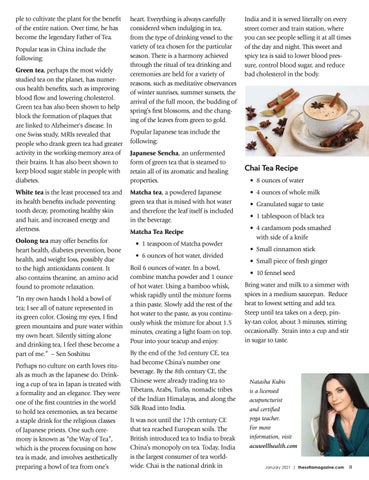
Chai Tea Recipe • 8 ounces of water • 4 ounces of whole milk • Granulated sugar to taste • 1 tablespoon of black tea • 4 cardamom pods smashed with side of a knife • Small cinnamon stick • Small piece of fresh ginger • 10 fennel seed Bring water and milk to a simmer with spices in a medium saucepan. Reduce heat to lowest setting and add tea. Steep until tea takes on a deep, pinky-tan color, about 3 minutes, stirring occasionally. Strain into a cup and stir in sugar to taste.
Natasha Kubis is a licensed acupuncturist and certified yoga teacher. For more information, visit acuwellhealth.com
January 2021 | thesofiamagazine.com
11
Homemade Face Mask Recipes to Try for an All-Natural Glow
S
tore-bought facial masks and one-timeuse sheet masks are enjoyable for an at-home spa treatment, but they're expensive with regular use. You can make your own therapeutic face mask with ingredients in your kitchen. Commercial face masks often contain synthetic ingredients and they're shipped with lots of packaging materials. Making your own face masks is an eco-friendly way to treat yourself without exposing your skin to potential harm. 12
thesofiamagazine.com | January 2021
What's a Face Mask? Face masks use plant extracts and other beneficial ingredients to help repair and condition your skin. To make your own face mask, you simply combine the food ingredients in a food processor or blender, or mix them manually with a utensil. Apply the paste to your face immediately and rinse it off after 15 to 20 minutes. Face masks can help with a range of skin problems, and you can
select the ingredients in your face mask according to your skin's needs. Here are three face mask recipes for all skin types: Lavender Avocado Face Mask to Hydrate Dry Skin 1 teaspoon organic honey 1 teaspoon virgin coconut oil 1/4 ripe avocado 5 drops lavender essential oil Note: Some essential oils can irritate the skin.
The coconut oil and avocado in this recipe provide essential fatty acids that moisturize and nourish your skin. Organic honey is a natural humectant, which means it helps lock in moisture in the skin, making it softer and more plump [1]. Lavender essential oil has moisturizing and soothing properties. It's also antimicrobial and it fights hyperpigmentation in the skin to diminish blemishes, acne scars, age spots and sun spots. Plus, you get the relaxing effects of aromatherapy! Turmeric Yogurt Face Mask for Glowing Skin 1 tablespoon natural, plain yogurt 1 tablespoon organic honey 1 tablespoon of turmeric powder The lactic acid in yogurt acts as a natural exfoliant, clearing away the outermost layer of skin cells to uncover younger, healthier skin [2]. Honey moisturizes,
nourishes with antioxidants and has a microbicidal effect [1]. Turmeric has been shown in studies to treat numerous skin conditions through its antimicrobial and anti-inflammatory properties. By reducing hyperpigmentation it helps smooth out your skin tone and give you a healthy
Egg whites have natural astringent properties, which help clear away impurities, tighten skin and shrink large pores. There's also a bactericidal enzyme in egg whites called lysozyme that can help acne clear up faster [6].
glow [3].
Apply the face mask immediately after combining the ingredients. Use either your fingers, a paint brush or a cotton ball to spread the mixture evenly on your face, avoiding the eye area. Sit back and relax while wearing a homemade facemask, to minimize the mess and maximize the absorption into your skin.
Papaya Egg Face Mask to Exfoliate and Cleanse 1/2 cup mashed papaya 1 whipped egg white 1 teaspoon organic honey Papaya is chock full of natural enzymes that clear away dead skin cells. This luscious tropical fruit is also a source of antioxidants. In fact, papaya is shown in lab research to protect human skin against sun damage and oxidative stress [5].
Homemade Face Mask Tips
Food is one of the safest ingredients to put on your skin. Essential oils, on the other hand, are highly concentrated. Lavender is considered safe for topical use and has low toxicity [4]. However, some essential oils can irritate skin, so it's important to select carefully. References: 1. pubmed.ncbi.nlm.nih.gov/24305429/ 2. ncbi.nlm.nih.gov/pmc/articles/ PMC6017965/ 3. pubmed.ncbi.nlm.nih.gov/27213821/ 4. ncbi.nlm.nih.gov/pmc/articles/ PMC5878871/ 5. ncbi.nlm.nih.gov/pmc/articles/ PMC3984819/ 6. pubmed.ncbi.nlm.nih.gov/25285490/
January 2021 | thesofiamagazine.com
13
14
thesofiamagazine.com | January 2021
Dig Deep, Practice and...
Find Your V o i c e
Dig Deep, Practice and...
�� Jazz �� Soul �� Rock �� Country
Blues Pop
Pre-Teens to Baby Boomers Novice to professional
Peggy Ratusz
Vocal Coach 828.301.6768
peggymarie43@gmail.com
reverbnation.com/peggyratusz
Improve balance, reduce pain, realize your dreams laviniaplonka.com
Lavinia Plonka, GCFP 828.258.7220
January 2021 | thesofiamagazine.com
15
to read
50+Living
e P A G E
he
PA GE
F L
Pt
P
FL
t h
SOFIA
to read