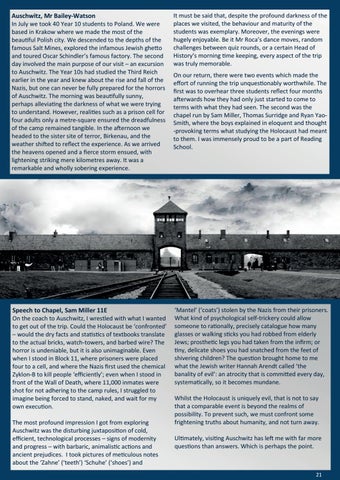
Auschwitz, Mr Bailey-Watson In July we took 40 Year 10 students to Poland. We were based in Krakow where we made the most of the beautiful Polish city. We descended to the depths of the famous Salt Mines, explored the infamous Jewish ghetto and toured Oscar Schindler’s famous factory. The second day involved the main purpose of our visit – an excursion to Auschwitz. The Year 10s had studied the Third Reich earlier in the year and knew about the rise and fall of the Nazis, but one can never be fully prepared for the horrors of Auschwitz. The morning was beautifully sunny, perhaps alleviating the darkness of what we were trying to understand. However, realities such as a prison cell for four adults only a metre-square ensured the dreadfulness of the camp remained tangible. In the afternoon we headed to the sister site of terror, Birkenau, and the weather shifted to reflect the experience. As we arrived the heavens opened and a fierce storm ensued, with lightening striking mere kilometres away. It was a remarkable and wholly sobering experience.
It must be said that, despite the profound darkness of the places we visited, the behaviour and maturity of the students was exemplary. Moreover, the evenings were hugely enjoyable. Be it Mr Roca’s dance moves, random challenges between quiz rounds, or a certain Head of History’s morning time keeping, every aspect of the trip was truly memorable.
Speech to Chapel, Sam Miller 11E On the coach to Auschwitz, I wrestled with what I wanted to get out of the trip. Could the Holocaust be ‘confronted’ – would the dry facts and statistics of textbooks translate to the actual bricks, watch-towers, and barbed wire? The horror is undeniable, but it is also unimaginable. Even when I stood in Block 11, where prisoners were placed four to a cell, and where the Nazis first used the chemical Zyklon-B to kill people ‘efficiently’; even when I stood in front of the Wall of Death, where 11,000 inmates were shot for not adhering to the camp rules, I struggled to imagine being forced to stand, naked, and wait for my own execution.
‘Mantel’ (‘coats’) stolen by the Nazis from their prisoners. What kind of psychological self-trickery could allow someone to rationally, precisely catalogue how many glasses or walking sticks you had robbed from elderly Jews; prosthetic legs you had taken from the infirm; or tiny, delicate shoes you had snatched from the feet of shivering children? The question brought home to me what the Jewish writer Hannah Arendt called ‘the banality of evil’: an atrocity that is committed every day, systematically, so it becomes mundane.
The most profound impression I got from exploring Auschwitz was the disturbing juxtaposition of cold, efficient, technological processes – signs of modernity and progress – with barbaric, animalistic actions and ancient prejudices. I took pictures of meticulous notes about the ‘Zahne’ (‘teeth’) ‘Schuhe’ (‘shoes’) and
On our return, there were two events which made the effort of running the trip unquestionably worthwhile. The first was to overhear three students reflect four months afterwards how they had only just started to come to terms with what they had seen. The second was the chapel run by Sam Miller, Thomas Surridge and Ryan YaoSmith, where the boys explained in eloquent and thought -provoking terms what studying the Holocaust had meant to them. I was immensely proud to be a part of Reading School.
Whilst the Holocaust is uniquely evil, that is not to say that a comparable event is beyond the realms of possibility. To prevent such, we must confront some frightening truths about humanity, and not turn away. Ultimately, visiting Auschwitz has left me with far more questions than answers. Which is perhaps the point.
21