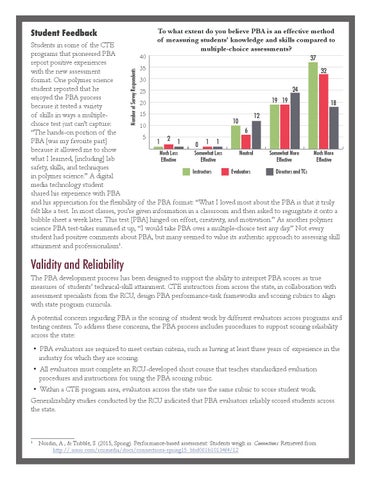
To what extent do you believe PBA is an effective method of measuring students’ knowledge and skills compared to multiple-choice assessments? 37
Student Feedback
Number of Survey Respondents
Students in some of the CTE programs that pioneered PBA 40 40 report positive experiences 35 35 32 with the new assessment 30 30 format. One polymer science student reported that he 24 25 25 enjoyed the PBA process 19 19 20 20 18 because it tested a variety 15 15 of skills in ways a multiple12 10 choice test just can’t capture: 10 10 6 “The hands-on portion of the 5 5 PBA [was my favorite part] 1 2 1 0 1 1 0 because it allowed me to show Much Less Somewhat Less Neutral Somewhat More Much More Much Less Somewhat Less Neutral Somewhat More Much More what I learned, [including] lab Effective Effective Effective Effective safety, skills, and techniques Instructors Evaluators Directors and TCs in polymer science.” A digital media technology student shared his experience with PBA and his appreciation for the flexibility of the PBA format: “What I loved most about the PBA is that it truly felt like a test. In most classes, you’re given information in a classroom and then asked to regurgitate it onto a bubble sheet a week later. This test [PBA] hinged on effort, creativity, and motivation.” As another polymer science PBA test-taker summed it up, “I would take PBA over a multiple-choice test any day.” Not every student had positive comments about PBA, but many seemed to value its authentic approach to assessing skill attainment and professionalism1.
Validity and Reliability The PBA development process has been designed to support the ability to interpret PBA scores as true measures of students’ technical-skill attainment. CTE instructors from across the state, in collaboration with assessment specialists from the RCU, design PBA performance-task frameworks and scoring rubrics to align with state program curricula. A potential concern regarding PBA is the scoring of student work by different evaluators across programs and testing centers. To address these concerns, the PBA process includes procedures to support scoring reliability across the state: • PBA evaluators are required to meet certain criteria, such as having at least three years of experience in the industry for which they are scoring. • All evaluators must complete an RCU-developed short course that teaches standardized evaluation procedures and instructions for using the PBA scoring rubric. • Within a CTE program area, evaluators across the state use the same rubric to score student work. Generalizability studies conducted by the RCU indicated that PBA evaluators reliably scored students across the state.
Nordin, A., & Tribble, S. (2015, Spring). Performance-based assessment: Students weigh in. Connections. Retrieved from http:// issuu.com/rcumedia/docs/connections-spring15_bbd061b10134f4/12
1