feature 1908
Mississippi Legislature passes laws to establish agricultural high schools
1911
1921
Bolivar County Agriculture High School and Forrest County Agriculture High School open as boarding schools
1910
Laws are revised to include Black students
Hinds County Agricultural High School and Pearl River County Agricultural High School offer high school and college classes
1917
Smith-Hughes Act passed
1928
10 agricultural high schools offer college courses
1989
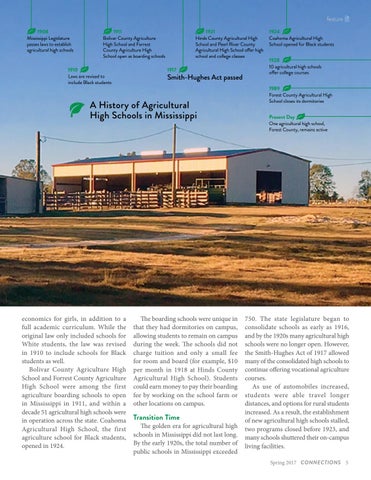
A History of Agricultural High Schools in Mississippi
economics for girls, in addition to a full academic curriculum. While the original law only included schools for White students, the law was revised in 1910 to include schools for Black students as well. Bolivar County Agriculture High School and Forrest County Agriculture High School were among the first agriculture boarding schools to open in Mississippi in 1911, and within a decade 51 agricultural high schools were in operation across the state. Coahoma Agricultural High School, the first agriculture school for Black students, opened in 1924.
1924
Coahoma Agricultural High School opened for Black students
The boarding schools were unique in that they had dormitories on campus, allowing students to remain on campus during the week. The schools did not charge tuition and only a small fee for room and board (for example, $10 per month in 1918 at Hinds County Agricultural High School). Students could earn money to pay their boarding fee by working on the school farm or other locations on campus.
Transition Time
The golden era for agricultural high schools in Mississippi did not last long. By the early 1920s, the total number of public schools in Mississippi exceeded
Forest County Agricultural High School closes its dormitories
Present Day
One agricultural high school, Forest County, remains active
750. The state legislature began to consolidate schools as early as 1916, and by the 1920s many agricultural high schools were no longer open. However, the Smith-Hughes Act of 1917 allowed many of the consolidated high schools to continue offering vocational agriculture courses. As use of automobiles increased, students were able travel longer distances, and options for rural students increased. As a result, the establishment of new agricultural high schools stalled, two programs closed before 1923, and many schools shuttered their on-campus living facilities. Spring 2017 CONNECTIONS 5