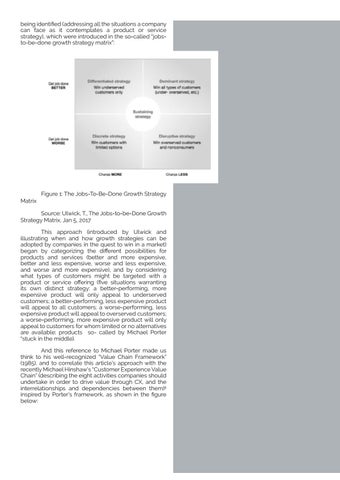
being identified (addressing all the situations a company can face as it contemplates a product or service strategy), which were introduced in the so-called “jobsto-be-done growth strategy matrix”:
Figure 1: The Jobs-To-Be-Done Growth Strategy Matrix Source: Ulwick, T., The Jobs-to-be-Done Growth Strategy Matrix, Jan 5, 2017 This approach (introduced by Ulwick and illustrating when and how growth strategies can be adopted by companies in the quest to win in a market) began by categorizing the different possibilities for products and services (better and more expensive, better and less expensive, worse and less expensive, and worse and more expensive), and by considering what types of customers might be targeted with a product or service offering (five situations warranting its own distinct strategy: a better-performing, more expensive product will only appeal to underserved customers; a better-performing, less expensive product will appeal to all customers; a worse-performing, less expensive product will appeal to overserved customers; a worse-performing, more expensive product will only appeal to customers for whom limited or no alternatives are available; products so- called by Michael Porter “stuck in the middle). And this reference to Michael Porter made us think to his well-recognized “Value Chain Framework” (1985), and to correlate this article’s approach with the recently Michael Hinshaw’s “Customer Experience Value Chain” (describing the eight activities companies should undertake in order to drive value through CX, and the interrelationships and dependencies between them)5 inspired by Porter’s framework, as shown in the figure below: