SUBSCRIPTIONS: Free to qualified recipients: $12 per year to all others in the United States. Subscription rate for Canada or Mexico is $35 for one year and for elsewhere outside of the United States is $55. Back-issue rate is $5.
Send subscriptions or change of address to: PARCEL, P.O. Box 259098 Madison WI 53725-9098
Allow six weeks for new subscriptions or address changes.
REPRINTS: For high quality reprints, please contact Chad Griepentrog, 608-241-8777, chad.g@rbpub.com
P.O. Box 259098 Madison WI 53725-9098
p: 608.241.8777 f: 608.241.8666
PARCELindustry.com
PIVOTING FOR SUCCESS
By Amanda Armendariz
In the past, many shippers were essentially married to one of the major carriers. Whether it was FedEx, UPS, or (prior to 2009) DHL, shippers were often aligned with one carrier, largely due to perceived benefits like volume discounts, ease of renegotiation, and so on.
And while there are certainly numerous shippers today who still subscribe to the one-carrier model, more and more have been creating multi-carrier networks to better optimize their delivery operations, especially in the post-COVID era.
The Big Two certainly have their strengths and play their parts well. But it has become more and more common for businesses to incorporate regional carriers or the USPS into their carrier mixes, since these organizations can often fulfill certain needs that the Big Two cannot. Especially in the age of growing supply chain disruptions, having alternative carriers in your mix is a necessity. In this issue, we take a look at the key considerations to keep in mind while designing a multi-carrier network, and also profile some of the regional carriers who could help you take your parcel operation to the next level.
The small-package industry is a growing and constantly evolving one, so it’s critical that you ensure your network is as efficient and cost-effective as possible. Regional carriers can help you achieve that.
As always, thanks for reading PARCEL.
PARCEL COUNSEL
STAYING OUT OF TROUBLE: AN INTRODUCTION TO ANTITRUST LAW
Andrew M. Danas
Not every PARCEL Counsel column needs to include the most important advice any attorney can provide to a client: “AVOID GOING TO JAIL.” This column, an initial introduction to antitrust law, definitely includes that advice.
Businesses compete. They seek to innovate; obtain market share; increase profits; and obtain advantages over their competitors. Sometimes they seek to do so working with competitors or using questionable business practices. The antitrust laws establish the rules and guardrails for acceptable and unacceptable forms of competition.
The Sherman and Clayton Antitrust Acts, enforced by the United States Department of Justice and Federal Trade Commission, are the two main US antitrust laws. Section 1 of the Sherman Act prohibits agreements that restrain trade. Section 2 prohibits actions to monopolize a part of trade or commerce.
Section 7 of the Clayton Act requires an antitrust review of certain mergers and acquisitions where the effect “may be to substantially lessen competition or tend to create a monopoly.”
Other federal laws also govern competition. Section 5 of the Federal Trade Commission Act prohibits “unfair methods of competition” and “unfair or deceptive acts or practices.” The Robinson-Patman Act also prohibits sales that discriminate in price on the sale of goods in certain circumstances. Federal laws regulate competition by prohibiting trademark and copyright infringement or the misuse or theft of trade secrets.
Each of the 50 states has its own set of antitrust laws. Many have also enacted a version of the Uniform Trade Secrets Act or other types of prohibition on unfair competition.
Some entities in the transportation industry, such as ocean carriers, marine terminal operators, and international air carriers, enjoy limited regulatory exemptions from the antitrust laws. Most — carriers, intermediaries, and shippers — do not.
The purpose of the federal antitrust laws is to protect competition, not competitors. Courts have interpreted the Sherman Act as prohibiting agreements that unreasonably restrain trade. That a company has been placed at a disadvantage due to the competitive practices of one or more rivals does not mean that there has been a violation of the antitrust laws.
Indeed, many types of agreements between competing companies are allowed under the antitrust laws because they create efficiencies and actually promote competition. For example, properly structured, the pooling of resources by competitors to engage in joint buying, marketing, or utilization of resources can create economies of scale that enhance competition. What activities violate the antitrust laws? Engaging in price fixing; market divisions or customer allocations; bid rigging; and types of group boycotts are examples of activities that so unreasonably restrict competition that they are considered to be per se, or automatic, violations of the antitrust laws.
If not a per se violation, the activity is analyzed under the
“rule of reason” test, where a court examines the market power of industry competitors; the competitive effects of any challenged activity; and the rationale for the activity and whether it is procompetitive or reasonably necessary.
Antitrust claims can result in possible lawsuits from competitors. The federal government can also seek the imposition of substantial civil and criminal penalties, both for individuals and corporations. Federal monetary penalties range from $1 million per individual up to $100 million per corporation, with up to 10 years imprisonment for individuals found in criminal violations of the law.
Executives from many industries, including transportation and logistics, are currently serving prison terms for violations of the federal antitrust laws. All parcel shippers thus need to be aware of the basic antitrust laws, especially the per se rules. The advice of legal counsel should always be sought to learn if proposed business activities could violate the antitrust laws. All for now!
Andrew M. Danas is a Partner, Grove, Jaskiewicz and Cobert, LLP, Washington, D.C. Visit www. gjcobert.com or email adanas@ danaslaw.com for more information. The information contained in this article is intended to be general background information. It does not constitute and should not be relied upon as legal advice.
SUPPLY CHAIN SUCCESS
DHL EXPRESS CHALLENGES THE US IMPORT/ EXPORT MARKET
By Eric Kubilus
For years, FedEx and UPS have dominated the US domestic shipping market, serving as the primary carriers for individuals and businesses alike. When DHL Express exited the US domestic market in 2009, many assumed the company had stepped back for good. In reality, DHL refocused on its core strength: international logistics. Operating in over 220 countries and territories, DHL has continued to offer global expertise while increasingly eyeing a return to the US market, particularly in high-growth sectors such as health & life sciences, e-commerce, and electric vehicles (EVs).
1. Targeting High-Growth Sectors
DHL Express is aligning its growth strategy with the evolving needs of niche industries, focusing on medical, technology, and e-commerce sectors. Offerings like DHL GlobalMail and DHL Medical Express (for time-sensitive shipments) are part of this tailored approach. The company has also committed to achieving net-zero emissions by 2050 and is heavily investing in the EV market.
According to DHL’s 2025 Outlook survey, 40% of small and medium-sized enterprises (SMEs) see expansion into new markets as their top growth opportunity — surpassing hopes for economic recovery (31%) or new technology adoption (14%). This aligns with DHL’s integrator model, which is well-suited for smaller, high-value shipments common in sectors like life sciences and healthcare.
In support of green logistics, DHL recently launched its EV Center of Excellence (CoE), which offers end-to-end logistics solutions for EV supply chains — from batteries and electric motors to critical automotive components.
“We have the know-how, especially in dealing with complex trade and customs regulations,” said Tim Robertson, CEO of DHL Global Forwarding Americas.
2. Competitive Pricing & Speed in Global Trade
International shipping is often expensive, particularly for SMEs, but DHL offers flexible and competitive pricing — especially for shipments to Europe and Asia. Its rates and frequent discounts make it a cost-effective alternative to FedEx and UPS, according to Synctrack.
For parcels under 21 kg in Southeast Asia and the US, DHL Express provides economical shipping options. It also maintains time-definite service for cargo under 75 kg in Europe and the Americas, with typical delivery times of three to four days, per Wozo. Through authorized resellers like Preferred Shipping, businesses can access DHL discounts without volume commitments.
DHL’s global customs expertise also streamlines clearance processes. Once shipment details are verified and transmitted, DHL expedites clearance — reducing delivery delays.
3. Strategic Infrastructure Investments
DHL Express is investing heavily in its infrastructure to boost service capabilities and shipping speed. In October 2024, the company announced a $292 million expansion of its CVG (Northern Kentucky) Gateway — a critical hub for US distribution. The investment will improve aircraft maintenance efficiency, reduce downtime, and allow for greater cargo volume through an expanded runway.
CVG serves as one of DHL’s three global superhubs,
alongside Hong Kong and Leipzig, Germany. Additional infrastructure improvements include:
$78 million expansion at the Miami International Airport hub, enhancing connectivity to South and Central America and the Caribbean.
Planned expansion of the Los Angeles Gateway, announced in February 2023, to strengthen capacity in the US’s largest export market.
These investments are paired with sustainability efforts. At DHL’s upgraded facilities, more than 80 employees manage up to 3,775 shipments per hour. The sites support domestic and international deliveries across 225 countries and feature EV charging stations — supporting DHL’s goal to electrify 60% of its delivery fleet by 2030.
DHL’s US Growth Momentum DHL Express is clearly positioning itself to reclaim market share in the US while continuing to lead in international logistics. Its focus on high-growth sectors, strategic infrastructure expansion, and competitive international pricing make it a formidable competitor to FedEx and UPS. As domestic shippers increasingly look to scale their brands globally, DHL’s blend of innovation, sustainability, and reliability will be key to gaining ground in the US logistics landscape.
Eric Kubilus is Transportation Consultant at Infios.
5 COMPANIES THAT ARE HERE TO CONSULT AND HELP
With our jobs, we all face a variety of challenges, both big and small, but your supply chain challenges can open up the door to many questions that a consultant is just waiting to help you solve. Each of these 5 companies have answers to help you with many of your current struggles and problems. Reach out to them today.
CT Logistics, a recognized global logistics supply chain provider, specializes in delivering impactful cost reduction strategies. Recognized by Gartner Group as a leading provider of global freight audit and payment services, and certified by FedEx, CT offers comprehensive offerings including BI analytics, contract management, benchmarking, impact studies, and bid management tailored for small package and other modes of transportation. Additionally, CT provides an array of value-added services including TMS, managed freight, and shipping co-op services. Our operations adhere to rigorous standards including SOC and ISO 9001:2015 certification. With over a century of expertise, CT consistently delivers proven cost savings solutions.
Why settle for average when you can raise the standard? Green Mountain goes beyond the status quo to deliver Parcel Spend Management (PSM) solutions built for scale. Our approach aligns shipping operations with business goals — unlocking savings, improving delivery outcomes, and creating value that compounds over time. In 2024, 37 PSM clients added $460M to their bottom lines through our strategic, data-driven approach.
that perform. With proprietary analytics and a white-glove approach, we turn data into decisions — and decisions into measurable impact. From auditing and contract negotiation to end-to-end parcel intelligence optimization, we bring intention, precision, and deep expertise to every client relationship. This is more than consulting.
— unifying cost centers, automating workflows, and unlocking millions in savings. With advanced document linking, predictive insights, and real-time visibility, Loop empowers teams to control costs, improve margins, and increase working capital. Industry leaders like Great Dane, Clemens Food Group, and J.P Morgan Chase trust Loop to transform transportation from a black box into a strategic advantage.
Loop.com/parcel
Supply Chain Secret Sauce: repairs, strengthens, and bulletproofs supply chains. What we have done: Packaging Optimization, shipping and distribution operations analysis, averaging $1.7M in savings. We help install machines, solve vendor problems, fix logistics issues, find the right robotic 3PL services, and provide data analytics in a simple way. We solve problems. Our Secret Sauce: over 30 years of experience in production, warehouse operations, logistics, and procurement. We value data-driven strategy and solutions. Monthly subscription-based, no contracts, easy to work with. Call us today for your free review of your business called our Quick Business Review Program.
https://supplychainsecretsauce.com
PRICING INCREMENTALISM
By Joe Wilkinson
Remember the good old days when parcel carriers would increase rates and surcharges once per year? I certainly do.
Annual General Rate Increases (GRIs) rarely touched underlying logic. They were typically just adjustments to list rates and surcharge amounts. Oh, sure, every year would come with a changing surcharge definition, or an adjustment to the DIM factor, or something else fundamental to the pricing logic. But, generally speaking, pricing changed once per year, with maybe an additional change in the fuel matrices thrown in mid-year sometime. The annual GRI was, if not predictable, at least reliable in the sense that impacts could be analyzed and costs could be budgeted with accuracy at least as good as internal projections. But I am sad to say those days seem to be gone; probably for good. We live in a different market at this point, and pricing incrementalism looks like the new norm, and that’s not good news for shippers.
Incrementalism is a decision-making approach that involves making small, gradual changes rather than large, disruptive shifts. This strategy is used across various fields, including economics, politics, and business, to reduce risks and allow for continuous learning. And it appears parcel carriers, particularly the national carriers, have learned the lesson. In transportation pricing, incrementalism allows companies to adjust rates and charges gradually in response to changing conditions like fuel costs, labor expenses, or demand fluctuations, all of which are certainly present in today’s market. Instead of imposing large price hikes, transportation providers may implement small, incremental increases over time. Moreover, the focus is not, or is not exclusively, on transportation charges.
Many recent changes by the national carriers have been on surcharges, fuel, and rating logic — areas that are less visible than changes to list transportation rates.
This approach helps carriers manage revenue while maintaining customer relationships, as sudden and dramatic price changes are likely to shock the market. Incremental pricing also provides flexibility, allowing companies to monitor customer reactions and adjust strategies accordingly, ensuring competitiveness without sacrificing customer retention.
If it sounds like I am exaggerating, I am not. See the bottom of this piece for a partial list of the extra-GRI changes FedEx and UPS have made in the last 12 months or will be making through May 2-25 (as of the date of this writing), and excluding peak / demand charges.
So, why have the national carriers adopted this approach? The use of surcharges for revenue enhancement purposes has been going on for a couple of decades now. As noted, the current market involves increased labor costs (for UPS in particular), decreased market-wide volumes, service downgrades by many shippers, a highly competitive marketplace, and a general yield per package decline.
Carriers are currently navigating a challenging landscape, balancing the need to remain competitive in the short term with the uncertainty of waiting for
volumes to recover. In this environment, they are tasked with finding innovative solutions to make lower service levels financially viable while also working to boost revenues — not an enviable position. But an incrementalist approach at least makes the resulting increases less visible than a simple transportation charge increase. Moreover, changes like fuel surcharge increases (some in the face of declining fuel prices) apply across service levels and are applied to many surcharges, providing a multiplier effect. While GRIs will continue to have a substantial impact, it is likely that incremental, mid-year changes to logic and surcharges will also contribute to cost increases, in often unexpected ways.
Large shippers often possess the leverage to counteract these effective price increases, either through direct negotiations or by having provisions in their agreements that mitigate the impact. In contrast, smaller shippers lack this advantage. As always, it is the smaller and less informed shippers who bear much of the cost of carrier incrementalism. Staying informed through carrier announcements and industry news is essential for shippers to anticipate upcoming changes. At this stage, proactive negotiations remain the most effective strategy to protect, or at least partially safeguard, shippers' profit and loss statements.
4/29/2024
UPS 0.5% increase in fuel surcharges for all services.
5/6/2024 FedEx 1.0% increase in fuel surcharges for domestic services.
7/1/2024 FedEx 1.0% increase in fuel surcharges for export/import services (excluding ground and consolidation to Canada).
7/15/2024 UPS 0.5% increase in fuel surcharges for all services.
9/2/2024 FedEx Fuel surcharge increase of 0.75% to 1.25%.
9/16/2024 UPS 2.5% increase in fuel surcharges for all services.
10/7/2024 FedEx 4.75% increase in fuel surcharges for export/import services (excluding ground and consolidation to Canada).
12/23/2024 UPS • Expanded Large Package Surcharge.
• Raised additional handling fees.
• 1.25% increase in fuel surcharges for all services.
2/10/2025
1/13/2025
FedEx • New inbound processing fee for U.S. imports.
• New duty and tax forwarding fee.
• 40-lb minimum for additional handling dimensions.
• Adjusted DAS/EAS/RAS zip codes.
1/13/2025 UPS • SurePost rate increase: 9.9% for 1-9 lb. packages, 5.9-7.1% for 10-70 lb. packages.
• Increases in Delivery Area Surcharge (DAS) and Extended DAS.
FedEx • Fuel surcharge adjustment for domestic and express freight services.
• 55% increase in Ground Economy DAS/EAS charges (in addition to the previous month’s GRI increases).
3/10/2025 UPS Fuel surcharge increases for U.S. Ground Domestic, UPS SurePost®, and U.S. Domestic Air services.
3/16/2025 UPS Implemented Surge Fee for certain international shipments.
3/17/2025 UPS $10 fee applied when commercial invoice is not provided digitally.
3/24/2025 UPS Fuel surcharges will apply to weekly scheduled pickup fees.
3/24/2025 UPS Revised zone charts affecting origin and destination ZIP code pairs, influencing shipping costs.
3/31/2025 UPS • $5 fee for printed invoice copies.
• $25 fee for check or wire payments.
• Late Payment Fee increase to 9.9%.
5/19/2025 UPS 2% Payment Processing Fee added to all invoice charges.
1/20/2025
FedEx One Rate pricing increase for flat-rate services.
Joe Wilkinson is Vice President of Professional Services, Intelligent Audit. He can be reached at joey.wilkinson@intelligentaudit.com.
PACKAGING
PACKAGING WITH A PURPOSE: THE ROLE OF SUSTAINABLE E-COMMERCE PACKAGING IN MODERN RETAIL
By Deepa Pandey
The rapid expansion of global e-commerce has placed sustainability at the forefront of packaging strategies. As consumers grow increasingly conscious of environmental issues, businesses are responding by prioritizing eco-friendly solutions in order to reduce their ecological footprint. Sustainable e-commerce packaging is no longer viewed as a niche initiative but as a necessary evolution, driven by regulatory frameworks, consumer demand, and the need for long-term operational efficiency.
This shift is transforming the e-commerce landscape by emphasizing materials and design practices that reduce carbon emissions, minimize landfill waste, and enhance packaging lifecycle performance across supply chains.
Market Drivers: Consumer Demand and Regulatory Influence
A major driver behind the adoption of sustainable packaging is the heightened environmental awareness among consumers. Shoppers are increasingly choosing brands that offer recyclable, compostable, and biodegradable packaging options — prompting businesses to transition away from traditional materials and towards solutions that support a circular economy.
Regulatory pressures have also played a critical role. Governments across regions have implemented stringent policies targeting waste reduction and emissions control, pushing organizations to invest in sustainable alternatives. The surge in e-commerce activity — particularly post-pandemic — has further intensified the need for durable, efficient, and sustainable packaging capable of withstanding the rigors of long-distance delivery.
North America: Leading with Regulation and Innovation
In 2024, North America emerged as the dominant region in the sustainable e-commerce packaging market. This leadership position is attributed to a combination of strict environmental regulations, strong consumer awareness, and the proactive shift of major brands toward sustainable operations.
Countries such as the United States and Canada have witnessed increased demand for environmentally responsible packaging, driven by both public sentiment and policy mandates. Additionally, the presence of key market players — such as Berry Global, Mondi Group, and others — has spurred continuous innovation, further reinforcing the region’s market dominance.
Asia Pacific: Fastest Growing Region Fueled by Ecological Consciousness
The Asia Pacific region is
expected to register the fastest growth over the forecast period, propelled by rising environmental awareness and the expansion of the e-commerce sector. China, in particular, plays a pivotal role due to its status as a global hub for e-commerce and manufacturing.
With growing concern over environmental degradation, both consumers and businesses in Asia Pacific are investing in sustainable packaging solutions. This shift is supported by ongoing research and innovation aimed at enhancing packaging materials and supply chain practices.
Plastic Leads as a Recyclable and Cost-Effective Material
In terms of materials, the plastic segment dominated the market in 2024. This is largely due to the recyclability, affordability, and versatility of plastics such as recycled polyethylene terephthalate (rPET) and high-density polyethylene (HDPE). These materials offer an effective balance of durability and sustainability, making them well-suited for the demands of e-commerce logistics. As online retail continues to grow, businesses are prioritizing packaging solutions that are both environmentally responsible and capable of protecting products — particularly fragile items — during transit.
B2C Segment at the Forefront of Packaging Innovation
The business-to-consumer
(B2C) segment led the market in 2024, driven by the accelerating growth of online retail and direct-to-consumer (DTC) business models. Brands in this segment are especially focused on consumer experience, using sustainable packaging as a key differentiator in building trust and reinforcing brand identity.
Sustainability has become a defining factor in consumer perception, and companies are increasingly adopting eco-conscious packaging to meet customer expectations and maintain competitiveness in a crowded marketplace.
Electronics and Appliances: High Demand for Durable Packaging
The electronics and appliances segment also captured a significant share of the market in 2024. The growing popularity of online purchases for electronic goods — which often require protective and durable packaging — has fueled demand for sustainable solutions that can withstand extended shipping distances.
These products, due to their fragility and value, require
packaging that ensures safety while aligning with environmental standards. Sustainable options that balance cost-efficiency with strength have proven especially attractive to both retailers and consumers in this segment.
The global shift toward sustainable e-commerce packaging reflects a broader transformation in how businesses approach environmental responsibility. With increasing consumer awareness, regulatory mandates, and e-commerce growth, sustainable packaging has become an essential component of modern retail
strategy. As companies continue to innovate and invest in eco-friendly solutions, they not only reduce their environmental impact but also enhance customer loyalty and long-term brand value.
Deepa Pandey, Principal Consultant at Towards Packaging, is a market research expert in packaging with 3+ years of experience, specializing in regulatory compliance, design innovations, sustainable packaging, and delivering insights to enhance safety and efficiency.
"WHERE’S MY STUFF?"
Why Package Visibility Is the New Cornerstone of Customer Satisfaction
By Taylor Pawelka
Let’s face it — customers are more impatient and better informed than ever. The moment they hit “place order,” a silent countdown begins in their heads. Not just to the delivery, but to reassurance. They want proof that their order exists, that it's moving, and that someone (preferably a human) knows where it is at all times.
Package visibility isn't just a logistical perk anymore — it's a baseline expectation. And in the race to earn repeat customers, that visibility can make or break a brand.
Expectations Have Shifted — Permanently
The Amazon Effect changed the game. Consumers now expect a seamless, trackable shipping experience from every brand, no matter the size. In their minds, if you can take their money in seconds, you should be able to show them where their package is just as quickly.
But what’s often overlooked is when this visibility should begin.
Too many businesses think about package tracking after fulfillment. But here’s the bold truth: The shipping experience begins at checkout — not at the warehouse.
That means the very first opportunity to shape customer expectations happens at the moment of shipment, when the carrier is selected and the label is created. This notifies the customer that their order has completed the pick phase and
communicates which carrier will be there for delivery. In that moment, clarity matters more than ever.
Carrier Selection: The First Step in Building Trust
Most customers don’t care whether their package ships via FedEx, UPS, DHL, or a regional courier — what they do care about is speed, reliability, and knowing what to expect. That's why carrier selection is more than a backend logistics decision — it's a customer-facing promise.
When you have the right shipping system in place and it chooses the best-cost carrier and service level to meet that promise at the time of shipment, it’s doing more than routing a box — it’s defining a timeline. And if that timeline isn’t communicated clearly, customer anxiety creeps in.
Even a small lack of clarity — “Will this arrive Friday or next week?” — can turn a routine order into a customer support ticket. Worse, it can quietly erode trust, one uncertain delivery at a time.
The Role of Real-Time Tracking
We all know the drill: you place an order and immediately receive a confirmation email. Then what?
If the next update comes two days later with a tracking number, that’s a problem. Customers today expect real-time status changes, even if their package hasn’t physically moved yet.
Visibility doesn't just mean “here’s your tracking link.” It means communicating every key milestone:
Order received
Label created
In transit
Out for delivery
Delivered
Silence between these stages equals doubt. Providing consistent, proactive updates removes the burden from customer service teams and creates a smooth, confident post-purchase experience. In fact, studies show that proactive shipping updates can reduce “where is my order” (WISMO) tickets by up to 70%.
That’s not just a cost savings — it’s a brand win.
Communicating Delays Isn’t a Risk — It’s a Relationship Builder
Here’s a counterintuitive truth: not all delays are bad for business — as long as you communicate them well.
Unexpected weather, mechanical issues, or supply chain hiccups will happen. Customers don’t expect perfection — they expect honesty. If you can alert them to a delay before they have to ask, you instantly position your brand as trustworthy and transparent.
Think of it like this: would you rather hear from the airline before your flight is delayed, or after you’ve already been waiting at the gate?
Too many businesses think of package visibility as something that kicks in once a label is slapped on a box. But the savviest
companies are baking in transparency upstream — starting in the cart, continuing through order confirmation, and evolving all the way to doorstep delivery.
Package visibility isn't optional anymore — it's expected, demanded, and central to satisfaction.
That’s why the moment a carrier is selected — often dynamically at time of shipment — is such a crucial opportunity. It’s the first honest signal to the customer about what’s happening behind the scenes. Done right, this creates a feedback loop of confidence, where every tracking update simply reinforces what the customer already believes: “These folks have it handled.”
Package Visibility Is the New Post-Purchase Experience
Let’s zoom out: why does any of this matter?
Because post-purchase is where brand loyalty is truly won. Ads, email campaigns, product detail pages — they all help close the first sale. But the shipping experience is what
determines whether there’s a second.
A beautiful checkout experience followed by a black hole of “where is my stuff?” anxiety is a recipe for disaster, or at least distrust.
So, if you're investing in marketing, operations, and customer service — but leaving shipping visibility up to chance — you’re solving 90% of the puzzle and leaving the last 10% to fate. And that final stretch? That’s where customer trust either solidifies or slips.
The Takeaway
Package visibility isn't optional anymore — it's expected, demanded, and central to satisfaction. From the moment a customer hits "buy" to the moment the doorbell rings, your brand is being evaluated. Every update — or lack of one — is part of that experience.
Here’s the big idea: Shipping isn’t just logistics. It’s communication. And visibility is your loudest message. Make sure you have the technology tools in place to provide it.
If you can show customers you’re in control from cart to curb, they’ll reward you with trust, loyalty, and, yes — repeat purchases.
Taylor Pawelka is VP of Marketing & Alliances at ProShip, Inc.
DESIGNING A MULTI-CARRIER NETWORK: KEEP THESE KEY CONSIDERATIONS IN MIND
By Jack McCrum
The parcel shipping landscape is evolving quickly, and carriers are no longer content to simply handle anything that comes their way. Instead, carriers are fine-tuning their networks, doubling down on their strengths (perceived or otherwise), and incentivizing the shipments they most covet. For shippers, this creates a more nuanced playing field — one where choosing the right carrier for each parcel requires a deeper understanding of their program and an understanding of potential carrier partners.
Enter 2025. As the industry continues to change, two emerging trends increasingly add shape and definition to the parcel shipping landscape.
First, despite problematic economic headwinds, headlines, and an inflationary environment, e-commerce sales — a key driver of shipping activity — remain fairly robust. The US Department of Commerce estimates that US retail e-commerce sales for the fourth quarter of 2024 amounted to a 9.4% increase over Q4 of last year, despite total retail sales increasing only 3.8% in the same period. Now Q4 is not the same as Q1 or Q2, but the important underlying callout here is that the consumer appetite for online shopping remains strong entering 2025. At the same time, another pivotal development continues to take shape. Eager to optimize their networks, play off their strengths, and incentivize the shipments they want, carriers continue to aggressively modify the cost structure that governs the shipping landscape,
most notably by embracing dynamic pricing strategies. Pricing changes are becoming increasingly common.
The extent of this effort can already be seen in the significant changes carriers have already introduced this year, among them updates to fuel surcharge tables, new and expanded delivery area surcharges, added fees for overweight or oversized packages, and additional adjustments that dictate when and where various services are best used. In some cases, these changes represent potentially exponential increases in shipping costs for businesses.
Just as importantly, because these efforts reflect each carrier’s efforts to optimize their own network and increase profitability, shippers face an increasingly material reality: Some parcels can be more cost effectively shipped with one carrier, while others are best handled by another. Facing this, more shippers are considering whether to implement a multi-carrier strategy, something which, when approached effectively, can result in greater flexibility and lower parcel shipping spend.
Despite this, implementing a multi-carrier shipping strategy is not without risks. Nor is a multi-carrier approach the right path for every organization. What, then, should shippers consider when determining if a multi-carrier shipping strategy is right for them? And, more specifically, what do they need to keep in mind when designing a multi-carrier network?
Moving beyond any one carrier, whether it be FedEx, DHL, or UPS, often places shippers in uncharted waters. To
ensure success and mitigate the risks involved, shippers are well-served to consider the following best practices for carrier diversification when designing their own multi-carrier network.
Exploration is the operative word.
Be Intentional: Start with a clear objective: What am I looking for in an additional carrier? Since the 2020 global pandemic, the parcel market has become highly fragmented, with niche carriers available for nearly every use case. Focusing on a narrow, high-impact set of evaluation criteria — such as transit times, cost, market coverage, on-time delivery performance, and supply chain resilience — can streamline the process and lead to faster implementation.
Know Thy Profile: When designing a multi-carrier network, it is imperative to first know your shipping profile. Revenue tiers and minimum volume commitments often prevent shippers from diversifying effectively. Before engaging with alternative carriers, review contract terms closely, especially how they align with actual shipping patterns and performance. Be aware of the potential financial impact of falling below a revenue tier or missing a volume threshold required for rebates or incentives and include contractual agreements that reflect these parameters in your contract negotiation strategy.
On the most fundamental level, it is also important to know your shipping vital factors, including total
parcel shipping spend, surcharge spend, the average weight of parcels you ship, the average zone you ship to, minimum charges, and, of course, the average cost-per-shipment. All of these factors should be actively tracked and used to determine what an effective multi-carrier network looks like for your organization.
Start Slow: Adopt a phased approach. Identify specific regions, package profiles, or service levels that can be tested with new carriers. Starting with smaller, low-risk segments helps establish quick wins, build internal confidence, and create a glidepath for broader rollout. Make sure to build in time after the initial start of the program to analyze your success and to identify areas where improvement is needed.
Leverage Technology: Technology, and the visibility over shipping activity and ability to manage it in real time that today’s platforms deliver, plays a central role in any multi-carrier net-
work. Drawing on powerful modeling technology, shippers can also analyze their historic shipping data to see what an optimal multi-carrier strategy might look like for their business. Modern platforms can also automate carrier selection, surface the lowest-cost option in real time, and keep programs running at peak efficiency. Shippers should also use them to continuously monitor KPIs like on-time performance, cost-per-shipment, and weekly volume — comparing these across all carriers in the network.
Importantly, shippers should also make sure they have tools in place that alert them when carriers unexpectedly make changes. To date in 2025, carriers unveiled a dizzying array of changes. Unlike adjustments in the past that were overtly announced to customers, these cost increases are increasingly made quietly and under the radar, a reality that makes it crucially important for shippers to immediately know when
changes that have the potential to materially impact their costs are made. By keeping these factors in mind, shippers can design a multi-carrier network with the confidence that it will deliver the savings, flexibility, performance and customer satisfaction that results when businesses take steps to proactively align their fulfillment and shipping strategies with each carrier’s unique strengths and capabilities. When approached in this way, a multi-carrier strategy and the network that enables it delivers a win-win for all involved.
Jack McCrum is the director of optimization & analytics at Reveel, specializing in shipping optimization and cost reduction strategies. With nearly a decade of experience in supply chain strategy and transportation cost management, he leads a team focused on helping businesses navigate carrier pricing changes, optimize networks, and improve efficiency.
By Helaine Rich
WHAT USPS PRIVATIZATION COULD MEAN FOR SHIPPING COSTS AND MARKET COMPETITION
The U.S. Postal Service is facing a defining moment.
With Postmaster General Louis DeJoy giving way to new leadership as he stepped down, and federal interest in potentially shifting USPS under the Department of Commerce increasing, the long-standing debate over privatization is gaining new momentum.
At the same time, USPS is already undergoing significant operational restructuring — cutting costs, consolidating routes, reducing its workforce, and adjusting delivery standards. It also raised prices by as much as 9.2% at the start of the year. If privatization happens, shipping costs will increase even more for retailers, and the structure of the delivery market will be anything but certain.
The trickle-down effect will fall most heavily on rural communities that depend on USPS for last-mile delivery and access to essential goods. They may face reduced delivery frequency or higher rates, depending on how responsibilities are divided and priced. But these changes also provide an opportunity for the shipping industry to reevaluate its reliance on certain carriers and plan for a fragmented delivery system.
Many private carriers, including Amazon, FedEx, and UPS, rely on USPS to complete deliveries in less accessible
areas. Communities and advocacy groups have already started raising concerns about what privatization could mean for consistent, affordable service in regions with limited delivery alternatives. Medication deliveries might slow. Perishables might spoil. Small businesses could find themselves priced out of markets they once served affordably. For many e-commerce retailers and logistics professionals, privatization could disrupt everything from inventory planning to customer satisfaction.
A cornerstone of reliable delivery is the exclusivity that USPS has to residential mailboxes. If privatization removes that, delivery models will need to evolve. That shift could introduce new costs for private carriers or lead to significant pricing model adjustments.
Areas that are now considered domestic deliveries because of the USPS’s universal service obligation would also experience major changes. A privatized USPS would likely need to establish an entirely new cost structure for places like Alaska, Guam, or Puerto Rico that currently have affordable service.
Similar impacts could be felt when sending packages to military addresses. Currently, the Postal Service processes Army Post Office (APO) and Fleet Post Office (FPO) deliveries at domestic pricing even when sending mail overseas.
This structure keeps costs predictable for shippers and ensures that deliveries remain within the US mail system, rather than entering foreign postal networks. If privatization eliminates this service, shipping costs to military personnel would likely rise, and private carriers may need to adjust their offerings to fill the resulting gap in the market.
Costs would also increase for certain types of items that are currently a competitive advantage for the Postal Service. Right now, the agency is known for shipping just about anything as long as there is proper documentation and labeling within certain restrictions. Other companies have a much higher cost of handling commodities like live animals and hazardous materials. That edge and cost structure would be wiped out under privatization.
A Shifting Competitive Landscape
Over time, the economics of parcel delivery have been shifting out of favor for the Postal Service. Private carriers like FedEx and UPS dominate densely populated delivery zones where route density reduces costs and boosts margins. In contrast, USPS shoulders the burden of reaching low-density rural areas and often does it at a loss.
If the Postal Service were to privatize, it would need to make major changes to remain competitive. Without offering more aggressive pricing structures or service offerings, USPS risks being relegated to less profitable, higher-cost deliveries. Regional carriers are already offering cost-effective solutions in urban zones, and larger companies continue to grow their share of last-mile delivery.
Amazon, for instance, is building a delivery network that rivals established carriers. It has promoted its services to businesses that don’t sell on its marketplace, positioning itself as a competitive option for domestic parcel delivery. This shift signals further fragmentation of the delivery landscape, particularly in high-density regions.
While change may be inevitable, USPS has previously shown a willingness to evolve. In past years, the agency tested same-day delivery services in San Francisco and New York City, shipping everything from consumer goods to fresh seafood. Even without privatization, this could become a renewed focus for the USPS to remain competitive.
Partnerships may represent a viable path forward to keep a strong foothold under privatization. USPS has historically partnered with carriers like FedEx, and similar arrangements could expand, carving out portions of USPS operations in a phased approach. These models would enable other firms to manage specific delivery segments, particularly in profitable zones, while USPS continues to serve under a universal service framework.
Preparing for a Fragmented Future
Regardless of whether privatization proceeds, USPS is in a period of transformation. For shippers, this means the need to plan for a more fragmented and dynamic delivery landscape. Businesses should evaluate their carrier mix, assess risk exposure tied to USPS services, and explore diversified fulfillment strategies. Shippers should also take a closer look at areas of their operations that haven’t needed to evolve thanks to longstanding reliance on the USPS, such as packaging. Many businesses use box sizes optimized for USPS models, which often have better pricing for
dimensional weight factors compared to other carriers. By proactively making adjustments and avoiding dimensional weight factors altogether, shippers can cut down on additional costs from private services, minimize wasted space, and stay competitive as delivery responsibilities shift. This is especially critical for operations using automated fulfillment systems, where package decisions made upstream can have a downstream impact on cost and delivery speed in a privatized environment. This is a time to think strategically. As the delivery ecosystem evolves, businesses that remain agile will be able to respond effectively, serve customers more efficiently, and stay competitive in a shifting market. Building flexibility into logistics networks, particularly for rural and underserved markets, can reduce disruptions and unlock new opportunities.
Helaine Rich is VP of Strategic Sales & Administration, ePost Global.
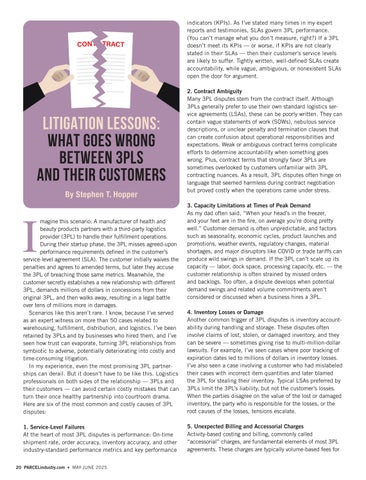
LITIGATION LESSONS: WHAT GOES WRONG BETWEEN 3PLS AND THEIR CUSTOMERS
By Stephen T. Hopper
Imagine this scenario: A manufacturer of health and beauty products partners with a third-party logistics provider (3PL) to handle their fulfillment operations. During their startup phase, the 3PL misses agreed-upon performance requirements defined in the customer’s service-level agreement (SLA). The customer initially waives the penalties and agrees to amended terms, but later they accuse the 3PL of breaching those same metrics. Meanwhile, the customer secretly establishes a new relationship with different 3PL, demands millions of dollars in concessions from their original 3PL, and then walks away, resulting in a legal battle over tens of millions more in damages.
Scenarios like this aren’t rare. I know, because I’ve served as an expert witness on more than 50 cases related to warehousing, fulfillment, distribution, and logistics. I’ve been retained by 3PLs and by businesses who hired them, and I’ve seen how trust can evaporate, turning 3PL relationships from symbiotic to adverse, potentially deteriorating into costly and time-consuming litigation.
In my experience, even the most promising 3PL partnerships can derail. But it doesn’t have to be like this. Logistics professionals on both sides of the relationship — 3PLs and their customers — can avoid certain costly mistakes that can turn their once healthy partnership into courtroom drama. Here are six of the most common and costly causes of 3PL disputes:
1. Service-Level Failures
At the heart of most 3PL disputes is performance: On-time shipment rate, order accuracy, inventory accuracy, and other industry-standard performance metrics and key performance
indicators (KPIs). As I’ve stated many times in my expert reports and testimonies, SLAs govern 3PL performance. (You can’t manage what you don’t measure, right?) If a 3PL doesn’t meet its KPIs — or worse, if KPIs are not clearly stated in their SLAs — then their customer’s service levels are likely to suffer. Tightly written, well-defined SLAs create accountability, while vague, ambiguous, or nonexistent SLAs open the door for argument.
2. Contract Ambiguity
Many 3PL disputes stem from the contract itself. Although 3PLs generally prefer to use their own standard logistics service agreements (LSAs), these can be poorly written. They can contain vague statements of work (SOWs), nebulous service descriptions, or unclear penalty and termination clauses that can create confusion about operational responsibilities and expectations. Weak or ambiguous contract terms complicate efforts to determine accountability when something goes wrong. Plus, contract terms that strongly favor 3PLs are sometimes overlooked by customers unfamiliar with 3PL contracting nuances. As a result, 3PL disputes often hinge on language that seemed harmless during contract negotiation but proved costly when the operations came under stress.
3. Capacity Limitations at Times of Peak Demand
As my dad often said, “When your head’s in the freezer, and your feet are in the fire, on average you’re doing pretty well.” Customer demand is often unpredictable, and factors such as seasonality, economic cycles, product launches and promotions, weather events, regulatory changes, material shortages, and major disruptors like COVID or trade tariffs can produce wild swings in demand. If the 3PL can’t scale up its capacity — labor, dock space, processing capacity, etc. — the customer relationship is often strained by missed orders and backlogs. Too often, a dispute develops when potential demand swings and related volume commitments aren’t considered or discussed when a business hires a 3PL.
4. Inventory Losses or Damage
Another common trigger of 3PL disputes is inventory accountability during handling and storage. These disputes often involve claims of lost, stolen, or damaged inventory, and they can be severe — sometimes giving rise to multi-million-dollar lawsuits. For example, I’ve seen cases where poor tracking of expiration dates led to millions of dollars in inventory losses. I’ve also seen a case involving a customer who had mislabeled their cases with incorrect item quantities and later blamed the 3PL for stealing their inventory. Typical LSAs preferred by 3PLs limit the 3PL’s liability, but not the customer’s losses. When the parties disagree on the value of the lost or damaged inventory, the party who is responsible for the losses, or the root causes of the losses, tensions escalate.
5. Unexpected Billing and Accessorial Charges
Activity-based costing and billing, commonly called “accessorial” charges, are fundamental elements of most 3PL agreements. These charges are typically volume-based fees for
specific activities and value-added services (VAS) performed by the 3PL for their customer. Often, 3PL customers are blindsided by these accessorial charges, typically due to unclear expectations or unrealistic assumptions by one or both parties, so these fees are a common flashpoint for 3PL disputes.
6. Breakdown in Communications
Even if effective contracts are put in place between a 3PL and their customer, the partnership can falter if expectations aren’t aligned. Misunderstandings often occur when a customer unreasonably believes they should receive exclusive, privileged service from their 3PL, but the 3PL serves them in a more standardized way. Misunderstandings also arise when 3PLs operate in a vacuum, without regular reporting or business reviews to discuss the health and success of their relationship with the customer. Poor communication practices, slow responsiveness, lack of shared data and explanations, unreasonable expectations, lack of escalation protocols, and lack of accountability frequently amplify tensions to the point where litigation between the 3PL and their customer becomes inevitable.
What Can You Do to Prevent 3PL Disputes?
In many of the cases I’ve supported, the legal disputes could have been avoided if those involved in establishing these relationships had applied industry best practices with rigor and foresight. Whether you’re a 3PL or a 3PL customer, the keys to a successful long-term partnership are mutual clarity, accountability, and communication.
First, document everything. Get both parties on the same page, literally, by clearly defining metrics and KPIs, responsibilities, volume expectations, and business rules in the contract documents (i.e., the LSA and SLA). Avoid vague terms. Spell out the details of escalation procedures, amendment processes, and penalties. Ensure the contract reflects the actual way the business intends to operate.
Second, forecast and flex. Account for capacity requirements driven by factors like seasonality, promotions, and potential disruptors in your volume projections. Plan contingency strategies for the times when exceptions occur. As the relationship moves forward, discuss any needed changes early, before they become a problem.
Third, regularly take the temperature of the relationship. Avoid surprises. Don’t wait for business review meetings before bringing issues to the attention of the other party. Establish and maintain a cadence of structured communication with shared metrics, root cause analysis, and action plans.
Fourth, educate each other. A 3PL needs context about their customer’s business, and a customer needs to be knowledgeable about their 3PL workflows and limitations. When each party understands the other party’s goals, challenges, and constraints, they can make better decisions to ensure mutual success.
Finally, don’t avoid the hard conversations. If you’re dissatisfied with what the other party is doing, bring it up early — but be professional, respectful, transparent, and constructive. Most of the cases I’ve seen began with minor
operational challenges that were left unaddressed, causing disputes and eventually escalating into major litigation between a customer and their 3PL.
Summary
These six most common causes of 3PL disputes aren’t theoretical — they’re based on more than a dozen cases on which I’ve served as an expert witness. I’ve found that the most successful 3PL relationships aren’t built just on rates and capabilities; they’re also built on mutual trust, alignment, and accountability. However, things can go wrong, even in strong 3PL partnerships. Ineffective contracts, misunderstandings, and unspoken expectations can lead to frustration, and often, unfortunately, to costly legal disputes. But I’ve found that most litigation is preventable. By defining mutual expectations, communicating openly, and collaboratively reviewing performance, 3PLs and their customers can avoid the traps that turn operational partnerships into legal battles and focus instead on mutual success.
Stephen (Steve) T. Hopper, P.E., is Founder & Principal of Inviscid Consulting. Inviscid helps businesses drive down operating costs and boost service levels in their warehousing, fulfillment, distribution, and logistics operations. He can be reached at steve.hopper@inviscidconsulting.com or 404.832.5326.
There are many carriers and networks out there that can get your parcels to their final destination. Here is a selection of 7 carriers who would like you to know a little more about how they can help you improve your delivery and customer experience.
In the ever-evolving shipping and logistics landscape, ePost Global stands out with over 25 years of experience, successfully delivering personalized end-to-end solutions by simplifying international shipping and have now extended our coverage to domestic markets. With reach to over 200 countries, we have the largest network of last-mile carriers to give you the best balance of rates and services. Experience the total package for your e-commerce shipping with ePost Global — offering expanded options, enhanced service, and tailored solutions to help you reach more customers. epostglobalshipping.com
FirstMile is a modern e-commerce shipping carrier built to simplify and improve the way brands deliver. We combine national, regional, and local delivery networks into one smart system, using our patented Xparcel ship method to choose the best path for every package. From line hauls to final-mile delivery, our infrastructure helps e-commerce brands and 3PLs lower costs, improve visibility, and keep customers happy — without managing multiple partners or platforms.
As a leading parcel delivery service provider, we at GLS are committed to offering reliable, efficient, and cost-effective logistics solutions to individuals and businesses across the US and internationally. Specializing in ground parcel services, including domestic and cross-border shipping, we often deliver 1-2 days faster than national carriers, which typically take 3-4 days. With smart delivery technology, optimized routing, and real-time tracking, we're dedicated to delivering every parcel to the right place at the right time, keeping customers updated every step of the way. Unlock seamless shipping — create a free account to connect the US, Canada, and Europe today!
www.gls-us.com | sales@gls-us.com |
Hackbarth Delivery Service, Inc. established in 1975 with $500 and one van has grown into a regional leader in logistics providing warehousing, line haul, distribution and final mile delivery services. As a certified womanowned corporation and SmartWay partner with 41 locations across 12 states, we deliver more than 20 million packages a year. We cover the first mile to the last mile! Hackbarth is your single-source regional connection for all types of shipments including small & large parcel, box truck, white glove, and dedicated routes. In addition we offer warehouse storage, pick pack and ship, and crossdocking services. Our Mission: To Improve people’s lives through logistics. We deliver the highest level of customer service, employing technology to drive efficiency, optimization, and complete visibility. Being #1 to the customer is the single most important goal. www.hackbarthdelivery.com |
Pace is the go-to final and middle mile – B2B AND B2C for the shipper who demands trust in their delivery partner. Built for shippers just like you. Scalable delivery network; regional strength with a national reach; consistent, disciplined execution; with your brand, our priority laser focused mentality. With assets stretching from the Carolinas to Texas, Pace specializes in final and middle mile; facilitybased sort and delivery; scheduled and dedicated linehaul; time-definite distribution; retail and parcel logistics; with an SLA and KPI driven execution. Let’s Solve Logistics Together!
www.pace-usa.com | sales@pace-usa.com
Spee-Dee Delivery Service, Inc. proudly celebrates 47 years of providing reliable and cost-effective service in the Midwest. Our company has grown to include 39 locations, serving over 12,000 daily shippers within 10 states. Our April 2025 expansion gives us a larger footprint in the Kansas and Missouri markets. We continue to add to our menu of service offerings including Spee-Dee On-Call, Spee-Dee LTL, and Spee-Dee Logistics. The upcoming rollout of our cloud-based TMS platform will further enhance the customer experience. Spee-Dee Delivery’s simplistic approach to pricing makes it easy for shippers to identify cost savings.
United Delivery Service (“UDS”) is a premier last-mile next-day regional courier. For more than 50 years, many of the world’s most trusted brands have partnered with UDS to enhance the delivery experience of their customers in the Midwest. UDS offers proprietary software that allows us the flexibility to develop solutions to meet the specific needs of our customers. Our technology stack offers real-time tracking including SMS notifications, Visual Proof of Delivery, and a suite of online tools for complete visibility of your shipment every step of the way. UDS . . . The First Name in Last-Mile Delivery
F I N A L - M I L E C A R R I E R S O L U T I O N S
Washington, D.C.
Final-Mile Delivery Service Area
ePost Global
AL, AK, AR, AZ, CA, CO, CT, DE, FL, GA, HI, IA, ID, IL, IN, KS, KY, LA, ME, MA, MD, MI, MN, MO, MS, MT, NE, NC, ND, NH, NJ, NM, NV, NY, OH, OK, OR, PA, RI, SC, SD, TN, TX, UT, VA, VT, WA, WI, WV, WY and US territories
FirstMile
AR, AZ, CA, CO, CT, DC, DE, FL, GA, ID, IL, IN, KS, KY, LA, MA, MD, ME, MI, MN, MO, MS, NC, NH, NJ, NV, NY, OH, OK, OR, PA, RI, SC, TN, TX, UT, VA, WA, WI, WV
GLS
AL, AK, AR, AZ, CA, CO, CT, DE, FL, GA, HI, IA, ID, IL, IN, KS, KY, LA, ME, MA, MD, MI, MN, MO, MS, MT, NE, NC, ND, NH, NJ, NM, NV, NY, OH, OK, OR, PA, RI, SC, SD, TN, TX, UT, VA, VT, WA, WI, WV, and WY
Hackbarth
AL, AR, GA, FL, LA, MO, MS, OH, OK, TN, TX, WV
Pace
AL, FL (Panhandle and Central Florida), GA, KY, LA, MS, NC, SC, TN, TX. VA
Spee-Dee Delivery Service
IA, IL, MN, ND, SD, WI and select ZIP Codes in KS, MI, MO, and NE
United Delivery Service IL, IN, and WI
By Joe Hudicka
PLANNING FOR SUPPLY CHAIN DISRUPTIONS CAN MAKE A WORLD OF DIFFERENCE
Businesses rightly worry about how disruptions such as tariffs will affect the supply chain, but instead of letting anxiety and uncertainty rule us, it’s important to take proactive steps in areas that we have control over.
One such area is how we share information with others in the chain.
A big problem with our global supply chain is the lack of communication among all the parties involved. Sometimes, as a package winds its way to the destination, it gets touched by a few dozen different organizations, and none of them really talk; they just exchange automated emails.
It’s as if everyone is expected to be psychic.
While we’re not psychic, we can take initiative. We know problems will pop up out of nowhere, and we can plan for the worst and hope for the best. This doesn’t mean gaming out every possible scenario because that will take too long. But what we can do is have general backup plans for when certain things happen, then act and adjust accordingly.
The key is to be adaptable — and to communicate.
Of course, when everything goes smoothly, minimal communication may be fine. But when disruptions occur, we need people on the phones right away, talking about how to strategize their way through predictable and unpredictable situations. Will there be road closures? How do you reroute items to avoid the ports? Is there a way we can get the contract negotiations done faster?
Unfortunately, in addition to a lack of communication in general, one common practice that adds to the breakdown in the information exchange is our tendency to protect our data. We hold tightly to it, unwilling to reveal everything. But if we were more willing to share data, we would all know more about situations that could affect our plans. For example, when you discover a weather pattern brewing on your side of the globe, and you share that information with me, I can prepare and react accordingly. If a fire breaks out in the destination city, and we are alerted to this, we can reroute and ensure everyone is safe.
I know what you may be thinking. Some information sharing might be OK, but you don’t want everyone to know everything that you know, right? Trade secrets and all that. There are specifics related to your operation you would rather competitors didn’t find out about. That data may be giving you an edge — an edge you don’t want to surrender. Certainly, that can be a concern. But there’s another option. What if we anonymized the data? We take all our data, hide who owns what, and then stir it into a large language model (LLM) that can spit back data to us. We would have more information that could make everyone more efficient and better prepared to handle disruptions. But we could not tie that information back to any specific company. Such a system would allow us to stop having these disconnected conversations where we hide things from each other. The more we share, the better off all of us will be. Once we
know what each of us knows, we can be more proactive. And frankly, that’s exactly what we need to do right now.
This new strategy is called “Connected Conversations,” in which we create AI Ecosystems to share our data with permissioned data sets. You would be in charge of who is in your trusted AI Ecosystems and whether the data you share is transactional or summarized. You control who sees what, each and every second.
We already know from experience that good information helps us plan. We don’t know exactly when a weather event will happen, but we know there are seasons when such an event is more likely. For example, the Atlantic hurricane season is June 1 to November 30, but the peak of the season is around September 10.
One common practice that adds to the breakdown in the information exchange is our tendency to protect our data. We hold tightly to it, unwilling to reveal everything.
Based on history, we know something likely will go down about then, so instead of debating whether or not we should do something, we can plan ahead. Set up trucks nearby to hold supplies. Make sure alternate routes are established in case of a blockage. Ship using different methods so the weather doesn’t come into play as heavily. There are a ton of different methods; you just have to find the one that works best for you.
And the more information you have, the easier it is to do that.
AI Ecosystems are the future of the global supply chain and will help us mitigate losses from events, both manmade and natural. All we have to do is get started with Connected Conversations.
Joe Hudicka, author of The AI Ecosystems Revolution: Transforming the Global Supply Chain Through Real-Time Collaboration, is the CEO and founder of EvenFlow, which produces software that helps businesses unify their various digital communication channels. Hudicka is also a speaker as well as a supply chain expert with 25 years of experience in business process reengineering, business intelligence, and technological innovation. Hudicka serves on Rider University’s Advisory Board for the Centers for Entrepreneurial & Analytics Studies and holds multiple roles at the university, including Entrepreneur in Residence and Adjunct Professor. He teaches Global Supply Chain Management, Product Innovation, and International Entrepreneurship at both the undergraduate and MBA levels.
Data and Analytics Recommendations to Help Optimize Parcel Shipping Operations
By Thomas Andersen
Shipping and package delivery operations are fundamental to both customer satisfaction and business performance. As consumer expectations rise for faster, more affordable delivery, businesses must go beyond just data collection — they need ongoing analytics to continuously measure and improve performance across the shipping ecosystem.
Below, we explore the information necessary to optimize shipping and delivery operations across key performance areas.
1. Rate Shopping Analytics
Rate shopping is essential to compare shipping rates across multiple carriers and service levels in real time to select the most cost-effective and reliable option. As shipping rates and service availability can vary based on destination, package characteristics, and timing, rate shopping tools combined with analytics are crucial for daily cost optimization and service quality.
Key Data and Analytics Requirements:
Real-time rate comparison: Integrate APIs from multiple carriers to dynamically compare rates for each shipment across available service levels.
Service-level analytics: Evaluate trade-offs between price and delivery time based on customer preferences carrier agreements.
Historical pricing trends: Use analytics to spot patterns in carrier pricing and predict when to shift volumes or negotiate contracts.
Carrier surcharges and accessorial fees: Track and compare non-base charges (e.g., fuel surcharges, residential delivery fees) that can significantly impact total cost.
Performance-adjusted rate evaluation: Combine rate shopping with carrier performance analytics (e.g., on-time performance, damage claims) to choose the best value option.
Performance Metrics:
Average savings per shipment from rate shopping
Service level chosen vs. optimal service level recommended
Percentage of shipments using lowest-cost compliant carrier
Frequency of rate exceptions or anomalies
Carrier mix balance (to avoid overdependence and maximize leverage)
2. Order Data and Analytics
Order data forms the basis of all shipping activities. Key metrics and analytics include:
Order volume trends: Use analytics to identify seasonal spikes and long-term trends for capacity and labor planning.
Weight and dimensional accuracy: Analyze variances to detect packaging inefficiencies that could increase costs.
Geographic distribution: Map delivery heatmaps to align warehouse locations and shipping methods with demand clusters.
Order cadence analytics: Identify high-frequency customers and peak times to improve forecasting and staffing models.
Performance Metrics:
Order fulfillment rate
Forecast accuracy
Adherence for processing times
3. Carrier Performance and Compliance Analytics
Carrier performance directly affects customer experience and delivery timelines. Ongoing monitoring and benchmarking should cover:
On-time delivery analytics: Track promised vs. actual delivery times per carrier, service level, and route.
Exception reporting: Analyze delays, lost packages, and damage claims to evaluate carrier service reliability.
Carrier scorecards: Develop dashboards to track KPIs like delivery accuracy, incident rates, and responsiveness.
Rate variance analysis: Compare invoice data to contracted rates to detect overcharges and ensure contract compliance.
Performance Metrics:
On-time delivery percentage
Claims ratio
Cost per package per service and carrier
Carrier agreement compliance rates
4. Shipping Cost Analytics
Analyzing cost drivers ensures shipping remains profitable and efficient:
Cost-per-shipment analysis: Break down total shipping spend by carrier, service level, region, and customer type.
Packaging optimization: Monitor dimensional weight charges vs. actual weights to find cost-saving opportunities.
Shipping method mix: Analyze the performance and profitability of free vs. paid shipping offers.
Freight audit analytics: Regularly compare carrier invoices to expected charges to catch errors or inconsistencies.
Performance Metrics:
Average shipping cost per order
Dimensional weight impact
Carrier rate adherence
Return on shipping promotions
5. Warehouse and Fulfillment Data Insights
Warehouse operations are central to fast and cost-effective delivery. Ongoing analytics should cover:
Order cycle time: Track time from order placement to dispatch across fulfillment centers.
Pick-pack efficiency: Monitor employee productivity, error rates, and order accuracy.
Location benchmarking: Compare performance across fulfillment centers to identify best practices.
Returns handling efficiency: Analyze turnaround time and restocking rates to improve reuse and resale.
Performance Metrics:
Order processing time
Picking accuracy
Warehouse throughput
Return processing time
6. Customer Behavior and Preference Analytics
Understanding customer preferences enables better shipping options and satisfaction strategies:
Shipping method usage trends: Identify popular choices by customer segment.
Delivery feedback loop: Analyze satisfaction surveys and reviews related to shipping.
Urban vs. rural performance: Evaluate delivery success and timeliness in different markets
Service level effectiveness: Test delivery windows to optimize cost vs. satisfaction.
Performance Metrics:
Shipping satisfaction score
Repeat purchase rate by delivery method
Abandonment rate due to shipping options and cost
Customer satisfaction segmented by delivery type
7. Route Optimization and Last-Mile Analytics
Delivery efficiency is highly dependent on real-time and historical logistics data:
Route performance: Analyze route efficiency, drop density, and vehicle utilization across zones.
Traffic and delay forecasting: Use predictive analytics for proactive route adjustments.
Delivery time windows: Monitor compliance with promised delivery windows to enhance customer trust.
Last-mile cost analysis: Break down final-mile delivery expenses and their correlation to delivery type and location.
Performance Metrics:
Delivery success rate
Cost per delivery
On-time final mile delivery percentage
Fuel and labor cost per route
8. Returns and Reverse Logistics Analytics
Reverse logistics is both a cost and a customer experience
factor. Key analytics include:
Return rate by SKU: Detect patterns in product defects or misalignment with customer expectations.
Disposition tracking: Monitor outcomes of returns (resell, refurbish, scrap) for inventory management.
Customer return behavior: Identify high-return customers or abuse patterns to refine policies.
Return cycle time: Measure time from return initiation to restock or refund to minimize impact.
Performance Metrics:
Return rate by category
Cost per return
Refund processing time
Restock rate
9. Customs and International Shipping Data
Cross-border logistics require special attention to ensure smooth operations:
Customs clearance performance: Track delays and common issues by country or region.
International carrier benchmarking: Compare global service providers on cost, speed, and reliability.
Regulatory analytics: Stay ahead of changes in trade agreements, tariffs, and compliance requirements.
Landed cost calculators: Use data models to ensure accurate international pricing.
Performance Metrics:
Customs delay rate
International on-time delivery percentage
Duty/tax calculation accuracy
Compliance incident rate
10. Technology, Automation, and System Analytics
Modern shipping relies on technology. Tracking performance of these tools is critical:
System uptime and integration health: Ensure platforms are reliably connected for real-time operations.
Forecast accuracy with AI: Continuously monitor predictions against actual performance.
Customer tracking engagement: Evaluate the effectiveness of tracking tools in reducing support inquiries.
Automation ROI: Measure time and cost savings from robotics, WMS, and TMS platforms.
Performance Metrics:
Forecast error rate
Platform downtime
Order tracking click-through rate
Cost savings from automation
By investing in robust data infrastructure and analytics capabilities, companies can ensure transparency, agility, and efficiency in an increasingly complex shipping landscape.