HOW AI
Is Reshaping the Parcel Industry.

THE JOURNEY FROM STATIC NETWORKS TO LIVING SUPPLY CHAINS. PAGE 20
BEYOND THE GRI: HOW TO NAVIGATE MODERN CARRIER RELATIONSHIPS. PAGE 22
RETAILERS PREPARE FOR EU CUSTOMS FEES. PAGE 24
THE JOURNEY FROM STATIC NETWORKS TO LIVING SUPPLY CHAINS. PAGE 20
BEYOND THE GRI: HOW TO NAVIGATE MODERN CARRIER RELATIONSHIPS. PAGE 22
RETAILERS PREPARE FOR EU CUSTOMS FEES. PAGE 24

Matt McKinney




Parth Davé
Tatiana Muñoz
Thomas Andersen
Alison Layfield
Stephen (Steve) T. Hopper, P.E.
Adam Lewenberg
In logistics and shipping, small inaccuracies in addresses or locations can cascade into big problems: missed deliveries, wasted fuel, delayed ETAs, and frustrated customers. Melissa's comprehensive datasets and APIs — available through its data marketplace — deliver clean, precise property, parcel, address, and geocoding data to fix these issues at the source. These tools cut errors, sharpen routing, and enable smarter planning for everything from last-mile delivery to network optimization.
U.S. Property API — Delivers 400+ fields per property, including parcel details (FIPS, APN, lat/long, lot size, zoning), building specs, and census insights across millions of records. Perfect for enriched analysis and context-aware decisions.
Parcel Boundary Shapefiles — Covers boundaries and attributes for 155 million U.S. properties. Enables precise spatial work: exact parcel mapping, dimension calculations, centroid placement, and boundary-aware routing to avoid disputes or inefficiencies.
Address Verification API — Fixes typos, fills gaps, and confirms deliverability (USPS CASS-Certified, plus 250+ countries/territories). Reliable addresses mean fewer returns and better inputs for downstream routing and geocoding.
Geocoding API — Turns validated addresses into rooftop-level lat/long coordinates for pinpoint accuracy in mapping and distance tools.
Street Route API — Computes real-world driving distances and times, factoring in roads, speed limits, and traffic patterns — essential for realistic ETAs and route planning.
Imagine a last-mile delivery platform struggling with vague drop-off points. By integrating Melissa's rooftop geocoding and parcel boundaries, it pinpoints exact locations, calculates true
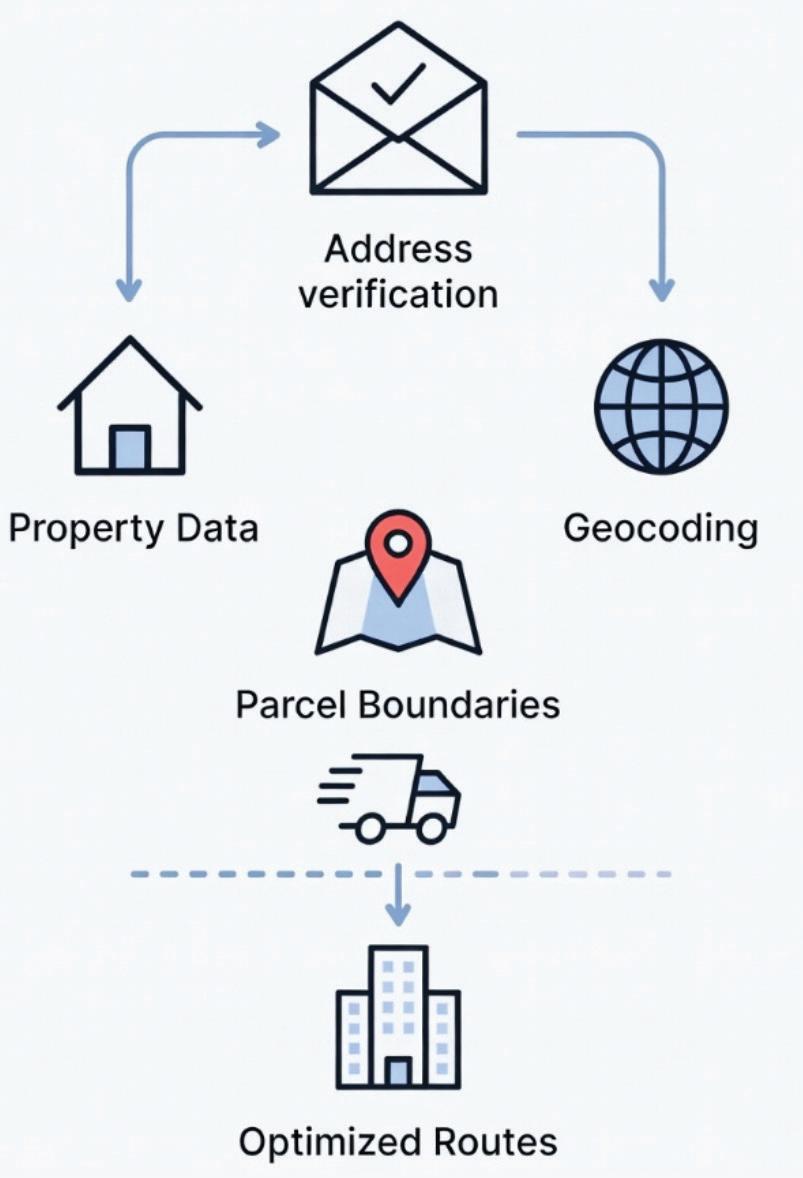
distances and travel times, and optimizes routes. Result: lower fuel use, higher on-time performance, and happier recipients.
Or consider a logistics firm redesigning territories. Using property data and shapefiles, it maps carrier routes and cities to eliminate overlaps, balance loads, and align delivery zones more intelligently.
The chain is simple but powerful: verified addresses precise geocodes boundary-aware routing dynamic, realworld distance calculations. The payoff? Fewer failed deliveries, reduced costs, more accurate ETAs — and operations built on trustworthy data, not guesswork.
Curious how these tools could transform your own logistics stack? Melissa's solutions offer the accuracy edge that turns everyday challenges into competitive advantages. Explore our data marketplace to see the full potential for your operations.


www.melissa.com info@melissa.com 800.635.4772
By Amanda Armendariz

2026 is certainly shaping up to be an eventful year for shippers, and we’re only a quarter of the way through. One of the biggest announcements to hit our industry, of course, is that the IEEPA tariffs were deemed by the Supreme Court to be unlawful, which was certainly welcome news for many shippers. On the downside, the increasing oil prices due to the Iran conflict will almost certainly have
a detrimental effect on the supply chain. One thing is clear: our industry is never at a standstill, which is why it’s so important to keep yourself informed by reading industry trade publications like this one and attending trade shows like the National Postal Forum. While NPF is perhaps best known for its contributions to the mailing industry, it truly is a trade show that shippers should consider attending as well. The United States Postal Service is an excellent delivery partner that sometimes files under shippers’ radars, but it really should be considered as an addition to the carrier mix.
This year’s show in Phoenix promises to deliver a plethora of educational sessions and exhibit hall solutions that shippers can take back to their companies. If you’re attending this year, I’d love to have you stop by our booth (#205) and say hello. It would be great to chat about the different challenges facing your business and what steps you’re taking to overcome them.
As always, thanks for reading PARCEL.

CHAD GRIEPENTROG PUBLISHER KEN WADDELL EDITOR AMANDA ARMENDARIZ [ amanda.c@rbpub.com ]
AUDIENCE DEVELOPMENT MANAGER RACHEL CHAPMAN [ rachel@rbpub.com ] CREATIVE DIRECTOR KELLI COOKE ADVERTISING KEN WADDELL (m) 608.235.2212 [ ken.w@rbpub.com ]
JOSH VOGT [ josh@rbpub.com ]
to all others in the United States. Subscription rate for Canada or Mexico is $35 for one year and for elsewhere outside of the United States is $55. Back-issue rate is $5.
Send subscriptions or change of address to: PARCEL, P.O. Box 259098 Madison WI 53725-9098
Allow six weeks for new subscriptions or address changes.
REPRINTS:
By Rickey DuBois
In August of 2025, the US parcel landscape changed in a way that seemed minor at first but ultimately had broad financial implications for shippers. Both UPS and FedEx announced a revised dimensional (DIM) calculation methodology that changed how package measurements are rounded to determine the final billable weight. Dimensional weight has long been calculated by multiplying the length, width, and height of a package, and dividing by a dimensional divisor. However, the adjustment announced by the carriers introduced a more aggressive rounding rule — any fractional inch in package dimensions would now be rounded up to the next whole inch before applying the DIM formula.
FedEx first announced the change effective August 18, a move positioned as a small pricing adjustment within wider rate updates. Shortly after, UPS confirmed it would align with the same approach, eliminating any inconsistencies between the two largest carriers. Many experts noted the change would increase billable weight even when package or product mix remained unchanged. While the policy shift did not alter dimensional divisors themselves, the rounding methodology effectively increased the calculated cubic volume of many shipments, pushing more packages into higher billable weight tiers and ultimately being billed a higher rate.
The most notable aspect of the August 2025 announcement was the near-complete alignment between UPS and FedEx. Historically, slight differences in things like rounding logic, rate minimums, or other surcharges have created a path that shippers have been able to leverage favorably. The new rounding rule largely eliminated that discrepancy. Both carriers now round any fraction of an inch up to the next whole inch in length, width, and height before multiplying dimensions and applying the divisor. In practical terms, a package measuring 10.1” x 8.2” x 5.3” is now billed as 11” x 9” x 6” for DIM calculation purposes at both carriers.
Industry analysis following the announcement highlighted that each carrier simplified the comparison of the change on the surface but reduced any cost opportunities between networks. According to industry reporting and ensuing rate impact analyses, the operational effect is consistent: packages near dimensional thresholds are more likely to move into higher billed weight categories under both carriers’ proposed changes.
The announcements displayed a uniform approach (highlighted in the chart on the next page), but the industry quickly pointed out the rounding adjustment will have a materially different cost impact across shipper profiles.
The effect will significantly depend on package mix and sizing, company sizing guidelines, and other variability.
One year later, the effects of the rounding change are evident across different cost structures throughout the industry. Prior to the change, small fractional dimensions have largely been absorbed without any material change. Now those same fractions are consistently pushing packages into a higher billable weight. The 2025 Parcel Carrier Rate Impact Report published in September 2025 by ICC Logistics was able to quantify this effect. They noted that dimensional rounding alone contributed to billed weight increases averaging between 5% and 12% across typical parcel portfolios.
For shippers with lightweight, cube-driven products (such as clothing or home goods) the impact has been very noticeable. A package that was previously billed at six pounds might now be billed at seven or eight pounds due solely to rounding. High package volume programs have felt the small incremental weight increase in large ways, but the cost impact extends beyond an increase in transportation charges. Higher billed weights can influence surcharge exposure, minimum package charges, and discount effectiveness within negotiated contracts.
The difference before and
FedEx 139 All Packages
UPS 139 All Packages
Any Fraction of an inch, rounded to nearest whole inch
Any Fraction of an inch, rounded up to nearest whole inch
Any Fraction of an inch, rounded to nearest whole inch
Any Fraction of an inch, rounded up to nearest whole inch
USPS 166 All Packages greater than > 1 ft³
All dimensions and weight round up to the next whole inch/pound
after the announcement revolves around a systemic cost shift. Many shippers reported parcel spend increases independent of volume growth, driven primarily by dimensional recalculation. This has forced supply chain leaders to pivot and reassess how they can diminish cost in other areas after this packaging change influenced transportation cost.
Shippers have responded by taking several strategic actions. First, packaging optimization has become more of a priority when discussing overall network optimization. Companies are investing in different software, automated dimensioning equipment, and package redesign initiatives to eliminate unnecessary cubic inches. Cutting even a half inch from a package dimension can offset the rounding impact across thousands of shipments.
Second, many shippers are turning towards third-party parcel consultants and analytics providers for support. External partners can conduct parcel spend analysis, simulate cost impact scenarios on dimensional rounding, benchmarking against comparable shippers, and even assist in cost reduction on contracts to help offset this impact. Market intelligence plays a critical role here as well. By analyzing similar shipper profiles, external partners can analyze whether their post-2025 cost increases are aligned with industry norms or can reveal any gaps within the network.
Visibility can be equally important and data analytics
can provide insight into dimensional thresholds, identifying shipments that consistently fall above or below a rounding breakpoint. This intelligence can provide shippers with the necessary info to implement changes where they will deliver the highest ROI. Additionally, other elements of carrier contracts are being reviewed to offset any dimensional cost increases. This includes negotiating improved discounts on higher billable weight tiers, adjusting minimum package charge terms, or exploring service adjustments between ground and air networks. Since dimensional rounding is now aligned across carriers, competitive leverage may come from broader contract structures rather than dimensional metrics alone.
One year after the carriers
implemented the change, dimensional rounding has proven to be more than a technical adjustment. It represents a structural shift in how parcel costs are calculated and managed. By aligning rounding methodology, UPS and FedEx effectively reset the baseline for dimensional billing across the parcel market. The resulting five to 12% billed weight increases reported across industry portfolios highlight how small measurement policies can produce significant financial impact.
For shippers, this change has forced them to become more flexible in their options. Packaging strategy, analytics capability, and market benchmarking/ intelligence have become central to cost control in parcel operations. Those who proactively responded with improved visibility, optimization tools, and strategic contract adjustments have mitigated the financial burden. Those who did not are likely experiencing some financial discomfort.
As the industry moves forward, dimensional intelligence will remain a defining factor in parcel economics. The 2025 rounding change demonstrated that even minor carrier policy changes can reshape supply chain cost structures. In modern parcel logistics, every fraction of an inch truly matters.
By Tammy Tippins
The world’s largest parcel carriers are shrinking physical footprints while expanding algorithmic control.
UPS now processes the majority of its volume through automated facilities, and major carriers — including UPS, FedEx, DHL, and the United States Postal Service — are consolidating hubs and expanding automation as network redesign accelerates. These are not cyclical adjustments. They mark a structural transfer in how parcel logistics is governed.
For decades, competitive advantage in parcel logistics meant larger fleets, more hubs, and denser routes. The industry was built on physical scale. It is now being reorganized around algorithmic control.
Artificial intelligence no longer supports operations — it governs them. Routing, forecasting, pricing, labor planning, revenue auditing, and network design are increasingly executed by systems that learn and recalibrate continuously.
Earlier waves of innovation expanded capacity while leaving operational wisdom intact. Workers became more efficient and networks grew larger. What did not change was who made the operational calls. AI introduces a different move. It doesn’t just enhance performance — it begins to absorb the thoughts behind it.
Today, machine learning systems can forecast shipping volumes down to specific postal codes, adjust delivery routes in real time based on traffic and population density, estimate trailer utilization before loading begins, flag billing discrepancies automatically, project labor needs by shift, and surface network bottlenecks before they ripple outward.
Independently, none of these capabilities seem radical. Collectively, they change the structure of how decisions are made. Tasks that once required analysts,
dispatchers, planners, and the like increasingly move into software environments that learn and adapt over time. This is not incremental improvement. It is a redesign of the evaluation layer.
AI’s disruption is defined by deployment speed. The Industrial Revolution unfolded over generations, requiring massive capital and decades of expansion. Even barcode and scanning technologies, which now feel basic, took years of infrastructure buildouts before these were fully integrated into parcel operations.
AI moves at a fundamentally different speed. Platforms can be deployed across large portions of a network in months, sometimes less, rather than years. Cloud design allows rapid scaling without the need for physical expansion. Unlike mechanical systems, algorithms improve as they process more data, often without visible changes to the infrastructure around them. Over time that velocity compounds. A one-percent efficiency gain across billions of parcels translates into hundreds of millions of dollars. Since AI influences multiple operational layers simultaneously, gains multiply across the network.
The acceleration is not merely operational, it is systemic.
The impact of AI is no longer theoretical — its implications are already visible.
For example, AI-guided
robotics use computer vision and machine learning to identify placement, adjust grip dynamically, and sequence loads in real time, absorbing physically demanding tasks once handled manually.
As these technologies scale, productivity gains become rooted in the operating model. Certain roles decline structurally and do not return when demand rebounds.
Architectural change does not eliminate work — it redesigns it. Human responsibility is modifying toward oversight, exception management, analytics, systems optimization, and advanced operations design. The center of gravity is moving from physical output to algorithmic literacy and adaptive decision-making.
For employees whose careers were built inside traditional facilities, this is more than modernization, it is a pivotal transition. The organizations that will lead will modernize workforce capability as deliberately as digital infrastructure.
Technology will reshape the operating model. Enduring advantage will belong to those who evolve their workforce with equal discipline.
While legacy carriers are modernizing networks that were built decades ago, a newer class of logistics companies started from a distinct premise entirely.
Amazon engineered a logistics ecosystem driven by continuous recalculation
across inventory, routing, labor, and capacity. The assets are physical while coordination is software-led. Gig-based last-mile platforms were built the same way — as real-time optimization systems rather than fixed networks.
In these models, operations and technology are inseparable. Decision-making was embedded in code from inception.
For established carriers, AI is a transition. For digital-native players, it is the operating foundation. Competitive advantage is shifting from physical scale to the intelligence directing it.
As algorithmic control centralizes, dependency increases.
Routing, forecasting, and sortation systems now operate within tightly integrated cloud architectures. Judgment once distributed across facilities increasingly resides in centralized platforms. Efficiency improves — but exposure concentrates.
A significant cyber event or prolonged outage would not merely slow operations — it could disrupt the decision layer coordinating the entire network. In highly automated environments, manual fallback is not simply slower — it
is less practiced. As systems assume operational judgment, human intervention becomes less routine and more difficult to scale. The resilience once fixed in distributed experience can erode when it is no longer exercised.
Earlier logistics systems were decentralized in judgment. AI-driven networks unify it. Efficiency and systemic risk now scale together. That is the defining tradeoff of algorithmic control.
The parcel industry is no longer navigating a modernization cycle. It is undergoing a structural realignment in how networks are governed.
AI is moving decision authority from the edge of the operation into centralized, continuously learning systems. That alteration affects cost structures, workforce composition, risk concentration, and competitive durability. It is not a pilot program. It is architecture.
In the decade ahead, leadership will not be defined by who has the largest network, but by who has engineered the most strategically designed one — and who controls it with discipline.
Tammy Tippins is Director, Professional Services at Intelligent Audit.

By Eric Roberts
The National Postal Forum (NPF) is more than a mailing and shipping industry conference; it is an excellent opportunity for Postal Customer Councils (PCCs) across the country to connect, collaborate, and showcase the strength of its network. This year’s PCC presence at NPF highlights education, engagement, and community-building in action.
Kicking off on Sunday, May 3, the PCC General Session and Leadership Awards Ceremony will bring together postal and industry leaders to celebrate the accomplishments of PCCs nationwide. This highly anticipated annual session recognizes innovation, collaboration, and the outstanding efforts of local councils that strengthen relationships between the United States Postal Service (USPS) and the mailing and shipping community. It is both a celebration and a reminder of the vital role PCCs play in driving communication, continuing education, and growth across the industry.
On Monday, attendees will have the opportunity to participate in two insightful PCC workshops designed to deliver best practices, practical tools, and actionable strategies. Starting with Membership Meeting Mastery: Live PCC Event Simulation, which offers a hands-on, interactive experience that walks participants through planning and executing a successful PCC general membership meeting from agenda development to member engagement. This workshop simulates a complete general membership meeting, showcases how to engage diverse attendees, deliver valuable content,
facilitate networking, and manage the flow of a successful event.
The second workshop, Engagement Engine: Growing and Energizing Your PCCs, focuses on sustainable growth and meaningful participation. Attendees will explore proven approaches for recruiting new members, increasing retention, and creating value-driven programming that keeps councils vibrant and relevant. Together, these workshops reinforce PCCs’ mission to educate, connect, and empower business mailers, shippers, and USPS leadership alike.
Monday evening continues the momentum with the PCC Reception; an opportunity to network, strengthen partnerships, and foster collaboration in a relaxed setting. The reception serves as a reminder that relationships are at the heart of every successful PCC.
PCC visibility will also be present throughout the Exhibit Hall. The PCC Advisory Committee (PCCAC) will staff a dedicated booth on the Exhibit Hall floor, providing resources, giveaways, answering questions, and connecting with PCC leaders from across the country. Additionally, the Arizona Desert Skies PCC will proudly host the Welcome Booth, serving as the first stop for many attendees and setting the tone for engagement and hospitality next to the Registration Desk. These booths offer attendees direct access to information, guidance, and the broader PCC network.
From recognition and
education to networking and outreach, PCC events and booths at the National Postal Forum provide energy, leadership, and collaboration that define PCCs nationwide. We look forward to seeing you there and continuing to strengthen and enhance the PCC community.
Eric Roberts is a Customer Outreach Specialist with the United States Postal Service. In this role, his primary responsibilities include managing Southern Area Postal Customer Councils and supporting the National Postal Forum and Mailers Technical Advisory Committee programs. Eric began his postal career in 2015 as a letter carrier in Waterbury, Connecticut, and has since grown into a role focused on building strong relationships between the Postal Service and the business customers it serves. He currently serves as the Postal Co-Chair for the Postal Customer Council Advisory Committee Education Sub-Committee, where he contributes to advancing education and professional development for individuals and businesses within the mailing and shipping industry. With a commitment to clear communication and customer-centered service, Eric brings both expertise and dedication to supporting Postal business customers across the country.
Packaging used to be predictable when everything came in a standard box, and systems were built around consistency. That’s no longer the case. Today’s operations handle everything from polybags and padded mailers to irregular, oversized parcels, often within the same shift. This variability creates friction where it matters most: induction, scanning, and sortation.
The challenge isn’t just volume either. It’s the growing mix of shapes, sizes, and materials moving through your facility. Soft-sided packages slump on belts. Lightweight bags shift unpredictably. Odd-shaped items disrupt flow and require manual handling. Each exception slows throughput, increases labor dependency, and puts pressure on service levels.
To keep pace, operations need systems that adapt in real time without adding complexity. That’s where flexible sortation becomes essential.
The Chameleon parcel sorting system is designed for this new reality. Instead of forcing uniformity onto non-uniform packages, it handles variability as part of the process. From induction through final sort, the system maintains consistent flow even when package types change minute to minute.
A key advancement is the Pop-Up Shuttle Divert. This module is built to handle the toughest items in the stream, allowing packages to move through tighter divert points without getting caught or damaged. Polybags are less likely to snag or tear, and lightweight items continue moving instead of stalling in the system. The result is smoother flow through areas that traditionally create slowdowns and exceptions.
Peak season adds another layer of complexity. Volumes surge, profiles shift, and systems are pushed beyond normal operating ranges. The Chameleon is built to flex with that demand. Modular capabilities like weighing, dimensioning, and label application can be added as needed or scaled back when volumes stabilize. That means you can expand functionality as your operation grows without replacing your core system, helping you avoid unnecessary capital while staying ready for what’s next.

Built to adapt, the Chameleon SLAM solution allows operations to shift sort logic, destinations, and workflows without major system or labor changes. This is especially valuable in environments where product mix, volume, or shipping requirements change frequently. Instead of reworking your floor, you can adjust the machine and keep moving.
The ultimate result is fewer manual touchpoints, more stable flow, and better overall efficiency. Teams spend less time managing exceptions and more time moving volume. Operations can handle peak demand, seasonal swings, and daily variability without sacrificing throughput.
As packaging continues to evolve, the ability to handle “ugly” parcels is becoming a competitive advantage. Flexible, adaptive sortation helps operations stay responsive, scale with demand, and deliver consistently.
Packages might get messy, but your operation doesn’t have to.

www.eii-online.com
sales@eii-online.com 765.807.0699
https://youtu.be/OC9SOi8UirM
By Brent Wm. Primus, JD
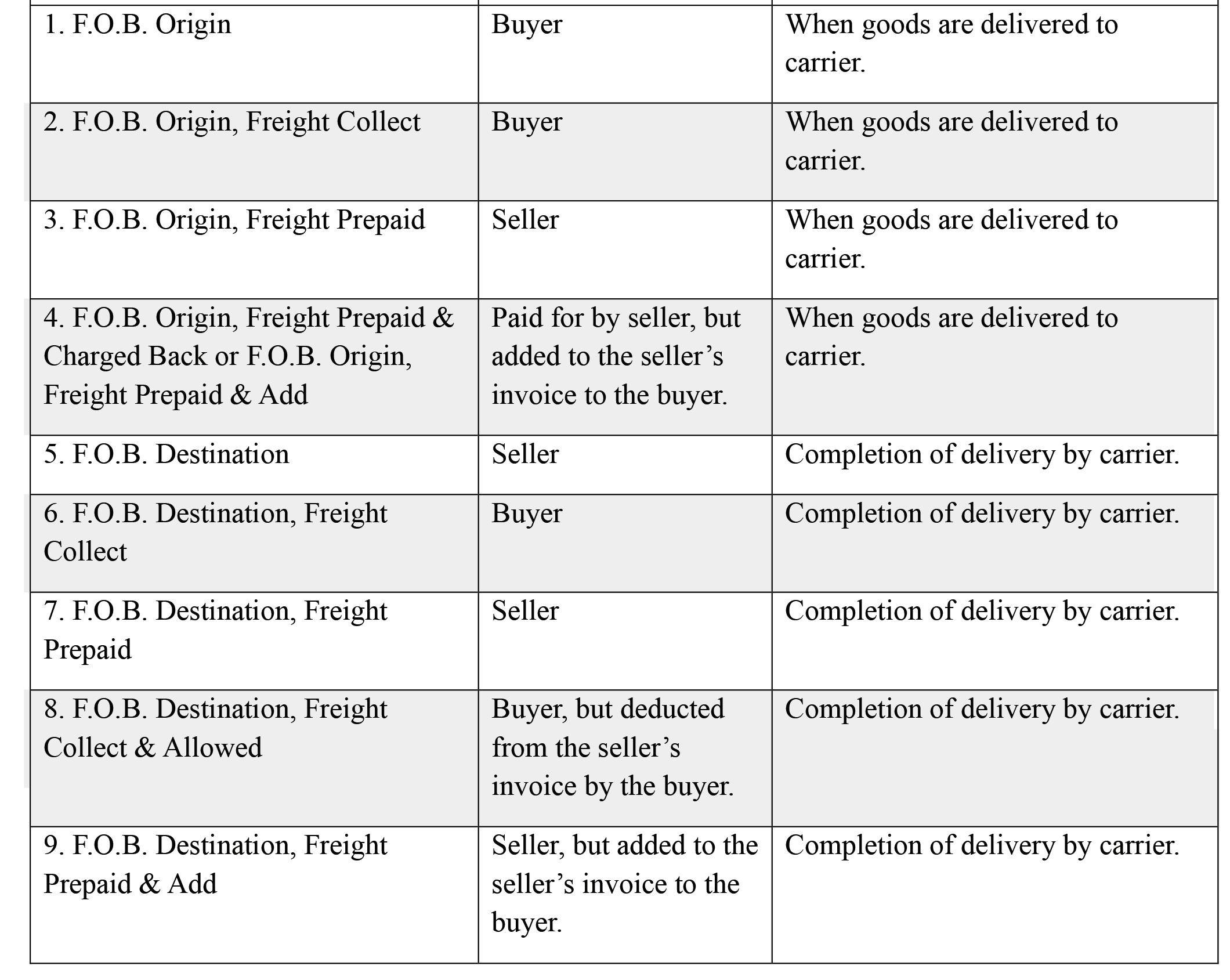
The terms of sale used for transactions within the United States have widespread recognition; however, these terms are not defined in a single source. “F.O.B. Origin” and “F.O.B. Destination” are defined in Section 336.2-319 of the Uniform Commercial Code (UCC). “Collect” and “Prepaid” are defined in Item 110 of the National Motor Freight Classification (NMFC). The other modifiers are industry slang with no authoritative basis. Thus, it is very important when using these modifiers to make sure that both parties are using them in the same way.
Brent Wm. Primus, J.D., is the CEO of Primus Law Office, P.A., the Senior Editor of transportlawtexts, inc., and Director of Virtual Education for the Transportation and Logistics Council, Inc.
Previous columns, including those of Andrew M. Danas, may be found in the “Content Library” on the PARCEL website (PARCELindustry.com).

CT Logistics offers intelligent freight and parcel management solutions through a standalone TMS or as an API-driven integration for existing systems. Shippers, 3PLs, and supply chain partners leverage CT's TMS to streamline Parcel Shipping, Truckload, Less-Than-Truckload (LTL), and Final-Mile with real-time rating, execution, and visibility from a single interface. These innovative technology applications automate multi-mode freight management by reducing manual tasks through Al-powered insights, predictive pricing, real-time business intelligence, and automated document generation and delivery. Offering enhanced visibility and control throughout the entire shipping process, users maximize operational efficiency and cost-savings.
www.ctlogistics.com | 216.267.2000, Ext. 2190 | sales@ctlogistics.com

Enveyo’s Cloudroute multi-carrier shipping software brings clarity and control to complex parcel operations by connecting carriers, systems, and data sources in one platform. Automated rate shopping and routing ensure every shipment is executed with the best cost, service, and speed, while real-time visibility and analytics help teams reduce spend and make confident decisions at scale.
enveyo.com | info@enveyo.com | 801.948.0727

Avoid the headaches and unnecessary costs associated with bad shipping addresses when you use Melissa's USPS® CASS Certified™ Global Address Autocomplete and Verification tools to ensure information enters your system correctly. Melissa verifies addresses in the USPS database as well as millions of valid, non-postal addresses, such as rural or private-delivery-only locations, to ensure accuracy for your couriers and a shipment process that avoids bad data, botched deliveries and hefty secondary delivery charges. Visit our website for a free trial. Melissa.com | 800.MELISSA | info@melissa.com

ProShip’s leading multi-carrier shipping software empowers businesses of all sizes to simplify parcel and LTL workflows, automate execution, and take control of their shipping strategies. Backed by decades of enterprise shipping experience, ProShip delivers confidence in complexity through proven best practices, stable technology, and carrier choice that scales as needs evolve. As a premier logistics technology provider exclusively dedicated to shipping software solutions, ProShip delivers powerful shipping software today and into the future. Connect with ProShip at NPF 2026 at booth #717 and join us on Tuesday, May 5th for an after-hours reception of networking and fun (details to come!)
www.proshipinc.com | sales@proshipinc.com |

Reveel is the leading Shipping Intelligence™ Platform that enables companies to level the playing field with their carriers across all modes of transportation. With over two decades of parcel spend management expertise and over $8Bn spend under management, the company provides real time actionable insights to empower customers to make smarter business decisions and have peace of mind. With the Reveel Shipping Intelligence Platform, backed by guidance from industry experts, shippers leverage the power of unified shipping data analyzed with AI, Machine Learning, and data science to capture significant ROI and improve their competitive advantage.
www.reveelgroup.com | support@reveelgroup.com |

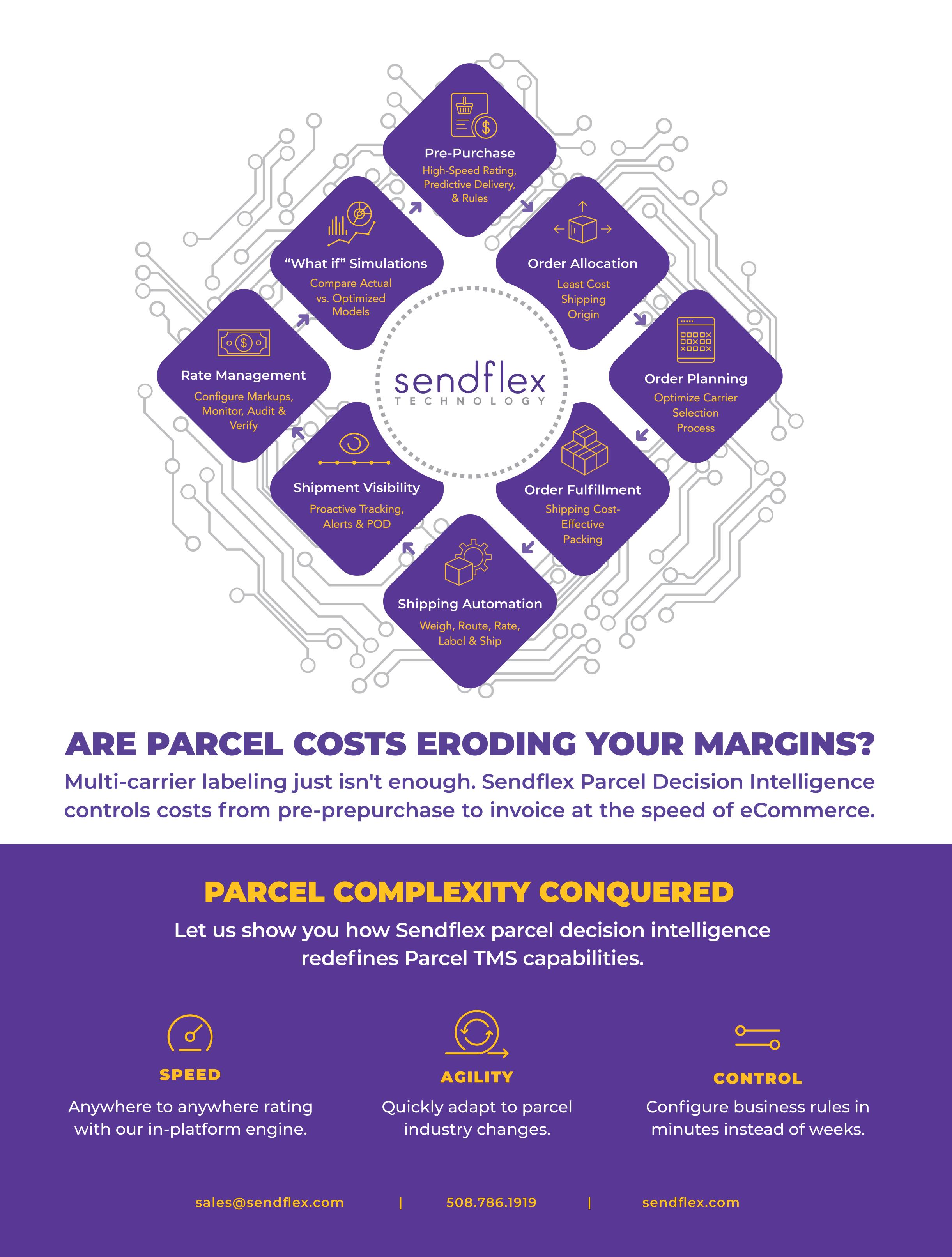
Sendflex is a next-generation, cloud-based parcel TMS platform designed to optimize cost-effective diversified carrier decisions during presales, order allocation, fulfillment and shipping processes. Sendflex no-code business rules help shippers quickly adapt to complex and ever-changing parcel industry challenges. Configure in minutes what otherwise requires days of expensive legacy shipping system programming and testing to accomplish. Sendflex’s AI-driven optimization engine processes 250,000 rates and business rules per second, opening the door to high-speed planning, what-if simulations, and modeling. Predict deliveries and fully loaded costs to protect margins. Conquer complexity at ludicrous speeds with Sendflex.
Sendflex.com | sales@sendflex.com | 647.291.8509

Shipstore gives high-volume, multi-carrier shippers one platform to automate logistics, control costs, and scale without complexity — backed by real shipping experts. Connect your OMS, ERP, eCommerce, and WMS systems into one centralized platform that automates rating, routing, packing, and labeling across parcel and LTL. Our rules engine lets you update shipping logic instantly — no code, no manual steps. Ship from one warehouse or 100 with full visibility and consistency. Every shipment follows your business rules — no matter the carrier, mode, or volume. More than software — a true partner. shipstore.com | info@shipstore.com | 816.781.5100

By Matt McKinney
The parcel industry is entering a new phase of AI adoption. What began as experimentation is now moving into day-to-day operations, with artificial intelligence playing an increasingly central role in how shipments are planned, monitored, and delivered. Gartner reports that AI is now one of the top investment priorities for supply chain and logistics leaders, particularly in areas such as predictive visibility and execution intelligence.
At the same time, research from MIT highlights an important distinction: durable impact comes not from isolated AI tools, but from embedding intelligence throughout the data lifecycle so systems can learn continuously and support real-time decision-making. Together, these forces are reshaping parcel delivery at its core. AI is becoming foundational to how parcel experiences are anticipated, explained, and delivered at scale.
In this article we explore the concrete ways AI is being applied across the parcel lifecycle today, from how packages are prepared and routed, to how delivery risk is predicted, exceptions are explained, and customer expectations are managed in real time. Together, these innovations show how AI is reshaping the parcel ecosystem as a set of interconnected systems working across operations, data, and customer experience.
AI is actively operating at nearly every stage of a shipment’s journey.
Upstream, AI-driven systems inform packaging decisions by analyzing historical shipment data, item characteristics, damage patterns, and dimensional weight exposure. These models optimize box selection and packing strategies, reducing downstream handling issues and minimizing cost variability before a package ever enters a carrier network.
In linehaul and last-mile delivery, models adapt routes based on real-world conditions such as traffic, weather, volume surges, and facility constraints. Address intelligence has become a machine-learning discipline of its own. AI models encode delivery-specific knowledge about apartments, campuses, access points, and non-obvious drop locations, reducing failed delivery attempts and improving first-pass success.
Each of these applications is part of the operational fabric of parcel networks. Together, they produce a continuously updating view of how shipments move through complex, real-world environments.
Traditional parcel visibility has long been descriptive. A scan occurs. A facility processes a package. A delivery attempt is made. That information is useful, but it often arrives too late to change outcomes.
AI is shifting parcel visibility from description to anticipation.
By analyzing historical performance, real-time network conditions, and contextual signals, AI models actively assess delivery risk earlier in the shipment lifecycle. Instead of simply reporting where a package is, systems evaluate whether it is likely to deviate from the plan and surface that risk before it becomes a customer issue.
This shift changes how teams operate. Transportation and operations teams manage by prioritized risk rather than by volume. Customer care teams focus on the shipments most likely to generate friction. Customers receive clearer expectations instead of reactive updates.
The result is fewer surprises, faster intervention, and a delivery experience that feels more intentional rather than reactive.
As AI-driven prediction becomes standard, explainability becomes essential. Customers actively engage with delivery. More than 90% of consumers track their packages, and over 98% say accurate delivery experience is critical to brand loyalty. When something changes, customers expect a clear answer. What happened. Why it happened. What happens next.
The same expectation exists internally. Customer care, transportation, and operations teams need shared context, not fragmented signals. When delivery experience directly impacts brand loyalty, vague updates and inconsistent explanations create unnecessary friction.
This is where generative AI is being deployed alongside classical machine learning. Predictive models identify risk and anomalies. Generative systems translate complex operational data into clear, human readable explanations.
Instead of working from raw scan logs or disconnected carrier messages, teams operate from an aggregated shipment view that explains the deviation, the root cause, and the expected outcome. This reduces resolution time, lowers support volume, and improves consistency in customer communication.
Explainable logistics is no longer a differentiator. It is the baseline expectation for parcel experiences.
As parcel networks continue to generate high data volumes, documents, and transactions, organizations are increasingly feeding this information through transportation data platforms powered by full-stack AI.
In these platforms, AI is applied end to end. They ingest, extract, and normalize transportation data from shipment feeds, emails, invoices, documents, and contracts, reconciling inconsistencies across sources, and continuously validating accuracy as new data arrives.
Because AI is embedded across the full data lifecycle, outcomes compound. Freight audit becomes more accurate and scalable. Cost allocation gains greater precision and granularity. Carrier performance is evaluated consistently across service, cost, and compliance. Contract performance is measured against actual network behavior, strengthening carrier accountability and supporting more informed negotiations.
This same foundation improves parcel visibility and customer experience. Real-time shipment signals are evaluated alongside historical performance and financial context, enabling earlier detection of service issues and clearer communication when expectations change. Customers benefit from more reliable delivery promises, faster resolution of exceptions, and greater transparency across the shipment journey.
In parcel operations built on transportation data platforms with full-stack AI, value is created through continuous interpretation of transportation activity at scale. Operational behavior, financial outcomes, and customer experience are connected through a shared intelligence layer that supports better decisions, stronger accountability, and more consistent service.
AI is reshaping parcel by improving predictability, accountability, and execution across increasingly complex networks. As these capabilities mature, shippers and carriers are making deliberate decisions about where AI creates the most value across optimization, prediction, explanation, and orchestration, and how those capabilities work together across the shipment lifecycle.
Competitive advantage increasingly comes from consistency at scale. Reliable delivery performance. Clear and timely communication. Accurate cost and service insight. These outcomes matter as much as speed, and they shape how customers experience and trust parcel delivery.
Over time, the most meaningful impact of AI in parcel may be its ability to restore confidence in the delivery experience. Not through automation alone, but through better understanding, stronger accountability, and more dependable outcomes, shipment by shipment.
platform.


By Parth Davé
Parcel carrier contracts often fail to deliver expected results after go-live. This article explains why those gaps emerge, not from poor negotiation, but from how shipment behavior is modeled, averaged, and translated during contract analysis, and how execution inevitably evolves once real-world shipping begins.
Most parcel carrier contracts look solid when they are signed. Rates are competitive. Incentives are clear. Service commitments are well defined. Then execution begins. Within months, results start to slip. Incentives are narrowly missed. Accessorial charges appear more often than expected. Service exceptions increase.
The contract has not changed, but performance has.
This gap is rarely caused by weak negotiation. Many organizations perform detailed analysis before entering a contract. The issue is that this analysis often relies on historical data and averages that simplify how shipments are expected to behave.
Every parcel contract is built on an operating model derived from those averages. It reflects how shipments moved in the past and how they are expected to move going forward. That model may be reasonable at the time of negotiation. It is also vulnerable to drift once execution evolves.
As order patterns shift, service expectations tighten, and volumes move across zones, the contract begins to price a version of reality that no longer
exists. What follows is not a contract failure, but a data and translation gap that shows up downstream in cost and service performance.
Parcel contracts rarely fail because of poor negotiation. They fail because execution drifts away from the models used to price them.
Parcel carrier contracts are built on more than rates and service tables. They are shaped by historical data, averaged shipment profiles, and simplified representations of how freight is expected to move.
One common simplification is service mix. Contracts often assume a stable balance between ground and expedited shipments. That balance may hold
when analysis is performed. It rarely remains fixed once customer expectations, cut-off times, or fulfillment constraints change.
Geographic distribution is treated in a similar way. Volume forecasts are typically averaged across zones. These averages mask gradual shifts in where orders are actually delivered. As volume moves farther from distribution points, zone exposure increases even though base rates remain unchanged.
Shipment formation introduces another layer of distortion. Sales forecasts are often provided in units, SKUs, or product configurations. They rarely describe how customers will order, how frequently shipments will occur, or how cartons will be built. Transportation teams are left to convert unit forecasts into shipments. When those translations are not explicit, contracts end up pricing demand in a form that never fully materializes in execution.
Cadence is also simplified. Negotiations assume relatively even shipping patterns. In reality, volume clusters around promotions, end-of-period pushes, and service recovery efforts. Peaks strain capacity and reduce the likelihood of meeting incentive thresholds.
None of these simplifications are unreasonable. They are necessary to complete analysis. The problem is that they flatten execution into averages and hide the variability that ultimately determines contract performance.
Contracts are negotiated on averages, but carriers invoice real shipments.
Before entering a renewal or renegotiation cycle, it is worth pausing to examine whether the contract is underperforming, or whether execution has simply moved on. As execution begins to drift, the contract starts to behave differently than expected. The breakdown is rarely sudden. It shows up through small, compounding signals.
Incentives are often the first area affected. As service mix shifts and volume patterns change, minimum
thresholds become harder to reach. Savings that appeared achievable during analysis are narrowly missed in practice.
Accessorial charges follow a similar pattern, but they are often underweighted during negotiations. Most attention is placed on base rates and, in some cases, residential delivery charges. Less focus is given to how accessorials and dimensional weight accumulate in execution.
When transportation analysis relies on system data rather than billed dimensional weight, contracts appear to underperform even though the model never fully captured how shipments would be charged.
Dimensional exposure amplifies this gap. Shipping systems frequently rely on estimated or default carton dimensions. Quoted charges reflect those estimates. Carrier invoices reflect scanned dimensions. When transportation analysis relies on system data rather than billed dimensional weight, contracts appear to underperform even though the model never fully captured how shipments would be charged.
Fuel surcharges are another frequent blind spot. Many shippers treat fuel programs as fixed, tied to public indices, and outside the scope of negotiation. In practice, fuel surcharge structures materially influence parcel spend, yet they are rarely pressure-tested alongside base rates and incentives.
Service performance also begins to erode. Peaks in volume and compressed
shipping windows increase the likelihood of exceptions. Delivery commitments tighten. Recovery shipments increase. The contract has not failed to define service levels. Execution has made them harder to sustain.
Taken together, these shifts create an execution reality that no longer matches the model used to price the contract. Rates are questioned. Carriers are challenged. Renegotiation is considered, even though the root cause sits in day-to-day operating behavior.
When contracts price a version of reality that no longer exists, performance gaps are inevitable
Parcel carrier contracts are priced against models. When execution aligns with those models, contracts perform as expected. When execution evolves, performance erodes, even if rates remain competitive.
Most contract failures are not negotiation failures. They are the result of relying on averaged, historical representations of shipment behavior that no longer reflect reality.
Stronger outcomes start with clarity. Understanding how shipments are modeled, formed, and billed in execution is a prerequisite to improving contract performance. Without that understanding, renegotiation risks solving the wrong problem.
Parth Davé is a supply chain and transportation strategist with more than a decade of experience supporting parcel, logistics, and execution improvement across consumer goods, healthcare, retail, and industrial sectors. His work focuses on contract performance, shipment behavior, and the operational decisions that drive parcel cost and service outcomes. He holds a Bachelor of Engineering, a Post-Graduate credential in Global Business Management, and the Certified Logistics Professional (CCLP) designation. Parth is the founder of NexaFlux, a fractional supply chain practice supporting execution-focused performance improvement. He can be reached at pdave@ nexafluxinc.com.
By Tatiana Muñoz

Once defined by linear processes and disconnected systems, supply chains are becoming dynamic networks that respond in real-time to demand signals, labor constraints, and customer expectations. This transformation is being driven by next generation technologies that are deeply integrated into daily operations rather than layered on top as standalone tools. Across industries, organizations are rethinking how warehouses, transportation networks, and information flows work together to deliver speed, accuracy, and resilience.
At the center of this transformation is the warehouse. No longer viewed as a static storage location, the modern warehouse functions as a high-performance hub that coordinates inventory, labor, automation, and data. The technologies being deployed today reflect this broader role. They are designed to connect people, machines, and systems into a single operational ecosystem that can adapt continuously as conditions change.
One of the most significant shifts has been the move toward cloud-based platforms. Cloud architecture allows supply chain systems to scale with business growth and seasonal demand without the heavy upfront investments that once slowed innovation. Updates and new capabilities can be introduced continuously, which helps organizations keep pace with changing market requirements. This flexibility has become essential as delivery expectations tighten and order profiles grow more complex.
Connectivity is another defining characteristic of next generation supply chains. Application programming interfaces and web services enable real-time data exchange between
warehouse systems, transportation platforms, enterprise systems, and automation technologies. This level of integration allows information to flow seamlessly from order creation through fulfillment and delivery. When systems are connected in this way, decision-making can shift from reactive to proactive, supported by accurate and timely data.
Automation is also playing an expanding role in reshaping operations. Automated storage and retrieval systems, conveyors, autonomous vehicles, and robotics are increasingly common in distribution environments. The value of these technologies depends on how well they are orchestrated alongside human labor. Modern management systems are designed to coordinate automated and manual tasks in realtime, balancing workloads and ensuring that each resource is used effectively. This orchestration helps improve throughput while reducing errors and physical strain on workers.
Artificial intelligence and advanced algorithms are further enhancing this coordination. By analyzing historical and real time data, these tools can optimize slotting strategies, predict congestion points, and recommend task prioritization. Over time, machine learning models can refine these recommendations as patterns change. The result is an operation that becomes smarter with use, improving performance without requiring constant manual intervention.
Labor management remains a critical challenge across the supply chain, and next generation technologies are addressing this issue directly. High turnover and persistent labor shortages have made it difficult to maintain consistent productivity. Advanced systems provide real-time visibility into workforce performance and workload distribution, which allows managers to adjust staffing and task assignments throughout the day. Forecasting tools also help anticipate labor needs based on historical trends and upcoming demand, reducing the risk of overstaffing or understaffing.
Order fulfillment strategies are evolving as well, particularly in response to e-commerce growth. Same-day and next-day delivery expectations require warehouses to process orders as they arrive rather than in predefined batches. Waveless fulfillment capabilities support this approach by continuously recalculating priorities and assignments. This enables faster response times while maintaining control over labor and automation resources.
Reverse logistics has become another area of focus. Returns are no longer an exception but a standard part of many business models. Efficient handling of returned goods requires clear visibility into product condition, disposition options, and inventory updates. Next generation systems streamline these processes by guiding inspections, directing items to the appropriate next step, and updating inventory in real time. This improves recovery value while minimizing delays and manual effort.
Transportation integration is also becoming more tightly coupled with warehouse operations. Rather than treating shipping as a downstream activity, modern platforms coordinate picking and packing with carrier schedules and load optimization strategies. Built in transportation capabilities or real time connections to transportation systems support better carrier selection, improved load utilization, and more reliable
delivery commitments. These capabilities help control costs while maintaining service levels.
Visibility and analytics tie all of these elements together. Real-time dashboards and performance indicators provide a clear view of operations as they unfold. Managers can identify bottlenecks, monitor service levels, and measure productivity across teams and sites. This transparency supports faster decision making and continuous improvement. It also enables organizations to respond quickly to disruptions, whether caused by demand spikes, equipment issues, or external events.
As supply chains become more interconnected, the concept of a control tower is gaining traction. By aggregating data from multiple sites and systems, control towers provide a holistic view of inventory and order flows across the network. This is particularly important for omnichannel strategies that span distribution centers, stores, and fulfillment partners. With a unified view, organizations can allocate inventory more effectively and align operations with customer expectations.
Collaboration extends beyond internal teams to include suppliers, carriers, and customers. Cloud-based platforms make it easier to share information securely and in real time. Improved collaboration supports better planning, reduces misunderstandings, and strengthens relationships across the supply chain. It also enables faster onboarding of new partners and systems, which is essential in a rapidly changing environment.
The adoption of next generation technologies is not driven solely by innovation for its own sake. Many organizations are reaching a point where legacy systems can no longer support
their operational needs. High maintenance costs, limited integration capabilities, and inflexible architectures create barriers to growth and efficiency. Modern platforms offer a path forward by providing configurable solutions that can evolve alongside the business.
Customer expectations continue to rise, placing additional pressure on supply chains to deliver speed, accuracy, and transparency. Real time order tracking, flexible fulfillment options, and consistent service across channels are now baseline requirements. Technologies that enable these capabilities help organizations protect their reputation and compete effectively in crowded markets.
Ultimately, the integration of next generation technologies is reshaping supply chain operations into connected, intelligent, and resilient networks. Warehouses are becoming strategic assets that drive performance rather than cost centers that constrain it. By embracing platforms that unify data, labor, and automation, organizations can build supply chains that are prepared for ongoing change, and this adaptability will become a defining advantage.
is
of Business Development, U.S.,
Supply Chain, where she leads strategic growth and partnerships for advanced warehouse and supply chain software solutions across North America. She brings nearly 20 years of experience spanning transportation, warehousing, and supply chain technology, offering a strong practitioner’s perspective on operational modernization.


By Thomas Andersen
For a long time, managing small parcel shipping was fairly predictable. Two major players, annual rate increases, and familiar contracts created a sense of stability. But that era is over. With more regional carriers, postal options, and a complex web of extra fees, the old "set it and forget it" strategy doesn’t cut it anymore.
Carrier economics have changed. Margin discipline, network optimization, and vertical prioritization are now driving decision-making. That means shippers who approach carrier relationships the way they did five or 10 years ago are operating at a disadvantage.
The most successful shippers today have changed their game. They aren't just reacting to what the carrier offers; they’re taking the lead. Maximizing the value of your carrier relationship is about finding a balance: being a great partner while also being your company’s most disciplined advocate. The following strategies provide a blueprint for maintaining a strong, professional relationship while ensuring your organization remains the lead architect of its own logistics future.
One of the biggest mistakes is treating your carrier rep like just another salesperson. In reality, a good account rep is your best advocate inside the carrier’s environment. They have their own goals and quotas to hit; when you understand those internal drivers, you can work together more effectively. By sharing your growth plans, operational changes, or upcoming shifts in volume, you give them the context they need to
fight for your preferred pricing, contract terms, and service exceptions during their internal reviews. When the account rep understands your goals, they can better align your account with the carrier’s internal "revenue quality" metrics, turning a standard vendor relationship into a strategic resource.
You can have a cordial relationship and still be a tough negotiator. Being a partner doesn't mean saying "yes" to every increase. It’s about being clear that while you value their service, you have a responsibility to your organization’s bottom line. When you encounter stalling tactics or misleading information about competitors or options, staying focused on the facts is your best move. Leading with data takes the heat out of the conversation and keeps things professional. By setting firm timelines for responses and maintaining a data-backed position, you move away from fear-based negotiations and toward a factual business case.
Carrier pricing isn't just about the yearly rate hike. Surcharges and extra fees now make up a significant part of your total spend. If you wait for the annual "General Rate Increase" (GRI) to talk about costs, you’re already behind. Instead, aim for regular check-ins, as often as once a quarter, using your own shipping data, ideally at the shipment and accessorial level.
When you can show exactly how specific fees (“accessorial density”) are hitting your business, you move the conversation from a generic 5.9% increase to the actual impact on your shipments. Using a baseline analysis of your specific shipping profile allows you to address "hidden" increases that the standard GRI often glosses over. This proactive stance ensures you are negotiating based on your actual costs, not the carrier's marketing materials or biased analysis.
Carriers are increasingly pushing for three-year deals that include heavy penalties for early termination. While this is often presented as a standard “internal requirement” or a way to ensure mutual stability, it is entirely one-sided. The shipper is effectively locked in, yet the carrier remains free to add new fees or modify operating policies.
This happens because the carrier's Service Guide, which can be changed at any time, supersedes the specific agreement you signed. Recent changes to zone charts illustrate this dynamic. In several markets, UPS quietly adjusted zone boundaries, increasing shipping distances and costs for many shippers without a formal rate increase. Because these changes fall under operational rules rather than base rate pricing, they apply immediately, even to long-term contracts.
We have seen similar impacts through unilateral changes to cubic inch thresholds for surcharges, significantly raising costs mid-contract without technically violating negotiated terms. A strong deal structure should create value for both parties. You shouldn’t have to trade away your long-term
Rep as a Resource: Turn your carrier rep into an internal advocate by understanding their goals.
Data-First Dialogue: Use your own shipping data to move past stalling tactics and emotional selling.
Proactive Planning: Use quarterly reviews to address the real-world impact of surcharges, rather than waiting for the annual GRI.
Watch the Fine Print: Ensure your contract isn't made irrelevant by the carrier's Service Guide.
Maintain the Unknown: Keep the carrier uncomfortable by routing a portion of your volume through alternative providers.
flexibility for short-term savings, only to remain vulnerable to whatever changes the carrier decides to make down the road.
Even if you’re happy with your current carrier, maintaining optionality is critical. Your best leverage comes from the carrier believing you have options. You don't need to reveal your internal limitations and why switching might be difficult for your specific operation.
By keeping even a small amount of volume, perhaps 10% to 20%, with a secondary or regional carrier, you show that you can move business if you need to. This demonstrates the operational capability to shift volume and creates credible negotiating leverage that forces the incumbent to stay competitive. This strategic uncertainty regarding their "share of wallet" ensures the incumbent carrier focuses on earning your business every day, rather than assuming it is guaranteed for the next three years.
Ultimately, maximizing your carrier relationship isn’t about winning a single negotiation; it’s about a consistent, informed approach to your entire shipping strategy. By viewing your rep as a resource, staying proactive with your own data, and keeping a close eye on the "fine print" of one-sided clauses, you stay in control of your logistics spend.
A strong relationship is built on mutual respect, but it’s maintained through vigilance. When you lead the conversation with a clear understanding of your costs and a willingness to keep your options open, you ensure the carrier continues to view your business as something they must earn, not something they can take for granted. This proactive stance is what separates a managed shipping budget from one that is simply at the mercy of the market.

Thomas Andersen is Partner & Chief Supply Chain Officer at LJM. Visit www.myljm.com for more information.


By Alison Layfield
France has become the latest country to enact a fee on low-value imports that takes effect before the European Union’s broader customs reform — a €3 duty across the bloc set to take effect this July. France’s €2 administrative charge applies to non-EU parcels valued under €150 and is intended to offset customs processing costs amid a surge in low-value shipments. Italy and Romania have already implemented similar country-specific fees.
These moves underscore how urgently countries want to respond to an overwhelming increase in imports. In the past year alone, the volume of low-value parcels entering the EU increased 26% to 5.8 billion parcels. But the urgency has also added a new layer of complexity. Retailers and shippers will adjust to these separate national fees in the first half of the year, and then make further changes when the broader reform takes effect in July.
This could also prove to be just the beginning of a changing environment. If other member states see these countries succeed in offsetting the cost of handling lowvalue shipments, they could implement their own fees, too. Retailers need processes in place that can handle even more mid-cycle changes.
Flexibility is also needed as the European Council continues to refine the rules around the EU duty, which is interim until full reform changes are put into place in 2028. The Council recently approved new rules for its application, outlining that the €3 charge will apply to each category of item within a parcel, identified by tariff subheading. That settles previous questions about whether the fee would be implemented per parcel or at the HS code level.
The distinction matters especially for high-volume e-commerce shipments. Many consumer parcels contain multiple product types that fall under different classifications. A shipment of two silk blouses and one wool blouse — two different HS codes — faces €6 in EU customs duty before any national fees are added. The rule reinforces the importance of accurate data. When duties are tied to item categories, even small discrepancies can compound at scale. It increases the importance of alignment between retailer product catalogs and customs documentation workflows.
Retailers should also monitor discussion of a separate €2 EU-wide customs handling fee currently under consideration. This proposed fee is distinct from the €3 customs duty and, if approved, would be implemented in addition to the July 1 levy, potentially beginning November 1, 2026. While no final decision has been adopted, the possibility of overlapping EU-level charges further reinforces the need for adaptable systems rather than one-time compliance updates.
As guidance continues to evolve, retailers should ensure their duty and tax calculation systems can adjust quickly. Checkout platforms should also be evaluated to ensure they can incorporate updated fee logic without disrupting customer experience, particularly as the language around who will ultimately be responsible for the new fees is still being interpreted.
Current guidance indicates that the seller or shipper will bear the cost. If that holds, retailers must ensure fees are incorporated into checkout or prepaid shipping models. If they are not, customs brokers or parcel operators may find themselves advancing duties at clearance and reconciling costs later. When you’re moving thousands of parcels a day, a
few euros per shipment can turn into real exposure if billing isn’t configured correctly.
The language around responsibility also raises questions for delivered duty unpaid (DDU) shipments. In many postal flows, fees are traditionally collected from the consumer at delivery. If the duty is formally assigned to the seller, it’s not yet entirely clear how that would be applied in a DDU scenario. Would the fee still be collected from the recipient, or would the seller ultimately remain liable? The postal stream operates with different mechanics than commercial carriers, and there's no documented process yet.
If any customs duty is transferred to the consumer, retailers need to have clear communication about what it is and why they’re paying it. The fee should be clearly listed as a line item at checkout so consumers understand the additional cost.
There are also questions about how these reforms will impact the larger system, such as the import one-stop shop (IOSS).
Today, IOSS is used to streamline VAT collection for shipments valued at €150 or less. It works because it sits neatly within that ceiling. Once the threshold disappears in July, the mechanics become less straightforward. Does IOSS continue to operate in parallel? How is the interim duty reconciled within existing IOSS reporting and registration processes? Will the duty be integrated into the same data flows, or treated as a distinct charge outside the VAT framework?
As these details continue to be clarified, retailers and parcel operators cannot afford to wait for a fully settled framework before acting.
With countries jumping ahead of the EU’s reform, the transition period has become the defining feature of the year, before July is even here. Organizations that build adaptable processes now won't be caught off guard if another country implements its own fee or if the rules shift again.
Retailers should ensure there is alignment among teams so they can make quick changes when needed. Revisit how responsibility is structured contractually and operationally, so billing workflows can adjust. The goal is not to overhaul existing models prematurely, but to ensure they are flexible now and can align with the emerging policy language.
All of this is setting the stage for the coming years, which are guaranteed to be marked by change. With the EU set to implement full trade reforms in 2028, there’s plenty of time between now and then for additional moves to be made by other countries. The retailers who treat changes now as a one-time compliance update will find themselves reacting every time the ground moves. Those who build for change will already be standing on solid ground when full reform takes place.

WHAT DO 31,000 PARCEL SHIPPING PROFESSIONALS KNOW THAT YOU DON’T?
For more than 30 years, PARCEL has delivered the information and solutions 1000s of industry decision-makers want and need to help them handle, package, ship, and deliver more small packages, more efficiently, and more effectively from coast to coast, across the borders, and around the world.
ARE YOU AND YOUR COLLEAGUES MISSING OUT?
Sign up for a FREE SUBSCRIPTION today!

By Stephen (Steve) T. Hopper, P.E.
Walk into a typical warehouse, DC, or fulfillment center on a busy day, and you’ll see the same pattern: supervisors expediting orders, reassigning people on the fly, hunting down inventory, and answering constant “where is it?” questions. By the end of the shift, leadership has two frustrations that seem to coexist far too often: labor costs are high, and service levels (such as accuracy, timeliness, capacity) still aren’t where they should be. In most of these operations, the workforce itself isn’t the root problem. The real problem is that the operation lacks a repeatable system to define “good work,” measure it fairly, and manage performance on a day-to-day basis. If performance depends on heroics, then it’s not a labor issue — it’s a management issue.
Here are six best practices that consistently move warehouse labor from firefighting to performance. The emphasis here is intentional: this isn’t about optimizing schedules or chasing down workers. It’s about improving how work is managed so you get more output and better service from the workforce you already have.
1. Standardize the work, so “good” is defined
If two associates can perform the same task in two different ways, you don’t really have a process. What you have is a collection of habits. Standard work doesn’t need to be complicated. Start with the primary activities that consume the most labor hours in your operation (usually order picking, but also receiving, putaway, replenishment, packing, and shipping). Then define the best-known way to execute each of them.
Here’s what “standardized” looks like in practice:
A clearly defined, recommended method that removes ambiguity
Simple standard operating procedures (SOPs) and visuals that match and clearly articulate the established methods
Actively training workers to follow the established methods (not just asking them to “shadow” another worker for a day)
Standard work isn’t bureaucracy; it’s fairness. It creates an objective foundation for measurement, coaching, and improvement.
2. Measure what matters and can be trusted
Most warehouses have productivity reports. The common failure with these is that workers don’t trust the productivity numbers because they don’t account for differences in work content, such as order profiles, product types, travel distances, congestion, and complexity. When productivity metrics feel arbitrary or unfair, they get debated — or worse, ignored. A more practical approach involves these steps:
Measuring performance by function and by other work attributes when needed
Keeping the scorecard tight to support output goals (quantity and quality)
Using reasonable “lost time” categories to expose what steals hours from productive work (such as waiting, searching, rework, and exceptions)
Where do labor standards and labor management systems (LMS) come into play? Think in levels:
A simple start: established methods, basic productivity tracking, visible (and reasonable) daily targets, etc.
More rigorous practices: reasonable expectancies, consistent feedback, a formalized coaching program, etc.
Advanced practices (for larger or more complex operations): multi-variable engineered labor standards and an LMS that automates measurement, reporting, coaching workflows, and (optionally) performance incentives
A realistic, qualified view of outcomes helps leaders prioritize: many operations experience meaningful improvements
(often a 10-30% performance boost) from fundamentals like standard work, clear metrics, and daily management. Bigger gains (sometimes a 40%+ performance boost) typically come as measurement becomes more engineered and performance management becomes more systematic.
3. Turn supervisors from babysitters into coaches
If a supervisor spends their whole shift chasing down workers and expediting work, then the operation is essentially unmanaged. Coaching is what turns labor standards into real performance. A simple, effective coaching cadence looks like this:
Start-of-shift huddle (10 minutes): what are the plans, the constraints, and the two to three measures that really matter today?
Mid-shift check: how are we doing on today’s goals, and are there any barriers that are stealing time?
End-of-shift post-mortem: what did we learn, what broke, and what should be improved or fixed before tomorrow?
Coaching should be frequent, short, and specific. It should reinforce standard work, encourage workers, recognize wins, correct gaps early, and remove barriers fast. And the coach should rarely (if ever) leave the warehouse floor. They can’t supervise from the back office.
4. Remove systemic barriers that force “heroics”
A surprising amount of labor “underperformance” is actually various forms of waste that crush potential productive work: walking (especially walking), waiting, searching, rework, and exception handling. This is where performance improvement becomes tangible.
These are some common barriers that quietly steal hours from productive time:
Replenishment lapses that hold up picking
Congestion
Excess travel
Rework loops caused upstream (such as receiving errors, damage, incorrect labeling)
Equipment downtime
Unclear priorities (such as “everything is hot!”)
If you want fast results, do the following every month:
Intentionally track time thieves.
Identify the top three.
Assign owners.
Eliminate at least one thief every month.
You’re likely to find that a few chronic barriers account for a disproportionate amount of labor losses.
5. Build flexibility without chaos
Everyone wants flexibility. But few operations effectively design it into practice. “Everyone can do everything” sounds great until it creates inconsistent methods, quality compromises, and constant reassignment. Instead, do this:
Build a simple skills matrix and certify cross-training intentionally.
Create a small flex pool of “floaters” to attack predictable bottlenecks.
Define rules for labor moves (such as who moves, when, and why), so changes don’t feel random.
Flexibility shouldn’t be seat-of-the-pants improvisation; it should be planned, thoughtful adaptation.
One common failure mode in labor performance programs is “winning” the productivity battle while quietly losing the war. If productivity gains create errors, injuries, or missed cutoffs, you didn’t improve performance — you just shifted cost downstream. And lost customers.
The fix is simple: keep a short set of non-negotiable guardrails (KPIs) on the same dashboard you use to drive labor performance. Here are a few examples:
On-Time Shipments (to ensure adherence to cutoffs)
Order Picking Accuracy (to ensure quality)
Perfect Order Rate (to ensure service)
OSHA Recordable Rate (TRIR) (to ensure safety)
The goal is higher productivity that also improves service, quality, and safety, not productivity that creates rework, missed commitments, returns, or injuries.
If you want a quick diagnostic of how effectively you’re managing your workforce, then ask yourself these five questions:
1. Have we established standard work for our top labor-consuming tasks?
2. Do we have trusted, objective, reasonable productivity metrics by function?
3. Are our supervisors coaching, or just babysitting and putting out fires?
4. Have we identified our top time thieves and who is responsible for stopping them?
5. Are we improving labor performance without hurting service, quality, or safety?
If you answered “no” to even one of these, then you probably have significant opportunities for improvement. When a warehouse relies on expediting and heroics, it’s not a “people problem.” It’s really a performance management problem. A simple operating system provides a way out. If you consistently focus on the fundamentals, you’ll get what every business wants: lower labor costs and better service.
and boost service levels in warehousing, fulfillment, distribution, and logistics operations. He can be reached at steve.hopper@inviscidconsulting.com or 404.832.5326.
Editor’s Note: This article was originally written for our sister publication, Mailing Systems Technology, but we thought our PARCEL readers would find it valuable, as well.

BY ADAM LEWENBERG
“We have the best rates through UPS.”
“We ship everything through FedEx.”
“We use the free UPS (or FedEx) online shipping platform.”
These are the most common statements we hear and, ironically, they usually signal the largest savings opportunities.
This is not a sales pitch for the United States Postal Service (USPS). It is a strategic discussion about where USPS fits within a modern shipping mix, how its economics differ from private carriers (UPS and FedEx), and how to access the most competitive pricing structures.
For this analysis, we will focus on the most widely used USPS services, including Priority Mail (2–3 Day) and Ground Advantage (2–5 Day), and compare them to two-day, three-day, and Ground (1–5 Day) services from UPS and FedEx. In the overnight space, most mid-to-high volume shippers can typically negotiate competitive private-carrier rates, so that segment is not our focus.
In Figure 1, we have provided the list prices of the private carriers (UPS and FedEx). Most customers will have some sort of discount off these rates that can
be as high as 80%. There is one area that most customers don’t pay attention to called “Minimum Service Fees.” This is a threshold that no matter how big your discount is, the rate cannot go below.
For example, if a 1 lb. Zone 2 Ground shipment lists at $12 and you have a 60% discount, you would expect to pay $4.80. However, if your Minimum Service Fee is $10, that discount becomes largely irrelevant.
For many lightweight, short-zone, or low-revenue shipments, the Minimum Service Fee quietly erodes negotiated savings. Understanding where those thresholds apply is essential before assuming your private carrier agreement is optimized. Also, it is the minimum service fee rate that should be compared, which may be higher than the USPS service.
These fees can make up 20-50% of the shipping charge and are growing at the fastest rate. We are going to focus on the most common UPS/FedEx fees that the USPS does not charge, making them ripe for savings.
Fuel Surcharges – These fluctuate, but at the time of writing this article are at
20% for Air and 21% for Ground. These will typically add at least $2 per package.
Residential Fees - $6.50–$7.00 per shipment. For organizations shipping to homes, this is often the single largest cost driver and one of USPS’s strongest competitive advantages.
Delivery Area Surcharges (DAS) – $4.50–$8.85. These apply to approximately 61% of US ZIP Codes deemed less densely populated. Notably, carriers now apply DAS in parts of New York City due to operational complexity.
Address Corrections - $25.25 per occurrence
When layered together, these fees can double the effective cost of a shipment. In many residential or rural areas, USPS pricing can create substantial savings simply by eliminating these accessorial costs.
Private carriers have dimensional rates on all boxes, where the USPS only calculates these rates for items over 1 cubic foot. Also, the private carriers calculate dimensions as length x width x height divided by a factor of 139. USPS calculates with the same method but uses a factor of 166.




































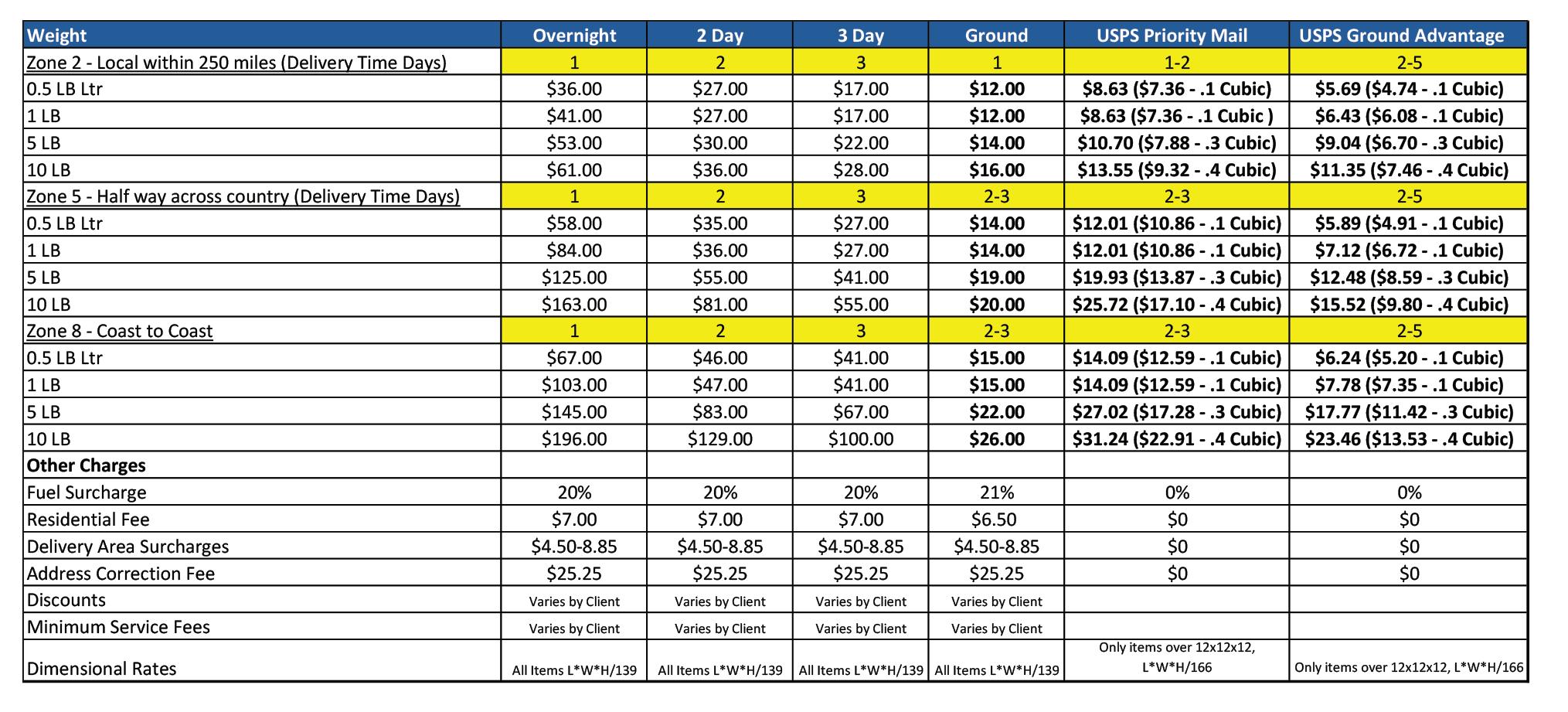
This means that for each box size, USPS will rate at a lower weight, as you can see in Figure 2 below.
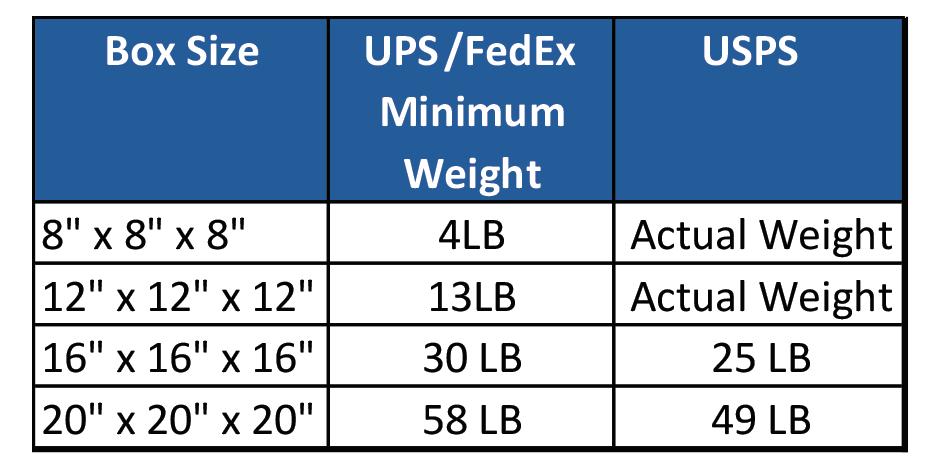
USPS pricing is not a single rate; it is a layered structure with four distinct levels. Optimization depends on how shipments are processed, the technology supporting them, and what volume commitments you can make.
Retail – These are the rates paid at the Post Office counter or when processed through a postage meter.
Commercial – This requires you to generate a 4X6 shipping label through a third-party shipping platform or API connection. The savings over Retail averages 16% for Priority Mail and 28% for Ground Advantage (based on items 20LB and under, which are the most common).
Cubic – This is a rate structure that provides discounts for taking up less than a cubic foot of space. This is great for dense material going in the smallest boxes possible. These rates are primarily offered through third-party shipping systems who make available their direct negotiated discounted rates with the USPS. As you can see from Figure 1, we listed out the most common cubic rates available. The discounts can be as high as 89% based
on weight, zone, and dimensions. The technology required also starts at nominal levels of $15 per month.
USPS Direct Negotiated Service Agreement (NSA) – If you can commit to higher mail volumes, the USPS will be able to give you your own specific rate structure where you can get their lowest prices.
USPS pricing is not a single rate; it is a layered structure with four distinct levels.
While every shipping profile is unique, USPS deserves consideration in the following scenarios:
Shipments under 20 lbs.
Residential items should always be compared due to the high accessorial fees.
Items shipped to rural areas due to Delivery Area Surcharges
Dense items produced in boxes less than a cubic foot due to the dimensional rates of the private carriers. Also, the USPS gives extra cubic discounts for items taking up smaller percentages of a cubic foot.
Items that are less than 1 LB to be sent USPS Ground Advantage because it has 4-, 8-and 12-ounce rates vs. the private carriers that start at 1LB.
Paper – Many companies send a lot of documents typically going through expen-
sive air services. USPS is a huge savings opportunity due to the reasons above.
Prescriptions – Many pharmacies are shipping prescriptions UPS and FedEx which is expensive with the accessorial fees. USPS can provide attractive pricing and is the main carrier for the largest chains.
It would be great if we could put our heads in the sand and just use one carrier for all items. The issue is we will be subject to much higher rates for this convenience. There are many scenarios where USPS should be considered. Also, there needs to be thought about how USPS shipments are being processed because of the differences in discount levels. The best case is that you have technology that can compare the carriers side by side on a transaction-by-transaction basis. This will make it the easiest to make the right decisions for each item. The good news is that if these comparisons are done, there are significant cost reductions available.
Adam Lewenberg, CMDSS, MDC, President/ CEO of Postal Advocate Inc., runs the largest Mail Audit and Recovery firm in the United States and Canada. They manage the largest portfolio of postage, mail equipment, USPS permits, and outsourced print mail and presort services in the world. Their mission is to help organizations reduce mail and parcel related expenses, recover lost postage funds, and simplify visibility and oversight. Since 2011, they have helped their clients save an average of 74% and over $111 million on postage, equipment, and third-party mail service fees. He can be reached at 617.372.6853 or adam.lewenberg@postaladvocate.com