05 PARCEL SHIPPING RATES IN 2026: WHY VISIBILITY AND LEVERAGE MATTER MORE THAN EVER
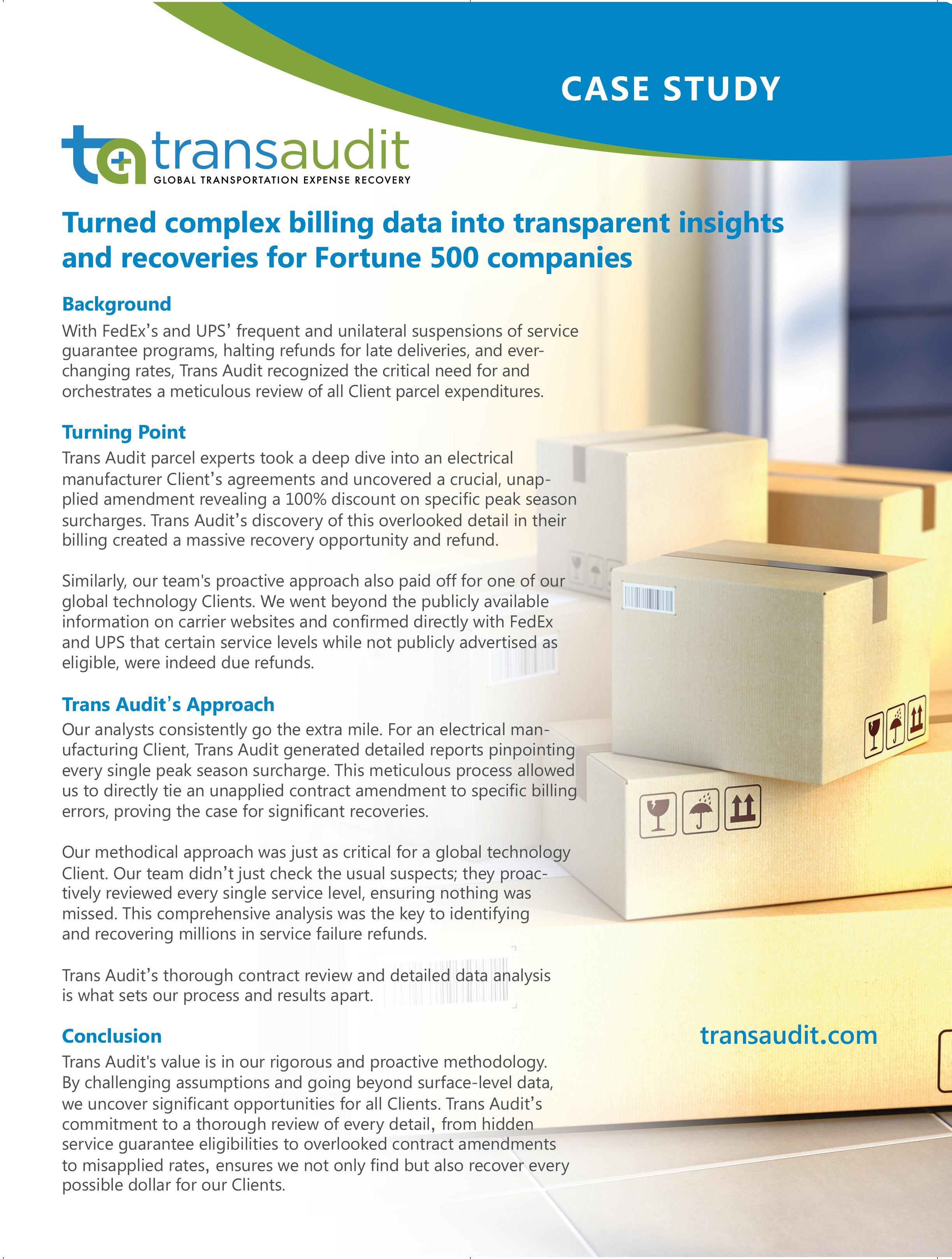
07 TRANS AUDIT TURNED COMPLEX BILLING DATA INTO TRANSPARENT INSIGHTS AND RECOVERIES FOR FORTUNE 500 COMPANIES
13 POWERING GLOBAL GROWTH AT SCALE: HOW AVALARA CROSS-BORDER SIMPLIFIES COMPLIANCE FOR PARCEL SHIPPERS
15 THE PERFORMANCE LAYER FOR MODERN PARCEL SHIPPING
26 WHO’S HELPING YOU WITH SPEND MANAGEMENT AND AUDITING?
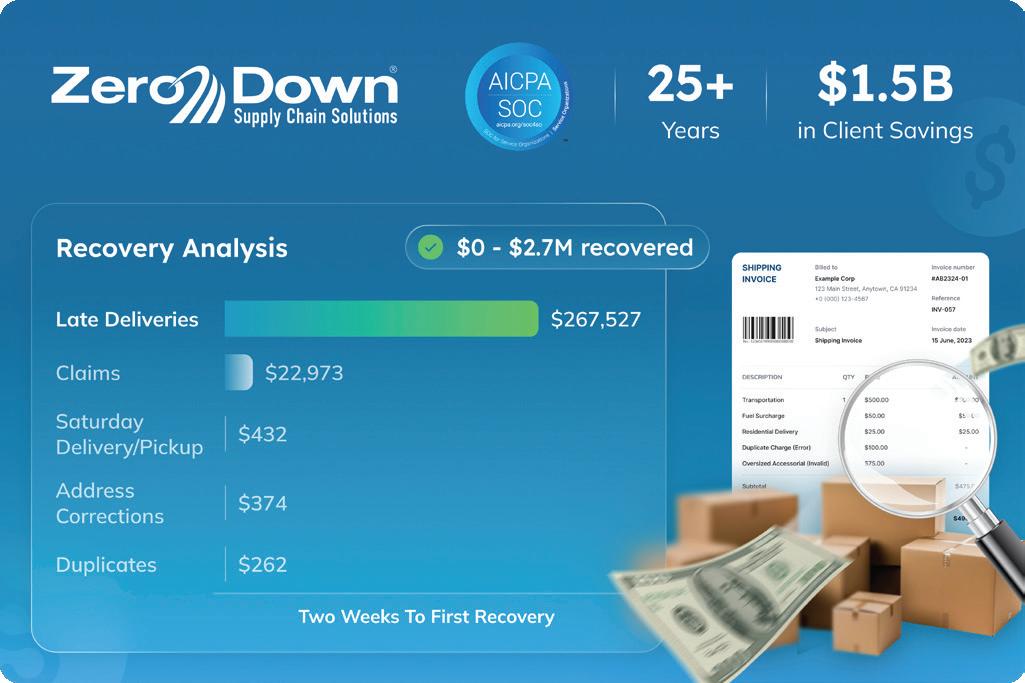
30 THE $2.7M OTHER AUDITORS MISSED
Parcel Shipping Rates in 2026: Why Visibility and Leverage Matter
More Than Ever
Parcel pricing pressure shows no sign of easing in 2026. FedEx and UPS once again implemented General Rate Increases (GRIs), layered with evolving surcharges, higher minimum charges, and mid-year pricing adjustments that quietly push shipping spend higher.
For many shippers, the result is familiar: parcel costs that are higher than expected and increasingly out of alignment with what they should be paying.
Negotiating the right carrier agreement in this environment requires more than timing — it requires deep industry expertise, real market data, and technology that understands how carriers price for profit. That’s where TransImpact comes in.
Our approach is different. TransImpact understands how to generate the most savings — and we guarantee it. We’ve helped clients achieve an average 23.6% reduction in parcel costs, delivering results that are often game-changing for shipping organizations. Achieving that level of impact requires more than negotiation tactics alone; it takes a clear understanding of market-appropriate rates based on a shipper’s unique volume, service mix, and shipping DNA.
Know Your Rates Before You Negotiate
TransImpact helps shippers understand their marketappropriate rates before entering negotiations — often within one-tenth of one percent accuracy. Using proprietary analytics and deep parcel market knowledge, TransImpact identifies the rate range a shipper should pay and pinpoints where carriers maintain margin.
From there, TransImpact partners with customers through a proven negotiation process designed to anticipate carrier behavior, surface hidden costs, and secure measurable savings.
This disciplined approach not only delivers immediate cost reductions, but also improves long-term contract positioning.
Beyond
Negotiation: Continuous Parcel Optimization
Savings don’t stop once a contract is signed. TransImpact remains an active partner, providing ongoing validation and insight as shipping patterns change and carrier pricing evolves. Clients receive regular performance reporting and guidance on how GRIs, peak season surcharges, and rule changes impact their parcel spend.
In 2026, this ongoing visibility is critical. With carriers continuing to adjust dimensional thresholds, minimum charges, and surcharge structures, shippers can no longer afford a “setit-and-forget-it” approach to parcel contracts.
A Unified Approach to the Supply Chain
TransImpact’s value extends beyond parcel negotiations. Its integrated approach connects parcel spend management with supply chain planning and inventory strategy — what TransImpact calls Intelligent Inventory. This end-to-end perspective helps companies align demand, inventory, and shipping decisions to improve efficiency and protect margin from forecast to final delivery.
Why TransImpact. Why Now.
Founded in 2008, TransImpact brings decades of combined parcel industry experience to a market defined by complexity and change. The company understands the misconceptions that cause shippers to miss opportunities — such as the belief that parcel contracts can only be renegotiated at expiration.
In a year marked by continued GRI pressure and pricing volatility, the opportunity for savings is real — but only for shippers with the right insight and leverage. TransImpact helps companies secure better rates today while building a foundation for long-term parcel and supply chain optimization.
COMING DOWN FROM THE PEAK SEASON RUSH
By Amanda Armendariz
The beginning of a new calendar year is always a good time to assess the state of your parcel operation. Peak season is a challenging time for any shipper who sees their order volumes increase during the last part of the year, so once it’s over, it’s a perfect time to slow down, take a deep breath, and see what you can learn from the way your company handled peak. The lessons you take away from this exercise can help you pinpoint what you need to improve and focus on before this year’s holiday rush arrives. Plus, any best practices you implement can help you improve your parcel operation all year long.
Speaking of your parcel operation, its success can often
be impacted by the delivery experience itself, which is why many shippers are excited that the USPS recently announced a bidding website to accept proposals for entry to its lastmile delivery network. “More than 18,000 USPS destination delivery units (DDUs) and local processing centers (LPCs) nationwide are now accessible to a broader range of customers via the dedicated bid solicitation platform,” according to a press release from the USPS. This is exciting news for shippers, since this is a service the USPS has been offering for years, but generally only to very large shippers. “Customers will have the ability to suggest a combination of volume, pricing and tender times at
each available DDU location for USPS delivery either the same day or the next day,” the release continued. Service for the winners of the bidding process would likely begin in third quarter of this year.
2026 is truly shaping up to be an exciting year, even in the wake of the uncertainty felt with ever-changing tariffs and geopolitical tensions impacting the supply chain. In the following pages, we highlight a variety of topics that should be at the top of your to-do list if your goal is to make 2026 a successful one.
As always, thanks for reading PARCEL.
SUPPLY CHAIN SUCCESS
AMAZON-USPS NEGOTIATIONS — A TURNING POINT FOR THE PARCEL INDUSTRY
By Andy Johnson
For more than three decades, Amazon and the United States Postal Service have maintained one of the most significant commercial logistics relationships in the US. E-commerce’s largest retailer has relied on USPS’s ubiquitous delivery network to reach millions of customers — especially in rural and hard-to-serve areas — while USPS has benefited from steady revenue. But as of late 2025 and into early 2026, this longstanding partnership faces critical challenges, and the implications are far-reaching for the parcel industry.
The Negotiations
At the center of the current standoff is the fact that Amazon’s contract with USPS is set to expire in October 2026. For Amazon, this deal has historically enabled it to offload a significant volume of last-mile deliveries — the most expensive and complex part of any shipping mode — to the nation’s postal network. For USPS, Amazon represents a major revenue source, contributing over $6 billion in annual business, roughly 7.5 % of its total revenue in 2025. Negotiations over the renewal have been protracted and complicated. Amazon wants terms that preserve reliability, cost-effectiveness, and integrated delivery service. Meanwhile, USPS leadership under the new Postmaster General, David Steiner, is pushing for structural changes that would transform how its last-mile network is accessed and monetized.
The Gamble
In a significant strategic shift, USPS has announced plans to open up its lastmile delivery network to competitive bidding beginning in early 2026. Traditionally, only a small number of large customers, like Amazon and UPS, were able to contract for access to USPS’s 18,000 delivery destination units (DDUs). This new plan, however, will allow national carriers, regional shippers, and even smaller retailers to bid for the right to inject their parcels directly into the USPS last-mile network. Contracts are expected to be finalized in the second quarter of 2026, with services projected to begin in the third quarter. This roll of the dice reflects the USPS’s broader effort to increase revenue, better leverage its delivery footprint, and reduce reliance on a handful of large contracts. By inviting a wider pool of bidders — not just Amazon — the Postal Service hopes to create a more competitive marketplace around its network.
The Turning Point
The decision to open access to the USPS last mile is more than a contractual negotiation — it’s a potential structural shift in domestic parcel logistics: Amazon Forced to Compete: The reverse auction model means Amazon would no longer have guaranteed access to the USPS facilities. Instead, it could be required to compete with other companies — such as Target, Walmart,
FedEx, and regional carriers — for delivery slots. The uncertainty has already led Amazon to evaluate alternative delivery strategies, including expanding its own network and potentially pulling large volumes out of the USPS entirely if no agreeable terms are found.
USPS Revenue and Risk: Losing Amazon’s business could be financially disastrous for the USPS. The agency has reported operating losses — including a net loss of roughly $9.5 billion (fiscal 2025) — despite modernization efforts, and it faces projections that it could run out of cash by early 2027 without new revenue streams. The Amazon contract has been a key pillar of the USPS’s package revenue model as First-Class Mail volumes have continued to decline.
Wider Industry Competition: If Amazon exits or significantly reduces its volume with the USPS, it would likely accelerate their continued push to become a true competitor of traditional carriers like UPS, FedEx, and the USPS itself. Amazon’s in-house logistics already handles billions of parcels annually and could expand further, especially with investments in delivery stations, aircraft, vans, and potentially autonomous delivery technologies.
The Implications
The fallout from a failed Amazon-USPS deal and
the USPS’s new last-mile bidding initiative would ripple across the entire parcel delivery landscape.
By opening last-mile capacity to more shippers, the USPS could spur tighter competition among carriers. Retailers that previously struggled to secure affordable and reliable delivery may now have direct access to the USPS’s network. Smaller carriers could also partner more effectively with the Postal Service. This competitive environment could drive innovation and potentially lower costs for some segments of ecommerce shipping. However, the administrative complexity of managing such disparate contract terms across thousands of DDUs could quickly become a nightmare, introducing challenges and inefficiencies for the USPS and bidders alike.
If talks collapse, Amazon could redirect a massive volume of packages away from the USPS and into its own network, which could shift market share and pricing power. Amazon Logistics has already grown rapidly and is poised to compete directly for last-mile business traditionally dominated by UPS, FedEx, and the USPS. This would certainly put pressure on traditional carriers to innovate and optimize pricing and service offerings.
The Takeaway
The USPS’s plan to diversify its customer base through competitive bidding could help reduce dependence on one large shipper. But if Amazon — its largest commercial partner — walks away, the USPS could face crippling financial strain. The loss of billions in annual revenue would shrink the Postal Service’s margin for subsidizing universal service obligations, particularly in rural and underserved areas where delivery is costly and private carriers don’t operate profitably.
For consumers, the outcomes could vary widely. On one hand, increased competition and innovation might improve delivery speed and flexibility. On the other, network disruptions such as shifts in delivery providers and pricing volatility could introduce complexity into shipping costs and customer expectations, especially for e-commerce deliveries tied to Prime and other fast-delivery promises.
The ongoing negotiations between Amazon and the USPS represent a potential turning point in domestic parcel networks. The outcome could redefine market dynamics, reshape delivery economics, and alter how packages move across the country — with lasting impacts for carriers, retailers, and consumers alike.
Andy Johnson is Project Manager, Parcel Consulting, at Infios.
RETHINKING PARCEL DIVERSIFICATION FOR 2026
By Joe Wilkinson
The beginning of the year is a natural moment to widen the lens, and that effort cannot be limited to internal process improvements. It must also reflect what is happening in the parcel market, because carrier strategy now shapes shipper outcomes as much as shipper execution does.
For many shippers, the last two and a half years were quite favorable from a rates and negotiations perspective. Capacity was broadly available, demand was flat to down, and both USPS and regional carriers priced aggressively to win volume. Even after national carriers removed some capacity, excess capacity still exists. Meanwhile, regional and tech-enabled carriers used the volatility of the early 2020s to expand, lifting their combined share by roughly five to six points since 2020. The result is a deeper bench of credible alternatives for shippers.
Diversification Then, and What Has Changed
Two decades ago, parcel carrier diversification was simple. Large shippers split volume between the national carriers. Smaller shippers often single sourced, believing leverage required concentration. In the 2010s, regionals matured and diversification widened. The USPS started playing a role in many fulfillment operations and legacy regionals became more popular. After COVID, it accelerated again as new networks and operating models appeared, and shippers experimented to protect service and cost.
Shippers gained real value from that expansion. Many moved a slice of residential ground to a regional or a tech-enabled provider and captured meaningful savings with manageable operational disruption. The problem is that the “slice” approach was designed for a world where the remaining national mix did not become the primary target for aggressive yield expansion.
The Nationals’ Play: Yield Over Share
This environment has not forced nationals to compete everywhere. It has pushed them to compete where it matters most to them. National carriers increasingly recognize that small, lightweight residential delivery is difficult to defend on price against flexible regional models. Many regionals are optimized for dense residential patterns, and some rely on gig labor in parts of the final mile. Nationals are not exiting residential delivery. They are simply less willing to be the price leader there. Instead, pricing power is being applied where many regionals are less efficient, less willing, or not built to compete at scale. The focus is on large packages, heavy packages, high value shipments, and commercial deliveries. In those segments, shippers are seeing a familiar pattern with sharper edges: tighter contractual controls, less insulation, and higher effective rates. Contract language is doing more work than it used to. Early termination provisions and minimum commitment penalties are more common and more consequential. Rate caps are reduced or removed. Surcharges expand through both higher prices and expanded definitions. Fuel, fees, and demand surcharges add volatility. The playbook is consistent: improve revenue and operating performance through higher per package yield, supported by cost
reduction, while waiting for organic growth to return.
For shippers, the arithmetic is uncomfortable. Savings captured by shifting 10 to 20% of volume to an alternative can be erased by yield expansion on the remaining national mix if that mix remains dominant and non-competitive.
Why the Old Diversification Model Breaks in 2026
This is not an argument against diversification. It is an argument for upgrading it. The historical model often looked like one national carrier handling 70 to 80% of volume, supplemented by USPS and perhaps one regional. USPS carried sub-pound residential. The regional carried a defined ground weight band within a limited footprint. That structure created some competitive tension while keeping operations simple. In 2026, it also concentrates too much spend under national pricing precisely when nationals are pushing yield hardest on the pieces they can defend. At the same time, the alternative market has broadened. Regional carriers have expanded footprints and capabilities. Tech-enabled networks continue to scale. USPS can cover more profiles for more shippers than it could in prior years.
For many programs, the objective should shift from “diversify a little” to “design the portfolio so no single carrier controls the economics.” Practically, that means
setting a spend and volume architecture where nationals are closer to a minority position. Many shippers will find that keeping national carrier spend near 35%, adjusted for network and product mix, creates healthier leverage, and reduces exposure to targeted yield increases.
How to Put More of Your Parcel Spend in Play
Re-run the regional market check - Engage tier one regionals directly and validate current capabilities. Footprints, service standards, induction options, and technology integrations have changed quickly. A carrier you ruled out three years ago may now be a fit for a meaningful class of shipments.
Make mode shifts part of the design - Consolidation that converts many parcels into fewer shipments can make LTL or zone skipping viable for select flows. Beyond cost, it can reduce exposure to minimum commitments by changing the shape of parcel volume the nationals can claim.
Treat transit time as a lever - When the customer promise allows it, modest flexibility in delivery standards can expand the portion of volume that can move through
regionals, USPS, or other carriers that price well for specific profiles. Many shippers find that standard e-commerce expectations cluster in a two-to-four-day window, giving room to optimize.
Diversify by classes, not by counting carriers - The goal is not to add logos. The goal is to prevent any one carrier from controlling the majority of the business. Segment the portfolio into operationally rational classes, such as by geography, service level, weight, package characteristics, or customer segment. Then structure those classes so none exceeds roughly 35 to 40% of total volume.
Scale new carriers with disciplined speed - Onboarding requires verification, but it also requires momentum. Start with a controlled test, expand to a meaningful share, then move to full deployment while measuring service, claims, and pickup performance at each step. Communicate the rollout plan up front so the carrier can staff and plan, and so staged growth is not misread as uncertainty.
Joe Wilkinson is Vice President of Professional Services, Intelligent Audit. He can be reached at joey. wilkinson@intelligentaudit.com.
PARCEL COUNSEL
A FURTHER LOOK AT DESTINATION CONTRACTS
By Brent Wm. Primus, J.D.
In the last installment of PARCEL Counsel, my colleague, Andrew M. Danas, discussed shipment and destination contracts with a focus on shipment contracts. In this installment, we will take a closer look at destination contracts. There are several provisions of the Uniform Commercial Code (UCC) that relate to both kinds of contracts. As a starting point, UCC 2-319 reads as follows:
UCC 2-319 F.O.B. and F.A.S. Terms.
(1) Unless otherwise agreed the term F.O.B. (which means “free on board”) at a named place, even though used only in connection with the stated price, is a delivery term under which
(a) when the term is F.O.B. [origin] the place of shipment, the seller must at that place ship the goods in the manner provided in this Article (Section 2-504) and bear the expense and risk of putting them into the possession of the carrier; or
The above describes a “shipment contract.” In other words, the parties have agreed that the buyer will have to arrange for the transportation of the product. These are often called customer pick-ups or CPUs.
(b) when the term is F.O.B. the place of destination, the seller must at his own expense and risk transport the goods to that place and there tender delivery of them in
the manner provided in this Article (Section 2-503); The above describes a “destination contract”. In this contract, the parties have agreed that the seller will have to arrange for the transportation of the product for delivery to the buyer.
It should be noted that although a destination contract calls for the seller to pay the carrier its freight charges, the parties often agree that the buyer will reimburse the seller for those charges. One reason for this is that a large seller can often obtain lower freight charges than a small buyer. With either type of contract, the obligations of the seller are set forth in UCC 2-503 and reads as follows:
UCC 2-503 Manner of Seller’s Tender of Delivery. (1) Tender of delivery requires that the seller put and hold conforming goods at the buyer’s disposition and give the buyer any notification reasonably necessary to enable him to take delivery. The manner, time, and place for tender are determined by the agreement and this Article, and in particular (a) tender must be at a reasonable hour, and if it is of goods they must be kept available for the period reasonably necessary to enable the buyer to take possession; but (b) unless otherwise agreed the buyer must furnish facilities reasonably suited to the receipt of the goods.
For either type of contract, the risk of loss is governed by UCC 2-509 and reads as follows:
UCC 2-509 Risk of Loss in the Absence of Breach.
(1) Where the contract requires or authorizes the seller to ship the goods by carrier
(a) if it does not require him to deliver them at a particular destination, the risk of loss passes to the buyer when the goods are duly delivered to the carrier…
Accordingly, this is an F.O.B. origin shipment contract where risk of loss passes at origin unless otherwise agreed by the parties.
For an F.O.B. destination contract, the following would apply:
(b) if it does require him to deliver them at a particular destination and the goods are there duly tendered while in the possession of the carrier, the risk of loss passes to the buyer when the goods are there duly so tendered as to enable the buyer to take delivery.
All for now!
Brent Wm. Primus, J.D., is the CEO of Primus Law Office, P.A., the Senior Editor of transportlawtexts, inc., and Director of Virtual Education for the Transportation and Logistics Council, Inc. Previous columns, including those of Andrew M. Danas, may be found on PARCELindustry.com.
Powering Global Growth at Scale: How Avalara Cross-Border Simplifies Compliance for Parcel Shippers
For parcel shippers expanding into international markets, navigating the ever-shifting landscape of customs regulations, tariffs, and trade content can be overwhelming. But with the right technology partner, global commerce doesn’t have to be complex.
Avalara Cross-Border helps shippers of all sizes simplify cross-border trade through automation, real-time data, and a unified compliance platform. Backed by more than 20 years of experience and hundreds of trade specialists, Avalara offers a full suite of tools to streamline everything from HS code classification and tariff calculation to landed cost estimation, trade restrictions and content.
One standout differentiator? Avalara combines AI-driven HS code classification with human oversight from a team of 250+ experts. This hybrid approach reduces the risk of reclassification, delays, and surprise duties — giving shippers confidence their goods will clear customs smoothly.
And Avalara doesn’t stop at automation. Through memberships with influential global trade organizations — including the Universal Postal Union Consultative Committee, the National Association of Manufacturers (NAM), the American Association of Exporters and Importers (AAEI), International Mailers Advisory Group (IMAG), International Compliance Professionals Association (ICPA), and the National Customs Brokers & Forwarders Association of America (NCBFAA) — Avalara helps shape best practices and stay ahead of emerging regulations. That insight is passed directly to customers, making Avalara a true strategic partner.
GlobalPost uses Avalara’s Self-Serve Tariff Code Classification on its website so shippers can quickly look up HS codes for international export. Users type a product description like “smartphone” or “cotton T-shirt” and the AI-powered tool returns the correct universal 6-digit or country-specific 10-digit code to support accurate classification and smoother cross-border shipping.
Avalara’s platform also integrates with 1,500+ systems, including ecommerce storefronts, marketplaces, and ERPs. This flexibility enables shippers to implement Avalara on their terms — via real-time API, low-code connectors, or batch workflows — without reengineering their stack.
While competitors offer similar capabilities, Avalara CrossBorder stands apart with deeper trade content, broader global coverage (over 180 countries), and enterprise-grade infrastructure. Avalara also sources compliance content directly from more than 200 government jurisdictions, assuring the data driving your business is both current and defensible.
In a global economy defined by complexity and change, Avalara Cross-Border helps parcel shippers move faster, with fewer errors and greater confidence. Whether you’re a growing ecommerce brand or a high-volume logistics provider, Avalara brings the technology, expertise, and scale to make crossborder compliance a growth driver — not a blocker.
Want to learn more about simplifying global trade? Visit avalara.com/supplychain to explore how Avalara can help you scale worldwide with confidence.
While “last-mile” parcel volumes tend to dominate planning conversations in the months leading up to the holidays, forecasting returns volumes during the holidays often plays a secondary task for retailers. But retailers recognize the importance of managing returns, approaching the typical holiday surge by extending the holiday returns period, revising returns policies, and implementing AI tools and automation to optimize their returns processes.
According to the NRF, US retailers are on track to process close to $850 billion in returned merchandise, representing roughly 15% to 16% of total retail sales. Approximately nine percent of those returns are fraudulent, according to NRF.
E-commerce remains the primary driver of returns, with online purchases returned at rates approaching 20%. Apparel, footwear, electronics, and home goods continue to lead the category mix, driven by fit issues, changing consumer preferences, and post-holiday gift returns.
Meanwhile, data from Adobe Analytics suggests that return volumes between November 1 and December 12 were down 2.5% year-over-year, but return volumes were down just 0.1% in the seven days following Cyber Week. Return volumes likely increased towards the end of December and into January.
Indeed, January is often referred to by retailers as “Returnuary” because of the increased return volume.
Consumer Behavior
Consumer behavior is shaping how retailers approach returns, especially during the holiday season. Many retailers extended holiday return deadlines well into January, spreading volume over a more extended period. At the same time, consumers expect refunds to be processed almost
immediately, often before merchandise has even reached a return facility, placing additional financial pressure on retailers managing cash flow and fraud risk.
Retailers are also reassessing returns policies that may include free returns or “no questions asked” options. Some are introducing return fees, encouraging in-store or drop-off returns instead of mailback options, and limiting free returns for frequent returners.
Indeed, according to a November 2025 FedEx survey, more than half of consumers (54%) said a brand’s return policy is one of their top three considerations when shopping for gifts online. About two-thirds say they expect free returns from online retailers during the holiday season.
A similar finding from Blue Yonder’s 2025 Global Consumer Retail Returns Survey finds that 84% of respondents said they would stop buying from a favorite retailer if strict return policies were introduced. About three in five US shoppers hesitate to buy when they expect returns to be difficult.
Technology
Technology is playing an increasingly significant role in more efficiently managing returns during the holiday season. Artificial intelligence (AI) is being incorporated into technology solutions to analyze return patterns, flag potential fraud, and determine the optimal disposition for returned goods — whether
an item should be restocked, redirected to a nearby store, sent to a secondary market, donated, or written off entirely.
During the holiday season, UPS’ Happy Returns tested its AI fraud detection tool with a handful of clients, including apparel sellers Everlane, Revolve (RVLV.N), and Under Armour.
Happy Returns' AI tool, Return Vision, helps find fraudulent returns by flagging suspicious packages, analyzing their contents, and sending them for final audit by humans who can verify the fraud and withhold the refund, according to Happy Returns CEO David Sobie.
Warehouses that also handle returns are deploying robotics, automated sorting systems, and computer vision to process high volumes quickly and accurately. At the consumer level, self-service return kiosks, locker networks, and labelless return options are becoming more common, simplifying the process for shoppers while reducing handling costs for retailers.
Returns are no longer a seasonal afterthought but a year-round operational priority. Increased online shopping, shifting consumer expectations, and rising fraud risks are forcing retailers to rethink how they manage returns.
Tony Sciarrotta is Senior Director for Reverse Logistics & Circularity at the National Retail Federation.
The Performance Layer for Modern Parcel Shipping
Unifying spend management, audit, contract optimization and execution to help parcel shippers lower cost, improve service and protect the customer experience.
Where Performance Begins
Parcel shipping grows more complex every year. Rules change frequently, pricing structures evolve, carrier programs shift and service expectations rise. Shippers must navigate dimensional pricing, accessorial fees, regional carrier options and customer demands for speed and visibility. Managing parcel now requires a connected strategy that leverages technology, operational intelligence and deep expertise.
Transportation Insight brings decades of parcel experience across national, postal and regional carrier networks. Our experts work daily within carrier programs, pricing structures, dimensional rules, surcharges and service commitments. We design and manage diversified carrier strategies that balance cost, coverage, reliability and risk — turning complexity into competitive advantage.
A Unified Performance Model
Combining expertise with advanced technology, analytics and automation, we deliver a performance layer that spans the parcel shipment lifecycle. Shippers gain a system that connects spend management, audit, contract optimization, rating, routing, delivery performance and customer experience into one continuous improvement engine.
Our clients gain clear visibility into true landed cost, service performance and network efficiency across every carrier and service level. This drives faster decisions, stronger accountability and smarter network design, with measurable improvements in cost, service and customer satisfaction.
Parcel Spend Management and Performance Intelligence
Transportation Insight turns parcel spend management into a performance advantage. Our analytics and carrier expertise show where costs live, why they change and which actions drive the greatest impact. Shippers gain control of parcel economics across carriers, services and networks.
Teams model GRIs, fuel, peak surcharges and network shifts before they hit the P&L. We analyze performance by carrier, lane, service and accessorial to optimize routing, carrier mix and
network design, strengthening budgets, forecasting and proactive cost management.
We also bring all carrier data into one normalized, connected view so finance, operations and customer teams work from the same source of truth. Real-time parcel analytics transform shipment data into insight for reporting, segmentation, performance tracking and continuous optimization.
Audit and Contract Optimization That Feed Performance
Our parcel audit goes beyond recovery. We validate shipments across billing, contracts and service performance to ensure accuracy and consistency — and to reveal where performance can improve.
Transportation Insight connects contract terms directly to shipment execution. Shippers see which pricing structures, services and carrier commitments deliver value. Contracts become a continuous optimization discipline that supports stronger negotiations, better carrier mix and sustained network performance.
One Operating Model for Parcel Performance
Transportation Insight unifies spend management, audit, contract optimization, routing intelligence and performance visibility into one connected operating model. We don’t just help shippers manage parcel shipping — we help them perform better across cost, service and customer experience.
SHIPPERS AND CARRIERS EXPERIENCE A MODEST, BUT SUCCESSFUL, 2025 HOLIDAY SEASON
By Jay Kent
The National Retail Federation forecasted that total holiday spending from November 1 to December 31 would surpass $1 trillion for the first time, with growth of 3.7% to 4.2% over 2024. Meanwhile, Adobe Analytics reported that consumers spent $257.8 billion online for the same period, up 6.8% year-over-year and setting a record for e-commerce.
From a volume perspective, the 2025 holiday season did not see record parcel volumes but instead a modest gain driven by e-commerce. FedEx Chief Customer Officer, Brie Carere, told analysts on December 19, “Right now, we are basically running right on our forecast for peak, which we had predicted was a mid-single-digit year-over-year growth on average daily volume.” Carere further noted that following Black Friday, volumes were “very strong,” but the second week was a little bit softer. “But we have seen building momentum in the last week,” she said.
As evidence of what Carere told analysts, consumers concentrated their purchasing around promotional events such as Black Friday and Cyber Monday. Adobe Analytics reported that Cyber Week sales (the five days from Thanksgiving to Cyber Monday) totaled $44.2 billion, up 7.7% year over year.
Despite record sales, consumers appeared inclined to use solutions such as Buy Online, Pick Up in Store (BOPIS) to either avoid shipping costs or simply purchase more items in-store.
Adobe Analytics reported that curbside pickup was used in 17.1% of online orders this holiday season, slightly down from 17.5% during the 2024 holiday season. However, curbside pickup peaked on December 23, accounting for 39% of online orders as shoppers used the service to ensure they got gifts on time, despite some carriers, such as Amazon, offering delivery on Christmas Eve. But even Amazon sent out a warning: “For customers shopping on Christmas Eve, make sure to shop early in the day as delivery windows are subject to availability and can sell out early in some areas when demand is high.”
UPS, FedEx, the United States Postal Service, and Amazon’s in-house delivery network all have invested heavily in automation, network optimization, and peak planning well
ahead of the holidays. These investments paid off in the form of strong on-time performance during the core weeks of peak. Industry data showed that on-time delivery rates remained high through early and mid-December, with most national parcel carriers delivering most shipments within promised service windows. For shippers, this reliability helped maintain customer trust.
That said, there were localized disruptions that impacted certain regions and service levels. Winter storms in parts of the Midwest, Northeast, and Mountain regions of the US slowed some ground transportation and disrupted air operations at key hubs during critical shipping windows.
Surcharges
Parcel carriers implemented higher peak-season surcharges reflecting rising labor costs, increased residential delivery density, heavier parcels, and ongoing investments in automation and sustainability. UPS and FedEx applied various surcharges, including demand surcharges, peak additional handling fees, and peak surcharges for oversized and non-conveyable packages. The USPS also introduced temporary peak pricing adjustments across key parcel products, adding to overall holiday shipping expenses.
Once again, many retailers absorbed a portion of the increased costs to remain competitive on free or discounted shipping offers. In contrast, others passed surcharges on to consumers through higher minimum purchase thresholds or holiday shipping fees. Profit margins were particularly squeezed for small and mid-sized e-commerce sellers that lacked the volume leverage to negotiate favorable carrier agreements. As a result, cost management became just as critical as capacity planning during the 2025 peak season.
Managing Returns
Returns also remained a major challenge for shippers and parcel carriers. Adobe Analytics noted declines in returns during the early holiday season, but return volume picked up in the days following Christmas Day (December 26 to December 31), increasing 4.7%.
While returns happen throughout the year, it is typical to see a surge in returns following Christmas, often extending peaklike conditions well into January.
Many retailers relied on automated returns platforms and flexible drop-off options to manage this influx, but returns still represented a significant operational and financial burden.
Defining Success
Shippers that performed best during the 2025 holiday season were those that embraced proactive planning and carrier diversification - often beginning planning immediately after the holiday peak season. Successful shippers were also those that secured carrier capacity well in advance, locked in service guarantees, and diversified volume across multiple parcel carriers to reduce dependency on a single network.
Consumer expectations continued to shape carrier and shipper strategies throughout the season. Shoppers increasingly expect fast, low-cost, and highly transparent delivery options year-round. Real-time tracking, accurate delivery estimates, and proactive communication are also important for maintaining customer satisfaction. Retailers that clearly communicated shipping cutoffs, potential delays, and alternative fulfillment options generally experience higher customer loyalty than those that overpromised delivery timelines.
The holiday season also highlighted how parcel carriers continue to refine their networks to handle peak demand more efficiently. Automation played a big role, including advanced sortation systems, AI-driven routing, and improved demand forecasting, helping carriers to sort and deliver more dynamically. Regional sortation hubs and expanded weekend delivery options also allowed carriers to process parcels closer to their final destinations, reducing transit times at national hubs.
2026 Planning
Planning for the 2026 holiday season is already underway for many shippers. Some thoughts to consider when planning include:
Plan for the unexpected, such as weather-related delays, surges, or volume declines.
Ensure carriers receive accurate parcel volume forecasts.
Ensure warehouses are ready. Peak-season labor plans should include flexible staffing models, cross-training, and automation, where feasible, to maintain throughput during higher volumes.
Establish a returns management strategy that includes capacity and data visibility across the network, enabling shippers to recover value faster and maintain customer satisfaction.
Jay Kent is the founder of SLB Performance, a business advisory company that helps companies lower their costs and drive shareholder value for the company. Jay has more than 25 years of experience in growth and turnaround companies with deep expertise in supply chain, global/domestic transportation, operations, omnichannel, retail, B2B, third-party logistics, vendor management, manufacturing, procurement, contract sales, and C-Suite executive leadership for medium to Fortune 150 companies.
SUPPLY
CHAIN STRATEGIES
THAT WILL SHAPE 2026
Staying ahead of shifting supply chain challenges in the new year will require the deployment of advanced technologies — and professionals can’t afford to stay complacent.
By Martin Conner
As supply chain professionals look ahead to a new year, we can be certain of perhaps just one thing: uncertainty.
Geopolitical and tariff-related volatility stands to continue complicating supply and delivery lanes. Cybersecurity attacks threaten to upend even the most buttoned-up operations. Economic whiplash and cost inflation management will be paramount as many outlooks suggest 2026 could be a “slow growth” year, with the associated ups and downs, rather than a clean rebound.
For supply chain professionals, navigating these scenarios will involve foresight, planning, and the deployment of cutting-edge technologies that those on the leading edge of supply chain management have already embraced. With this in mind, let’s explore some of the technological trends that stand to shape 2026, and how you can harness them for the betterment of your business.
AI-Driven, Autonomous Decision-Making
In 2026, artificial intelligence (AI) will be far beyond pilot programs for forward-thinking supply chain professionals. Instead, AI will be embedded in planning, execution, customer service, and warehouse/transport automation.
Specifically, agentic AI systems are the next step in this evolution. Already granting an edge to organizations around the world, 2026 will see continued adoption in order to achieve improved inventory levels, better service levels, and reduced logistics costs. Where generative and other traditional AI
systems require human input to train the program and create new content, agentic AI has a higher degree of autonomy and can generate actions and decisions without human intervention. Using machine learning and natural language processing, agentic AI is always building on its previous experiences and incorporating new data with historical information.
For example, agentic AI systems can enable professionals to streamline operations by automating workflows, tracking shipments in real time, planning and optimizing loads and routes, and even enhancing customer service. As a result, people can focus on handling more complex and often nuanced tasks involving real-world interactions. Any operation runs more smoothly when its team members can spend more time doing what they do best.
Agentic AI is also capable of assessing operations and suggesting productivity improvements to your workflows. For example, how many touch points are in your manufacturing process? Sourcing, procurement, packaging, labeling — the list may go on — and agentic AI can analyze them to see whether it's possible to reduce the number without adversely affecting product quality.
Agentic AI's ability to continuously learn from previous tasks and a constant influx of real-time data is what sets it apart from previous AI tools. Where one forecast might spot a possible stockout in the future, agentic AI can tell you whether that demand is a sign of a trend or just an outlier that doesn't necessitate a major production shift. Information can be gleaned from market trends, competitor information, historical statistics, and more, enabling AI to notice things like rising costs before proactively developing a solution. It can even run analyses you may not have considered. It's all about delivering insights that help you improve your supply chain.
The Power of Digital Twins
One way that supply chain professionals are building greater visibility and resiliency into their supply chains is with the deployment of digital twins through advanced software technologies. These twins function as “living” virtual replicas of their end-to-end networks — including plants, suppliers, inventory, logistics lanes, and even demand signals — so they can see what’s happening now, anticipate what’s next, and test decisions safely before acting in the real world.
A supply-chain digital twin can combine:
A structural model of the supply network (including suppliers/factories/DCs, transport lanes, and other data including capacities and lead times)
Simulation + AI to predict outcomes and recommend actions
Collectively, these features can help supply chain professionals more clearly see where critical parts are in the pipeline, true lead time variability, real line capacity, shifts in demand, other potential sources of volatility.
The Importance of Clean Data
Importantly, clean data is necessary for agentic AI or a digital
twin’s ability to deliver results. These systems are only as effective as the data behind them, but the influx and sheer volume of data generated by interconnected systems and devices make keeping data clean and accurate vital. Because if the data isn’t reliable, even the most sophisticated AI tools could generate inefficiencies instead of solutions.
For this reason, supply chain professionals should examine software packages through the lens of not only the volume of data collected, but even more importantly, data accuracy. For example, software with a 99.9% data accuracy rate will provide companies with a demonstrable competitive advantage. They won’t be spending precious time fixing mistakes that AI pulled through because the data was wrong.
Additionally, they’ll be ahead of the curve thanks to accurate data that will speed up the work and enhance their employees’ ability to work quickly and efficiently. Combining quality data with a robust AI component to filter noise and highlight actionable trends will reduce costs, enhance efficiency, and improve customer satisfaction.
Sustainable Supply Chain Management Matters
With governments everywhere imposing stricter environmental regulations and companies pursuing self-imposed goals, the pressure to prioritize transparency of process and the goods they purchase has increased. Nowhere is that more apparent than in sustainable supply chain management
One effective way to build more sustainable supply chains is to transform shipping containers from single-use products to returnable packaging systems. For example, leading major companies are deploying real-time asset tracking using RFID technology, helping to transform warehouse and manufacturing operations by providing actionable insights that have streamlined processes. Diesel engine OEM Cummins recently deployed this strategy, and it has helped and bring the company closer to its sustainability goal of eliminating 84 million pounds of packaging waste globally by 2050. Additionally, by deploying the right supply chain management software, companies can optimize transportation routes and cube loads, reduce emissions, and minimize energy consumption.
However, keeping products moving smoothly from warehouse to customer in the most efficient and cost-effective manner always remains the crucial goal, and sustainability should work in tandem with that overarching goal. Working with industry software partners can help align those two crucial business objectives and make sustainability a company-wide value.
Looking Ahead
2026 will come with its share of challenges — but supply chain professionals have the ability to transform those challenges into opportunities with the right technologies and partners. Adapting is key — professionals who do so stand to have a successful year.
Martin Conner is COO, Surgere.
Lost and Late Parcels: Why Superb CX Is Your Best Friend
By Jeannie Walters
Lately, there’s been a lot that frustrates online shoppers, especially those waiting for parcels arriving from overseas. For example, this past peak season brought unprecedented challenges: tariff-induced customs backlogs and supply chain delays, alongside the usual sky-high level of customer expectations. To state the obvious, online shoppers have much to complain about. According to the latest research from Asendia, 40% of shoppers cite customs as a major friction point. Meanwhile, returns remain problematic in cross-border transactions, with 16% of retailers globally refusing to accept international returns altogether.
Here's what most retailers miss: it's not the delay that loses the customer. It's the silence and lack of reassurance when things aren’t going as planned.
The Real CX Battleground
US retailers and overseas retailers with American customers faced a unique convergence of pressures this peak season. Tariffs created customs gridlock, rippling through the entire supply chain. Would-be stock and e-commerce parcels sat in warehouses, awaiting clearance. Shoppers accustomed to three-day delivery suddenly had to wait two weeks! There was a genuine risk that holiday gifts wouldn’t make it to friends and family on time.
The temptation is to treat this purely as a logistics problem, only thinking internally about processes and systems. But truly, it's a customer experience problem. Recent research reveals where the pain lives. That 40% citing customs
confusion? They're confused because nobody explained what to expect. The 16% of retailers refusing international returns altogether? That leaves customers stranded.
Customers can cope with delays. They should not be expected to be neglected and left in the dark. Many of the frustrations around cross-border shipping come from unclear customs procedures and unexpected paperwork.
So how can you help your customers? What’s clear is that the retailers who master this now will own a competitive advantage that lasts all year long.
Carriers are doing their part to find solutions, with some now offering Delivery Duty Paid (DDP) options that handle all customs formalities and prepay duties in advance for US deliveries, simplifying clearance and reducing friction for shoppers. These thoughtful fixes show customers that someone is looking out for them when it matters most.
Micromoments Matter More than Grand Gestures
Every retailer invests in their homepage, product photography, and checkout flow. But here's what actually builds loyalty: the confirmation email at 2 AM when someone's worried their order didn't go through. The error message that explains what happened and what to do next. The delivery notification that arrives before the customer starts wondering where their parcel is.
These micromoments are where trust truly lives. They're easy to overlook because they seem mundane, but they're what customers remember.
Think about your own experience. You
probably don't remember the brands with the fanciest websites. You remember the ones that made you feel looked after when something went wrong. The company that texted you proactively about a delay. The retailer that sent a return label without making you beg for it!
Especially during peak season, when systems are strained and delays are inevitable, these micromoments become make-or-break moments. A proactive email saying "Your parcel is stuck in customs due to new tariff inspections; we expect it to clear within 3-5 business days" transforms anxiety into patience, whereas silence transforms patience into rage.
The confirmation email is particularly powerful. Most retailers treat it as a receipt. The smart ones treat it as reassurance. Tell customers what happens next, when they'll hear from you again, and what to do if something seems off.
Service Recovery Is Your Secret Weapon Here’s the interesting part: excellent service recovery builds stronger loyalty than perfect service ever could.
When everything goes smoothly, customers think "that's what I paid for." When something goes wrong AND you fix it brilliantly, they think "this company actually cares about me."
My view is that good recovery has four essential elements. First, acknowledge the problem quickly. Ideally, this happens before the customer complains. Your systems can flag delayed parcels automatically and trigger communication. Second, be transparent. The phrase "Your parcel is delayed because of increased customs inspections" provides customers with context.
The message "Your parcel is delayed" causes them frustration.
Third, show real empathy. Understand that this affects their life. "We know you were counting on this arriving before the weekend" demonstrates you understand they're not just order number 847392.
Fourth, take action. Can you expedite a replacement? Offer a partial refund? Provide a return label? Consider what specific solution will demonstrate you're actively solving their problem.
Getting Practical: Your CX Checklist
As retailers invest in ever-more sophisticated CRM technologies and supply chain tracking systems, communicating with hard-won customers should become easier and more affordable. Here are a few suggestions:
Set up communication triggers. Any parcel 24 hours past its delivery window should trigger an automatic email. The retailers who wait end up managing angry customers instead of concerned ones. Be honest about tariff impacts. US customers understand tariffs
are affecting deliveries. They don't understand vague language about "processing delays." Tell them customs is backlogged. Give realistic timeframes. Update them often, and especially when things change.
Empower your customer service team. Your frontline team needs authority to solve problems without escalating to three managers. If a parcel is genuinely lost, they should issue a refund or send a replacement immediately. Track transparently. Make sure tracking is accurate and updated frequently. If a parcel sits in customs, say so. If it's on a truck for delivery, say so. Mystery breeds anxiety.
Simplify your returns process. Put a return label in every package. Include clear instructions. Make it possible to initiate a return from the order confirmation email. Respect data privacy whilst using it wisely. Be transparent about how you'll use customer data. Then use it to make their lives easier, with text alerts about delays, delivery windows, and customs clearance.
The Bottom Line
The current parcel market will test every retailer and partner parcel carrier. Supply chains will strain. Delays are inevitable. Customs headaches will surely happen. But customers don't abandon brands because parcels arrive late.
The retailers who'll thrive understand something fundamental. Customer experience isn't what happens when everything goes right. It's what you do when things go wrong. Your parcels will be delayed; that's beyond your control. How do you respond to those delays? That's entirely up to you. Make it count.
Jeannie Walters is founder and CEO of Experience Investigators. She is an award-winning customer experience consultant, international speaker, author of Experience is Everything, and a trusted trainer for LinkedIn Learning and CXI Membership. To read more of the research referenced in this article, please visit www. asendia.com/beyond-borders.
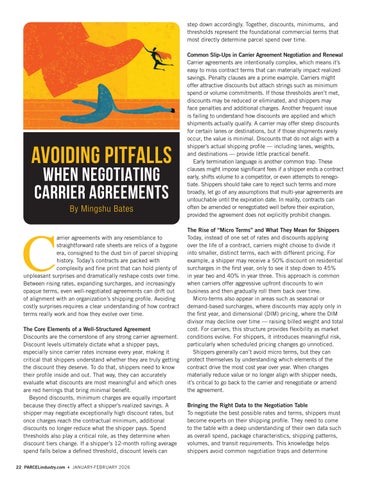
AVOIDING PITFALLS WHEN NEGOTIATING CARRIER AGREEMENTS
By Mingshu Bates
Carrier agreements with any resemblance to straightforward rate sheets are relics of a bygone era, consigned to the dust bin of parcel shipping history. Today’s contracts are packed with complexity and fine print that can hold plenty of unpleasant surprises and dramatically reshape costs over time. Between rising rates, expanding surcharges, and increasingly opaque terms, even well-negotiated agreements can drift out of alignment with an organization’s shipping profile. Avoiding costly surprises requires a clear understanding of how contract terms really work and how they evolve over time.
The Core Elements of a Well-Structured Agreement
Discounts are the cornerstone of any strong carrier agreement. Discount levels ultimately dictate what a shipper pays, especially since carrier rates increase every year, making it critical that shippers understand whether they are truly getting the discount they deserve. To do that, shippers need to know their profile inside and out. That way, they can accurately evaluate what discounts are most meaningful and which ones are red herrings that bring minimal benefit. Beyond discounts, minimum charges are equally important because they directly affect a shipper’s realized savings. A shipper may negotiate exceptionally high discount rates, but once charges reach the contractual minimum, additional discounts no longer reduce what the shipper pays. Spend thresholds also play a critical role, as they determine when discount tiers change. If a shipper’s 12-month rolling average spend falls below a defined threshold, discount levels can
step down accordingly. Together, discounts, minimums, and thresholds represent the foundational commercial terms that most directly determine parcel spend over time.
Common Slip-Ups in Carrier Agreement Negotiation and Renewal
Carrier agreements are intentionally complex, which means it’s easy to miss contract terms that can materially impact realized savings. Penalty clauses are a prime example. Carriers might offer attractive discounts but attach strings such as minimum spend or volume commitments. If those thresholds aren’t met, discounts may be reduced or eliminated, and shippers may face penalties and additional charges. Another frequent issue is failing to understand how discounts are applied and which shipments actually qualify. A carrier may offer steep discounts for certain lanes or destinations, but if those shipments rarely occur, the value is minimal. Discounts that do not align with a shipper’s actual shipping profile — including lanes, weights, and destinations — provide little practical benefit.
Early termination language is another common trap. These clauses might impose significant fees if a shipper ends a contract early, shifts volume to a competitor, or even attempts to renegotiate. Shippers should take care to reject such terms and more broadly, let go of any assumptions that multi-year agreements are untouchable until the expiration date. In reality, contracts can often be amended or renegotiated well before their expiration, provided the agreement does not explicitly prohibit changes.
The Rise of “Micro Terms” and What They Mean for Shippers
Today, instead of one set of rates and discounts applying over the life of a contract, carriers might choose to divide it into smaller, distinct terms, each with different pricing. For example, a shipper may receive a 50% discount on residential surcharges in the first year, only to see it step down to 45% in year two and 40% in year three. This approach is common when carriers offer aggressive upfront discounts to win business and then gradually roll them back over time.
Micro-terms also appear in areas such as seasonal or demand-based surcharges, where discounts may apply only in the first year, and dimensional (DIM) pricing, where the DIM divisor may decline over time — raising billed weight and total cost. For carriers, this structure provides flexibility as market conditions evolve. For shippers, it introduces meaningful risk, particularly when scheduled pricing changes go unnoticed.
Shippers generally can’t avoid micro terms, but they can protect themselves by understanding which elements of the contract drive the most cost year over year. When changes materially reduce value or no longer align with shipper needs, it’s critical to go back to the carrier and renegotiate or amend the agreement.
Bringing the Right Data to the Negotiation Table
To negotiate the best possible rates and terms, shippers must become experts on their shipping profile. They need to come to the table with a deep understanding of their own data such as overall spend, package characteristics, shipping patterns, volumes, and transit requirements. This knowledge helps shippers avoid common negotiation traps and determine
if discounts are being applied where they actually matter. Shipping data must be clear and well-organized. Depending on the shipper’s size, pricing requests may move through different approval paths within a carrier, and clear, organized data makes it easier for carrier sales teams to escalate requests and advocate for better discounts.
Shippers should also be prepared to challenge carrier proposals. Carriers may position their initial offer as “best available” or present projected savings that do not hold up under detailed review. Shippers should require transparency regarding the assumptions and calculations behind any savings claims, and validate the results independently — either internally or with third-party support.
Smaller Shippers Have More Negotiating Power Than They Think
Although small- and mid-sized businesses (SMBs) might seem to lack the leverage of large enterprise shippers, they actually still have meaningful negotiating power. What works in their favor is profitability. SMBs typically represent the highest-margin customer segment for carriers, whereas large enterprise accounts can operate on extremely thin — or even negative — margins due to the volume needed to cover the carrier’s fixed network costs. For carriers, SMB pricing generally leaves more room to negotiate, even if the actual percentage discounts are lower than those offered to enterprise clients.
To take advantage of this flexibility, SMBs need to know their shipping profile and fully understand what matters most to their business. The last element is benchmarking the
market at large. Without that broader context, it’s difficult to tell whether a discount is competitive or not.
When to Review and Renegotiate
At a minimum, shippers should review their carrier agreements annually. This is critical to understanding and mitigating the impact of major, predictable changes such as the General Rate Increase (GRI). However, it’s best to treat renegotiation as a more frequent or as-needed exercise, rather than an annual event. Over the past two years in particular, carriers have introduced frequent surcharge and pricing changes midyear, and shippers need to understand how those changes affect their shipping profiles and renegotiate accordingly.
Some changes are broad and relatively neutral, while others are highly targeted. A recent example is the change to additional handling criteria that introduced volumetric thresholds. For some shippers, the impact was minimal. For others, packages that once incurred a $28–$40 additional handling fee suddenly qualified for oversize charges ranging from $250 to $340, representing a multifold cost increase. Situations like this are a clear signal that it’s time to go back to the negotiating table. As long as their agreements don’t include restrictive termination or renegotiation clauses, shippers should engage carriers whenever pricing changes materially affect their bottom line.
Mingshu Bates is Chief Analytics Officer and President of Parcel, AFS Logistics.
By Andrew M. Danas
One Year Later: What the Trump Administration’s Policies Mean for Parcel Shippers
Editor’s Note: There were some significant developments that occurred after this article was published; you can read the update here.
First-year reviews of any presidential term are an important checkpoint for businesses, and President Trump’s return to office has brought significant and disruptive change for parcel shippers. While the dust has not settled, policies affecting global trade, supply chains, labor, transportation, and competition regulation have introduced new costs and compliance risks, tied to a higher level of uncertainty. The President’s actions have affected short and long-term sourcing decisions, fulfillment strategies, carrier operations, and compliance costs. Many of President Trump’s first-year actions were accomplished through Executive Orders and enforcement actions. New federal legislation was at a historic low, as were regulatory actions. President Trump’s first-year actions may have a long-lasting impact on how parcel shippers do business, but it remains to be seen whether they will be implemented into permanent laws. One thing is clear: parcel shippers should assume that the volatility seen in 2025 will continue through at least 2026.
Trade Policy, Supply Chains, and the End of De Minimis
For parcel shippers engaged in international shipping and e-commerce, the Administration’s most consequential first-year action has been its overhaul of US trade policy — most notably the elimination of the de minimis exemption and the aggressive use of tariffs for trade, national security, and foreign policy purposes.
The Administration’s willingness to disregard existing trade agreements and impose the highest effective tariff rates since the Great Depression has reshaped the economics of cross-border parcel shipping. Its new approach to trade had several themes. First, a priority focus on country-of-origin determinations as the basis of tariff rates. Second, increased tariffs and documentation requirements on imported goods that contain materials and products deemed critical to US national security. Third, more aggressive enforcement of customs and other laws.
Together, these changes reflect President Trump’s broader goal of restructuring global supply chains to bring more manufacturing activity and investment back to the United States. Whether that goal is actually realized, in 2025, parcel shippers were at the
forefront of bearing the consequences of shifting policies that affected day-today operations and long term planning decisions.
Faced with increased and targeted Customs enforcement and compliance costs, parcel shippers placed greater emphasis on supplier vetting; documentation accuracy; and internal controls designed to detect red flags such as transshipment through third countries.
A key focus of the President’s 2025 trade policy was whether its use of the International Emergency Economic Powers Act (IEEPA) to impose tariffs was legal. Often overlooked was the fact that many of the President’s other tariff tools — such as Section 232 tariffs on derivative metal products and Section 301 tariffs targeting Chinese goods and vessels — have already been upheld by the courts. In addition, the President’s measures against unfair trade practices, if not the actual use of tariffs in general, appear to enjoy broad, bipartisan Congressional support, especially when applied to countries such as China.
The end of the de minimis exemption and the imposition of Section 301 tariffs on Chinese ships illustrate this point. In 2024, the Biden Administration initiated
reviews of the de minimis exemption and the USTR shipbuilding investigation.
President Trump’s sudden universal suspension of the de minimis exemption in August 2025 via Executive Order may have surprised some parcel shippers, but Congress had already voted to eliminate the exemption when the One Big Beautiful Bill Act was enacted on July 4, 2025. While that law scheduled the demise of de minimis on July 1, 2027, it also imposed severe penalties for abuses during the two-year transition period.
From a business perspective, the message from Congress was clear: the de minimis exemption was ending. President Trump simply accelerated its demise. Similarly, while the Administration ultimately suspended the penalties on Chinese-built vessels calling at US ports, the basic principal that the US needs to address unfair trade practices and see a return of some strategic manufacturing and industries back to the United States had bipartisan support in Congress.
An uncertain US trade policy is likely to continue in 2026. Still in flux are the technical details of many of the announced 2025 “trade deals” with US trading partners. Significantly, a mandatory joint review of the United States–Mexico–Canada Agreement (USMCA) will begin in July 2026. Mexico and Canada are the United States’ two largest trading partners, and — notwithstanding President Trump’s Mexico and Canada tariffs — most goods from those countries were exempt from the Administration’s first-year tariffs due to the USMCA. For parcel shippers, 2026 will be a critical year in determining whether their North American cross-border supply chains remain relatively stable or face further disruption.
Domestic Regulation
Adoption of new federal regulations in 2025 was limited, in large part because in Executive Order No. 14192, President Trump declared a “one-in, ten-out” rule requiring the repeal of 10 regulations for every new one added.
Trucking was one area of regulatory attention. An April 2025 Executive Order mandated English proficiency for commercial vehicle drivers. Although subsequently stayed by a federal appellate court, in September 2025,
the Federal Motor Carrier Safety Administration also increased oversight of state-issued commercial driver’s licenses to non-domiciled residents.
The Administration also moved to roll back or delay regulations affecting trucking operations. These include postponing broker transparency rules, withdrawing a proposed federal speed limiter mandate, and rescinding proposed emissions standards for commercial vehicles. The Administration also took actions to terminate or otherwise rescind the right of States to adopt their own electric vehicle and emissions mandates.
Presidential Authority over Independent Agencies including the USPS
If successful, President Trump’s efforts in 2025 to assume more control over federal “independent agencies” may also have far-reaching consequences for parcel shippers.
Many areas of federal policy affecting parcel shippers are administered by independent agencies that have specialized authority over either industries or policy subject areas. The U.S. Postal Service (USPS); Postal Regulatory Commission (PRC); Surface Transportation Board (STB); Federal Maritime Commission (FMC); Consumer Products Safety Commission (CPSC); Federal Trade Commission (FTC); National Labor Relations Board (NLRB); and the Equal Employment Opportunity Commission (EEOC), are all instrumental in adopting regulations and enforcing laws governing transportation; logistics; workplace and employment rights; product safety; and prohibitions on unfair competition and deceptive trade practices.
These agencies have historically been structured to operate with a degree of independence from the White House. Statutorily composed of bipartisan multi-member leadership appointed by the President; confirmed by Congress; and with staggered terms, these agencies have statutory protections against Presidential removal of their members without cause.
President Trump challenged this legal structure in 2025 when he fired multiple Democratic members from several independent agencies with jurisdiction over parcel shippers, including the STB, the NLRB, the EEOC, the CPSC; and
the FTC. The Supreme Court allowed some of these removals to proceed while it considers whether to overturn a 1935 precedent which lower courts found clearly prohibited the President from engaging in such unilateral firings without cause.
Since the 1800s Congress has determined that some federal agencies should be at least partially independent from White House political control. Should the Supreme Court rule that the President has the legal authority to exercise greater control over such agencies by removing individual independent agency regulators at will, many federal policies affecting the operations of parcel shippers may become subject to potentially swifter and broader policy swings, both from President Trump and any future occupant of the Oval Office.
For example, while President Trump did not follow through with proposals in 2025 that he would fire the USPS Board of Governors and merge the USPS with the Department of Commerce, a Supreme Court ruling clarifying that he has that authority may facilitate such an action in future years.
Looking Ahead
President Trump’s first-year return to office has been historic. While many of his actions can be reversed by Congress, the courts, or a new President, by now, parcel shippers know that the volatility of 2025 is unlikely to completely subside. Heading into 2026, and beyond, parcel shippers will need to continually monitor and diversify their supply chains, strengthen their compliance programs, and monitor day-to-day regulatory developments as they engage in future business planning for the next few years of the Trump Administration.
Andrew M. Danas is a Partner with Grove, Jaskiewicz and Cobert, LLP, Washington, D.C.. For more information, visit www.gjcobert. com or email adanas@danaslaw.com. The information contained in this article is intended to be general background information. It does not constitute and should not be relied upon as legal advice. Readers should contact a qualified attorney should they have a specific legal question.
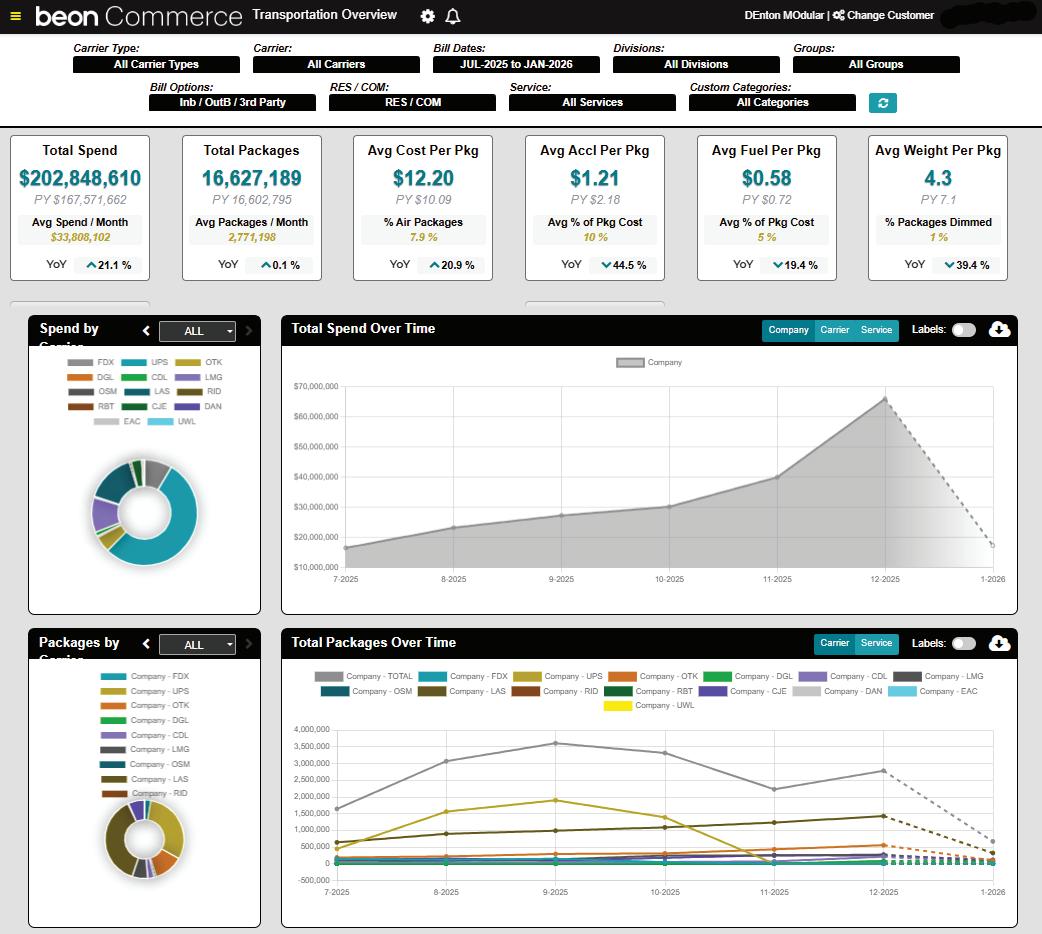
Who's Helping You with Spend Management and Auditing?
Your business could be at risk of losing hundreds of thousands of dollars or more every year! Accurate auditing and spend management are crucial to your business's success; however, it can be overwhelming. A solution: contact these professionals and use their expertise to your advantage.
Keep your parcel on par with the best. CTSI-Global brings world-class freight audit and payment solutions to the Parcel Spend Management arena. Create a multimodal spend management strategy to optimize your shipping, from small packages to full freight. Choose CTSI-Global for the comprehensive spend management, strategy expertise, datadriven custom development, and Honeybee TMS solutions to take your business to the next level.
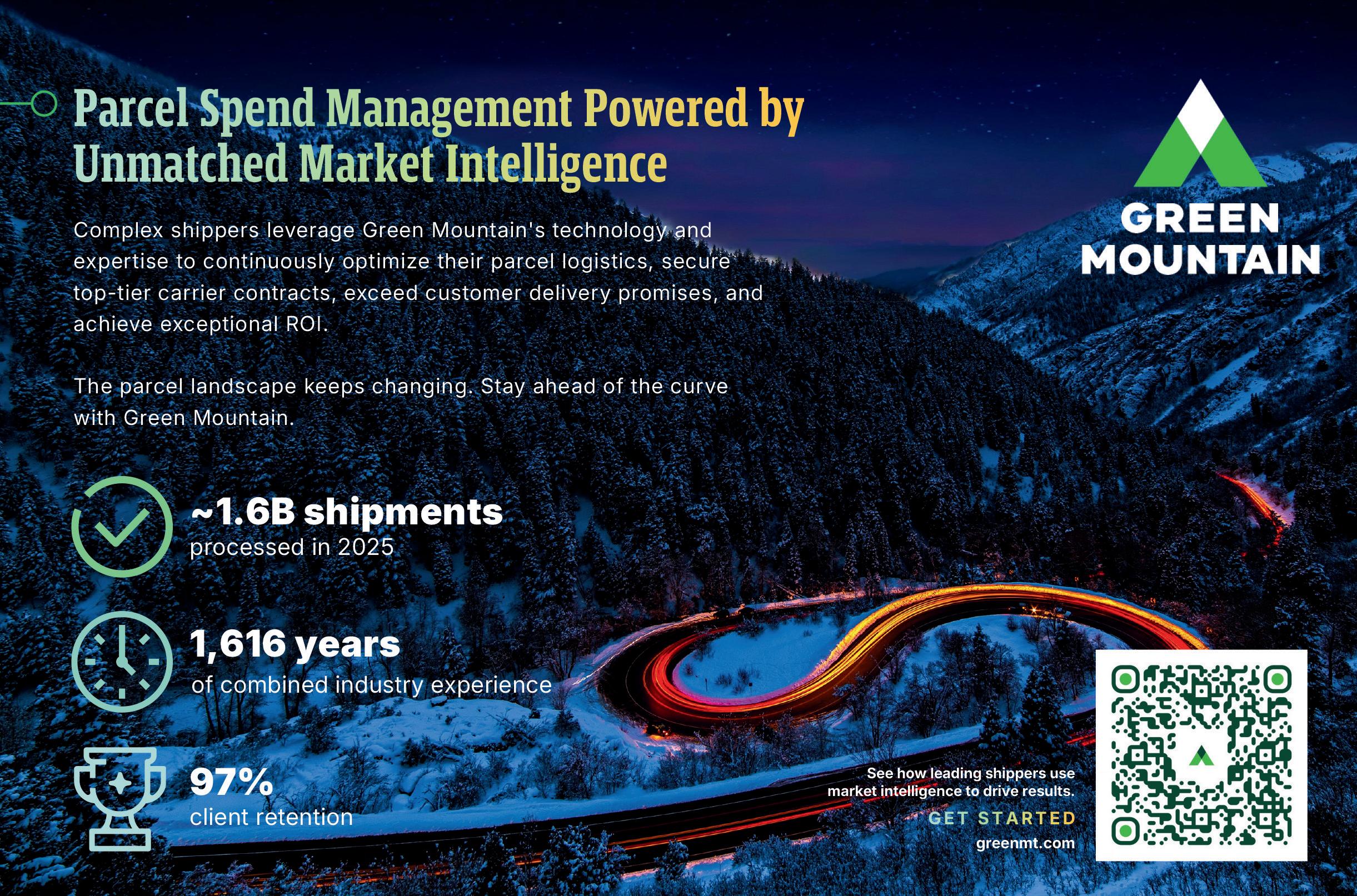
Green Mountain’s Parcel Spend Management solution is built for large, complex shippers to continuously optimize their parcel networks and the costs that make it possible. Founded in 1999, Green Mountain manages $13B in annual parcel spend and processes nearly 1.6B yearly shipments — giving our clients unique market insight and results. We unify contract management, carrier invoice audit, dispute resolution, and advanced analytics to achieve 10X more annual client deliverables. With an average client ROI of 1796% and 97% retention rate, Green Mountain goes beyond audit accuracy to support carrier strategy, network optimization, and continuous improvement for shippers spending $40M+ annually.
greenmt.com
CT Logistics marks 103 years of leadership in freight audit and payment, delivering technology-driven parcel solutions that help shippers navigate highly complex carrier networks and rate structures. Our platforms simplify parcel shipping agreements, automate audits to identify overcharges, and leverage advanced modeling to evaluate contracts, surcharges, and network scenarios — while supporting improved cash flow and timely carrier payments. Backed by experienced parcel specialists, CT provides actionable analytics and global visibility that drive sustained cost reduction. Every solution is purpose-built to improve parcel performance and reduce spend. CT is ISO 9001:2015 and SOC certified.
Enveyo transforms parcel spend management from a reactive process into a strategic advantage. We unify shipping data, audit every invoice automatically, and turn recovered dollars into intelligence you can act on. With clear visibility into spend, performance, and cost drivers, shippers and 3PLs can negotiate smarter, adapt faster, and control parcel operations as volumes grow. Enveyo replaces uncertainty with confidence and helps teams run shipping with clarity at scale.
enveyo.com | info@enveyo.com | 801.948.0727
For nearly three decades, Intelligent Audit has helped leading brands and household names across retail, consumer goods, manufacturing, and pharma turn complex shipping data into confident decisions. Recognized by Gartner and independent analysts as a market leader, Intelligent Audit pairs McKinseyrecognized AI with a best-in-class team that understands insight, not just technology, drives results. With innovation grounded in experience, the platform supports shippers of every size and processed 2.1B shipments last year alone, delivering the scale, credibility, and intelligence today’s shippers expect.
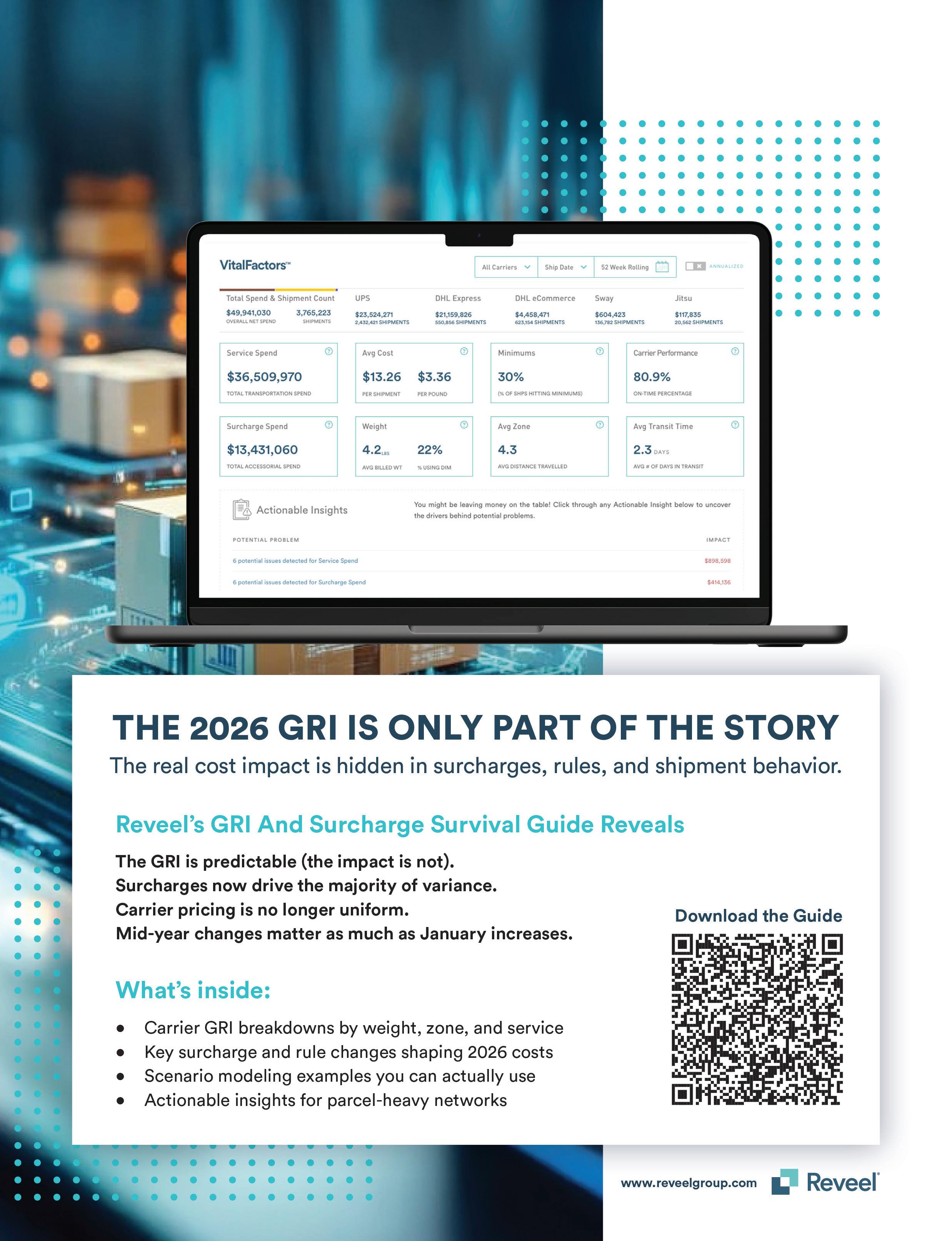
The published 2026 GRI is only part of the story. The real cost impact is buried in surcharges, evolving rules, and shipment behavior that rarely show up in headline increases. Reveel’s 2026 GRI & Surcharge Survival Guide breaks down how carrier GRIs actually apply by weight, zone, and service, and why surcharges now drive most parcel cost variance. With scenario modeling and actionable insights built for parcel-heavy networks, the guide reveals where costs really change and how to plan for them. Download the guide to see what invoices will show next.
www.reveelgroup.com
Trusted by today’s Fortune and Global 1000 companies to uncover hidden overcharges across every mode of transportation, Trans Audit is the world’s leading specialist in post payment expense recovery. With swift onboarding and a simple, success based recovery process, Trans Audit manages overpayment and overbilling claims from identification to refund processing with unmatched precision. Trans Audit’s award winning team, spanning the U.S., Europe, and Asia, delivers more than refunds providing powerful business intelligence that fortifies supplier relationships and best practices. Partner with Trans Audit for a simple, swift, and stress free path to transportation cost recovery.
transaudit.com | peaceofmind@transaudit.com
Transportation Insight combines deep parcel expertise and a unified operating model to give parcel shippers real control over cost, performance and customer experience. By connecting spend management, audit, contract optimization, rating, routing and performance visibility in one place, shippers see where costs originate, why they change and how to reduce them while protecting service. Execution-based parcel intelligence then informs planning for GRIs and surcharges, optimized carrier usage and stronger network design. As visibility to true landed cost and on-time performance improves, exception response becomes faster and delivery promises more reliable, turning parcel shipping into a sustained, measurable business advantage.
Sifted is a Logistics Intelligence provider that helps direct parcel shippers and 3PLs take control of shipping spend. Their software, SiftedAI, provides continuous visibility into parcel cost and performance — uncovering hidden inefficiencies, highlighting savings opportunities, and surfacing issues before they impact the P&L. SiftedAI Copilot layers agentic AI into the platform as an always-on logistics analyst. It actively inspects shipping data, analyzes scenarios, and guides confident decision-making around parcel spend, service levels, and carrier strategy.
sifted.com | sales.team@sifted.com |
TransImpact delivers intelligent logistics and supply chain solutions that unlock measurable savings and total cost visibility across parcel shipping and inventory. By integrating parcel spend management with supply chain and business planning, TransImpact creates a unified approach that helps companies plan smarter, move faster, and improve profitability from forecasted demand to product shipped. As the industry’s most trusted partner in parcel spend management, TransImpact combines deep carrier expertise, market intelligence, and AI-driven SaaS technology to help businesses negotiate optimal rate agreements, streamline shipping operations, and uncover hidden savings — without compromising service quality or customer satisfaction.
Zero Down helps shippers reduce transportation costs across all modes, from parcel and LTL to ocean and rail. Our FreightOptics platform delivers complete visibility across your carrier network through AI-powered audit and payment, contract optimization, claims management, insurance solutions, TMS integration, and duty drawback recovery. Our savings create budgets for continuous improvement. End-to-end exception management handles claims from filing through recovery, including re-opening previously rejected refunds. With $1.5 billion in verified client savings, 35+ years of expertise, SOC II Type 2 certification, and GDPR compliance, Zero Down ensures you never overpay for transportation.
www.zdscs.com | info@zdscs.com | 954.753.7006
ROBOTICS IN ORDER FULFILLMENT: FROM FUTURE PROMISE TO EVERYDAY ADVANTAGE
By Phil Pletcher
Just a few years ago, the idea of robots playing a central role in order fulfillment operations felt intriguing, but unproven. Many warehouse operators viewed robotics with a fair amount of hesitation. Where had this been done before? Would it really deliver value?
Fast forward to today, and the tone of the conversation has changed. Robotics in fulfillment has moved from “this could work” to “this is how it works.” Real-world installations have proven that robotics can drive measurable improvements in productivity, flexibility, and customer service.
The Maturation of Robotics in Fulfillment
The push to limit exposure to a turnover-prone labor market and save space has traditionally fueled interest in robotics. But while labor and space remain key drivers, other strategic priorities also steer the adoption of robotics as facilities seek to enhance operational performance — boosting throughput, increasing flexibility, and enhancing reliability.
A significant shift is the use of robotics to enhance existing workflows, like goods-to-person (GTP) order fulfillment. Just as traditional crane- or shuttle-based automated storage and retrieval systems (AS/RS) bring inventory directly to picking and packing stations, a new breed of AS/RS carries out the same function — with some key advantages.
Extremely dense cube storage, serviced by mobile robots, reduces inventory footprint, and can more easily scale as throughput needs fluctuate, like adding more robots to pull inventory from the grid. Another key element is system
resilience. In the event one or two robots go down, the rest can pick up the slack and keep the system running — a stark contrast to older systems, in which a single failure could have a much more negative impact.
The next frontier is robotic solutions for picking and placing individual items and systems to unload incoming trucks. Although still in the pilot or early deployment stages, advances in vision systems, artificial intelligence, machine learning, and end-of-arm tooling bring these solutions closer to commercial viability.
Integrating Robotics: More Than Just Hardware
While the mechanical capabilities of robotics have advanced rapidly, successfully integrating these technologies as part of efficient, multi-piece automated systems depends on much more than the hardware itself. The real key lies in the software — the “brains” that manage robotic systems so they work in harmony with the rest of the operation.
The right software knows what’s happening upstream and downstream of robotics and can adjust accordingly, making the best use of robotics capacity and overall system output. But even the smartest, most advanced systems still depend on a human element. Many experienced warehouse operators are used to dealing with demand spikes and solving unexpected challenges in manual or semi-automated systems. But working with robotics requires a mindset shift.
Operators must understand that the system has a designed capacity, is optimized for certain order profiles, and that big deviations — such as a new product category — can cause disruption if not accounted for in advance. This places a premium on communication between the fulfillment center and other departments, like marketing or procurement, to forecast the effect of changes.
For instance, if a marketing campaign suddenly drives high demand for slow-moving SKUs that are not positioned for quick picking, or if a vendor changes to case pack sizes that no longer fit an automated storage bin, system performance can quickly fall. Robotics success requires ongoing collaboration between technology, process, and people.
Robots in Fulfillment: Collaborators, Not Replacements
The notion that introducing robotics is an express ticket to a “lights-out” warehouse is misguided. The reality is far more nuanced. Rather than a one-to-one replacement for human roles, robots reshape their work.
In traditional fulfillment environments, workers might walk six to eight miles a day retrieving items, often performing repetitive lifts, bends, and other motions. With goods-toperson robotic solutions, those same workers can stay at ergonomic workstations while inventory comes to them, and spend more time packing orders and less downtime walking between pick locations — reducing physical strain and making work more engaging.
As more operations invest in robotics, warehouse jobs can become more appealing and less prone to turnover. According to a 2024 study titled “The Relationship Between Workplace
Robots, Employee Exhaustion and Turnover Intention in the Age of Industry 5.0,” evidence shows that the use of robotics can have a positive impact on employee retention. Instead of competitors, robots are employed as collaborators — partners that handle the repetitive and strenuous work so people can focus on higher-value tasks.
What’s Next: The New Frontiers of Robotics in Fulfillment
Looking ahead, several key trends are poised to shape the next generation of robotics in order fulfillment.
1. Artificial Intelligence and Machine Learning
Traditional automation needed engineers to code for each scenario, which isn’t scalable in the fast, chaotic world of fulfillment. AI and reinforcement learning allow robots to learn and adapt, recognizing new products, adjusting to workflow changes and optimizing strategies to accomplish tasks, with no programming input required. For example, a robotic arm might discover an easier way to grasp an item without explicit programming. This flexibility is crucial for constantly changing operations.
2. Robotics-as-a-Service (RaaS)
The capital expense of automation is a longstanding roadblock on the path to automation for some companies. However, the rise of RaaS models — where robotics can be leased as an operational expense — makes automation more accessible and scalable. Just like companies lease equipment or subscribe to cloudbased software, RaaS enables fulfillment centers to deploy robots, pay as they go, and adjust usage based on demand. It offers a practical approach for managing seasonal peaks or piloting new automation strategies without the need for large upfront investments.
3. Interoperability and Multi-Vendor Integration
As robots proliferate, many facilities now deploy robots from multiple vendors. Getting these systems to communicate effectively often depends on systems integrators who create custom interfaces. But native interoperability may become common, allowing robots from different manufacturers to communicate directly with each other thanks to shared standards, enabling increased performance and reliability.
4. Smarter Packaging Solutions
Another frontier is the ability to adapt to packaging. As parcel carriers adjust pricing structures to favor certain package types and sizes, robotic systems need to accommodate that variability. Advances in adaptive grippers and vision systems to accommodate form-fit boxing will enable robots to handle a broader range of items and packaging types, as changes affecting warehouse operations are dictated by forces outside the four walls.
For more than 30 years, PARCEL has delivered the information and solutions 1000s of industry decision-makers want and need to help them handle, package, ship, and deliver more small packages, more efficiently, and more effectively from coast to coast, across the borders, and around the world.
ARE YOU AND YOUR COLLEAGUES MISSING OUT?
Sign up for a FREE SUBSCRIPTION today!
Phil Pletcher is Vice President, Global Solution Automation, FORTNA.
The $2.7M Other Auditors Missed
A parcel audit review uncovered $291K in missed refunds and a contract costing millions
For five years, a leading specialty retailer shipping over a million parcels annually across ground and express services worked with parcel auditors to recover carrier refunds. The results were underwhelming. They switched providers. Same story. Leadership concluded that their account simply had limited refund opportunities.
The Audit That Changed Everything
When they engaged Zero Down to perform an "Audit the Auditor" analysis, we loaded two years of parcel data into FreightOptics and examined what previous providers had missed.
In our proof-of-concept, we identified $291K in recoverable refunds that were never submitted to the carriers by their previous auditors. Since contracting with Zero Down, we have recovered $268K in late delivery refunds. These were serviceguarantee violations that the client was contractually entitled to recover.
But the audit revealed something bigger. Once we had visibility into the data, we saw their carrier contract was significantly underperforming.
From Audit Recovery to Spend Optimization
Zero Down led a competitive carrier negotiation that reduced the client's parcel spend by 10% resulting in $1.3M in first-year savings. Combined with ongoing audit recoveries and freight negotiations, total savings reached $2.7M over two years.
"Zero Down's audit immediately uncovered significant savings we never knew existed. Their platform has automated a complex process, freeing my team to focus on logistics, not paperwork." — Director of Logistics
Why Auditors Miss What They Miss
Most parcel audit providers run weekly batch scans against carrier invoices. They catch obvious errors but struggle with
time-sensitive recovery categories. Late delivery claims have filing windows. Miss the window, lose the refund.
FreightOptics monitors shipments continuously and files claims within carrier-required timeframes. Our approval rate on late delivery claims is 56%, which matters when filing thousands of claims monthly.
We also re-file rejected claims. Carriers routinely deny valid claims on first submission. Many auditors accept the rejection. We don't.
About Zero Down
$1.5 billion in verified client savings over 25+ years. Parcel and freight audit, carrier contract optimization, real-time spend analytics. SOC 2 Type II certified. GDPR compliant. See what your auditor is missing. Request a complimentary audit review by scanning the QR code below. Reach the Zero Down team at zdscs.com