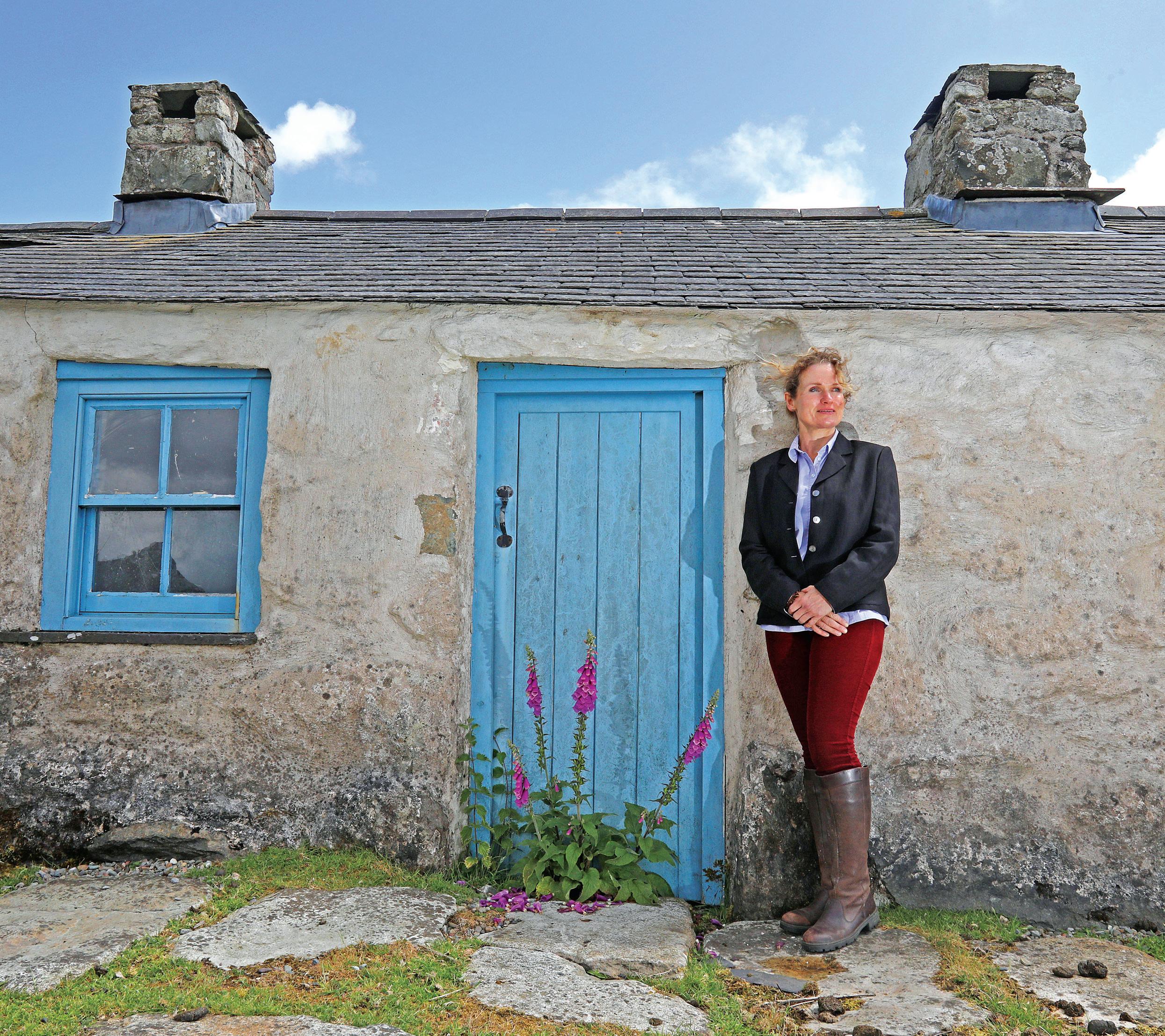
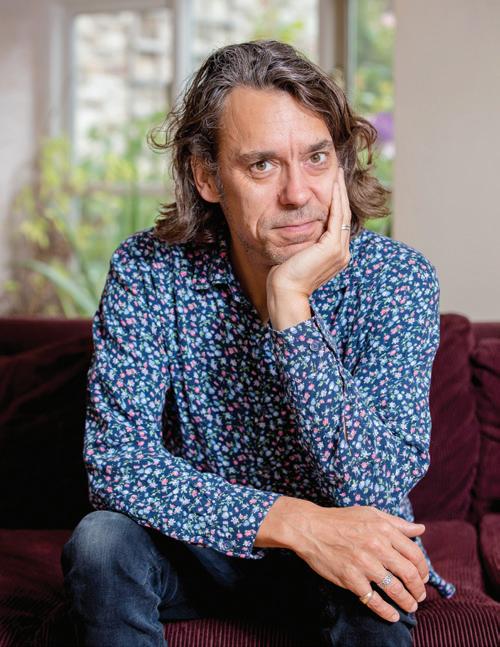
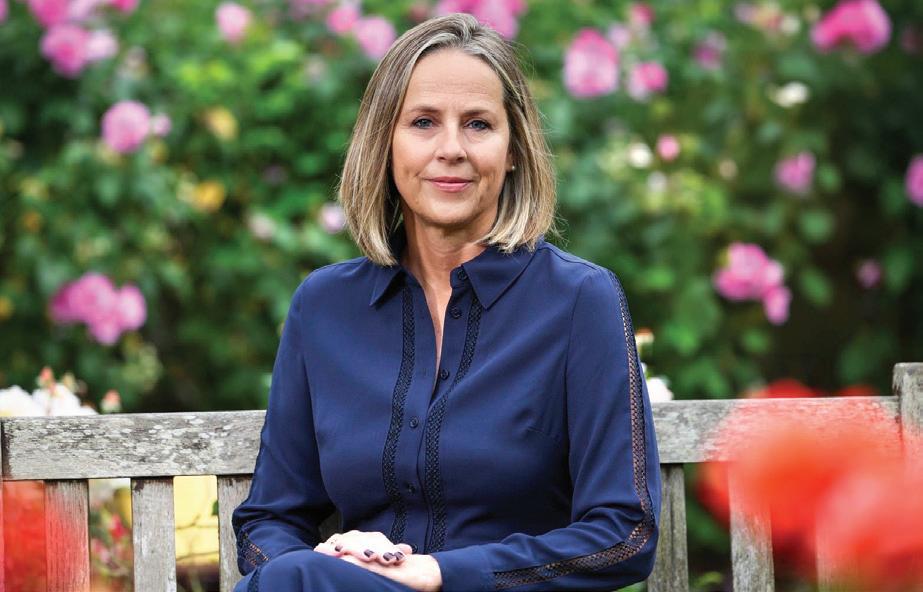
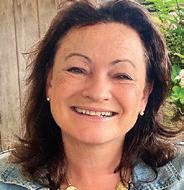
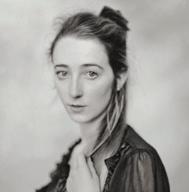
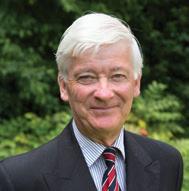
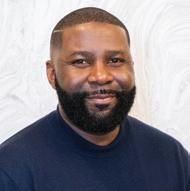
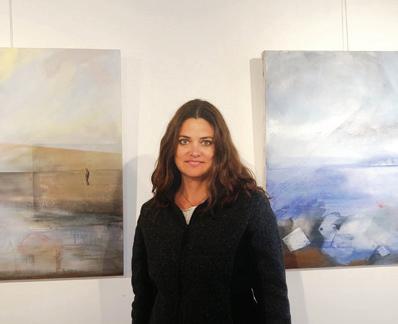
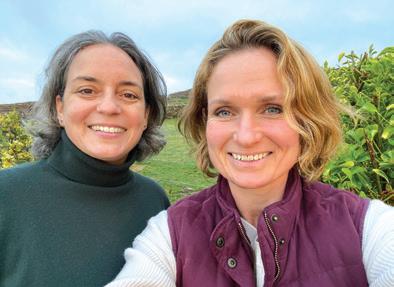
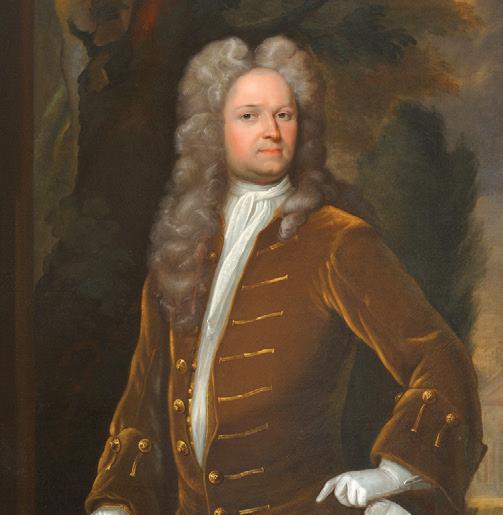
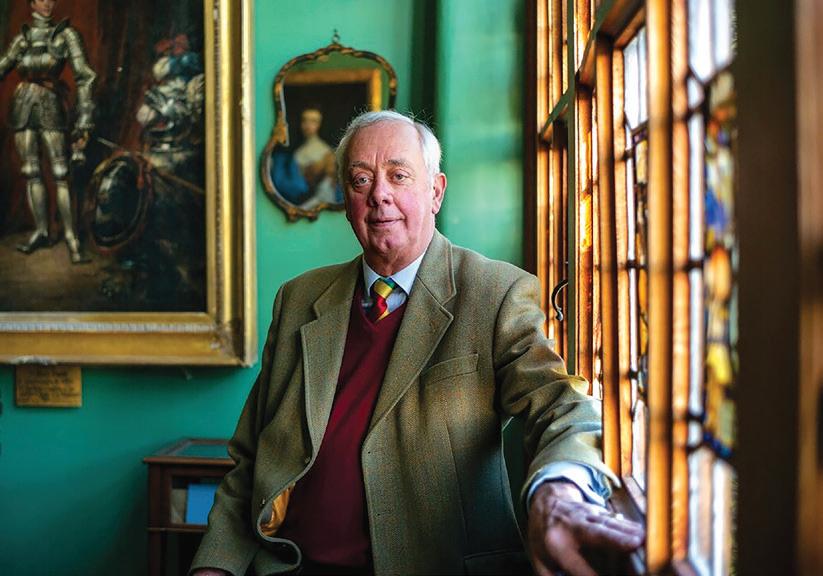
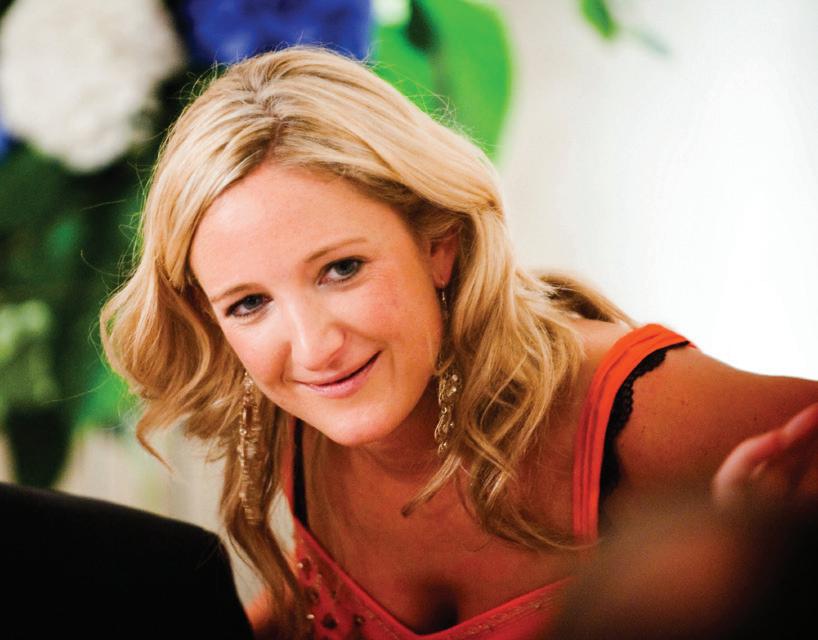
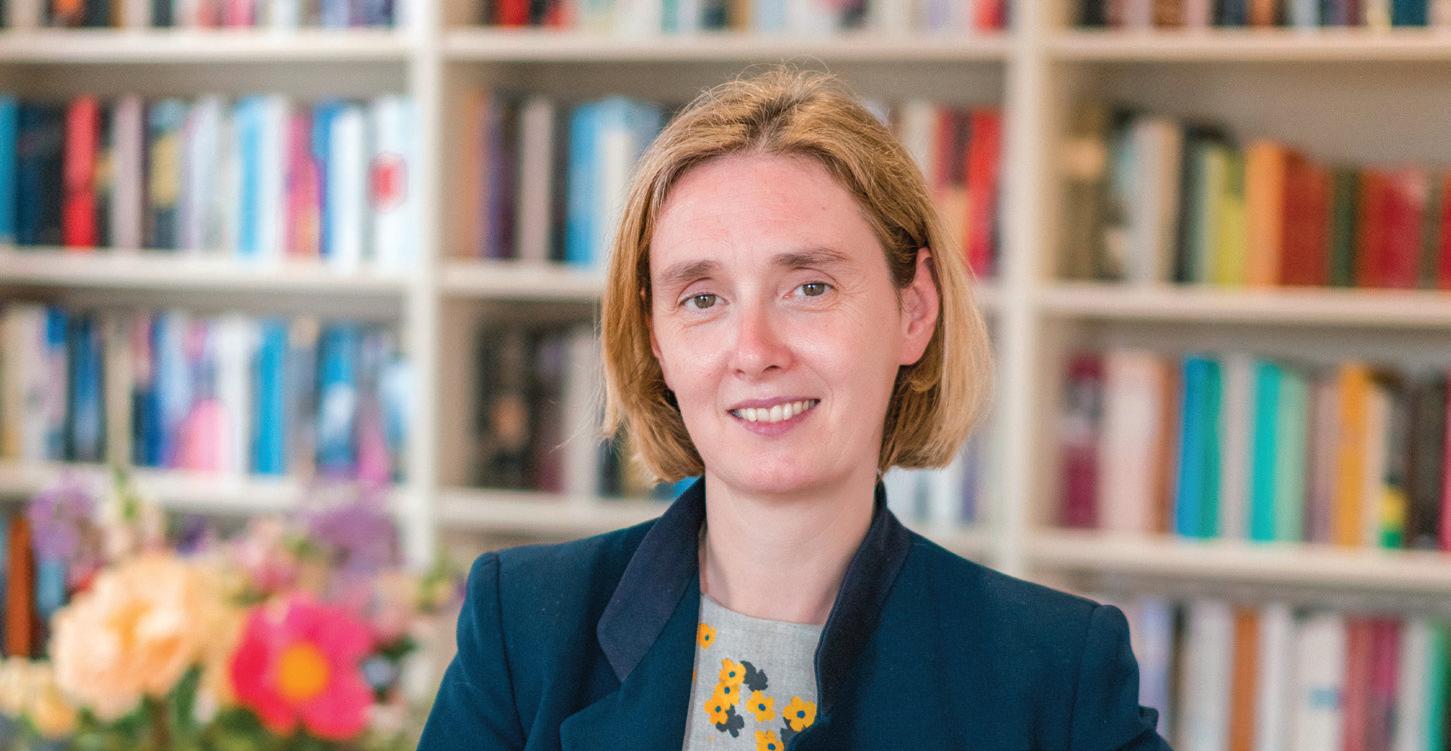
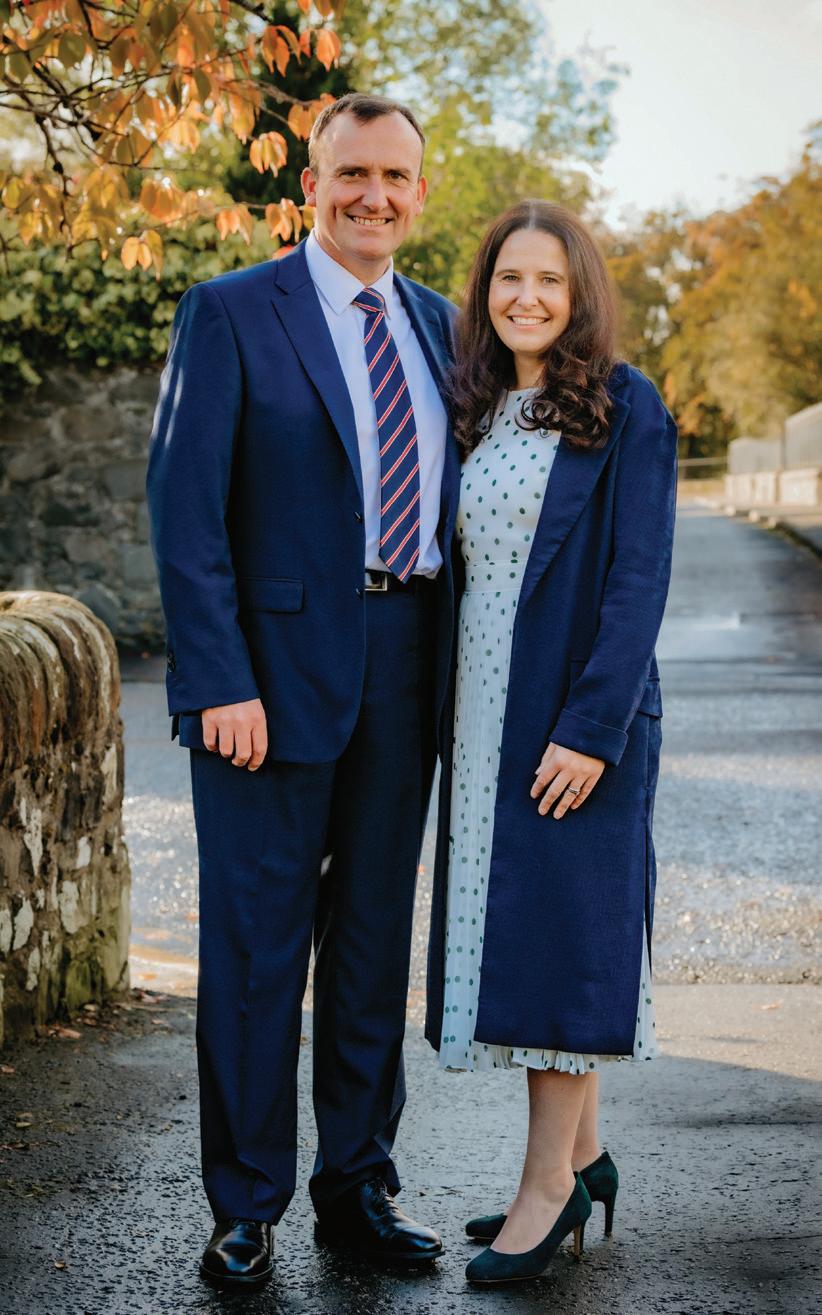
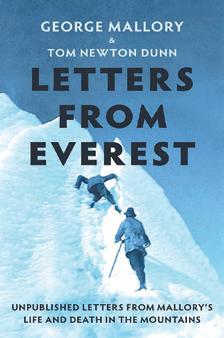
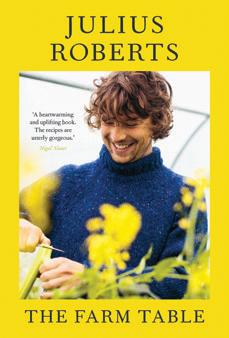
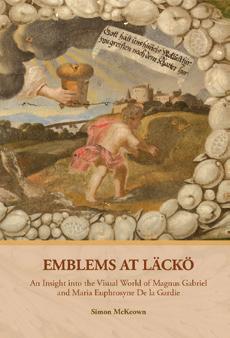
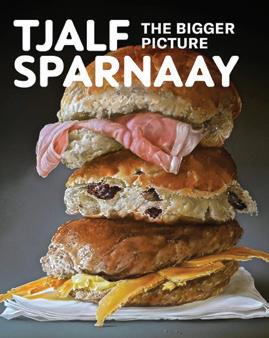
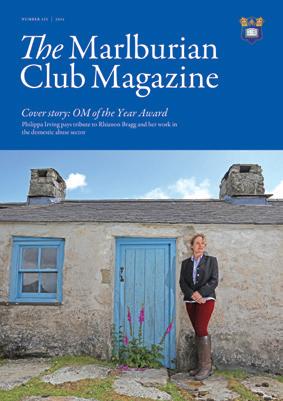
Philippa Irving pays tribute to Rhianon Bragg and her work in the domestic abuse sector
28 How Plants can Improve our Daily Lives
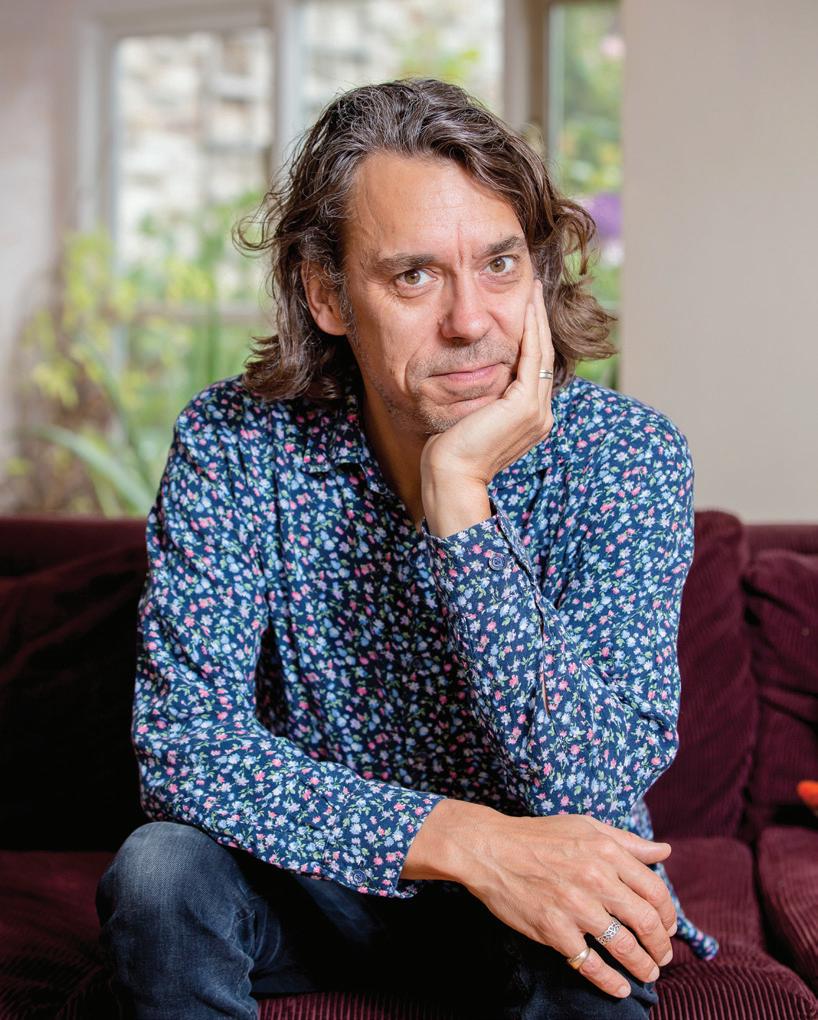
Alex Wright interviews Sebastian Pole, co-founder and master herbsmith at Pukka Herbs UK
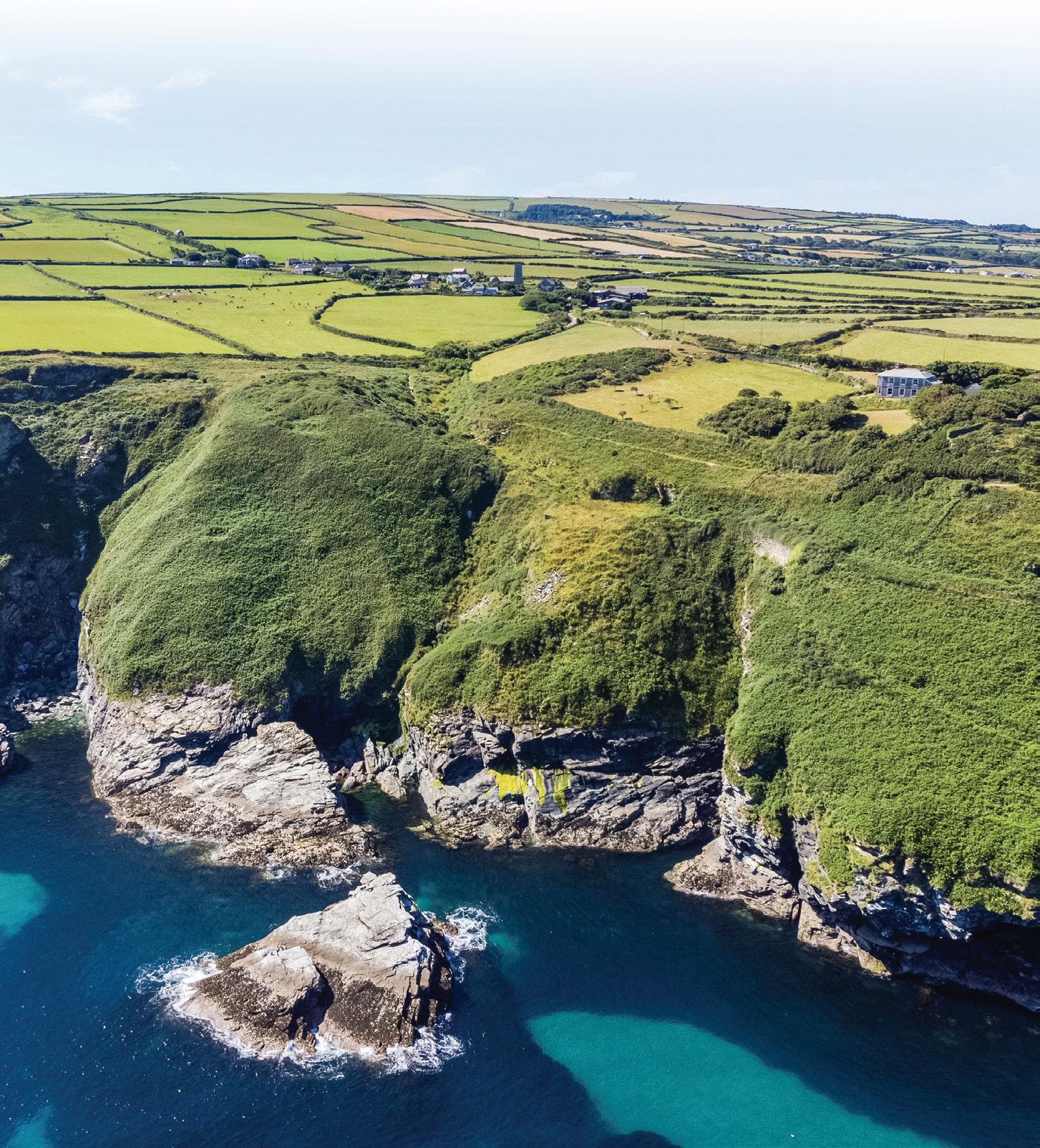
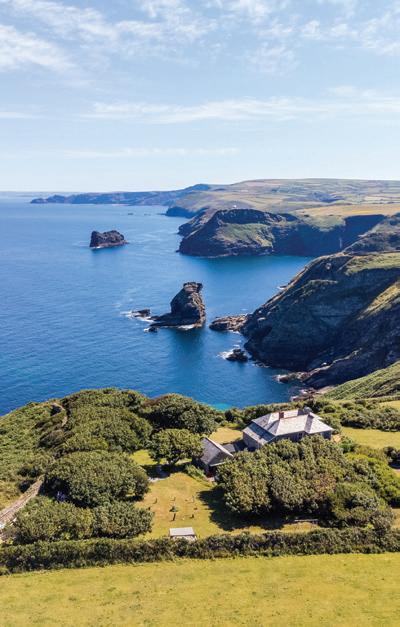
32 A Cornish Benefactor
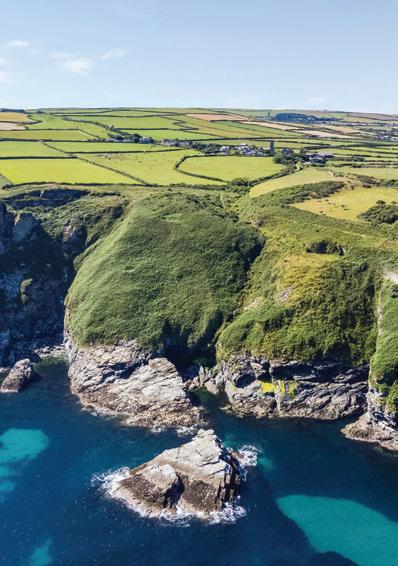
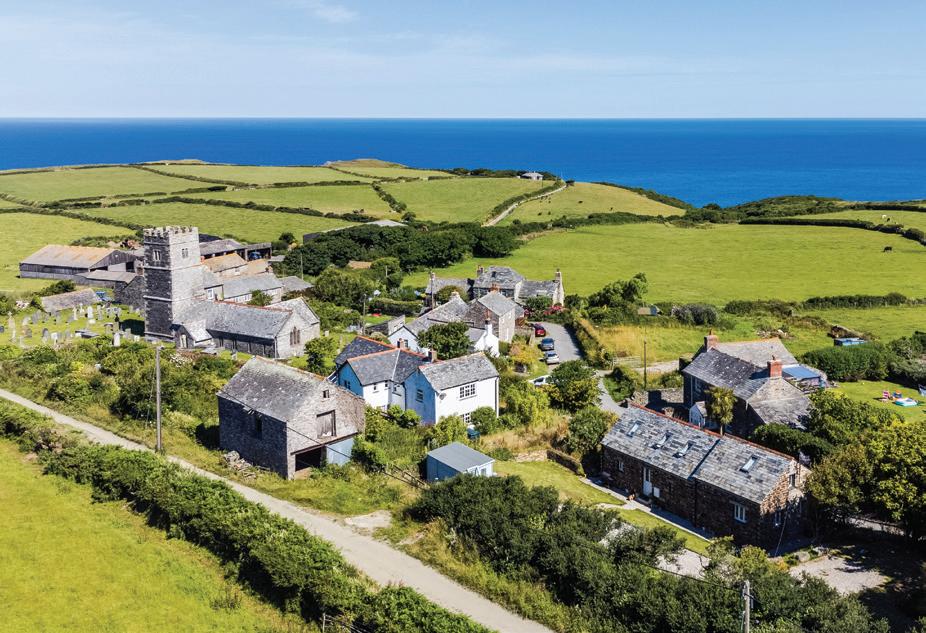
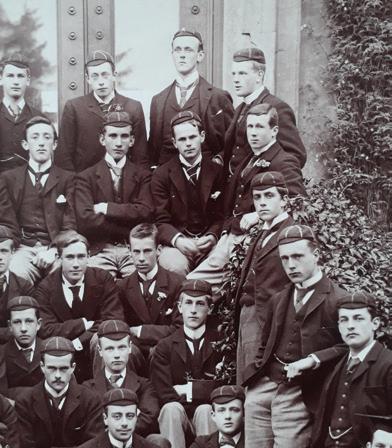
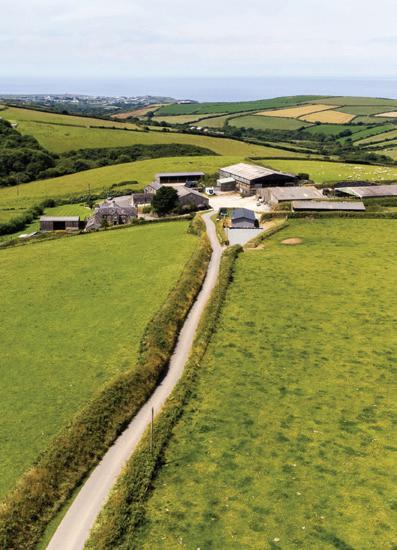
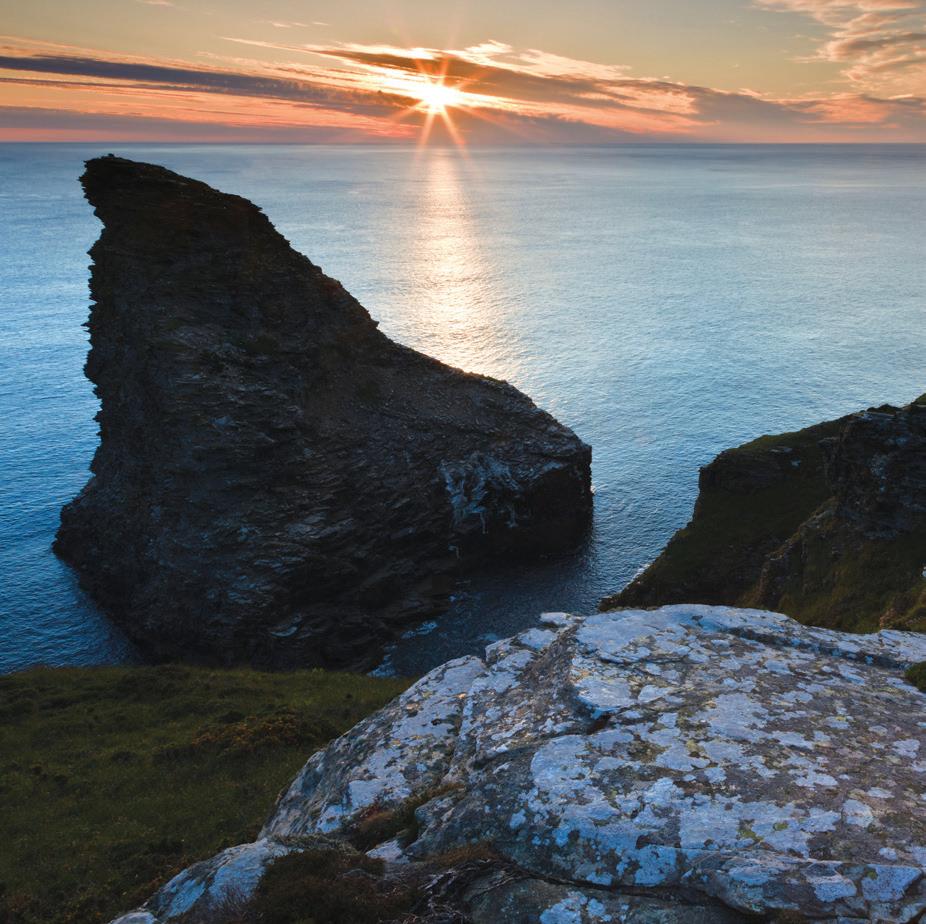
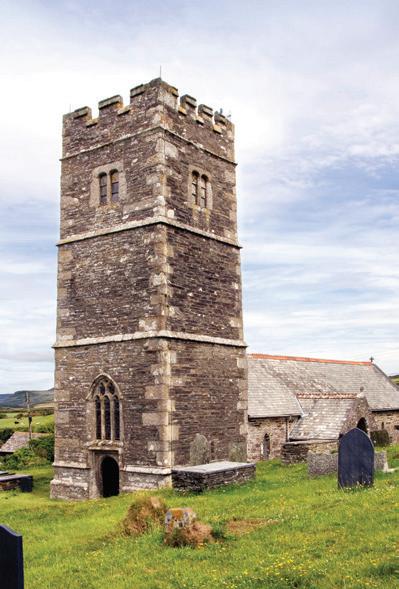
Gerald Curgenven bequeathed his Trevalga estate to the College. Jane Vyvyvan writes about his life
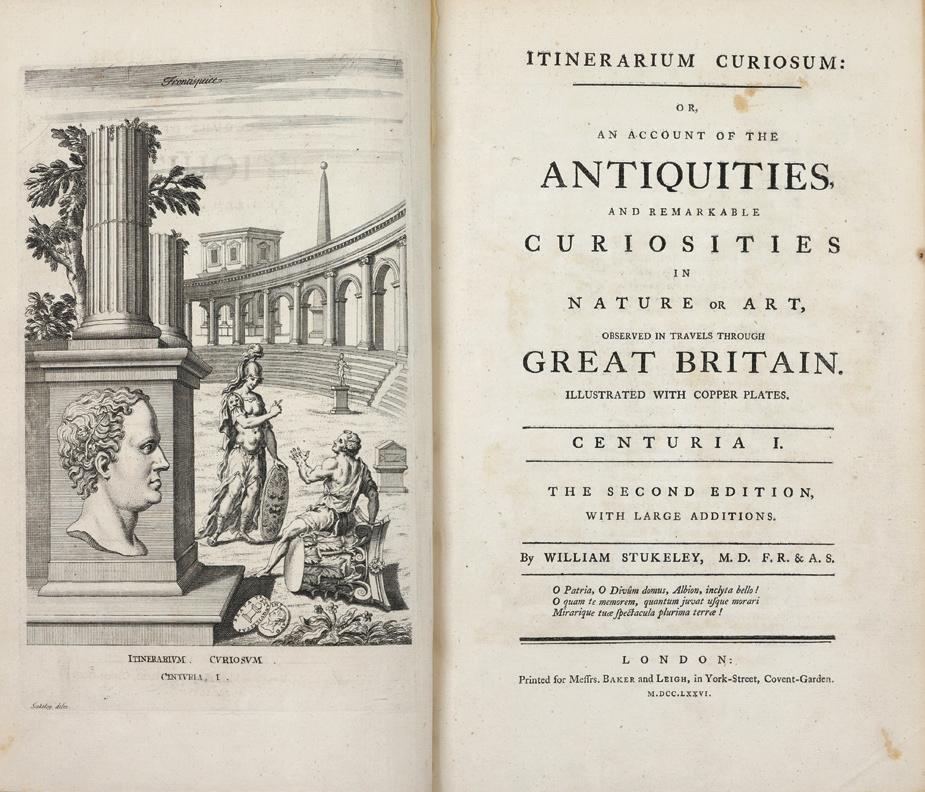
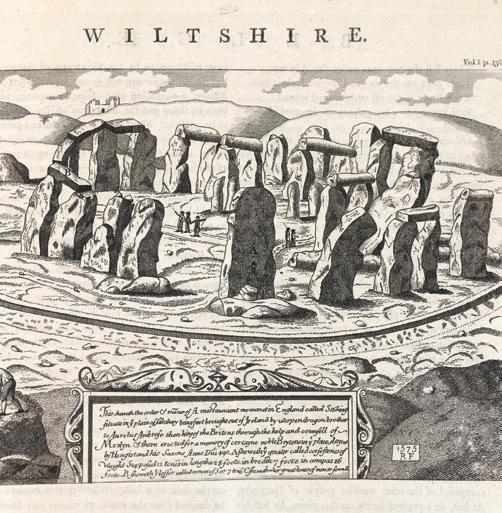
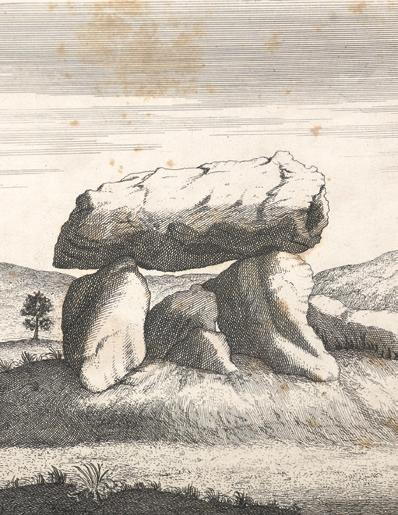
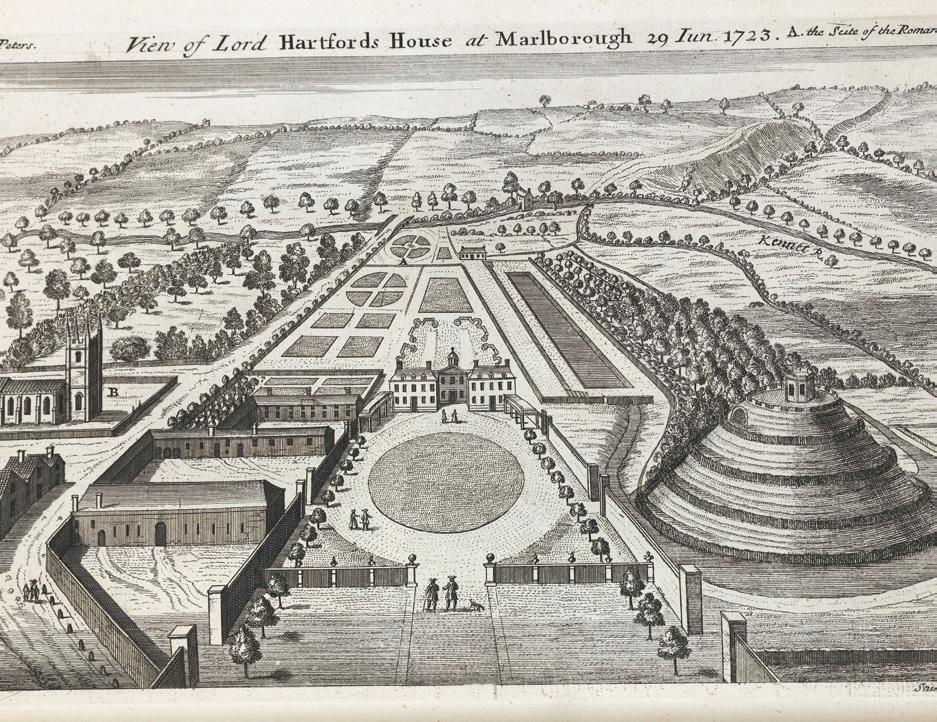
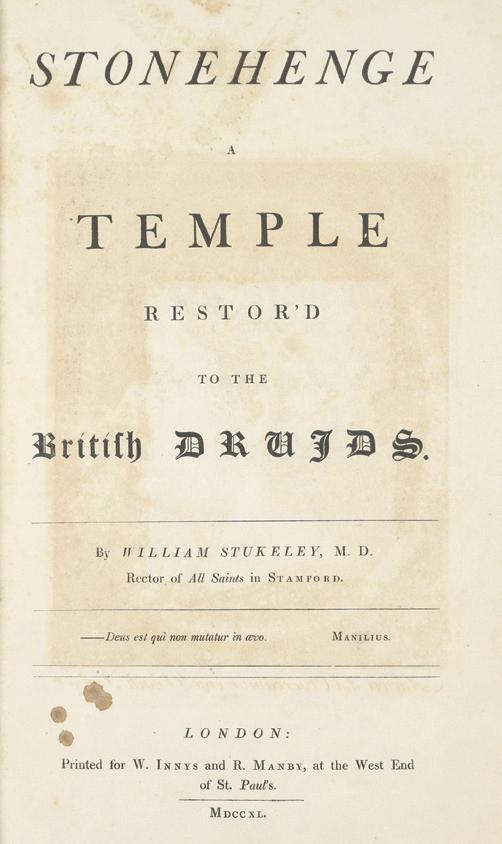
35 Rare Books: Stukeley’s Wiltshire
William Stukeley’s Itinerarium Curiosum contains some of earliest surviving views of the school site. Florence Shorthouse finds out more
38 A Necessary Way of Thinking
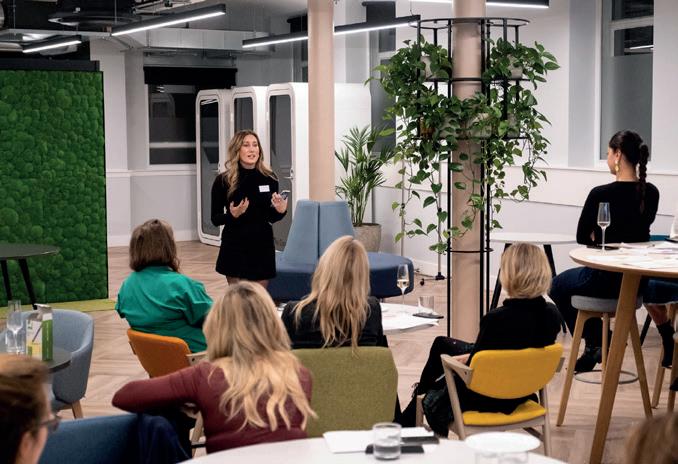
Emily Foster and Kasase Kabwe discuss equality, diversity and inclusion in the workplace
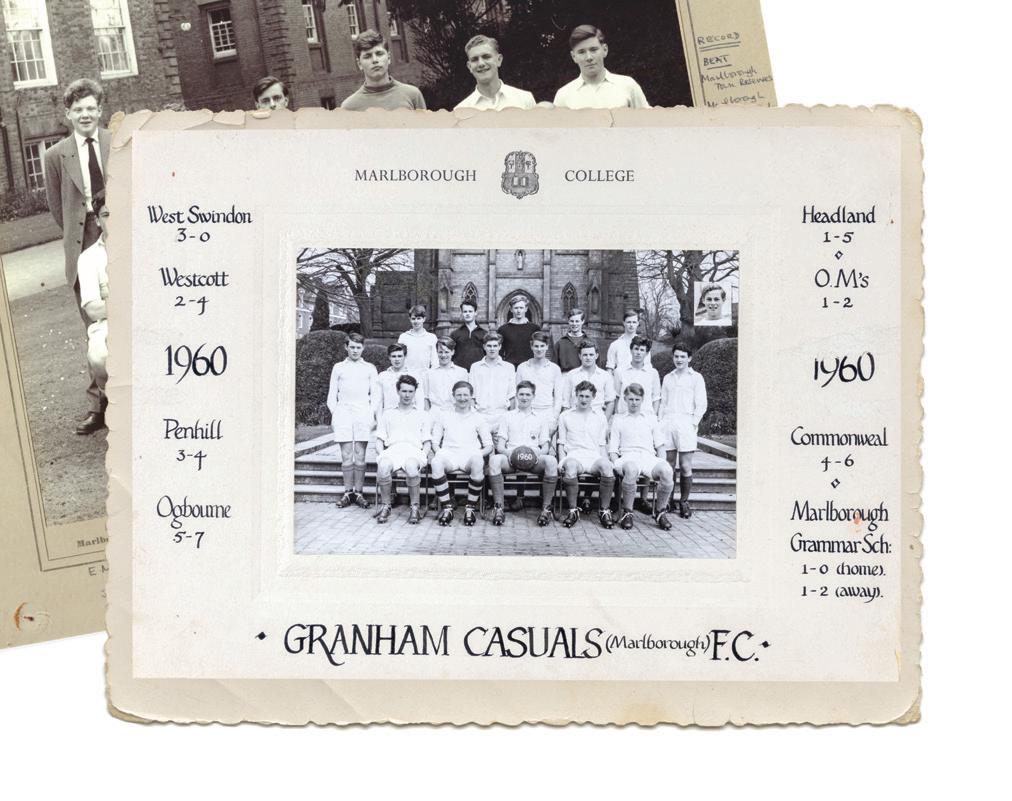
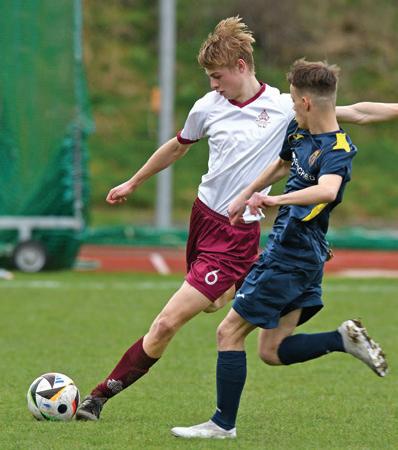
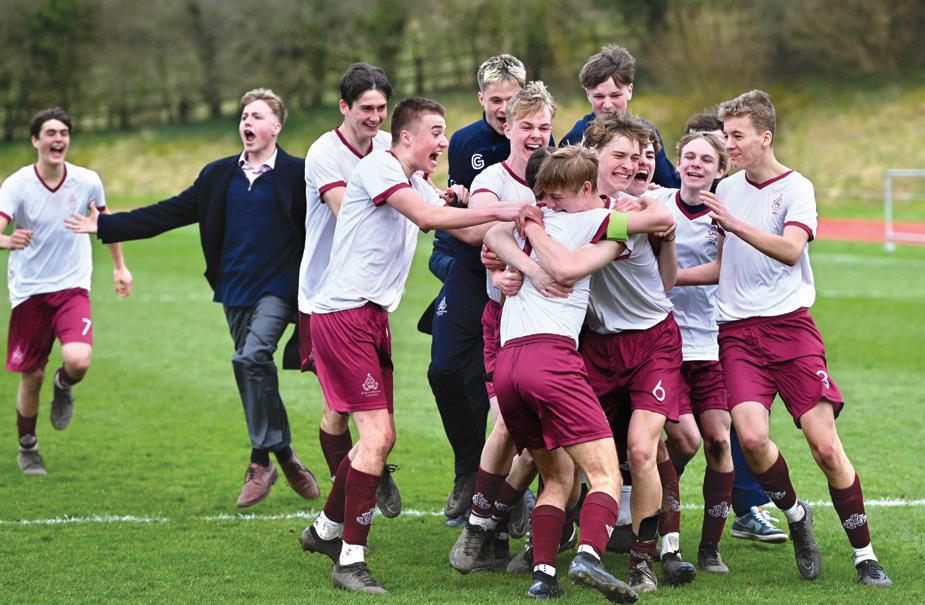
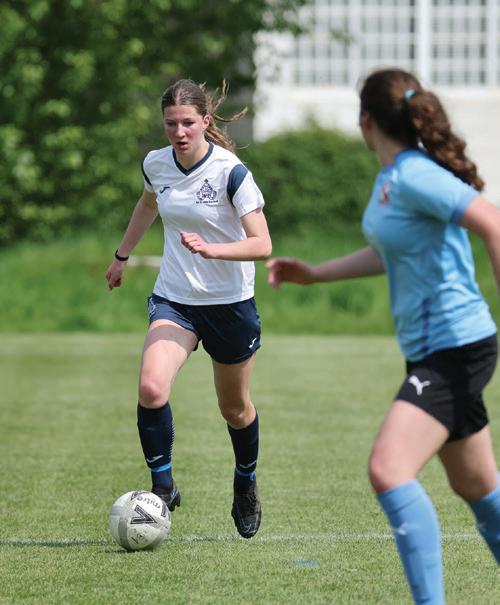
41 Football at the College
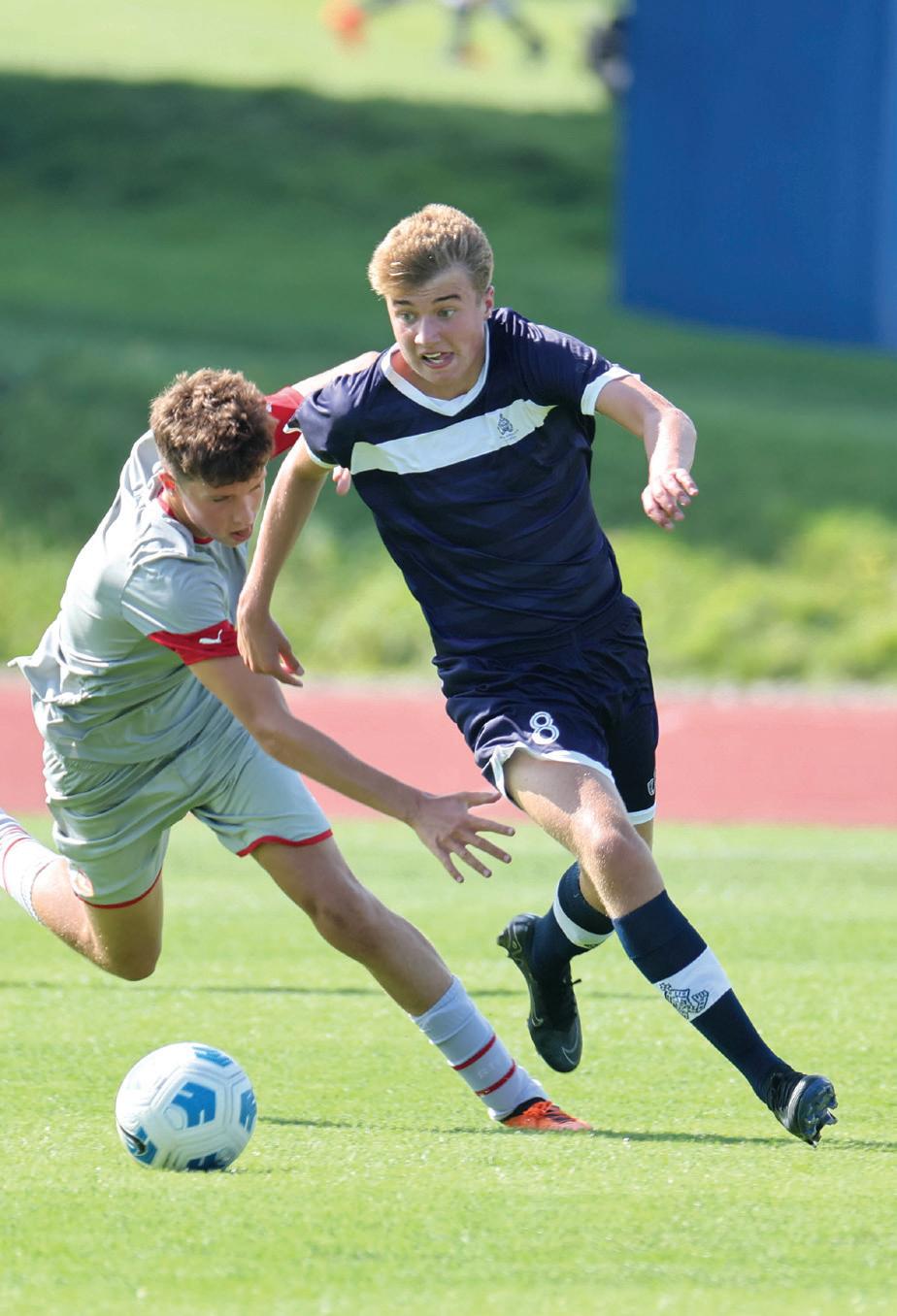
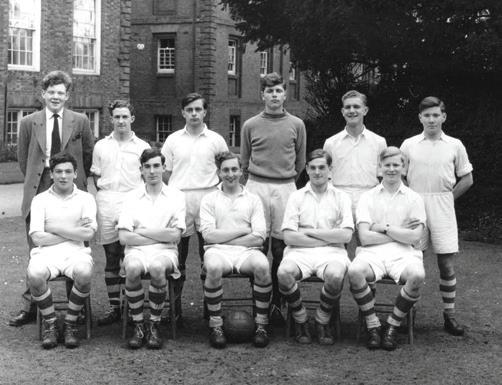
Anna Pembroke explores the history of football at Marlborough on the 70th anniversary of the Granham Casuals
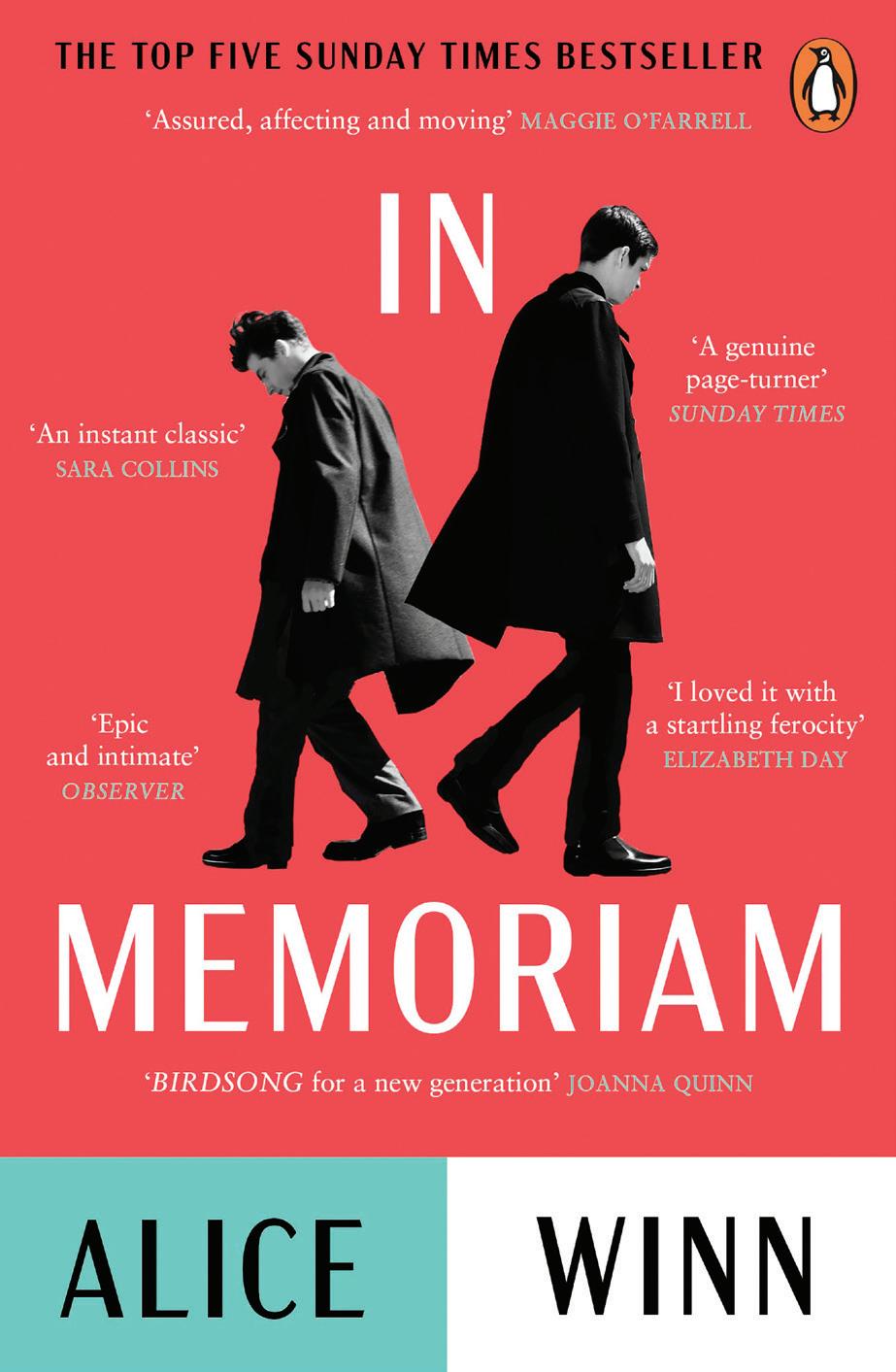
44 In Memoriam
Alice Winn explains how finding the online archive of The Marlburian magazine inspired her to write her debut novel
46 Career Connections
Two young OMs describe the benefits of using MC Connect
48 MCM: Morley House
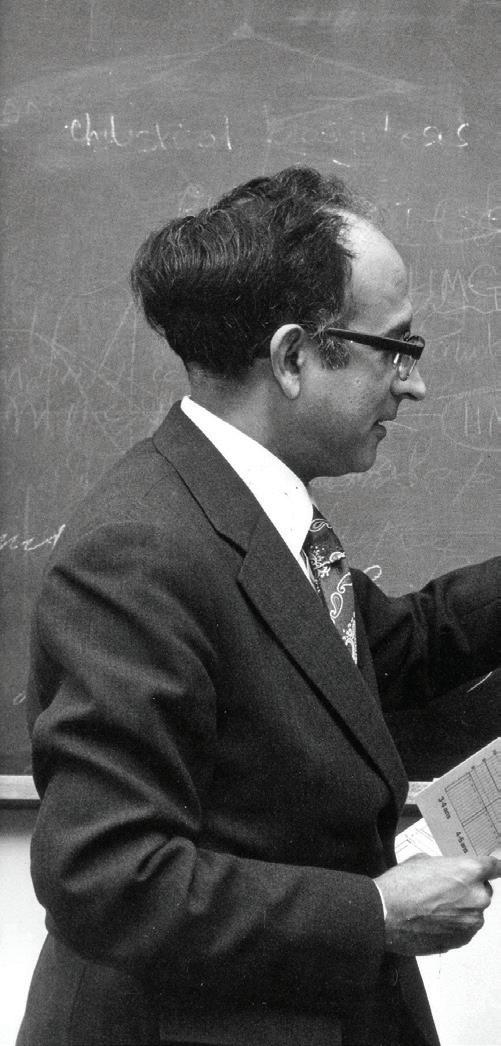
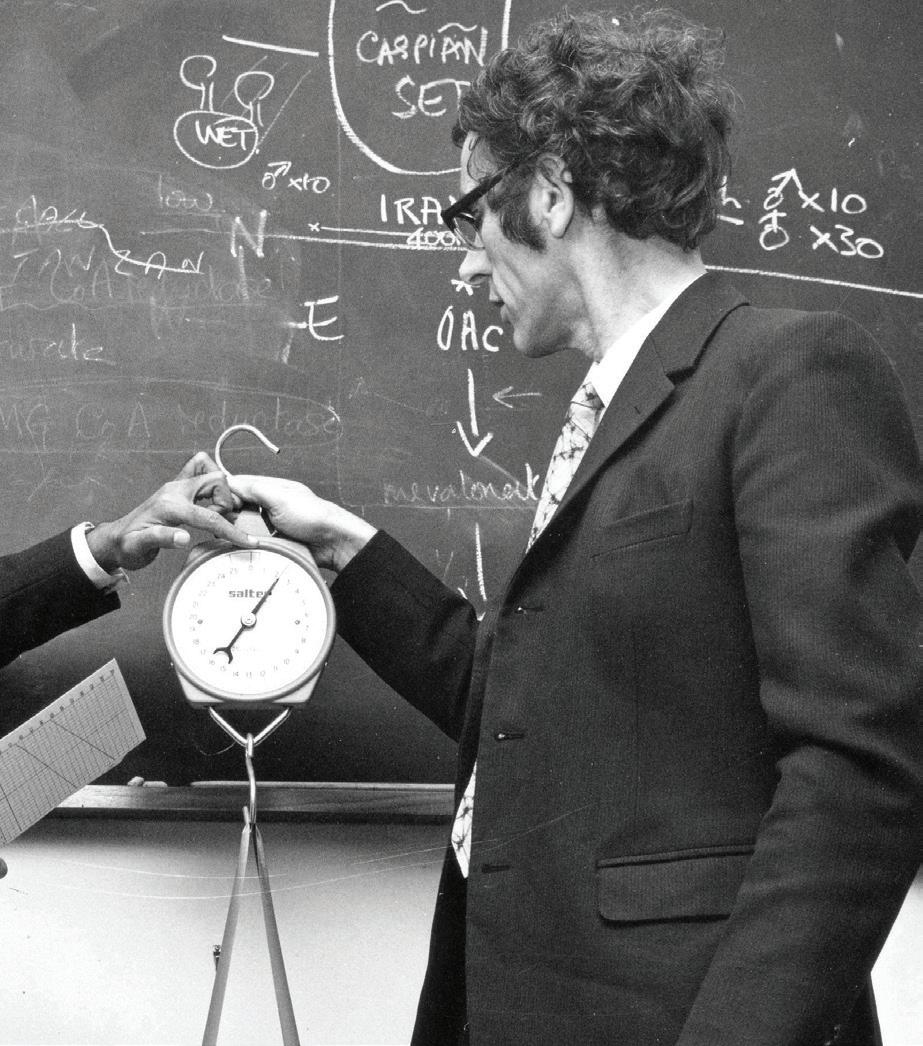
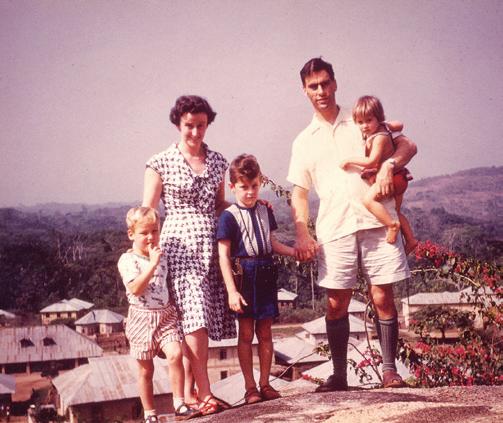
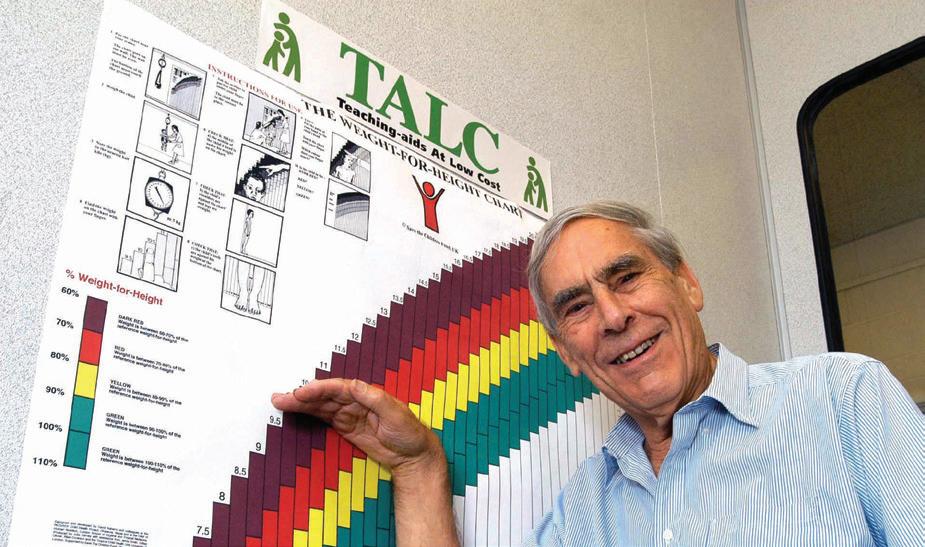
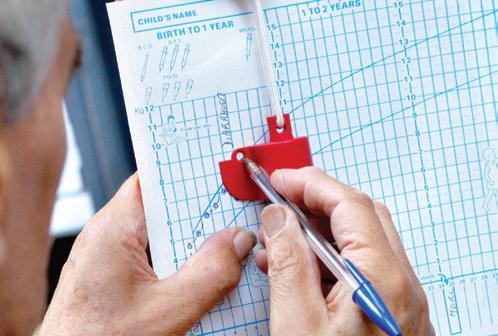
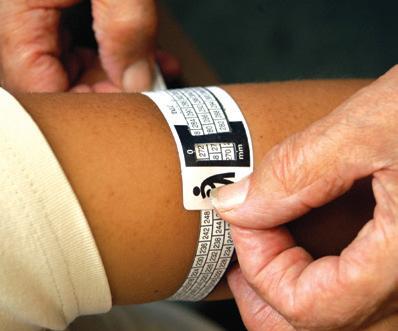
A new house at Marlborough College Malaysia is named after an OM whose work had international significance. Andy Morley remembers his father David’s life
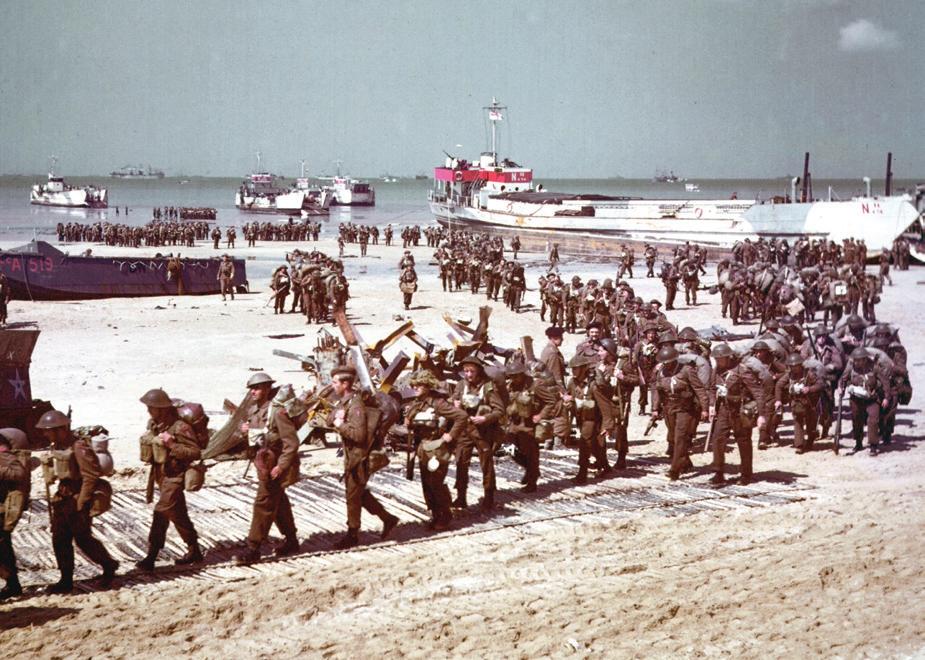
51 D-Day 80 Years On: A Time for Reflection
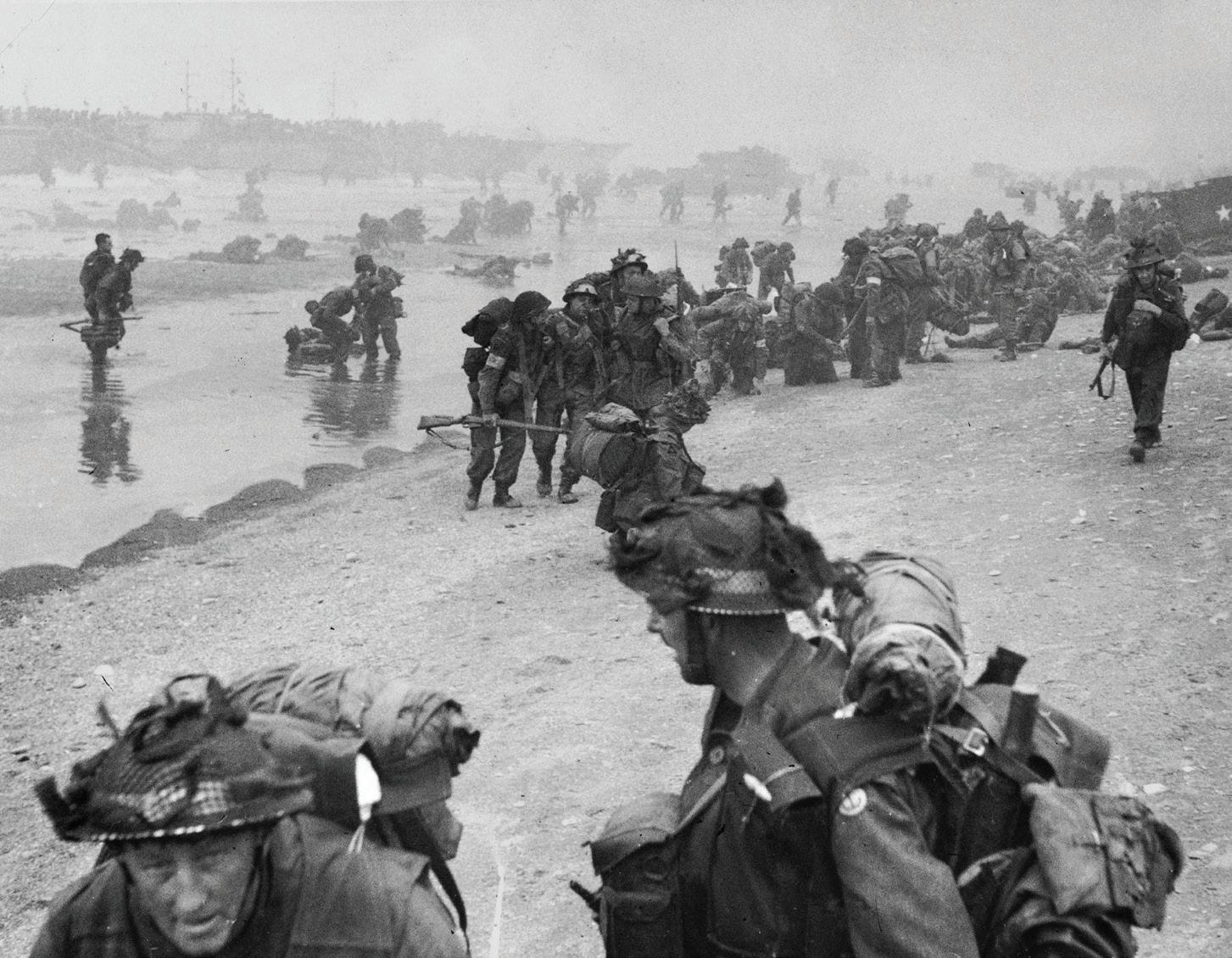
David Walsh reflects on the momentous summer of 1944
‘Putting this amazing magazine together this year, I have seen at first-hand what incredibly colourful lives OMs lead, how willing they are to help others and the strength of OM bonds.’
As I start my tenure as Editor I’ve reflected upon the wonderful job done by my predecessors, Catherine Brumwell (née Redpath NC 1991-96), who has set enormously high standards to follow, and Susannah Spicer (SU 1979-81), whose knowledge of the OM community is unsurpassed. I am indebted to you both for leaving me such an exceptional publication to take forward.
Putting this amazing magazine together this year, I have seen at first-hand what incredibly colourful lives OMs lead, how willing they are to help others and the strength of OM bonds. I have loved immersing myself in our collective history, reading your memories of shared experiences and bringing generations of OMs to mind again. My history with the College has been a great asset in my new role. My father, David Green (CR 1962-95), taught History and was Master in Charge of cricket. Through being a pupil in B3 (1982-84), a parent from 2013 to 2021, a House Tutor in Summerfield from 2001 to the present, I have many connections with Old Marlburians from different generations as well as former beaks and leavers’ parents.
So, I am delighted that my first issue includes a historical article reflecting on the 80th anniversary of D-Day written by David Walsh (C1 1960-65), who was my father’s first captain of cricket when he took over from John Thompson (CR 1946-88). The summer of 1944 was not only the dawn of liberation for Europe, but also the start of a new educational world in which Rab Butler’s (CO 1916-20) Secondary Education Act made boarding education more accessible through scholarships and grants, paving the way for broader entry at the College.
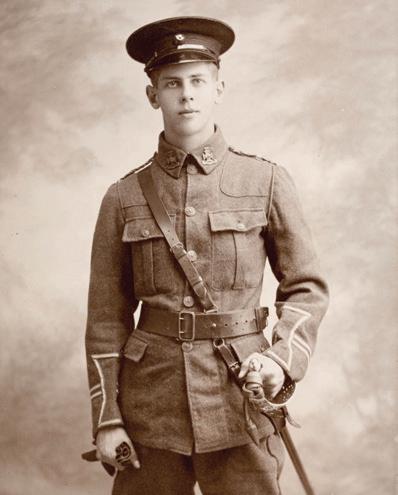
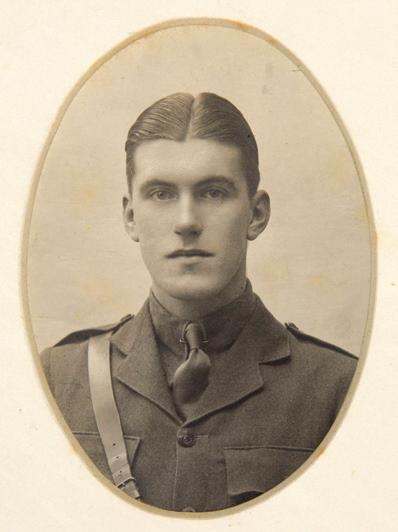
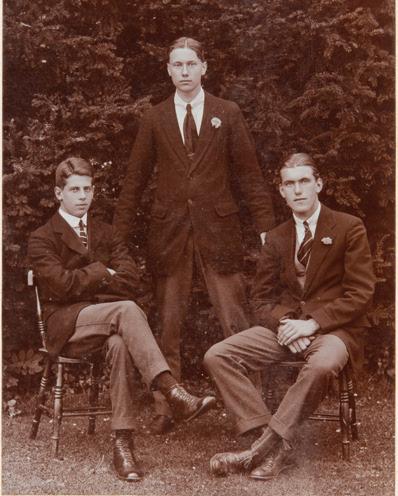
With history in mind, Alice Winn (PR 2009-11) brings alive the experiences of a generation of OMs killed at the Western Front in her work of historical fiction, In Memoriam. Her debut novel is based on her research from the College’s online archive of The Marlburian magazines from 1914 to 1919. The stories she found there ‘cry out to be remembered’ and she captures the tragedy of ‘Preshutians’ going to the front so vividly. I have also been the editor of The Marlburian magazine for the last 14 years and feel privileged to have committed to print a record of Marlborough’s recent history for the future.
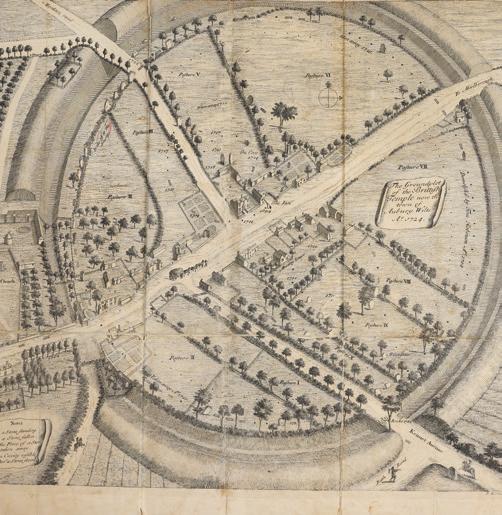
The early history of the school campus depicted in William Stukely’s skilled drawings of 1724 are the earliest surviving views of the College’s unique setting.
We celebrate the 300th anniversary of their publication in Itinerarium Curiosum from our Rare Books Collection. Moving to the present, Anna Pembroke (MO 2013-18) has examined the history of football at the College as a new era of girls’ league football began this year, 70 years after the Granham Casuals became the first football team at the College.
We can see how the past continues to shape the future with the opening of Morley House at Marlborough College Malaysia and the naming of it after David Morley CBE FRCP (C2 1937-41), whose work contributed so much to paediatric healthcare in developing countries. So too the benefaction of Gerald Curgenven (C1 1890-95), whose legacy has provided a significant bursary fund for gifted or deserving pupils from Cornwall. Last but by no means least, the magazine would not be complete without highlighting OMs who are able to bring benefits to others. Sebastian Pole (PR 1983-87) was aware of the impact that food has on our health and the environment way before supermarkets went organic. He started experimenting with different blends of herbal tea in 2001 and today Pukka is a familiar brand on our shelves. We also spotlight two OMs whose dedicated work is helping to create a more equal society. Through their work in equality, diversity and inclusion, they are provoking both thought and action in today’s workplaces.
Finally, I would like to thank all the contributors this year, who have written so masterfully, and our archivist Gráinne Lenehan, who has responded so helpfully to all my requests. To the OMs I have met at events and from whom I have extracted promises, ideas and goodwill, please keep in touch. I’d also love to receive news and ideas from any OMs who would be willing to share it. I hope you enjoy this year’s magazine.
Jane Green (B3
1982-84)
Editor, The Marlburian Club Magazine clubmagazine@marlboroughcollege.org
Contributors
Alex Wright (B1 1989-94)
Alex is a freelance copywriter and journalist, specialising in technology and financial services. During his career he has worked as a sub-editor for the Daily Telegraph, The Times and Sunday Times. He also had a five-year stint as the deputy business editor on Bermuda’s national newspaper, the Royal Gazette
Anna Pembroke (MO 2013-18)
Anna works as an educational consultant, having just graduated with a degree in English Literature and Creative Writing. Previously, she worked at a language school in London and has published short fiction and poetry in literary journals. She hopes to build on her work with Ukrainian refugees in the non-profit sector.
Jane Vyvyan (CO 1981-83)
Jane is a co-founder of a business providing commercial advice and representation to media content producers. Earlier in her career she was a corporate finance and general commercial solicitor. Jane is Chair of Governors at Farleigh School and has held a number of trustee positions in the education and autism diagnostic fields.
Alice
Winn
(PR 2009-11)
Alice is the author of In Memoriam, for which she won the Waterstones Debut Fiction Prize and Waterstones Novel of the Year Award in 2023. She grew up in Paris and was educated in the UK, gaining a degree in English Literature from St Peter’s College, Oxford University. She lives in Brooklyn, New York.
David Walsh
(C1 1960-65)
David taught at Tonbridge School, retiring as Second Master in 2009. He had 10 years post-retirement as Chairman of the Old Tonbridgian Society and edits The Old Tonbridgian Magazine He has authored and co-authored five books about the two World Wars, including contributing many of the stories in Marlborough and the Great War in 100 Stories
Kasase Kabwe
(LI 1993-98)
Kasase is an HR professional, currently the EMEA Head of Executive Research at Google, and a Council member at Marlborough College. After Marlborough he studied Business Administration at the University of Bath before embarking on a 20-year career in the City as a banker and talent acquisition executive.
Stay in touch with the latest news and events
Please update your contact details by using our online form www.marlburianclub.org/ update-contact-details. Alternatively, you can give us a call on 01672 892 558 or email marlburianclub@marlboroughcollege.org
Andy Morley (C2
1968-73)
Andy is now retired after 40 years working all over the world as a geologist and IT consultant in the oil and gas industry. He enjoys travelling and outdoor adventures with his wife, Kathy. They are proud of their two sons, James and David, and enjoy their three grandchildren. They live in Houston and Austin, Texas.
Emily Foster (PR
1993-95)
Emily founded The Third Culture, a company that creates spaces for fearless and human inclusion conversations. After leaving Marlborough, she studied English at Leeds University. She worked in the media industry for over 20 years in London, Manila and Hong Kong, fully transitioning into the inclusion field in 2021.
Simon McKeown (CR
2009-)
Simon is Head of the History of Art Department at Marlborough, and also teaches some classes of English. Since 2009 he has served as Keeper of Rare Books and mounted various exhibitions and given talks based on the College’s collection. In 2023 he published Rare Books at Marlborough: An A to Z
This Year
‘I was a member of the Chapel Choir, the experience of which stood me in such good stead in the London choral world, where I joined the renowned Monteverdi Choir at the age of 19.’
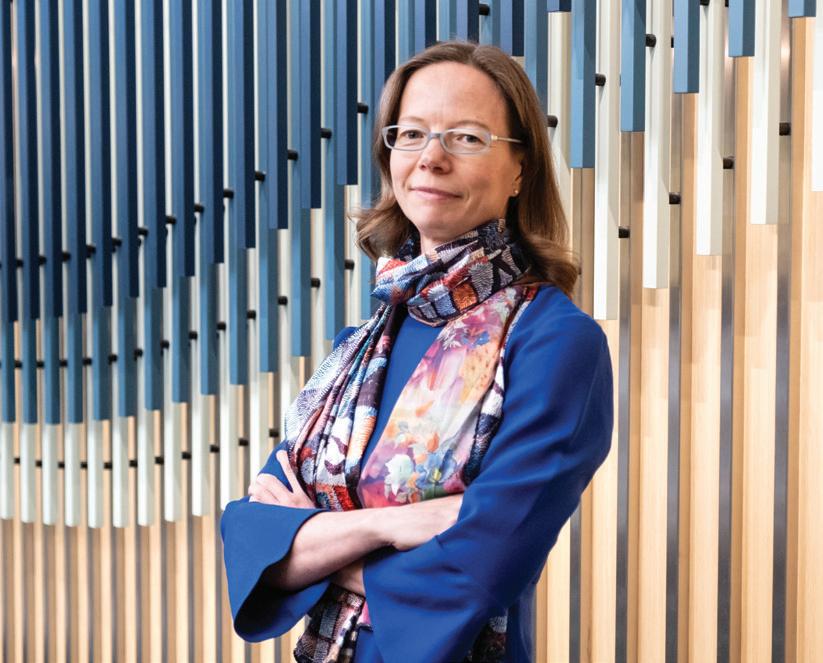
Iam delighted to be the incoming President of the Marlburian Club. I was a committee member a few years back, along with Chris Carpmael (C1 1980-84), who impressed me enormously with his positive ideas and energy. My many thanks to Chris for his sterling work as President over the past year. I am also indebted to the Development Office, without whose help and support my task would be impossible. In my time at Marlborough College (B2 1972–74), there were only 50 girls in the school, who were all in the Sixth Form.
One of my A levels was Maths, and I had done my sums and worked out that the ratio of girls to boys was 50:750 = 1:15 or, if you were to just consider the Sixth Form boys, 50:200 = 1:4. With this in mind, I reckoned I had a pretty good chance of acquiring a boyfriend – and I was right! I had several –much to the embarrassment of my younger brother, Tom (B3 1970-75). Nowadays, the ratio is nearly 50:50, and having a dedicated OM Women’s Networking Group to support women at every stage of their careers reflects just how times have changed.
However, even more important in the long run were the opportunities that were given to me while at the College. From the start, I was a member of the Chapel Choir, the experience of which stood me in such good stead in the London choral world, where I joined the renowned Monteverdi Choir at the age of 19.
My big opportunity at school came when I was asked to sing Handel’s soprano solo ‘I Know That My Redeemer Liveth’ in Chapel one Sunday morning. It was a compulsory chapel, so I reckon there must have been about 1,000 people in the congregation (including beaks and parents). It was an experience I shall never forget. Potentially terrifying, it was a make-or-break moment for me. But as my voice reached the high notes, the Chapel’s acoustics took the sound right up into the roof and I felt absolute exhilaration. I was hooked! This experience gave me the confidence I needed to sail through my imminent audition to study singing at the Royal Academy of Music, which eventually led to a career as a soprano soloist and a professional choir singer.
I’m sure there are many OMs who sang in the Chapel Choir who have used that experience to continue singing in later life. Judging by the talent and enthusiasm of those who sing in the choir for the OM Carol Service, I would say this is definitely the case.
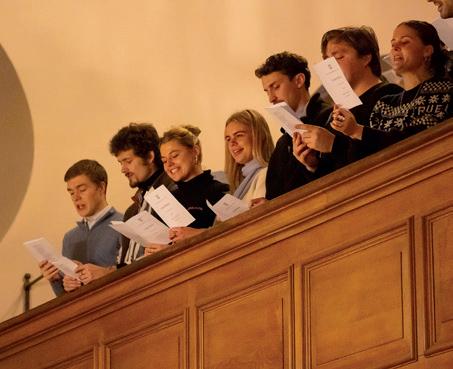
But the College Chapel and its fantastic acoustics are what all Chapel Choir singers remember with such pleasure. So, we are planning a Choral Evensong event in Chapel on 2nd March 2025. To sing in the OM choir, you have to have sung in the Chapel Choir during your time at Marlborough. But we also need a large congregation to raise the Chapel roof in the hymn-singing – so, regardless of your singing capabilities, do come along and relive the experience of us singing together. I can guarantee you will feel all the better for it!
Lis Priday (B2 1972-74) President of the Marlburian Club
From the Chair
‘This year, on a Sunday in June, we hosted the Marlburian Club Garden Party (formerly known as Club Day). The event was well attended, with OMs of every generation and their families.’
First, I’d like to extend a very warm welcome to Jane Green (B3 1982-84), as the new Editor of The Marlburian Club Magazine. As an OM, Jane understands the depth of affection in which our members hold our magazine. To this end, Jane has been striving to ensure that the magazine continues to deliver quality articles that appeal to Marlburians of all ages.
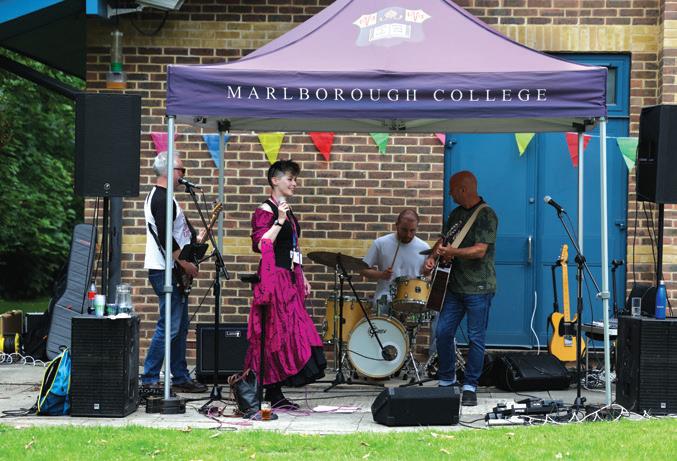
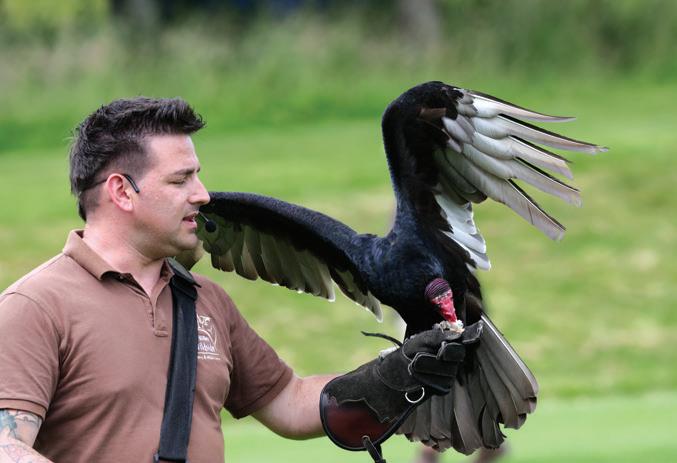
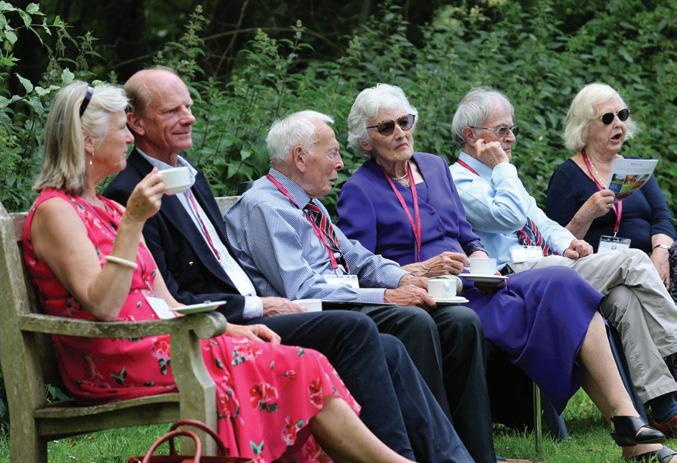
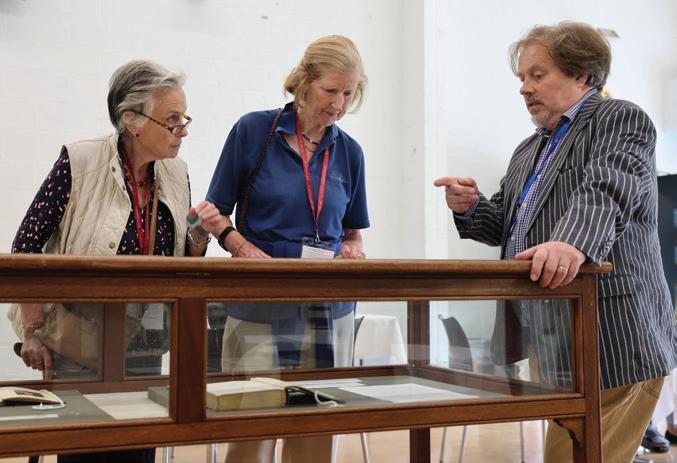
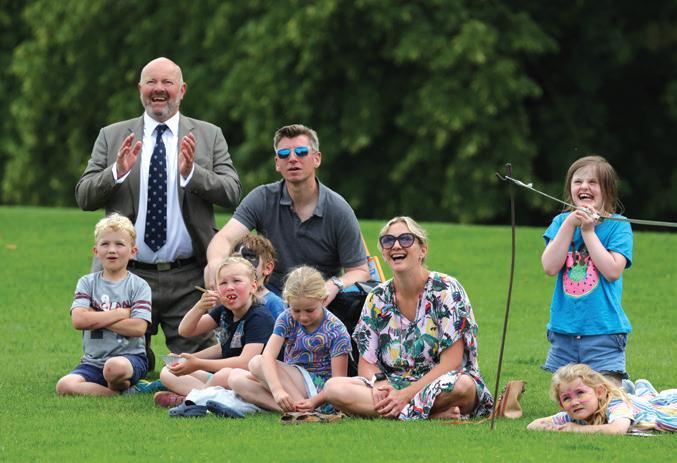
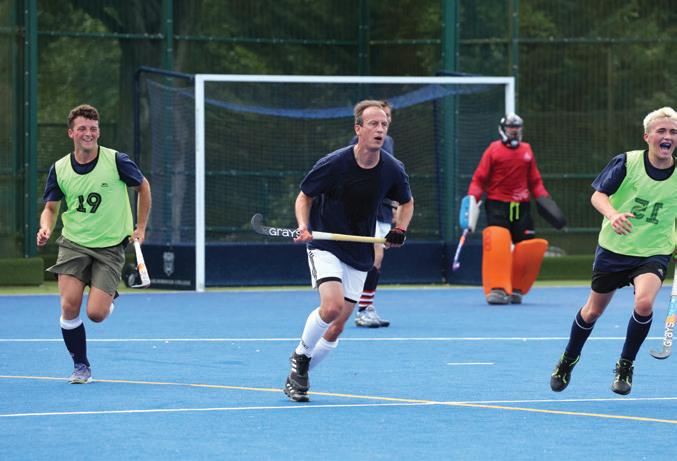
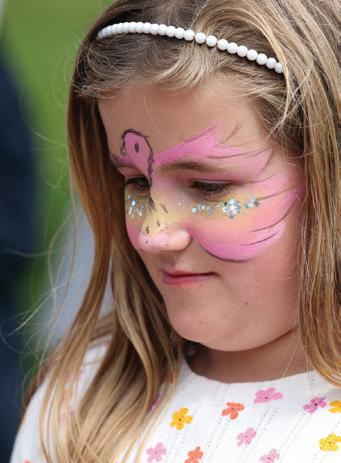
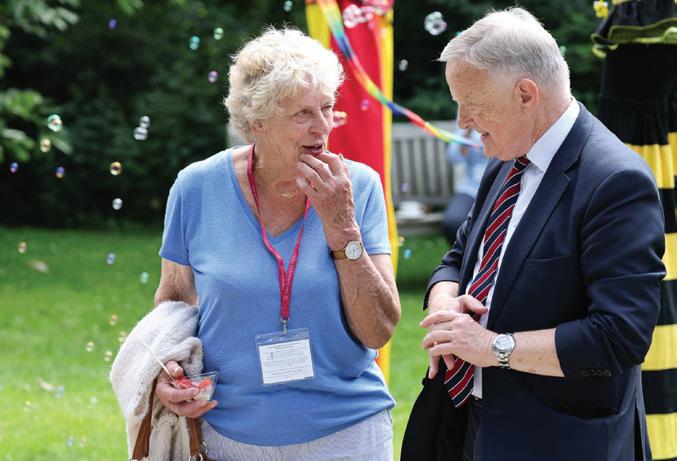
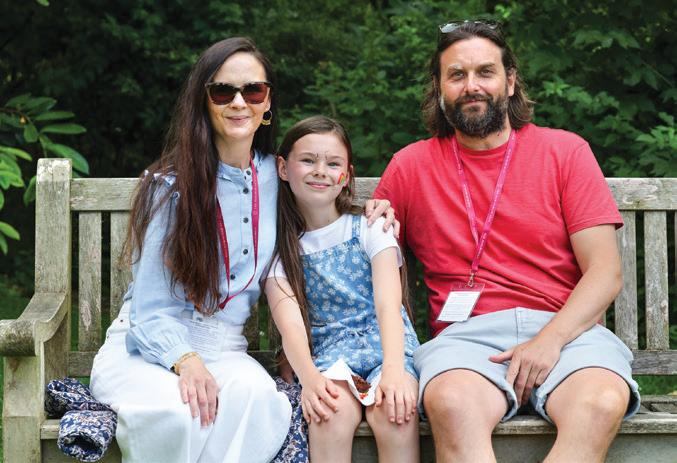
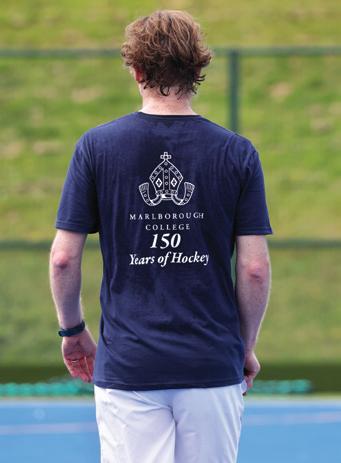
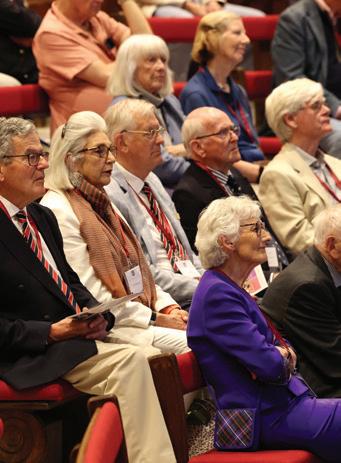
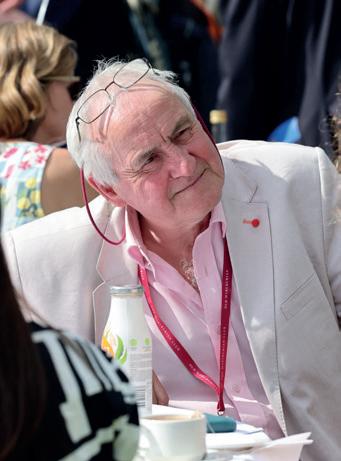
Social events remain a popular feature of our calendar. This year, on a Sunday in June, we hosted the Marlburian Club Garden Party (formerly known as Club Day). The event was well attended, with OMs of every generation and their families (images from the day can be found on page 84). Many came for the morning Chapel service followed by the lecture in the Memorial Hall and stayed for a nostalgic pupil-style lunch in Norwood Hall. Throughout the afternoon, there was entertainment for all, including a birds of prey display, magician Michael King (CO 1970-74), an immersive Gong Bath delivered by my sister, Julia Edwards (MM 1991-93), and a celebration of the 150th anniversary of hockey at the College.
Thank you to the OMs who have organised their own events this year, in particular to Lucy Martin (SU 2011-13), who organised a 10-year reunion for the class of 2013 in May, and to Peter Wong (B3 1958-62), who organised a reunion in August for those in B3 between 1958 and 1962. The Club organises reunions for those celebrating their 5 year, 25 year and 50 year reunions, but if you’d like to celebrate another milestone of your own or host an event closer to wherever you are in the world, please do let us know. We are more than happy to work with you on the event and advertise it to your contemporaries.
Meanwhile, professional networking is well and truly alive, with over 2,900 members signed up on the new MC Connect platform. This amazing resource offers access to information about professional networking events and mentoring (read more about this on page 46). The platform also includes a Marlburian business directory and space to advertise jobs and opportunities to Club members. If you have not already signed up, please do so to enjoy all these benefits!
11,761 contactable Old Marlburians
This year 1,117 people attended a Club event, including 535 people who attended their first event
Over 2, 900 on MC Connect
3,000 OMs
follow one of our social media channels
Rhiannon Bragg (PR 1988-90), who you may remember from an article in the 2022 edition of the magazine, has won this year’s Old Marlburian of the Year. Over the past 12 months she has worked incredibly hard in the pursuit of improving the experiences and outcomes for victims of stalking and domestic abuse (more can be read about her most recent work on page 26). This is now the third year running that a selfless OM has been recognised – previous winners were Mayoor Patel (PR 1973-77), for his dedication to the empowerment of poor and disadvantaged children, and Rosie Richards (EL 2010-15), due to her outstanding contribution to the non-profit scene, both nationally and internationally. We value your submissions to this venture and look forward to hearing more about your amazing efforts to make a difference.
I would also like to thank the President, the Club Committee, Professional and Sporting Group Heads and the Development Office for all their hard work and support this past year.
Karen Hill (B2/MM 1988-90) Club Chairman
My Memories: Losing my Leg in the Remove
‘There was nothing for it but to pick it up and walk on with the cello under one arm and the foot in the other....’
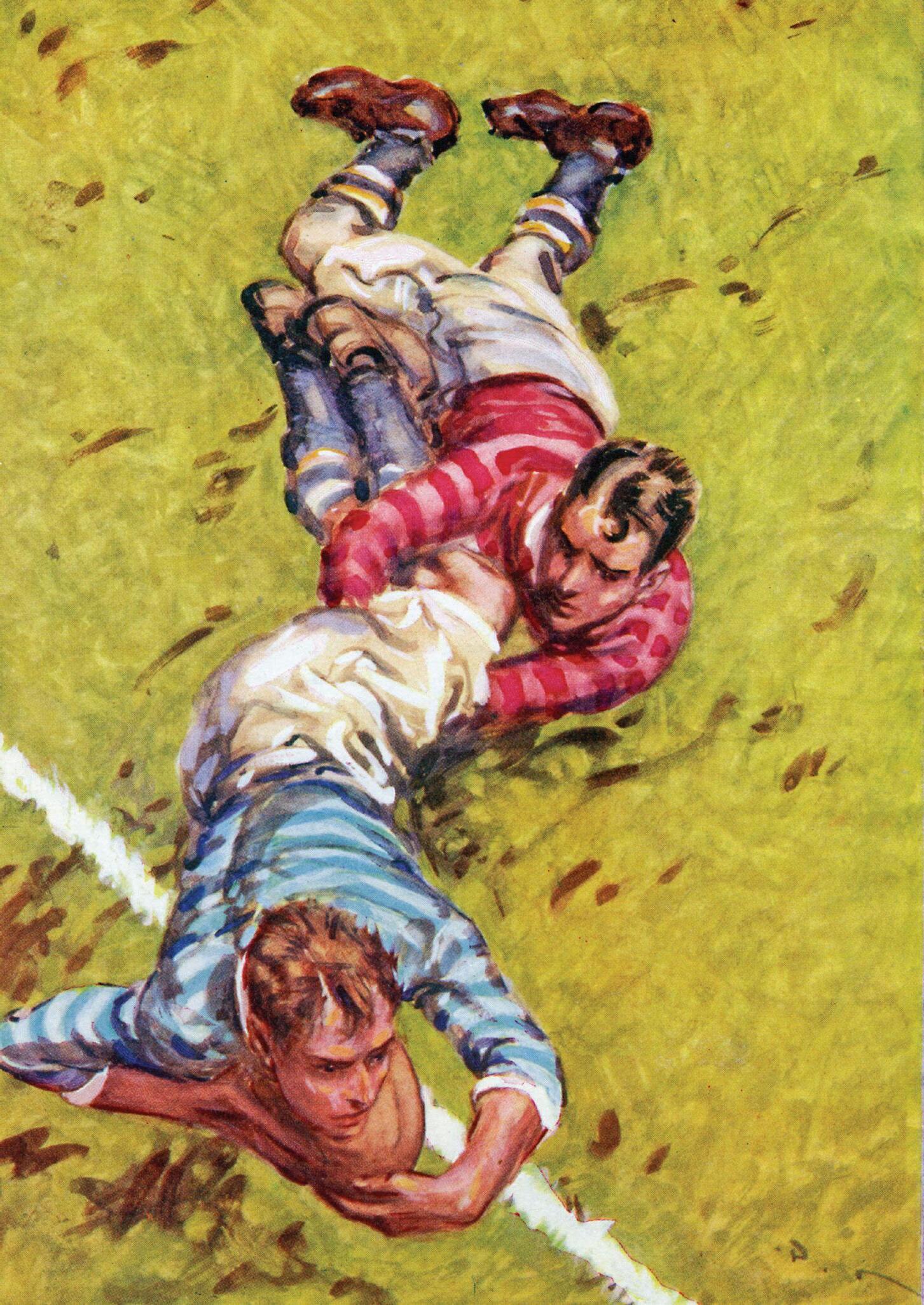
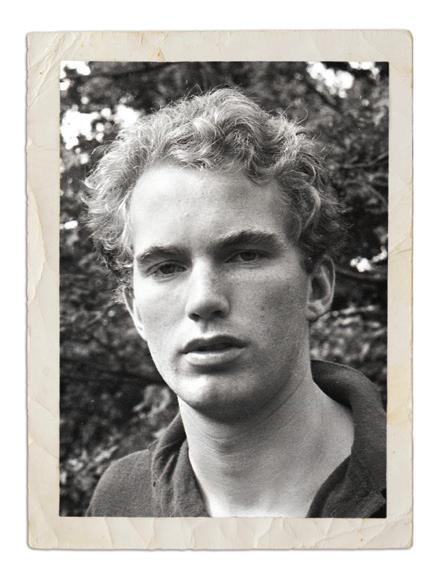
Ilost my leg playing a rugby trial against the Colts when I was 14 and in the Remove. I think, what happened was that the tackler had his arms around my knees and his weight over my feet, so there was an almighty crunch as my right knee was severely dislocated. I was taken off to the John Radcliffe Hospital in Oxford, where they tried for months to save the arteries, but around Christmas, it had to come off.
In those days the prosthetics were still pretty primitive. For the first year, one was issued with a ‘rocker’. This had a fixed knee, which could be released to sit down, and just a semi-circular block for a foot. The idea was that it gave you stability while you were getting used to a prosthetic limb, but it was horrid to walk with. Then you moved on to a proper prosthetic with a knee joint. The legs in those days were made of an aluminium alloy, into which you inserted a heavy woollen ‘stump sock’. The socks had to be washed after each day and quickly became thick and heavy. The leg was held on by a heavy belt round the waist and another over the shoulder, though I got rid of the latter fairly quickly. The leg had to be swung through from the hip and, even though there was a heavy elastic band to help bring the foot through, was very ungainly.
The leg creaked and groaned, which was a bit embarrassing, but it resulted in one nice story. I had started to learn the cello and the classroom was at the other end of town. One day, walking back after my lesson, there was a dreadful crack and my foot came off. There was nothing for it but to pick it up and walk on with the cello under one arm and the foot in the other. An old lady coming the other way nearly fainted. Nowadays, the legs are much more sophisticated; my current one has a hydraulically assisted knee controlled by a microprocessor, which makes walking much easier.
I had a year off school with some home tutoring in English and Maths and returned to school the following year and went straight into A level classes for Chemistry, Physics and Maths. I thought the boy who had tackled me must have felt awful about it, so I found out his name and, though we never spoke about it, I made it clear there were no hard feelings. It was only in my last days at Marlborough that another boy with the same name came up and apologised.
I had been very keen on sport at my prep school, so the loss of my leg was pretty grim. I started playing cricket again but, at least
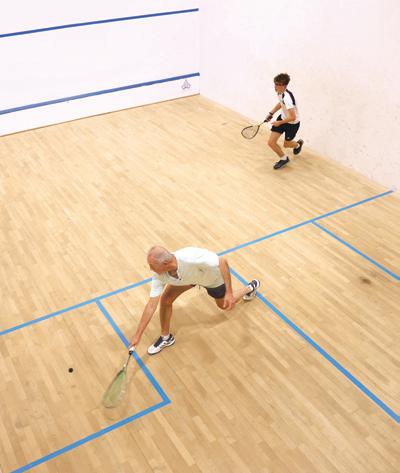
to start with, was totally frustrated, as I kept stepping back onto my wicket – the worst possible way of getting out. I found I could play squash and tennis to a reasonable level, hopping and skipping around the court. The school encouraged me to try fencing and I loved it, eventually fencing for my university (Nottingham). My crowning glory was being runner-up in the East Midlands fencing championship, though I have to admit the opposition was a bit depleted, as there was a lot of flu around.
I’m often asked how losing my leg at such a young age affected me. At the time, I thought I was coping reasonably well, but looking back, I clearly wasn’t. I’d kept very much to myself and made no close friends. I remember when I went up to Nottingham University, I consciously told myself that I had to start making friends properly, which I did. Later life has been good. I got a 2:1 at Nottingham, and spent many years in Singapore and Australia, ending up as MD of Chubb Australia. Later, I had my own company distributing high-security safe locks in the UK and Ireland.
Lord Bill Hayter (Bill Chubb, B3 1957-62)
If you have a memory you’d like to share please email the Club Magazine Editor: clubmagazine@marlboroughcollege.org
Totally Inspirational
George Heywood (Master 1939-52)
Francis Melville Heywood, known as George, arrived at Marlborough to become Master in 1939 aged 30, just one term before the outbreak of the Second World War. His arrival marked the end of one era and heralded the start of another.
The staid and conventional world of the 1930s meant Chapel every day – and twice on Sundays; black school cap – and stiff collars on Sundays; everyone addressed by surname. Into this world came unconventional George Heywood, young and brilliant – scholar of Haileybury, scholar of Cambridge, double first and rugby blue.
The conjunction of George’s arrival and the outbreak of a six-year war spelt disruption and change in the established order of things. There was food rationing, a total blackout at night and shortages of all sorts, and some of the younger members of Common Room (his contemporaries) disappeared into the armed services. George had to cope with all this, helped by an ageing staff of men who stayed on long after normal retirement age. And a further complication was the arrival, at short notice, of the City of London School as evacuees.
Marlborough can be thankful – and grateful – that the College was in the hands of a man who combined academic prowess with a flair for administration. George brought Marlborough through the war unscathed and set about the post-war reorganisation and development that started us on the path to where we are today.
But none of what I have written so far has illustrated the strong faith and sensitivity of George Heywood. At the height of the war, when news of casualties was coming thick and fast, George wrote to a friend:
‘It is not very pleasant to see 710 boys in front of you (in the Memorial Hall); to realise that it is your job to ensure for them as good an education as possible; to wonder what on earth will happen to them within three years, and whether they will have any chance of using what they’ve learnt; and then to try to utter words sizzling with encouragement and optimism.’
David West OBE (B1 1935-40, CR 1948-85), Lt Col CMDG CCF, Housemaster, Registrar, Archivist
John Cunningham (C3 1951-55) was a very junior member of the school during Heywood’s later years and proposed him as a totally inspirational figure in Marlborough’s history. This piece is his obituary, written by David West for The Marlburian magazine in 1996.
Off the beaten track
Alan Cassels (B1 1963-68) has been travelling all his life and in February this year he completed his quest to set foot in every country in the world. He lived in the Middle East as a child and his career in the airline industry and express logistics allowed him to live and work in countries in Europe, Asia and Africa.
How can you drive through a coup d’état and not know it? How do you escape from a drunken soldier intent upon showing you how his gun works? Well, the wonderful thing about travel, especially in ‘difficult’ places, is that help can come from unexpected quarters. My family drove right through a coup in Lebanon on the last day of 1961. Communication then was not what it is today. We did come across lots of soldiers, tanks and checkpoints, but assumed they must be there to deter revellers during that night’s New Year’s Eve celebrations. They didn’t seem to know any more than we did. At each checkpoint, after some headscratching, we were waved through. It was only when we had driven the whole length of the country that we discovered what had transpired!
On the Trans-Siberian railway in 1973, I did indeed share a cabin with an extremely drunk Russian soldier who, after imbibing enormous quantities of vodka, attempted to demonstrate how to load his gun. It was only through the kindness of a local fellow traveller, whom I had befriended after we left Irkutsk, that the situation was resolved. He saw what was happening as he walked along the train’s corridor. He came in, told the soldier off in no uncertain terms, confiscated his gun and told him to go to sleep – which he did.
There have been dead dogs under the bed in Paraguay; aggressive youths in Chad, upset at finding a westerner travelling in their country because Russian propaganda has told them we are only there to exploit their resources; and a gunfight between the police and the army in Haiti at the
exact spot where I had been standing five minutes before. There was the time I was hijacked outside my house in Poland in the mid-1990s; and a close shave in Indonesia after 9/11, when I learned that, as a bomb goes off, you feel the blast before you hear the explosion; and so on.
One of the things you can do to mitigate some situations is to dress as locals do, so as not to stand out from the crowd. This was particularly useful in Afghanistan and Yemen. That way, it takes longer for ne’er-do-wells to clock that you are foreign and, hopefully, by that time you are through and gone.
This said, most travels go smoothly. It’s taken me a lifetime to visit more than 230 countries and territories and I have encountered problems in very few. Give me an opportunity to travel anywhere and I will gladly go.
If you have a travel story about a tricky situation, experienced the kindness of strangers or had an epiphany, please email the Club Magazine Editor: clubmagazine@marlboroughcollege.org
OM Entrepreneurs
93digital
The Founder: Alex Price (LI 2006-11)
The Business: 93digital is a web design and digital marketing agency specialising in working with B2B tech and software clients.
The Beginning: Alex started doing £7-an-hour freelance web design work in his room during Lower Sixth (despite the College’s rules on term-time employment!). His first client used to drop a hard drive with the files he needed at the Food Gallery to pick up over lunch.
The Eureka Moment: Winning Amazon as a client was a great feeling and validation of having built a strong business.
The Keys to Success: Perseverance. There’s no such thing as an overnight success.
The Present: Alex grew the business to 35 people and £3m annual revenue before selling it in 2022. He spent 18 months
working for the acquirer and left at the end of 2023 to find his next challenge.
The Future: Alex intends to start a new business, but he’s still in the process of working out exactly what it is! In the meantime, he’s travelling and recharging.
The Nitty-Gritty: alexprice.co.uk 93digital.co.uk
Excel in Property
The Founder: Lucy Gordon (NC 2002-07)
The Business: Consultancy helping real estate investors make strategic investment decisions using financial models and training aspiring analysts.
The Beginning: After deciding to leave her job due to mental health issues, Lucy started working freelance, supporting investors and operators across all sectors of real estate.
The Eureka Moment: When she handed in her notice, Lucy’s boss asked her if she would continue to support them as a consultant.
The Keys to Success: Nurturing relationships and gaining as much experience as possible.
The Present: Excel in Property has supported investors through modelling over £1.2bn worth of real estate transactions, and has developed a series of training courses for analysts, enabling them to build a financial model from scratch. Lucy also
wrote the practical application guidance for discounted cash flows for the RICS isurv knowledge platform.
The Future: To support aspiring analysts with their careers, encouraging better quality analysis and appreciation of their contributions to real estate investment.
The Nitty-Gritty: www.excelinproperty.com hello@excelinproperty.com
ChicP
The Founder: Hannah McCollum (MM 2003-08)
The Business: ChicP creates a variety of hummus and other plant-based foods, based on a passionate commitment to reduce waste and create healthier, natural plant-based products.
The Beginning: Running around London wholesale markets at 6.00am, rummaging in bins for surplus vegetables.
The Eureka Moment: Getting listed with Wholefoods and First Distributor at the same time.
The Keys to Success: Focusing on the priorities that are going to get you sales.
The Present: New fridge-less (ambient) hummus snack pots, which are a huge opportunity, the first of their kind in the UK.
The Future: Manufacturing in India and the United States to supply fridge-less snack pots over there.
The Nitty-Gritty: www.chicp.co.uk hannah@chicp.co.uk
Stairpay
The Founder: Floris ten Nijenhuis (LI 2006-11)
The Business: An app that connects first-time buyers to institutional capital to facilitate gradual homeownership transactions.
The Beginning: Being part of ‘generation rent’ is not fun for anyone, especially when the only hope of getting onto the property ladder is to rely on the Bank of Mum and Dad. After cutting his teeth in investment banking and tech startups, Floris decided to take matters into his own hands and try to make a difference.
The Eureka Moment: Reading a news article talking about legislative changes to shared ownership, outlining the need for an automated solution to buying equity in homes gradually, made Floris think he had a way into what is normally a closed-off and backward environment.
The Keys to Success: Redefining the public’s perception of ‘affordable housing’, moving away from the idea that it is social housing and towards it being seen more as a sustainable way for younger generations to buy homes.
The Present: Fixing the inefficiencies in the Shared Ownership scheme by increasing the rates at which people can buy more equity in their homes.
The Future: Become the go-to app for first-time buyers struggling to get onto the property ladder, create a network of institutional capital, and connect the two in order to fix the housing crisis in the UK and beyond.
The Nitty-Gritty: www.stairpay.com floris@stairpay.com
Next year’s Entrepreneurs...
If you would like to be featured on the pages of next year’s OM Entrepreneurs, please scan the QR code and send us more details about your business. www.marlburianclub.org/entrepreneurs
OM News
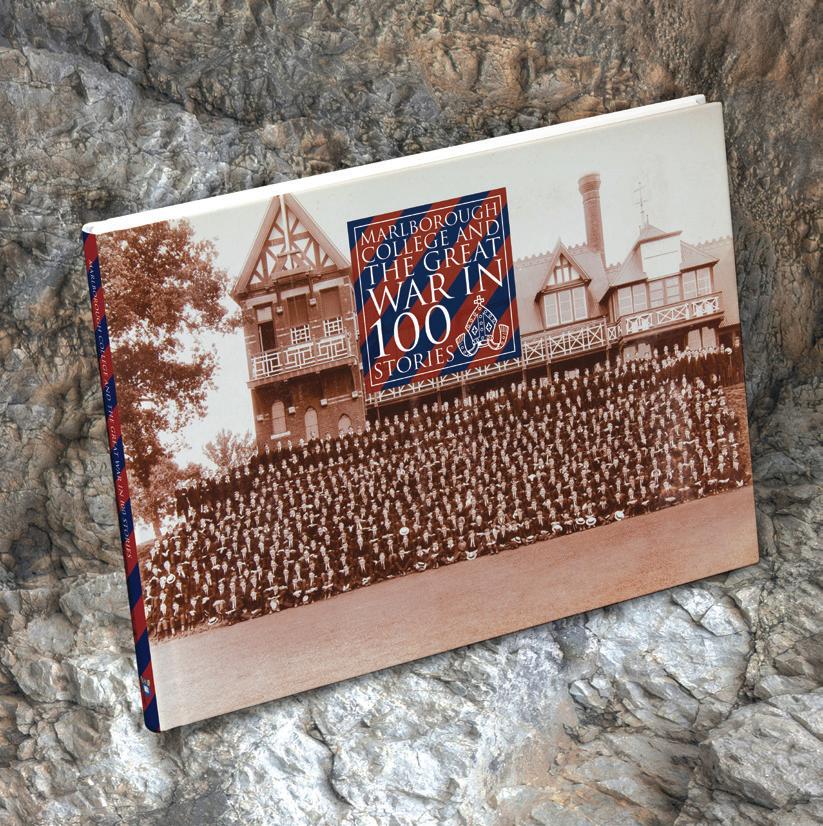
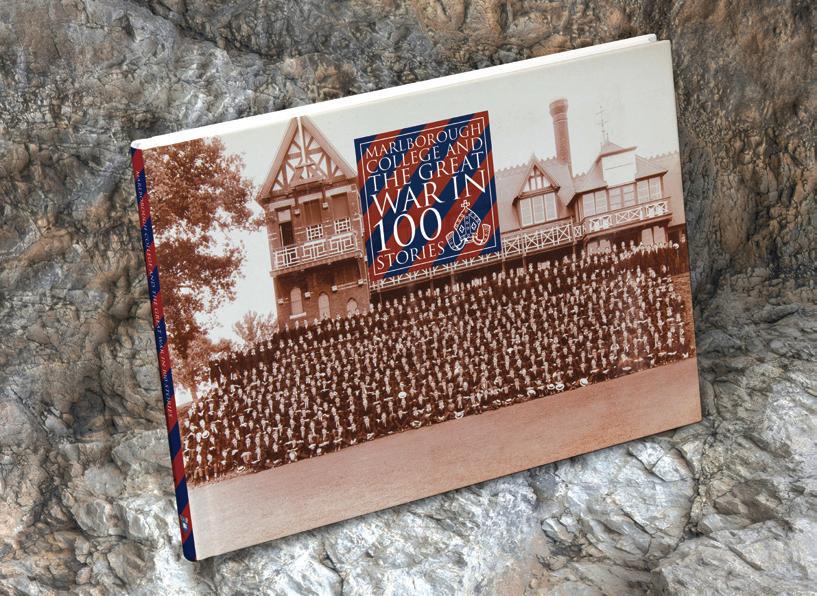
Marlborough College and the Great War in 100 Stories
This limited edition publication endeavours to honour the memory of the 749 former pupils, teachers and staff who gave their lives during the First World War. It draws together stories from across the whole spectrum of this community in wartime – before, during and after – those who died and those who survived. It is a unique journey of reflection through which runs a strong sense of shared Marlborough heritage, experience and memory. It is, in the words of one Marlburian parent, ‘the book every Marlburian family should have’.
All proceeds from the sale of this book go towards funding the Marlborough Difference Campaign for life-changing bursaries.
Michael Goodrick (PR 1945-49) retired from his career as a general surgeon in Seattle. Now 92, he lives in Seattle but winters in California. This year he has attended OM get-togethers in New York, and Pacific Palisades, California, with his wife of 60 years, Linda. Michael plays tennis, does water aerobics and Jazzercise and, he says, generally makes a nuisance of himself.
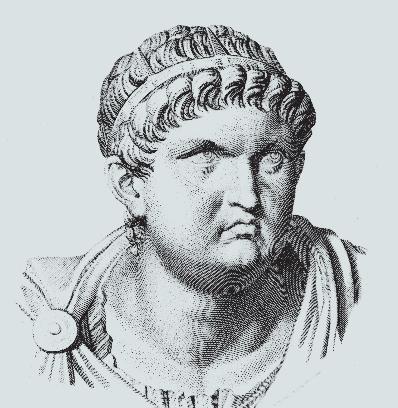
Michael Faunce-Brown (B1 1949-52) left Marlborough and joined the Army, the Queens Bays cavalry in Aqaba, Jordan, as a 2nd Lieutenant and was soon in charge of its transport. After National Service, he survived stone-throwing Arabs in Amman, played in the 10-piece dance band, The Daltones, on tenor sax in New Zealand and learned coarse rugby. He’s also written a musical, Emperor Nero, as well as eight books.
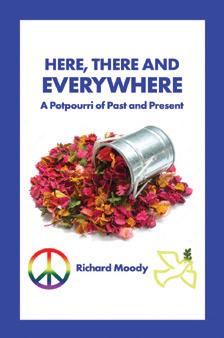
Richard Moody (C3 1954-59) has written an article about his time at Marlborough, which was published in the local Cranbury village magazine, The Chronicle
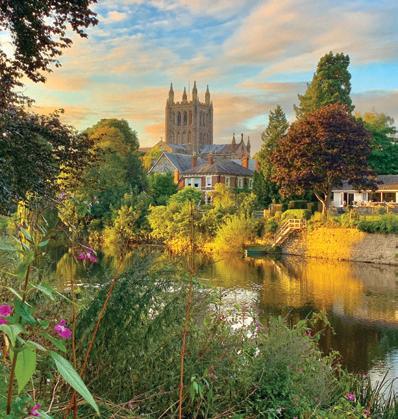
Anthony Bradshaw (PR 1955-60) lives in an idyllic spot in Herefordshire, England’s best-kept secret, five miles north of Ledbury. He is surrounded by apple orchards, which are glorious at blossom time, hopyards, tree-lined hillsides and
Emperor Nero
distant views of the Welsh mountains. His garden pond is home to ducklings, baby moorhens and Canada geese. Sheep and lambs graze contentedly in the meadow. What could be more delightful? Yes, old age has its pitfalls (falls being the operative word!), but it also has much to commend.
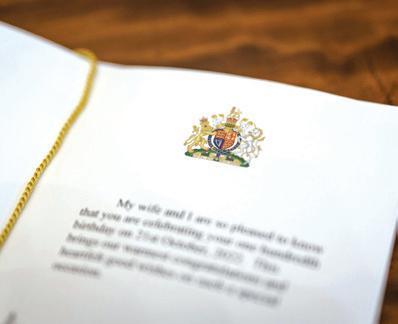
Christopher Clark (B3 1955-60) shared the news that he and his wife Katie marked their 60th wedding anniversary in March 2024, which brought them a congratulatory card from the King. Christopher’s working life comprised a 42 -year career at the FTSE 100 company Johnson Matthey, where he was Chief Executive for his last six years. Now retired and in his 80s, Christopher is a governor of two state schools in south London. Christopher has three children and nine grandchildren. His daughter, Joanna, was briefly a member of Common Room at the College, and his eldest grandson sang in the choir at Kings College Cambridge and is now an opera singer in Germany.
Robert Stedall (LI 1956-60) is now the Senior Member of the Ironmongers’ Livery Company, having been Master in 1989. Robert is a keen writer and has written nine history books in his retirement, mainly focusing on Tudor history. He is currently supporting work on the rewrite of the The Ironmongers’ Company, which is due for publication in 2025. When Robert’s granddaughter joins the College in September, she will be the fifth generation of his family to attend Marlborough.
Michael Richards (B3 1956-60) whose Marlborough education led him to Hartford College, Oxford, went on to an engineering career, becoming a graduate chartered engineer and working around the world. Michael has lived in the United States for 18 years and is willing to help any OMs thinking of going there for work or a holiday.
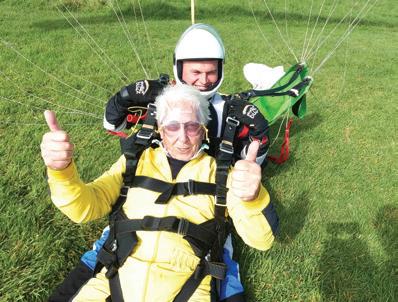
In the Summer of 2023, John Walters (C3 1957-62) took the opportunity to go paragliding in the French Alps, joined by three generations of his family – all in the air at the same time. With the taste for
adrenaline, John then decided to skydive from 15,000 feet in Devon. Having never done anything like this before, John, who was approaching 80 at the time, found the process to be exhilarating, good fun and rewarding.
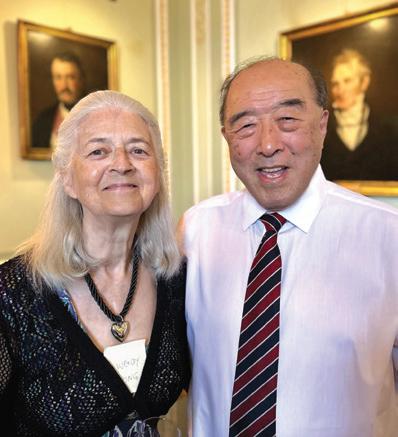
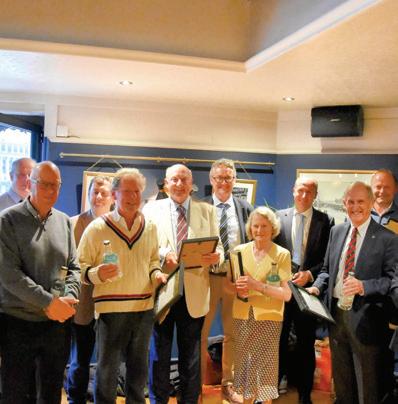
Peter Wong (B3 1958-62) organised a long-awaited reunion for those in B3 between 1958 and 1962. Over lunch at the Oriental Club, OMs reconnected, reminisced and celebrated their memories of Marlborough College some 65 years ago.
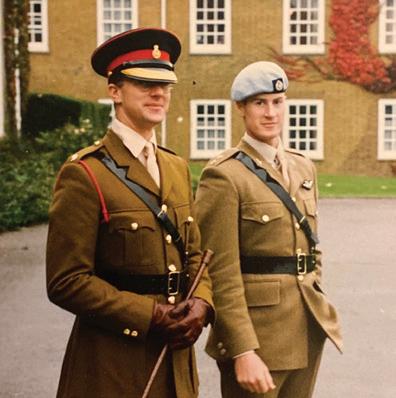
From
1955-59)
1947-51) and Allan Adair (C2 1965-69), the Household Liaison Officer.
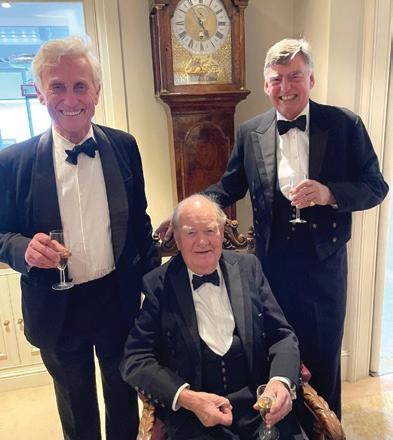
Three OMs who served on the Royal Yacht Britannia during the late Queen’s Silver Jubilee Tour of the Pacific Islands, New Zealand and Australia in 1977 were present at a reunion at the Royal Yacht Squadron, Cowes, in April 2024.
left: Nicko Franks (C1
, First Lieutenant Robert Worlidge (C2
John Walters took the opportunity to go paragliding in the French Alps
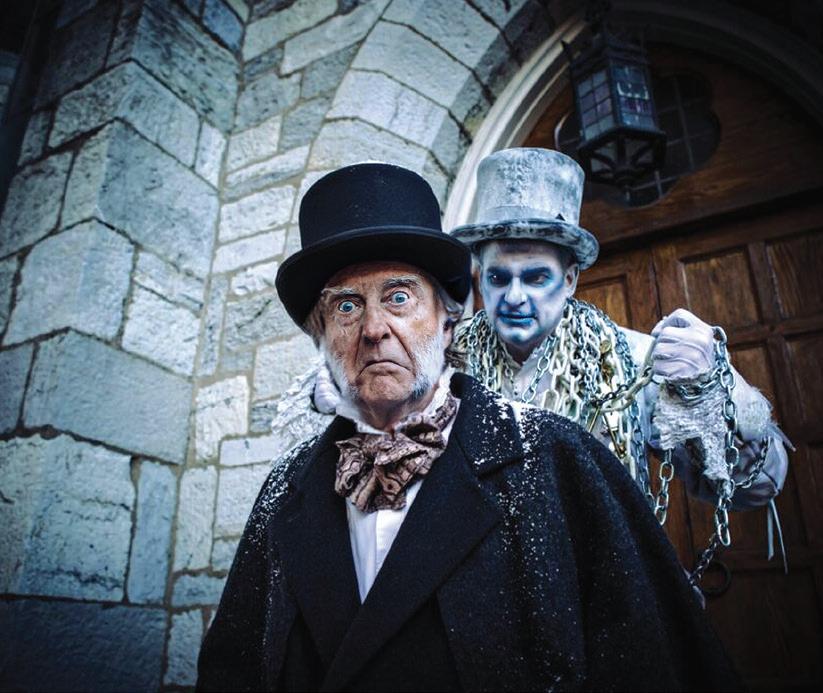
This year marks the 24th consecutive year that Nicholas Hughes (B3 1959-63) returns to play the iconic role of Ebenezer Scrooge in the annual production of Dickens’ A Christmas Carol at OpenStage in Harrisburg, Pennsylvania. Nicholas noted that a Marlburian accent is a definite asset when auditioning for roles in US theatre. At Marlborough, his only thespian activity was in the B3 production of Luther, with Christopher Martin-Jenkins (B3 1958-63) in the title role.
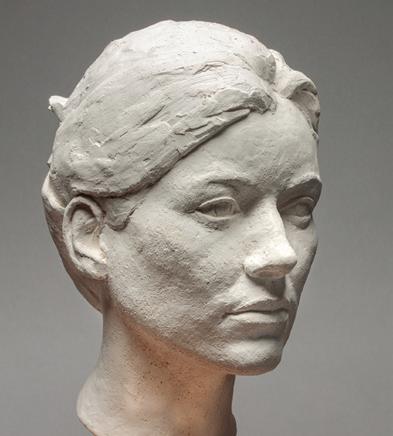
Robert Hunt (C3 1959-63) told us that his academic achievements were overshadowed by gymnastics, beagling, rock climbing and art during his years at Marlborough. Not that any of these activities, except for art, played a major role in his early career – 18 years in the Army followed by a further 18 years in the City.
In 2000, he decided to take up art, particularly portrait sculpture, full-time. He was elected a member of the Society of Portrait Sculptors in 2005 and soon became its Honorary Secretary. The Society’s annual exhibition in London is hugely popular and the 2024 exhibition attracted submissions from 32 countries. Robert’s work is generated from both private commissions, which happen to include portraits of several OMs, and public commissions.
John Grundy (B1 1959-64) wrote to the Club to share his recent unexpected encounter with an OM. John and his wife, Diana Bell, who live in Oxford, volunteered to host the first exchange visitor from the city’s newest link with Padua. When the ‘Italian’ visiting artist turned up, it was fellow OM Hannah Gauntlett (MO 1992-97)
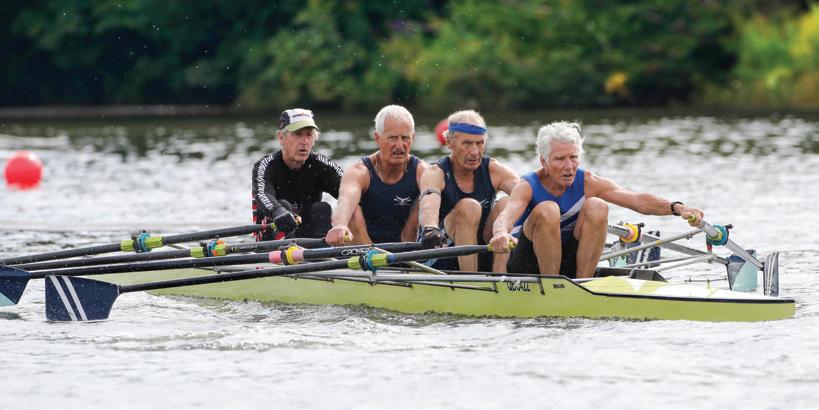
A week after Henley Royal Regatta, a regatta takes place on the same course for veteran rowers up to the age of 85. The photo of the winning crew in the quadruple sculls (age 75–80) features two OMs who were in the same House at the same time (C2 1960-64): Graham Bagnall at the stern of the boat and Chris George the bow steer. Graham and Chris were also both in the crew that won the quad sculls at the inaugural Henley Masters Regatta in 1994!
Jolyon Warwick James (PR 1960-64) works as a volunteer for radio station 2RPH in Sydney, reading print media on air. This includes daily newspapers as well as selected papers, journals and books. One particular programme includes Antiques Roadshow, a monthly repeated programme about art and antiques.
Nicholas Hughes as Ebenezer Scrooge
Henley Masters: Graham Bagnall at the stern of the boat and Chris George the bow steer
Hannah Gauntlett, artist
James Davenport (C2 1966-70), Hebron and Medlock Professor of Information Technology at the University of Bath, has been awarded an Honorary Fellowship of the British Computer Society. He first encountered computers when the IBM schools computer, created with the inspiration of Colin Goldsmith (CR 1955-91) and colleagues, visited Marlborough in 1969.
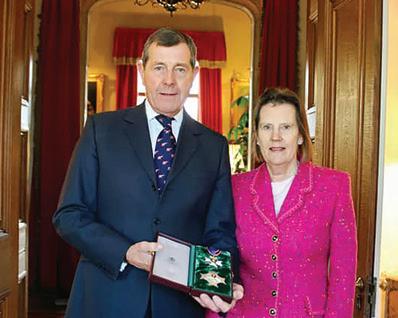
Charles Richards (B2 1966-71) retired at the end of March 2023 from his role as Deputy Master of the Royal Household and Equerry to the late Queen Elizabeth II after some 26 years in the Royal Household. He was made a Knight Commander of the Victorian Order by the King in November 2023.
Charles Boston (PR 1967-69) is a leading authority on leasehold enfranchisement and is the general editor of the Handbook of Residential Tenancies. He has also written an explanatory guide entitled How to Break Out of an English Residential Lease. In his spare time, he plays regularly with a bluegrass band and has written about 100 songs.
Berkshire Hospital’s League of Friends and as a volunteer accountant for the Berkshire Credit Union, which provides finance to people unable to obtain it from standard high-street banks.
Charles Watson (B1 1967-72) launched his latest art exhibition, New Perspectives, in Fulham, London, in April 2024. Having grown up in Malawi, Charles has fond memories of a wonderful childhood, with vibrant colours and diverse wildlife. All proceeds from the exhibition went towards Ripple Africa, a charity that focuses on changing regulations to try and restore sustainable fishing practices.
Patrick Woodroffe (PR 1967-68) is a long-time creative director and lighting designer for the Rolling Stones and led the design of their US Hackney Diamonds tour in Houston and another 17 shows across North America. He shared with us
that he ‘was not sure how his Marlborough education guided me towards this odd career, but I’m very happy for it!’
Mick Jonas (B3 1968-73) retired from full-time work in education in 2013, though continued working for the Independent Schools Inspectorate and taking other consultancy work. Mick and Sara have lived
Clive Arnold (C2 1967-71) is a retired chartered accountant who now works as a volunteer accountant for New Beginnings Reading, a charity that feeds the homeless. He also worked for 10 years at Royal
Patrick Woodroffe, creative director and lighting designer
Charles Watson launched his latest art exhibition, New Perspectives
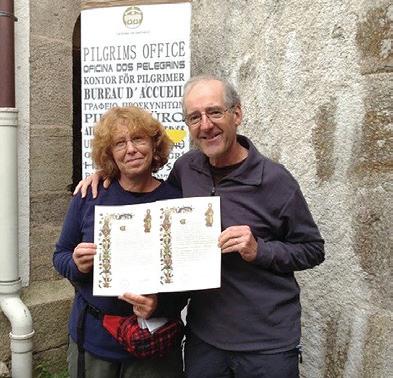
near Humshaugh in Northumberland since 2013. Mick is a governor of two Hexham schools. To mark the start of retirement, Mick and Sara hiked the Camino Frances over the Pyrenees and across northern Spain to Santiago de Compostela over four weeks.
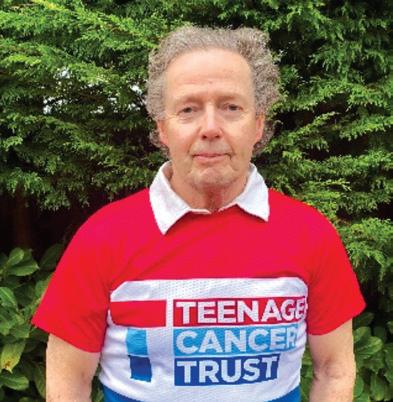
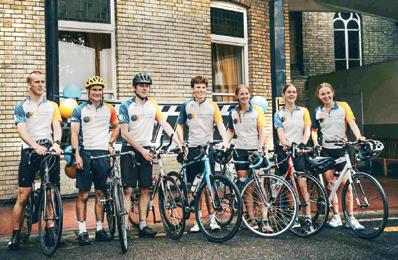
Richard Jones (B2 1968-73) completed the 2024 London Marathon and has raised over £3,500 to support the Teenage Cancer Trust.
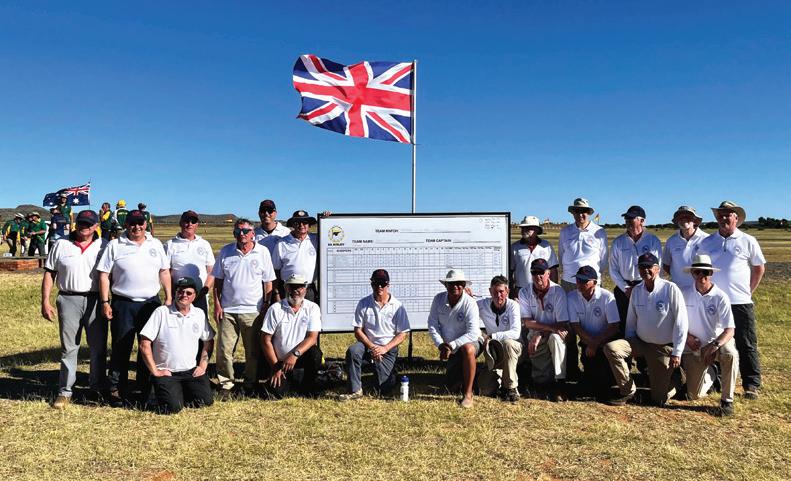
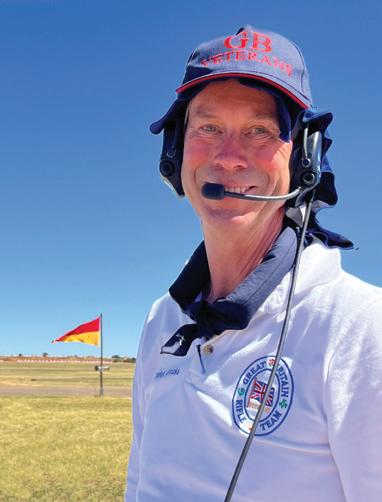
Charles Brooks (PR 1969-74) has been appointed as the captain of the Great Britain Veterans Rifle Team (over 60s) and his vice captain is David Richards (B3 1972-76). David was also the captain of Great Britain in last year’s Kolapore Match, which is the premier international match shot annually at Bisley.
Richard Savage (CI 1969-74) was inaugurated in May 2024 into the Cricketer Cup All Time Hall of Fame XI 1967–2023. The Cricketer Cup is played by 36 alumni teams. Richard played cricket for Oxford University and Warwickshire and was also a member of the only Marlborough Blues team to win the Cricketer Cup, in 1980. The Hall of Fame team was chosen through nominations by clubs and statistics from Cricketer Cup matches played.
After 45 years as a chartered land surveyor in the Middle East, Africa and latterly for 20 years in south-east England, Richard Groom (SU 1970-74) retired in 2022. For 12 years he was technical editor of the industry magazine Geomatics World. He now lives in Luton and is relearning how to play the piano and sing with the choral
society. He goes walking in the hills and does most of the cooking, cleaning and ‘oiling’, while his partner continues to toil. Older OMs will know what oiling was!
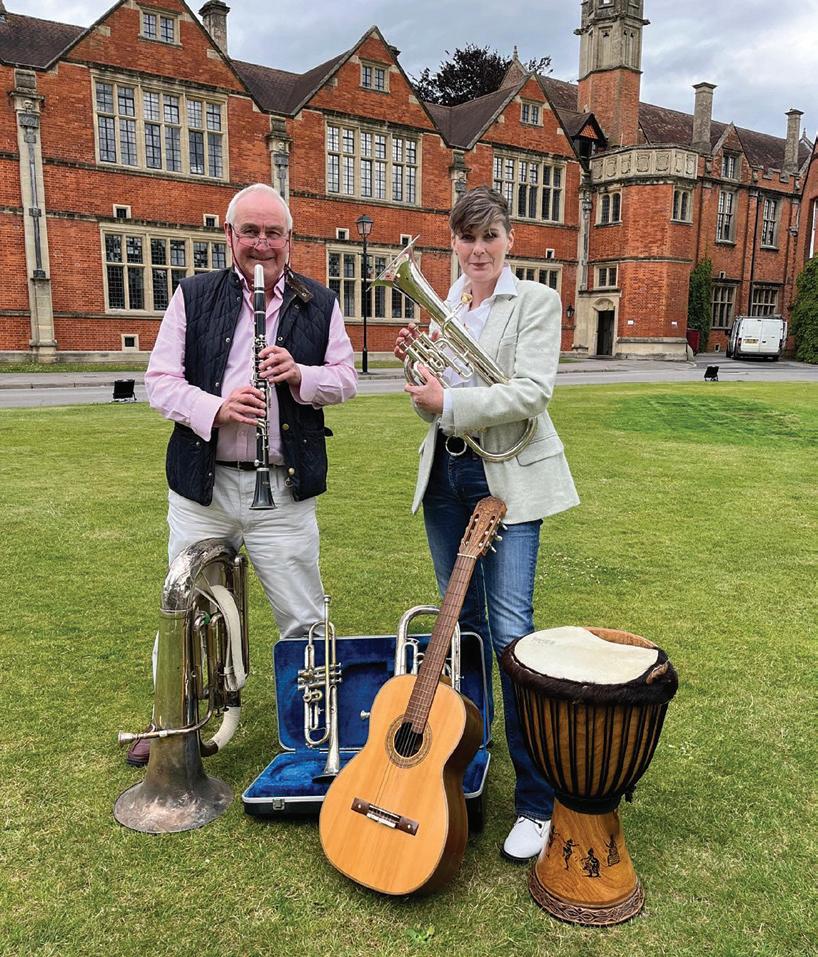
Simon Arnold (B1 1971-76), the lead for the OM Music Professional Group, has collected over 140 musical instruments (on behalf of the OMIYA charity) to send to Africa for use by youngsters who are part of the Ghetto Classics project of the Art of Music Foundation in Kenya. Robert Chase (L1 1961-66) and PA to the Director of Development, Amanda Cramsie-Smith, donated a variety of wind instruments to be reconditioned to become useful again in the education of children.
Julian Bickersteth (TU 1971-75) completes his sixth and final year as President of the International Institute for Conservation of Historic and Artistic Works in 2024. In the Australia Day Honours 2024, he was appointed an Officer of the Order of Australia (AO) ‘For distinguished service to the museum and arts sector, and to conservation and the environment.’
Simon Arnold has collected over 140 musical instruments on behalf of the OMIYA charity
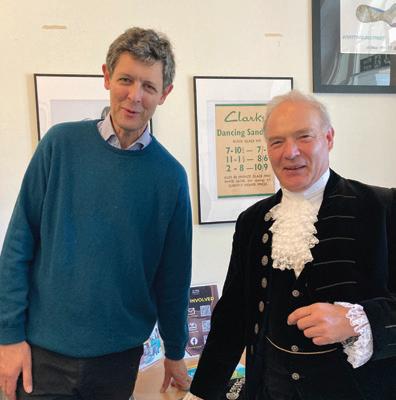
Robert Drewett (C3/BH 1972-77) came across fellow OM Hugh Pym (C1 1973-77) at a fundraising event organised by the Alfred Gillett Trust in Street, where they are building a new Shoemakers Museum to celebrate the contribution made by the Clark family to shoemaking in Somerset – and indeed both nationally and internationally. They had not seen each other since 1977, when they were in the same form.
This February, Lewis Borg-Cardona (BH 1973-77) was the producer for the BBC World Service podcast series U.Me: The Complete Musical, which is available on BBC Sounds. The podcast is a seven-episode version of the original BBC World Service radio musical that had its world premiere on 21st February of this year. The first episode is Lewis’ debut as a BBC World Service presenter, introduced by Stephen Fry.
Lewis’ 2023 radio documentary Tito Puente: Mambo Man won four awards in the 2024 New York Festivals Radio Awards, including a Gold for writing.
Mark Lee (B1 1974-79) sold Craftinsure, a specialist in boat insurance, last October and has now (virtually) retired. He hopes to be more actively involved in one or two of the OM clubs as the result of his supposed extra free time. Though a cliché, the old adage that once retired you wonder how you ever had time for work is rapidly turning true!
After retiring from his position in the NHS as a consultant ophthalmologist, Charles Diaper (C1 1976-81) has gone back to studying and has recently finished and passed his first year of a Fine Art degree at the Glasgow School of Art.
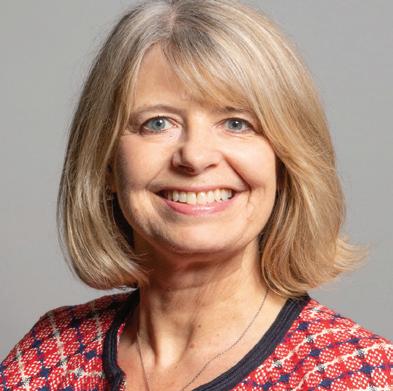
Congratulations to Harriett Baldwin MP (LI 1977-79) who was made a Dame in the Easter Honours List 2024.
Bill Richards (C1 1977-79) is in the main GB Rifle Team competing in the World Long Range Championships, which take place on the same range as the Veterans World Championships but a few days later.
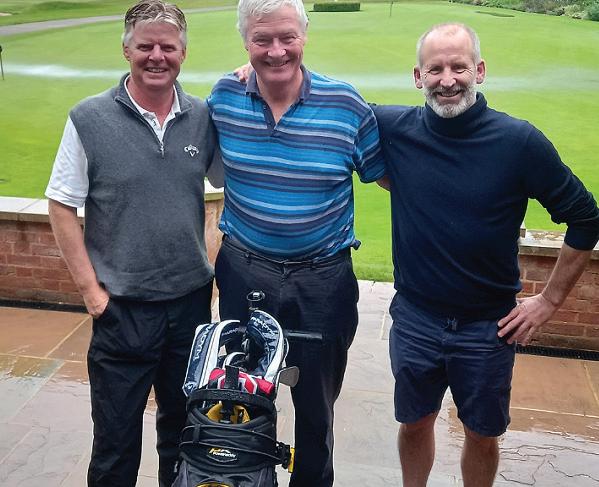
Robert Wakely (CR 1978-2023) has asked us to thank all those who contributed to his wonderful new golf clubs and has sent us a picture of himself and the
clubs at Sunningdale with Guy Barker (B3 1983-88) and Ali Robinson (PR 1983-88). He’d be delighted to hear from OMs and can be contacted at robwakely@ googlemail.com.
Ceri Twynam (B1 1978-80) has recently retired from teaching after 36 years and is making the most of travelling off-peak and having time for her hobbies.
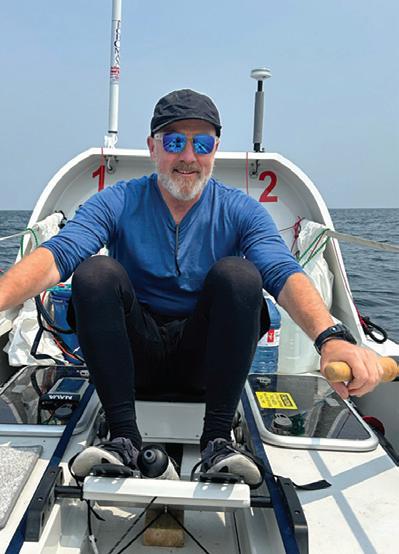
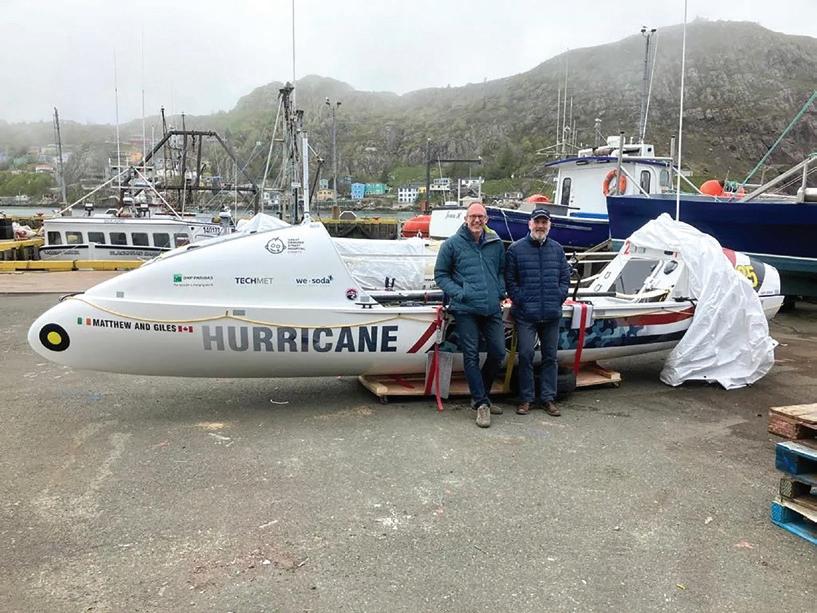
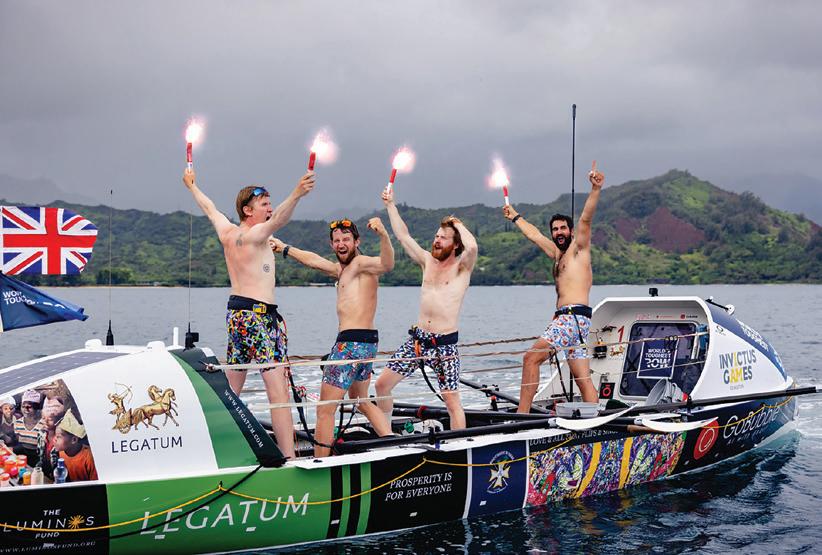
Matthew Ponsonby (PR 1978-83) completed the epic North Atlantic row, raising over £100,000 for Great Ormond Street Hospital. The impressive challenge covered 1,700 nautical miles (3,150 km), took 36 days and involved battling against
Lewis Borg-Cardona won four awards in the 2024 New York Festivals Radio Awards
gruelling waves, high winds and brutal weather conditions. Despite facing sea temperatures of 12 degrees and being pushed to his mental and physical limits, Matthew described it as an ‘extraordinary trip for an extraordinary cause.’
Brothers William de Gale (LI 1980-84) and Robert de Gale (LI 1981-86) now work together at BlueBox Asset Management, a firm that William co-founded six years ago. William graduated from Durham University and qualified as a chartered accountant with Coopers & Lybrand, before becoming an officer in the Lifeguards. This was followed by 20 years at BlackRock, investing in technology companies. Bob went from Exeter University into the Army Air Corps, and then switched from flying Army helicopters to civilian airliners. However, after 20 years with British Airways, he had time on his hands during lockdown and started some part-time work for BlueBox, which led to him becoming full-time COO in 2022. Their father, David de Gale (C2 1945-50), sadly didn’t live to see this, having died shortly after his wife Jean, seven years ago. Bob is married to Jan, with two sons at Bristol University, while William and Sasha have a daughter about to start at Exeter.
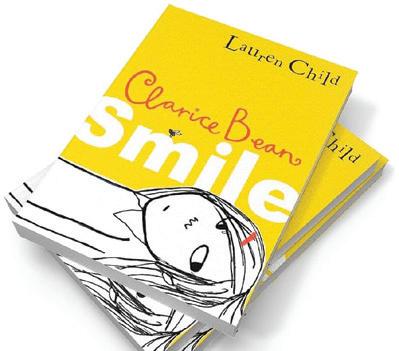
Former Children’s Laureate Lauren Child (B1 1982-84) talked about Smile, the final novel in the Clarice Bean series, which focuses on children’s anxiety about the environment, at the Hay Festival in May.
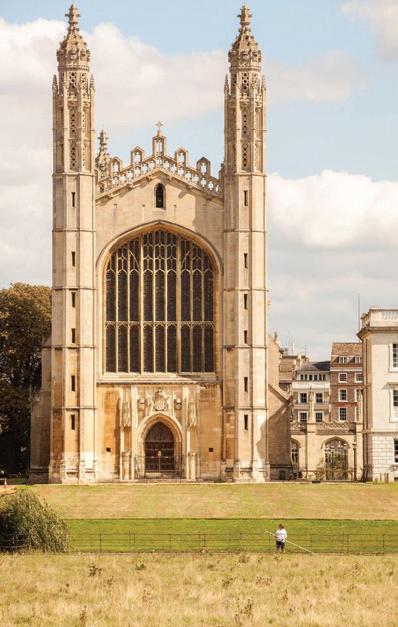
Robin Nelson (CR 1982-2003) had his carol ‘Out of Your Sleep’ sung on Christmas Eve in the Festival of Nine Lessons and Carols from King’s.
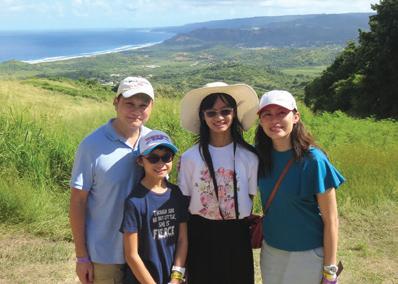
In December 2023, Christopher Ng (B2 1983-87), with his family, made an epic 16-day crossing of the Atlantic Ocean to the Pacific Ocean, from Barbados to Machu Picchu, Peru, via the Panama Canal. Christopher graduated as a doctor from St Mary’s Hospital Medical School, Imperial College in 1995, and this year marks the 17th anniversary of the opening of his private obstetrics and gynaecology clinic (GynaeMD Women’s & Rejuvenation Clinic) at Camden Medical Centre in Singapore.
Having enjoyed a successful 17-year career as a journalist, Elizabeth Blake (CO 1984-86) changed tack 10 years ago to become a CV consultant. She recently passed the stringent test to become a certified member of the British Association of CV Writers (BACVW) and offers a high level of expertise to anyone seeking a professional to refresh their CV.
John MacDonald-Brown (B3 1984-89) and Thorold Barker (C2 1984-89) visited Marlborough College in January as speakers at an Economics & Business Society event.
Matthew Ponsonby completed a North Atlantic row, raising over £100,000
Christopher Ng with his family
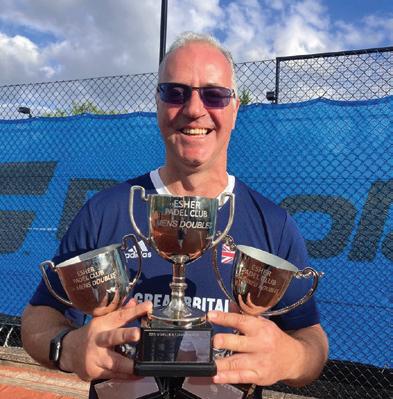
William Wells (C2 1984-89) has had the honour of being selected for and representing Great Britain at padel. Victory over Ireland in Dublin helped secure one of the qualification slots for the Seniors Padel World Championships in Las Vegas last year. More recently, Will played at the FIP Senior European Championship in Alicante, Spain, where Team GB came a creditable ninth out of 16 countries. Will runs a business building and operating padel clubs.
Pete Read (PR 1985-87) is leading an edtech impact startup, Persona Life Skills, that helps schools and colleges boost teenage students’ wellbeing, attainment and employability, by developing socialemotional skills such as self-awareness, critical thinking and teamwork.
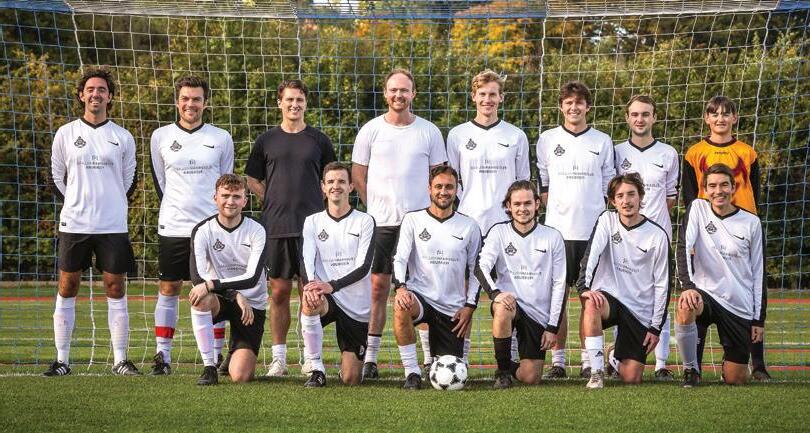
A cricket match was held at the College in July to remember Christian Youens (LI 1986-91), brother of Arabella (LI 1993-95), who died, aged 50, in 2023 from motor neurone disease. His obituary is featured on page 70. An OM team faced an opposition of Christian’s family, friends and colleagues, and Campbell Gordon (PR 1956-60) did the scoring. Lunch was enjoyed in the Cricket Pavilion, and James ‘Flash’ Gordon (PR 1986-91) brought his barbecue for the occasion. There are plans for the match to happen again next year, with fingers crossed for better weather.
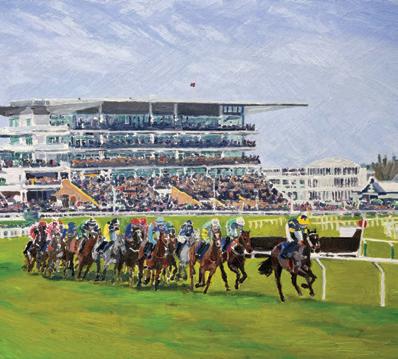
Leila Barton (EL 1989-91) had her painting featured as ‘My Favourite Painting’ in a March edition of Country Life magazine. It was an equestrian painting chosen by the CEO of the Jockey Club, Nevin Truesdale. Leila took A level Art at Marlborough, going on to study History of Art and English at the University of Nottingham before working at Condé Nast Publications. At 25, Leila realised she couldn’t imagine a future without painting, so returned to study at Chelsea College of Art in London and then won an award to study at the Slade School of Fine Art for her master’s.
After leaving Marlborough, Charlie Tryon (C1 1990-95) went to the City in 2000 and after three years left it for a job in Afghanistan running a telecoms business. Having lived there for five years and building a number of businesses, he moved to India briefly before returning to the UK in 2008. Setting up a private equity business in 2009 and investing in frontier markets in Africa, Charles moved to Kenya a few years later. He has recently returned again to the UK with his family, however he still spends much of his time in a diverse range of businesses in Africa.
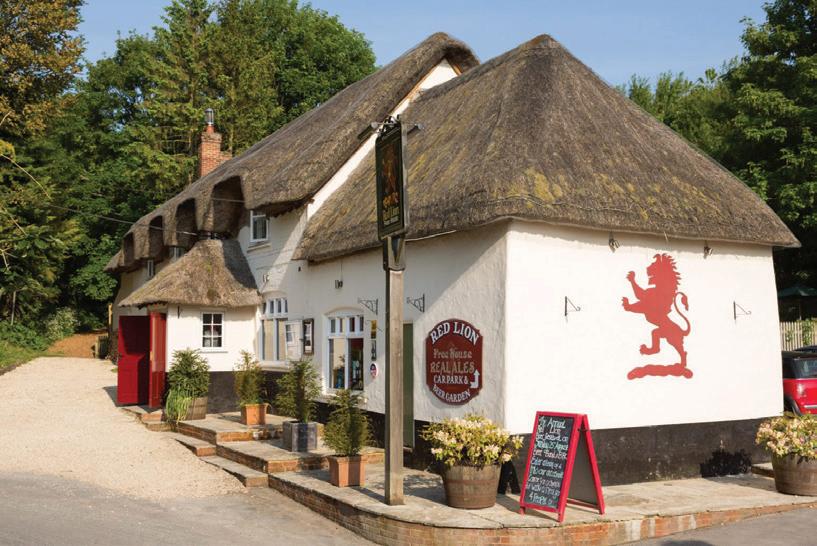
Guy Manning (C2 1990-95) owns and runs The Red Lion at East Chisenbury, which was nominated as a Best Local Restaurant in the Good Food Guide Awards 2024.
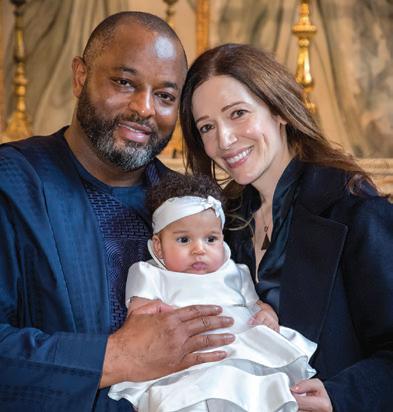
On 3rd September 2023, Pina and Louis Mbanefo (LI 1990-95) welcomed a daughter, Gaia Nkechi Gabriella. A granddaughter to Monica and Louis Mbanefo (B2 1958-63), a niece to Gabriel Mbanefo (BH 1995-2000) and a great-niece to Charles Mbanefo (B2 1959-64)
Guy Manning owns and runs The Red Lion at East Chisenbury
Rosie Scott (MO 1990-92) had an exhibition of her paintings at The White Horse Gallery in September 2023. Instagram: @roseshorrockartist
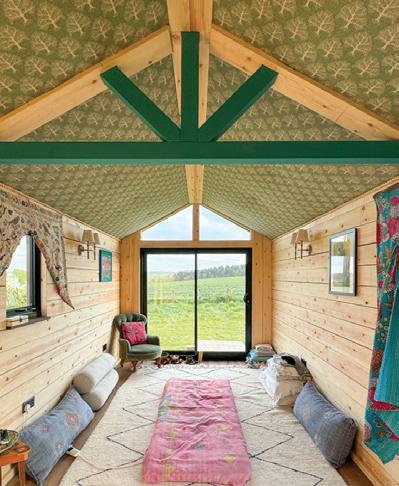
After 25 years of photographing interiors and beautiful homes, Ed Shepherd (LI 1991-96) decided to branch out into the world of wood cabins and huts. For the past three years, Ed has worked on his business Cotswold Building Bespoke Cabins, where he sends wooden cabins all over the UK and further afield. These have been used as studios, Airbnbs and wellness spaces.
Lara Cowan (MO 1992-97) set up a garden design and maintenance business at the end of last year: www.botanicshed.com
Lucinda Cook (EL 1993-98), previously Head of House in Elmhurst, founded Elmhurst Education to help parents realise their child’s potential by providing comprehensive support to children, young people, families and schools through bespoke educational assessments, expert guidance and coaching.
Edward St John Webster (CO 1994-99) married Georgina Crichton at the Church of Our Most Holy Redeemer and St Thomas More, Chelsea, on 2nd December 2023.
Matt Pocock (TU 1995-2000) was part of a team that ran 106km around the Isle of Wight in aid of Talent Tap, whose mission is to change the lives of talented young people from social mobility coldspots across the UK.
Alice Palau (MO 1997-2001) shared that since leaving Marlborough at seventeen without A levels, her life has been an interesting journey. Alice is now a published poet and her blog has been read in 54 countries to date. She is currently on an awareness mission, doing interviews for mental health, disability, homelessness, medicine, health and politics. Alice works part time as a sports massage therapist and nanny. Her dream is to write a book and make it into a film.
Harry Amos (B1 1999-2004) rowed across the Pacific Ocean from California to Hawaii during the summer of 2023, a 39-day, 4,800km adventure, raising £130,000 for the Blue Marine Foundation and the Invictus Games Foundation. We also congratulate Harry and his wife Pheobe for the birth of Jonathan Arthur Wallace on 15th February 2024. A brother to Constance and Theodora.
Pauline Harding (PR 2001-03) contributed to an episode of BBC Radio 3’s Free Thinking in March, talking about aspects of her PhD research, with a focus on attitudes towards archaeological sites in Uganda.
Georgy Pounds (MO 2004-09) started a new role as gallery director at OMR, Mexico City.
Rosie Scott had an exhibition of her paintings
Lara Cowan
Congratulations to Liam Dempster (B1 2005-10) and Izzy Nixon (LI 2009-11) on their marriage in August 2023.
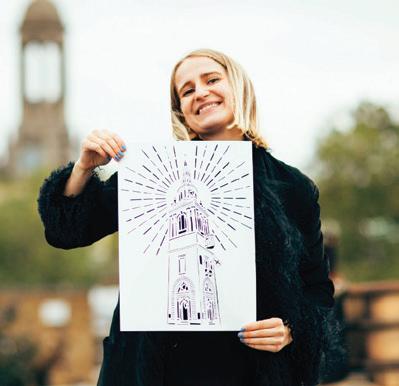
In September and October 2023, Chloe Campbell (MO 2005-10) exhibited playing cards and 52 papercuts of the churches in the City of London built by the office of Sir Christopher Wren after the Great Fire of London. Chloe’s work, alongside that of photographer and printmaker James Newton, was on display at the Wren on Paper exhibition at the Alan Baxter Gallery in London, a celebration of Wren 300, marking 300 years since the death of Christopher Wren.
Congratulations to Max Turner (C1 2005-10) and Megan Dempster (MM 2007-12) on their engagement.
Will Liney (C1 2007-12) works as a film-maker in London and runs a small video production company, making video content for brands, as well as writing and directing his own short films.
Sophie Mei Birkin (MO 2008-13) created a new piece of artwork containing plants and soil from the River Cam that has taken pride of place within the Dining Hall of Trinity Hall, replacing one of the more
traditional portraits that usually grace the walls. The work was unveiled during a special dinner at Trinity Hall by the Master of the College, Mary Hockaday.
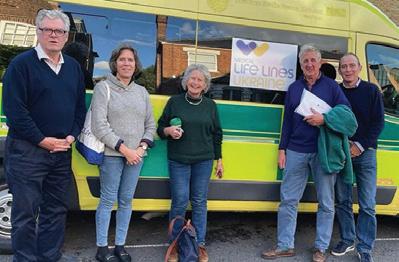
Florence Dowley (NC 2008-13), along with five others, drove three lifesaving and medical aid-filled ambulances to Ukraine. The team undertook the mission through the wonderful auspices of the charity Medical Life Lines Ukraine, who have already successfully delivered 38 ambulances, 19 generators and one all-terrain rescue crane across Ukraine over the past few months.
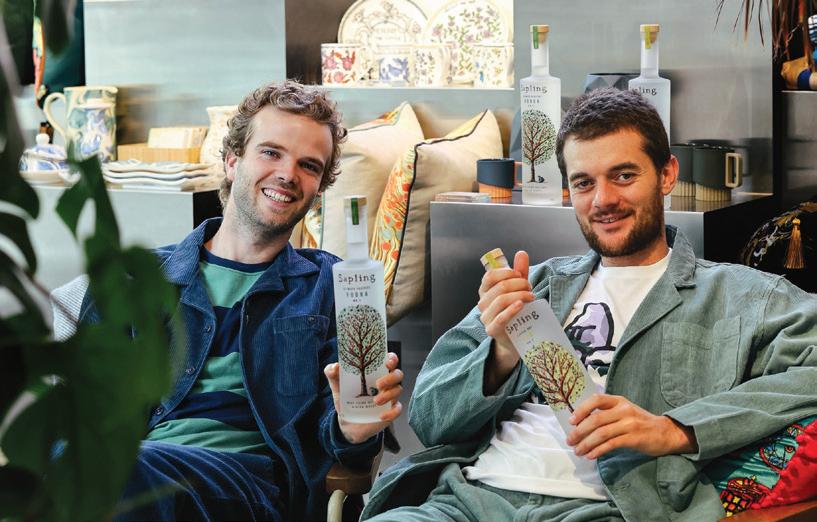
Edward Faulkner (PR 2008-13), co-founder of Sapling Spirits (sustainably farmed flavoured vodkas and gins), and Ivo Devereux (B1 2008-13) were listed in Forbes 30 Under 30 Europe 2024: Art and Culture.
Henry Alexander (BH 2010-15) and Florence Blair (CO 2013-15) got married on 15th September 2023.
Caspar Moran (CO 2010-12) recently finished his Dual International MBA at IE Business School in Madrid and Pontificia Universidad Católica de Chile in Santiago
Harry Amos rowed across the Pacific Ocean, raising £130,000
Edward Faulkner and Ivo Devereux of Sapling Spirits
de Chile and has launched his own entrepreneurial acquisition investment fund based in Spain. He is currently in the process of fundraising and launching the fund.
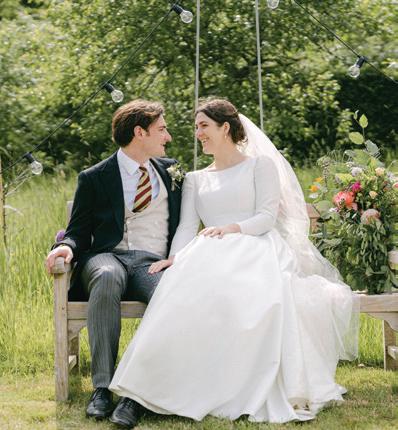
Lucy Touche (MM 2010-15) and her partner Giles Skrine (C1 2009-14) met in 2014 at the College on a preparation weekend for the OA mountaineering expedition to Peru that summer. They have been together ever since and were married on 1st June 2024, 10 years to the day after they decided to be ‘boyfriend and girlfriend.’ They acquired from Marlborough the exact bench that they had their first after-prep chat on in the Rose Garden, which was their photo booth at the wedding.
To celebrate their 10th anniversary of leaving Marlborough, Lucy Martin (SU 2011-13) organised a drinks reception in London for the Class of 2013.
Congratulations to Schuyler Neuhauser (B1 2011-16) and Shelby Carr on their June 2023 engagement. Plans are being finalised for a November 2024 wedding in the groom’s hometown of Tuxedo Park, New York.
Imogen Redpath (MM 2011-16) set up a small theatre company in London called Purple Turtle Theatre. Since graduating with a first class honours degree and a gold medal in Drama and French from Trinity College Dublin, she has been working towards a Master of Fine Art in Scriptwriting at the Royal Central School of Speech and Drama. She has also been working as a private English tutor to children in years 5–7 in London and internationally.
Ebe Igwe (MCM ST 2012-17) proudly represented Singapore in the Olympic qualifiers in Japan. Ebe remains a familiar figure within the MCM community, regularly playing for Iskandar Pirates Rugby Club, where he plays alongside both pupils and beaks.
Nicholas Goh (MCM TH 2012-18) pursued his passion for renewable energy by studying for a master’s in Chemical Engineering at Imperial College London. The rigorous academic preparation for his International Baccalaureate translated seamlessly to university-level classes, and the emphasis on independence and time management became valuable assets in his post-school life. Today, Nicholas works at Argus Media, on various energy-related projects, primarily in the biofuels and green hydrogen space.
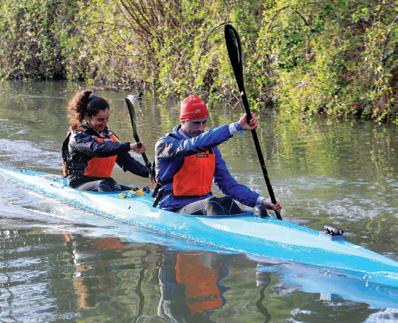
Congratulations to Anoushka Freeman (IH 2012-17), who won the Devizes to Westminster International Canoe race (DW) with her partner Tom Sharpe.
Anoushka took up kayaking during her time at Marlborough and completed the junior race in 2016 with Maddie Kirkwood (EL 2012-17). After leaving Marlborough she continued to train and raced at multiple World and European Championships, before returning to compete in the DW last year. Anoushka becomes one of just three women to ever win this iconic race.
Congratulations to Laura Jardine Paterson (MO 2012-17) for winning the Most Impactful Initiative Award at the 2023 Women in Tech® MENA Awards.
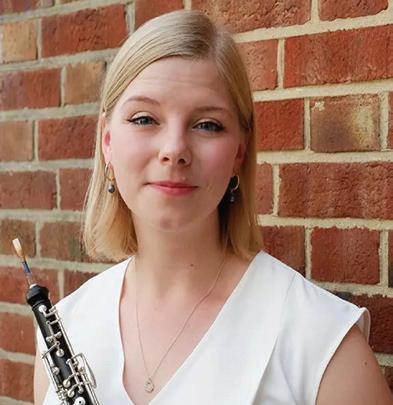
Congratulations to Helena Mackie (MO 2012-17), who has been appointed Principal Oboe of the Royal Liverpool Philharmonic Orchestra.
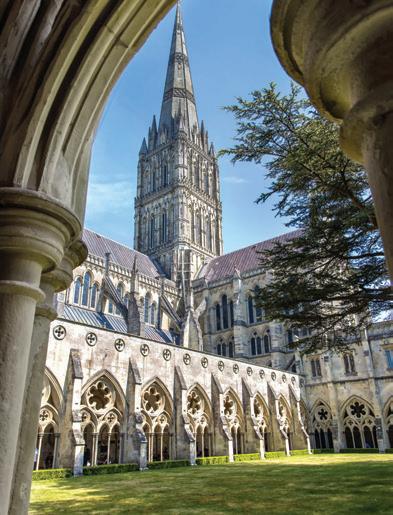
Jonathan Leigh (Master 2012-18) has joined the Council of Canons at Salisbury Cathedral and the Chapter as a lay member. He is also Chairman of their property standards group which looks after 80 properties in the Cathedral Close and consults for Salisbury Cathedral School where he has assisted with a number of appointments including their new Head.
Nicki
Douglas-Lee
Freddie Elmberg (BH 2013-18) signed a three-year publishing deal as a songwriter with BMG and Tommy Advice.
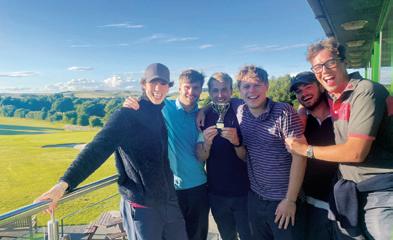
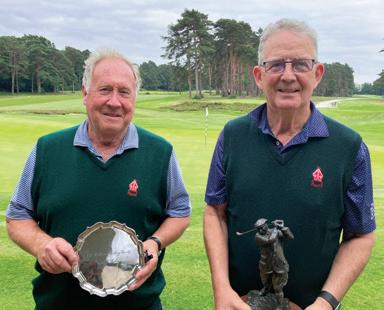
OM golfers reunited to play in the annual Yaxley Cup in memory of Hugo Yaxley (SU 2014-18), who tragically died in 2020. This year’s champion was Will Cook (SU 2014-19).
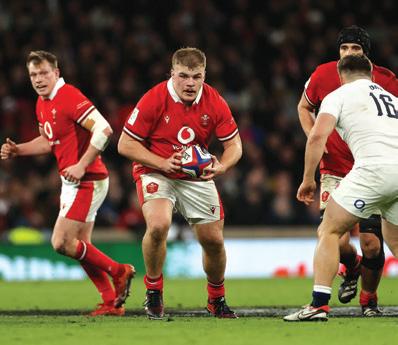
Congratulations to Archie Griffin (C3 2014-19), who won his first international cap for Wales at the Six Nations, playing against England at Twickenham. He has subsequently started for Wales in two further test matches against the Wallabies on Wales’ summer tour to Australia.
Claudia Vyvyan (MO 2014-19) gained a first class honours degree from Cambridge and received a college prize, and she was awarded the title of Senior Scholar on account of getting a first in at least three of her finals papers.
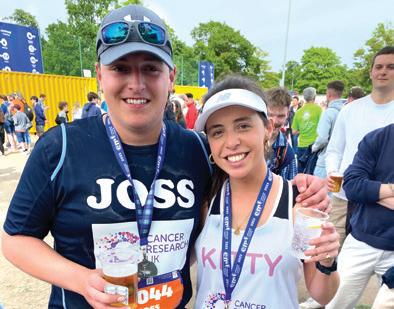
Kitty Fellowes (SU 2015-17) and brother Joss (C2 2014-19) ran the Edinburgh Marathon together, raising over £2,500 for
Cancer Research UK. Kitty made it round a little faster than her brother, and although Joss was a little slower, he hardly spilt a drop of his pint!
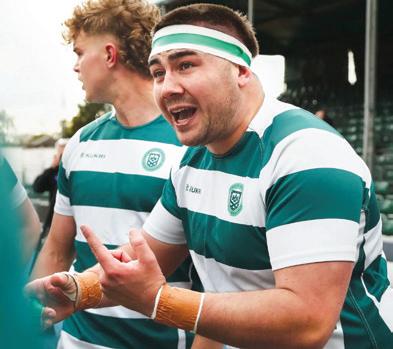
Christian Freeman (SU 2015-20) was Club Captain 2023-2024 of Exeter University Rugby Football Club and played in the BUCS Super Rugby 1st XV side, who achieved a record-breaking season by winning the BUCS Super Rugby league. Along with fellow members of the Exeter Uni 1st XV, Christian has also launched a calendar to raise money for the Oddballs and Movember charities.
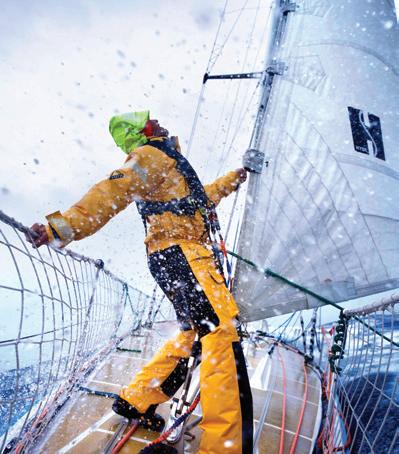
Will Ackerley (TU 2015-20) took part in the Clipper Round the World Yacht Race as a circumnavigator. The challenge is a 40,000 nautical mile (approx 74,000km) race around the world, comprising eight legs and between 13 and 16 individual races. Will is raising money for James’ Place, a charity whose mission is to stop men dying by suicide. One of the ways they hope to achieve this is by offering free, lifesaving treatment to suicidal men in the charity’s centres in Liverpool and London.
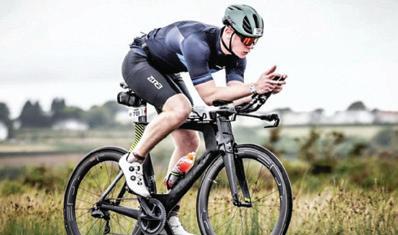
Patrick McClintock (SU 2019-21) completed his Triple Ironman Triathlon challenge. Paddy decided to run three Ironman 70.3 events to raise money and awareness for the young suicide prevention charity Papyrus. He decided to take on the challenge after losing two of his close friends, Oliver Chessher (CO 2019-21) and Honor Edwards (LI 2019-21), to suicide.
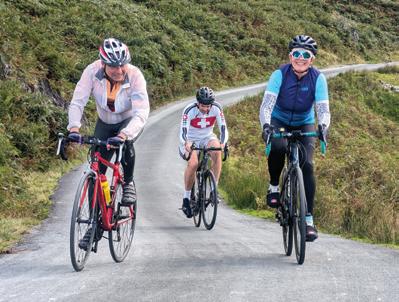
Tom Chavasse (C3 2019-24), together with OMs Josh Bateman (SU 2019-24), Phoebe Cox (IH 2019-24), Will Elviss (B1 2019-24), Jake Hobson (C3 2019-24), Ottie Hunt (EL 2019-24) and Martha Jameson (SU 2022-24), undertook a fundraising cycle ride from Oxford to London, a distance of over 100km, to raise funds for the Royal Hospital for Neurodisability in memory of a close family friend.
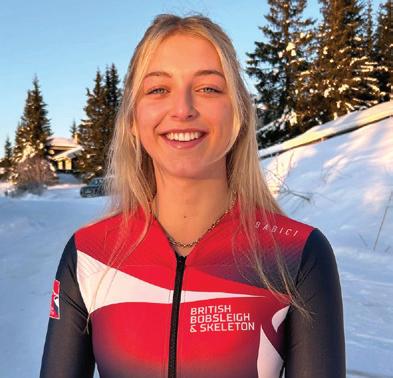
Willa Gibb (PR 2020-22) was selected again for the GB women’s bobsleigh team and competed in her World Cup debut in St Moritz in March, where she and her partner came ninth in the world. She has since done one more World Cup and has competed in the World Championships in Winterberg, Germany.
Charlotte Longden (NC 2016-21) competed in the 2020 Youth Winter Olympics and is now training for the 2026 Milan Cortina Olympics.
OM of the Year Award
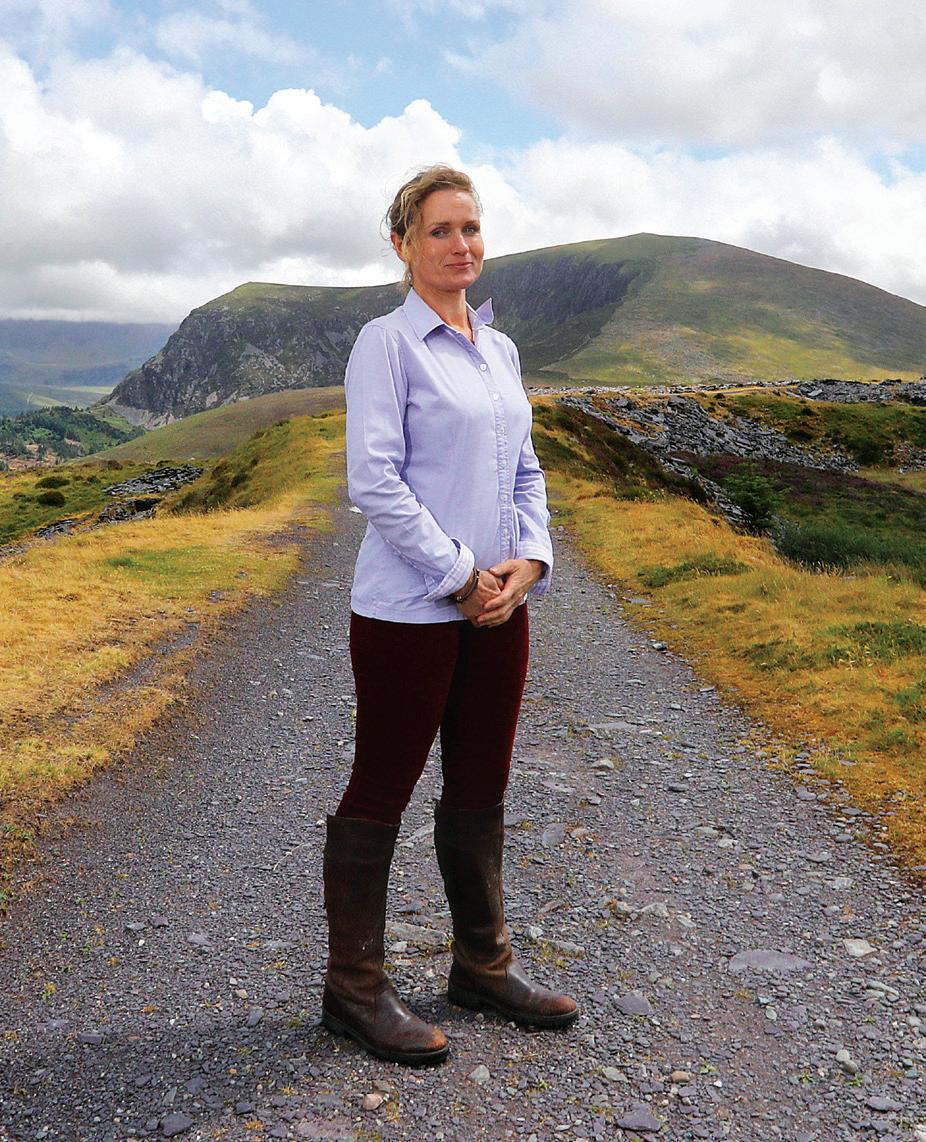
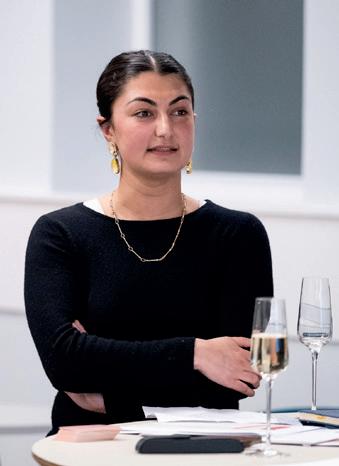
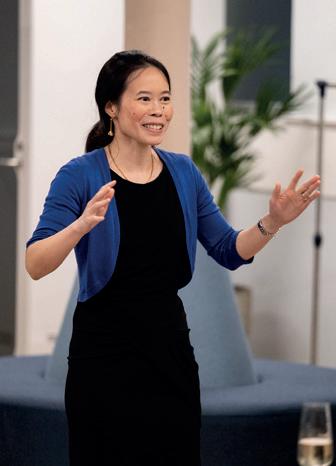
The OM of the Year Award recognises someone who has generously contributed their time and talents for the good of others or displayed courage or resilience in the face of adversity. This year’s winner, Rhianon Bragg (PR 1988-90), is interviewed by her friend and nominator Philippa Irving (LI 1988-90).
Ihave known Rhianon for over 45 years, but our friendship truly flourished during our time at Marlborough. In recent years Rhianon has carried out significant work in tackling domestic abuse and the courage she has shown following the horrors she faced has been commendable. It was therefore an honour to nominate her for the OM of the Year Award.
Rhianon first shared her experience with the public in April 2021 in a piece by Lebby Eyres (C2 1987-89) in the Daily Mail. Through this she was able to raise awareness of the issues she encountered. Not just the abuse, but the challenge of being an unsupported victim. Since then, Rhianon has been invited to share her experience through training and via many
different media outlets, including radio, podcasts and TV channels.
From her rural, sheep-scattered smallholding in Wales, Rhianon has proactively raised the profile of these key issues and facilitated change by helping to tighten gun licensing laws in Britain. Rhianon has helped highlight the need for better funding for support services and for tougher sentencing to reflect impact and has addressed the challenges brought by rurality and the need for victim advocates.
I recently asked Rhianon to reflect on some of her experiences at the College and to tell me more about some of the work she is doing now…
Can you share some memories from your time at Marlborough College?
I’ve incredibly fond memories. Strong friendships were forged, and an invaluable, all-round education received. I felt secure within the Preshute family, the walk from College back to house felt like a walk home.
The fact those relationships have weathered the decades is testimony to that early established, deep sense of caring about each other.
Quite shy when I arrived, I was supported trying new experiences and my confidence grew. I left aware that I was more capable than I had thought before. Of course, another important lesson Marlborough taught me was to give back to society when we are able, to do what we can.
I heard you speak to pupils at the College this year and witnessed such a positive response. How did it feel to be back at school at an event like that?
It was a huge privilege to be invited to speak. Great to be back, such a familiar environment, passing the Science Block and the Memorial Hall, before entering Court – although we never had to go through security before.
I admit anxiety, not sure I’d be able to maintain my audience’s attention – they were the youngest group I had spoken with – would I do a good enough job?
Rhianon Bragg
Being the Chapel alternative I’d expected a small number and hadn’t thought the Garnett Room would fill to capacity and beyond as it did.
I was very aware that the subject matter, although important to talk about, is sensitive and I was conscious of the potential impact on pupils. They quietly listened. I heard afterwards that, as a result of the talk, conversations had started.
I reflected as I drove home that those pupils were the same age as my own children; that brought a hefty dose of reality. So much can be experienced at a young age.
From my own previous ignorance, I know it is a subject that needs to be spoken about, the discussion must happen. We should do whatever we can to protect our children and future generations with knowledge, to enable them to speak out and to educate them not just for themselves, but for each other, and to empower those who go on to roles that will enable them to influence change for many.
Being the Chapel alternative was cathartic.
You have played a key role in facilitating changes in the gun licensing procedure. Can you tell me about Project Titanium and its impact?
Despite what I experienced I’m not antishooting, it’s a normal part of rural life. However, my ordeal illustrates that work is needed to tighten the firearms licensing procedure. I’ve been part of Titanium since its inception; the project has been relatively fast moving, it is low cost and easy to implement. Now successfully trialled by
‘It’s pretty special to see how positively impactful this work has been in protecting the public and helping to support victims of abuse who may not otherwise have come to attention.’
a number of police forces, we’re looking to a UK wide roll-out. It’s pretty special to see how positively impactful this work has been in protecting the public and helping to support victims of abuse who may not otherwise have come to attention. Through my work around the project I have met some extraordinarily brave people – the bereaved, also needing change. Meeting them keeps one motivated.
Can you tell me about the work you are doing around stalking and raising awareness?
Stalking is the most devastating offence. It takes so many forms and too often the true impact on victims and the risk presented by stalkers is not appreciated. There are more effective ways of tackling stalking, particularly the multi-agency approach. I strongly believe this should be the model followed across the UK. It’s been shown to save not only lives, but also significant amounts of money. It really is a case of what’s not to like?
As well as raising awareness through the press and alongside the Suzy Lamplugh Trust, I’m looking to help the campaign to reform anti-stalking laws. There’s been so much learning since the laws to tackle stalking were introduced, it’s time to bring them up to date.
‘Of course, another important lesson Marlborough taught me was to give back to society when we are able, to do what we can.’
You have received support and encouragement from the OM community. This must have helped you through some of the challenges you have recently been working through?
Yes, it’s been incredible, it’s helped me achieve so much more than I would have done otherwise. None of them should underestimate the positive impact they have had, how much they have enabled me. It’s not just the emotional support from old friends – which has been continuous, and I couldn’t have coped without it – there’s been so much more. From when I first wanted to approach the press and Lebby helped, to Robert Drewett (C3/BH 1972-77), responding to my article in the Club Magazine in 2022, and, through his role as High Sheriff of Somerset, introducing me to Avon and Somerset Police’s Firearms Licensing team, who I delivered training to. I would never have predicted that over 30 years after leaving the College, Dr Richard Jones-Parry, my Preshute house tutor, and his wife, Sue, my neighbours in Wales for part of the year, would again be encouraging me in what I’m doing.
It is clear how incredibly grateful you are to the response you have received from the OM community. This has clearly made the most immense difference and helped save lives.
As one of the OMs who nominated Rhianon for this award, I encourage others to consider nominating an OM they know whose recent work and actions have been inspirational and impactful to the lives of others. To nominate, please visit: www.marlburianclub.org/omotya
Rhianon and Philippa
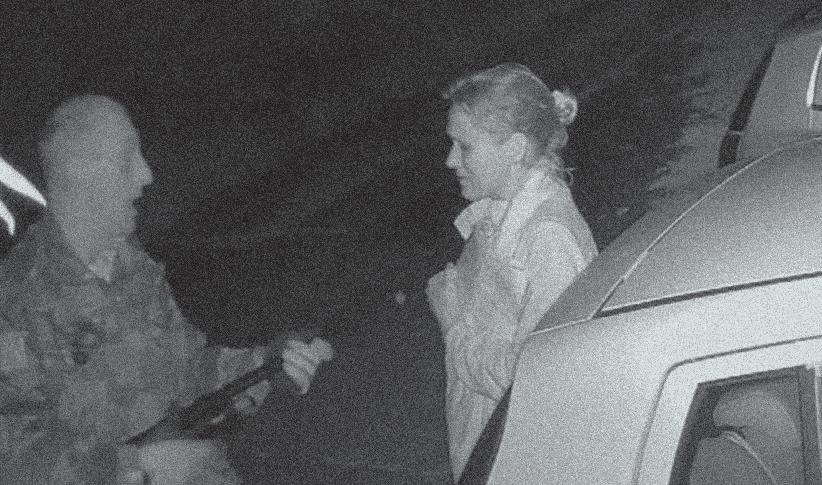
CCTV
Rhianon held at gunpoint
How Plants can Improve our Daily Lives
Alex Wright (B1 1989-94) finds out why Sebastian Pole (PR 1983-87), co-founder and master herbsmith at Pukka Herbs UK, the UK’s second largest herbal tea producer, is on a mission to spread the word about how plants can help improve our daily lives.
In my view, the potential that plants and herbal medicine have for supporting health isn’t recognised nearly enough,’ said Sebastian. ‘Plants can help our health in so many different ways: for example, with our digestion to help us metabolise food, and with our nervous system to manage stress more effectively. In essence, herbs used properly enhance your natural tendencies towards being in the best health.
‘I
‘We currently face a complex health challenge with an over-burdened National Health Service in the UK coupled with the epidemics of obesity, diabetes and degenerative disease becoming ever more prevalent in our society. If used as a regular part of the diet, herbs and spices can help to mitigate some of these day-to-day as well as long-term problems.
started making the master blends in my kitchen and we tweaked them until we were ready to make our first small order for our first three teas; Relax, Refresh and Revitalise.’
‘For example, cinnamon has been shown to react against diabetes, turmeric has been shown to be effective against osteoarthritis, and rosemary and sage have also been proven to be effective against cognitive and other neurological diseases.’
Sebastian also wants the principles of herbalism and natural history to become part of mainstream education. He believes that they can be incorporated into a range of subjects, from biology and chemistry to history, and even business studies, to improve students’ knowledge of plants and their uses, the roles that food and nature play in our lives.
‘It’s a really great opportunity for educational establishments such as Marlborough to look at how they can incorporate herbalism
‘We currently face a complex health challenge with an over-burdened National Health Service in the UK coupled with the epidemics of obesity, diabetes and degenerative disease becoming ever more prevalent in our society.’
and nature into their core curriculum,’ said Sebastian. ‘By making plants more tangible and relevant to pupils, they can learn what is integral to their health and have more control over it.’
Sebastian, whose father and grandfather both attended Marlborough, first became interested in the power of plants at the age of 18, while on an overland trip to China. After being struck down with a stomach bug in the Indian Himalayas, he went to see a herbalist, who prescribed him a powdered mixture of liquorice, amla and shatavari.
Having made a full recovery, Sebastian was amazed by the healing power of herbs. Having discovered the science that backs up his personal experience, he has been a keen advocate ever since, going on to study Ayurvedic, Chinese and Western herbal medicine.
‘I fell head-over-heels in love with the clarity and insights of traditional medicine and was blessed to have some great teachers,’ said Sebastian. ‘Traditional medicine is so person-centred, with such deep insights into the workings of nature that I was completely inspired. And when I saw what the plants can do to people’s health, it just lit me up. But the flip side of this inspiring time was that as soon as I started to look deeper into herbal sourcing, I realised that the state of many of the world’s plants was dire, with one in five threatened with extinction, and that initiated a different type of insight, one that put me on a deeper environmental and social mission.’
Sebastian studied Hindi and Indian Religions at SOAS, University of London for his degree and then worked in several jobs, including as a gardener and a yoga teacher. While he continued his herbalism studies he worked on an organic herb farm that would go on to become one of Pukka Herbs’ biggest suppliers.
Meanwhile, Sebastian was always experimenting with new blends of herbal teas: ‘I just had this strong feeling that if we made tea using high-quality herbs from an ethical supply that were blended properly for taste and benefit, we could make something good; a tea that would be grown in a way that benefited the land where the herbs come from, that would enhance the lives of the people growing and harvesting the plants and then serve our customers with something that tasted good, did good and – just like a beautiful garden – looked good too.’
It wasn’t until Sebastian came across an advert in Venue magazine in Bristol offering to help start-up ethical businesses, however, that his dream became a reality. He called the number and arranged to meet up with Tim Westwell, his soon-to-be business partner, over a cup of tea to discuss the opportunity.
Sebastian Pole
‘Today, Pukka Herbs works directly with thousands of organic farmers and growers, producing four million cups of tea per day and exporting to around 30 countries.’
They hit it off straight away and, finding they shared the same values, and with a vision of building a more positive world, they went into business together. Starting with £2,000 each, they secured some investment and continued to scrimp and save to get the business off the ground, launching Pukka Herbs in 2001.
‘I started making the master blends in my kitchen and we tweaked them until we were ready to make our first small order for our first three teas; Relax, Refresh and Revitalise.
‘After getting some initial investment, we went round all the independent health food shops and asked them if we could set up to do some tastings. And it just took off from there, really.’
Pukka Herbs’ birth coincided with a big push by the supermarkets to go organic. Riding that wave, with a clear and uncompromising vision, the company got its teas into Tesco in 2004 and others soon followed.
‘Back then, there was growing awareness of the impact the food we eat has on both our own health and that of the environment,’ said Sebastian, who is a keen vegetarian. ‘We saw a big gap in the market – there were plenty of herbal teas around, but while they may have looked and smelt good, they were often let down by the taste and the ethics behind them.
‘We wanted to give people something really special. A good cup of herbal tea is like a reliable friend; always there when you need them. With herbs grown and blended in the right way to bring out the body, flavour,
textures and aromas, you can make a tea that is a guaranteed good moment.
‘We also wanted to create a business centred around mutual benefit – one where everyone who came into contact with it would profit through its products’ health, ecological social and financial benefits. We wanted to reach millions of people, so that their lives could be touched with the power of herbs. And while these ideas are all very nice to have, none of them would have happened without being fortunate enough to have worked with an exceptionally brilliant team and very engaged group of partners and growers.’
Today, Pukka Herbs works directly with thousands of organic farmers and growers, producing four million cups of tea per day and exporting to around 30 countries.
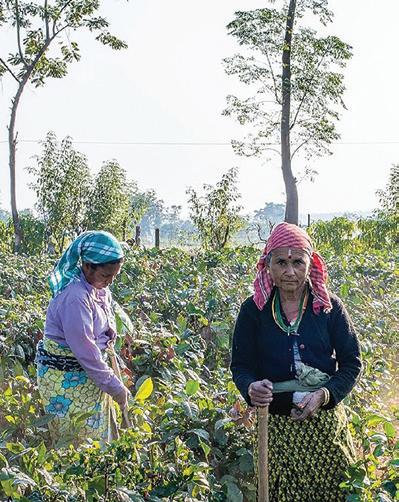
More than 100 different species of plants are used in their teas, with around 30 different flavours on offer. As well as the taste and health benefits of their products, Sebastian and Tim wanted to make a difference both ethically and environmentally. Reflecting Pukka’s meaning of real, authentic or genuine, they back this up by donating 1% of their turnover to social and environmental initiatives through 1% for the Planet.
All of the herbs the company uses are 100% organic and, where possible, they use FairWild-certified ingredients. FairWild is an initiative that guarantees that plants sourced from the wild have been harvested in a sustainable way and the workers have been paid fairly for their work.
‘Organic farming is an example of how farming can create good health for all,’ said Sebastian. ‘It is a way of farming and caring for the natural world that is better for the environment, wildlife and us; for example, organic farming mitigates against the climate crisis, organic farms have 50% greater biodiversity and organic foods have higher levels of protective phyto-nutrients than conventional foods.
‘Plants are an endless source of knowledge – how they grow, what makes them taste good and how they can influence our health and the way we feel,’ said Sebastian, who is a member of the Ayurvedic Practitioners Association, the Register of Chinese Herbal Medicine and the Unified Register of Herbal Practitioners. ‘It’s well known that they have a long history of being used to support everyday health, something that a growing scientific base reasserts, and that’s exactly what we are seeking to provide with our teas.’
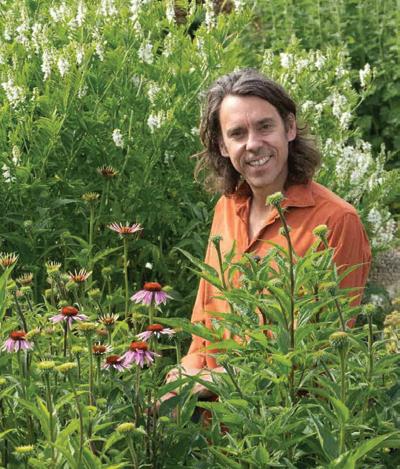
Pukka was sold to Unilever in 2017 and is now a part of Lipton Teas and Infusions, expanding on their herbal mission around the world. Along with supporting Pukka Herbs to deliver on its purpose, Sebastian is now also focused on advocating for herbalism through sharing health information at www.herbalreality.com, an online resource on all things health and herbal. And when not typing he’s found working in the garden at Earthsong Seeds, the organic seed nursery he now runs. www.earthsongseeds.co.uk. It’s all about spreading the good word, he said.
‘I love connecting people to the incredible power of herbs, whether that’s through a good cup of herbal tea, appreciating them in the garden or seeing a professional herbalist,’ said Sebastian. ‘Ultimately, I want to keep championing herbs and the benefits they bring, and help them become a more useful part of everyday life.’
crazy
That’s what they called us when we started making mattresses and championing natural, organic, and sustainable materials in 1999.
25 years on, who’s crazy now?
Today, people demand the best of both. What’s good for us should also be good for our planet. And what we choose to sleep on should be no different.
Thankfully, there’s never been a choice at Naturalmat; and our uncompromising pursuit of better, healthier, and more natural sleep will never rest.
local. sustainable.
London | Knutsford | Cotswolds | Devon
A Cornish Benefactor
Gerald Curgenven (C1 1890-95) died in October 1959, aged 83. Thanks to his generosity in naming Marlborough College as his beneficiary, and following the sale last year of the beautiful estate of Trevalga in North Cornwall, there is now a significant bursary fund available to support the education at Marlborough of motivated and talented pupils from or with a family connection to Cornwall. This is how, in the words of the Master, Louise Moelwyn-Hughes, the College ‘can honour the memory and wishes of Gerald Curgenven.’ Jane Vyvyan (CO 1981-83) tells us more.
Gerald was born on 17 May 1876, the son of a clergyman, the Reverend Francis Curgenven, who originally hailed from Plymouth. Although his rectory home was in Byfield, just north of Banbury, Gerald Curgenven is likely to have spent time in his childhood in and around the Trevalga Manor, which was owned from 1858 by Curgenven’s uncle, Richard Bolitho Stephens, and then by his estate until the death of Richard’s wife Edith in 1933.
The Trevalga estate is situated on the North Cornwall coast, and is a place of great natural beauty, with incredible clifftop views and unspoilt landscape, including many acres of farmland, surrounding the village of Trevalga.
In January 1890, the young Gerald Curgenven was sent to Marlborough College, where he clearly excelled both in sport and in academics, leaving Marlborough in 1895 for Corpus Christi College, Oxford. Marlborough itself had been founded only 52 years earlier, specifically for the education of the sons of Church of England clergy, and was therefore an excellent choice of school for the young and sporty Curgenven. From records held in the College Archives, it is clear that Gerald contributed enormously
to all the main school sports. He rose to captain the XV in 1893/94, where he played at half-back and received many glowing mentions in match reports for his play, and played at back in the hockey XI with evident gusto and determination. In the summer months, Gerald Curgenven was also to be found excelling at athletics, taking part in Marlborough’s annual three-day athletics tournament.
The Marlburian magazine of Gerald’s time contained detailed match reports and often included personal appraisals of team members. In The Marlburian issue dated 20 December 1893, there is a heading of ‘Characters of the XV’, under which Gerald Curgenven is described in the extolling and simultaneously slightly deprecating style of school reports of the time: ‘Strong, dashing half, plays very well individually but fails to combine as well as he might.’
We can see that Gerald was a strong team player and an effective team leader during his time at Marlborough and he must have also paid close attention to his academic work since, on leaving school, he went up to Corpus Christi College, Oxford, and subsequently became a schoolmaster himself.
Gerald began his teaching career as an assistant master at Rossall School in
‘The Trevalga estate is situated on the North Cornwall coast, and is a place of great natural beauty, with incredible clifftop views and unspoilt landscape, including many acres of farmland, surrounding the village of Trevalga.’
Above: Gerald Curgenven (C1 1890-95)
Top, left, right and below: Estate of Trevalga in North Cornwall
Lancashire. Canon St Vincent Beechey had founded Rossall in 1844 as a sister school to Marlborough College, which had been established the previous year. The connection between the schools was through Dean George Hull Bowers, then Rector of St Paul’s Church in Covent Garden, who was a founder of Marlborough and instrumental in assisting Beechy in the establishment of Rossall. It is possible that his Marlborough connections helped Gerald to secure this first position in what became a long and dedicated teaching career. He moved to St Peter’s York in 1900 and then to Clifton College, where he remained, latterly as headmaster, until his retirement in 1934.
Gerald was married at St Sidwell’s church in Exeter on 7 January 1902 to Jacquète Woolcombe, youngest child of Henry and
Mary Woolcombe, both of whom had died before the marriage. Henry Woolcombe had been archdeacon of Barnstaple and at least two of his sons were clergymen. Jacquète was several years older than Gerald and they had no children.
In 1934, following the death of Edith, the widow of Richard Bolitho Stephens, the Manor of Trevalga was put up for sale. This coincided with Gerald Curgenven’s retirement from his headship at Clifton and he decided at that point to purchase the whole Trevalga estate. During his 25 years of ownership, Gerald increased the size of the estate by almost 50%, taking it from 825 to 1,200 acres.
The estate’s dramatic cliffs and panoramic views of the Atlantic Ocean between Boscastle and Tintagel would have made
‘In 2023 proceeds of the Estate’s sale were realised and, in accordance with the spirit of Gerald Curgenven’s wishes, the College determined that they will be used for funding transformational bursaries for pupils from Cornwall or with a Cornish family connection.’
Trevalga a wonderfully attractive place for Gerald and Jacquète Curgenven to live. They did not take up residence in the Manor House itself but chose to live in a smaller house on the estate, and Gerald was a very hands-on landlord, helping with all manner of farmwork around the estate.
Gerald was clearly keen to preserve the rural heritage and community of the Trevalga estate as he knew it, as in October 1951 he executed a will expressing his wish that, ‘as far as possible’, after his death the estate should continue to be managed by his trustees in the same way and with the same stewards and agents as had managed it during his lifetime, with the excess income being paid over to Marlborough College. He had a clear sense of duty towards the individuals who had worked for him and had helped him to improve and add to the Trevalga estate over the period of his ownership. He did, however, contemplate that the estate might eventually be sold, if Marlborough were to agree.
In 2023, proceeds of the Estate’s sale were realised and, in accordance with the spirit of Gerald Curgenven’s wishes, the College determined that they will be used for funding transformational bursaries for pupils from Cornwall or with a Cornish family connection.
The bursary funding made possible by the generosity of Gerald Curgenven will ensure that talented Cornish pupils can derive benefit from a Marlborough education, as did Gerald himself in the dying years of the 19th century. The College will ensure that the Curgenven legacy provides vital financial support for this purpose and the Curgenven name will live on at Marlborough.
Rare Books Collection:
William Stukeley (1687-1765)
In the second of a series of articles about the College’s Rare Books Collection, Florence Shorthouse (EL 2017-22) sits down with the Keeper of Rare Books, Dr Simon McKeown, to talk about a volume that this year celebrates its tercentenary.
Florence: Everyone who passes through Marlborough College is very conscious of the wonderful environment that surrounds us during our time here. I understand that you want to talk about a book that already recognised the unique importance of this setting 300 years ago?
Simon: Yes, that’s right. This year, 2024, marks the tercentenary of the publication of William Stukeley’s Itinerarium Curiosum or an Account of the Antiquitys and Remarkable Curiositys in Nature or Art Observed in Travels Thro’ Great Britain. It appeared in London as a two-volume work in 1724, and the College is fortunate to own not only a
copy of the first edition, but a copy of the second edition too from 1776. [1]
Florence: For the benefit of readers experiencing a momentary brain freeze about William Stukeley, can you remind us who he was, and why his book is worthy of commemoration?
Simon: Yes, certainly. William Stukeley [2] was one of this country’s earliest and greatest archaeologists, and the first to recognise the importance of Avebury. There had been some scholarly interest in British archaeology before Stukeley – notably by the Elizabethan William Camden – but Stukeley elevated the practice to a new level, partly by applying empirical principles
to his field studies. He was unquestionably a gifted man, even something of a polymath – a skilled draughtsman and cartographer, an expert in geology and pedology (the study of soils), and an author, historian and theologian. He was naturally sociable and counted among his friends eminent figures such as Isaac Newton, Edmond Halley and Christopher Wren. [3]
Florence: Would you say Stukeley was instrumental in establishing archaeology as a discipline in this country?
Simon: In some senses, yes. Britain lagged behind other European countries in its documentation of ancient sites and monuments, a neglect already deplored
in the 1660s by members of the Royal Society – a body to which Stukeley belonged. But because it was an emerging discipline, Stukeley had to earn his living in other ways. For the first 20 years of his adult life he practised as a physician in the Lincolnshire town of Boston, before switching to a career in the Church, taking Holy Orders in 1729 and becoming a vicar in Stamford. So, he had to conduct his archaeological work as an amateur.
Florence: You mentioned that Avebury was a place he identified as particularly significant in early British history. I guess that’s where Stukeley’s link with Wiltshire comes from?
Simon: Yes, it’s quite shocking to read that people before Stukeley paid very little attention to Avebury. Interest in Stonehenge can be found in documents dating back to the Middle Ages, but there is comparative silence when it comes to discussion of Avebury. What is even odder is that the old road between London and Bath didn’t just pass through Avebury, but dissected the great embanked circle, so that thousands of travellers apparently trudged or rode through the stones without finding them worthy of investigation. And it is worth remembering that Avebury was a very much more impressive sight in Stukeley’s time than it is in ours because it consisted of many more stones than we see today. [4]
Florence: What happened to those stones between his time and ours?
Simon: It’s a depressing story of wilful destruction: local farmers taking the stones for building materials, burning them, or even grinding them down for aggregate. Stukeley saw it with his own eyes on his first visit to Avebury in 1719, and wrote that he was partly driven in his work by a desire
to preserve a memory of the place before it disappeared altogether. [5]
Florence: I suppose Stukeley’s regular visits to Avebury meant he was familiar with the town of Marlborough?
Simon: Very much so, and it is really his link to the town that we celebrate this year. It was 300 years ago in 1724 that he published the earliest surviving views of the
site on the west side of Marlborough that was later occupied by the College. As mentioned, he was a skilful draughtsman, and he drew many pictures of the places he visited. He was particularly assiduous in recording views of Marlborough on a visit in the summer of 1723 – including one from the top of Granham Hill, overlooking the town towards the north, an excellent picture of the Mound and, most valuably, a bird’s-eye view over what is now Court, New Court, C1, the Mound and the Wilderness. The process of translating his drawings into copper-engravings was undertaken by the London-born Dutch engraver Gerrard Vandergucht, and the plates were included in his Itinerarium Curiosum of the following year.
Florence: There is a lot in Stukeley’s bird’s-eye image that is still readily recognisable in our campus today.
Simon: It is a very important record of the general layout of what he calls ‘Lord Hartford’s House at Marlborough.’ The Seymour mansion we know as C1 is clearly identifiable in its essential details, although its Ionic porch was yet to be added. And we can clearly recognise the stable block that was to become New Court, and the carriageway around Court leading in from the Bath Road. We can also see the Mound,
‘His meticulous documentation, visual records, assessment of artefacts, etc., really do stand as excellent efforts in understanding our remote past...’
the Wilderness, the formal plots in what we know today as the Master’s Garden, and even the yew hedges that still tower over the Duelling Lawn. [6]
Florence: Was Stukeley acquainted with the Seymours?
Simon: Yes. Lord Hertford, Algernon Seymour, later to become the 7th Duke of Somerset and Earl of Northumberland, was elected President of the Society of Antiquaries in January 1723. This was a relatively new body, established in 1717 with Stukeley as its first secretary. So, Seymour and Stukeley were initially both office holders in that circle, an association that soon warmed into friendship despite the gulf in social rank, to the extent that Stukeley became a regular dining companion of the Duke’s, and thereby met the Duke’s brilliant wife, Frances, Lady Hertford. [7]
Florence: She enjoyed a reputation as a poet and patroness of poets, didn’t she?
Simon: Very much so. One of the foremost poets of the early Augustan period was the Scot James Thomson, author of The Seasons, a volume that won him Europe-wide fame. He dedicated ‘Spring’, the poem’s opening canto, to Lady Hertford because she had invited him to Marlborough as a house guest, a favour she extended to other writers she thought worthy of bringing on. And of course, she wrote and published poems herself, and engaged in literary correspondence with like-minded aristocratic women. What is less well known is her interest in archaeology, a passion cultivated by Stukeley. Archaeologists had discovered the grottoes at Herculaneum only in 1709, and it was not long before Lady Hertford, Alexander Pope and others created their own grottoes in emulation of the newly unearthed antiquities. [7]
Florence: Did the Seymour family facilitate Stukeley’s fieldwork at Avebury and elsewhere in Wiltshire?
Simon: Yes. Stukeley undertook some dozen separate expeditions to Avebury, each lasting several weeks – so if we complain today about the difficulty of getting a doctor’s appointment, spare a thought for Stukeley’s poor patients in Lincolnshire! Stukeley stayed with the Seymours for part of the time, although when he was at Avebury he lodged at an inn called The Catherine Wheel, which formerly stood opposite the present Red Lion. But the Seymours were involved more directly in Stukeley’s archaeological work. In 1722, Stukeley founded an antiquarian club in London which he rather floridly named The Society of Roman Knights. These ‘knights’ gathered at The Fountain Tavern in The Strand, its members meeting under assumed names taken from inscriptions found on Roman or Celtic artefacts. Stukeley took on the alter ego of Chyndonax, supposedly a prominent druid, while Lord Hertford attended under the name of Segonax, a chieftain who had defied Julius Caesar. Remarkably for the time, Lady Hertford was invited to join too, assuming the best name on the list –Bonduca: in other words, Boadicea, Queen of the Iceni!
Florence: Brilliant! Do we know whether Lady Hertford took an active part in these meetings?
Simon: Unfortunately, there is no record either way. But it is important to stress that Lady Hertford’s membership of the Society makes her the first woman in British history to be admitted to a learned society, quite something when we consider that it was to be fully another two centuries before the Society of Antiquaries admitted its first female Fellow!
Florence: Did Stukeley’s association with Marlborough and the Seymours continue in later life?
Simon: This window of time around 1722 to 1729 was the period when their ties were closest. Algernon Seymour was called to perform various public roles that took him away not only from Marlborough, but from London – he became variously Governor of Guernsey and Governor of Minorca, for example – and he later rose to even greater eminence as Earl of Northumberland, which obliged him to spend more time in the North East. Stukeley, meanwhile, retired to Stamford, living the agreeable clerical life of the 18th century, troubled more by the gout than any compulsion to write sermons. But he also took something of an odd turn in his scholarship, becoming rather obsessive about the role and nature of
the druids, and indulging in ever more wild and implausible theories concerning the proto-Christian character of the ancient druidic religion. [8]
Florence: It sounds as if he succumbed to eccentricity.
Simon: It was always latent in him, I think. But, yes, and it caused lasting damage to his reputation, so that even in his own lifetime, many admirers of his former work thought he had lost his way.
Florence: Despite this decline, is it possible to admire Stukeley’s work today?
Simon: It’s important to take his various works on their own merits. There is certainly very much still to admire, above all his pioneering work on Avebury and many less-familiar antiquities of Wiltshire, as well as outstanding work in other British counties. His meticulous documentation, visual records, assessment of artefacts, etc., really do stand as excellent efforts in understanding our remote past, and many of his verdicts have been vindicated by time. But we at Marlborough should remember him with particular gratitude for the wonderful images he made of our particular locale, recording things we would otherwise have lost sight of, and handing down to us our earliest visual record of the historical environment we so much enjoy today.
A Necessary Way of Thinking
Emily Foster (PR 1993-95), culture, diversity and inclusion consultant and trainer and the founder of The Third Culture, and Kasase Kabwe (LI 1993-98), Head of Executive Research at Google and member of Council at Marlborough College, each with deep expertise in the area, discuss the stop-start reality of change in the journey to equality, diversity and inclusion (EDI) in the workplace.
Emily and Kasase met and recorded this conversation earlier this year. The article below is an edited transcript. To hear the complete conversation, scan the QR code at the end of the article or visit www.marlburianclub.org/ edi-magazine-2024 If you have any thoughts or experiences about EDI that you would like to share, please email the Editor at clubmagazine@marlboroughcollege.org
Where is the EDI movement going at the moment?
Emily:
I love the question because there’s so much within it that I’d like to question.
When we think about EDI in the workplace and the world, you might think it’s fairly new, but the fight for social justice and equality, and the fight to remove exclusion, systemic exclusion or racism, spans hundreds of years. It’s really not new, so I think, in a way, the question itself presents a challenge for us.
Because it’s being seen as an ideology that people who work in this space are wrestling with, the words EDI are being weaponised. We’re moving away from understanding that there is something really important at play here, i.e., there is a fight for equality and a fight for justice. It is not just an argument about varying ideologies.
I would rather call it a necessary way of thinking than a movement.
There have been some really complex cases [such as what happened at Harvard University with Claudine Gay, a Black woman and Harvard’s president, where she was forced to resign amid allegations of plagiarism that were seen by some
as an attempt to undermine her work in social justice]. There have also been various employment cases in the UK where people have unlawfully received positive discrimination, such as in the RAF [where women were offered employment on the basis only of their gender rather than merit (under the guise of a training opportunity)]. This can pose some problems in terms of bringing people who are unconvinced about integrating inclusion and diversity thinking on the journey.
Basically, my overall answer is that we’re in a place where the ‘movement’, if you want to call it that, is being challenged.
Kasase:
From a corporate perspective, it mystifies me that we’re actually calling it a movement when the drive for equality has been ongoing over time. However, over the last few years, there have certainly been different triggers that have brought EDI more into the spotlight.
When I think about my time as a banking professional in the City in the late ’90s, the EDI focus then was very much on addressing the gender imbalance. In the early 2000s the wider protected characteristics weren’t at the front of the mind. If I fast forward to the murder of George Floyd in 2020, this was a major trigger that forced organisations to look more deeply at the representation and wellbeing of Black employees within organisations. I don’t want to call it cyclical, but trigger points do shape the narrative.
Then, there was the Black Lives Matter movement and the ideologies associated with it. My thinking, and hoping to be proved wrong, was that while this spotlight is welcomed, this is only a moment in time.
Will this focus on change really last? It became quickly evident that the spotlight was going to be a focus for businesses for the next two years or until the news cycle would change, leading to a shift in priorities. When economic conditions did change, the teams that ended up being impacted were not your profit centres. The focus became less on getting a more representative workforce, and more on what we need to do to cut costs. Identifying and growing diverse talent became secondary because the economy is shrinking. Instead, the focus was then to find those people who could ‘hit the ground running’, putting representation on the backburner. Conversations I was having two years ago on why we need more diverse talent were being pushed off the agenda entirely.
Emily:
To some degree, we’ve shot ourselves in the foot by just talking or focusing on diversity alone. And actually, that’s where the misunderstanding is coming from. What we are seeing is people attacking the work because they see it as representation for representation’s sake, or diversity for diversity’s sake without a care for other factors. There are various media outlets that fill a significant amount of print space criticising organisations that invest in diversity and inclusion training or those that are reviewing their programmes to become more inclusive, which can be extremely influential to those who lack knowledge about EDI. Therefore, there needs to be a better understanding of what the work actually involves and the fact that diversity is an outcome of inclusion.
What does having an inclusive culture within an organisation really mean?
Emily:
For me, Mary Frances Winters, a writer and practitioner of inclusion, sums up the spirit of the question. She particularly focuses on inclusive conversations. One of my favourite quotes from her is: ‘I have learned over the years that the ability to have difficult conversations effectively across differences is more about creating the right conditions than having a list of dos and don’ts about what to say (and not to say).’
For me, these words are the dream. When I am asked to do training for organisations, some ask me to give them a list of top tips about the language they need to use now so as not to offend anyone. But the reality is that language is always evolving and we’re all bound to make some mistakes. It’s also not the best use of time that could be spent on serious active learning and discussion,
Photographs Jack Ladenburg
when you can easily look for inclusive language resources online. It’s more about how you create that psychologically safe environment and culture in your organisation for everyone. And about remembering there are people who have suffered the injustice of discrimination because of their identity. You’ve got to make sure they know that they have a voice that is respected and that they can speak freely and be listened to without fear of recrimination. This cannot be done without those who haven’t faced discrimination asking difficult questions (of themselves and others) and facing discomfort too. That, for me, is at the heart of how you embed EDI.
Teams, leaders and managers all need to think about the kind of culture they’re creating, even down to the simple daily tasks: how they manage their team’s calls, their daily team catch-ups or their conversations with suppliers, for example.
Kasase:
I agree. Psychological safety in the workplace – with individuals feeling they can challenge and speak up and that they have a platform upon which they can share their thoughts and views – is key to an inclusive culture. If you erode psychological safety, the culture is not ready to embrace change or to hold some of those really challenging and difficult discussions.
There is a need for individuals throughout the organisation, and especially those at the top, to be role models. A culture cannot be driven by the HR department alone.
Any time a hiring manager or a senior leader turns up and says ‘We’re having this conversation because HR told me we need to have this conversation,’ there is a complete disconnect and little chance that you will see that culture really evolving.
How can success be measured?
Kasase:
From a recruitment point of view, a measure of success is not simply how many individuals from under-represented groups you can bring into an organisation. Many organisations start investing in attracting talent at the entry levels, when they realise that they have too few under-represented employees in the most senior seats. This is the right approach. You have to start at the base. Your entry-level pool needs to be as broad as possible and, from there, you need to nurture those individuals throughout the organisation. The most important measure of success needs to be the retention and development of this talent. Have you been able to grow talent and show clear career pathways for under-represented groups, so as not to have individuals leaving at
different stages of their careers? What support networks do you have to support their development and career progression?
Emily:
I have a big picture answer, and then another which is more about how I help organisations. One measure of success (with my consultant hat on) is when the organisation no longer needs an EDI lead or a consultant to help it.
When I’m talking to organisations, yes, there can be targets and numbers, and I can help put an action plan together. However, where I find real breakthroughs are made is when a leader says to me: ‘I’ve had a really hard time on this one,’ ‘I’ve had a really difficult conversation’ or ‘I messed something up in this board meeting.’ Or perhaps they have responded to a particular inclusion challenge posed to them directly by an employee that they feel uncomfortable about. And that’s made them learn what power they have. They begin to model being an inclusive leader authentically by confronting their discomfort, and they realise they can change a process or a policy in a way that makes a difference in people’s lives.
That, for me, is a measure of success, because I truly believe we have to understand that where there are institutional or systemic issues, we can work on interpersonal skills – we can work on recruitment and give some guidance on how to be less biased. However, it is the people who are in positions of power – those who make certain decisions in the same way that they’ve done for so long – who actually have to understand that the power to make institutional change does lie in their hands.
How do you help to broaden perspectives and ideas in society?
Kasase:
From a personal perspective, my involvement in other networks or initiatives, outside of my day-to-day job, such as board or council positions, has revealed some challenges that are very different from those found in my corporate experience. As I have a young family, I look at representation at their schools very closely. One of my main aims is understanding the true ethos of the school. Knowing that the early formative years for my children will be influenced by what’s taught and by whom and what they see at school means representation is of paramount importance. In a position either on council or as a parent, I’m able to hold the senior leaders to account, to ensure that their schools are thinking about inclusion in this broadest form and trying to understand how much of a priority it is for them.
Emily:
I worked in advertising for over 20 years and started my business quite late on in my life. To broaden perspectives in society, I’ve started a new strand of my business, which I call ‘Intentions’. It’s about creating intentional spaces for inclusive conversations and positive conditions for discussion and dialogue. One of the programmes within this looks at how we can be more inclusive leaders in a holistic way. For example, when we think about things like bias, we explore how our physiology, our wellbeing and self-awareness (things we don’t often equate to leadership) form a critical part of that. We try to break down myths and misconceptions about EDI to help broaden people’s perspectives.
I’ve also created a platform for people in the EDI field, to help leaders with a passion for understanding more about inclusion come together to talk about some of the more complicated, sometimes problematic topics that are generally overlooked in standard inclusion conferences. These are often things that even EDI leads within organisations might not be allowed to talk about – at least not publicly. The increasingly negative counter-narrative against EDI, which is, in part, driven by political rhetoric in the United States, and also in the UK, can naturally make us feel angry about the attacks on inclusivity. [Back in 2022, Home Secretary Suella Braverman had supported proposals to scrap diversity and inclusion roles at the Home Office, saying that there had been a ‘takeover by HR teams, campaign groups’ that had ‘propagated a political ideology when it comes to identity politics.’ In the United States, we’ve witnessed the reduction/ removal of EDI teams at Google, Facebook, Nike, Walmart and Amazon, as they lay off swathes of employees.] But this anger is not a productive place to be. Our sessions essentially work through solutions under a strictly enforced Chatham House Rule on how you could evolve the narrative into an actual conversation or dialogue. A report is then drafted and shared with the people who attended the workshop, then after a period of time the report is made available publicly, as a piece of thought leadership that is free to be used by anyone in an unadapted form.
In summary, I’m trying to involve more people in the EDI industry and create a space where we can come together and really think through solutions in a collaborative way, which should in turn help to influence a wider group of leaders across industries and sectors.
To hear the conversation Scan the QR code or visit: www.marlburianclub.org/ edi-magazine-2024
Football’s history at the College
2024 sees the 70th anniversary of the Granham Casuals, the first football team in Marlborough College history. While ostensibly a victory for the sport’s existence at the College, it would be another 50 years before football progressed beyond that single team. Anna Pembroke (MO 2013-18) explored the school archive to find out why.
‘Association’ football rules were first used at the College in the early 1870s, seemingly to improve dribbling skills that were, at that point, intrinsic to the ‘Rugby’ football game. In 1873, a suggestion was made that the Lower School should devote one day a week to the Association game, a move which was met with considerable opposition. Some highlighted the danger of ‘watering down’ the Rugby game, others warning against confusing pupils with rules, but the predominant concern underlying the discourse is epitomised best by an OM opponent signing off as ‘A Lover of Marlborough in General and Marlborough Games in Particular’. His closing wish was this: ‘it is sincerely to be hoped that the present committee will see and confess their error, before lessening our reputation by dividing our zeal.’ Without knowing it, that writer echoed the concerns that would plague football at the College for the next 125 years: that it would distract from other, more reputable sports. In 1874, the decision was made to permanently alter the rules of football to those of Rugby Union, and while Association games were played, they were social occasions with fixtures limited to ‘Town v Country’ and ‘School v Common Room’. The significance of the College in popularising Rugby Union has been well documented, and the rugby/ football debate was emphatically resolved in favour of rugby.
The pupils, however, did not stop playing football. Correspondence in The Marlburian magazine throughout the late 1870s and 1880s repeatedly refers to dissatisfaction at the lack of Association games, and –significantly – a tradition of inter-house ‘football’ matches developed. It was in the mid-1880s when the force of collective action came into play, as pupils railed against the growing popularity of hockey –a sport that had only been introduced at the College in 1874 (but which celebrates its 150th anniversary this year). Only two years after its introduction, and fuelled in no small
Granham Casuals 1954
‘The relationship between the FA and the Granham Casuals continued throughout the 1960s, helped in no small part by Michael Gliksten who, by then, was Chairman of Charlton Athletic.’
part by the participation and support of the Common Room, hockey had managed to do what football had not: secured an external fixture against the East Surrey Hockey Club and legitimised its place in the College’s sporting history. However, trouble was afoot. In 1884, a whole-house boycott began as C2 refused to play hockey in favour of football – a move that would last nearly a decade. After Cotton joined the boycott in 1889, a vote was held in November, the results of which revealed a majority of a hundred were in favour of football. It seemed a triumphant result: yet, it was hockey that won out, and by 1891, hockey was recorded as the ‘school game’ in The Marlburian. The question of exactly how this came to pass is unclear, but it revealed the weight of prejudice that football would continue to face.
During the inter-war years, there are records of Swindon Club teams playing informal matches against the College, but it was not until 1952 that the question of football would be meaningfully revisited. The ‘Marlborough College Association Football Club’ was founded by Michael Gliksten (PR 1951-55), whose support for football at Marlborough continued throughout his life. The MCAFC have one recorded game under that name: a charity match against Marlborough Town
FC to raise money for the Wiltshire Blind in June 1953. Alongside 175 spectators, both the Mayor of Marlborough and the Master, Thomas Garnett (CR 1952-61), watched the College lose 8-3 to the Town. Seemingly, Garnett’s presence had more to do with town-gown relations than any support for the sport itself. In February 1954, following an ‘emergency meeting’, the name ‘Granham Casuals’ was adopted in lieu of the Marlborough College name. The football team would be prevented from playing under the school name for the next 50 years.
In the decades after the Granham Casuals, or ‘Grannies’, were established, football at Marlborough continued despite the College, not because of it. The politicking surrounding the sport is humorously captured by its place in The Marlburian, initially appearing in the Minor Sport section before being downgraded to the Societies section, next to Classical Gramophone and Motor Society. Fixtures were only allowed on a Sunday, opponents were confined to local grammar schools and clubs, and little or no equipment was provided by the school – although the Grannies did have a regular Sunday fixture, with the famous Corinthian Casuals, from whom they took their name. In 1960, the Football Association (FA) is thanked in The Marlburian for donating a complete team kit and two new balls.
The relationship between the FA and the Granham Casuals continued throughout the 1960s, helped in no small part by Michael Gliksten who, by then, was Chairman of Charlton Athletic. In 1969, Granham Casuals’ captain John Rubinstein (C1 1965-69) entered into correspondence with Gliksten following the College’s repeated refusal to grant football Minor Sport status. Rubinstein’s ambitious request to play the FA’s Youth Team was tactfully redirected by Gliksten, who instead put him in touch with Alan Wade, the FA’s Director of Coaching. Wade was generous in his offerings, setting up a whole-day programme of coaching, lunch and a game against the England Amateur Internationals, with Gliksten and his eldest son in attendance. Without the persistence of Casuals members and support provided by footballing OMs, it is highly likely football would have ceased to exist at the College in any form.
The Granham Casuals existed with little change for the next 20 years. Perceptions of football as a ‘common’ game were not helped by the external picture, as incidents of hooliganism among Football League spectators began to spiral out of control. This reached boiling point with the 1985 Heysel Stadium disaster, when clashes between Liverpool and Juventus fans resulted in a crowd crush that claimed 39 lives and injured a further 600. When Liverpool fans were charged with inciting the violence, a five-year ban was imposed on English teams playing European football, and the repression of football at the College had found legitimacy. Kyle Burrows (C1 1986-90), Granham Casuals’ captain in 1989/90, characterises the 30-member squad as ‘outcasts who found themselves on the football pitch.’ There were no games against other public schools, and the highlight of the year was the hotly contested fixture against the Norwood Hall staff. The Grannies continued to play their Sunday matches against local teams, as well as an annual fixture against the Old Marlburian team, but the increasing number of pupils identifying as supporters of league clubs did little to change participation numbers for the Grannies.
The tides began to change in the late 1990s, as the prominence of English national football became impossible to ignore. If the 1990 World Cup semi-final against West Germany was the gasoline, England’s run as hosts in the 1996 Euros was the match. The zeitgeist was shifting – and for the first time, members of Common Room facilitated football’s growing popularity. At the College, Colin Smith (CR 1991-24) and Colin Fraser’s (CR 1984-11 and Oxford football blue) careful cultivation of the sport came to fruition when, in 1997, the Granham Casuals played matches against
Granham Casuals 1960
Stowe and Bradfield. Key to this was the relationship they established between Swindon Town FC and the school, enlisting the help of coaches Jon Holloway and Clive Maguire, who would go on to work with the XI for 23 years. Another significant shift followed when, at a momentous Games committee meeting, and in the face of considerable opposition, Colin Smith gained permission from the Master for a trial match to be played on a Saturday. James Rothwell (CR 1984-09), the Second Master, among others, encouraged this decision. This coincided with housemasters changing their stance, to accomodate boys playing football alongside their main sport. In 2004, for the first time, the football team competed under the Marlborough College name.
Under Matt Gow (CR 1997-23), with the continued support of Swindon Town staff, football grew from strength to strength. Initiated by Colin Smith, for seven consecutive years Marlborough entered teams in the Gothia Youth World Cup competition, held in Sweden every summer, which played a fundamental part in both raising the profile and improving the quality of football at the College. Between 2007 and 2011, two playing teams transformed into eight, with an even split between Open, Colts and Junior Colts teams. Alongside the tireless efforts of ground staff and the willingness of pupils to maintain an atmosphere of discipline and respect, Gow is quick to credit the efforts of returning OM teams in creating a wider sense of community. In 2014, the Open XI won the Mercian League: a victory that emblematised
not only the work of the team, but also the generations of pupils who drove football at the College despite the institution’s resistance.
The strength and passion of football played within the College seamlessly transferred to OM football. The OM team, also known as the Granham Casuals, joined at the foot of the Arthurian League in 2009/10. They started off playing in a west London park before moving to 3G astro, and have achieved some considerable highs, including a four-year spell of consecutive promotions, playing in the Arthurian League’s Premier League Division against the likes of the Old Carthusians 1st XI. In 2014 they won the Junior League Cup, and have become firmly established at the highest level of the Arthurian League, playing up to 25 games a season including the hugely anticipated fixture against the College’s 1st XI, which the 1st XI won this year! At university level, both Jack Fletcher (C2 2004-09), who captained a varsity
‘The football scene at Marlborough continues to thrive. In the past three years, under new head Riccardo De Rosa (CR 2018-), the Open XI has won the County Cup twice...’
side, and Theo Oulton (BH 2005-10) won Oxford blues, as did Victoria Kottler (née Fraser) (EL 1989-91) in 1992.
The football scene at Marlborough continues to thrive. In the past three years, under new head Riccardo De Rosa (CR 2018-), the Open XI has won the County Cup twice and claimed victory in the inaugural ISTAaccredited CISL league, comprising eight independent schools, and there is growing interest from the Shell in Michaelmas and Lent Terms. The most recent development in the College’s footballing history has been the creation of a competitive girls’ team in 2023, captained by Iona Gladstone (EL 2018-23) and Jojo Kiggell (DA L6) Prior to this, Sophie Smith (DA 2016-21) won two caps playing ISFA (Independent Schools Football Association) representative football while training at the College with the boys. Recently, Samatha Tully (MM Re) a consistent figure in the Girls’ XI fixtures, has also been selected for Wiltshire Representative matches.
Although football had previously been offered as an activity, the first away fixture at Haileybury School marked a new era in girls’ sport at Marlborough, where the ‘beautiful game’ could be played by the entire pupil body. Visiting the team in a Lent Term tournament revealed just how profoundly the new XI epitomises the value of wholeschool community. With girls from Remove playing alongside Sixth Form, buoyed by a cheering crowd of boys and girls alike, the picture of football at Marlborough today is a far cry from the obstructions that marred its past. Who knows what the future may hold?
The OMs are always looking to recruit players. Please do get in touch with us at omfc.management@gmail.com – we look forward to seeing you on the pitch.
In Memoriam
Alice Winn’s (PR 2009-11) debut novel, In Memoriam, won the award of Waterstones Novel of the Year 2023. It was also included among the top five in the Sunday Times Bestseller List. Here, Alice tells us how discovering the archive of The Marlburian magazine, and reading every single issue of the pupil newspaper from 1914 to 1919, inspired her to base the book on the world she discovered there.
Iwas living in Los Angeles when I decided to quit writing novels. I had written three and failed to find an agent for any of them. I turned my attention to screenplays, and it was while I was procrastinating on writing one that I discovered the archive of The Marlburian magazine. I had been reading Robert Graves’ Goodbye to All That and thinking a lot about Sassoon, and it occurred to me that he might have written poems while he was at Marlborough.
If he did, he didn’t publish them in The Marlburian. By the time I realised that, I had discovered something else: that Marlborough had put the pupil newspapers from the first part of the 20th century online. I started reading the 1913 papers, idly at first, and then more and more obsessively. Soon I could think of nothing else.
The papers were funny: stupid poems about breakfast sausages (‘Come tell me, gentle sausage, / I stay the threatening knife / The secret of your early years, / The story of your life.’) or descriptions of cricket matches filled with in-jokes I could just about make out. They felt recognisable; I knew the places they spoke of and remembered the rhythm of their writers’ schooldays.
But then the First World War broke out, and the papers changed. The font, for one: it went from an old-fashioned Gothic to a bold typeface: killed in action. The humour disappeared, replaced by earnest, sentimental war poems and pages of pupils, staff and OMs who had enlisted. And, soon enough, the In Memoriam notices for those who had died.
These were heartbreaking. Obituaries written by teenage boys for their older brothers and friends, and then later, the obituaries of the obituary-writers. They were optimistic at first: ‘In all our sorrow, we cannot but envy him,’ reads Harold Roseveare’s In Memoriam in November 1914. ‘A happier boy one cannot imagine – happier still in realising his ambition, in dying as he did a true soldier’s death.’ He was 19 years old.
In Memorian is available in paperback and hardback at most bookshops. It’s also available on e-reader and on audiobook.
The tenor of the In Memoriam notices changed as the war dragged on. The sense that there was some glory in all these deaths became almost desperate. ‘Can anyone ever repay England? At present, how little I’ve done,’ wrote Charles Gordon Jelf, shortly before his death at the Battle of Loos at the age of 29. ‘The 16th was an awfully sad day,’ writes R. A. Knubley in 1915. ‘I had never been in a big action before, and did not fully realise what it was to see one’s friends, both officers and men, dead and dying all about one.’
I would hover by the guacamole at pool parties in LA, trying to make people understand how sad these newspapers were. (This didn’t go well.) Most war literature is written after the fact by people who have endured a dreadful tragedy and wish to make those who were not there understand what happened. But these papers were different. They were raw and immediate: they were by people at the heart of a cataclysm, for others also there. I felt like a voyeur as I read, and I found myself furiously copying down sentences, piecing together my own newspapers. My novel, In Memoriam, poured out soon after, most of it written in two weeks (although I then spent a year and a half editing it – it’s not slapdash, I promise!).
‘We know the glory that is his, / A glory that can never die,’ went a poem about Sidney Woodroffe, one of three brothers, all senior prefects, all killed within the first two years of the war. The author of the poem went on to be killed at Loos at the age of 20. I felt as if the In Memoriams begged to be remembered, and I wrote the book in response to them.
I feel conflicted about Marlborough, and I know I’m not alone in that. But I am unequivocally grateful for the work the College has put into archiving the First World War and the 749 Marlburians who were killed. Many public schools have
put their pupil papers behind paywalls or made them inaccessible. Not only is The Marlburian archive free, but the College has also uploaded photographs and handwritten, contemporary descriptions of each victim. After reading a boy’s obituary I could easily find him in the online Rolls of Honour. I could look at his face. I don’t know who specifically to thank for this, but I am very grateful. I wish all history could be handled with such care and respect.
The WW1 Archive was the College’s response to commemorating the 749 Marlburians who were killed in the Great War. David Du Croz (CR 1996-2007), Terry Rogers (CR 1964-2014) and Clare Russell (CR 1980-2018) were instrumental in creating the content. Digital archive officer Ian Leonard digitised each photograph from the Rolls of Honour and Judy Byran transcribed each entry. Visit it here: archive.marlboroughcollege.org
Marlborough College and the Great War in 100 Stories
This limited edition publication commemorates the First World War, honouring the memory of the 749 Marlburians who gave their lives. It can be ordered online. marlboroughdifference.org/GreatWarBook
Harold Roseveare
Editors of The Marlburian 1914, including Roseveare (left) and Woodroffe (right)
Sidney Woodroffe
Career Connections
MC Connect, our engagement platform enabling OMs to connect, was relaunched last Christmas. The platform is perfect to help you facilitate career connections within the Marlburian community in a secure online environment.
Communicating with the Marlburian Community is easy and has real benefits, whether you are a pupil, a recent leaver or are further on in your career and are looking for a mentor. Maybe you are looking for guidance at a challenging time in your career, or you want a new skill for your CV or an opportunity to share your experience – if so, you will quickly find the benefits of this exclusive service for the Marlburian Community.
• Are you looking for information about a particular industry – one you want to get your foot into?
• Are you an OM or parent who could offer a helping hand to pupils and other OMs?
• Would you like to move up the ladder in your profession?
• Are you curious about career prospects in other industries, to which your skills and expertise may be transferable?
• Are you considering a career change?
• Would you like to talk to someone about career advancement options?
Become an MC Connect mentor and you will provide support, job search advice and career guidance to another Marlburian, who will benefit from your unique experience and skills. Sharing your knowledge will open your mentee’s eyes, keep you connected to the innovation that defines Marlborough, and play a crucial role in building a dynamic, enduring Marlburian Community.
Benefits for the Mentor
• Knowledge that you have helped someone to grow in confidence and self-esteem
• The satisfaction that you have given your mentee increased knowledge, skills and experience for attaining their career goals
• A chance to develop a new skill for your CV
• An opportunity to reflect on your own experiences from a new perspective and to learn from those about to enter employment
• An understanding of the challenges and expectations of those coming into the workplace
• A heightened sense of value and contribution to the graduate ‘talent pool’
• An opportunity to increase networks and contacts outside of the current workplace environment
How to be a Mentor
Join MC Connect and fill in your mentor profile so that a mentee can see what help you are offering. You don’t have to sign up as a full mentor – you can tailor your offer to suit you. If you have joined MC Connect but have not filled in your mentor profile, please do. You might not be contacted by a mentee immediately, but don’t think your offer is not appreciated – the right mentee will find you.
Work Experience
If you can offer work experience to a pupil or university student, then you can post opportunities on MC Connect or alternatively please email Kate Goodwin at kgoodwin@marlboroughcollege.org
Here are two OMs
Parliamentary experience
During the summer of 2022, I had an amazing opportunity to spend a week in Parliament, in the office of MP Harriett Baldwin (LI 1995-97), and work with a dedicated and knowledgeable team who were passionate about their work and eager to share their expertise with me. I gained an
Become a Mentee
Build your network. Expand your horizons. Find new opportunities.
When you join MC Connect you will gain insights and connections that can help you to build your career. Your mentor will share advice and experience and give you a personal connection. You’ll gain knowledge, make connections and gain a new perspective.
Benefits for the Mentee
• One-to-one support from an experienced professional
• An opportunity to network and build contacts within an industry
• Insights into your chosen industry or career
• Help in recognising your abilities and limitations in relation to your career ideas and in highlighting areas for development
• Development of specialist skills
• Development of employability skills
• Practical advice on job search techniques and skills
How to be a Mentee
Search through the mentor profiles (or the Directory, as we build up the mentor list). Think about what you want to gain from your mentor, so you have a clear structure for your mentor–mentee relationship. There are some tips for mentees on the platform.
in-depth understanding of the inner workings of Parliament and the legislative process. The tasks assigned to me were challenging and stimulating, and I learnt a lot about the political and policy issues facing the country. There were also some fun tasks, like navigating through Westminster Palace trying to find a dozen MPs to sign a bill or replying to constituents’ emails and letters. I attended the Treasury Select and Foreign Affairs Committees, which gave me an insight into how they conduct scrutiny of different suggestions and potential actions. I was lucky to observe the last PMQs of Boris Johnson, which gave me an unforgettable experience and an idea of how competitive Parliament is.
The work environment was professional and dynamic, and I felt supported and encouraged throughout my time there. The team was always willing to answer my questions and provide guidance. Overall, it was an incredibly valuable experience.
Tymur Aleksandrov (CO 2019-24)
Using design skills in PR
In the early summer of 2023, I had the privilege of working with OM Hannah Kapff (EL 1991-93). Before my work experience, I met her for lunch, where she explained what the work experience week would look like, and it allowed me the opportunity to ask her questions about her routine on a day-to-day basis. It also helped make me feel less nervous about it all as I was meeting her and her assistant in a less formal setting.
During the work experience week, it was clear from the outset that Hannah is incredibly talented at PR, as well as loving her work and being very disciplined in terms of her organisation! She gave me several tasks to crack on with which complemented my creative side, designing some social media posts on upcoming events and current affairs, using a particular platform. Other aspects of the week included undertaking research and observing Hannah’s interactions with her various clients during meetings and calls.
She taught me so much and gave me the experience and confidence to work hard for what I want in life.
Phoebe Cox (IH 2019-24)
MCM: Morley House
A new house at Marlborough College Malaysia will be named after an Old Marlburian whose work had international significance. Morley House will recognise the extraordinary achievements of David Morley CBE FRCP (C2 1937-41) and his contribution to paediatric healthcare in developing countries.
His son Andy (C2 1968-73) remembers their family life and his father’s work.
My father, Professor David Cornelius Morley CBE FRCP, was born in Rothwell, Northamptonshire, on 15th June 1923. The youngest of seven children, he had four older brothers and two sisters. His father, John Arthur Malcomson Morley, was the Vicar in Rothwell until they moved to Ston Easton in Somerset.
As a family they enjoyed many visits to the Malcomson/Morley family home of Milfort House near Portlaw, west of Waterford in southern Ireland. My dad followed three of his brothers, Peter, Christopher and Roger, to Marlborough College from 1937 to 1941. Attending my first Geography class at Marlborough in 1968, I remember the teacher asking me if I was Roger or David’s son as he had taught both my uncle and my father!
‘G’ Kempson (CR 1925-67) was a favourite teacher of my dad while at Marlborough, so we would often enjoy tea with him when my parents visited me at the College. On one memorable evening, after enjoying dinner together at the Red Lion in Avebury, G announced that the ladies would drive back to the College and the men would walk. After a wonderful moonlit hike over the downs, we arrived back at C2 well after midnight. Luckily for me, G had phoned John Issacson (CR 1955-94) to tell him I would be a bit late!
After Marlborough, dad went on to study Natural Sciences at Claire College, Cambridge, followed by undergraduate studies at St Thomas’ Hospital in London, qualifying in medicine in 1947. In 1949, he was conscripted for National Service and joined the Royal Army Medical Corps in Singapore during the Malayan Emergency. The Army tried to teach dad how to fly. The story was that taking off and flying the Tiger Moth was not difficult, but his short-sightedness meant that landings were a problem!
My parents very much enjoyed visiting us in Singapore when we lived there in the mid ’80s and where our second son, David, was born. A prized possession from our stay is a teak chest with a carved Chinese dragon, identical to the one my dad brought back from Singapore.
Dad was demobbed in Australia in 1950 and worked as a doctor in Yallourn, Victoria. His father died in 1951, so he returned to the UK to look after his mother. He was given a junior position at the Children’s Hospital in Sunderland, where he met my mother, Aileen Leyburn, who was a ward sister. Mum was warned to always take two
Ilesha, Nigeria
pairs of shoes with her when meeting my dad, as dates with him invariably involved walking across muddy fields. They were married in 1952, my brother Robin was born in 1953 and I followed in 1955.
With his dyslexia and awful handwriting, my dad always said he was a hopeless student with little respect for his dogmatic teachers. After multiple attempts, he finally passed his MD and DCH exams in 1955.
Unknown to my mum, dad had promised his parents that he would become involved with missionary work. In 1956, dad accepted a position at the Methodist Wesley Guild Hospital in Ilesha, a small village in west central Nigeria. At the time, the only way to travel to Nigeria was by cargo ship. During the month-long voyage, I spent my first birthday at the bishop’s residence in Freetown, Sierra Leone. A new house was built for us in the hospital compound in Ilesha, but there was no fridge, no ceiling fans and all drinking water had to be filtered and boiled. When electricity was finally installed, it was only on for an hour in the evenings. We had one tap on our bath, which produced a stream of cold, red-brown water. During a family visit to England in 1958, my sister Ruth was born, and she was only 12 weeks old when we returned to Nigeria. My mother insisted we had to invest in a propane fridge for the family.
Nigeria, 1959-60
‘Dad believed that good education was critical to a child’s development and wellbeing. While he never sought any recognition or fame, I know that he would be very honoured to know a new house at Marlborough College Malaysia is named after him.’
Teaching-Aids at Low Cost (TALC)
While keeping up with his full-time work as a doctor in the hospital, my dad started a long-term nutrition and health study of over 400 children from the village. This led him to understand the value of keeping track of children’s growth for their healthy development. It also showed the importance of having local clinics in the villages to enable this work.
During the last years of his work in Nigeria, my dad was involved in testing the new measles vaccine. Before administering the vaccine to any of the children in his study, all of us received a shot.
Life was hard for my mum and her young family, as, despite having the best medical care available, we were always sick with tropical parasites and diseases. On our return to England in 1961, my mum made it clear that we would not be returning to Nigeria. We moved from Newcastle to
St Albans as my dad had taken a position at the London School of Hygiene and Tropical Medicine.
This started the daily routine of dad riding his bicycle in all weathers the five miles to the station for the train journey to St Pancras, and the same journey in reverse every evening. He followed this routine for over 40 years. I was very proud that one of my first pay cheques bought him a new bike – one which actually had gears!
In 1964, dad moved to the Institute of Child Health, where he established the Tropical Child Health Unit, dedicated to training paediatricians and health workers from developing countries. Dad travelled extensively to lecture abroad so, with us children also being away at school, it seemed we rarely saw him.
In 1965, dad established Teaching-Aids at Low Cost (TALC), a charity dedicated
to providing specific training material at the lowest cost to health workers all over the world. He worked with publishers to acquire books at or below cost which, along with other teaching material, were mailed overseas. Initially, he recruited us all to help with the task of addressing large envelopes, packing them and delivering them to the post office. As TALC grew, he recruited mum’s friends to help. Eventually, TALC grew so large that permanent staff were hired. The work is continued today by Health Books International.
TALC showed dad that there was a severe shortage of appropriate training material. In 1973, he published a book, Paediatric Priorities in the Developing World, to address the policies of providing childcare. Controversially, he challenged the role of large hospitals, which he thought were ‘disease palaces’ that served only a small portion of the population, advocating instead for clinics at the village level. This idea is now central to the policies of the World Health Organization and UNICEF.
Dad went on to write many other medical papers, books and audio-visual training guides focused on paediatric care. My mum was a big help to him as he would initially dictate his thoughts, which she would capture in shorthand and then type out for him. A dictaphone allowed him to compose material on his train commute every day. My mum’s neat handwriting can still be seen on the illustrations in his books.
Following his strong belief that simple was best, dad developed growth charts that are now standard practice for monitoring a child’s weight and height all over the world. We still regularly see the MUAC tapes he championed being used to measure the mid-upper arm circumference of malnourished children. Millions of the double-ended spoons used to measure the correct daily doses of sugar and salt have been delivered all over the world. The garage at my parents’ home in Harpenden was full of two-litre plastic bottles, which dad used to develop a fly trap, to reduce the primary cause of trachoma transmission, and a solar water purifier.
Dad did not shy away from controversy. He played a key role with others in highlighting Nestlé’s role in pushing the use of baby formula in the developing world, in what would become the ‘Baby Killer’ controversy. Dad was also very critical of the Catholic church’s stance on the use of condoms during the AIDS epidemic in Africa.
My dad was a very honest, easy-going person who had strong beliefs, including his Christian faith. He would have considered it a great honour to have a house named after him.
D-Day 80 years on: A time for reflection
David Walsh (C1 1960-65) reflects on the momentous summer of 1944, when Marlburians fell in the Normandy bocage, the mountains of Italy, the jungles of Burma and the skies above Germany, and on the impact the war had on the College itself.
In the earliest hours of D-Day, 6th June 1944, Brigadier James ‘Speedy’ Hill (B3 1924), commanding the 3rd Parachute Brigade, landed in Normandy (the ‘Speedy’ nickname derived from his captaincy of athletics at Sandhurst and the long strides he took as a tall man). When he briefed his officers before the operation, he had told them, ‘Do not be daunted if chaos reigns.’ It certainly did.
Hill was dropped three miles from the dropping zone, into flooded terrain crisscrossed with deep irrigation ditches, from which he took three hours to extricate himself. He had already been badly wounded in North Africa, where he added the Distinguished Service Order (DSO) to the Military Cross (MC) he won at Dunkirk, and now he was wounded again, ironically by a bomb dropped by a British aircraft
which killed 17 around him. He reached divisional headquarters at Ranville, from where, following an operation on his wounds, he directed a ferocious defensive battle by his depleted brigade against repeated German attempts to drive in the British bridgehead to the east of the invasion beaches. He was awarded a bar to his DSO and added a second bar in the crossing of the Rhine in 1945.
D-Day. Dawn of Liberation for Europe. Heroic days when the future seemed clearer and more optimistic. Today, how you remember D-Day depends on the generation from which you come. We are now 80 years distant, but it still lies within the living memory of many Marlburians, alas very few who fought in the conflict itself, but certainly many more who were at the College that year. For current Marlburians, it is as much a piece of ancient history as the 1879 Zulu War was to those of us who went to Marlborough in 1960.
My baby-boomer generation, born soon after the war, is appreciative of our luck as the first generation since the mid-19th century not to reach military age in a major war. We had no living memories of the war, but it was still for us a recent and familiar piece of history. Only six years before I was born, my mother’s brother was killed at Dunkirk. My father, who came to Marlborough from Belfast in 1929, fought in North Africa and Italy in the Indian Army. I still have his copy of Marlborough’s 1939-45 Roll of Honour, with marks against the names of 75 friends and contemporaries who were killed. They include many who fell in those summer months of 1944 in the Normandy bocage, the mountains of Italy, the jungles of Burma or the skies above Germany.
We were taught at Marlborough by men who had been to war. My C1 housemaster, Bill Spray (CR 1946-70), a conscientious objector from his Quaker roots, was awarded the Croix de Guerre for his bravery while serving with the Friends’ Ambulance Unit in North Africa and France. Most of our fathers had fought in the war and, although
few could reach the legendary fighting record of Brigadier Hill, some from my own year, like Philip Ling (SU 1960-64) (fondly remembered as the legendary drummer with ‘The Four Squares’), had fathers with significant war decorations.
It is a fallacy to believe that the Second World War was a cakewalk compared with the Western Front in 1914-18. Yes, the ground war lacked the day-on-day, weekon-week attrition of 1914-18, but the periods of intensive fighting were equally murderous. The daily casualty rate for junior officers in the three months of the Normandy campaign exceeded that of the Somme, while one historian wrote that ‘the battle for Monte Cassino should be borne in mind by anyone who might think that the Second World War was any sort of soft option for the men at the sharp end.’ Junior officers in all three services still came
predominantly from public schools like Marlborough, as they had in 1914-18, the most recent leavers bearing the heaviest losses in both wars. Of the 37 who left Marlborough in 1939, 14 were killed, which is 38%, the same percentage as for the leavers of 1914. This year group included: Tony Hayter (C2 1934-37), one of 50 RAF prisoners murdered by the Gestapo following the ‘Great Escape’; David Maltby (B3 1934-36), Dambuster hero, whose bouncing bomb breached the Moehne Dam in May 1943, and who was killed four months later; and Lionel Queripel (B3 1934-38), regular officer in 10 Para, who was posthumously awarded the Victoria Cross for his efforts in the ferocious battle of Arnhem in September 1944.
In that same summer of 1944, far away in the hill station of Kohima on the border of India and Burma, John Randle (B3 1931-36), Royal Norfolk Regiment, also won a posthumous Victoria Cross. He had been wounded in the knee and face two days before his death, while leading his company to take an objective. Now, on 6th May, their advance was held up by a Japanese machine gun in a concrete bunker. Hobbling from his knee wound,
John Randle
Bill Spray
Brigadier James ‘Speedy’ Hill
his face covered with blood, his medal citation records his unbelievable heroism and self-sacrifice: ‘Captain Randle charged the machinegun post single-handed with rifle and bayonet. Although bleeding in the face and mortally wounded by machinegun fire, he reached the bunker and silenced the gun with a grenade thrown through the bunker slit. He then flung his body across the slit so that the aperture should be completely sealed.’ Randle’s is one of 415 names inscribed on the walls of Memorial Hall, built to commemorate the 749 killed in the earlier conflict, and his medal can be seen in the Imperial War Museum.
What of the College itself in that momentous summer of 1944? The City of London School was evacuated to Marlborough in 1939 but decided to go home in 1944, probably to the relief of both sides. That redoubtable and endearing schoolmaster Reginald ‘Jumbo’ Jennings, wounded Great War veteran, moved from B3 to Barton Hill to continue his remarkable 28 years of housemastering in four different houses. The Lord’s match against Rugby was played on the Eleven, resulting in a loss by 84 runs. War news in the July 1944 edition of The Marlburian was limited to a couple of columns, in stark contrast to the First World War editions, in which school news was swamped by the names and obituaries of the dead. The future of the College looked bright with 103 boys joining that September, including two future Presidents of the Marlburian Club in Alan Gillett (C2 1944-48) and Peter Worlidge (C2 1944-49).
The year 1944 was significant in Marlborough’s history for other reasons. In the July 1944 edition of The Marlburian, tucked into the brief column of ‘Birthday Honours’ notices, was this: ‘OBE (Civil). WG Welchman, Foreign Office (C3 1920-25).’ Secrecy abides, but this is Gordon Welchman, Bletchley codebreaker,* whose work unlocked the key not only to German codes, but also to the computer age which has come to dominate our own lives. Incidentally, fellow codebreaker Alan Turing should also have come to Marlborough, but his Marlburian elder brother so disliked his experience that his parents sent Alan to Sherborne.
The gates into a new educational world, with profound long-term consequences for Marlborough, also opened in the summer of 1944. Rab Butler’s (CO 1916-20) Education Act was passed, revolutionising secondary education, and the report of the Fleming Committee was published. This recommended that a quarter of places at boarding schools should be taken up and paid for by the state. Together, they accelerated the process of making the
‘Junior officers in all three services still came predominantly from public schools like Marlborough, as they had in 1914-18, the most recent leavers bearing the heaviest losses in both wars.’
public schools into the divisive political issue they still are today, Marlburian Labour MP John Parker (B1 1920-25) in 1944 being one of the most vociferous critics of these schools. The ‘New Jerusalem’ vision expressed in the 1942 Beveridge Report, and in Labour’s 1945 manifesto, emboldened progressives within the sector. John Dancy (Master 1961-72) was one, returning from war service in the Rifle Brigade to teach at Winchester, Lancing and then Marlborough. He believed
passionately that the Fleming Report, even though its recommendations withered on the post-war vine, pointed the way to the imperative need to broaden the base of entry to Marlborough, which he proceeded to do in the 1960s with his Swindon scheme and the introduction of co-education, both against significant institutional resistance.
Marlborough College and the Great War in 100 Stories, published in 2018, is an important piece of Marlborough history, with many fascinating and moving stories of those who fought and of the College itself in that war (see page 45 for details). A similar book about the Second World War will probably have to wait until the occasion of a new centenary in 2039, but the stories it will tell will be no less heroic or compelling than those in its predecessor. And, when you next visit Normandy, and the grounds of the Pegasus Memorial Museum at Ranville, look for the statue of Brigadier Stanley James Ledger Hill, DSO and two bars, MC, and reflect on what men and women like him did in 1944 to secure our future.
* Read more about Bletchley codebreaker WG Welchman, see page 37 of the 2021 Marlburian Club Magazine.
City of London boys entering Hall for lunch, note the Corps uniforms
The Memorial Hall Roll of Honour
Letters to the Editor
Double Acrostic Solution
The solution to the main clue of the acrostic which appeared in the last edition of the magazine is Sarsen Stones. The other six sub-clues, whose first and last letters display the solution to the main clue, lead to: SOBs, ant, Romeo, stetson, élève and nuts. The SOBs were the senior outboarders, who at the time were the Housemasters Mr Sandford, Mr Cornwall and Mr Lamb. The term senior outboarders was common in 1952 but makes the clue difficult for OMs of later generatations. ‘Élève’ is French for elevate and also for pupil (of the eye) – a neat double entendre!
Attempting to solve the acrostic puzzle from the A House Magazine of 1952, which was supplied by John Hext (A1 1952-53, C2 1953-56) was a pleasure in itself. I was not entirely successful, but I am delighted to have come close enough to be rewarded with the 1951 Festival of Britain crown, generously donated by John Hext, which is a fascinating artefact.
I apologise to John Hext for my inelegant failure to provide the correct – French –answer to sub-clue 5, clumsily offering ‘elevate’ instead of ‘élève’; I feel I should
also apologise to the excellent French beaks who taught me at Marlborough, Mr Latham (CR 1953-88) for O level and Mr Chapman (CR 1964-75) for A level. I am very grateful to John Hext – and the Club Magazine – for the crown, and the experience.
Crispin Owen (TU 1972-75)
Richard Pollock
(CR 1959-64)
Letters in response to the article on the totally inspirational beak Richard Pollock (which appeared in the last edition) revealed that he taught French, German, Classics and even a Religious Studies course. Thank you to the OMs who sent us information but whose letters cannot be published here: Martin Pagnamenta (SU 1959-63), Christopher McKane (CO 1959-64), John Roberts (CR 1963-74), Richard Hallows (CO 1961-65) and Phil Kemball (LI 1959-64).
In answer to your question at the end of the article, I can confirm that he also taught French. He was one of a number of new, young language teachers who joined the school in the early ’60s, bringing fresh air to a rather stuffy department of older men. Another was Ted Neather (CR 1961-68), whose equally inspirational teaching led to my becoming a Germanist and having a career as a teacher of German myself.
I well remember sitting bolt upright in surprise when Richard Pollock appeared on the television news report from Moscow during Mrs Thatcher’s visit. I had last seen him in the classroom. I often retell a story that he must have told us when teaching. During his student years in London a group of students of Russian were returning on the underground after lectures. That day the topic had been Soviet collective agriculture, with associated vocabulary. At one stop a man got into their carriage sporting a long, thick beard. One of the pupils remarked, in Russian, ‘He needs a combine harvester over that.’ The traveller did not react, but a few stops later he got up from his seat, pushed past them saying ‘Excuse me’ in Russian, and left the train. Stylish behaviour worthy of Richard himself.
John Grundy (B1 1959-64)
I enjoyed reading the appreciation of Richard Pollock. I came to know him very well during my time at Marlborough, as he taught me both Classics and Russian during my last three years. In fact, I was a little surprised by the statement that he was engaged to teach Russian at Marlborough as I had always understood that his official subject was Classics. The initial Russian classes were always held during the ‘Extra-Tu’ time after lunch twice
a week in the classroom under the shadow of the Mound. My dealings with him in the Classical Sixth were comparatively limited as we only coincided there for one term.
I think it is true to say that I was in his first group of pupils who wanted to try Russian as an extra subject. The classes started comparatively early in his time at the College though I can’t be absolutely precise on the date. Anyway, they proved popular and led to some of us taking O level in 1961.
Then I dropped the Russian classes while I worked for the Cambridge entrance exam. Much to my Housemaster’s disgust but encouraged by Richard I then decided to spend my last two terms working for an A level in Russian, which I achieved in the summer. Richard was always enthusiastic about including the details of Russian life and customs in his classes. He was also instrumental in starting up a Russian Society, which met two or three times a term. In one of them I remember his detailed interview with Peter (the College’s Crimean refugee caretaker) in which he drew out Peter’s account of how he came to be working at Marlborough after his wartime experiences. I did, of course, have some conversation sessions with Peter during my A level work, and very helpful they were.
Philip Herrick (B2 1957-62)
I commenced studying Russian when Richard joined the College, and wrote the following as part of a biography. ‘One of our language teachers at Marlborough was a very impressive young man called Richard Pollock. He introduced an optional Russian for Scientists class, which was intended to teach us budding scientists how to read original Russian scientific texts (in the days before Google Translate!). However, he treated it as a fun learning experience, and we did lots of literature and colloquial Russian and little if any science. We all used to meet at his house once a week for tea and conversation – very sociable. He (bravely, having spent time under cover in the Soviet Union) led us on the first ever school trip to Moscow and Leningrad (as it was, now St Petersburg), in 1963, in the days before they were on the tourist map.’
Jon Cook (LI 1958-63)
We invariably referred to members of CR by their initials – Richard Pollock was always RWWP. He occupied a classroom at the back of A House overlooking the Mound and embellished with Soviet propaganda posters – featuring such things as muscular workers throttling capitalists, capitalists (who all wore top hats) waving atom bombs
around, and young country girls in floral dresses enjoying what was supposed to be Soviet living.
We learned Russian from a French book – Le Russe – as there were no books for teaching Russian in English. These books were later sold second hand (but at a great profit) to a school in France, when English
language books became available. RWWP essentially developed the course from scratch. I remember his detailed four-page ‘Everyday topics in Russian’, which translated useful phrases into Russian. A phrase I remember clearly was ‘I never use my fingers, but always a knife, when I eat fish’.
His main innovation was taking a party of boys from the College to Russia (1963), in an age when this never happened, so we could learn at first-hand what life was like under the Soviet Union.
William Bailey (1959-64)
I think I was among the earliest pupils at the College to take Russian lessons from Richard Pollock. It was my impression that he was hired with the exclusive task
of teaching Russian; from my perspective he did so with enormous skill and charm, addressing each of us with either the prefix ‘Gospodin’ (Russian for Sir) as well as in Russian style (first name + patronymic, thus I was ‘Alan Geoffreyvich’, or Alan, son of Geoffrey, or ‘ Gospodin Greenwood’); he did so partly in humour and partly to mimic the communist practice of calling everyone Comrade.
Richard’s excellent teaching and the interest he stimulated among the pupils for the Russian language and life led to the organisation of a second school trip to Moscow and St Petersburg in the Easter vacation of 1964 with the Head of Department John Roberts (JCQR) (see obituary on page 65). Our two-plus-days train journey took us via Hook of Holland to Berlin, and all across Poland to Warsaw.
At Brest-Litovsk we changed into a broader gauge train for the final leg to Moscow.
Over the following days we visited with and met pupils from Moscow School, taking in the usual sights of Red Square, the Kremlin and Lenin’s gruesome mausoleum. Then it was on to ‘Leningrad’ – now St Petersburg – the Hermitage and the nearby former Tsarist palaces. We returned to London by the passenger boat, preceded for the first 36 hours by a Soviet ice-breaker ship, since our ship, the Baltika, was the first passenger ship of the season to venture out into the ice covering the Gulf of Finland.
No surprise then that this trip made learning Russian and about Russia from Richard Pollock my most memorable academic experience at Marlborough!
Back row: EC Wake-Walker, ID Burton, MS Bizony, RAK Forster, TC Sheldon, RHA Broadhurst, RJS Lindsay, AGP Forrest, HMA von Etzdorf. Middle row: HG Nettlefield, TRW Hawkes, KJ Curtis, ME Toulmin, CH Besley, EH Rowlandson, JR MacPhail, RM Fairbairn, RH Waller. Front row: AHM Bankes-Jones, TN Murray-Jones, JFG Wort, HS Brooksbank, FHP Barber (Housemaster), CF Knowles, DN Clark, SHW Woodroffe, JC Elliot
Priory House
The photo of Priory’s incumbents in (supposedly) 1948 is not so. I’m sure that the Housemaster shown is Pat Barber, who took on Priory some years later. Readers might have thought it was the Housemaster cited by Peter Everington in the article, Alan Cornwall. You’ve probably had countless earlier reactions on the same line.
Richard Hallows (CO 1961-65)
Editor:
Richard is correct in noting that the My House photo of Priory featured in last year’s magazine was not taken in 1948. It was in fact taken in the Summer Term of 1966 and donated by Roger Forster (B1 1966-70), who has provided a list of all those featured.
I was interested to see the House photograph of Priory in the last edition. In case you are trying to put names to faces, I am in the photo at the end of the front row on the right, next to Simon Woodroffe and a few places along from our housemaster FHP Barber, who we knew as Fosse although his usual name was, I think, Pat. On the far left-hand end front row is Tony Bankes-Jones, later in C1.
Jo C Elliot (Priory, C3/TU 1965-69)
Not Out at 80
I was interested to read about Nigel Ring (C3 1956-61) and his book 80 Not Out in the last edition. During my first year in
C3 I saw Nigel as a fine example to follow, especially during the Summer Term 1960 when he took over command of the C3 House Platoon in the CCF. He showed us, a bunch of about 15 unenthusiastic recruits square bashing and working for the army exams, that if we set our minds on enjoying whatever we were doing, life would become more exciting and fun. What a lesson to learn! We went on to win that year’s interhouse CCF platoon competition. I am sure that his spirit lingered on into the Michaelmas Term 1962 when the C3 Remnants rugby team got going. We were the bottom 15 rugby players in house and played weekly matches against the other
better than any other team, but our extra effort won us every match by between 25-0 and 104-0 (I think), with a total of about 10 points against. Every team member helped, or was helped, to score a try. For our last match almost all the rest of the house came out to support us from the touchline – unheard of! What a lesson for life. Thank you Nigel.
John Wright (C3 1958-63)
Metal Workshop
Peter Landell-Mills’ (we were contemporaries) letter in the last edition outlining the enjoyment he got from the Observatory, often on his own, and you giving space to those who had neither the ability nor inclination to excel in the major sporting activities, ‘struck a chord’.
My rather ‘eccentric’ interest was the Metal Workshop (as it was called then) in a backwater under the Mound, where I used to slink off whenever the opportunity arose; I am sure to the detriment of my academic results. Likewise, I had very little guidance and had access on my own to a variety of machines that would be considered much too dangerous for a schoolboy to use in today’s health and safety climate. I still use some of the tools I made then and have been associated with ‘metal bashing’ industries all my life.
John Del Mar (LI 1953-57)
Brasser
Seeing the Brasser photos, I couldn’t resist digging out this one from 1955. Those were
Letters to the Editor
name I sadly cannot recall), a delightful man who skilfully taught a wide range of instruments to a large number of boys extremely well, was not permitted to enter the Common Room; the reason being, we were led to believe, was that he was not of officer class.
John Del Mar (LI 1953-57)
FL Coggins (Coggs)
I have just re-read Adrian Platt’s letter in the 2023 magazine in which he wonders if the story about Coggs can be confirmed. I do confirm it and complete it slightly differently. In my version, Coggs returned to Marlborough and found his car was missing. He assumed it had been stolen and rang the police. They rang back the following day to say his car had been found abandoned in London. I am amused to learn it was outside Harrod’s with the engine running. John Anderson’s actual dates were (C3 1949-53). I am his older brother James, he could not have written in the 2022 magazine as he died in 2017, but the mistake would have amused him.
James Anderson (C3 1948-52)
I write this letter in response to your request at the end of the splendid article on Richard Pollock by Antonia Bullard. If I am not mistaken, Richard came to Marlborough to teach Latin, and Russian. Incidentally, teaching Russian
Bisley 1952. Back row: Major M Kenber TD (CR 1936-73) known as ‘Kay’, RA Frorath (PR 1948-52), RT Dean (CO 1949-52), FVD Tennant (CO 1949-54), PB Saxby (B3 1949-53), WR Woods Ballard, RSM W Shaw MBE (PR 1947-52) (team coach). Middle row: Dr JH MacMillan (B1 1948-53), APH Rogers (LI 1948-53), Lt Col PL Dell MBE (CO 1948-53) (Capt), NA Penrhys-Evans (B3 1950-54). Front row: AJ Hayman (B3 1950-55), RW Brittain (CO 1950-55)
at the College was begun by FL Coggins (Coggs) (CR 1926-62), but that is another fascinating story.
The Very Revd Maxim Nikolsky (CR 1973- 92)
Bisley photo 1954
The letters from David Fletcher, Roland Everington and Tom Hill in the last edition spurred me into action as sometime OM Rifle Club (OMRC) Archivist and current Curator of the Museum of the National Rifle Association (NRA) at Bisley to provide an answer to the query about the 1954 MC rifle squad seen in the photograph in the last edition.
OMRC records yielded fragments of information. They mainly record the activities of the OM shooters rather than the College, but in 1954 there was a passing reference to certain members of the College VIII, giving us some names to supplement or confirm those already noted. The 1954 squad contained sufficient members of the CCF to form the Ashburton team of VIII, a cadet pair, with three others who would have been the unlucky individuals not selected in any of the final team shooting berths. Peter Godfrey represented the overall College
discipline (he was a fine shot) and RSM W Shaw from the College CCF was in charge of CCF discipline and equipment.
The 1954 NRA annual ‘Report of Proceedings’ recorded the results of the NRA Schools’ Meeting including individual names and scores of the first three Ashburton VIIIs. Allhallows won with a score of 524, Uppingham came second with 515 and Marlborough third with 514. The MC VIII’s names and scores were:
FL Coggins (CR 1926-62)
Finally, the Summer 1954 edition of The Marlburian had the full set of names that comprised the VIII and other segments of the team from which we have built the reconstruction of the photo. The cadet pair (MW Butler (LI 1952-57) and WBT Miller (C2 1952-57)) are almost certainly two of the three squatting cross-legged in the front (the reward for being the youngest cadets). In the fashion of the late Eric Morecambe, we have all of the faces and all of the names – but not necessarily in the right order.
Tony de Launay (PR 1960-64)
Bisley Photo 1952
To add a bit more interest to the Bisley scene I have provided my photo of the 1952 team who came 15th in the Ashburton but fifth on aggregate when other competitions were included.
A brief comparison between the 1952 and 1954 teams maybe worthwhile; the 1954 team had 13 cadets, the 1952 team 12; the 1954 team appears to be made up of only Army cadets, while the 1952 team comprised: six Army, four Navy and two RAF cadets. Three individuals appear in
both photos: RW Brittain, FVD Tennant and our coach RSM W Shaw, affectionately known as ‘Tiny’! The 1952 team comprised seven out-College and five in-College cadets. The one constant across both teams is the Lee Enfield ‘303’ rifles.
Bill Woods Ballard (Priory/PR 1947-52)
B1/B2 House name
On a recent Marlburian Club post on Facebook there was some discussion about the house described as B1, to the effect that of course it wasn’t always just B1. Those of us who were in B2 seemed to feel that it would be far better, now that the house is no longer subdivided into B1, B2 etc., for it to be simply called B House, which would not discriminate.
George Browning (B2 1963-66)
Editor:
Thank you very much for raising this. Research from the archive has revealed a draft document from 1988/89 which outlines the school’s transition to full coeducation. With regard to B2 and B3, the draft states: ‘After 1989 there will be
no further entries to B2 and B3 and the intention is that, by September 1992, the remaining boys in these two houses should merge with the boys in B1 and C2, respectively, to form two all-age boys’ houses, ‘B’ House and Field House’. From this we can see that the Houses were initially named ‘B’ House and Field House. According to the current Housemaster, something as simple as the laundry label of BH being the same as that for Barton Hill, and the fact that the B1 swipe colour was adopted, may have led to the name of the combined house defaulting to B1.
Photographers and writers
The Magazine would like to help any potential writers and photographers.
If you would like to get your name onto the pages of this magazine (going out to over 10,500 subscribers), please contact the Editor, on clubmagazine@marlboroughcollege.org
Deaths
Marlburian Club deaths between June 21st 2023 – August 31st 2024. Obituaries included in the magazine and featured on the website are marked with an asterisk.
Joe Mullins (C1 1934-38)*
Francis Austen (C3 1938-41)
David Durst (C1 1936-41)
John Cumming (B3 1941-46)
James Butler (LI 1942-47)*
David Pope (B2 1944-47)
John Potts (B1 1944-48)
Scott Shepherd (LI 1945-48)
Martin Yeatman (C3 1944-48)
James Land (PR 1946-49)
Desmond Pryor (PR 1944-49)
Giles Galley (C1 1945-50)
Peter Miller (B3 1945-50)
John Shaw (CO 1945-50)*
Adrian Wright (C1 1946-50)
Charles Newton (CO 1949-51)
John Simpson (C3 1947-51)*
Anthony Tisdall (B2 1946-51)
John Welch (LI 1947-51)
Alasdair Shand (CO 1949-52)
Bill Streatfeild (B3 1948-52)
Claude Brownlow (PR 1949-53)
Robin Lilly (CO 1950-53)
John Yarnold (C1 1948-53)
Ian Bond (PR 1951-54)
Bill Caldwell (CO 1949-54)
Jolyon Goodman (PR 1950-54)
John Gold (CO 1950-55)
Alan Hudson (LI 1950-55)
Des Lowden (B2 1951-55)
Mark Santer (C2 1950-55)
Ian Buckley Sharp (C3 1952-56)
Richard Fox (LI 1951-56)
Julian Gray (B2 1954-58)
Anthony Winckworth (PR 1954-59)
Peter Beresford-Stooke (C2 1955-60)
Geoffrey Russell-Grant (CO 1955-60)
Tony Smith (B1 1955-60)
George Bird (C3 1957-61)
Stephen Daniell (LI 1957-61)
Richard Webb (C1 1957-61)
Ian Clegg (C2 1957-62)
Peter Droop (C2 1957-62)
Simon Verity (PR 1959-63)
James Arthur (C1 1961-65)
Nicholas Ward-Campbell (LI 1961-65)
Charles Drayson (CO 1961-66)
Jeremy Howell (B1 1962-66)
Richard Moxon (C2 1963-67)
Guy Prichard (C1 1966-70)
Charles Taylor (C3 1967-70)*
Gordon Robertson (PR 1966-71)
Francis Dymoke (SU 1968-73)*
Sheila Elliott (ST 1965-74)*
John Roberts (CR 1963-74)*
Nicola Belben (B1 1974-76)*
Simon Northridge (TU 1973-77)
Peter Yarrow (CO 1973-78)
Vanessa Spence (CO 1977-79)
Martin Beaumont (CR 1977-81)
William Noel (B3 1978-83)
Stephen Willmore (B2 1980-85)
Martin Shepherd (C3 1981-86)
Mark Stringer (B2 1981-86)
Harry Reeves (C1 1982-87)*
Lachlan McArthur (LI 1985-88)
Peter Bowie (CR 1962-89)
Kate Herbert (PR 1987-89)
Christian Youens (LI 1986-91)*
Malcolm Hardstaff (CR 1961-92)*
Gerald Groffman (CR 1973-96)*
Alice Sykes (MM 1992-97)*
Bob Ratcliffe (CR 1988-15)*
David Harrison (C3 1998-20)
Robert Sanderson (CR 1972-20)*
Justin Leang (CR 2019-20)
Andrea Keighley (CR 2011-22)*
Obituaries
Sadly, we are unable to include every obituary that we receive for the magazine. However, we have published all obituaries that have been provided by family or friends online.
For the most up-to-date list and links to full obituaries, please visit www.marlburianclub.org/om-deaths
Edgar Aveling (B3 1931-35)
Edgar, thought to be one of our oldest OMs, died just short of his 105th birthday.
At school, he excelled at shooting and was part of the team that won the Ashburton Shield in 1935. He was also introduced to the Welsh mountains by the Everest veteran ‘G’ Kempson (CR 1925-57) and was a keen walker all his life. He made his final ascent of Tryfan in north Wales at the age of 79. He sang in the school choir and later with the Bach Choir in London. He loved operas and was a lifelong member of Glyndebourne.
Edgar attended the College of Estate Management before being called up in 1940. He joined a survey regiment in the Royal Artillery and was mentioned in dispatches having survived a landmine explosion in Normandy that killed his driver.
Realising that it was land surveying that he loved, Edgar joined the Survey of Kenya in 1953. One of his jobs was mapping the
Tsavo National Park. Much of the work was done on foot and hairy encounters with wildlife were frequent. On one occasion, he had to climb a tree to escape a charging black rhino. Later, he served as a provincial surveyor in both Nyeri and Nakuru.
In his spare time, he played tennis and occasionally golf, a sport at which his wife, Dorothy, excelled. Always a lover of trees, he planted several fine specimens, notably a copper beech, a swamp cypress and a fine red oak.
For most of his 40-year retirement, Edgar was very active, celebrating his 100th birthday with a lunch party on the lawn and writing a Betjemanesque poem for the occasion. He outlived Dorothy, who he had been married to for 60 years, by 11 years, and is survived by two sons, Wynne (B3 1960-64) and Conrad (B3 1964-69), six grandchildren and six great-grandchildren. www.marlburianclub.org/EdgarAveling
Joe Mullins
(C1 1934-38)
When the war broke out in 1939, Joe Mullins returned to Britain and enlisted as a ‘private gentleman’ in the hastily and eccentrically raised 5th Battalion, Scots Guards. Intended to assist the Finns, and nicknamed ‘The Snowballers’, the battalion comprised
of able skiers and conducted training operations near Chamonix in the French Alps. After the battalion was disbanded in March 1940, Joe entered the Royal Military College, Sandhurst. He was commissioned the following year into the Queen’s Royal Regiment, whose first battalion was in garrison in India.
As part of Slim’s 14th Army, 1 Queens would be almost continually in action after the Japanese invasion of Burma in 1942, until after the desperate Battle of Kohima in 1944, which, together with the concurrent action at nearby Imphal on the border with India, had been the high-water mark of the Japanese offensive in south-east Asia.
After the action for which he was awarded the MC, Joe spent eight weeks in hospital with infected leech bites, and while there he felt the call to ordination.
After the war, Joe read Theology at Trinity College, Oxford, and thence for pastoral training at Ridley Hall, Cambridge. After ordination and a curacy in London, in 1952, Joe went back to India to work with the Children’s Special Service Mission. There he met Edith Gooding, from Barbados, who was at a language school learning Hindi. They were married in 1956.
Joe was priest-in-charge of St John’s, Bangalore, India, until the family moved to Australia in 1974, where for eight years he was senior minister at St Peter’s, Weston, a suburb of Canberra, followed by two years
Joe Mullins
at St Nicholas’ in Goulburn, New South Wales, before formally retiring in 1984.
Joe remained certain to the end that the harmless course of the three bullets that had struck his helmet during the war had been by divine providence.
Edith and Joe Mullins are survived by six children: Ruth, Jennie, Chris, Rachel, Danny and Beth.
www.marlburianclub.org/JoeMullins
Sir James ‘Jim’ Butler (LI
1942-47)
Percy James Butler was born in 1929 in Batheaston near Bath, the only child of Percy Butler and Phyllis (neé Bartholomew), part of the Wadworth brewery family. It was the second marriage for Percy, a wealthy farmer turned businessman who became a director of United Dairies, later merged into Unigate.
Glad to escape a stifling home life, Jim embraced Marlborough College. ‘I loved everything about it,’ he said. He took to mathematics and science, rugby, cricket and hockey, became head boy and later played rugby as a hooker for Bath. His sporting career was abruptly curtailed when a motorcycle accident damaged his shoulder shortly after he went up to Clare College, Cambridge, to read mathematics. Nevertheless, he rowed for the College.
After qualifying as a chartered accountant in 1955 he became a partner in Peats ten years later and was senior partner from 1986 to 1993. While climbing the auditing ladder he found time to join the committee reviewing railway finance, the Cadbury committee on financial aspects of corporate governance, the council of Business in the Community, the council of the Institute of Chartered Accountants in England and Wales and the Confederation of British Industry.
Jim became active in charities, as chairman of the Royal Opera House and
a trustee of the Prince’s Youth Business Trust and Winchester Cathedral Trust. He was Master of the Worshipful Company of Cutlers, Deputy Lieutenant of Hampshire and for 26 years was a member of the Marlborough College Council.
He was appointed CBE in 1981 and knighted 20 years later for charitable services, ‘especially in Hampshire’.
(MC Council 1975-2001) (Chair of Council 1992-2001)
www.marlburianclub.org/JimButler
John Shaw
(CO 1945-50)
John Shaw, son of Wilfred, and brother of Andrew Shaw (CO 1952-56), died on 22nd January 2024, aged 91.
After Marlborough College, John studied at St John’s College, Cambridge, joining the Medical College of St Bartholomew’s Hospital in 1953. He gained a Shuter Scholarship in 1953 and won the Matthews Duncan Gold Medal and Prize in Obstetrics in 1956. Following various junior hospital appointments, he carried out his National Service in Germany as a medical officer to the Queen’s Royal Irish Hussars. He settled as a GP in Redhill, where he worked for 34 years in the Hatchlands Road Practice, and from 1985 he was the managing partner.
Since his retirement in 1997, he attended literature classes and authored several published articles associated with the poem Luriana Lurilee quoted in Virginia Woolf’s To the Lighthouse. He leaves three children – Rosalind, Robert and Martin – and six grandchildren.
www.marlburianclub.org/JohnShaw
Sir Jim Butler
Obituaries
John Simpson (C3 1947-51)
John, a submariner, priest, teacher and harpsichord player, died on 23rd March 2024, aged 90.
After Marlborough, John entered the Royal Navy as an electrical officer and read Engineering at Sidney Sussex College, Cambridge. At Sidney, he played the organ, organised the college music society, played hockey and founded a cricket team to play pub cricket in the summer.
On his return to the Navy, John served in submarines, including an experimental submarine running on high-test peroxide and HMS Orpheus, the first of the Oberon-class submarines. John started collecting early keyboard instruments including a single-manual harpsichord, some virginals and a square piano. In 1958, he bought a 1779 double manual Kirckman harpsichord at Sotheby’s. His last job in the Navy was Training Electrical Officer at HMS Dolphin in Gosport.
He retired in 1963, to be ordained, having taken his ARCM. After ordination, he served as a curate in Winchester, then as a Minor Canon at the cathedral and taught at Peter Symonds School, before going to Repton School, as senior chaplain, then Helston School, as Head of Religious Education, where he established a music society.
In 1979, he returned to Somerset as Rector of Curry Rivel before moving to the parish of King Charles the Martyr in Tunbridge Wells in 1987 and then on to Bristol Cathedral in 1989. At Bristol, he founded a cathedral girls’ choir and organised the ordination service for the first women priests in the Church of England.
In 2001, he preached at the submarine centenary service in Westminster Abbey in front of the Queen and the Duke of Edinburgh. He was given the degree of Hon MMus by the University of the West of England and in 2004 he was made a Deputy Lieutenant of the County of Somerset.
To the end of his life, he continued to take services in local parishes. Throughout his life, he founded six music societies. He married Anne Pinsent in 1964. They had three children and eight grandchildren. www.marlburianclub.org/JohnSimpson
Malcolm Hardstaff (CR 1961-92)
Malcolm joined Marlborough College in 1961 following a brief period at Keighley Grammar School. Not entirely convinced of his vocation in those early years, a two-year
secondment to the Nuffield Foundation’s Junior Science Project assured him that his future lay in teaching and that Marlborough was going to be a difficult place to beat. His pedigree as a biologist was impressive, his particular interest being the flora of the British Isles; many a member of the Natural History Society, of which he was President for many years, would testify to his detailed knowledge of local species. A founding member of the Wiltshire Botanical Society and honorary keeper of the Wedgewood Herbarium in the College, his botanical interests occupied a considerable proportion of his time throughout his life.
In the classroom, his enthusiasm for his subject was infectious, his attention to detail typical of a well-trained scientist, his care and concern for his pupils characteristic of his quiet, unselfish nature – a man who saw the best in everyone, slow to chide, quick to praise. To colleagues and pupils alike he gave wise and honest counsel.
Malcolm Hardstaff
A keen walker, Malcolm, together with his wife Jean, for many years shared his knowledge and love of the Wiltshire countryside with visitors to the College’s Summer School.
Malcolm retired in 1992 after 31 years, 20 as Head of Department. During a lull in the Prize Day drinks party, he turned to me (Alan McKnight CR 1981-2013) with a wry smile and said, ‘I’ll think of you on this day next year.’ Reflected in his eye, I saw the first tee at the Marlborough Golf Club. Golf was one of Malcolm’s passions, and several generations of Marlburians will thank him for their introduction to competitive interschool golf. Together with David Green (CR 1962-95), he was a founding member of the Pedagogues Golfing Society. www.marlburianclub.org/ MalcolmHardstaff
John
Roberts (CR 1963-74)
John Roberts was born in Ruislip (now London) in 1933 to Hubert, a bank manager, and his wife Emily (née Warden). He won an open scholarship to King’s College Taunton, and then, encouraged by his father, a career in finance beckoned. But he was bored by banking, so he joined the first intake of National Servicemen into the Joint Services School for Linguists, the Cold War initiative to provide intensive training as Russian translators and interpreters, primarily to meet the needs of Britain’s intelligence operations. The training was so effective that his tone, accent, phraseology, instant appreciation of and use of humour were simply Russian, such that, after long conversations with him, Muscovites asked why he called himself John.
After reading Russian at Merton College, Oxford, John was recruited by Shell International in 1957 and posted to East Africa. There he met and, in 1959, married Dinah Webster Williams, the daughter of an army officer stationed in Kenya. They had two children: Gwen, who went into estate agency, and Stephen, who became a solicitor.
After his first child was born, John brought his young family back to Britain and, from 1963, taught languages at Marlborough, greatly enjoyed teaching A level pupils and especially helping them to learn Russian.
In 1973, John was selected to succeed Major-General Thomas Churchill as director of the Great Britain-USSR Association, a post that he held through to 1993. As the promotion of continuing cultural interchange between the UK and the USSR in the Cold War fell in part to the Foreign Office, but very largely to the Great Britain-USSR Association that it funded, Roberts thought himself fortunate to be the right man in the right place at the right time.
www.marlburianclub.org/JohnRoberts
Sheila Elliott (ST 1965-74)
Sheila Elliott, wife of AFE, and Dame of Cotton House from 1965 to 1974, died in her sleep in Wales, aged 93, on 29th April 2024. Her memory had been declining due to Alzheimer’s, but previously her recol-
lections of her years living in Marlborough were of some of the happiest times of her life. She arrived newly married to Alan (CR 1954-74), and while he taught Classics at the College, she taught at Marlborough Secondary Modern and local primary schools, played hockey for Marlborough town and became County Commissioner for Girl Guides. They produced three daughters, Caroline (PR 1975-77), Buffy and Kathy.
Before girls arrived at Marlborough, Sheila was called upon several times to take female roles in House and school plays, which she loved. When girls did arrive at Cotton House, she was instrumental in welcoming them and creating cosy accommodation by making their curtains and bedspreads herself. At the Memorial
Saint Basil’s Cathedral, Red Square in Moscow
Obituaries
Service for John Dancy (Master, 1961-72), Caroline was touched to hear from one of those first girls that her mum helped her get over her homesickness when she first started at the College.
Equally moving was a sheaf of letters found by Caroline at Sheila’s house in Brecon, which had been kept by her parents for 50 years. These letters were written by boys, and a few girls, who had been at Cotton during the Elliott tenure, often thanking both her father and mother for how well they had been looked after at Cotton.
If anyone reading this thinks you may have written one of those letters and would be curious to revisit your younger self, Sheila’s family would love to hear from you via Caroline at sackchristiansen@gmail.com.
www.marlburianclub.org/SheilaElliott
Charles Taylor (C3 1967-70)
The Very Reverend Charles Taylor died aged 70 after a long illness. He came to Marlborough having been Head Chorister at St Paul’s Cathedral and was one of Graham Smallbone’s first music scholars. Charles read Theology at Selwyn College, Cambridge, where he was a Choral Scholar, and where he performed in the Gilbert & Sullivan Society. He studied for the ministry at Ripon College Cuddesdon and Church Divinity School of the Pacific, Berkeley, California.
Charles was a liturgist, a theologian, a renowned preacher, and a kind pastor to his congregations in the parishes and
cathedrals in which he served. Ordained deacon in 1976, he served his curacy at the Collegiate Church of St Peter in Wolverhampton, where he was priested in 1977. Between 1979 and 1984, he was the first Chaplain to the congregation of Westminster Abbey, where he helped with Precentor’s duties. From 1984 to 1990, he was Vicar of Stanmore with Oliver’s Battery, Winchester, and from 1990 to 1995 Rector of Stoneham and Bassett, Southampton, and a tutor in Liturgy at Salisbury and Wells Theological College. In 1995, he was appointed Canon Residentiary and Precentor of Lichfield Cathedral and in 2007 he became Dean of Peterborough Cathedral.
In early 2018, Charles was diagnosed with cancer and he fought it tenaciously to outlive the initial prognosis by some six years. From 2017 to 2022, he was Chaplain to the Worshipful Company of Plaisterers, an appointment that provided opportunities for the memorable graces he composed.
After a year supporting a decanal interregnum at Salisbury Cathedral, Charles and Catherine moved to Northumberland and, like many ‘retired’ priests, he assisted in rural ministry. He died on 21st February. His Honour Judge Philip Head (TU 1966-70), a close friend from his Marlborough days, read the epistle at the Requiem Eucharist that was attended by a large congregation in Lichfield Cathedral on 14th March.
Catherine survives him with their two children, Rachel and Benedict. A full obituary was published in the Daily Telegraph on what would have been his 71st birthday.
Francis Dymoke was a former accountant and Lincolnshire farmer who, at the Coronation of King Charles III on 6th May 2023, was seen by millions of television viewers around the world leading the royal couple into Westminster Abbey, carrying the Royal Standard as the King’s Champion. This ceremonial role has been performed by members of his family since the reign of William the Conqueror.
As the son of an Army officer, Francis spent most of his childhood on the move. After education at Marlborough and Hull University, where he read Economics, he qualified as a chartered accountant, and worked at Price Waterhouse, before deciding to work as a jackaroo in Australia. In 1992, his father handed over to him the management of the estate. A tree-lover like his father, he planted many new trees across the estate, while his wife, Gail, converted the walled garden into a wedding venue.
Francis Dymoke
Heathcliff O’Malley
Francis was a popular member of the rural Lincolnshire community and supported many local causes. He served as chairman of the Lincolnshire branch of the Prince’s Trust, on the board of the Heritage Trust of Lincolnshire and as chairman of the Lincolnshire branch of the Country Landowners’ Association. An honorary Colonel of the county Cadet Force, he served as High Sheriff of Lincolnshire in 1999 and was a Deputy Lieutenant of the county.
He is survived by Gail, and by two sons and a daughter from a previous marriage, to Rosie. In an interview after the Coronation, he expressed the hope that his eldest son, Henry, would be invited to perform the honours as King’s Champion at Prince William’s coronation, ‘so our family can proudly say we’ve stood as the King’s Champion for 1,000 years.’
David Whiting, who died on 26th September 2022 at the age of 75, was a member of the Modern Languages Department for 35 years and Head of Modern Languages for 30, until his retirement in 2005. A talented linguist with an ever-present sense of humour, he was held in high regard by pupils and colleagues alike. Teaching French and German at A level and Oxbridge Entrance, he set high standards in the classroom, with his pupils achieving outstanding results at all levels of the school.
His tenure as Head of Modern Languages coincided with a time of major changes in language teaching nationally, and David was at the forefront of the transition from an essentially grammar-translation approach to a more eclectic and communicative methodology of language teaching. Within the Department, he oversaw the change from O levels to GCSE in the 1980s, and significant changes in A levels. A particular legacy is the Language Centre, the design of which he oversaw, in conjunction with Classics. The remarkable breadth and depth of the Department across nine languages is also a testament to his vision.
Outside the Department, David’s love of the theatre was never far away. Over the years, he directed many of the College's Penny Readings, always with a meticulous eye and with impressive results. A keen footballer (many Marlburians did indeed believe that David had played for Aston Villa and had dazzled the crowd in the 1968 FA Cup Final), he also coached teams in the Granham Casuals.
He leaves behind Hilary and their children Hattie (MM 1989-94) and Will (B1 1992-97).
www.marlburianclub.org/DavidWhiting
Bob Sanderson (CR 1972-20)
Bob Sanderson graduated from Bristol with First Class Honours in Geography and a Distinction in his Teaching Diploma. He arrived at Marlborough in 1972 and spent the rest of his career here; he will be remembered by generations of pupils for his inspiration and passionate commitment. As Housemaster of C3 (1984–99) he also made a huge impact. His style was unique, and his boys knew he could run rings around them, and he would mimic their occasional crassness with a carefully framed sense of the ironic, but he did this with genuine care. There was something of a vintage BBC comic style about the way he ran C3, and the boys loved living in the sitcom he made for them. Bob taught the confused teenage male mind many things, notably about the difference between cleaning and tidying, underlining that the cleaners should not have to do any tidying: unmade beds resulted in duvets being thrown out of the window and the grounds around house could sometimes be a sea of coloured pattern.
Bob delighted in travel, with members of Common Room often enjoying the
Bob Sanderson
Obituaries
white-knuckle ride dashes to European cultural centres. His extraordinary knowledge of wine was something which he delighted in sharing with others, and he was an exceptionally generous host. In the background to meals or car journeys, he loved to hear the voices of Dionne Warwick, Aretha Franklin and Diana Ross: C3 dormitories were, of course, named after these divas.
Bob left C3 in 1999 and went on his second sabbatical. He became a much-loved tutor in B1, and he was a popular and tireless President of Common Room. His gifts for caring embraced the whole of the Marlborough community, and he became a sort of Housemaster to everyone. Marlborough was so lucky to have enjoyed the friendship and the service of such a kind, colourful, bright and amusing man.
www.marlburianclub.org/ BobSanderson
Gerald Groffman (CR 1973-96)
Gerald, an elegant and learned man, came to Marlborough with his New Zealander wife, Prue, in 1973 where he taught French, Russian, Spanish, Italian and German.
He began the Oriental Studies project in the mid-1980s, making Marlborough the first British secondary school to introduce Arabic, Chinese and Japanese. He was inspiring, uncompromising and ferociously diligent. When he taught a lower set, his pupils often outperformed those in the set above.
He was born in north London in 1931, survived the heavy bombing of his neighbourhood, served in the British Army in Suez, and read French and Russian at Pembroke College, Oxford. In the 1960s, he acted at the Tower Theatre in London, but he gave up performing in 1967 when he met Prue, to whom he proposed after just one month. Once married, he accepted a teaching job at Loretto in Scotland, where he and Prue stayed until tempted south again six years later. They produced many plays together at Marlborough, and he wrote songs for musicals.
He was a Jew and made friends with people of any race or creed. He studied and enlightened others about Islamic and German culture in the belief that knowledge of other cultures and languages is key to avoiding conflict. Both Prue and Gerald were happy and had many friends at Marlborough, and so after he retired, they chose to stay. He passed away peacefully on 17th November 2023. Prue died just two months later, her heartbreak proving
the strength of their 56-year marriage. They leave behind their two sons, Alex (PR 1988-93) and Nicolas (PR 1985-90), and three grandchildren.
www.marlburianclub.org/ GeraldGroffman
(B1 1974-76)
Nicky passed away peacefully in the south of France, her home of the past decade, which she shared with her beloved husband, Trevor.
She was one of 25 girls who entered the College in 1974, with three of them in B1. She was bubbly, shrewd, intelligent, softly spoken (but always heard) and late with work (but achieving miraculous results) and had an infectious chuckle – the memory of which we still hear clearly – and smile. She maintained lifelong friendships with her ‘gang’ of OMs. Her father, David (C2 1942-47), and brother, Geoff (B1 1977-82), were also OMs.
Nicky studied Psychology at Exeter University, after which she was offered graduate training in HR for the now-defunct Standard Telephones and Cables plc. This was the springboard for working in a succession of large companies, latterly Transport for London and the Kingfisher group.
Always adventurous, she took a year off to go travelling to Central and East Africa, where she happily met her Australian husband-to-be, Trevor, running an overlanding company in an open-sided
Nicola Belben (née Moller)
Gerald Groffman
truck, an enterprise which she joined with gusto. From there the two lived and worked in Australia, finding their way back to Africa when Nicky was offered a position as director of a mining company in Ghana. Having been born in Ghana, and now married to an ex-mining engineer, this was an interesting and fitting career finale.
Opting for early retirement, Nicky and Trevor bought and renovated an old vintner’s house in St Geniès de Fontedit, where Nicky lived life to the full right to the very end. Nicky will be much missed by her husband, family and many friends for her joie de vivre, enthusiasm, integrity, empathy, loyalty and happy laugh.
www.marlburianclub.org/ NicolaBelben
Harry Reeves (C1 1982-87)
Harry Reeves, brother of Patrick (B1 1981-86) and Michael (C1 1989-94), died on the 13th June 2024.
Harry’s greatest memories from his time at Marlborough might have been of his exploits as a competitive sportsman, representing his school in the rugby, cricket and tennis first teams. After leaving Marlborough, Harry continued to channel his passion for sport, including playing semi-professional rugby for Richmond, while also reorienting himself towards more extreme challenges in the great outdoors and working to support children in this arena.
Harry summited four of the ‘Seven Summits’, the highest peaks on each continent, including Mont Blanc, Mount McKinley/Denali and Mount Everest, as well as succeeding in a solo ascent of Aconcagua. He kite-skied 335 miles across
Greenland, and embarked on numerous long-distance cycling trips in the Caucasus and Pyrenees, as well as the off-road Great Divide Mountain Bike Route across North America.
Diagnosed with a brain tumour in 2023, Harry faced his terminal illness with fortitude and admirable calm. He died at home on his farm in Devon, where he had planted tens of thousands of trees in an effort to re-wild the landscape. He had planned further reforestation, but those plans were thwarted by his untimely death aged 55. Many OMs were in attendance at Harry’s funeral, a testament to the long-lasting strength of the friendships he forged during his school days at Marlborough College.
www.marlburianclub.org/HarryReeves
Bob Ratcliffe (CR 1988-20)
Bob Ratcliffe, the College cricket professional between 1988 and 2011, died on 28th August 2023 at the age of 71, after a lengthy illness.
Born in Accrington, Bob was a phenomenally talented sportsman who turned down the offer of a professional football contract with Blackpool before joining Lancashire CCC. He played 181 games for Lancashire, with best figures of 7-58
against Hampshire in 1978 and an undefeated championship hundred against Warwickshire in 1979. He was a member of the Gillette Cup winning team of 1975 and his bowling figures of 12 overs, 5 maidens, 25 runs and 3 wickets in the final played a huge part in Lancashire’s victory.
Injuries prevented a longer first-class career, and Bob left Lancashire in 1980, playing minor counties cricket with Cumberland and being a professional in the Lancashire leagues. He coached at a variety of schools in the north of England and Scotland and was working at Queen Elizabeth Grammar School Blackburn when he applied to Marlborough in 1988.
Ratters became a well-known figure in the town and served the College with distinction as a cricket professional, Sports Hall Manager, hockey coach, particularly the 3rd XI girls’ team, and was a muchloved tutor in B1 and Turner before his formal retirement in 2011 and final retirement in 2015.
As well as being a loving husband to Sue (married in September 1973), proud father of Lee (C1 1990-95) and Helen (MM 1994-99) and a doting grandfather, Bob was a true and loyal friend to many. He had a heart of gold, a real generosity of spirit and would go out of his way to help anyone he could. We have lost a great man, whose light will remain with us, and a dear friend who lived and loved life to the full.
www.marlburianclub.org/BobRatcliffe
Bob Ratcliffe
Obituaries
Christian Youens
(LI 1986-91)
Christian Youens, brother of Arabella Youens (LI 1993-95), died, aged 50, on 13th July 2023. He had been diagnosed with motor neurone disease (MND) just before the UK went into its first lockdown of 2020 and had navigated the following three and a half years, as the disease took its increasingly cruel physical toll on his body, with courage, stoicism and humour.
Christian arrived at Marlborough from Ludgrove in 1986 and spent some extremely happy years at the school, the final two of which as a proud member of the 1st XI cricket team. A group of OMs –including members of that team – gathered to celebrate his life last November and an OM cricket match was held in his name at the College in July this year, organised by Roddy Chisolm-Batten (LI 1986-91).
Having studied hotel management in Switzerland after Marlborough, Christian worked in various roles within the sector before turning his attention to hotel investment. Living by now in Wiltshire, with his wife and three children, he spent nine years working for the Mayfair-based group Cedar Capital. The team at Cedar supported him throughout his illness, for
which his family are forever grateful, and they continue to raise funds for MND charities in his memory.
www.marlburianclub.org/ ChristianYouens
Alice Sykes (MM 1992-97)
There are a few things that always immediately come to mind when I (Kate Faber MM/CO 1993-97) think about Alice: she was very small; she was very naughty; and she was, without a shadow of a doubt, the bravest person that I’ve ever known.
While on holiday with friends in the Caribbean in 2002, her life was changed forever in an instant by a waterskiing accident. She could never again do any of the active pursuits that she so loved –skiing, tennis or even dancing – without suffering the next day. No one should have to go through the pain, the knockdowns, the 27 operations, the two deep-brain surgeries or the brain haemorrhage.
Most wouldn’t have endured the endless challenges to their spirit that Alice had to. Challenges that would have diminished the optimism and destroyed the sense of fun of most. But not Alice.
After the accident, she took a Master’s degree in Physiology and Nutrition and later had a small practice on Harley Street. She worked with Chelsea Football Club as a nutritional adviser which, as a staunch Manchester United supporter, was perhaps one of the other great challenges she
Christian Youens
Alice Sykes
overcame! She volunteered in Tanzania, travelled across India and lived in California for a while. Perhaps most memorably, she had a starring role on the cult BBC3 TV series that undoubtedly had the best title in the history of television – Fat Men Can’t Hunt!
A fighter to the end, she wasn’t going to give in to dying in hospital. At the very end, she took herself home, despite how ill she was, to be in her own bed surrounded by her beloved cats, where she finally passed away. She was supported throughout it all by her parents, Richard and Patti, along with her sister, Lucy, and her brother, William.
www.marlburianclub.org/AliceSykes
Andrea Keighley
(CR 2011-22)
Andrea was an exceptional teacher of Modern Languages and the first Housemistress of Ivy House. On her appointment as Head of French at Bradfield College in 1995, aged just 25, she was soon promoted to Head of Modern Languages and then, aged just 33, to the Senior
Management Team as Head of Girls. Bradfield was about to go co-educational, and Andrea was seen as the right person to take them through this transition. She subsequently had a career break with children, but then Marlborough spotted her talent and asked her to open and run
Ivy House as Housemistress in 2012. On meeting up with friends in The Sun in 2003, she met Pete (CR 1995-23). He recognised her talents, but perhaps in a different way, and asked her to marry him just 11 weeks later.
She was diagnosed with Parkinson’s in February 2017, thus forcing her out of Ivy House, and then with stage 4 bowel cancer in August 2022. Those who knew her never ceased to be amazed at her bravery and her love of life; those who also knew her well knew that this was rooted in her love for Jesus Christ. She cycled from London to Paris in 2018 raising £5,900, ‘Walked to the Stones’ in 2019 and raised £2,500 and walked for Parkinson’s with her family in 2021 raising £5,500.
Andrea died on 23rd October 2023. Pete, Hannah and Mimi were humbled by her memorial service in Chapel, attended by nearly 800 people. Those who were able to attend knew how exceptionally kind and loving she was, as well as her confidence in going to heaven and the legacy of love she left for her family.
www.marlburianclub.org/ AndreaKeighley
Visitors to the College
You are most welcome to visit Marlborough throughout the year
As an Old Marlburian, visiting your old school is an opportunity to witness first-hand how Marlborough has evolved over time, adapted to new technologies, and continued to provide enriching experiences for pupils.
To help us comply with statutory guidance and our pupil safeguarding policy, please arrange an appointment before you arrive by emailing the office at: marlburianclub@marlboroughcollege.org
Financial Help for OMs
The Marlburian Club’s Charitable Funds exist to assist OMs in various circumstances, as outlined below.
Assistance with College fees
Assistance may be made available to ensure that when OMs with children at Marlborough encounter some unexpected severe hardship (sudden redundancy, severe illness or death) their children can complete their education at the College.
Assistance with professional training expenses
Nowadays, more students are studying for postgraduate qualifications that often involve periods of study abroad. The Trustees have assisted various OMs training to be doctors by helping towards the costs of overseas medical elective studies; a talented music graduate – who had shown great initiative and determination in his fundraising – was given a grant
to enable him to undertake specialist training abroad; and a former student was given a grant to take up a United Nations internship.
Assistance with gap year plans
Gap year pupils are invited to apply for grants to undertake schemes that involve an element of service to those less privileged than themselves. About £5,000 is made available each year for this purpose, with typical grants averaging about £400. Funds come from an endowment made by Judge Edwin Konstam (LI 1884-87)
Constructive emergency assistance
Help is occasionally given to OMs who fall on hard times and are in need of short-term help in order to get them back on their feet. Such assistance is usually given in the form of a one-off ex-gratia payment for a very specific purpose.
MC Connect
MC Connect is our new engagement platform for the Marlburian Community
Communicating with the Marlburian Community is easy with MC Connect.
Career Connections: Share and benefit from the knowledge and experience within our community on careers, work experiences and university destinations.
Groups: Join professional networking, sporting, regional and interest groups and communicate with others in these groups via the platform.
Jobs and Volunteer Opportunities: Search for and share jobs and volunteer opportunities.
Online Directory: Search for those you know in the Marlburian Community.
Advice Hub: Pose a question to the Marlburian Community.
Beyond the categories of personal grants listed above, the Club – as a charity – has been able to give considerable financial help to the College making it possible to undertake capital improvements, which would otherwise have been beyond its means. The funds have paid for the building of the Sixth Form Social Centre, the Marlburian Club, and mobile shelving in the College Archives, and they have contributed to the refurbishment of the Memorial Hall.
To apply for assistance from the Charitable Funds, please either send an email to the Trustees at marlburianclub@ marlboroughcollege.org or write to them at:
The Marlburian Club
Marlborough College
Bath Road
Marlborough Wiltshire
SN8 IPA
Photographs Jack Ladenburg
Development From Land’s End to the Lords
It is difficult to believe that it is already a year since I wrote about the successful, and record-breaking, launch of the Marlborough Difference Campaign – the College’s ambitious new fundraising campaign for life-changing bursaries. And what a 12 months it has been.
August bought a real milestone moment. The Trevalga estate in Cornwall, originally a legacy gift from Gerald Curgenven (an OM who you can read more about on page 32), was sold by the trustees. This generated funds of £10m for the College, which will be used to fund bursaries for disadvantaged young people from or with family connections to Cornwall. Parts of this county are some of the most deprived areas in the UK so these bursaries will make a real difference.
In October and November, campaign launch events were held in New York, Hong Kong
‘In October, all the pupils took part in the Marlborough Difference Walk, a 22km ramble over the Wiltshire countryside to raise funds for the campaign. Over £110,000 was donated...’
and Singapore, with over 150 OMs and parents attending in total. Collectively, £1.5m was raised during these events, including an immensely generous donation of £28m from an OM and current parent in the United States. This really is a campaign with global reach.
In March, we held a one-year anniversary drinks at the House of Lords to thank all those donors who had supported the campaign during the first 12 months. The event was kindly hosted and sponsored by Lord Johnson (C2 1987-92), who inspired the audience by telling them about the impact of his own bursary. Harlan Hines, (C1 2022-24) a prefect in the Upper Sixth, also explained how his bursary had been life-changing for him and his family.
March saw the end of our telephone appeal, during which six recent leavers, some of whom received a bursary themselves, called over 500 OMs and parents to thank them for their support, talk to them about the impact of bursaries and seek further funds. They had some amazing conversations and over £65,000 was raised, so thank you to all those who spoke to our callers and donated.
Over the course of the past year, staff and pupils have taken part in various fundraising challenges, including Sam Brooks, Head of CCF, who courageously kayaked and
then ran from Land’s End to Marlborough. In October, all the pupils took part in the Marlborough Difference Walk, a 22km ramble over the Wiltshire countryside to raise funds for the campaign. Over £110,000 was donated – enough to fund a new Sixth Form bursary.
The Trevalga funds, along with the generosity of thousands of parents and two OMs, mean that we have now raised a staggering £30m for the campaign. More importantly, this money is currently funding 47 pupils on free places at the College, quadruple the number five years ago and tantalisingly close to being half-way to our goal of reaching 100 free places at Marlborough by 2033. These bursaries are life-changing for those pupils who receive them, like Harlan, while creating a more diverse College, which benefits all pupils.
Thank you to everyone who has played their part this year. I am looking forward to reporting in the next edition of the magazine what this incredible Marlborough community has achieved together in year two!
Simon Lerwill Director of Development
1843 Society
Legacy gifts have played an important role at Marlborough since 1843. These are personal donations and have provided bursaries, restored historic buildings and funded sports and the arts. A gift to Marlborough in your will plays a significant role in shaping the school.
‘A great occasion’ and ‘brilliant’ were just two of the delightful comments that 1843 Society members shared after attending the ‘Back to School’ experience and the annual lunch in May. Three beaks welcomed the Society to their classrooms for lessons in History, Philosophy and Russian. It is fair to say that current beaks use more modern techniques than many members encountered during their time at the College! All agreed it was a fun and interesting prelude to lunch, and the beaks also enjoyed presenting to a different audience.
Horace Busk (PR 1948-52) gave a notable Grace before lunch, and Second Master Susan Wessels, deputising for the Master, provided an update on College life.
The quality of the teaching and facilities at Marlborough is second to none, and returning to the classroom for this event was a reminder as to why members have chosen to leave a legacy to the College. Marlborough can only keep the standards high and extend it to youngsters with fewer financial resources thanks to the generosity of OMs and the wider Marlborough community. The more that young people benefit from a good, well-rounded education, the better the chances, for a decent and kinder world.
The Marlborough Difference Campaign aims to achieve 100 full bursaries (10% of
‘We both immensely enjoyed the day and were greatly impressed by what we witnessed. Marlborough is clearly in very good hands! The ‘Back to School’ idea was eye-opening and so well done.’
the school) by 2033 and so it is incumbent on those OMs to consider supporting this aim by doing all they can.
I am sad to announce the deaths of eight 1843 Society members in the past year: Sir James Butler (LI 1942-47) (see obit on page 63), Richard Russell (B1
1943-48), Charles Newton (CO 1949-51), Ian Buckley Sharp (C3 1952-56), Bill Buxton (C1 1953-57), James Spender (PR 1953-57), Julian Gray (B2 1954-58), Anthony Smith (B1 1955-60). Please see the website for obits.
On a brighter note, I am delighted to announce that fellow 1843 Society member Richard Brown (C1 1965-70) is supporting my work as an ambassador. If you know Richard, and would like to chat to him, please do get in touch with Jan Perrins on 01672 892439 or jperrins@marlboroughcollege. org and she will connect you.
Personally, I took some considerable time to recommit to Marlborough, and having done so I would recommend you visit to see how your old school has changed. I believe that once you have, you will feel, as I have, that it is right to commit to a legacy.
Rupert Mullins TD (CO 1967-70) President
If you have decided to leave a gift in your will or would like more information about legacy giving, we would love to hear from you. Contact 1843 President Rupert Mullins at 1843society@marlboroughcollege.org or visit www.marlboroughdifference.org/leave-a-legacy
Older pupils back at school
Sixth Form pupil recital at lunch
Master’s Review
Taken from the Master’s speech at Prize Day in May 2024.
In considering what to say today, I couldn’t help but think of the simple facts about Marlborough – it is a brilliant school, it attracts brilliant pupils, it has brilliant staff, brilliant parents, and a brilliant Council. We are blessed with a uniquely beautiful heritage site and we offer the most exceptional facilities. The College provides its pupils with the opportunity and inspiration to fly academically, in the co-curricular, in the Arts, in leadership and in service. Our full boarding setting enables a preparation and a honing of skills and behaviours which are utterly vital to collaboration, drive and success, and which inculcate an ability and willingness to work at and reflect on relationships and ambitions which prove a constant throughout our lives. Marlborough encourages a confidence which doesn’t spill beyond, and it has running through it to its core a focus on individuality, tolerance, independence, kindness and philanthropy which by far transcends any school I have ever come across. It is this blend that, in my view, makes us the best in the country.
At Marlborough we attract and support a broad church of ability academically, the average Marlburian grade profile at A level for the past two years has been 3As.
Last year’s A level results were our best on record and our GCSE results the best since the introduction of the 9–1 grading system. This year we are in the strongest UCAS position ever, with 96% of our pupils holding an offer to study at a Russell Group university, in addition to offers from UCLA, Columbia, North Western, NYU, William and Mary, Florida State and McGill, including several what we call ‘full ride’ scholarships to the United States and Canada.
Beyond academic ambition, our determined aim of being a more diverse, accessible, international and outward-looking community has seen continued success. We are striving to create 100 free places by 2033 and have secured 47 already. In relation to our partial bursary provision, 74 pupils are currently in receipt of meanstested support, and we have created a hardship fund to help those families where there is need and which can be accessed when circumstances change.
The work of the Art Department has been astonishing again this year. The William Morris Project, completed by our 37 Scholars, has been accepted by a prominent gallery in Donegal and by the Bankside Gallery in London – and will eventually go to the British Museum. The refurbished Mount House Gallery
has seen a cascade of exhibitions, beginning with portrait paintings by our Artist-in-Residence, Grace Payne-Kumar. This was followed by the restored Masters’ Portraits exhibition and Explore a Tree by Amanda Cook. The Lent Term saw 60 works entitled Visual Conversations expertly curated by Lower Sixth artists. This term, 120 pupils sat public exams in Art or Photography this term, a number not seen at the College in nearly 40 years. One pupil gained a highly coveted place to study Architecture at the Bartlett School of Architecture, and in Fine Art, Design, Film and Photography, seven of our pupils will head to leading Art and Design destinations in this country and in Spain post A levels.
Our amazing Drama Department treated us to an incredible production of A Midsummer Night’s Dream and the Penny Reading was A Doll’s House. The Upper Sixth took on the challenge of Anatomy of a Suicide and the Shell delivered a colourful and vibrant production of Arabian Nights Finally, a season of original work was produced in the Bradleian, with pieces that explored issues ranging from the impact of AI on relationships to the ethics of population control against the backdrop of global catastrophe
The Music Department has once again enjoyed a spectacular year of musicmaking, including countless high-quality
‘Beyond academic ambition, our determined aim of being a more diverse, accessible, international and outward-looking community has seen continued success.’
performances from the Chapel Choir, the keenly contested House Harmony and House Shout Competitions and the magnificent Music Scholars’ Gala Recital at the Royal Academy of Music, which featured an eclectic range of chamber music. Our ever-popular internal music festival featured over 250 solo performances and our partnership with London’s Southbank Sinfonia continues. Grade 8 and Diploma Distinctions through the year were won by 13 pupils, with Lottie Vitaloni (LI U6) gaining an unprecedented 100% in her ARSM singing diploma.
Sport at Marlborough has excelled this year:
• In hockey, the U16 girls won the National Tier 2 Plate.
• In rugby, the XV won through to the regional finals of the Continental Schools Cup and the Junior Colt’s to the South West Area Final. The Sevens Senior Squad won the Plate at the Seaford 10s and the Yearlings won the Bowl at Dean Close and were runners up in the Cup at Sherborne. At Rosslyn Park the Senior and Yearlings squads made it to their respective finals.
• In cricket, the boys’ XI won the John Harvey Cup, as did the Yearlings.
The JC1 boys were crowned South West Champions for the third time in five seasons and reached the last four in the country in the ESCA Cup.
• In lacrosse, the 1sts won the First Division of the South West Schools Tournament and qualified for the Championship Division for National Schools. The U15As reached the Division 1 final at the National Schools Tournament.
• In football, the 1st XI won the County Cup final on penalties.
• In netball, the 1st VII and U16s became Wiltshire Champions and Regional Finalists.
• In tennis, the U15 boys were Wiltshire Champions and went on to come joint ninth in England in the National Finals. 12 girls’ teams were unbeaten this season and a combined age team won the ISTGL competition.
• In athletics, longstanding College records were broken for shot put, 800m, 100m, long jump and triple jump.
• The Senior Boys’ Water Polo Team were runners up in the English Schools Plate Competition and the Girls’ swimming team came second in the Independent Schools Relay Competition.
• In squash, the U18 girls’ and boys’ squads won through to the National Finals Day Plate Competition.
• In fencing, the team remains undefeated this season.
• In riding, Lucas Murphy (C2 Re) won the British Showjumping Schools 1m and 1m 10 Direct Qualifier, and he and Cecilia Von Michel (EL Sh) rode at Hickstead in July.
• In fives, Isaac Bradbury (BH Re) won the West of England U16 Plate competition and Phoenix Fleming (NC U6) won the Ladies’ U25s Open Championships Plate Competition. Phoenix was also a semi-finalist in the National U18 Singles and won the U18 Plate doubles competition with Charlotte Grader (IH U6).
• In rackets, our first pair won the National Schools Girls’ Doubles Competition and Sophia Mordaunt (MM L6) went on to win the Girls’ Singles Competition, ranking her number six in the world.
And to the Class of 2024, as you move on to universities, colleges and gap years, I hope you will look back on the camaraderie you shared here at a most special time in your lives. You display perfectly all that is good in Marlburians.
Louise Moelwyn-Hughes (Master 2018-)
Malaysia Review
Taken from the Master’s speech at MCM Prize Day in May 2024.
‘We were absolutely delighted to be selected as one of the top 100 private schools globally, for the fourth consecutive year, by the prestigious Spear’s Schools Index.’
Reflecting on my first year here at Marlborough College Malaysia (MCM) there is no doubt that it has been tremendous, with so many amazing highlights, but what has struck me more than anything is the strength of community that runs through every thread of what takes place here. The feeling of being among such a rich and diverse tapestry of cultures – hearing different languages and accents, learning about different religious and cultural festivals, as well as different family customs, and just being able to gain a much broader understanding of what it means to be a world citizen – has been wonderfully refreshing.
At the start of the academic year, we celebrated some outstanding International Baccalaureate results, with our pupils achieving an average point score of 33, the equivalent of straight A grades at A level, and again significantly surpassing the global average. Our record-breaking IGCSE results were the best in the school’s history – the standard was so high that the average grade was an A.
We were absolutely delighted to be selected as one of the top 100 private schools globally, for the fourth consecutive year, by the prestigious Spear’s Schools Index, in addition to being one of the top 10 best schools in Asia Pacific. Secondly, we were named, by the Tes (formerly Times Educational Supplement) as International School of the Year 2024.
On the sports field, we have enjoyed success in Straits and FOBISIA tournaments, across multiple sports. We also hosted the JASC Swimming Gala, with over 190 participants from nine different schools, and, of course, the New Zealand All Blacks Sevens were in residence here for a few days. A real treat for the whole community.
Anyone who has had the opportunity to observe musical, artistic or dramatic performances and events at the College will similarly recognise the phenomenal strength in these areas. The level of talent and musicianship on display at the final of the Master’s Recital Prize was simply outstanding, as was the level of skill and artistry at the Master’s Art Exhibition. The Summer Festival truly showcased the breadth of talent we have at MCM across all of the arts. The stunning performance of 14 Minutes by our Drama scholars, to mark the naming of our theatre as the Irving Theatre, was simply outstanding.
Over the past year, the evolution of our co-curricular provision has been remarkable, with over 40 residential educational visits taking place this year. Our pupils have enjoyed some amazing experiences, including the Shell MCUK exchange, scuba diving trips to Bali and Tioman, the Japan ski trip, the Year 3 sleepover at the Singapore Zoo, our Awe and Wonder expedition to the volcanoes of Indonesia, drama and arts festivals, and canoe and kayak expeditions.
None of this would be possible if it were not for the dedication, professionalism and inspiration of the staff at MCM. And for that I am hugely appreciative. For me, seeing these teachers at work is the biggest joy, their enthusiasm, energy, and caring, diligent and individual approach is
quite outstanding. They are the ones on the sports field, on the stage, organising trips, supervising activities, coaching teams, directing ensembles and supporting in the boarding houses. I am indebted to all our beaks, our support staff, the boarding teams and my senior management team for the wonderful job they do on a daily basis. So, all in all, a very good year. Chairman, members of the Council and, particularly, parents, you can all rest assured that your children really are attending a remarkable school, which is being recognised as such all around the globe. That said, we are not about to rest on our laurels. We have exciting and ambitious plans to realise, many more extraordinary experiences to enjoy and plenty of future successes to celebrate.
To all 57 of our Upper Sixth leavers, every single one of you has brought an individual energy, personality and uniqueness to our community, and we are, as a College, all the better for it. Good luck with your new adventures, take that Marlborough spirit with you, it will serve you well.
Simon Burbury (Master 2023-)
Valete
‘Colin’s contributions to the co-curriculum have been transformative. Initially, he coached football and ran Year 11 of the CCF. He became Head of Soccer in the early 2000s.’
Colin Smith (CR 1991-24)
Colin brings to a close a long (33 years) and varied career at the College. Colin, originally from North Belfast, was appointed in 1991 as a programmer and a Maths teacher. All the Heads of Department he has served under are effusive about his being as adept at teaching the brightest of Further Maths pupils as those struggling to gain a pass at GCSE. The teaching timetable took only a fraction of Colin’s time, and in pastoral roles Colin has given enormously, having been a Resident House Tutor in three houses: B3, Cotton and B1.
Colin’s contributions to the co-curriculum have been transformative. Initially, he coached football and ran Year 11 of the CCF. He became Head of Soccer in the early 2000s. At this time hockey was moving away from being played on grass to AstroTurf: this meant fewer opportunities for mass participation. Colin spotted this gap and managed to steer the school towards offering football fixtures on a Saturday afternoon alongside hockey during Lent Term. Coaching of football improved with the input of coaches from Swindon Town and regular tours were also arranged.
Another area that Colin developed further was the Outreach Programme. Colin has, over the years, provided Swindon Academy pupils with genuinely formative educational experiences.
Colin has contributed to or lead College expeditions and cultural trips to central European countries, China, Russia, Ecuador, Vietnam, Sweden, the Sinai Desert and Rajasthan. The many Marlburian expeditioners under Colin’s watchful eye on these trips experienced special opportunities that fostered resilience, independence and insight and created memories for life.
During his time at the College, Colin undertook two teaching exchanges, one to Ridley College, Canada, and one to Wanganui Collegiate School, New Zealand. Both experiences were much enjoyed by Colin, Elinor and their three children, Hugo, Luke and Sophie.
Colin is also an accomplished bagpiper and enjoys playing with a local pipe band. He will enjoy this hobby even more once retired, along with many trips to his holiday house down in the Pyrenees.
Neil Moore (CR 1996-)
Emma Penrose (CR 2014-24)
Emma has been an English as an Additional Language (EAL) Coordinator and Academic Support teacher at Marlborough College since 2014. She leaves this year to follow the call to adventure and further broaden her horizons at an international school, taking up the post of EAL teacher at Dulwich College, Beijing.
Following her schooling at St. Michael’s School, Llanelli, and Haberdashers’ Monmouth School for Girls, Emma studied English and American Literature at the University of Kent, Canterbury, and later gained two master’s degrees, in Spanish Translation and Teaching English as a Foreign Language. She also holds a PGCE in ESOL and Literacy and a certificate in SpLD Dyslexia.
Emma has always loved travelling and experiencing different cultures: she spent many years as an English teacher in Santiago de Compostela in Galicia, northern Spain, where she immersed herself in the culture and became fluent in Spanish.
During her time at Marlborough, Emma was course coordinator for EFL courses at Marlborough College Summer School between 2016 and 2018. She also greatly enjoyed teaching the novel in translation on the Marlborough Sixth Form Chinese Studies course for three consecutive years.
Emma has been a passionate advocate for supporting international pupils for whom English is a second language. In addition to
supporting EAL pupils with their curriculum subjects, Emma has taught IELTS and IGCSE English as a Second Language. In her other role as Academic Support teacher, many pupils have improved their reading strategies, essay writing and study skills under her dedicated guidance. We wish Emma all the best as she embarks on this new adventure.
Jo McClean (CR 2013-24)
Jo McClean
(CR 2013-24)
Jo leaves the College after 11 years of distinguished service. She initially worked part-time in the Academic Support department, though as is the way with Marlborough this quickly escalated to a full-time post, and with Claire Paige leaving the College, Jo found herself becoming Head of Department. She brought many of her skills to this role: her empathetic leadership engendered a close-knit team who worked tirelessly to support the pupils. She is a ferocious administrator, a necessary quality given the mountains of paperwork that go with applications for special exam access arrangements. New strategies were introduced during her time as Head of Department, which included Academic Support teachers getting out into the classroom to help subject teachers support their pupils. She also provided an excellent role model for her department by gaining further qualifications in both dyslexia teaching and dyslexia assessment. Jo then decided to pass on the baton as Head of Department so that she could widen her teaching experience here with teaching English to Lower School sets, a job she excelled at, bringing her Academic Support experience to bear in the classroom.
Jo has also given the wider aspect of working in a full boarding school tremendous commitment. She has been a much-loved tutor in Cotton throughout her time, with all Cottonians, not just her tutees, benefitting from her empathetic approach: both Mark Conlen (CR 1995-24) and Gregor Macmillan (CR 2010-24) are great fans of Jo’s approach. She has busied herself in the afternoons with coaching hockey, netball and Wattbiking. CCF is another area where Jo’s contribution has been much appreciated: she went through the course to qualify as a CCF officer and has provided excellent support to both the Remove programme and to field days on Salisbury Plain. Jo’s husband, Colin, who recently retired as a senior Army officer, has also made valuable contributions to
the College during Jo’s time with us. He was the inspecting officer for one of the CCF’s biennial inspections and gave a most poignant address to the College in Chapel on Remembrance Sunday a few years ago. We wish Jo and Colin all the best as they begin their retirement.
Neil Moore (CR 1996-)
Mark Conlen (CR 1995-24)
Mark arrived in January 1995 with a teaching timetable comprising two-thirds Design Technology and one-third Physics, having transitioned from an early career in electrical engineering. A PGCE based in schools in Bradford and Manchester was more than adequate preparation for
a Marlborough classroom and Mark was quick to establish an excellent rapport with all his pupils.
Mark was lead teacher for the electronics GCSE for many years and every pupil under his stewardship was lucky to receive the care, precision and detail that he put into supporting their projects. He ensured that some of the brightest Marlburians of that generation had an authentic and challenging experience.
Mark was first a tutor in C1 before he and his family moved into Littlefield as Resident House Tutor, a position he held for over a decade. After this, Mark was appointed as Head of Shell before becoming Housemaster of Cotton.
Not looking for personal gain of any kind, Mark and Julie’s objective was clear from the start: to be the very best House parents that they could be to all Cottonians in their care. How lucky the many boys and girls of Cotton were who were part of their tenure – all of whom received the same levels of love, care and patience during the Conlens’ 12-year term.
In 2008, Mark was tasked with reintroducing the Whole School Walk. The result was a new 21-mile route that included the highlights of the Marlborough Downs. As ever, Mark showed the professionalism and keen attention to detail that he give to all that he does.
I'd like to thank Mark for being an incredibly supportive, kind mentor and advocate and to wish him and his family all the best for the next adventure to come.
David Madden (CR 2013-)
Academic Results and College Admissions 2024
Academic Results
The class of 2024 came very close to matching the record A level results of their immediate predecessors: 22% of grades were at A*, 62% were at A*A and 86% were at A*B. The average Marlburian left the College with grades equivalent to AAA. Every one of the grades represents a significant achievement and is the product of a huge amount of hard work by each pupil. The College does an outstanding job of supporting these pupils, something recognised by the fact that, for the second year running, the College finds itself in the top 10% of value adding schools nationally.
The outstanding work of the Futures Department, under the leadership of Alys Langdale, meant that pupils were better placed than ever to make the most of a positive university landscape, with 90% winning places at their first-choice university, 80% of which are Russell Group universities, including Oxford and Cambridge. The quality of international places secured is equally impressive, with Columbia, Notre Dame, Northeastern and Virginia on the list of North American destinations, and IE Madrid leading the pack for Europe. The courses they have chosen, whether Veterinary Science at Cambridge, Humanitarian Response at Manchester, or Cancer Biology and Immunology at Bristol, reflect the College’s value of academic ambition, married with confidence and the skill needed to make a positive impact on the world.
The GCSE cohort also recorded strong results, with 21% of all grades at grade 9, 44% at 9 or 8 and 69% at 9–7. Notably, one of our pupils was among fewer than 20 pupils nationally to score 13 grade 9s.
Dan Clark (CR 2016-) Deputy Head (Academic)
College Admissions
For 13+ entry into the Shell, the College uses an assessment process that aims to select children with not only academic
ability, but also a keenness to get involved in the wide co-curriculum that a full boarding school like Marlborough has to offer. We consider a combination of academic assessment, in the form of the ISEB Pre-Test, and a head’s reference from the applicant’s current school, as well as inviting every child who enrols to an interview day at the College. The main admissions process takes place when a child is in Year 6, so we would recommend visiting the College when they are in Year 4 or 5.
For 16+ entry into the Sixth Form, the application deadline is early in Year 11. As well as requiring a reference from the child’s current school, the assessment process involves an academic assessment in the form of an ATOM test, two subject papers and an interview. We are looking for children who are academically ambitious, but who will also add to the wider life of the College in the Sixth Form.
If you are interested in either 13+ or 16+ entry, please contact the Admissions Team by emailing admissions@marlboroughcollege.org, or by completing the enquiry form available on the College website. Please indicate that you are an OM so that this can be added to your child’s record.
Bursaries
Means-tested bursaries are available. These are no longer linked to scholarships. If you would like to apply for bursarial assistance, please contact the Admissions Department by emailing admissions@ marlboroughcollege.org. Please note that the deadline for application is the 1st of July prior to your child’s enrolment date. For further information visit: www.marlboroughcollege.org/bursarial-support
Scholarships
A wide variety of scholarships are available to all children at 13+ and 16+ entry. Scholarships do not offer a reduction in fees but allow pupils to access an enhanced programme of mentoring and enrichment once they join the College. For 13+ entry, only children who have been awarded a place
at the College can apply for a scholarship. Details of all available awards, dates, qualification criteria and assessment processes are available on the College website, and an application form will be sent to all those holding places at the end of Year 7. For 16+ entry, scholarship applications are invited at enrolment stage. Visit: www.marlboroughcollege.org/bursarial-support
Charitable Funds
The Marlburian Club Charitable Fund provides support for various purposes, but commonly assists OMs, with a child at the College, who experience unexpected hardship. It also gives grants to College leavers pursuing gap year projects that involve an element of service to others. To apply, please contact marlburianclub@ marlboroughcollege.org
Clergy Fund
The Marlborough Children of Clergy Fund, in accordance with the intentions of the College’s founders, assists ordained members of the Church of England (whether OMs or not) to send their children to the College. All awards are means tested and if you would like to apply for assistance, please contact the Admissions Department on admissions@ marlboroughcollege.org. Please note that the deadline for application is the 1st of July prior to your child’s enrolment date. Further information is available on the College website www.marlboroughcollege.org/ bursarial-support
Sports
Marlborough Blues Cricket Season 2024
In another fun summer, there were impressive wins against Westminster, the Guards, the RAC and the HAC. The highlight of the season saw the Blues retain their Eton T20 title under the leadership of Jack Bunn. There were commanding performances against Charterhouse in the semi-final and the hosts in the final, with Dominic Coulson scoring half-centuries in both matches.
Another thrilling Cricketer Cup first-round tie yielded another agonising exit. Having lost with a ball to spare at Cheltenham in 2023, the Blues were desperately unlucky to go down by one wicket off the final ball at Cranleigh this year. Donald Corbett was the top scorer in a competitive total of 270-8, and impressive bowling from Ben Higton, Archie Del Mar and Will Hammersley almost pulled off a memorable victory. Unfortunately, Cranleigh’s George Ealham, who had sub-fielded for England in the Ashes a year previously, proved the match winner with an unbeaten hundred for the hosts.
There was personal success for Will von Behr, who recorded the only century of the season, versus the Guards. Fifties were scored by Dom Coulson (×3), Jamie Staight, Humphrey Braxton, Ben Spink, Archie Turner, Jack Bunn, Harry Laidlaw and Magnus McGrigor. Ben Wilson and Ben Spink both took four-wicket hauls, and there were other leading bowling performances from Will Freeman, Jim Crossland, Joe Lloyd and Max Koe.
Blues Results
Played 12 Won 6 Lost 5 Drawn 1
v Hurlingham (A) 12th May – Lost by 148 runs. Hurlingham 292-8 dec (Jim Crossland (C1 2012-17) 3-74, Magnus McGrigor (C2 2007-12) 2-64) Blues 144 all out (Jamie Staight (B1 2003-08) 52, Will Fremlin-Key (C2 1998-2003) 27)
v Charterhouse Friars (Eton T20 Semi-Final) 12th May – Won by 51 runs. Blues 142-7 off 20 (Dom Coulson (C1 2013-18) 51*, Ed Kilbee (C2 2001-06) 37) Charterhouse Friars 91 all out off 18.1 (Ben Wilson (BH 2011-16) 4-17, Will Davies (C3 2012-17) 2-19)
v Eton Ramblers (Eton T20 Final) 12th May – Won by 8 wkts. Eton Ramblers 123 all out off 18.4 (Jack Bunn (SU 2011-16) 2-14, Joe Lloyd
(SU 2012-17) 2-23) Blues 124-2 off 14 (Dom Coulson 55*, Elijah Samuel (LI 2012-17) 36*, Ed Kilbee 25)
v School (Prize Day T20) 25th May – Lost by 13 runs. School 168-9 off 20 (Will Freeman (BH 2017-22) 3-34, James Watson (SU 2017-22) 2-28) Blues 155-7 off 20 (Dom Coulson 78)
v Old Cranleighans (Cricketer Cup 1st Round A) 9th June – Lost by 1 wkt. Blues 270-8 off 50 (Donald Corbett (TU 2018-22) 55, Max Read (TU 2012-17) 42, Ben Higton (SU 2019-21) 40) Old Cranleighans 274-9 off 50 (Ben Higton 3-38, Will Hammersley (PR 2016-21) 3-52)
v Dilettantes (H) 9th June – Lost by 7 wkts. Blues 209-7 dec (Humphrey Braxton (BH 2020-24) 50*, Mark Hunt (LI 1980-85) 30) Dilettantes 210-3 (Hector Moorhead (TU 2019-24) 2-35)
v School (H) 29th June – Match drawn. School 296-4 dec (Woody Wilson (LI 2018-23) 2-59) Blues 173-9 (Stuart Swift (C2 2007-12) 45, Freddie Kottler (C2 2016-21) 42)
v Hampshire Hogs (A) 6th July – Match abandoned, rain
v Old Westminster (A) 14th July – Won by 70 runs. Blues 271-8 dec (Ben Spink (SU 2015-20) 63, Ed Kilbee 35) Old Westminster 201 all out (Jim Crossland 2-23, Luke Williams (B1 2009-14) 2-25, Ed Kilbee 2-28)
v Guards (A) 20th July – Won by 189 runs. Blues 237-5 off 35 (Will von Behr (B1 2007-12) 100, Archie Turner (C1 2008-13) 59, Kit Williams (C2 2007-12) 30) Guards 48 all out off 22.5 (Max Koe (BH 2008-13) 3-6)
v Radley Rangers (H) 21st July – Lost by 103 runs. Radley Rangers 240-8 off 40 (Fred Coles (BH 2018-23) 2-32, Archie Del Mar (B1 2016-21) 2-34) Blues 137 all out off 29.2 (Ben Spink 23)
v RAC (T20 – Battersea Park) 24th July –Won by 83 runs. Blues 204-8 off 20 (Dom Coulson 33*, Max Koe 32, Cameron Coulson (C1 2010-15) 31) RAC 121-8 off 20 (Alex Armstrong (C1 1996-2001) 2-13)
v HAC (A) 31st August – Won by 6 wkts. HAC 197 all out (Ben Spink 4-22, Joe Lloyd 3-27, Jim Crossland 3-43) Blues 198-4 (Jack Bunn 77, Harry Laidlaw (PR 2007-12) 50, Magnus McGrigor 50*)
Sports
Cycling Club
In September 2024, nine OMs met in Mid Wales for a two-day cycling meet across the Brecon Beacons.
The ‘advert’ on the Marlburian Club website had spelled out a tough and challenging ride, but this was only a minor issue as the sheer beauty of the hills on a glorious day in early autumn meant that spirits were high and the legs felt strong. Riders came from all over
Football
The 2023-24 season was a solid season for the Old Marlburian Football Club (OMFC), with a top half finish in the Arthurian League (played 18 matches, won seven, drew four and lost seven). The season began with captaincy duties being shared by longstanding members Rob Guppy (C3 2002-07), Alex Azis (CO 2004-09), Ben Walters (SU 2005-10), Xand Walters (SU 2007-12), George Blakey (C2 2006-11) and Alex Callender
the UK and Europe, with Ian Ledzion (C3 1982-87) making the trip from Switzerland.
Day 1 was a northern route taking in a local climb known as the Devil’s Staircase. This hill opened up the ride to almost traffic-free roads across the middle of the Brecons, and offered views of the reservoirs where much of country’s water is stored. There were a number of nods to the old OA centre in Betws-y-Coed as we drew on decades-old learning about some of the geographical
(SU 2010-15). Regular performers included Charlie McKelvey (BH 2008-13), Nick Horowitz (C3 2007-07), Edoardo Tomassini (C3 2007-12), James Archer (C3 2003-08), Joe Hare (C3 1999-04) and Ed Siddeley (C2 2007-12), with many others contributing to the team’s success.
After a slow start to the season, which began with two losses, the OMs found a steady rhythm heading into October. With one loss between mid-October and mid-January, the team found themselves seeking promotion once again. This
features. We also crossed the Sennybridge army range twice, where several of the group, including Jonathan Wax (C1 1974-79), had been on manoeuvres.
On Day 2 we headed south towards the old mining towns and had our lunch in the easy to say Sgwd Gwladys – a highly recommended spot. The route took us back though some ancient landscapes of the Braen Lila forests, fully furnished with 5,000-year-old menhirs, and down another Devil – this time his elbow.
Thank you to everyone who came and made this a very enjoyable couple of days. Our youngest rider, Nick Howes (C1 2011-13), was two weeks away from getting married, and Matt Field (C3 1991-96) was on call for a second child, while our eldest, Francesca Cooper (PR 1975-77) left Marlborough in the mid ’70s, all contributing to making the cycling club one of the most diverse clubs available for you to enjoy.
Piers Dibben (B2 1981-85) piers@dibben.co.uk
was their strongest period, with the side developing into one of the more formidable attacking outfits in the league, scoring 33 goals during this 10-game period. Notable games and performances came against Rugby, securing a comfortable 7-1 win, and a hugely exciting 6-3 win over Malvern. The team prides itself on playing attractive football and the match against eventual league champions St Johns, though drawn 1-1, was capped off by a memorable long-range strike by Ben Walters (SU 2005-10).
The team finished the season in February this year in a respectable fourth place. There were many standout performers, with Rob Guppy and Xand Walters regularly supplying goals and assists from the wing and midfield, respectively. A special mention to Ed Siddeley, who for consecutive seasons has topped the appearance charts.
OMFC is always looking for young, enthusiastic players to join and try a game. If interested, please reach out to us.
Ben Walters (SU 2005-10) omfc.management@gmail.com
Golf – Women
In June, Marlborough entered a team for the Silver Tassie, a ladies’ golf competition for alumnae of independent schools held at the Berkshire Golf Club. Marlborough were placed eighth overall in a field of 28 teams. It was a cold and windy day, despite being early June, but the team of Charlotte Hampel (PR 1979-81), Katie Naylor (CO 1974-76), Pippa Lark (BH 1975-77) and Rita Mitchell (SU 1995-96) had an enjoyable day on the course. Charlotte did another cracking job of organising the entire event, and Katie expertly captained the OM team. We would be thrilled to welcome other OM women to join the team for next year (and maybe even enter two teams!)
Rita Mitchell (SU 1995-96)
Golf – Men
This has been a steady year for the Old Marlburian Golfing Society (OMGS). We were knocked out in the first round of the Halford Hewitt by the closest of margins. The score stood at two all, and the deciding fifth pair eventually capitulated at the 20th hole; nail-biting stuff! We had similarly limited success in the Brent Knoll Bowl, the Darwin, the Senior Darwin, the Veterans’ Darwin and the Alba. We did, however, come second in the schools’ putting competition at Royal Wimbledon!
It is fantastic news that the construction of a new indoor golf facility at the College, sited by the observatory, will begin soon. Thanks to Michael Birkin (B3 1971-76) for his significant contribution and to Bob Carrick (B2 1963-67), Tim Martin-Jenkins (B3 1961-65) and Matt Mockridge (C1 1972-76) for spearheading the initiative. This facility will be a huge asset for training young golfers in an on-campus studio, and will have far-reaching benefits for Marlborough College golf.
We give our heartfelt appreciation and thanks to Malcolm Cornish (C2 1966-70), our Honorary Treasurer, for all he has done to enable the society to function and thrive. Malcolm, who has run the society alongside Bob Carrick for many years, retires from the committee and has passed on the role to Francis Bulman (B1 1988-93). Malcolm will remain an integral part of the society as a player, match manager and, most importantly, our website supremo. William Wells (C2 1984-89) stood down from the role of Honorary Secretary at the AGM in May. We are very grateful to Will for all he has done. Mark Lee (B1 1974-79) will replace him to drive the continued success of this fantastic society.
Highlights of the year are the Autumn (Royal Cinque Ports, Deal), Spring (Royal Worlington & Newmarket), Mixed (West Sussex) and Summer (Woking) meetings. It was only fitting that the winners of the Summer Meeting in June were last year’s Captain, Alasdair Niven (C3 1966-70), and this year’s Captain, David Dickson (C3 1967-72), pictured with their trophies at Woking.
We have a steady flow of younger OMs joining the OMGS, with special College Leaver rates and subsidies for all under-35s playing in our matches and meetings. Join the society and sign up for matches at www.omgs.org.uk
Mark Lee (B1 1974-79) secretary@OMGS.info
Rugby
The Malones kicked off their season with a raucous inter-club match in October 2023. The encounter was anything but a walk in the park, but it was certainly some fun in the sun. The Malones displayed their signature blend of seasoned skill and new-school flair, with the Old Guard XV defeating the New Upstarts XV by 65-45.
The match was a rollercoaster of rugged rucks and precise passing. Captain Finn Walsh (C1 2008-13) led by example, bulldozing through the opposition with the tenacity of a man potentially playing his last season for the Malones. The backline, marshalled by Henry Martin (PR 2011-16), conjured tries out of seemingly impossible situations, proving that old dogs can indeed perform new tricks.
Man of the Match was awarded to Zak Chukwuemeka (SU 2016-21), whose relentless yardage and sprints left the opposition feeling like they were chasing a runaway train. The camaraderie and spirit shown on the field were emblematic of the Malones’ ethos: play hard, play fair, and always complain about how much better we were at school.
In February, the Malones were slated to face Sherborne in what promised to be a grudge match of epic proportions. However,
Sports
the much-anticipated fixture was unfortunately cancelled due to adverse weather conditions (the Sherborne team couldn’t find enough substitutes to take on the Malones). While the team were disappointed, they took it in stride, using the opportunity to engage in some rigorous indoor training sessions and tactical planning.
April saw the Malones take on the Radley Serpents in what can only be described as a masterclass in veteran rugby prowess.
The Malones stormed to a comprehensive 65-30 victory, leaving the Serpents thoroughly outclassed and outgunned. The Malones’ forwards, nicknamed ‘The Herd’ for their collective power and drive, were unstoppable in the scrums and lineouts, providing a solid platform from which the backs could unleash their attacking flair.
From the kick off, it was clear that the Malones were in it to win it. ‘Bulldozer’ Will Hammersley (PR 2016-21) made his presence felt early on with a bonecrunching run that set the tone for the match. Tries started to come courtesy of ‘Dangerman’ Will Freeman (BH 2017-22), whose darting run left defenders grasping at thin air. Not to be outdone, Henry ‘England Rugby’ Martin (PR 2011-16) showcased his sharp-shooting skills, slotting home multiple conversions to keep the scoreboard ticking over.
The Serpents tried to slither back into the game, but every move they made was countered with precision and ferocity. ‘The Montenegro Tank’, Toby Finley (TU 2009-14), demonstrated the Malones’ relentless forward momentum with his
stunning display of rugby. The coup de grâce came from a brilliant try combining the Malones team and the healthy amount of ringers who answered the call to play. Post-match celebrations were lively, with the team reflecting on their superb performance. The victory against the Serpents was not just a win but a statement of intent for the rest of the season.
As we prepare to go to press the last matches of the season are set to be at Christmas with a clash that promises to be another test of the Malones’ mettle. While the opposition is yet to be confirmed, the team is already in high spirits and training with renewed vigour.
In an exciting development, the Malones are also planning an overseas tour to Montenegro. This ambitious tour will see them take on the Montenegro national team, a challenge that the team is eagerly anticipating. Plans are already underway for travel, accommodation and the logistics of transporting enough heat rub to soothe a small army. The tour promises to be a highlight of the season, providing a unique opportunity to showcase the Malones’ skills on an international stage and perhaps indulge in some Balkan hospitality. We will be looking for new players and sponsorship to help with this tour for the squad. Please do get in touch if you’d like to participate.
To see photos please go to: www.marlburianclub.org/ RugbyReport2024
Finn Walsh (C1 2008-13) Finn.walsh@mirakl.com
Sailing
On 6th October, 10 OMs assembled on the south coast to compete in the 36th Arrow Trophy, the annual independent schools sailing competition. The weekend regatta, organised by the Royal London Yacht Club, is held in two fleets of one-design yachts crewed by former pupils, in the challenging waters of the Solent, off Cowes.
For 2023, the Old Marlburian Sailing Association (OMSA) crew featured a strong line-up, with Mike Orange (PR 1986-91) returning as skipper, Andrew Halliwell (C3 1988-93) new on as tactician, Hugo Hentenaar (C2 2012-17) on main, James Meredith (B2 1988-93), Edward Gregg (C2 1988-93) and Angus McNab (SU 1986-91) as trimmers, Charles Kendrick (C1 1998-03) in the pit, Karen Hill (B2/MM 1988-90) on kite, Sebastian Katkhuda (C2 1985-90) on mast and James Harding (TU 1987-92) on foredeck.
Having been promoted to the faster Sunsail fleet after winning in the Fairview fleet in 2022, the team’s objective this year was to perform well within the stronger fleet and avoid relegation
After picking up the boat on Friday afternoon, the crew headed south from Port Solent, into a steady breeze of 15–20 knots, towards Osborne Bay, to blow away the cobwebs. With the sun setting and dusk falling, the team headed up the Medina in Cowes, to raft up with the other 22 school teams. As has become tradition pre-regatta, after checking in at the crew house in Cowes, the OMSA team enjoyed dinner at the restaurant Number 3, joined in addition by OM Piers Dibben (B2 1981-85)
The next morning, the Royal London committee laid a start line off Hillhead and set a windward leeward course with two laps for each race, with the first to start at 10am. The sea state was fairly calm, with a stiff fresh breeze of 13–15 knots gusting up to 20 knots. After an unexciting start the OMSA team struggled to make up places on the course. Mike Orange’s helming was excellent and the crew’s boat handling was good, and the team felt to be on the right side of the course with no major tactical mistakes, cheating the tide and making the most of any available wind shifts. The team’s boat, however, was plagued by unwelcome significant breakages, which made setting a fast mainsail shape and pointing to windward increasingly challenging. The team finished eighth in the first race.
The second race had a similar start, and a further breakage, this time the second main strop. Following a caught jib sheet at the spinnaker drop on the leeward mark, the team clipped the leeward mark, picking up an unwelcome yellow flag and a two-place penalty, resulting in a ninth-place finish. In the third race, although the tide advantage had dissolved, the team were still finding slightly more breeze on the north side of the course. Despite a breakage of the vang, this time on the windward leg, the team sailed well and achieved a slightly improved seventh place.
On the fourth race of the day the team had a stronger start. The team held sixth position at the windward mark. With slick kite work from James Harding, Seb Katkhuda and Karen Hill and fast tacks and effective trimming by Edward Gregg, Jim Merideth, Angus McNab and Hugo Hentenaar, the team held their best result of fifth place in the fourth and final race of the day.
On the final day, the Solent looked like glass and with no available wind all racing was cancelled. We took time to remember our crewmate Mike Dana (B3 1959-63), who sadly died suddenly at home on the Isle of Wight on 1st May 2023. Mike was a stalwart of the OMSA for many years. We always enjoyed his company, and his perpetually cheerful demeanour will be greatly missed.
The team achieved a fairly modest eighth place overall, but that was enough to put them clear of relegation. The significantly improving results during the regatta, with a fifth place in the last race, achieved against a much faster, more competitive fleet than last year, left the team looking forward to an even stronger result in 2024.
To see photos: www.marlburianclub.org/SailingReport2024
Andrew Halliwell (C3 1993-97)
Sports
Shooting
Although 2024 has not been a vintage year for the Old Marlburian Rifle Club, with no team successes, the same cannot be said on an individual level, where a number of OMs excelled both nationally and internationally.
Charles Brooks (PR 1969-74) was the captain, with David Richards (B3 1972-76) as his vice-captain, of the Great Britain Veterans team at the World Championships in South Africa in March, securing silver medals behind a very strong Australia Veterans team.
Bill Richards (C1 1977-79) was the main coach of the Great Britain Palma team at the same championships, where the team dropped a remarkable 32 points out of 7,200, only to be beaten by the Australian team, who dropped only 28, breaking every record for the World Championships.
Meanwhile, David White (B3 1977-81) has continued to excel in smallbore and has been appointed captain of the Great Britain Wakefield 50m team. He represented England in the inter-services match, shot for Great Britain in the International Dewar match against the United States and was the fourth highest score and, almost in passing, was Sussex county indoor champion!
In July, Ed Jeens (BH 1998-03), attending his first full Imperial Meeting for a number of years, led the Grand Aggregate until the final day of competition, before just slipping back to fourth place; his was the highest placing by an OM in recent times.
Also in the Imperial Meeting, Bill Richards followed in the footsteps of his brother, David, and Charles Brooks to captain Great Britain to victory in the Kolapore Match.
We were also delighted to welcome a number of OMs returning to shoot for the first time at the PS Veterans match in July, including Frank Gardner (LI 1974-79), who was top-scorer for the D team. Shooting is one of the few sports where OMs, who maybe only shot at the College, can come back 20 or 30 years later and participate in events (all equipment required can be provided) and be competitive.
To see photos please go to: www.marlburianclub.org/ ShootingReport2024
Bill Richards (C1 1977-79) OMRC.secretary@gmail.com
Squash
Five OMs made the annual pilgrimage to Marlborough in early October 2023 to compete for the Harold Rose Bowl in the match against the College. Charlie Horrell (B2 1976-81), Mark Skull (C1 1975-79), Alex Wildman (C2 1984-89), Charles Laughton (TU 1994-99) and Roger Preston (C3 1994-99) made the trip and contested the trophy with three pupils, in a round robin format. Alex came away the winner on the day but the pupils were not far behind.
OMs of all squash standards are welcome to join the next Harold Rose Bowl tournament, which will be held at the College.
The Courtiers were regrettably unable to field a competitive team again in the Londonderry Cup tournament.
Alex Wildman (C2 1984-89) alex@brookshirecapital.co.uk
Great Britain Veterans team at the World Championships in South Africa
On the Shelves
Swansong
by Henry Disney (B1 1952-57)
Swansong is the final collection of poems by Henry Disney, a scientist and poet who is nearing the end of an extraordinary life. With a degree in Natural Sciences from Cambridge, Henry spent time working in a field centre and as a medical entomologist in tropical forests in Belize and Cameroon, then took charge of a field centre and nature reserve in Yorkshire, before becoming a research fellow in the Department of Zoology, University of Cambridge, researching the extraordinary habits of scuttle flies across the world.
The style of the poems in Swansong makes them accessible to a wide range of people including those who have not read poetry since their school days. The poems reflect on unusual incidents in Henry’s life and comment on contemporary concerns, including politics, conflicts across the world and the impacts of climate change. Several poems reveal that Henry’s wife was the gifted support throughout his life, along with their three children.
Henry has been writing poems since his youth, with his first collection being published in 1963.
Here, There and Everywhere
by Richard Moody (C3
1954-59)
Here, There and Everywhere is a potpourri of Richard’s experiences and travels around the world as an explorer and volunteer in the name of peace. Towards the end of his career as a fighter pilot with the Royal Navy, Richard became an ardent peace activist and Quaker. Richard’s previous book,
and Quaker.
Liberating the United Nations: Realism with Hope
by Hans von Sponeck
(SU 1957-57)
and Richard Falk
The United Nations (UN) has always loomed large in international conflicts, but today accepted wisdom declares that it has lost its way. Liberating the United Nations provides a thorough review of its founding and history, and tracks critical junctures that obscured or diverted its path towards being a powerful and just organisation that abides by international law. Based on the extensive expertise of two former UN insiders, Richard Falk and Hans von Sponeck, the book goes beyond critique and diagnosis,
proposing ways to achieve a more effective and legitimate UN. Hans von Sponeck is a former UN Assistant Secretary-General and served as UN Humanitarian Coordinator for Iraq from 1998 to 2000. Falk and von Sponeck argue for how important the UN has become, and could be, in aiding with the transnational and global challenges of the present and future, including pandemics, environmental crises and mass migration.
Understanding Media: Communication, Power and Social Change
by James Curran (PR 1959-63) and Joanna Redden
Our lives are more mediated than ever before. Adults in economically advanced countries spend, on average, over eight hours per day interacting with the media. The news and entertainment industries are
Flying Through Life: From Fighter Pilot to Peace Activist, explores his conversion from naval pilot to peace activist
On the Shelves
being transformed by the shift to digital platforms. But how much is really changing in terms of what shapes media content? What are the impacts on our public and imaginative lives? And is the Internet a democratising tool of social protest, or of state and commercial manipulation?
Drawing on decades of research, James Curran and his co-author interrogate claims about the Internet, explore how representations in TV and film may influence perceptions of self, and trace overarching trends while attending to crucial local context, from the United States to China, Norway to Malaysia, and Brazil to Britain.
Understanding Media is an accessible and essential guide to the world’s most influential force – the contemporary media.
Living with the Trees of Life
by Roger Leakey (B1
1960-64)
With our world torn by climate change, deforestation, land degradation, hunger, malnutrition, poverty, loss of wildlife habitat, zoonotic pandemics, illegal migration and social injustice, Roger Leakey seeks to
find a practical and pragmatic way forward. Based on Roger’s experience of tropical agriculture and forestry around the world, as well as his combination of practical and academic agricultural qualifications, the second edition of Living with the Trees of Life presents a unique and positive perspective on resolving these big global issues.
The book aims to identify principles, strategies, techniques and skills for finding a path through the maze of options for sustainable living in the tropics and subtropics.
Three Men in a Land Rover
by Mike Palmer (CO 1961-65), Chris Wall (CO 1961-65) and Waxy Wainwright
In 1969, three young men set out from London’s Charing Cross on an extraordinary adventure, crossing through Europe, Asia and Africa on the trip of a lifetime. At the wheel of ‘TEN’, their 1964 Series IIA Land Rover, Chris Wall, Mike Palmer and Andrew ‘Waxy’ Wainwright navigated across challenging terrain and through political unrest –finding themselves held at gunpoint, being arrested on suspicion of murder and even accused of spying!
From the civilisation of northern Europe, to crossing into Burma on an inflatable lilo, this is the tale of a truly epic overland trip, covering 40,000 miles and 40 countries, as told by the three adventurers. The book is based on their personal diaries of the time and includes more than 250 never-before-seen photographs and documents from their archives.
General Hastings ‘Pug’ Ismay. Soldier, Statesman, Diplomat: A New Biography
by John Kiszely (B2
1962-66)
A biography of the unsung general at Churchill’s side throughout the Second World War, instrumental in events from Indian and Pakistani independence to the establishment of NATO. John Kiszely served in the British Army for forty years, including as Assistant Chief of the Defence Staff and Director General of the UK Defence Academy. He has been a visiting professor at King’s College London and visiting research fellow at the Changing Character of War Centre, University of Oxford.
The World Administered by Irishmen: The Life and Times of Robert Hart and Contemporary Irish in East Asia
by Robin
Masefield (PR 1965-69)
While the initial focus of this book is on the Chinese Maritime Customs Service, and the Ulsterman, Sir Robert Hart, who led it for 45 years, Robin Masefield brings together a treasure trove of other Irish people in
East Asia, including men from Ulster working in the Customs Service, a nurse from Roscommon, a doctor from Cork, a diplomat from Meath, Hong Kong governors from Dublin, and many more. Using first-hand accounts where possible, the book vividly brings to life the special contribution that Irish men and women made to developing relations with China, Japan and Korea in the 19th century.
Richly illustrated with many historical images, the book will appeal widely to academics and all those with an interest in East Asia. The author lived in Hong Kong for three years and has published a number of historical books.
Gaza Medic: A War Surgeon’s Story 2024
by Dr Richard Villar (PR 1966-71)
No stranger to operating in conflict-torn countries, Richard Villar, a former SAS Medical Officer and current war surgeon, volunteered to provide medical support in Central Gaza during the 2024 invasion. In Gaza Medic, he offers a gripping and harrowing first-hand account of his experiences working in the war zone, where he faced his most daunting challenges yet.
Coasts and Waters: The British Seafood Cookbook
by Christopher Trotter (B1
1970-75)
Coasts and Waters is a cookbook designed to show off the variety of fish available in British waters through some simple seasonal recipes.
Great Britain is a collection of islands, and has many inland waters, lochs, lakes and reservoirs. This recipe book takes you on a journey through the many varieties of fish available in these waters. It presents 50 recipes for fish, from a simply grilled salmon steak, to the more involved mussels with wild garlic chorizo and red pepper and a
Bengali curry for whiting or a freshwater pike, and includes notes on nutrition, sustainability and seasonal availability.
A Brand is an Onion
by Hugh Wilson (C3
1973-78)
A Brand is an Onion is designed to be a brand person’s cabinet of curiosities. It contains insider secrets from the French luxury sector, presented in attractive, bite-sized pieces. In this book, Hugh Wilson stimulates thinking and lights fires, using examples from his own experience. The 43 chapters cover many subjects, from management, culture and creativity to practical techniques for the would-be brand builder. Hugh has worked in the French luxury industry for over 30 years. He was a marketer for ten years at Lancôme (L’Oréal) and more recently Brand Director of Clarins. Today, he is a strategic brand consultant.
Why choose an onion as a metaphor? Perhaps because a brand is multi-layered, each layer being slightly different from the next, but nevertheless forming a coherent whole.
Logo Rhythm: Band Logos that Rocked the World
by
Jim Davies (B2 1974-78) and Jamie Ellul
While thousands of people wear band logos on their T-shirts every day, the cultural
significance of these logos has largely been overlooked. Band logos are mostly worn as badges of allegiance, but also simply because they look cool. Some have even become tropes – think the Ramones, Run DMC, AC/DC.
Logo Rhythm includes stories and insights from well-known designers, such as the Beatles art director Kosh, Bowie designer Jonathan Barnbook, Malcom Garrett, Rob O’Connor of Stylorouge, Chris Bigg of 4AD and editorial guru Mark Porter. There are contributions from Horace Panter of the Specials, XTC’s Andy Partridge, Allan Gorrie of the Average White Band, Jim McCarty of the Yardbirds and Alex Kapranos of Franz Ferdinand.
This book hails the unsung heroes and tall stories behind iconic band logos of all genres.
Cull of the Wild: Killing in the Name of Conservation
by Hugh Warwick (C2
1979-84)
Across the world, invasive species pose a danger to ecosystems. Tackling this problem isn't easy, and no one knows this better than Hugh Warwick, a conservationist who loathes the idea of killing, harming or even eating animals. Yet, as an ecologist, he is acutely aware of the need, at times, to kill invasive species.
On the Shelves
Combining scientific theory with gentle humour in his signature style, he explains the issues conservationists face to control non-native animals and protect native species; including grey and red squirrels on Anglesey, ravens, tortoises in the Mojave Desert, cane toads in Australia, and the smooth-billed ani on the Galapagos. He also describes cases like Pablo Escobar's cocaine hippos and the Burmese python pet trade.
Schooled by Rock: Studies in Stone and High Places
by Jules McKim (SU 1979-84)
Schooled by Rock describes climbing as a pilgrimage into the heart of the world, through intimate interaction with stone and mountains. This book tracks two decades in a climber's journeying. The compulsion to climb gives direction and offers a curriculum for learning about life – an alternative education gained from climbing, with its up-close interaction with nature Illustrated with drawings by Kai McKim, the author’s son, this engaging story explores such universal themes as family, friendship, mastery, aging and the future – and the transformative power of rock climbing.
The Tulip Garden: Growing and Collecting Species, Rare and Annual Varieties
by Polly Nicholson (PR 1986-88)
Tulips are one of the world’s most popular flowers, with over 2,500 varieties produced in the Netherlands each year.
This spectacular book showcases a unique collection of rare and covetable tulips at Blacklands, the beautiful English country garden of tulip expert Polly Nicholson. Combining a rich cultural history of the flower with growing advice, Polly provides a comprehensive introduction to cultivating species, historic Dutch and English florists’ tulips, and the ever popular annual garden tulips. Polly also offers modern context and sensible and practical advice for gardeners, based on her personal horticultural experience.
The Tulip Garden is an essential reference for tulip lovers, florists and gardeners, set against the backdrop of a beautiful English garden, with expert tips and advice for gardeners.
Letters from Everest: Unpublished Letters from Mallory’s Life and Death in the Mountains
by Tom Newton Dunn (C1 1986-91)
On the 8th of June 1924, George Mallory and Sandy Irvine were seen through a telescope on the upper slopes of Mount Everest. They were never seen alive again.
In 1999, Mallory’s body was found below the ridge where he was last seen. In the 100 years since his disappearance, many words have been written about Mallory, but very little has ever been published of his own thoughts.
Letters from Everest is an eye-opening set of personal letters from Mallory to his family, recently discovered hidden in a drawer. In the letters, Mallory is completely open about his life, his climbing and especially the three Everest expeditions he was a part of –in 1921, 1922 and the last in 1924. His writing is full of extraordinary insights –most of which have never been published in any form. They are a unique collection – an actual reflection, possibly the one and only, of the thoughts of a climbing legend who walked into history a century ago.
The Farm Table
by
Julius Roberts (PR 2006-11)
In this cookbook, first-generation farmer and chef Julius Roberts shares honest tales of farming life and easy dishes to reconnect us to nature and the seasons.
Making the most of simple ingredients, this is food to comfort and inspire. A few good things on a plate, assembled with joy and ease.
Passionate about seasonality, Julius shows us how to make the most of produce, from crisp, crunchy apples in autumn, pink rhubarb in winter, asparagus in spring and the first summer strawberries. The Farm Table is unfussy home cooking at its very best.
Emblems at Läckö: An Insight into the Visual World of Magnus Gabriel and Maria Euphrosyne De la
Gardie
by Simon McKeown
(CR 2009-)
This book examines mysterious Baroque paintings that form part of the rich décor at Läckö, one of Sweden’s greatest castles. Dating from the 17th century and presented as emblems – a fashionable genre stemming from the Italian Renaissance – Läckö’s paintings address some of the major preoccupations of the age: questions surrounding faith, worldly power, the ethics of poverty and wealth, and the pursuit of inner peace.
Commissioned by the Count of Läckö, Magnus Gabriel De la Gardie, and his wife, Princess Maria Euphrosyne, the emblems reveal new insights into the world view, interests and anxieties of two of the most significant artistic patrons in Swedish history. Richly illustrated throughout, Emblems at Läckö describes the intellectual and cultural world inhabited by the De la Gardies, considers their artistic vision for the castle and shows how they used emblems to convey both their public ideals and private aspirations.
Tjalf Sparnaay: The Bigger Picture
by Karin van Lieverloo and Simon McKeown
(CR 2009-)
This handsomely illustrated book celebrates one of the world’s leading painters of traditional still life, the Dutch artist Tjalf Sparnaay. Sparnaay is well known for his remarkably life-like oil paintings of hamburgers, fish and chips, lobsters, condiment bottles and, above all, fried eggs, all rendered in a painstaking photorealist technique. The authors analyse how
Sparnaay uses the methods of the Dutch Old Master painters to document the food we eat today, and sees in its textures, colours and packaging an eloquent critique of the excesses of consumerism in Western culture.
The book is lavishly illustrated with stunning reproductions of many of Sparnaay’s best works, including numerous close-up details. The essays by Marlborough’s Simon McKeown, Head of the History of Art Department, and Karin van Lieverloo, a museum director from the Netherlands, are written in Dutch and English.
Fibber
by Walker Zupp (B1 2012-14)
In this novel by Walker Zupp, a Bermudian writer who specialises in speculative fiction, the Tectum is a giant stone head
in the wastelands of England, designed by the government to shelter citizens from a Belgian invasion. Crisis brews when Fibber, a poet-turned-civil-servant, arrives to take charge of the Tectum. Typewriters fall out of the walls, while a doomed production of Othello is staged on the top floor.
As Fibber struggles for control, a group of escapees battle the elements outside, unable to thwart the government's plans for the Tectum.
Bright the Vision: Public School Missions from the Victorian Age
Edited by Malcolm Tozer
Bright the Vision is a collection of essays that focus on the missions set up by public schools in deprived neighbourhoods in London and other expanding cities during the latter decades of the 19th century.
The book features an essay on the Marlborough Mission written by College Archivist Gráinne Lenehan, and one on the Tonbridge Mission written by Assistant Master at Tonbridge (1972-2009) David Walsh (C1 1960-65).
Deep Sea Adventure
by Naz Ahsun (CR 2023-)
Dive deep underwater in the third Shackleton adventure. Shackleton and Fisher test out their brand-new sea-pod by exploring the mysterious Mariana Trench. They're excited to travel to the deepest part of the ocean, but they're in for a big surprise. There are creatures hiding in the deep.
Authored by Naz Ahsun, who teaches English at Marlborough, Deep Sea Adventure is for children aged seven to eight to read without support. This book is from Readerful’s Independent Library, a reading library specially designed to motivate children to read more.
Thank you
The College and Club would like to thank members of the Marlburian community who have volunteered their time to help current pupils, Old Marlburians, the Club and the College as a whole.
OMs
Richard Abbott (B3 1973-78)
Amelia Abdul Alim (MCM - 2023)
Henry Adamson (LI 2016-20)
Ivan Anderson (C1 2001-06)
James Archer (C3 2003-08)
Tom Archer (C3 2002-07)
Joe Arkwright (SU 2010-15)
Simon Arnold (B1 1971-76)
Alexander Azis (CO 2004-09)
Harriett Baldwin (LI 1975-77)
Andrew Barnes (B1 1973-79)
Nick Baum (PR 1961-65)
Charlie Bawden (MM 2010-15)
Michael Birkin (B3 1971-76)
Steven Bishop (PR 1969-73)
George Blakey (C2 2006-11)
Pip Brignall (LI 2002-07)
Charles Brooks (PR 1969-74)
Virginia Brown (MO 1997-02)
Dominic Brown (C1 2007-12)
Catherine Brumwell (NC 1991-96)
Caesar Bryan (B2 1968-73)
Charlie Bryant (C1 1983-88)
Antonia Bullard (C1 1970-72)
Frank Bulman (B1 1988-93)
Jack Bunn (SU 2011-16)
Michael Bush (TU 1993-98)
Alexander Callender (SU 2010-15)
Finn Campbell (C1 2010-15)
Chris Carpmael (C1 1980-84)
Bob Carrick (B2 1963-67)
Greg Caterer (CO 2000-06)
Philip Cayford (PR 1965-70)
Michelle Chan (TU 1990-92)
Charlie Channing-Williams (TU 2002-07)
David Chase (PR 1994-99)
Hock Chua (B1 1978-82)
Fraser Clarke (TU 2004-09)
Jeremy Cohen (BH 1986-90)
Alexander Combe (PR 2010-15)
Nick Cooke-Priest (LI 1983-85)
Donald Corbett (TU 2018-22)
Rupert Corfield (C2 1979-84)
Malcolm Cornish (C2 1966-70)
Jim Crossland (C1 2012-17)
Ian Crowlesmith (CO 1964-69)
Ivo Darnley (SU 1981-86)
James Deal (BH 1988 - 93)
Archie Del Mar (B1 2016-21)
Jessamy Dibben (MM 2008-13)
Piers Dibben (B2 1981-85)
David Dickson (C3 1967-72)
Robert Drewett (C3/BH 1972-77)
Peter Everington (CO 1948-52)
Will Eversfield (C3 2007-12)
Molly Fisher (EL 2013-18)
Richard Fleck (B3 1962-67)
Miriam Foster (TU 2001-03)
Philip French (SU 1989-94)
Freddie Garland (BH 2001-06)
James Gillett (C2 1971-75)
David Good (B2 1955-60)
Dan Gore (LI 1991-96)
Anna Gray (NC 2008-13)
Edward Gregg (C2 1988-93)
Michael Gregory (B2 1959-64)
Mike Griffith (C3 1957-62)
Rob Guppy (C3 2002-07)
Antonia Halliday (NC 2001-06)
Charlotte Hampel (PR 1979-81)
Daniel Hannan (BH 1984 - 89)
Owen Hargrove (LI 2011-16)
Jeremy Hebblethwaite (B2 1987-92)
Oliver Hickling (CO 1994-99)
Karen Hill (B2/MM 1988-90)
Victoria Hornby (B3 1984-86)
Za Za Horne Berven (CO 1973-75)
Nick Horowitz (C3 2002-07)
Robin Inglis (B2 1956-60)
Hattie Jagger (PR 1976-78)
Emma James (EL 2009-14)
Dominic Johnson (C2 1987-92)
Hannah Kapff (EL 1991-93)
Charlie Kendrick (C1 1998-03)
Naomi Kerbel (NC 1993-98)
Ed Kilbee (C2 2001-06)
Max Koe (BH 2008-13)
Camille Koppen (EL 1995-00)
Freddie Kottler (C2 2016-21)
Henry Langdon (TU 2001-06)
Advertising
Phillipa Lark (BH 1975-77)
Huan Yeong Lau (C2 1970-75)
Mark Lee (C1 1974-79)
Tom Leslie (C1 1988-93)
CJ Lim (C2 1970-75)
Miranda Lindsay-Fynn (NC 1991-96)
John Macdonald-Brown (B3 1984-89)
Charles Macfadyen (LI 1985-90)
Lucy Martin (SU 2011-13)
Tim Martin-Jenkins (B3 1961-65)
Samuel Matanle (C2 2008-13)
Hannah McCollum (MM 2003-08)
Charlie McKelvey (BH 2008-13)
Jacquie McMahon (SU 1973-75)
James Meredith (B2 1988-93)
Jake Meyer (C3 1997-02)
Fergie Miller (C2 1992-97)
Rita Mitchell (SU 1995-96)
Matt Mockridge (C1 1972-76)
Tom Montagu-Pollock (C2 1996-01)
Seamus Moorhead (B3 1981-86)
Lucy Morgan (PR 1988-90)
Ali Muhriz (BH 1990 - 95)
Rupert Mullins (CO 1967-70)
Rupert Naylor (C3 2004-09)
Katie Naylor (CO 1974-76)
Joshua Neely (BH 2003-08)
Bill Newton Dunn (C2 1955-59)
Tom Newton Dunn (C2 1986-91)
Alasdair Niven (C3 1966-70)
Alex Northcott (B1 1982-87)
Tallulah O’Hea (EL 2009-14)
Olof Olsson (CO 1968-69)
Michael Orange (PR 1986-91)
Charlie Pascoe (C2 2008-13)
Mayoor Patel (PR 1973-77)
Rob Perrins (SU 1978-83)
Christopher Philipsborn (PR 1978-83)
Keith Porter (LI 1965-67)
Alex Price (LI 2006-11)
Lis Priday (B2 1972-74)
Alex Quinan (C1 2004-09)
David Richards (B3 1972-76)
Bill Richards (C1 1977-79)
Mark Riley (C3 1982-87)
James Spender (C2 1987-92)
Ben Spink (SU 2015-20)
Nicholas Stockwell (C2 1992-97)
Stuart Swift (C2 2007-12)
Alex Tart (CO 1987-92)
Imran Tayabali (LI 1989-94)
Finn Taylor (BH 2014-19)
Helena Territt (MM 1993-95)
Bernie Thomson (B3 1967-71)
Mark Tidmarsh (B3 1983-87)
Edoardo Tomassini (C3 2007-12)
Susannah Tresilian (NC 1992-97)
Will von Behr (B1 2007-12)
Jane Vyvyan (CO 1981-83)
Alisdair Wade (TU 1989-94)
Finn Walsh (C1 2008-13)
Benedict Walters (SU 2005-10)
Alexander Walters (SU 2007-12)
Greg Wang (CO 1985-90)
Chris Ward (C1 1979-84)
Tim Webber (B1 1978-83)
Will Wells (C2 1984-89)
Alex Wildman (C2 1984-89)
Mark Williams (C3 1976-80)
Kit Williams (C2 2007-12)
Ben Wilson (BH 2011-16)
Peter Wong (B3 1958-62)
Parents, Beaks and Council
Members
Penny Cameron Watt
Joe Chambers
Piers Coleman
Dermot Coleman
Ed Elliott
Tania Freeman
Elizabeth Goodyear
Stephen Gray
Niall Hamilton (CR 1985-18)
Gilad Hayeem
Joanna Jensen
Nick Jones
Ros King
Steohen Lake
Neil Moore (CR 1996- )
Matthew Moskey
Hilton Nathanson
Sabina Reeves
Andrew Salmon
Sarah Thomas
Andrea Tien
Heidi Venamore
Sangay Wangchuk
The Marlburian Club Magazine is circulated to over 10,000 alumni of Marlborough College as well as to all parents and guardians of over 900 current pupils.
Research indicates the magazine is read by between two and five AB1 readers per copy, and that it is kept for the whole year. With alumni and parents living in all corners of the globe, its reach is international. For that reason, the magazine has always attracted very high-quality advertisers. If your business would like to target the same demographic and you would like the opportunity to advertise in next year’s edition, please register your interest today by emailing: marlburianclub@marlboroughcollege.org