A STYLE TRANSCENDING TIME The origins of Hsiao Chin's creative style come from the progressive
a spiritual path and the search for the deeper meaning of life.
concepts of Li Chun-shan, the modelling mechanics of Paul Klee,
Through this search for what lies beyond, he discovered the eternal
post war abstract art and a desire to re-introduce the surrealism of
nature of life itself. "The Sublimation of Samantha'" and "Passage
automatic techniques. This is what Hsiao Chin wishes to bring to
Through the Great Threshold" are both series that show an attitude
the Western art scene. In the 1950's Hsiao Chin was the first one to
of contentment and well being, his emotions and story are revealed
bring European art influences into Taiwan. He started a movement
through the colour and movement in the works. Hsiao Chins most
that included the "Tong-fang Art Group", the first in Asian art
iconic work is "Eternal Garden" in which he is reborn after passing
history, changing the world of post war abstract art forever and
through many trials. This series of works is still the most popular at
revolutionising Chinese abstract painting.
auction, and the following 4 pieces represent brilliantly the state of
"The purity of ideas and the reasons for creation are to understand the "finite" in" infinity", the reality of its thoughts and the understanding of the true meaning of life" - manifesto of Punto International Art Movement In 1959, Hsiao Chin moved to Milan, Italy. Here, he felt the movement and heartbeat of the times and he reflected on his own culture. He stopped using his oil paints and began to explore the medium of ink and water based paints to fill his canvas. Then, in 1961, he began the remarkable, "Punto International Art Movement" with Italian artist Antonio Calderara, Japanese Sculptor Kenjiro Azuma, and Chinese artist Li Yuan-jia. They were to steep the Western art scene in their Chinese philosophy. From 1967 to 1976 Hisao Chin created the series "Hard-Edge", in an attempt to establish a "static and yet constantly dynamic" living environment in this symbolic universe. 1970 to 1980 Hisao Chin evoked the "SURYA" and "SHAKTI" movements. Although Hsiao Chin recognised the cutting edge of ever changing art, he still saw art as a journey within.
Hsiao Chin's heart after his Ch'an experience.
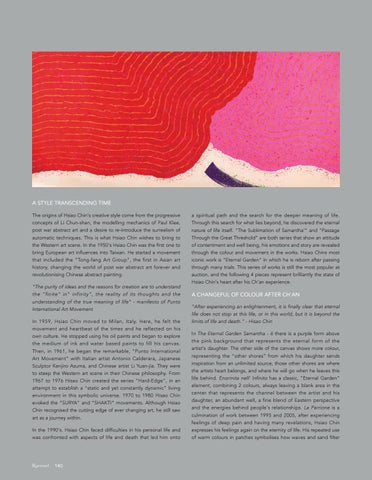
A CHANGEFUL OF COLOUR AFTER CH'AN "After experiencing an enlightenment, it is finally clear that eternal life does not stop at this life, or in this world, but it is beyond the limits of life and death." - Hisao Chin In The Eternal Garden Samantha - 6 there is a purple form above the pink background that represents the eternal form of the artist's daughter. The other side of the canvas shows more colour, representing the "other shores" from which his daughter sends inspiration from an unlimited source, those other shores are where the artists heart belongs, and where he will go when he leaves this life behind. Enormita nell' Infinito has a classic, "Eternal Garden" element, combining 2 colours, always leaving a blank area in the center that represents the channel between the artist and his daughter, an abundant well, a fine blend of Eastern perspective and the energies behind people's relationships. La Parrione is a culmination of work between 1995 and 2005, after experiencing feelings of deep pain and having many revelations, Hsiao Chin
In the 1990's. Hsiao Chin faced difficulties in his personal life and
expresses his feelings again on the eternity of life. His repeated use
was confronted with aspects of life and death that led him onto
of warm colours in patches symbolises how waves and sand filter
140