CELEBRITY
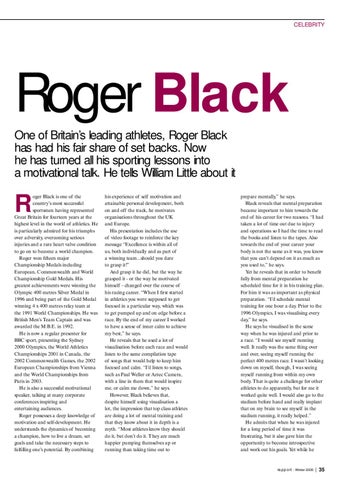
Roger Black One of Britain’s leading athletes, Roger Black has had his fair share of set backs. Now he has turned all his sporting lessons into a motivational talk. He tells William Little about it oger Black is one of the country’s most successful sportsmen having represented Great Britain for fourteen years at the highest level in the world of athletics. He is particularly admired for his triumphs over adversity, overcoming serious injuries and a rare heart valve condition to go on to become a world champion. Roger won fifteen major Championship Medals including European, Commonwealth and World Championship Gold Medals. His greatest achievements were winning the Olympic 400 metres Silver Medal in 1996 and being part of the Gold Medal winning 4 x 400 metres relay team at the 1991 World Championships. He was British Men’s Team Captain and was awarded the M.B.E. in 1992. He is now a regular presenter for BBC sport, presenting the Sydney 2000 Olympics, the World Athletics Championships 2001 in Canada, the 2002 Commonwealth Games, the 2002 European Championships from Vienna and the World Championships from Paris in 2003. He is also a successful motivational speaker, talking at many corporate conferences inspiring and entertaining audiences. Roger possesses a deep knowledge of motivation and self-development. He understands the dynamics of becoming a champion, how to live a dream, set goals and take the necessary steps to fulfilling one’s potential. By combining
R
his experience of self motivation and attainable personal development, both on and off the track, he motivates organisations throughout the UK and Europe. His presentation includes the use of video footage to reinforce the key message “Excellence is within all of us, both individually and as part of a winning team...should you dare to grasp it!” And grasp it he did, but the way he grasped it - or the way he motivated himself - changed over the course of his racing career. “When I first started in athletics you were supposed to get focused in a particular way, which was to get pumped up and on edge before a race. By the end of my career I worked to have a sense of inner calm to achieve my best,” he says. He reveals that he used a lot of visualisation before each race and would listen to the same compilation tape of songs that would help to keep him focused and calm. “I’d listen to songs, such as Paul Weller or Aztec Camera, with a line in them that would inspire me, or calm me down,” he says. However, Black believes that, despite himself using visualisation a lot, the impression that top class athletes are doing a lot of mental training and that they know about it in depth is a myth. “Most athletes know they should do it, but don’t do it. They are much happier pumping themselves up or running than taking time out to
prepare mentally,” he says. Black reveals that mental preparation became important to him towards the end of his career for two reasons. “I had taken a lot of time out due to injury and operations so I had the time to read the books and listen to the tapes. Also towards the end of your career your body is not the same as it was, you know that you can’t depend on it as much as you used to,” he says. Yet he reveals that in order to benefit fully from mental preparation he scheduled time for it in his training plan. For him it was as important as physical preparation. “I’d schedule mental training for one hour a day. Prior to the 1996 Olympics, I was visualising every day,” he says. He says he visualised in the same way when he was injured and prior to a race. “I would see myself running well. It really was the same thing over and over, seeing myself running the perfect 400 metres race. I wasn’t looking down on myself, though, I was seeing myself running from within my own body. That is quite a challenge for other athletes to do apparently, but for me it worked quite well. I would also go to the stadium before hand and really implant that on my brain to see myself in the stadium running, it really helped.” He admits that when he was injured for a long period of time it was frustrating, but it also gave him the opportunity to become introspective and work out his goals. Yet while he
rapport - Winter 2006
| 35