that the operation is rooted in today — the integrity of the Kessler name. In a business where a man’s word equates his worth, Kessler focused on the value of his reputation and the performance of his cattle. Trends shifted his way as the Angus cow gained prominence and the breed’s value grew. He stayed steadily 28 | Ranch House Journal
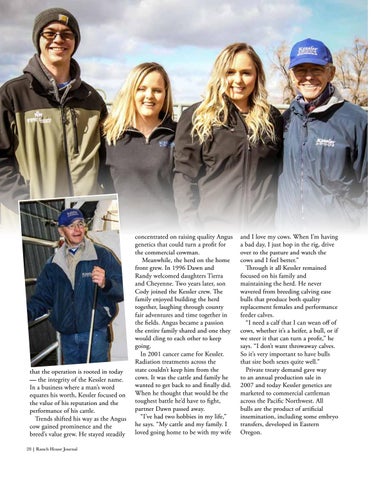
concentrated on raising quality Angus genetics that could turn a profit for the commercial cowman. Meanwhile, the herd on the home front grew. In 1996 Dawn and Randy welcomed daughters Tierra and Cheyenne. Two years later, son Cody joined the Kessler crew. The family enjoyed building the herd together, laughing through county fair adventures and time together in the fields. Angus became a passion the entire family shared and one they would cling to each other to keep going. In 2001 cancer came for Kessler. Radiation treatments across the state couldn’t keep him from the cows. It was the cattle and family he wanted to get back to and finally did. When he thought that would be the toughest battle he’d have to fight, partner Dawn passed away. “I’ve had two hobbies in my life,” he says. “My cattle and my family. I loved going home to be with my wife
and I love my cows. When I’m having a bad day, I just hop in the rig, drive over to the pasture and watch the cows and I feel better.” Through it all Kessler remained focused on his family and maintaining the herd. He never wavered from breeding calving ease bulls that produce both quality replacement females and performance feeder calves. “I need a calf that I can wean off of cows, whether it’s a heifer, a bull, or if we steer it that can turn a profit,” he says. “I don’t want throwaway calves. So it’s very important to have bulls that sire both sexes quite well.” Private treaty demand gave way to an annual production sale in 2007 and today Kessler genetics are marketed to commercial cattleman across the Pacific Northwest. All bulls are the product of artificial insemination, including some embryo transfers, developed in Eastern Oregon.