additional funds for first-year students enrolled in Ramapo’s Educational Opportunity Fund (EOF) program, in which qualified, many first-generation, college students receive financial and academic assistance. Mercer noticed in his earliest years that a disturbing number of EOF students were not returning to Ramapo after their first year, while the graduation rate for EOF students lagged behind that of the overall student body. For many families, Mercer says, even with the financial aid given to EOF students, it posed a significant hurdle. He proposed using discretionary funds to eliminate that hurdle altogether and enable first-year EOF students to attend Ramapo cost-free. “It was amazing what happened,” Mercer says. “Retention and graduation rates improved to the same level as the rest of the student body, and they’ve stayed there.” By any variety of measures, Ramapo has raised its national profile substantially during Mercer’s presidency. In 2011 the business school was formally accredited by the Association to Advance Collegiate Schools of Business, the largest such accrediting agency. Worldwide, less than five percent of business schools have earned this distinction. Earlier this year Kiplinger’s Personal Finance Magazine named Ramapo among the “100 Best Values in Public Colleges” nationwide, the tenth straight year that Ramapo has made the list. U.S. News & World Report also ranked Ramapo fifth among public institutions and 26th overall in its “Regional Universities North Rankings.”
Photo Courtesy: Thomas Mannion ’16
BUILDING UP
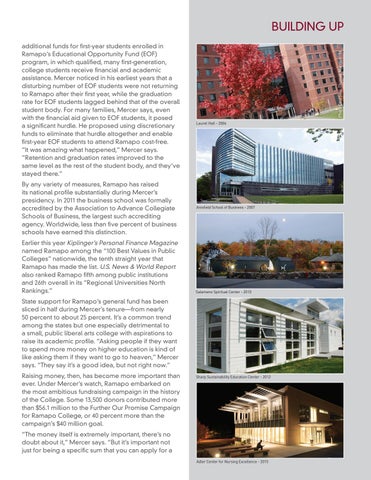
Laurel Hall - 2006
Anisfield School of Business - 2007
Salameno Spiritual Center - 2010
State support for Ramapo’s general fund has been sliced in half during Mercer’s tenure—from nearly 50 percent to about 25 percent. It’s a common trend among the states but one especially detrimental to a small, public liberal arts college with aspirations to raise its academic profile. “Asking people if they want to spend more money on higher education is kind of like asking them if they want to go to heaven,” Mercer says. “They say it’s a good idea, but not right now.” Raising money, then, has become more important than ever. Under Mercer’s watch, Ramapo embarked on the most ambitious fundraising campaign in the history of the College. Some 13,500 donors contributed more than $56.1 million to the Further Our Promise Campaign for Ramapo College, or 40 percent more than the campaign’s $40 million goal.
Sharp Sustainability Education Center - 2012
“The money itself is extremely important, there’s no doubt about it,” Mercer says. “But it’s important not just for being a specific sum that you can apply for a Adler Center for Nursing Excellence - 2015
www.ramapo.edu
5