TTC OPERATED BY ENSCO
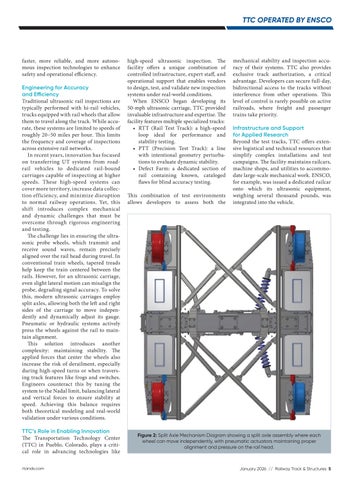
faster, more reliable, and more autonomous inspection technologies to enhance safety and operational efficiency. Engineering for Accuracy and Efficiency Traditional ultrasonic rail inspections are typically performed with hi-rail vehicles, trucks equipped with rail wheels that allow them to travel along the track. While accurate, these systems are limited to speeds of roughly 20–50 miles per hour. This limits the frequency and coverage of inspections across extensive rail networks. In recent years, innovation has focused on transferring UT systems from roadrail vehicles to dedicated rail-bound carriages capable of inspecting at higher speeds. These high-speed systems can cover more territory, increase data collection efficiency, and minimize disruption to normal railway operations. Yet, this shift introduces complex mechanical and dynamic challenges that must be overcome through rigorous engineering and testing. The challenge lies in ensuring the ultrasonic probe wheels, which transmit and receive sound waves, remain precisely aligned over the rail head during travel. In conventional train wheels, tapered treads help keep the train centered between the rails. However, for an ultrasonic carriage, even slight lateral motion can misalign the probe, degrading signal accuracy. To solve this, modern ultrasonic carriages employ split axles, allowing both the left and right sides of the carriage to move independently and dynamically adjust its gauge. Pneumatic or hydraulic systems actively press the wheels against the rail to maintain alignment. This solution introduces another complexity: maintaining stability. The applied forces that center the wheels also increase the risk of derailment, especially during high-speed turns or when traversing track features like frogs and switches. Engineers counteract this by tuning the system to the Nadal limit, balancing lateral and vertical forces to ensure stability at speed. Achieving this balance requires both theoretical modeling and real-world validation under various conditions. TTC’s Role in Enabling Innovation The Transportation Technology Center (TTC) in Pueblo, Colorado, plays a critical role in advancing technologies like rtands.com
high-speed ultrasonic inspection. The facility offers a unique combination of controlled infrastructure, expert staff, and operational support that enables vendors to design, test, and validate new inspection systems under real-world conditions. When ENSCO began developing its 50-mph ultrasonic carriage, TTC provided invaluable infrastructure and expertise. The facility features multiple specialized tracks: • RTT (Rail Test Track): a high-speed loop ideal for performance and stability testing. • PTT (Precision Test Track): a line with intentional geometry perturbations to evaluate dynamic stability. • Defect Farm: a dedicated section of rail containing known, cataloged flaws for blind accuracy testing. This combination of test environments allows developers to assess both the
mechanical stability and inspection accuracy of their systems. TTC also provides exclusive track authorization, a critical advantage. Developers can secure full-day, bidirectional access to the tracks without interference from other operations. This level of control is rarely possible on active railroads, where freight and passenger trains take priority. Infrastructure and Support for Applied Research Beyond the test tracks, TTC offers extensive logistical and technical resources that simplify complex installations and test campaigns. The facility maintains railcars, machine shops, and utilities to accommodate large-scale mechanical work. ENSCO, for example, was issued a dedicated railcar onto which its ultrasonic equipment, weighing several thousand pounds, was integrated into the vehicle.
Figure 2: Split Axle Mechanism Diagram showing a split axle assembly where each wheel can move independently, with pneumatic actuators maintaining proper alignment and pressure on the rail head.
January 2026 // Railway Track & Structures 5