VIEWPOINT
This is where impact becomes tangible. At Heathrow Airport, for example, improving punctuality required more than a set of initiatives, it depended on coordinating multiple stakeholders – from airlines to ground handlers – and aligning them around a shared outcome. By engaging the full ecosystem and focusing on how change would be delivered in practice, the programme was able to generate both short-term improvements and longer-term capability. Communication then reinforces this foundation. Messages need to be relevant to different groups and grounded in their dayto-day experience. Combined with visible progress, this helps maintain engagement and reduces the risk of fatigue.
Designing and running the transformation
Even with strong leadership and engagement, transformation can lose direction if it is not structured effectively. A common pitfall is treating transformation as a collection of individual projects. This can fragment effort, dilute accountability, and make it harder to track progress against overall goals. Instead, taking a portfolio-wide view helps to maintain focus. By defining clear objectives
aligned to strategy, organisations can prioritise activity and avoid the drift that often slows programmes. This also clarifies dependencies between initiatives, reducing
‘Middle managers are expected to deliver transformation alongside full operational responsibilities. When change is treated as an add-on, it competes with the demands of the day job, and momentum slows.’
duplication and helping teams understand how their work contributes to wider outcomes. At the same time, delivery models and governance need to reflect the organisation itself. Standard approaches rarely translate well into complex operational environments. Tailoring structures to fit the organisation’s culture and operating model ensures transformation can cut across silos. Getting this right early creates the conditions for sustained progress allowing organisations to maintain focus while adapting as the transformation evolves.
Culture as the critical success factor
At a time when transport organisations need to unlock the full potential of technology, it is easy to focus on platforms and tools. But technology alone does not deliver transformation. Successful organisations are those that recognise that change really happens in leadership behaviours, in how teams are supported, and in how new ways of working are embedded day to day. By starting with people – and designing transformation around them – organisations give themselves the best chance of turning technological potential into real, lasting outcomes.
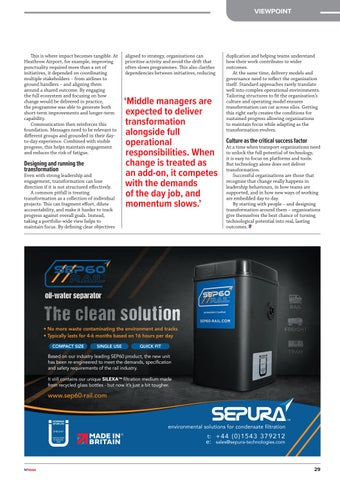
• No more waste contaminating the environment and tracks • Typically lasts for 4-6 months based on 16 hours per day COMPACT SIZE
SINGLE USE
QUICK FIT
Based on our industry leading SEP60 product, the new unit has been re-engineered to meet the demands, specification and safety requirements of the rail industry. It still contains our unique SILEXA™ filtration medium made from recycled glass bottles - but now it’s just a bit tougher.
www.sep60-rail.com
environmental solutions for condensate filtration
t: +4 4 ( 0 ) 1 5 4 3 3 7 9 2 1 2 e: sales@sepura-technologies.com
29