34
the rail engineer • November 2013
big show
DAVID SHIRRES, Russian Railways’s best foreign journalist of 2013.
R
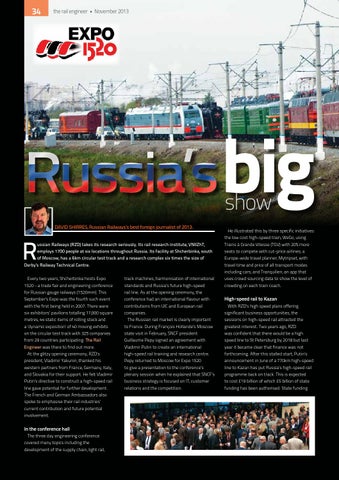
ussian Railways (RZD) takes its research seriously. Its rail research institute, VNIIZhT, employs 1700 people at six locations throughout Russia. Its facility at Shcherbinka, south of Moscow, has a 6km circular test track and a research complex six times the size of Derby’s Railway Technical Centre. Every two years, Shcherbinka hosts Expo 1520 - a trade fair and engineering conference for Russian gauge railways (1520mm). This September’s Expo was the fourth such event with the first being held in 2007. There were six exhibitors’ pavilions totalling 17,000 square metres, 44 static items of rolling stock and a ‘dynamic exposition’ of 40 moving exhibits on the circular test track with 325 companies from 29 countries participating. The Rail Engineer was there to find out more. At the glitzy opening ceremony, RZD’s president, Vladimir Yakunin, thanked his western partners from France, Germany, Italy, and Slovakia for their support. He felt Vladimir Putin’s directive to construct a high-speed rail line gave potential for further development. The French and German Ambassadors also spoke to emphasise their rail industries’ current contribution and future potential involvement.
In the conference hall The three day engineering conference covered many topics including the development of the supply chain, light rail,
track machines, harmonisation of international standards and Russia’s future high-speed rail line. As at the opening ceremony, the conference had an international flavour with contributions from UIC and European rail companies. The Russian rail market is clearly important to France. During François Hollande’s Moscow state visit in February, SNCF president Guillaume Pepy signed an agreement with Vladimir Putin to create an international high-speed rail training and research centre. Pepy returned to Moscow for Expo 1520 to give a presentation to the conference’s plenary session when he explained that SNCF’s business strategy is focused on IT, customer relations and the competition.
He illustrated this by three specific initiatives: the low cost high-speed train, WeGo, using Trains à Grande Vitesse (TGV) with 20% more seats to compete with cut-price airlines; a Europe-wide travel planner, Mytripset, with travel time and price of all transport modes including cars; and Tranquilien, an app that uses crowd sourcing data to show the level of crowding on each train coach.
High-speed rail to Kazan With RZD’s high speed plans offering significant business opportunities, the sessions on high-speed rail attracted the greatest interest. Two years ago, RZD was confident that there would be a high speed line to St Petersburg by 2018 but last year it became clear that finance was not forthcoming. After this stalled start, Putin’s announcement in June of a 770km high-speed line to Kazan has put Russia’s high-speed rail programme back on track. This is expected to cost £19 billion of which £5 billion of state funding has been authorised. State funding