38
the rail engineer • May 2014
Delivering an
Engineering Advantage A
s the drive to reduce the costs of maintenance and replacement components continues to gather pace, the demands on those who supply critical components become more stringent too. Rail operators and maintenance contractors are increasingly seeking to foster partnerships with companies which can guarantee product quality and availability, and an innovative approach based on deep market understanding which can drive performance improvements and reduce operating costs. One example of this type of company is Norgren, a global market leader in pneumatic motion and fluid control which has more than 30 years’ experience in delivering a combination of high-performance products, innovation and technical excellence to the rail industry.
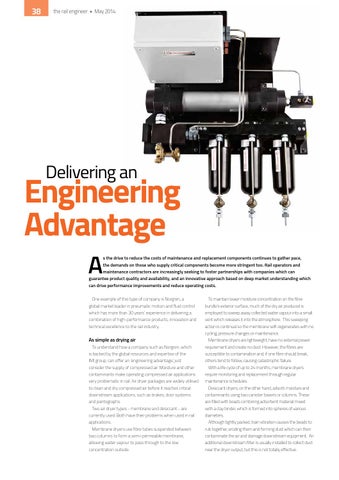
As simple as drying air To understand how a company such as Norgren, which is backed by the global resources and expertise of the IMI group, can offer an ‘engineering advantage’, just consider the supply of compressed air. Moisture and other contaminants make operating compressed air applications very problematic in rail. Air dryer packages are widely utilised to clean and dry compressed air before it reaches critical downstream applications, such as brakes, door systems and pantographs. Two air dryer types - membrane and desiccant - are currently used. Both have their problems when used in rail applications. Membrane dryers use fibre tubes suspended between two columns to form a semi-permeable membrane, allowing water vapour to pass through to the low concentration outside.
To maintain lower moisture concentration on the fibre bundle’s exterior surface, much of the dry air produced is employed to sweep away collected water vapour into a small vent which releases it into the atmosphere. This sweeping action is continual so the membrane self-regenerates with no cycling, pressure changes or maintenance. Membrane dryers are lightweight, have no external power requirement and create no dust. However, the fibres are susceptible to contamination and, if one fibre should break, others tend to follow, causing catastrophic failure. With a life cycle of up to 24 months, membrane dryers require monitoring and replacement through regular maintenance schedules. Desiccant dryers, on the other hand, adsorb moisture and contaminants using two canister towers or columns. These are filled with beads combining adsorbent material mixed with a clay binder, which is formed into spheres of various diameters. Although tightly packed, train vibration causes the beads to rub together, eroding them and forming dust which can then contaminate the air and damage downstream equipment. An additional downstream filter is usually installed to collect dust near the dryer output, but this is not totally effective.