68
Rail Engineer • July 2016
Other areas prone to corrosion include coastal routes, where seaspray soaks the tracks with salt laden water; wet tunnels where the constantly damp environment can reek havoc; mineral and ore routes where spillage and dust contamination can corrode rails; and, further afield, salt pans where salinity combined with moisture condensing on cold rails can accelerate corrosion to excessive levels. While the last example isn’t really a UK, or perhaps even an EU problem, we certainly have our fair share of the rest.
Corrosion ate away the foot of this unprotected rail in less than 6 months. It has always seemed slightly odd to me as a materials engineer that we go to great lengths to provide corrosion protection for lineside structures such as signals, OLE and bridges, yet the rail itself remains naked in a sea of salt-soaked sludge. The most troubling thing about rail corrosion is that it is often unseen. Disguised in dark damp tunnels, concealed by crossing panels, festering under the foot of the rail, corrosion eats away at our precious asset and can be invisible to standard inspection techniques. In the picture right, all appears normal when inspected from above. The view from below is a different matter. Sadly, the bottom of a rail can’t effectively be seen when it is clipped in place. (RIGHT) This six year old aluminium-coated rail is in a sorry state despite its original corrosion protection. Much focus is understandably given to maintaining the head of the rail in a good and safe condition through grinding and various
inspection techniques, but the foundations of the rail, its foot, must not be neglected. This area provides much of the rail’s strength and stability and neglecting it is akin to building a house on poor foundations.
Fatigue in the foot One of the increasing forms of rail failure seen in service is that of foot fatigue failure. As other forms of failure are being prevented, by improved maintenance and the use of better rail types, this failure mechanism is becoming increasingly important. The rail foot is under great tensile stress in service and damage or, as in the case below, corrosion pits in the rail foot can initiate a fatigue crack. These grow with time and are virtually invisible to current NDT techniques, ultimately causing unpredicted failure.
wholesale rail replacement (which as a rail manufacturer I of course endorse wholeheartedly!), it is a challenge to control this somewhat unpredictable failure mode, and corrosion protection will have its place to tackle this tricky task.
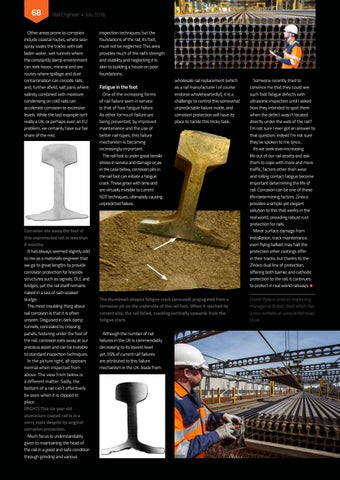
The thumbnail-shaped fatigue crack (arrowed) propagated from a corrosion pit on the underside of the rail foot. When it reached its current size, the rail failed, cracking vertically upwards from the fatigue crack. Although the number of rail failures in the UK is commendably decreasing to its lowest level yet, 55% of current rail failures are attributed to this failure mechanism in the UK. Aside from
Someone recently tried to convince me that they could see such foot fatigue defects with ultrasonic inspection until I asked how they intended to spot them when the defect wasn’t located directly under the web of the rail? I’m not sure I ever got an answer to that question; indeed I’m not sure they’ve spoken to me since... As we seek ever-increasing life out of our rail assets and ask them to cope with more and more traffic, factors other than wear and rolling contact fatigue become important determining the life of rail. Corrosion can be one of these life-determining factors. Zinoco provides a simple yet elegant solution to this that works in the real world, providing robust rust protection for rails. Minor surface damage from installation, track maintenance, even flying ballast may halt the protection other coatings offer in their tracks, but thanks to the Zinoco dual line of protection, offering both barrier and cathodic protection to the rail, it continues to protect in real world railways. Daniel Pyke is product marketing manager at British Steel which has a new website at www.britishsteel. co.uk