42 | the rail engineer | august 2011
level crossings
Safe to Cross
Detecting obstacles writer
Stuart Rackley are nearly 7,000 level crossings on T here the Network Rail infrastructure. These range from large barrier and gated crossings operated by railway staff, through automatic barrier and half barrier crossings, automatic open crossings down to the humble footpath and bridleway crossing. Every one of these presents risks to road and rail user alike and it is a sad fact that pedestrians and motorists are killed and seriously injured every year. Following every accident there are train delays and cancellations causing untold inconvenience to railway users not to mention the cost of restoring the infrastructure to a safe working condition. Whilst it is impossible to close 7000 level crossings, using the latest technology and engineering practices can reduce the risks for all users - motorists, pedestrians, rail staff and passengers.
LIDAR
RADAR RADAR LIDAR
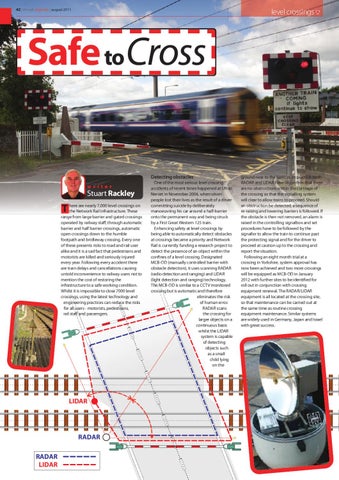
One of the most serious level crossing accidents of recent times happened at Ufton Nervet in November 2004, when seven people lost their lives as the result of a driver committing suicide by deliberately manoeuvring his car around a half-barrier onto the permanent way and being struck by a First Great Western 125 train. Enhancing safety at level crossings by being able to automatically detect obstacles at crossings became a priority and Network Rail is currently funding a research project to detect the presence of an object within the conďŹ nes of a level crossing. Designated MCB-OD (manually controlled barrier with obstacle detection), it uses scanning RADAR (radio detection and ranging) and LIDAR (light detection and ranging) technology. The MCB-OD is similar to a CCTV monitored crossing but is automatic and therefore eliminates the risk of human error. RADAR scans the crossing for larger objects on a continuous basis whilst the LIDAR system is capable of detecting objects such as a small child lying on the
ground near to the barriers. In practice, both RADAR and LIDAR have to conďŹ rm that there are no obstructions within the curtilage of the crossing so that the signalling system will clear to allow trains to proceed. Should an obstruction be detected, a sequence of re-raising and lowering barriers is followed. If the obstacle is then not removed, an alarm is raised in the controlling signalbox and set procedures have to be followed by the signaller to allow the train to continue past the protecting signal and for the driver to proceed at caution up to the crossing and report the situation. Following an eight month trial at a crossing in Yorkshire, system approval has now been achieved and two more crossings will be equipped as MCB-OD in January 2012 with further sites to be identiďŹ ed for roll out in conjunction with crossing equipment renewal. The RADAR/LIDAR equipment is all located at the crossing site, so that maintenance can be carried out at the same time as routine crossing equipment maintenance. Similar systems are widely used in Germany, Japan and Israel with great success.