Dartmoor
Campaign gathers pace for more Dartmoor improvements
Image: Network Rail.
Exciting plans to reopen rail links aim to provide better connectivity for rural areas across southwest England
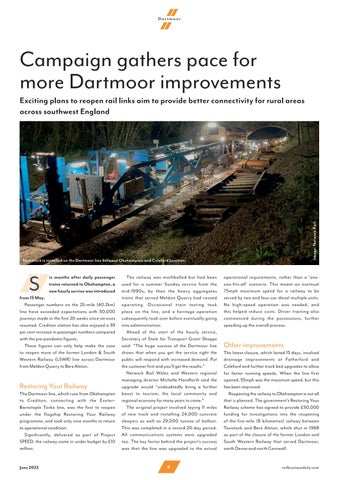
New track is installed on the Dartmoor line between Okehampton and Coleford Junction
S
ix months after daily passenger trains returned to Okehampton, a new hourly service was introduced
from 15 May. Passenger numbers on the 25-mile (40.2km) line have exceeded expectations with 50,000 journeys made in the first 20 weeks since services resumed. Crediton station has also enjoyed a 39 per cent increase in passenger numbers compared with the pre-pandemic figures. These figures can only help make the case to reopen more of the former London & South Western Railway (LSWR) line across Dartmoor from Meldon Quarry to Bere Alston.
Restoring Your Railway The Dartmoor line, which runs from Okehampton to Crediton, connecting with the Exeter– Barnstaple Tarka line, was the first to reopen under the flagship Restoring Your Railway programme, and took only nine months to return to operational condition. Significantly, delivered as part of Project SPEED, the railway came in under budget by £10 million.
June 2022
The railway was mothballed but had been used for a summer Sunday service from the mid-1990s; by then the heavy aggregates trains that served Meldon Quarry had ceased operating. Occasional train testing took place on the line, and a heritage operation subsequently took over before eventually going into administration. Ahead of the start of the hourly service, Secretary of State for Transport Grant Shapps said: “The huge success of the Dartmoor line shows that when you get the service right the public will respond with increased demand. Put the customer first and you’ll get the results.” Network Rail Wales and Western regional managing director Michelle Handforth said the upgrade would “undoubtedly bring a further boost to tourism, the local community and regional economy for many years to come.” The original project involved laying 11 miles of new track and installing 24,000 concrete sleepers as well as 29,000 tonnes of ballast. This was completed in a record 20-day period. All communications systems were upgraded too. The key factor behind the project’s success was that the line was upgraded to the actual
8
operational requirements, rather than a ‘onesize-fits-all’ scenario. This meant an eventual 75mph maximum speed for a railway to be served by two and four-car diesel multiple units. No high-speed operation was needed, and this helped reduce costs. Driver training also commenced during the possessions, further speeding up the overall process.
Other improvements The latest closure, which lasted 15 days, involved drainage improvements at Fatherford and Coleford and further track bed upgrades to allow for faster running speeds. When the line first opened, 55mph was the maximum speed, but this has been improved. Reopening the railway to Okehampton is not all that is planned. The government’s Restoring Your Railway scheme has agreed to provide £50,000 funding for investigations into the reopening of the five-mile (8 kilometres) railway between Tavistock and Bere Alston, which shut in 1968 as part of the closure of the former London and South Western Railway that served Dartmoor, north Devon and north Cornwall.
railbusinessdaily.com