Image: Network Rail
M ar tin Frobisher
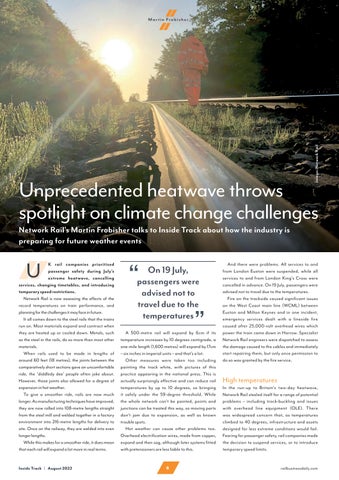
Unprecedented heatwave throws spotlight on climate change challenges Network Rail’s Martin Frobisher talks to Inside Track about how the industry is preparing for future weather events
Inside Track | August 2022
“
On 19 July, passengers were advised not to travel due to the temperatures
“
U
K rail companies prioritised passenger safety during July’s extreme heatwave, cancelling services, changing timetables, and introducing temporary speed restrictions. Network Rail is now assessing the effects of the record temperatures on train performance, and planning for the challenges it may face in future. It all comes down to the steel rails that the trains run on. Most materials expand and contract when they are heated up or cooled down. Metals, such as the steel in the rails, do so more than most other materials. When rails used to be made in lengths of around 60 feet (18 metres), the joints between the comparatively short sections gave an uncomfortable ride, the ‘diddledy dee’ people often joke about. However, those joints also allowed for a degree of expansion in hot weather. To give a smoother ride, rails are now much longer. As manufacturing techniques have improved, they are now rolled into 108-metre lengths straight from the steel mill and welded together in a factory environment into 216-metre lengths for delivery to site. Once on the railway, they are welded into even longer lengths. While this makes for a smoother ride, it does mean that each rail will expand a lot more in real terms.
A 500-metre rail will expand by 6cm if its temperature increases by 10 degrees centigrade, a one-mile length (1,600 metres) will expand by 17cm – six inches in imperial units – and that’s a lot. Other measures were taken too including painting the track white, with pictures of this practice appearing in the national press. This is actually surprisingly effective and can reduce rail temperatures by up to 10 degrees, so bringing it safely under the 59-degree threshold. While the whole network can’t be painted, points and junctions can be treated this way, so moving parts don’t jam due to expansion, as well as known trouble spots. Hot weather can cause other problems too. Overhead electrification wires, made from copper, expand and then sag, although later systems fitted with pretensioners are less liable to this.
8
And there were problems. All services to and from London Euston were suspended, while all services to and from London King’s Cross were cancelled in advance. On 19 July, passengers were advised not to travel due to the temperatures. Fire on the trackside caused significant issues on the West Coast main line (WCML) between Euston and Milton Keynes and in one incident, emergency services dealt with a lineside fire caused after 25,000-volt overhead wires which power the train came down in Harrow. Specialist Network Rail engineers were dispatched to assess the damage caused to the cables and immediately start repairing them, but only once permission to do so was granted by the fire service.
High temperatures In the run-up to Britain’s two-day heatwave, Network Rail steeled itself for a range of potential problems – including track-buckling and issues with overhead line equipment (OLE). There was widespread concern that, as temperatures climbed to 40 degrees, infrastructure and assets designed for less extreme conditions would fail. Fearing for passenger safety, rail companies made the decision to suspend services, or to introduce temporary speed limits.
railbusinessdaily.com