Electrophysiology and Ablation Table 3: Incidence of Sudden Cardiac Death Population
0.05–0.94
group (among the 1,168 patients, 206 were asymptomatic), no deaths were associated with the procedure and there was a very low rate of major complications (complete atrioventricular block in 0.08 %). Kaplan–Meier analysis at 8 years showed that catheter ablation was associated with a significantly better survival free from malignant arrhythmias (AF lasting >1 minute with a SPERRI ≤250 milliseconds) and from VF.
0.09
Discussion
Sudden Cardiac Death Rate*
Asymptomatic pre-excitation Including Italian studies55 • Excluding Italian studies52
2.4
General population • 0–35 years72 • 1–35 years
• 14–35 years
Loss of pre-excitation (e.g. ECG, Holter monitoring, exercise stress test, etc)
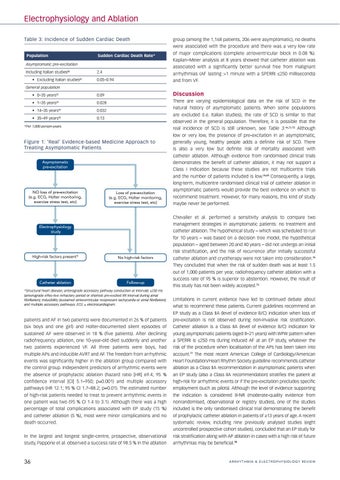
There are varying epidemiological data on the risk of SCD in the natural history of asymptomatic patients. When some populations are excluded (i.e. Italian studies), the rate of SCD is similar to that observed in the general population. Therefore, it is possible that the real incidence of SCD is still unknown, see Table 3.44,72-75 Although low or very low, the presence of pre-excitation in an asymptomatic, generally young, healthy people adds a definite risk of SCD. There is also a very low but definite risk of mortality associated with catheter ablation. Although evidence from randomised clinical trials demonstrates the benefit of catheter ablation, it may not support a Class I indication because these studies are not multicentre trials and the number of patients included is low.26,63 Consequently, a large, long-term, multicentre randomised clinical trial of catheter ablation in asymptomatic patients would provide the best evidence on which to recommend treatment. However, for many reasons, this kind of study maybe never be performed.
No high-risk factors
Chevalier et al. performed a sensitivity analysis to compare two management strategies in asymptomatic patients: no treatment and catheter ablation. The hypothetical study – which was scheduled to run for 10 years – was based on a decision tree model, the hypothetical population – aged between 20 and 40 years – did not undergo an initial risk stratification, and the risk of recurrence after initially successful catheter ablation and cryotherapy were not taken into consideration.76
0.028
73
74
• 35–49 years75
0.032 0.13
*Per 1,000 person-years.
Figure 1: ‘Real’ Evidence-based Medicine Approach to Treating Asymptomatic Patients Asymptomatic pre-excitation
NO loss of pre-excitation (e.g. ECG, Holter monitoring, exercise stress test, etc)
Electrophysiology study
High-risk factors present*
Catheter ablation
Follow-up
*Structural heart disease; anterograde accessory pathway conduction at intervals ≤250 ms (anterograde effec-tive refractory period or shortest pre-excited RR interval during atrial fibrillation); inducibility (sustained atrioventricular reciprocant tachycardia or atrial fibrillation); and multiple accessory pathways. ECG = electrocardiogram.
patients and AF in two patients) were documented in 26 % of patients (six boys and one girl) and Holter-documented silent episodes of sustained AF were observed in 18 % (five patients). After declining radiofrequency ablation, one 10-year-old died suddenly and another two patients experienced VF. All three patients were boys, had multiple APs and inducible AVRT and AF. The freedom from arrhythmic events was significantly higher in the ablation group compared with the control group. Independent predictors of arrhythmic events were the absence of prophylactic ablation (hazard ratio [HR] 69.4; 95 % confidence interval [CI] 5.1–950; p=0.001) and multiple accessory pathways (HR 12.1; 95 % CI 1.7–88.2; p=0.01). The estimated number of high-risk patients needed to treat to prevent arrhythmic events in one patient was two (95 % CI 1.4 to 3.1). Although there was a high percentage of total complications associated with EP study (15 %) and catheter ablation (5 %), most were minor complications and no death occurred. In the largest and longest single-centre, prospective, observational study, Pappone et al. observed a success rate of 98.5 % in the ablation
36
AER_ Brugada_FINAL2.indd 36
They concluded that when the risk of sudden death was at least 1.5 out of 1,000 patients per year, radiofrequency catheter ablation with a success rate of 95 % is superior to abstention. However, the result of this study has not been widely accepted.76 Limitations in current evidence have led to continued debate about what to recommend these patients. Current guidelines recommend an EP study as a Class IIA (level of evidence B/C) indication when loss of pre-excitation is not observed during non-invasive risk stratification. Catheter ablation is a Class IIA (level of evidence B/C) indication for young asymptomatic patients (aged 8–21 years) with WPW pattern when a SPERRI is ≤250 ms during induced AF at an EP study, whatever the risk of the procedure when localisation of the APs has been taken into account.77 The most recent American College of Cardiology/American Heart Foundation/Heart Rhythm Society guideline recommends catheter ablation as a Class IIA recommendation in asymptomatic patients when an EP study (also a Class IIA recommendation) stratifies the patient at high-risk for arrhythmic events or if the pre-excitation precludes specific employment (such as pilots). Although the level of evidence supporting the indication is considered B-NR (moderate-quality evidence from nonrandomised, observational or registry studies), one of the studies included is the only randomised clinical trial demonstrating the benefit of prophylactic catheter ablation in patients of ≥13 years of age. A recent systematic review, including nine previously analysed studies (eight uncontrolled prospective cohort studies), concluded that an EP study for risk stratification along with AP ablation in cases with a high risk of future arrhythmias may be beneficial.78
ARRHYTHMIA & ELECTROPHYSIOLOGY REVIEW
09/03/2018 12:35