FACADES // ALUMASC VENTILATED SYSTEM
Mending UK Housing with Innovative Products Mark Gibbs, Technical Director for Alumasc Facade Systems and designer of the company’s new Alumasc Ventilated System (AVS), shares his views on the challenges of hitting Government housing targets through offsite manufacture and standardised design.
01 Housing Minister, Brandon Lewis has set out an ambitious target to build one million new homes before the end of the current Parliament. Hitting such an aspirational target calls for immediate action and an increase in construction to at least 200,000 new homes per year. This is a level of housebuilding that has not been seen in England since 1989. So how do we ensure that we are producing quality, desirable housing at a rapid rate? It is clear that the housing market in Britain is broken and fixing it has been a key priority for both the current Government and their predecessors. There have been attempts to tackle the issue and stimulate increased supply by boosting demand with measures such as the Help-to-Buy scheme. Whatever the solution is, there is no getting away from the fact that if the UK is to meet its ambitious housebuilding targets, we are going to have to build an increasingly large number of homes in a limited time frame.
It is easy however, to focus on the short-term goal which is to construct a mass volume of housing. In my opinion, it is equally important to consider the long term aspirations of creating good quality homes that will stand the test of time. This is not just a numbers game – it is crucial to specify materials and components that will develop homes to last for years to come. Standardised buildings were the Government’s solution to tackling the post-war issue of a booming population in need of housing – not dissimilar to the problems that we are facing today. We must be cautious not to follow the same path of high-density, low-quality homes that are lacking in appeal. Despite the mistakes of the last century, standardisation of homes does not necessarily have to be viewed as a negative. For example, a guarantee of reduced time, optimum cost and high
72 | www.structuraltimbermagazine.co.uk | STMAG
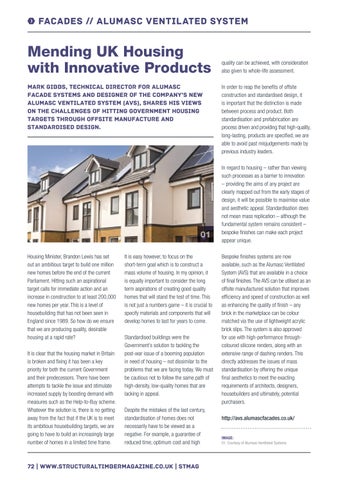
quality can be achieved, with consideration also given to whole-life assessment. In order to reap the benefits of offsite construction and standardised design, it is important that the distinction is made between process and product. Both standardisation and prefabrication are process driven and providing that high-quality, long-lasting, products are specified, we are able to avoid past misjudgements made by previous industry leaders. In regard to housing – rather than viewing such processes as a barrier to innovation – providing the aims of any project are clearly mapped out from the early stages of design, it will be possible to maximise value and aesthetic appeal. Standardisation does not mean mass replication – although the fundamental system remains consistent – bespoke finishes can make each project appear unique. Bespoke finishes systems are now available, such as the Alumasc Ventilated System (AVS) that are available in a choice of final finishes. The AVS can be utilised as an offsite manufactured solution that improves efficiency and speed of construction as well as enhancing the quality of finish – any brick in the marketplace can be colour matched via the use of lightweight acrylic brick slips. The system is also approved for use with high-performance throughcoloured silicone renders, along with an extensive range of dashing renders. This directly addresses the issues of mass standardisation by offering the unique final aesthetics to meet the exacting requirements of architects, designers, housebuilders and ultimately, potential purchasers. http://avs.alumascfacades.co.uk/
IMAGE: 01. Courtesy of Alumasc Ventilated Systems