TIMBER PROTECTION
VAC-VAC is Back Lonza Wood Protection has launched a new promotional push to highlight the importance of correct preservative treatment of construction and joinery timbers as the building of new homes becomes a priority.
Andy Hodge, Marketing Director of Lonza explains: “Over the last few years a lot of work has been done by the timber treatment industry to make sure the protection levels of preservative treated fencing and landscaping timbers are where they should be to perform in the most extreme of environments – outdoors and often in direct ground contact. But equally important in making sure that timber remains a valued and important construction material choice is reminding important decision makers in the housing
industry that internal construction timber also need protecting to last an expected 30 or 60 years when used in a new building. “Over the last few years our proven low pressure, double vacuum treatments which are tailored to suit close tolerance building and joinery timbers seem to have been neglected, which is really concerning bearing in mind that changes in our climate bring new threats from decay organisms which can attack and degrade these structural components. For our sector
Wood Weathering The SiOO Wood Protection System offers a different dimension to combating the unsightly discolouration of timber in exposed conditions.
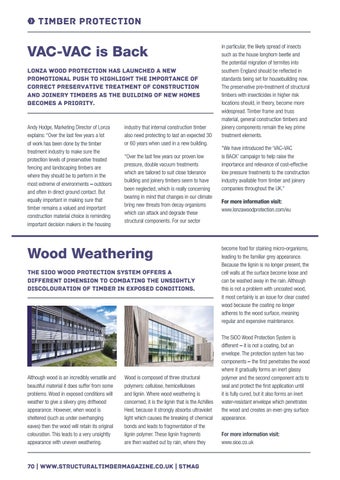
Although wood is an incredibly versatile and beautiful material it does suffer from some problems. Wood in exposed conditions will weather to give a silvery grey driftwood appearance. However, when wood is sheltered (such as under overhanging eaves) then the wood will retain its original colouration. This leads to a very unsightly appearance with uneven weathering.
Wood is composed of three structural polymers: cellulose, hemicelluloses and lignin. Where wood weathering is concerned, it is the lignin that is the Achilles Heel, because it strongly absorbs ultraviolet light which causes the breaking of chemical bonds and leads to fragmentation of the lignin polymer. These lignin fragments are then washed out by rain, where they
70 | www.structuraltimbermagazine.co.uk | STMAG
in particular, the likely spread of insects such as the house longhorn beetle and the potential migration of termites into southern England should be reflected in standards being set for housebuilding now. The preservative pre-treatment of structural timbers with insecticides in higher risk locations should, in theory, become more widespread. Timber frame and truss material, general construction timbers and joinery components remain the key prime treatment elements. “We have introduced the ‘VAC-VAC is BACK’ campaign to help raise the importance and relevance of cost-effective low pressure treatments to the construction industry available from timber and joinery companies throughout the UK.” For more information visit: www.lonzawoodprotection.com/eu
become food for staining micro-organisms, leading to the familiar grey appearance. Because the lignin is no longer present, the cell walls at the surface become loose and can be washed away in the rain. Although this is not a problem with uncoated wood, it most certainly is an issue for clear coated wood because the coating no longer adheres to the wood surface, meaning regular and expensive maintenance. The SiOO Wood Protection System is different – it is not a coating, but an envelope. The protection system has two components – the first penetrates the wood where it gradually forms an inert glassy polymer and the second component acts to seal and protect the first application until it is fully cured, but it also forms an inert water-resistant envelope which penetrates the wood and creates an even grey surface appearance. For more information visit: www.sioo.co.uk