ROBUST DETAILS
EXCEEDING PERFORMANCE EXPECTATIONS
1
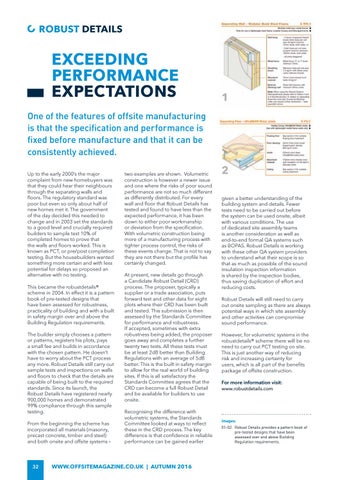
One of the features of offsite manufacturing is that the specification and performance is fixed before manufacture and that it can be consistently achieved. Up to the early 2000’s the major complaint from new homebuyers was that they could hear their neighbours through the separating walls and floors. The regulatory standard was poor but even so only about half of new homes met it. The government of the day decided this needed to change and in 2003 set the standards to a good level and crucially required builders to sample test 10% of completed homes to prove that the walls and floors worked. This is known as PCT, or pre/post completion testing. But the housebuilders wanted something more certain and with less potential for delays so proposed an alternative with no testing. This became the robustdetails® scheme in 2004. In effect it is a pattern book of pre-tested designs that have been assessed for robustness, practicality of building and with a built in safety margin over and above the Building Regulation requirements. The builder simply chooses a pattern or patterns, registers his plots, pays a small fee and builds in accordance with the chosen pattern. He doesn’t have to worry about the PCT process any more. Robust Details still carry out sample tests and inspections on walls and floors to check that the details are capable of being built to the required standards. Since its launch, the Robust Details have registered nearly 900,000 homes and demonstrated 99% compliance through this sample testing. From the beginning the scheme has incorporated all materials (masonry, precast concrete, timber and steel) and both onsite and offsite systems –
32
two examples are shown. Volumetric construction is however a newer issue and one where the risks of poor sound performance are not so much different as differently distributed. For every wall and floor that Robust Details has tested and found to have less than the expected performance, it has been down to either poor workmanship or deviation from the specification. With volumetric construction being more of a manufacturing process with tighter process control, the risks of these events change. That is not to say they are not there but the profile has certainly changed. At present, new details go through a Candidate Robust Detail (CRD) process. The proposer, typically a supplier or a trade association, puts forward test and other data for eight plots where their CRD has been built and tested. This submission is then assessed by the Standards Committee for performance and robustness. If accepted, sometimes with extra robustness being added, the proposer goes away and completes a further twenty two tests. All these tests must be at least 2dB better than Building Regulations with an average of 5dB better. This is the built in safety margin to allow for the real world of building sites. If this is all satisfactory the Standards Committee agrees that the CRD can become a full Robust Detail and be available for builders to use onsite. Recognising the difference with volumetric systems, the Standards Committee looked at ways to reflect these in the CRD process. The key difference is that confidence in reliable performance can be gained earlier
WWW.OFFSITEMAGAZINE.CO.UK | AUTUMN 2016
2 given a better understanding of the building system and details. Fewer tests need to be carried out before the system can be used onsite, albeit with various conditions. The use of dedicated site assembly teams is another consideration as well as end-to-end formal QA systems such as BOPAS. Robust Details is working with these other QA system providers to understand what their scope is so that as much as possible of the sound insulation inspection information is shared by the inspection bodies, thus saving duplication of effort and reducing costs. Robust Details will still need to carry out onsite sampling as there are always potential ways in which site assembly and other activities can compromise sound performance. However, for volumetric systems in the robustdetails® scheme there will be no need to carry out PCT testing on site. This is just another way of reducing risk and increasing certainty for users, which is all part of the benefits package of offsite construction. For more information visit: www.robustdetails.com
Images: 01-02.
Robust Details provides a pattern book of pre-tested designs that have been assessed over and above Building Regulation requirements.