A:
Castle Connolly Private Health Partners, LLC* concierge physicians add value to patients through enhanced services, such as health coaching tools, tele-health capability and access to a variety of wellness services. CCPHP physicians can even provide house calls. Most importantly, though, CCPHP’s concierge or membership model enables patients and physicians to collaborate more closely on working towards patients’ personalized health care goals. The CCPHP concierge membership program allows health care to be more focused on prevention and wellness. Each patient is provided with a host of services not covered under traditional practices, such as convenient appointment scheduling, direct private phone line, and help dealing with health related administrative and insurance issues. At the same time, physicians have more time to provide an in-depth wellness-focused physical exam, which becomes the foundation of care, and to oversee greater care coordination between specialists, among other things. By managing the volume of patients I see, no one is rushed, so visits can be more rewarding for both physician and patient. The added time I can devote to patients can improve the likeliness of healthier outcomes, and in the process, both parties can benefit from a more connected partnership.
Bernard Schayes, MD
162 E. 80th Street, 1B New York, NY 10075 www.schayesccphp.com (646) 598-9133 | www.CCPHP.net *Castle Connolly Private Health Partners, LLC (CCPHP) works with physicians/practices through collaborations (or “companies”) that offer certain non-medical amenities or enhancements to members for a fee. All medical services are provided by the physicians and their practices, which bill separately for those medical services.
00 QUEST
D AV I D PAT R I C K C O L U M B I A “SIP FOR THE SEA” WITH THE WILDLIFE C O N S E R VAT I O N S O C I E T Y AT T H E C E N T R A L PA R K Z O O
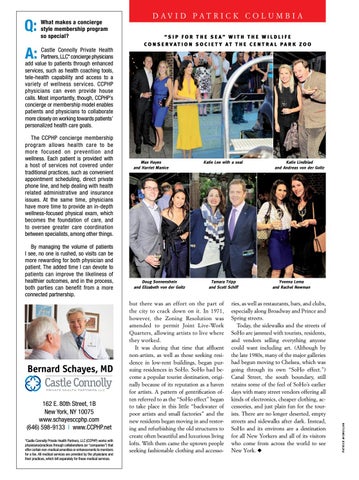
Max Hayes and Harriet Manice
Doug Sonnenshein and Elizabeth von der Goltz
Katie Lee with a seal
Tamara Tripp and Scott Schiff
but there was an effort on the part of the city to crack down on it. In 1971, however, the Zoning Resolution was amended to permit Joint Live-Work Quarters, allowing artists to live where they worked. It was during that time that affluent non-artists, as well as those seeking residence in low-rent buildings, began pursuing residences in SoHo. SoHo had become a popular tourist destination, originally because of its reputation as a haven for artists. A pattern of gentrification often referred to as the “SoHo effect” began to take place in this little “backwater of poor artists and small factories” and the new residents began moving in and restoring and refurbishing the old structures to create often beautiful and luxurious living lofts. With them came the uptown people seeking fashionable clothing and accesso-
Katie Lindblad and Andreas von der Goltz
Yvonna Lema and Rachel Newman
ries, as well as restaurants, bars, and clubs, especially along Broadway and Prince and Spring streets. Today, the sidewalks and the streets of SoHo are jammed with tourists, residents, and vendors selling everything anyone could want including art. (Although by the late 1980s, many of the major galleries had begun moving to Chelsea, which was going through its own “SoHo effect.”) Canal Street, the south boundary, still retains some of the feel of SoHo’s earlier days with many street vendors offering all kinds of electronics, cheaper clothing, accessories, and just plain fun for the tourists. There are no longer deserted, empty streets and sidewalks after dark. Instead, SoHo and its environs are a destination for all New Yorkers and all of its visitors who come from across the world to see New York. u
PAT R I C K M C M U LL A N
Q:
What makes a concierge style membership program so special?